
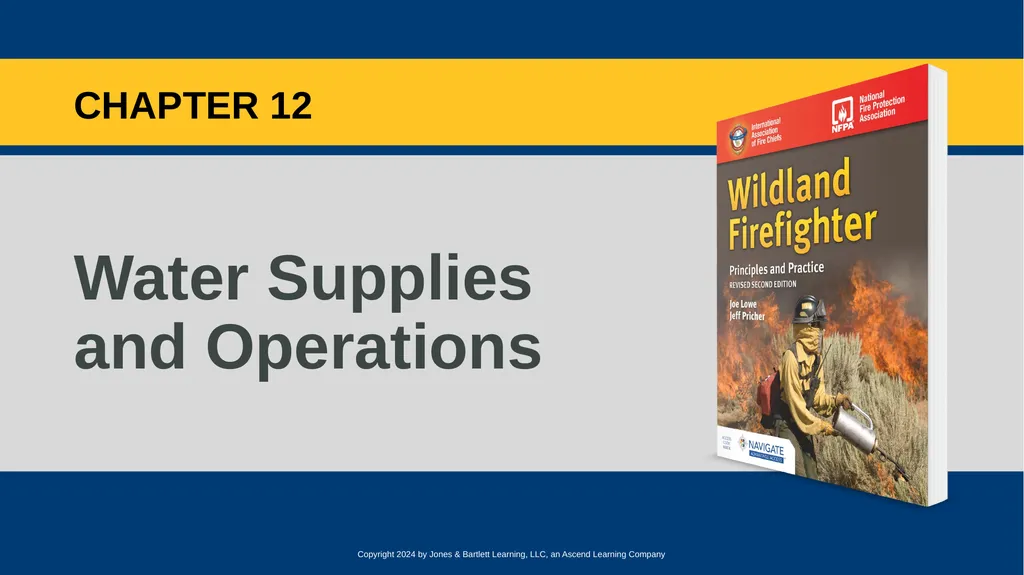
CHAPTER 12 Water Supplies and Operations Knowledge
MT
Published · 57 slides · 0 views
1 / 1

Description
CHAPTER 12 Water Supplies and Operations Knowledge Objectives Identify common water sources. Identify common wildland fire hoses. Describe different nozzle fittings and their uses. Identify common hose appliances and accessories. Understand
Related Topics
Share
Embed code
Download this presentation From Below
"CHAPTER 12 Water Supplies and Operations Knowledge" is the property of its rightful owner. Permission is granted to download and print the materials on this website for personal, non-commercial use only, and to display it on your personal computer provided you do not modify the materials and that you retain all copyright notices contained in the materials. By downloading content from our website, you accept the terms of this agreement.
Presentation Transcript
01
CHAPTER 12 Water Supplies and Operations<br>
02
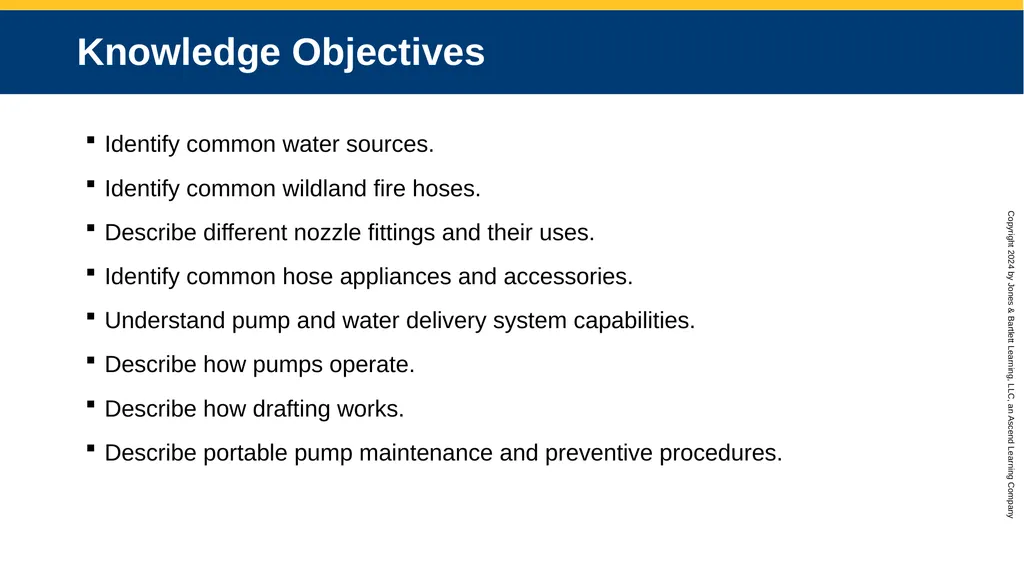
Knowledge Objectives Identify common water sources.
Identify common wildland fire hoses.
Describe different nozzle fittings and their uses.
Identify common hose appliances and accessories.
Understand pump and water delivery system capabilities.
Describe how pumps operate.
Describe how drafting works.
Describe portable pump maintenance and preventive procedures.<br>
Identify common wildland fire hoses.
Describe different nozzle fittings and their uses.
Identify common hose appliances and accessories.
Understand pump and water delivery system capabilities.
Describe how pumps operate.
Describe how drafting works.
Describe portable pump maintenance and preventive procedures.<br>
03
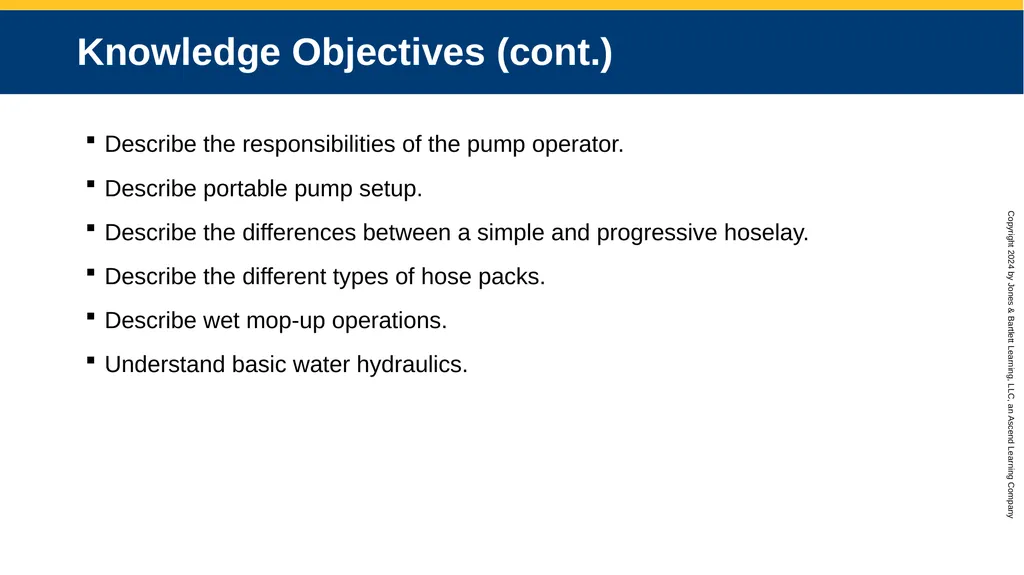
Knowledge Objectives (cont.) Describe the responsibilities of the pump operator.
Describe portable pump setup.
Describe the differences between a simple and progressive hoselay.
Describe the different types of hose packs.
Describe wet mop-up operations.
Understand basic water hydraulics.<br>
Describe portable pump setup.
Describe the differences between a simple and progressive hoselay.
Describe the different types of hose packs.
Describe wet mop-up operations.
Understand basic water hydraulics.<br>
04
Skills Objectives Restrict water flow in a hose line with a hose clamp.
Uncouple a hose with spanner wrenches.
Operate a backpack pump.
Unroll a hose.
Construct a simple hoselay.
Construct a progressive hoselay.
Butterfly a hose.
Perform a doughnut hose roll.<br>
Uncouple a hose with spanner wrenches.
Operate a backpack pump.
Unroll a hose.
Construct a simple hoselay.
Construct a progressive hoselay.
Butterfly a hose.
Perform a doughnut hose roll.<br>
05
Introduction Fire fighters must understand the fundamentals of how to get water, where to find water, and how to deliver water in a way that will successfully stop the fire by removing the heat component of the fire triangle.
Basics of common water sources, the tools and accessories used to obtain water from the sources, hoselay techniques, mop-up operations, and basic hydraulics
Foundation to build on as you develop your skills and knowledge with water use on fire
Every fire situation you encounter will be different.<br>
Basics of common water sources, the tools and accessories used to obtain water from the sources, hoselay techniques, mop-up operations, and basic hydraulics
Foundation to build on as you develop your skills and knowledge with water use on fire
Every fire situation you encounter will be different.<br>
06
Water Sources Water is a valuable commodity at a wildland fire, so use it wisely.
Using your water wisely will enable you to be effective in suppressing fire.
Upon arrival at the scene of a wildland fire, it is necessary to find a water source.
Streams, Lakes, Ponds, and Irrigation Canals
A natural stream, irrigation canal, lake, or pond can be used to supply the engine or water tender with water.<br>
Using your water wisely will enable you to be effective in suppressing fire.
Upon arrival at the scene of a wildland fire, it is necessary to find a water source.
Streams, Lakes, Ponds, and Irrigation Canals
A natural stream, irrigation canal, lake, or pond can be used to supply the engine or water tender with water.<br>
07
Water Sources (cont.) Swimming Pools
Access is not always easy for fire apparatus, though, because pools are usually found in residential backyards
Consider using a floating pump or a portable pump in cases where there are access restrictions.<br>
Access is not always easy for fire apparatus, though, because pools are usually found in residential backyards
Consider using a floating pump or a portable pump in cases where there are access restrictions.<br>
08
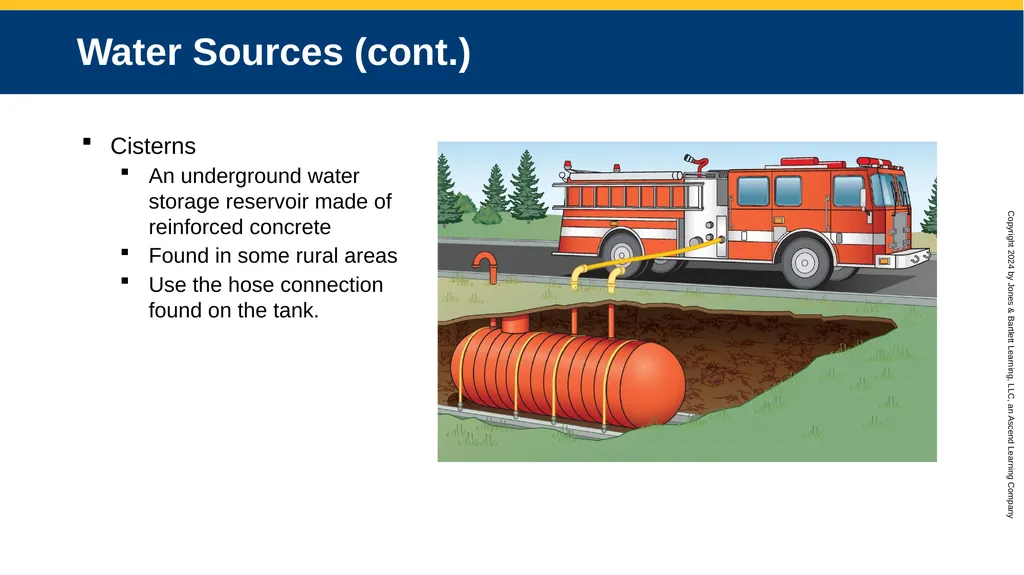
Water Sources (cont.) Cisterns
An underground water storage reservoir made of reinforced concrete
Found in some rural areas
Use the hose connection found on the tank.<br>
An underground water storage reservoir made of reinforced concrete
Found in some rural areas
Use the hose connection found on the tank.<br>
09
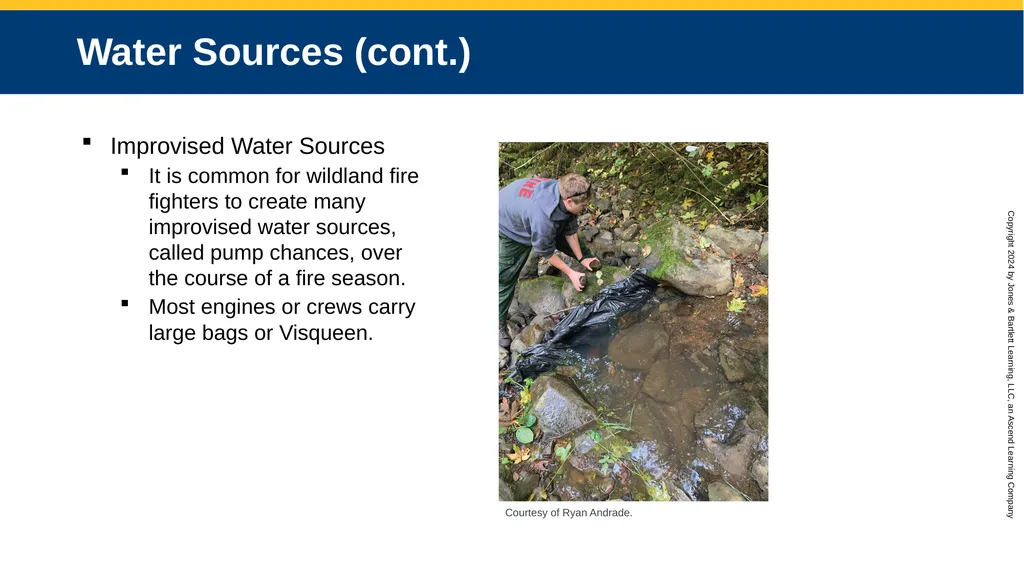
Water Sources (cont.) Improvised Water Sources
It is common for wildland fire fighters to create many improvised water sources, called pump chances, over the course of a fire season.
Most engines or crews carry large bags or Visqueen. Courtesy of Ryan Andrade.<br>
It is common for wildland fire fighters to create many improvised water sources, called pump chances, over the course of a fire season.
Most engines or crews carry large bags or Visqueen. Courtesy of Ryan Andrade.<br>
10
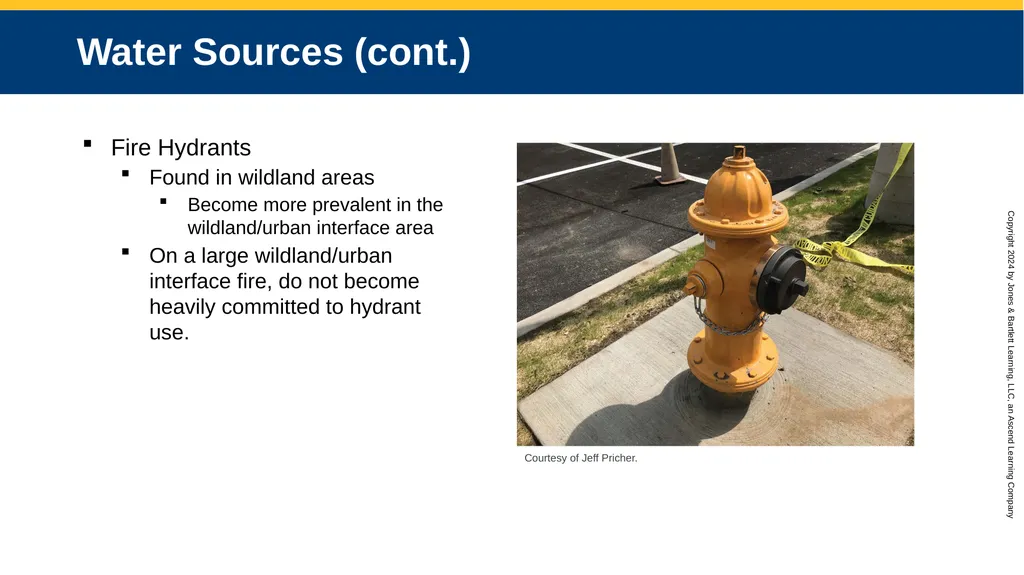
Water Sources (cont.) Fire Hydrants
Found in wildland areas
Become more prevalent in the wildland/urban interface area
On a large wildland/urban interface fire, do not become heavily committed to hydrant use. Courtesy of Jeff Pricher.<br>
Found in wildland areas
Become more prevalent in the wildland/urban interface area
On a large wildland/urban interface fire, do not become heavily committed to hydrant use. Courtesy of Jeff Pricher.<br>
11
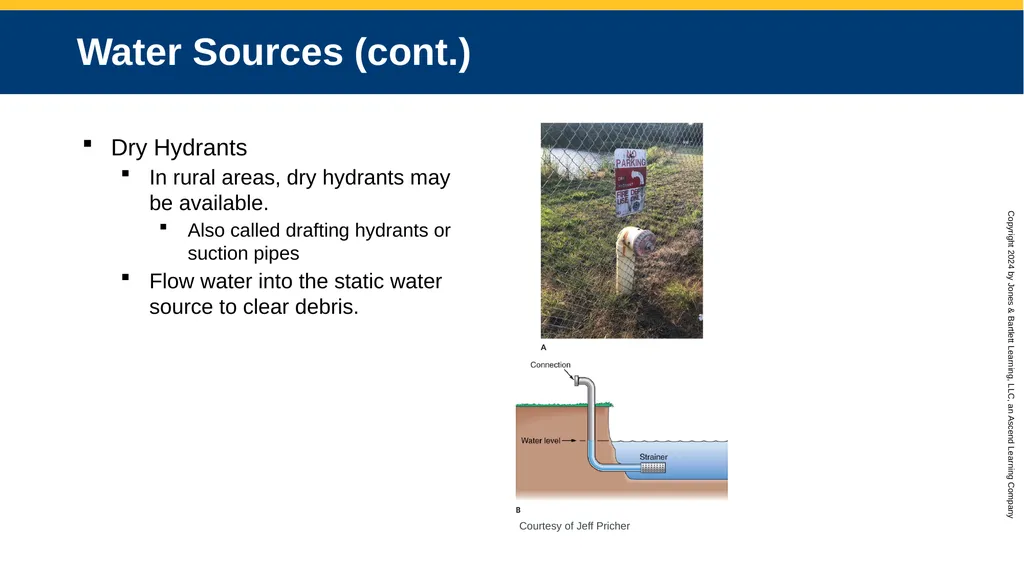
Water Sources (cont.) Dry Hydrants
In rural areas, dry hydrants may be available.
Also called drafting hydrants or suction pipes
Flow water into the static water source to clear debris. Courtesy of Jeff Pricher<br>
In rural areas, dry hydrants may be available.
Also called drafting hydrants or suction pipes
Flow water into the static water source to clear debris. Courtesy of Jeff Pricher<br>
12
Water Sources (cont.) Water Tenders
Tank trucks that hold a large quantity of water, called water tenders or tankers, are widely used on wildland fires.
Portable Water Tanks
Portable water tanks (Port-A-Tanks) are containers used as reservoirs to store water that engines can use to refill.<br>
Tank trucks that hold a large quantity of water, called water tenders or tankers, are widely used on wildland fires.
Portable Water Tanks
Portable water tanks (Port-A-Tanks) are containers used as reservoirs to store water that engines can use to refill.<br>
13
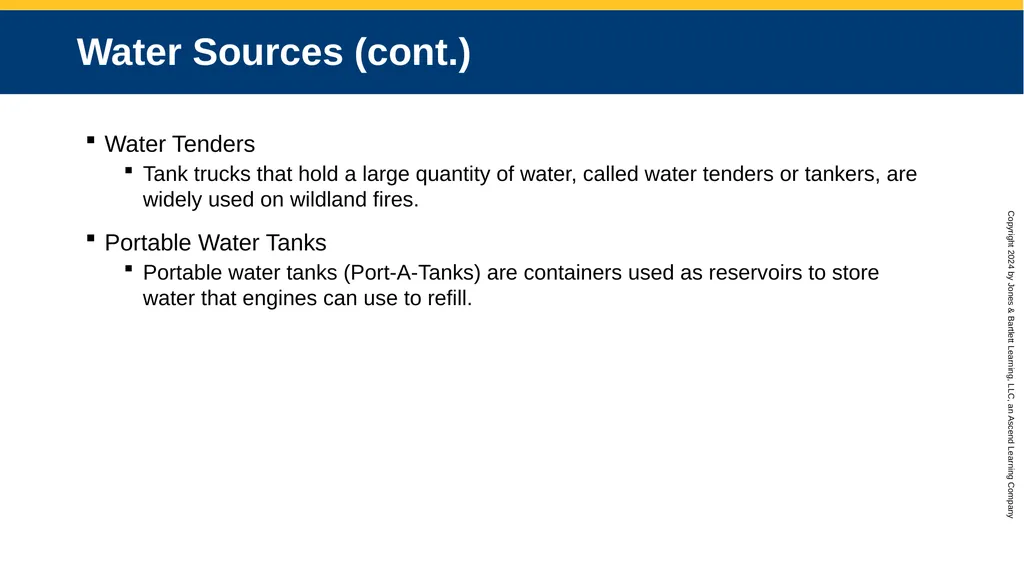
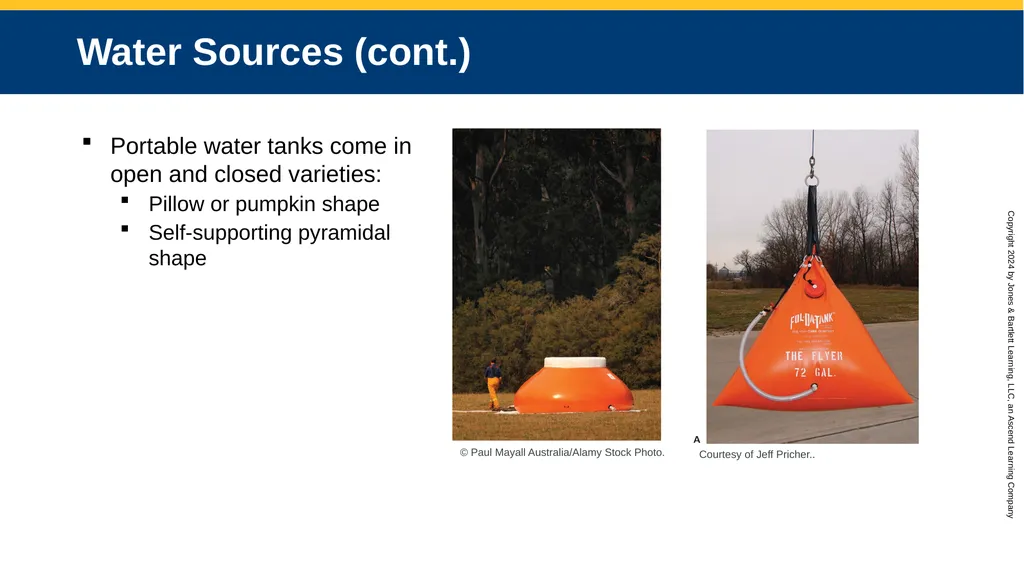
Water Sources (cont.) Portable water tanks come in open and closed varieties:
Pillow or pumpkin shape
Self-supporting pyramidal shape © Paul Mayall Australia/Alamy Stock Photo. Courtesy of Jeff Pricher..<br>
Pillow or pumpkin shape
Self-supporting pyramidal shape © Paul Mayall Australia/Alamy Stock Photo. Courtesy of Jeff Pricher..<br>
14
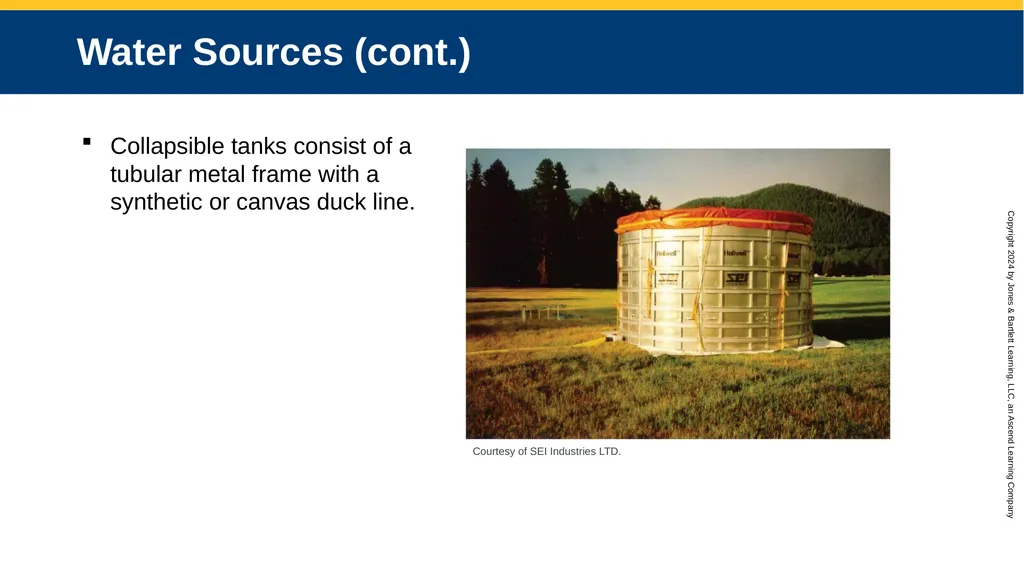
Water Sources (cont.) Collapsible tanks consist of a tubular metal frame with a synthetic or canvas duck line. Courtesy of SEI Industries LTD.<br>
15
Hoses A hose is a device used to deliver water from a water source to a fire.
Wildland hoses normally come in 100-foot (30.5-m) lengths.
Typically two types of hoses used on wildland fires: attack hoses and supply hoses<br>
Wildland hoses normally come in 100-foot (30.5-m) lengths.
Typically two types of hoses used on wildland fires: attack hoses and supply hoses<br>
16
Hoses (cont.) Forestry Fire Hose
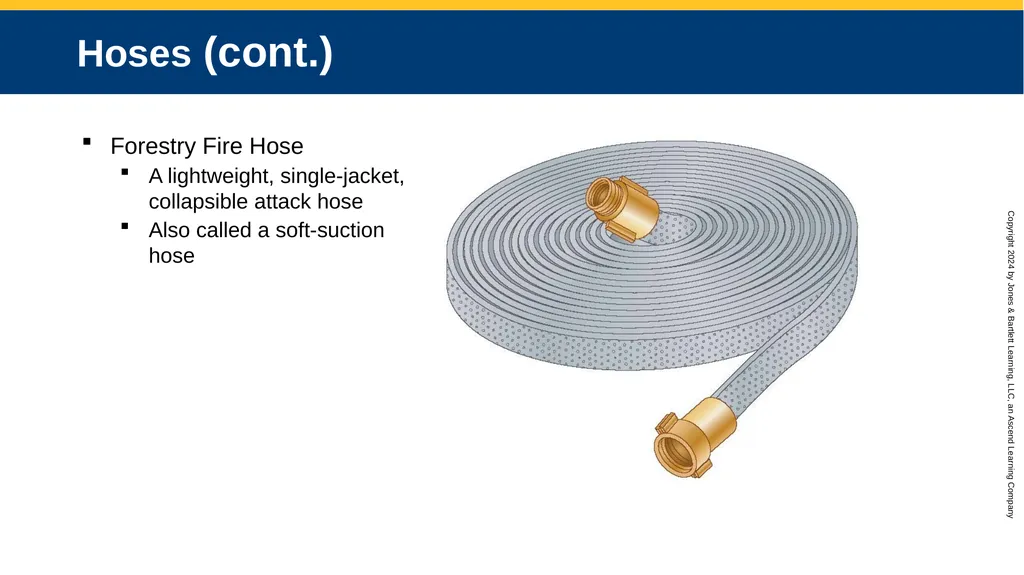
A lightweight, single-jacket, collapsible attack hose
Also called a soft-suction hose<br>
A lightweight, single-jacket, collapsible attack hose
Also called a soft-suction hose<br>
17
Hoses (cont.) Hard Suction Hose
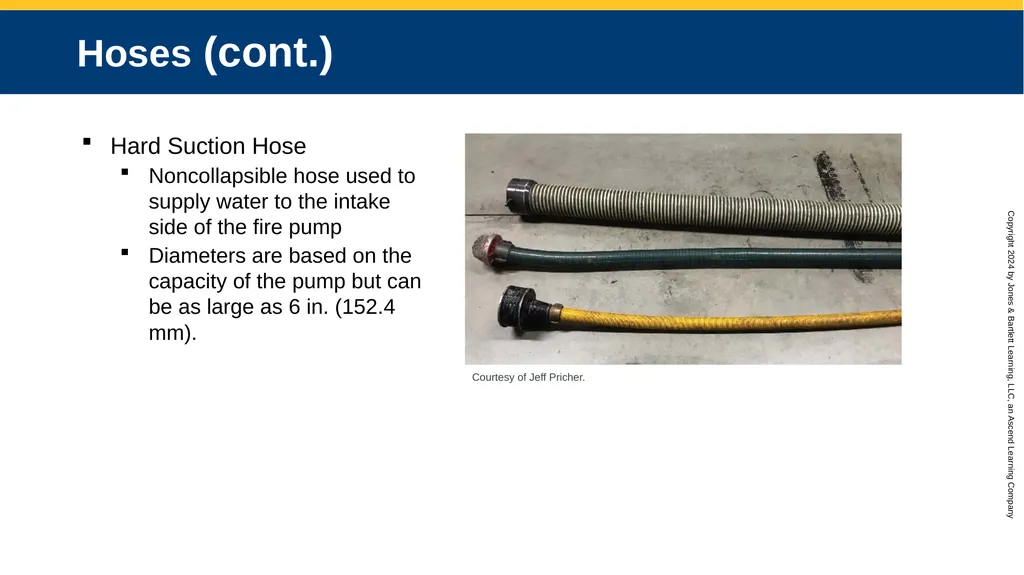
Noncollapsible hose used to supply water to the intake side of the fire pump
Diameters are based on the capacity of the pump but can be as large as 6 in. (152.4 mm). Courtesy of Jeff Pricher.<br>
Noncollapsible hose used to supply water to the intake side of the fire pump
Diameters are based on the capacity of the pump but can be as large as 6 in. (152.4 mm). Courtesy of Jeff Pricher.<br>
18
Hose Appliances Hose Clamp
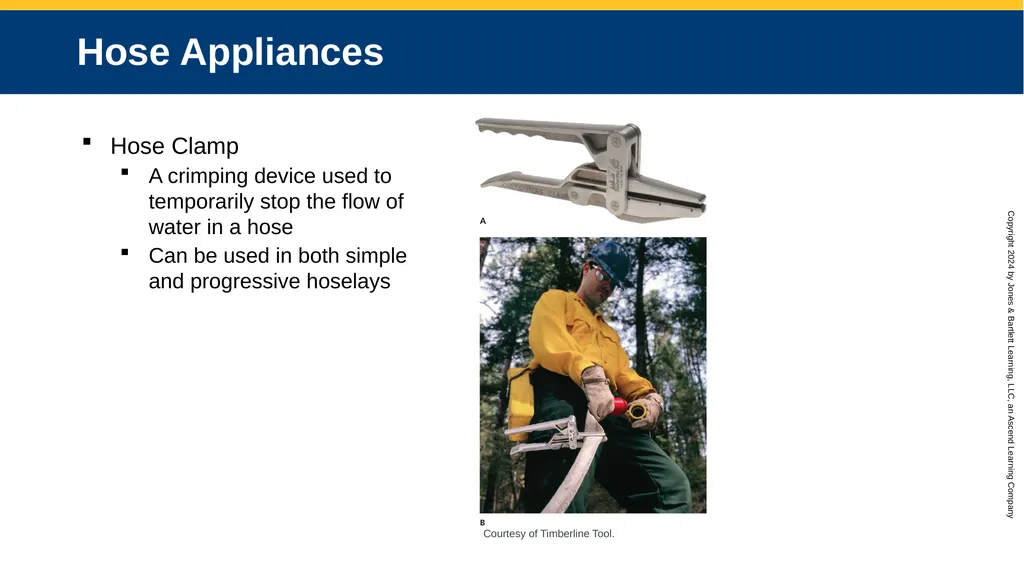
A crimping device used to temporarily stop the flow of water in a hose
Can be used in both simple and progressive hoselays Courtesy of Timberline Tool.<br>
A crimping device used to temporarily stop the flow of water in a hose
Can be used in both simple and progressive hoselays Courtesy of Timberline Tool.<br>
19
Hose Appliances (cont.) Nozzles
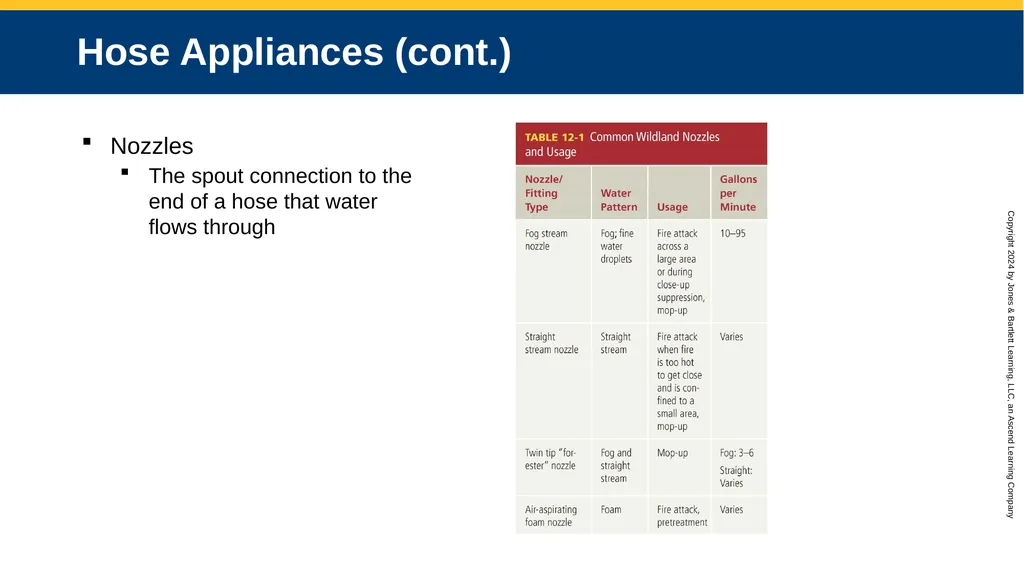
The spout connection to the end of a hose that water flows through<br>
The spout connection to the end of a hose that water flows through<br>
20
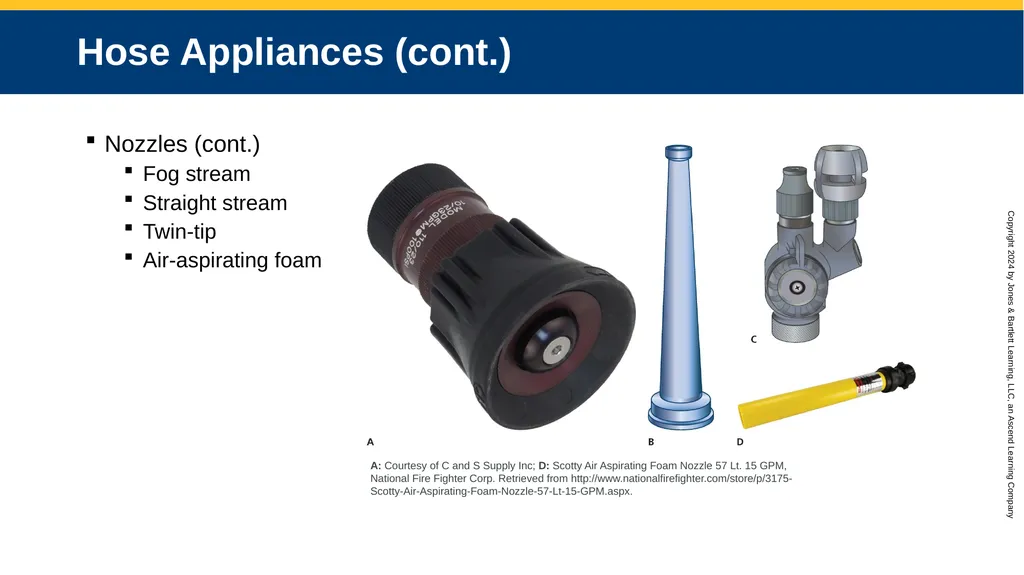
Hose Appliances (cont.) Nozzles (cont.)
Fog stream
Straight stream
Twin-tip
Air-aspirating foam A: Courtesy of C and S Supply Inc; D: Scotty Air Aspirating Foam Nozzle 57 Lt. 15 GPM, National Fire Fighter Corp. Retrieved from http://www.nationalfirefighter.com/store/p/3175-Scotty-Air-Aspirating-Foam-Nozzle-57-Lt-15-GPM.aspx.<br>
Fog stream
Straight stream
Twin-tip
Air-aspirating foam A: Courtesy of C and S Supply Inc; D: Scotty Air Aspirating Foam Nozzle 57 Lt. 15 GPM, National Fire Fighter Corp. Retrieved from http://www.nationalfirefighter.com/store/p/3175-Scotty-Air-Aspirating-Foam-Nozzle-57-Lt-15-GPM.aspx.<br>
21
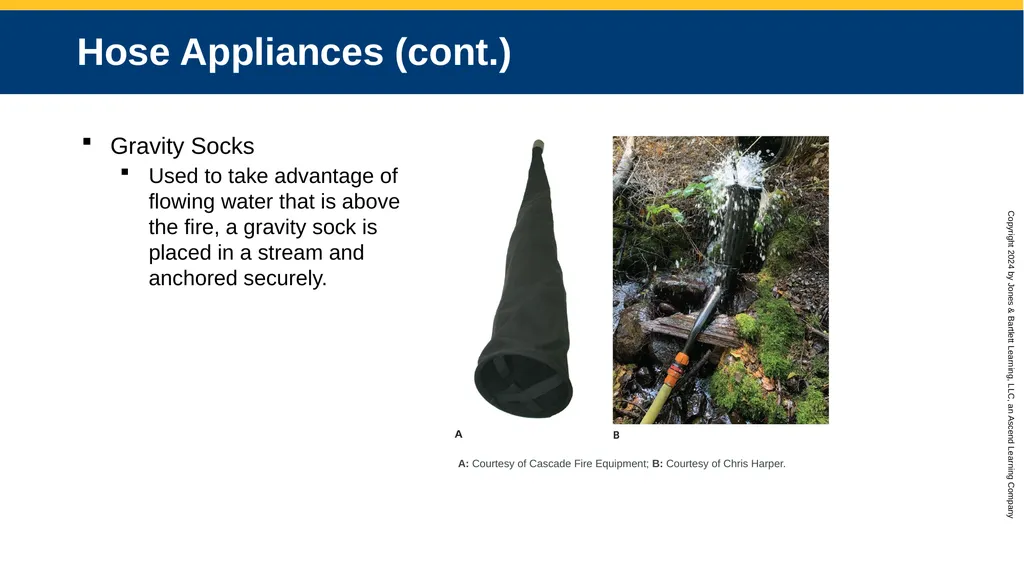
Hose Appliances (cont.) Gravity Socks
Used to take advantage of flowing water that is above the fire, a gravity sock is placed in a stream and anchored securely. A: Courtesy of Cascade Fire Equipment; B: Courtesy of Chris Harper.<br>
Used to take advantage of flowing water that is above the fire, a gravity sock is placed in a stream and anchored securely. A: Courtesy of Cascade Fire Equipment; B: Courtesy of Chris Harper.<br>
22
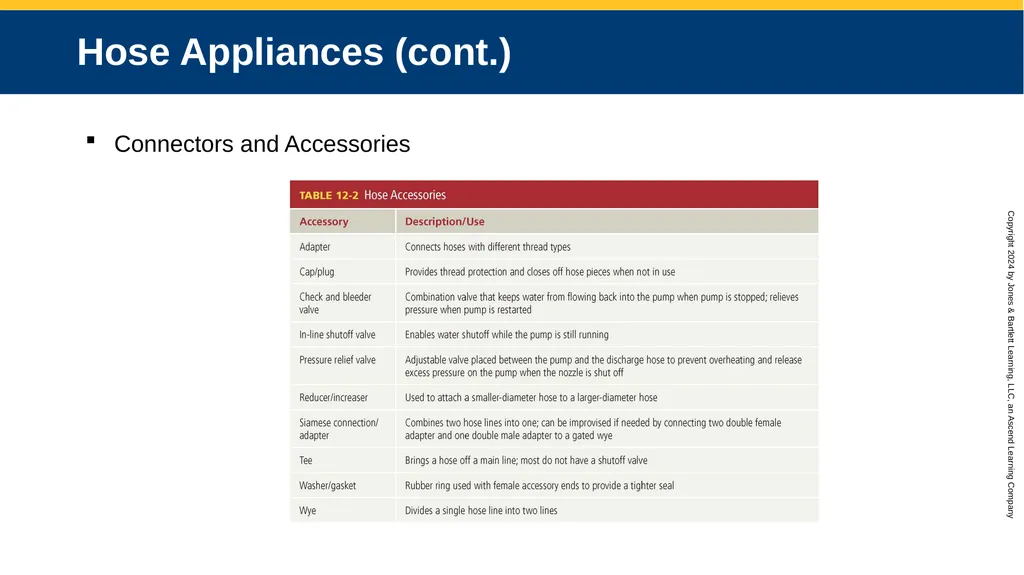
Hose Appliances (cont.) Connectors and Accessories<br>
23
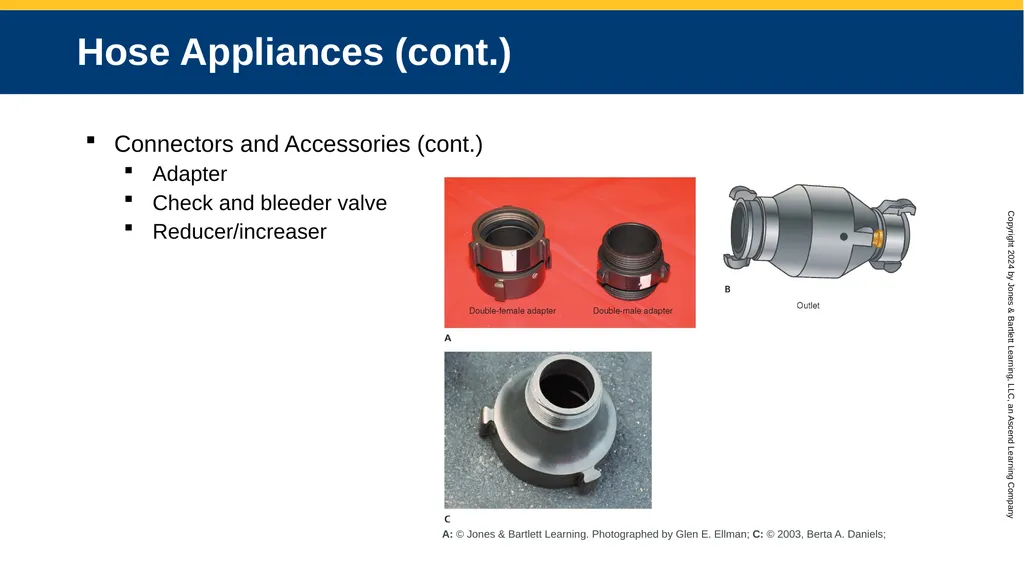
Hose Appliances (cont.) Connectors and Accessories (cont.)
Adapter
Check and bleeder valve
Reducer/increaser A: © Jones & Bartlett Learning. Photographed by Glen E. Ellman; C: © 2003, Berta A. Daniels;<br>
Adapter
Check and bleeder valve
Reducer/increaser A: © Jones & Bartlett Learning. Photographed by Glen E. Ellman; C: © 2003, Berta A. Daniels;<br>
24
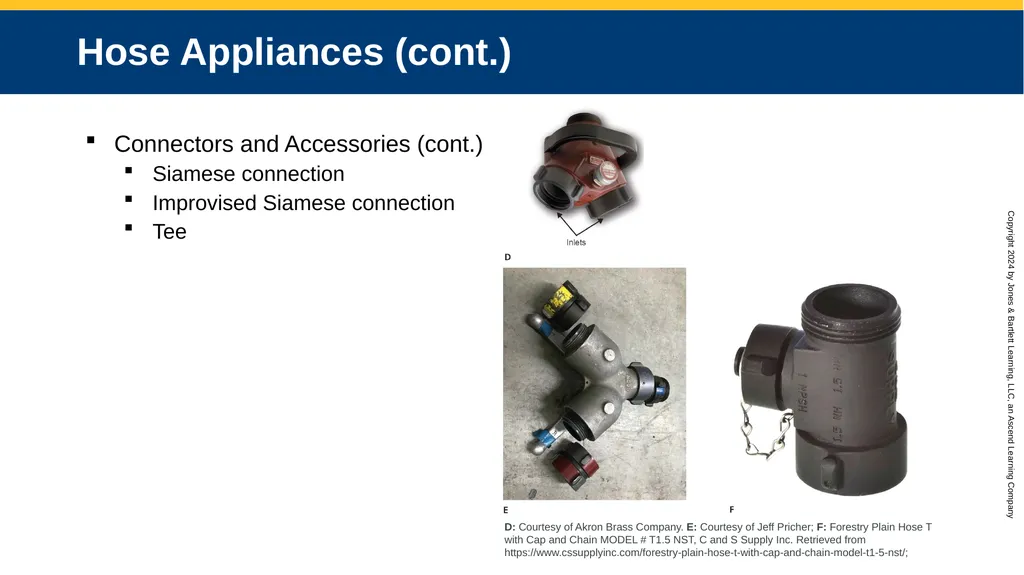
Hose Appliances (cont.) Connectors and Accessories (cont.)
Siamese connection
Improvised Siamese connection
Tee D: Courtesy of Akron Brass Company. E: Courtesy of Jeff Pricher; F: Forestry Plain Hose T with Cap and Chain MODEL # T1.5 NST, C and S Supply Inc. Retrieved from https://www.cssupplyinc.com/forestry-plain-hose-t-with-cap-and-chain-model-t1-5-nst/;<br>
Siamese connection
Improvised Siamese connection
Tee D: Courtesy of Akron Brass Company. E: Courtesy of Jeff Pricher; F: Forestry Plain Hose T with Cap and Chain MODEL # T1.5 NST, C and S Supply Inc. Retrieved from https://www.cssupplyinc.com/forestry-plain-hose-t-with-cap-and-chain-model-t1-5-nst/;<br>
25
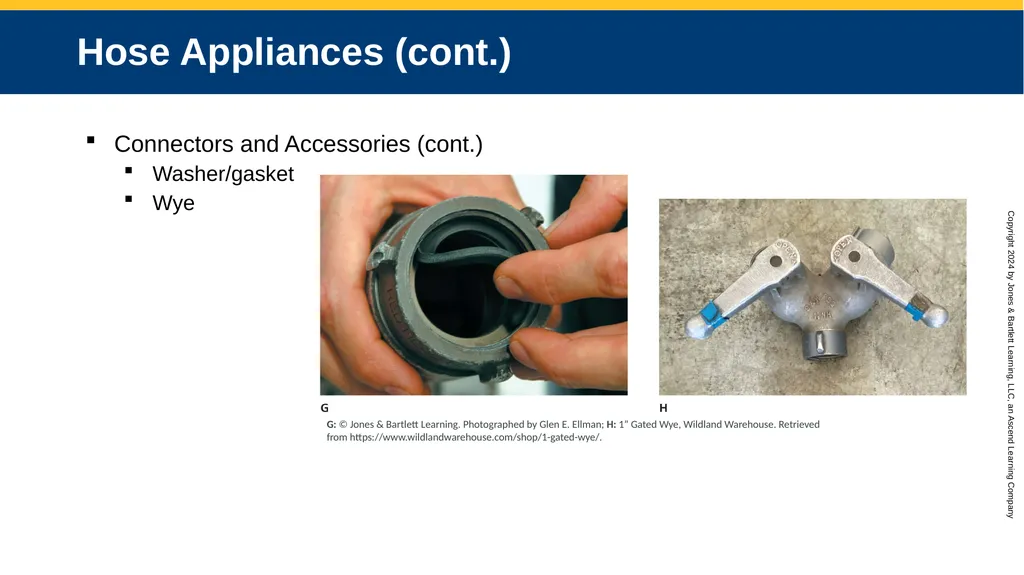
Hose Appliances (cont.) Connectors and Accessories (cont.)
Washer/gasket
Wye G: © Jones & Bartlett Learning. Photographed by Glen E. Ellman; H: 1” Gated Wye, Wildland Warehouse. Retrieved from https://www.wildlandwarehouse.com/shop/1-gated-wye/.<br>
Washer/gasket
Wye G: © Jones & Bartlett Learning. Photographed by Glen E. Ellman; H: 1” Gated Wye, Wildland Warehouse. Retrieved from https://www.wildlandwarehouse.com/shop/1-gated-wye/.<br>
26
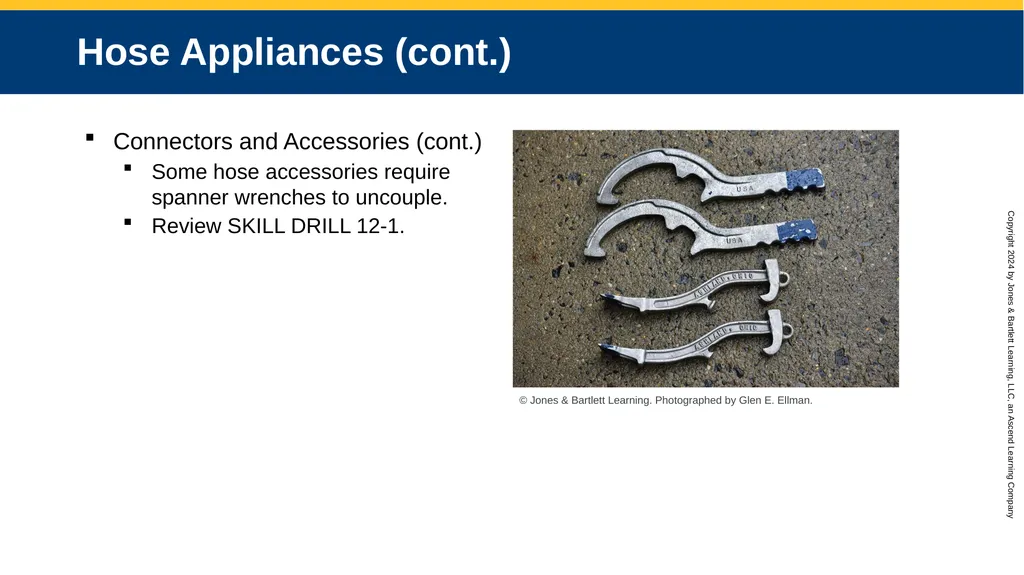
Hose Appliances (cont.) Connectors and Accessories (cont.)
Some hose accessories require spanner wrenches to uncouple.
Review SKILL DRILL 12-1. © Jones & Bartlett Learning. Photographed by Glen E. Ellman.<br>
Some hose accessories require spanner wrenches to uncouple.
Review SKILL DRILL 12-1. © Jones & Bartlett Learning. Photographed by Glen E. Ellman.<br>
27
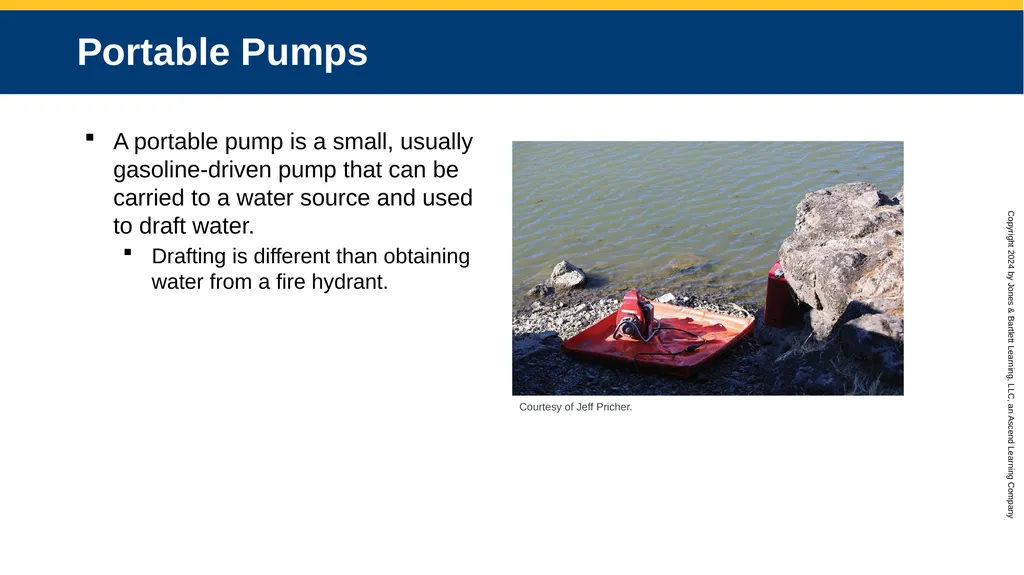
Portable Pumps A portable pump is a small, usually gasoline-driven pump that can be carried to a water source and used to draft water.
Drafting is different than obtaining water from a fire hydrant. Courtesy of Jeff Pricher.<br>
Drafting is different than obtaining water from a fire hydrant. Courtesy of Jeff Pricher.<br>
28
Portable Pumps (cont.) Portable pumps should be operated and maintained according to the pump manufacturer’s instructions.
There are several types of pumps, including:
Backpack pumps
Eductor pumps
Floating pumps
High-pressure portable pumps<br>
There are several types of pumps, including:
Backpack pumps
Eductor pumps
Floating pumps
High-pressure portable pumps<br>
29
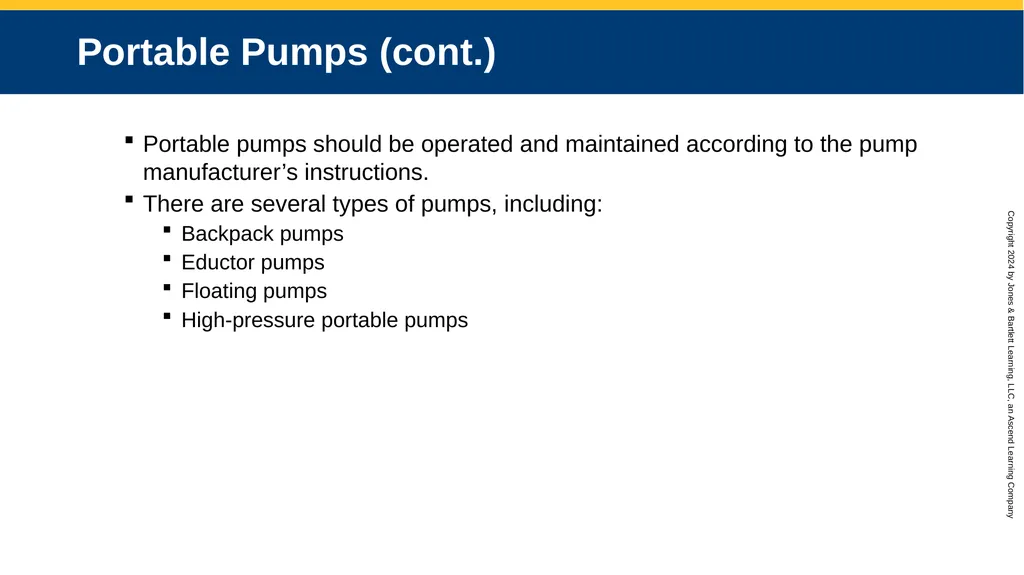
Portable Pumps (cont.) Backpack Pump
Portable pump and tank fitted with straps so that it can be carried on a fire fighter’s back
Designed to be refilled easily in the field, such as from a lake or stream, through a large opening at the top
Most are operated via manual hand pumps.
Not working properly checklist
To operate a backpack pump, see SKILL DRILL 12-2.<br>
Portable pump and tank fitted with straps so that it can be carried on a fire fighter’s back
Designed to be refilled easily in the field, such as from a lake or stream, through a large opening at the top
Most are operated via manual hand pumps.
Not working properly checklist
To operate a backpack pump, see SKILL DRILL 12-2.<br>
30
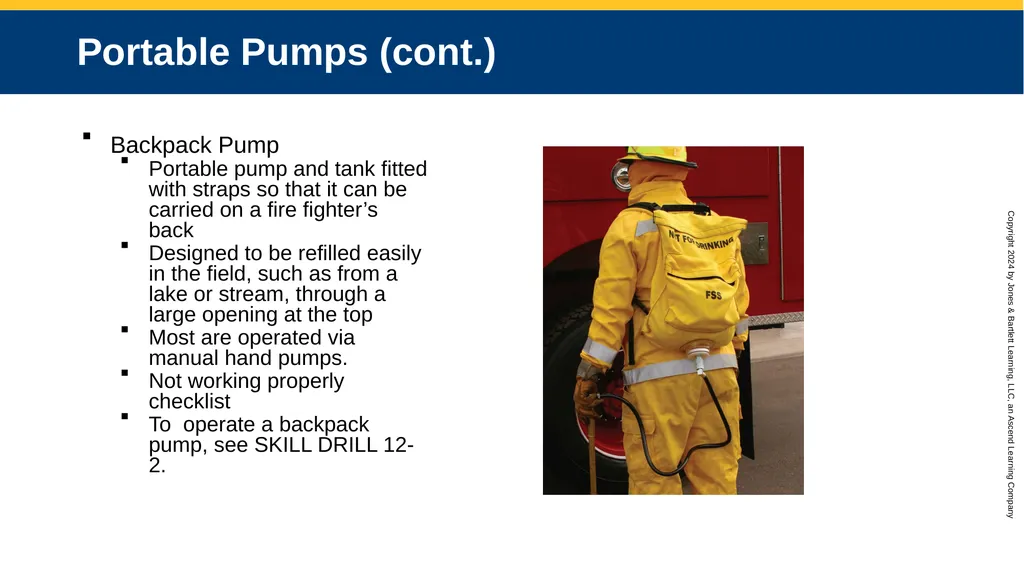
Portable Pumps (cont.) Fire Eductor Pump
Becoming more common in wildland firefighting
Used to draft water from static sources
Usable and sustained water supply and flow Courtesy of Jeff Pricher.<br>
Becoming more common in wildland firefighting
Used to draft water from static sources
Usable and sustained water supply and flow Courtesy of Jeff Pricher.<br>
31
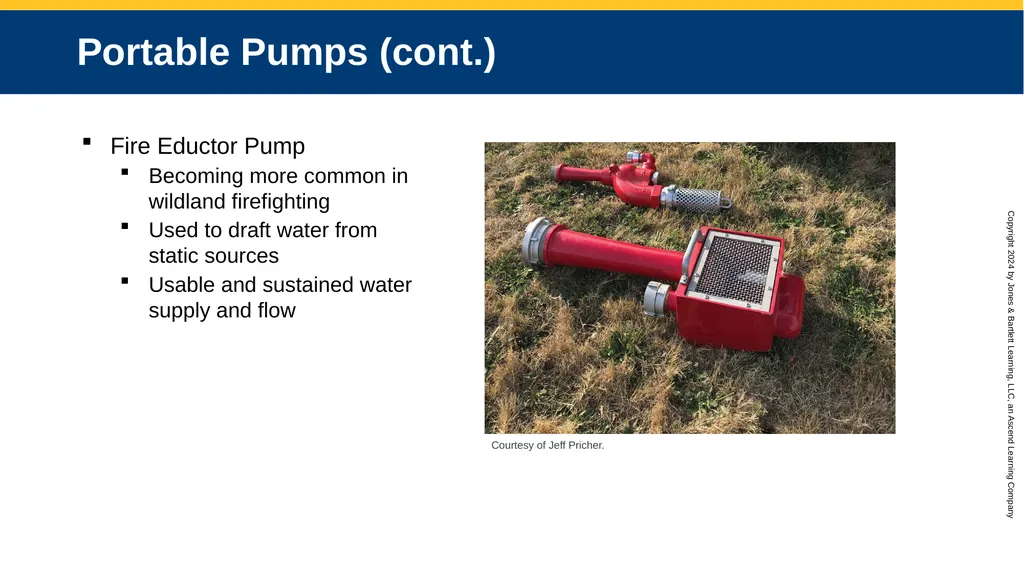
Portable Pumps (cont.) Floating Pump
Portable pumps that float on the water’s surface
Work extremely well on interface fires where there are many residential swimming pools or in wildland areas with available lakes or streams
Used when water is not deep enough © Jones & Bartlett Learning. Photographed by Glen E. Ellman.<br>
Portable pumps that float on the water’s surface
Work extremely well on interface fires where there are many residential swimming pools or in wildland areas with available lakes or streams
Used when water is not deep enough © Jones & Bartlett Learning. Photographed by Glen E. Ellman.<br>
32
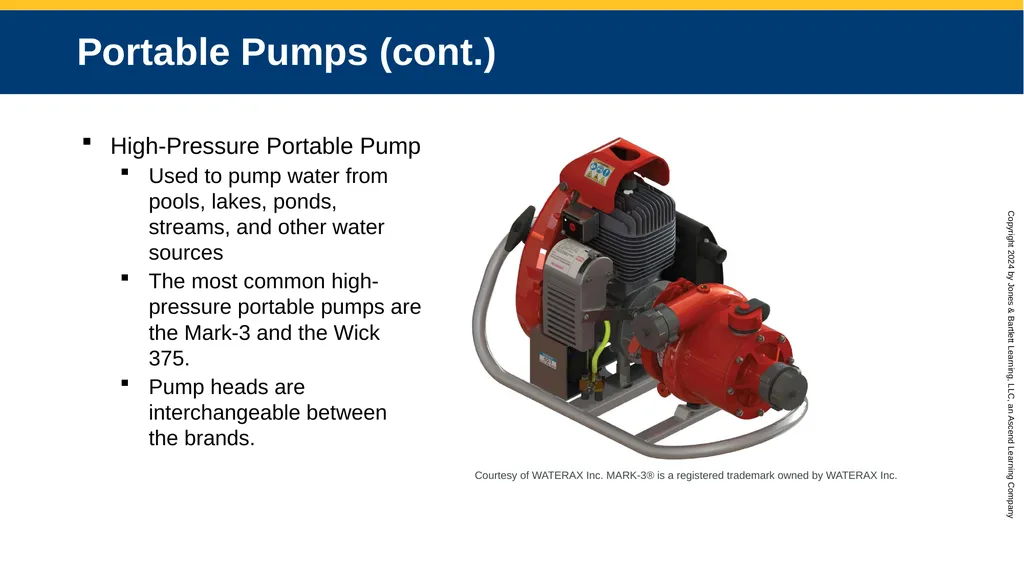
Portable Pumps (cont.) High-Pressure Portable Pump
Used to pump water from pools, lakes, ponds, streams, and other water sources
The most common high-pressure portable pumps are the Mark-3 and the Wick 375.
Pump heads are interchangeable between the brands. Courtesy of WATERAX Inc. MARK-3® is a registered trademark owned by WATERAX Inc.<br>
Used to pump water from pools, lakes, ponds, streams, and other water sources
The most common high-pressure portable pumps are the Mark-3 and the Wick 375.
Pump heads are interchangeable between the brands. Courtesy of WATERAX Inc. MARK-3® is a registered trademark owned by WATERAX Inc.<br>
33
Portable Pumps (cont.) Portable Pump Operator
The portable pump operator maintains and works the portable pumps.
Pump operator must have a warm coat, hard hat, gloves, earplugs, and established radio communications.
Must also have a pump kit
Their job is to ensure that all items in the pump kit are compatible and the proper sizes.<br>
The portable pump operator maintains and works the portable pumps.
Pump operator must have a warm coat, hard hat, gloves, earplugs, and established radio communications.
Must also have a pump kit
Their job is to ensure that all items in the pump kit are compatible and the proper sizes.<br>
34
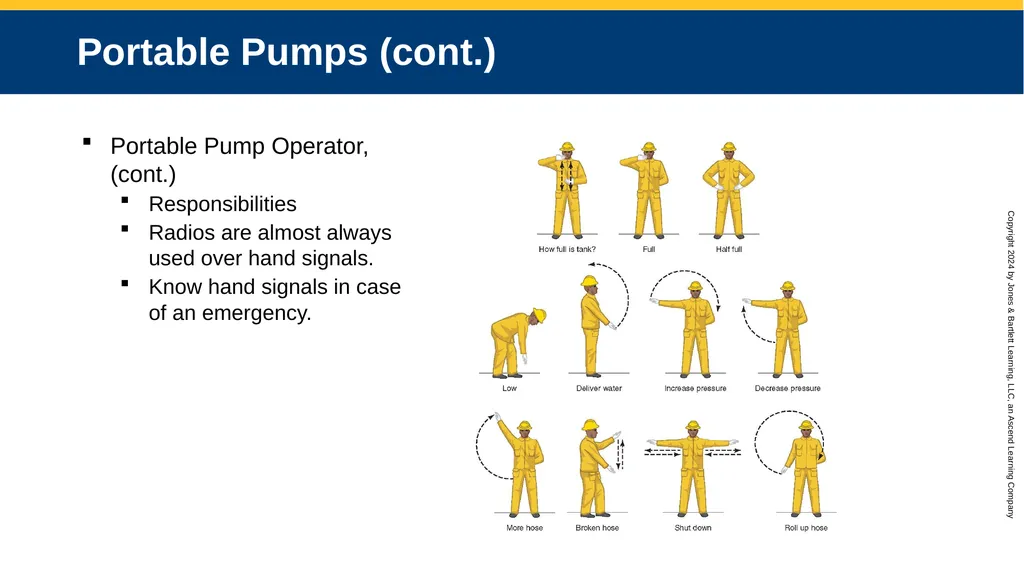
Portable Pumps (cont.) Portable Pump Operator, (cont.)
Responsibilities
Radios are almost always used over hand signals.
Know hand signals in case of an emergency.<br>
Responsibilities
Radios are almost always used over hand signals.
Know hand signals in case of an emergency.<br>
35
Portable Pumps (cont.) Portable Pump Setup
There are three portable pump flow setups:
Staged Setup: pumps that are set up to include a single pump or two pumps that are not connected to each other
Parallel Setup: utilized to increase the volume of water for the intended use
Series Setup: a dual-pump effort that is used when increased pressure is needed for a specific use on a fire<br>
There are three portable pump flow setups:
Staged Setup: pumps that are set up to include a single pump or two pumps that are not connected to each other
Parallel Setup: utilized to increase the volume of water for the intended use
Series Setup: a dual-pump effort that is used when increased pressure is needed for a specific use on a fire<br>
36
Hoselays A hoselay, or hose lay, is the arrangement of connected fire hose and accessories on the ground, beginning at the first pumping location and ending at the point of water delivery
Essentially creates one long hose through which water travels
There are two types of hoselay construction:
Simple
Progressive<br>
Essentially creates one long hose through which water travels
There are two types of hoselay construction:
Simple
Progressive<br>
37
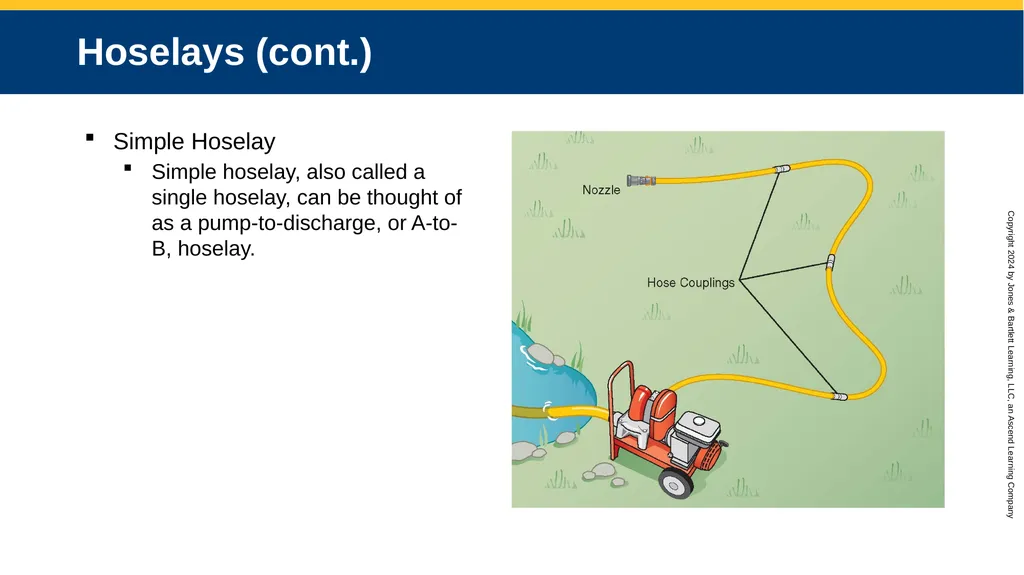
Hoselays (cont.) Simple Hoselay
Simple hoselay, also called a single hoselay, can be thought of as a pump-to-discharge, or A-to-B, hoselay.<br>
Simple hoselay, also called a single hoselay, can be thought of as a pump-to-discharge, or A-to-B, hoselay.<br>
38
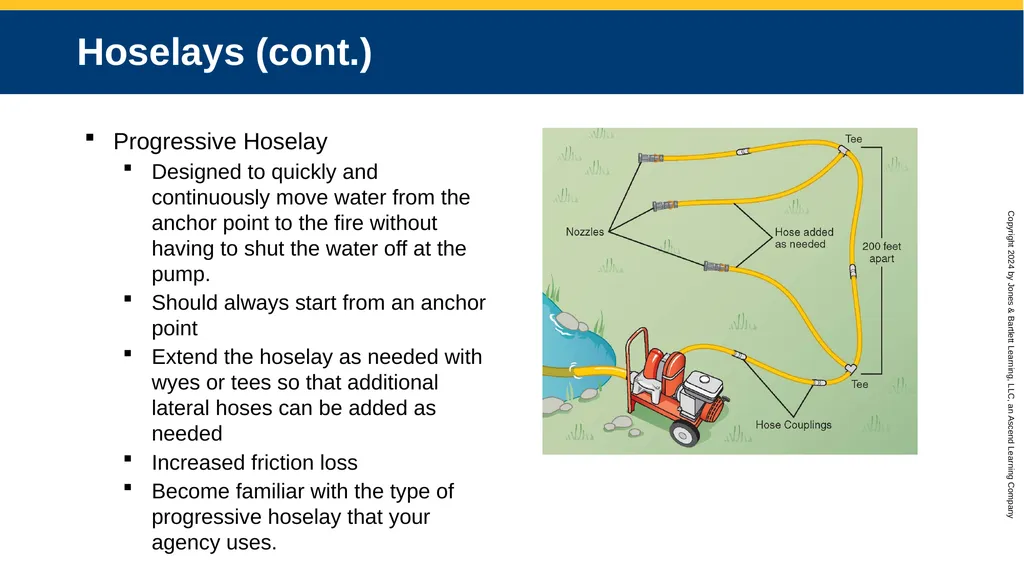
Hoselays (cont.) Progressive Hoselay
Designed to quickly and continuously move water from the anchor point to the fire without having to shut the water off at the pump.
Should always start from an anchor point
Extend the hoselay as needed with wyes or tees so that additional lateral hoses can be added as needed
Increased friction loss
Become familiar with the type of progressive hoselay that your agency uses.<br>
Designed to quickly and continuously move water from the anchor point to the fire without having to shut the water off at the pump.
Should always start from an anchor point
Extend the hoselay as needed with wyes or tees so that additional lateral hoses can be added as needed
Increased friction loss
Become familiar with the type of progressive hoselay that your agency uses.<br>
39
Hoselays (cont.) Hose Packs
A backpack containing a hose, hose accessories, and other hoselay equipment in a predetermined arrangement.
Used to quickly perform a progressive hoselay
Usually used in areas where water tenders and other large vehicles cannot reach
Several kinds of progressive hose packs
The most common packs include the Travis, the Gansner, the Gnass, and the Pondosa.<br>
A backpack containing a hose, hose accessories, and other hoselay equipment in a predetermined arrangement.
Used to quickly perform a progressive hoselay
Usually used in areas where water tenders and other large vehicles cannot reach
Several kinds of progressive hose packs
The most common packs include the Travis, the Gansner, the Gnass, and the Pondosa.<br>
40
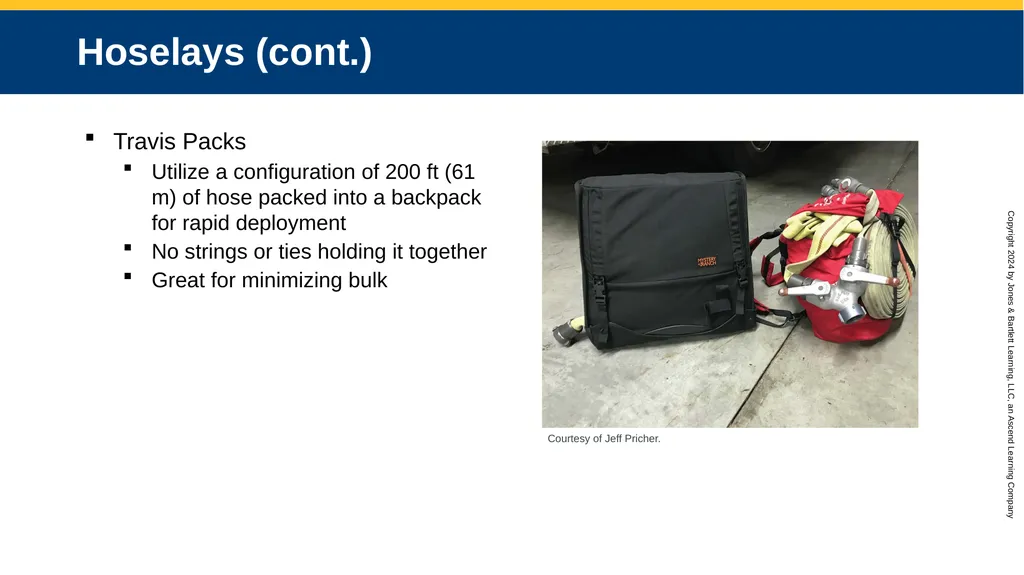
Hoselays (cont.) Travis Packs
Utilize a configuration of 200 ft (61 m) of hose packed into a backpack for rapid deployment
No strings or ties holding it together
Great for minimizing bulk Courtesy of Jeff Pricher.<br>
Utilize a configuration of 200 ft (61 m) of hose packed into a backpack for rapid deployment
No strings or ties holding it together
Great for minimizing bulk Courtesy of Jeff Pricher.<br>
41
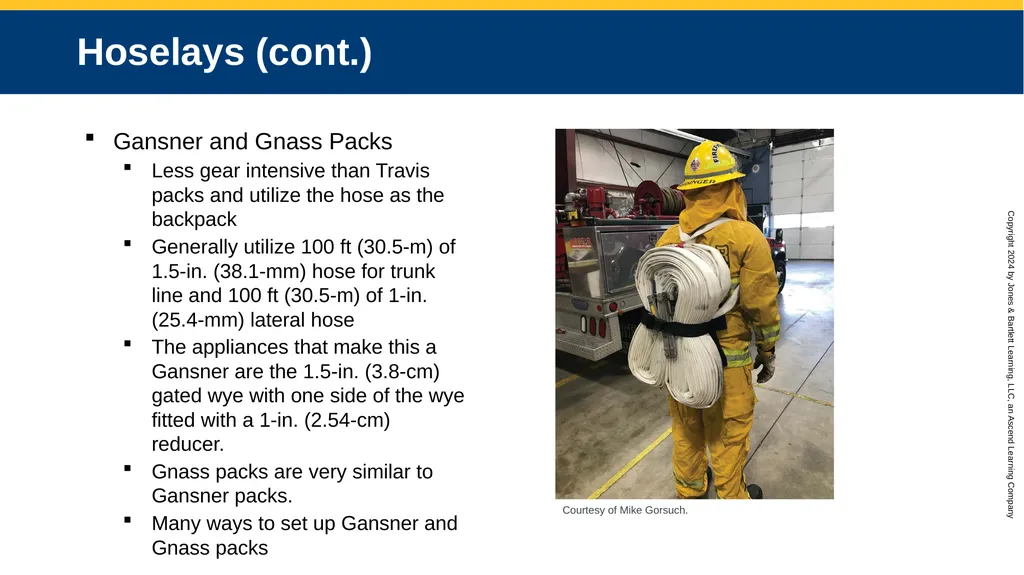
Hoselays (cont.) Gansner and Gnass Packs
Less gear intensive than Travis packs and utilize the hose as the backpack
Generally utilize 100 ft (30.5-m) of 1.5-in. (38.1-mm) hose for trunk line and 100 ft (30.5-m) of 1-in. (25.4-mm) lateral hose
The appliances that make this a Gansner are the 1.5-in. (3.8-cm) gated wye with one side of the wye fitted with a 1-in. (2.54-cm) reducer.
Gnass packs are very similar to Gansner packs.
Many ways to set up Gansner and Gnass packs Courtesy of Mike Gorsuch.<br>
Less gear intensive than Travis packs and utilize the hose as the backpack
Generally utilize 100 ft (30.5-m) of 1.5-in. (38.1-mm) hose for trunk line and 100 ft (30.5-m) of 1-in. (25.4-mm) lateral hose
The appliances that make this a Gansner are the 1.5-in. (3.8-cm) gated wye with one side of the wye fitted with a 1-in. (2.54-cm) reducer.
Gnass packs are very similar to Gansner packs.
Many ways to set up Gansner and Gnass packs Courtesy of Mike Gorsuch.<br>
42
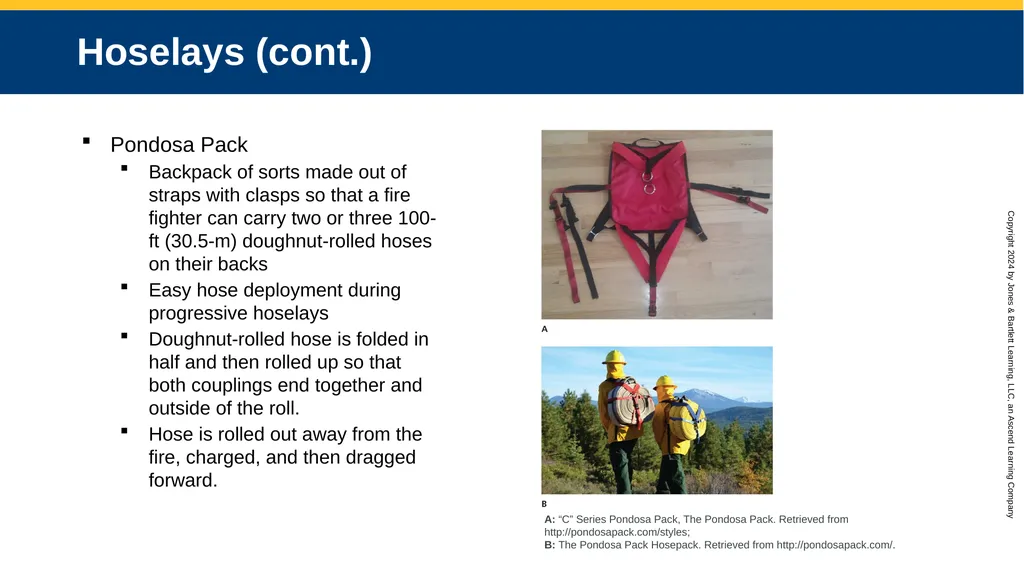
Hoselays (cont.) Pondosa Pack
Backpack of sorts made out of straps with clasps so that a fire fighter can carry two or three 100-ft (30.5-m) doughnut-rolled hoses on their backs
Easy hose deployment during progressive hoselays
Doughnut-rolled hose is folded in half and then rolled up so that both couplings end together and outside of the roll.
Hose is rolled out away from the fire, charged, and then dragged forward. A: “C” Series Pondosa Pack, The Pondosa Pack. Retrieved from http://pondosapack.com/styles; B: The Pondosa Pack Hosepack. Retrieved from http://pondosapack.com/.<br>
Backpack of sorts made out of straps with clasps so that a fire fighter can carry two or three 100-ft (30.5-m) doughnut-rolled hoses on their backs
Easy hose deployment during progressive hoselays
Doughnut-rolled hose is folded in half and then rolled up so that both couplings end together and outside of the roll.
Hose is rolled out away from the fire, charged, and then dragged forward. A: “C” Series Pondosa Pack, The Pondosa Pack. Retrieved from http://pondosapack.com/styles; B: The Pondosa Pack Hosepack. Retrieved from http://pondosapack.com/.<br>
43
Hoselays (cont.) Retrieving Hoselays
Before hose can be removed and retrieved, all of the water must be drained from it.
If a hose has been identified as damaged, tie a knot in the hose.
There are several techniques for retrieving and packaging hoses:
Butterflying the Hose
Utilizes no tools other than the hands and arms of a fire fighter
See SKILL DRILL 12-3
Doughnut Rolling the Hose
Used when the hose will be put into use directly from the rolled state
See SKILL DRILL 12-4<br>
Before hose can be removed and retrieved, all of the water must be drained from it.
If a hose has been identified as damaged, tie a knot in the hose.
There are several techniques for retrieving and packaging hoses:
Butterflying the Hose
Utilizes no tools other than the hands and arms of a fire fighter
See SKILL DRILL 12-3
Doughnut Rolling the Hose
Used when the hose will be put into use directly from the rolled state
See SKILL DRILL 12-4<br>
44
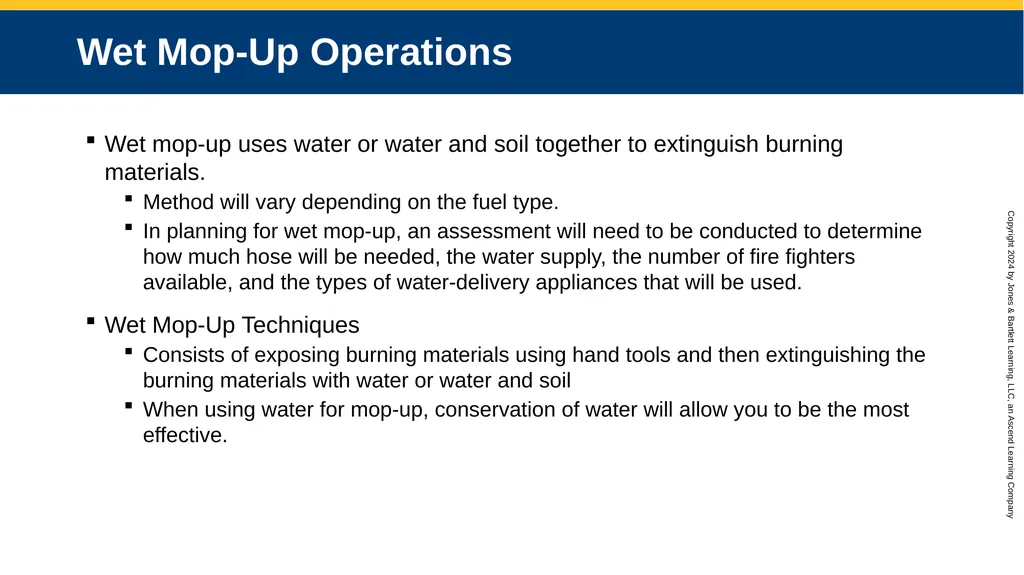
Wet Mop-Up Operations Wet mop-up uses water or water and soil together to extinguish burning materials.
Method will vary depending on the fuel type.
In planning for wet mop-up, an assessment will need to be conducted to determine how much hose will be needed, the water supply, the number of fire fighters available, and the types of water-delivery appliances that will be used.
Wet Mop-Up Techniques
Consists of exposing burning materials using hand tools and then extinguishing the burning materials with water or water and soil
When using water for mop-up, conservation of water will allow you to be the most effective.<br>
Method will vary depending on the fuel type.
In planning for wet mop-up, an assessment will need to be conducted to determine how much hose will be needed, the water supply, the number of fire fighters available, and the types of water-delivery appliances that will be used.
Wet Mop-Up Techniques
Consists of exposing burning materials using hand tools and then extinguishing the burning materials with water or water and soil
When using water for mop-up, conservation of water will allow you to be the most effective.<br>
45
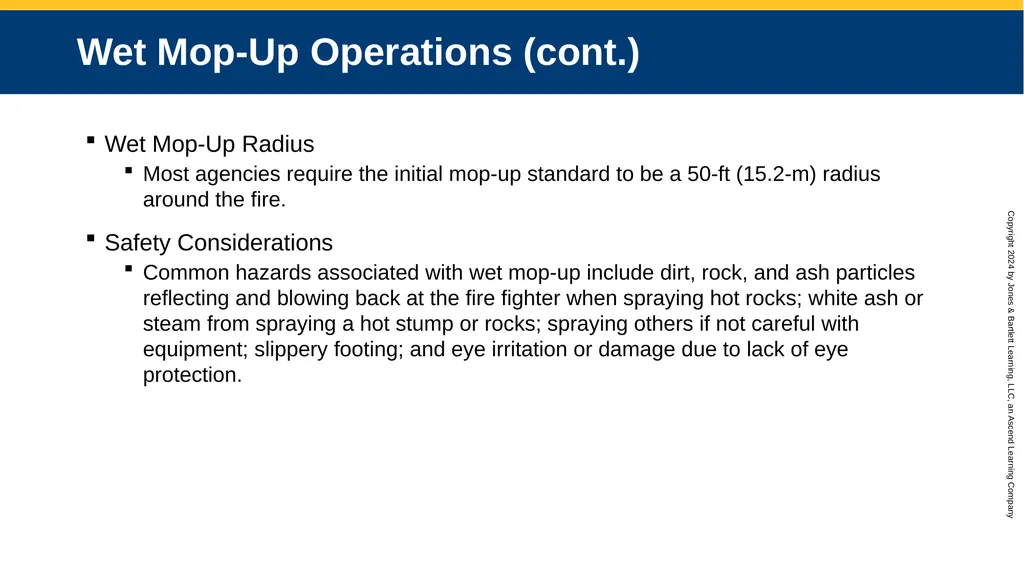
Wet Mop-Up Operations (cont.) Wet Mop-Up Radius
Most agencies require the initial mop-up standard to be a 50-ft (15.2-m) radius around the fire.
Safety Considerations
Common hazards associated with wet mop-up include dirt, rock, and ash particles reflecting and blowing back at the fire fighter when spraying hot rocks; white ash or steam from spraying a hot stump or rocks; spraying others if not careful with equipment; slippery footing; and eye irritation or damage due to lack of eye protection.<br>
Most agencies require the initial mop-up standard to be a 50-ft (15.2-m) radius around the fire.
Safety Considerations
Common hazards associated with wet mop-up include dirt, rock, and ash particles reflecting and blowing back at the fire fighter when spraying hot rocks; white ash or steam from spraying a hot stump or rocks; spraying others if not careful with equipment; slippery footing; and eye irritation or damage due to lack of eye protection.<br>
46
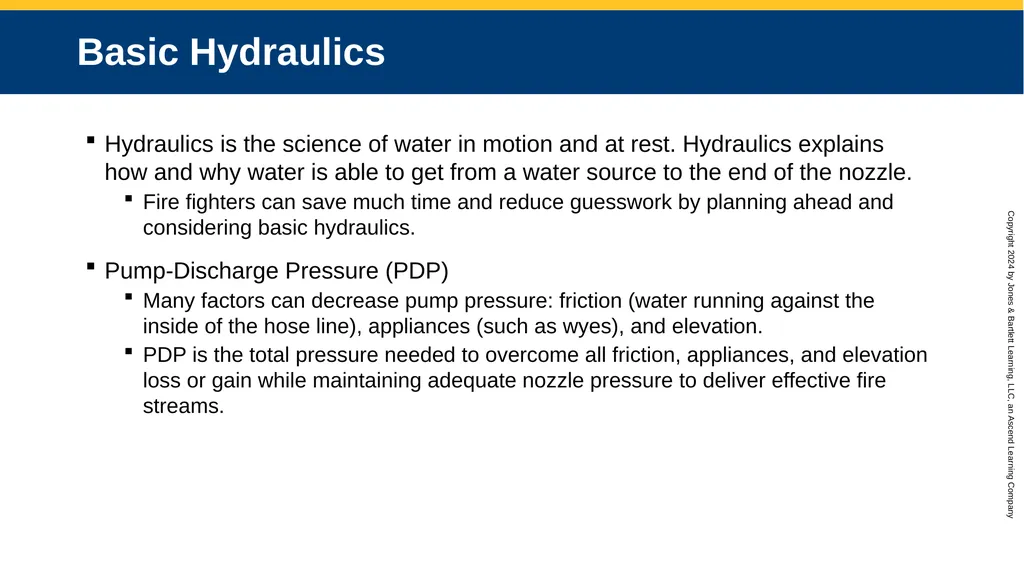
Basic Hydraulics Hydraulics is the science of water in motion and at rest. Hydraulics explains how and why water is able to get from a water source to the end of the nozzle.
Fire fighters can save much time and reduce guesswork by planning ahead and considering basic hydraulics.
Pump-Discharge Pressure (PDP)
Many factors can decrease pump pressure: friction (water running against the inside of the hose line), appliances (such as wyes), and elevation.
PDP is the total pressure needed to overcome all friction, appliances, and elevation loss or gain while maintaining adequate nozzle pressure to deliver effective fire streams.<br>
Fire fighters can save much time and reduce guesswork by planning ahead and considering basic hydraulics.
Pump-Discharge Pressure (PDP)
Many factors can decrease pump pressure: friction (water running against the inside of the hose line), appliances (such as wyes), and elevation.
PDP is the total pressure needed to overcome all friction, appliances, and elevation loss or gain while maintaining adequate nozzle pressure to deliver effective fire streams.<br>
47
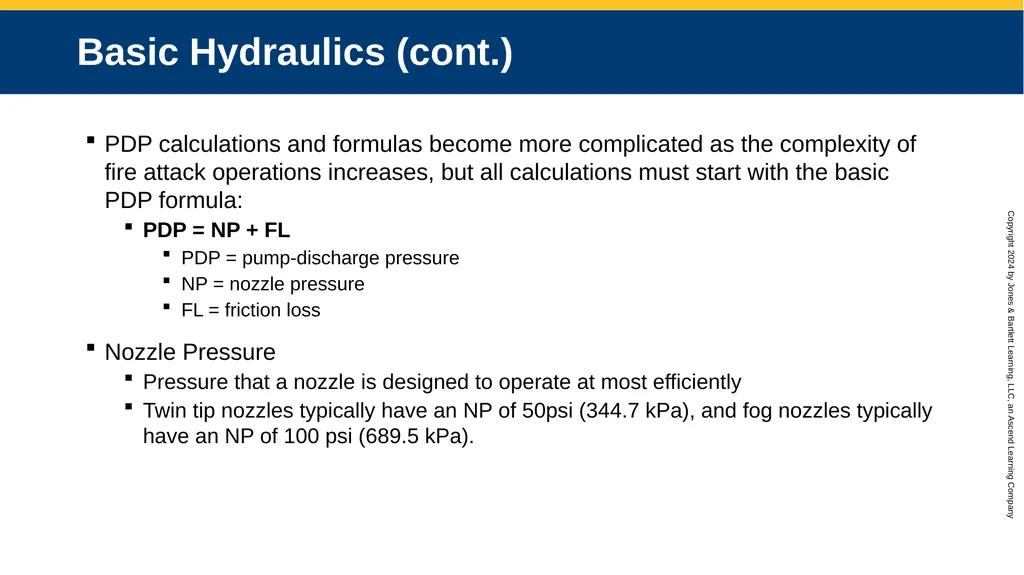
Basic Hydraulics (cont.) PDP calculations and formulas become more complicated as the complexity of fire attack operations increases, but all calculations must start with the basic PDP formula:
PDP = NP + FL
PDP = pump-discharge pressure
NP = nozzle pressure
FL = friction loss
Nozzle Pressure
Pressure that a nozzle is designed to operate at most efficiently
Twin tip nozzles typically have an NP of 50psi (344.7 kPa), and fog nozzles typically have an NP of 100 psi (689.5 kPa).<br>
PDP = NP + FL
PDP = pump-discharge pressure
NP = nozzle pressure
FL = friction loss
Nozzle Pressure
Pressure that a nozzle is designed to operate at most efficiently
Twin tip nozzles typically have an NP of 50psi (344.7 kPa), and fog nozzles typically have an NP of 100 psi (689.5 kPa).<br>
48
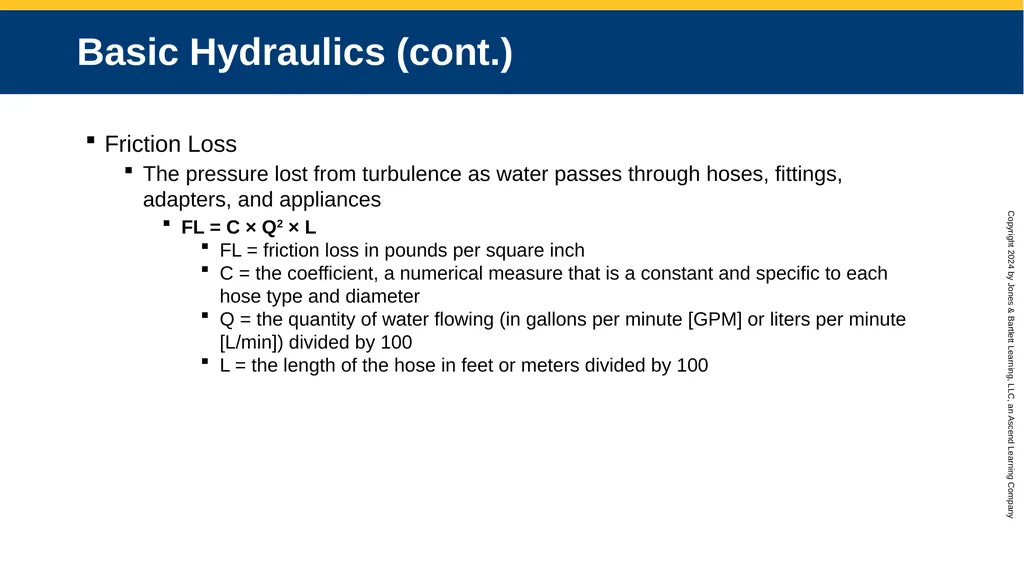
Basic Hydraulics (cont.) Friction Loss
The pressure lost from turbulence as water passes through hoses, fittings, adapters, and appliances
FL = C × Q2 × L
FL = friction loss in pounds per square inch
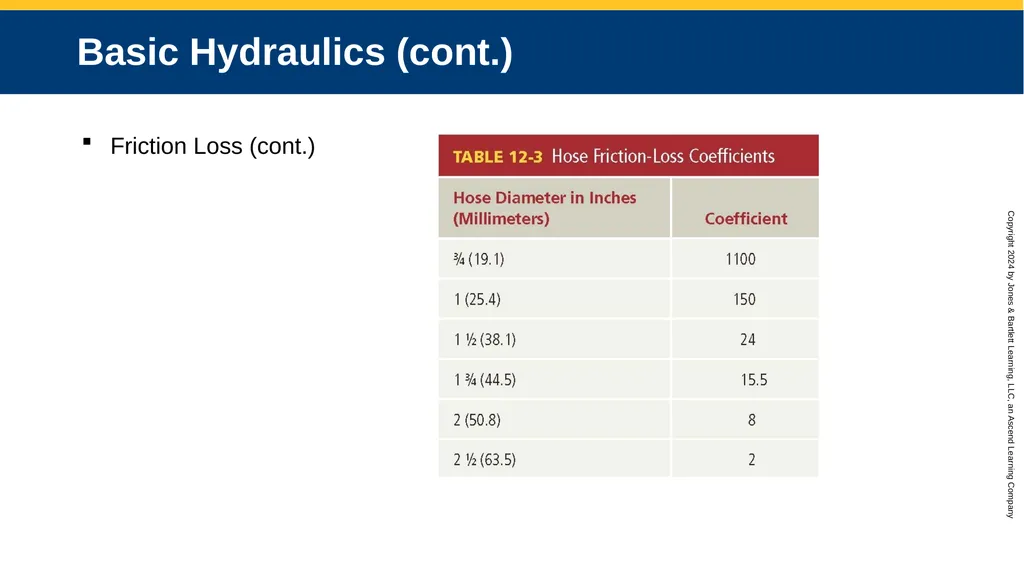
C = the coefficient, a numerical measure that is a constant and specific to each hose type and diameter
Q = the quantity of water flowing (in gallons per minute [GPM] or liters per minute [L/min]) divided by 100
L = the length of the hose in feet or meters divided by 100<br>
The pressure lost from turbulence as water passes through hoses, fittings, adapters, and appliances
FL = C × Q2 × L
FL = friction loss in pounds per square inch
C = the coefficient, a numerical measure that is a constant and specific to each hose type and diameter
Q = the quantity of water flowing (in gallons per minute [GPM] or liters per minute [L/min]) divided by 100
L = the length of the hose in feet or meters divided by 100<br>
49
Basic Hydraulics (cont.) Friction Loss (cont.)<br>
50
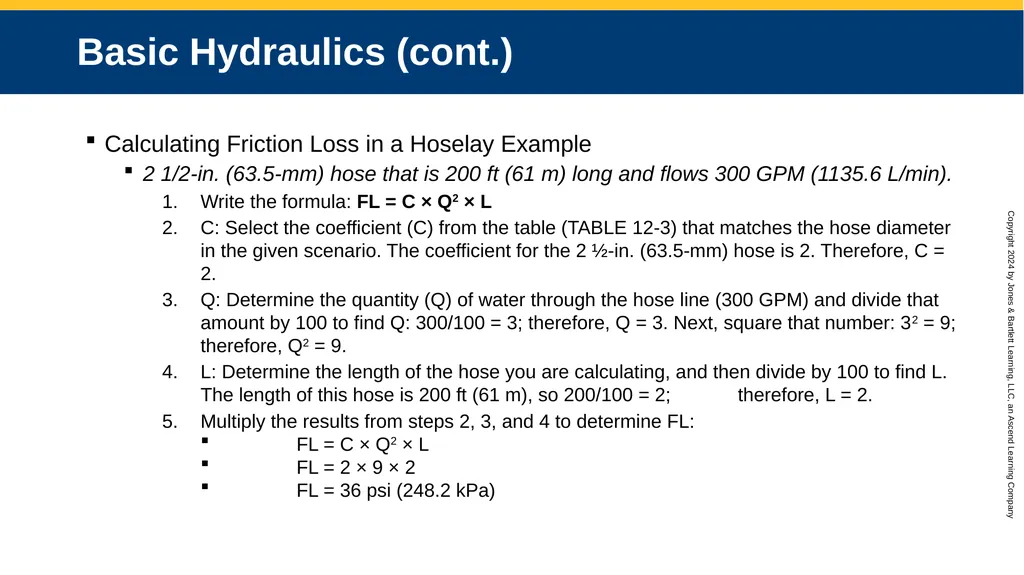
Basic Hydraulics (cont.) Calculating Friction Loss in a Hoselay Example
2 1/2-in. (63.5-mm) hose that is 200 ft (61 m) long and flows 300 GPM (1135.6 L/min).
Write the formula: FL = C × Q2 × L
C: Select the coefficient (C) from the table (TABLE 12-3) that matches the hose diameter in the given scenario. The coefficient for the 2 ½-in. (63.5-mm) hose is 2. Therefore, C = 2.
Q: Determine the quantity (Q) of water through the hose line (300 GPM) and divide that amount by 100 to find Q: 300/100 = 3; therefore, Q = 3. Next, square that number: 32 = 9; therefore, Q2 = 9.
L: Determine the length of the hose you are calculating, and then divide by 100 to find L. The length of this hose is 200 ft (61 m), so 200/100 = 2; therefore, L = 2.
Multiply the results from steps 2, 3, and 4 to determine FL:
FL = C × Q2 × L
FL = 2 × 9 × 2
FL = 36 psi (248.2 kPa)<br>
2 1/2-in. (63.5-mm) hose that is 200 ft (61 m) long and flows 300 GPM (1135.6 L/min).
Write the formula: FL = C × Q2 × L
C: Select the coefficient (C) from the table (TABLE 12-3) that matches the hose diameter in the given scenario. The coefficient for the 2 ½-in. (63.5-mm) hose is 2. Therefore, C = 2.
Q: Determine the quantity (Q) of water through the hose line (300 GPM) and divide that amount by 100 to find Q: 300/100 = 3; therefore, Q = 3. Next, square that number: 32 = 9; therefore, Q2 = 9.
L: Determine the length of the hose you are calculating, and then divide by 100 to find L. The length of this hose is 200 ft (61 m), so 200/100 = 2; therefore, L = 2.
Multiply the results from steps 2, 3, and 4 to determine FL:
FL = C × Q2 × L
FL = 2 × 9 × 2
FL = 36 psi (248.2 kPa)<br>
51
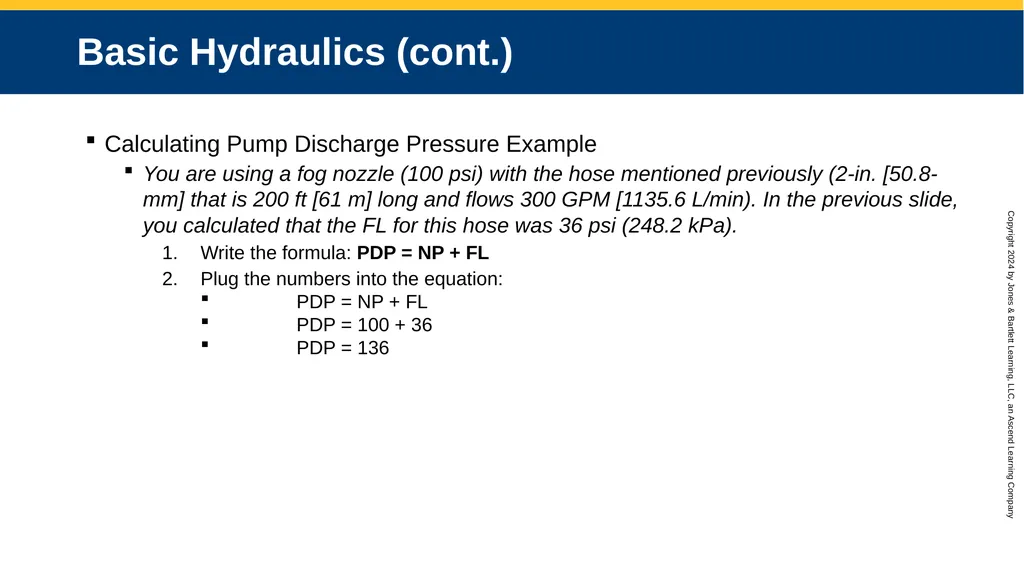
Basic Hydraulics (cont.) Calculating Pump Discharge Pressure Example
You are using a fog nozzle (100 psi) with the hose mentioned previously (2-in. [50.8-mm] that is 200 ft [61 m] long and flows 300 GPM [1135.6 L/min). In the previous slide, you calculated that the FL for this hose was 36 psi (248.2 kPa).
Write the formula: PDP = NP + FL
Plug the numbers into the equation:
PDP = NP + FL
PDP = 100 + 36
PDP = 136<br>
You are using a fog nozzle (100 psi) with the hose mentioned previously (2-in. [50.8-mm] that is 200 ft [61 m] long and flows 300 GPM [1135.6 L/min). In the previous slide, you calculated that the FL for this hose was 36 psi (248.2 kPa).
Write the formula: PDP = NP + FL
Plug the numbers into the equation:
PDP = NP + FL
PDP = 100 + 36
PDP = 136<br>
52
Basic Hydraulics (cont.) Calculating Pump Discharge Pressure
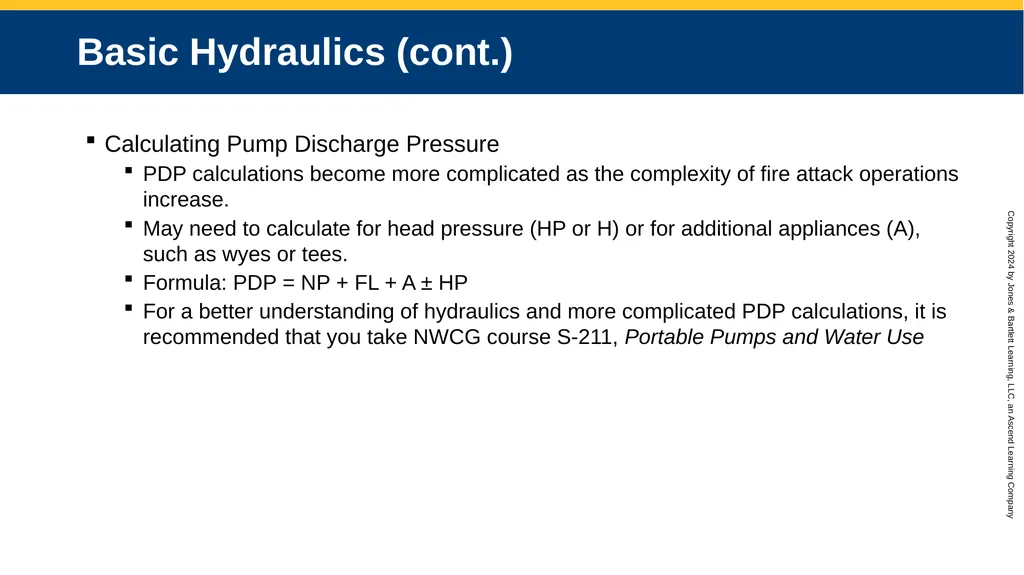
PDP calculations become more complicated as the complexity of fire attack operations increase.
May need to calculate for head pressure (HP or H) or for additional appliances (A), such as wyes or tees.
Formula: PDP = NP + FL + A ± HP
For a better understanding of hydraulics and more complicated PDP calculations, it is recommended that you take NWCG course S-211, Portable Pumps and Water Use<br>
PDP calculations become more complicated as the complexity of fire attack operations increase.
May need to calculate for head pressure (HP or H) or for additional appliances (A), such as wyes or tees.
Formula: PDP = NP + FL + A ± HP
For a better understanding of hydraulics and more complicated PDP calculations, it is recommended that you take NWCG course S-211, Portable Pumps and Water Use<br>
53
Summary<br>
54
Summary Water is a valuable commodity at a wildland fire, so every drop counts. Find water sources after your arrival at the scene of a wildland fire and communicate their locations to your team.
Before using a dry hydrant, clear any debris that may be against the strainer.
There are some portable water sources that can be brought to the wildland fire scene, such as water tenders and portable water tanks.
There are two types of hoses used on wildland fires: attack hoses and supply hoses.<br>
Before using a dry hydrant, clear any debris that may be against the strainer.
There are some portable water sources that can be brought to the wildland fire scene, such as water tenders and portable water tanks.
There are two types of hoses used on wildland fires: attack hoses and supply hoses.<br>
55
Summary (cont.) There are several different types of nozzles to choose from, including fog-stream nozzles, which produce fine water droplets; straight-stream nozzles, which produce a straight stream of water; and twin-tip nozzles, which produce both fine water droplets and a straight stream of water.
Drafting is the process of drawing water from static water sources into a pump. This is different from obtaining water from a fire hydrant because the water coming out of a fire hydrant is pressurized.
Fire eductor pumps use the venturi effect from water discharged from the pump and tank to assist with lifting water and moving it over greater distances than with hard suction hoses.
In addition to standard PPE, pump operators must have a warm coat, hard hat, gloves, and ear plugs.<br>
Drafting is the process of drawing water from static water sources into a pump. This is different from obtaining water from a fire hydrant because the water coming out of a fire hydrant is pressurized.
Fire eductor pumps use the venturi effect from water discharged from the pump and tank to assist with lifting water and moving it over greater distances than with hard suction hoses.
In addition to standard PPE, pump operators must have a warm coat, hard hat, gloves, and ear plugs.<br>
56
Summary (cont.) There are three different portable pump flow configurations: parallel, series, and staged.
Simple hoselays are the most basic form of water delivery. They connect hose in a line and include hoses, fittings, and a nozzle that connect directly to the discharge port of a pump.
Progressive hoselays are designed to include shutoff valves (wyes or tees) that allow the hoselays to attack fire at several points.
Hose packs allow fire fighters to easily transport hose, hose accessories, and equipment to various locations.<br>
Simple hoselays are the most basic form of water delivery. They connect hose in a line and include hoses, fittings, and a nozzle that connect directly to the discharge port of a pump.
Progressive hoselays are designed to include shutoff valves (wyes or tees) that allow the hoselays to attack fire at several points.
Hose packs allow fire fighters to easily transport hose, hose accessories, and equipment to various locations.<br>
57
Summary (cont.) It is important to know how to breakdown sections of hose after fire suppression operations are completed and safely store it for future use.
Wet mop-up primarily consists of exposing burning materials using hand tools, then extinguishing them with water or water and soil.
Hydraulics is the science of water in motion and at rest.
Many factors can decrease water pressure: friction, appliance use (wyes), and elevation.<br>
Wet mop-up primarily consists of exposing burning materials using hand tools, then extinguishing them with water or water and soil.
Hydraulics is the science of water in motion and at rest.
Many factors can decrease water pressure: friction, appliance use (wyes), and elevation.<br>