03
The Linnaean System of Classification The system of classification most widely used in biology dates back to Swedish botanist Carolus Linnaeus (1707–1778).
The system has two main characteristics—a two-part Latin name for each species and a hierarchy, or ordering, of species into broader and broader groups.
The first part of a binomial (two-part name) is the genus (plural, genera) to which the species belongs.
The second part of a binomial refers to one species within the genus.
An example of a binomial is Panthera pardus, the scientific name of the leopard. <br>
04
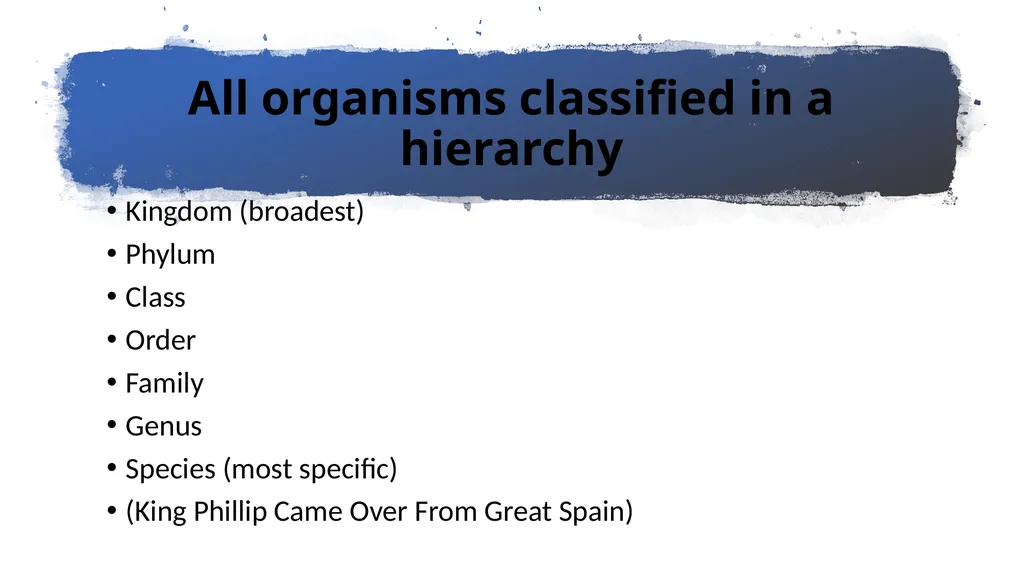
All organisms classified in a hierarchy Kingdom (broadest)
Phylum
Class
Order
Family
Genus
Species (most specific)
(King Phillip Came Over From Great Spain)<br>
05
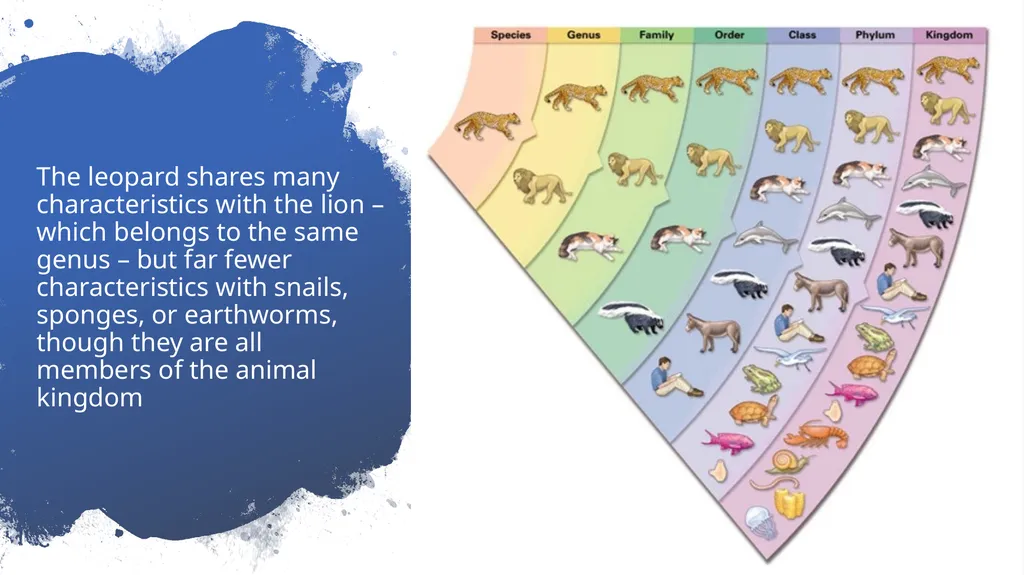
The leopard shares many characteristics with the lion – which belongs to the same genus – but far fewer characteristics with snails, sponges, or earthworms, though they are all members of the animal kingdom<br>
06
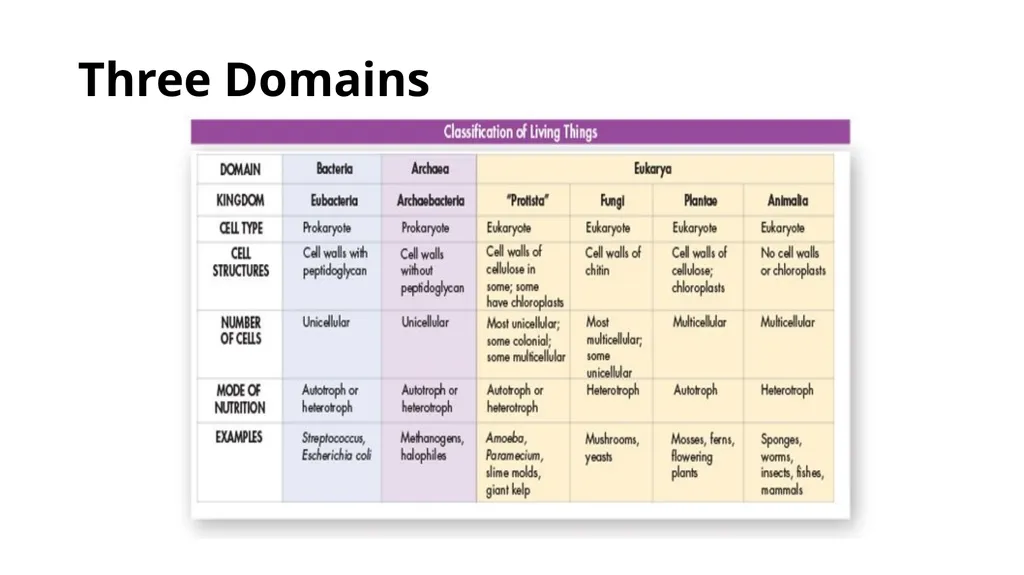
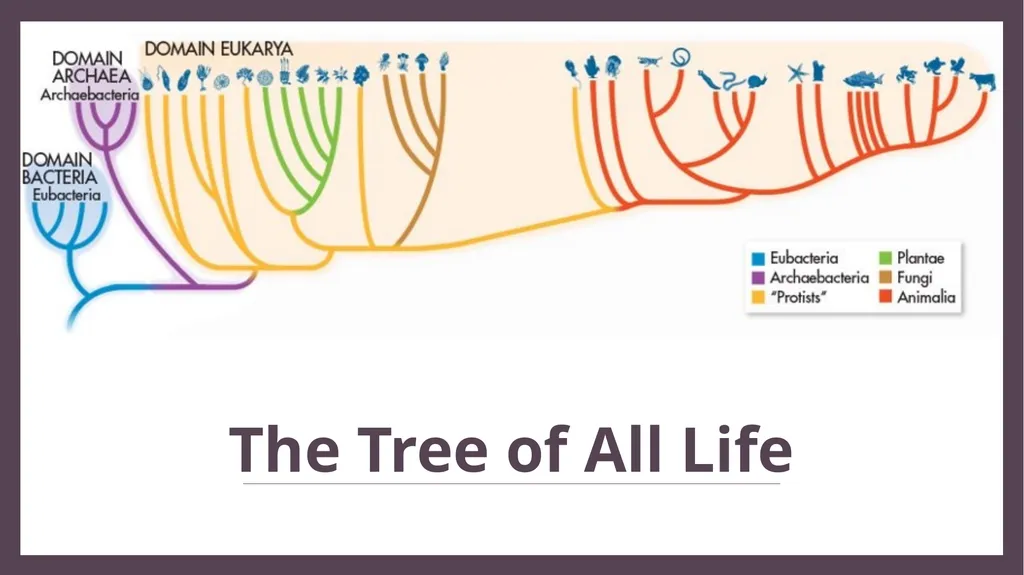
Kingdoms The six-kingdom system of classification includes the kingdoms Eubacteria, Archaebacteria, Protista, Fungi, Plantae, and Animalia.<br>
07
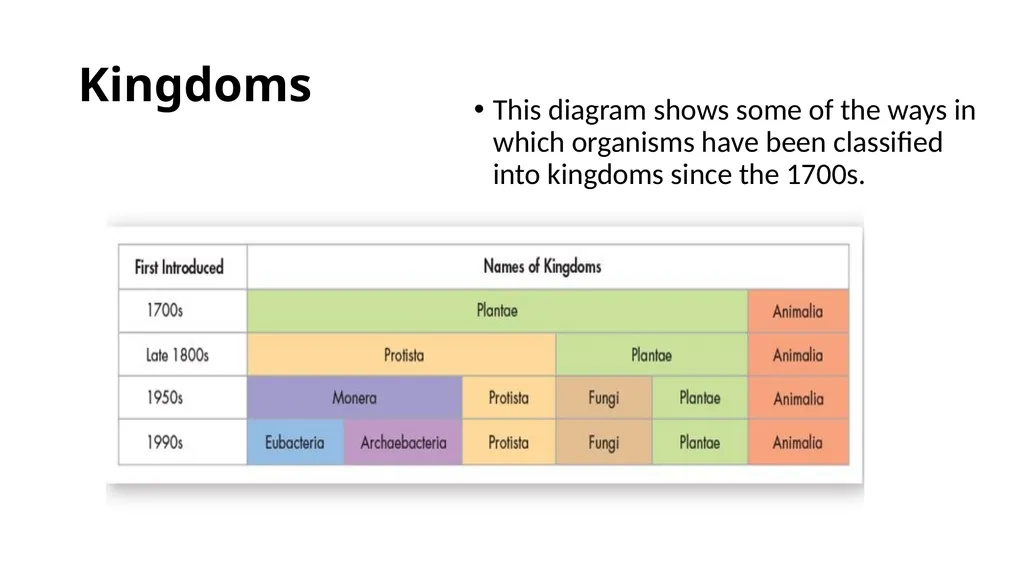
Kingdoms This diagram shows some of the ways in which organisms have been classified into kingdoms since the 1700s.<br>
10
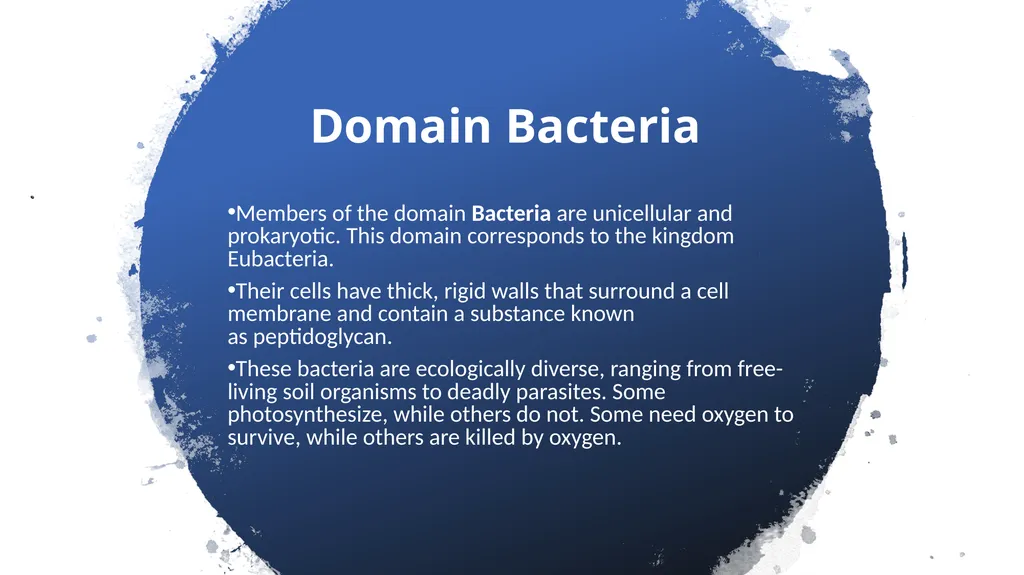
Domain Bacteria Members of the domain Bacteria are unicellular and prokaryotic. This domain corresponds to the kingdom Eubacteria.
Their cells have thick, rigid walls that surround a cell membrane and contain a substance known as peptidoglycan.
These bacteria are ecologically diverse, ranging from free-living soil organisms to deadly parasites. Some photosynthesize, while others do not. Some need oxygen to survive, while others are killed by oxygen. <br>
11
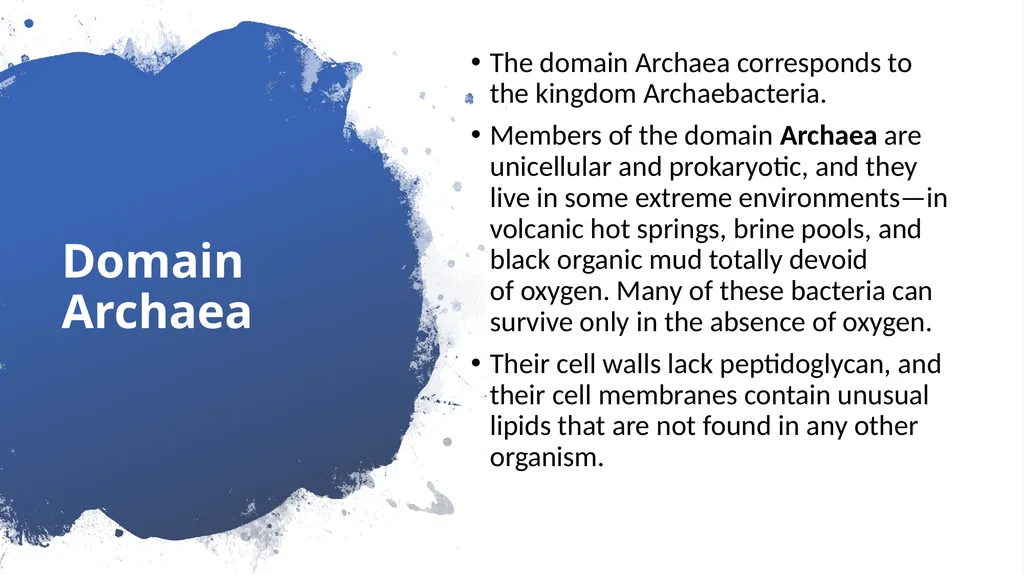
Domain Archaea The domain Archaea corresponds to the kingdom Archaebacteria.
Members of the domain Archaea are unicellular and prokaryotic, and they live in some extreme environments—in volcanic hot springs, brine pools, and black organic mud totally devoid of oxygen. Many of these bacteria can survive only in the absence of oxygen.
Their cell walls lack peptidoglycan, and their cell membranes contain unusual lipids that are not found in any other organism. <br>
12
Domain Eukarya The domain Eukarya consists of all organisms that have a nucleus. It comprises the four remaining kingdoms of the six-kingdom system: “Protista,” Fungi, Plantae, and Animalia.<br>
13
The “Protists”: Unicellular Eukaryotes <br>
14
The “Protists”: Unicellular Eukaryotes Most “protists” are unicellular, but one group, the brown algae, is multicellular.
Some “protists” are photosynthetic, while others are heterotrophic.
Some display characters that resemble those of fungi, plants, or animals. <br>
15
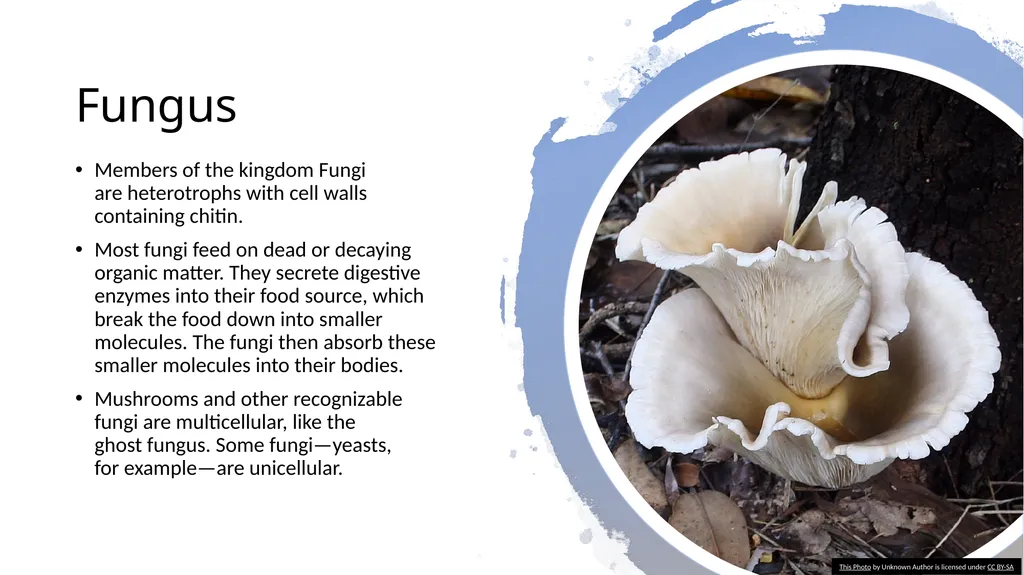
Fungus Members of the kingdom Fungi are heterotrophs with cell walls containing chitin.
Most fungi feed on dead or decaying organic matter. They secrete digestive enzymes into their food source, which break the food down into smaller molecules. The fungi then absorb these smaller molecules into their bodies.
Mushrooms and other recognizable fungi are multicellular, like the ghost fungus. Some fungi—yeasts, for example—are unicellular. This Photo by Unknown Author is licensed under CC BY-SA<br>
16
Plantae Members of the kingdom Plantae are multicellular, have cell walls that contain cellulose, and are autotrophic.
Autotrophic plants are able to carry on photosynthesis using chlorophyll.
Plants are nonmotile—they cannot move from place to place.
The entire plant kingdom is the sister group to the red algae, which are “protists.” The plant kingdom, therefore, includes the green algae along with mosses, ferns, cone-bearing plants, and flowering plants.<br>
17
Animalia Members of the kingdom Animalia are multicellular and heterotrophic.
Animal cells do not have cell walls.
Most animals can move about, at least for some part of their life cycle.
There is incredible diversity within the animal kingdom, and many species of animals exist in nearly every part of the planet. <br>
18
Cladograms Phylogeny is the study of the evolutionary history of lineages of organisms.
The goal of evolutionary classification is to group species into larger categories that reflect lines of evolutionary descent, rather than overall similarities and differences.
A cladogram links groups of organisms, or clades, by showing how evolutionary lines, or lineages, branched off from common ancestors.
Modern evolutionary classification uses a method called cladistic analysis to determine how clades are related to one another.
Cladistic analysis focuses on certain kinds of characters, called derived characters or traits that arose in the most recent common ancestor of a lineage and passed to its descendants.<br>
19
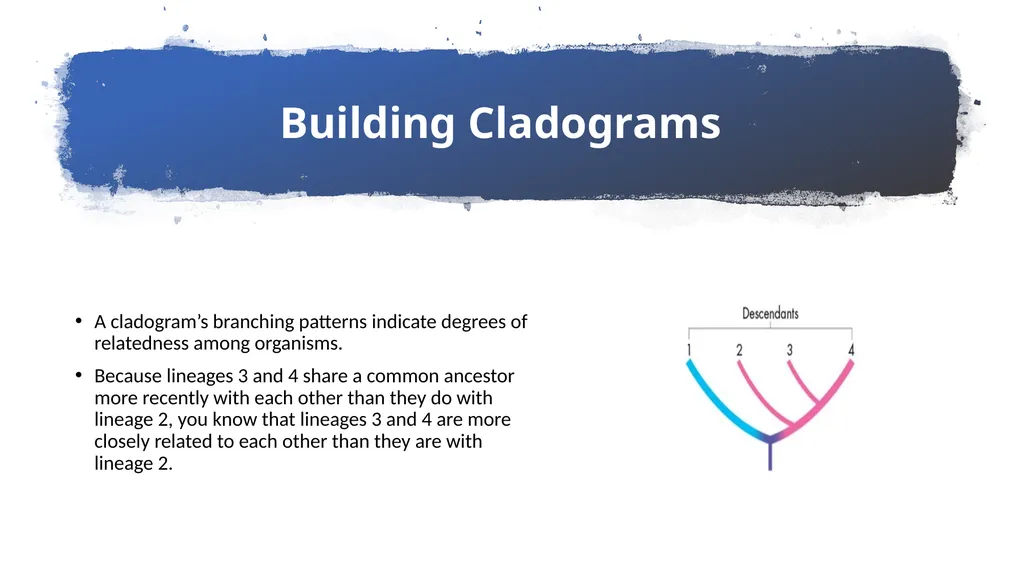
Building Cladograms A cladogram’s branching patterns indicate degrees of relatedness among organisms.
Because lineages 3 and 4 share a common ancestor more recently with each other than they do with lineage 2, you know that lineages 3 and 4 are more closely related to each other than they are with lineage 2.<br>
20
Genes as Derived Characters Similarities and differences in DNA can be used to develop hypotheses about evolutionary relationships.
In general, the more derived genetic characters two species share, the more recently they shared a common ancestor and the more closely they are related in evolutionary terms.<br>
21
The Tree of All Life<br>
22
The Tree of All Life<br>
23
iTOL: Interactive Tree of Life https://itol.embl.de/
Solution proposed by biologist David Hillis to convert the tree of life into a circular model instead of a branching “normal” style for cladograms, that would take up several pages.<br>