04
Political Systems 1 of 6 Learning Objective 2-1 Understand how the political systems of countries differ. Political systems:
Collectivism vs. individualism
Democratic vs. totalitarian<br>
05
Political Systems 2 of 6 Collectivism and Individualism
Collectivism
The needs of society as a whole are generally viewed as being more important than individual freedoms
Socialism
Karl Marx: The few benefit at the expense of the many in a capitalist society where individual freedoms are not restricted
Communists vs. social democrats
Privatization<br>
06
Political Systems 3 of 6 Collectivism and Individualism continued
Individualism
An individual should have freedom in his or her economic and political pursuits
The interests of the individual should take precedence over the interests of the state
Two tenets
Guarantee of individual freedom and self-expression
Welfare of society best served by letting people pursue their own economic self-interest<br>
07
Political Systems 4 of 6 Democracy and Totalitarianism
At different ends of a political dimension
Democracy and individualism go hand in hand, as do the communist version of collectivism and totalitarianism, with exceptions<br>
08
Political Systems 5 of 6 Democracy and Totalitarianism continued
Democracy
Representative democracy
Totalitarianism
Communist totalitarianism
Theocratic totalitarianism
Tribal totalitarianism
Right-wing totalitarianism<br>
09
Political Systems 6 of 6 Democracy and Totalitarianism continued
Pseudo-democracies
Lie between pure democracies and complete totalitarianism systems
Authoritarian elements have captured some or much of the machinery of state and use this in an attempt to deny basic political and civil liberties<br>
10
Economic Systems 1 of 3 Learning Objective 2-2 Understand how the economic systems of countries differ. Market Economy
All productive activities are privately owned
Production is determined by supply and demand
Government encourages vigorous free and fair competition<br>
11
Economic Systems 2 of 3 Command Economy
Government plans the good and services, quantity and price, then allocates them for “the good of society”
All businesses are state owned
Historically found in communist economies
No incentive for individuals to look for better ways to serve needs<br>
12
Economic Systems 3 of 3 Mixed Economy
Some sectors are privately owned, some are government owned
Once common in developed world, less so now
Government may aid troubled firms
U.S. helped Citigroup, General Motors<br>
13
Legal Systems 1 of 9 Learning Objective 2-3 Understand how the legal systems of countries differ. Legal Systems
Rules or laws that regulate behavior
Process through which laws are enforced
Redress for grievances
Influenced by the prevailing political system<br>
14
Legal Systems 2 of 9 Legal Systems continued
Different Legal Systems
Common Law
Tradition, precedent, custom
More flexible than other systems
Civil Law
Laws organized into codes
Less adversarial
Theocratic Law
Based on religious teachings
Most common is Islamic law<br>
15
Legal Systems 3 of 9 Differences in Contract Law
Governs the enforcement of contracts
Common law
Contracts are very detailed with all contingencies spelled out
More expensive and can be adversarial.
Civil law
Contracts tend to be much shorter and less specific<br>
16
Legal Systems 4 of 9 Differences in Contract Law continued
United Nations Convention on Contracts for the International Sale of Goods (CISG)
Establishes a uniform set of rules governing certain aspects of the making and performance of everyday commercial contracts between sellers and buyers who have their places of business in different nations
Applies automatically to all contracts for the sale of goods between different firms based in countries that have ratified the convention, unless the parties opt out<br>
17
Legal Systems 5 of 9 Property Rights and Corruption
Property is a resource that an individual or business owns
Land, buildings, equipment, capital, mineral rights, businesses, intellectual property
Most countries protect property rights<br>
18
Legal Systems 6 of 9 Property Rights and Corruption continued
Private action
Theft, piracy, blackmail
Public action and corruption
Public officials extort income, resources, or property
Levying excessive taxation, requiring expensive licenses or permits from property holders, taking assets into state ownership without compensating the owners, redistributing assets without compensating the prior owners
Corruption, demanding bribes<br>
19
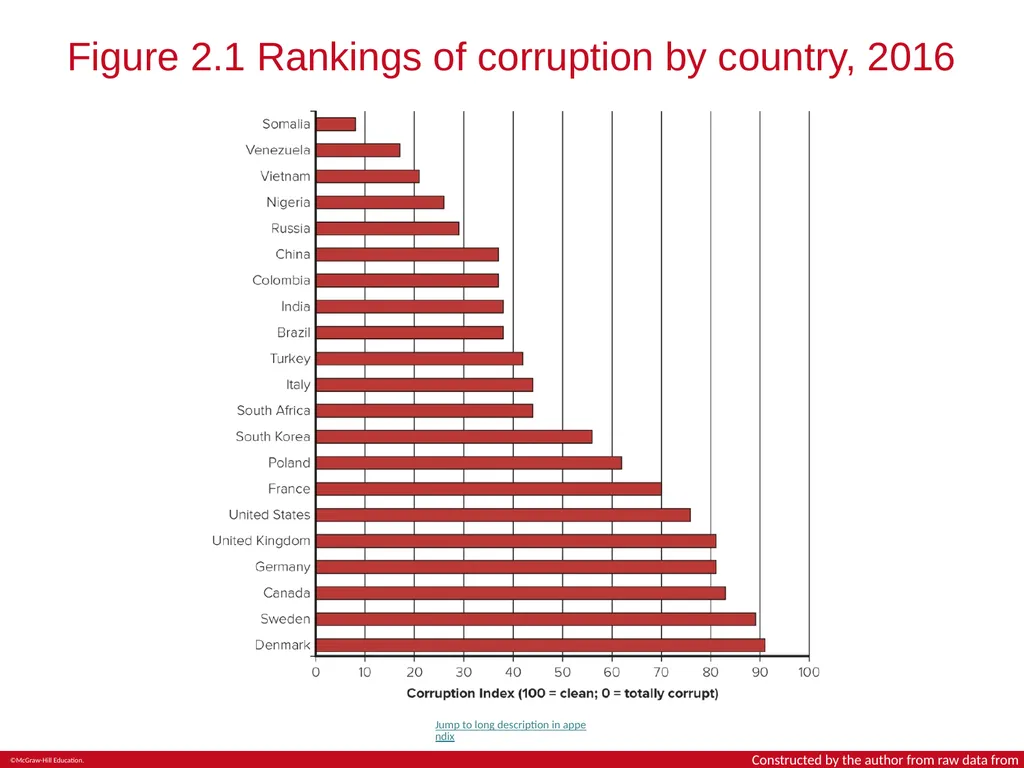
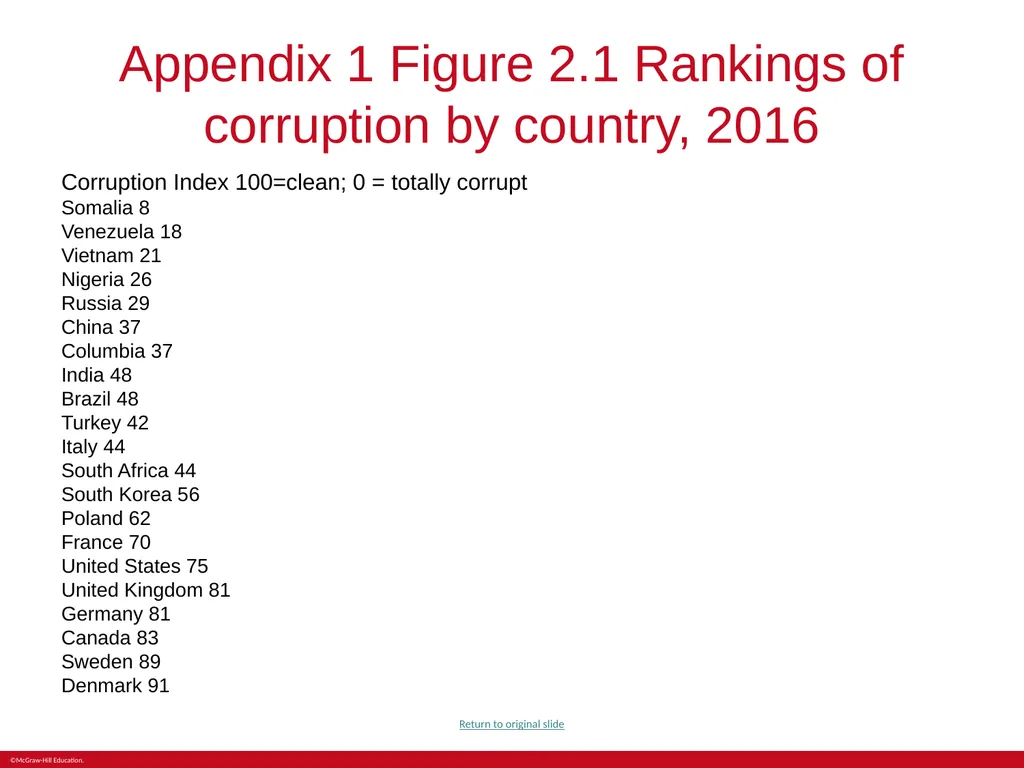
Figure 2.1 Rankings of corruption by country, 2016 Jump to long description in appendix Constructed by the author from raw data from Transparency International, Corruption Perceptions Index 2016.<br>
20
Legal Systems 7 of 9 Property Rights and Corruption continued
Foreign Corrupt Practices Act (FCPA)
Illegal to bribe a foreign government official to obtain or maintain business over which that foreign official has authority
Requires all publicly traded companies to keep detailed records that would reveal whether a violation of the act has occurred
Convention on Combating Bribery of Foreign Public Officials in International Business Transactions (1997)
Allows for facilitating or expediting payments<br>
21
Legal Systems 8 of 9 The Protection of Intellectual Property
Patent
Copyrights
Trademarks
World Intellectual Property Organization
Paris Convention for the Protection of Industrial Property<br>
22
Legal Systems 9 of 9 Product Safety and Product Liability
Product safety
Product liability
Greater if a product does not conform to safety standards
Criminal and civil laws apply<br>
23
Focus on Managerial Implications Learning Objective 2-4 Explain the implications for management practice of national differences in political economy. Two broad implications
Political, economic, and legal systems of a country raise important ethical issues that have implications for international business.
Political, economic, and legal environments of a country clearly influence the attractiveness of that country as a market or investment site.
A country with democratic political institutions, market-based economic system, and strong legal system clearly more attractive to do business in.<br>
24
Appendix of Image Long Descriptions<br>
25
Appendix 1 Figure 2.1 Rankings of corruption by country, 2016 Corruption Index 100=clean; 0 = totally corrupt
Somalia 8
Venezuela 18
Vietnam 21
Nigeria 26
Russia 29
China 37
Columbia 37
India 48
Brazil 48
Turkey 42
Italy 44
South Africa 44
South Korea 56
Poland 62
France 70
United States 75
United Kingdom 81
Germany 81
Canada 83
Sweden 89
Denmark 91 Return to original slide<br>