
Chapter 2: Number Systems Investigate the

Published  . 0 views
↓ Download
Chapter 2: Number Systems Investigate the
1 / 1
Chapter 2: Number Systems Investigate the - slide 1 of 10 Chapter 2: Number Systems Investigate the - slide 2 of 10 Chapter 2: Number Systems Investigate the - slide 3 of 10 Chapter 2: Number Systems Investigate the - slide 4 of 10 Chapter 2: Number Systems Investigate the - slide 5 of 10 Chapter 2: Number Systems Investigate the - slide 6 of 10 Chapter 2: Number Systems Investigate the - slide 7 of 10 Chapter 2: Number Systems Investigate the - slide 8 of 10 Chapter 2: Number Systems Investigate the - slide 9 of 10 Chapter 2: Number Systems Investigate the - slide 10 of 10
Description: Chapter 2: Number Systems Investigate the representation of numbers and arithmetic operations so that you can perform the operations of addition, subtraction, multiplication, and division and understand the relationship between these

Related Topics

Download Presentation

"Chapter 2: Number Systems Investigate the" is the property of its rightful owner. Permission is granted to download and print the materials on this website for personal, non-commercial use only, and to display it on your personal computer provided you do not modify the materials and that you retain all copyright notices contained in the materials. By downloading content from our website, you accept the terms of this agreement.

Presentation Transcript

slide1. Chapter 2: Number Systems Investigate the representation of numbers and arithmetic operations so that you can perform the operations of addition, subtraction, multiplication, and division and understand the relationship between these operations and the properties: commutative, associative and distributive in N, Z and Q and in R\Q, including operating on surds.<br>
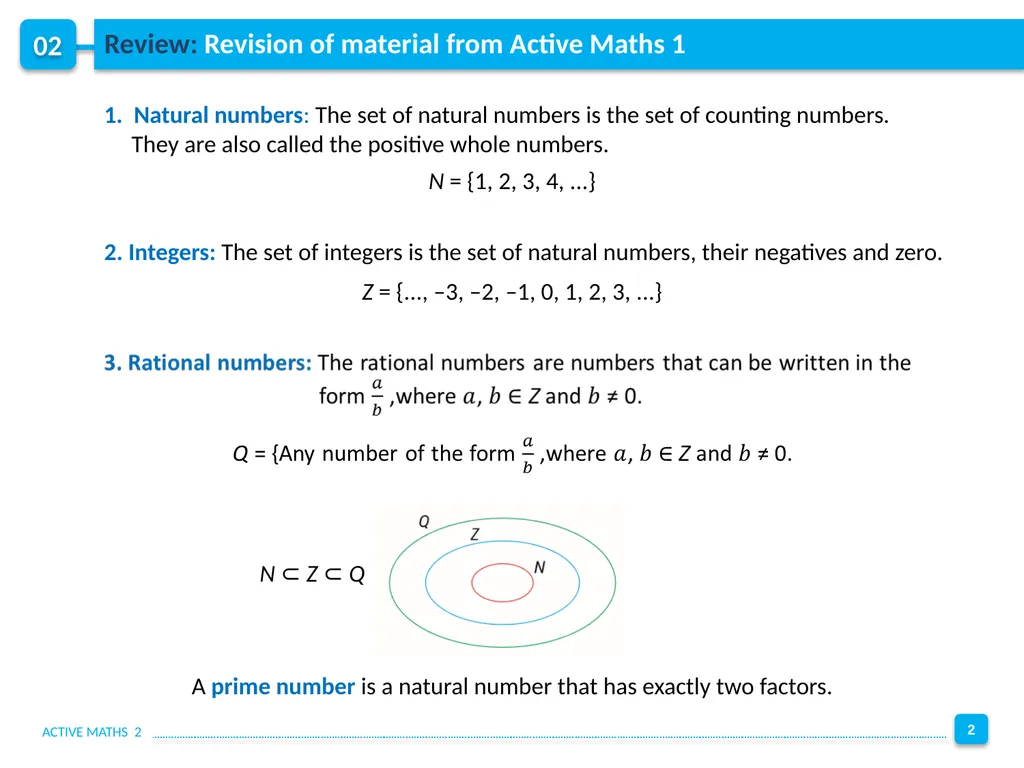
slide2. Review: Revision of material from Active Maths 1 1. Natural numbers: The set of natural numbers is the set of counting numbers. They are also called the positive whole numbers. N = {1, 2, 3, 4, ...} 2. Integers: The set of integers is the set of natural numbers, their negatives and zero. Z = {..., –3, –2, –1, 0, 1, 2, 3, ...} A prime number is a natural number that has exactly two factors.<br>
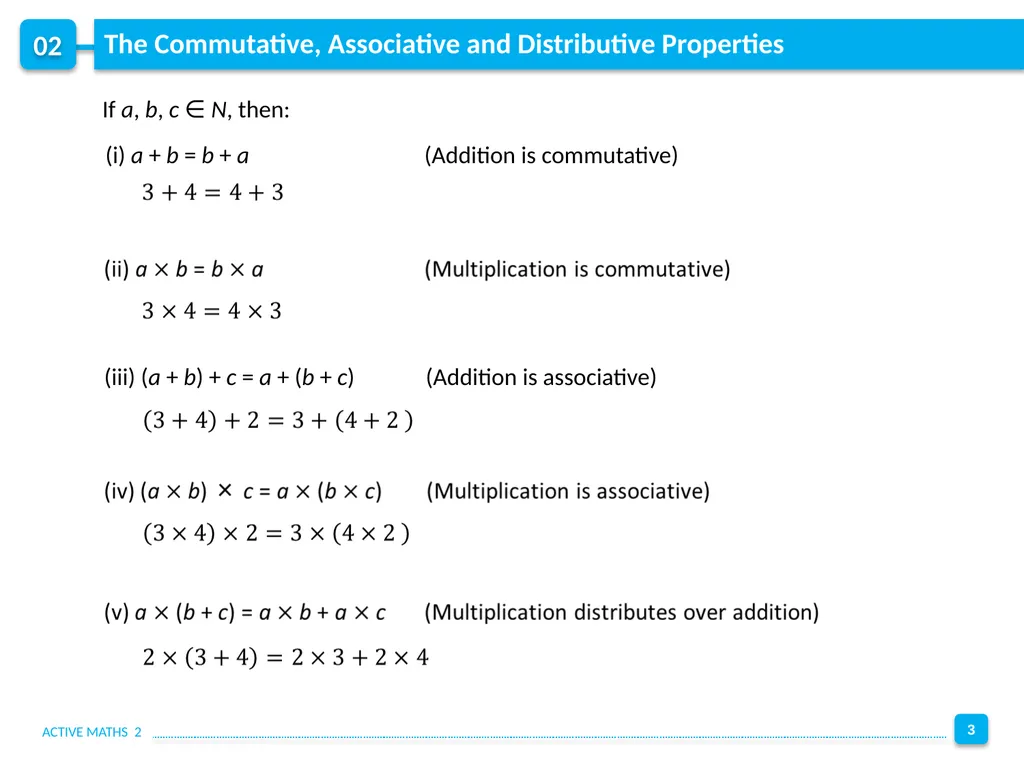
slide3. The Commutative, Associative and Distributive Properties If a, b, c ∈ N, then: (i) a + b = b + a (Addition is commutative) (iii) (a + b) + c = a + (b + c) (Addition is associative)<br>
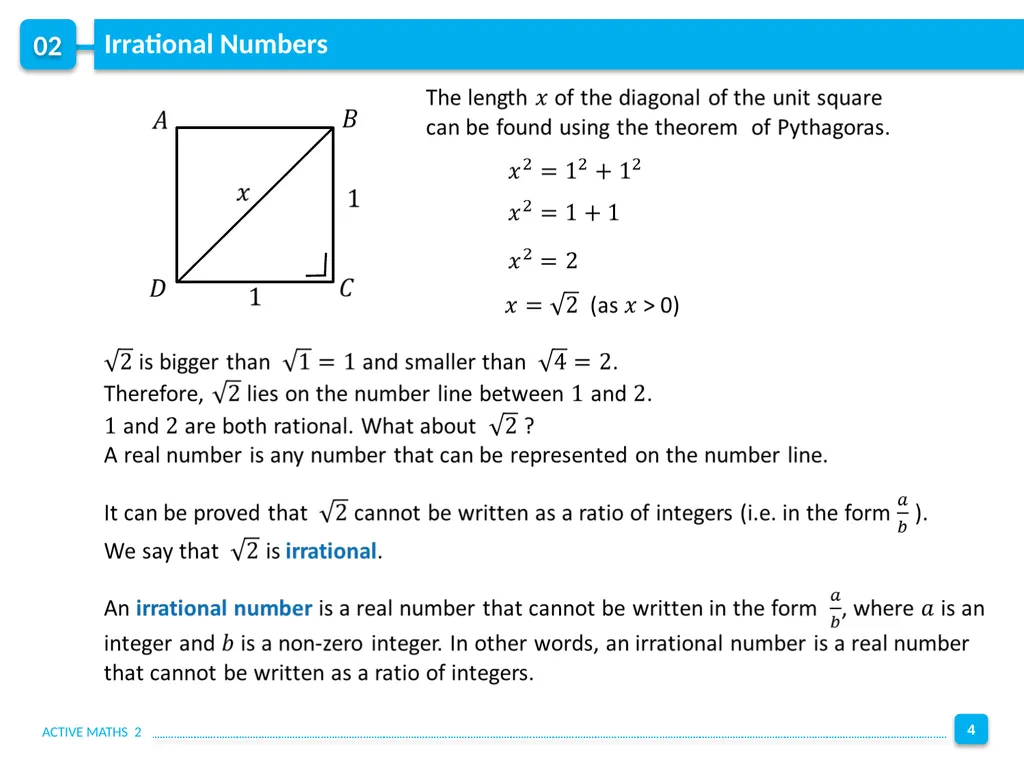
slide4. Irrational Numbers<br>
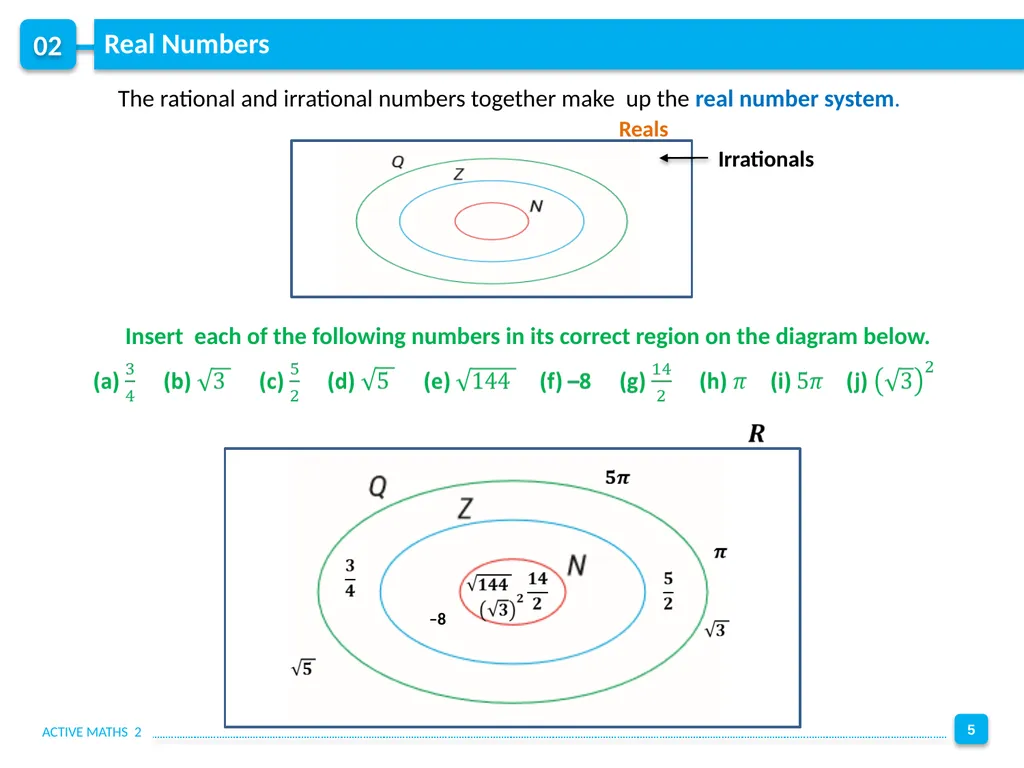
slide5. Real Numbers The rational and irrational numbers together make up the real number system. –8<br>
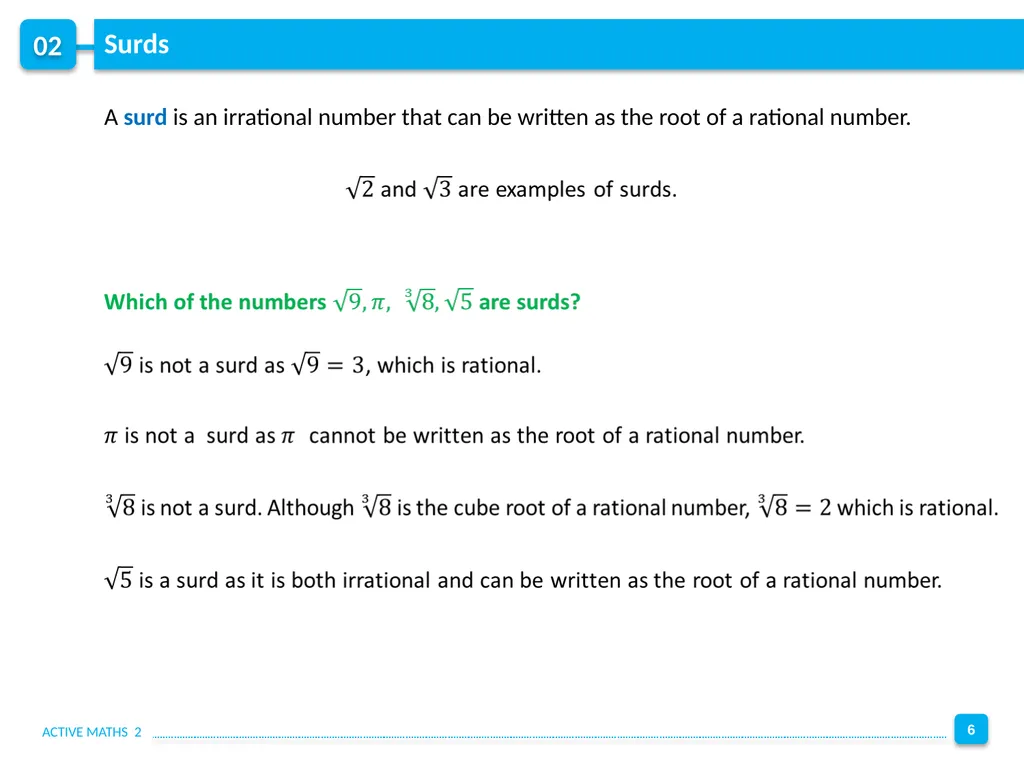
slide6. Surds A surd is an irrational number that can be written as the root of a rational number.<br>
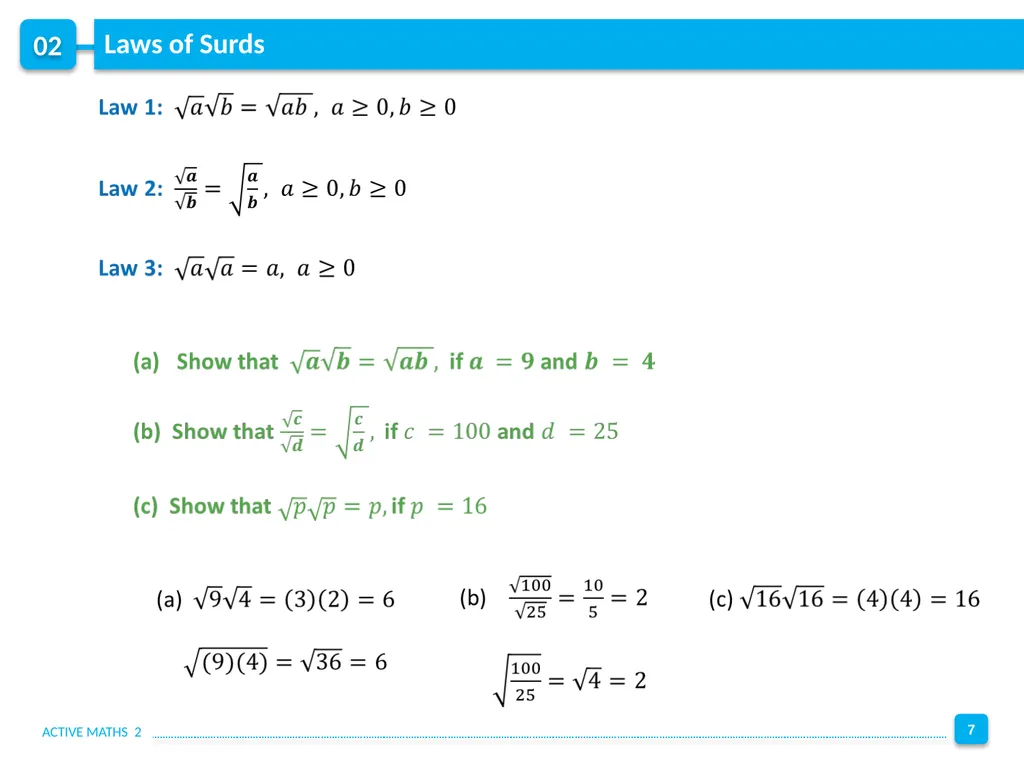
slide7. Laws of Surds<br>
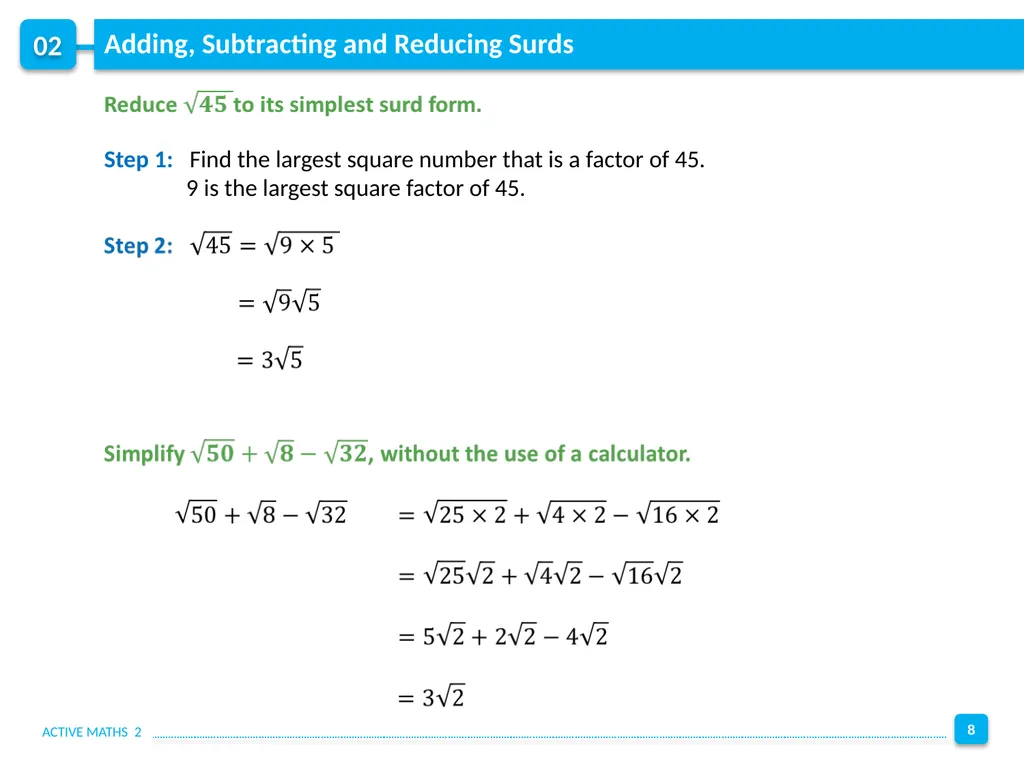
slide8. Adding, Subtracting and Reducing Surds Step 1: Find the largest square number that is a factor of 45. 9 is the largest square factor of 45.<br>
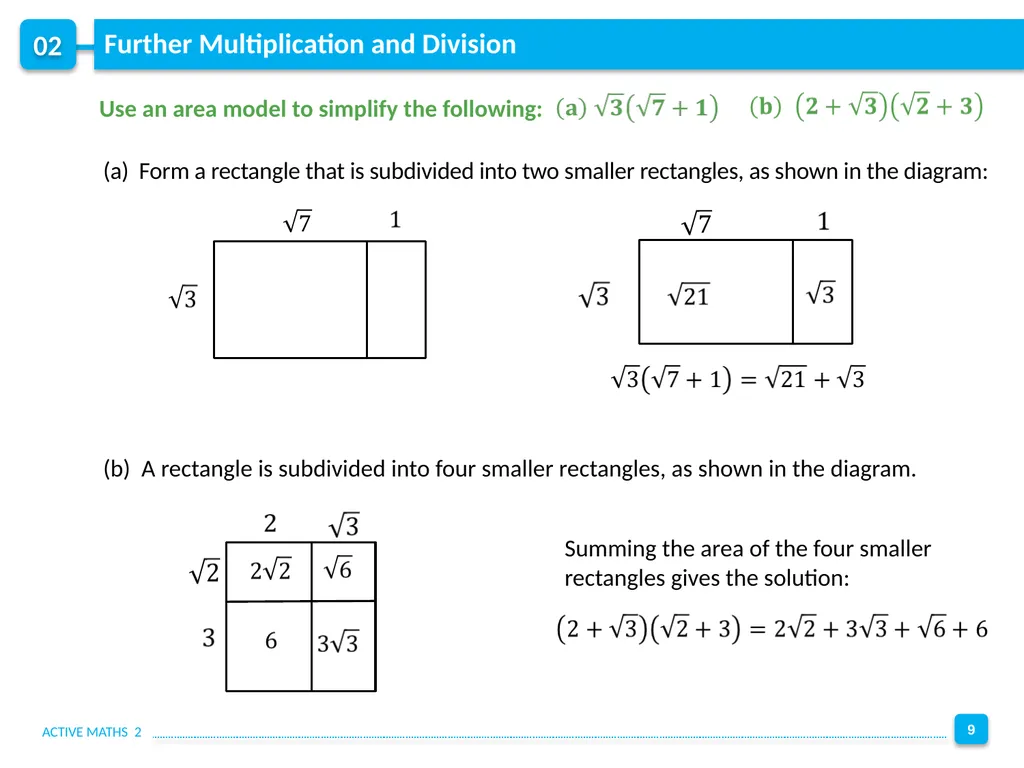
slide9. Further Multiplication and Division (a) Form a rectangle that is subdivided into two smaller rectangles, as shown in the diagram: (b) A rectangle is subdivided into four smaller rectangles, as shown in the diagram. Summing the area of the four smaller rectangles gives the solution:<br>
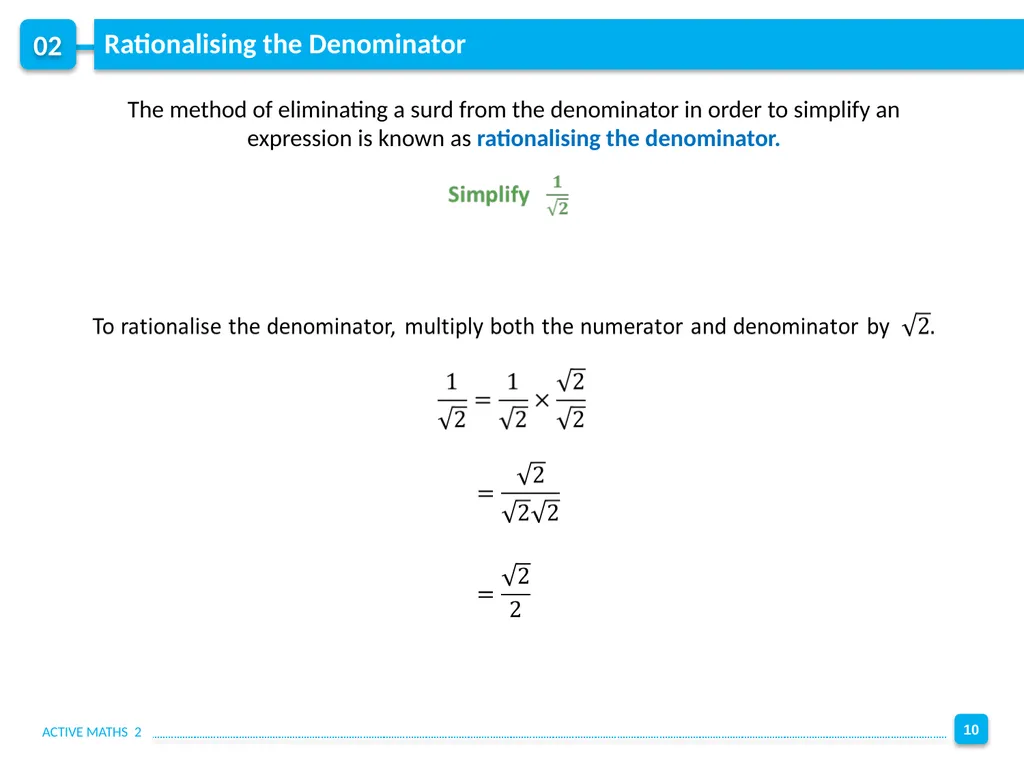
slide10. Rationalising the Denominator The method of eliminating a surd from the denominator in order to simplify an expression is known as rationalising the denominator.<br>