
Chapter 21 A Plea Bargaining Cr.P.C. 1973 History
EM
Published · 21 slides · 0 views

1 / 1
Description
Chapter 21 A Plea Bargaining Cr.P.C. 1973 History of Plea Bargaining It would be wrong to assume that the concept of Plea Bargaining found favor of courts only in the recent past. In fact it is used in the American Judiciary in 19thcentury
Related Topics
Share
Embed code
Download this presentation From Below
"Chapter 21 A Plea Bargaining Cr.P.C. 1973 History" is the property of its rightful owner. Permission is granted to download and print the materials on this website for personal, non-commercial use only, and to display it on your personal computer provided you do not modify the materials and that you retain all copyright notices contained in the materials. By downloading content from our website, you accept the terms of this agreement.
Presentation Transcript
01
Chapter 21 A
Plea Bargaining Cr.P.C. 1973<br>
02
History of Plea Bargaining It would be wrong to assume that the concept of Plea Bargaining found favor of courts only in the recent past. In fact it is used in the American Judiciary in 19thcentury itself. The bill of Rights makes no mention of the practice when establishing the fair trial principle in the sixth amendment but the constitutionality of the Plea Bargaining had constantly been upheld there. In the year 1969, James Earl Ray pleaded guilty to assassinating Martin Luthar King, Jr. to avoid execution sentence. He finally got an imprisonment of 99years.
More than 90 percent of the criminal cases in America are never tried. The majorities of the individuals who are accused of a crime give up their constitutional rights and plead guilty. Every minute, a criminal case is disposed off in an American Court by way of a guilty plea or Nolo Contendere Plea.<br>
03
Plea Bargaining The Doctrine of Nolo Contendere or Plea Bargaining has been introduced by Criminal Law Amendment Act, 2005. A new Chapter 21 A on Plea Bargaining was introduced in the Criminal Procedure Code, 1973. The term Plea Bargaining can be defined as pre-trial negotiations between the accused and the prosecution where the accused pleads guilty in exchange for certain concessions by the prosecution. The twin object of plea bargaining is to reduce the delay involved in criminal trial and to punish the accused with a lesser sentence for pleading his guilt.
* Nolo Contendere is a legal term that comes from the Latin phrase for "I do not wish to contend". It is also referred to as a plea of no contest.<br>
* Nolo Contendere is a legal term that comes from the Latin phrase for "I do not wish to contend". It is also referred to as a plea of no contest.<br>
04
Silent features of Plea Bargaining; 1.It is applicable in respect of those offences for which punishment is up to a period of 7 years.
2.It does not apply to cases where offence is committed against a woman or a child below the age of 14 years
3.When court passes an order in the case of plea bargaining no appeal shall lie to any court against that order.
4.It reduces the charge.
5.It drops multiple counts and press only one charge.
6.It makes recommendation to the courts about punishment or sentence.<br>
05
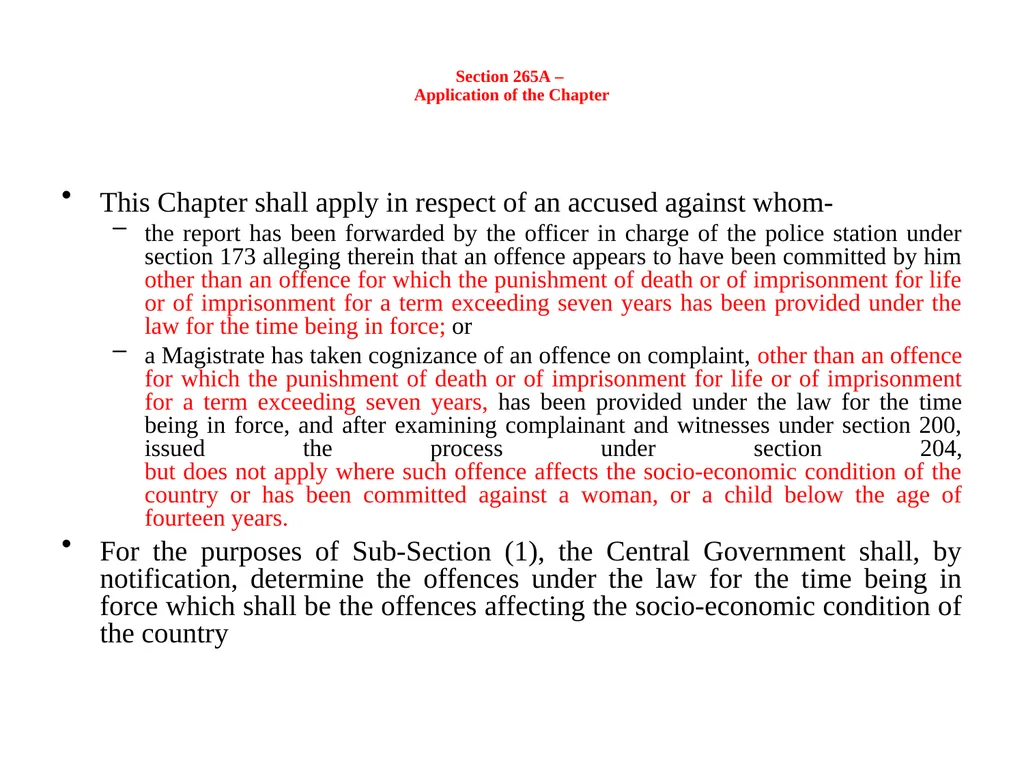
Section 265A –
Application of the Chapter This Chapter shall apply in respect of an accused against whom-
the report has been forwarded by the officer in charge of the police station under section 173 alleging therein that an offence appears to have been committed by him other than an offence for which the punishment of death or of imprisonment for life or of imprisonment for a term exceeding seven years has been provided under the law for the time being in force; or
a Magistrate has taken cognizance of an offence on complaint, other than an offence for which the punishment of death or of imprisonment for life or of imprisonment for a term exceeding seven years, has been provided under the law for the time being in force, and after examining complainant and witnesses under section 200, issued the process under section 204, but does not apply where such offence affects the socio-economic condition of the country or has been committed against a woman, or a child below the age of fourteen years.
For the purposes of Sub-Section (1), the Central Government shall, by notification, determine the offences under the law for the time being in force which shall be the offences affecting the socio-economic condition of the country<br>
06
265 A Plea Bargaining is applicable only in respect of offences for which punishment of imprisonment is upto seven years ;
It does not apply where the offence is in the nature of socio-economic crimes or has been committed against a woman or a child below the age of 14 years.<br>
It does not apply where the offence is in the nature of socio-economic crimes or has been committed against a woman or a child below the age of 14 years.<br>
07
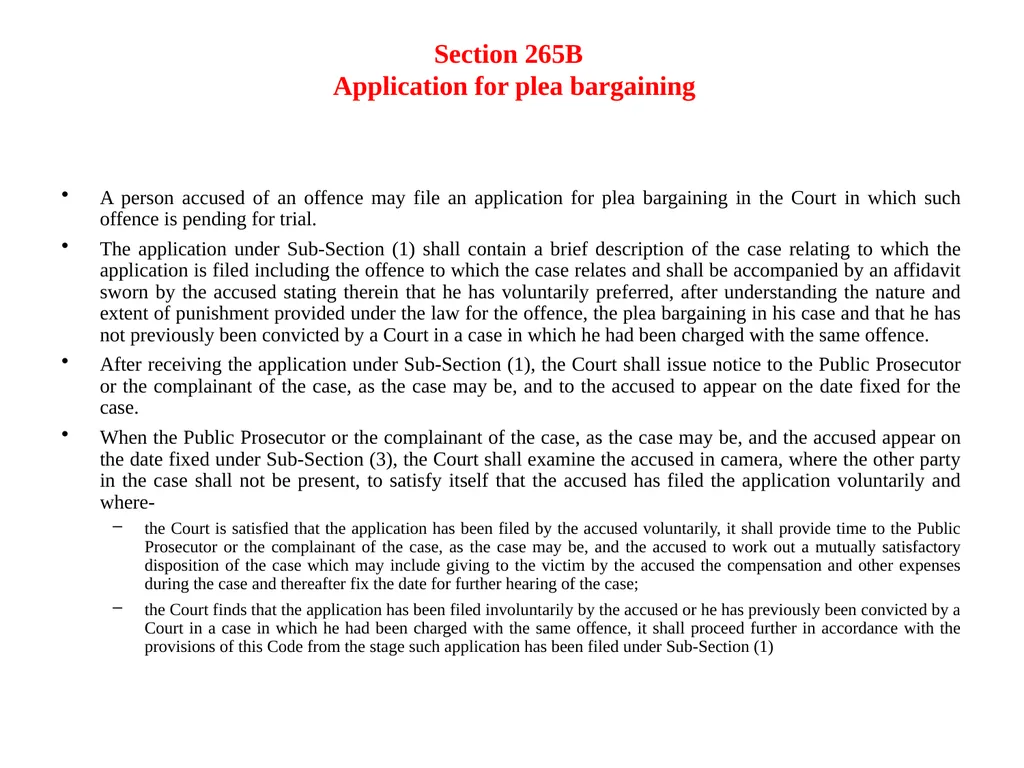
Section 265B
Application for plea bargaining A person accused of an offence may file an application for plea bargaining in the Court in which such offence is pending for trial.
The application under Sub-Section (1) shall contain a brief description of the case relating to which the application is filed including the offence to which the case relates and shall be accompanied by an affidavit sworn by the accused stating therein that he has voluntarily preferred, after understanding the nature and extent of punishment provided under the law for the offence, the plea bargaining in his case and that he has not previously been convicted by a Court in a case in which he had been charged with the same offence.
After receiving the application under Sub-Section (1), the Court shall issue notice to the Public Prosecutor or the complainant of the case, as the case may be, and to the accused to appear on the date fixed for the case.
When the Public Prosecutor or the complainant of the case, as the case may be, and the accused appear on the date fixed under Sub-Section (3), the Court shall examine the accused in camera, where the other party in the case shall not be present, to satisfy itself that the accused has filed the application voluntarily and where-
the Court is satisfied that the application has been filed by the accused voluntarily, it shall provide time to the Public Prosecutor or the complainant of the case, as the case may be, and the accused to work out a mutually satisfactory disposition of the case which may include giving to the victim by the accused the compensation and other expenses during the case and thereafter fix the date for further hearing of the case;
the Court finds that the application has been filed involuntarily by the accused or he has previously been convicted by a Court in a case in which he had been charged with the same offence, it shall proceed further in accordance with the provisions of this Code from the stage such application has been filed under Sub-Section (1)<br>
08
265 B This section requires that application for plea bargaining should be filed by the accused voluntarily. Such application has to be filed in the court in which offence of the accused is to be tried or is pending trial.<br>
09
Section 265C
Guidelines for mutually satisfactory disposition In working out a mutually satisfactory disposition under clause (a) of Sub-Section (4) of section 265B, the Court shall follow the following procedure, namely:
in a case instituted on a police report, the Court shall issue notice to the Public Prosecutor, the police officer who has investigated the case, the accused and the victim of the case to participate in the meeting to work out a satisfactory disposition of the case: Provided that throughout such process of working out a satisfactory disposition of the case, it shall be the duty of the Court to ensure that the entire process is completed voluntarily by the parties participating in the meeting: Provided further that the accused may, if he so desires, participate in such meeting with his pleader, if any, engaged in the case;
in a case instituted otherwise than on police report, the Court shall issue notice to the accused and the victim of the case to participate in a meeting to work out a satisfactory disposition of the case: Provided that it shall be the duty of the Court to ensure, throughout such process of working out a satisfactory disposition of the case, that it is completed voluntarily by the parties participating in the meeting: Provided further that if the victim of the case or the accused, as the case may be, so desires, he may participate in such meeting with his pleader engaged in the case<br>
10
265 C The section lays down the procedure when an application for plea bargaining has been filed by the accused before the trial court.<br>
11
Section 265D
Report of the mutually satisfactory disposition to be submitted before the Court Where in a meeting under section 265C, a satisfactory disposition of the case has been worked out, the Court shall prepare a report of such disposition which shall be signed by the presiding officer of the Court and all other persons who participated in the meeting and if no such disposition has been worked out, the Court shall record such observation and proceed further in accordance with the provisions of this Code from the stage the application under Sub-Section (1) of section 265B has been filed in such case<br>
12
Section 265E
Disposal of the case Where a satisfactory disposition of the case has been worked out under section 265D, the Court shall dispose of the case in the following manner, namely:
the Court shall award the compensation to the victim in accordance with the disposition under section 265D and hear the parties on the quantum of the punishment, releasing of the accused on probation of good conduct or after admonition under section 360 or for dealing with the accused under the provisions of the Probation of Offenders Act, 1958(20 of 1958) or any other law for the time being in force and follow the procedure specified in the succeeding clauses for imposing the punishment on the accused;
after hearing the parties under clause a), if the Court is of the view that section 360 or the provisions of the Probation of Offenders Act, 1958(20 of 1958) or any other law for the time being in force are attracted in the case of the accused, it may release the accused on probation or provide the benefit of any such law, as the case may be;
after hearing the parties under clause b), if the Court finds that minimum punishment has been provided under the law for the offence committed by the accused, it may sentence the accused to half of such minimum punishment;
in case after hearing the parties under clause b), the Court finds that the offence committed by the accused is not covered under clause b) or clause c), then, it may sentence the accused to one-fourth of the punishment provided or extendable, as the case may be, for such offence.<br>
13
265 E Once the court is convicted that the accused is participating in the plea bargaining voluntarily, it will allow time to both the parties i.e. the accused and the complainant/victim to reach a mutually satisfactory disposition, which may include giving to the victim by the accused, compensation and other expenses incurred during the case.
Where the satisfactory disposition of the case has been mutually worked out by the parties, the court will dispose of the case by sentencing the accused to one forth of the punishment provided or extendable as the case may be, in such offence.<br>
Where the satisfactory disposition of the case has been mutually worked out by the parties, the court will dispose of the case by sentencing the accused to one forth of the punishment provided or extendable as the case may be, in such offence.<br>
14
Section 265F
Judgment of the Court The Court shall deliver its judgment in terms of section 265E in the open Court and the same shall be signed by the presiding officer of the Court.<br>
15
Section 265G
Finality of the judgment The judgment delivered by the Court under section 265G shall be final and no appeal (except the special leave petition under article 136 and writ petition under articles 226 and 227 of the Constitution) shall lie in any Court against such judgment<br>
16
265 G The judgment delivered by the court in the case of plea bargaining shall be final and no separate appeal shall lie in any Court against such judgment expect by a special leave petition under Article 136 and writ petition under Articles 226 and 227 of the Constitution.<br>
17
Section 265H
Power of the Court in plea bargaining A Court shall have, for the purposes of discharging its functions under this Chapter, all the powers vested in respect of bail, trial of offences and other matters relating to the disposal of a cast in such Court under this Code<br>
18
Section 265 I
Period of detention undergone by the accused to be set off against the sentence of imprisonment The provisions of section 428 shall apply, for setting off the period of detention undergone by the accused against the sentence of imprisonment imposed under this Chapter, in the same manner as they apply in respect of the imprisonment under other provisions of this Code.<br>
19
Section 265J
Savings The provisions of this Chapter shall have effect notwithstanding anything inconsistent therewith contained in any other provisions of this Code and nothing in such other provisions shall be construed to constrain the meaning of any provision of this Chapter.
Explanation – For the purposes of this Chapter, the expression “Public Prosecutor” has the meaning assigned to it under clause (u) of section 2 and includes an Assistant Public Prosecutor appointed under section 25<br>
20
Section 265 K
Statements of accused not to be used Notwithstanding anything contained in any law for the time being in force, the statements or facts stated by an accused in an application for plea bargaining filed under section 265B shall not be used for any other purpose except for the purpose of this Chapter<br>
21
Section 265L
Non-application of the Chapter Nothing in this Chapter shall apply to any juvenile or child as defined in clause (k) of section 2 of the Juvenile Justice (Care and Protection of Children) Act, 2000 (56 of 2000).<br>