
Chapter 23 Safe Mobility Introduction Mobility is
JO
Published · 28 slides · 0 views
1 / 1
Description
Chapter 23 Safe Mobility Introduction Mobility is the most important aspect of physiologic function Maintenance for independence Risks affecting mobility Falls and fractures Safety is the integral aspect of mobility Age-Related Changes That
Related Topics
Share
Embed code
Download this presentation From Below
"Chapter 23 Safe Mobility Introduction Mobility is" is the property of its rightful owner. Permission is granted to download and print the materials on this website for personal, non-commercial use only, and to display it on your personal computer provided you do not modify the materials and that you retain all copyright notices contained in the materials. By downloading content from our website, you accept the terms of this agreement.
Presentation Transcript
01
Chapter 23
Safe Mobility<br>
02
Introduction Mobility is the most important aspect of physiologic function
Maintenance for independence
Risks affecting mobility
Falls and fractures
Safety is the integral aspect of mobility<br>
Maintenance for independence
Risks affecting mobility
Falls and fractures
Safety is the integral aspect of mobility<br>
03
Age-Related Changes That Affect
Mobility and Safety #1 Bones
Framework for musculoskeletal system
Age-related changes
Increased bone resorption, diminished calcium absorption, increased serum parathyroid hormone, impaired regulation of osteoblast activity, impaired bone formation secondary to reduced osteoblastic production, fewer functional marrow cells, and decreased estrogen in women and testosterone in men<br>
Framework for musculoskeletal system
Age-related changes
Increased bone resorption, diminished calcium absorption, increased serum parathyroid hormone, impaired regulation of osteoblast activity, impaired bone formation secondary to reduced osteoblastic production, fewer functional marrow cells, and decreased estrogen in women and testosterone in men<br>
04
Age-Related Changes That Affect
Mobility and Safety #2 Muscles
Directly affects all activities of daily living (ADLs)
Age-related changes
Decreased size and number of muscle fibers, loss of motor neurons, replacement of muscle tissue by connective tissue, deterioration of muscle cell membranes, diminished protein synthesis
Sarcopenia: loss of muscle mass, strength, and endurance<br>
Directly affects all activities of daily living (ADLs)
Age-related changes
Decreased size and number of muscle fibers, loss of motor neurons, replacement of muscle tissue by connective tissue, deterioration of muscle cell membranes, diminished protein synthesis
Sarcopenia: loss of muscle mass, strength, and endurance<br>
05
Age-Related Changes That Affect
Mobility and Safety #3 Joints and connective tissues
Harmed by continued use and begin to show wear and tear during early adulthood
Age-related changes
Diminished viscosity of synovial fluid, degeneration of collagen and elastin cells, fragmentation of fibrous structures in connective tissue, outgrowths of cartilaginous clusters, formation of scar tissue and areas of calcification in joint capsules and connective tissue, and degenerative changes in articular cartilage<br>
Harmed by continued use and begin to show wear and tear during early adulthood
Age-related changes
Diminished viscosity of synovial fluid, degeneration of collagen and elastin cells, fragmentation of fibrous structures in connective tissue, outgrowths of cartilaginous clusters, formation of scar tissue and areas of calcification in joint capsules and connective tissue, and degenerative changes in articular cartilage<br>
06
Age-Related Changes That Affect
Mobility and Safety #4 Nervous system
Age-related changes
Central and peripheral nervous system may be the primary mechanism in diminished muscle function
Maintenance of balance
Altered visual abilities, slower righting reflex, impaired proprioception, diminished vibratory and positioning sensations in lower extremities
Body sway: measure of motion of the body while standing<br>
Age-related changes
Central and peripheral nervous system may be the primary mechanism in diminished muscle function
Maintenance of balance
Altered visual abilities, slower righting reflex, impaired proprioception, diminished vibratory and positioning sensations in lower extremities
Body sway: measure of motion of the body while standing<br>
07
Age-Related Changes That Affect
Mobility and Safety #5 Osteopenia and osteoporosis
Loss of bone: age-related change
Bone density: amount of minerals in bone
Scored according to standard deviations
T-score: between 1 and 2.5 diagnosis is osteopenia
Lower T-score is diagnosis of osteoporosis
Osteoporosis: silent disease
Fragility fracture: little to no trauma<br>
Loss of bone: age-related change
Bone density: amount of minerals in bone
Scored according to standard deviations
T-score: between 1 and 2.5 diagnosis is osteopenia
Lower T-score is diagnosis of osteoporosis
Osteoporosis: silent disease
Fragility fracture: little to no trauma<br>
08
Question #1 Is the following statement true or false?
Exercise programs to increase strength and endurance in the older adult population may help delay the onset of the age-related functional consequences of decreased strength and endurance<br>
Exercise programs to increase strength and endurance in the older adult population may help delay the onset of the age-related functional consequences of decreased strength and endurance<br>
09
Answer to Question #1 True
Age-related changes in skeletal muscles, which are controlled by motor neurons, directly affect all activities of daily living. The end result of these age-related changes is a decline in motor function and a loss of strength and endurance, even in healthy older adults. Exercise programs to increase strength and endurance may help delay the onset of the age-related consequences of disability and loss of function<br>
Age-related changes in skeletal muscles, which are controlled by motor neurons, directly affect all activities of daily living. The end result of these age-related changes is a decline in motor function and a loss of strength and endurance, even in healthy older adults. Exercise programs to increase strength and endurance may help delay the onset of the age-related consequences of disability and loss of function<br>
10
Question #2 Which statement about osteoporosis is true?
Primary osteoporosis occurs with pathologic problems
Secondary osteoporosis occurs as a result of age-related changes
Osteoporosis can cause serious negative functional consequences even in the absence of additional risk factors
Estrogen levels have a minimal impact on the development of osteoporosis<br>
Primary osteoporosis occurs with pathologic problems
Secondary osteoporosis occurs as a result of age-related changes
Osteoporosis can cause serious negative functional consequences even in the absence of additional risk factors
Estrogen levels have a minimal impact on the development of osteoporosis<br>
11
Answer to Question #2 C. Osteoporosis can cause serious negative functional consequences even in the absence of additional risk factors
Osteoporosis is a gradual loss of bone mass that affects all adults to some degree and is strongly associated with low-trauma fractures in older adults. Osteoporosis is classified as primary when it is associated with age-related changes and as secondary when it is caused by medications or pathologic disturbances<br>
Osteoporosis is a gradual loss of bone mass that affects all adults to some degree and is strongly associated with low-trauma fractures in older adults. Osteoporosis is classified as primary when it is associated with age-related changes and as secondary when it is caused by medications or pathologic disturbances<br>
12
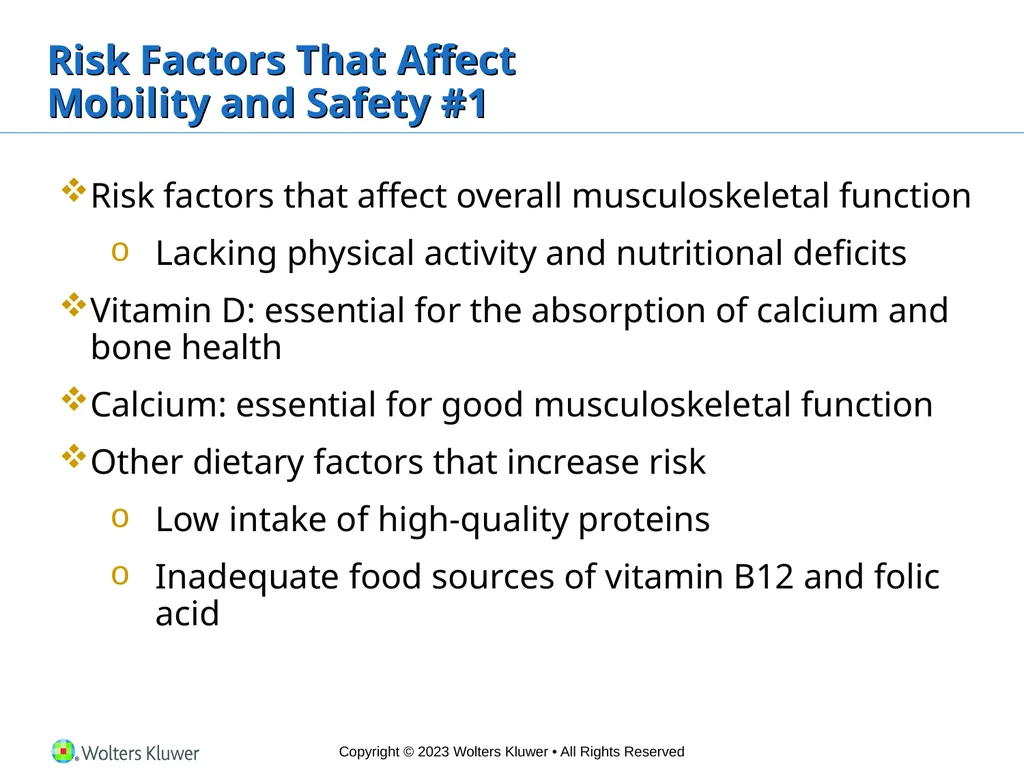
Risk Factors That Affect
Mobility and Safety #1 Risk factors that affect overall musculoskeletal function
Lacking physical activity and nutritional deficits
Vitamin D: essential for the absorption of calcium and bone health
Calcium: essential for good musculoskeletal function
Other dietary factors that increase risk
Low intake of high-quality proteins
Inadequate food sources of vitamin B12 and folic acid<br>
Lacking physical activity and nutritional deficits
Vitamin D: essential for the absorption of calcium and bone health
Calcium: essential for good musculoskeletal function
Other dietary factors that increase risk
Low intake of high-quality proteins
Inadequate food sources of vitamin B12 and folic acid<br>
13
Risk Factors That Affect
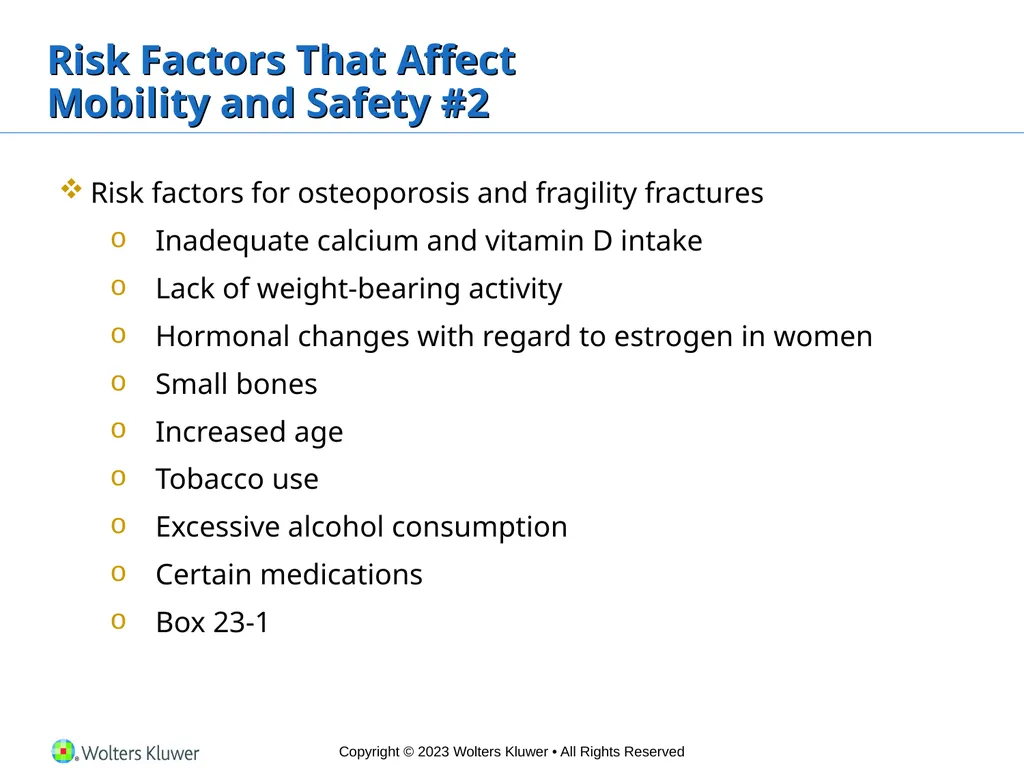
Mobility and Safety #2 Risk factors for osteoporosis and fragility fractures
Inadequate calcium and vitamin D intake
Lack of weight-bearing activity
Hormonal changes with regard to estrogen in women
Small bones
Increased age
Tobacco use
Excessive alcohol consumption
Certain medications
Box 23-1<br>
Inadequate calcium and vitamin D intake
Lack of weight-bearing activity
Hormonal changes with regard to estrogen in women
Small bones
Increased age
Tobacco use
Excessive alcohol consumption
Certain medications
Box 23-1<br>
14
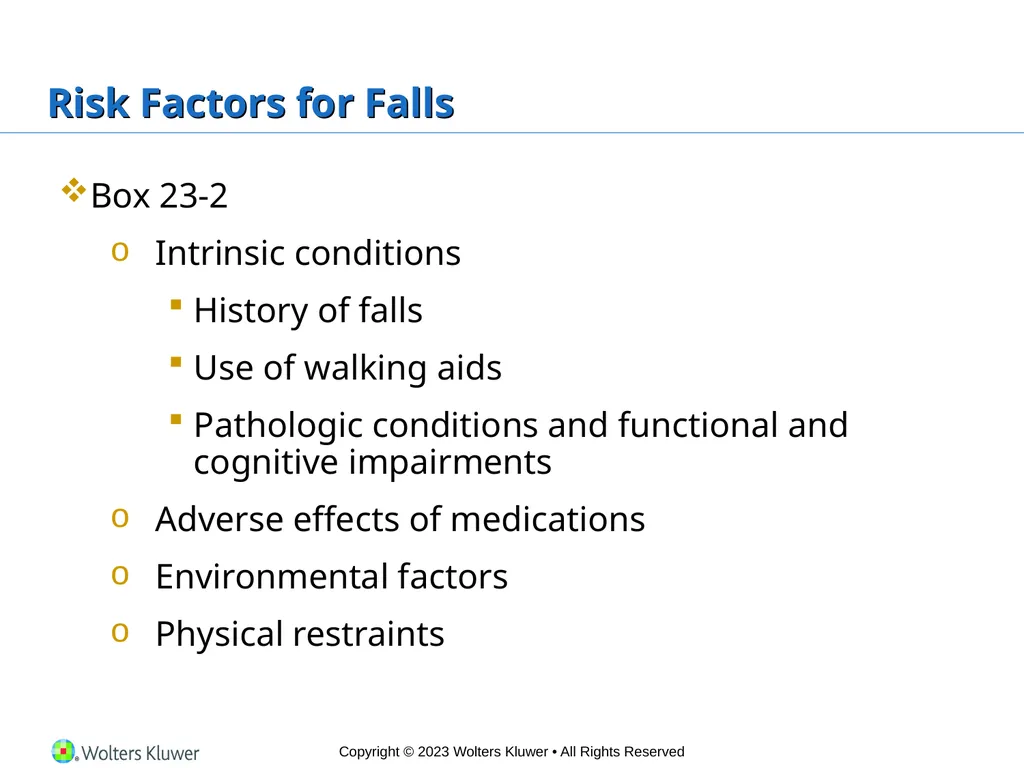
Risk Factors for Falls Box 23-2
Intrinsic conditions
History of falls
Use of walking aids
Pathologic conditions and functional and cognitive impairments
Adverse effects of medications
Environmental factors
Physical restraints<br>
Intrinsic conditions
History of falls
Use of walking aids
Pathologic conditions and functional and cognitive impairments
Adverse effects of medications
Environmental factors
Physical restraints<br>
15
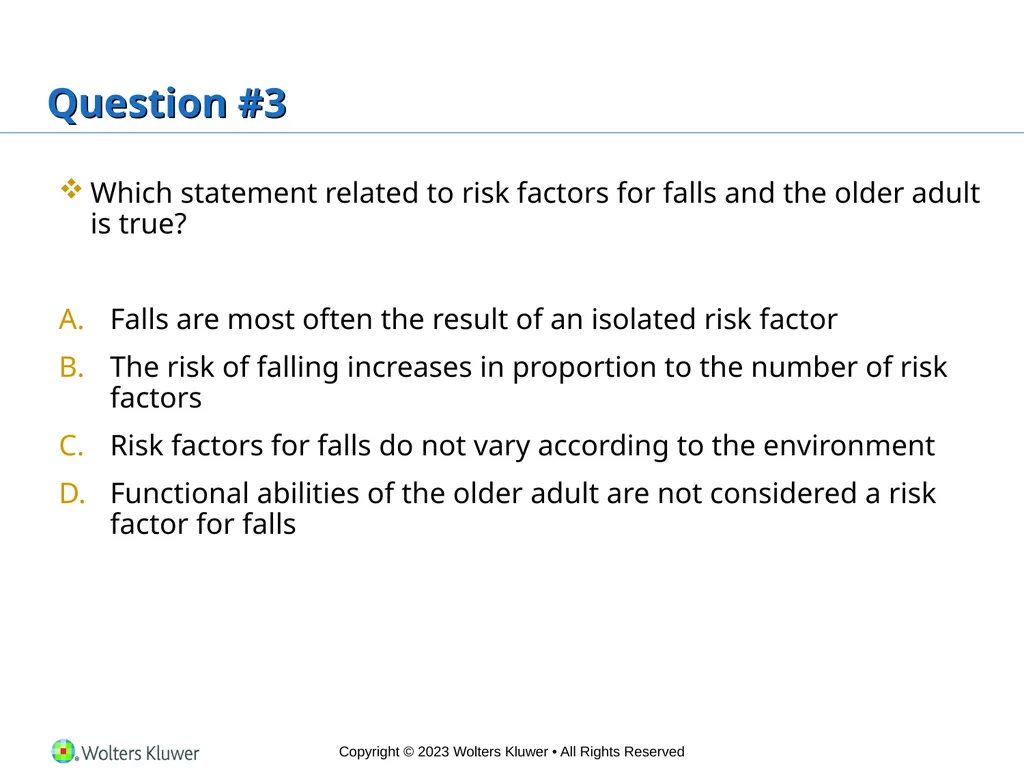
Question #3 Which statement related to risk factors for falls and the older adult is true?
Falls are most often the result of an isolated risk factor
The risk of falling increases in proportion to the number of risk factors
Risk factors for falls do not vary according to the environment
Functional abilities of the older adult are not considered a risk factor for falls<br>
Falls are most often the result of an isolated risk factor
The risk of falling increases in proportion to the number of risk factors
Risk factors for falls do not vary according to the environment
Functional abilities of the older adult are not considered a risk factor for falls<br>
16
Answer to Question #3 B. The risk of falling increases in proportion to the number of risk factors
Falls are the result of a combination of risk factors rather than one isolated risk factor, and the risk of falls increases in proportion to the number of risk factors<br>
Falls are the result of a combination of risk factors rather than one isolated risk factor, and the risk of falls increases in proportion to the number of risk factors<br>
17
Functional Consequences Affecting Musculoskeletal Wellness Effects on musculoskeletal function
Diminished muscle strength, endurance, and coordination, increased difficulty performing ADLs
Susceptibility to falls and fractures
Osteoporotic fractures, increases with age, serious consequences
Fear of falling
Excessive anxiety about falling<br>
Diminished muscle strength, endurance, and coordination, increased difficulty performing ADLs
Susceptibility to falls and fractures
Osteoporotic fractures, increases with age, serious consequences
Fear of falling
Excessive anxiety about falling<br>
18
Pathologic Condition Affecting Musculoskeletal Function: Osteoarthritis Osteoarthritis: degenerative inflammatory disease affecting joints and attached muscles, tendons, and ligaments
Characterized by pain, swelling, and limited movement of joints
Leading cause of disability
Risk factors
Trauma, genetics, obesity, and age-related changes
Focus: self-care health education interventions<br>
Characterized by pain, swelling, and limited movement of joints
Leading cause of disability
Risk factors
Trauma, genetics, obesity, and age-related changes
Focus: self-care health education interventions<br>
19
Question #4 Which statement related to musculoskeletal function and the older adult population is true?
There is a greater decline in muscle strength in the upper extremities
Diminished muscle strength is attributed primarily to age-related loss of muscle mass
Older adults experience muscle fatigue after longer periods of exercise than do younger adults
Lifelong patterns of exercise and activity have little effect on muscle strength<br>
There is a greater decline in muscle strength in the upper extremities
Diminished muscle strength is attributed primarily to age-related loss of muscle mass
Older adults experience muscle fatigue after longer periods of exercise than do younger adults
Lifelong patterns of exercise and activity have little effect on muscle strength<br>
20
Answer to Question #4 B. Diminished muscle strength is attributed primarily to age-related loss of muscle mass
Beginning at about the age of 40 years, muscle strength declines gradually, resulting in an overall decrease of 30% to 50% by the age of 80 years, with a greater decline in muscle strength in the lower extremities than in the upper extremities<br>
Beginning at about the age of 40 years, muscle strength declines gradually, resulting in an overall decrease of 30% to 50% by the age of 80 years, with a greater decline in muscle strength in the lower extremities than in the upper extremities<br>
21
Nursing Assessment of
Musculoskeletal Function Assessment of overall musculoskeletal performance
Assessing musculoskeletal performance
Box 23-3
Identifying risks for osteoporosis
Boxes 23-1 and 23-3
Identifying risks for falls and injury
Box 23-3
Falls risk assessment tools
Assessing fear of falling<br>
Assessing musculoskeletal performance
Box 23-3
Identifying risks for osteoporosis
Boxes 23-1 and 23-3
Identifying risks for falls and injury
Box 23-3
Falls risk assessment tools
Assessing fear of falling<br>
22
Nursing Interventions for Musculoskeletal Wellness #1 Promoting healthy musculoskeletal function
Balance, endurance, mobility, activity tolerance
Risk control, risk detection
Safety behavior: fall prevention, home physical environment
Coping, fear control, comfort level
Teaching about osteoporosis
Box 23-4<br>
Balance, endurance, mobility, activity tolerance
Risk control, risk detection
Safety behavior: fall prevention, home physical environment
Coping, fear control, comfort level
Teaching about osteoporosis
Box 23-4<br>
23
Nursing Interventions for Musculoskeletal Wellness #2 Implementing fall prevention programs
Eliminating risks
Using monitoring devices
Addressing contributing factors
Preventing fall-related injuries and death
Hip protectors
Environmental interventions
Addressing fear of falling<br>
Eliminating risks
Using monitoring devices
Addressing contributing factors
Preventing fall-related injuries and death
Hip protectors
Environmental interventions
Addressing fear of falling<br>
24
Preventing Falls and Fall-Related Injuries #1 Conducting a fall risk assessment
Developing a personalized fall prevention plan
Consistently implementing the plan
Interventions in health care settings
Interventions in community settings
Box 23-6<br>
Developing a personalized fall prevention plan
Consistently implementing the plan
Interventions in health care settings
Interventions in community settings
Box 23-6<br>
25
Preventing Falls and Fall-Related Injuries #2 Addressing intrinsic risk factors
Addressing extrinsic risk factors
Using monitoring devices in institutional settings
Providing assistance in independent settings
Preventing fall-related injuries
Addressing fear of falling
Promoting caregiver wellness
Box 23-7<br>
Addressing extrinsic risk factors
Using monitoring devices in institutional settings
Providing assistance in independent settings
Preventing fall-related injuries
Addressing fear of falling
Promoting caregiver wellness
Box 23-7<br>
26
Question #5 Which statement related to adequate calcium supplementation and the older adult is true?
Calcium supplements are rarely necessary
Calcium supplementation lowers the rate of fractures in older adults
Calcium supplements have few detrimental effects when taken by older adults
Absorption of calcium supplements is optimal at 1500 mg per dose<br>
Calcium supplements are rarely necessary
Calcium supplementation lowers the rate of fractures in older adults
Calcium supplements have few detrimental effects when taken by older adults
Absorption of calcium supplements is optimal at 1500 mg per dose<br>
27
Answer to Question #5 B. Calcium supplementation lowers the rate of fractures in older adults
A recent report from the U.S. Surgeon General recommended a pyramidal treatment approach to osteoporosis that includes physical activity, fall prevention, and supplementation with calcium and vitamin D as the foundation for fracture prevention. Absorption of calcium supplements is optimal at not more than 600 mg per dose<br>
A recent report from the U.S. Surgeon General recommended a pyramidal treatment approach to osteoporosis that includes physical activity, fall prevention, and supplementation with calcium and vitamin D as the foundation for fracture prevention. Absorption of calcium supplements is optimal at not more than 600 mg per dose<br>
28
Wellness Outcomes (Positive Functional Consequences) Evaluation based on person’s ability to achieve and maintain highest possible level of independence and safe mobility
Incorporation of preventive measures in daily life to ensure safety and prevent osteoporosis
Expressed feelings of safety and improved quality of life
Evaluation of risk factors<br>
Incorporation of preventive measures in daily life to ensure safety and prevent osteoporosis
Expressed feelings of safety and improved quality of life
Evaluation of risk factors<br>