
Chapter 33 Estimating Potential Harm and Planning
AM
Published · 86 slides · 0 views
1 / 1
Description
Chapter 33 Estimating Potential Harm and Planning a Response Objectives: Hazardous Materials Operations Level Explain how to estimate the potential harm or severity of an incident. Explain how exposures might be affected by various types of
Related Topics
Share
Embed code
Download this presentation From Below
"Chapter 33 Estimating Potential Harm and Planning" is the property of its rightful owner. Permission is granted to download and print the materials on this website for personal, non-commercial use only, and to display it on your personal computer provided you do not modify the materials and that you retain all copyright notices contained in the materials. By downloading content from our website, you accept the terms of this agreement.
Presentation Transcript
01
Chapter 33 Estimating Potential Harm and Planning a Response<br>
02
Objectives: Hazardous Materials Operations Level Explain how to estimate the potential harm or severity of an incident.
Explain how exposures might be affected by various types of hazardous materials incidents.
Describe how to plan an initial response.
Describe how to select personal protective equipment (PPE) for an incident.<br>
Explain how exposures might be affected by various types of hazardous materials incidents.
Describe how to plan an initial response.
Describe how to select personal protective equipment (PPE) for an incident.<br>
03
Objectives: Hazardous Materials Operations Level Identify and describe the types of PPE needed for hazardous materials incidents.
Identify and describe the four chemical-protective clothing ratings.
Explain the role of respiratory protection.
Describe the basic types of decontamination.<br>
Identify and describe the four chemical-protective clothing ratings.
Explain the role of respiratory protection.
Describe the basic types of decontamination.<br>
04
Introduction Response objectives
Ensure your own safety.
Address potential life safety of persons affected or potentially affected by the incident.<br>
Ensure your own safety.
Address potential life safety of persons affected or potentially affected by the incident.<br>
05
Estimating the Potential Harm or Severity of the Incident Incident response objectives should be based on the need to protect or reduce the threat to
Life
Property
Critical systems
Environment<br>
Life
Property
Critical systems
Environment<br>
06
Toxicological Data Organizations that establish and publish toxicological data
American Conference of Governmental Industrial Hygienists (ACGIH)
Introduced threshold limit value (TLV)
Occupational Safety and Health Administration (OSHA)
Sets permissible exposure limit (PEL)
OSHA standards are the law<br>
American Conference of Governmental Industrial Hygienists (ACGIH)
Introduced threshold limit value (TLV)
Occupational Safety and Health Administration (OSHA)
Sets permissible exposure limit (PEL)
OSHA standards are the law<br>
07
Toxicological Values Expressed in units of
Parts per million (ppm)
Parts per billion (ppb)
Parts per trillion (ppt)
Contamination levels for fibers and dusts are expressed through units of milligrams per cubic meter (mg/m3)
The lower the value, the more toxic the product<br>
Parts per million (ppm)
Parts per billion (ppb)
Parts per trillion (ppt)
Contamination levels for fibers and dusts are expressed through units of milligrams per cubic meter (mg/m3)
The lower the value, the more toxic the product<br>
08
Toxicological Values Threshold limit values
Threshold limit value/short-term exposure limit (TLV/STEL)
Threshold limit value/time-weighted average (TLV/TWA)
Threshold limit value/ceiling (TLV/C)
Threshold limit value/skin (TLV/S)<br>
Threshold limit value/short-term exposure limit (TLV/STEL)
Threshold limit value/time-weighted average (TLV/TWA)
Threshold limit value/ceiling (TLV/C)
Threshold limit value/skin (TLV/S)<br>
09
Toxicological Values Recommended exposure level (REL)
Established by the National Institute for Occupational Safety and Health (NIOSH)
Comparable to OSHA’s PEL
Immediately dangerous to life and health (IDLH)
Atmospheric concentration of a substance poses an immediate or delayed threat to life or could cause irreversible adverse effects or interfere with an individual’s ability to escape unaided from a hazardous environment<br>
Established by the National Institute for Occupational Safety and Health (NIOSH)
Comparable to OSHA’s PEL
Immediately dangerous to life and health (IDLH)
Atmospheric concentration of a substance poses an immediate or delayed threat to life or could cause irreversible adverse effects or interfere with an individual’s ability to escape unaided from a hazardous environment<br>
10
Applying Exposure Values Use exposure guidelines to identify environments
Green environments
Low hazard, low risk
Yellow environments
Transitional
Red environments
High hazard, high risk<br>
Green environments
Low hazard, low risk
Yellow environments
Transitional
Red environments
High hazard, high risk<br>
11
Applying Exposure Values Understand why and how you will interact with the problem
Safe atmosphere
No harmful hazardous materials effects exist
Unsafe atmosphere
Hazardous material no longer contained
Potential for acute or chronic injury from exposure
Dangerous atmosphere
Serious injury or death may occur without PPE<br>
Safe atmosphere
No harmful hazardous materials effects exist
Unsafe atmosphere
Hazardous material no longer contained
Potential for acute or chronic injury from exposure
Dangerous atmosphere
Serious injury or death may occur without PPE<br>
12
Resources for Determining the Size of the Incident Computer programs can model and predict the size and direction of vapor clouds.
Emergency Response Guidebook (ERG)
Outlines predetermined evacuation distances and basic action plans
Suggests stand-off distances for improvised explosive devices (IEDs) and BLEVE (boiling liquid expanding vapor explosion) situations<br>
Emergency Response Guidebook (ERG)
Outlines predetermined evacuation distances and basic action plans
Suggests stand-off distances for improvised explosive devices (IEDs) and BLEVE (boiling liquid expanding vapor explosion) situations<br>
13
Exposures Include any people, property, structures, or environments subject to influence, damage, or injury from contact with a hazardous material or weapons of mass destruction (WMD)
Number of exposures determined by
Location of incident
Physical and chemical properties of substance
Amount of progress made in protecting exposures<br>
Number of exposures determined by
Location of incident
Physical and chemical properties of substance
Amount of progress made in protecting exposures<br>
14
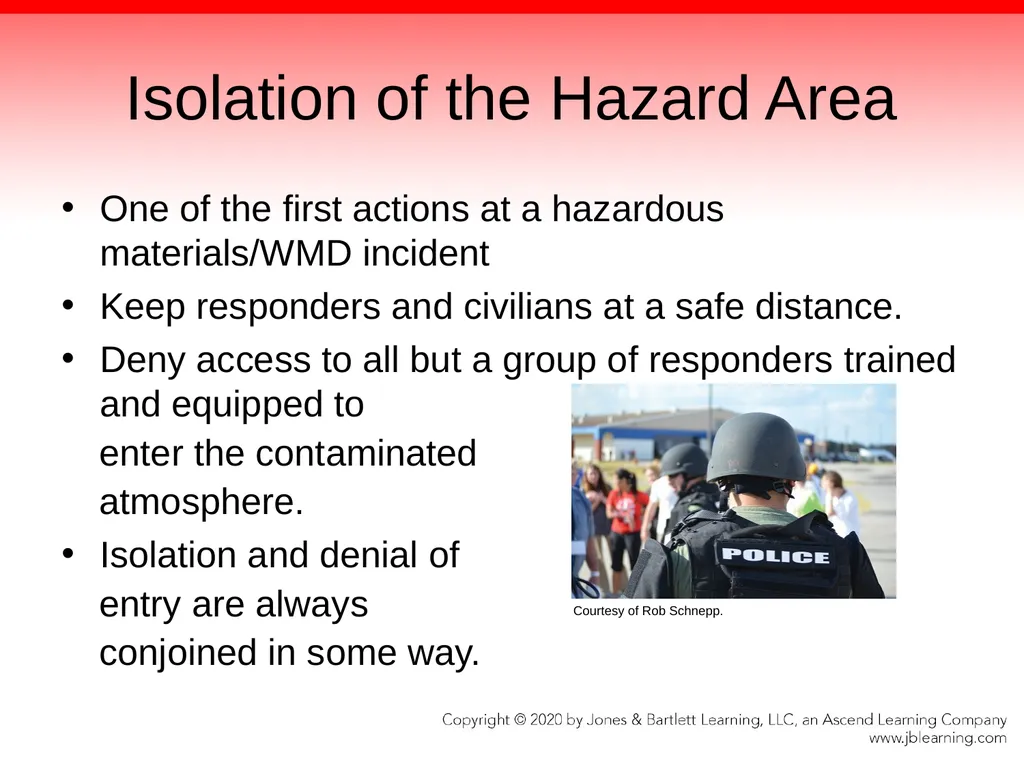
Isolation of the Hazard Area One of the first actions at a hazardous materials/WMD incident
Keep responders and civilians at a safe distance.
Deny access to all but a group of responders trained and equipped to
enter the contaminated
atmosphere.
Isolation and denial of
entry are always
conjoined in some way. Courtesy of Rob Schnepp.<br>
Keep responders and civilians at a safe distance.
Deny access to all but a group of responders trained and equipped to
enter the contaminated
atmosphere.
Isolation and denial of
entry are always
conjoined in some way. Courtesy of Rob Schnepp.<br>
15
Evacuation and Sheltering-in-Place Evacuation
Removal/relocation of individuals who may be affected by the release of a hazardous material
Sheltering-in-place
Protecting people located near a hazardous area by temporarily keeping them in a cleaner atmosphere<br>
Removal/relocation of individuals who may be affected by the release of a hazardous material
Sheltering-in-place
Protecting people located near a hazardous area by temporarily keeping them in a cleaner atmosphere<br>
16
Reporting the Size and Scope of the Incident Use information available at the scene.
Size of the release determines units used to express it.
Can range from square ft(m) to square mi.(km)
Communicate accurately
and clearly with
Other responders
Assisting agencies
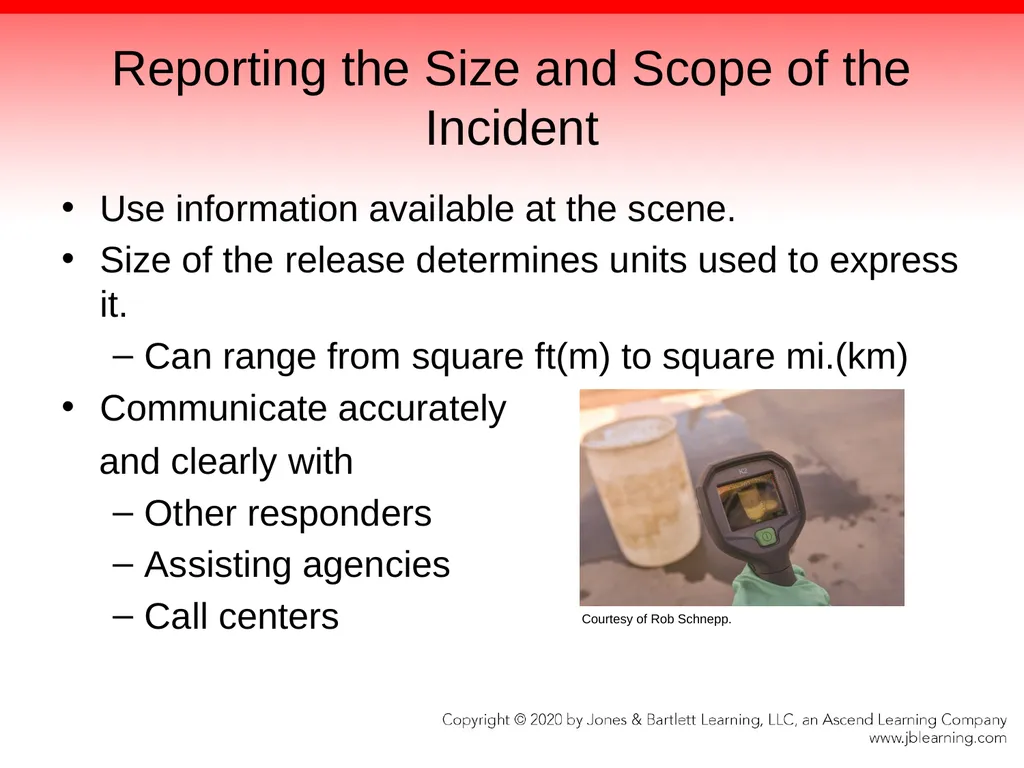
Call centers Courtesy of Rob Schnepp.<br>
Size of the release determines units used to express it.
Can range from square ft(m) to square mi.(km)
Communicate accurately
and clearly with
Other responders
Assisting agencies
Call centers Courtesy of Rob Schnepp.<br>
17
Determining the Concentration of a Released Hazardous Material Concentration
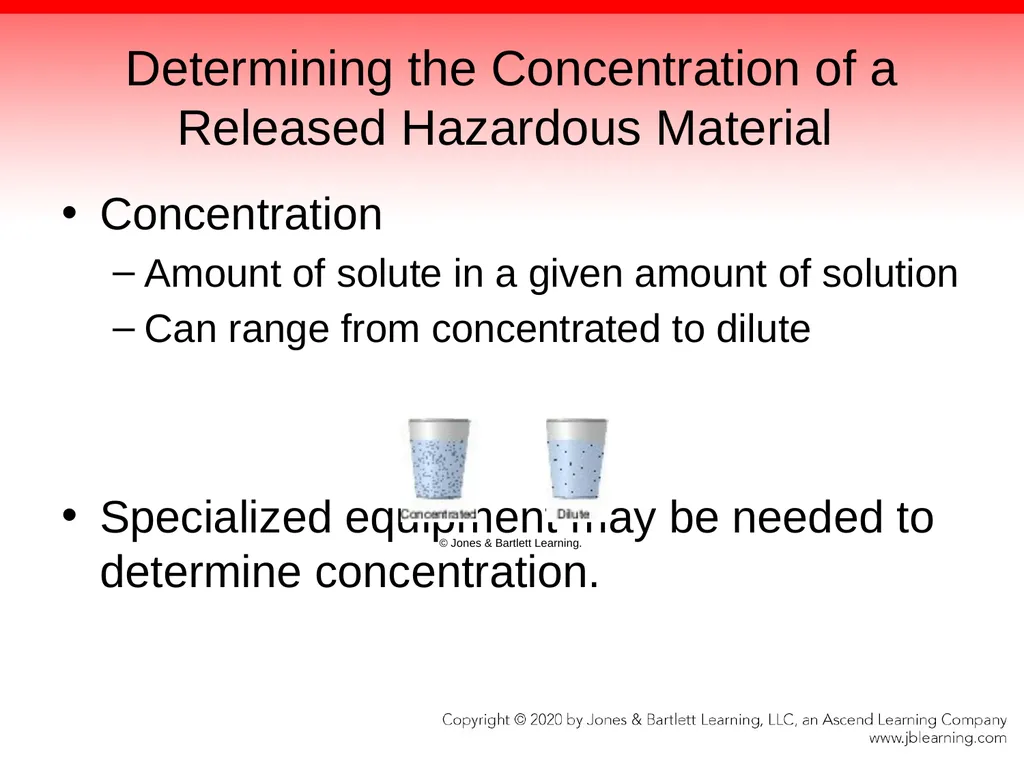
Amount of solute in a given amount of solution
Can range from concentrated to dilute
Specialized equipment may be needed to determine concentration. © Jones & Bartlett Learning.<br>
Amount of solute in a given amount of solution
Can range from concentrated to dilute
Specialized equipment may be needed to determine concentration. © Jones & Bartlett Learning.<br>
18
Determining the Concentration of a Released Hazardous Material Corrosives
Important to know the concentration when the released substance is corrosive
Concentration is expressed as percentage of how much of the acid or base is dissolved in a solution.<br>
Important to know the concentration when the released substance is corrosive
Concentration is expressed as percentage of how much of the acid or base is dissolved in a solution.<br>
19
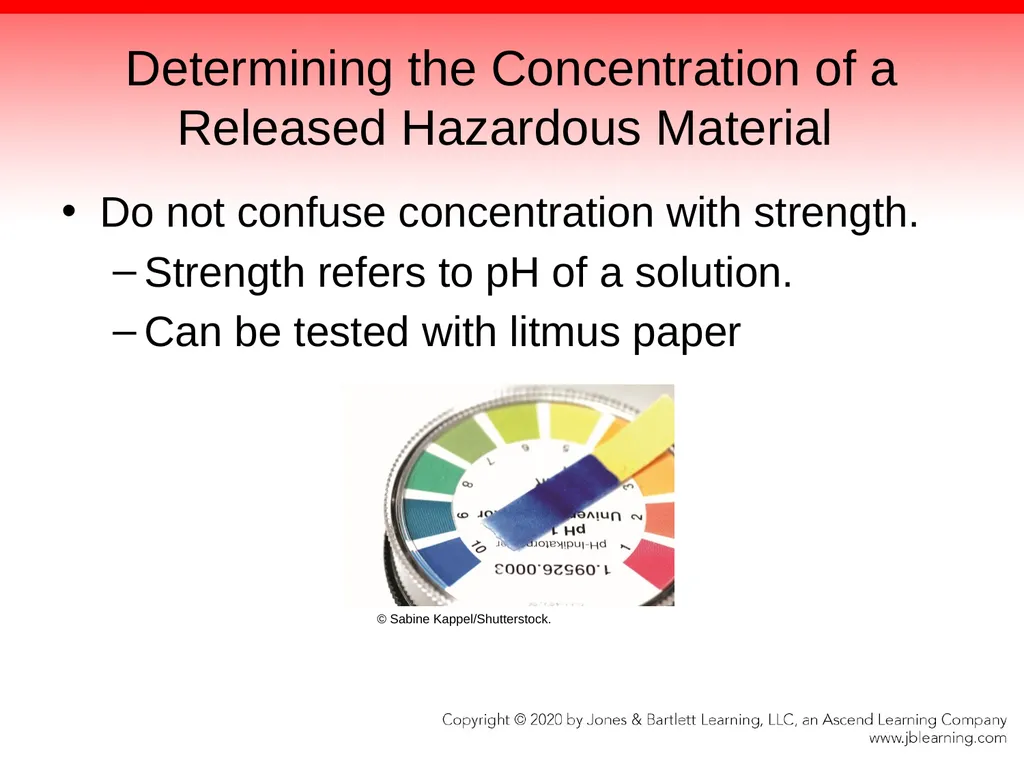
Determining the Concentration of a Released Hazardous Material Do not confuse concentration with strength.
Strength refers to pH of a solution.
Can be tested with litmus paper © Sabine Kappel/Shutterstock.<br>
Strength refers to pH of a solution.
Can be tested with litmus paper © Sabine Kappel/Shutterstock.<br>
20
Skin Contact Hazards Skin can absorb toxins without sensation.
Absorption is enhanced by
Abrasions
Cuts
Heat
Moisture
Rate of absorption varies by body part.
Corrosives will immediately damage skin or body tissues on contact.<br>
Absorption is enhanced by
Abrasions
Cuts
Heat
Moisture
Rate of absorption varies by body part.
Corrosives will immediately damage skin or body tissues on contact.<br>
21
Plan an Initial Response Boils down to
Understanding the nature of the incident
Determining a course of action
Proper incident planning
Keeps responders safe
Provides a means to control the incident effectively<br>
Understanding the nature of the incident
Determining a course of action
Proper incident planning
Keeps responders safe
Provides a means to control the incident effectively<br>
22
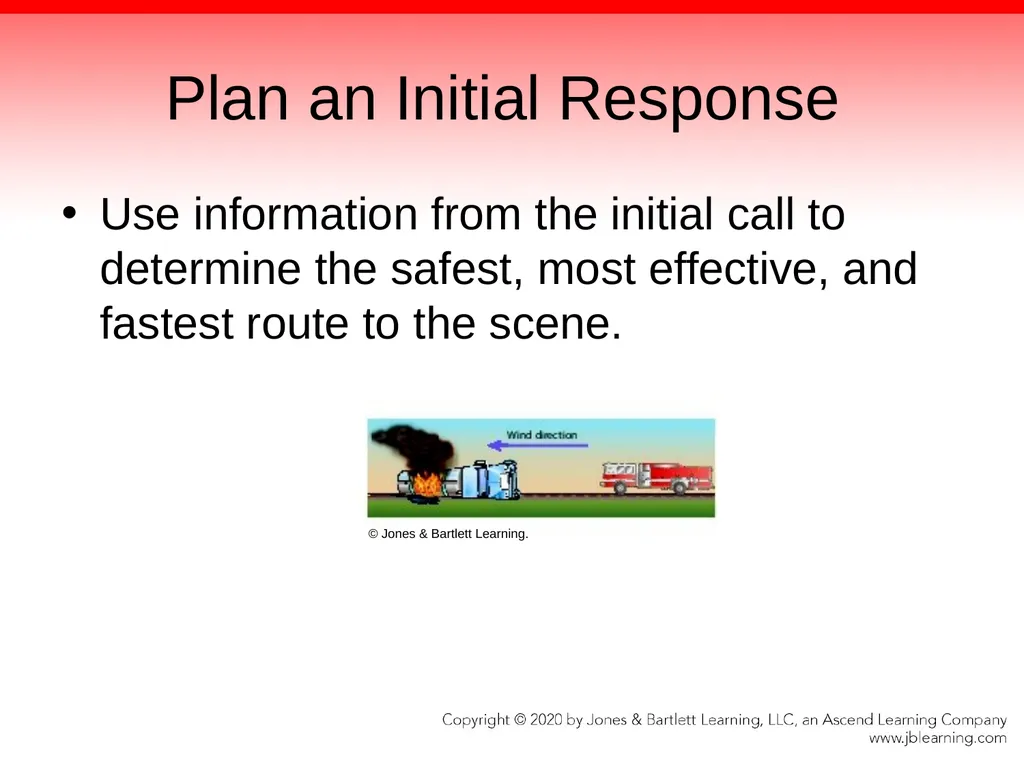
Plan an Initial Response Use information from the initial call to determine the safest, most effective, and fastest route to the scene. © Jones & Bartlett Learning.<br>
23
Plan an Initial Response Need to know as much as possible about the material involved
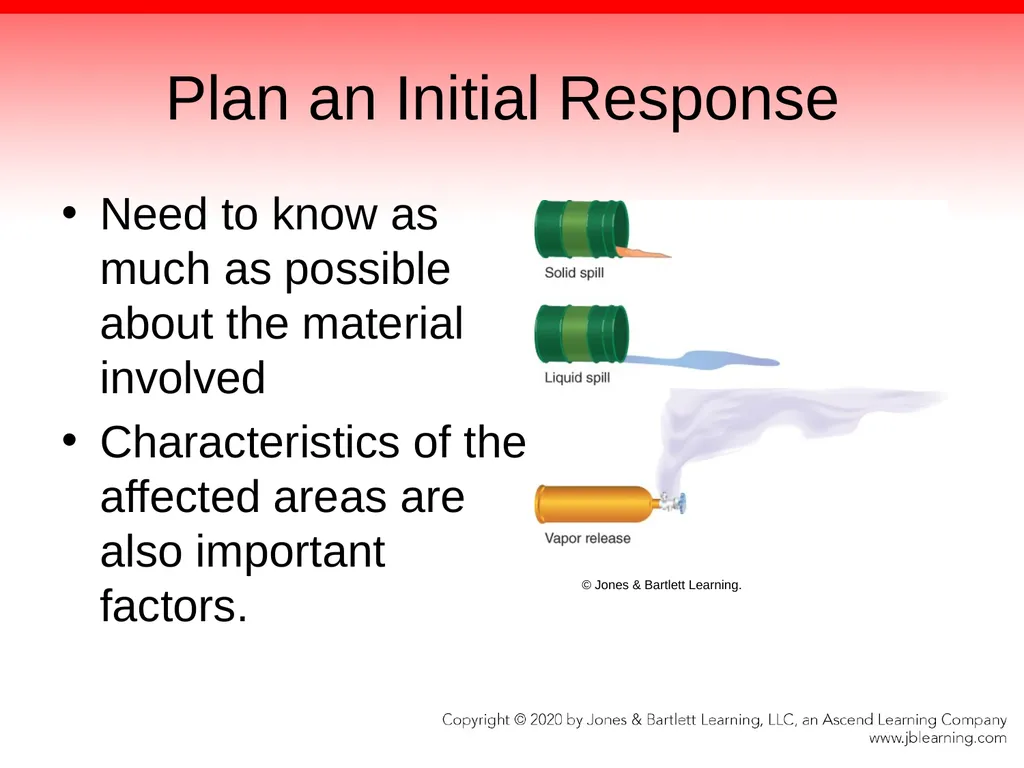
Characteristics of the affected areas are also important factors. © Jones & Bartlett Learning.<br>
Characteristics of the affected areas are also important factors. © Jones & Bartlett Learning.<br>
24
Response Objectives Should be
Measurable
Flexible
Time-sensitive
Based on the chosen strategy
Several objectives may be necessary.
Objectives must be tied to the reason you chose to act.<br>
Measurable
Flexible
Time-sensitive
Based on the chosen strategy
Several objectives may be necessary.
Objectives must be tied to the reason you chose to act.<br>
25
Response Objectives Categories
Offensive operations
Take place in the hot zone
Defensive actions
Take place outside of the hot zone
Non-intervention
Occurs when it is too dangerous to enter the hot zone<br>
Offensive operations
Take place in the hot zone
Defensive actions
Take place outside of the hot zone
Non-intervention
Occurs when it is too dangerous to enter the hot zone<br>
26
Response Objectives Mode of operations should be identified in the incident action plan (IAP)
Main components of an IAP
Specific objectives
Clear work assignments
Resources needed
Organizational chart
Communications channels or methods
Medical plan<br>
Main components of an IAP
Specific objectives
Clear work assignments
Resources needed
Organizational chart
Communications channels or methods
Medical plan<br>
27
Personal Protective Equipment Selected based on
Hazardous material involved
Specific hazards present
Physical state of the material
Consideration of tasks to be performed
Necessary to protect against skin and respiratory exposure<br>
Hazardous material involved
Specific hazards present
Physical state of the material
Consideration of tasks to be performed
Necessary to protect against skin and respiratory exposure<br>
28
National Fire Protection Association (NFPA) Publishes protective clothing standards
NFPA 1991, Standard on Vapor-Protective Ensembles for Hazardous Materials Emergencies and CBRN Terrorism Incidents
NFPA 1992, Standard on Liquid Splash-Protective Ensembles and Clothing for Hazardous Materials Emergencies
NFPA 1994, Standard on Protective Ensembles for First Responders to Hazardous Materials Emergencies and CBRN Terrorism Incidents<br>
NFPA 1991, Standard on Vapor-Protective Ensembles for Hazardous Materials Emergencies and CBRN Terrorism Incidents
NFPA 1992, Standard on Liquid Splash-Protective Ensembles and Clothing for Hazardous Materials Emergencies
NFPA 1994, Standard on Protective Ensembles for First Responders to Hazardous Materials Emergencies and CBRN Terrorism Incidents<br>
29
National Fire Protection Association (NFPA) Does not certify garments
Provides guidance on manufacturing quality and performance standards
Third-party testing laboratory tests and certifies garments
NFPA standards are performance documents for garments only.<br>
Provides guidance on manufacturing quality and performance standards
Third-party testing laboratory tests and certifies garments
NFPA standards are performance documents for garments only.<br>
30
PPE Cleaning and Maintenance Responders must know the procedures for cleaning, disinfecting, and inspecting PPE
Some types of PPE must be tested
At regular intervals
After each use
Most chemical-protective garments should be stored in a cool, dry place.
Contact the manufacturer before performing repairs.<br>
Some types of PPE must be tested
At regular intervals
After each use
Most chemical-protective garments should be stored in a cool, dry place.
Contact the manufacturer before performing repairs.<br>
31
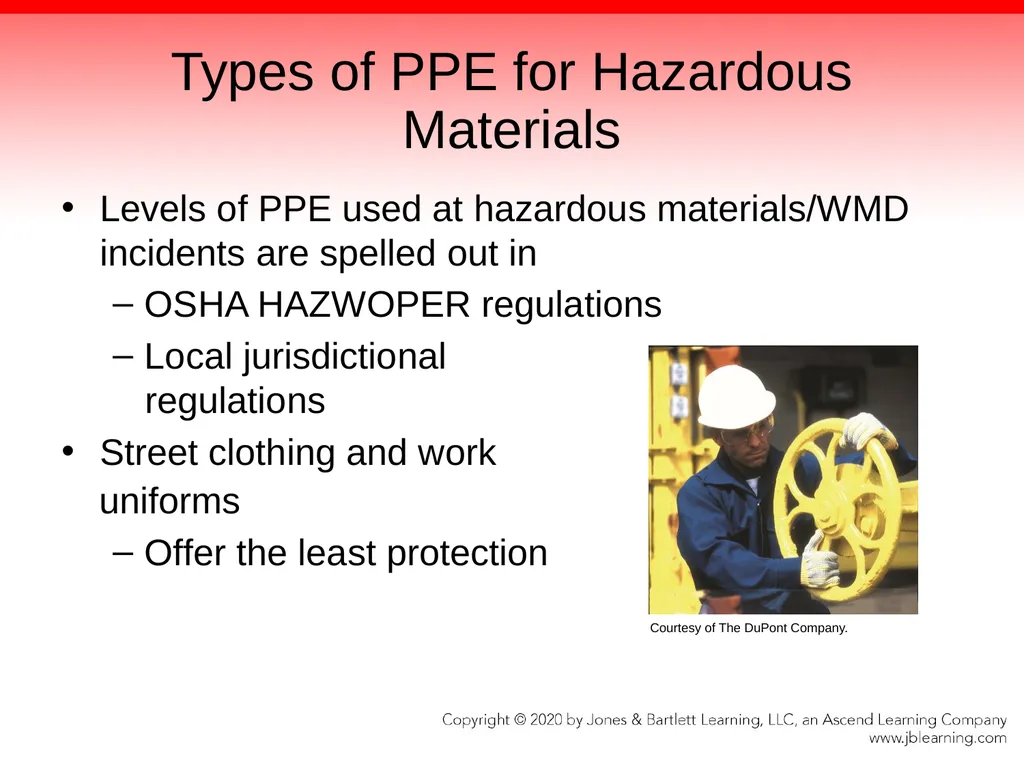
Types of PPE for Hazardous Materials Levels of PPE used at hazardous materials/WMD incidents are spelled out in
OSHA HAZWOPER regulations
Local jurisdictional
regulations
Street clothing and work
uniforms
Offer the least protection Courtesy of The DuPont Company.<br>
OSHA HAZWOPER regulations
Local jurisdictional
regulations
Street clothing and work
uniforms
Offer the least protection Courtesy of The DuPont Company.<br>
32
Structural Firefighting Protective Clothing Not recognized as a chemical-protective ensemble, but does have a place at hazardous materials/WMD incidents
Many support functions can be carried out in structural fire fighter’s gear.<br>
Many support functions can be carried out in structural fire fighter’s gear.<br>
33
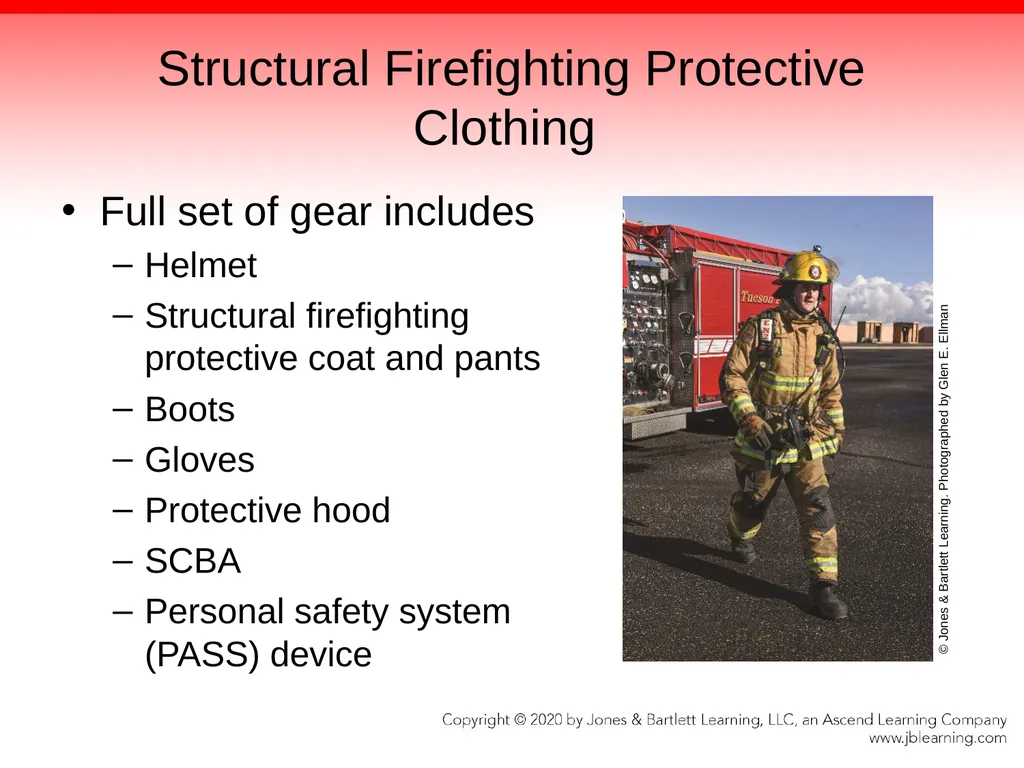
Structural Firefighting Protective Clothing Full set of gear includes
Helmet
Structural firefighting protective coat and pants
Boots
Gloves
Protective hood
SCBA
Personal safety system (PASS) device © Jones & Bartlett Learning. Photographed by Glen E. Ellman<br>
Helmet
Structural firefighting protective coat and pants
Boots
Gloves
Protective hood
SCBA
Personal safety system (PASS) device © Jones & Bartlett Learning. Photographed by Glen E. Ellman<br>
34
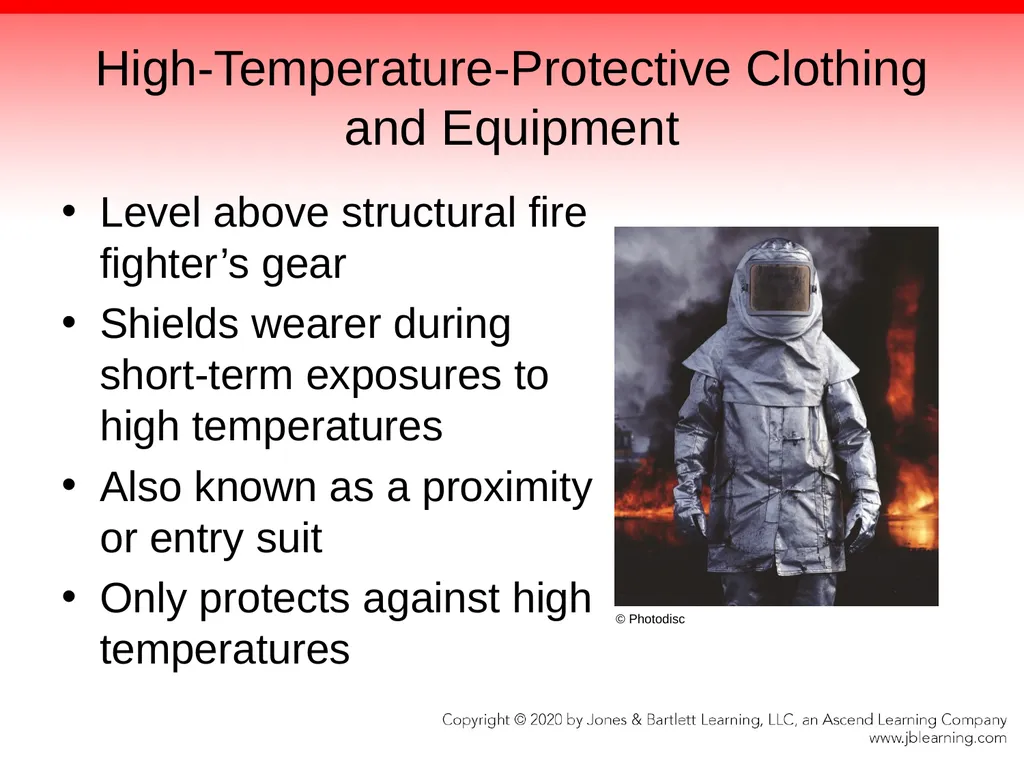
High-Temperature-Protective Clothing and Equipment Level above structural fire fighter’s gear
Shields wearer during short-term exposures to high temperatures
Also known as a proximity or entry suit
Only protects against high temperatures © Photodisc<br>
Shields wearer during short-term exposures to high temperatures
Also known as a proximity or entry suit
Only protects against high temperatures © Photodisc<br>
35
Chemical-Protective Clothing and Equipment Prevents chemicals from meeting the body
Not all types are the same.
No single garment protects against everything.
Manufacturers provide compatibility charts.<br>
Not all types are the same.
No single garment protects against everything.
Manufacturers provide compatibility charts.<br>
36
Chemical-Protective Clothing and Equipment Factors affecting chemical resistance
Time
Temperature
Resistance to cuts, tears, and abrasions
Other requirements
Flexibility
Temperature resistance
Shelf life
Sizing criteria<br>
Time
Temperature
Resistance to cuts, tears, and abrasions
Other requirements
Flexibility
Temperature resistance
Shelf life
Sizing criteria<br>
37
Chemical-Protective Clothing and Equipment Chemical resistance
Ability of garment to resist damage or become compromised because of direct contact with a chemical
Chemical-resistance materials inhibit or resist the passage of chemicals into and through the material by penetration, permeation, and degradation.<br>
Ability of garment to resist damage or become compromised because of direct contact with a chemical
Chemical-resistance materials inhibit or resist the passage of chemicals into and through the material by penetration, permeation, and degradation.<br>
38
Chemical-Protective Clothing and Equipment Chemical-protective clothing can be constructed as
Single-piece garment
Multiple-piece garment
Common suit materials
Butyl rubber
Tyvek®
Saranex™
Polyvinyl chloride
Viton®<br>
Single-piece garment
Multiple-piece garment
Common suit materials
Butyl rubber
Tyvek®
Saranex™
Polyvinyl chloride
Viton®<br>
39
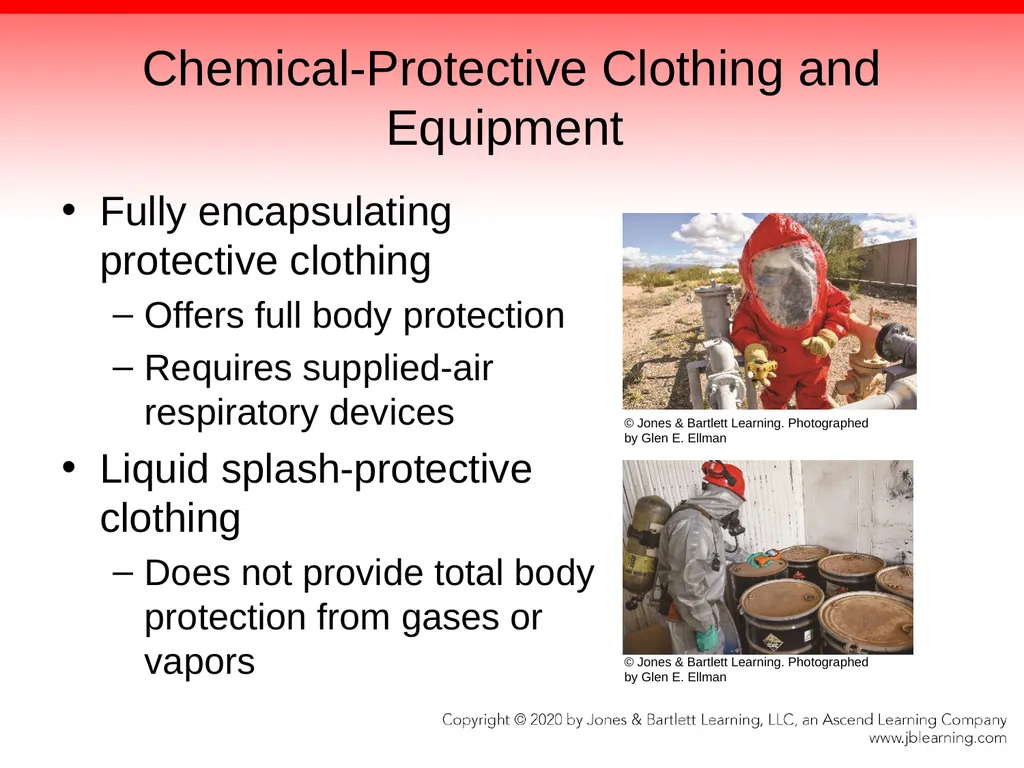
Chemical-Protective Clothing and Equipment Fully encapsulating protective clothing
Offers full body protection
Requires supplied-air respiratory devices
Liquid splash-protective clothing
Does not provide total body protection from gases or vapors © Jones & Bartlett Learning. Photographed by Glen E. Ellman © Jones & Bartlett Learning. Photographed by Glen E. Ellman<br>
Offers full body protection
Requires supplied-air respiratory devices
Liquid splash-protective clothing
Does not provide total body protection from gases or vapors © Jones & Bartlett Learning. Photographed by Glen E. Ellman © Jones & Bartlett Learning. Photographed by Glen E. Ellman<br>
40
Chemical-Protective Clothing Ratings Defined by the Environmental Protection Agency (EPA) using an alphabetic system
Level A
Fully encapsulating garment
Used when the highest level of protection is needed for the skin, eyes, and respiratory tract
Effective against vapors, gases, mists, and dusts
Must meet NFPA 1991 requirements<br>
Level A
Fully encapsulating garment
Used when the highest level of protection is needed for the skin, eyes, and respiratory tract
Effective against vapors, gases, mists, and dusts
Must meet NFPA 1991 requirements<br>
41
Chemical-Protective Clothing Ratings Recommended PPE of a Level A ensemble
SCBA or supplied-air respirator (SAR)
Fully encapsulating vapor-protective chemical-resistant suit
Inner and outer chemical-resistant gloves
Chemical-resistant safety boots/shoes
Two-way radio<br>
SCBA or supplied-air respirator (SAR)
Fully encapsulating vapor-protective chemical-resistant suit
Inner and outer chemical-resistant gloves
Chemical-resistant safety boots/shoes
Two-way radio<br>
42
Chemical-Protective Clothing Ratings Optional PPE for Level A
Coveralls
Cooling vest
Long cotton underwear
Hard hat
Disposable gloves and boot covers<br>
Coveralls
Cooling vest
Long cotton underwear
Hard hat
Disposable gloves and boot covers<br>
43
Level B Consists of
Chemical-protective clothing
Boots
Gloves
SCBA
Use when conditions require a high level of respiratory protection, but less skin protection.<br>
Chemical-protective clothing
Boots
Gloves
SCBA
Use when conditions require a high level of respiratory protection, but less skin protection.<br>
44
Level B Defining piece of equipment is an SCBA or other SAR.
Garments and ensembles should comply with NFPA 1992 performance standards.
Type of gloves and boots depend on identified chemical.
Wrists and ankles must be properly sealed.<br>
Garments and ensembles should comply with NFPA 1992 performance standards.
Type of gloves and boots depend on identified chemical.
Wrists and ankles must be properly sealed.<br>
45
Level B Recommended PPE for a Level B ensemble
SCBA or SAR
Chemical-resistant clothing
Inner and outer chemical-resistant gloves
Chemical-resistant safety boots/shoes
Two-way radio<br>
SCBA or SAR
Chemical-resistant clothing
Inner and outer chemical-resistant gloves
Chemical-resistant safety boots/shoes
Two-way radio<br>
46
Level B Optional PPE for a Level B ensemble
Cooling vest
Coveralls
Disposable gloves and boot covers
Face shield
Long cotton underwear
Hard hat<br>
Cooling vest
Coveralls
Disposable gloves and boot covers
Face shield
Long cotton underwear
Hard hat<br>
47
Level C Consists of standard work clothing plus
Chemical-protective clothing
Chemical-resistant gloves
Respiratory protection
Typically work with an air-purifying respirator (APR) or powered air-purifying respirator (PAPR)
Garments must meet NFPA 1992 performance requirements.<br>
Chemical-protective clothing
Chemical-resistant gloves
Respiratory protection
Typically work with an air-purifying respirator (APR) or powered air-purifying respirator (PAPR)
Garments must meet NFPA 1992 performance requirements.<br>
48
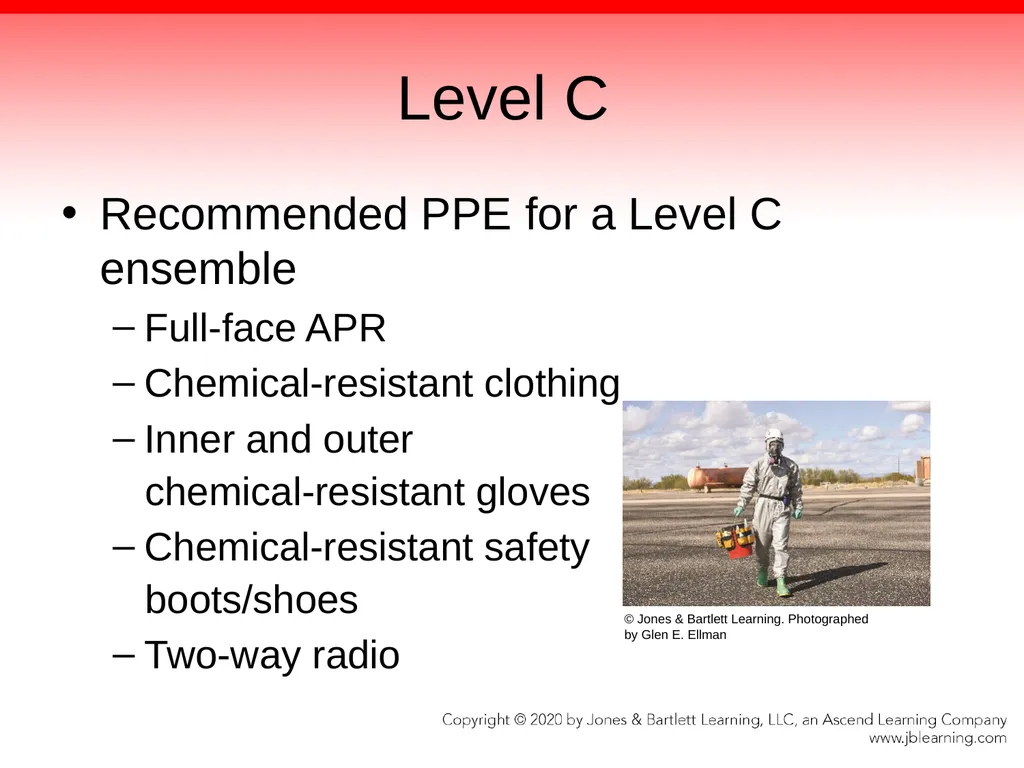
Level C Recommended PPE for a Level C ensemble
Full-face APR
Chemical-resistant clothing
Inner and outer
chemical-resistant gloves
Chemical-resistant safety
boots/shoes
Two-way radio © Jones & Bartlett Learning. Photographed by Glen E. Ellman<br>
Full-face APR
Chemical-resistant clothing
Inner and outer
chemical-resistant gloves
Chemical-resistant safety
boots/shoes
Two-way radio © Jones & Bartlett Learning. Photographed by Glen E. Ellman<br>
49
Level C Optional PPE for a Level C ensemble
Coveralls
Disposable gloves and boot covers
Face shield
Escape mask
Long cotton underwear
Hard hat<br>
Coveralls
Disposable gloves and boot covers
Face shield
Escape mask
Long cotton underwear
Hard hat<br>
50
Level D Lowest level of protection
Consists of standard work clothing
Should be used only when
Atmosphere contains no known hazard
Work functions preclude any type of contact with hazardous levels of chemicals
Used for nuisance contamination only<br>
Consists of standard work clothing
Should be used only when
Atmosphere contains no known hazard
Work functions preclude any type of contact with hazardous levels of chemicals
Used for nuisance contamination only<br>
51
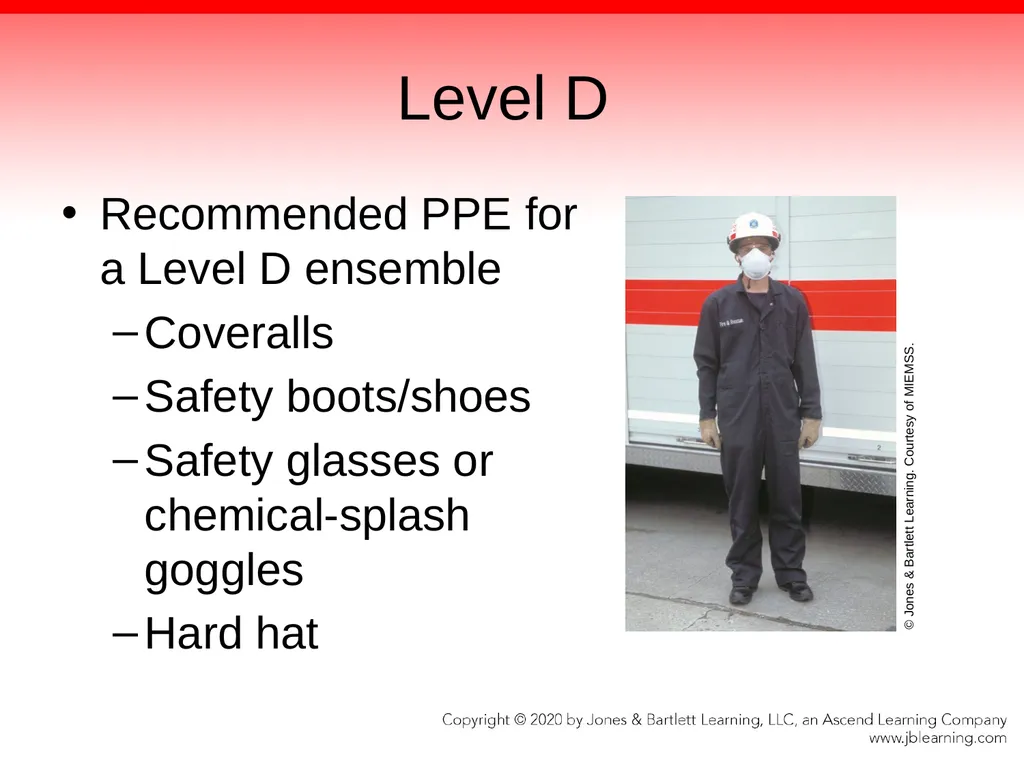
Level D Recommended PPE for a Level D ensemble
Coveralls
Safety boots/shoes
Safety glasses or chemical-splash goggles
Hard hat © Jones & Bartlett Learning. Courtesy of MIEMSS.<br>
Coveralls
Safety boots/shoes
Safety glasses or chemical-splash goggles
Hard hat © Jones & Bartlett Learning. Courtesy of MIEMSS.<br>
52
Level D Optional PPE for a Level D ensemble
Gloves
Escape mask
Face shield<br>
Gloves
Escape mask
Face shield<br>
53
Multiple-PPE Approach In some situations, responders may wear liquid splash-protective clothing over or under structural firefighting protective clothing.<br>
54
Respiratory Protection NFPA 1994
Addresses performance of protective ensembles and garments specific to WMDs
NFPA 1994 classes
Class 2: liquid-splash garment performance with SCBA
Class 3: liquid-splash garment performance with APR
Class 4: performance requirements for particles and liquid-borne viral protection<br>
Addresses performance of protective ensembles and garments specific to WMDs
NFPA 1994 classes
Class 2: liquid-splash garment performance with SCBA
Class 3: liquid-splash garment performance with APR
Class 4: performance requirements for particles and liquid-borne viral protection<br>
55
Respiratory Protection SCBA or APR with a NIOSH CBRN (chemical, biological, radiological and nuclear defense) certification must
Meet NFPA 1981, Standard on Open-Circuit Self-Contained Breathing Apparatus (SCBA) for Emergency Services, requirements
Pass a battery of tests that measure performance against sarin and sulfur mustard<br>
Meet NFPA 1981, Standard on Open-Circuit Self-Contained Breathing Apparatus (SCBA) for Emergency Services, requirements
Pass a battery of tests that measure performance against sarin and sulfur mustard<br>
56
Physical Capability Requirements OSHA HAZWOPER components of a health and safety management system for hazardous materials responders
Medical surveillance
Treatment plans for acute on-scene illness and injury
Thorough recordkeeping of all elements of the program
Mechanism to periodically review the entire process<br>
Medical surveillance
Treatment plans for acute on-scene illness and injury
Thorough recordkeeping of all elements of the program
Mechanism to periodically review the entire process<br>
57
Physical Capability Requirements Primary objectives of a medical surveillance program
Determine whether an individual can perform his or her assigned duties
Detect any changes in body system functions caused by physical or chemical exposures<br>
Determine whether an individual can perform his or her assigned duties
Detect any changes in body system functions caused by physical or chemical exposures<br>
58
Physical Capability Requirements Responders should be examined by a physician once a year or biennially
The physician may
Perform a routine exam
Conduct a health questionnaire
Take X-rays
Perform a respiratory function test
Evaluate an individual’s fitness for wearing respiratory protection devices<br>
The physician may
Perform a routine exam
Conduct a health questionnaire
Take X-rays
Perform a respiratory function test
Evaluate an individual’s fitness for wearing respiratory protection devices<br>
59
Physical Capability Requirements For specific requirements and guidance, refer to
29 CFR 1910.134
Occupational Safety and Health Guidance Manual for Hazardous Waste Site Activities
Medical monitoring
On-scene evaluation of response personnel who may experience adverse effects due to exposure to heat, cold, stress, or hazardous materials<br>
29 CFR 1910.134
Occupational Safety and Health Guidance Manual for Hazardous Waste Site Activities
Medical monitoring
On-scene evaluation of response personnel who may experience adverse effects due to exposure to heat, cold, stress, or hazardous materials<br>
60
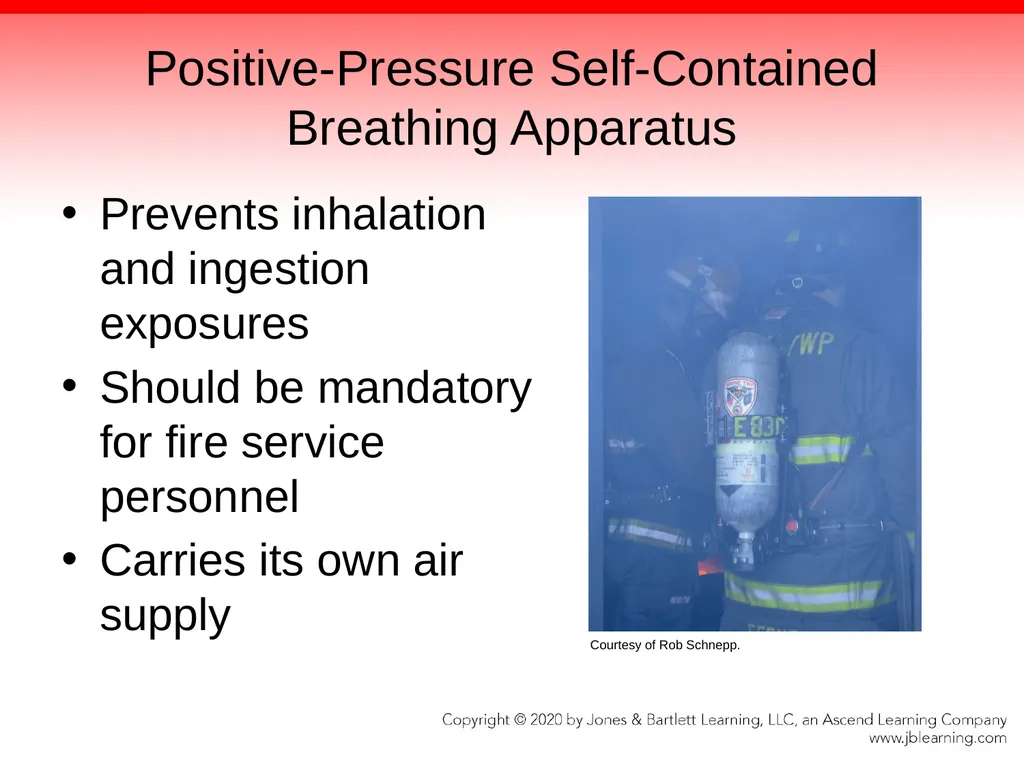
Positive-Pressure Self-Contained Breathing Apparatus Prevents inhalation and ingestion exposures
Should be mandatory for fire service personnel
Carries its own air supply Courtesy of Rob Schnepp.<br>
Should be mandatory for fire service personnel
Carries its own air supply Courtesy of Rob Schnepp.<br>
61
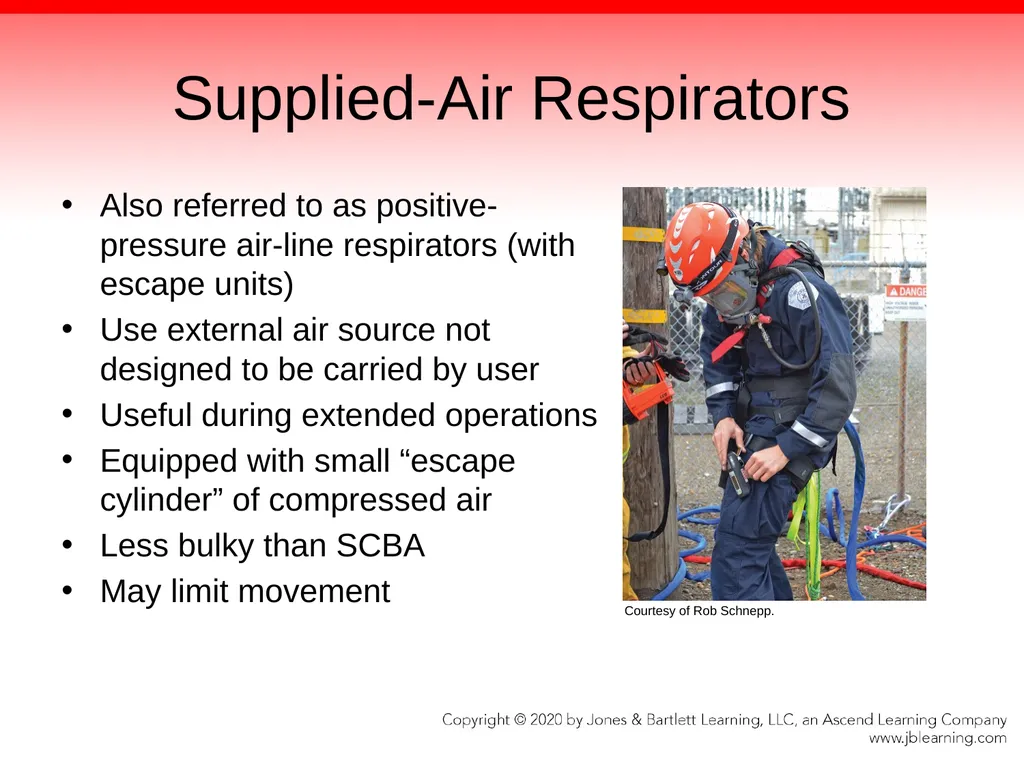
Supplied-Air Respirators Also referred to as positive-pressure air-line respirators (with escape units)
Use external air source not designed to be carried by user
Useful during extended operations
Equipped with small “escape cylinder” of compressed air
Less bulky than SCBA
May limit movement Courtesy of Rob Schnepp.<br>
Use external air source not designed to be carried by user
Useful during extended operations
Equipped with small “escape cylinder” of compressed air
Less bulky than SCBA
May limit movement Courtesy of Rob Schnepp.<br>
62
Closed-Circuit SCBA Also called a “rebreather”
Can be used for long work periods
Exhaled air is
Scrubbed free of carbon dioxide
Supplemented with a small amount of oxygen
“Rebreathed” by the wearer
Closed-circuit system<br>
Can be used for long work periods
Exhaled air is
Scrubbed free of carbon dioxide
Supplemented with a small amount of oxygen
“Rebreathed” by the wearer
Closed-circuit system<br>
63
Air-Purifying Respirators Filtering device or particulate respirator
Removes particles, vapors, and contaminants from air before it is inhaled
Should be worn only in atmospheres where
The type and quantity of contaminants are known
Sufficient oxygen is available for breathing<br>
Removes particles, vapors, and contaminants from air before it is inhaled
Should be worn only in atmospheres where
The type and quantity of contaminants are known
Sufficient oxygen is available for breathing<br>
64
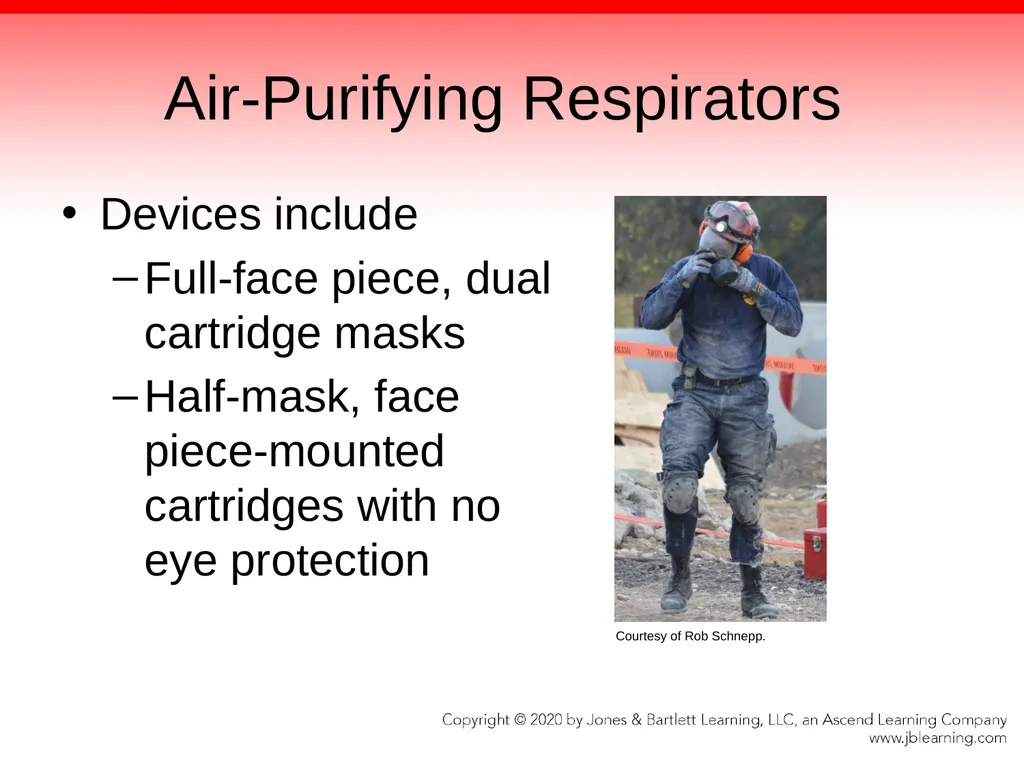
Air-Purifying Respirators Devices include
Full-face piece, dual cartridge masks
Half-mask, face piece-mounted cartridges with no eye protection Courtesy of Rob Schnepp.<br>
Full-face piece, dual cartridge masks
Half-mask, face piece-mounted cartridges with no eye protection Courtesy of Rob Schnepp.<br>
65
Air-Purifying Respirators Easy to wear, but have drawbacks
Cartridges are specific to expected contaminants.
Air and ambient oxygen level must be continually monitored.
Should not be employed at hazardous materials/WMD incidents until qualified personnel have tested the ambient atmosphere<br>
Cartridges are specific to expected contaminants.
Air and ambient oxygen level must be continually monitored.
Should not be employed at hazardous materials/WMD incidents until qualified personnel have tested the ambient atmosphere<br>
66
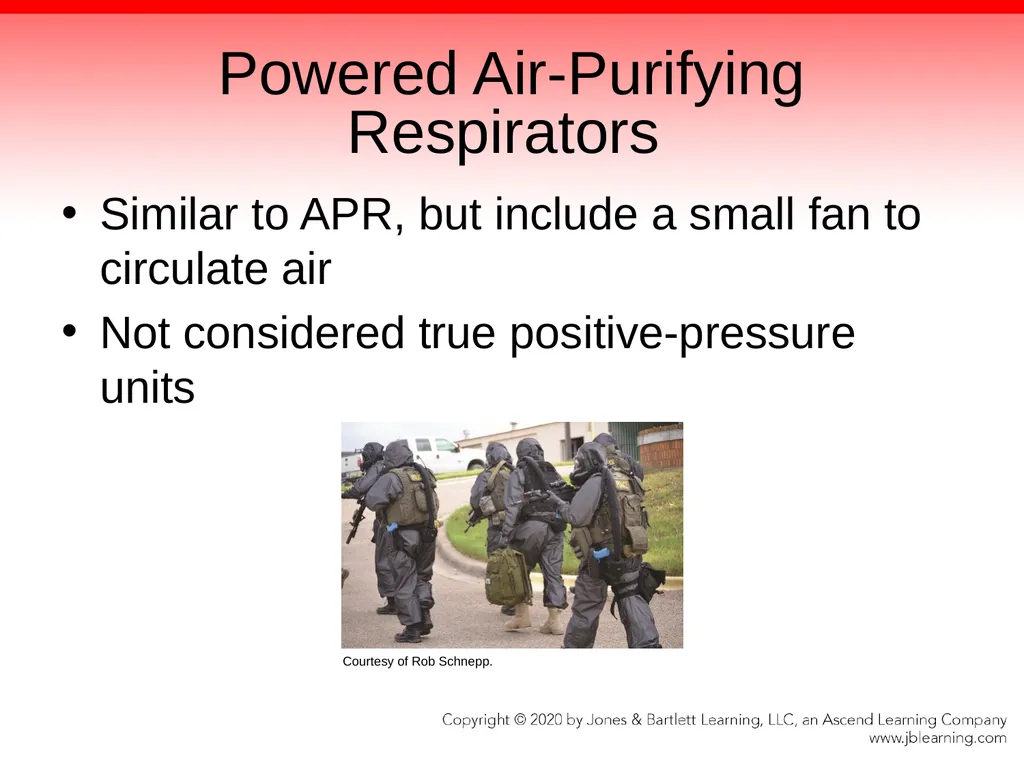
Powered Air-Purifying Respirators Similar to APR, but include a small fan to circulate air
Not considered true positive-pressure units Courtesy of Rob Schnepp.<br>
Not considered true positive-pressure units Courtesy of Rob Schnepp.<br>
67
Powered Air-Purifying Respirators Main advantages
Diminish work of breathing
Help reduce fogging in the mask
Provide constant flow of cool air across the face<br>
Diminish work of breathing
Help reduce fogging in the mask
Provide constant flow of cool air across the face<br>
68
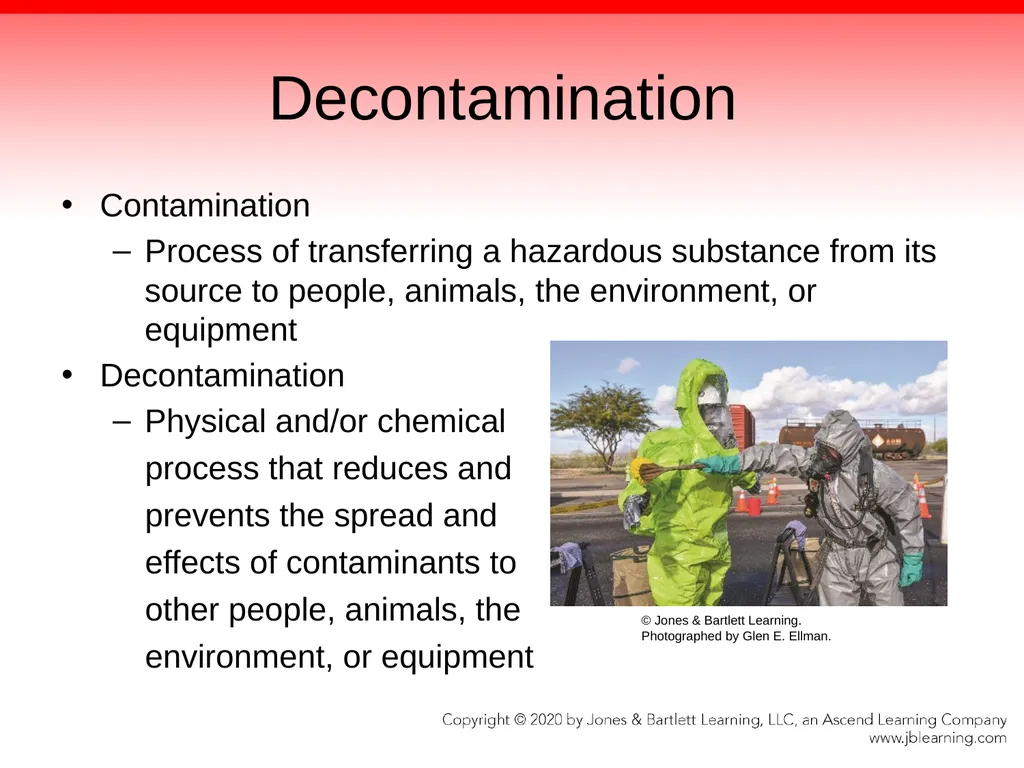
Decontamination Contamination
Process of transferring a hazardous substance from its source to people, animals, the environment, or equipment
Decontamination
Physical and/or chemical
process that reduces and
prevents the spread and
effects of contaminants to
other people, animals, the
environment, or equipment © Jones & Bartlett Learning. Photographed by Glen E. Ellman.<br>
Process of transferring a hazardous substance from its source to people, animals, the environment, or equipment
Decontamination
Physical and/or chemical
process that reduces and
prevents the spread and
effects of contaminants to
other people, animals, the
environment, or equipment © Jones & Bartlett Learning. Photographed by Glen E. Ellman.<br>
69
Decontamination Emergency decontamination
Immediately reduces contamination of individuals in potentially life-threatening situations
May or may not involve a decontamination corridor
Sole purpose is to quickly separate contaminants from the individual to minimize exposure and injury<br>
Immediately reduces contamination of individuals in potentially life-threatening situations
May or may not involve a decontamination corridor
Sole purpose is to quickly separate contaminants from the individual to minimize exposure and injury<br>
70
Decontamination Gross decontamination
Phase in which surface contamination is significantly reduced
Often involves mechanical removal of contaminants
Performed on
Team members before technical decontamination
Emergency responders before leaving the scene
Victims during emergency decontamination
Persons requiring mass decontamination
PPE used by responders before leaving the scene<br>
Phase in which surface contamination is significantly reduced
Often involves mechanical removal of contaminants
Performed on
Team members before technical decontamination
Emergency responders before leaving the scene
Victims during emergency decontamination
Persons requiring mass decontamination
PPE used by responders before leaving the scene<br>
71
Decontamination Technical decontamination
Reducing contamination to a level as low as reasonably possible
Occurs after gross decontamination
Minimizes the spread of contamination
Normally established in support of emergency responders at hazardous materials incidents
Can be used on victims of the initial release of non-threatening contamination<br>
Reducing contamination to a level as low as reasonably possible
Occurs after gross decontamination
Minimizes the spread of contamination
Normally established in support of emergency responders at hazardous materials incidents
Can be used on victims of the initial release of non-threatening contamination<br>
72
Decontamination Mass decontamination
Physically reducing or removing surface contaminants from large numbers of victims
Used in potentially life-threatening situations
Involves
Making a rapid assessment of the situation and the number of victims present
Attempting to identify the contaminant
Setting up a mass decontamination process
Selecting and wearing appropriate PPE
Getting the job done<br>
Physically reducing or removing surface contaminants from large numbers of victims
Used in potentially life-threatening situations
Involves
Making a rapid assessment of the situation and the number of victims present
Attempting to identify the contaminant
Setting up a mass decontamination process
Selecting and wearing appropriate PPE
Getting the job done<br>
73
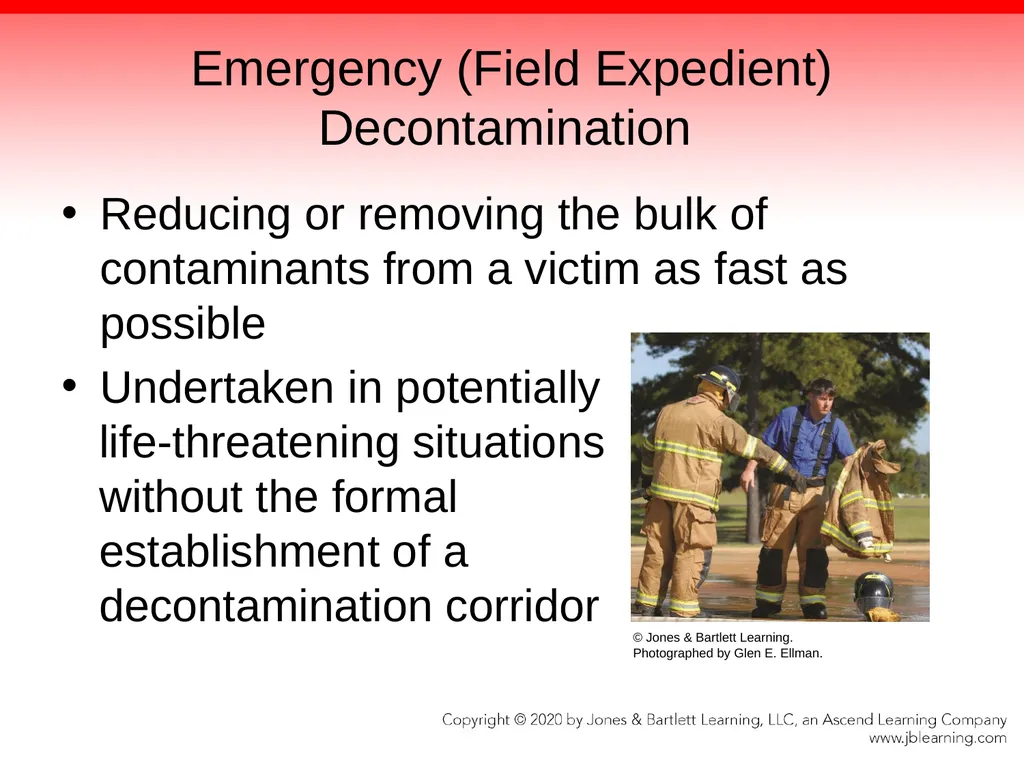
Emergency (Field Expedient) Decontamination Reducing or removing the bulk of contaminants from a victim as fast as possible
Undertaken in potentially
life-threatening situations
without the formal
establishment of a
decontamination corridor © Jones & Bartlett Learning. Photographed by Glen E. Ellman.<br>
Undertaken in potentially
life-threatening situations
without the formal
establishment of a
decontamination corridor © Jones & Bartlett Learning. Photographed by Glen E. Ellman.<br>
74
Emergency (Field Expedient) Decontamination Usually involves
Removing contaminated clothing
Dousing the victim with water
If an emergency decontamination area has not been designated
Isolate exposed victims.
Establish an appropriate location.
Divert the stream of water for treatment or disposal.<br>
Removing contaminated clothing
Dousing the victim with water
If an emergency decontamination area has not been designated
Isolate exposed victims.
Establish an appropriate location.
Divert the stream of water for treatment or disposal.<br>
75
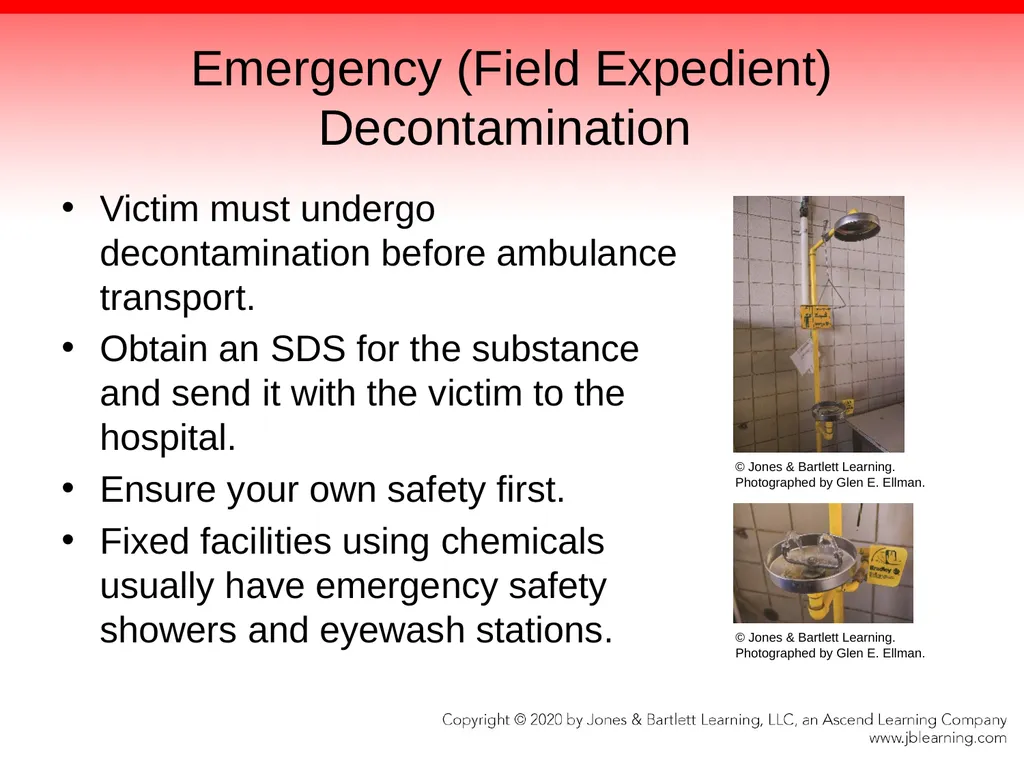
Emergency (Field Expedient) Decontamination Victim must undergo decontamination before ambulance transport.
Obtain an SDS for the substance and send it with the victim to the hospital.
Ensure your own safety first.
Fixed facilities using chemicals usually have emergency safety showers and eyewash stations. © Jones & Bartlett Learning. Photographed by Glen E. Ellman. © Jones & Bartlett Learning. Photographed by Glen E. Ellman.<br>
Obtain an SDS for the substance and send it with the victim to the hospital.
Ensure your own safety first.
Fixed facilities using chemicals usually have emergency safety showers and eyewash stations. © Jones & Bartlett Learning. Photographed by Glen E. Ellman. © Jones & Bartlett Learning. Photographed by Glen E. Ellman.<br>
76
Secondary Contamination Also known as cross contamination
Process of transferring a hazardous material from its source to people, animals, the environment, or equipment, which may act as carriers<br>
Process of transferring a hazardous material from its source to people, animals, the environment, or equipment, which may act as carriers<br>
77
Secondary Contamination Occurs when a contaminated person or object comes into direct contact with another person or object
Areas at hazardous materials/WMD incidents should be designated as hot, warm, or cold control zones based on:
Safety considerations
Degree of hazard<br>
Areas at hazardous materials/WMD incidents should be designated as hot, warm, or cold control zones based on:
Safety considerations
Degree of hazard<br>
78
Summary The first priority for all responders is to ensure their own safety while operating at the scene.
Hazardous materials/WMD incident response priorities should be based on the need to protect and/or reduce the threat to life, property, critical systems, and the environment.<br>
Hazardous materials/WMD incident response priorities should be based on the need to protect and/or reduce the threat to life, property, critical systems, and the environment.<br>
79
Summary To have some frame of reference for the degree of harm a substance may pose, responders should have a basic understanding of some commonly used toxicological terms and definitions.
Gather information from detection and monitoring devices, bystanders, reference sources, and environmental conditions to obtain a clear picture of the incident.<br>
Gather information from detection and monitoring devices, bystanders, reference sources, and environmental conditions to obtain a clear picture of the incident.<br>
80
Summary Exposures, which includes people, property, structures, or the environment, are subject to influence, damage, or injury because of contact with a hazardous material/WMD.
Immediate protective actions include isolation of the hazard area, denial of entry, evacuation, or sheltering-in-place.
Tactical control objectives include preventing further injury and controlling or containing the spread of the hazardous material.<br>
Immediate protective actions include isolation of the hazard area, denial of entry, evacuation, or sheltering-in-place.
Tactical control objectives include preventing further injury and controlling or containing the spread of the hazardous material.<br>
81
Summary Response objectives should be measurable, flexible, and time sensitive; they should also be based on the chosen strategy.
Defensive actions include absorbing or adsorbing the hazardous material, stopping the flow remotely from a valve or shut-off, diluting or diverting the material, and suppressing or dispersing vapors.<br>
Defensive actions include absorbing or adsorbing the hazardous material, stopping the flow remotely from a valve or shut-off, diluting or diverting the material, and suppressing or dispersing vapors.<br>
82
Summary The decision to act at a hazardous materials/WMD incident should be based on the concept of risk versus benefit.
The type of PPE required for an incident depends on the material involved, any specific hazards, the physical state of the material, and the tasks to be performed by the operations level responder.<br>
The type of PPE required for an incident depends on the material involved, any specific hazards, the physical state of the material, and the tasks to be performed by the operations level responder.<br>
83
Summary The selection and use of chemical-protective clothing may have the greatest direct effect on responder health and safety.
The EPA defines four levels of PPE: Level A (highest level of protection), Level B, Level C, and Level D (lowest level of protection).<br>
The EPA defines four levels of PPE: Level A (highest level of protection), Level B, Level C, and Level D (lowest level of protection).<br>
84
Summary NFPA 1994, Standard on Protective Ensembles for First Responders to Hazardous Materials Emergencies and CBRN Terrorism Incidents, was developed to address the performance of protective ensembles specific to weapons of mass destruction.
It covers three classes of garments: Class 2, Class 3, and Class 4.<br>
It covers three classes of garments: Class 2, Class 3, and Class 4.<br>
85
Summary Respiratory protection is so important that it can be viewed as the defining element of PPE.
Medical surveillance is the cornerstone of an effective health and safety management system for responders.
Before any PPE is worn, hazardous materials response personnel should be aware of the physiological stress those garments create.<br>
Medical surveillance is the cornerstone of an effective health and safety management system for responders.
Before any PPE is worn, hazardous materials response personnel should be aware of the physiological stress those garments create.<br>
86
Summary Even though there should be no intentional contact with the hazardous material involved, a procedure or a plan must be established at every hazardous materials/WMD incident to decontaminate anyone who accidentally becomes contaminated.<br>