
Chapter 4 THE HELLENISTIC WORLD Western
GB
Published · 31 slides · 0 views
1 / 1




Description
Chapter 4 THE HELLENISTIC WORLD Western Civilization, Eleventh Edition ACTIVITY.. Think, Pair, Share Think about the following question: Why do so many regard Alexander as great? Pair with one or two nearby classmates. Share your response
Related Topics
Share
Embed code
Download this presentation From Below
"Chapter 4 THE HELLENISTIC WORLD Western" is the property of its rightful owner. Permission is granted to download and print the materials on this website for personal, non-commercial use only, and to display it on your personal computer provided you do not modify the materials and that you retain all copyright notices contained in the materials. By downloading content from our website, you accept the terms of this agreement.
Presentation Transcript
01
Chapter 4 THE HELLENISTIC WORLD Western Civilization, Eleventh Edition<br>
02
ACTIVITY..
Think, Pair, Share Think about the following question:
Why do so many regard Alexander as “great”?
Pair with one or two nearby classmates.
Share your response and listen to how your classmates responded.<br>
Think, Pair, Share Think about the following question:
Why do so many regard Alexander as “great”?
Pair with one or two nearby classmates.
Share your response and listen to how your classmates responded.<br>
03
4-1 Macedonia and the Conquests of Alexander (1 of 2) Macedonian Expansion
Macedonian king Philip II conquers Greek cities by 338 B.C.E. and controls them through new Corinthian League.
Greek opinion split—some see Philip II as a much needed strong leader.
Small coalition led by Athens opposes Macedonian expansion, but defeated.
Peloponnesian War had severely weakened Greek city-states.
Philip II assassinated in 334 B.C.E.
Philip II’s son Alexander moves quickly to suppress dissent and takes control of Macedonian empire.
Begins organizing for an invasion of Persia<br>
Macedonian king Philip II conquers Greek cities by 338 B.C.E. and controls them through new Corinthian League.
Greek opinion split—some see Philip II as a much needed strong leader.
Small coalition led by Athens opposes Macedonian expansion, but defeated.
Peloponnesian War had severely weakened Greek city-states.
Philip II assassinated in 334 B.C.E.
Philip II’s son Alexander moves quickly to suppress dissent and takes control of Macedonian empire.
Begins organizing for an invasion of Persia<br>
04
4-1 Macedonia and the Conquests of Alexander (2 of 2) Alexander’s Campaigns
Alexander wins quick victories because of new tactics and an exhausted Persian army.
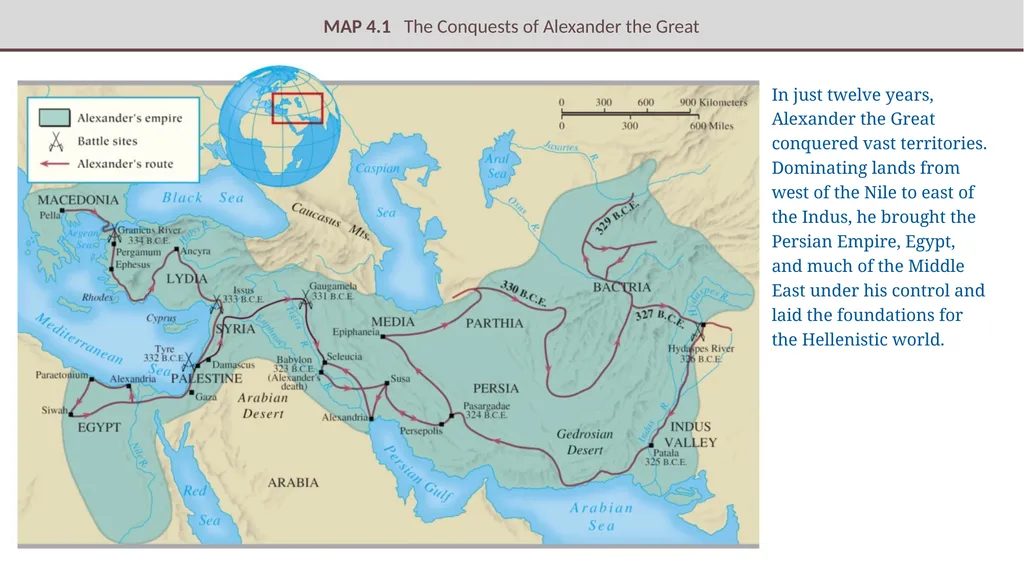
Wins important victory at Issus in 333 B.C.E.
Tyre, Egypt, and Palestine under Alexander’s control by 332 B.C.E. no Persian access to Mediterranean
Wins decisive victory at Gaugamela in 331 B.C.E.
Alexander’s army reaches and burns Persepolis in 331 B.C.E.; Persian king Darius assassinated.
After considering invading Afghanistan and India, turns back to Mesopotamia and consolidates hold over former Persian territories in the 320s
Although an admirer of Greek culture, he largely followed Persian customs to maintain control of conquered lands.
Encouraged his commanders to adopt local customs to appear legitimate rulers
Helped settle his soldiers on lands across the empire<br>
Alexander wins quick victories because of new tactics and an exhausted Persian army.
Wins important victory at Issus in 333 B.C.E.
Tyre, Egypt, and Palestine under Alexander’s control by 332 B.C.E. no Persian access to Mediterranean
Wins decisive victory at Gaugamela in 331 B.C.E.
Alexander’s army reaches and burns Persepolis in 331 B.C.E.; Persian king Darius assassinated.
After considering invading Afghanistan and India, turns back to Mesopotamia and consolidates hold over former Persian territories in the 320s
Although an admirer of Greek culture, he largely followed Persian customs to maintain control of conquered lands.
Encouraged his commanders to adopt local customs to appear legitimate rulers
Helped settle his soldiers on lands across the empire<br>
05
ACTIVITY (1 of 2)
Quick Check Why did the once formidable Greek world fall so quickly to Macedonian forces?
(A) Plagues decimated Greek during the wars, weakening the will to fight.
(B) Macedonia used new military tactics and exploited Greek political divisions.
(C) There were many powers who wanted revenge on the Greeks that helped.<br>
Quick Check Why did the once formidable Greek world fall so quickly to Macedonian forces?
(A) Plagues decimated Greek during the wars, weakening the will to fight.
(B) Macedonia used new military tactics and exploited Greek political divisions.
(C) There were many powers who wanted revenge on the Greeks that helped.<br>
06
ACTIVITY (2 of 2)
Quick Check Why did the once formidable Greek world fall so quickly to Macedonian forces?
(A) Plagues decimated Greek during the wars, weakening the will to fight.
(B) Macedonia used new military tactics and exploited Greek political divisions.
(C) There were many powers who wanted revenge on the Greeks that helped.
How effective was the Corinthian League at persuading Greeks to support Macedonian aims?<br>
Quick Check Why did the once formidable Greek world fall so quickly to Macedonian forces?
(A) Plagues decimated Greek during the wars, weakening the will to fight.
(B) Macedonia used new military tactics and exploited Greek political divisions.
(C) There were many powers who wanted revenge on the Greeks that helped.
How effective was the Corinthian League at persuading Greeks to support Macedonian aims?<br>
07
4-2 The World of the Hellenistic Kingdoms (1 of 3) The Hellenistic World
Alexander died just a few years after conquering his empire in 323 B.C.E.
Left an empire fragmented into territories controlled by his highest-ranking commanders
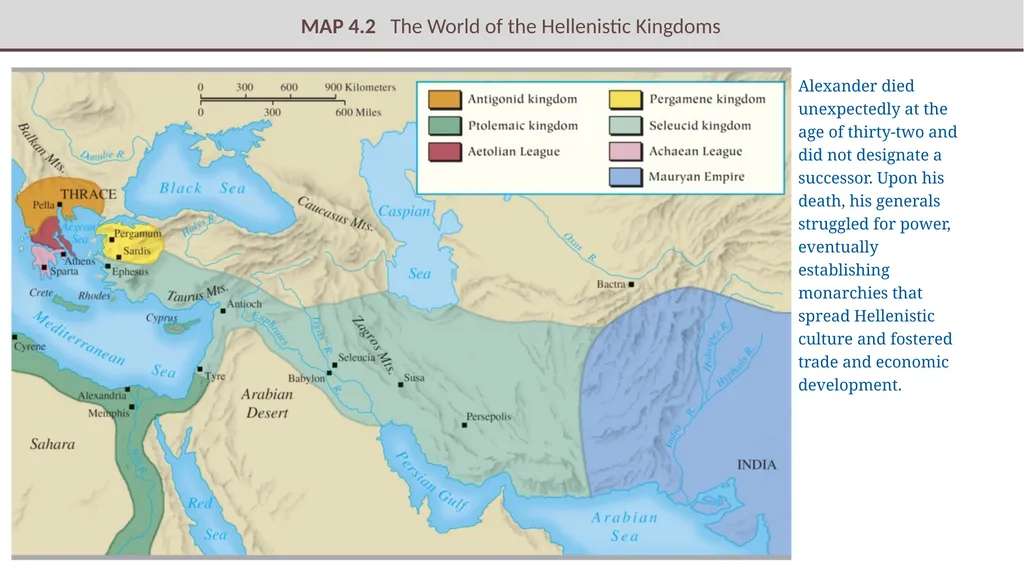
Ptolemy in Egypt; Seleucus in Mesopotamia and Persia; Antigonus in Greece
Each ruled as kings over subjects with few rights.
Despite political fragmentation, economic activity, migration, and exchange of ideas connects each.
Extensive trade networks connecting Greek, Egyptian, Persian, Indian, and Chinese worlds
Greek became common language of the elite.<br>
Alexander died just a few years after conquering his empire in 323 B.C.E.
Left an empire fragmented into territories controlled by his highest-ranking commanders
Ptolemy in Egypt; Seleucus in Mesopotamia and Persia; Antigonus in Greece
Each ruled as kings over subjects with few rights.
Despite political fragmentation, economic activity, migration, and exchange of ideas connects each.
Extensive trade networks connecting Greek, Egyptian, Persian, Indian, and Chinese worlds
Greek became common language of the elite.<br>
08
4-2 The World of the Hellenistic Kingdoms (2 of 3) Hellenistic Kingdoms
Antigonid Greece
Fought desperate and bloody battles to maintain the Antigonid dynasty into the 270s B.C.E.
Never fully consolidated, conquered by Rome in the 100s
Seleucid Kingdom
Based in Syria but extended power over Mesopotamia, Persia, and northern India
Large territory proved difficult to control centrally, devolved power became norm.<br>
Antigonid Greece
Fought desperate and bloody battles to maintain the Antigonid dynasty into the 270s B.C.E.
Never fully consolidated, conquered by Rome in the 100s
Seleucid Kingdom
Based in Syria but extended power over Mesopotamia, Persia, and northern India
Large territory proved difficult to control centrally, devolved power became norm.<br>
09
4-2 The World of the Hellenistic Kingdoms (3 of 3) Hellenistic Kingdoms
Kingdom of Pergamum
Based in Asia Minor, invited Roman intervention against Seleucids in 190s, became Roman territory themselves in 130s
Ptolemaic Egypt
Adopted Greek ideals and encouraged syncretism, lasted until Roman defeat of Cleopatra VII’s forces in Roman Civil Wars in 30 B.C.E.
Other minor kingdoms—Greco-Bactrian, Indo-Greek<br>
Kingdom of Pergamum
Based in Asia Minor, invited Roman intervention against Seleucids in 190s, became Roman territory themselves in 130s
Ptolemaic Egypt
Adopted Greek ideals and encouraged syncretism, lasted until Roman defeat of Cleopatra VII’s forces in Roman Civil Wars in 30 B.C.E.
Other minor kingdoms—Greco-Bactrian, Indo-Greek<br>
10
4-3 Hellenistic Society Hellenistic Societies
Hellenistic kingdoms concerned with stability
Compromise of Greek values as rulers become “Persian-style” monarchs
Greek language became key to status and government offices—Greek elites, non-Greek commoners (mostly agricultural).
Still high rate of enslavement in Hellenistic world
Hellenistic societies highly urbanized and sometimes militarized but usually free and commercially minded
Cities modeled on Greek polis, heavily involved in trade
Alexandria in Ptolemaic Egypt became one of the largest cities, center of trade and scholarship.
Hellenistic cities provided new opportunities, especially to women in upper classes.
Women of lower classes experienced new struggles with increased urbanization.
Hellenistic kings controlled cities’ foreign relations, demanded tribute in return for some autonomy.<br>
Hellenistic kingdoms concerned with stability
Compromise of Greek values as rulers become “Persian-style” monarchs
Greek language became key to status and government offices—Greek elites, non-Greek commoners (mostly agricultural).
Still high rate of enslavement in Hellenistic world
Hellenistic societies highly urbanized and sometimes militarized but usually free and commercially minded
Cities modeled on Greek polis, heavily involved in trade
Alexandria in Ptolemaic Egypt became one of the largest cities, center of trade and scholarship.
Hellenistic cities provided new opportunities, especially to women in upper classes.
Women of lower classes experienced new struggles with increased urbanization.
Hellenistic kings controlled cities’ foreign relations, demanded tribute in return for some autonomy.<br>
11
ACTIVITY
Written Reflection Write down a few words, phrases, or sentences in response to the following question:
Which Greek values did Hellenistic leaders preserve, and which did they modify, adapt, or abridge?<br>
Written Reflection Write down a few words, phrases, or sentences in response to the following question:
Which Greek values did Hellenistic leaders preserve, and which did they modify, adapt, or abridge?<br>
12
4-4 Culture in the Hellenistic World (1 of 2) Hellenistic Culture
Greeks maintained their belief in their cultural superiority—cities became places of “Greekification.”
Promoted through new public education programs in many Hellenistic cities
Gymnasia—athletic institution as well as secondary school funded by wealthy public patrons
Alexandria became known as cultural capital during this time, rivaled Athens.
Greek historical writing continued—Polybius’s histories of Roman expansion.
The Hellenistic world marked by a synthesis of Greek culture with Egyptian and Persian culture.
Many Romans later attracted to Hellenistic “cosmopolitanism”<br>
Greeks maintained their belief in their cultural superiority—cities became places of “Greekification.”
Promoted through new public education programs in many Hellenistic cities
Gymnasia—athletic institution as well as secondary school funded by wealthy public patrons
Alexandria became known as cultural capital during this time, rivaled Athens.
Greek historical writing continued—Polybius’s histories of Roman expansion.
The Hellenistic world marked by a synthesis of Greek culture with Egyptian and Persian culture.
Many Romans later attracted to Hellenistic “cosmopolitanism”<br>
13
4-4 Culture in the Hellenistic World (2 of 2) Hellenistic Thought and Expression
Alexandria became center of natural science
Aristarchus—developed heliocentric model of solar system
Eratosthenes—calculated circumference of Earth to within 200 miles
Euclid—developed long-standing principles of planar geometry
Archimedes—established pi, developed hydrostatics (rules of buoyancy, principles of irrigation)
Also medicine
Hippocrates, Herophilus, and Erasistratus made advances in understanding the body and human organs.
Also philosophy
Epicurus of Athens—happiness and pleasure are the purpose of life, the gods do not interfere
Zeno—stoicism, or accepting the reality of nature and thus the inherent equality of humans<br>
Alexandria became center of natural science
Aristarchus—developed heliocentric model of solar system
Eratosthenes—calculated circumference of Earth to within 200 miles
Euclid—developed long-standing principles of planar geometry
Archimedes—established pi, developed hydrostatics (rules of buoyancy, principles of irrigation)
Also medicine
Hippocrates, Herophilus, and Erasistratus made advances in understanding the body and human organs.
Also philosophy
Epicurus of Athens—happiness and pleasure are the purpose of life, the gods do not interfere
Zeno—stoicism, or accepting the reality of nature and thus the inherent equality of humans<br>
14
4-5 Religion in the Hellenistic World Hellenistic Religion
Breadth of religious traditions in the Hellenistic world combined with imported Greek religions.
Greeks generally tolerant and even supportive of local religious practices.
Many increasingly drawn to mystery religions that offered personal connections.
Cult of Isis—mystical devotion to Hellenized Egyptian fertility goddess who promised salvation
Cult of Mithra—mystical devotion to old Persian sun god who promised salvation but only to those initiated in its secrets
Jews in Hellenistic world aloof to Hellenistic religious syncretism
Seleucid kings attempted coercion but successful Jewish resistance and revolt by 80s B.C.E.<br>
Breadth of religious traditions in the Hellenistic world combined with imported Greek religions.
Greeks generally tolerant and even supportive of local religious practices.
Many increasingly drawn to mystery religions that offered personal connections.
Cult of Isis—mystical devotion to Hellenized Egyptian fertility goddess who promised salvation
Cult of Mithra—mystical devotion to old Persian sun god who promised salvation but only to those initiated in its secrets
Jews in Hellenistic world aloof to Hellenistic religious syncretism
Seleucid kings attempted coercion but successful Jewish resistance and revolt by 80s B.C.E.<br>
15
ACTIVITY
Discussion In small groups or as a whole class, discuss the following question:
To what extent do the legacies of the Hellenistic world still influence us today?<br>
Discussion In small groups or as a whole class, discuss the following question:
To what extent do the legacies of the Hellenistic world still influence us today?<br>
16
ACTIVITY
Diary In a paragraph or two, write a response to the following question:
What was the appeal of mystery religions in the Hellenistic world? To what extent do people still participate in mystery religions like those of the Hellenistic world? Are the motivations similar?<br>
Diary In a paragraph or two, write a response to the following question:
What was the appeal of mystery religions in the Hellenistic world? To what extent do people still participate in mystery religions like those of the Hellenistic world? Are the motivations similar?<br>
17
ACTIVITY
Self-Assessment We covered a lot of ground in this chapter. Take a few minutes to write down a few topics, concepts, or events that you’d like to go over again before we move on. Then, drop them off at the front at the end of class.
As always, feel free to ask me questions at any time. Chances are you’re not the only one who wants to take another look at something we covered!<br>
Self-Assessment We covered a lot of ground in this chapter. Take a few minutes to write down a few topics, concepts, or events that you’d like to go over again before we move on. Then, drop them off at the front at the end of class.
As always, feel free to ask me questions at any time. Chances are you’re not the only one who wants to take another look at something we covered!<br>
18
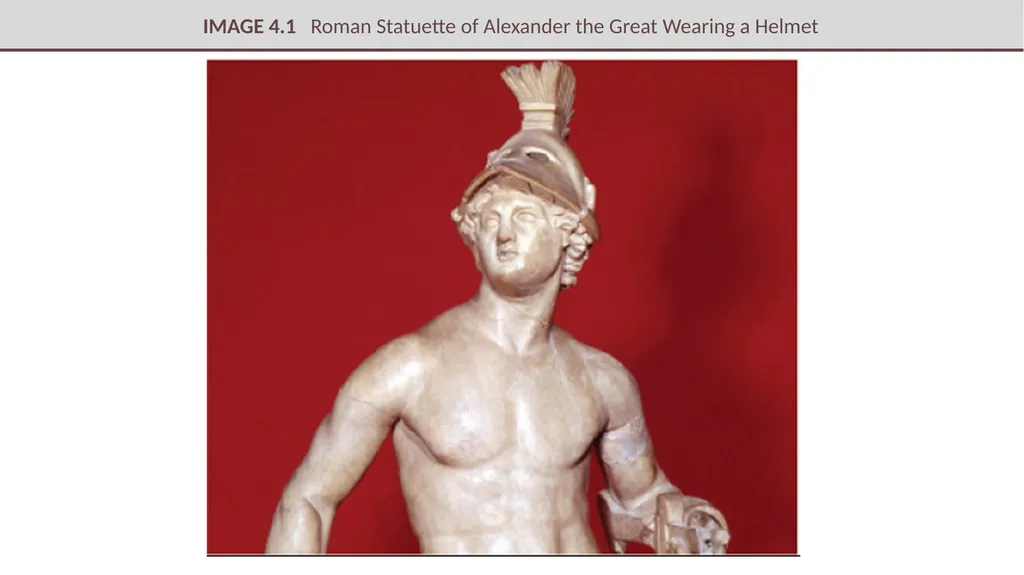
IMAGE 4.1 Roman Statuette of Alexander the Great Wearing a Helmet<br>
19
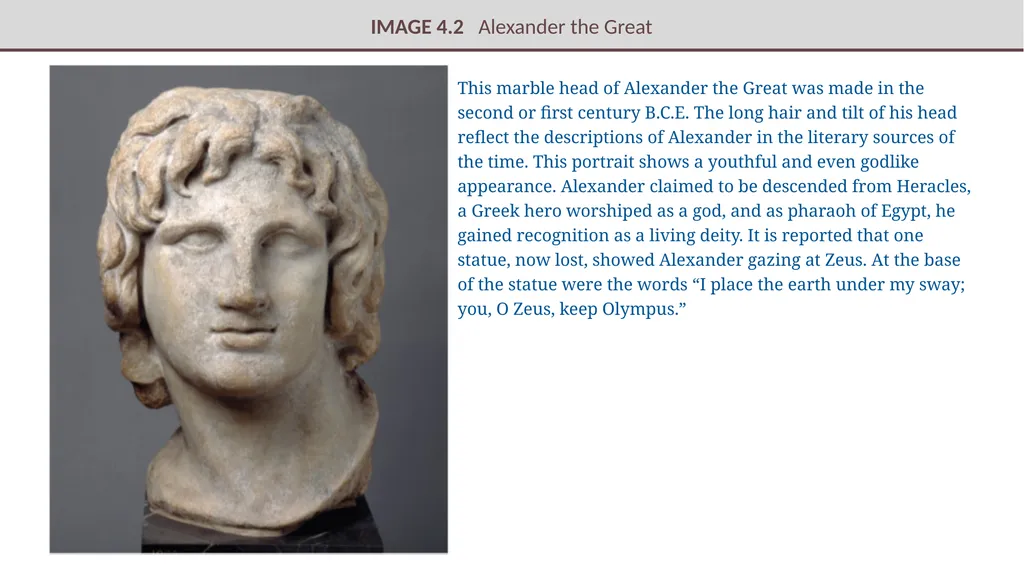
IMAGE 4.2 Alexander the Great This marble head of Alexander the Great was made in the second or first century B.C.E. The long hair and tilt of his head reflect the descriptions of Alexander in the literary sources of the time. This portrait shows a youthful and even godlike appearance. Alexander claimed to be descended from Heracles, a Greek hero worshiped as a god, and as pharaoh of Egypt, he gained recognition as a living deity. It is reported that one statue, now lost, showed Alexander gazing at Zeus. At the base of the statue were the words “I place the earth under my sway; you, O Zeus, keep Olympus.”<br>
20
MAP 4.1 The Conquests of Alexander the Great In just twelve years, Alexander the Great conquered vast territories. Dominating lands from west of the Nile to east of the Indus, he brought the Persian Empire, Egypt, and much of the Middle East under his control and laid the foundations for the Hellenistic world.<br>
21
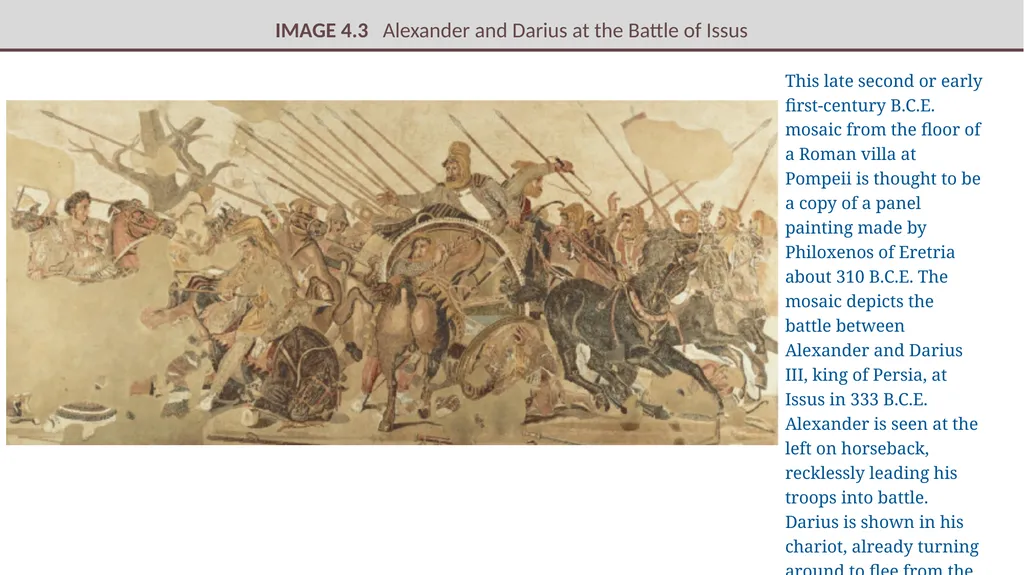
IMAGE 4.3 Alexander and Darius at the Battle of Issus This late second or early first-century B.C.E. mosaic from the floor of a Roman villa at Pompeii is thought to be a copy of a panel painting made by Philoxenos of Eretria about 310 B.C.E. The mosaic depicts the battle between Alexander and Darius III, king of Persia, at Issus in 333 B.C.E. Alexander is seen at the left on horseback, recklessly leading his troops into battle. Darius is shown in his chariot, already turning around to flee from the battlefield.<br>
22
MAP 4.2 The World of the Hellenistic Kingdoms Alexander died unexpectedly at the age of thirty-two and did not designate a successor. Upon his death, his generals struggled for power, eventually establishing monarchies that spread Hellenistic culture and fostered trade and economic development.<br>
23
MAP 4.3 The Mauryan Empire Under Ashoka<br>
24
IMAGE 4.4 A Gaul and His Wife: Monument to the Victory of a Hellenistic King This statue of a Gaulish chieftain and his wife is a Roman copy of a bronze original that was part of a larger monument erected around 230–220 B.C.E. to commemorate the victory of Attalus I of Pergamum over the Gauls, a victory that gave Pergamum control over much of Asia Minor. In this scene, the defeated Gaulish leader plunges a sword into his chest just after he has killed his wife to prevent her from being sold into slavery.<br>
25
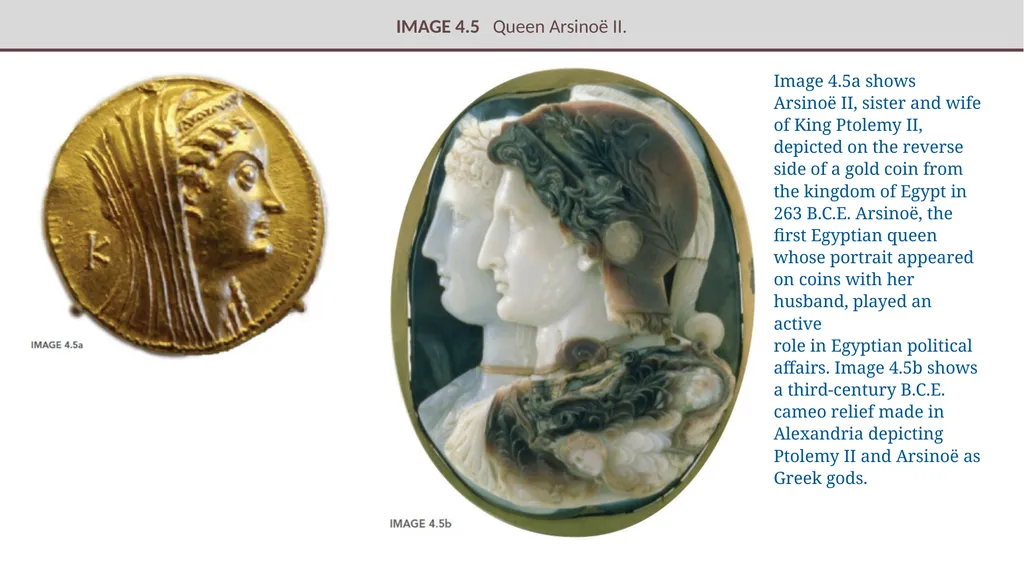
IMAGE 4.5 Queen Arsinoë II. Image 4.5a shows Arsinoë II, sister and wife of King Ptolemy II, depicted on the reverse side of a gold coin from the kingdom of Egypt in 263 B.C.E. Arsinoë, the first Egyptian queen whose portrait appeared on coins with her husband, played an active
role in Egyptian political affairs. Image 4.5b shows a third-century B.C.E. cameo relief made in Alexandria depicting Ptolemy II and Arsinoë as Greek gods.<br>
role in Egyptian political affairs. Image 4.5b shows a third-century B.C.E. cameo relief made in Alexandria depicting Ptolemy II and Arsinoë as Greek gods.<br>
26
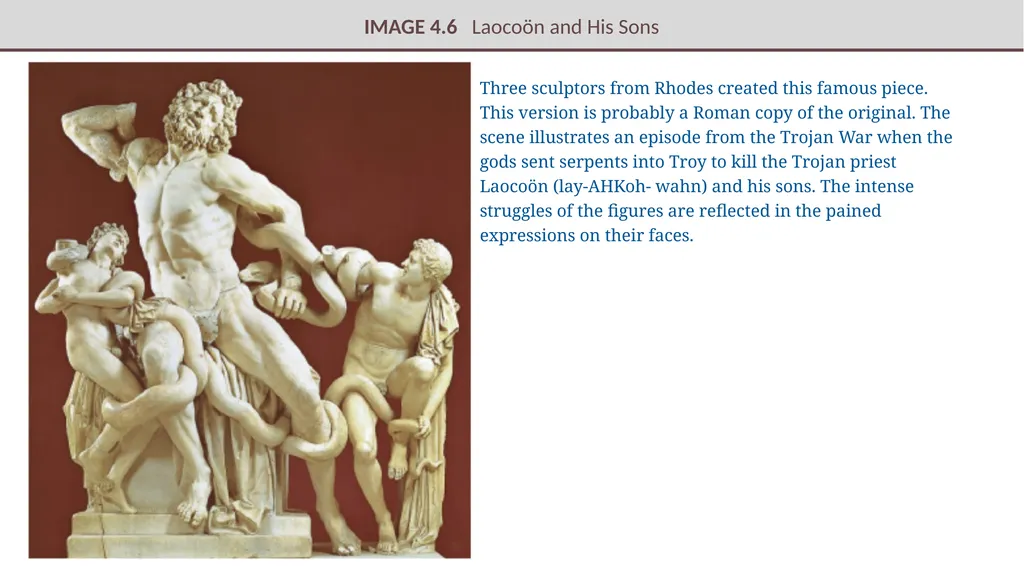
IMAGE 4.6 Laocoön and His Sons Three sculptors from Rhodes created this famous piece. This version is probably a Roman copy of the original. The scene illustrates an episode from the Trojan War when the gods sent serpents into Troy to kill the Trojan priest Laocoön (lay-AHKoh- wahn) and his sons. The intense struggles of the figures are reflected in the pained expressions on their faces.<br>
27
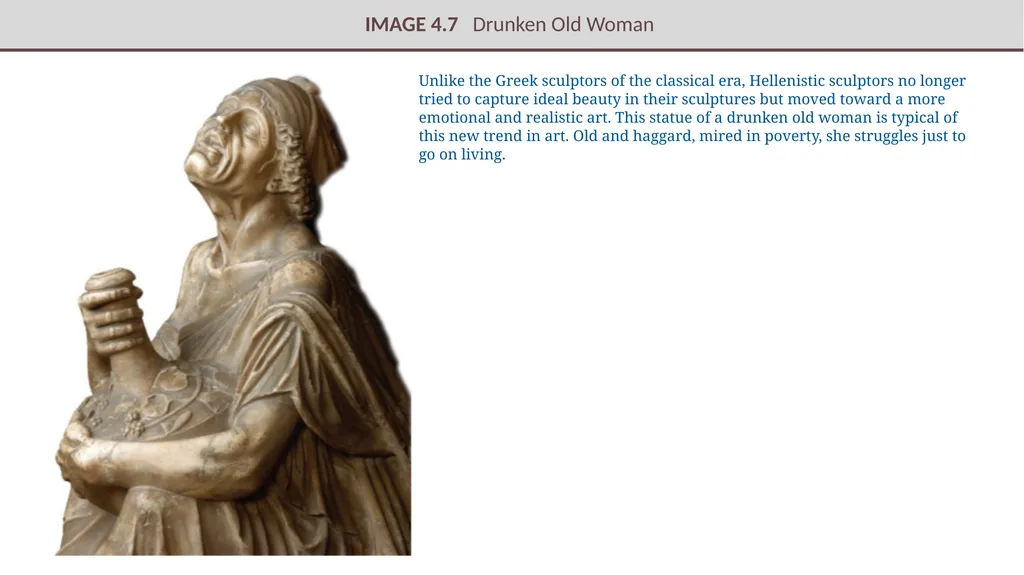
IMAGE 4.7 Drunken Old Woman Unlike the Greek sculptors of the classical era, Hellenistic sculptors no longer tried to capture ideal beauty in their sculptures but moved toward a more emotional and realistic art. This statue of a drunken old woman is typical of this new trend in art. Old and haggard, mired in poverty, she struggles just to go on living.<br>
28
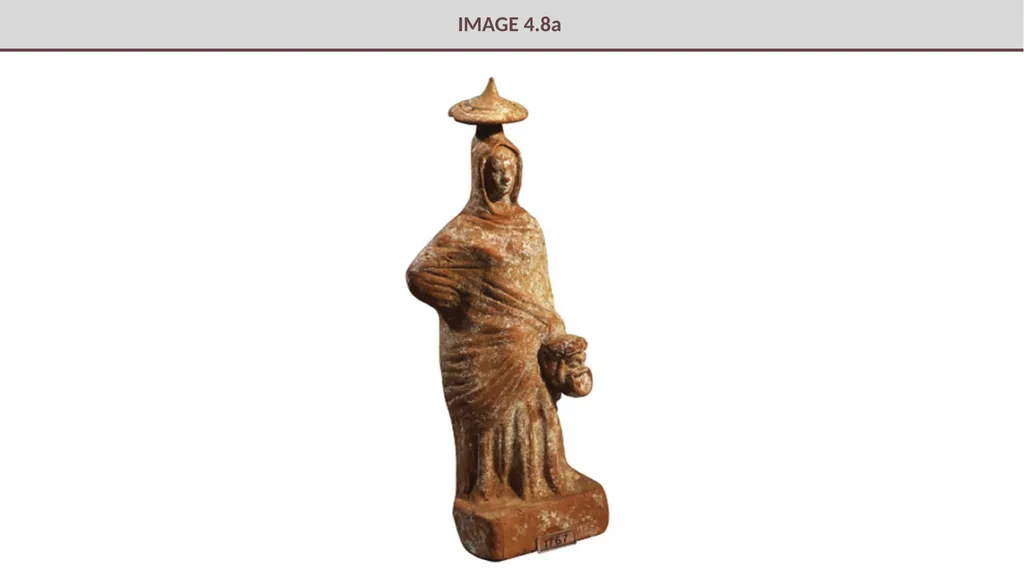
IMAGE 4.8a<br>
29
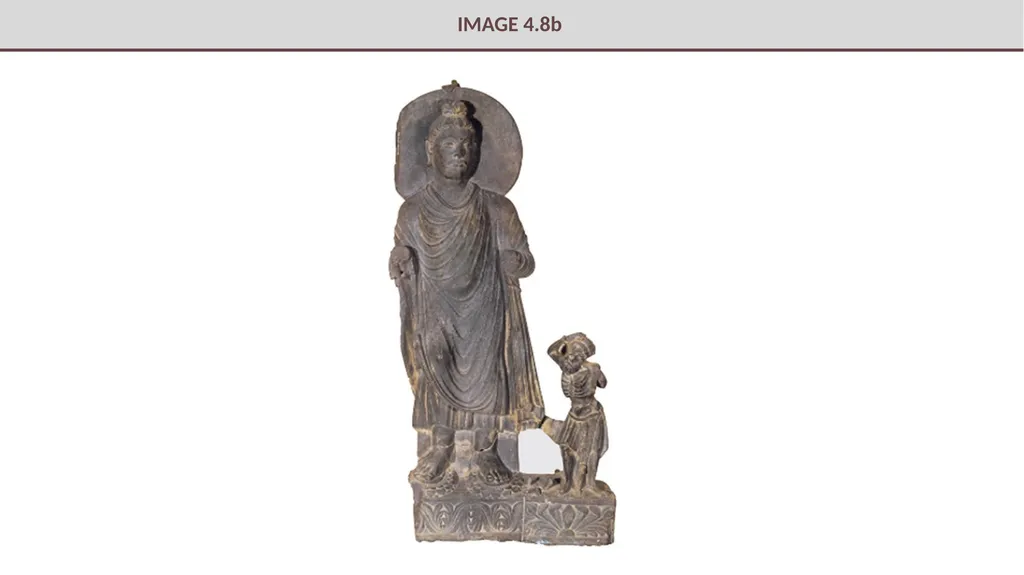
IMAGE 4.8b<br>
30
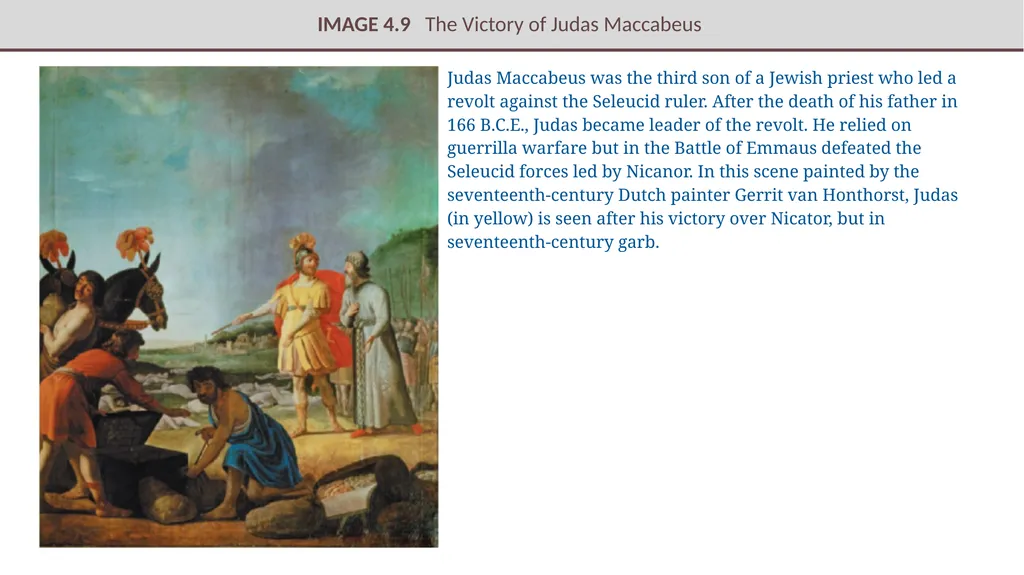
IMAGE 4.9 The Victory of Judas Maccabeus Judas Maccabeus was the third son of a Jewish priest who led a revolt against the Seleucid ruler. After the death of his father in 166 B.C.E., Judas became leader of the revolt. He relied on guerrilla warfare but in the Battle of Emmaus defeated the Seleucid forces led by Nicanor. In this scene painted by the seventeenth-century Dutch painter Gerrit van Honthorst, Judas (in yellow) is seen after his victory over Nicator, but in seventeenth-century garb.<br>
31
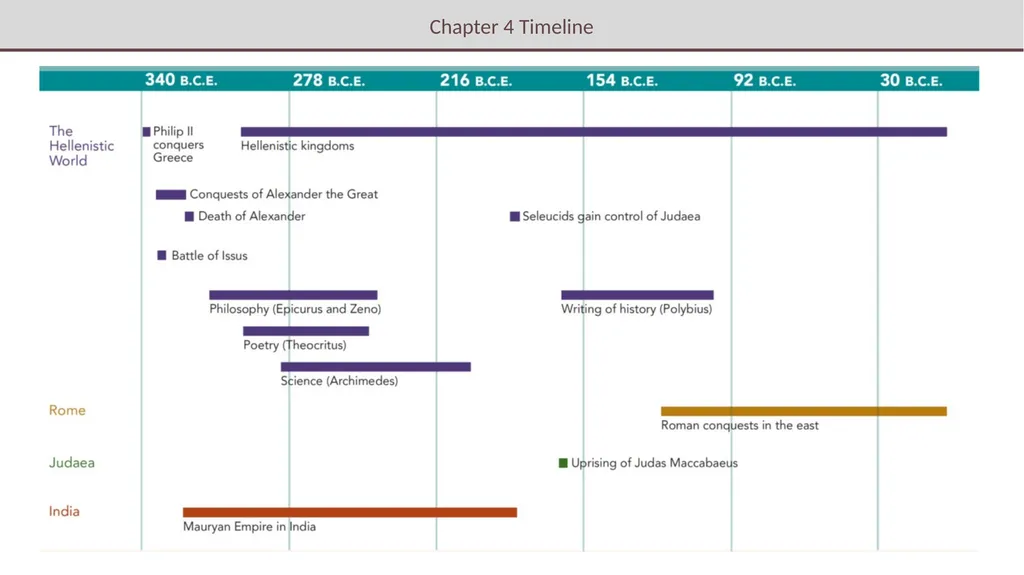
Chapter 4 Timeline<br>