Chapter 47 CONSERVATION BIOLOGY AND BIODIVERSITY PowerPoint Image Slideshow BIOLOGY 2E This work is licensed under a Creative Commons Attribution-NonCommercial-ShareAlike 4.0 International License. Terms Biodiversity - variety of a
"Chapter 47 CONSERVATION BIOLOGY AND BIODIVERSITY" is the property of its rightful owner. Permission is granted to
download and print the materials on this website for personal, non-commercial use only, and to display it
on your personal computer provided you do not modify the materials and that you retain all copyright
notices contained in the materials. By downloading content from our website, you accept the terms of this
agreement.
Presentation Transcript
01
Chapter 47 CONSERVATION BIOLOGY AND BIODIVERSITY
PowerPoint Image Slideshow BIOLOGY 2E This work is licensed under a Creative Commons Attribution-NonCommercial-ShareAlike 4.0 International License.<br>
02
Terms Biodiversity - variety of a biological system, typically conceived as the number of species, but also applying to genes, biochemistry, and ecosystems
Adaptive Radiation - rapid branching through speciation of a phylogenetic tree into many closely related species
Extinction - disappearance of a species from Earth; local extinction is the disappearance of a species from a region
Mass Extinction - sudden and dramatic (greater than half of all extant species disappearing from the fossil record) losses in biodiversity<br>
03
The number and kinds of species and their abundance in a given location or on the planet.
Genetic Diversity: Potential for adaptation (and survival) is linked to genetic variation.
Species Diversity: number of species in an ecosystem or across the biosphere
Endangered species
Threatened species
Ecosystem Diversity: The number of different ecosystems on the planet or within a given geographic area TYPES OF BIODIVERSITY<br>
04
Scientists work to identify and catalog organisms.
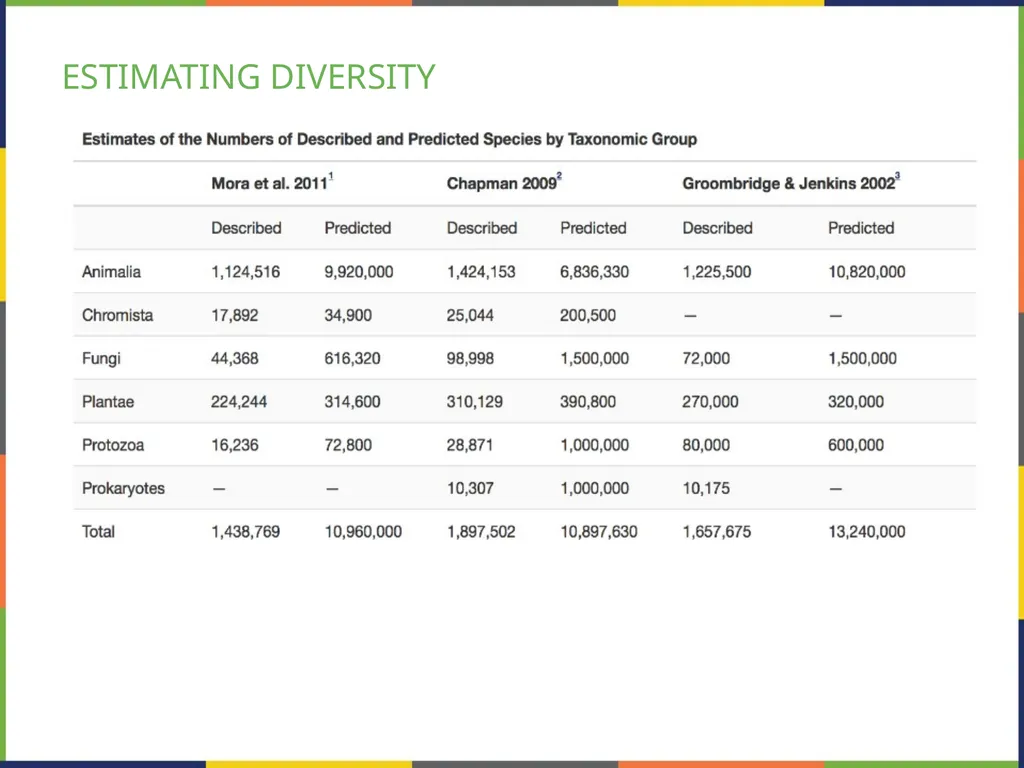
We currently have names for 1.5 million eukaryote species, which represents less than 20 percent of the total.
Diversity is so great that it would take another 500 years to complete the process at the current rate.
At the rate species are undergoing extinction, some of the species that existed will never be known. NAMED, DESCRIBED, AND PREDICTED SPECIES<br>
05
ESTIMATING DIVERSITY<br>
06
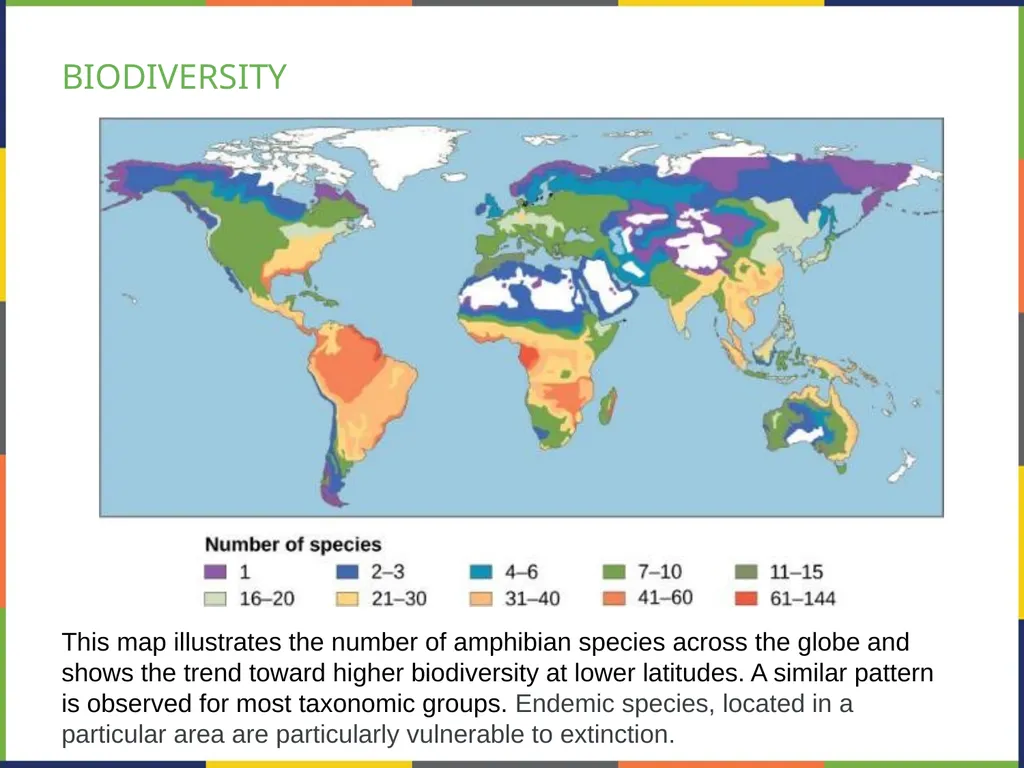
This map illustrates the number of amphibian species across the globe and shows the trend toward higher biodiversity at lower latitudes. A similar pattern is observed for most taxonomic groups. Endemic species, located in a particular area are particularly vulnerable to extinction. BIODIVERSITY<br>
07
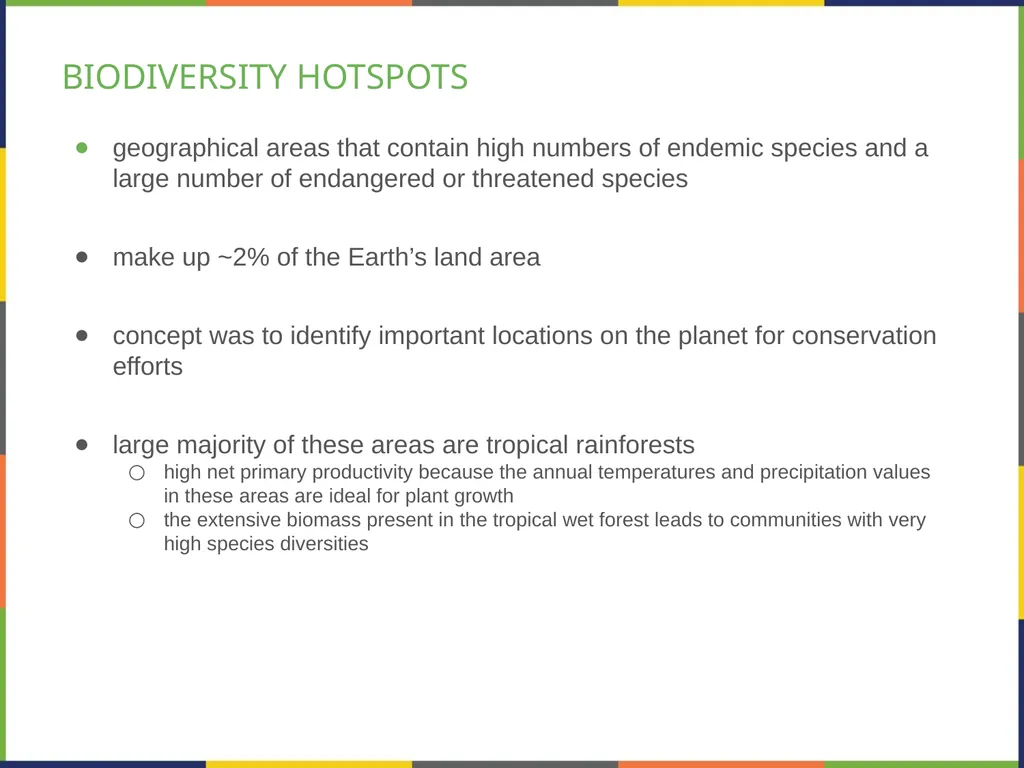
BIODIVERSITY HOTSPOTS geographical areas that contain high numbers of endemic species and a large number of endangered or threatened species
make up ~2% of the Earth’s land area
concept was to identify important locations on the planet for conservation efforts
large majority of these areas are tropical rainforests
high net primary productivity because the annual temperatures and precipitation values in these areas are ideal for plant growth
the extensive biomass present in the tropical wet forest leads to communities with very high species diversities<br>
08
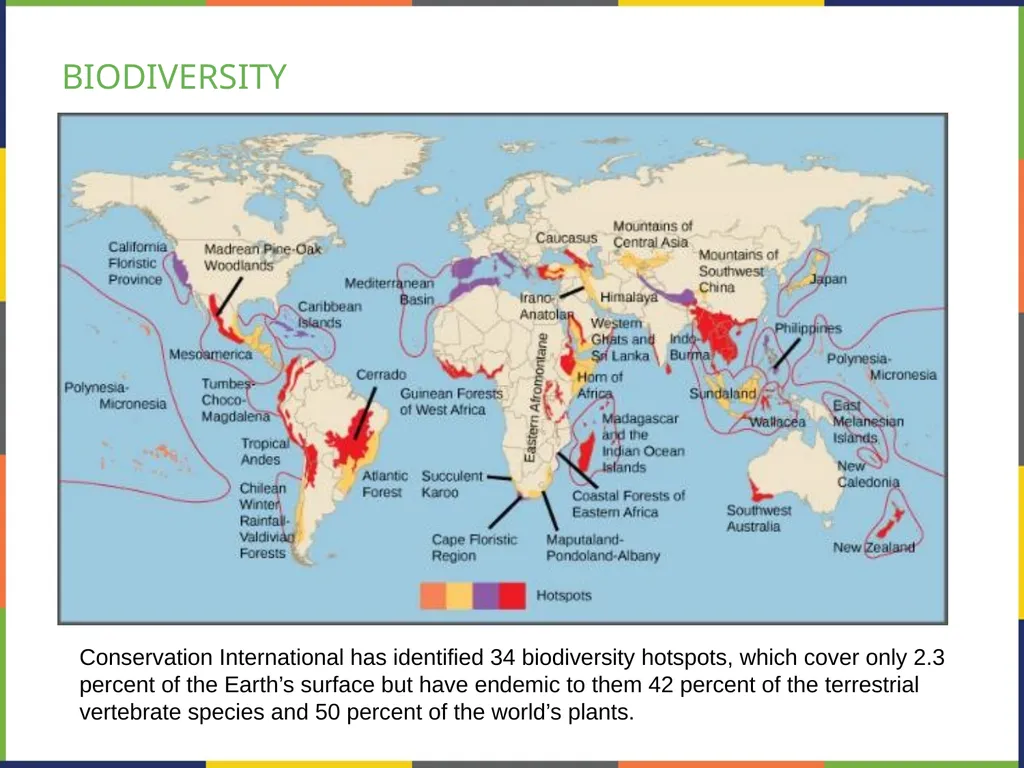
Conservation International has identified 34 biodiversity hotspots, which cover only 2.3 percent of the Earth’s surface but have endemic to them 42 percent of the terrestrial vertebrate species and 50 percent of the world’s plants. BIODIVERSITY<br>
09
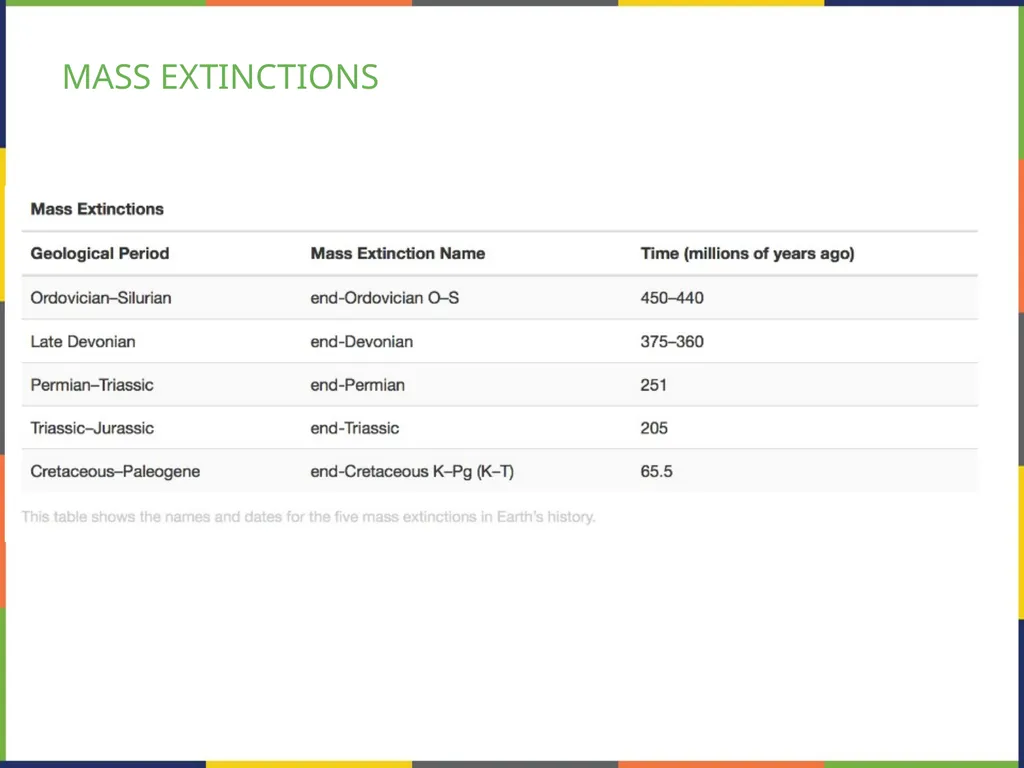
MASS EXTINCTIONS<br>
10
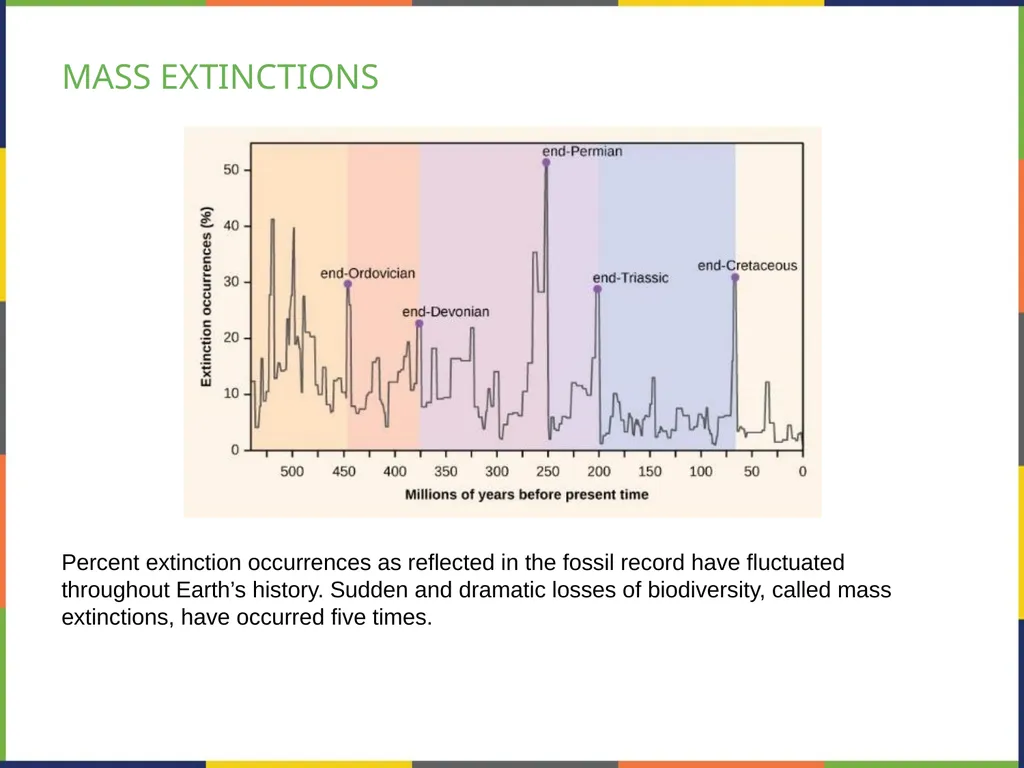
Percent extinction occurrences as reflected in the fossil record have fluctuated throughout Earth’s history. Sudden and dramatic losses of biodiversity, called mass extinctions, have occurred five times. MASS EXTINCTIONS<br>
11
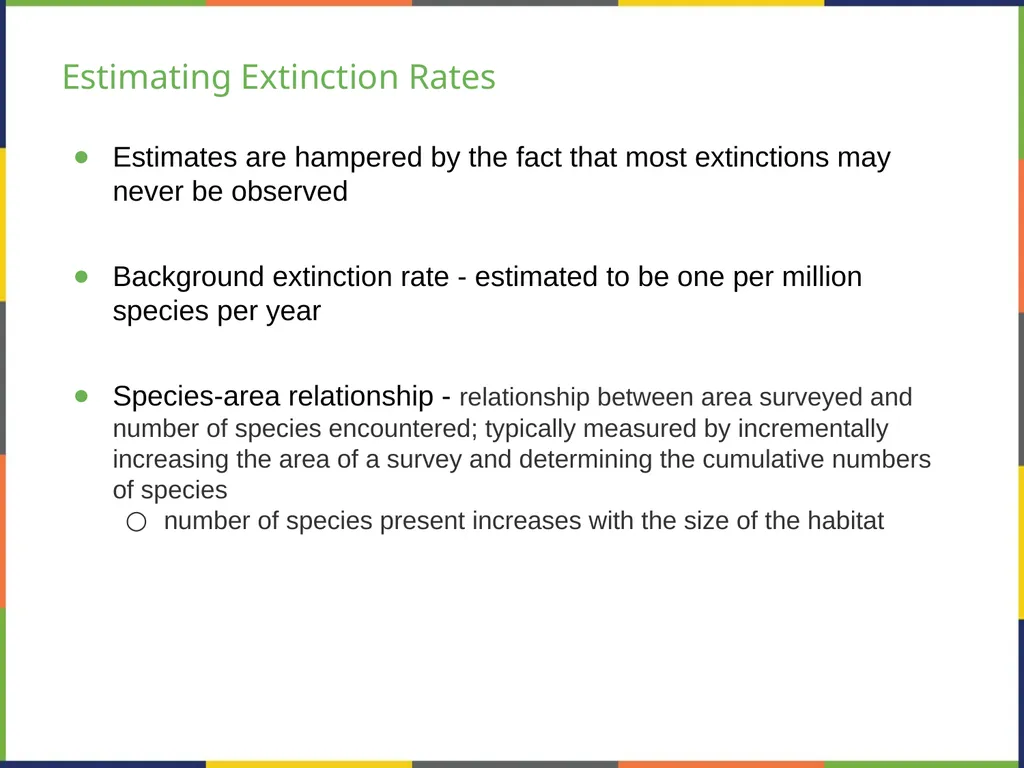
Estimating Extinction Rates Estimates are hampered by the fact that most extinctions may never be observed
Background extinction rate - estimated to be one per million species per year
Species-area relationship - relationship between area surveyed and number of species encountered; typically measured by incrementally increasing the area of a survey and determining the cumulative numbers of species
number of species present increases with the size of the habitat<br>
12
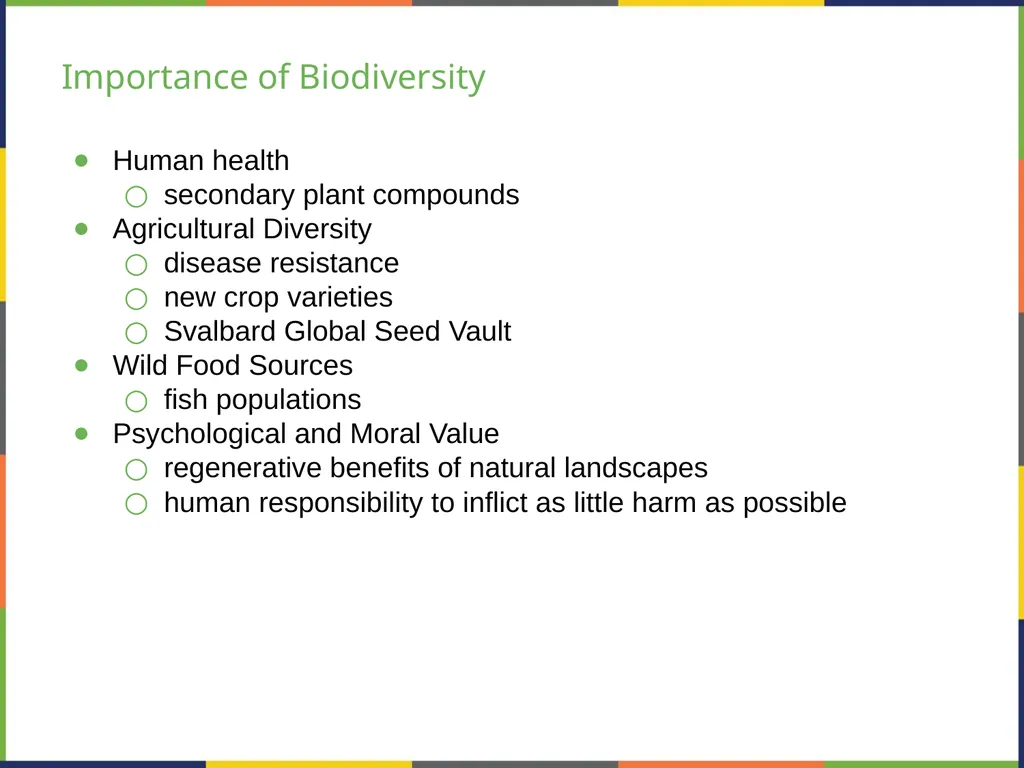
Importance of Biodiversity Human health
secondary plant compounds
Agricultural Diversity
disease resistance
new crop varieties
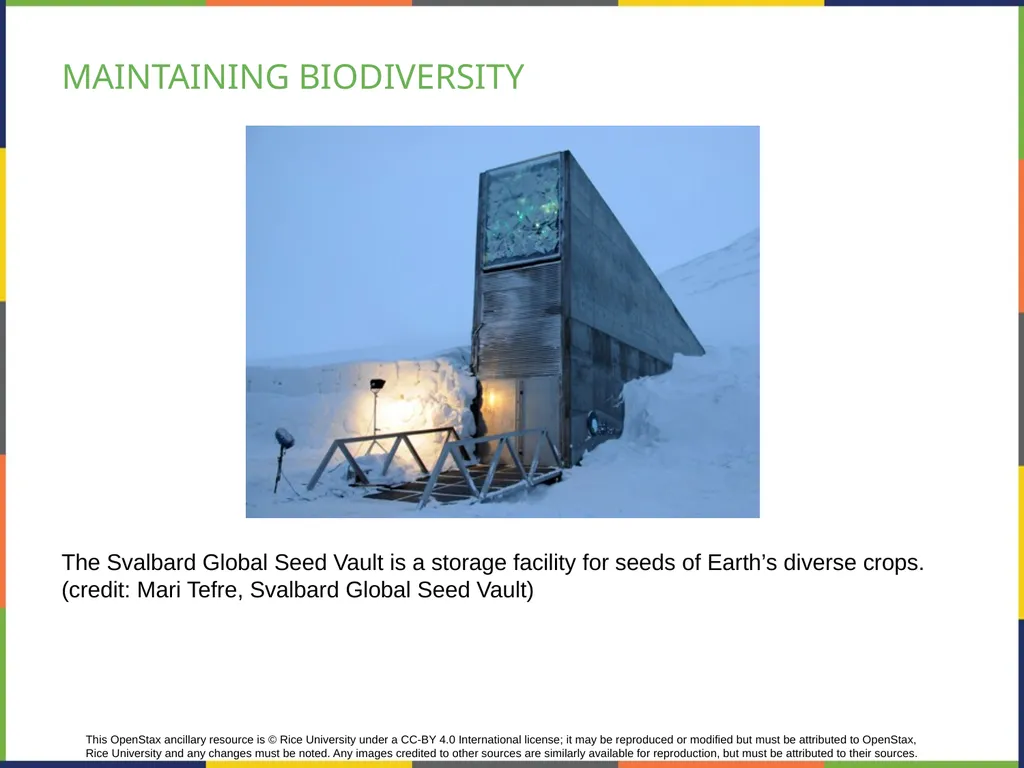
Svalbard Global Seed Vault
Wild Food Sources
fish populations
Psychological and Moral Value
regenerative benefits of natural landscapes
human responsibility to inflict as little harm as possible<br>
Habitat Loss – common across the globe
Overharvesting – particularly acute in fisheries
Many fisheries are international, and there is little motivation for preservation
Technology leads to overfishing
Exotic/invasive species
Exotic species may either outcompete, feed on, or bring disease to endemic species
May also directly affect humans
Star thistle renders useless US crop land
Giant hogweed and several invasive ticks are extremely dangerous to humans
Climate Change THREATS TO BIODIVERSITY<br>
15
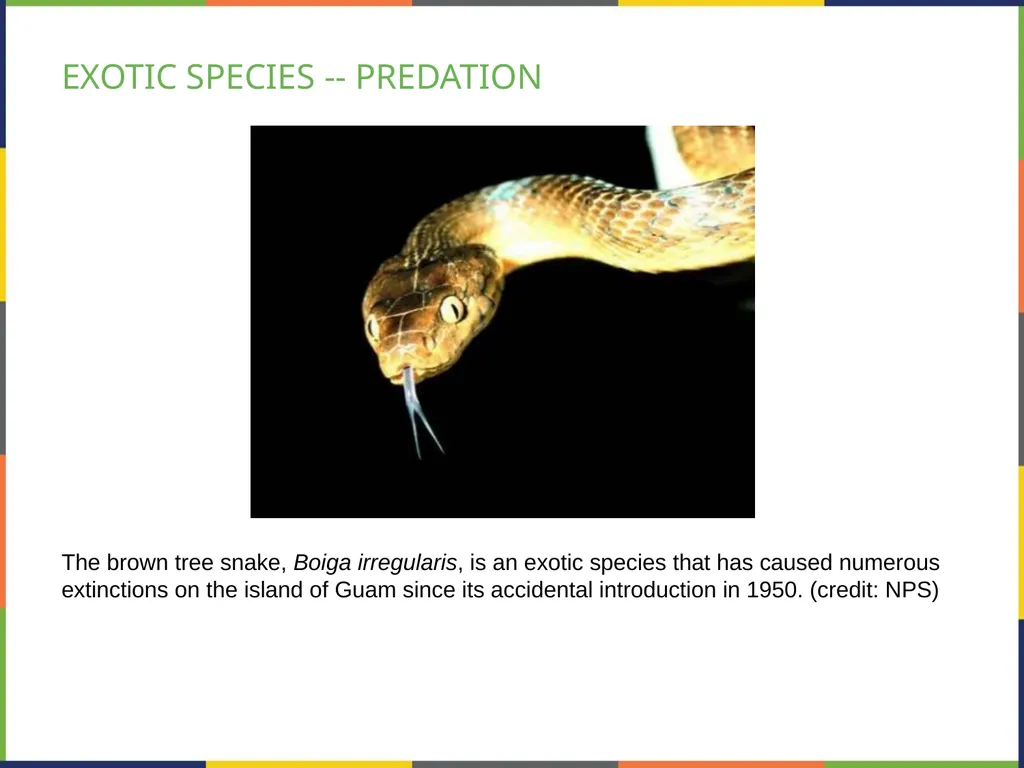
The brown tree snake, Boiga irregularis, is an exotic species that has caused numerous extinctions on the island of Guam since its accidental introduction in 1950. (credit: NPS) EXOTIC SPECIES -- PREDATION<br>
16
White-nose syndrome is the result of a European fungus that was brought to the United States.
This little brown bat in Greeley Mine, Vermont, March 26, 2009, was found to have white-nose syndrome. (credit: Marvin Moriarty, USFWS) INVASIVE SPECIES<br>
17
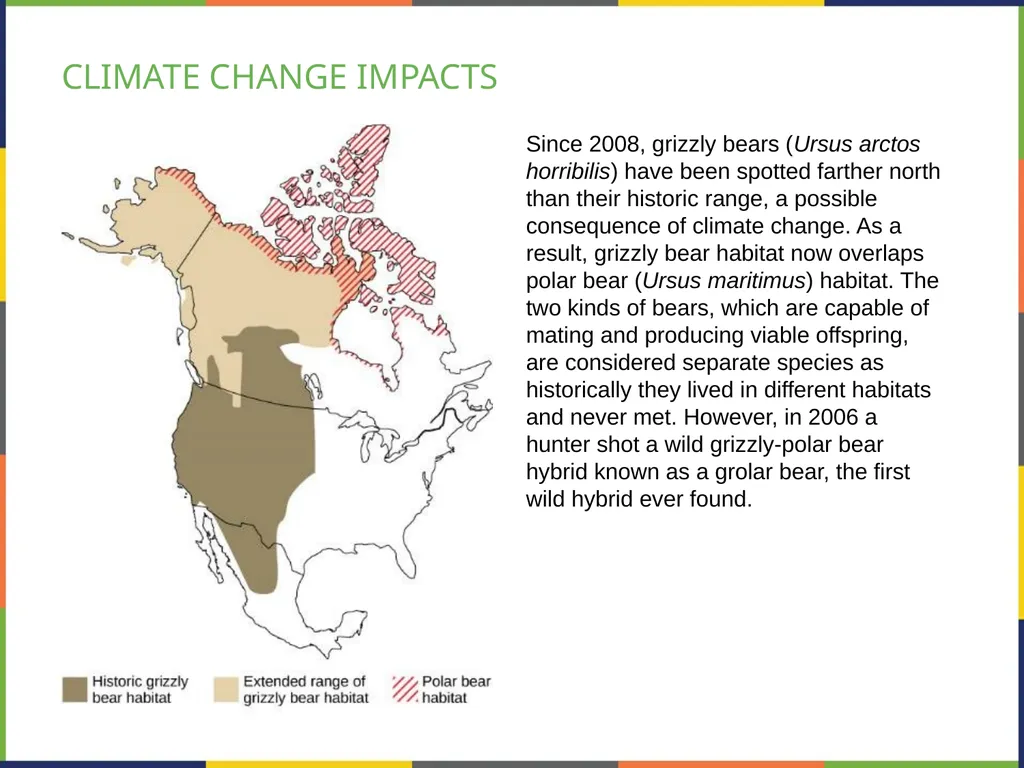
Since 2008, grizzly bears (Ursus arctos horribilis) have been spotted farther north than their historic range, a possible consequence of climate change. As a result, grizzly bear habitat now overlaps polar bear (Ursus maritimus) habitat. The two kinds of bears, which are capable of mating and producing viable offspring, are considered separate species as historically they lived in different habitats and never met. However, in 2006 a hunter shot a wild grizzly-polar bear hybrid known as a grolar bear, the first wild hybrid ever found. CLIMATE CHANGE IMPACTS<br>
18
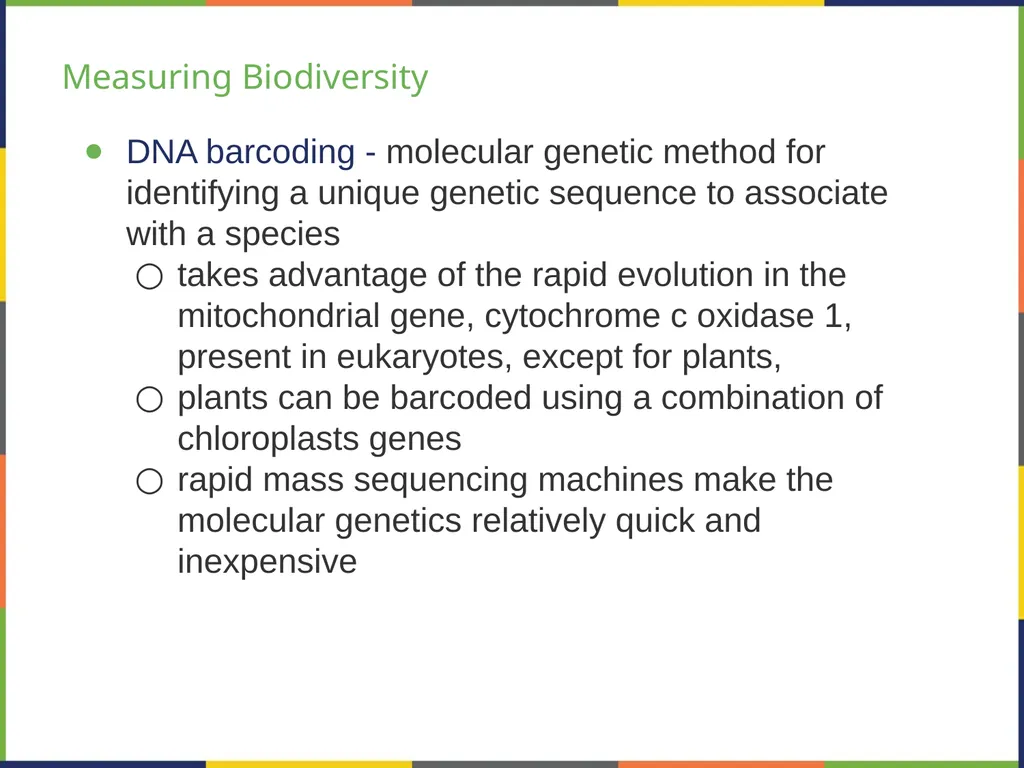
Measuring Biodiversity DNA barcoding - molecular genetic method for identifying a unique genetic sequence to associate with a species
takes advantage of the rapid evolution in the mitochondrial gene, cytochrome c oxidase 1, present in eukaryotes, except for plants,
plants can be barcoded using a combination of chloroplasts genes
rapid mass sequencing machines make the molecular genetics relatively quick and inexpensive<br>
19
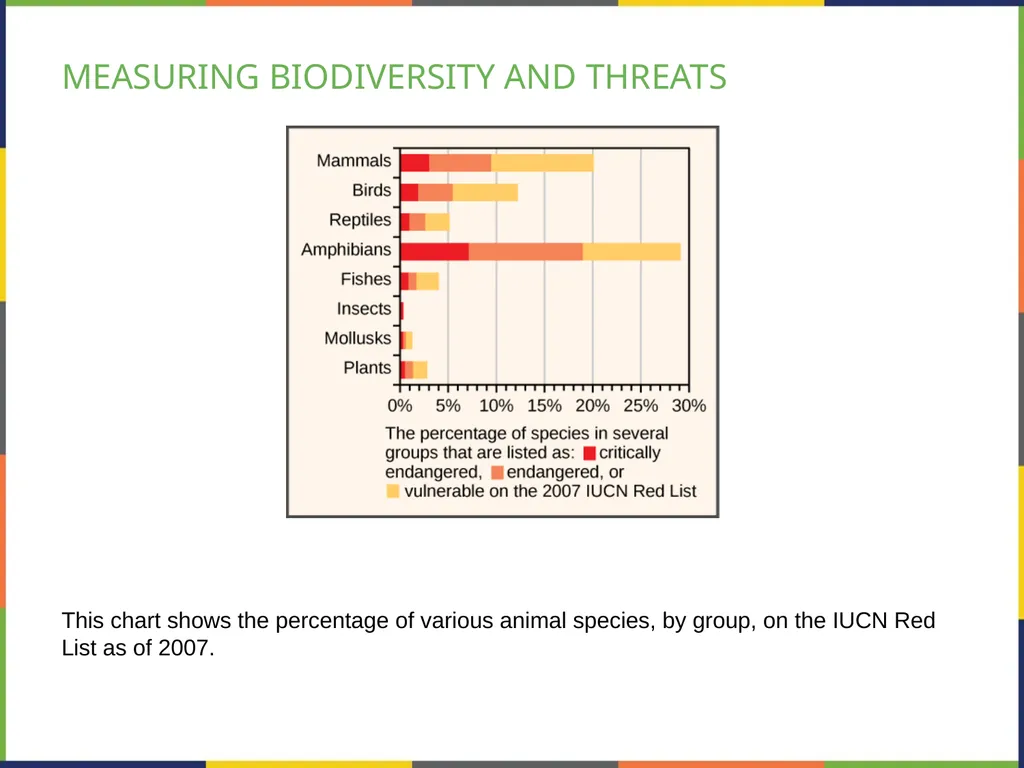
This chart shows the percentage of various animal species, by group, on the IUCN Red List as of 2007. MEASURING BIODIVERSITY AND THREATS<br>
20
PRESERVING BIODIVERSITY Legislation
Convention on International Trade in Endangered Species of Wild Fauna and Flora (CITES)
Endangered Species Act (ESA)
Migratory Bird Treaty Act (MBTA)
Nature Conservancy<br>
21
PRESERVING BIODIVERSITY Conservation in Preserves
Establishment of wildlife and ecosystem preserves
Buffer zones
Wildlife corridors
Habitat Restoration
Reintroductions of keystone species
Dam removal
Captive Breeding
Transforming zoos from collection and exhibition to facilities dedicated to conservation and education<br>