
Chapter 6: Fire Hose, Appliances, and Nozzles
CM
Published · 61 slides · 0 views

1 / 1
Description
Chapter 6: Fire Hose, Appliances, and Nozzles Knowledge Objectives Describe the types of hoses used in the fire service. Describe connecting a hose to a hydrant. Describe fire hose appliances. Describe the types and designs of nozzles.
Related Topics
Share
Embed code
Download this presentation From Below
"Chapter 6: Fire Hose, Appliances, and Nozzles" is the property of its rightful owner. Permission is granted to download and print the materials on this website for personal, non-commercial use only, and to display it on your personal computer provided you do not modify the materials and that you retain all copyright notices contained in the materials. By downloading content from our website, you accept the terms of this agreement.
Presentation Transcript
01
Chapter 6: Fire Hose, Appliances, and Nozzles<br>
02
Knowledge Objectives Describe the types of hoses used in the fire service.
Describe connecting a hose to a hydrant.
Describe fire hose appliances.
Describe the types and designs of nozzles.
Describe nozzle maintenance and inspection.<br>
Describe connecting a hose to a hydrant.
Describe fire hose appliances.
Describe the types and designs of nozzles.
Describe nozzle maintenance and inspection.<br>
03
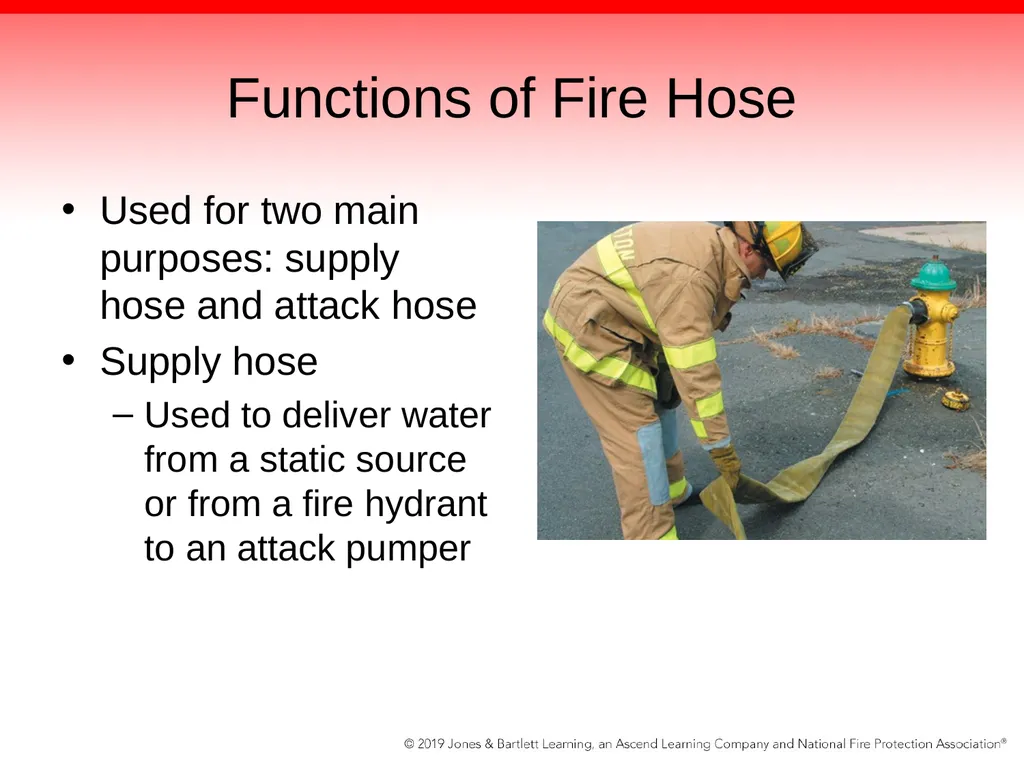
Functions of Fire Hose Used for two main purposes: supply hose and attack hose
Supply hose
Used to deliver water from a static source or from a fire hydrant to an attack pumper<br>
Supply hose
Used to deliver water from a static source or from a fire hydrant to an attack pumper<br>
04
Supply Hose Water can come directly from a hydrant or from another engine
Supply line sizes include 3½-inch (90-mm), 4-inch (100-mm), 5-inch (125-mm), and 6-inch (150-mm) hoses.
Designed to carry larger volumes of water at lower pressures<br>
Supply line sizes include 3½-inch (90-mm), 4-inch (100-mm), 5-inch (125-mm), and 6-inch (150-mm) hoses.
Designed to carry larger volumes of water at lower pressures<br>
05
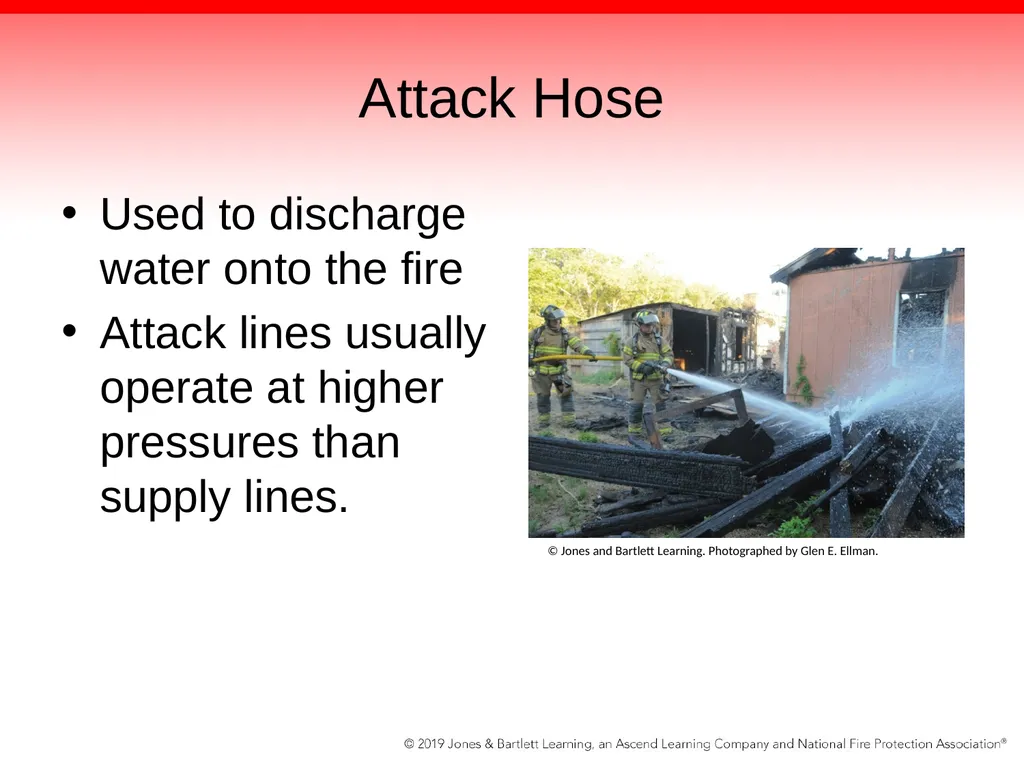
Attack Hose Used to discharge water onto the fire
Attack lines usually operate at higher pressures than supply lines. © Jones and Bartlett Learning. Photographed by Glen E. Ellman.<br>
Attack lines usually operate at higher pressures than supply lines. © Jones and Bartlett Learning. Photographed by Glen E. Ellman.<br>
06
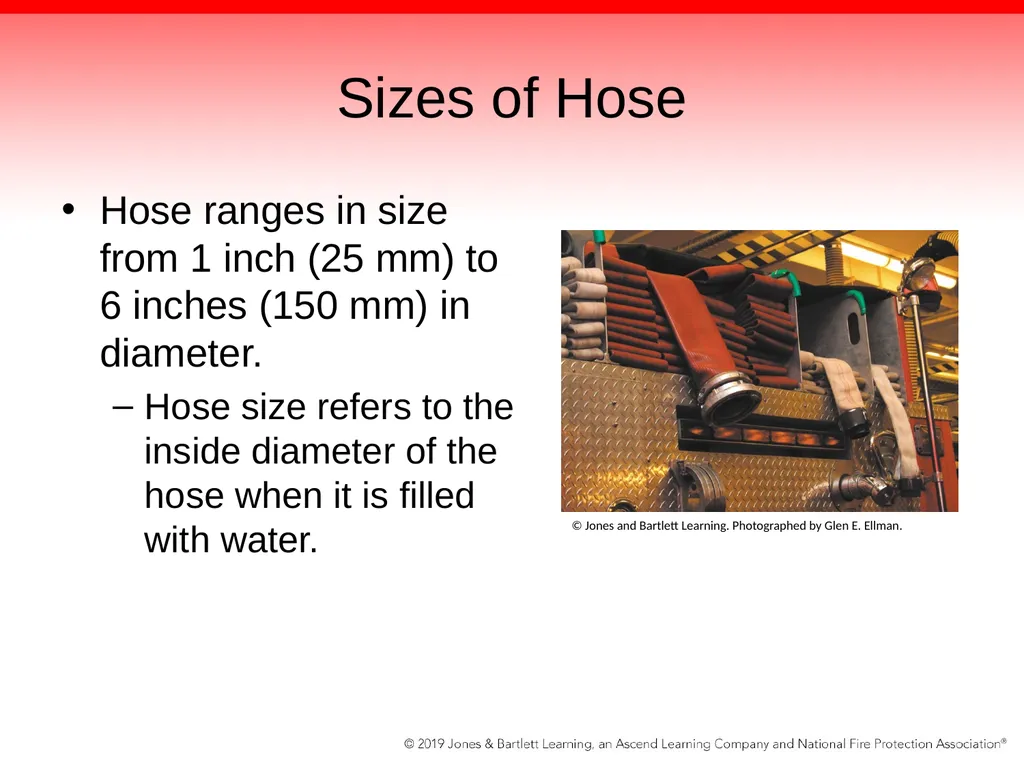
Sizes of Hose Hose ranges in size from 1 inch (25 mm) to 6 inches (150 mm) in diameter.
Hose size refers to the inside diameter of the hose when it is filled with water. © Jones and Bartlett Learning. Photographed by Glen E. Ellman.<br>
Hose size refers to the inside diameter of the hose when it is filled with water. © Jones and Bartlett Learning. Photographed by Glen E. Ellman.<br>
07
Sizes of Hose Smaller-diameter hose is used as attack lines.
Larger-diameter hose is used as supply lines.
Medium-diameter hose can be used as either attack lines or supply lines.<br>
Larger-diameter hose is used as supply lines.
Medium-diameter hose can be used as either attack lines or supply lines.<br>
08
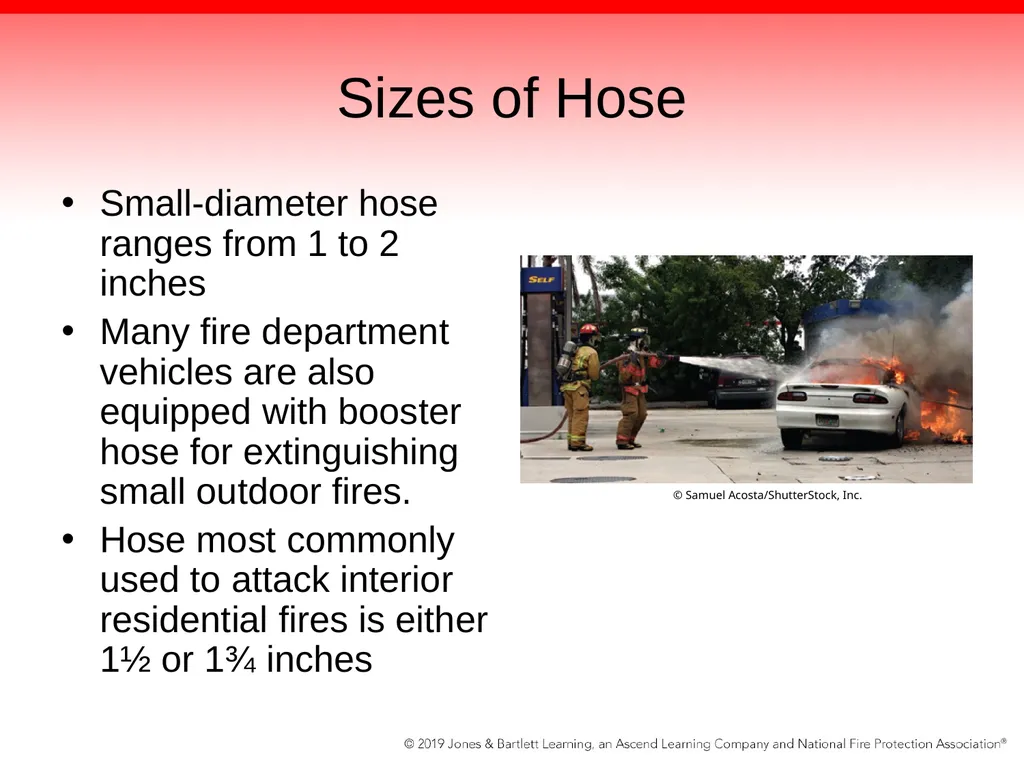
Sizes of Hose Small-diameter hose ranges from 1 to 2 inches
Many fire department vehicles are also equipped with booster hose for extinguishing small outdoor fires.
Hose most commonly used to attack interior residential fires is either 1½ or 1¾ inches © Samuel Acosta/ShutterStock, Inc.<br>
Many fire department vehicles are also equipped with booster hose for extinguishing small outdoor fires.
Hose most commonly used to attack interior residential fires is either 1½ or 1¾ inches © Samuel Acosta/ShutterStock, Inc.<br>
09
Sizes of Hose Medium-diameter hose (MDH) has a diameter of 2½ inches (65 mm) or 3 inches (77 mm).
Can be used as either supply lines or attack lines
Large handline nozzles are often used with 2½-inch (65-mm) hose to attack larger fires.<br>
Can be used as either supply lines or attack lines
Large handline nozzles are often used with 2½-inch (65-mm) hose to attack larger fires.<br>
10
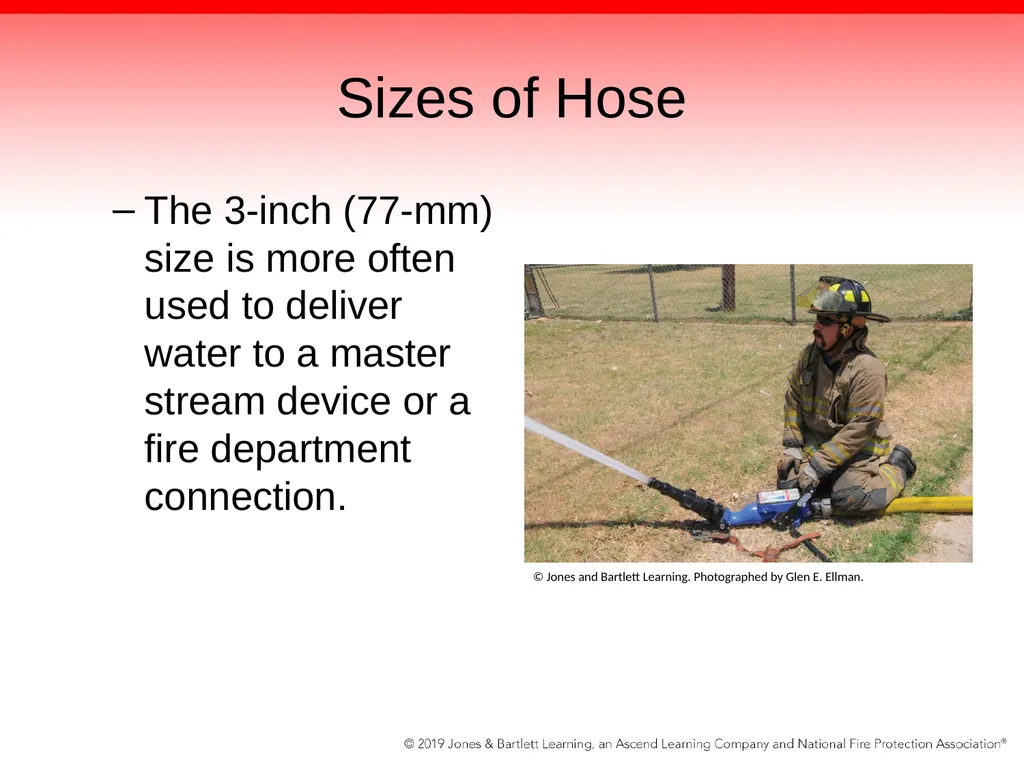
Sizes of Hose The 3-inch (77-mm) size is more often used to deliver water to a master stream device or a fire department connection. © Jones and Bartlett Learning. Photographed by Glen E. Ellman.<br>
11
Sizes of Hose Large-diameter hose (LDH) has a diameter of 3½ inches (90 mm) or more.
Standard LDH sizes include 4-inch (100-mm) and 5-inch (125-mm) diameters.
Largest LDH size is 6 inches (150 mm) in diameter.
Standard lengths of 50 ft (15 m) and 10 ft (3 m) are available for LDH.<br>
Standard LDH sizes include 4-inch (100-mm) and 5-inch (125-mm) diameters.
Largest LDH size is 6 inches (150 mm) in diameter.
Standard lengths of 50 ft (15 m) and 10 ft (3 m) are available for LDH.<br>
12
Sizes of Hose Fire hose is typically designed to be used as either attack hose or supply hose.
Some types are used as both
Attack hose must withstand higher pressures.
Attack hose can be subjected to high temperatures, sharp surfaces, abrasion, and other potentially damaging conditions.
Attack hose can be used as supply hose, but LDH supply hose must never be used as attack hose.<br>
Some types are used as both
Attack hose must withstand higher pressures.
Attack hose can be subjected to high temperatures, sharp surfaces, abrasion, and other potentially damaging conditions.
Attack hose can be used as supply hose, but LDH supply hose must never be used as attack hose.<br>
13
Sizes of Hose Attack hose must be tested annually at a pressure of at least 300 psi and is intended to be used at pressures up to 275 psi
Supply hose must be tested annually at a pressure of at least 200 psi and is intended to be used at pressures up to 185 psi
Most LDH is constructed for use as supply lines.
This hose may be used in water supply operations in case of high-rise fires or large industrial fires.<br>
Supply hose must be tested annually at a pressure of at least 200 psi and is intended to be used at pressures up to 185 psi
Most LDH is constructed for use as supply lines.
This hose may be used in water supply operations in case of high-rise fires or large industrial fires.<br>
14
Attack Hose Designed for fire suppression
Must be tough, flexible, and light in weight
Most fire departments use two sizes of hose as attack lines for fire suppression.
Smaller size is 1½ inches (38 mm) or 1¾ inches (45 mm) in diameter.
Medium-diameter (2½-inch [65-mm]) hose is used for heavy interior attack lines and for certain types of exterior attacks.<br>
Must be tough, flexible, and light in weight
Most fire departments use two sizes of hose as attack lines for fire suppression.
Smaller size is 1½ inches (38 mm) or 1¾ inches (45 mm) in diameter.
Medium-diameter (2½-inch [65-mm]) hose is used for heavy interior attack lines and for certain types of exterior attacks.<br>
15
1½-Inch (38-mm) and 1¾-Inch (45-mm) Attack Hose Used as primary attack line by most departments
Both sizes use 1½-inch (38-mm) couplings.
Handlines can usually be operated by one fire fighter.
Having a second person on the line makes it easier to advance and control the hose.<br>
Both sizes use 1½-inch (38-mm) couplings.
Handlines can usually be operated by one fire fighter.
Having a second person on the line makes it easier to advance and control the hose.<br>
16
1½-Inch (38-mm) and 1¾-Inch (45-mm) Attack Hose Often stored on fire apparatus as preconnected attack lines
Primary difference between 1½-inch and 1¾-inch hose is the amount of water that can flow through the hose.
1½-inch hose can flow water at a rate between 60 and 125 gpm.
1¾-inch hose can flow water at a rate between 120 and 200 gpm.<br>
Primary difference between 1½-inch and 1¾-inch hose is the amount of water that can flow through the hose.
1½-inch hose can flow water at a rate between 60 and 125 gpm.
1¾-inch hose can flow water at a rate between 120 and 200 gpm.<br>
17
1½-Inch (38-mm) and 1¾-Inch (45-mm) Attack Hose 1¾-inch (45-mm) hose can deliver much more water and is only slightly heavier and more difficult to advance than a 1½-inch (38-mm) hoseline.
1¾-inch hose is one of the most widely used primary attack lines in the fire service.<br>
1¾-inch hose is one of the most widely used primary attack lines in the fire service.<br>
18
2½-Inch (65-mm) Attack Hose Used as an attack line for fires too large to be controlled by a 1½-inch or 1¾-inch hoseline
Delivers a flow of 250 gpm (945 L/min)
Takes at least two fire fighters to safely control
Higher flows up can be achieved with higher pressures and larger nozzles, but such flows are more likely to be used as a master stream device<br>
Delivers a flow of 250 gpm (945 L/min)
Takes at least two fire fighters to safely control
Higher flows up can be achieved with higher pressures and larger nozzles, but such flows are more likely to be used as a master stream device<br>
19
Booster Hose Usually carried on a hose reel that holds 150 ft (45 m) or 200 ft (60 m) of rubber hose
Contains a steel wire that gives it a rigid shape
Lightweight and can be advanced quickly by one person
Disadvantage is limited flow.
Typically limited to small outdoor fires and trash dumpsters
Should not be used for structural firefighting<br>
Contains a steel wire that gives it a rigid shape
Lightweight and can be advanced quickly by one person
Disadvantage is limited flow.
Typically limited to small outdoor fires and trash dumpsters
Should not be used for structural firefighting<br>
20
Supply Hose Used to deliver water to an attack pumper from a pressurized source
Supply lines range from 3½ to 6 inches in diameter.
Choice of diameter based on:
Requirements of each fire department
Amount of water needed to supply the attack pumper
Distance from the source to the attack pumper
Pressure available at the source<br>
Supply lines range from 3½ to 6 inches in diameter.
Choice of diameter based on:
Requirements of each fire department
Amount of water needed to supply the attack pumper
Distance from the source to the attack pumper
Pressure available at the source<br>
21
Supply Hose Engines are normally loaded with at least one bed of hose that can be laid out as a supply line.
When 2½-inch hose is used as a supply line, it comprises the same type of hose that is used for attack lines.
Large-diameter supply lines are more efficient than for moving larger volumes of water over longer distances.
A typical fire engine may carry anywhere from 600 to 1250 ft of supply hose.<br>
When 2½-inch hose is used as a supply line, it comprises the same type of hose that is used for attack lines.
Large-diameter supply lines are more efficient than for moving larger volumes of water over longer distances.
A typical fire engine may carry anywhere from 600 to 1250 ft of supply hose.<br>
22
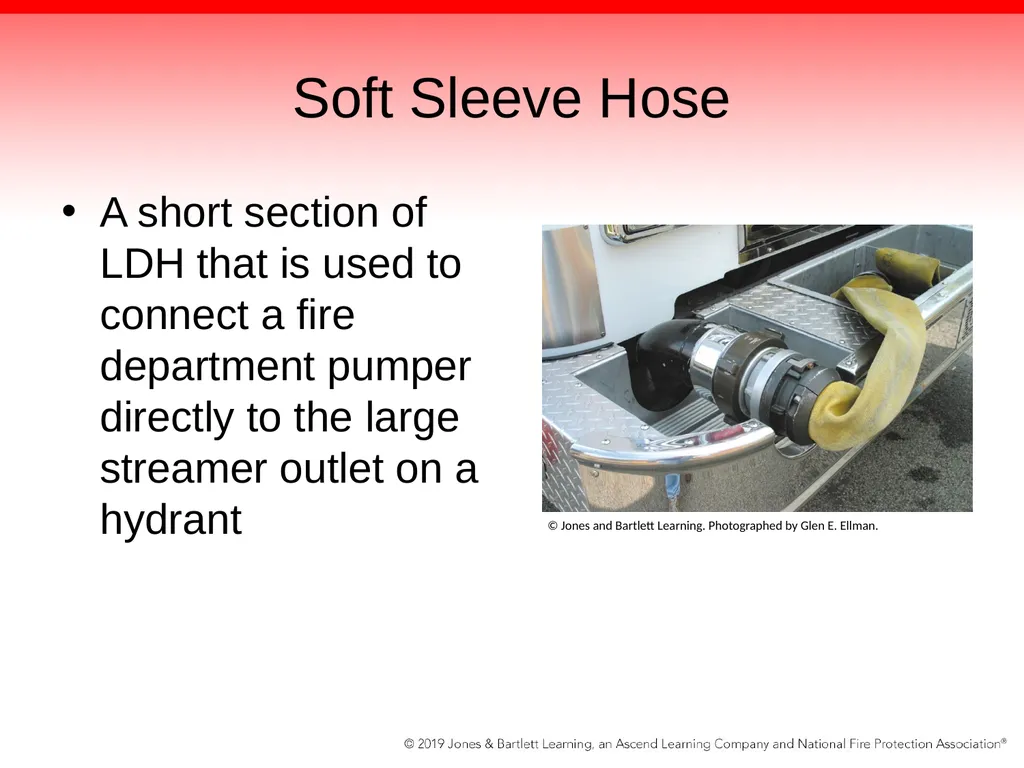
A short section of LDH that is used to connect a fire department pumper directly to the large streamer outlet on a hydrant Soft Sleeve Hose © Jones and Bartlett Learning. Photographed by Glen E. Ellman.<br>
23
Allows as much water as possible to flow from the hydrant to the pump through a single hose
May have Storz or similar connections on both ends or a female connection on each end
Always make sure the coupling is locked before charging the line.
Can range from 4 to 6 inches in diameter and is usually between 10 and 25 ft in length Soft Sleeve Hose<br>
May have Storz or similar connections on both ends or a female connection on each end
Always make sure the coupling is locked before charging the line.
Can range from 4 to 6 inches in diameter and is usually between 10 and 25 ft in length Soft Sleeve Hose<br>
24
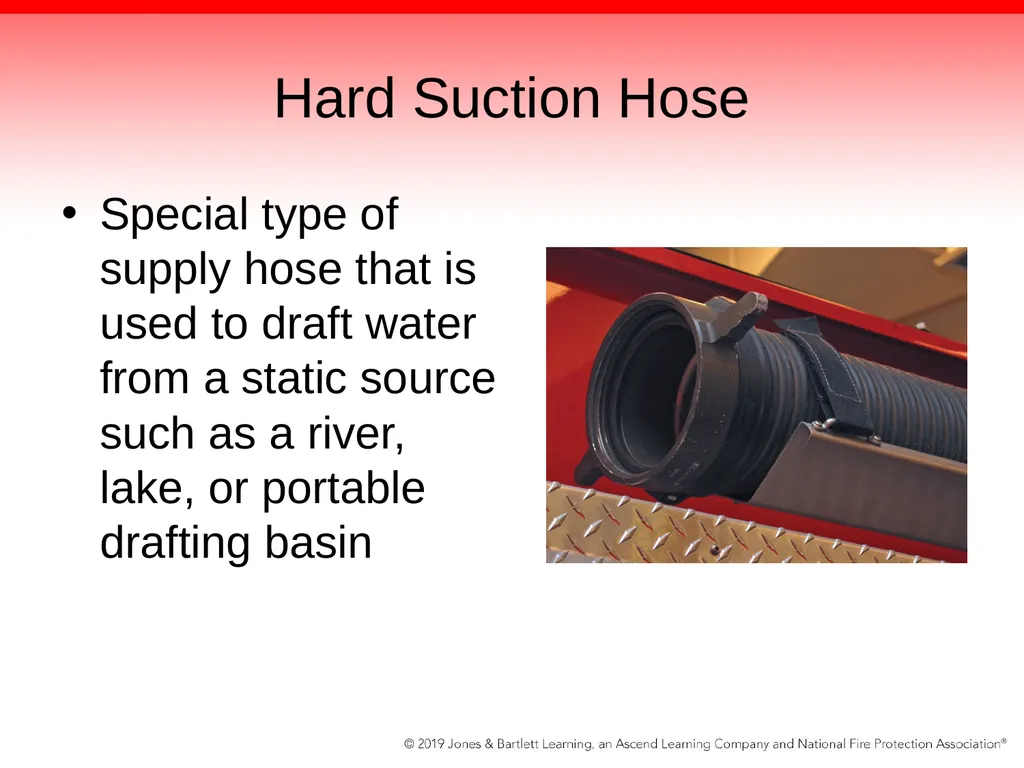
Hard Suction Hose Special type of supply hose that is used to draft water from a static source such as a river, lake, or portable drafting basin<br>
25
Hard Suction Hose Water is drawn through the hose into the pump on a fire department engine or into a portable pump.
Designed to remain rigid and not collapse when a vacuum is created to draw the water through
Normally comes in 10- or 20-ft sections
Diameter is based on the capacity of the pump and can be as large as 6 in
Can be made from either rubber or plastic<br>
Designed to remain rigid and not collapse when a vacuum is created to draw the water through
Normally comes in 10- or 20-ft sections
Diameter is based on the capacity of the pump and can be as large as 6 in
Can be made from either rubber or plastic<br>
26
Fire Hose Appliances Any device used in conjunction with a fire hose for the purpose of delivering water
Some are used primarily with supply lines, others are most often used with attack lines.
Many can be employed with both supply lines and attack lines.<br>
Some are used primarily with supply lines, others are most often used with attack lines.
Many can be employed with both supply lines and attack lines.<br>
27
Wye A device that splits one hose stream into two hose streams
Wye refers to a Y-shaped part or object.
When threaded couplings are used, a wye has one female connection and two male connections.
Foot-tilt method helps to prevent cross-threading the two couplings.<br>
Wye refers to a Y-shaped part or object.
When threaded couplings are used, a wye has one female connection and two male connections.
Foot-tilt method helps to prevent cross-threading the two couplings.<br>
28
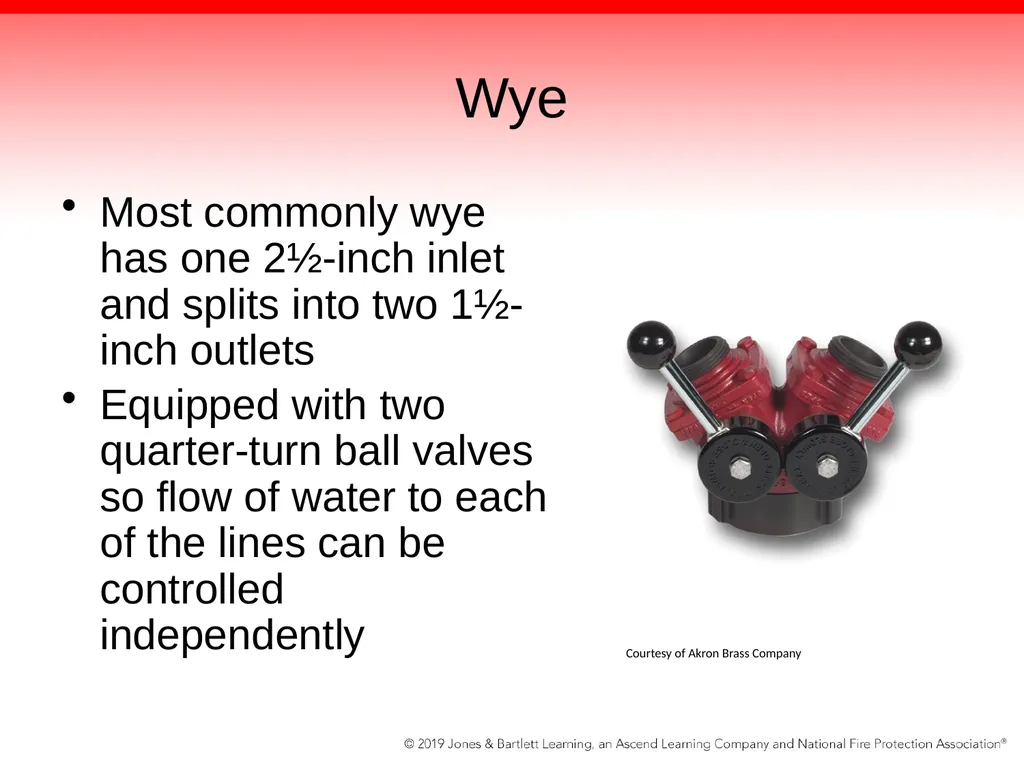
Wye Most commonly wye has one 2½-inch inlet and splits into two 1½-inch outlets
Equipped with two quarter-turn ball valves so flow of water to each of the lines can be controlled independently Courtesy of Akron Brass Company<br>
Equipped with two quarter-turn ball valves so flow of water to each of the lines can be controlled independently Courtesy of Akron Brass Company<br>
29
Wye Gated wye enables fire fighters to start with one hoseline and to add a second hose later if necessary.
Use of a gated wye avoids the need to shut down the hoseline supplying the wye while attaching this second line.<br>
Use of a gated wye avoids the need to shut down the hoseline supplying the wye while attaching this second line.<br>
30
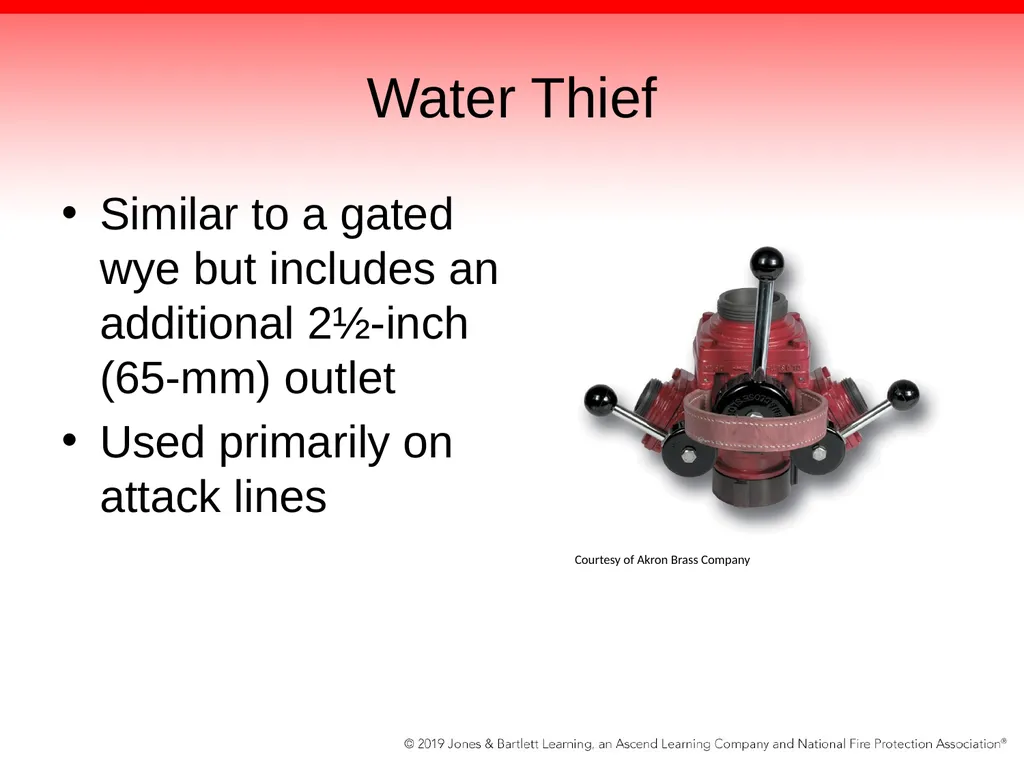
Water Thief Similar to a gated wye but includes an additional 2½-inch (65-mm) outlet
Used primarily on attack lines Courtesy of Akron Brass Company<br>
Used primarily on attack lines Courtesy of Akron Brass Company<br>
31
Water Thief Water from a single 2½-inch inlet can be directed to two 1½-inch outlets and one 2½-inch outlet.
Attach the water thief to the 2½-inch (65-mm) hoseline and then connect the other lines to the appliance as needed.
Adjust pressure by opening or closing valves.
Can be placed near the entrance to a building to provide the water for interior attack lines<br>
Attach the water thief to the 2½-inch (65-mm) hoseline and then connect the other lines to the appliance as needed.
Adjust pressure by opening or closing valves.
Can be placed near the entrance to a building to provide the water for interior attack lines<br>
32
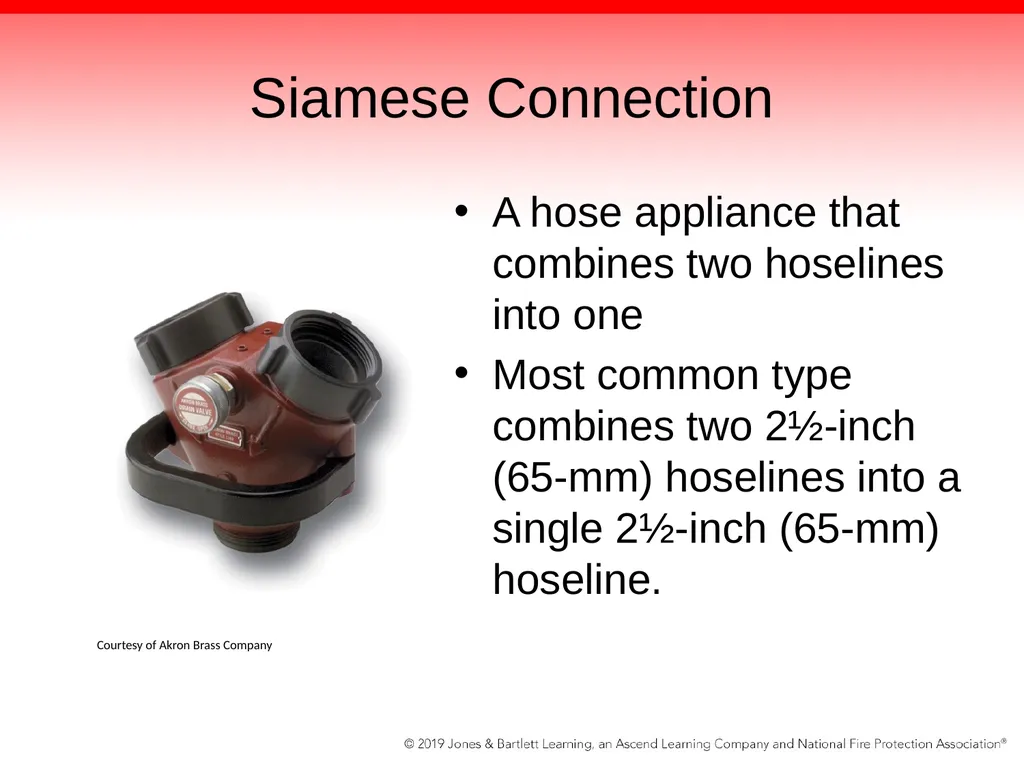
Siamese Connection A hose appliance that combines two hoselines into one
Most common type combines two 2½-inch (65-mm) hoselines into a single 2½-inch (65-mm) hoseline. Courtesy of Akron Brass Company<br>
Most common type combines two 2½-inch (65-mm) hoselines into a single 2½-inch (65-mm) hoseline. Courtesy of Akron Brass Company<br>
33
Siamese Connection Increases the flow of water on the outlet side of the Siamese connection
Connection that is used with threaded couplings has two female connections on the inlets and one male connection on the outlet
Can be used with supply lines and with some attack lines
Most contain a built-in clapper valve to allow for one hoseline to be charged before the other one is connected.<br>
Connection that is used with threaded couplings has two female connections on the inlets and one male connection on the outlet
Can be used with supply lines and with some attack lines
Most contain a built-in clapper valve to allow for one hoseline to be charged before the other one is connected.<br>
34
Siamese Connection Siamese connection is sometimes used on an engine inlet to allow water to be received from two different supply lines.
Used to supply master stream devices and ladder pipes
Commonly installed on the fire department connections used to supply water to standpipe and sprinkler systems in buildings<br>
Used to supply master stream devices and ladder pipes
Commonly installed on the fire department connections used to supply water to standpipe and sprinkler systems in buildings<br>
35
Adapters Connect hose couplings that have the same diameter but dissimilar threads.
Connect threaded couplings to Storz-type couplings.
Useful for both supply lines and attack lines<br>
Connect threaded couplings to Storz-type couplings.
Useful for both supply lines and attack lines<br>
36
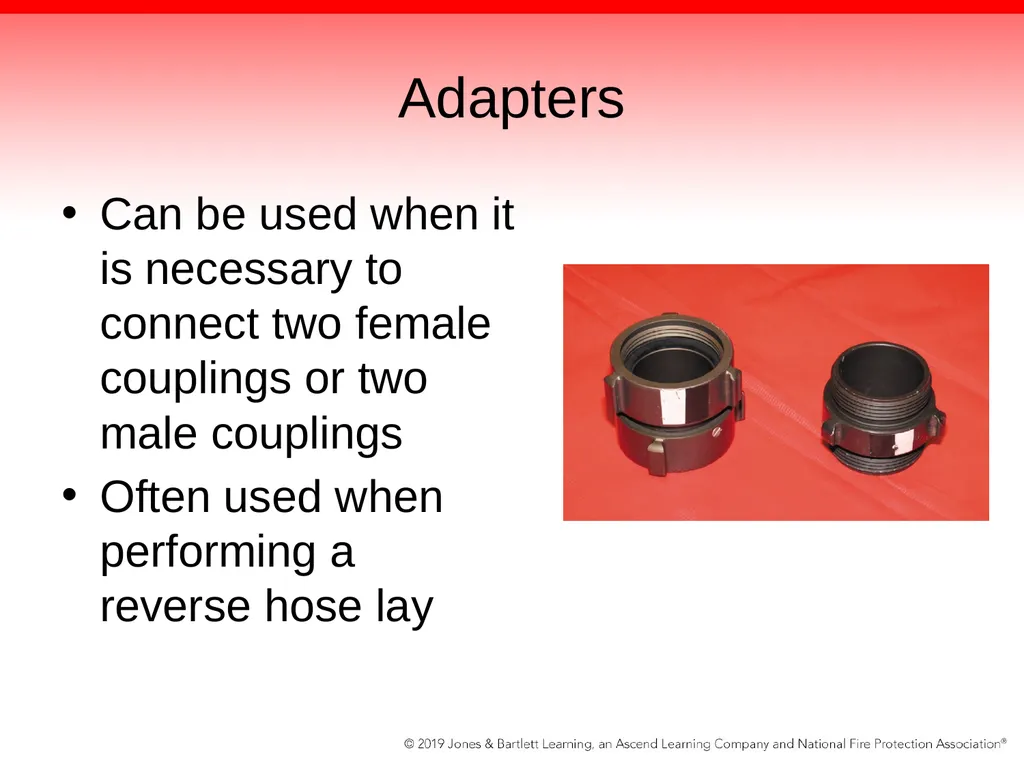
Adapters Can be used when it is necessary to connect two female couplings or two male couplings
Often used when performing a reverse hose lay<br>
Often used when performing a reverse hose lay<br>
37
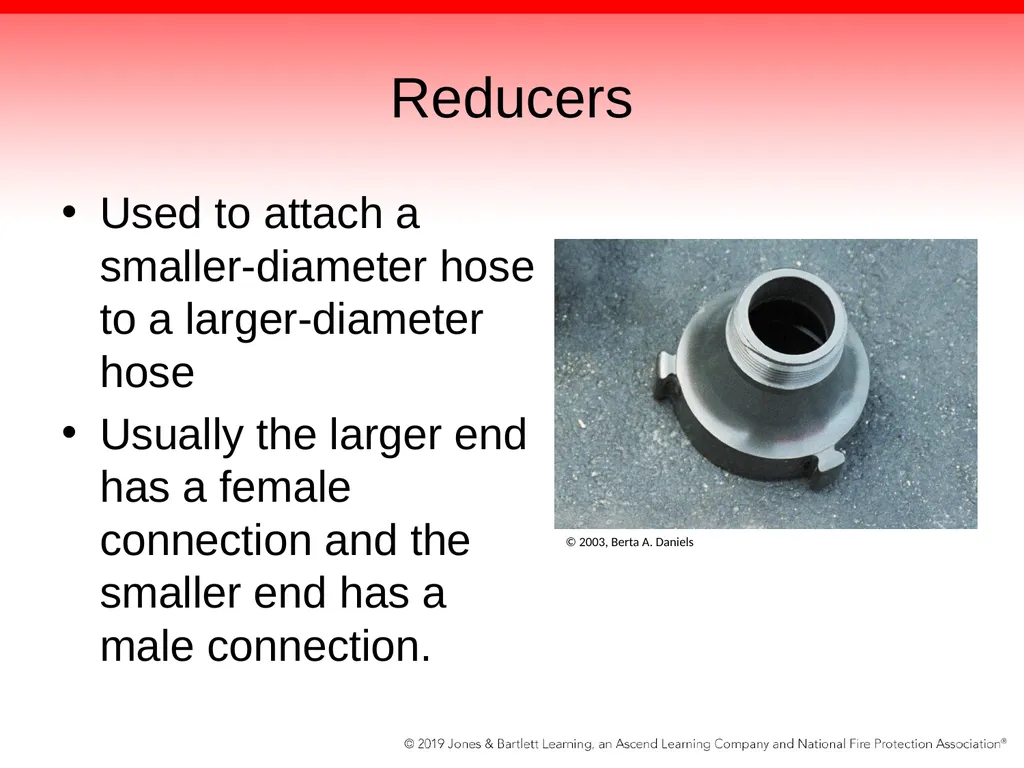
Reducers Used to attach a smaller-diameter hose to a larger-diameter hose
Usually the larger end has a female connection and the smaller end has a male connection. © 2003, Berta A. Daniels<br>
Usually the larger end has a female connection and the smaller end has a male connection. © 2003, Berta A. Daniels<br>
38
Reducers One type of reducer is used to attach 2½-inch (65-mm) couplings to 1½-inch (38-mm) couplings.
Many 2½-inch (65-mm) nozzles are constructed with a built-in reducer, so a 1½-inch (38-mm) line can be attached for overhaul.
May also be used to attach a 2½-inch (65-mm) supply line to a larger suction inlet on a fire pumper<br>
Many 2½-inch (65-mm) nozzles are constructed with a built-in reducer, so a 1½-inch (38-mm) line can be attached for overhaul.
May also be used to attach a 2½-inch (65-mm) supply line to a larger suction inlet on a fire pumper<br>
39
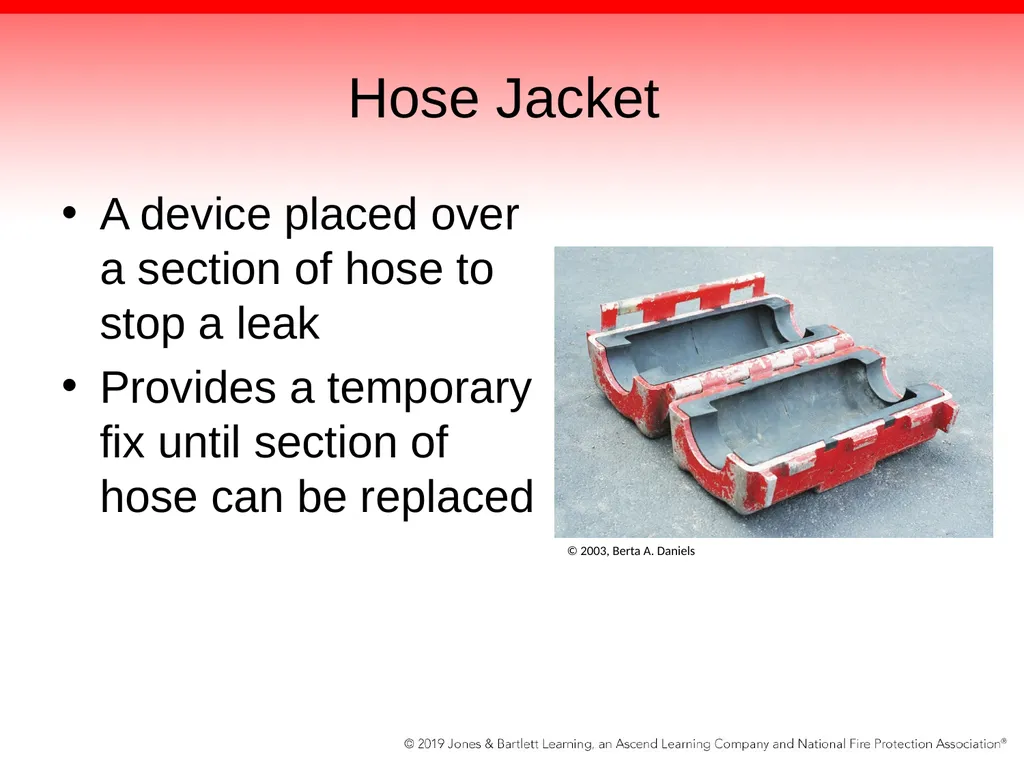
Hose Jacket A device placed over a section of hose to stop a leak
Provides a temporary fix until section of hose can be replaced © 2003, Berta A. Daniels<br>
Provides a temporary fix until section of hose can be replaced © 2003, Berta A. Daniels<br>
40
Hose Jacket Should be used only when it is not possible to quickly replace the leaking section of hose
Can be applied to supply lines and attack lines
Consists of a split metal cylinder that fits tightly over the outside of a hoseline
To deploy the hose jacket, place the section of hose with the leak between the two rubber gaskets and securely lock the device in position.<br>
Can be applied to supply lines and attack lines
Consists of a split metal cylinder that fits tightly over the outside of a hoseline
To deploy the hose jacket, place the section of hose with the leak between the two rubber gaskets and securely lock the device in position.<br>
41
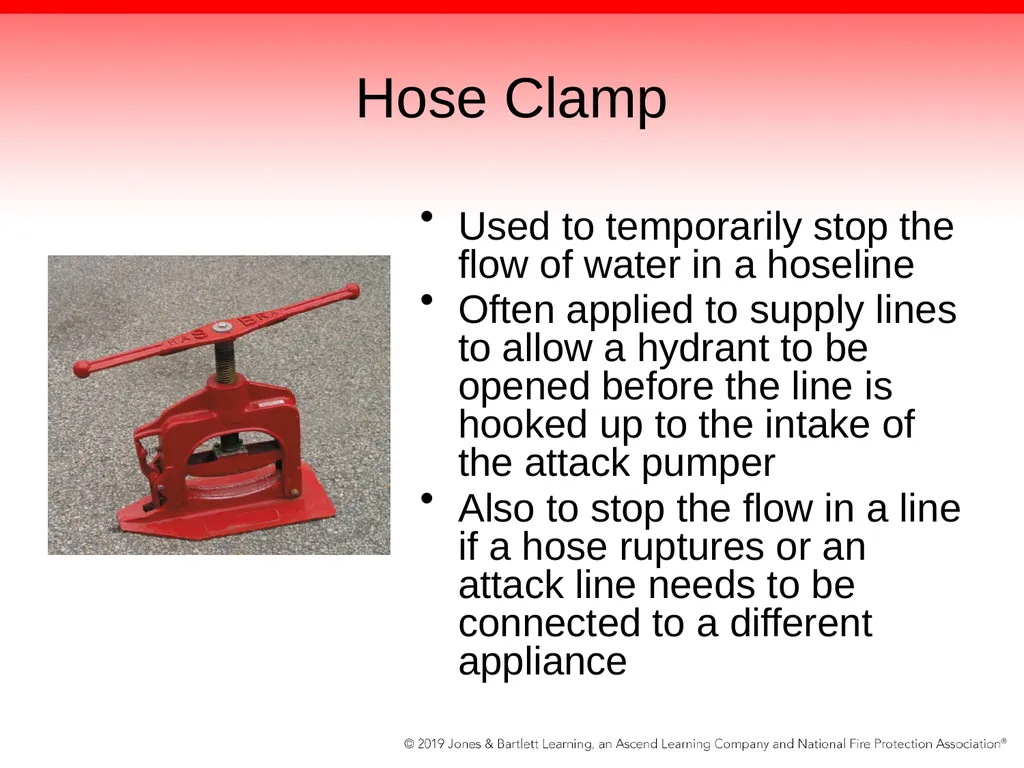
Hose Clamp Used to temporarily stop the flow of water in a hoseline
Often applied to supply lines to allow a hydrant to be opened before the line is hooked up to the intake of the attack pumper
Also to stop the flow in a line if a hose ruptures or an attack line needs to be connected to a different appliance<br>
Often applied to supply lines to allow a hydrant to be opened before the line is hooked up to the intake of the attack pumper
Also to stop the flow in a line if a hose ruptures or an attack line needs to be connected to a different appliance<br>
42
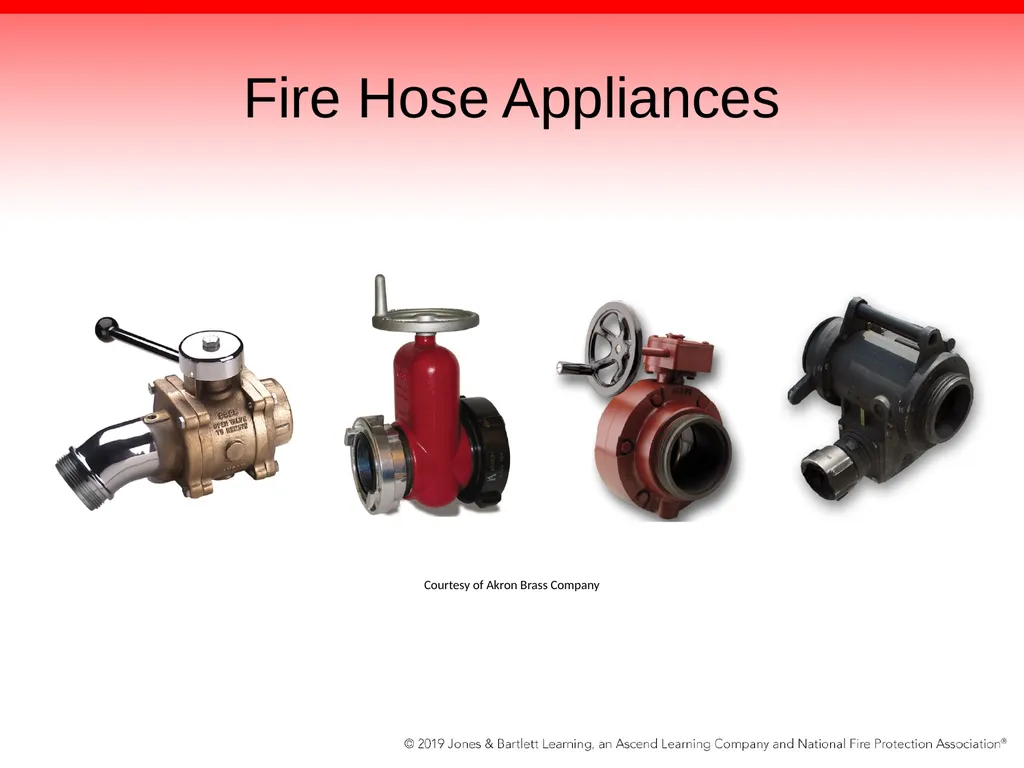
Valves Used to control the flow of water in a pipe or hoseline
Several types used:
Ball valves
Gate valves
Butterfly valves
Relay or hydrant valves<br>
Several types used:
Ball valves
Gate valves
Butterfly valves
Relay or hydrant valves<br>
43
Fire Hose Appliances Courtesy of Akron Brass Company<br>
44
Nozzles Attached to the discharge end of attack lines to give fire streams shape and direction
Without a nozzle, the water discharged from a hose would reach only a short distance.
Nozzles are used on all sizes of handlines and master stream devices.<br>
Without a nozzle, the water discharged from a hose would reach only a short distance.
Nozzles are used on all sizes of handlines and master stream devices.<br>
45
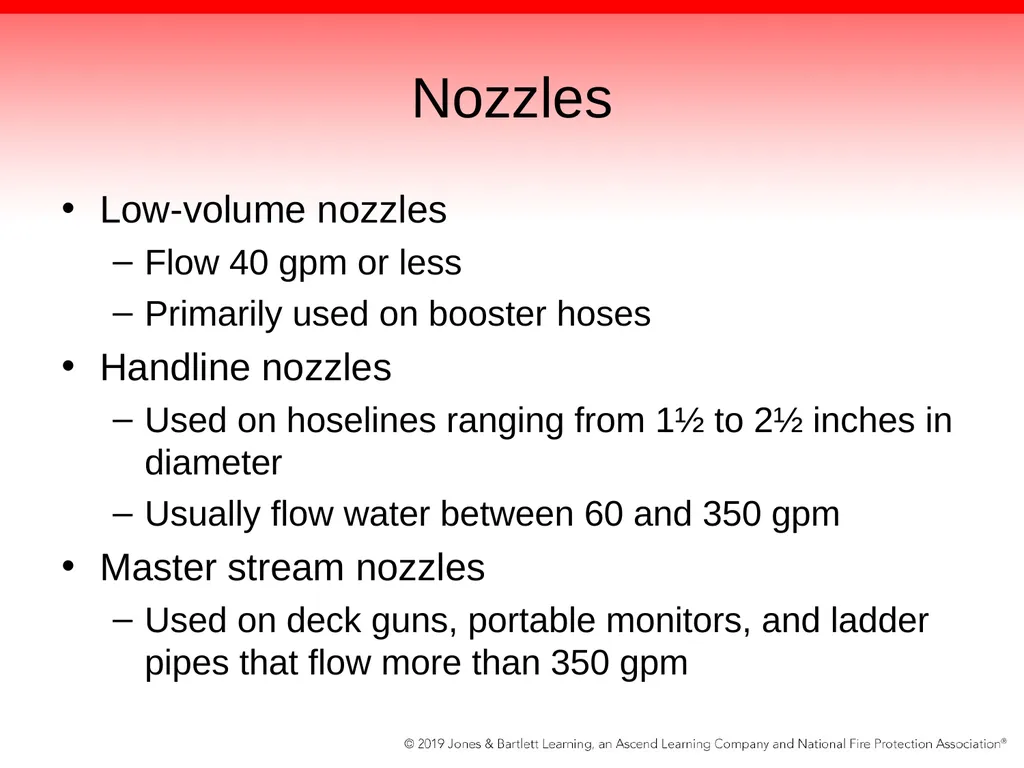
Nozzles Low-volume nozzles
Flow 40 gpm or less
Primarily used on booster hoses
Handline nozzles
Used on hoselines ranging from 1½ to 2½ inches in diameter
Usually flow water between 60 and 350 gpm
Master stream nozzles
Used on deck guns, portable monitors, and ladder pipes that flow more than 350 gpm<br>
Flow 40 gpm or less
Primarily used on booster hoses
Handline nozzles
Used on hoselines ranging from 1½ to 2½ inches in diameter
Usually flow water between 60 and 350 gpm
Master stream nozzles
Used on deck guns, portable monitors, and ladder pipes that flow more than 350 gpm<br>
46
Nozzles Low-volume and handline nozzles have a shut-off valve to control the flow of water.
Control valve for a master stream is usually separate from the nozzle.
All nozzles have some type of device or mechanism to direct the water stream into a certain shape.
Some nozzles incorporate a mechanism that can automatically adjust the flow based on the water’s volume and pressure.<br>
Control valve for a master stream is usually separate from the nozzle.
All nozzles have some type of device or mechanism to direct the water stream into a certain shape.
Some nozzles incorporate a mechanism that can automatically adjust the flow based on the water’s volume and pressure.<br>
47
Nozzle Shut-offs Enable the fire fighter at the nozzle to start or stop the flow of water
Most commonly encountered mechanism is a ball valve or quarter-turn valve.
Some nozzles incorporate a rotary control valve that rotates the nozzle in one direction to open it and in the opposite direction to shut off the flow of water.<br>
Most commonly encountered mechanism is a ball valve or quarter-turn valve.
Some nozzles incorporate a rotary control valve that rotates the nozzle in one direction to open it and in the opposite direction to shut off the flow of water.<br>
48
Nozzles Two types of nozzles:
Smooth-bore nozzles
Produce a solid column of water
Fog-stream nozzles
Separate the water into droplets
Fire fighter can adjust the droplet size and discharge pattern.<br>
Smooth-bore nozzles
Produce a solid column of water
Fog-stream nozzles
Separate the water into droplets
Fire fighter can adjust the droplet size and discharge pattern.<br>
49
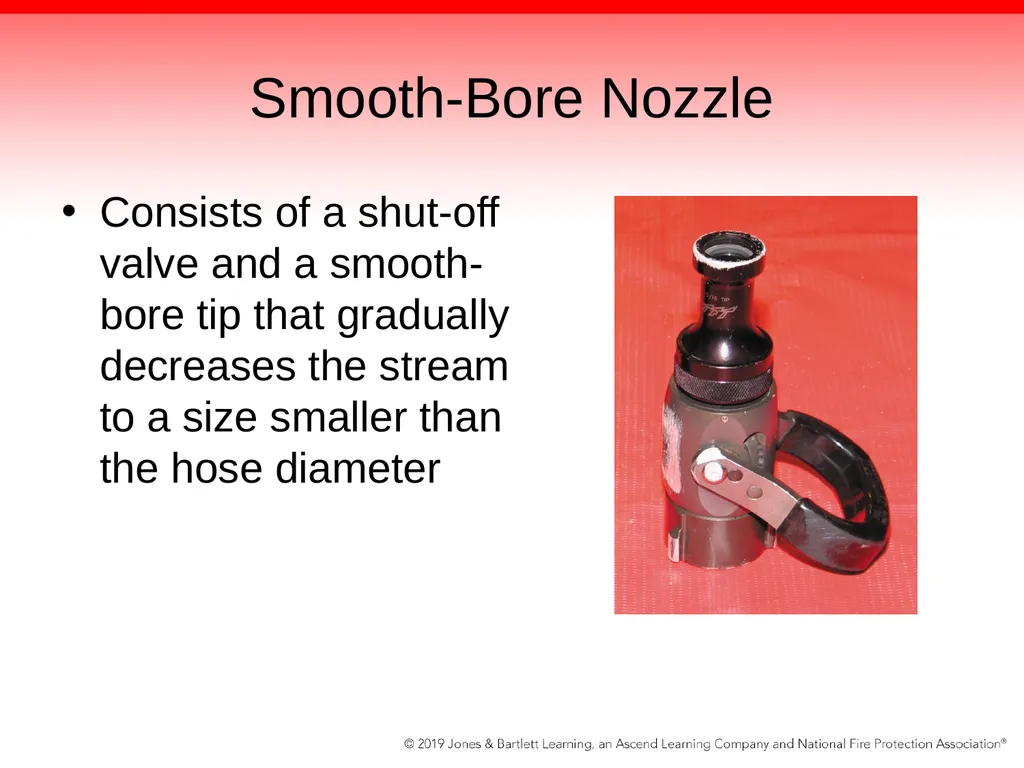
Smooth-Bore Nozzle Consists of a shut-off valve and a smooth-bore tip that gradually decreases the stream to a size smaller than the hose diameter<br>
50
Smooth-Bore Nozzle Manufactured to fit both handlines and master stream devices
Those used for master streams and ladder pipes often consist of a set of stacked tips.
Each successive tip in the stack has an increasingly smaller tip diameter.
Tips can be added or removed.<br>
Those used for master streams and ladder pipes often consist of a set of stacked tips.
Each successive tip in the stack has an increasingly smaller tip diameter.
Tips can be added or removed.<br>
51
Smooth-Bore Nozzle Advantages Has a longer reach than a combination fog nozzle operating at a straight stream setting
Capable of deeper penetration into burning materials
Operates at lower pressures
Solid stream extinguishes a fire with less air movement and less disturbance of the thermal layering than a fog stream.<br>
Capable of deeper penetration into burning materials
Operates at lower pressures
Solid stream extinguishes a fire with less air movement and less disturbance of the thermal layering than a fog stream.<br>
52
Smooth-Bore Nozzle Disadvantages Streams do not absorb heat as readily as fog streams and are not as effective for hydraulic ventilation.
Fire fighter cannot change the setting of a smooth-bore nozzle to produce a fog pattern.<br>
Fire fighter cannot change the setting of a smooth-bore nozzle to produce a fog pattern.<br>
53
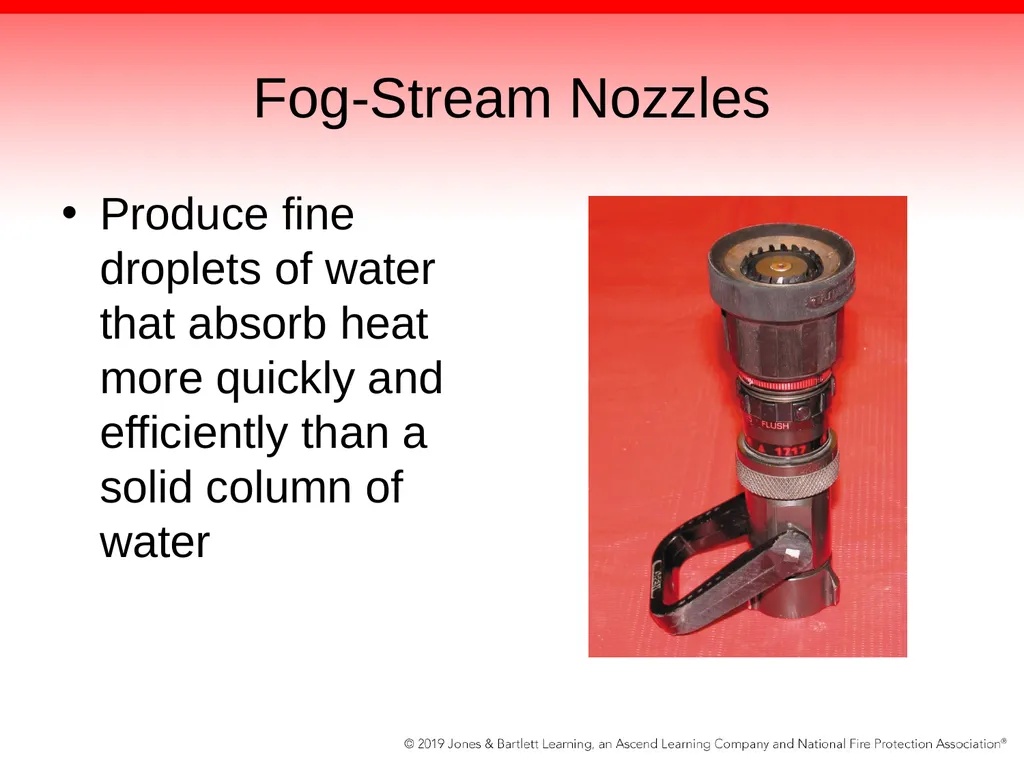
Fog-Stream Nozzles Produce fine droplets of water that absorb heat more quickly and efficiently than a solid column of water<br>
54
Fog-Stream Nozzles Can produce a variety of stream patterns
A straight stream
A narrow fog cone of less than 45 degrees
A wide-angle fog pattern close to 90 degrees
Straight streams produced by fog nozzles have openings in the center.
Break up more quickly and do not have the reach of a solid stream delivered by a smooth-bore nozzle<br>
A straight stream
A narrow fog cone of less than 45 degrees
A wide-angle fog pattern close to 90 degrees
Straight streams produced by fog nozzles have openings in the center.
Break up more quickly and do not have the reach of a solid stream delivered by a smooth-bore nozzle<br>
55
Fog-Stream Nozzle Advantages Can produce a variety of stream patterns by rotating the tip of the nozzle
Effective at absorbing heat
Can create a water curtain to protect fire fighters from extreme heat
Move large volumes of air along with the water<br>
Effective at absorbing heat
Can create a water curtain to protect fire fighters from extreme heat
Move large volumes of air along with the water<br>
56
Fog-Stream Nozzle Types Fixed-gallonage fog nozzle delivers a preset flow at the rated discharge pressure
Adjustable-gallonage fog nozzle allows operator to select a desired flow by rotating a selector bezel to adjust the size of the opening
Automatic-adjusting fog nozzle can deliver a wide range of flows
As pressure increases or decreases, internal spring-loaded piston adjusts opening size<br>
Adjustable-gallonage fog nozzle allows operator to select a desired flow by rotating a selector bezel to adjust the size of the opening
Automatic-adjusting fog nozzle can deliver a wide range of flows
As pressure increases or decreases, internal spring-loaded piston adjusts opening size<br>
57
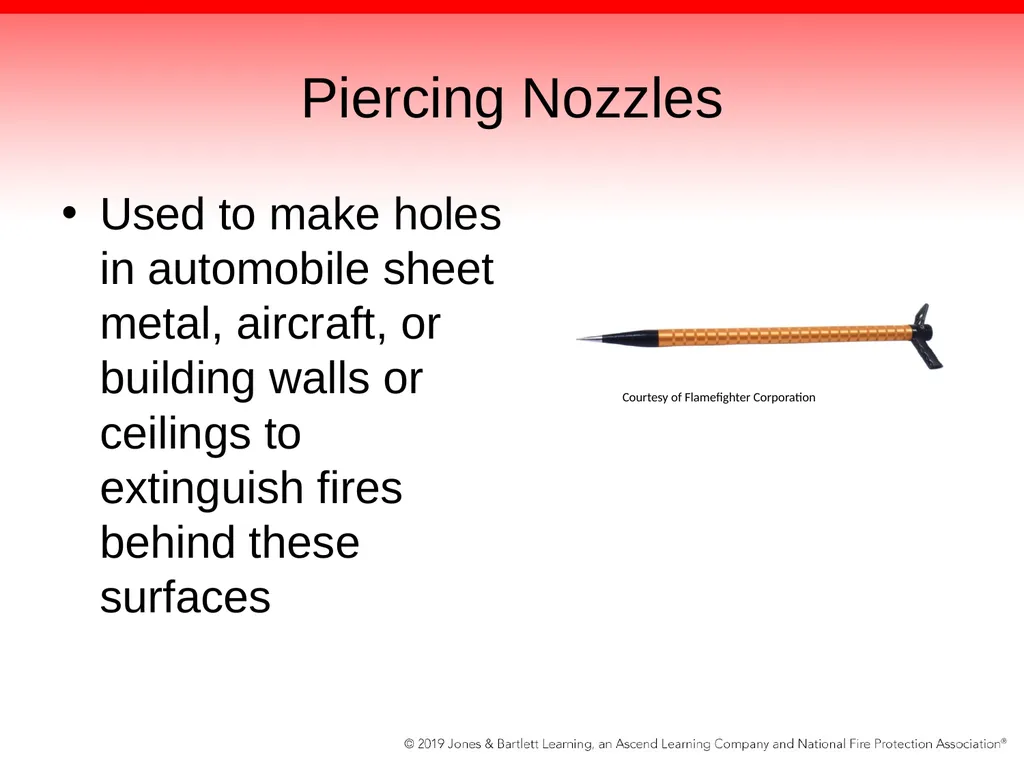
Piercing Nozzles Used to make holes in automobile sheet metal, aircraft, or building walls or ceilings to extinguish fires behind these surfaces Courtesy of Flamefighter Corporation<br>
58
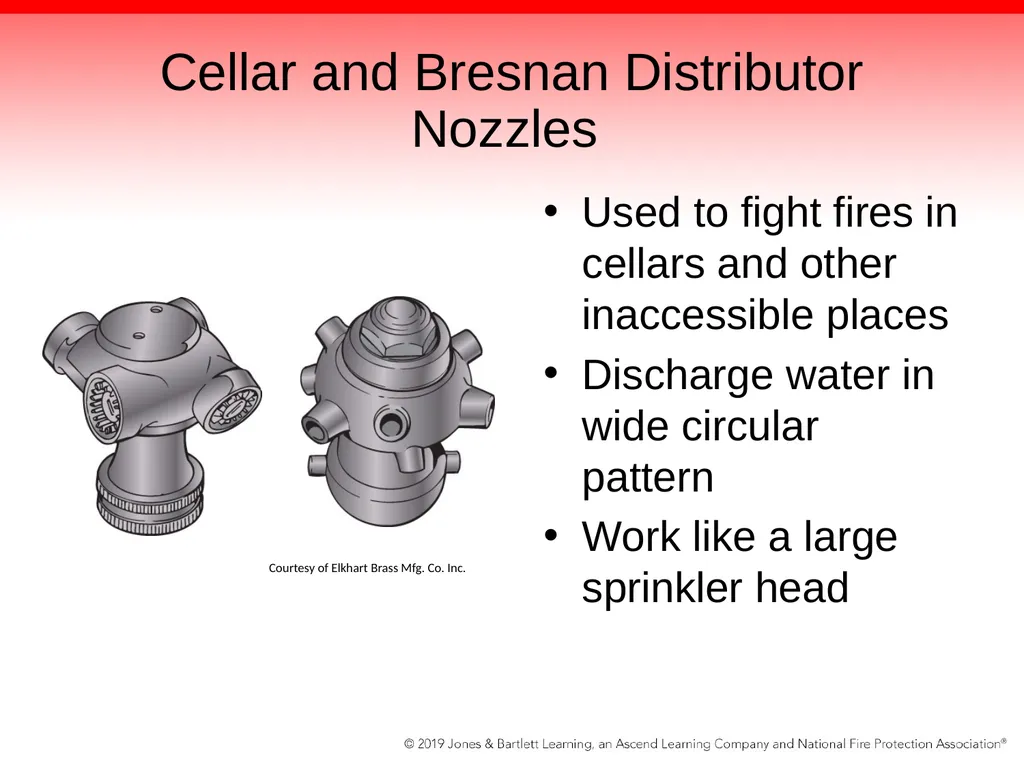
Cellar and Bresnan Distributor Nozzles Used to fight fires in cellars and other inaccessible places
Discharge water in wide circular pattern
Work like a large sprinkler head Courtesy of Elkhart Brass Mfg. Co. Inc.<br>
Discharge water in wide circular pattern
Work like a large sprinkler head Courtesy of Elkhart Brass Mfg. Co. Inc.<br>
59
Nozzle Maintenance and Inspection Nozzles should be inspected on a regular basis, especially after use at an incident.
Keep nozzles clean and clear of debris, dirt, and grit.
Apply a light grease to valve ball to keep it operating smoothly.
Inspect teeth on fog nozzles.
Refer any problems to a competent technician for repair.<br>
Keep nozzles clean and clear of debris, dirt, and grit.
Apply a light grease to valve ball to keep it operating smoothly.
Inspect teeth on fog nozzles.
Refer any problems to a competent technician for repair.<br>
60
Summary Fire hoses are used for two main purposes: as supply hoses and as attack hoses.
Small-diameter hoses are used as attack lines, large-diameter hoses are almost always used as supply hoses, and medium-diameter hoses can be used for both purposes.
Supply hose can be classified into two categories: soft sleeve hose and hard suction hose.
A fire hose appliance is any device used in conjunction with a fire hose for the purpose of delivering water.<br>
Small-diameter hoses are used as attack lines, large-diameter hoses are almost always used as supply hoses, and medium-diameter hoses can be used for both purposes.
Supply hose can be classified into two categories: soft sleeve hose and hard suction hose.
A fire hose appliance is any device used in conjunction with a fire hose for the purpose of delivering water.<br>
61
Summary Nozzles can be classified as low-volume, handline, or master stream devices.
Both smooth-bore and fog-stream nozzles have distinct advantages and disadvantages.
Three types of fog-stream nozzles are available: fixed gallonage, adjustable gallonage, and automatic adjusting.
Nozzle maintenance and inspection are critical to their performance.<br>
Both smooth-bore and fog-stream nozzles have distinct advantages and disadvantages.
Three types of fog-stream nozzles are available: fixed gallonage, adjustable gallonage, and automatic adjusting.
Nozzle maintenance and inspection are critical to their performance.<br>