Chapter 7 Incorporating Flexibility into your Program Learning Outcomes What youll be able to do: Define how muscle imbalances effect movement and provide solutions Incorporate flexibility as a corrective measure to your program Identify
"Chapter 7 Incorporating Flexibility into your" is the property of its rightful owner. Permission is granted to
download and print the materials on this website for personal, non-commercial use only, and to display it
on your personal computer provided you do not modify the materials and that you retain all copyright
notices contained in the materials. By downloading content from our website, you accept the terms of this
agreement.
Presentation Transcript
01
Chapter 7
Incorporating Flexibility into your Program<br>
02
Learning Outcomes What you'll be able to do:
Define how muscle imbalances effect movement and provide solutions
Incorporate flexibility as a corrective measure to your program
Identify the different types of flexibility training
Integrate flexibility into correcting postural imbalances and know why it is important to have flexibility and range of motion for certain movements
Inadequate flexibility or ROM will prevent people from properly performing movements<br>
03
Flexibility Defined Flexibility is how well one can move a joint through it's full range of motion
Range of motion (ROM) of a joint is determined by the extensibility of its surrounding muscles
Neuromuscular efficiency ability of muscles to add and subtract force as needed
Stabilizing and moving the body through all three planes of motion<br>
04
Postural Allignment Postural distortion patterns when one or more segments of the body are misalligned
Relative flexibility (or altered movement patterns), which is the process in which the HMS seeks the path of least resistance*
It does this during regular movement patterns<br>
05
Basic Flexibility All-around approach
Using multiple techniques
Moving in all planes of motion
Must understand muscle imbalances<br>
06
Limitations Poor flexibility leads to the development of relative flexibility.
The body always seeks the path of least resistance during functional movement patterns.*
This is the root of muscle imbalances<br>
07
When the Body is not Moving Properly What Happens during muscle imbalance?
Altered Reciprocal inhibition
Synergistic dominance
Arthrokinetic dysfunction
Decreased neuromuscular control<br>
08
Improper Movement Altered Reciprocal Inhibition
When the main muscle is too tight it impedes the movement of the antagonist.
An overactive psoas decreasing the neural drive to the gluteus maximus is an example of Altered Reciprocal Inhibition.*
Synergistic Dominance
When the prime mover is too weak and the synergistic muscles take over
Arthrokinetic Dysfunction
Unique joint movement due to abnormal forces on the joint
Neuromuscular Efficiency
Nervous system can efficiently coordinate movements<br>
09
Muscle Spindles Muscle Spindles
Major sensory organ of the muscle
Detects changes in length and how fast or slow the change is occuring
Spindles are stretched when muscles lengthen
This information is transmitted to the nervous system, exciting the muscle spindle and thus causing the muscle fibers to contract.<br>
10
Golgi Tendon Organ Found inside the musculotendinous junction
meeting place of muscle and tendon
detects changes in tension and speed of tension changes
Foam Roller = proper stimulation of the GTO, is known as Autogenic inhibition*
Foam rolling will relax overactive muscles<br>
11
How Overuse Happens Pattern Overload
Similar to overuse, doing the same movement pattern over and over again
Not changing the training routine
Same movements every day at work
Sedentary lifestyle<br>
12
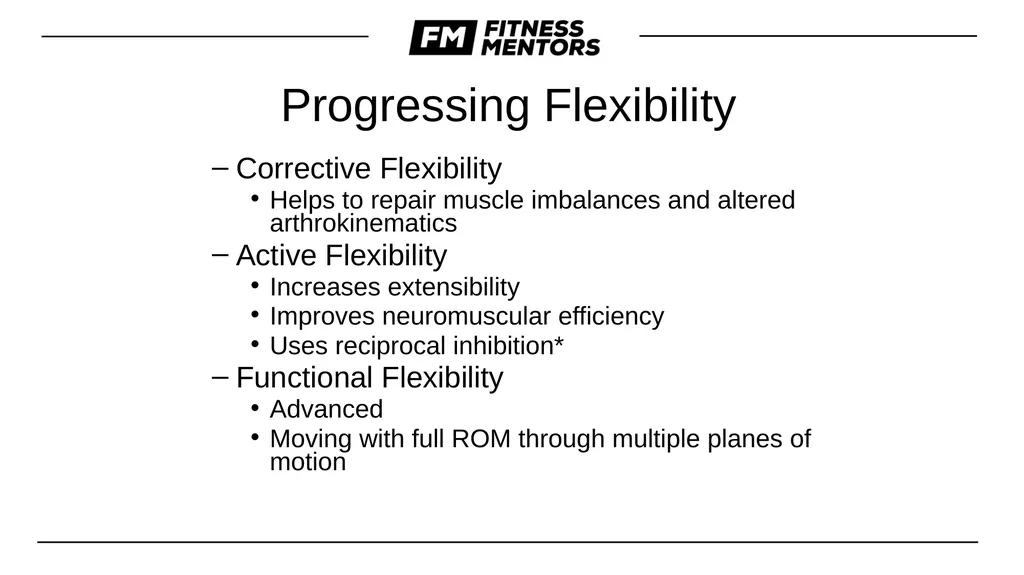
Progressing Flexibility Corrective Flexibility
Helps to repair muscle imbalances and altered arthrokinematics
Active Flexibility
Increases extensibility
Improves neuromuscular efficiency
Uses reciprocal inhibition*
Functional Flexibility
Advanced
Moving with full ROM through multiple planes of motion<br>
13
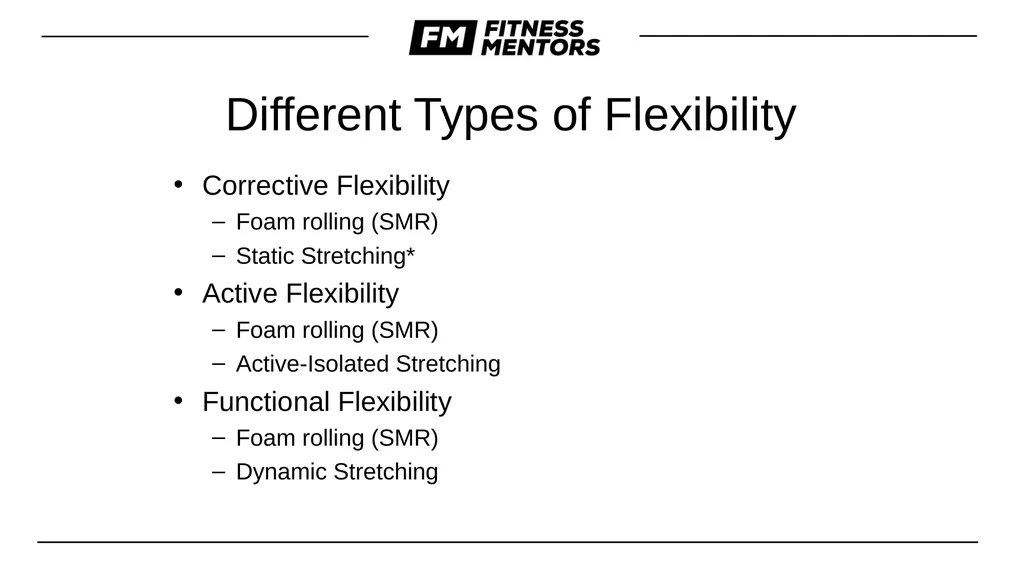
Different Types of Flexibility Corrective Flexibility
Foam rolling (SMR)
Static Stretching*
Active Flexibility
Foam rolling (SMR)
Active-Isolated Stretching
Functional Flexibility
Foam rolling (SMR)
Dynamic Stretching<br>
14
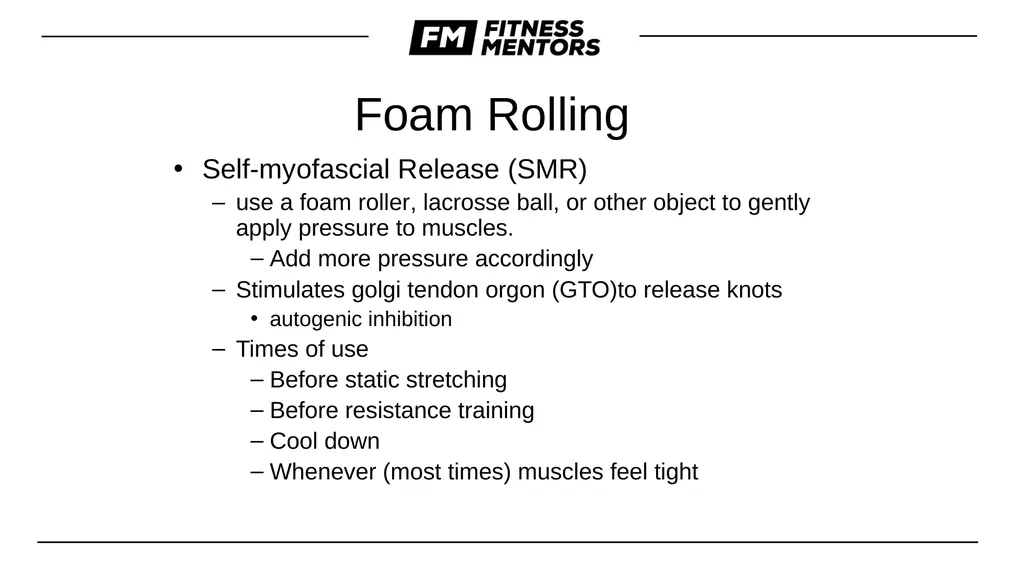
Foam Rolling Self-myofascial Release (SMR)
use a foam roller, lacrosse ball, or other object to gently apply pressure to muscles.
Add more pressure accordingly
Stimulates golgi tendon orgon (GTO)to release knots
autogenic inhibition
Times of use
Before static stretching
Before resistance training
Cool down
Whenever (most times) muscles feel tight<br>
15
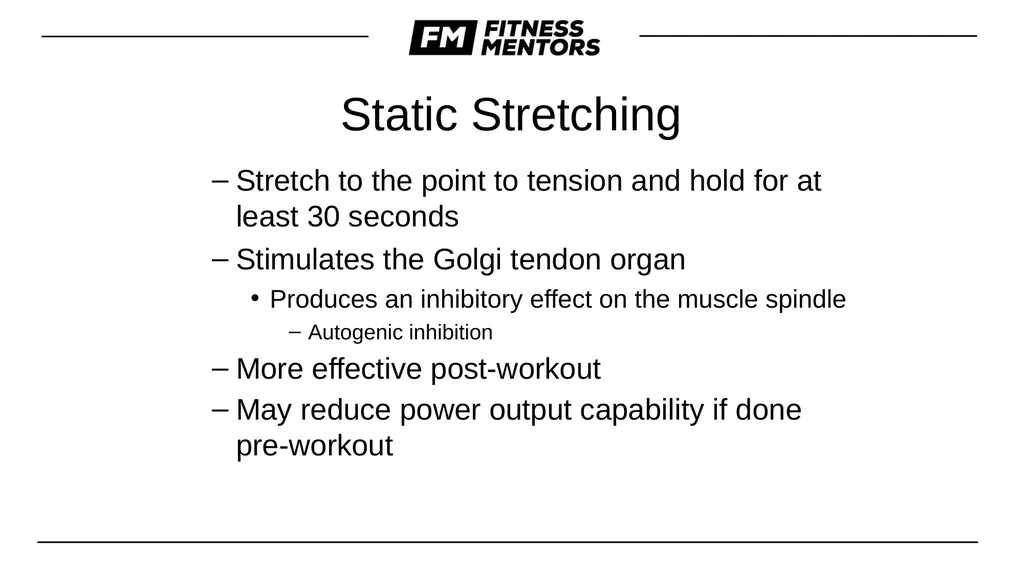
Static Stretching Stretch to the point to tension and hold for at least 30 seconds
Stimulates the Golgi tendon organ
Produces an inhibitory effect on the muscle spindle
Autogenic inhibition
More effective post-workout
May reduce power output capability if done pre-workout<br>
16
Active-Isolated Stretching Moves a joint into a range of motion by using agonists and synergists
Recipricol inhibition
Created by functional agonists
Helps to achieve more range of motion
Five to 10 repetitions of each stretch
Hold 1 to 2 seconds each<br>
17
Dynamic Stretching Stretching that involves moving and using force and momentum to generate full range of motion
Great for warm-up activity before exercise<br>
18
Summary Muscle imbalances and poor movement patterns can be corrected with flexibility
Have beginner clients use corrective flexibility for warm-up and cool-down
Use active and functional flexibility as needed with more advanced clients or when beginner clients show improvements<br>