
Chapter 7 Outline Tracking Tracking All the
AS
Published · 25 slides · 0 views
1 / 1
Description
Chapter 7 Outline Tracking Tracking All the candidates who are trained under DDU-GKY project should be tracked every month for a period of one year Candidate who are tracked will be grouped into Group A and B Group A: candidates whose
Related Topics
Share
Embed code
Download this presentation From Below
"Chapter 7 Outline Tracking Tracking All the" is the property of its rightful owner. Permission is granted to download and print the materials on this website for personal, non-commercial use only, and to display it on your personal computer provided you do not modify the materials and that you retain all copyright notices contained in the materials. By downloading content from our website, you accept the terms of this agreement.
Presentation Transcript
01
Chapter 7<br>
02
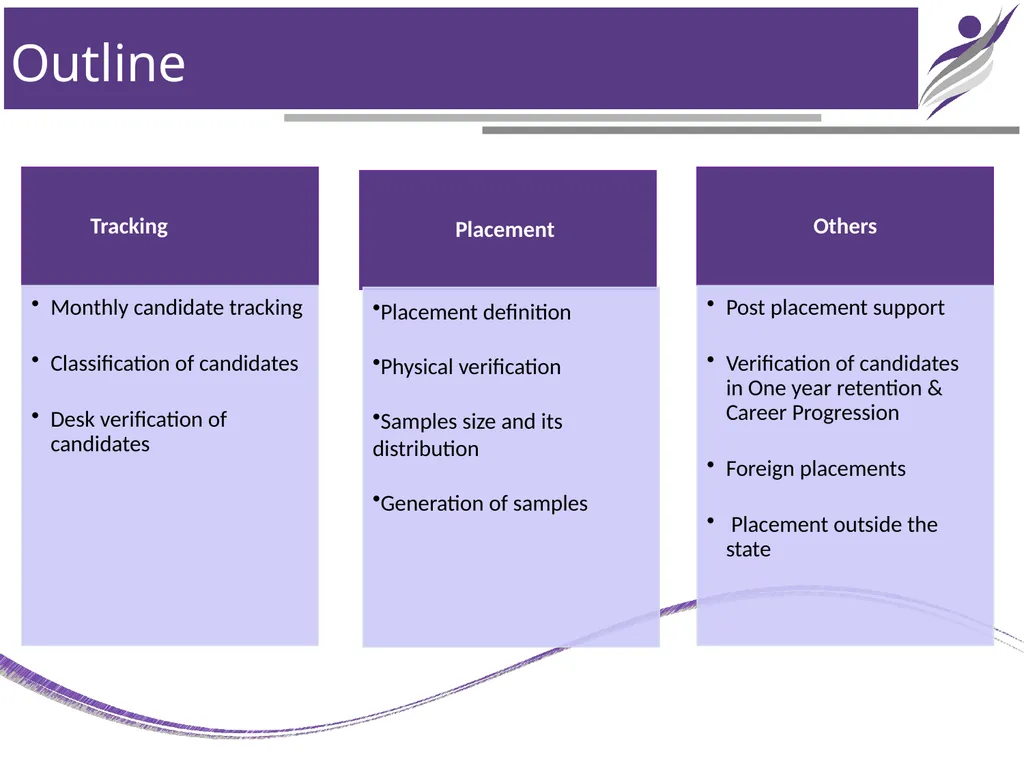
Outline<br>
03
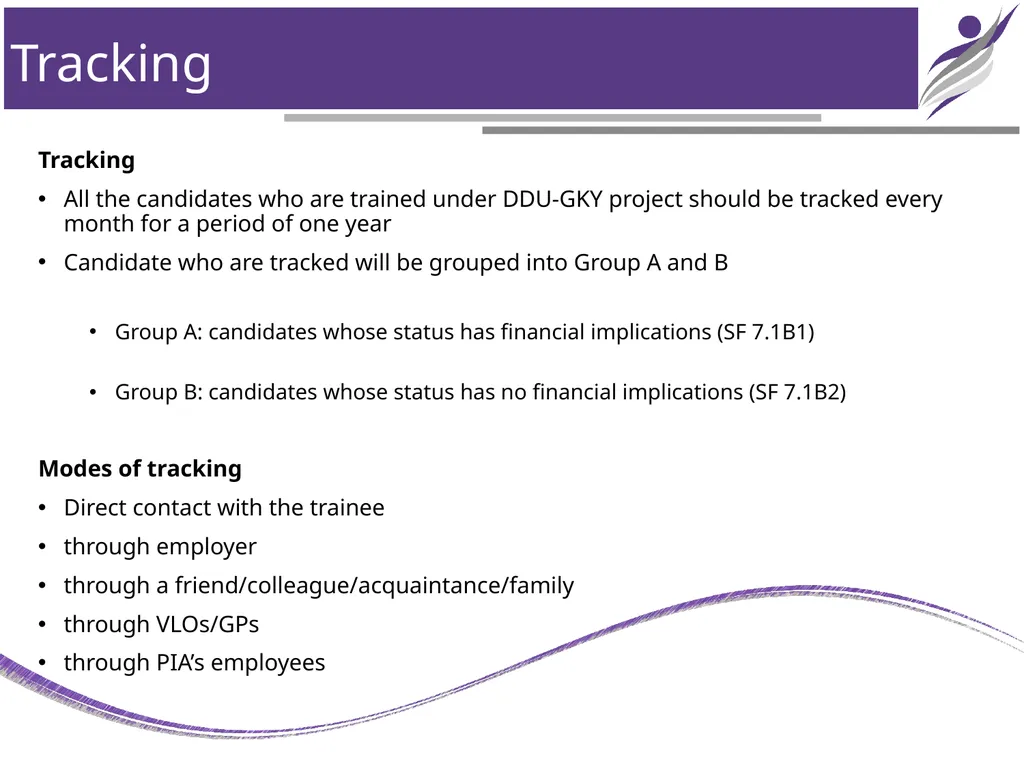
Tracking Tracking
All the candidates who are trained under DDU-GKY project should be tracked every month for a period of one year
Candidate who are tracked will be grouped into Group A and B
Group A: candidates whose status has financial implications (SF 7.1B1)
Group B: candidates whose status has no financial implications (SF 7.1B2)
Modes of tracking
Direct contact with the trainee
through employer
through a friend/colleague/acquaintance/family
through VLOs/GPs
through PIA’s employees<br>
All the candidates who are trained under DDU-GKY project should be tracked every month for a period of one year
Candidate who are tracked will be grouped into Group A and B
Group A: candidates whose status has financial implications (SF 7.1B1)
Group B: candidates whose status has no financial implications (SF 7.1B2)
Modes of tracking
Direct contact with the trainee
through employer
through a friend/colleague/acquaintance/family
through VLOs/GPs
through PIA’s employees<br>
04
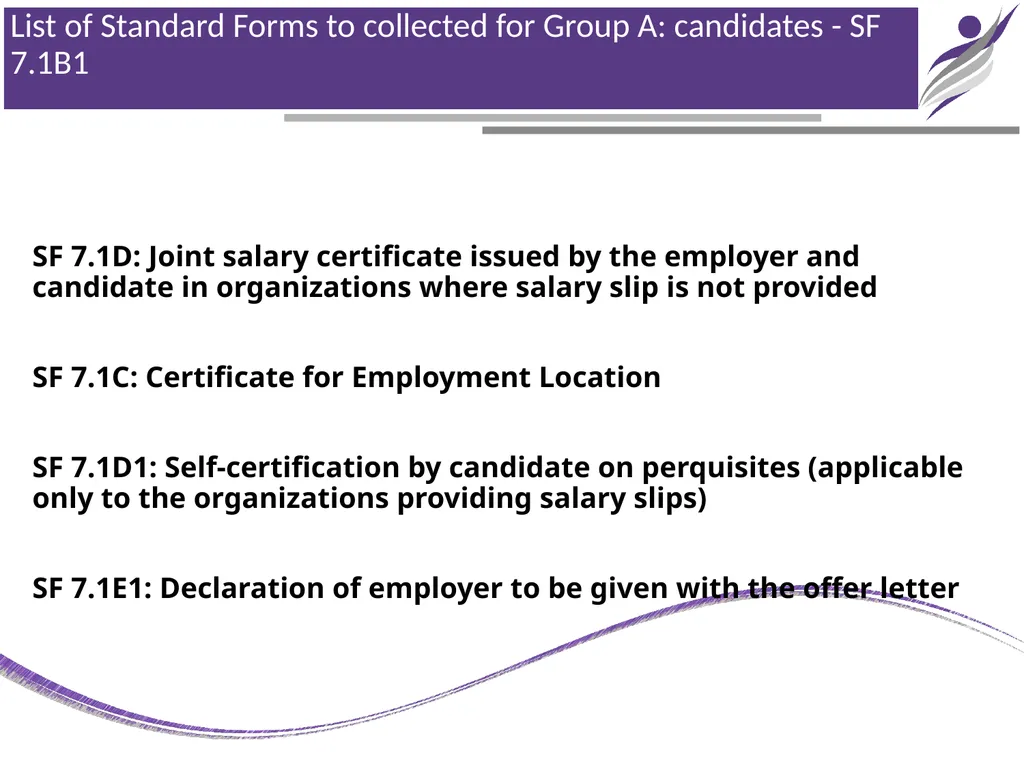
List of Standard Forms to collected for Group A: candidates - SF 7.1B1 SF 7.1D: Joint salary certificate issued by the employer and candidate in organizations where salary slip is not provided
SF 7.1C: Certificate for Employment Location
SF 7.1D1: Self-certification by candidate on perquisites (applicable only to the organizations providing salary slips)
SF 7.1E1: Declaration of employer to be given with the offer letter<br>
SF 7.1C: Certificate for Employment Location
SF 7.1D1: Self-certification by candidate on perquisites (applicable only to the organizations providing salary slips)
SF 7.1E1: Declaration of employer to be given with the offer letter<br>
05
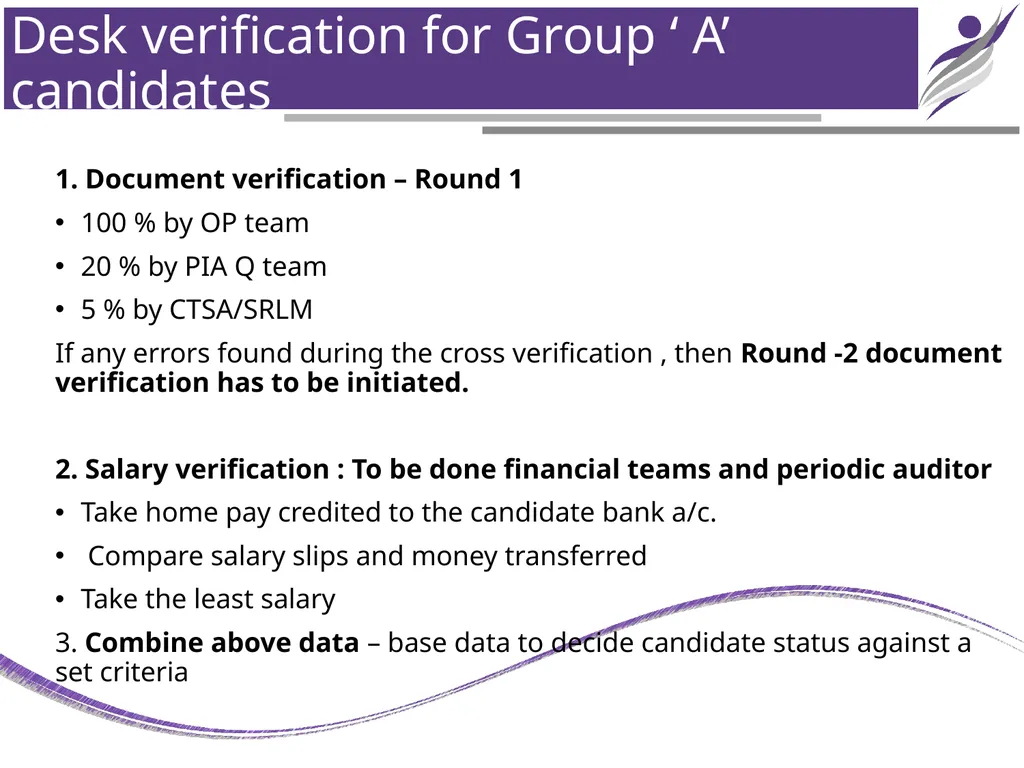
Desk verification for Group ‘ A’ candidates 1. Document verification – Round 1
100 % by OP team
20 % by PIA Q team
5 % by CTSA/SRLM
If any errors found during the cross verification , then Round -2 document verification has to be initiated.
2. Salary verification : To be done financial teams and periodic auditor
Take home pay credited to the candidate bank a/c.
Compare salary slips and money transferred
Take the least salary
3. Combine above data – base data to decide candidate status against a set criteria<br>
100 % by OP team
20 % by PIA Q team
5 % by CTSA/SRLM
If any errors found during the cross verification , then Round -2 document verification has to be initiated.
2. Salary verification : To be done financial teams and periodic auditor
Take home pay credited to the candidate bank a/c.
Compare salary slips and money transferred
Take the least salary
3. Combine above data – base data to decide candidate status against a set criteria<br>
06
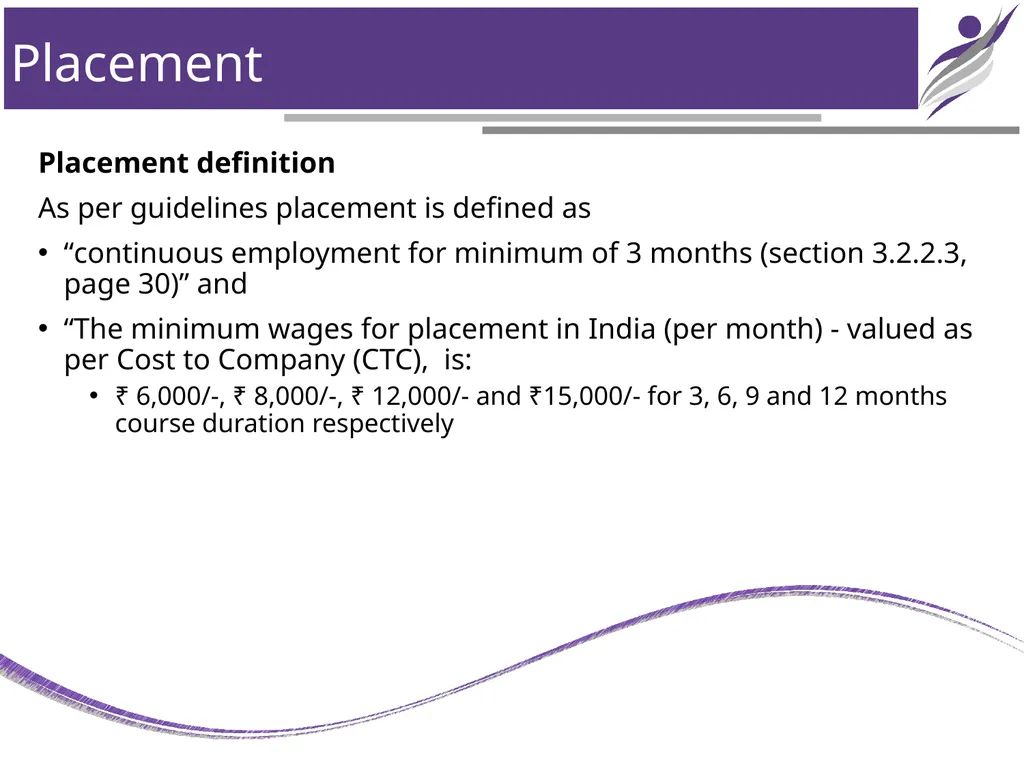
Placement Placement definition
As per guidelines placement is defined as
“continuous employment for minimum of 3 months (section 3.2.2.3, page 30)” and
“The minimum wages for placement in India (per month) - valued as per Cost to Company (CTC), is:
₹ 6,000/-, ₹ 8,000/-, ₹ 12,000/- and ₹15,000/- for 3, 6, 9 and 12 months course duration respectively<br>
As per guidelines placement is defined as
“continuous employment for minimum of 3 months (section 3.2.2.3, page 30)” and
“The minimum wages for placement in India (per month) - valued as per Cost to Company (CTC), is:
₹ 6,000/-, ₹ 8,000/-, ₹ 12,000/- and ₹15,000/- for 3, 6, 9 and 12 months course duration respectively<br>
07
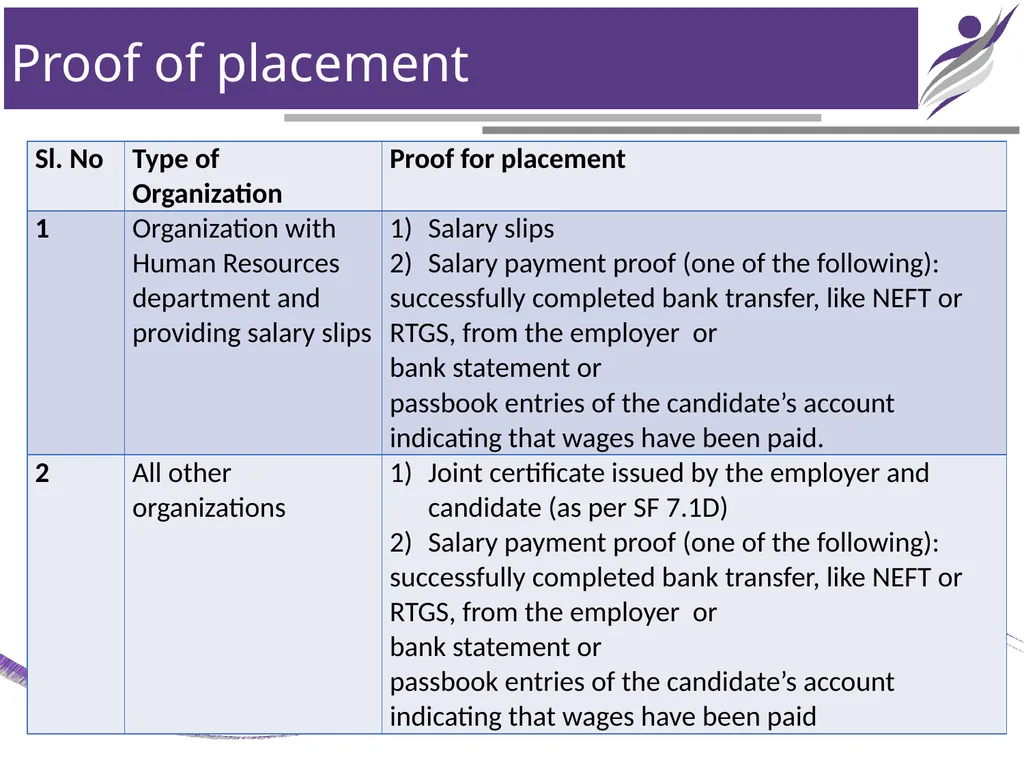
Proof of placement<br>
08
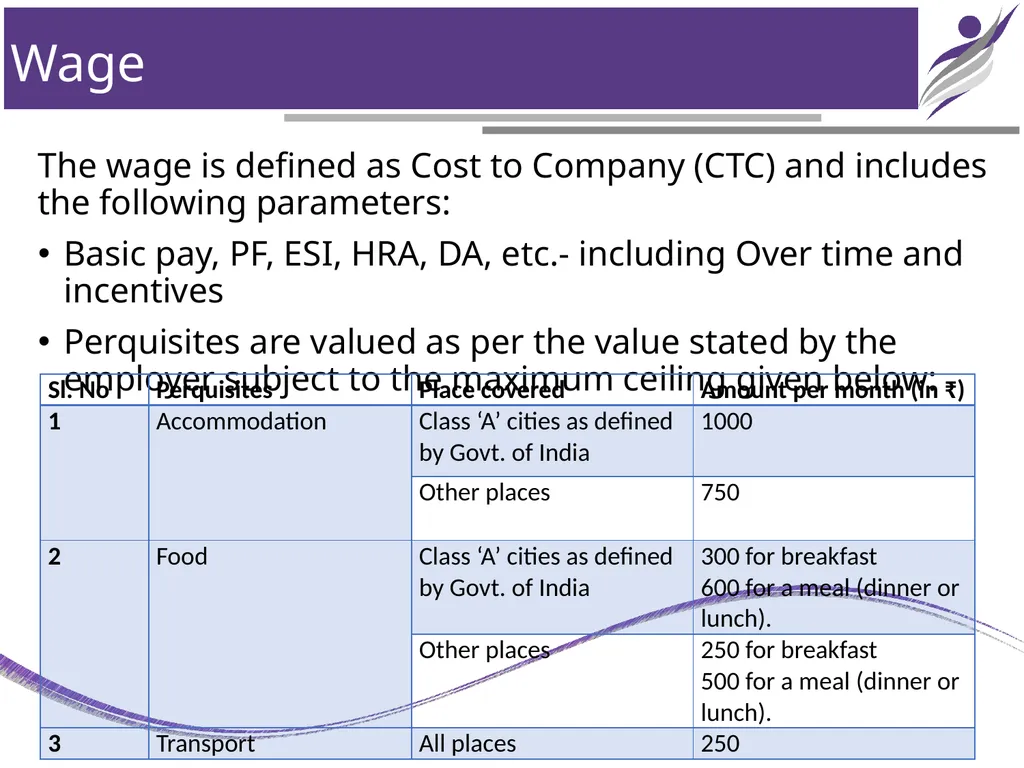
Wage The wage is defined as Cost to Company (CTC) and includes the following parameters:
Basic pay, PF, ESI, HRA, DA, etc.- including Over time and incentives
Perquisites are valued as per the value stated by the employer subject to the maximum ceiling given below:<br>
Basic pay, PF, ESI, HRA, DA, etc.- including Over time and incentives
Perquisites are valued as per the value stated by the employer subject to the maximum ceiling given below:<br>
09
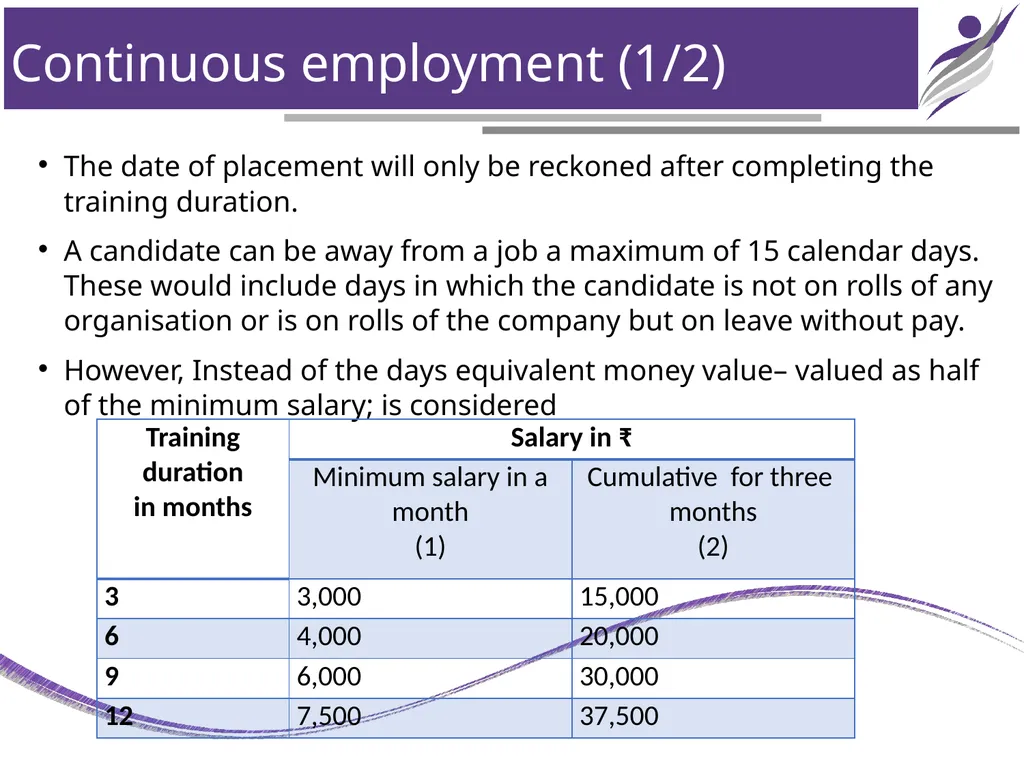
Continuous employment (1/2) The date of placement will only be reckoned after completing the training duration.
A candidate can be away from a job a maximum of 15 calendar days. These would include days in which the candidate is not on rolls of any organisation or is on rolls of the company but on leave without pay.
However, Instead of the days equivalent money value– valued as half of the minimum salary; is considered<br>
A candidate can be away from a job a maximum of 15 calendar days. These would include days in which the candidate is not on rolls of any organisation or is on rolls of the company but on leave without pay.
However, Instead of the days equivalent money value– valued as half of the minimum salary; is considered<br>
10
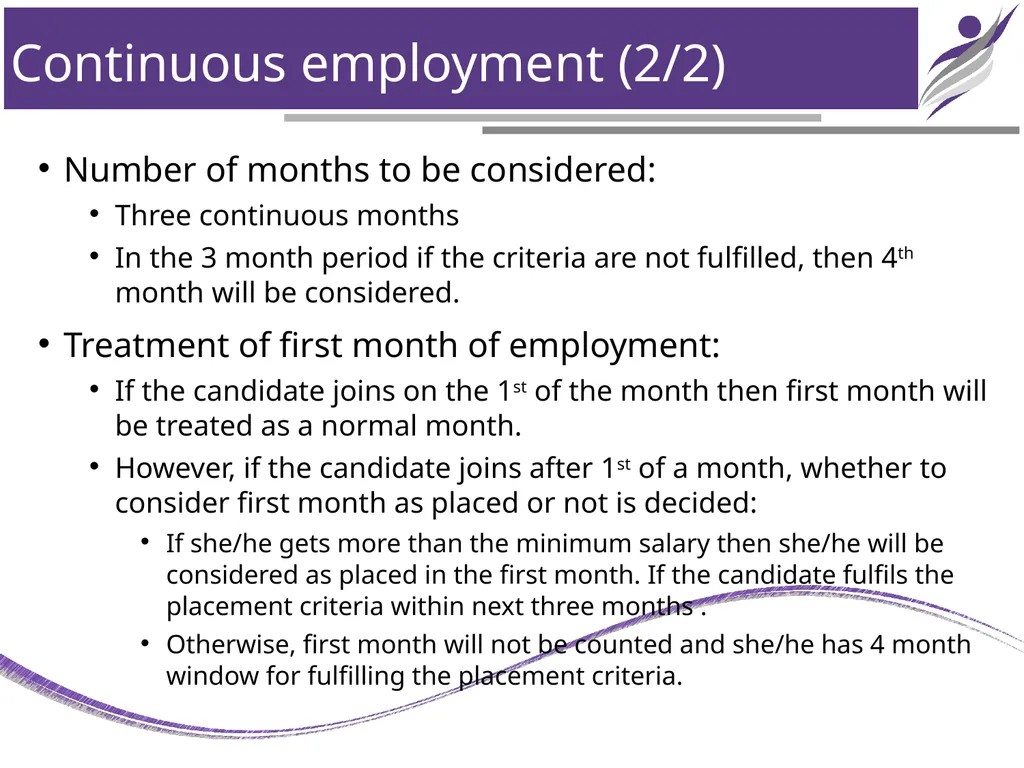
Continuous employment (2/2) Number of months to be considered:
Three continuous months
In the 3 month period if the criteria are not fulfilled, then 4th month will be considered.
Treatment of first month of employment:
If the candidate joins on the 1st of the month then first month will be treated as a normal month.
However, if the candidate joins after 1st of a month, whether to consider first month as placed or not is decided:
If she/he gets more than the minimum salary then she/he will be considered as placed in the first month. If the candidate fulfils the placement criteria within next three months .
Otherwise, first month will not be counted and she/he has 4 month window for fulfilling the placement criteria.<br>
Three continuous months
In the 3 month period if the criteria are not fulfilled, then 4th month will be considered.
Treatment of first month of employment:
If the candidate joins on the 1st of the month then first month will be treated as a normal month.
However, if the candidate joins after 1st of a month, whether to consider first month as placed or not is decided:
If she/he gets more than the minimum salary then she/he will be considered as placed in the first month. If the candidate fulfils the placement criteria within next three months .
Otherwise, first month will not be counted and she/he has 4 month window for fulfilling the placement criteria.<br>
11
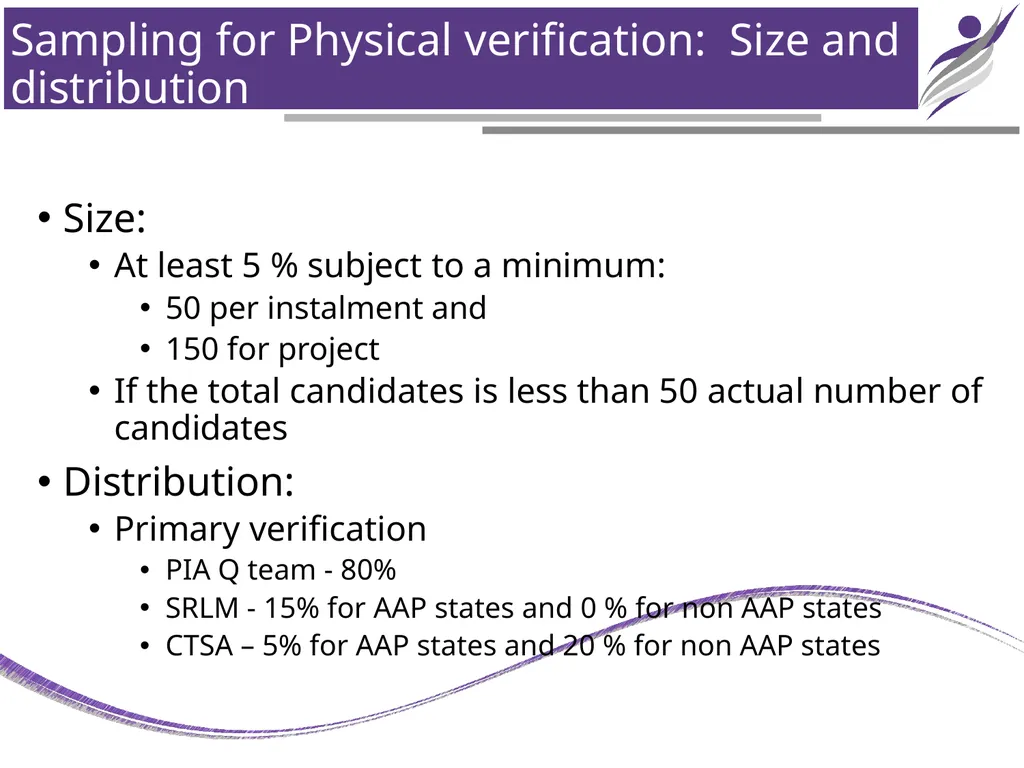
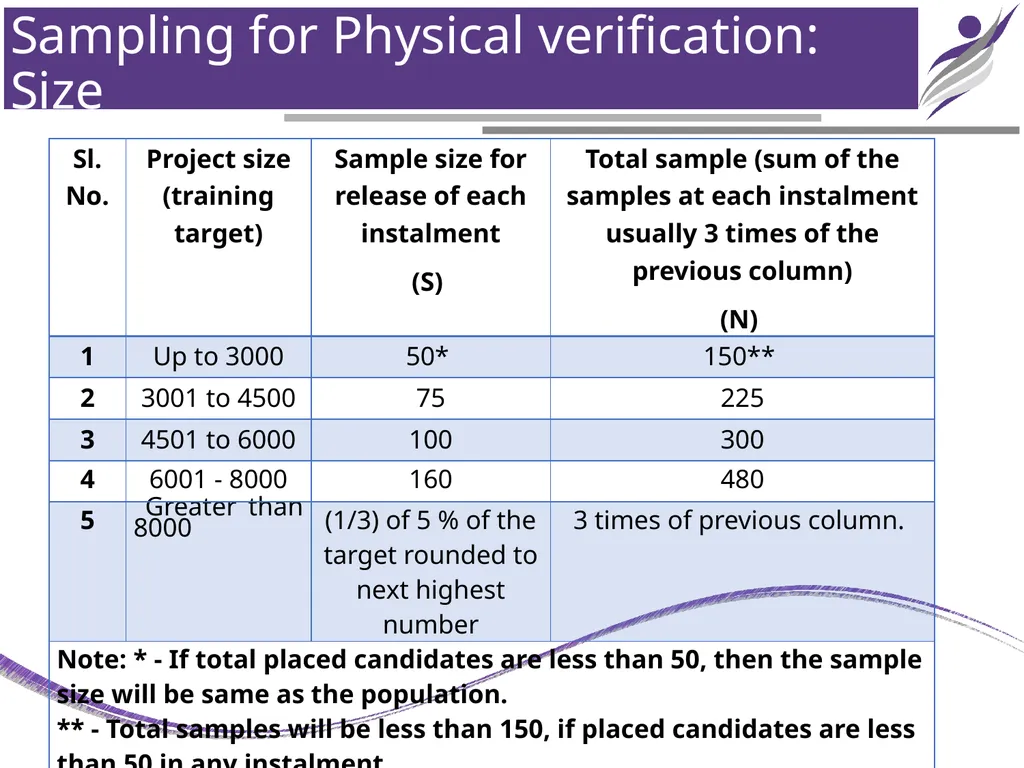
Sampling for Physical verification: Size and distribution Size:
At least 5 % subject to a minimum:
50 per instalment and
150 for project
If the total candidates is less than 50 actual number of candidates
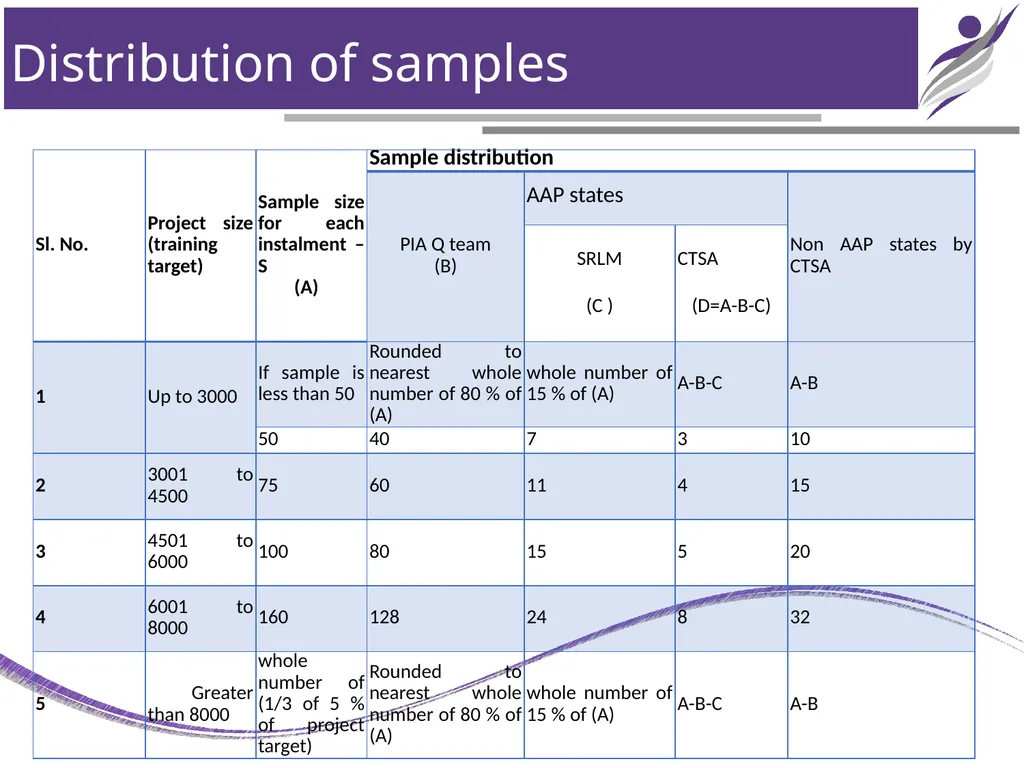
Distribution:
Primary verification
PIA Q team - 80%
SRLM - 15% for AAP states and 0 % for non AAP states
CTSA – 5% for AAP states and 20 % for non AAP states<br>
At least 5 % subject to a minimum:
50 per instalment and
150 for project
If the total candidates is less than 50 actual number of candidates
Distribution:
Primary verification
PIA Q team - 80%
SRLM - 15% for AAP states and 0 % for non AAP states
CTSA – 5% for AAP states and 20 % for non AAP states<br>
12
Contd…. Distribution
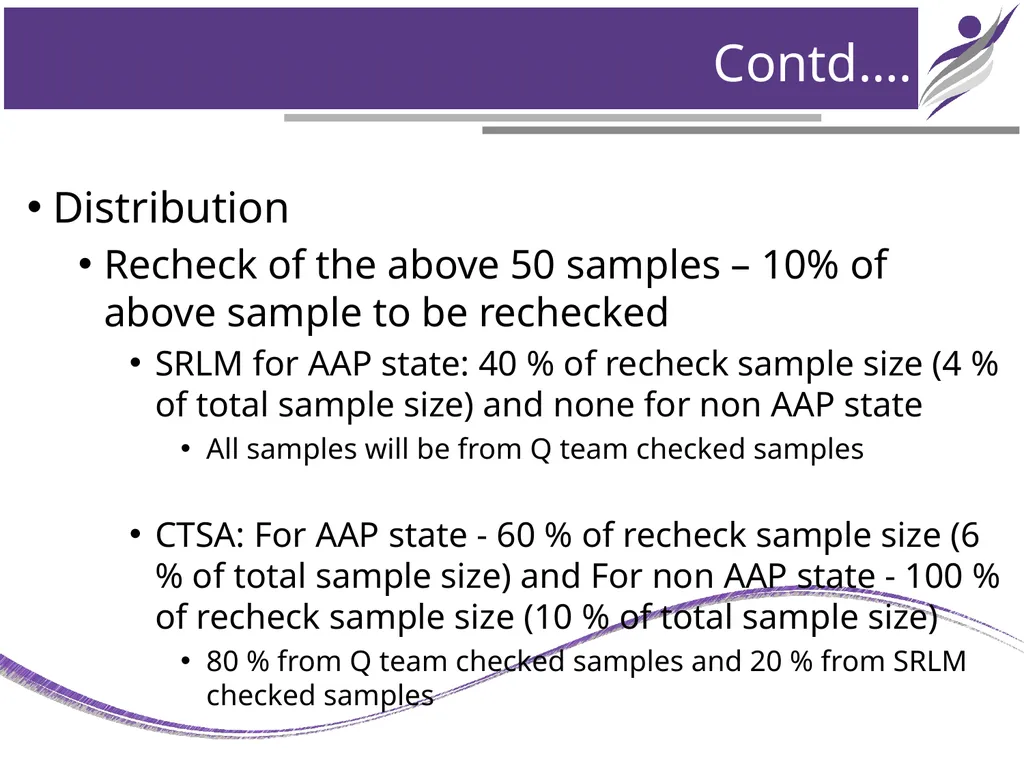
Recheck of the above 50 samples – 10% of above sample to be rechecked
SRLM for AAP state: 40 % of recheck sample size (4 % of total sample size) and none for non AAP state
All samples will be from Q team checked samples
CTSA: For AAP state - 60 % of recheck sample size (6 % of total sample size) and For non AAP state - 100 % of recheck sample size (10 % of total sample size)
80 % from Q team checked samples and 20 % from SRLM checked samples<br>
Recheck of the above 50 samples – 10% of above sample to be rechecked
SRLM for AAP state: 40 % of recheck sample size (4 % of total sample size) and none for non AAP state
All samples will be from Q team checked samples
CTSA: For AAP state - 60 % of recheck sample size (6 % of total sample size) and For non AAP state - 100 % of recheck sample size (10 % of total sample size)
80 % from Q team checked samples and 20 % from SRLM checked samples<br>
13
Sampling for Physical verification: Size<br>
14
Distribution of samples<br>
15
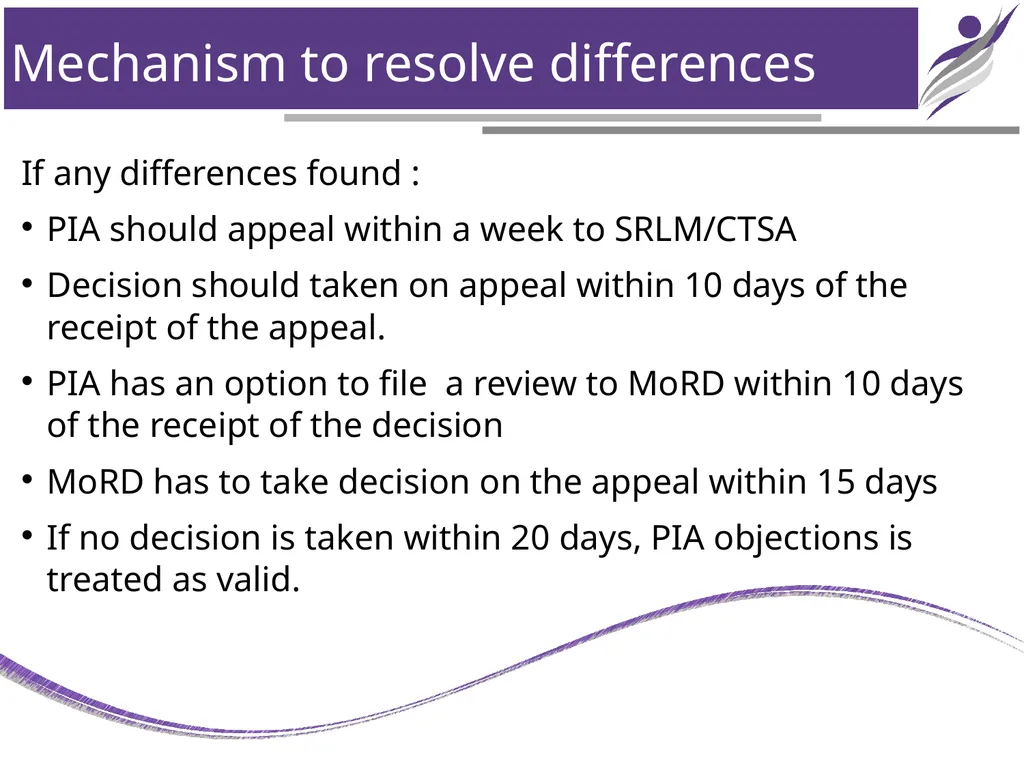
Mechanism to resolve differences If any differences found :
PIA should appeal within a week to SRLM/CTSA
Decision should taken on appeal within 10 days of the receipt of the appeal.
PIA has an option to file a review to MoRD within 10 days of the receipt of the decision
MoRD has to take decision on the appeal within 15 days
If no decision is taken within 20 days, PIA objections is treated as valid.<br>
PIA should appeal within a week to SRLM/CTSA
Decision should taken on appeal within 10 days of the receipt of the appeal.
PIA has an option to file a review to MoRD within 10 days of the receipt of the decision
MoRD has to take decision on the appeal within 15 days
If no decision is taken within 20 days, PIA objections is treated as valid.<br>
16
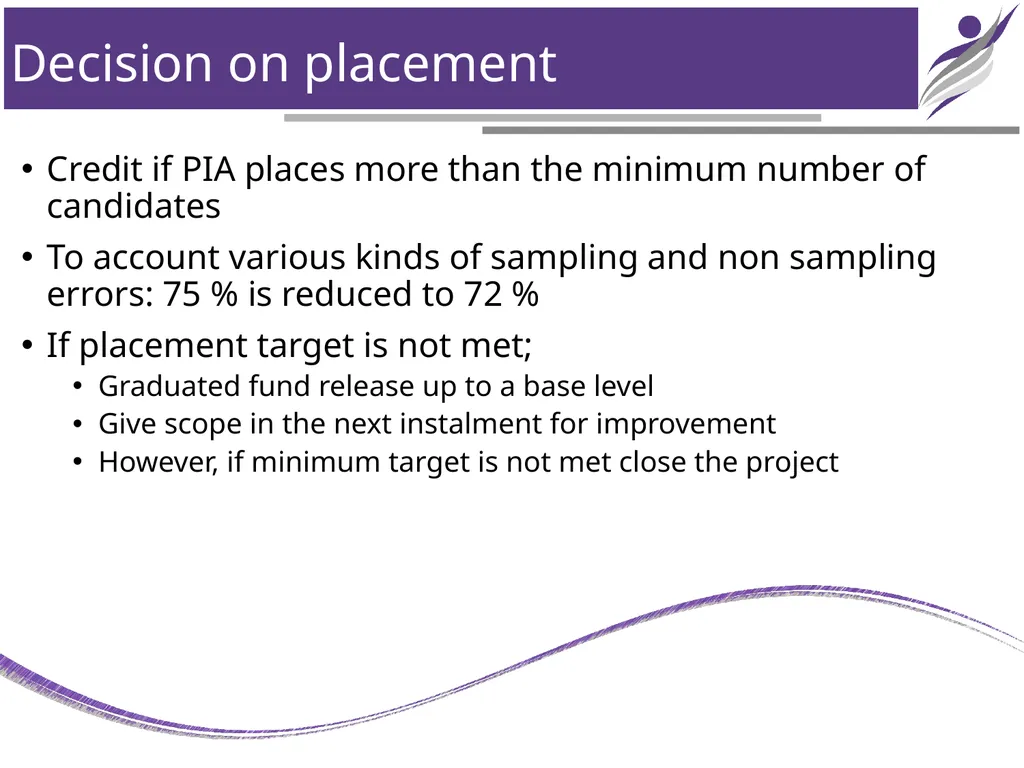
Decision on placement Credit if PIA places more than the minimum number of candidates
To account various kinds of sampling and non sampling errors: 75 % is reduced to 72 %
If placement target is not met;
Graduated fund release up to a base level
Give scope in the next instalment for improvement
However, if minimum target is not met close the project<br>
To account various kinds of sampling and non sampling errors: 75 % is reduced to 72 %
If placement target is not met;
Graduated fund release up to a base level
Give scope in the next instalment for improvement
However, if minimum target is not met close the project<br>
17
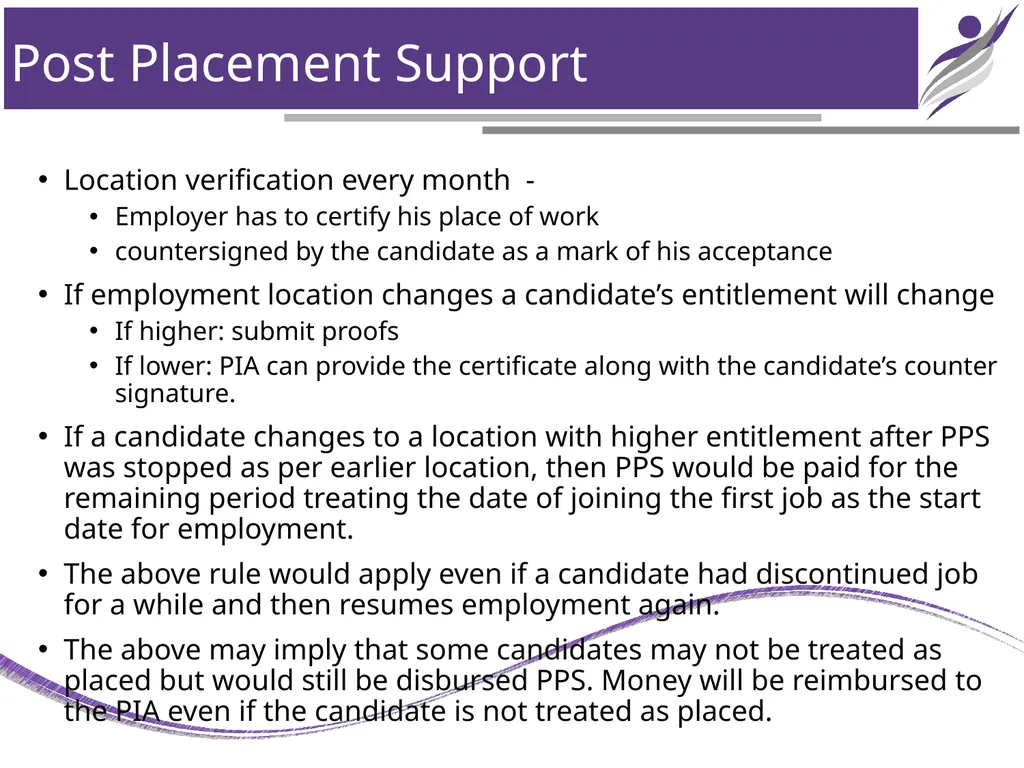
Post Placement Support Location verification every month -
Employer has to certify his place of work
countersigned by the candidate as a mark of his acceptance
If employment location changes a candidate’s entitlement will change
If higher: submit proofs
If lower: PIA can provide the certificate along with the candidate’s counter signature.
If a candidate changes to a location with higher entitlement after PPS was stopped as per earlier location, then PPS would be paid for the remaining period treating the date of joining the first job as the start date for employment.
The above rule would apply even if a candidate had discontinued job for a while and then resumes employment again.
The above may imply that some candidates may not be treated as placed but would still be disbursed PPS. Money will be reimbursed to the PIA even if the candidate is not treated as placed.<br>
Employer has to certify his place of work
countersigned by the candidate as a mark of his acceptance
If employment location changes a candidate’s entitlement will change
If higher: submit proofs
If lower: PIA can provide the certificate along with the candidate’s counter signature.
If a candidate changes to a location with higher entitlement after PPS was stopped as per earlier location, then PPS would be paid for the remaining period treating the date of joining the first job as the start date for employment.
The above rule would apply even if a candidate had discontinued job for a while and then resumes employment again.
The above may imply that some candidates may not be treated as placed but would still be disbursed PPS. Money will be reimbursed to the PIA even if the candidate is not treated as placed.<br>
18
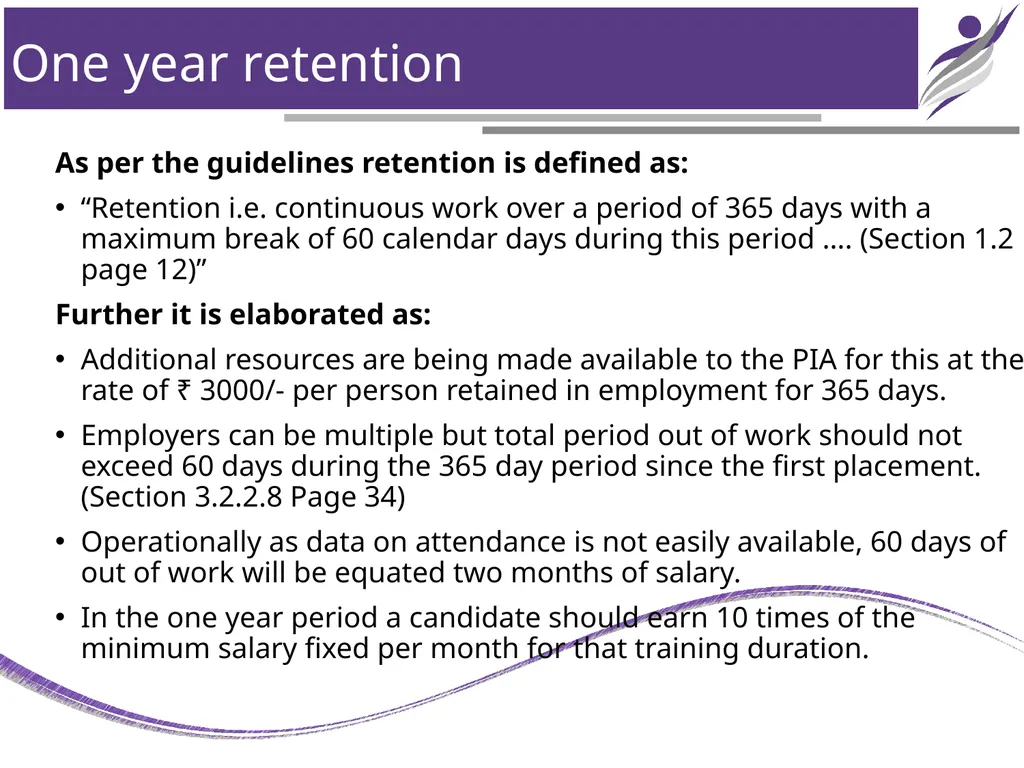
One year retention As per the guidelines retention is defined as:
“Retention i.e. continuous work over a period of 365 days with a maximum break of 60 calendar days during this period …. (Section 1.2 page 12)”
Further it is elaborated as:
Additional resources are being made available to the PIA for this at the rate of ₹ 3000/- per person retained in employment for 365 days.
Employers can be multiple but total period out of work should not exceed 60 days during the 365 day period since the first placement. (Section 3.2.2.8 Page 34)
Operationally as data on attendance is not easily available, 60 days of out of work will be equated two months of salary.
In the one year period a candidate should earn 10 times of the minimum salary fixed per month for that training duration.<br>
“Retention i.e. continuous work over a period of 365 days with a maximum break of 60 calendar days during this period …. (Section 1.2 page 12)”
Further it is elaborated as:
Additional resources are being made available to the PIA for this at the rate of ₹ 3000/- per person retained in employment for 365 days.
Employers can be multiple but total period out of work should not exceed 60 days during the 365 day period since the first placement. (Section 3.2.2.8 Page 34)
Operationally as data on attendance is not easily available, 60 days of out of work will be equated two months of salary.
In the one year period a candidate should earn 10 times of the minimum salary fixed per month for that training duration.<br>
19
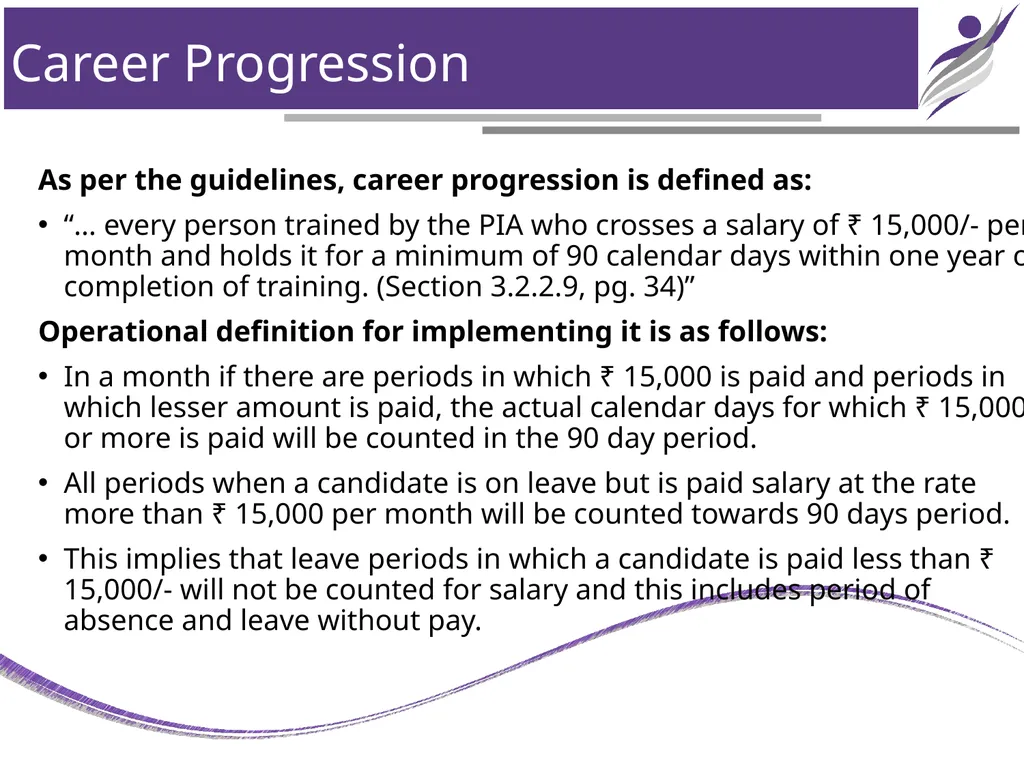
Career Progression As per the guidelines, career progression is defined as:
“… every person trained by the PIA who crosses a salary of ₹ 15,000/- per month and holds it for a minimum of 90 calendar days within one year of completion of training. (Section 3.2.2.9, pg. 34)”
Operational definition for implementing it is as follows:
In a month if there are periods in which ₹ 15,000 is paid and periods in which lesser amount is paid, the actual calendar days for which ₹ 15,000 or more is paid will be counted in the 90 day period.
All periods when a candidate is on leave but is paid salary at the rate more than ₹ 15,000 per month will be counted towards 90 days period.
This implies that leave periods in which a candidate is paid less than ₹ 15,000/- will not be counted for salary and this includes period of absence and leave without pay.<br>
“… every person trained by the PIA who crosses a salary of ₹ 15,000/- per month and holds it for a minimum of 90 calendar days within one year of completion of training. (Section 3.2.2.9, pg. 34)”
Operational definition for implementing it is as follows:
In a month if there are periods in which ₹ 15,000 is paid and periods in which lesser amount is paid, the actual calendar days for which ₹ 15,000 or more is paid will be counted in the 90 day period.
All periods when a candidate is on leave but is paid salary at the rate more than ₹ 15,000 per month will be counted towards 90 days period.
This implies that leave periods in which a candidate is paid less than ₹ 15,000/- will not be counted for salary and this includes period of absence and leave without pay.<br>
20
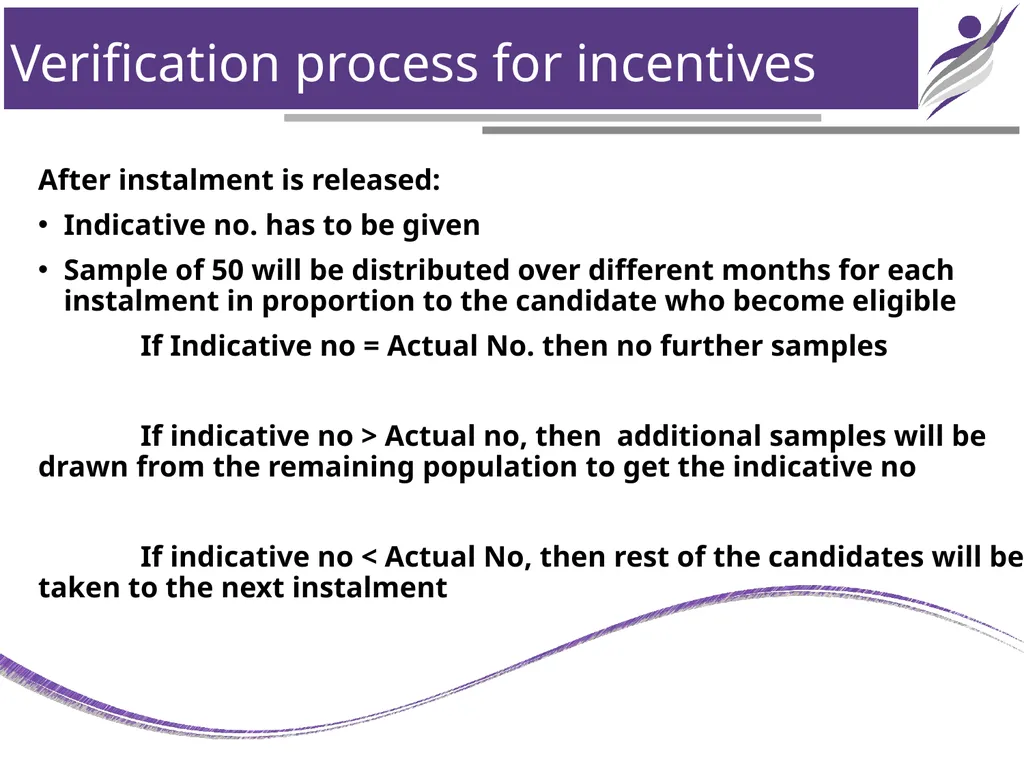
Verification process for incentives After instalment is released:
Indicative no. has to be given
Sample of 50 will be distributed over different months for each instalment in proportion to the candidate who become eligible
If Indicative no = Actual No. then no further samples
If indicative no > Actual no, then additional samples will be drawn from the remaining population to get the indicative no
If indicative no < Actual No, then rest of the candidates will be taken to the next instalment<br>
Indicative no. has to be given
Sample of 50 will be distributed over different months for each instalment in proportion to the candidate who become eligible
If Indicative no = Actual No. then no further samples
If indicative no > Actual no, then additional samples will be drawn from the remaining population to get the indicative no
If indicative no < Actual No, then rest of the candidates will be taken to the next instalment<br>
21
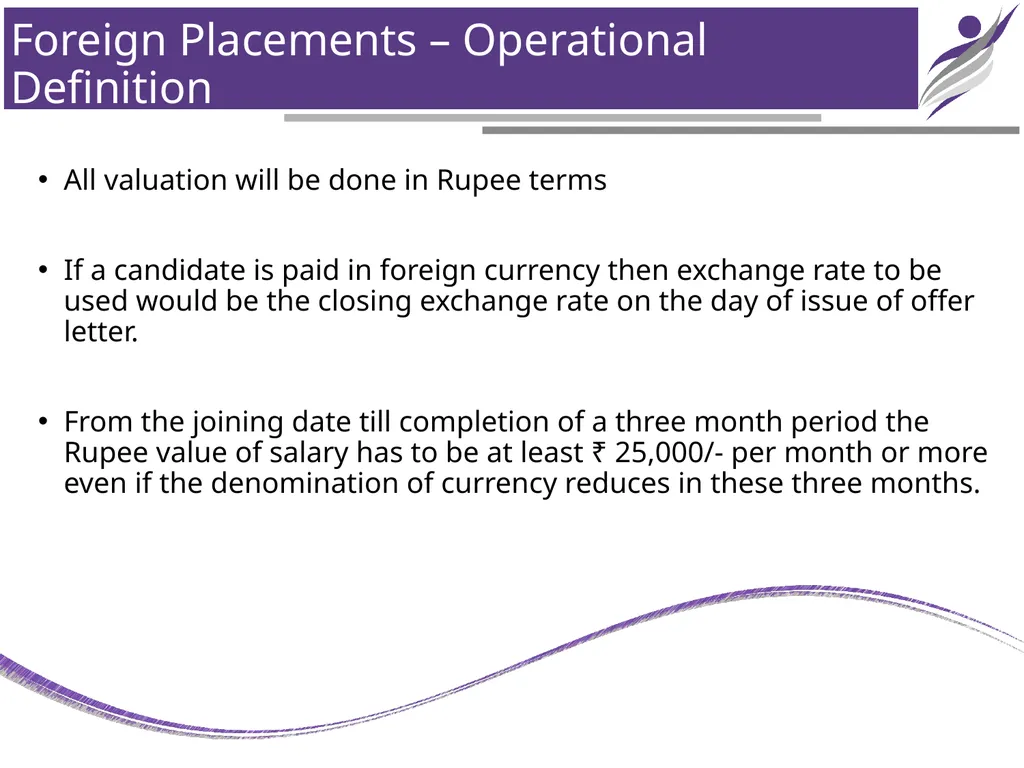
Foreign Placements – Operational Definition All valuation will be done in Rupee terms
If a candidate is paid in foreign currency then exchange rate to be used would be the closing exchange rate on the day of issue of offer letter.
From the joining date till completion of a three month period the Rupee value of salary has to be at least ₹ 25,000/- per month or more even if the denomination of currency reduces in these three months.<br>
If a candidate is paid in foreign currency then exchange rate to be used would be the closing exchange rate on the day of issue of offer letter.
From the joining date till completion of a three month period the Rupee value of salary has to be at least ₹ 25,000/- per month or more even if the denomination of currency reduces in these three months.<br>
22
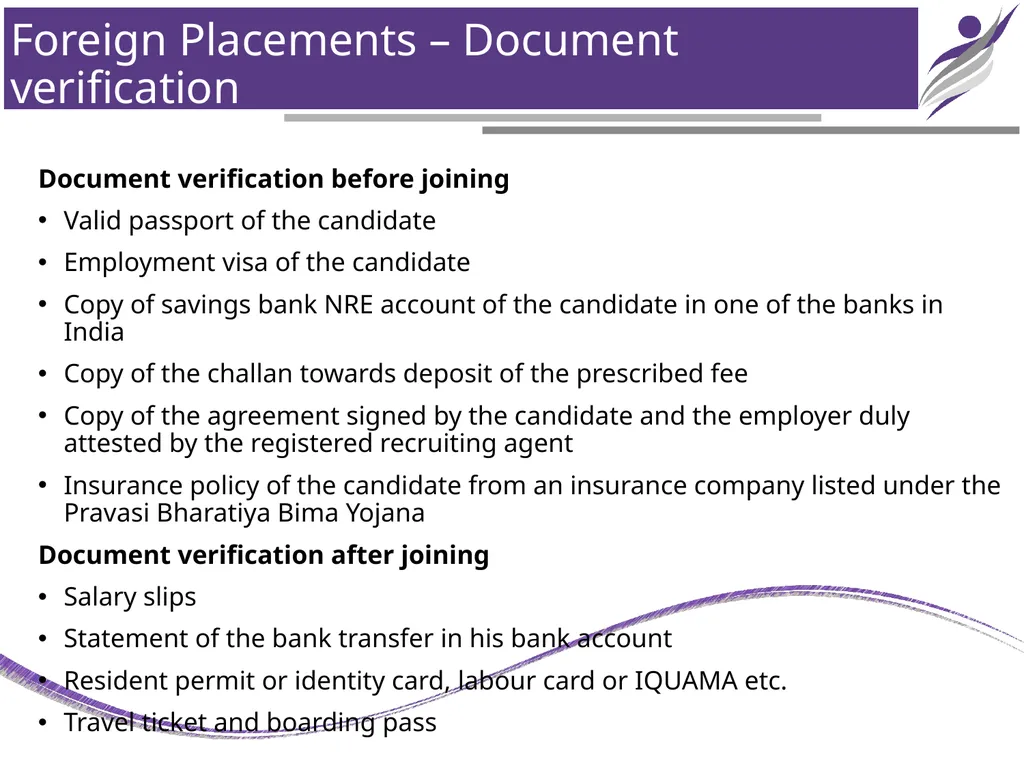
Foreign Placements – Document verification Document verification before joining
Valid passport of the candidate
Employment visa of the candidate
Copy of savings bank NRE account of the candidate in one of the banks in India
Copy of the challan towards deposit of the prescribed fee
Copy of the agreement signed by the candidate and the employer duly attested by the registered recruiting agent
Insurance policy of the candidate from an insurance company listed under the Pravasi Bharatiya Bima Yojana
Document verification after joining
Salary slips
Statement of the bank transfer in his bank account
Resident permit or identity card, labour card or IQUAMA etc.
Travel ticket and boarding pass<br>
Valid passport of the candidate
Employment visa of the candidate
Copy of savings bank NRE account of the candidate in one of the banks in India
Copy of the challan towards deposit of the prescribed fee
Copy of the agreement signed by the candidate and the employer duly attested by the registered recruiting agent
Insurance policy of the candidate from an insurance company listed under the Pravasi Bharatiya Bima Yojana
Document verification after joining
Salary slips
Statement of the bank transfer in his bank account
Resident permit or identity card, labour card or IQUAMA etc.
Travel ticket and boarding pass<br>
23
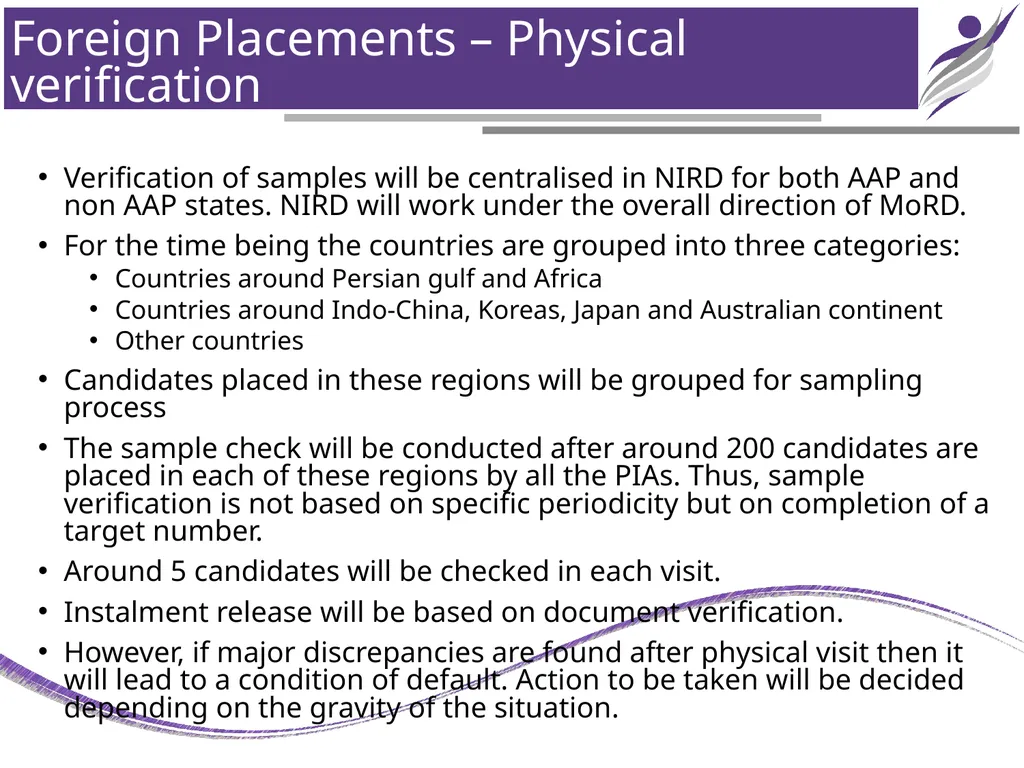
Foreign Placements – Physical verification Verification of samples will be centralised in NIRD for both AAP and non AAP states. NIRD will work under the overall direction of MoRD.
For the time being the countries are grouped into three categories:
Countries around Persian gulf and Africa
Countries around Indo-China, Koreas, Japan and Australian continent
Other countries
Candidates placed in these regions will be grouped for sampling process
The sample check will be conducted after around 200 candidates are placed in each of these regions by all the PIAs. Thus, sample verification is not based on specific periodicity but on completion of a target number.
Around 5 candidates will be checked in each visit.
Instalment release will be based on document verification.
However, if major discrepancies are found after physical visit then it will lead to a condition of default. Action to be taken will be decided depending on the gravity of the situation.<br>
For the time being the countries are grouped into three categories:
Countries around Persian gulf and Africa
Countries around Indo-China, Koreas, Japan and Australian continent
Other countries
Candidates placed in these regions will be grouped for sampling process
The sample check will be conducted after around 200 candidates are placed in each of these regions by all the PIAs. Thus, sample verification is not based on specific periodicity but on completion of a target number.
Around 5 candidates will be checked in each visit.
Instalment release will be based on document verification.
However, if major discrepancies are found after physical visit then it will lead to a condition of default. Action to be taken will be decided depending on the gravity of the situation.<br>
24
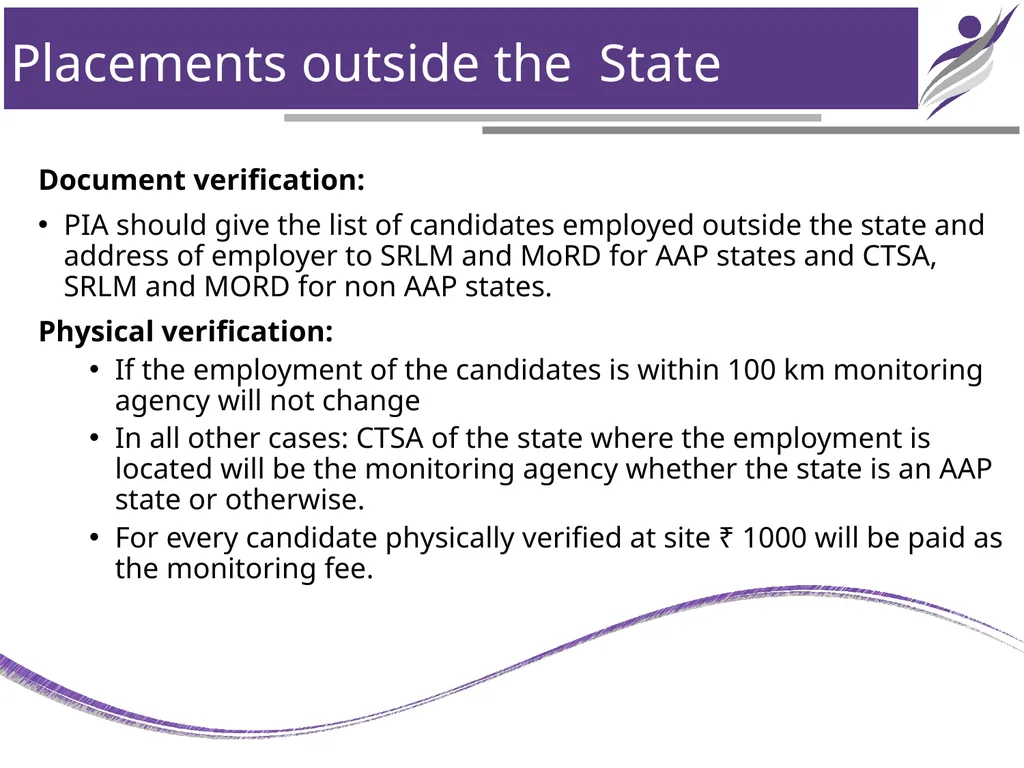
Placements outside the State Document verification:
PIA should give the list of candidates employed outside the state and address of employer to SRLM and MoRD for AAP states and CTSA, SRLM and MORD for non AAP states.
Physical verification:
If the employment of the candidates is within 100 km monitoring agency will not change
In all other cases: CTSA of the state where the employment is located will be the monitoring agency whether the state is an AAP state or otherwise.
For every candidate physically verified at site ₹ 1000 will be paid as the monitoring fee.<br>
PIA should give the list of candidates employed outside the state and address of employer to SRLM and MoRD for AAP states and CTSA, SRLM and MORD for non AAP states.
Physical verification:
If the employment of the candidates is within 100 km monitoring agency will not change
In all other cases: CTSA of the state where the employment is located will be the monitoring agency whether the state is an AAP state or otherwise.
For every candidate physically verified at site ₹ 1000 will be paid as the monitoring fee.<br>
25
Thank you<br>