
Chapter 8 PATTERNS OF INHERITANCE PowerPoint Image
JO
Published · 36 slides · 0 views
1 / 1


Description
Chapter 8 PATTERNS OF INHERITANCE PowerPoint Image Slideshow Concepts of Biology This work is licensed under cc by 4.0 license. Credit: OpenStax: modified by M. F. Sega J. Wedincamp for ALG 18 grant through addition of ppt slides with
Related Topics
Share
Embed code
Download this presentation From Below
"Chapter 8 PATTERNS OF INHERITANCE PowerPoint Image" is the property of its rightful owner. Permission is granted to download and print the materials on this website for personal, non-commercial use only, and to display it on your personal computer provided you do not modify the materials and that you retain all copyright notices contained in the materials. By downloading content from our website, you accept the terms of this agreement.
Presentation Transcript
01
Chapter 8 PATTERNS OF INHERITANCE
PowerPoint Image Slideshow Concepts of Biology This work is licensed under cc by 4.0 license. Credit: OpenStax: modified by M. F. Sega & J. Wedincamp for ALG 18 grant through addition of ppt slides with texts made using Openstax textbook information.<br>
PowerPoint Image Slideshow Concepts of Biology This work is licensed under cc by 4.0 license. Credit: OpenStax: modified by M. F. Sega & J. Wedincamp for ALG 18 grant through addition of ppt slides with texts made using Openstax textbook information.<br>
02
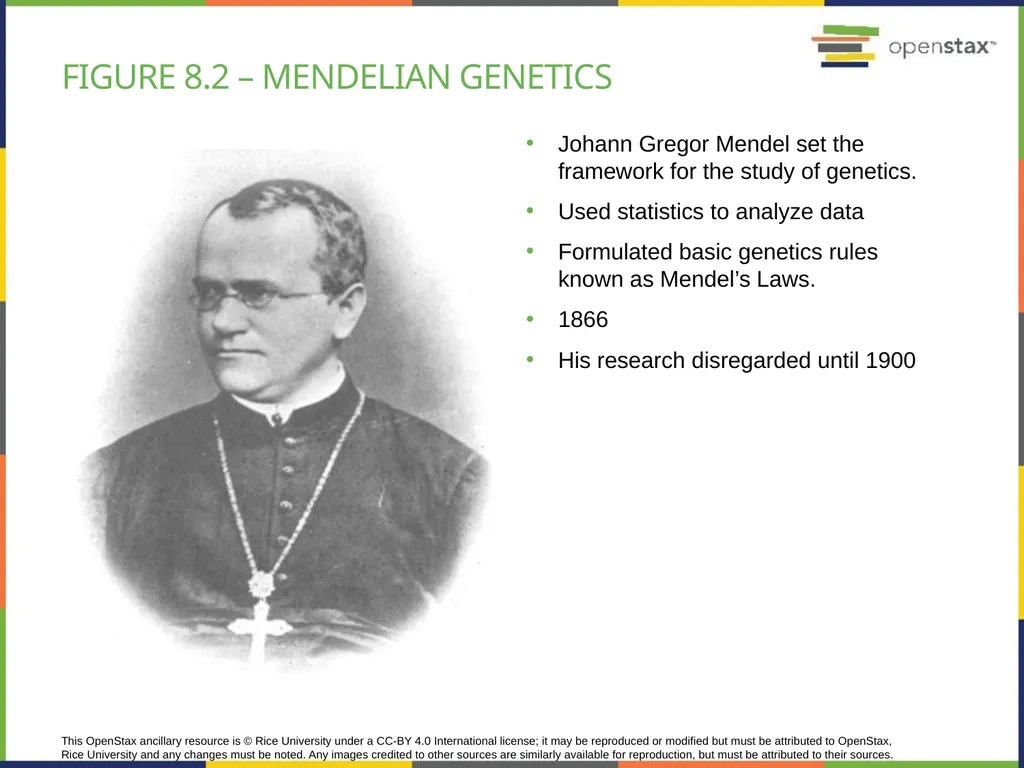
This OpenStax ancillary resource is © Rice University under a CC-BY 4.0 International license; it may be reproduced or modified but must be attributed to OpenStax, Rice University and any changes must be noted. Any images credited to other sources are similarly available for reproduction, but must be attributed to their sources. Johann Gregor Mendel set the framework for the study of genetics.
Used statistics to analyze data
Formulated basic genetics rules known as Mendel’s Laws.
1866
His research disregarded until 1900 Figure 8.2 – mendelian genetics<br>
Used statistics to analyze data
Formulated basic genetics rules known as Mendel’s Laws.
1866
His research disregarded until 1900 Figure 8.2 – mendelian genetics<br>
03
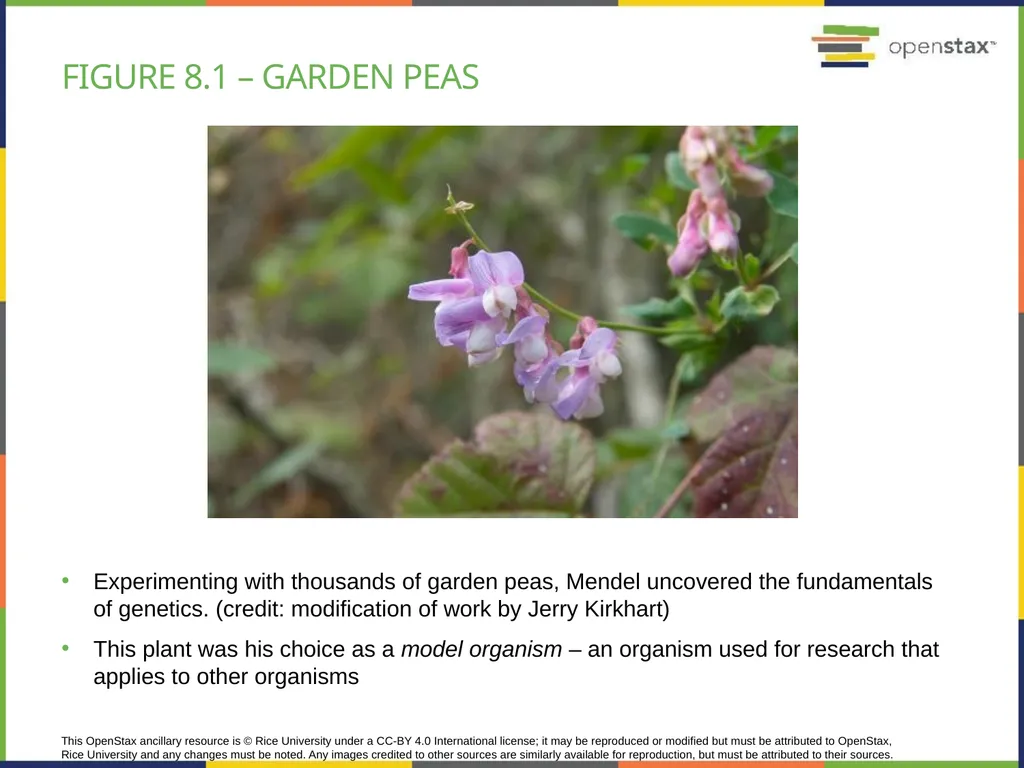
This OpenStax ancillary resource is © Rice University under a CC-BY 4.0 International license; it may be reproduced or modified but must be attributed to OpenStax, Rice University and any changes must be noted. Any images credited to other sources are similarly available for reproduction, but must be attributed to their sources. Experimenting with thousands of garden peas, Mendel uncovered the fundamentals of genetics. (credit: modification of work by Jerry Kirkhart)
This plant was his choice as a model organism – an organism used for research that applies to other organisms Figure 8.1 – garden peas<br>
This plant was his choice as a model organism – an organism used for research that applies to other organisms Figure 8.1 – garden peas<br>
04
Garden peas Fertilization = pollen (male) + ova (female)
Cross-fertilization – between 2 plants (pollen from one and ova from the other)
Self-fertilization – within the same plant’s flower (since they are hermaphrodite)
As a result of this plants were having pure offspring (manifesting only 1 feature all the time throughout generations) hence called true-breeding organisms<br>
Cross-fertilization – between 2 plants (pollen from one and ova from the other)
Self-fertilization – within the same plant’s flower (since they are hermaphrodite)
As a result of this plants were having pure offspring (manifesting only 1 feature all the time throughout generations) hence called true-breeding organisms<br>
05
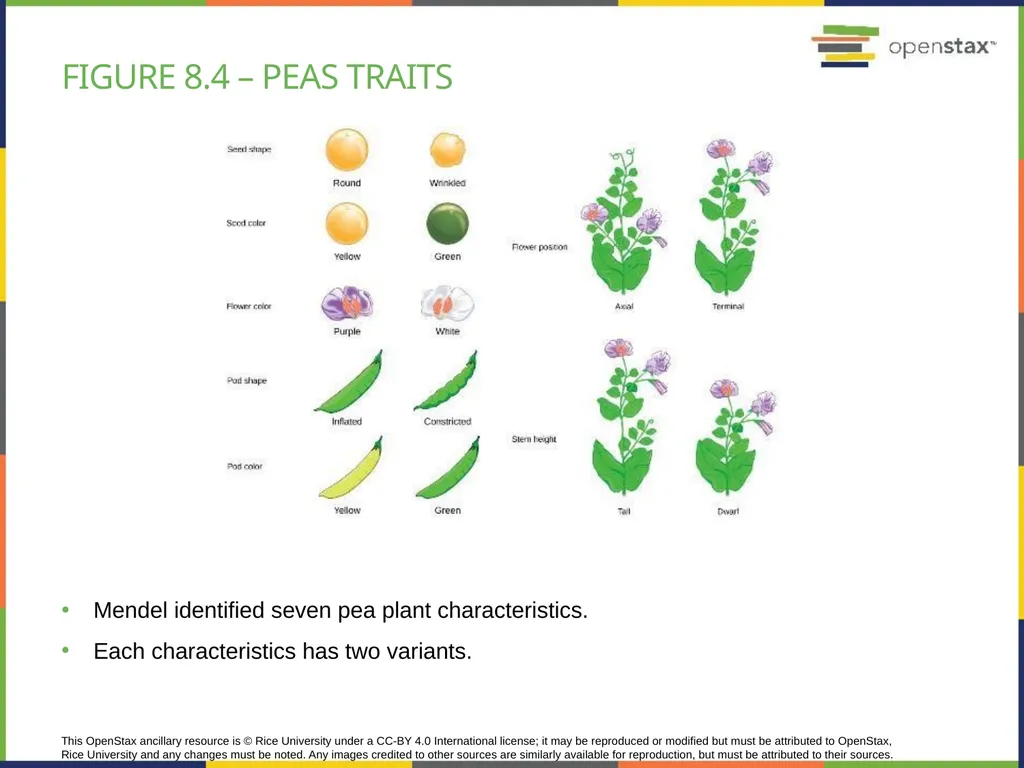
This OpenStax ancillary resource is © Rice University under a CC-BY 4.0 International license; it may be reproduced or modified but must be attributed to OpenStax, Rice University and any changes must be noted. Any images credited to other sources are similarly available for reproduction, but must be attributed to their sources. Mendel identified seven pea plant characteristics.
Each characteristics has two variants. Figure 8.4 – peas traits<br>
Each characteristics has two variants. Figure 8.4 – peas traits<br>
06
Mendel experiments Parental Generation (P) – the first-generation of plants used to cross
First-generation offspring (F1) – babies of P
Second – generation offspring (F2) – babies of F1
Mendel’s experiment:
P – true-breeding plants (violet x white flower) were cross-fertilized
F1 – all offspring were Violet
F1 – allowed to self-fertilize
F2 – mostly violet & some white<br>
First-generation offspring (F1) – babies of P
Second – generation offspring (F2) – babies of F1
Mendel’s experiment:
P – true-breeding plants (violet x white flower) were cross-fertilized
F1 – all offspring were Violet
F1 – allowed to self-fertilize
F2 – mostly violet & some white<br>
07
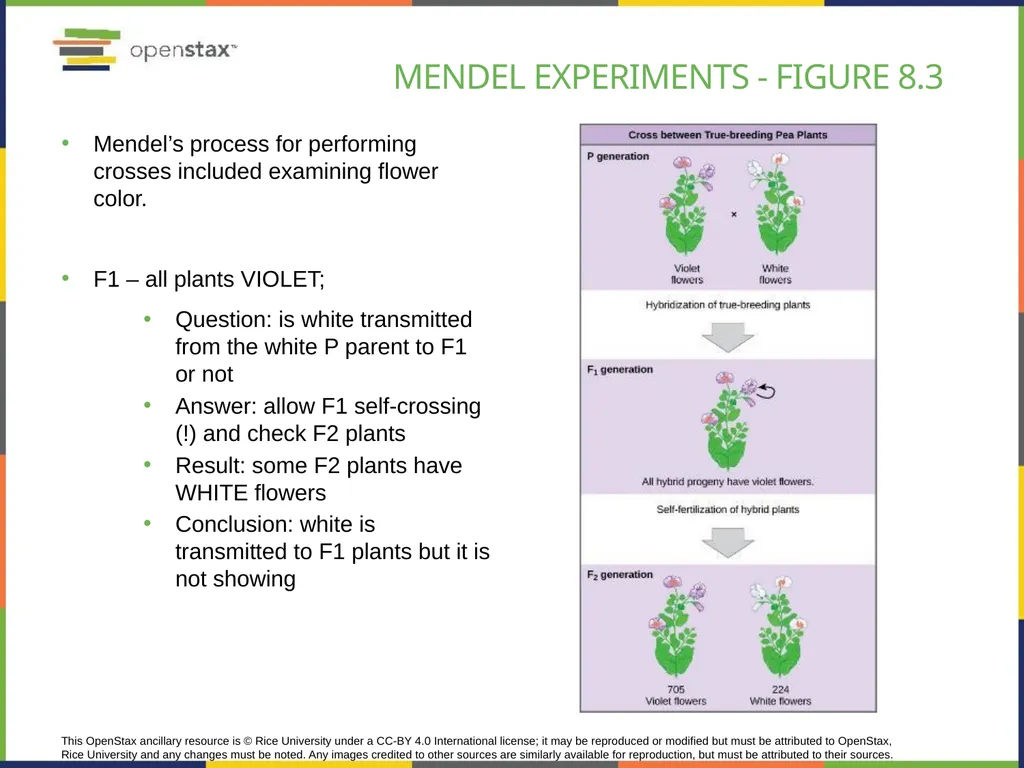
This OpenStax ancillary resource is © Rice University under a CC-BY 4.0 International license; it may be reproduced or modified but must be attributed to OpenStax, Rice University and any changes must be noted. Any images credited to other sources are similarly available for reproduction, but must be attributed to their sources. Mendel’s process for performing crosses included examining flower color.
F1 – all plants VIOLET;
Question: is white transmitted from the white P parent to F1 or not
Answer: allow F1 self-crossing (!) and check F2 plants
Result: some F2 plants have WHITE flowers
Conclusion: white is transmitted to F1 plants but it is not showing Mendel experiments - Figure 8.3<br>
F1 – all plants VIOLET;
Question: is white transmitted from the white P parent to F1 or not
Answer: allow F1 self-crossing (!) and check F2 plants
Result: some F2 plants have WHITE flowers
Conclusion: white is transmitted to F1 plants but it is not showing Mendel experiments - Figure 8.3<br>
08
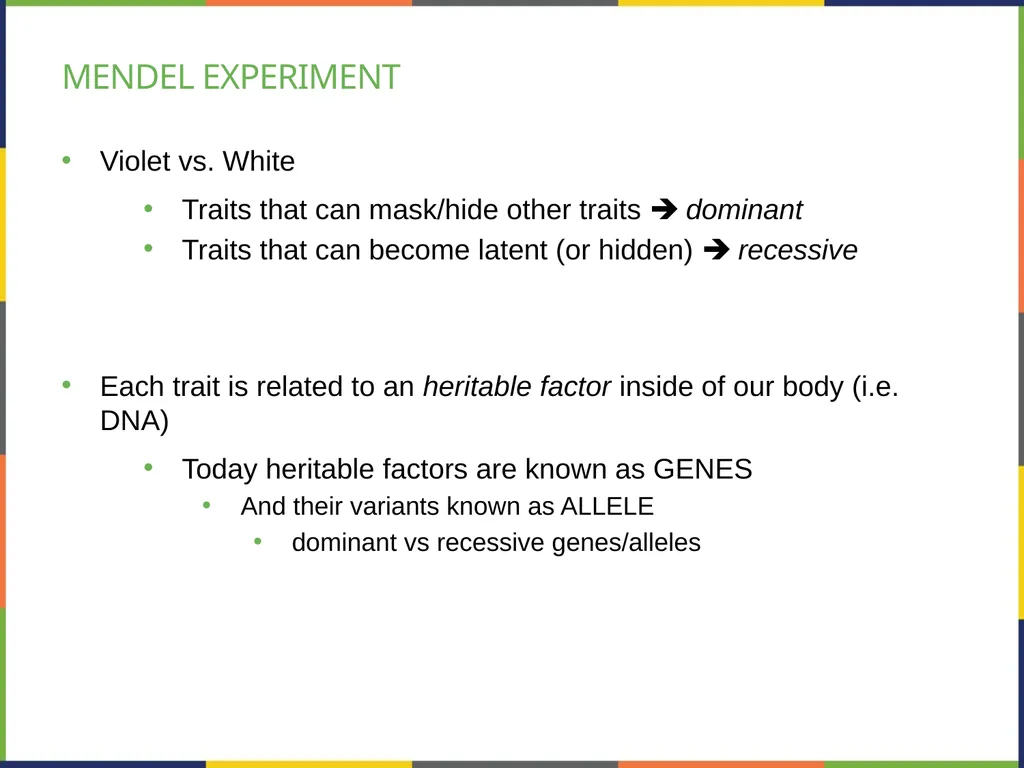
Mendel experiment Violet vs. White
Traits that can mask/hide other traits dominant
Traits that can become latent (or hidden) recessive
Each trait is related to an heritable factor inside of our body (i.e. DNA)
Today heritable factors are known as GENES
And their variants known as ALLELE
dominant vs recessive genes/alleles<br>
Traits that can mask/hide other traits dominant
Traits that can become latent (or hidden) recessive
Each trait is related to an heritable factor inside of our body (i.e. DNA)
Today heritable factors are known as GENES
And their variants known as ALLELE
dominant vs recessive genes/alleles<br>
09
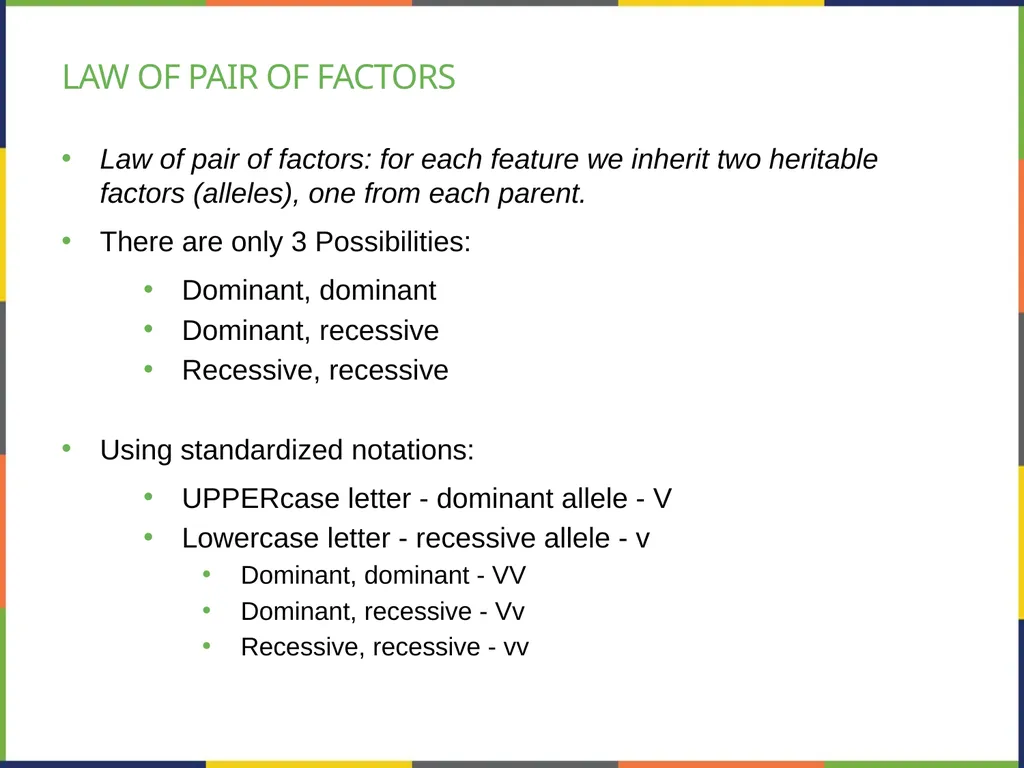
Law of pair of factors Law of pair of factors: for each feature we inherit two heritable factors (alleles), one from each parent.
There are only 3 Possibilities:
Dominant, dominant
Dominant, recessive
Recessive, recessive
Using standardized notations:
UPPERcase letter - dominant allele - V
Lowercase letter - recessive allele - v
Dominant, dominant - VV
Dominant, recessive - Vv
Recessive, recessive - vv<br>
There are only 3 Possibilities:
Dominant, dominant
Dominant, recessive
Recessive, recessive
Using standardized notations:
UPPERcase letter - dominant allele - V
Lowercase letter - recessive allele - v
Dominant, dominant - VV
Dominant, recessive - Vv
Recessive, recessive - vv<br>
10
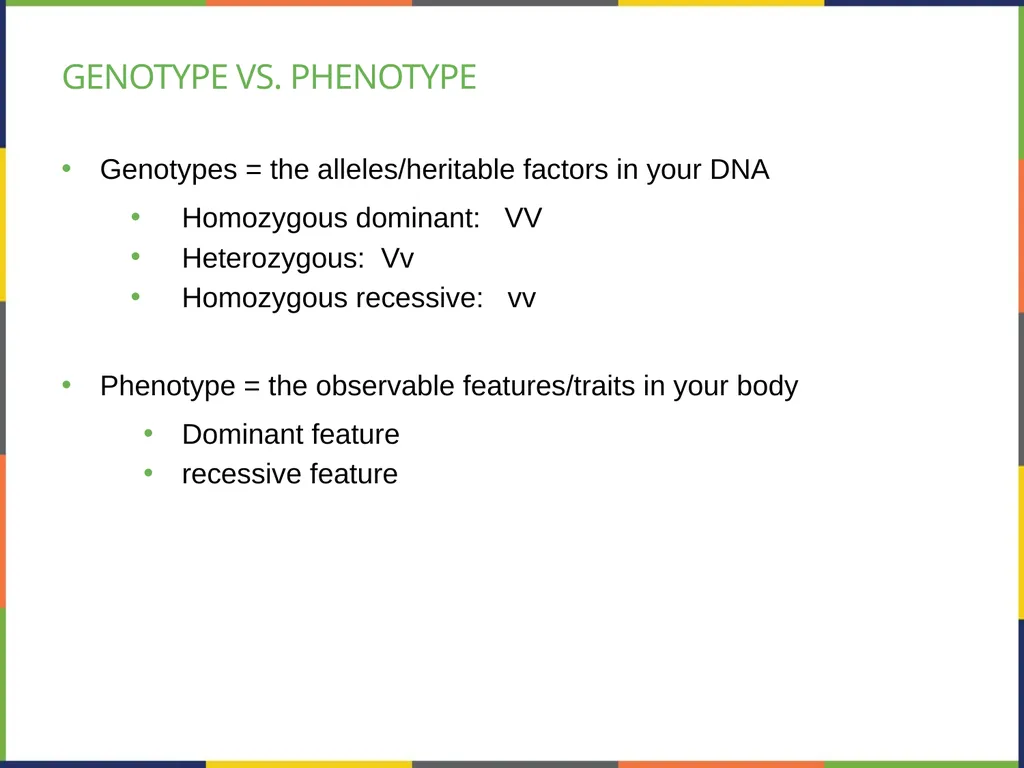
Genotype vs. phenotype Genotypes = the alleles/heritable factors in your DNA
Homozygous dominant: VV
Heterozygous: Vv
Homozygous recessive: vv
Phenotype = the observable features/traits in your body
Dominant feature
recessive feature<br>
Homozygous dominant: VV
Heterozygous: Vv
Homozygous recessive: vv
Phenotype = the observable features/traits in your body
Dominant feature
recessive feature<br>
11
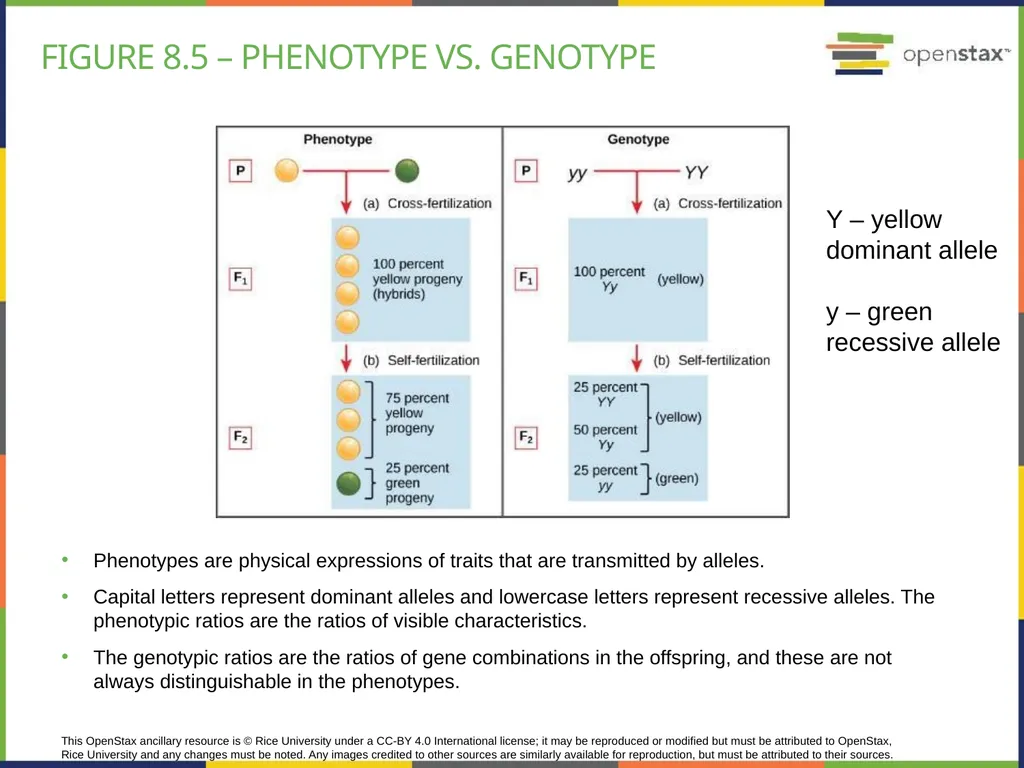
This OpenStax ancillary resource is © Rice University under a CC-BY 4.0 International license; it may be reproduced or modified but must be attributed to OpenStax, Rice University and any changes must be noted. Any images credited to other sources are similarly available for reproduction, but must be attributed to their sources. Phenotypes are physical expressions of traits that are transmitted by alleles.
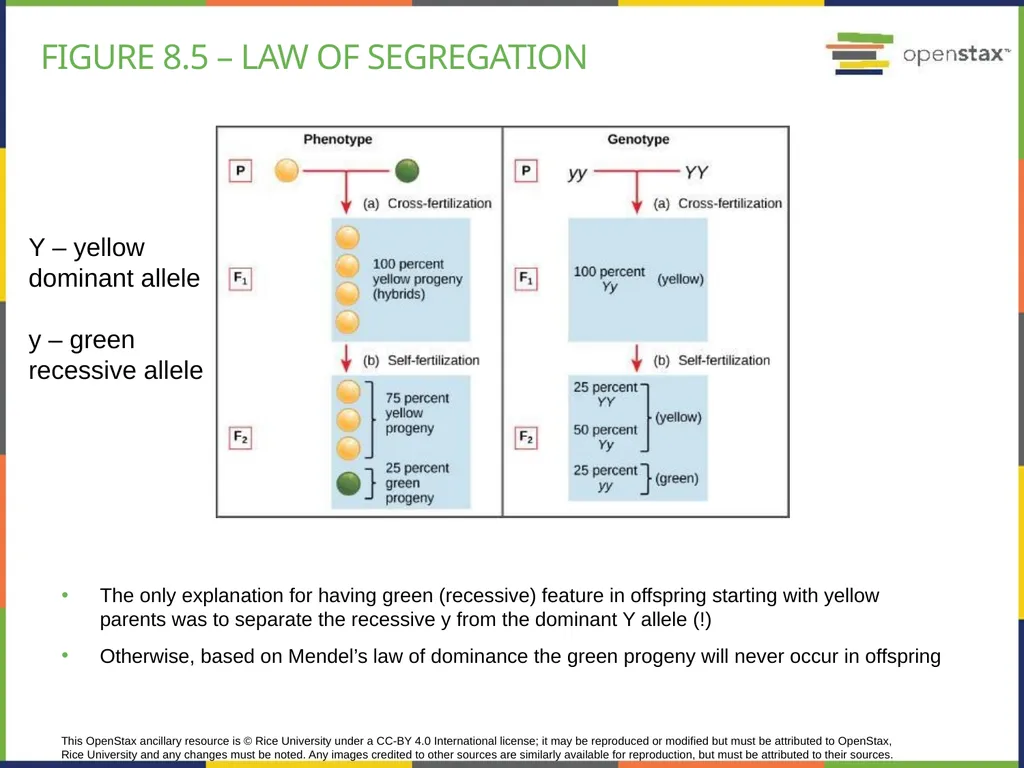
Capital letters represent dominant alleles and lowercase letters represent recessive alleles. The phenotypic ratios are the ratios of visible characteristics.
The genotypic ratios are the ratios of gene combinations in the offspring, and these are not always distinguishable in the phenotypes. Figure 8.5 – phenotype Vs. genotype Y – yellow dominant allele
y – green recessive allele<br>
Capital letters represent dominant alleles and lowercase letters represent recessive alleles. The phenotypic ratios are the ratios of visible characteristics.
The genotypic ratios are the ratios of gene combinations in the offspring, and these are not always distinguishable in the phenotypes. Figure 8.5 – phenotype Vs. genotype Y – yellow dominant allele
y – green recessive allele<br>
12
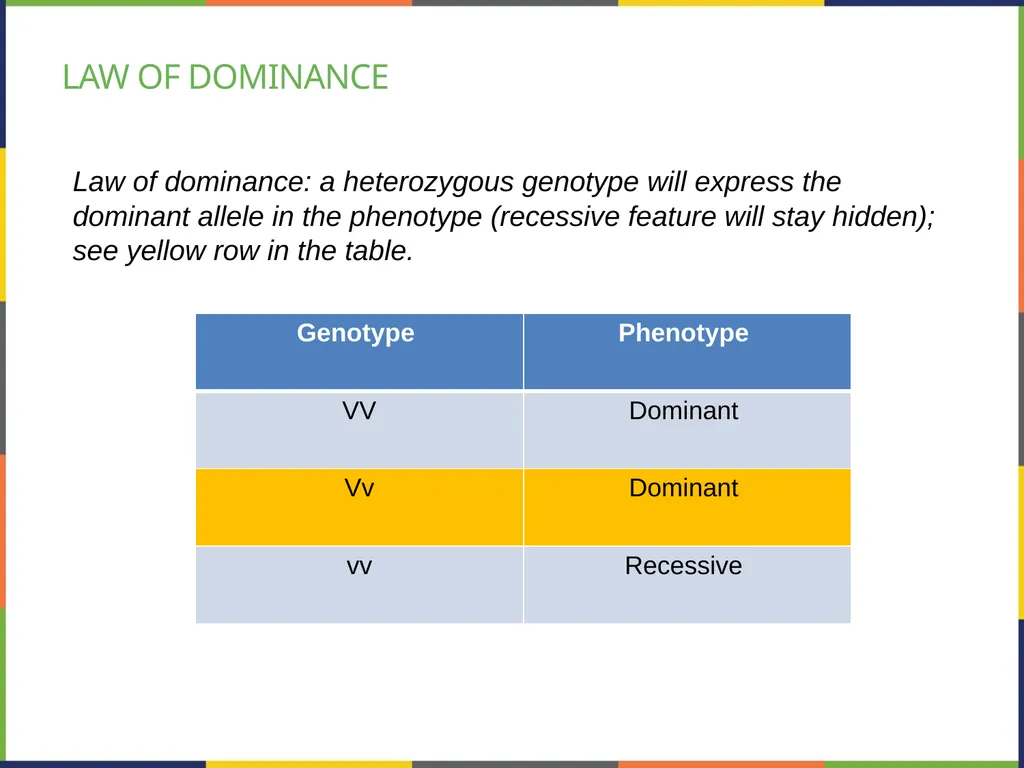
Law of dominance Law of dominance: a heterozygous genotype will express the dominant allele in the phenotype (recessive feature will stay hidden); see yellow row in the table.<br>
13
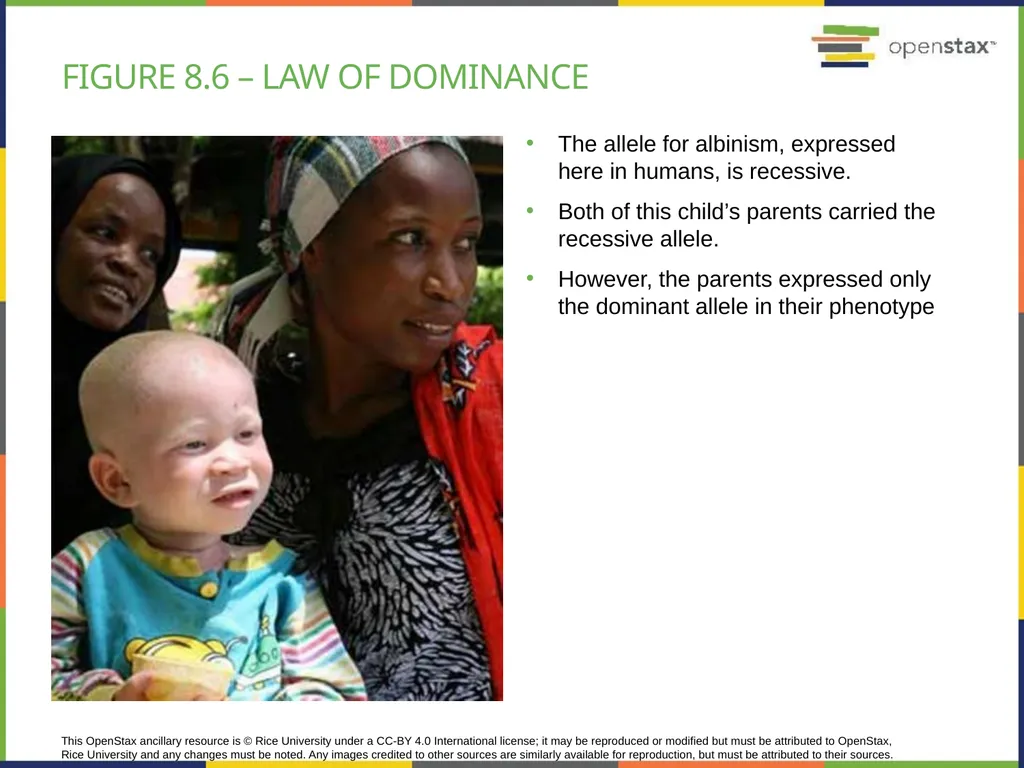
This OpenStax ancillary resource is © Rice University under a CC-BY 4.0 International license; it may be reproduced or modified but must be attributed to OpenStax, Rice University and any changes must be noted. Any images credited to other sources are similarly available for reproduction, but must be attributed to their sources. The allele for albinism, expressed here in humans, is recessive.
Both of this child’s parents carried the recessive allele.
However, the parents expressed only the dominant allele in their phenotype Figure 8.6 – law of dominance<br>
Both of this child’s parents carried the recessive allele.
However, the parents expressed only the dominant allele in their phenotype Figure 8.6 – law of dominance<br>
14
This OpenStax ancillary resource is © Rice University under a CC-BY 4.0 International license; it may be reproduced or modified but must be attributed to OpenStax, Rice University and any changes must be noted. Any images credited to other sources are similarly available for reproduction, but must be attributed to their sources. Figure 8.5 – Law of segregation Y – yellow dominant allele
y – green recessive allele The only explanation for having green (recessive) feature in offspring starting with yellow parents was to separate the recessive y from the dominant Y allele (!)
Otherwise, based on Mendel’s law of dominance the green progeny will never occur in offspring<br>
y – green recessive allele The only explanation for having green (recessive) feature in offspring starting with yellow parents was to separate the recessive y from the dominant Y allele (!)
Otherwise, based on Mendel’s law of dominance the green progeny will never occur in offspring<br>
15
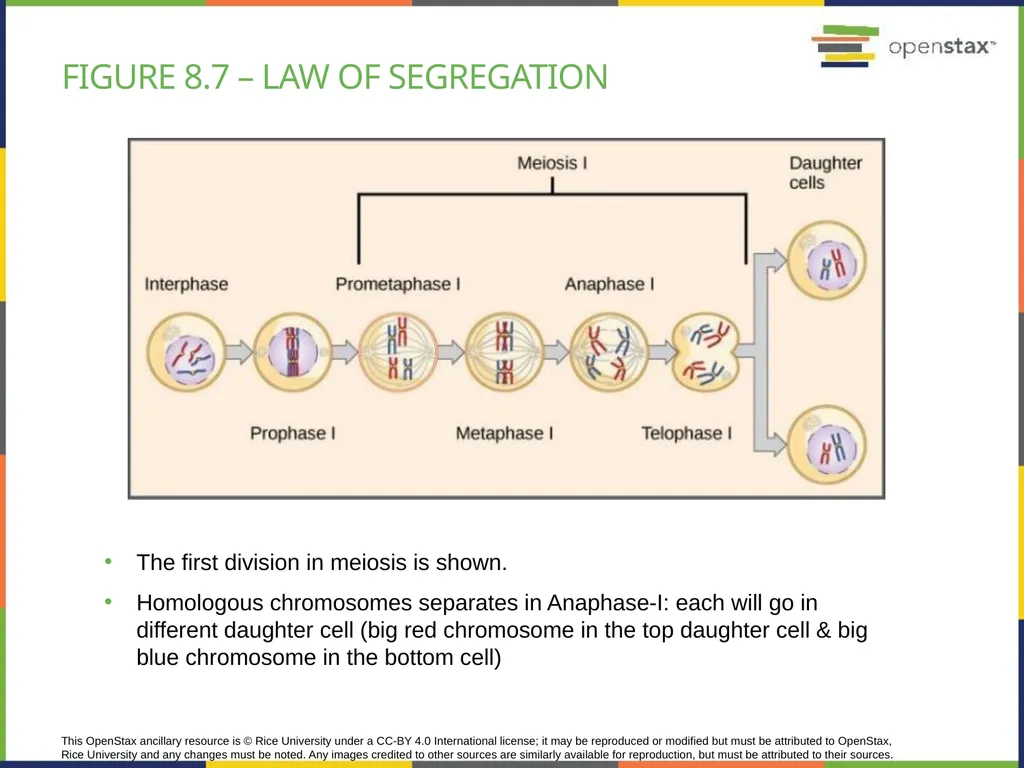
Law of segregation Law of segregation: the pair of alleles we inherit from our parents (see law of pair of factors) have to separate/segregate so that each allele goes in different sex cells (gametes);
The cellular basis for explaining this law is the process of MEIOSIS – where the paternal homolog separates from maternal homolog in the anaphase I.
Remember, an allele/gene is carried on a chromosome, so when homologous chromosomes separates then the alleles separate.<br>
The cellular basis for explaining this law is the process of MEIOSIS – where the paternal homolog separates from maternal homolog in the anaphase I.
Remember, an allele/gene is carried on a chromosome, so when homologous chromosomes separates then the alleles separate.<br>
16
This OpenStax ancillary resource is © Rice University under a CC-BY 4.0 International license; it may be reproduced or modified but must be attributed to OpenStax, Rice University and any changes must be noted. Any images credited to other sources are similarly available for reproduction, but must be attributed to their sources. The first division in meiosis is shown.
Homologous chromosomes separates in Anaphase-I: each will go in different daughter cell (big red chromosome in the top daughter cell & big blue chromosome in the bottom cell) Figure 8.7 – law of segregation<br>
Homologous chromosomes separates in Anaphase-I: each will go in different daughter cell (big red chromosome in the top daughter cell & big blue chromosome in the bottom cell) Figure 8.7 – law of segregation<br>
17
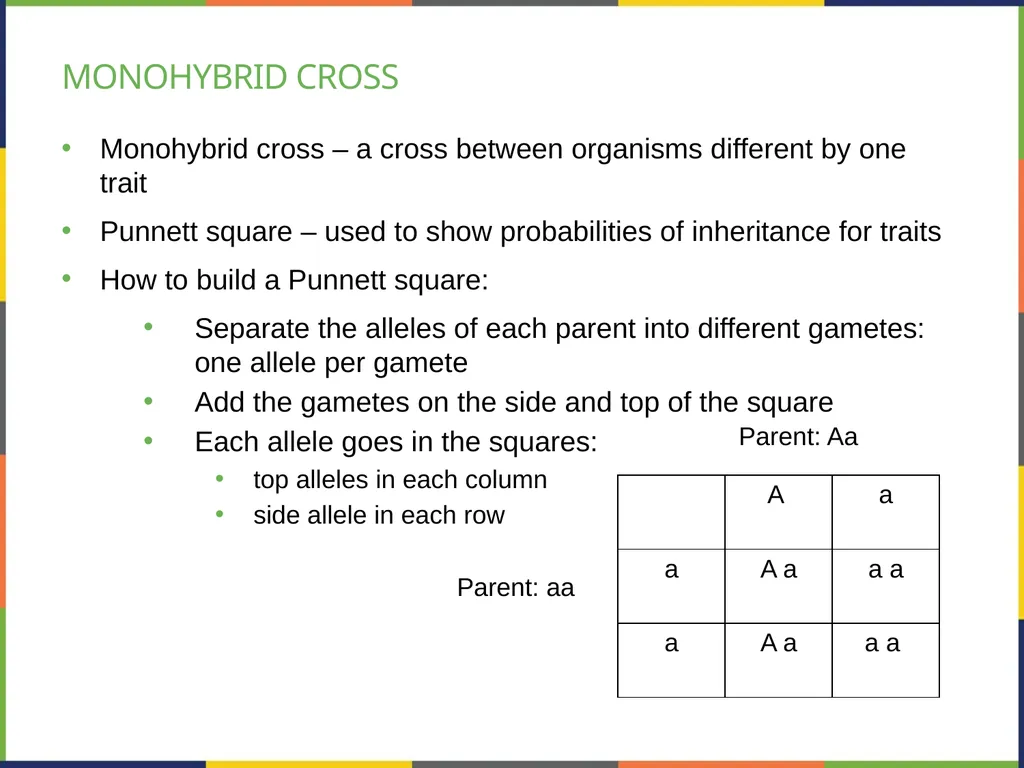
Monohybrid cross Monohybrid cross – a cross between organisms different by one trait
Punnett square – used to show probabilities of inheritance for traits
How to build a Punnett square:
Separate the alleles of each parent into different gametes: one allele per gamete
Add the gametes on the side and top of the square
Each allele goes in the squares:
top alleles in each column
side allele in each row Parent: aa Parent: Aa<br>
Punnett square – used to show probabilities of inheritance for traits
How to build a Punnett square:
Separate the alleles of each parent into different gametes: one allele per gamete
Add the gametes on the side and top of the square
Each allele goes in the squares:
top alleles in each column
side allele in each row Parent: aa Parent: Aa<br>
18
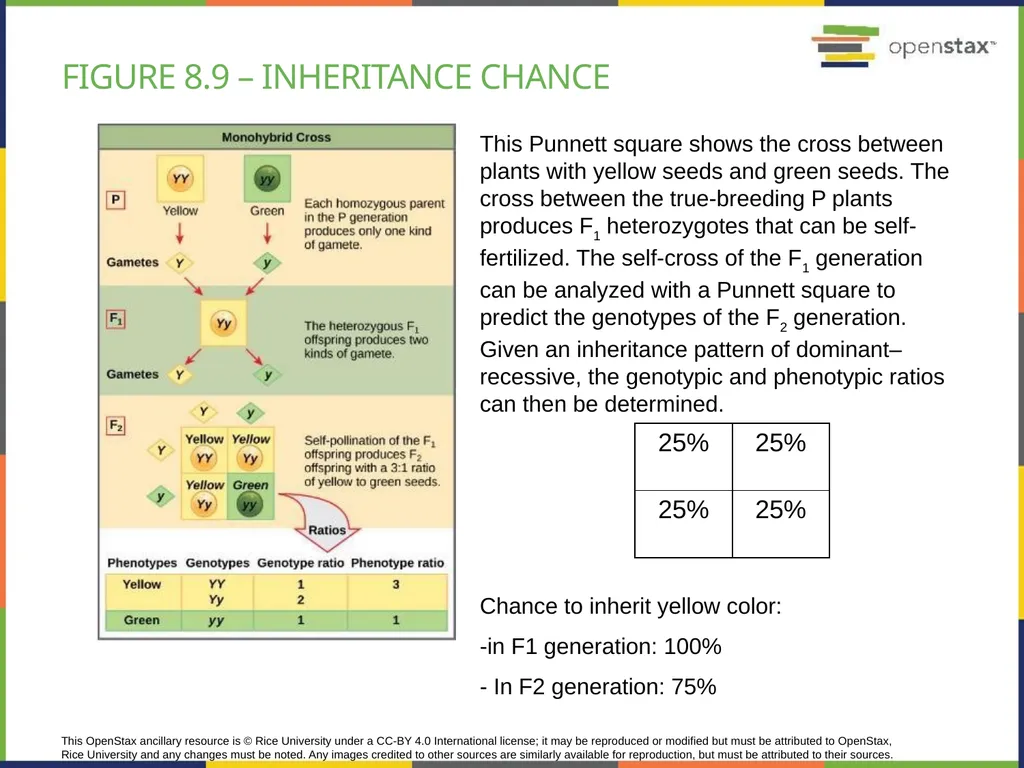
This OpenStax ancillary resource is © Rice University under a CC-BY 4.0 International license; it may be reproduced or modified but must be attributed to OpenStax, Rice University and any changes must be noted. Any images credited to other sources are similarly available for reproduction, but must be attributed to their sources. This Punnett square shows the cross between plants with yellow seeds and green seeds. The cross between the true-breeding P plants produces F1 heterozygotes that can be self-fertilized. The self-cross of the F1 generation can be analyzed with a Punnett square to predict the genotypes of the F2 generation. Given an inheritance pattern of dominant–recessive, the genotypic and phenotypic ratios can then be determined.
Chance to inherit yellow color:
-in F1 generation: 100%
- In F2 generation: 75% Figure 8.9 – inheritance chance<br>
Chance to inherit yellow color:
-in F1 generation: 100%
- In F2 generation: 75% Figure 8.9 – inheritance chance<br>
19
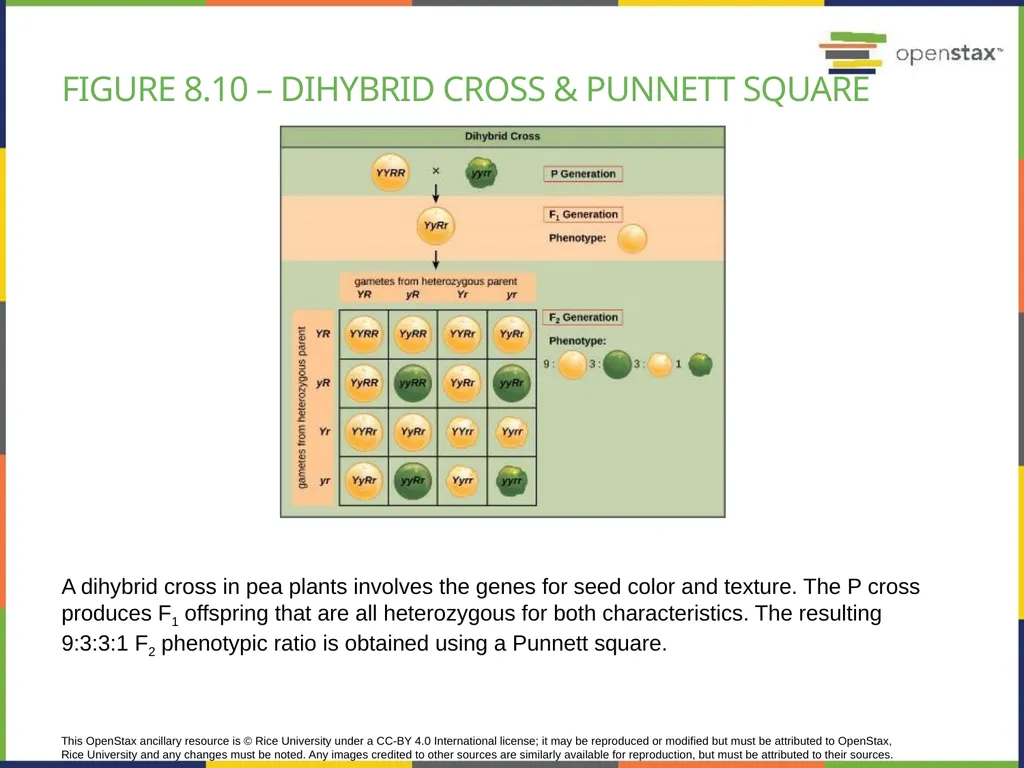
Dihybrid crosses Dihybrid crosses – crosses between organisms different by 2 traits so you can follow both features’ inheritance.
Examples: - seed color & seed shape
Punnett square:
remember to separate alleles (law of segregation !)
Each gamete will have two alleles (!)
No alleles of the same gene should be in same gamete
Gametes from a parent with the genotype YyRr:
YR, Yr, yR, yr<br>
Examples: - seed color & seed shape
Punnett square:
remember to separate alleles (law of segregation !)
Each gamete will have two alleles (!)
No alleles of the same gene should be in same gamete
Gametes from a parent with the genotype YyRr:
YR, Yr, yR, yr<br>
20
This OpenStax ancillary resource is © Rice University under a CC-BY 4.0 International license; it may be reproduced or modified but must be attributed to OpenStax, Rice University and any changes must be noted. Any images credited to other sources are similarly available for reproduction, but must be attributed to their sources. A dihybrid cross in pea plants involves the genes for seed color and texture. The P cross produces F1 offspring that are all heterozygous for both characteristics. The resulting 9:3:3:1 F2 phenotypic ratio is obtained using a Punnett square. Figure 8.10 – dihybrid cross & Punnett square<br>
21
Law of independent assortment Law of independent assortment: genes will segregate independent of each other into gametes.
Can be shown by a dihybrid crosses.
Dependency means: one allele depends on the other allele when segregates forming gametes.
Example: if Y allele depends on R then the parent YyRr will only have YR & yr gametes
Independency means: one allele do not depend on any other allele, so they just combine randomly, and all possible combinations are possible.
Example: for YyRr parent the gametes are YR, Yr, yR, yr (like you have seen in the dihybrid Punnett square)
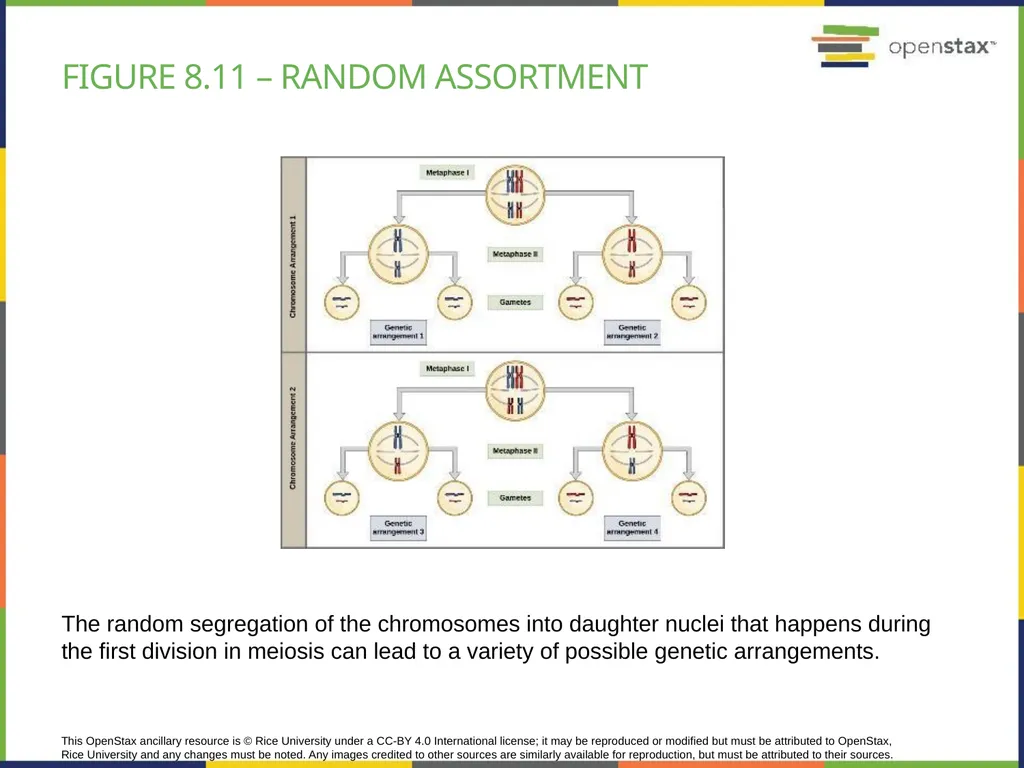
Cellular basis explanation for this law is the random assortment of the chromosomes in metaphase-I.<br>
Can be shown by a dihybrid crosses.
Dependency means: one allele depends on the other allele when segregates forming gametes.
Example: if Y allele depends on R then the parent YyRr will only have YR & yr gametes
Independency means: one allele do not depend on any other allele, so they just combine randomly, and all possible combinations are possible.
Example: for YyRr parent the gametes are YR, Yr, yR, yr (like you have seen in the dihybrid Punnett square)
Cellular basis explanation for this law is the random assortment of the chromosomes in metaphase-I.<br>
22
This OpenStax ancillary resource is © Rice University under a CC-BY 4.0 International license; it may be reproduced or modified but must be attributed to OpenStax, Rice University and any changes must be noted. Any images credited to other sources are similarly available for reproduction, but must be attributed to their sources. The random segregation of the chromosomes into daughter nuclei that happens during the first division in meiosis can lead to a variety of possible genetic arrangements. Figure 8.11 – random assortment<br>
23
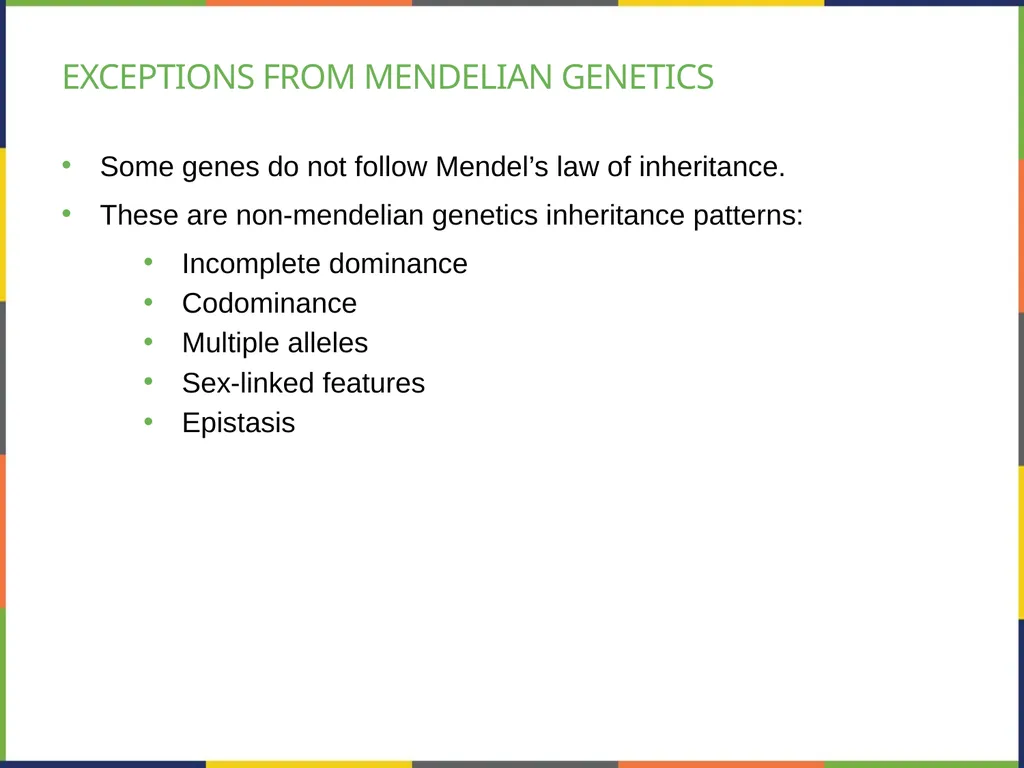
Exceptions from mendelian genetics Some genes do not follow Mendel’s law of inheritance.
These are non-mendelian genetics inheritance patterns:
Incomplete dominance
Codominance
Multiple alleles
Sex-linked features
Epistasis<br>
These are non-mendelian genetics inheritance patterns:
Incomplete dominance
Codominance
Multiple alleles
Sex-linked features
Epistasis<br>
24
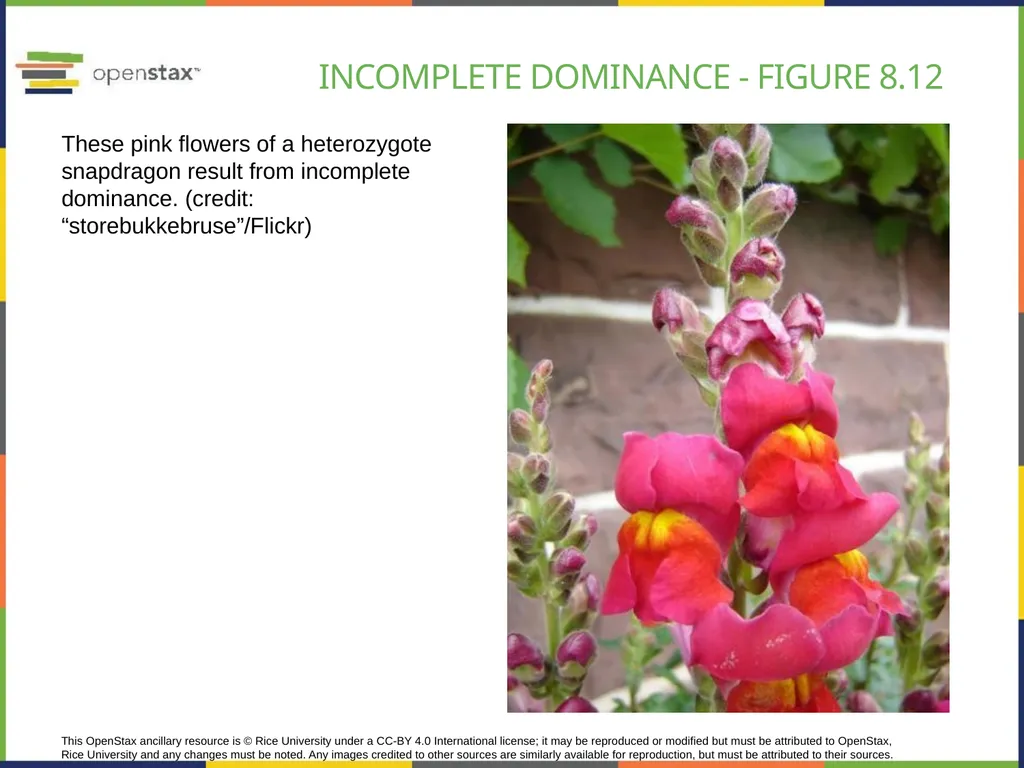
This OpenStax ancillary resource is © Rice University under a CC-BY 4.0 International license; it may be reproduced or modified but must be attributed to OpenStax, Rice University and any changes must be noted. Any images credited to other sources are similarly available for reproduction, but must be attributed to their sources. These pink flowers of a heterozygote snapdragon result from incomplete dominance. (credit: “storebukkebruse”/Flickr) Incomplete dominance - Figure 8.12<br>
25
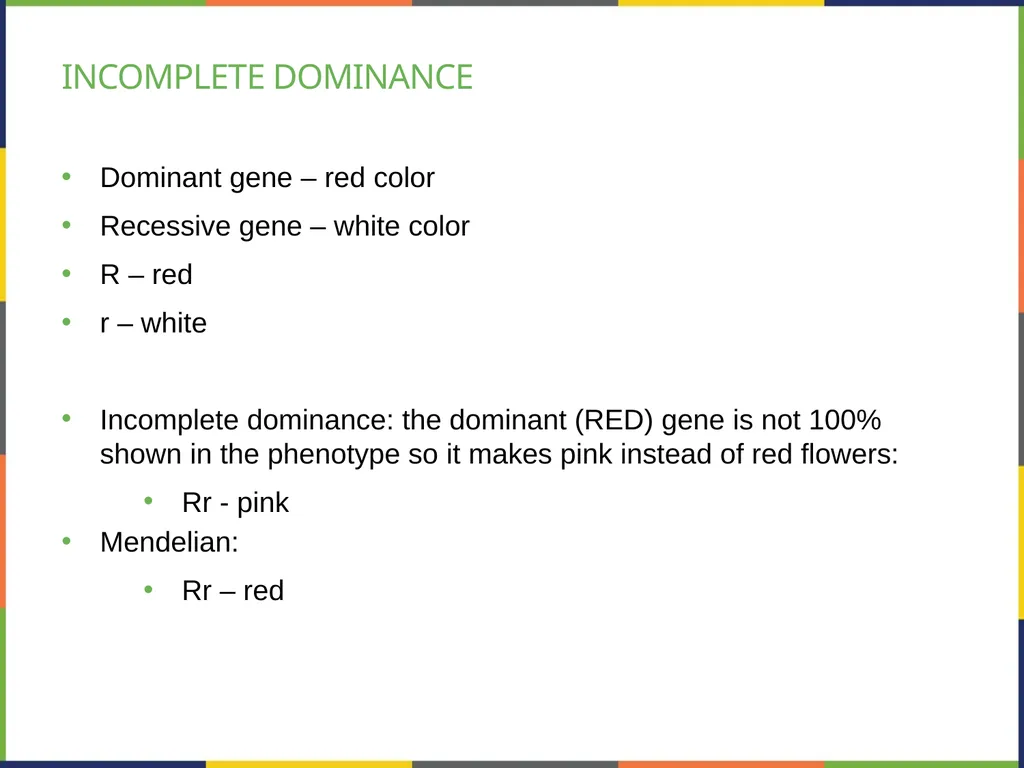
Incomplete dominance Dominant gene – red color
Recessive gene – white color
R – red
r – white
Incomplete dominance: the dominant (RED) gene is not 100% shown in the phenotype so it makes pink instead of red flowers:
Rr - pink
Mendelian:
Rr – red<br>
Recessive gene – white color
R – red
r – white
Incomplete dominance: the dominant (RED) gene is not 100% shown in the phenotype so it makes pink instead of red flowers:
Rr - pink
Mendelian:
Rr – red<br>
26
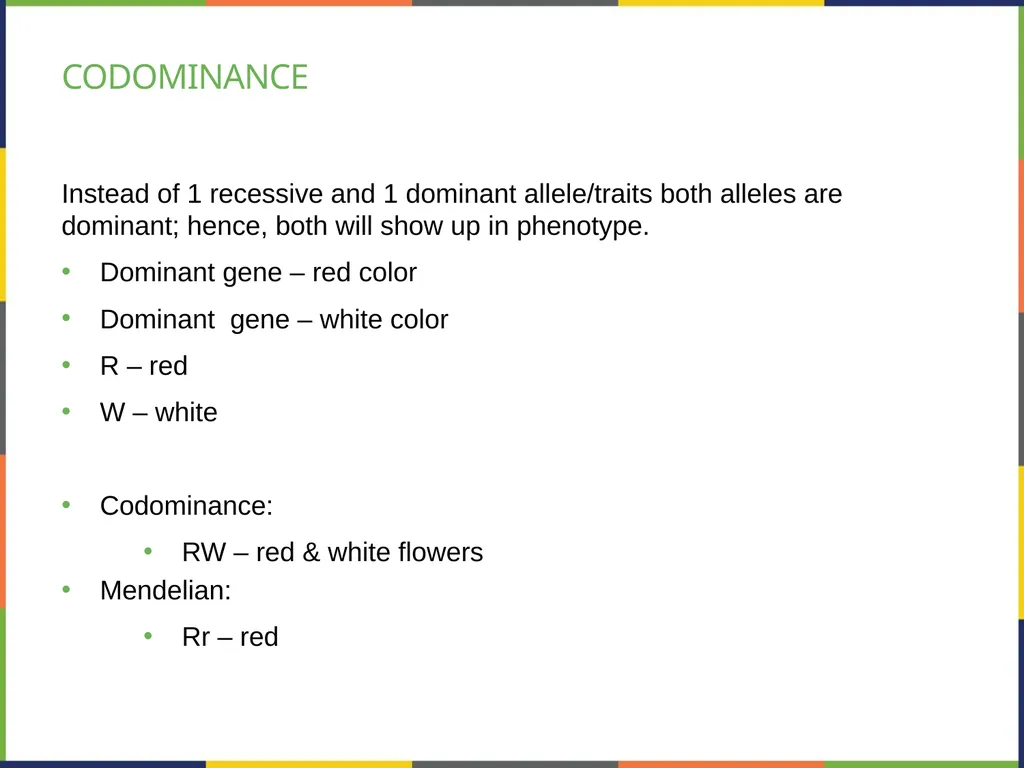
Codominance Instead of 1 recessive and 1 dominant allele/traits both alleles are dominant; hence, both will show up in phenotype.
Dominant gene – red color
Dominant gene – white color
R – red
W – white
Codominance:
RW – red & white flowers
Mendelian:
Rr – red<br>
Dominant gene – red color
Dominant gene – white color
R – red
W – white
Codominance:
RW – red & white flowers
Mendelian:
Rr – red<br>
27
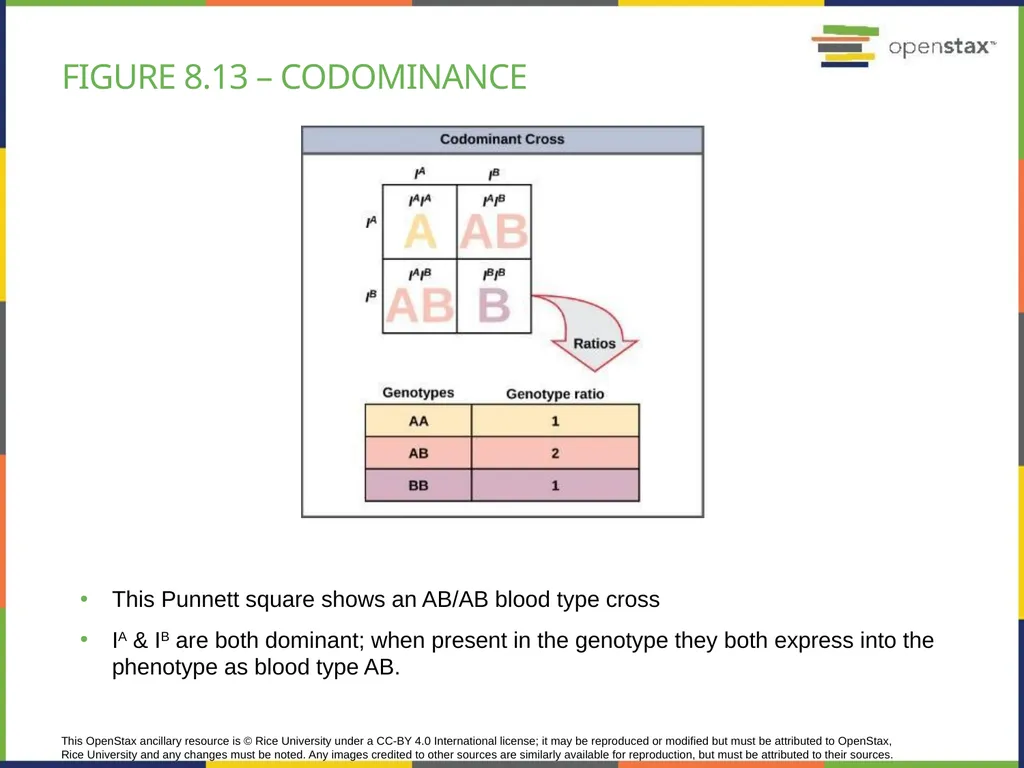
This OpenStax ancillary resource is © Rice University under a CC-BY 4.0 International license; it may be reproduced or modified but must be attributed to OpenStax, Rice University and any changes must be noted. Any images credited to other sources are similarly available for reproduction, but must be attributed to their sources. This Punnett square shows an AB/AB blood type cross
IA & IB are both dominant; when present in the genotype they both express into the phenotype as blood type AB. Figure 8.13 – codominance<br>
IA & IB are both dominant; when present in the genotype they both express into the phenotype as blood type AB. Figure 8.13 – codominance<br>
28
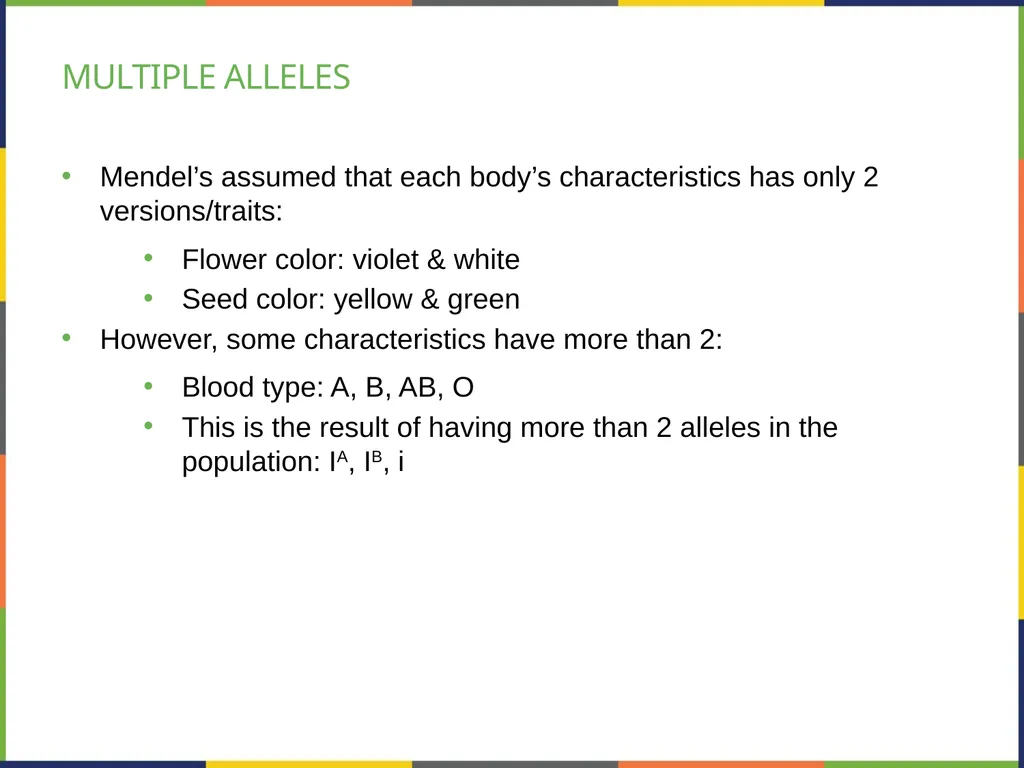
Multiple alleles Mendel’s assumed that each body’s characteristics has only 2 versions/traits:
Flower color: violet & white
Seed color: yellow & green
However, some characteristics have more than 2:
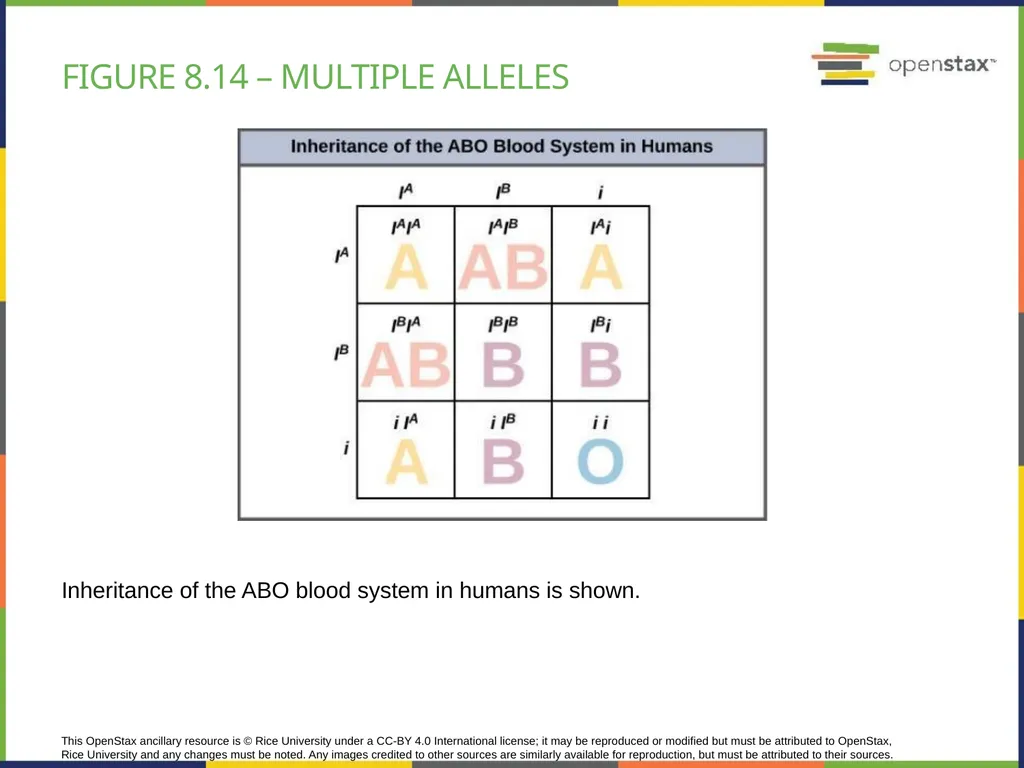
Blood type: A, B, AB, O
This is the result of having more than 2 alleles in the population: IA, IB, i<br>
Flower color: violet & white
Seed color: yellow & green
However, some characteristics have more than 2:
Blood type: A, B, AB, O
This is the result of having more than 2 alleles in the population: IA, IB, i<br>
29
This OpenStax ancillary resource is © Rice University under a CC-BY 4.0 International license; it may be reproduced or modified but must be attributed to OpenStax, Rice University and any changes must be noted. Any images credited to other sources are similarly available for reproduction, but must be attributed to their sources. Inheritance of the ABO blood system in humans is shown. Figure 8.14 – multiple alleles<br>
30
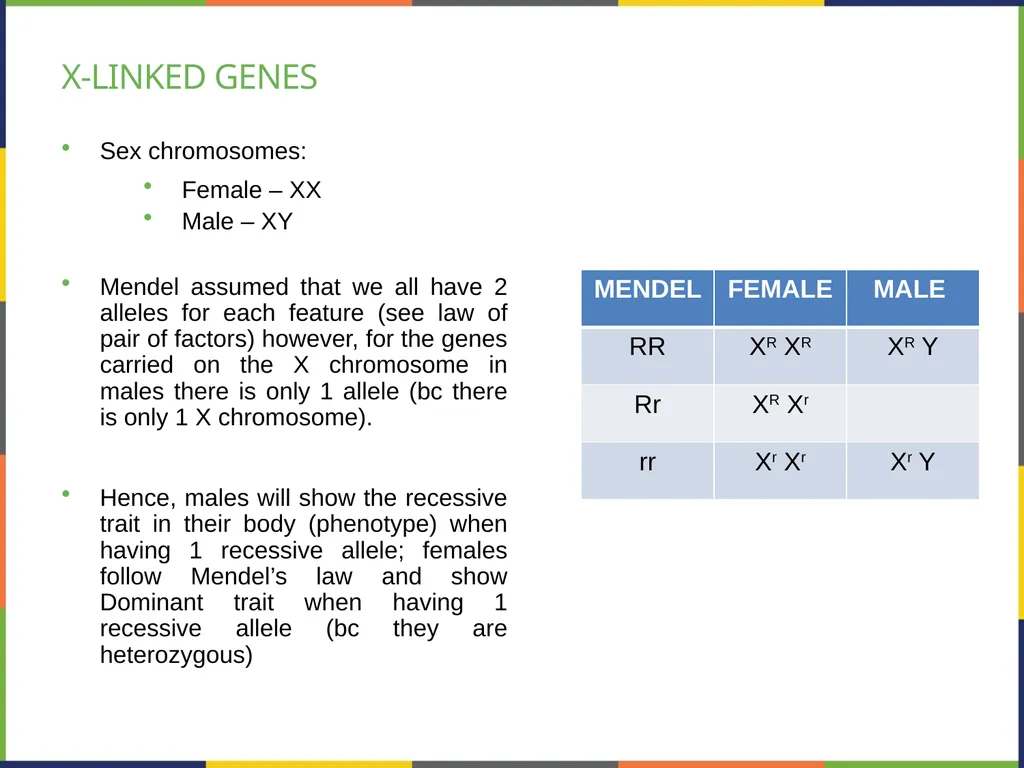
X-linked genes Sex chromosomes:
Female – XX
Male – XY
Mendel assumed that we all have 2 alleles for each feature (see law of pair of factors) however, for the genes carried on the X chromosome in males there is only 1 allele (bc there is only 1 X chromosome).
Hence, males will show the recessive trait in their body (phenotype) when having 1 recessive allele; females follow Mendel’s law and show Dominant trait when having 1 recessive allele (bc they are heterozygous)<br>
Female – XX
Male – XY
Mendel assumed that we all have 2 alleles for each feature (see law of pair of factors) however, for the genes carried on the X chromosome in males there is only 1 allele (bc there is only 1 X chromosome).
Hence, males will show the recessive trait in their body (phenotype) when having 1 recessive allele; females follow Mendel’s law and show Dominant trait when having 1 recessive allele (bc they are heterozygous)<br>
31
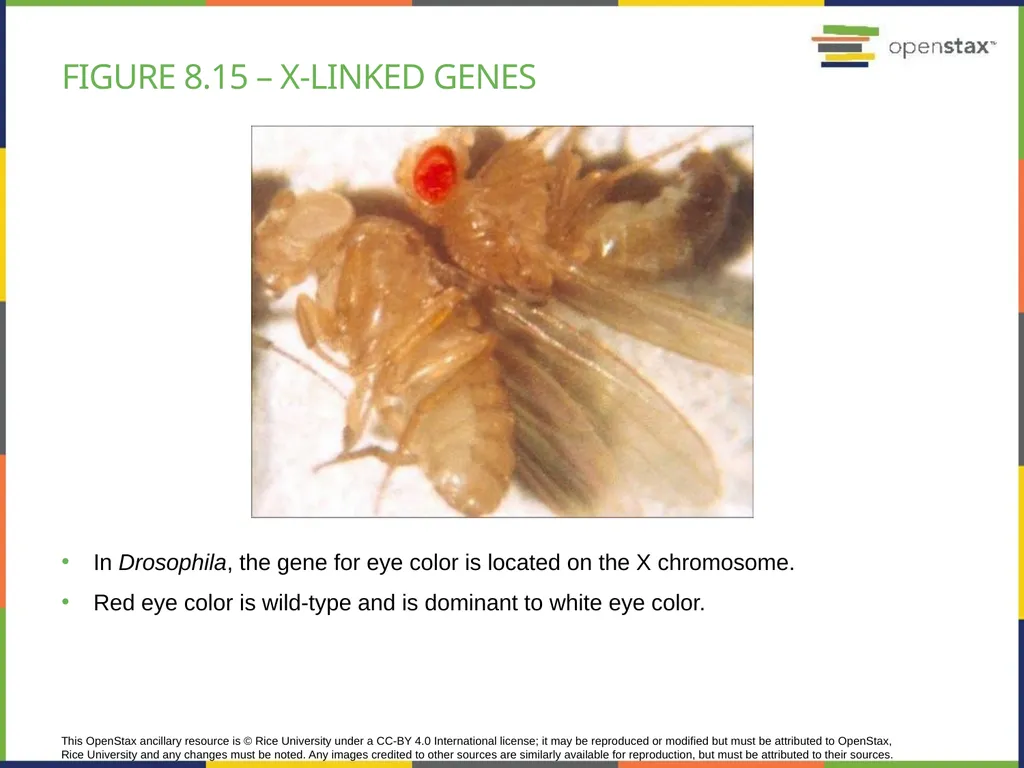
This OpenStax ancillary resource is © Rice University under a CC-BY 4.0 International license; it may be reproduced or modified but must be attributed to OpenStax, Rice University and any changes must be noted. Any images credited to other sources are similarly available for reproduction, but must be attributed to their sources. In Drosophila, the gene for eye color is located on the X chromosome.
Red eye color is wild-type and is dominant to white eye color. Figure 8.15 – x-linked genes<br>
Red eye color is wild-type and is dominant to white eye color. Figure 8.15 – x-linked genes<br>
32
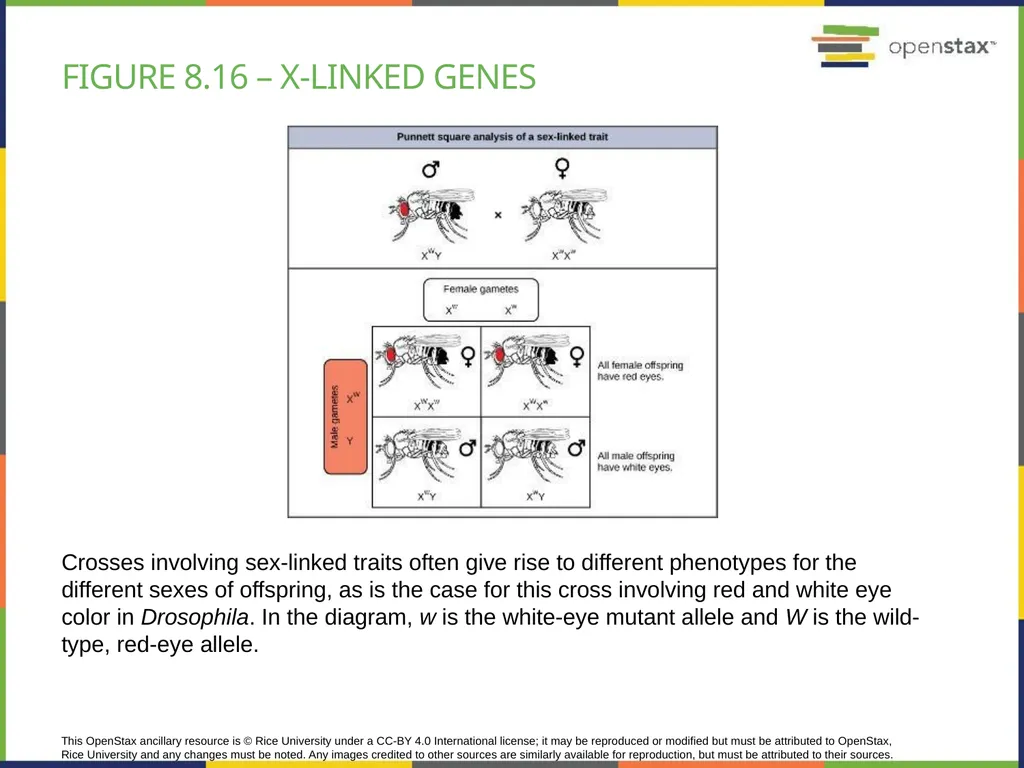
This OpenStax ancillary resource is © Rice University under a CC-BY 4.0 International license; it may be reproduced or modified but must be attributed to OpenStax, Rice University and any changes must be noted. Any images credited to other sources are similarly available for reproduction, but must be attributed to their sources. Crosses involving sex-linked traits often give rise to different phenotypes for the different sexes of offspring, as is the case for this cross involving red and white eye color in Drosophila. In the diagram, w is the white-eye mutant allele and W is the wild-type, red-eye allele. Figure 8.16 – x-linked genes<br>
33
Epistasis One gene masks/ suppresses another gene.
C – black fur dominant
A – not a gene for fur color but is controlling the genes for fur color
Phenotypes:
aaCc – black fur coat
AaCc – brown fur color (here dominant A gene is present and suppresses dominant C gene for black color resulting in a brown color instead).
Aacc – white fur color<br>
C – black fur dominant
A – not a gene for fur color but is controlling the genes for fur color
Phenotypes:
aaCc – black fur coat
AaCc – brown fur color (here dominant A gene is present and suppresses dominant C gene for black color resulting in a brown color instead).
Aacc – white fur color<br>
34
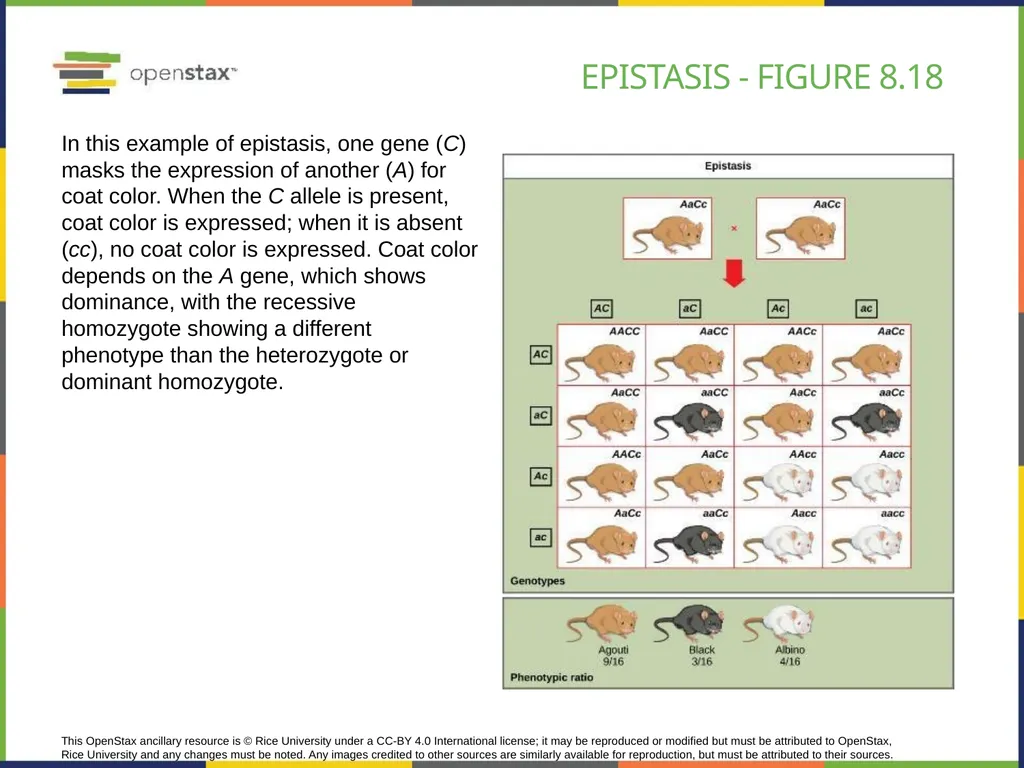
This OpenStax ancillary resource is © Rice University under a CC-BY 4.0 International license; it may be reproduced or modified but must be attributed to OpenStax, Rice University and any changes must be noted. Any images credited to other sources are similarly available for reproduction, but must be attributed to their sources. In this example of epistasis, one gene (C) masks the expression of another (A) for coat color. When the C allele is present, coat color is expressed; when it is absent (cc), no coat color is expressed. Coat color depends on the A gene, which shows dominance, with the recessive homozygote showing a different phenotype than the heterozygote or dominant homozygote. Epistasis - Figure 8.18<br>
35
The end<br>
36
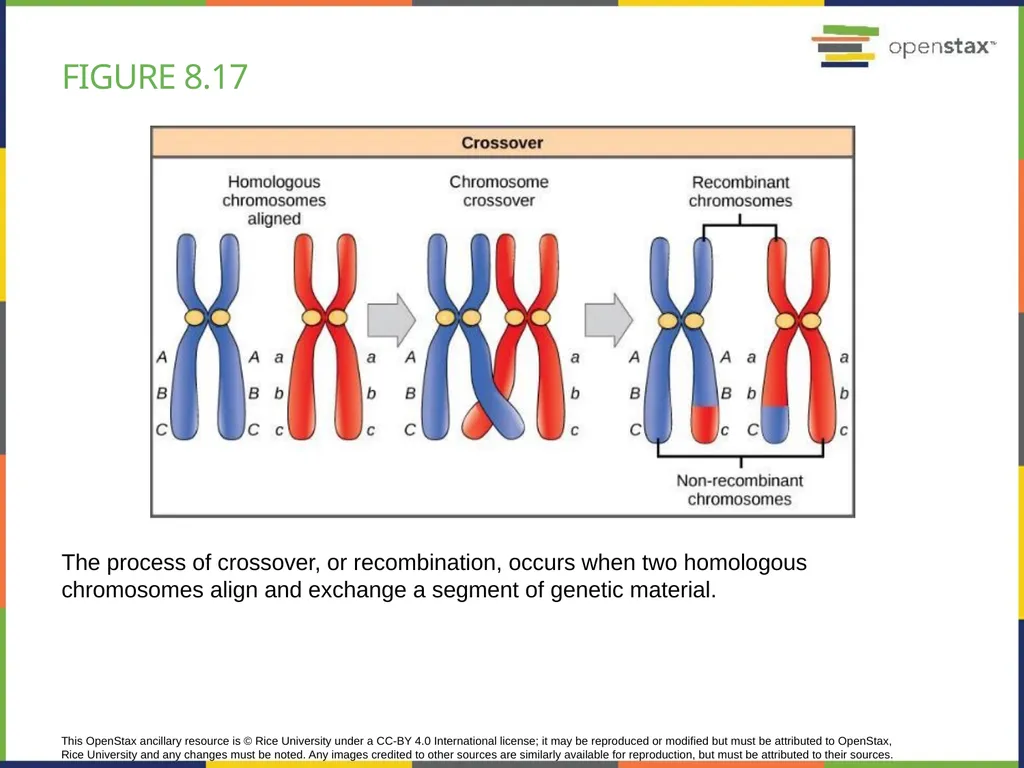
This OpenStax ancillary resource is © Rice University under a CC-BY 4.0 International license; it may be reproduced or modified but must be attributed to OpenStax, Rice University and any changes must be noted. Any images credited to other sources are similarly available for reproduction, but must be attributed to their sources. The process of crossover, or recombination, occurs when two homologous chromosomes align and exchange a segment of genetic material. Figure 8.17<br>