Chapter 9 Managerial Decision Making Types of Decisions and Problems 2 Decision making is the process of identifying opportunities Decision is a choice made from available alternatives Programmed and Nonprogrammed Decisions Programmed
"Chapter 9 Managerial Decision Making Types of" is the property of its rightful owner. Permission is granted to
download and print the materials on this website for personal, non-commercial use only, and to display it
on your personal computer provided you do not modify the materials and that you retain all copyright
notices contained in the materials. By downloading content from our website, you accept the terms of this
agreement.
Presentation Transcript
01
Chapter 9 Managerial Decision Making<br>
02
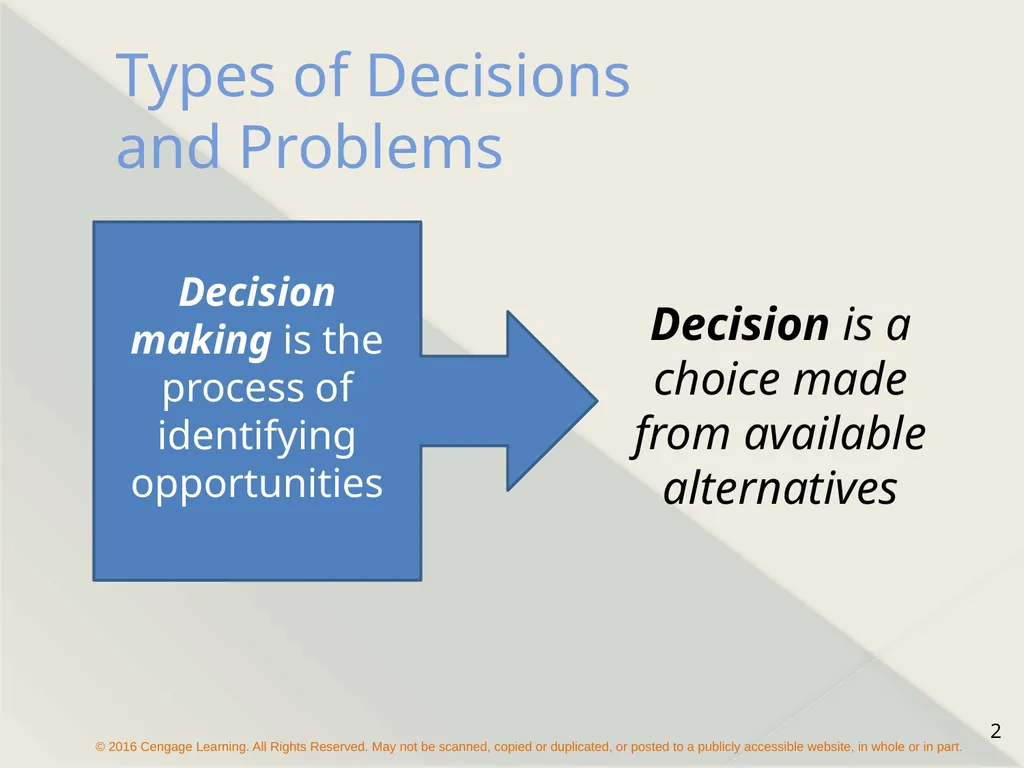
Types of Decisions and Problems 2 Decision making is the process of identifying opportunities Decision is a choice made from available alternatives<br>
03
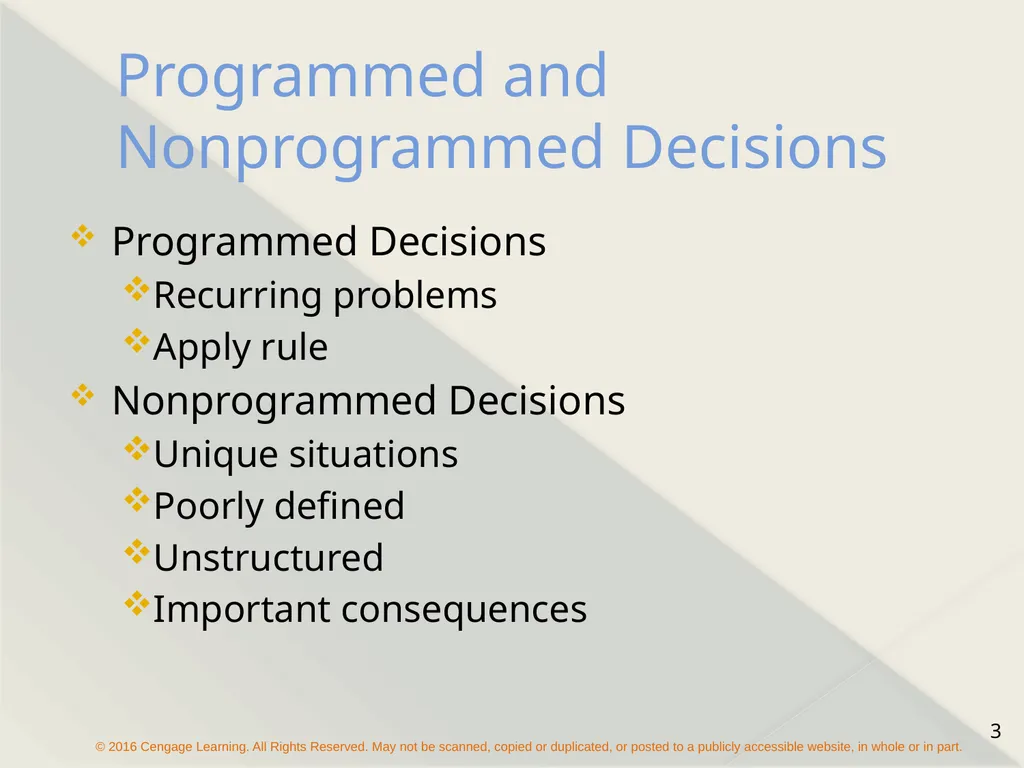
Programmed and Nonprogrammed Decisions Programmed Decisions
Recurring problems
Apply rule
Nonprogrammed Decisions
Unique situations
Poorly defined
Unstructured
Important consequences 3<br>
04
Facing Certainty and Uncertainty Difference between programmed and unprogrammed decisions
Certainty – Situation in which all information is fully available
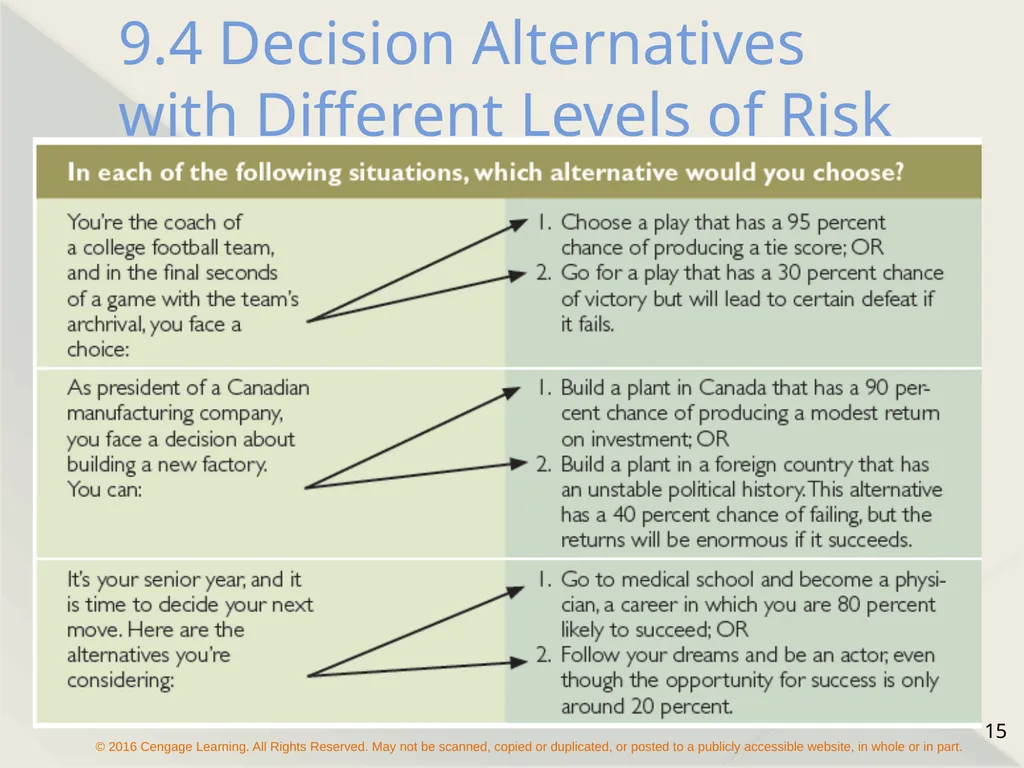
Risk – Future outcomes associated with an alternative are subject to chance
Uncertainty - Depends on the amount and value of information available 4<br>
05
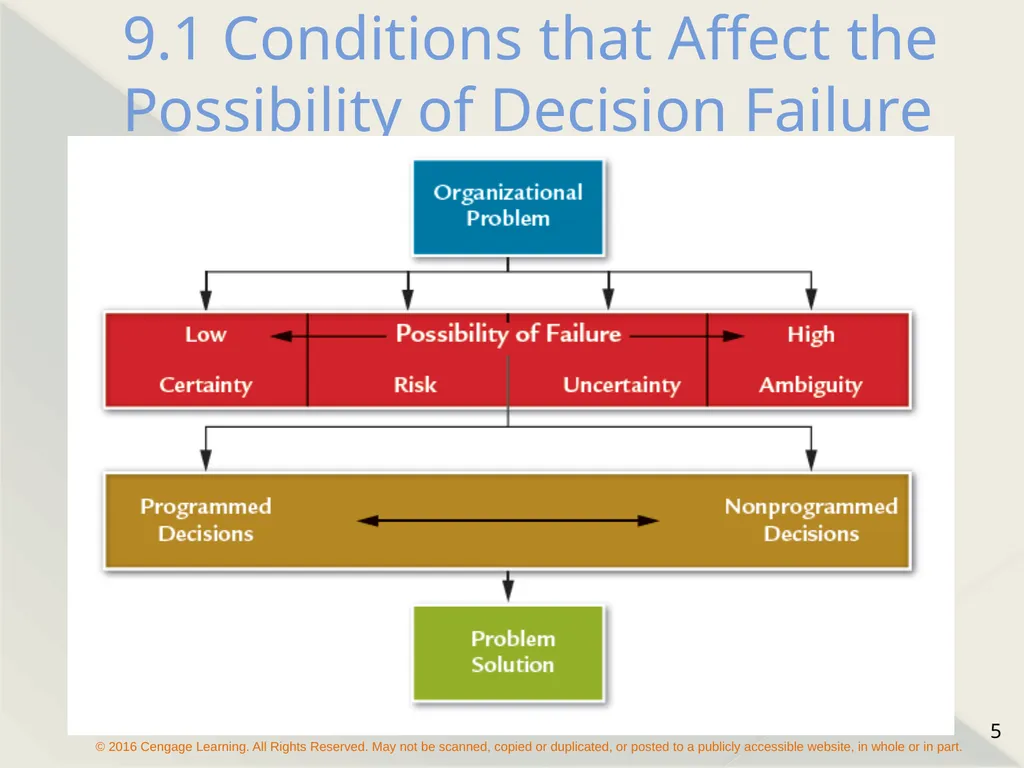
9.1 Conditions that Affect the Possibility of Decision Failure 5<br>
06
Ambiguity and Conflict Ambiguity - Making decisions in difficult situations
The goals and the problem are unclear
Wicked decisions involve conflict over goals and have changing circumstances, fuzzy information, and unclear links
There is often no “right” answer 6<br>
07
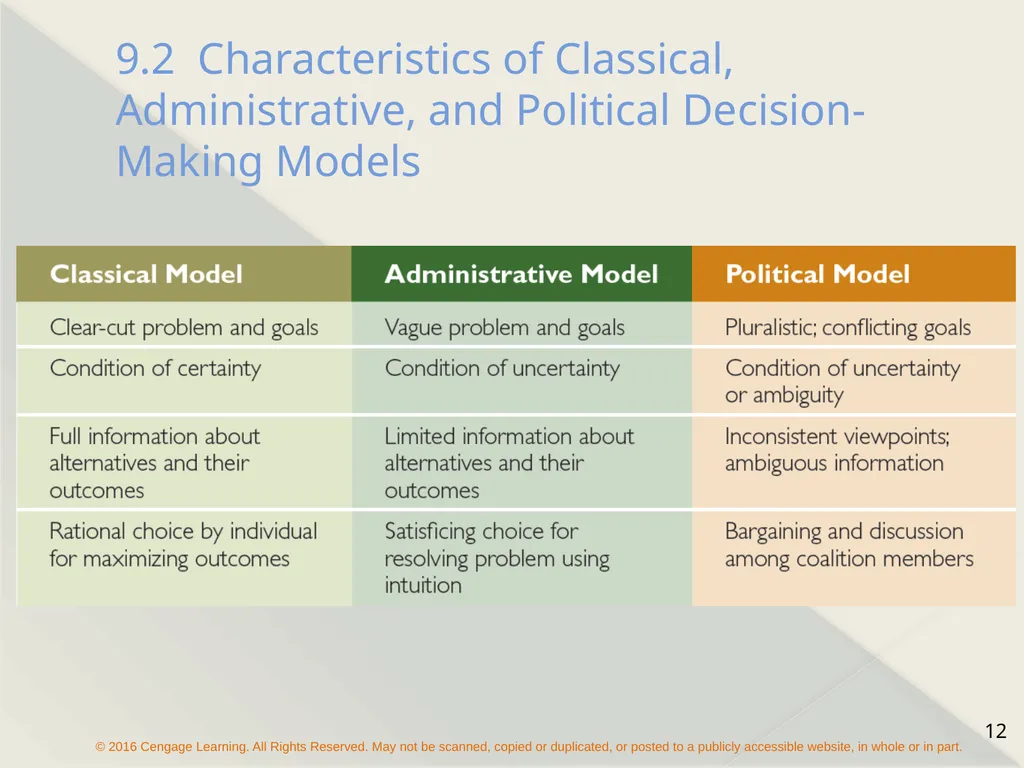
The Ideal, Rational Model Rational economic assumptions drive decisions
Operates to accomplish established goals, problem is defined
Decision maker strives for information and certainty, alternatives evaluated
Criteria for evaluating alternatives is known; select alternative with maximum benefit
Decision maker is rationale and uses logic
Normative─ how a decision maker should make a decision 7<br>
08
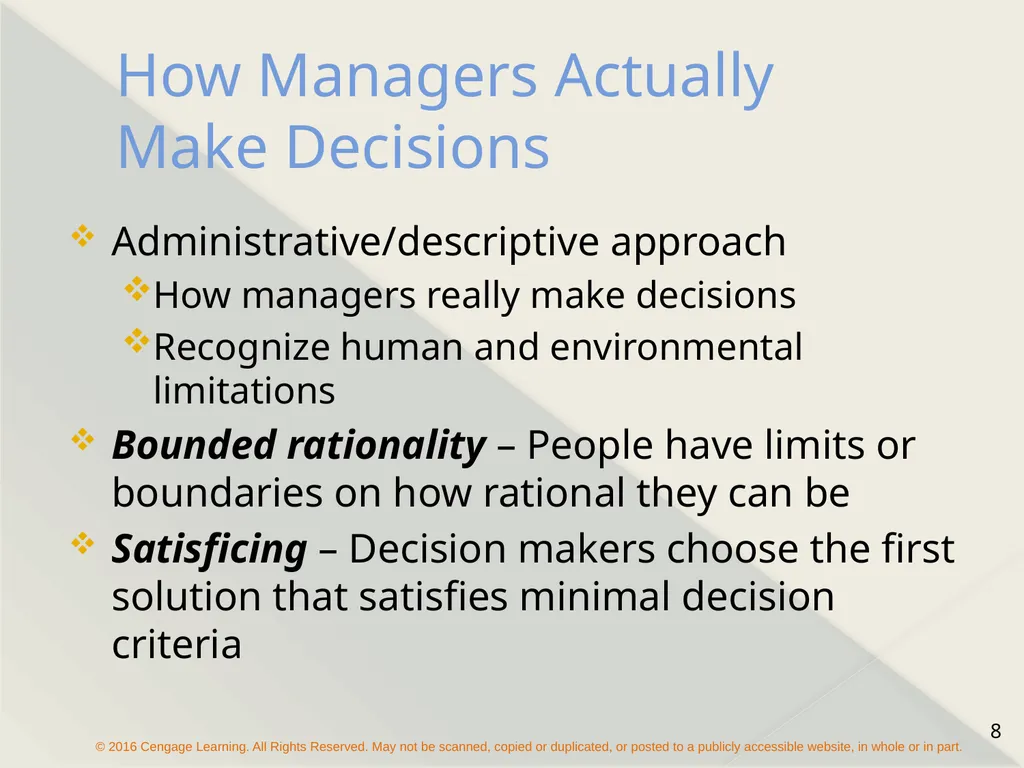
How Managers Actually Make Decisions Administrative/descriptive approach
How managers really make decisions
Recognize human and environmental limitations
Bounded rationality – People have limits or boundaries on how rational they can be
Satisficing – Decision makers choose the first solution that satisfies minimal decision criteria 8<br>
09
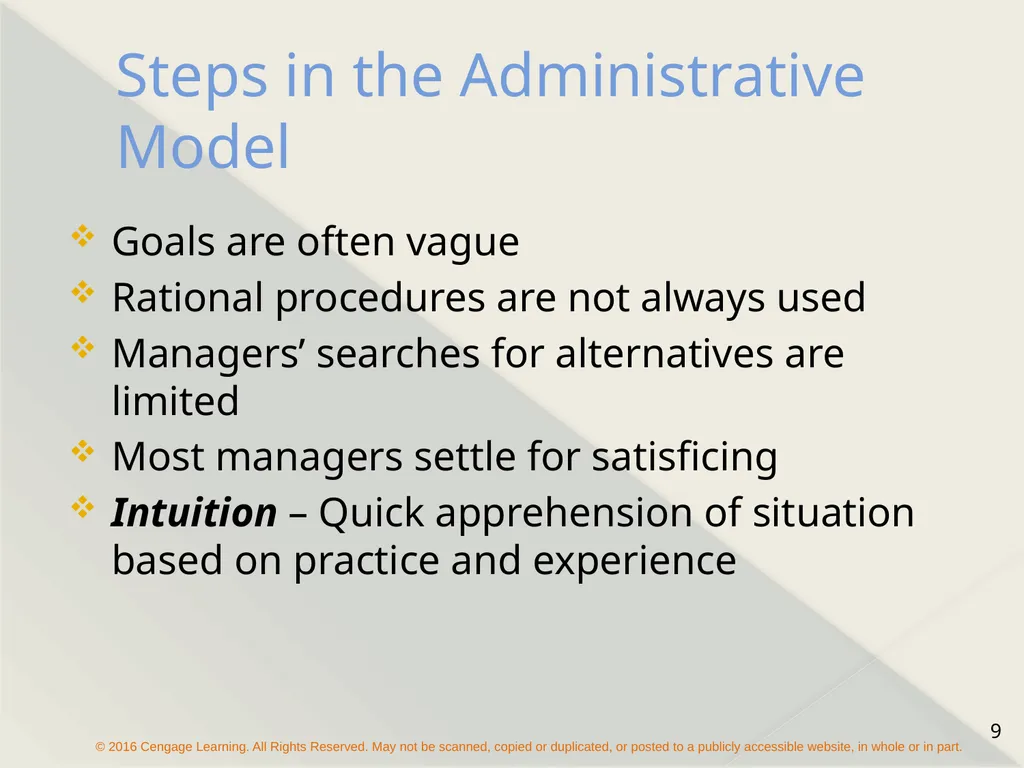
Steps in the Administrative Model Goals are often vague
Rational procedures are not always used
Managers’ searches for alternatives are limited
Most managers settle for satisficing
Intuition – Quick apprehension of situation based on practice and experience 9<br>
10
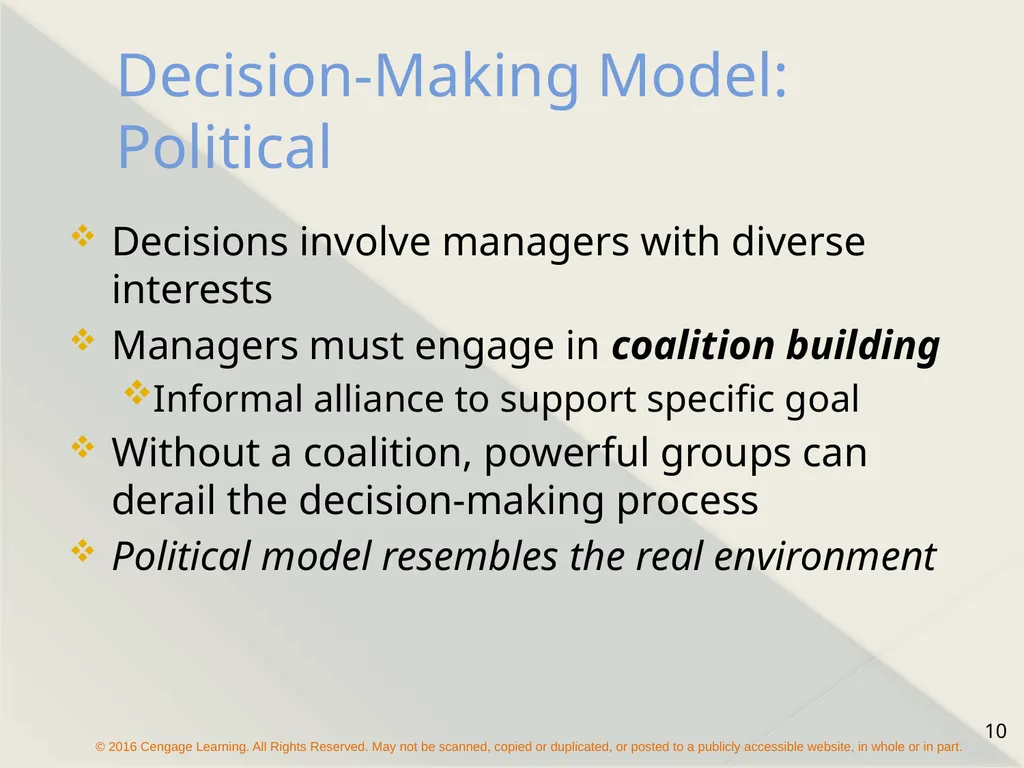
Decision-Making Model: Political Decisions involve managers with diverse interests
Managers must engage in coalition building
Informal alliance to support specific goal
Without a coalition, powerful groups can derail the decision-making process
Political model resembles the real environment 10<br>
11
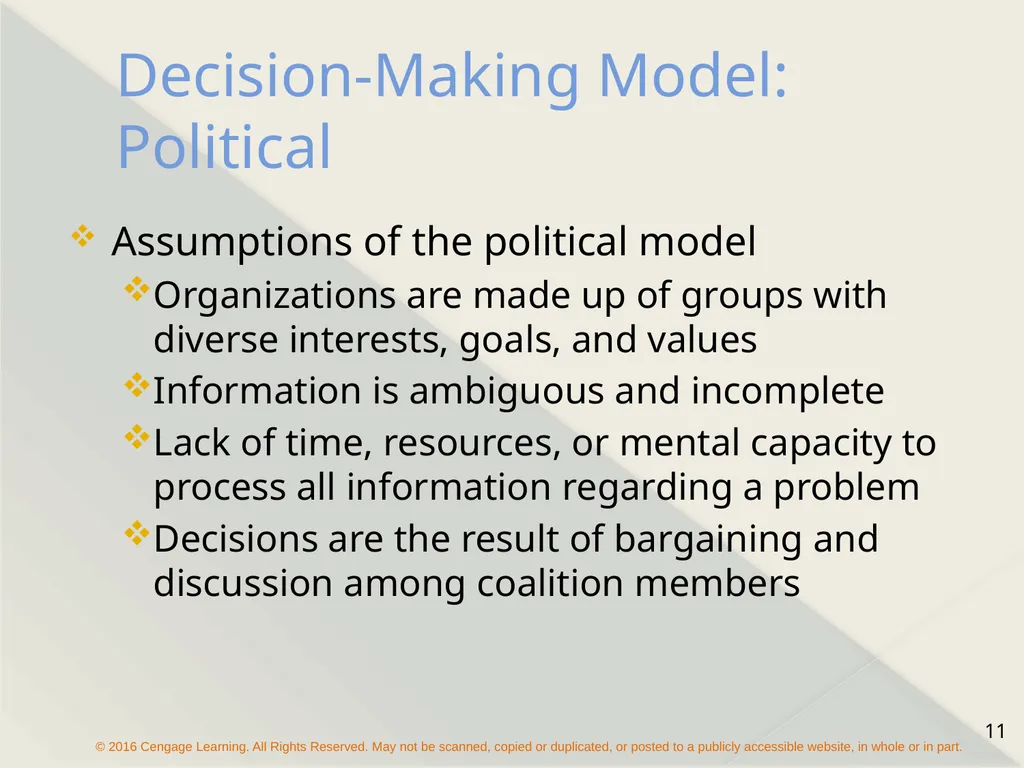
Decision-Making Model: Political Assumptions of the political model
Organizations are made up of groups with diverse interests, goals, and values
Information is ambiguous and incomplete
Lack of time, resources, or mental capacity to process all information regarding a problem
Decisions are the result of bargaining and discussion among coalition members 11<br>
12
9.2 Characteristics of Classical, Administrative, and Political Decision-Making Models 12<br>
13
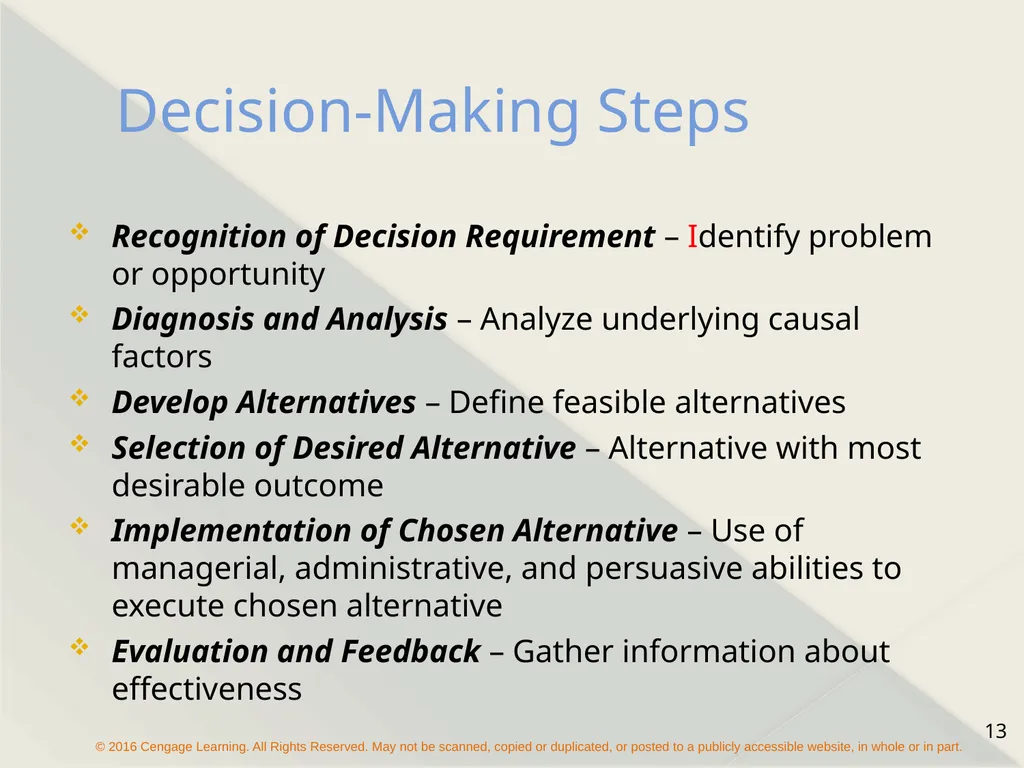
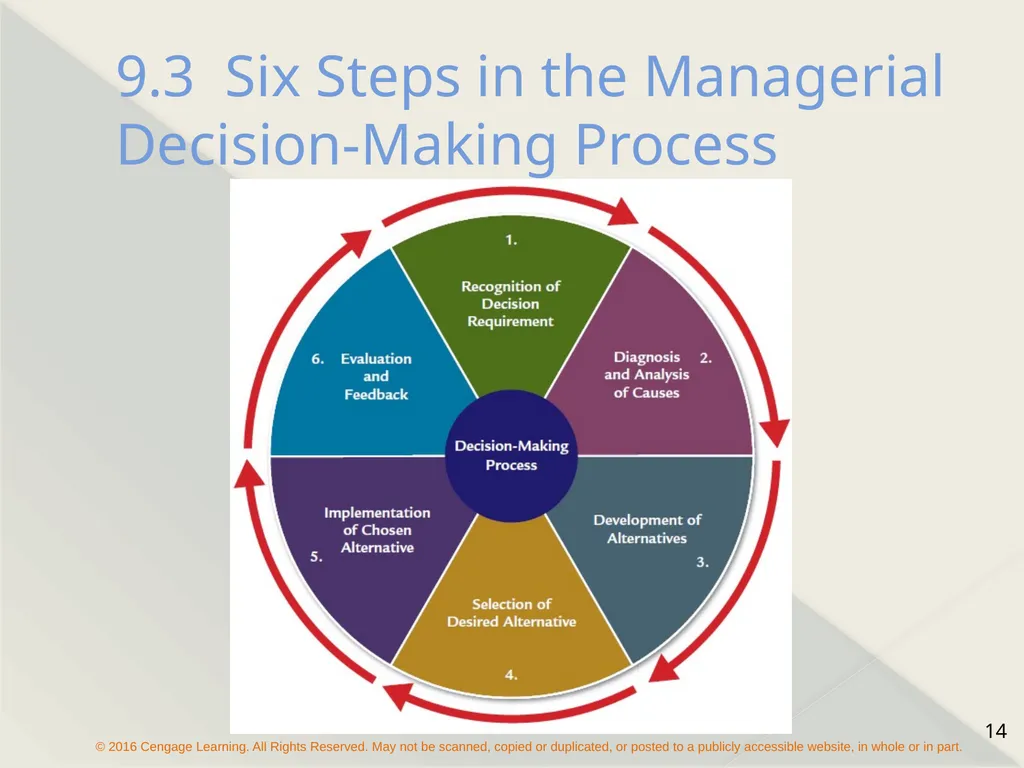
Decision-Making Steps Recognition of Decision Requirement – Identify problem or opportunity
Diagnosis and Analysis – Analyze underlying causal factors
Develop Alternatives – Define feasible alternatives
Selection of Desired Alternative – Alternative with most desirable outcome
Implementation of Chosen Alternative – Use of managerial, administrative, and persuasive abilities to execute chosen alternative
Evaluation and Feedback – Gather information about effectiveness 13<br>
14
9.3 Six Steps in the Managerial Decision-Making Process 14<br>
15
9.4 Decision Alternatives with Different Levels of Risk 15<br>
16
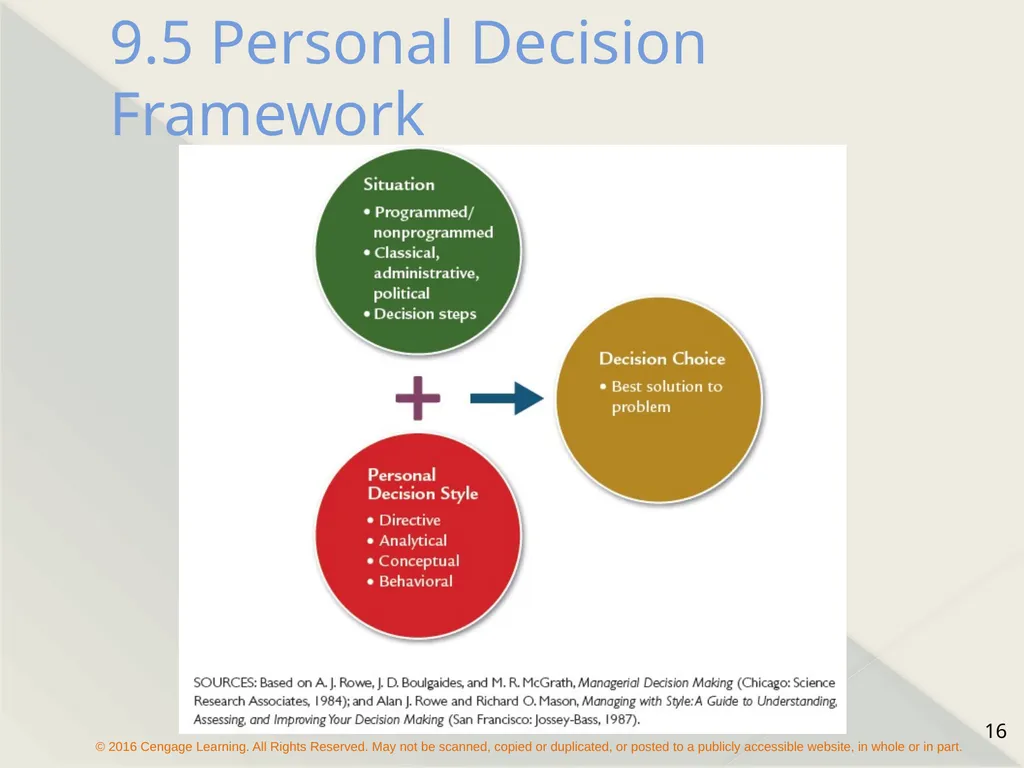
9.5 Personal Decision Framework 16<br>
17
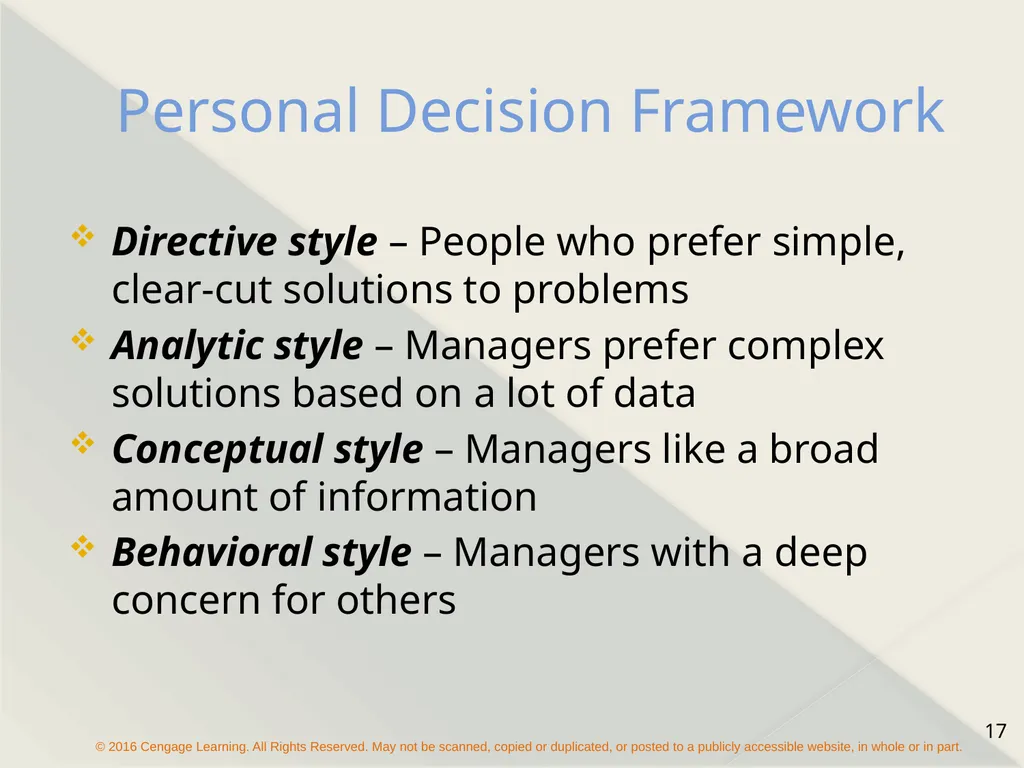
Personal Decision Framework Directive style – People who prefer simple, clear-cut solutions to problems
Analytic style – Managers prefer complex solutions based on a lot of data
Conceptual style – Managers like a broad amount of information
Behavioral style – Managers with a deep concern for others 17<br>
18
Why Do Managers Make Bad Decisions? Being influenced by initial impressions
Justifying past decisions
Seeing what you want to see
Perpetuating the status quo
Being influenced by problem framing
Overconfidence 18<br>
19
Innovative Decision Making Mechanisms to help reduce bias-related decision errors:
Start with brainstorming
Use hard evidence
Engage in rigorous debate
Avoid groupthink
Know when to bail
Do a postmortem 19<br>