
Child Development Revision Guide CNAT OCR TA2
PC
Published · 63 slides · 0 views
1 / 1



Description
Child Development Revision Guide CNAT OCR TA2 Topic Area 2: Antenatal care and preparation for birth Name: Introduction Welcome to your TA2 Child Development Revision Booklet! This booklet is designed to be your comprehensive guide to
Related Topics
Share
Embed code
Download this presentation From Below
"Child Development Revision Guide CNAT OCR TA2" is the property of its rightful owner. Permission is granted to download and print the materials on this website for personal, non-commercial use only, and to display it on your personal computer provided you do not modify the materials and that you retain all copyright notices contained in the materials. By downloading content from our website, you accept the terms of this agreement.
Presentation Transcript
01
Child Development Revision Guide
CNAT OCR
TA2
Topic Area 2: Antenatal care and preparation for birth Name:<br>
02
Introduction Welcome to your TA2 Child Development Revision Booklet! This booklet is designed to be your comprehensive guide to preparing for the OCR Child Development TA1 exam. Inside, you'll find everything you need to confidently tackle the assessment.
To help you organise your revision, we've included helpful checklists to break down the information into manageable chunks. Each section of the TA2 specification is covered, providing a clear and concise overview of the key concepts. We've also included QR codes throughout the booklet that link to helpful websites, offering supplementary information and different perspectives on the topics.
To really get you thinking and applying your knowledge, each section concludes with activities designed to address common misconceptions and challenge your understanding. You'll also find practice exam questions, complete with model answers, to give you a feel for the exam format and the level of detail required.
Finally, a comprehensive glossary of key terms is provided at the back of the booklet.
Don't forget to check the very back for a complete answer section for all the activities.
Good luck with your revision!<br>
To help you organise your revision, we've included helpful checklists to break down the information into manageable chunks. Each section of the TA2 specification is covered, providing a clear and concise overview of the key concepts. We've also included QR codes throughout the booklet that link to helpful websites, offering supplementary information and different perspectives on the topics.
To really get you thinking and applying your knowledge, each section concludes with activities designed to address common misconceptions and challenge your understanding. You'll also find practice exam questions, complete with model answers, to give you a feel for the exam format and the level of detail required.
Finally, a comprehensive glossary of key terms is provided at the back of the booklet.
Don't forget to check the very back for a complete answer section for all the activities.
Good luck with your revision!<br>
03
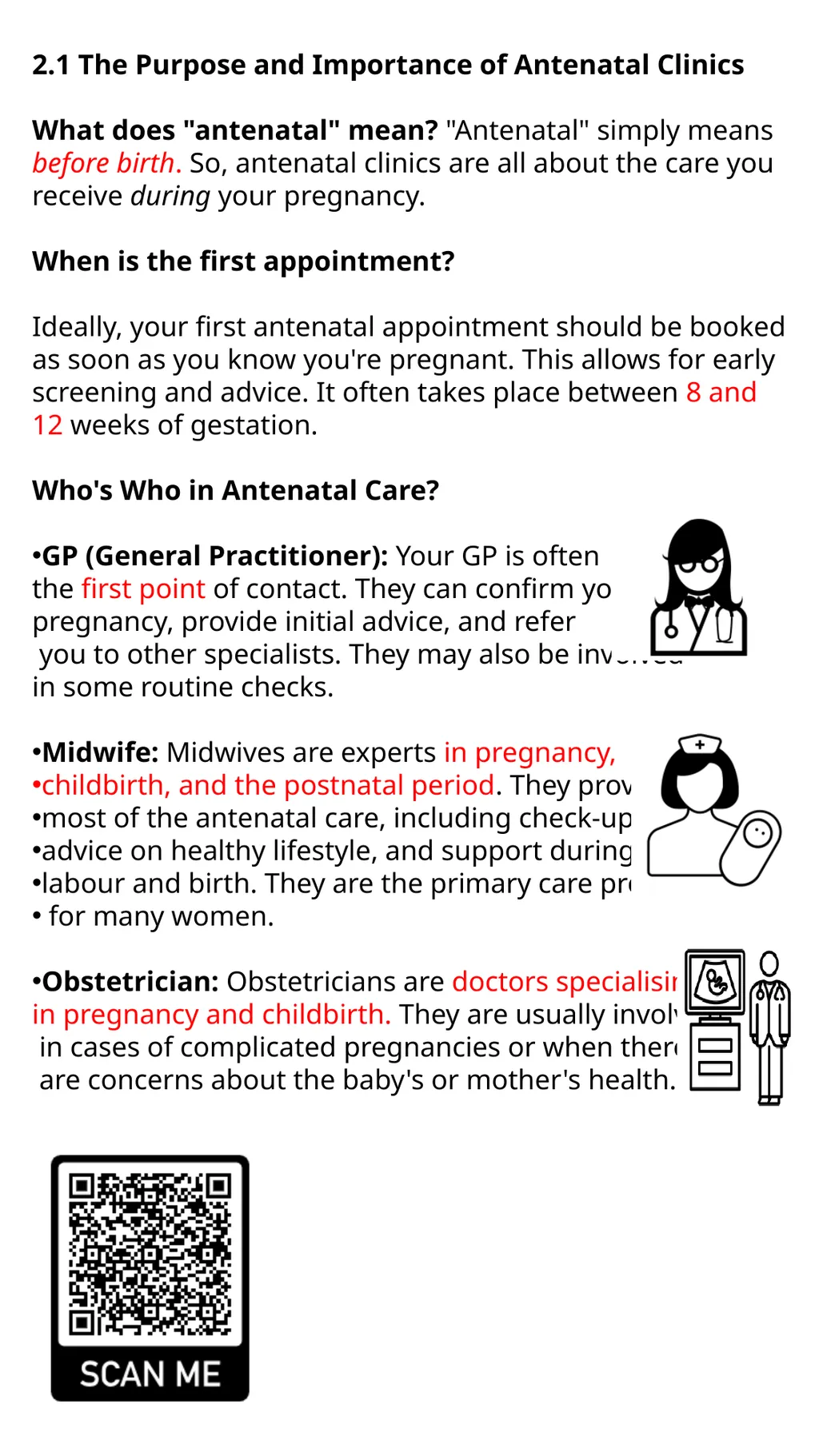
2.1 The Purpose and Importance of Antenatal Clinics
What does "antenatal" mean? "Antenatal" simply means before birth. So, antenatal clinics are all about the care you receive during your pregnancy.
When is the first appointment?
Ideally, your first antenatal appointment should be booked as soon as you know you're pregnant. This allows for early screening and advice. It often takes place between 8 and 12 weeks of gestation.
Who's Who in Antenatal Care?
GP (General Practitioner): Your GP is often
the first point of contact. They can confirm your
pregnancy, provide initial advice, and refer
you to other specialists. They may also be involved
in some routine checks.
Midwife: Midwives are experts in pregnancy,
childbirth, and the postnatal period. They provide
most of the antenatal care, including check-ups,
advice on healthy lifestyle, and support during
labour and birth. They are the primary care provider
for many women.
Obstetrician: Obstetricians are doctors specialising
in pregnancy and childbirth. They are usually involved
in cases of complicated pregnancies or when there
are concerns about the baby's or mother's health.<br>
What does "antenatal" mean? "Antenatal" simply means before birth. So, antenatal clinics are all about the care you receive during your pregnancy.
When is the first appointment?
Ideally, your first antenatal appointment should be booked as soon as you know you're pregnant. This allows for early screening and advice. It often takes place between 8 and 12 weeks of gestation.
Who's Who in Antenatal Care?
GP (General Practitioner): Your GP is often
the first point of contact. They can confirm your
pregnancy, provide initial advice, and refer
you to other specialists. They may also be involved
in some routine checks.
Midwife: Midwives are experts in pregnancy,
childbirth, and the postnatal period. They provide
most of the antenatal care, including check-ups,
advice on healthy lifestyle, and support during
labour and birth. They are the primary care provider
for many women.
Obstetrician: Obstetricians are doctors specialising
in pregnancy and childbirth. They are usually involved
in cases of complicated pregnancies or when there
are concerns about the baby's or mother's health.<br>
04
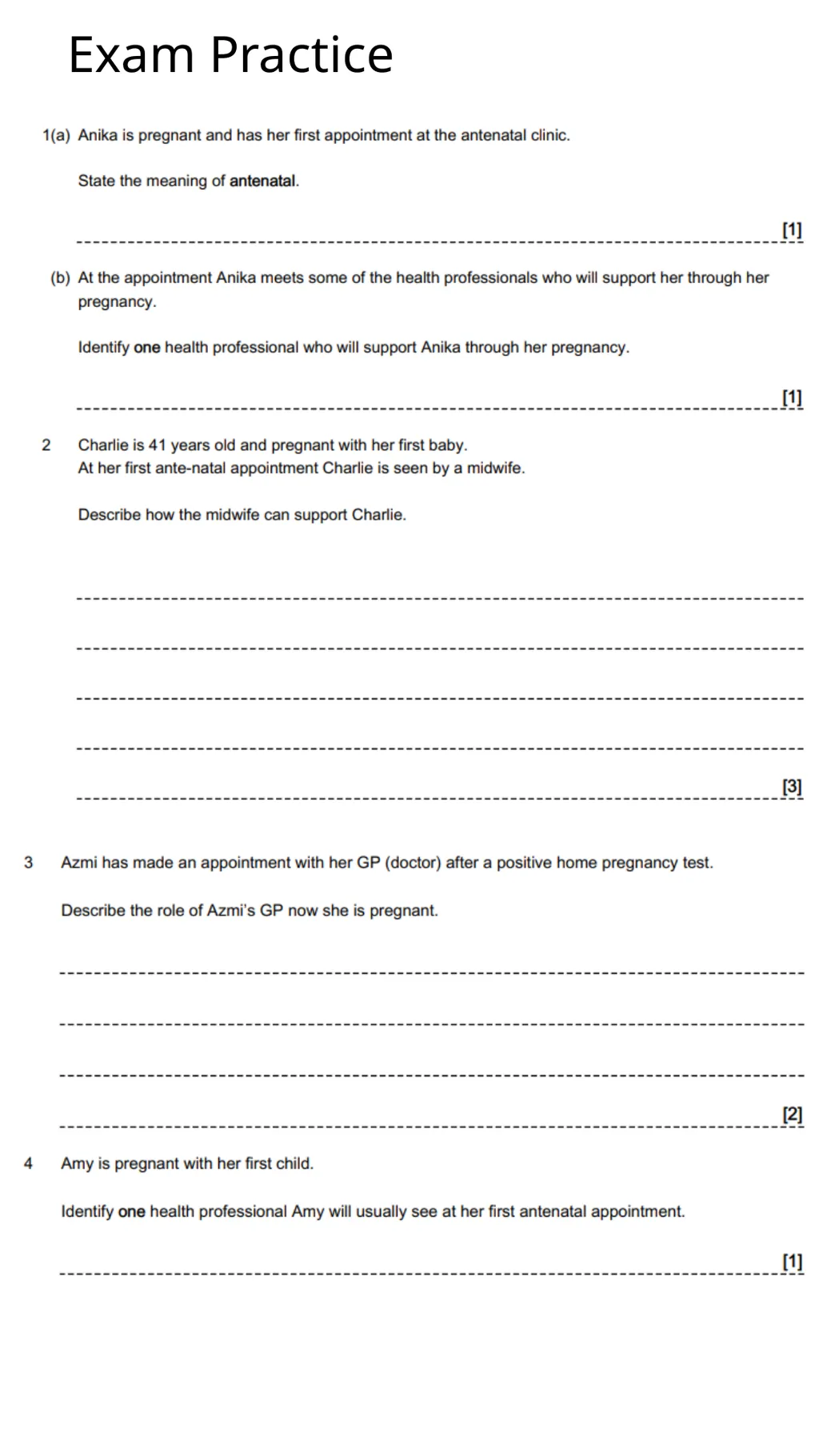
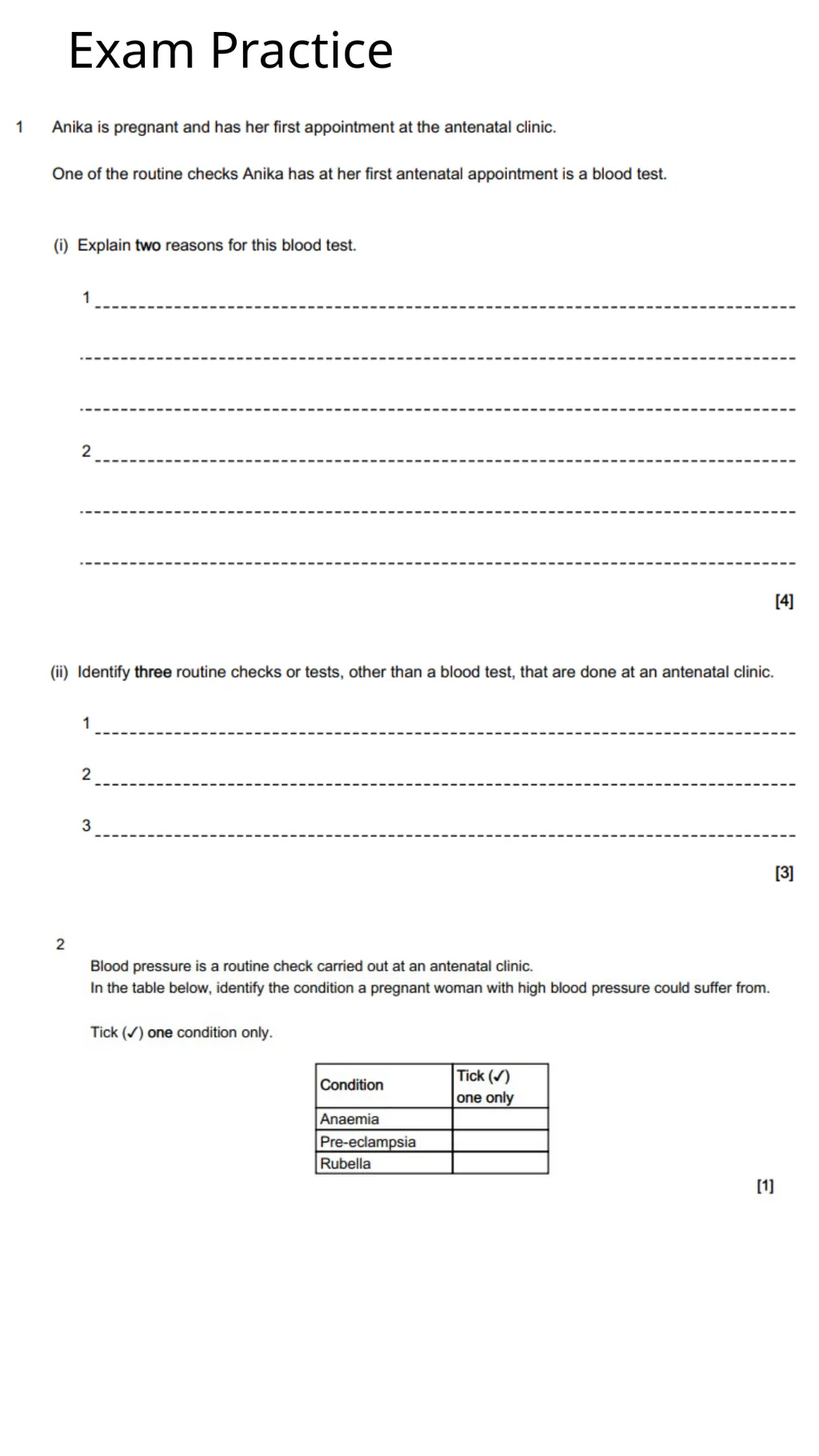
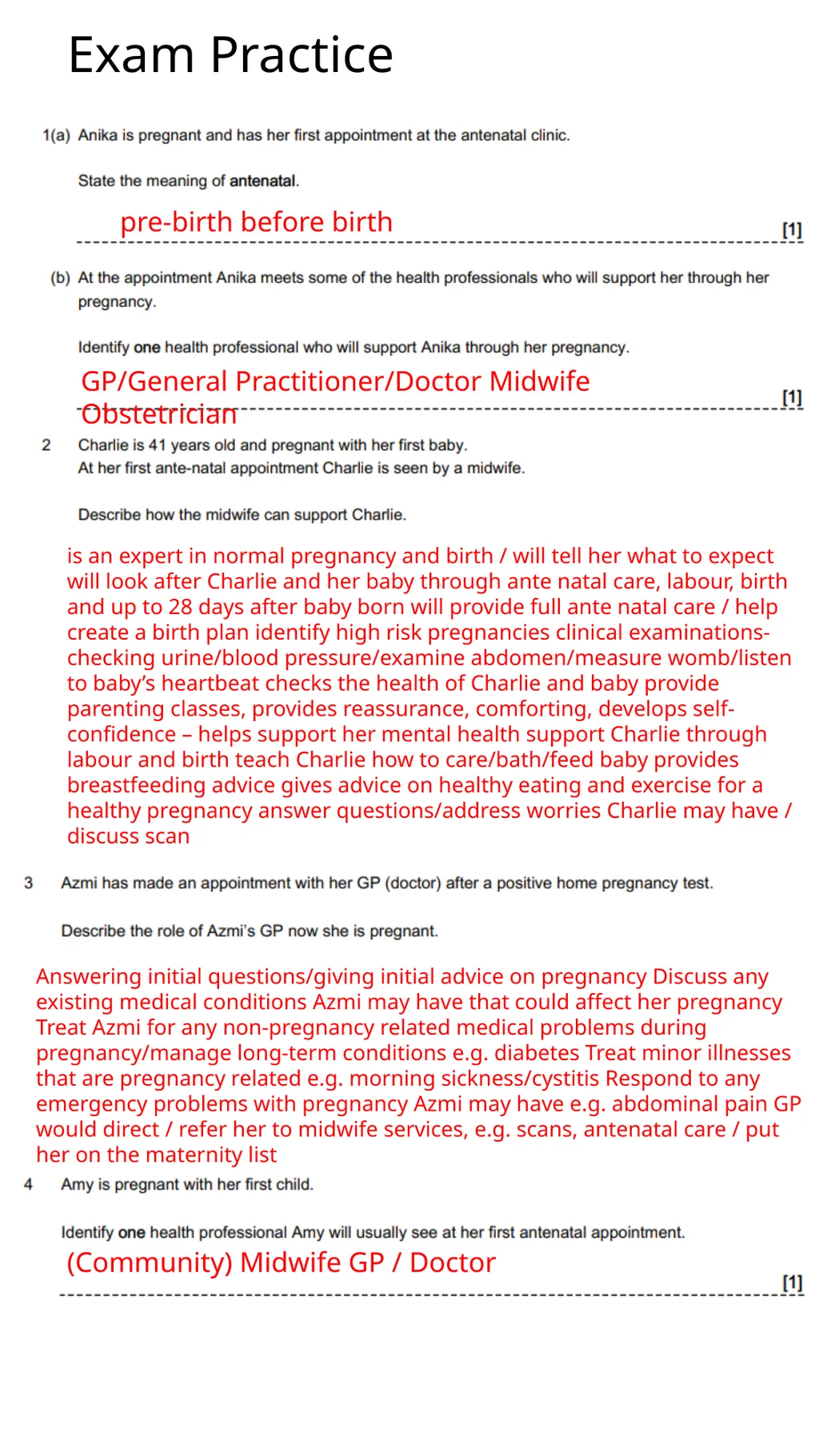
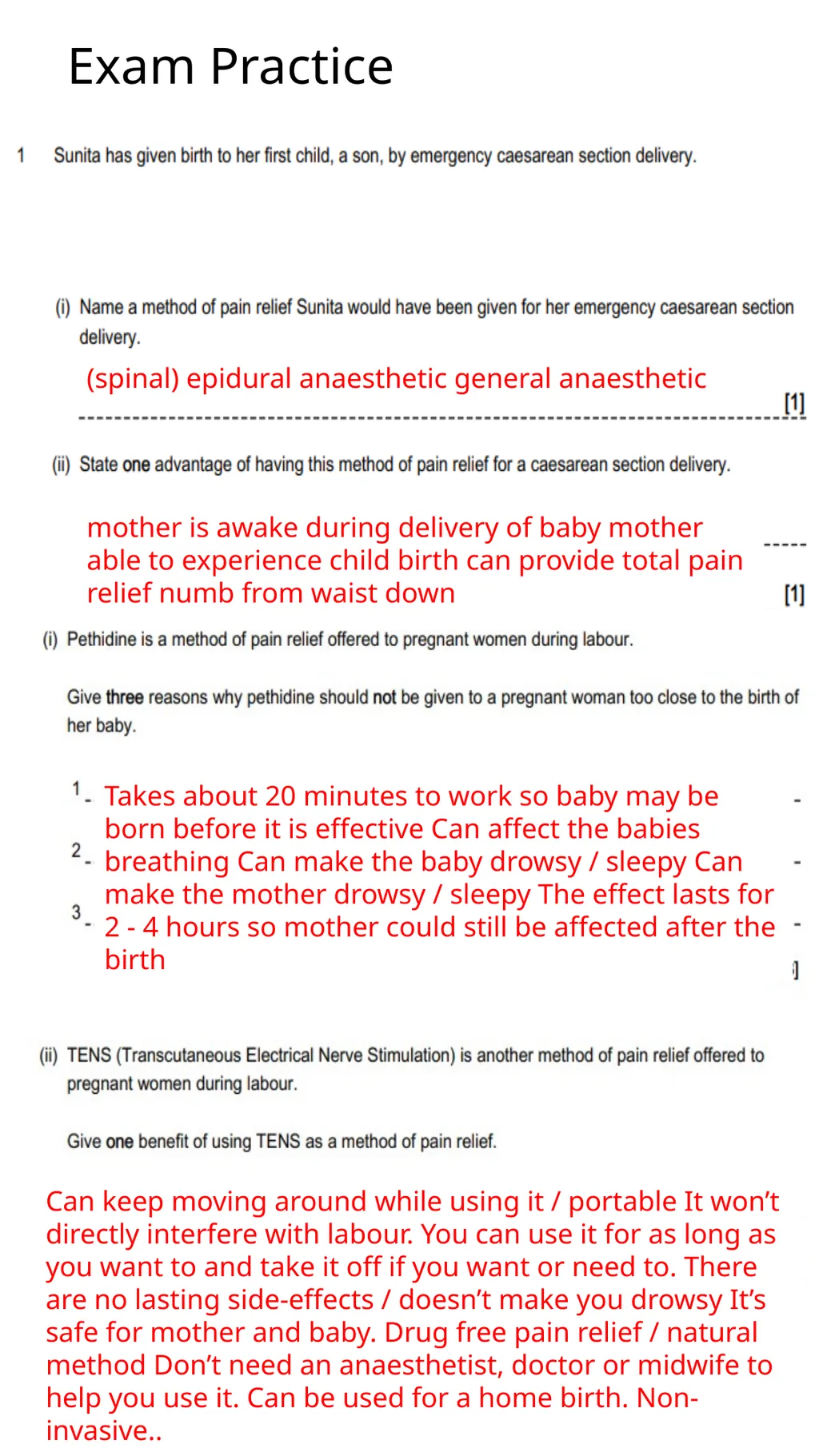
Exam Practice<br>
05
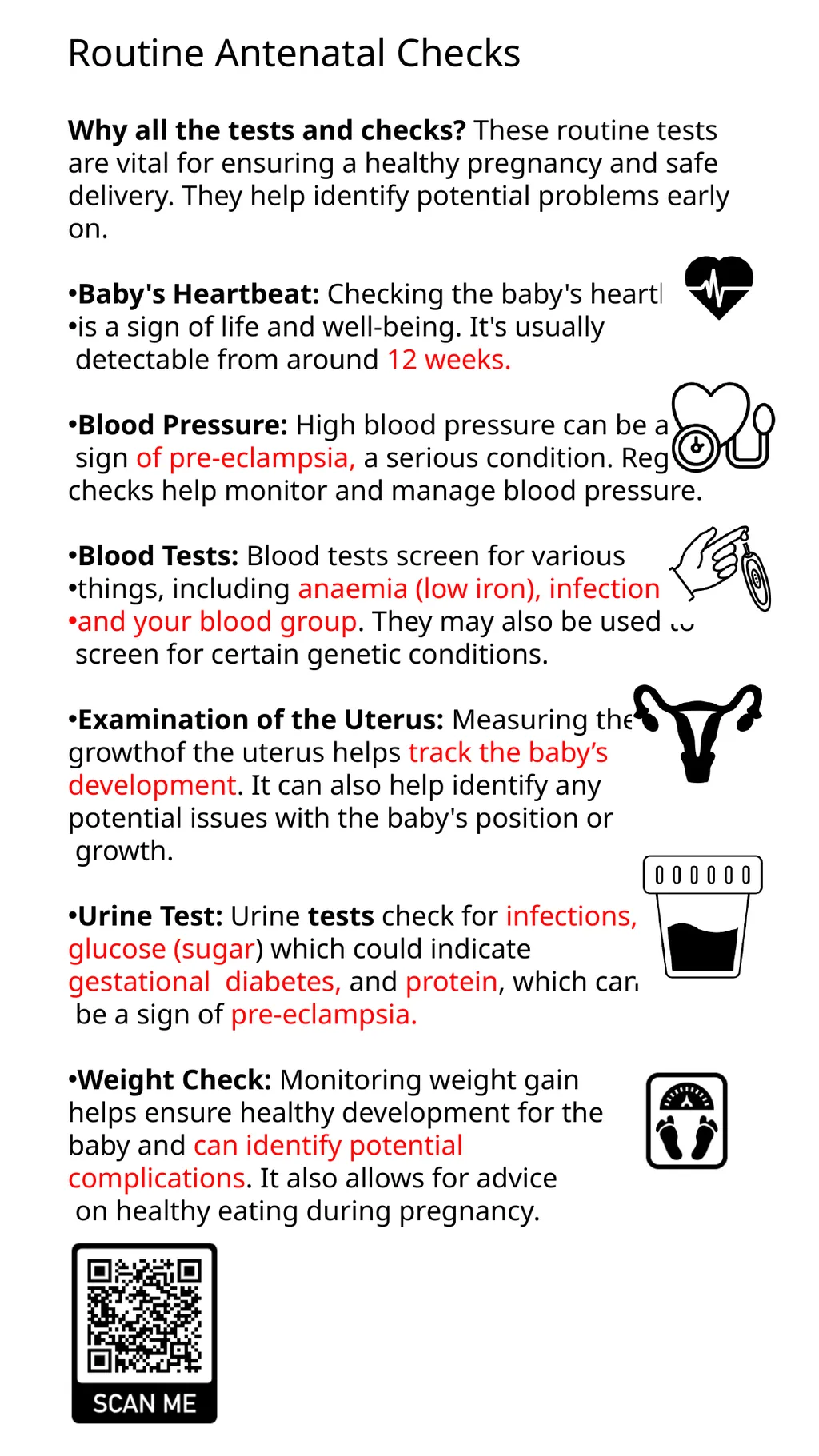
Routine Antenatal Checks Why all the tests and checks? These routine tests are vital for ensuring a healthy pregnancy and safe delivery. They help identify potential problems early on.
Baby's Heartbeat: Checking the baby's heartbeat
is a sign of life and well-being. It's usually
detectable from around 12 weeks.
Blood Pressure: High blood pressure can be a
sign of pre-eclampsia, a serious condition. Regular
checks help monitor and manage blood pressure.
Blood Tests: Blood tests screen for various
things, including anaemia (low iron), infections,
and your blood group. They may also be used to
screen for certain genetic conditions.
Examination of the Uterus: Measuring the
growthof the uterus helps track the baby’s
development. It can also help identify any
potential issues with the baby's position or
growth.
Urine Test: Urine tests check for infections,
glucose (sugar) which could indicate
gestational diabetes, and protein, which can
be a sign of pre-eclampsia.
Weight Check: Monitoring weight gain
helps ensure healthy development for the
baby and can identify potential
complications. It also allows for advice
on healthy eating during pregnancy.<br>
Baby's Heartbeat: Checking the baby's heartbeat
is a sign of life and well-being. It's usually
detectable from around 12 weeks.
Blood Pressure: High blood pressure can be a
sign of pre-eclampsia, a serious condition. Regular
checks help monitor and manage blood pressure.
Blood Tests: Blood tests screen for various
things, including anaemia (low iron), infections,
and your blood group. They may also be used to
screen for certain genetic conditions.
Examination of the Uterus: Measuring the
growthof the uterus helps track the baby’s
development. It can also help identify any
potential issues with the baby's position or
growth.
Urine Test: Urine tests check for infections,
glucose (sugar) which could indicate
gestational diabetes, and protein, which can
be a sign of pre-eclampsia.
Weight Check: Monitoring weight gain
helps ensure healthy development for the
baby and can identify potential
complications. It also allows for advice
on healthy eating during pregnancy.<br>
06
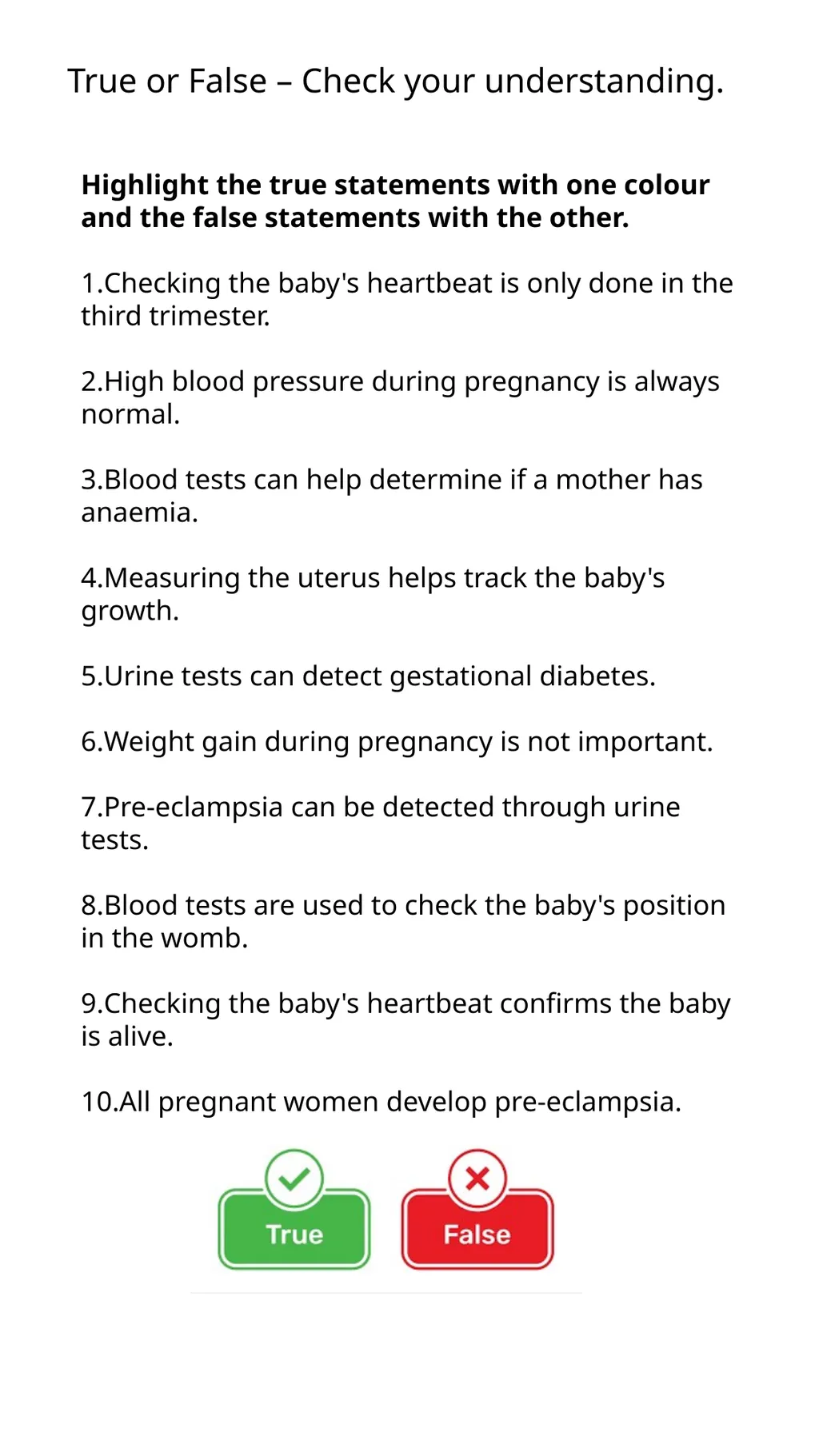
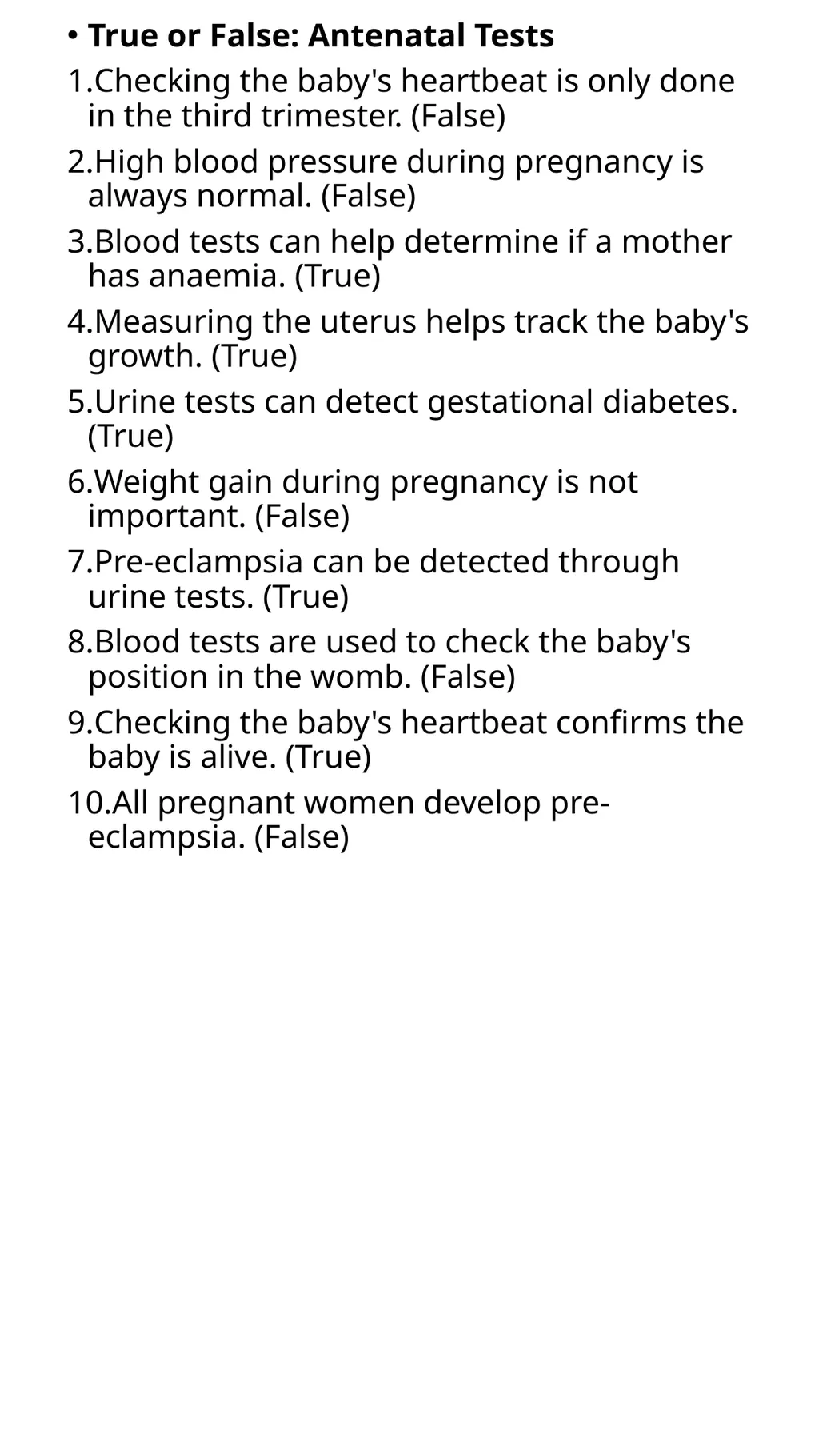
True or False – Check your understanding. Highlight the true statements with one colour and the false statements with the other.
Checking the baby's heartbeat is only done in the third trimester.
High blood pressure during pregnancy is always normal.
Blood tests can help determine if a mother has anaemia.
Measuring the uterus helps track the baby's growth.
Urine tests can detect gestational diabetes.
Weight gain during pregnancy is not important.
Pre-eclampsia can be detected through urine tests.
Blood tests are used to check the baby's position in the womb.
Checking the baby's heartbeat confirms the baby is alive.
All pregnant women develop pre-eclampsia.<br>
Checking the baby's heartbeat is only done in the third trimester.
High blood pressure during pregnancy is always normal.
Blood tests can help determine if a mother has anaemia.
Measuring the uterus helps track the baby's growth.
Urine tests can detect gestational diabetes.
Weight gain during pregnancy is not important.
Pre-eclampsia can be detected through urine tests.
Blood tests are used to check the baby's position in the womb.
Checking the baby's heartbeat confirms the baby is alive.
All pregnant women develop pre-eclampsia.<br>
07
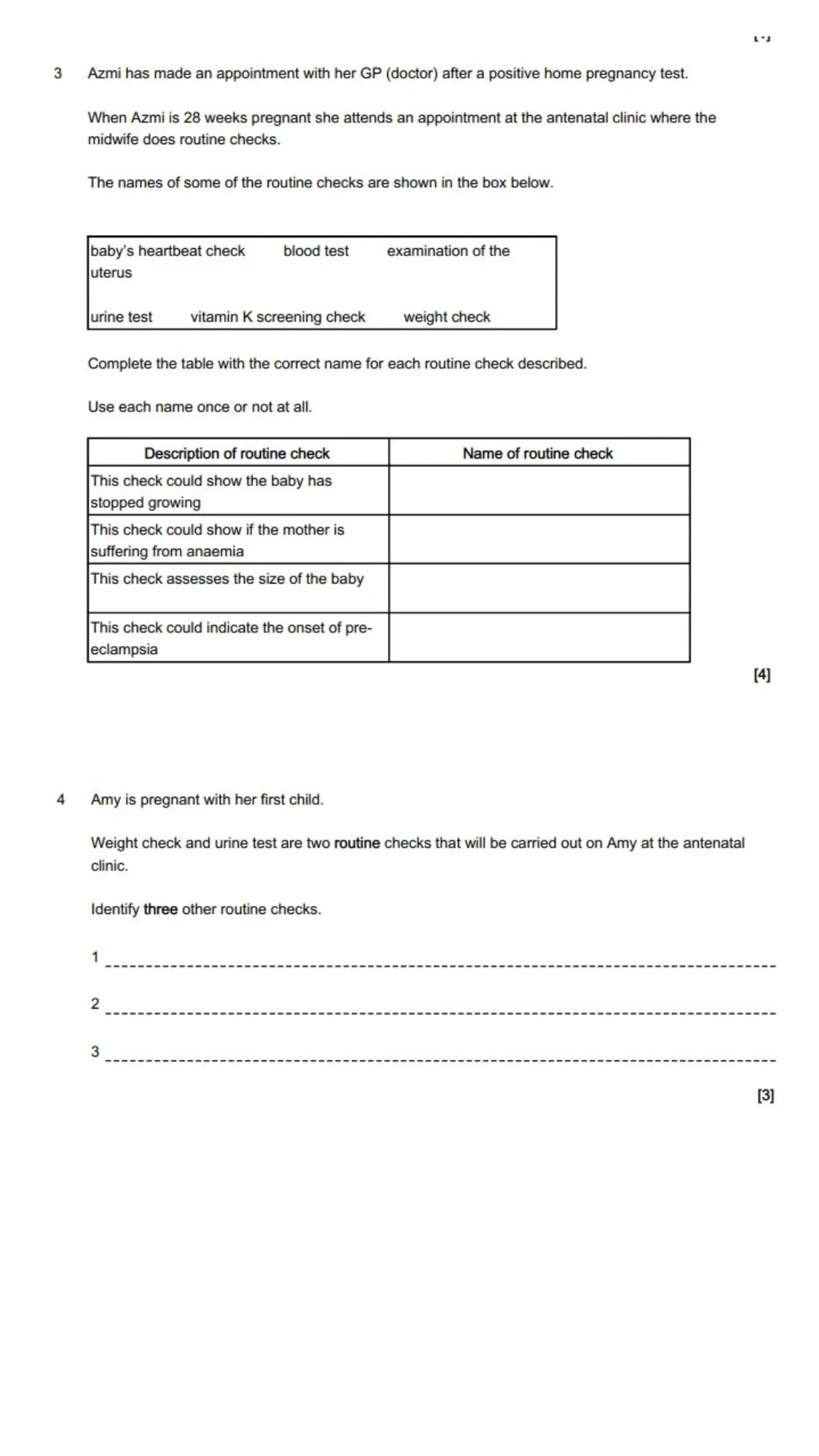
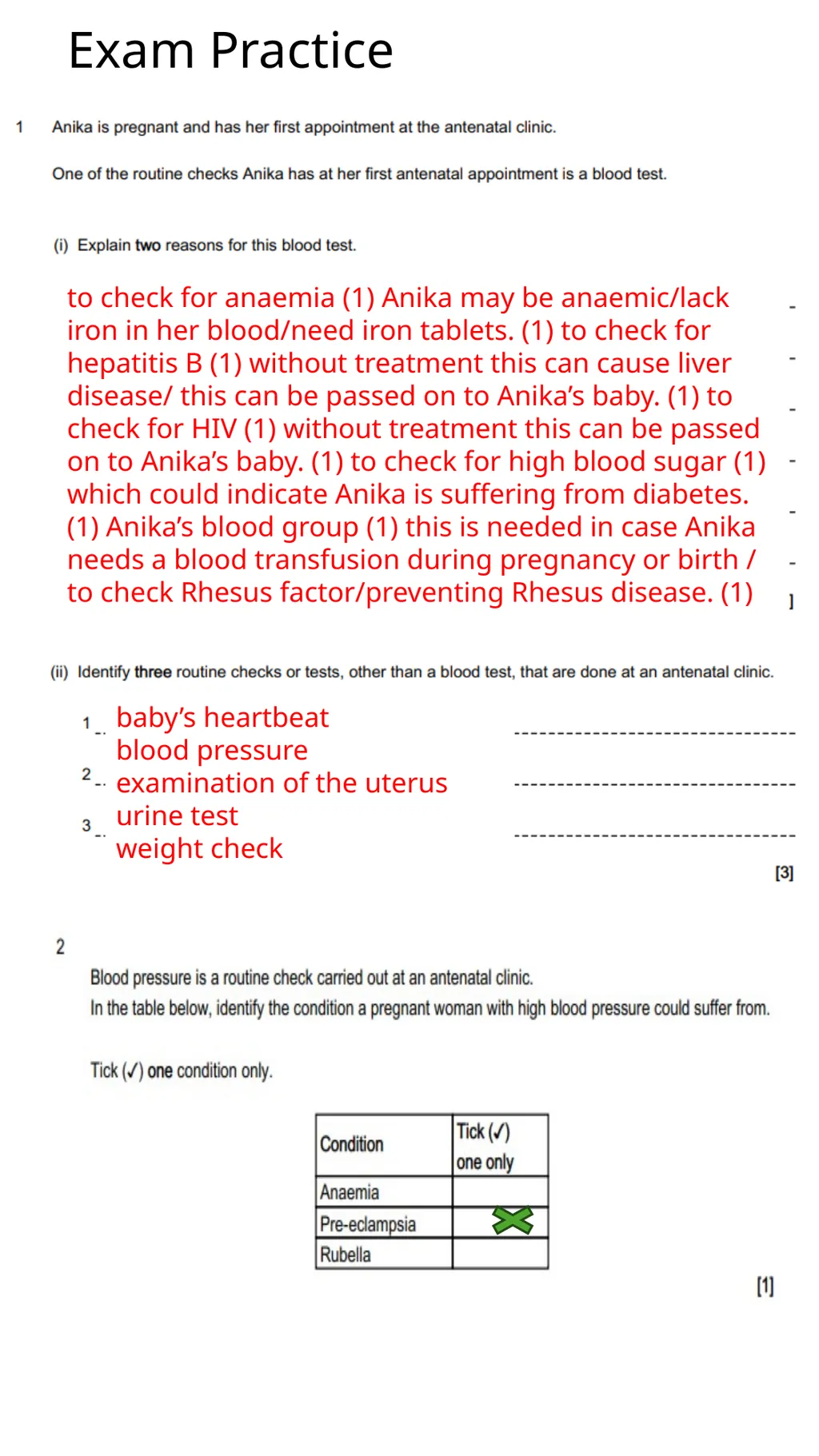
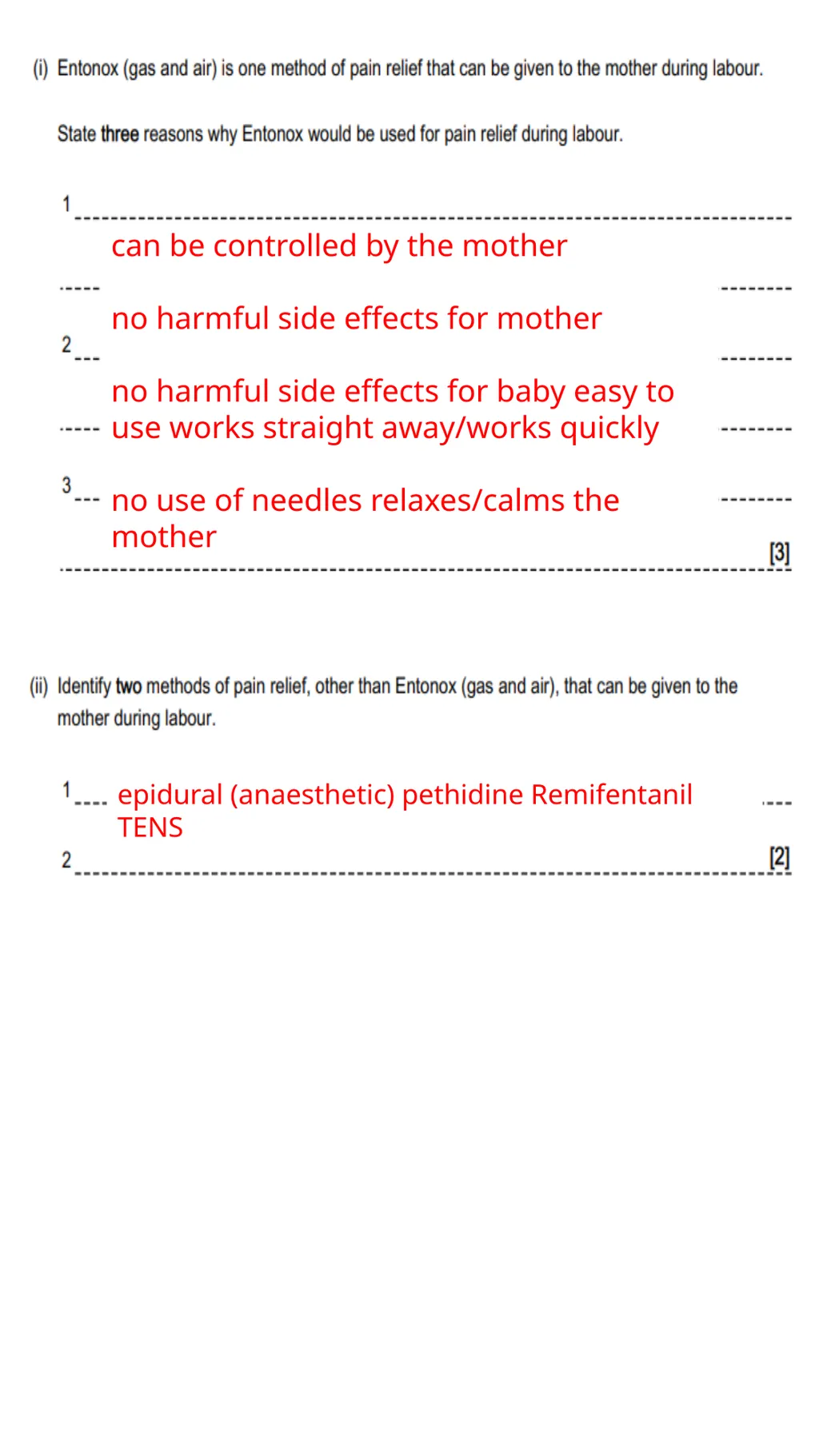
Exam Practice<br>
08
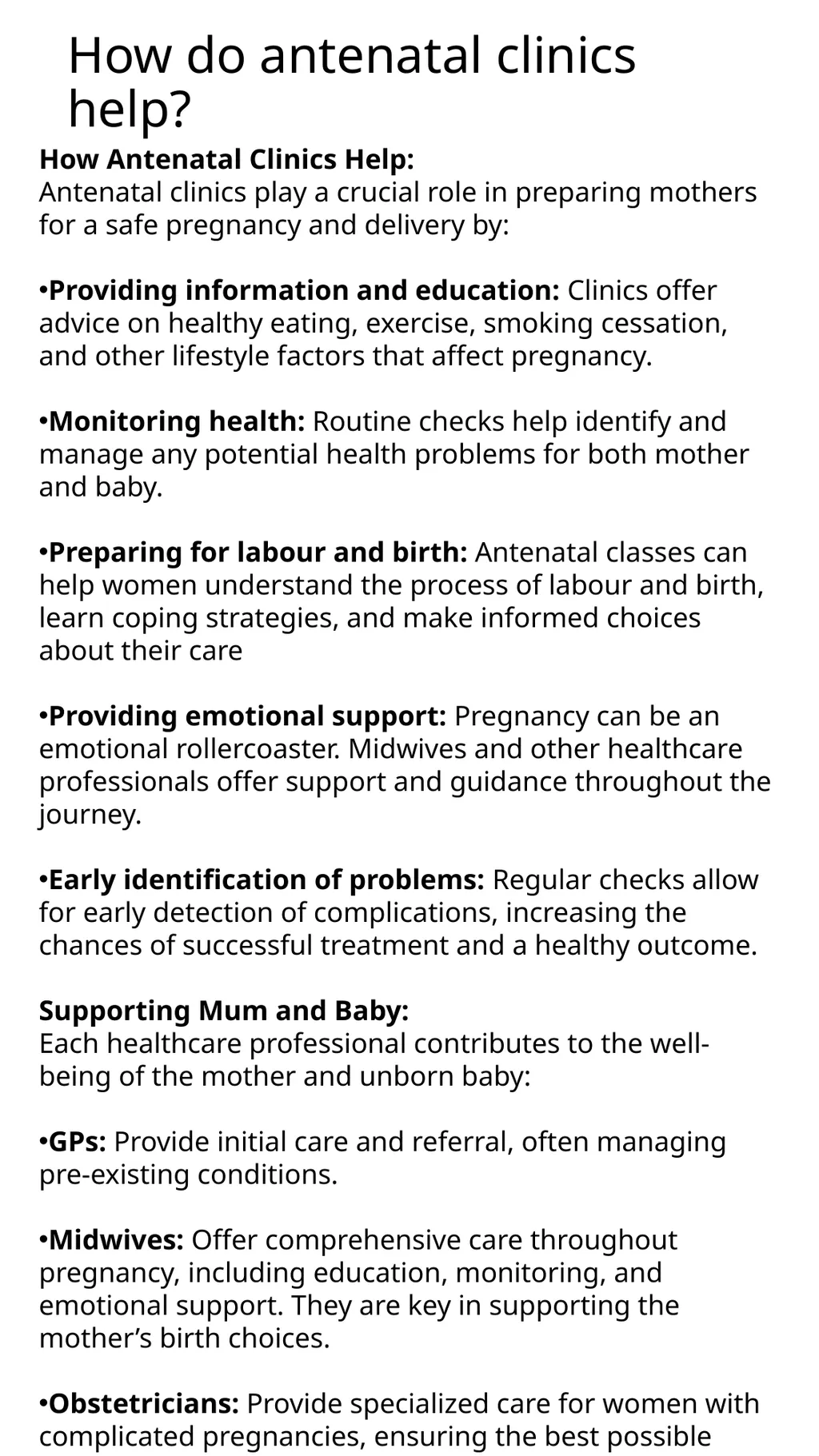
How do antenatal clinics help? How Antenatal Clinics Help:
Antenatal clinics play a crucial role in preparing mothers for a safe pregnancy and delivery by:
Providing information and education: Clinics offer advice on healthy eating, exercise, smoking cessation, and other lifestyle factors that affect pregnancy.
Monitoring health: Routine checks help identify and manage any potential health problems for both mother and baby.
Preparing for labour and birth: Antenatal classes can help women understand the process of labour and birth, learn coping strategies, and make informed choices about their care
Providing emotional support: Pregnancy can be an emotional rollercoaster. Midwives and other healthcare professionals offer support and guidance throughout the journey.
Early identification of problems: Regular checks allow for early detection of complications, increasing the chances of successful treatment and a healthy outcome.
Supporting Mum and Baby:
Each healthcare professional contributes to the well-being of the mother and unborn baby:
GPs: Provide initial care and referral, often managing pre-existing conditions.
Midwives: Offer comprehensive care throughout pregnancy, including education, monitoring, and emotional support. They are key in supporting the mother’s birth choices.
Obstetricians: Provide specialized care for women with complicated pregnancies, ensuring the best possible outcome for both mother and baby.<br>
Antenatal clinics play a crucial role in preparing mothers for a safe pregnancy and delivery by:
Providing information and education: Clinics offer advice on healthy eating, exercise, smoking cessation, and other lifestyle factors that affect pregnancy.
Monitoring health: Routine checks help identify and manage any potential health problems for both mother and baby.
Preparing for labour and birth: Antenatal classes can help women understand the process of labour and birth, learn coping strategies, and make informed choices about their care
Providing emotional support: Pregnancy can be an emotional rollercoaster. Midwives and other healthcare professionals offer support and guidance throughout the journey.
Early identification of problems: Regular checks allow for early detection of complications, increasing the chances of successful treatment and a healthy outcome.
Supporting Mum and Baby:
Each healthcare professional contributes to the well-being of the mother and unborn baby:
GPs: Provide initial care and referral, often managing pre-existing conditions.
Midwives: Offer comprehensive care throughout pregnancy, including education, monitoring, and emotional support. They are key in supporting the mother’s birth choices.
Obstetricians: Provide specialized care for women with complicated pregnancies, ensuring the best possible outcome for both mother and baby.<br>
09
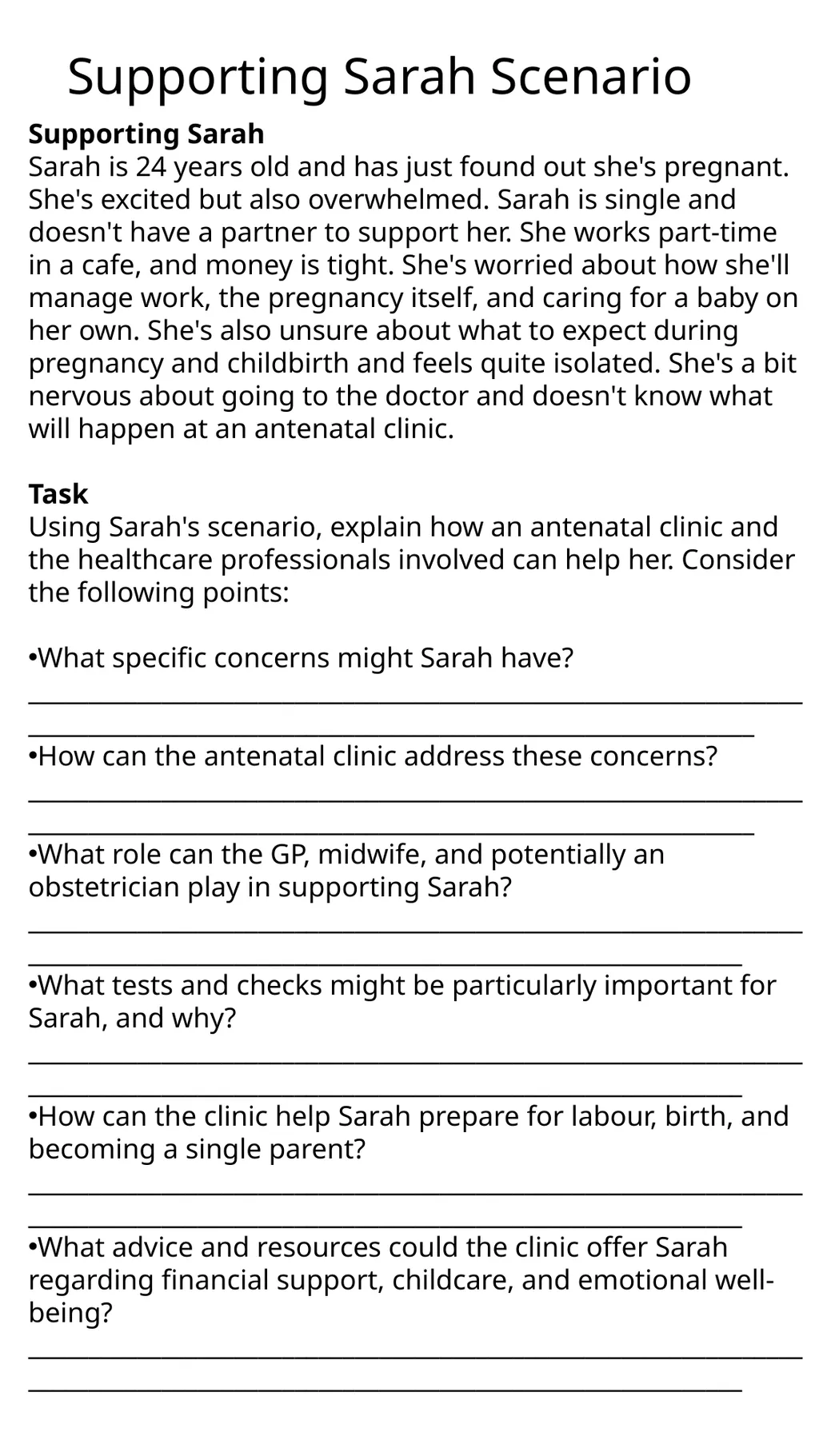
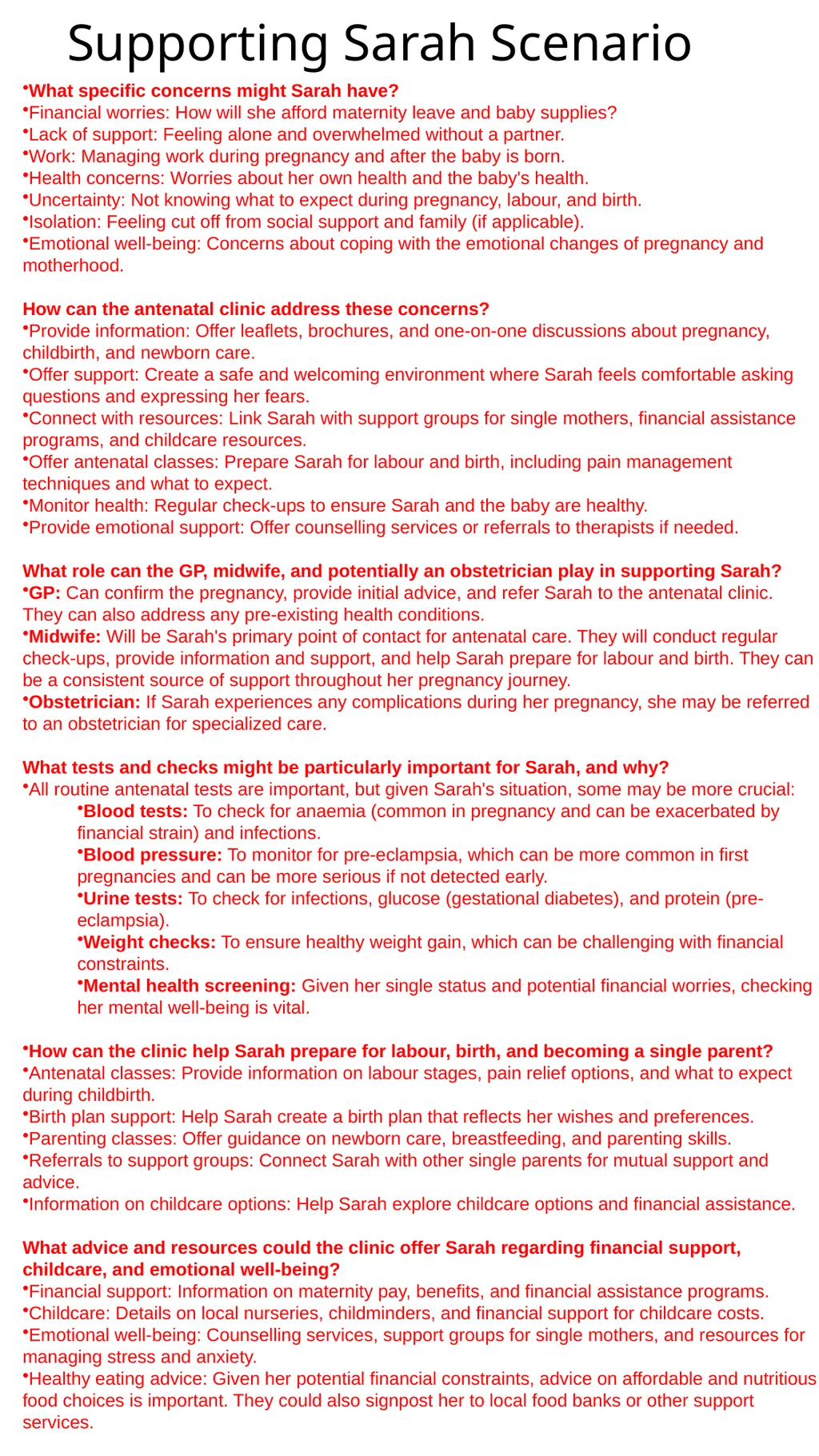
Supporting Sarah Scenario Supporting Sarah
Sarah is 24 years old and has just found out she's pregnant. She's excited but also overwhelmed. Sarah is single and doesn't have a partner to support her. She works part-time in a cafe, and money is tight. She's worried about how she'll manage work, the pregnancy itself, and caring for a baby on her own. She's also unsure about what to expect during pregnancy and childbirth and feels quite isolated. She's a bit nervous about going to the doctor and doesn't know what will happen at an antenatal clinic.
Task
Using Sarah's scenario, explain how an antenatal clinic and the healthcare professionals involved can help her. Consider the following points:
What specific concerns might Sarah have?
____________________________________________________________________________________________________________________________
How can the antenatal clinic address these concerns?
____________________________________________________________________________________________________________________________
What role can the GP, midwife, and potentially an obstetrician play in supporting Sarah?
___________________________________________________________________________________________________________________________
What tests and checks might be particularly important for Sarah, and why?
___________________________________________________________________________________________________________________________
How can the clinic help Sarah prepare for labour, birth, and becoming a single parent?
___________________________________________________________________________________________________________________________
What advice and resources could the clinic offer Sarah regarding financial support, childcare, and emotional well-being?
___________________________________________________________________________________________________________________________<br>
Sarah is 24 years old and has just found out she's pregnant. She's excited but also overwhelmed. Sarah is single and doesn't have a partner to support her. She works part-time in a cafe, and money is tight. She's worried about how she'll manage work, the pregnancy itself, and caring for a baby on her own. She's also unsure about what to expect during pregnancy and childbirth and feels quite isolated. She's a bit nervous about going to the doctor and doesn't know what will happen at an antenatal clinic.
Task
Using Sarah's scenario, explain how an antenatal clinic and the healthcare professionals involved can help her. Consider the following points:
What specific concerns might Sarah have?
____________________________________________________________________________________________________________________________
How can the antenatal clinic address these concerns?
____________________________________________________________________________________________________________________________
What role can the GP, midwife, and potentially an obstetrician play in supporting Sarah?
___________________________________________________________________________________________________________________________
What tests and checks might be particularly important for Sarah, and why?
___________________________________________________________________________________________________________________________
How can the clinic help Sarah prepare for labour, birth, and becoming a single parent?
___________________________________________________________________________________________________________________________
What advice and resources could the clinic offer Sarah regarding financial support, childcare, and emotional well-being?
___________________________________________________________________________________________________________________________<br>
10
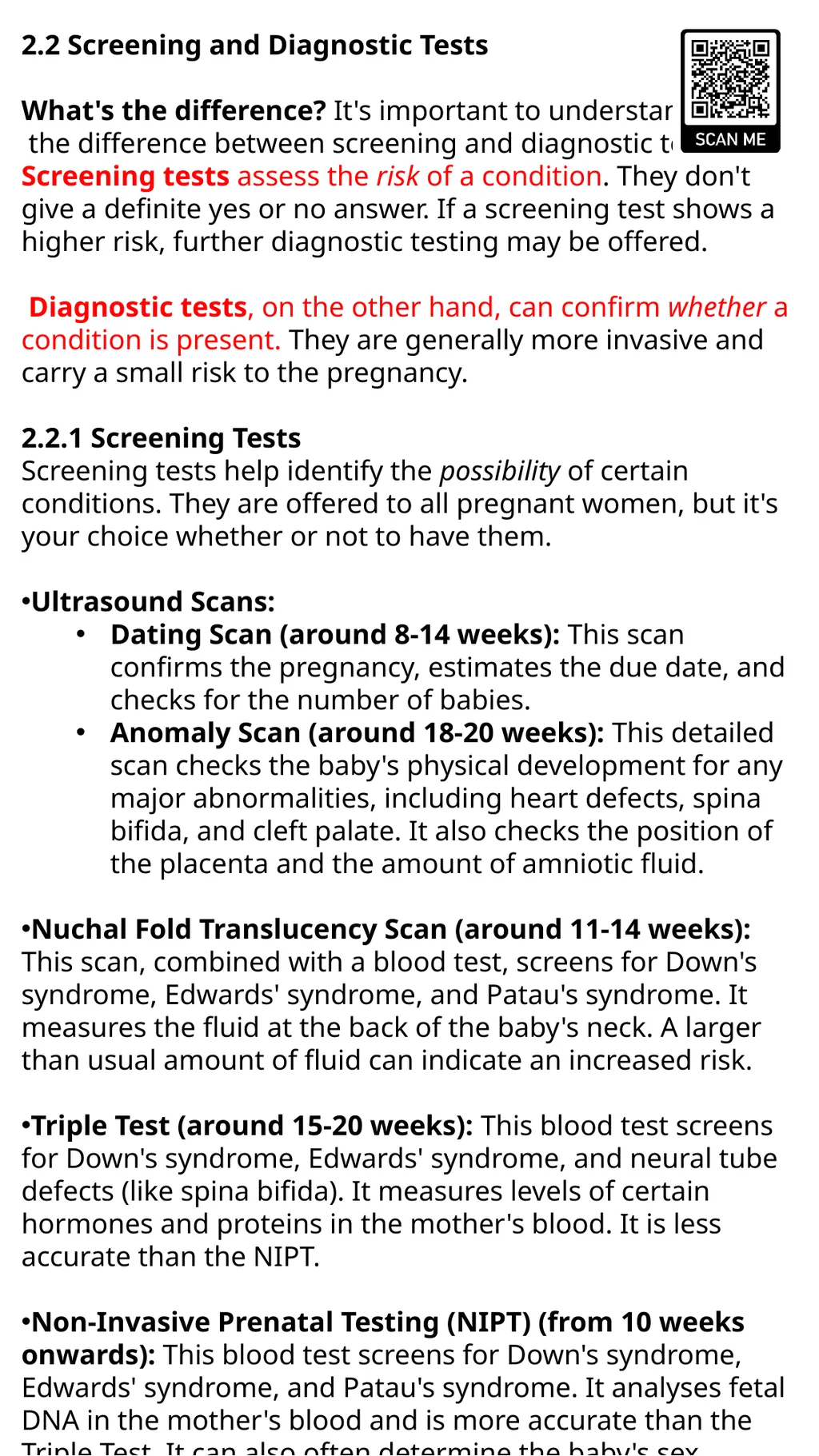
2.2 Screening and Diagnostic Tests
What's the difference? It's important to understand
the difference between screening and diagnostic tests. Screening tests assess the risk of a condition. They don't give a definite yes or no answer. If a screening test shows a higher risk, further diagnostic testing may be offered.
Diagnostic tests, on the other hand, can confirm whether a condition is present. They are generally more invasive and carry a small risk to the pregnancy.
2.2.1 Screening Tests
Screening tests help identify the possibility of certain conditions. They are offered to all pregnant women, but it's your choice whether or not to have them.
Ultrasound Scans:
Dating Scan (around 8-14 weeks): This scan confirms the pregnancy, estimates the due date, and checks for the number of babies.
Anomaly Scan (around 18-20 weeks): This detailed scan checks the baby's physical development for any major abnormalities, including heart defects, spina bifida, and cleft palate. It also checks the position of the placenta and the amount of amniotic fluid.
Nuchal Fold Translucency Scan (around 11-14 weeks): This scan, combined with a blood test, screens for Down's syndrome, Edwards' syndrome, and Patau's syndrome. It measures the fluid at the back of the baby's neck. A larger than usual amount of fluid can indicate an increased risk.
Triple Test (around 15-20 weeks): This blood test screens for Down's syndrome, Edwards' syndrome, and neural tube defects (like spina bifida). It measures levels of certain hormones and proteins in the mother's blood. It is less accurate than the NIPT.
Non-Invasive Prenatal Testing (NIPT) (from 10 weeks onwards): This blood test screens for Down's syndrome, Edwards' syndrome, and Patau's syndrome. It analyses fetal DNA in the mother's blood and is more accurate than the Triple Test. It can also often determine the baby's sex.<br>
What's the difference? It's important to understand
the difference between screening and diagnostic tests. Screening tests assess the risk of a condition. They don't give a definite yes or no answer. If a screening test shows a higher risk, further diagnostic testing may be offered.
Diagnostic tests, on the other hand, can confirm whether a condition is present. They are generally more invasive and carry a small risk to the pregnancy.
2.2.1 Screening Tests
Screening tests help identify the possibility of certain conditions. They are offered to all pregnant women, but it's your choice whether or not to have them.
Ultrasound Scans:
Dating Scan (around 8-14 weeks): This scan confirms the pregnancy, estimates the due date, and checks for the number of babies.
Anomaly Scan (around 18-20 weeks): This detailed scan checks the baby's physical development for any major abnormalities, including heart defects, spina bifida, and cleft palate. It also checks the position of the placenta and the amount of amniotic fluid.
Nuchal Fold Translucency Scan (around 11-14 weeks): This scan, combined with a blood test, screens for Down's syndrome, Edwards' syndrome, and Patau's syndrome. It measures the fluid at the back of the baby's neck. A larger than usual amount of fluid can indicate an increased risk.
Triple Test (around 15-20 weeks): This blood test screens for Down's syndrome, Edwards' syndrome, and neural tube defects (like spina bifida). It measures levels of certain hormones and proteins in the mother's blood. It is less accurate than the NIPT.
Non-Invasive Prenatal Testing (NIPT) (from 10 weeks onwards): This blood test screens for Down's syndrome, Edwards' syndrome, and Patau's syndrome. It analyses fetal DNA in the mother's blood and is more accurate than the Triple Test. It can also often determine the baby's sex.<br>
11
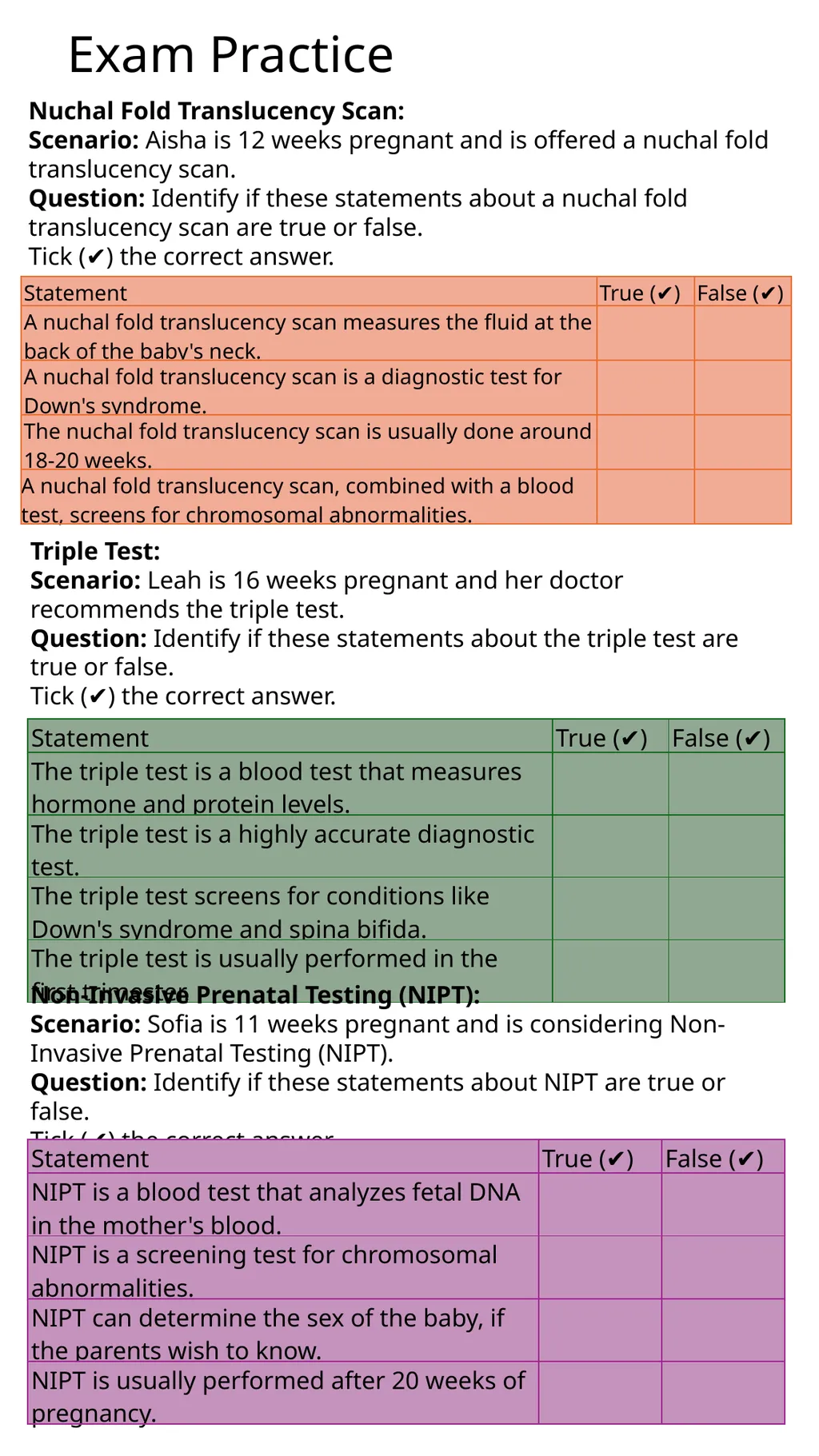
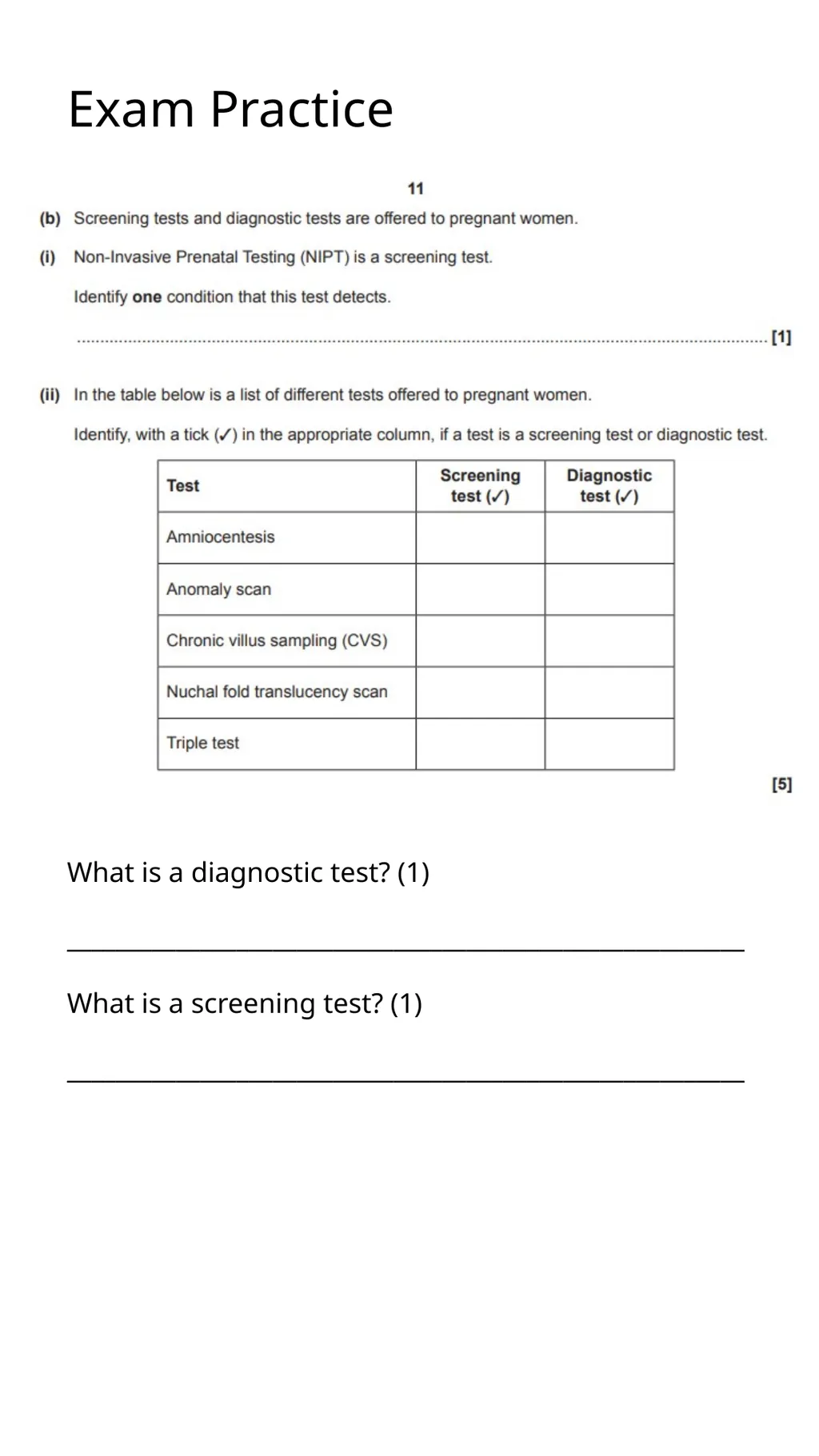
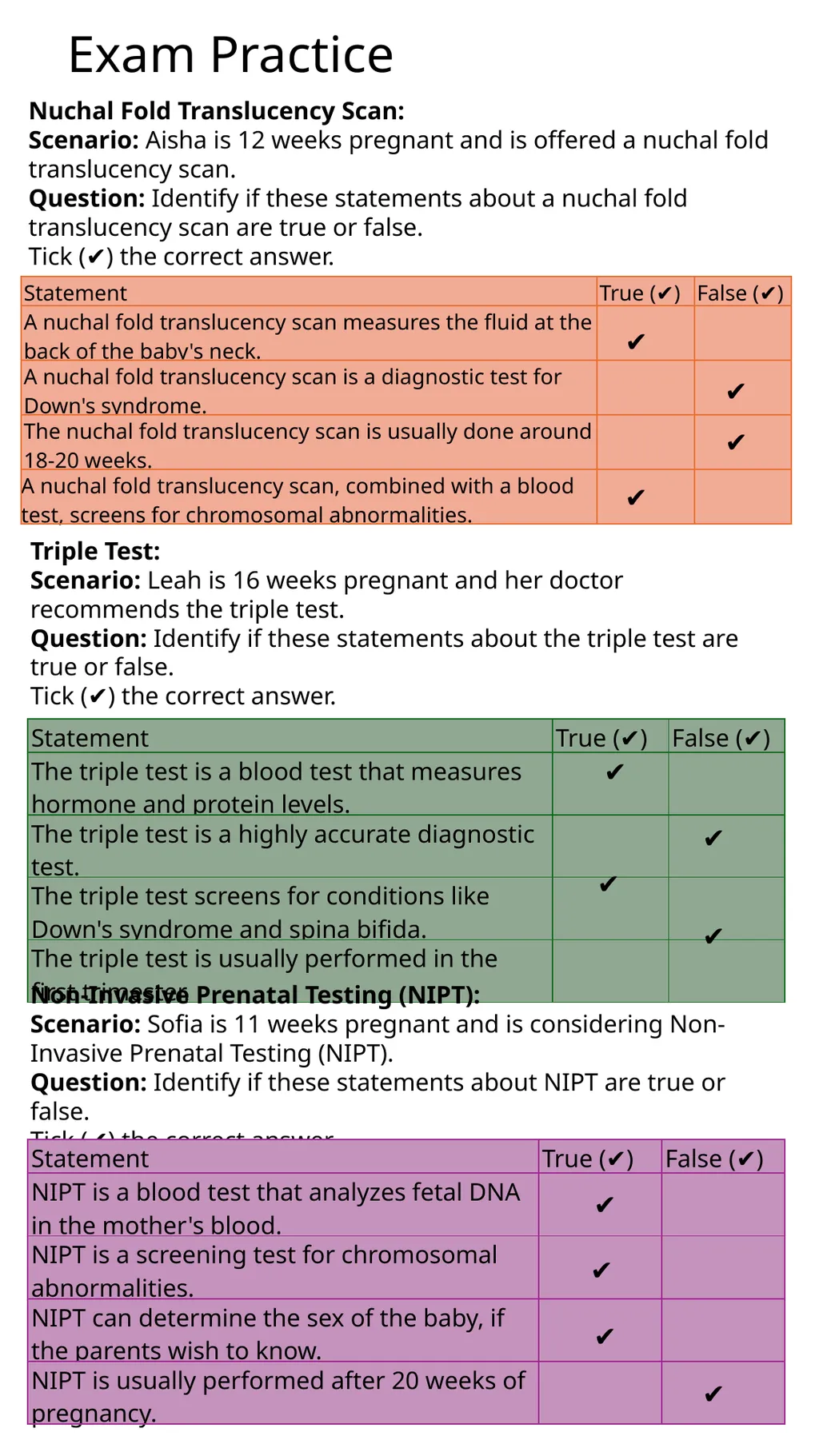
Exam Practice Nuchal Fold Translucency Scan:
Scenario: Aisha is 12 weeks pregnant and is offered a nuchal fold translucency scan.
Question: Identify if these statements about a nuchal fold translucency scan are true or false.
Tick (✔) the correct answer. Triple Test:
Scenario: Leah is 16 weeks pregnant and her doctor recommends the triple test.
Question: Identify if these statements about the triple test are true or false.
Tick (✔) the correct answer. Non-Invasive Prenatal Testing (NIPT):
Scenario: Sofia is 11 weeks pregnant and is considering Non-Invasive Prenatal Testing (NIPT).
Question: Identify if these statements about NIPT are true or false.
Tick (✔) the correct answer.<br>
Scenario: Aisha is 12 weeks pregnant and is offered a nuchal fold translucency scan.
Question: Identify if these statements about a nuchal fold translucency scan are true or false.
Tick (✔) the correct answer. Triple Test:
Scenario: Leah is 16 weeks pregnant and her doctor recommends the triple test.
Question: Identify if these statements about the triple test are true or false.
Tick (✔) the correct answer. Non-Invasive Prenatal Testing (NIPT):
Scenario: Sofia is 11 weeks pregnant and is considering Non-Invasive Prenatal Testing (NIPT).
Question: Identify if these statements about NIPT are true or false.
Tick (✔) the correct answer.<br>
12
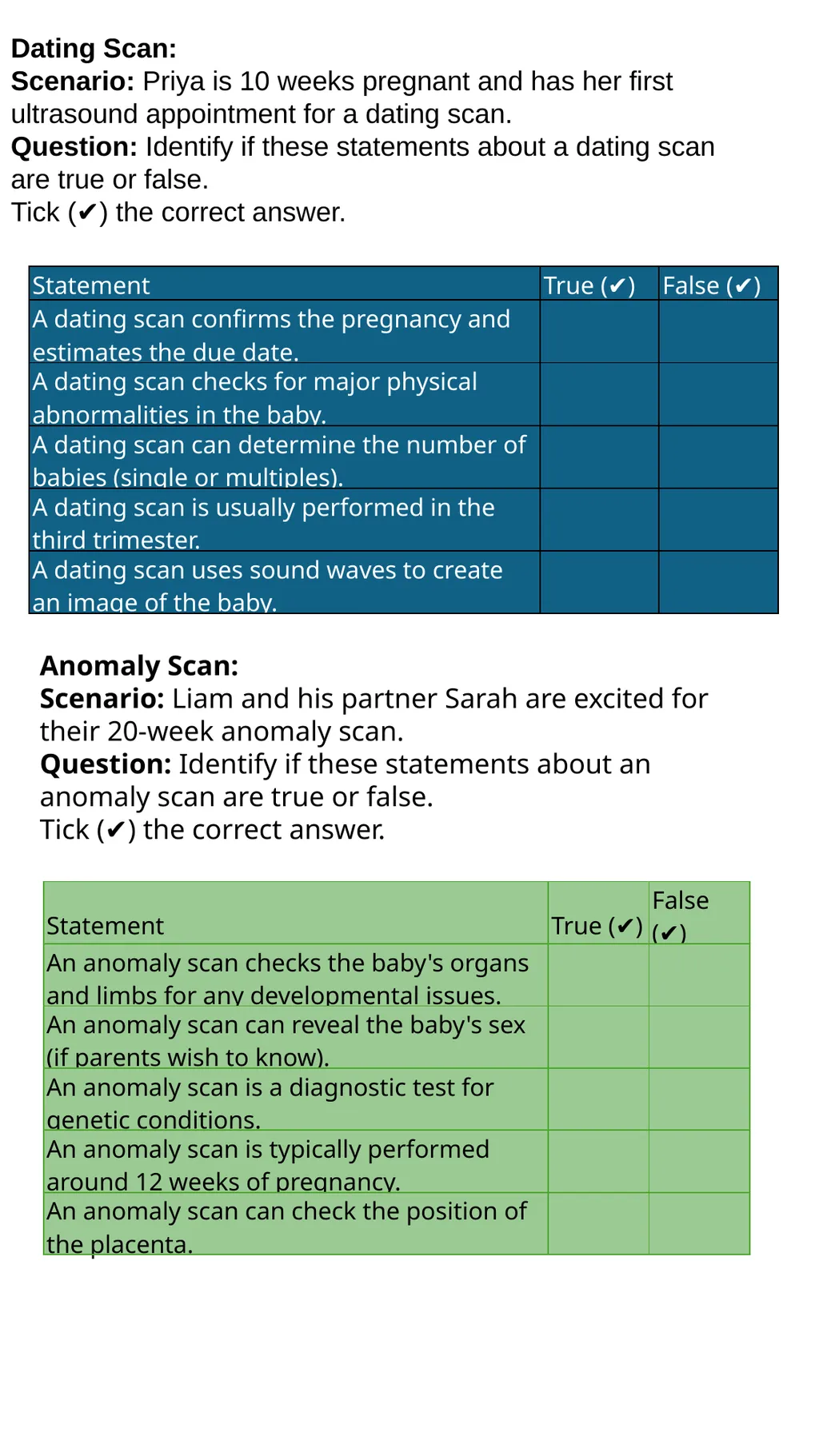
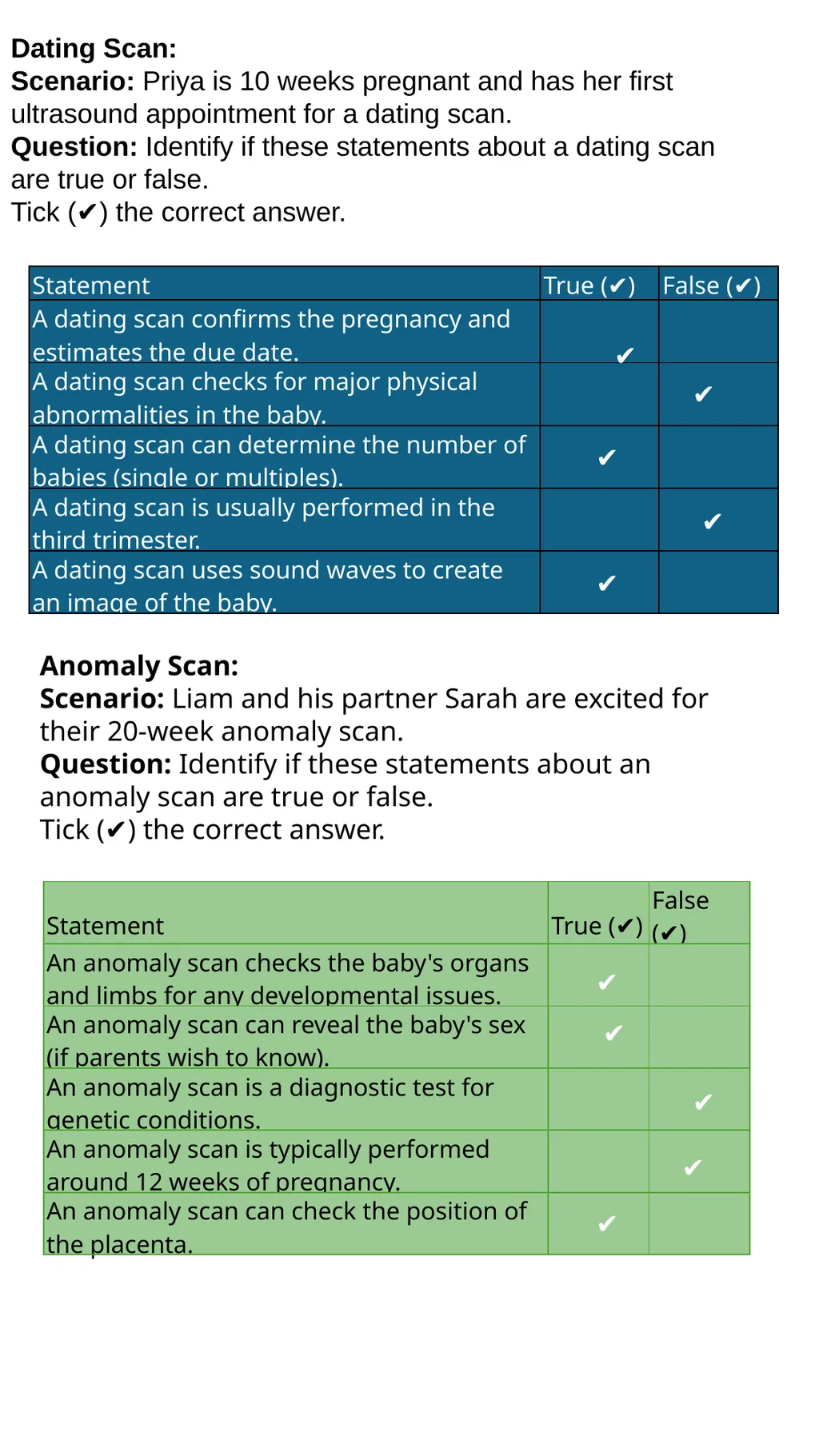
Dating Scan:
Scenario: Priya is 10 weeks pregnant and has her first ultrasound appointment for a dating scan.
Question: Identify if these statements about a dating scan are true or false.
Tick (✔) the correct answer. Anomaly Scan:
Scenario: Liam and his partner Sarah are excited for their 20-week anomaly scan.
Question: Identify if these statements about an anomaly scan are true or false.
Tick (✔) the correct answer.<br>
Scenario: Priya is 10 weeks pregnant and has her first ultrasound appointment for a dating scan.
Question: Identify if these statements about a dating scan are true or false.
Tick (✔) the correct answer. Anomaly Scan:
Scenario: Liam and his partner Sarah are excited for their 20-week anomaly scan.
Question: Identify if these statements about an anomaly scan are true or false.
Tick (✔) the correct answer.<br>
13
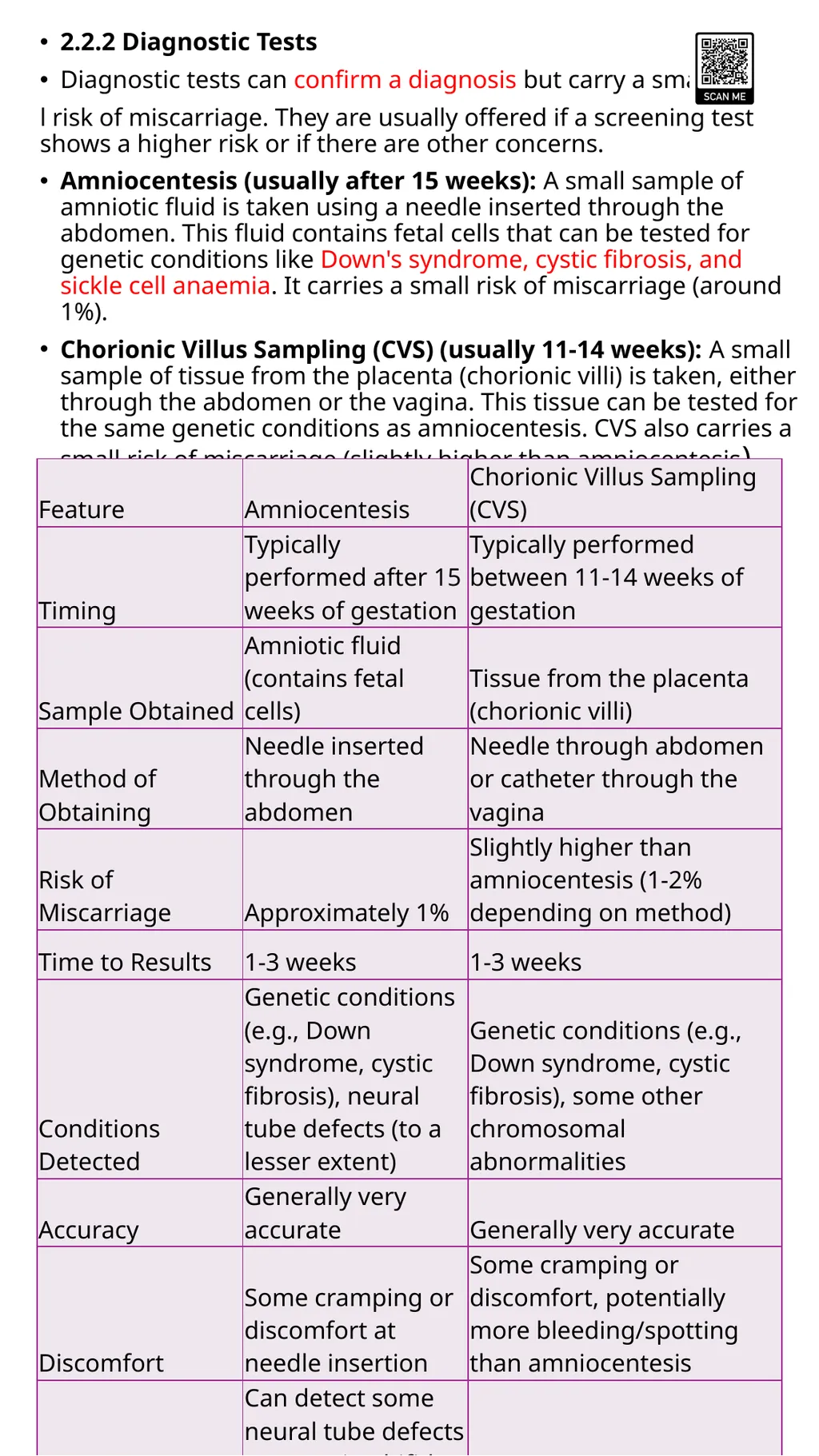
2.2.2 Diagnostic Tests
Diagnostic tests can confirm a diagnosis but carry a small
l risk of miscarriage. They are usually offered if a screening test shows a higher risk or if there are other concerns.
Amniocentesis (usually after 15 weeks): A small sample of amniotic fluid is taken using a needle inserted through the abdomen. This fluid contains fetal cells that can be tested for genetic conditions like Down's syndrome, cystic fibrosis, and sickle cell anaemia. It carries a small risk of miscarriage (around 1%).
Chorionic Villus Sampling (CVS) (usually 11-14 weeks): A small sample of tissue from the placenta (chorionic villi) is taken, either through the abdomen or the vagina. This tissue can be tested for the same genetic conditions as amniocentesis. CVS also carries a small risk of miscarriage (slightly higher than amniocentesis)<br>
Diagnostic tests can confirm a diagnosis but carry a small
l risk of miscarriage. They are usually offered if a screening test shows a higher risk or if there are other concerns.
Amniocentesis (usually after 15 weeks): A small sample of amniotic fluid is taken using a needle inserted through the abdomen. This fluid contains fetal cells that can be tested for genetic conditions like Down's syndrome, cystic fibrosis, and sickle cell anaemia. It carries a small risk of miscarriage (around 1%).
Chorionic Villus Sampling (CVS) (usually 11-14 weeks): A small sample of tissue from the placenta (chorionic villi) is taken, either through the abdomen or the vagina. This tissue can be tested for the same genetic conditions as amniocentesis. CVS also carries a small risk of miscarriage (slightly higher than amniocentesis)<br>
14
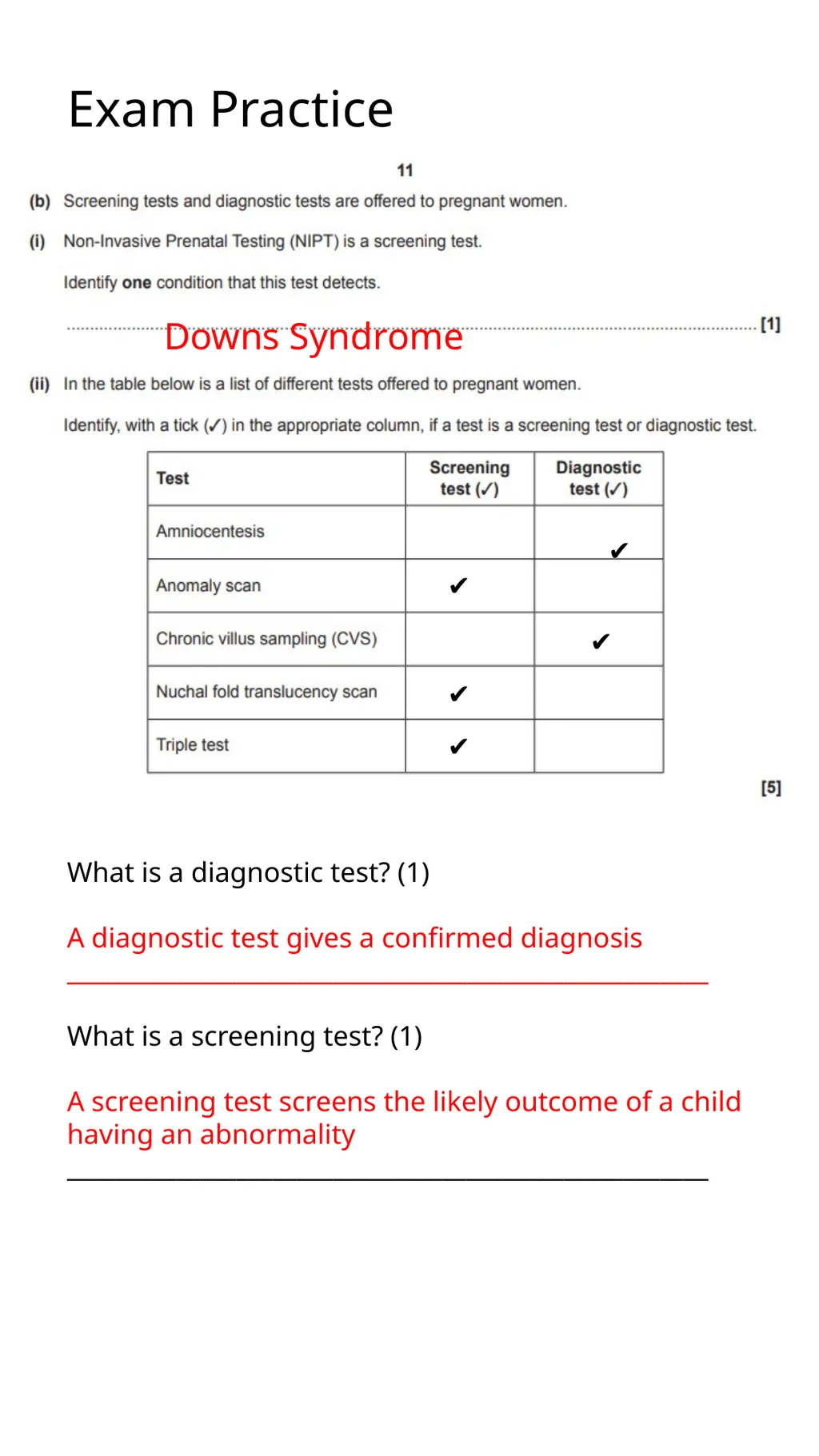
Exam Practice What is a diagnostic test? (1)
________________________________________________________
What is a screening test? (1)
________________________________________________________<br>
________________________________________________________
What is a screening test? (1)
________________________________________________________<br>
15
2.3 The Purpose and Importance of Antenatal
(Parenting) Classes
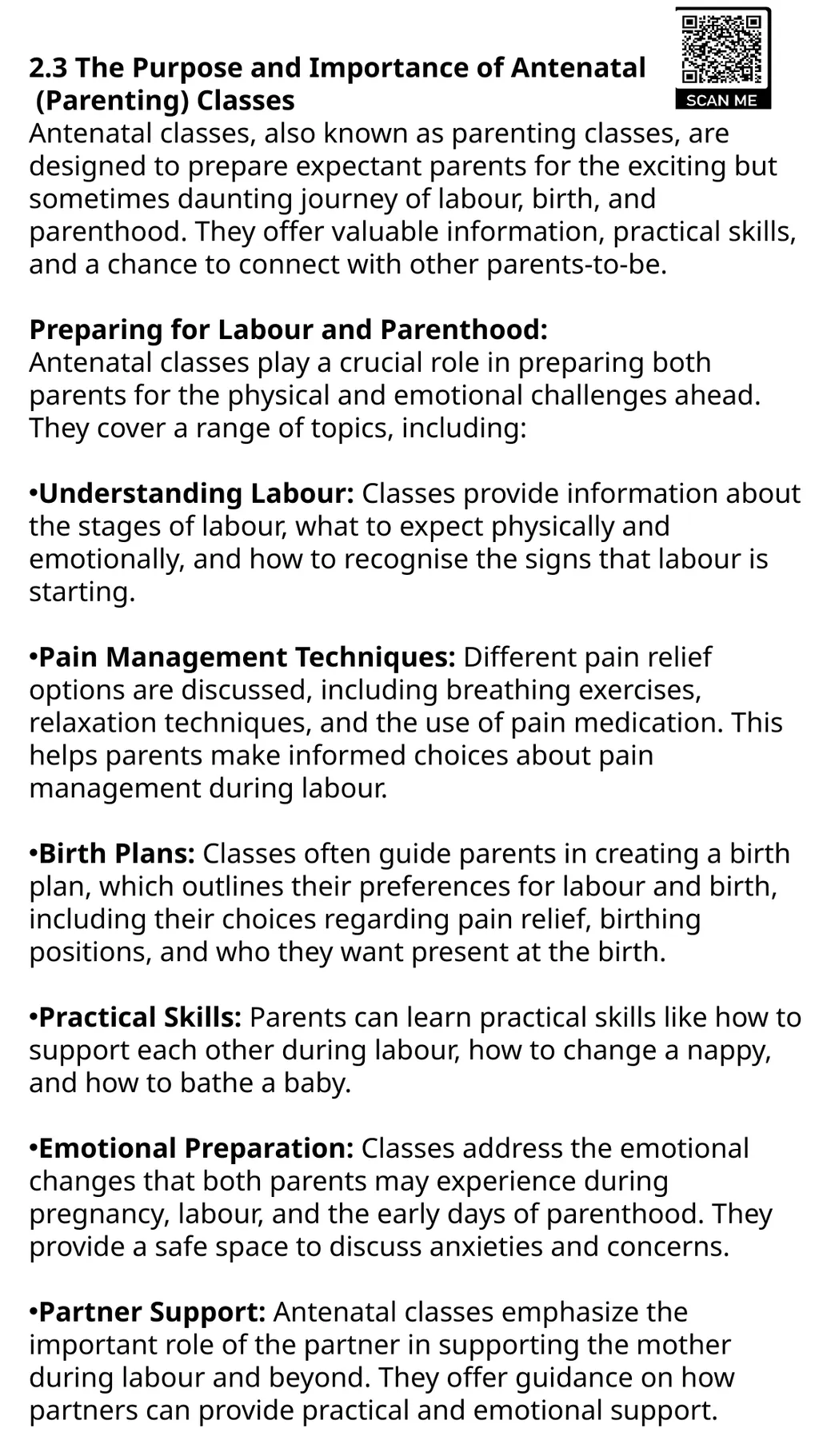
Antenatal classes, also known as parenting classes, are designed to prepare expectant parents for the exciting but sometimes daunting journey of labour, birth, and parenthood. They offer valuable information, practical skills, and a chance to connect with other parents-to-be.
Preparing for Labour and Parenthood:
Antenatal classes play a crucial role in preparing both parents for the physical and emotional challenges ahead. They cover a range of topics, including:
Understanding Labour: Classes provide information about the stages of labour, what to expect physically and emotionally, and how to recognise the signs that labour is starting.
Pain Management Techniques: Different pain relief options are discussed, including breathing exercises, relaxation techniques, and the use of pain medication. This helps parents make informed choices about pain management during labour.
Birth Plans: Classes often guide parents in creating a birth plan, which outlines their preferences for labour and birth, including their choices regarding pain relief, birthing positions, and who they want present at the birth.
Practical Skills: Parents can learn practical skills like how to support each other during labour, how to change a nappy, and how to bathe a baby.
Emotional Preparation: Classes address the emotional changes that both parents may experience during pregnancy, labour, and the early days of parenthood. They provide a safe space to discuss anxieties and concerns.
Partner Support: Antenatal classes emphasize the important role of the partner in supporting the mother during labour and beyond. They offer guidance on how partners can provide practical and emotional support.<br>
(Parenting) Classes
Antenatal classes, also known as parenting classes, are designed to prepare expectant parents for the exciting but sometimes daunting journey of labour, birth, and parenthood. They offer valuable information, practical skills, and a chance to connect with other parents-to-be.
Preparing for Labour and Parenthood:
Antenatal classes play a crucial role in preparing both parents for the physical and emotional challenges ahead. They cover a range of topics, including:
Understanding Labour: Classes provide information about the stages of labour, what to expect physically and emotionally, and how to recognise the signs that labour is starting.
Pain Management Techniques: Different pain relief options are discussed, including breathing exercises, relaxation techniques, and the use of pain medication. This helps parents make informed choices about pain management during labour.
Birth Plans: Classes often guide parents in creating a birth plan, which outlines their preferences for labour and birth, including their choices regarding pain relief, birthing positions, and who they want present at the birth.
Practical Skills: Parents can learn practical skills like how to support each other during labour, how to change a nappy, and how to bathe a baby.
Emotional Preparation: Classes address the emotional changes that both parents may experience during pregnancy, labour, and the early days of parenthood. They provide a safe space to discuss anxieties and concerns.
Partner Support: Antenatal classes emphasize the important role of the partner in supporting the mother during labour and beyond. They offer guidance on how partners can provide practical and emotional support.<br>
16
Promoting a Healthy Lifestyle and Diet:
Antenatal classes often include information on maintaining a healthy lifestyle during pregnancy, which is crucial for the well-being of both mother and baby. This includes:
Healthy Eating: Classes provide general advice on maintaining a balanced diet during pregnancy, highlighting the importance of essential nutrients for foetal development.
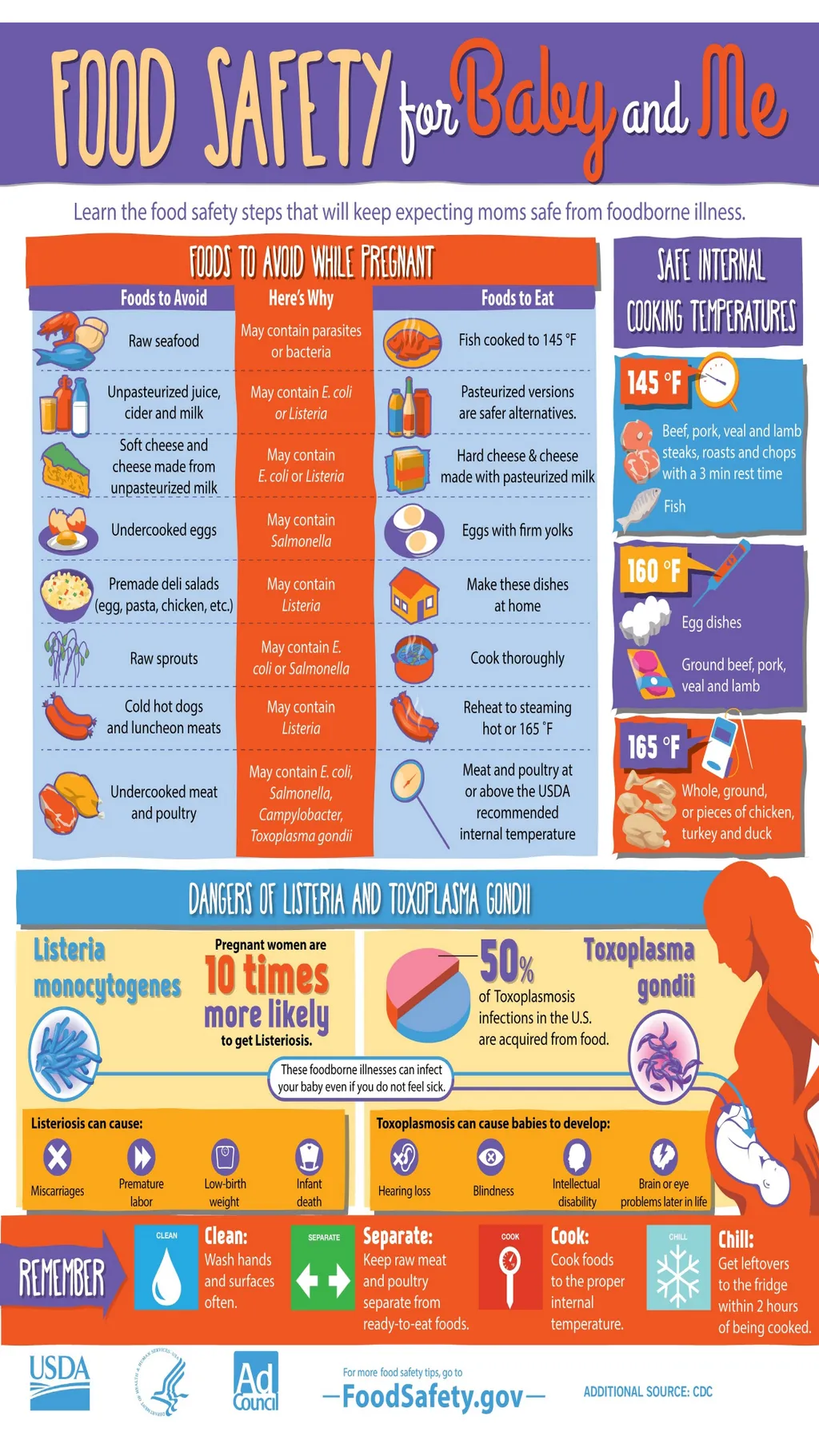
Foods to Avoid: Information is given on foods that should be avoided during pregnancy to minimise the risk of infections or other complications. This may include unpasteurised dairy products, raw or undercooked meats, certain types of fish (due to mercury levels), and excessive caffeine.
Exercise: The benefits of gentle exercise during pregnancy are discussed, along with guidance on safe and appropriate activities.
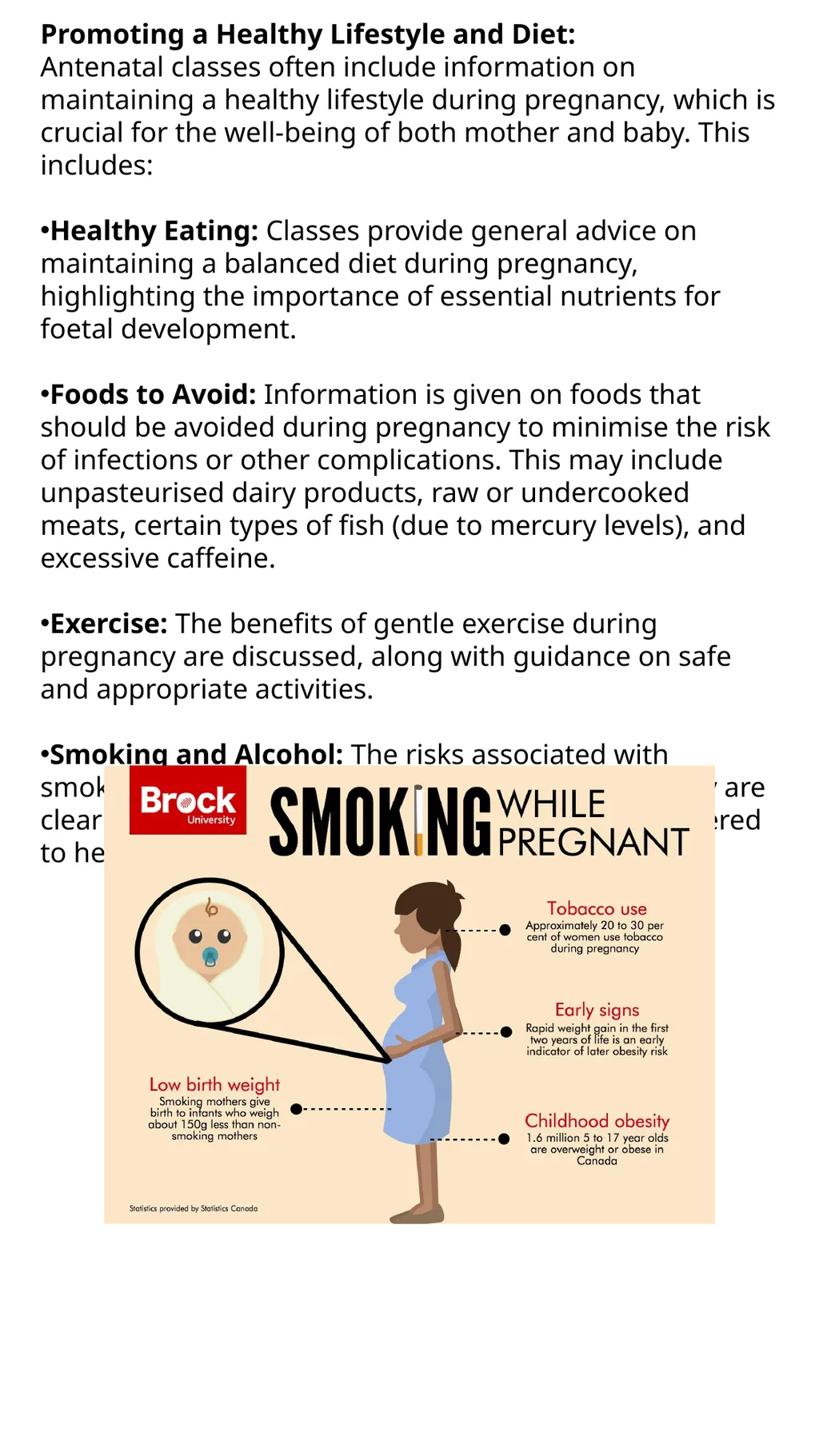
Smoking and Alcohol: The risks associated with smoking and alcohol consumption during pregnancy are clearly explained. Support and resources may be offered to help parents quit.<br>
Antenatal classes often include information on maintaining a healthy lifestyle during pregnancy, which is crucial for the well-being of both mother and baby. This includes:
Healthy Eating: Classes provide general advice on maintaining a balanced diet during pregnancy, highlighting the importance of essential nutrients for foetal development.
Foods to Avoid: Information is given on foods that should be avoided during pregnancy to minimise the risk of infections or other complications. This may include unpasteurised dairy products, raw or undercooked meats, certain types of fish (due to mercury levels), and excessive caffeine.
Exercise: The benefits of gentle exercise during pregnancy are discussed, along with guidance on safe and appropriate activities.
Smoking and Alcohol: The risks associated with smoking and alcohol consumption during pregnancy are clearly explained. Support and resources may be offered to help parents quit.<br>
17
Advice on Feeding and Caring for the Baby:
Antenatal classes also equip parents with the knowledge and skills they need to care for their newborn. This includes:
Feeding: Information is shared on different feeding methods, including breastfeeding and bottle-feeding. Classes often cover the benefits of breastfeeding and provide guidance on positioning, latch, and frequency of feeds.
Why Breastfeeding is Encouraged: The classes will explain the benefits of breastfeeding for at least the first two weeks, such as the provision of colostrum (early milk) which is rich in antibodies, and how it helps to build the baby’s immune system.
Nappy Changing: Practical demonstrations and guidance on how to change a nappy effectively.
Bathing: Safe and gentle techniques for bathing a newborn.
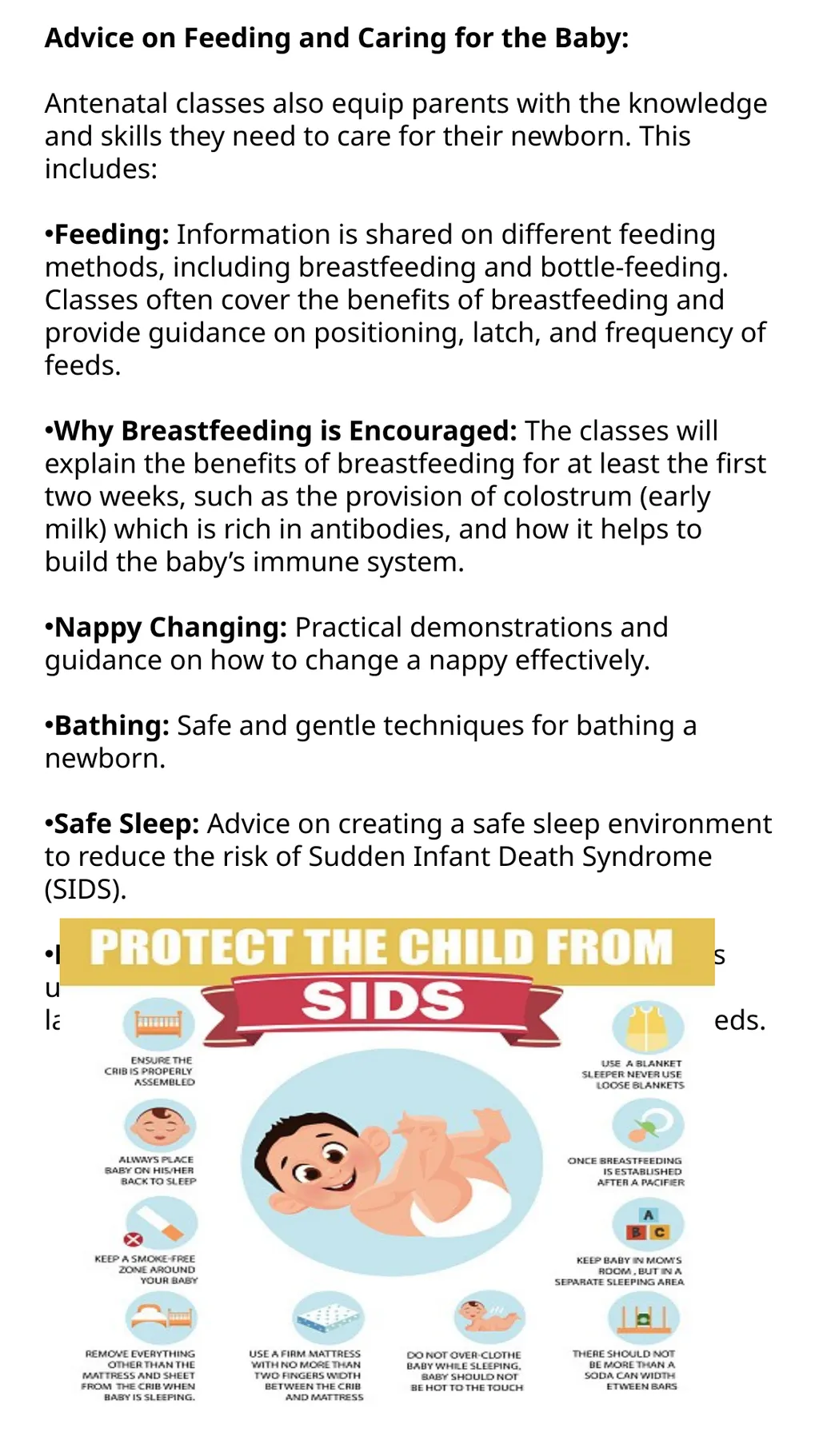
Safe Sleep: Advice on creating a safe sleep environment to reduce the risk of Sudden Infant Death Syndrome (SIDS).
Recognising Baby's Cues: Classes may help parents understand their baby's different cries and body language, so they can respond effectively to their needs.<br>
Antenatal classes also equip parents with the knowledge and skills they need to care for their newborn. This includes:
Feeding: Information is shared on different feeding methods, including breastfeeding and bottle-feeding. Classes often cover the benefits of breastfeeding and provide guidance on positioning, latch, and frequency of feeds.
Why Breastfeeding is Encouraged: The classes will explain the benefits of breastfeeding for at least the first two weeks, such as the provision of colostrum (early milk) which is rich in antibodies, and how it helps to build the baby’s immune system.
Nappy Changing: Practical demonstrations and guidance on how to change a nappy effectively.
Bathing: Safe and gentle techniques for bathing a newborn.
Safe Sleep: Advice on creating a safe sleep environment to reduce the risk of Sudden Infant Death Syndrome (SIDS).
Recognising Baby's Cues: Classes may help parents understand their baby's different cries and body language, so they can respond effectively to their needs.<br>
18
Exam Technique Understanding the 4-Mark, Two-Answer Question Format
Many questions in the OCR Child Development exam are worth 4 marks but only require two points to be made. The key is that each point needs a clear and detailed explanation to earn full marks. Simply stating two facts will only get you 2 marks. The other 2 marks come from explaining why those facts are important or relevant.
How to Approach These Questions:
Identify the Two Key Points: Carefully read the question and determine the two main things you need to address.
State Your First Point Clearly: Start with a clear statement of your first point.
Explain the Significance of Your First Point: This is where you earn the extra marks. Explain why this point is important, what its impact is, or how it relates to the question. Use connecting words like "because," "this means that," "as a result," or "therefore" to show the link between your point and its explanation.
Example using the Anomaly Scan Question:
Question: Identify two true statements about an ultrasound anomaly scan and explain why each statement is important.
Answer:
Statement 1: An ultrasound anomaly scan checks for major physical abnormalities in the baby. Explanation: This is important because it allows parents and healthcare professionals to identify potential health issues early in the pregnancy.
Statement 2: An ultrasound anomaly scan checks the baby's spinal cord. Explanation: Checking the spinal cord is crucial as it helps to detect neural tube defects like spina bifida<br>
Many questions in the OCR Child Development exam are worth 4 marks but only require two points to be made. The key is that each point needs a clear and detailed explanation to earn full marks. Simply stating two facts will only get you 2 marks. The other 2 marks come from explaining why those facts are important or relevant.
How to Approach These Questions:
Identify the Two Key Points: Carefully read the question and determine the two main things you need to address.
State Your First Point Clearly: Start with a clear statement of your first point.
Explain the Significance of Your First Point: This is where you earn the extra marks. Explain why this point is important, what its impact is, or how it relates to the question. Use connecting words like "because," "this means that," "as a result," or "therefore" to show the link between your point and its explanation.
Example using the Anomaly Scan Question:
Question: Identify two true statements about an ultrasound anomaly scan and explain why each statement is important.
Answer:
Statement 1: An ultrasound anomaly scan checks for major physical abnormalities in the baby. Explanation: This is important because it allows parents and healthcare professionals to identify potential health issues early in the pregnancy.
Statement 2: An ultrasound anomaly scan checks the baby's spinal cord. Explanation: Checking the spinal cord is crucial as it helps to detect neural tube defects like spina bifida<br>
19
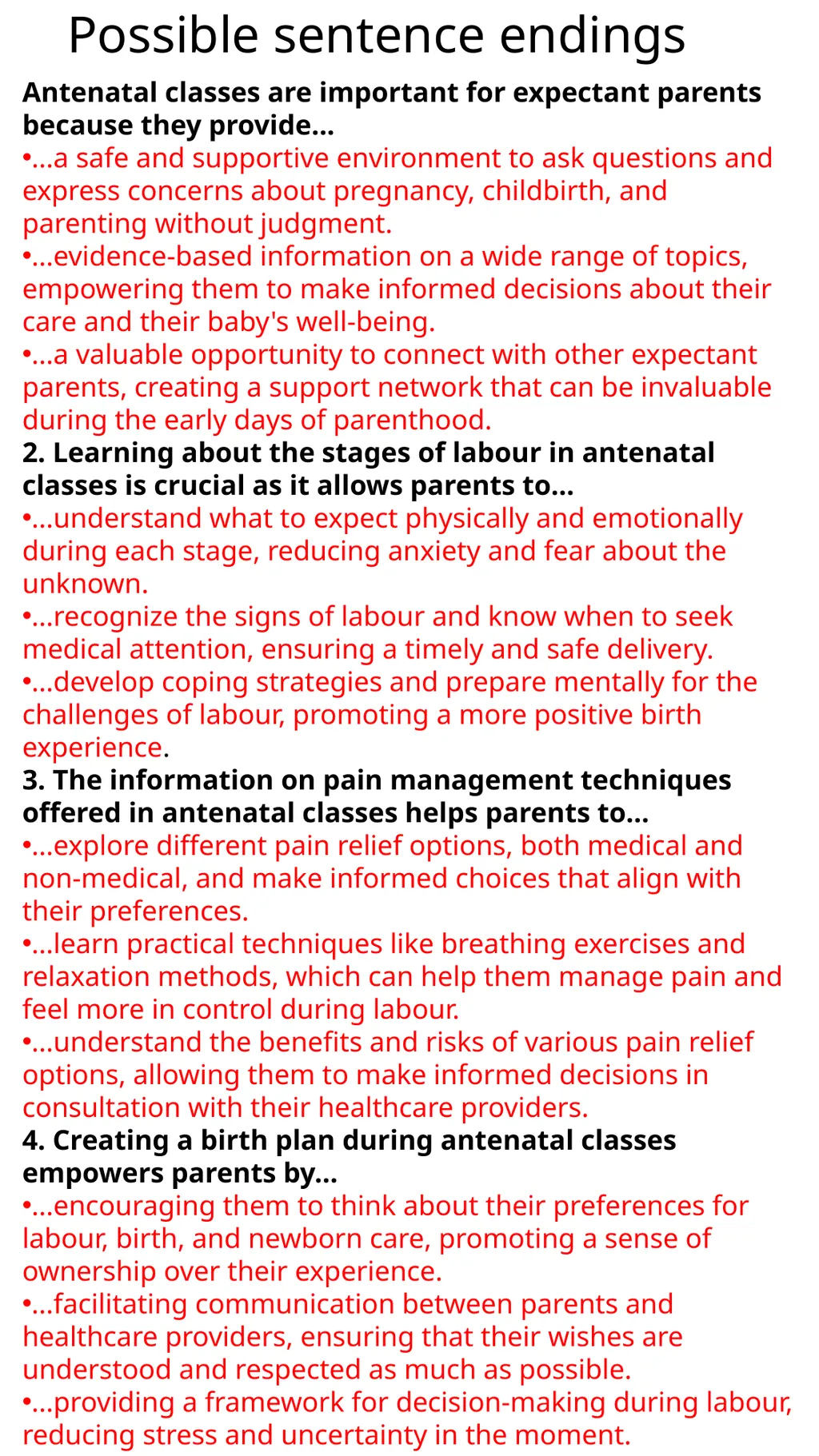
You do Here are 10 sentence starters for students to practice explaining the importance of antenatal classes. Complete each sentence with a detailed explanation:
Antenatal classes are important for expectant parents because they provide
________________________________________________________________________________________________________________________
Learning about the stages of labour in antenatal classes is crucial as it allows parents to…
______________________________________________________________________________________________________________________
The information on pain management techniques offered in antenatal classes helps parents to…
______________________________________________________________________________________________________________________
Creating a birth plan during antenatal classes empowers parents by…
______________________________________________________________________________________________________________________
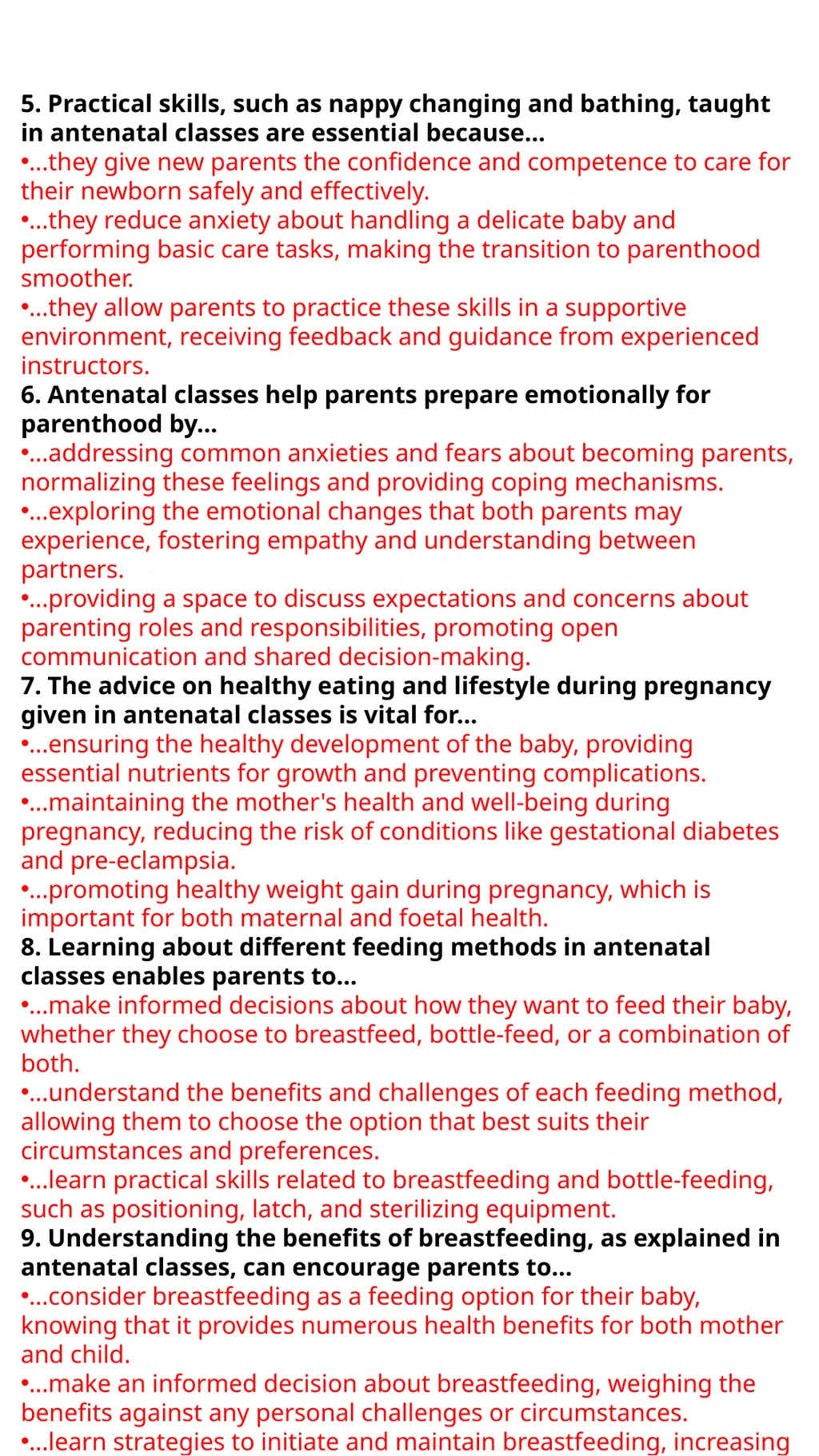
Practical skills, such as nappy changing and bathing, taught in antenatal classes are essential because…
______________________________________________________________________________________________________________________
Antenatal classes help parents prepare emotionally for parenthood by
______________________________________________________________________________________________________________________
The advice on healthy eating and lifestyle during pregnancy given in antenatal classes is vital for…
______________________________________________________________________________________________________________________
Learning about different feeding methods in antenatal classes enables parents to…
______________________________________________________________________________________________________________________
Understanding the benefits of breastfeeding, as explained in antenatal classes, can encourage parents to…
___________________________________________________________________________________________________________________________<br>
Antenatal classes are important for expectant parents because they provide
________________________________________________________________________________________________________________________
Learning about the stages of labour in antenatal classes is crucial as it allows parents to…
______________________________________________________________________________________________________________________
The information on pain management techniques offered in antenatal classes helps parents to…
______________________________________________________________________________________________________________________
Creating a birth plan during antenatal classes empowers parents by…
______________________________________________________________________________________________________________________
Practical skills, such as nappy changing and bathing, taught in antenatal classes are essential because…
______________________________________________________________________________________________________________________
Antenatal classes help parents prepare emotionally for parenthood by
______________________________________________________________________________________________________________________
The advice on healthy eating and lifestyle during pregnancy given in antenatal classes is vital for…
______________________________________________________________________________________________________________________
Learning about different feeding methods in antenatal classes enables parents to…
______________________________________________________________________________________________________________________
Understanding the benefits of breastfeeding, as explained in antenatal classes, can encourage parents to…
___________________________________________________________________________________________________________________________<br>
20
2.4 The Choices Available for Delivery
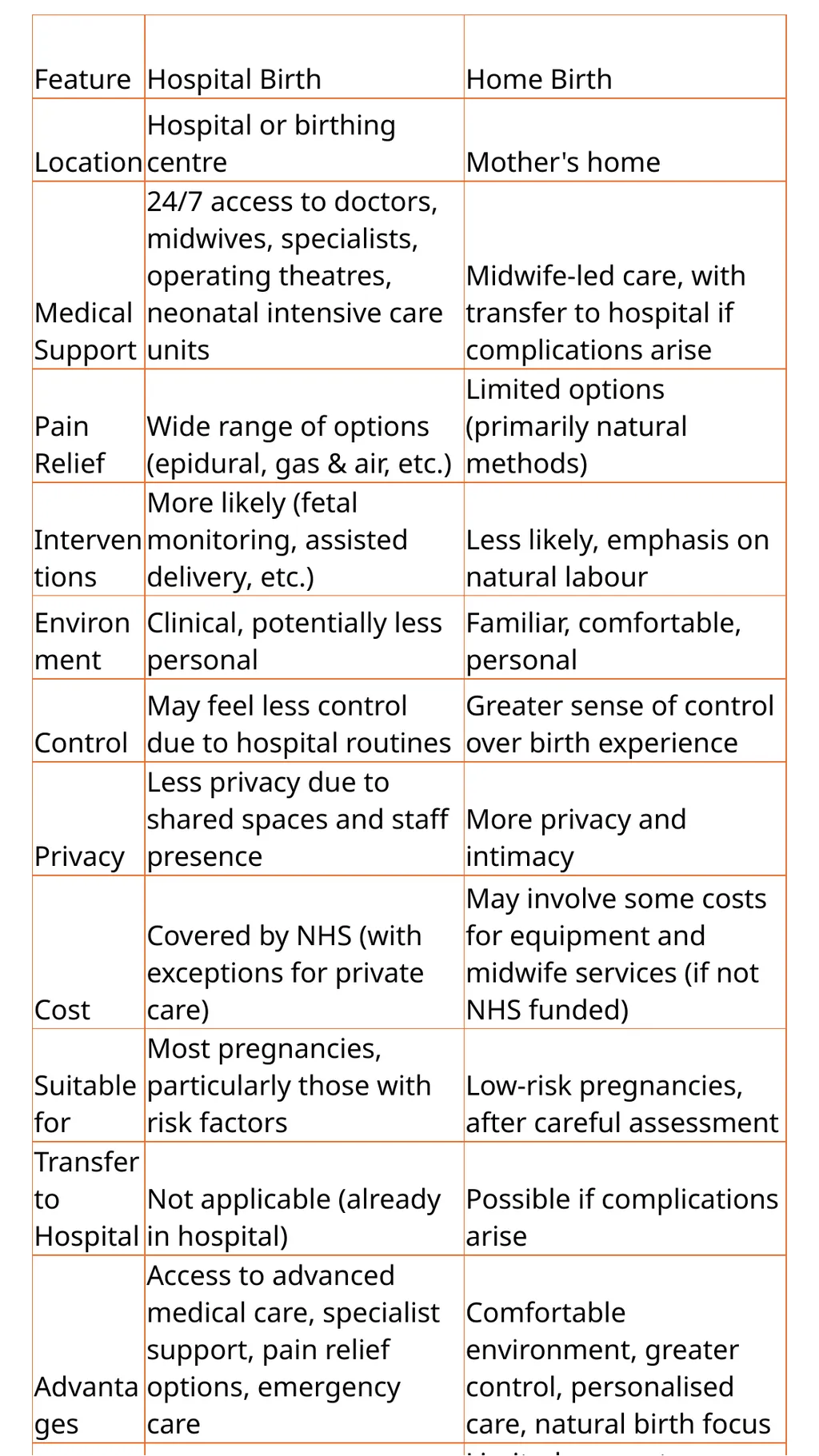
When it comes to giving birth, expectant parents have several choices to consider. Two common options are hospital birth and home birth. Each has its own set of advantages and disadvantages, and the best choice for each family depends on their individual circumstances, preferences, and risk factors.
Hospital Birth:
A hospital birth is the most common choice in many countries. Hospitals offer a range of medical facilities and specialist care readily available should any complications arise.
Reasons for Choosing a Hospital Birth:
Access to Medical Care: Hospitals have immediate access to advanced medical technology, including foetal monitoring, pain relief options (like epidurals), and operating theatres for caesarean sections. This is particularly important for women with pre-existing medical conditions or those at risk of complications during labour.
Specialist Support: A team of healthcare professionals, including doctors, midwives, and nurses, are available 24/7 to provide care and support during labour and birth. Specialists, such as obstetricians and paediatricians, are on hand should the need arise.
Pain Relief Options: Hospitals offer a wider range of pain relief options, including epidural anaesthesia, which may not be available for home births.
Emergency Care: In case of emergencies, such as foetal distress or complications during delivery, hospitals are equipped to provide immediate intervention.
Advantages of Hospital Birth:
Availability of advanced medical technology and interventions.
24/7 access to specialist medical care.
Wide range of pain relief options.
Immediate access to emergency care for both mother and baby.
Disadvantages of Hospital Birth:
Less personal control over the birth environment. Hospital protocols and routines may sometimes feel impersonal or restrictive.
Potentially higher intervention rates. The availability of medical interventions may sometimes lead to their overuse.
Can feel less intimate and personal than a home birth. The hospital environment may feel less relaxed and home-like.<br>
When it comes to giving birth, expectant parents have several choices to consider. Two common options are hospital birth and home birth. Each has its own set of advantages and disadvantages, and the best choice for each family depends on their individual circumstances, preferences, and risk factors.
Hospital Birth:
A hospital birth is the most common choice in many countries. Hospitals offer a range of medical facilities and specialist care readily available should any complications arise.
Reasons for Choosing a Hospital Birth:
Access to Medical Care: Hospitals have immediate access to advanced medical technology, including foetal monitoring, pain relief options (like epidurals), and operating theatres for caesarean sections. This is particularly important for women with pre-existing medical conditions or those at risk of complications during labour.
Specialist Support: A team of healthcare professionals, including doctors, midwives, and nurses, are available 24/7 to provide care and support during labour and birth. Specialists, such as obstetricians and paediatricians, are on hand should the need arise.
Pain Relief Options: Hospitals offer a wider range of pain relief options, including epidural anaesthesia, which may not be available for home births.
Emergency Care: In case of emergencies, such as foetal distress or complications during delivery, hospitals are equipped to provide immediate intervention.
Advantages of Hospital Birth:
Availability of advanced medical technology and interventions.
24/7 access to specialist medical care.
Wide range of pain relief options.
Immediate access to emergency care for both mother and baby.
Disadvantages of Hospital Birth:
Less personal control over the birth environment. Hospital protocols and routines may sometimes feel impersonal or restrictive.
Potentially higher intervention rates. The availability of medical interventions may sometimes lead to their overuse.
Can feel less intimate and personal than a home birth. The hospital environment may feel less relaxed and home-like.<br>
21
Home Birth:
A home birth involves giving birth in the comfort and familiarity of your own home, typically with the assistance of a midwife. It's becoming an increasingly popular choice for women who desire a more natural and personalized birth experience.
Reasons for Choosing a Home Birth:
Comfort and Familiarity: Giving birth at home allows women to labour in a familiar and comfortable environment, surrounded by their own belongings and loved ones.
Greater Control: Women often feel more in control of the birthing process at home, as they are less subject to hospital routines and interventions.
More Personalised Care: Home births typically involve one-on-one care from a known midwife, fostering a more personal and supportive relationship.
Natural Birth Experience: Women who choose home birth often desire a more natural and less intervention-focused birth experience.
Advantages of Home Birth:
Comfort and familiarity of the home environment.
Greater sense of control over the birth experience.
More personalized care from a known midwife.
Opportunity for a more natural and less intervention-focused birth.
Disadvantages of Home Birth:
Limited access to medical interventions. In case of complications, transfer to a hospital may be necessary.
Not suitable for all pregnancies. Women with certain medical conditions or those at high risk of complications may not be eligible for a home birth.
Requires careful planning and assessment. A thorough risk assessment is essential to ensure the safety of both mother and baby.<br>
A home birth involves giving birth in the comfort and familiarity of your own home, typically with the assistance of a midwife. It's becoming an increasingly popular choice for women who desire a more natural and personalized birth experience.
Reasons for Choosing a Home Birth:
Comfort and Familiarity: Giving birth at home allows women to labour in a familiar and comfortable environment, surrounded by their own belongings and loved ones.
Greater Control: Women often feel more in control of the birthing process at home, as they are less subject to hospital routines and interventions.
More Personalised Care: Home births typically involve one-on-one care from a known midwife, fostering a more personal and supportive relationship.
Natural Birth Experience: Women who choose home birth often desire a more natural and less intervention-focused birth experience.
Advantages of Home Birth:
Comfort and familiarity of the home environment.
Greater sense of control over the birth experience.
More personalized care from a known midwife.
Opportunity for a more natural and less intervention-focused birth.
Disadvantages of Home Birth:
Limited access to medical interventions. In case of complications, transfer to a hospital may be necessary.
Not suitable for all pregnancies. Women with certain medical conditions or those at high risk of complications may not be eligible for a home birth.
Requires careful planning and assessment. A thorough risk assessment is essential to ensure the safety of both mother and baby.<br>
22
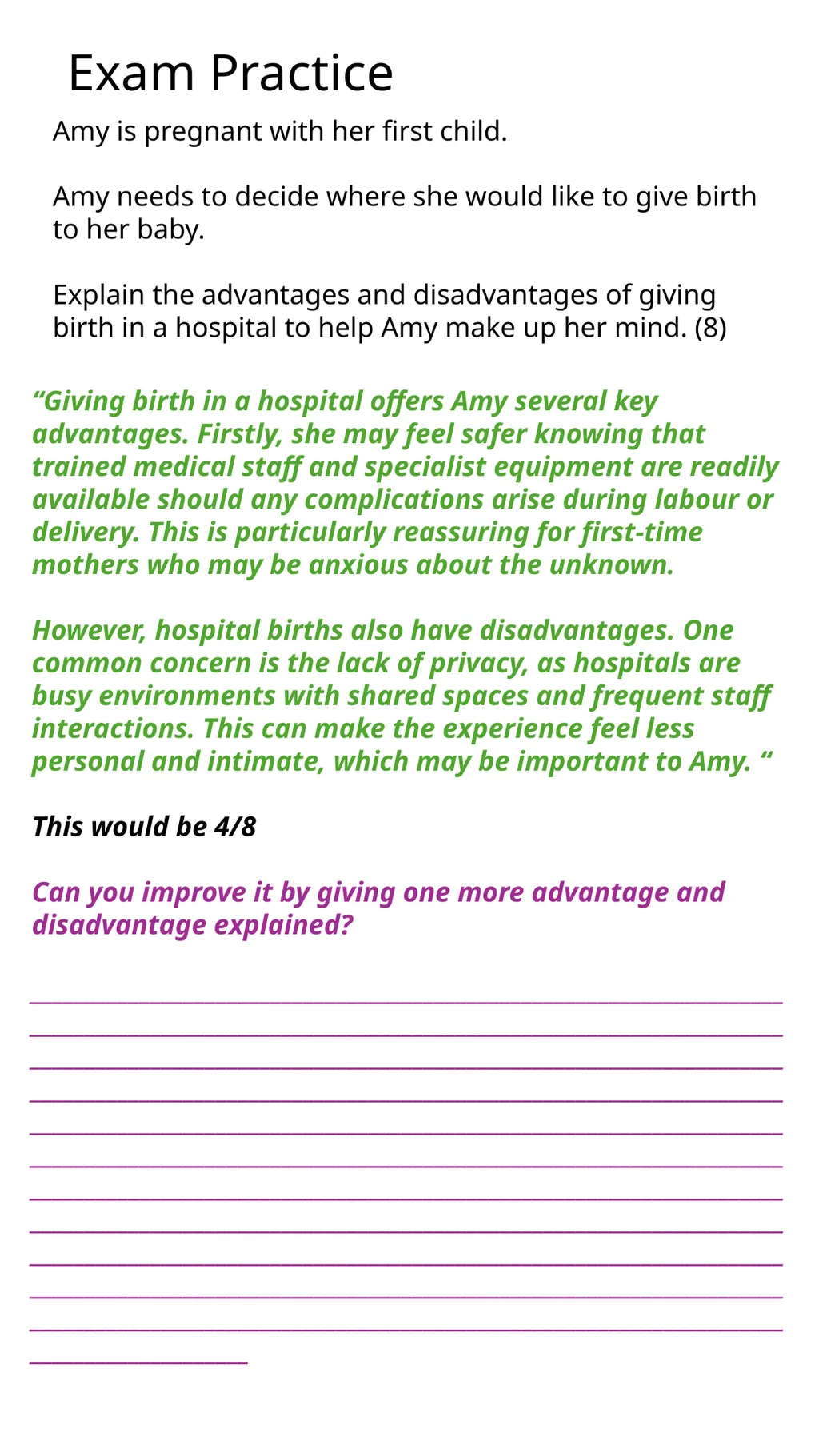
Exam Practice Amy is pregnant with her first child.
Amy needs to decide where she would like to give birth to her baby.
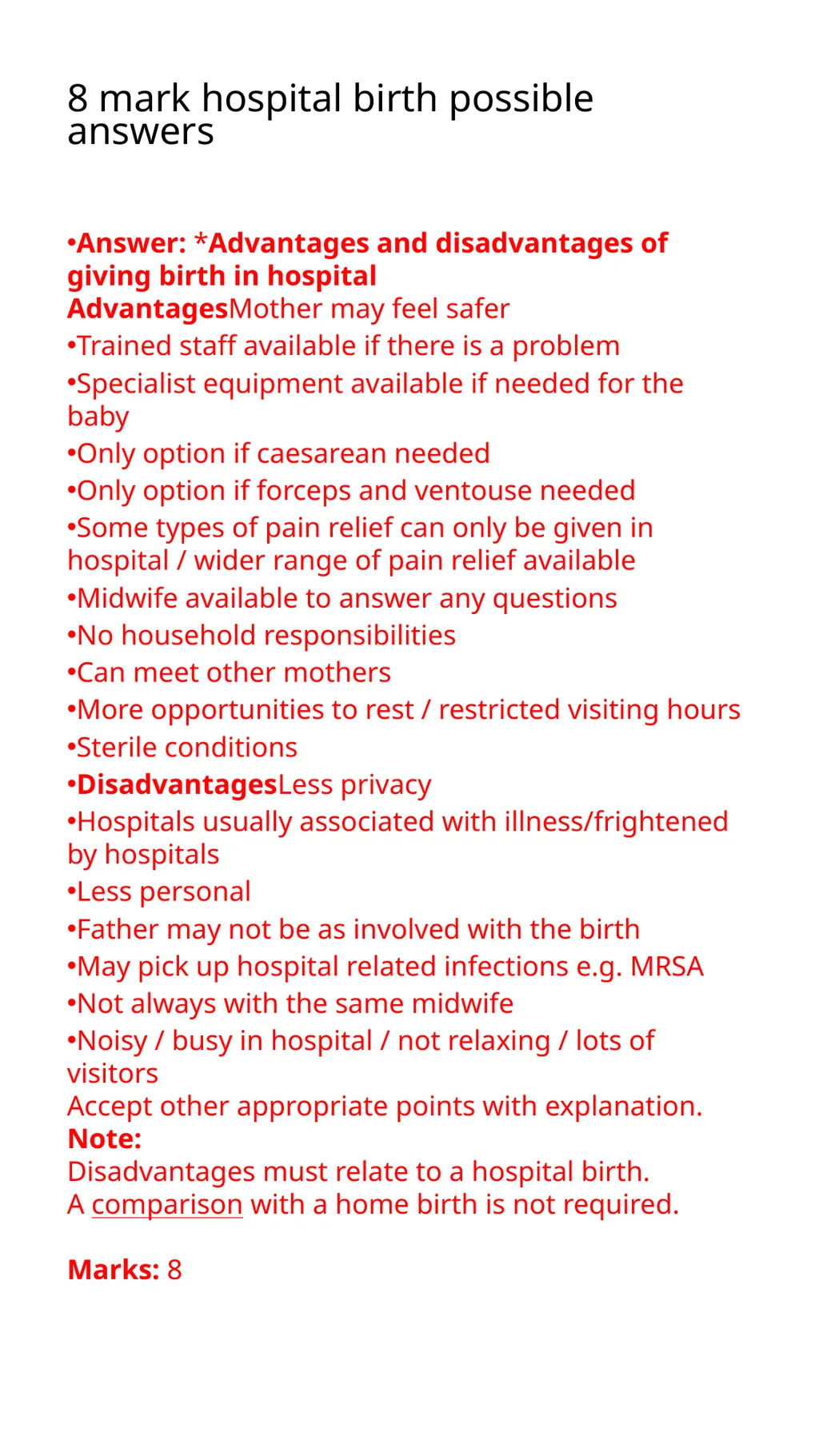
Explain the advantages and disadvantages of giving birth in a hospital to help Amy make up her mind. (8) “Giving birth in a hospital offers Amy several key advantages. Firstly, she may feel safer knowing that trained medical staff and specialist equipment are readily available should any complications arise during labour or delivery. This is particularly reassuring for first-time mothers who may be anxious about the unknown.
However, hospital births also have disadvantages. One common concern is the lack of privacy, as hospitals are busy environments with shared spaces and frequent staff interactions. This can make the experience feel less personal and intimate, which may be important to Amy. “
This would be 4/8
Can you improve it by giving one more advantage and disadvantage explained?
___________________________________________________________________________________________________________________________________________________________________________________________________________________________________________________________________________________________________________________________________________________________________________________________________________________________________________________________________________________________________________________________________________________________________________________________________________________________________________________________________________________________________________________________________________________________________________________________________________<br>
Amy needs to decide where she would like to give birth to her baby.
Explain the advantages and disadvantages of giving birth in a hospital to help Amy make up her mind. (8) “Giving birth in a hospital offers Amy several key advantages. Firstly, she may feel safer knowing that trained medical staff and specialist equipment are readily available should any complications arise during labour or delivery. This is particularly reassuring for first-time mothers who may be anxious about the unknown.
However, hospital births also have disadvantages. One common concern is the lack of privacy, as hospitals are busy environments with shared spaces and frequent staff interactions. This can make the experience feel less personal and intimate, which may be important to Amy. “
This would be 4/8
Can you improve it by giving one more advantage and disadvantage explained?
___________________________________________________________________________________________________________________________________________________________________________________________________________________________________________________________________________________________________________________________________________________________________________________________________________________________________________________________________________________________________________________________________________________________________________________________________________________________________________________________________________________________________________________________________________________________________________________________________________<br>
23
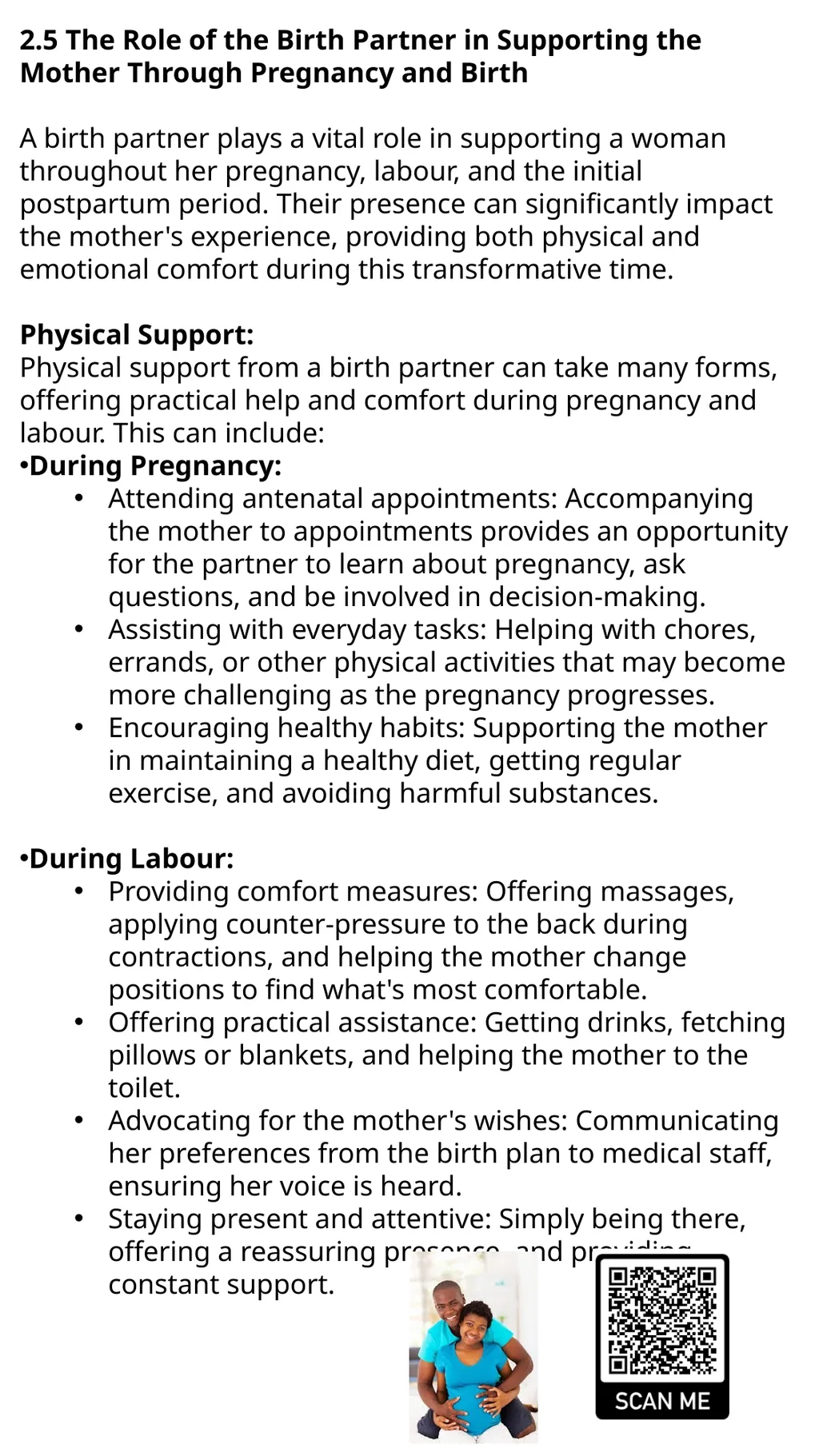
2.5 The Role of the Birth Partner in Supporting the Mother Through Pregnancy and Birth
A birth partner plays a vital role in supporting a woman throughout her pregnancy, labour, and the initial postpartum period. Their presence can significantly impact the mother's experience, providing both physical and emotional comfort during this transformative time.
Physical Support:
Physical support from a birth partner can take many forms, offering practical help and comfort during pregnancy and labour. This can include:
During Pregnancy:
Attending antenatal appointments: Accompanying the mother to appointments provides an opportunity for the partner to learn about pregnancy, ask questions, and be involved in decision-making.
Assisting with everyday tasks: Helping with chores, errands, or other physical activities that may become more challenging as the pregnancy progresses.
Encouraging healthy habits: Supporting the mother in maintaining a healthy diet, getting regular exercise, and avoiding harmful substances.
During Labour:
Providing comfort measures: Offering massages, applying counter-pressure to the back during contractions, and helping the mother change positions to find what's most comfortable.
Offering practical assistance: Getting drinks, fetching pillows or blankets, and helping the mother to the toilet.
Advocating for the mother's wishes: Communicating her preferences from the birth plan to medical staff, ensuring her voice is heard.
Staying present and attentive: Simply being there, offering a reassuring presence, and providing constant support.<br>
A birth partner plays a vital role in supporting a woman throughout her pregnancy, labour, and the initial postpartum period. Their presence can significantly impact the mother's experience, providing both physical and emotional comfort during this transformative time.
Physical Support:
Physical support from a birth partner can take many forms, offering practical help and comfort during pregnancy and labour. This can include:
During Pregnancy:
Attending antenatal appointments: Accompanying the mother to appointments provides an opportunity for the partner to learn about pregnancy, ask questions, and be involved in decision-making.
Assisting with everyday tasks: Helping with chores, errands, or other physical activities that may become more challenging as the pregnancy progresses.
Encouraging healthy habits: Supporting the mother in maintaining a healthy diet, getting regular exercise, and avoiding harmful substances.
During Labour:
Providing comfort measures: Offering massages, applying counter-pressure to the back during contractions, and helping the mother change positions to find what's most comfortable.
Offering practical assistance: Getting drinks, fetching pillows or blankets, and helping the mother to the toilet.
Advocating for the mother's wishes: Communicating her preferences from the birth plan to medical staff, ensuring her voice is heard.
Staying present and attentive: Simply being there, offering a reassuring presence, and providing constant support.<br>
24
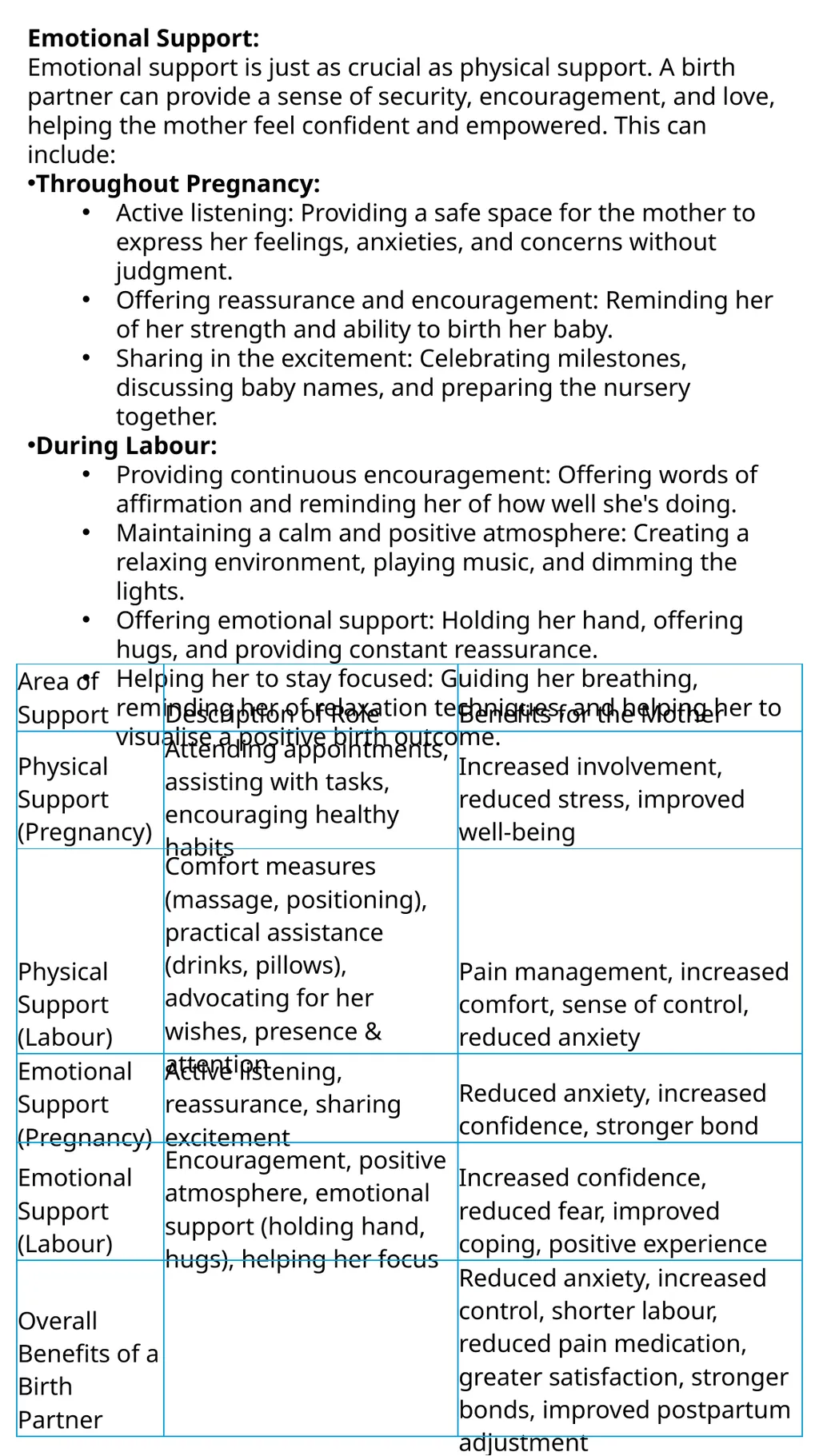
Emotional Support:
Emotional support is just as crucial as physical support. A birth partner can provide a sense of security, encouragement, and love, helping the mother feel confident and empowered. This can include:
Throughout Pregnancy:
Active listening: Providing a safe space for the mother to express her feelings, anxieties, and concerns without judgment.
Offering reassurance and encouragement: Reminding her of her strength and ability to birth her baby.
Sharing in the excitement: Celebrating milestones, discussing baby names, and preparing the nursery together.
During Labour:
Providing continuous encouragement: Offering words of affirmation and reminding her of how well she's doing.
Maintaining a calm and positive atmosphere: Creating a relaxing environment, playing music, and dimming the lights.
Offering emotional support: Holding her hand, offering hugs, and providing constant reassurance.
Helping her to stay focused: Guiding her breathing, reminding her of relaxation techniques, and helping her to visualise a positive birth outcome.<br>
Emotional support is just as crucial as physical support. A birth partner can provide a sense of security, encouragement, and love, helping the mother feel confident and empowered. This can include:
Throughout Pregnancy:
Active listening: Providing a safe space for the mother to express her feelings, anxieties, and concerns without judgment.
Offering reassurance and encouragement: Reminding her of her strength and ability to birth her baby.
Sharing in the excitement: Celebrating milestones, discussing baby names, and preparing the nursery together.
During Labour:
Providing continuous encouragement: Offering words of affirmation and reminding her of how well she's doing.
Maintaining a calm and positive atmosphere: Creating a relaxing environment, playing music, and dimming the lights.
Offering emotional support: Holding her hand, offering hugs, and providing constant reassurance.
Helping her to stay focused: Guiding her breathing, reminding her of relaxation techniques, and helping her to visualise a positive birth outcome.<br>
25
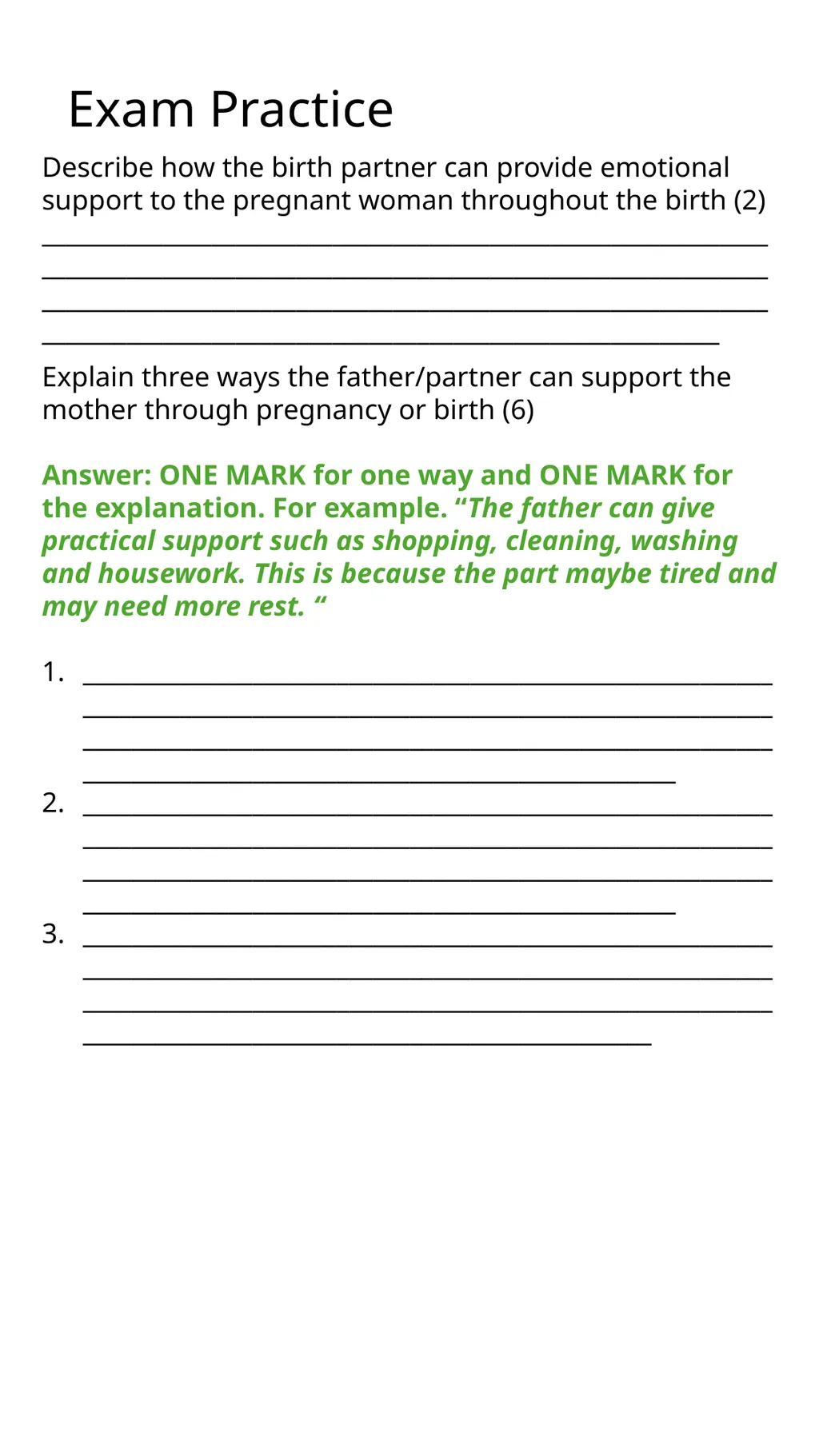
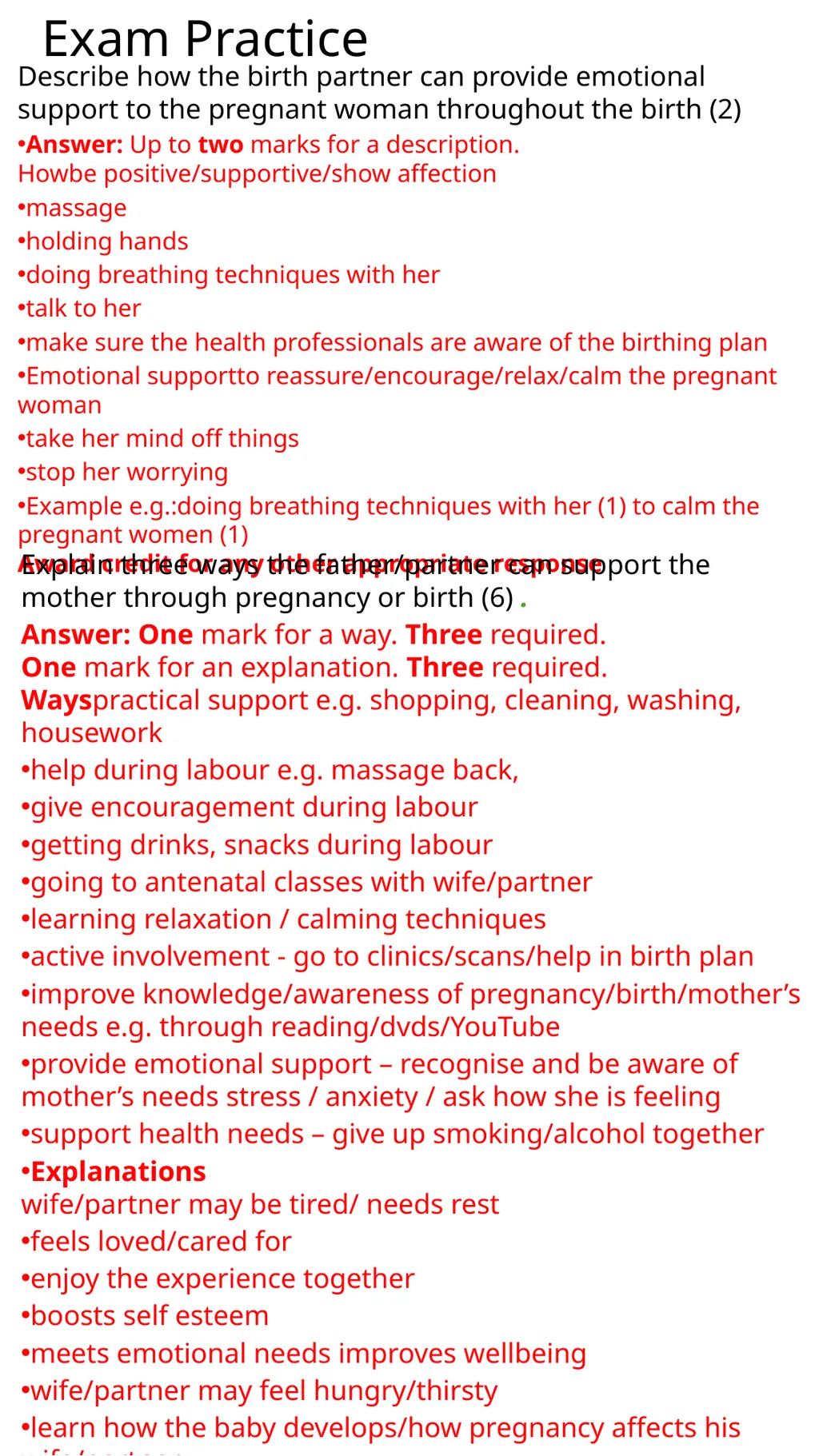
Exam Practice Describe how the birth partner can provide emotional support to the pregnant woman throughout the birth (2)
____________________________________________________________________________________________________________________________________________________________________________________________________________________________________________ Explain three ways the father/partner can support the mother through pregnancy or birth (6)
Answer: ONE MARK for one way and ONE MARK for the explanation. For example. “The father can give practical support such as shopping, cleaning, washing and housework. This is because the part maybe tired and may need more rest. “
____________________________________________________________________________________________________________________________________________________________________________________________________________________________
____________________________________________________________________________________________________________________________________________________________________________________________________________________________
__________________________________________________________________________________________________________________________________________________________________________________________________________________________<br>
____________________________________________________________________________________________________________________________________________________________________________________________________________________________________________ Explain three ways the father/partner can support the mother through pregnancy or birth (6)
Answer: ONE MARK for one way and ONE MARK for the explanation. For example. “The father can give practical support such as shopping, cleaning, washing and housework. This is because the part maybe tired and may need more rest. “
____________________________________________________________________________________________________________________________________________________________________________________________________________________________
____________________________________________________________________________________________________________________________________________________________________________________________________________________________
__________________________________________________________________________________________________________________________________________________________________________________________________________________________<br>
26
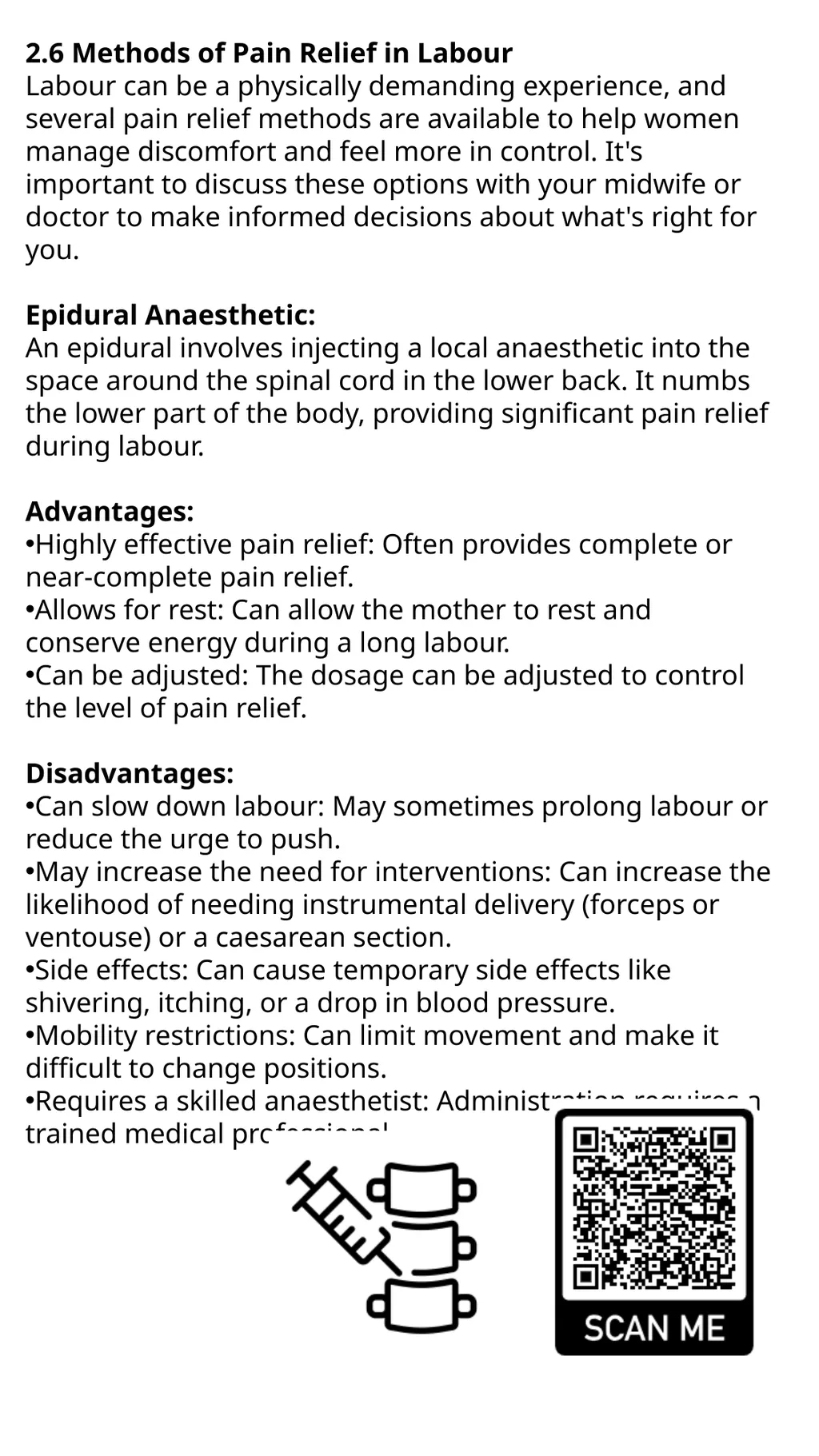
2.6 Methods of Pain Relief in Labour
Labour can be a physically demanding experience, and several pain relief methods are available to help women manage discomfort and feel more in control. It's important to discuss these options with your midwife or doctor to make informed decisions about what's right for you.
Epidural Anaesthetic:
An epidural involves injecting a local anaesthetic into the space around the spinal cord in the lower back. It numbs the lower part of the body, providing significant pain relief during labour.
Advantages:
Highly effective pain relief: Often provides complete or near-complete pain relief.
Allows for rest: Can allow the mother to rest and conserve energy during a long labour.
Can be adjusted: The dosage can be adjusted to control the level of pain relief.
Disadvantages:
Can slow down labour: May sometimes prolong labour or reduce the urge to push.
May increase the need for interventions: Can increase the likelihood of needing instrumental delivery (forceps or ventouse) or a caesarean section.
Side effects: Can cause temporary side effects like shivering, itching, or a drop in blood pressure.
Mobility restrictions: Can limit movement and make it difficult to change positions.
Requires a skilled anaesthetist: Administration requires a trained medical professional.<br>
Labour can be a physically demanding experience, and several pain relief methods are available to help women manage discomfort and feel more in control. It's important to discuss these options with your midwife or doctor to make informed decisions about what's right for you.
Epidural Anaesthetic:
An epidural involves injecting a local anaesthetic into the space around the spinal cord in the lower back. It numbs the lower part of the body, providing significant pain relief during labour.
Advantages:
Highly effective pain relief: Often provides complete or near-complete pain relief.
Allows for rest: Can allow the mother to rest and conserve energy during a long labour.
Can be adjusted: The dosage can be adjusted to control the level of pain relief.
Disadvantages:
Can slow down labour: May sometimes prolong labour or reduce the urge to push.
May increase the need for interventions: Can increase the likelihood of needing instrumental delivery (forceps or ventouse) or a caesarean section.
Side effects: Can cause temporary side effects like shivering, itching, or a drop in blood pressure.
Mobility restrictions: Can limit movement and make it difficult to change positions.
Requires a skilled anaesthetist: Administration requires a trained medical professional.<br>
27
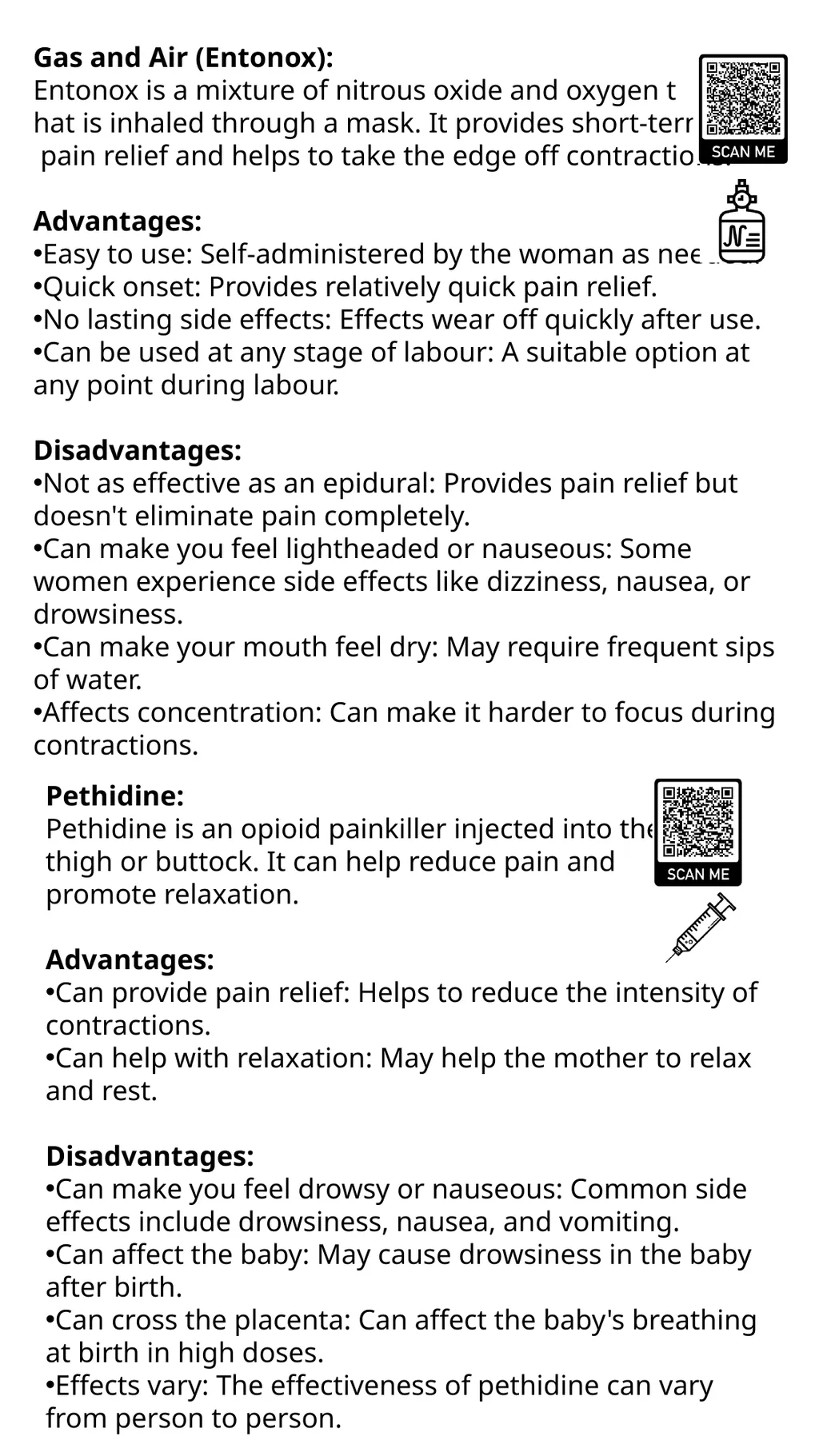
Gas and Air (Entonox):
Entonox is a mixture of nitrous oxide and oxygen t
hat is inhaled through a mask. It provides short-term
pain relief and helps to take the edge off contractions.
Advantages:
Easy to use: Self-administered by the woman as needed.
Quick onset: Provides relatively quick pain relief.
No lasting side effects: Effects wear off quickly after use.
Can be used at any stage of labour: A suitable option at any point during labour.
Disadvantages:
Not as effective as an epidural: Provides pain relief but doesn't eliminate pain completely.
Can make you feel lightheaded or nauseous: Some women experience side effects like dizziness, nausea, or drowsiness.
Can make your mouth feel dry: May require frequent sips of water.
Affects concentration: Can make it harder to focus during contractions. Pethidine:
Pethidine is an opioid painkiller injected into the
thigh or buttock. It can help reduce pain and
promote relaxation.
Advantages:
Can provide pain relief: Helps to reduce the intensity of contractions.
Can help with relaxation: May help the mother to relax and rest.
Disadvantages:
Can make you feel drowsy or nauseous: Common side effects include drowsiness, nausea, and vomiting.
Can affect the baby: May cause drowsiness in the baby after birth.
Can cross the placenta: Can affect the baby's breathing at birth in high doses.
Effects vary: The effectiveness of pethidine can vary from person to person.<br>
Entonox is a mixture of nitrous oxide and oxygen t
hat is inhaled through a mask. It provides short-term
pain relief and helps to take the edge off contractions.
Advantages:
Easy to use: Self-administered by the woman as needed.
Quick onset: Provides relatively quick pain relief.
No lasting side effects: Effects wear off quickly after use.
Can be used at any stage of labour: A suitable option at any point during labour.
Disadvantages:
Not as effective as an epidural: Provides pain relief but doesn't eliminate pain completely.
Can make you feel lightheaded or nauseous: Some women experience side effects like dizziness, nausea, or drowsiness.
Can make your mouth feel dry: May require frequent sips of water.
Affects concentration: Can make it harder to focus during contractions. Pethidine:
Pethidine is an opioid painkiller injected into the
thigh or buttock. It can help reduce pain and
promote relaxation.
Advantages:
Can provide pain relief: Helps to reduce the intensity of contractions.
Can help with relaxation: May help the mother to relax and rest.
Disadvantages:
Can make you feel drowsy or nauseous: Common side effects include drowsiness, nausea, and vomiting.
Can affect the baby: May cause drowsiness in the baby after birth.
Can cross the placenta: Can affect the baby's breathing at birth in high doses.
Effects vary: The effectiveness of pethidine can vary from person to person.<br>
28
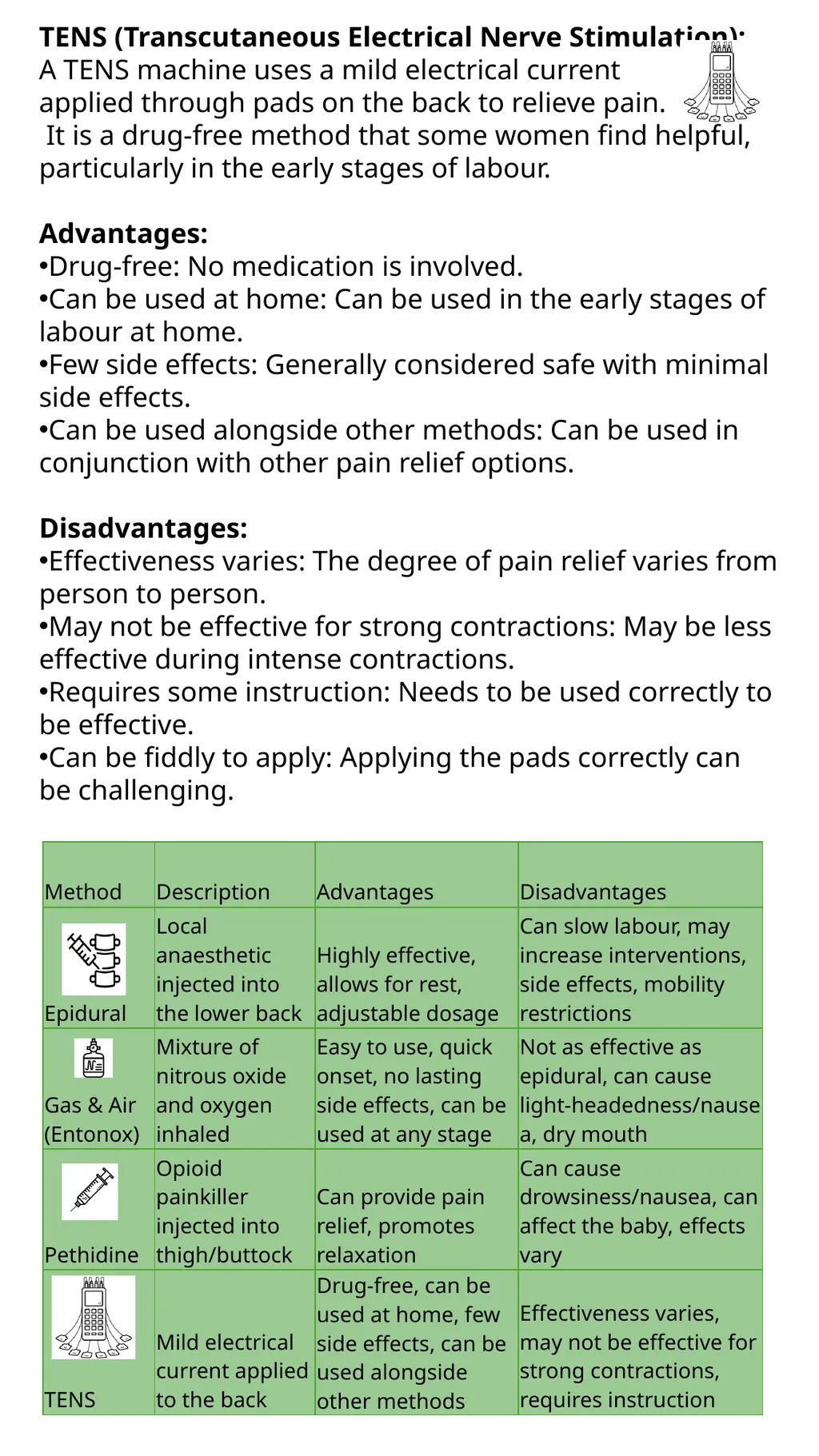
TENS (Transcutaneous Electrical Nerve Stimulation):
A TENS machine uses a mild electrical current
applied through pads on the back to relieve pain.
It is a drug-free method that some women find helpful, particularly in the early stages of labour.
Advantages:
Drug-free: No medication is involved.
Can be used at home: Can be used in the early stages of labour at home.
Few side effects: Generally considered safe with minimal side effects.
Can be used alongside other methods: Can be used in conjunction with other pain relief options.
Disadvantages:
Effectiveness varies: The degree of pain relief varies from person to person.
May not be effective for strong contractions: May be less effective during intense contractions.
Requires some instruction: Needs to be used correctly to be effective.
Can be fiddly to apply: Applying the pads correctly can be challenging.<br>
A TENS machine uses a mild electrical current
applied through pads on the back to relieve pain.
It is a drug-free method that some women find helpful, particularly in the early stages of labour.
Advantages:
Drug-free: No medication is involved.
Can be used at home: Can be used in the early stages of labour at home.
Few side effects: Generally considered safe with minimal side effects.
Can be used alongside other methods: Can be used in conjunction with other pain relief options.
Disadvantages:
Effectiveness varies: The degree of pain relief varies from person to person.
May not be effective for strong contractions: May be less effective during intense contractions.
Requires some instruction: Needs to be used correctly to be effective.
Can be fiddly to apply: Applying the pads correctly can be challenging.<br>
29
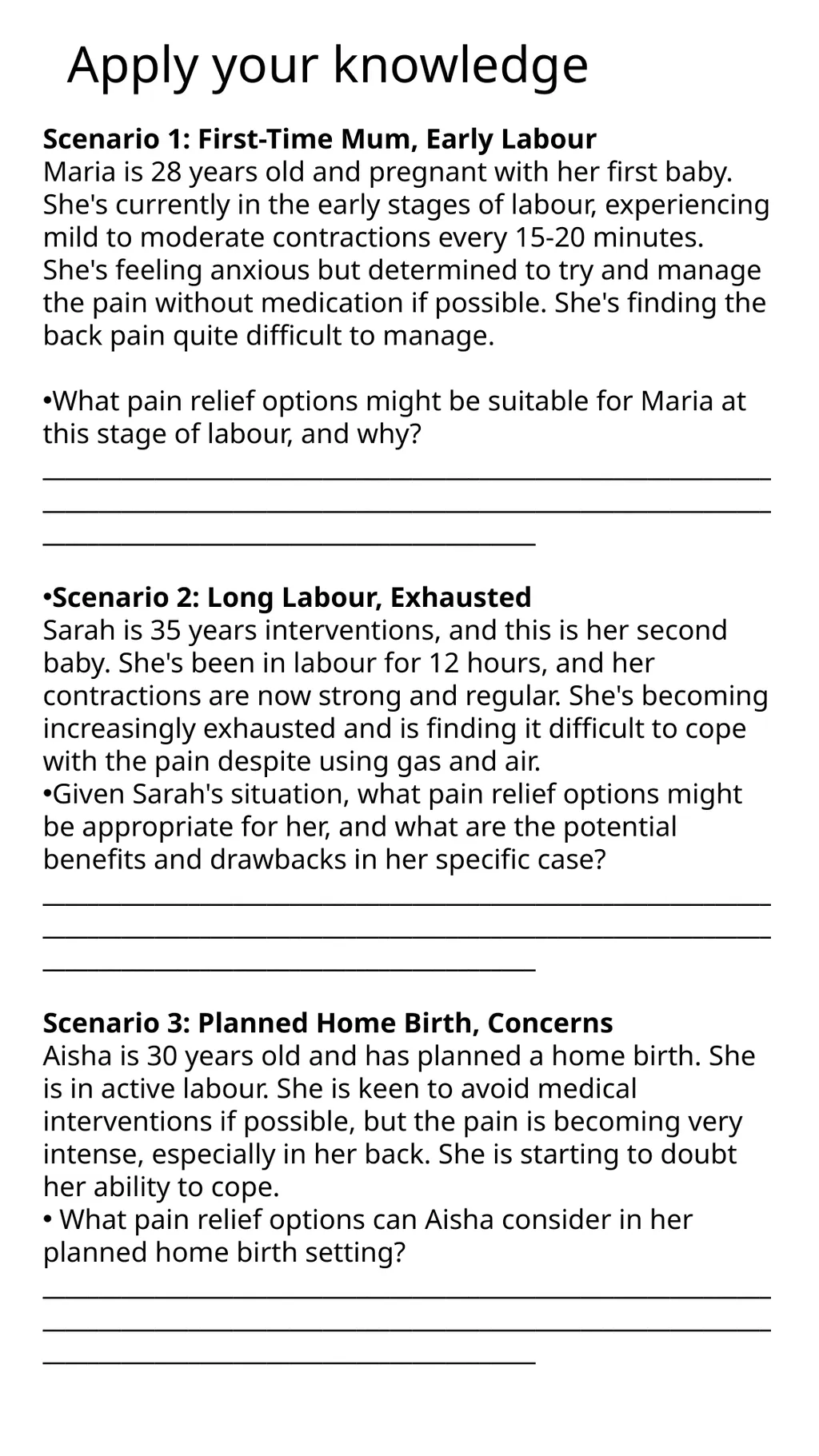
Apply your knowledge Scenario 1: First-Time Mum, Early Labour
Maria is 28 years old and pregnant with her first baby. She's currently in the early stages of labour, experiencing mild to moderate contractions every 15-20 minutes. She's feeling anxious but determined to try and manage the pain without medication if possible. She's finding the back pain quite difficult to manage.
What pain relief options might be suitable for Maria at this stage of labour, and why?
______________________________________________________________________________________________________________________________________________________________________________
Scenario 2: Long Labour, Exhausted
Sarah is 35 years interventions, and this is her second baby. She's been in labour for 12 hours, and her contractions are now strong and regular. She's becoming increasingly exhausted and is finding it difficult to cope with the pain despite using gas and air.
Given Sarah's situation, what pain relief options might be appropriate for her, and what are the potential benefits and drawbacks in her specific case?
______________________________________________________________________________________________________________________________________________________________________________
Scenario 3: Planned Home Birth, Concerns
Aisha is 30 years old and has planned a home birth. She is in active labour. She is keen to avoid medical interventions if possible, but the pain is becoming very intense, especially in her back. She is starting to doubt her ability to cope.
What pain relief options can Aisha consider in her planned home birth setting?
______________________________________________________________________________________________________________________________________________________________________________<br>
Maria is 28 years old and pregnant with her first baby. She's currently in the early stages of labour, experiencing mild to moderate contractions every 15-20 minutes. She's feeling anxious but determined to try and manage the pain without medication if possible. She's finding the back pain quite difficult to manage.
What pain relief options might be suitable for Maria at this stage of labour, and why?
______________________________________________________________________________________________________________________________________________________________________________
Scenario 2: Long Labour, Exhausted
Sarah is 35 years interventions, and this is her second baby. She's been in labour for 12 hours, and her contractions are now strong and regular. She's becoming increasingly exhausted and is finding it difficult to cope with the pain despite using gas and air.
Given Sarah's situation, what pain relief options might be appropriate for her, and what are the potential benefits and drawbacks in her specific case?
______________________________________________________________________________________________________________________________________________________________________________
Scenario 3: Planned Home Birth, Concerns
Aisha is 30 years old and has planned a home birth. She is in active labour. She is keen to avoid medical interventions if possible, but the pain is becoming very intense, especially in her back. She is starting to doubt her ability to cope.
What pain relief options can Aisha consider in her planned home birth setting?
______________________________________________________________________________________________________________________________________________________________________________<br>
30
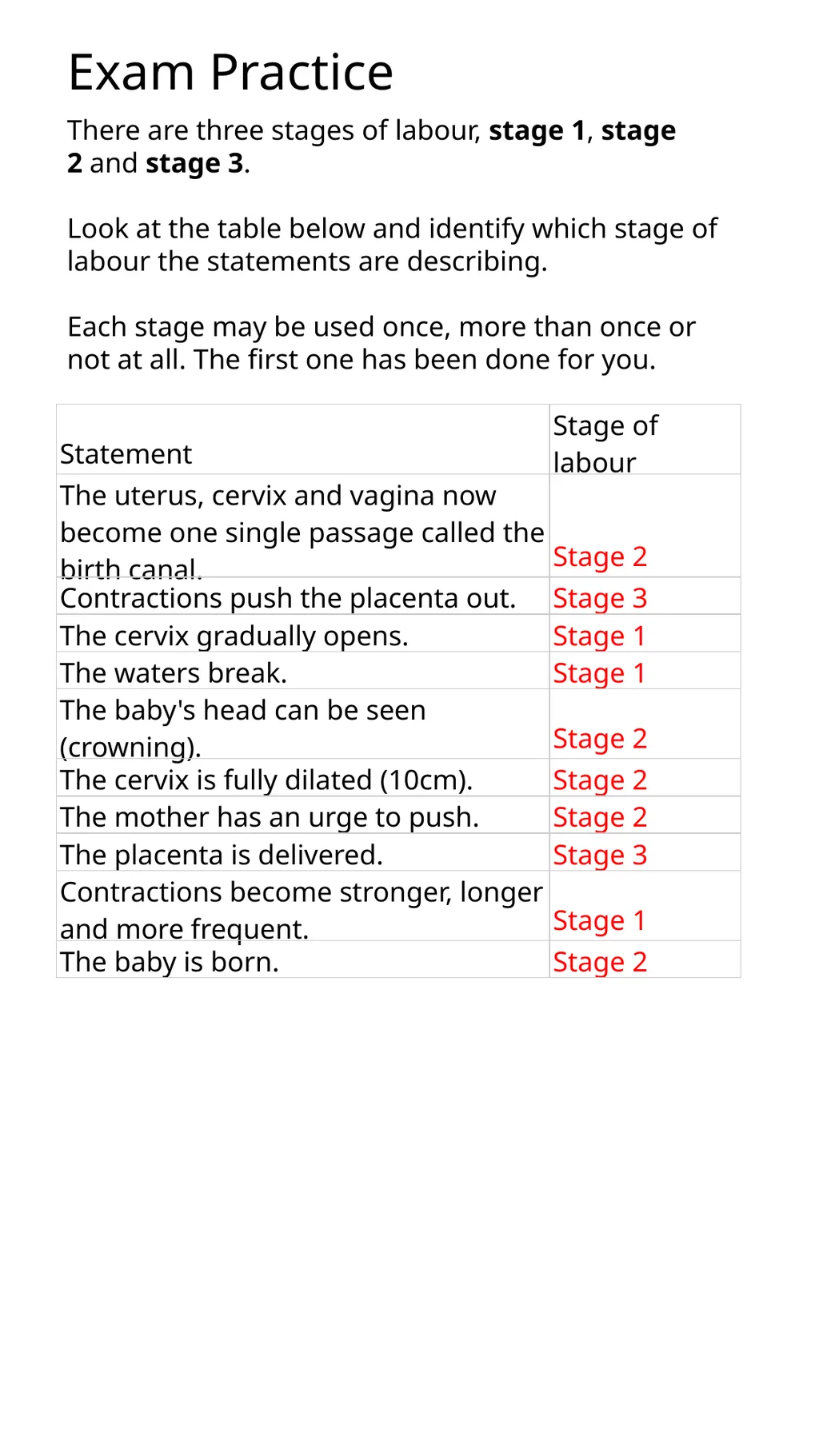
Exam Practice<br>
31
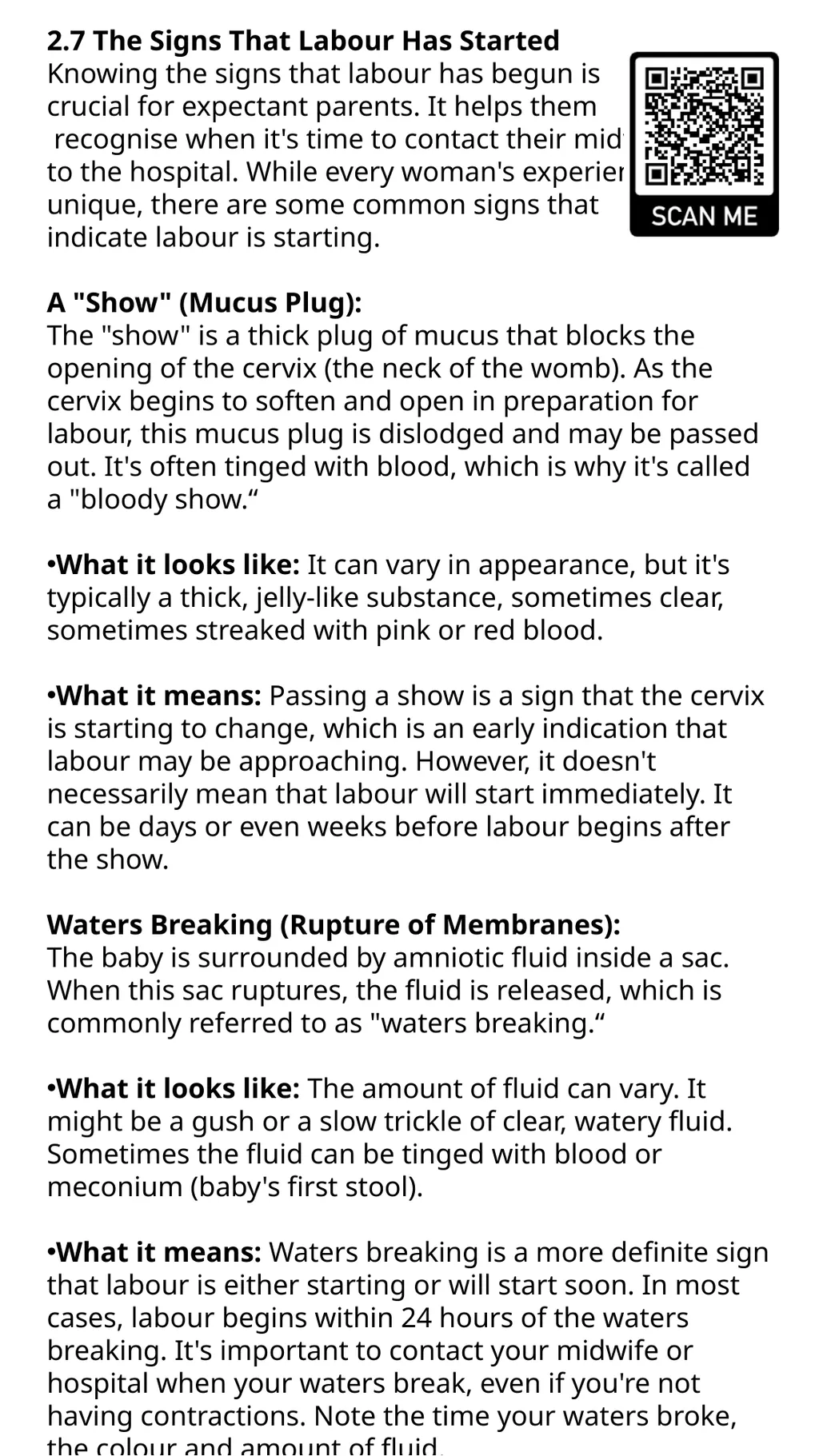
2.7 The Signs That Labour Has Started
Knowing the signs that labour has begun is
crucial for expectant parents. It helps them
recognise when it's time to contact their midwife or go to the hospital. While every woman's experience is
unique, there are some common signs that
indicate labour is starting.
A "Show" (Mucus Plug):
The "show" is a thick plug of mucus that blocks the opening of the cervix (the neck of the womb). As the cervix begins to soften and open in preparation for labour, this mucus plug is dislodged and may be passed out. It's often tinged with blood, which is why it's called a "bloody show.“
What it looks like: It can vary in appearance, but it's typically a thick, jelly-like substance, sometimes clear, sometimes streaked with pink or red blood.
What it means: Passing a show is a sign that the cervix is starting to change, which is an early indication that labour may be approaching. However, it doesn't necessarily mean that labour will start immediately. It can be days or even weeks before labour begins after the show.
Waters Breaking (Rupture of Membranes):
The baby is surrounded by amniotic fluid inside a sac. When this sac ruptures, the fluid is released, which is commonly referred to as "waters breaking.“
What it looks like: The amount of fluid can vary. It might be a gush or a slow trickle of clear, watery fluid. Sometimes the fluid can be tinged with blood or meconium (baby's first stool).
What it means: Waters breaking is a more definite sign that labour is either starting or will start soon. In most cases, labour begins within 24 hours of the waters breaking. It's important to contact your midwife or hospital when your waters break, even if you're not having contractions. Note the time your waters broke, the colour and amount of fluid.<br>
Knowing the signs that labour has begun is
crucial for expectant parents. It helps them
recognise when it's time to contact their midwife or go to the hospital. While every woman's experience is
unique, there are some common signs that
indicate labour is starting.
A "Show" (Mucus Plug):
The "show" is a thick plug of mucus that blocks the opening of the cervix (the neck of the womb). As the cervix begins to soften and open in preparation for labour, this mucus plug is dislodged and may be passed out. It's often tinged with blood, which is why it's called a "bloody show.“
What it looks like: It can vary in appearance, but it's typically a thick, jelly-like substance, sometimes clear, sometimes streaked with pink or red blood.
What it means: Passing a show is a sign that the cervix is starting to change, which is an early indication that labour may be approaching. However, it doesn't necessarily mean that labour will start immediately. It can be days or even weeks before labour begins after the show.
Waters Breaking (Rupture of Membranes):
The baby is surrounded by amniotic fluid inside a sac. When this sac ruptures, the fluid is released, which is commonly referred to as "waters breaking.“
What it looks like: The amount of fluid can vary. It might be a gush or a slow trickle of clear, watery fluid. Sometimes the fluid can be tinged with blood or meconium (baby's first stool).
What it means: Waters breaking is a more definite sign that labour is either starting or will start soon. In most cases, labour begins within 24 hours of the waters breaking. It's important to contact your midwife or hospital when your waters break, even if you're not having contractions. Note the time your waters broke, the colour and amount of fluid.<br>
32
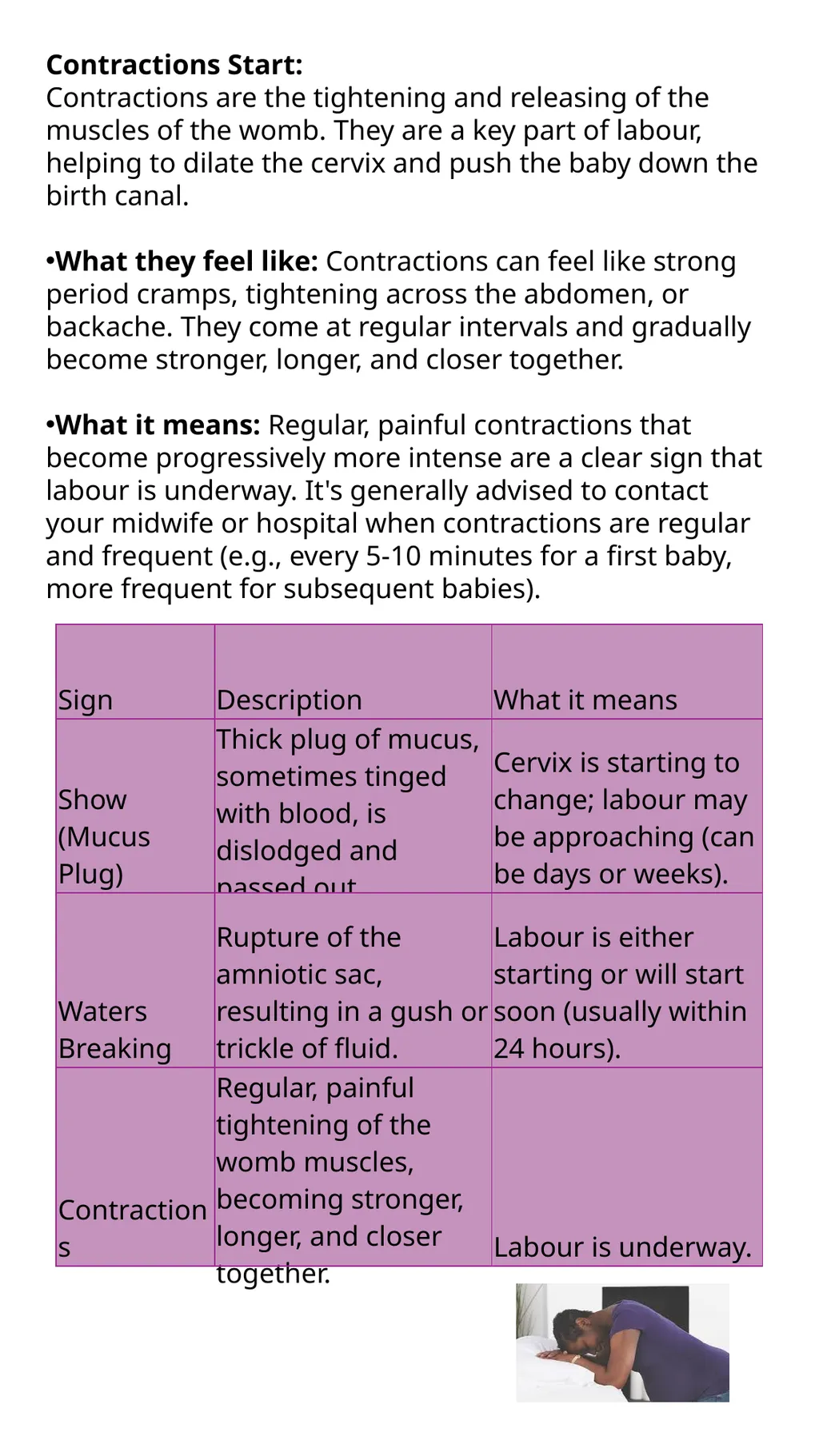
Contractions Start:
Contractions are the tightening and releasing of the muscles of the womb. They are a key part of labour, helping to dilate the cervix and push the baby down the birth canal.
What they feel like: Contractions can feel like strong period cramps, tightening across the abdomen, or backache. They come at regular intervals and gradually become stronger, longer, and closer together.
What it means: Regular, painful contractions that become progressively more intense are a clear sign that labour is underway. It's generally advised to contact your midwife or hospital when contractions are regular and frequent (e.g., every 5-10 minutes for a first baby, more frequent for subsequent babies).<br>
Contractions are the tightening and releasing of the muscles of the womb. They are a key part of labour, helping to dilate the cervix and push the baby down the birth canal.
What they feel like: Contractions can feel like strong period cramps, tightening across the abdomen, or backache. They come at regular intervals and gradually become stronger, longer, and closer together.
What it means: Regular, painful contractions that become progressively more intense are a clear sign that labour is underway. It's generally advised to contact your midwife or hospital when contractions are regular and frequent (e.g., every 5-10 minutes for a first baby, more frequent for subsequent babies).<br>
33
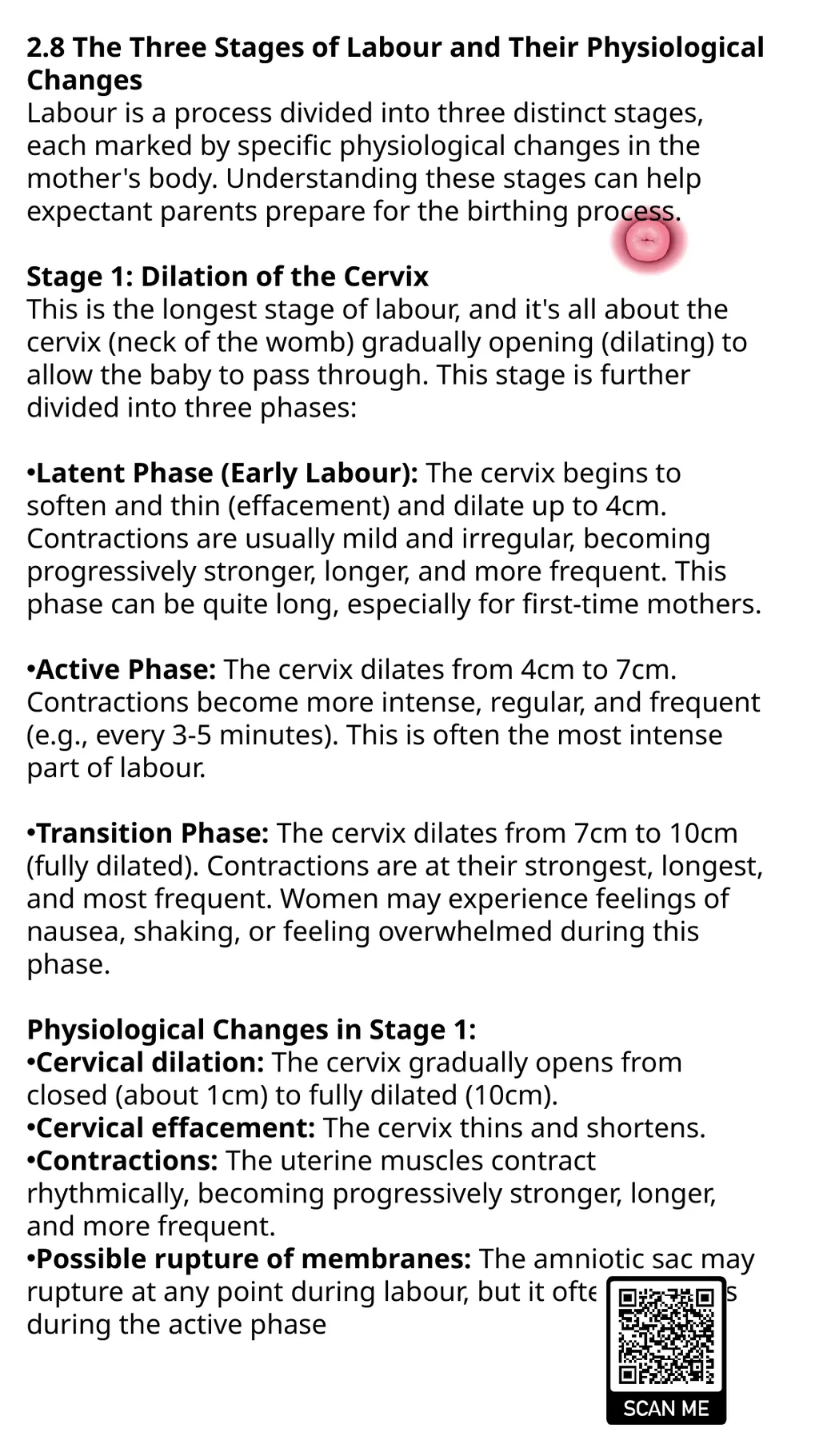
2.8 The Three Stages of Labour and Their Physiological Changes
Labour is a process divided into three distinct stages, each marked by specific physiological changes in the mother's body. Understanding these stages can help expectant parents prepare for the birthing process.
Stage 1: Dilation of the Cervix
This is the longest stage of labour, and it's all about the cervix (neck of the womb) gradually opening (dilating) to allow the baby to pass through. This stage is further divided into three phases:
Latent Phase (Early Labour): The cervix begins to soften and thin (effacement) and dilate up to 4cm. Contractions are usually mild and irregular, becoming progressively stronger, longer, and more frequent. This phase can be quite long, especially for first-time mothers.
Active Phase: The cervix dilates from 4cm to 7cm. Contractions become more intense, regular, and frequent (e.g., every 3-5 minutes). This is often the most intense part of labour.
Transition Phase: The cervix dilates from 7cm to 10cm (fully dilated). Contractions are at their strongest, longest, and most frequent. Women may experience feelings of nausea, shaking, or feeling overwhelmed during this phase.
Physiological Changes in Stage 1:
Cervical dilation: The cervix gradually opens from closed (about 1cm) to fully dilated (10cm).
Cervical effacement: The cervix thins and shortens.
Contractions: The uterine muscles contract rhythmically, becoming progressively stronger, longer, and more frequent.
Possible rupture of membranes: The amniotic sac may rupture at any point during labour, but it often happens during the active phase<br>
Labour is a process divided into three distinct stages, each marked by specific physiological changes in the mother's body. Understanding these stages can help expectant parents prepare for the birthing process.
Stage 1: Dilation of the Cervix
This is the longest stage of labour, and it's all about the cervix (neck of the womb) gradually opening (dilating) to allow the baby to pass through. This stage is further divided into three phases:
Latent Phase (Early Labour): The cervix begins to soften and thin (effacement) and dilate up to 4cm. Contractions are usually mild and irregular, becoming progressively stronger, longer, and more frequent. This phase can be quite long, especially for first-time mothers.
Active Phase: The cervix dilates from 4cm to 7cm. Contractions become more intense, regular, and frequent (e.g., every 3-5 minutes). This is often the most intense part of labour.
Transition Phase: The cervix dilates from 7cm to 10cm (fully dilated). Contractions are at their strongest, longest, and most frequent. Women may experience feelings of nausea, shaking, or feeling overwhelmed during this phase.
Physiological Changes in Stage 1:
Cervical dilation: The cervix gradually opens from closed (about 1cm) to fully dilated (10cm).
Cervical effacement: The cervix thins and shortens.
Contractions: The uterine muscles contract rhythmically, becoming progressively stronger, longer, and more frequent.
Possible rupture of membranes: The amniotic sac may rupture at any point during labour, but it often happens during the active phase<br>
34
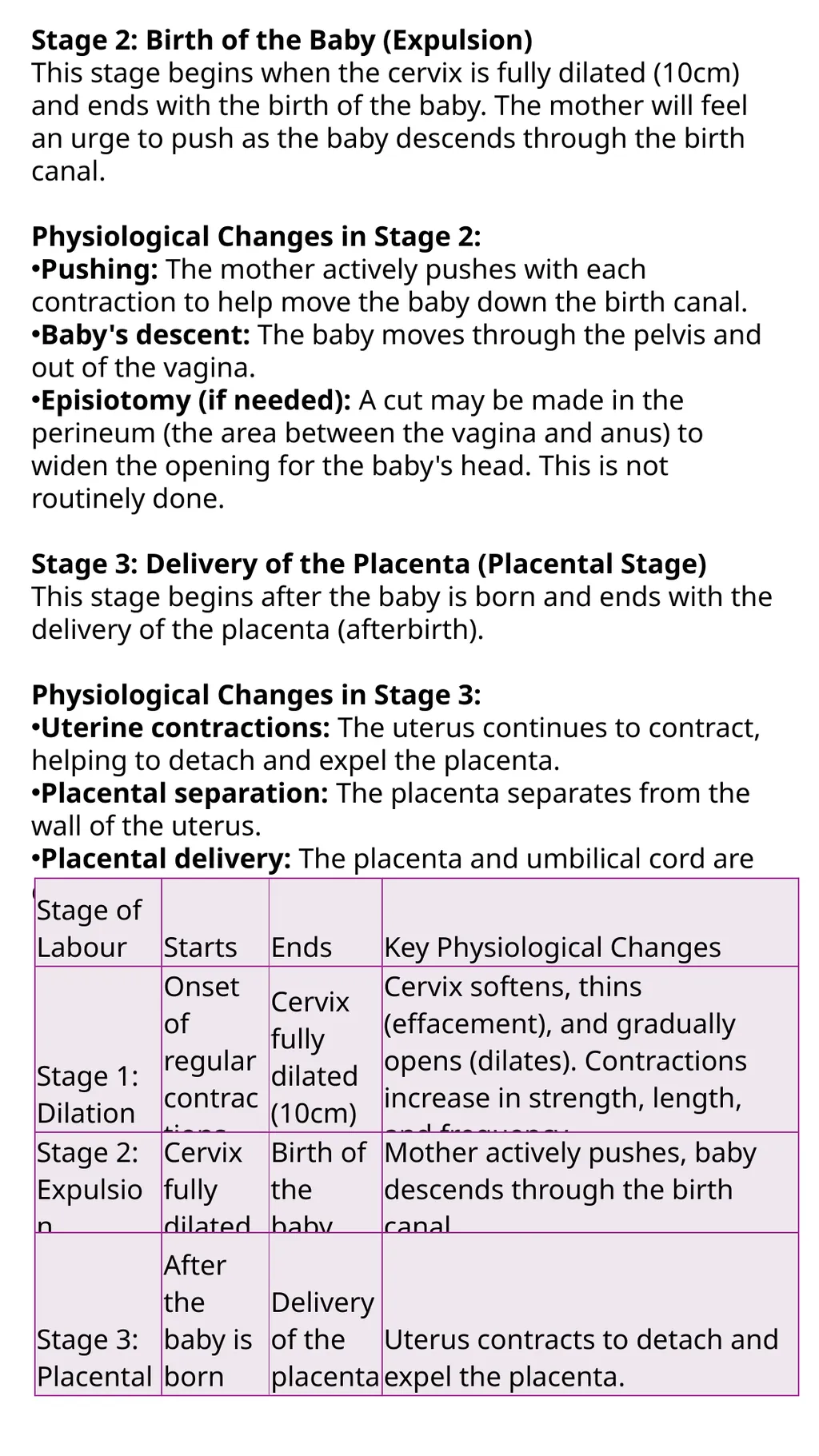
Stage 2: Birth of the Baby (Expulsion)
This stage begins when the cervix is fully dilated (10cm) and ends with the birth of the baby. The mother will feel an urge to push as the baby descends through the birth canal.
Physiological Changes in Stage 2:
Pushing: The mother actively pushes with each contraction to help move the baby down the birth canal.
Baby's descent: The baby moves through the pelvis and out of the vagina.
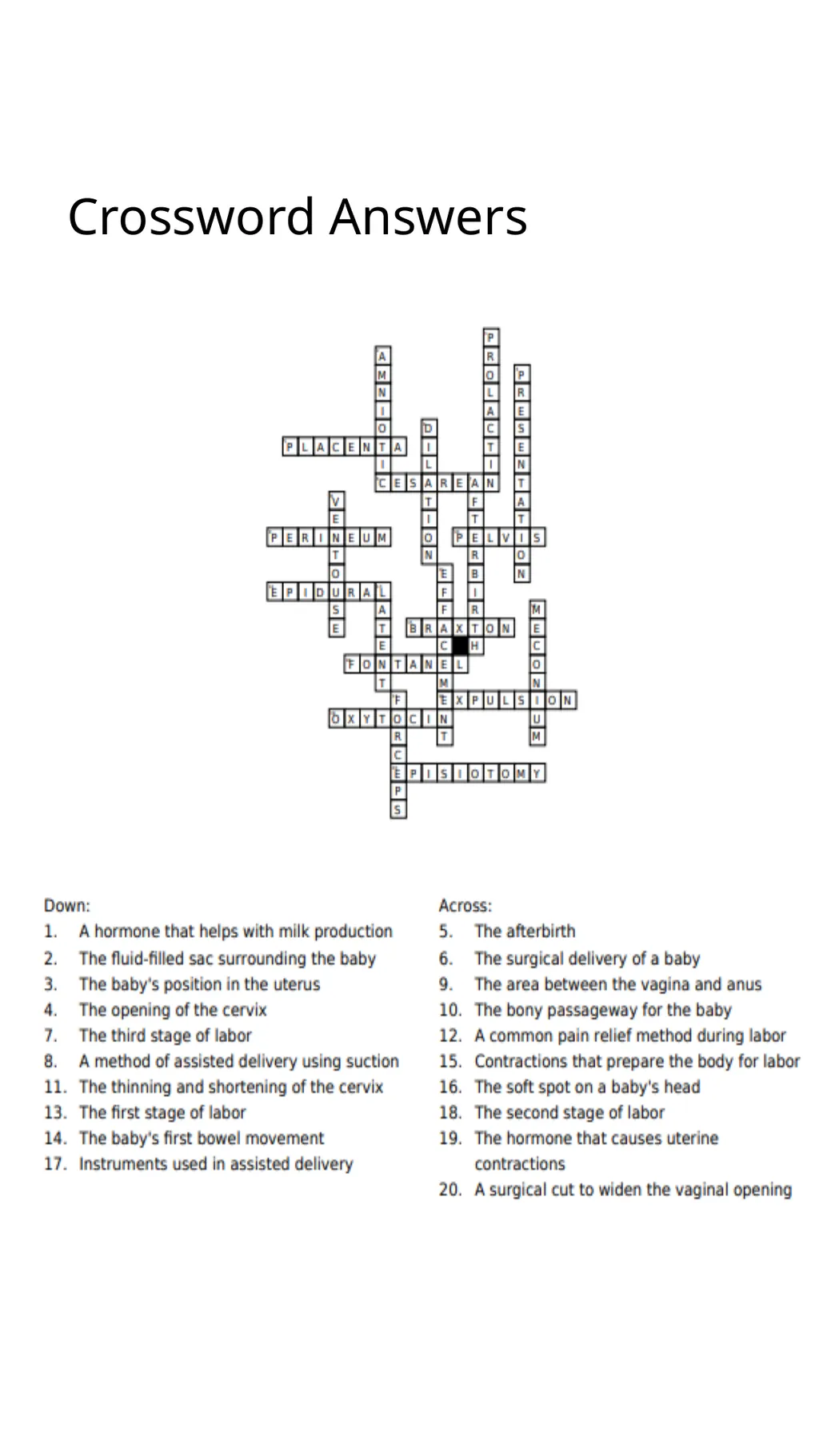
Episiotomy (if needed): A cut may be made in the perineum (the area between the vagina and anus) to widen the opening for the baby's head. This is not routinely done.
Stage 3: Delivery of the Placenta (Placental Stage)
This stage begins after the baby is born and ends with the delivery of the placenta (afterbirth).
Physiological Changes in Stage 3:
Uterine contractions: The uterus continues to contract, helping to detach and expel the placenta.
Placental separation: The placenta separates from the wall of the uterus.
Placental delivery: The placenta and umbilical cord are delivered.<br>
This stage begins when the cervix is fully dilated (10cm) and ends with the birth of the baby. The mother will feel an urge to push as the baby descends through the birth canal.
Physiological Changes in Stage 2:
Pushing: The mother actively pushes with each contraction to help move the baby down the birth canal.
Baby's descent: The baby moves through the pelvis and out of the vagina.
Episiotomy (if needed): A cut may be made in the perineum (the area between the vagina and anus) to widen the opening for the baby's head. This is not routinely done.
Stage 3: Delivery of the Placenta (Placental Stage)
This stage begins after the baby is born and ends with the delivery of the placenta (afterbirth).
Physiological Changes in Stage 3:
Uterine contractions: The uterus continues to contract, helping to detach and expel the placenta.
Placental separation: The placenta separates from the wall of the uterus.
Placental delivery: The placenta and umbilical cord are delivered.<br>
35
Exam Practice There are three stages of labour, stage 1, stage 2 and stage 3.
Look at the table below and identify which stage of labour the statements are describing.
Each stage may be used once, more than once or not at all. The first one has been done for you.<br>
36
2.9 Methods of Assisted Birth
While most births occur naturally, sometimes medical intervention is necessary to ensure the safety of the mother and baby. These interventions are known as assisted births or instrumental deliveries.
Forceps Delivery:
Forceps are instruments, similar to tongs
,that are used to gently grasp the baby’s
head to help guide it through the birth
canal.
How it's carried out: The obstetrician inserts the forceps into the vagina and carefully applies them to the baby's head. During contractions, the obstetrician gently pulls to assist with the delivery.
Why it might be necessary:
Prolonged second stage of labour: If the mother has been pushing for a long time without the baby descending.
Fetal distress: If the baby's heartbeat indicates problems.
Maternal exhaustion: If the mother is too tired to push effectively.
Medical conditions: Certain maternal health conditions may make a forceps delivery necessary.
Ventouse Delivery:
A ventouse (vacuum extraction) involves
placing a soft, cup-like device on the baby’s h
ead. Suction is applied to help guide the baby
through the birth canal.
How it's carried out: The ventouse cup is placed on the baby's head, and suction is applied. The obstetrician then gently pulls during contractions to assist with the delivery.
Why it might be necessary:
Similar reasons to forceps delivery: Prolonged second stage, foetal distress, maternal exhaustion.
May be preferred over forceps in certain situations: Depending on the baby's position and other factors.
.<br>
While most births occur naturally, sometimes medical intervention is necessary to ensure the safety of the mother and baby. These interventions are known as assisted births or instrumental deliveries.
Forceps Delivery:
Forceps are instruments, similar to tongs
,that are used to gently grasp the baby’s
head to help guide it through the birth
canal.
How it's carried out: The obstetrician inserts the forceps into the vagina and carefully applies them to the baby's head. During contractions, the obstetrician gently pulls to assist with the delivery.
Why it might be necessary:
Prolonged second stage of labour: If the mother has been pushing for a long time without the baby descending.
Fetal distress: If the baby's heartbeat indicates problems.
Maternal exhaustion: If the mother is too tired to push effectively.
Medical conditions: Certain maternal health conditions may make a forceps delivery necessary.
Ventouse Delivery:
A ventouse (vacuum extraction) involves
placing a soft, cup-like device on the baby’s h
ead. Suction is applied to help guide the baby
through the birth canal.
How it's carried out: The ventouse cup is placed on the baby's head, and suction is applied. The obstetrician then gently pulls during contractions to assist with the delivery.
Why it might be necessary:
Similar reasons to forceps delivery: Prolonged second stage, foetal distress, maternal exhaustion.
May be preferred over forceps in certain situations: Depending on the baby's position and other factors.
.<br>
37
Episiotomy:
An episiotomy is a surgical cut made in the
perineum (the area between the vagina and
anus) to widen the vaginal opening and make I
t easier for the baby to be born.
How it's carried out: A local anaesthetic is usually given to numb the area. The obstetrician makes a small cut in the perineum during delivery.
Why it might be necessary:
Used to be common, but now only performed when medically necessary: Such as in situations where the baby needs to be delivered quickly, or if there is a significant risk of tearing. It is not routinely performed
Elective/Emergency Caesarean Section:
A caesarean section is a surgical procedure
where the baby is delivered through an
incision
in the mother's abdomen and uterus.
How it's carried out: An incision is made in the abdomen, and the baby is lifted out of the uterus. The placenta is then removed, and the incision is closed with stitches or staples.
Why it might be necessary:
Elective (planned) caesarean: May be chosen for various reasons, such as if the mother has a medical condition that makes vaginal birth risky, or if the baby is in a breech position.
Emergency caesarean: May be necessary if complications arise during labour, such as foetal distress, placental abruption, or if labour is not progressing.<br>
An episiotomy is a surgical cut made in the
perineum (the area between the vagina and
anus) to widen the vaginal opening and make I
t easier for the baby to be born.
How it's carried out: A local anaesthetic is usually given to numb the area. The obstetrician makes a small cut in the perineum during delivery.
Why it might be necessary:
Used to be common, but now only performed when medically necessary: Such as in situations where the baby needs to be delivered quickly, or if there is a significant risk of tearing. It is not routinely performed
Elective/Emergency Caesarean Section:
A caesarean section is a surgical procedure
where the baby is delivered through an
incision
in the mother's abdomen and uterus.
How it's carried out: An incision is made in the abdomen, and the baby is lifted out of the uterus. The placenta is then removed, and the incision is closed with stitches or staples.
Why it might be necessary:
Elective (planned) caesarean: May be chosen for various reasons, such as if the mother has a medical condition that makes vaginal birth risky, or if the baby is in a breech position.
Emergency caesarean: May be necessary if complications arise during labour, such as foetal distress, placental abruption, or if labour is not progressing.<br>
38
Exam Practice Sunita has given birth to her first child, a son, by emergency caesarean section delivery.
Give two possible reasons why Sunita needed an emergency caesarean section delivery (2)
1.____________________________________________________________________________________________________________________
2.____________________________________________________________________________________________________________________ Give two features of a caesarean section delivery. (2)
1.____________________________________________________________________________________________________________________
2.____________________________________________________________________________________________________________________ Charlie is 41 years old and pregnant with her first baby.
At her first ante-natal appointment Charlie is seen by a midwife.
Charlie’s labour is long and she becomes very tired. The decision is made for her baby to be delivered with the assistance of a ventouse.
Describe how a ventouse is used to help delivery. (3)
________________________________________________________________________________________________________________________________________________________________________________________________
Name one other method of assisted delivery that could have been used to help Charlie with the delivery of her baby. [1]
________________________________________________________________________________________________________________________________<br>
Give two possible reasons why Sunita needed an emergency caesarean section delivery (2)
1.____________________________________________________________________________________________________________________
2.____________________________________________________________________________________________________________________ Give two features of a caesarean section delivery. (2)
1.____________________________________________________________________________________________________________________
2.____________________________________________________________________________________________________________________ Charlie is 41 years old and pregnant with her first baby.
At her first ante-natal appointment Charlie is seen by a midwife.
Charlie’s labour is long and she becomes very tired. The decision is made for her baby to be delivered with the assistance of a ventouse.
Describe how a ventouse is used to help delivery. (3)
________________________________________________________________________________________________________________________________________________________________________________________________
Name one other method of assisted delivery that could have been used to help Charlie with the delivery of her baby. [1]
________________________________________________________________________________________________________________________________<br>
39
Revision Crossword<br>
40
Activity Answers
Don’t peek until you’ve completed them!<br>
41
Exam Practice pre-birth before birth GP/General Practitioner/Doctor Midwife Obstetrician is an expert in normal pregnancy and birth / will tell her what to expect will look after Charlie and her baby through ante natal care, labour, birth and up to 28 days after baby born will provide full ante natal care / help create a birth plan identify high risk pregnancies clinical examinations- checking urine/blood pressure/examine abdomen/measure womb/listen to baby’s heartbeat checks the health of Charlie and baby provide parenting classes, provides reassurance, comforting, develops self-confidence – helps support her mental health support Charlie through labour and birth teach Charlie how to care/bath/feed baby provides breastfeeding advice gives advice on healthy eating and exercise for a healthy pregnancy answer questions/address worries Charlie may have / discuss scan Answering initial questions/giving initial advice on pregnancy Discuss any existing medical conditions Azmi may have that could affect her pregnancy Treat Azmi for any non-pregnancy related medical problems during pregnancy/manage long-term conditions e.g. diabetes Treat minor illnesses that are pregnancy related e.g. morning sickness/cystitis Respond to any emergency problems with pregnancy Azmi may have e.g. abdominal pain GP would direct / refer her to midwife services, e.g. scans, antenatal care / put her on the maternity list (Community) Midwife GP / Doctor<br>
42
True or False: Antenatal Tests
Checking the baby's heartbeat is only done in the third trimester. (False)
High blood pressure during pregnancy is always normal. (False)
Blood tests can help determine if a mother has anaemia. (True)
Measuring the uterus helps track the baby's growth. (True)
Urine tests can detect gestational diabetes. (True)
Weight gain during pregnancy is not important. (False)
Pre-eclampsia can be detected through urine tests. (True)
Blood tests are used to check the baby's position in the womb. (False)
Checking the baby's heartbeat confirms the baby is alive. (True)
All pregnant women develop pre-eclampsia. (False)<br>
Checking the baby's heartbeat is only done in the third trimester. (False)
High blood pressure during pregnancy is always normal. (False)
Blood tests can help determine if a mother has anaemia. (True)
Measuring the uterus helps track the baby's growth. (True)
Urine tests can detect gestational diabetes. (True)
Weight gain during pregnancy is not important. (False)
Pre-eclampsia can be detected through urine tests. (True)
Blood tests are used to check the baby's position in the womb. (False)
Checking the baby's heartbeat confirms the baby is alive. (True)
All pregnant women develop pre-eclampsia. (False)<br>
43
Exam Practice to check for anaemia (1) Anika may be anaemic/lack iron in her blood/need iron tablets. (1) to check for hepatitis B (1) without treatment this can cause liver disease/ this can be passed on to Anika’s baby. (1) to check for HIV (1) without treatment this can be passed on to Anika’s baby. (1) to check for high blood sugar (1) which could indicate Anika is suffering from diabetes. (1) Anika’s blood group (1) this is needed in case Anika needs a blood transfusion during pregnancy or birth / to check Rhesus factor/preventing Rhesus disease. (1) baby’s heartbeat
blood pressure
examination of the uterus
urine test
weight check<br>
blood pressure
examination of the uterus
urine test
weight check<br>
44
Weight Check Blood Test Examination of uterus Urine Test Blood tests / blood checks / blood type / blood group / blood sugar levels / blood(s) Blood pressure
Check for STIs / STDs
Examination of the uterus Baby’s heartbeat Mother’s heartbeat<br>
Check for STIs / STDs
Examination of the uterus Baby’s heartbeat Mother’s heartbeat<br>
45
Supporting Sarah Scenario What specific concerns might Sarah have?
Financial worries: How will she afford maternity leave and baby supplies?
Lack of support: Feeling alone and overwhelmed without a partner.
Work: Managing work during pregnancy and after the baby is born.
Health concerns: Worries about her own health and the baby's health.
Uncertainty: Not knowing what to expect during pregnancy, labour, and birth.
Isolation: Feeling cut off from social support and family (if applicable).
Emotional well-being: Concerns about coping with the emotional changes of pregnancy and motherhood.
How can the antenatal clinic address these concerns?
Provide information: Offer leaflets, brochures, and one-on-one discussions about pregnancy, childbirth, and newborn care.
Offer support: Create a safe and welcoming environment where Sarah feels comfortable asking questions and expressing her fears.
Connect with resources: Link Sarah with support groups for single mothers, financial assistance programs, and childcare resources.
Offer antenatal classes: Prepare Sarah for labour and birth, including pain management techniques and what to expect.
Monitor health: Regular check-ups to ensure Sarah and the baby are healthy.
Provide emotional support: Offer counselling services or referrals to therapists if needed.
What role can the GP, midwife, and potentially an obstetrician play in supporting Sarah?
GP: Can confirm the pregnancy, provide initial advice, and refer Sarah to the antenatal clinic. They can also address any pre-existing health conditions.
Midwife: Will be Sarah's primary point of contact for antenatal care. They will conduct regular check-ups, provide information and support, and help Sarah prepare for labour and birth. They can be a consistent source of support throughout her pregnancy journey.
Obstetrician: If Sarah experiences any complications during her pregnancy, she may be referred to an obstetrician for specialized care.
What tests and checks might be particularly important for Sarah, and why?
All routine antenatal tests are important, but given Sarah's situation, some may be more crucial:
Blood tests: To check for anaemia (common in pregnancy and can be exacerbated by financial strain) and infections.
Blood pressure: To monitor for pre-eclampsia, which can be more common in first pregnancies and can be more serious if not detected early.
Urine tests: To check for infections, glucose (gestational diabetes), and protein (pre-eclampsia).
Weight checks: To ensure healthy weight gain, which can be challenging with financial constraints.
Mental health screening: Given her single status and potential financial worries, checking her mental well-being is vital.
How can the clinic help Sarah prepare for labour, birth, and becoming a single parent?
Antenatal classes: Provide information on labour stages, pain relief options, and what to expect during childbirth.
Birth plan support: Help Sarah create a birth plan that reflects her wishes and preferences.
Parenting classes: Offer guidance on newborn care, breastfeeding, and parenting skills.
Referrals to support groups: Connect Sarah with other single parents for mutual support and advice.
Information on childcare options: Help Sarah explore childcare options and financial assistance.
What advice and resources could the clinic offer Sarah regarding financial support, childcare, and emotional well-being?
Financial support: Information on maternity pay, benefits, and financial assistance programs.
Childcare: Details on local nurseries, childminders, and financial support for childcare costs.
Emotional well-being: Counselling services, support groups for single mothers, and resources for managing stress and anxiety.
Healthy eating advice: Given her potential financial constraints, advice on affordable and nutritious food choices is important. They could also signpost her to local food banks or other support services.<br>
Financial worries: How will she afford maternity leave and baby supplies?
Lack of support: Feeling alone and overwhelmed without a partner.
Work: Managing work during pregnancy and after the baby is born.
Health concerns: Worries about her own health and the baby's health.
Uncertainty: Not knowing what to expect during pregnancy, labour, and birth.
Isolation: Feeling cut off from social support and family (if applicable).
Emotional well-being: Concerns about coping with the emotional changes of pregnancy and motherhood.
How can the antenatal clinic address these concerns?
Provide information: Offer leaflets, brochures, and one-on-one discussions about pregnancy, childbirth, and newborn care.
Offer support: Create a safe and welcoming environment where Sarah feels comfortable asking questions and expressing her fears.
Connect with resources: Link Sarah with support groups for single mothers, financial assistance programs, and childcare resources.
Offer antenatal classes: Prepare Sarah for labour and birth, including pain management techniques and what to expect.
Monitor health: Regular check-ups to ensure Sarah and the baby are healthy.
Provide emotional support: Offer counselling services or referrals to therapists if needed.
What role can the GP, midwife, and potentially an obstetrician play in supporting Sarah?
GP: Can confirm the pregnancy, provide initial advice, and refer Sarah to the antenatal clinic. They can also address any pre-existing health conditions.
Midwife: Will be Sarah's primary point of contact for antenatal care. They will conduct regular check-ups, provide information and support, and help Sarah prepare for labour and birth. They can be a consistent source of support throughout her pregnancy journey.
Obstetrician: If Sarah experiences any complications during her pregnancy, she may be referred to an obstetrician for specialized care.
What tests and checks might be particularly important for Sarah, and why?
All routine antenatal tests are important, but given Sarah's situation, some may be more crucial:
Blood tests: To check for anaemia (common in pregnancy and can be exacerbated by financial strain) and infections.
Blood pressure: To monitor for pre-eclampsia, which can be more common in first pregnancies and can be more serious if not detected early.
Urine tests: To check for infections, glucose (gestational diabetes), and protein (pre-eclampsia).
Weight checks: To ensure healthy weight gain, which can be challenging with financial constraints.
Mental health screening: Given her single status and potential financial worries, checking her mental well-being is vital.
How can the clinic help Sarah prepare for labour, birth, and becoming a single parent?
Antenatal classes: Provide information on labour stages, pain relief options, and what to expect during childbirth.
Birth plan support: Help Sarah create a birth plan that reflects her wishes and preferences.
Parenting classes: Offer guidance on newborn care, breastfeeding, and parenting skills.
Referrals to support groups: Connect Sarah with other single parents for mutual support and advice.
Information on childcare options: Help Sarah explore childcare options and financial assistance.
What advice and resources could the clinic offer Sarah regarding financial support, childcare, and emotional well-being?
Financial support: Information on maternity pay, benefits, and financial assistance programs.
Childcare: Details on local nurseries, childminders, and financial support for childcare costs.
Emotional well-being: Counselling services, support groups for single mothers, and resources for managing stress and anxiety.
Healthy eating advice: Given her potential financial constraints, advice on affordable and nutritious food choices is important. They could also signpost her to local food banks or other support services.<br>
46
Exam Practice Nuchal Fold Translucency Scan:
Scenario: Aisha is 12 weeks pregnant and is offered a nuchal fold translucency scan.
Question: Identify if these statements about a nuchal fold translucency scan are true or false.
Tick (✔) the correct answer. Triple Test:
Scenario: Leah is 16 weeks pregnant and her doctor recommends the triple test.
Question: Identify if these statements about the triple test are true or false.
Tick (✔) the correct answer. Non-Invasive Prenatal Testing (NIPT):
Scenario: Sofia is 11 weeks pregnant and is considering Non-Invasive Prenatal Testing (NIPT).
Question: Identify if these statements about NIPT are true or false.
Tick (✔) the correct answer. ✔ ✔ ✔ ✔ ✔ ✔ ✔ ✔ ✔ ✔ ✔ ✔<br>
Scenario: Aisha is 12 weeks pregnant and is offered a nuchal fold translucency scan.
Question: Identify if these statements about a nuchal fold translucency scan are true or false.
Tick (✔) the correct answer. Triple Test:
Scenario: Leah is 16 weeks pregnant and her doctor recommends the triple test.
Question: Identify if these statements about the triple test are true or false.
Tick (✔) the correct answer. Non-Invasive Prenatal Testing (NIPT):
Scenario: Sofia is 11 weeks pregnant and is considering Non-Invasive Prenatal Testing (NIPT).
Question: Identify if these statements about NIPT are true or false.
Tick (✔) the correct answer. ✔ ✔ ✔ ✔ ✔ ✔ ✔ ✔ ✔ ✔ ✔ ✔<br>
47
Dating Scan:
Scenario: Priya is 10 weeks pregnant and has her first ultrasound appointment for a dating scan.
Question: Identify if these statements about a dating scan are true or false.
Tick (✔) the correct answer. Anomaly Scan:
Scenario: Liam and his partner Sarah are excited for their 20-week anomaly scan.
Question: Identify if these statements about an anomaly scan are true or false.
Tick (✔) the correct answer. ✔ ✔ ✔ ✔ ✔ ✔ ✔ ✔ ✔ ✔<br>
Scenario: Priya is 10 weeks pregnant and has her first ultrasound appointment for a dating scan.
Question: Identify if these statements about a dating scan are true or false.
Tick (✔) the correct answer. Anomaly Scan:
Scenario: Liam and his partner Sarah are excited for their 20-week anomaly scan.
Question: Identify if these statements about an anomaly scan are true or false.
Tick (✔) the correct answer. ✔ ✔ ✔ ✔ ✔ ✔ ✔ ✔ ✔ ✔<br>
48
Exam Practice What is a diagnostic test? (1)
A diagnostic test gives a confirmed diagnosis _____________________________________________________
What is a screening test? (1)
A screening test screens the likely outcome of a child having an abnormality _____________________________________________________ Downs Syndrome ✔ ✔ ✔ ✔ ✔<br>
A diagnostic test gives a confirmed diagnosis _____________________________________________________
What is a screening test? (1)
A screening test screens the likely outcome of a child having an abnormality _____________________________________________________ Downs Syndrome ✔ ✔ ✔ ✔ ✔<br>
49
Possible sentence endings Antenatal classes are important for expectant parents because they provide...
...a safe and supportive environment to ask questions and express concerns about pregnancy, childbirth, and parenting without judgment.
...evidence-based information on a wide range of topics, empowering them to make informed decisions about their care and their baby's well-being.
...a valuable opportunity to connect with other expectant parents, creating a support network that can be invaluable during the early days of parenthood.
2. Learning about the stages of labour in antenatal classes is crucial as it allows parents to…
...understand what to expect physically and emotionally during each stage, reducing anxiety and fear about the unknown.
...recognize the signs of labour and know when to seek medical attention, ensuring a timely and safe delivery.
...develop coping strategies and prepare mentally for the challenges of labour, promoting a more positive birth experience.
3. The information on pain management techniques offered in antenatal classes helps parents to…
...explore different pain relief options, both medical and non-medical, and make informed choices that align with their preferences.
...learn practical techniques like breathing exercises and relaxation methods, which can help them manage pain and feel more in control during labour.
...understand the benefits and risks of various pain relief options, allowing them to make informed decisions in consultation with their healthcare providers.
4. Creating a birth plan during antenatal classes empowers parents by…
...encouraging them to think about their preferences for labour, birth, and newborn care, promoting a sense of ownership over their experience.
...facilitating communication between parents and healthcare providers, ensuring that their wishes are understood and respected as much as possible.
...providing a framework for decision-making during labour, reducing stress and uncertainty in the moment.<br>
...a safe and supportive environment to ask questions and express concerns about pregnancy, childbirth, and parenting without judgment.
...evidence-based information on a wide range of topics, empowering them to make informed decisions about their care and their baby's well-being.
...a valuable opportunity to connect with other expectant parents, creating a support network that can be invaluable during the early days of parenthood.
2. Learning about the stages of labour in antenatal classes is crucial as it allows parents to…
...understand what to expect physically and emotionally during each stage, reducing anxiety and fear about the unknown.
...recognize the signs of labour and know when to seek medical attention, ensuring a timely and safe delivery.
...develop coping strategies and prepare mentally for the challenges of labour, promoting a more positive birth experience.
3. The information on pain management techniques offered in antenatal classes helps parents to…
...explore different pain relief options, both medical and non-medical, and make informed choices that align with their preferences.
...learn practical techniques like breathing exercises and relaxation methods, which can help them manage pain and feel more in control during labour.
...understand the benefits and risks of various pain relief options, allowing them to make informed decisions in consultation with their healthcare providers.
4. Creating a birth plan during antenatal classes empowers parents by…
...encouraging them to think about their preferences for labour, birth, and newborn care, promoting a sense of ownership over their experience.
...facilitating communication between parents and healthcare providers, ensuring that their wishes are understood and respected as much as possible.
...providing a framework for decision-making during labour, reducing stress and uncertainty in the moment.<br>
50
5. Practical skills, such as nappy changing and bathing, taught in antenatal classes are essential because…
...they give new parents the confidence and competence to care for their newborn safely and effectively.
...they reduce anxiety about handling a delicate baby and performing basic care tasks, making the transition to parenthood smoother.
...they allow parents to practice these skills in a supportive environment, receiving feedback and guidance from experienced instructors.
6. Antenatal classes help parents prepare emotionally for parenthood by…
...addressing common anxieties and fears about becoming parents, normalizing these feelings and providing coping mechanisms.
...exploring the emotional changes that both parents may experience, fostering empathy and understanding between partners.
...providing a space to discuss expectations and concerns about parenting roles and responsibilities, promoting open communication and shared decision-making.
7. The advice on healthy eating and lifestyle during pregnancy given in antenatal classes is vital for…
...ensuring the healthy development of the baby, providing essential nutrients for growth and preventing complications.
...maintaining the mother's health and well-being during pregnancy, reducing the risk of conditions like gestational diabetes and pre-eclampsia.
...promoting healthy weight gain during pregnancy, which is important for both maternal and foetal health.
8. Learning about different feeding methods in antenatal classes enables parents to…
...make informed decisions about how they want to feed their baby, whether they choose to breastfeed, bottle-feed, or a combination of both.
...understand the benefits and challenges of each feeding method, allowing them to choose the option that best suits their circumstances and preferences.
...learn practical skills related to breastfeeding and bottle-feeding, such as positioning, latch, and sterilizing equipment.
9. Understanding the benefits of breastfeeding, as explained in antenatal classes, can encourage parents to…
...consider breastfeeding as a feeding option for their baby, knowing that it provides numerous health benefits for both mother and child.
...make an informed decision about breastfeeding, weighing the benefits against any personal challenges or circumstances.
...learn strategies to initiate and maintain breastfeeding, increasing their chances of success if they choose this option.<br>
...they give new parents the confidence and competence to care for their newborn safely and effectively.
...they reduce anxiety about handling a delicate baby and performing basic care tasks, making the transition to parenthood smoother.
...they allow parents to practice these skills in a supportive environment, receiving feedback and guidance from experienced instructors.
6. Antenatal classes help parents prepare emotionally for parenthood by…
...addressing common anxieties and fears about becoming parents, normalizing these feelings and providing coping mechanisms.
...exploring the emotional changes that both parents may experience, fostering empathy and understanding between partners.
...providing a space to discuss expectations and concerns about parenting roles and responsibilities, promoting open communication and shared decision-making.
7. The advice on healthy eating and lifestyle during pregnancy given in antenatal classes is vital for…
...ensuring the healthy development of the baby, providing essential nutrients for growth and preventing complications.
...maintaining the mother's health and well-being during pregnancy, reducing the risk of conditions like gestational diabetes and pre-eclampsia.
...promoting healthy weight gain during pregnancy, which is important for both maternal and foetal health.
8. Learning about different feeding methods in antenatal classes enables parents to…
...make informed decisions about how they want to feed their baby, whether they choose to breastfeed, bottle-feed, or a combination of both.
...understand the benefits and challenges of each feeding method, allowing them to choose the option that best suits their circumstances and preferences.
...learn practical skills related to breastfeeding and bottle-feeding, such as positioning, latch, and sterilizing equipment.
9. Understanding the benefits of breastfeeding, as explained in antenatal classes, can encourage parents to…
...consider breastfeeding as a feeding option for their baby, knowing that it provides numerous health benefits for both mother and child.
...make an informed decision about breastfeeding, weighing the benefits against any personal challenges or circumstances.
...learn strategies to initiate and maintain breastfeeding, increasing their chances of success if they choose this option.<br>
51
8 mark hospital birth possible answers Answer: *Advantages and disadvantages of giving birth in hospital
AdvantagesMother may feel safer
Trained staff available if there is a problem
Specialist equipment available if needed for the baby
Only option if caesarean needed
Only option if forceps and ventouse needed
Some types of pain relief can only be given in hospital / wider range of pain relief available
Midwife available to answer any questions
No household responsibilities
Can meet other mothers
More opportunities to rest / restricted visiting hours
Sterile conditions
DisadvantagesLess privacy
Hospitals usually associated with illness/frightened by hospitals
Less personal
Father may not be as involved with the birth
May pick up hospital related infections e.g. MRSA
Not always with the same midwife
Noisy / busy in hospital / not relaxing / lots of visitors
Accept other appropriate points with explanation. Note: Disadvantages must relate to a hospital birth. A comparison with a home birth is not required. Marks: 8<br>
Trained staff available if there is a problem
Specialist equipment available if needed for the baby
Only option if caesarean needed
Only option if forceps and ventouse needed
Some types of pain relief can only be given in hospital / wider range of pain relief available
Midwife available to answer any questions
No household responsibilities
Can meet other mothers
More opportunities to rest / restricted visiting hours
Sterile conditions
DisadvantagesLess privacy
Hospitals usually associated with illness/frightened by hospitals
Less personal
Father may not be as involved with the birth
May pick up hospital related infections e.g. MRSA
Not always with the same midwife
Noisy / busy in hospital / not relaxing / lots of visitors
Accept other appropriate points with explanation. Note: Disadvantages must relate to a hospital birth. A comparison with a home birth is not required. Marks: 8<br>
52
Exam Practice Describe how the birth partner can provide emotional support to the pregnant woman throughout the birth (2)
Answer: Up to two marks for a description. Howbe positive/supportive/show affection
massage
holding hands
doing breathing techniques with her
talk to her
make sure the health professionals are aware of the birthing plan
Emotional supportto reassure/encourage/relax/calm the pregnant woman
take her mind off things
stop her worrying
Example e.g.:doing breathing techniques with her (1) to calm the pregnant women (1)
Award credit for any other appropriate response Explain three ways the father/partner can support the mother through pregnancy or birth (6) .
Answer: One mark for a way. Three required. One mark for an explanation. Three required. Wayspractical support e.g. shopping, cleaning, washing, housework
help during labour e.g. massage back,
give encouragement during labour
getting drinks, snacks during labour
going to antenatal classes with wife/partner
learning relaxation / calming techniques
active involvement - go to clinics/scans/help in birth plan
improve knowledge/awareness of pregnancy/birth/mother’s needs e.g. through reading/dvds/YouTube
provide emotional support – recognise and be aware of mother’s needs stress / anxiety / ask how she is feeling
support health needs – give up smoking/alcohol together
Explanations wife/partner may be tired/ needs rest
feels loved/cared for
enjoy the experience together
boosts self esteem
meets emotional needs improves wellbeing
wife/partner may feel hungry/thirsty
learn how the baby develops/how pregnancy affects his wife/partner<br>
Answer: Up to two marks for a description. Howbe positive/supportive/show affection
massage
holding hands
doing breathing techniques with her
talk to her
make sure the health professionals are aware of the birthing plan
Emotional supportto reassure/encourage/relax/calm the pregnant woman
take her mind off things
stop her worrying
Example e.g.:doing breathing techniques with her (1) to calm the pregnant women (1)
Award credit for any other appropriate response Explain three ways the father/partner can support the mother through pregnancy or birth (6) .
Answer: One mark for a way. Three required. One mark for an explanation. Three required. Wayspractical support e.g. shopping, cleaning, washing, housework
help during labour e.g. massage back,
give encouragement during labour
getting drinks, snacks during labour
going to antenatal classes with wife/partner
learning relaxation / calming techniques
active involvement - go to clinics/scans/help in birth plan
improve knowledge/awareness of pregnancy/birth/mother’s needs e.g. through reading/dvds/YouTube
provide emotional support – recognise and be aware of mother’s needs stress / anxiety / ask how she is feeling
support health needs – give up smoking/alcohol together
Explanations wife/partner may be tired/ needs rest
feels loved/cared for
enjoy the experience together
boosts self esteem
meets emotional needs improves wellbeing
wife/partner may feel hungry/thirsty
learn how the baby develops/how pregnancy affects his wife/partner<br>
53
Exam Practice mother is awake during delivery of baby mother able to experience child birth can provide total pain relief numb from waist down (spinal) epidural anaesthetic general anaesthetic Takes about 20 minutes to work so baby may be born before it is effective Can affect the babies breathing Can make the baby drowsy / sleepy Can make the mother drowsy / sleepy The effect lasts for 2 - 4 hours so mother could still be affected after the birth Can keep moving around while using it / portable It won’t directly interfere with labour. You can use it for as long as you want to and take it off if you want or need to. There are no lasting side-effects / doesn’t make you drowsy It’s safe for mother and baby. Drug free pain relief / natural method Don’t need an anaesthetist, doctor or midwife to help you use it. Can be used for a home birth. Non-invasive..<br>
54
can be controlled by the mother
no harmful side effects for mother
no harmful side effects for baby easy to use works straight away/works quickly
no use of needles relaxes/calms the mother epidural (anaesthetic) pethidine Remifentanil TENS<br>
no harmful side effects for mother
no harmful side effects for baby easy to use works straight away/works quickly
no use of needles relaxes/calms the mother epidural (anaesthetic) pethidine Remifentanil TENS<br>
55
Exam Practice There are three stages of labour, stage 1, stage 2 and stage 3.
Look at the table below and identify which stage of labour the statements are describing.
Each stage may be used once, more than once or not at all. The first one has been done for you.<br>
56
Exam Practice Sunita has given birth to her first child, a son, by emergency caesarean section delivery.
Give two possible reasons why Sunita needed an emergency caesarean section delivery (2)
1.____________________________________________________________________________________________________________________
2.____________________________________________________________________________________________________________________ Give two features of a caesarean section delivery. (2)
1.____________________________________________________________________________________________________________________
2.____________________________________________________________________________________________________________________ Charlie is 41 years old and pregnant with her first baby.
At her first ante-natal appointment Charlie is seen by a midwife.
Charlie’s labour is long and she becomes very tired. The decision is made for her baby to be delivered with the assistance of a ventouse.
Describe how a ventouse is used to help delivery. (3)
________________________________________________________________________________________________________________________________________________________________________________________________
Name one other method of assisted delivery that could have been used to help Charlie with the delivery of her baby. [1]
________________________________________________________________________________________________________________________________ baby is in distress baby is in breech position / feet first
baby is too large/very big baby not getting enough oxygen and nutrients
birth canal is too narrow excessive vaginal bleeding
if induction has failed labour not progressing
mother has STI/HIV mother is too ill to cope with labour
placenta previa pre-eclampsia
risk to mother’s or baby’s health e.g. baby heart rate dropping umbilical cord is wrapped around the baby’s neck mother too exhausted to push / delivery taking too long :Starts with an epidural Procedure takes about 40 – 45 minutes
Mother normally awake Carried out by obstetrician
Carried out in an operating theatre Screen placed across mothers stomach so she can’t see what is being done
A cut is made through the abdomen and womb, normally just below bikini line
Baby is delivered/taken out through cut/opening Cut/opening stitched up Is a plastic or metal cap that fits on baby’s head
Is attached to baby’s head by suction / is a suction cup
As the mother pushed with each contraction an obstetrician gently pulls to help deliver the baby.
Helps to gently pull the baby out Forceps
Caesarean (section) / C-section<br>
Give two possible reasons why Sunita needed an emergency caesarean section delivery (2)
1.____________________________________________________________________________________________________________________
2.____________________________________________________________________________________________________________________ Give two features of a caesarean section delivery. (2)
1.____________________________________________________________________________________________________________________
2.____________________________________________________________________________________________________________________ Charlie is 41 years old and pregnant with her first baby.
At her first ante-natal appointment Charlie is seen by a midwife.
Charlie’s labour is long and she becomes very tired. The decision is made for her baby to be delivered with the assistance of a ventouse.
Describe how a ventouse is used to help delivery. (3)
________________________________________________________________________________________________________________________________________________________________________________________________
Name one other method of assisted delivery that could have been used to help Charlie with the delivery of her baby. [1]
________________________________________________________________________________________________________________________________ baby is in distress baby is in breech position / feet first
baby is too large/very big baby not getting enough oxygen and nutrients
birth canal is too narrow excessive vaginal bleeding
if induction has failed labour not progressing
mother has STI/HIV mother is too ill to cope with labour
placenta previa pre-eclampsia
risk to mother’s or baby’s health e.g. baby heart rate dropping umbilical cord is wrapped around the baby’s neck mother too exhausted to push / delivery taking too long :Starts with an epidural Procedure takes about 40 – 45 minutes
Mother normally awake Carried out by obstetrician
Carried out in an operating theatre Screen placed across mothers stomach so she can’t see what is being done
A cut is made through the abdomen and womb, normally just below bikini line
Baby is delivered/taken out through cut/opening Cut/opening stitched up Is a plastic or metal cap that fits on baby’s head
Is attached to baby’s head by suction / is a suction cup
As the mother pushed with each contraction an obstetrician gently pulls to help deliver the baby.
Helps to gently pull the baby out Forceps
Caesarean (section) / C-section<br>
57
Crossword Answers<br>