04
Introduction Purpose:
To provide a well standardized, comprehensive assessment of learning and memory in children and adolescents (aged 5-16) that is directly linked to current intelligence tests (WISC-III and WPPSI-R)<br>
05
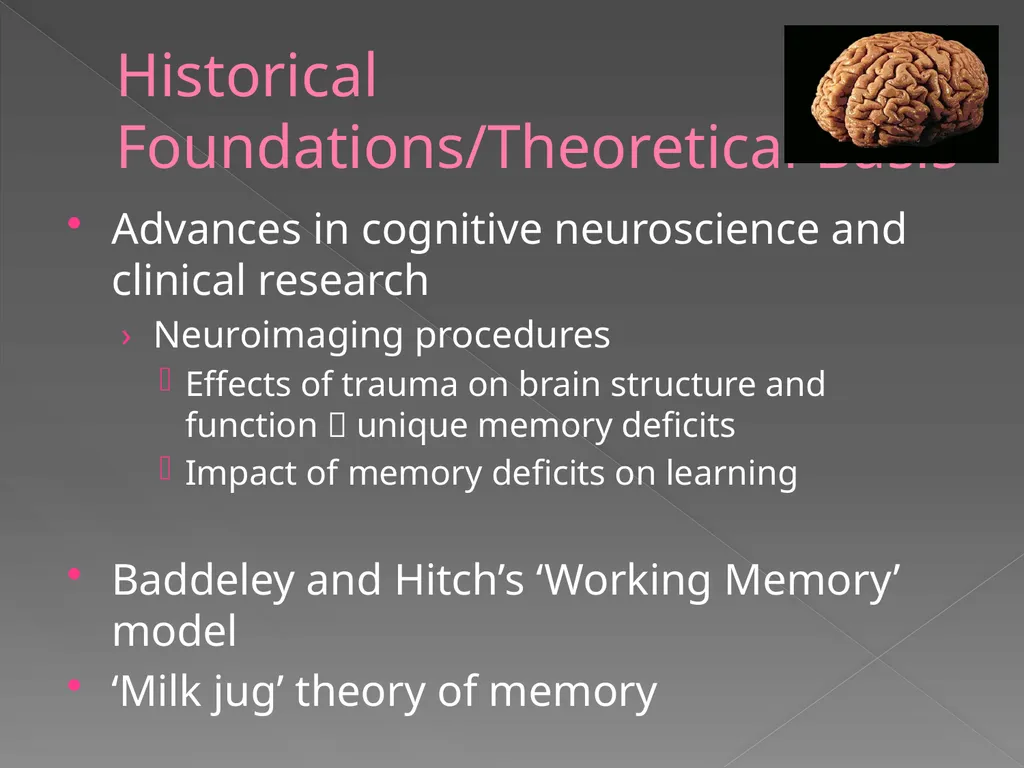
Historical Foundations/Theoretical Basis Advances in cognitive neuroscience and clinical research
Neuroimaging procedures
Effects of trauma on brain structure and function unique memory deficits
Impact of memory deficits on learning
Baddeley and Hitch’s ‘Working Memory’ model
‘Milk jug’ theory of memory<br>
06
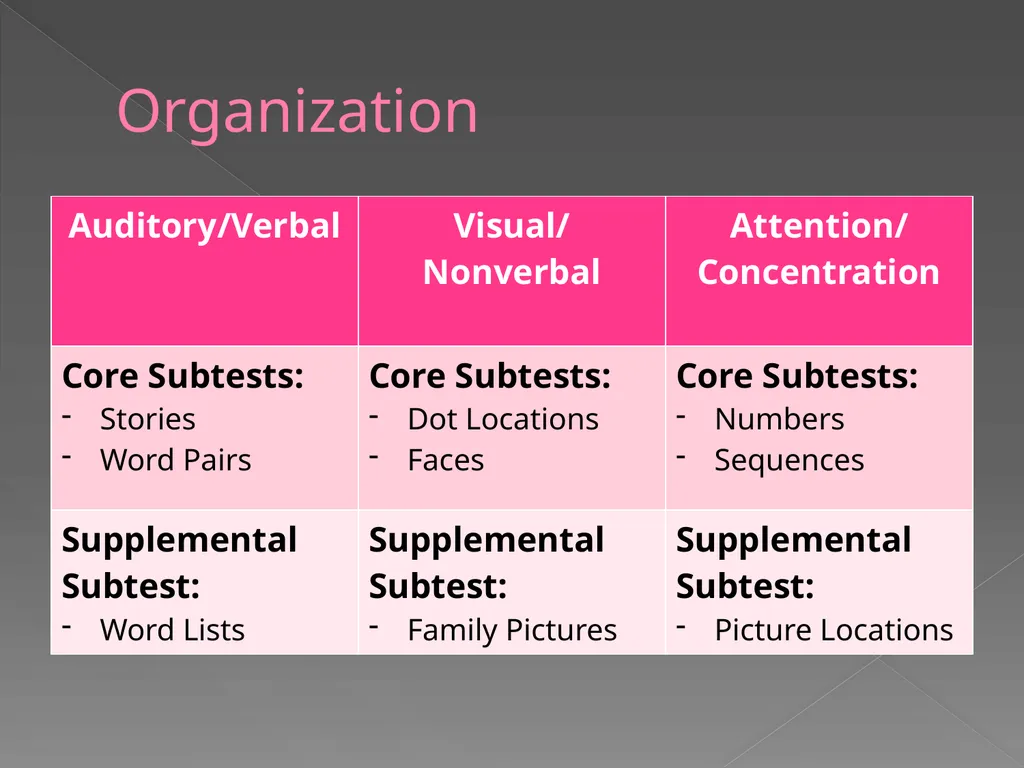
Overview 6 core and 3 supplemental subtests measure memory and learning abilities in children and adolescents aged 5 -16
Assesses:
Attention and working memory
Verbal and visual memory
Short- and long-delay memory
Recall and recognition<br>
07
Unique Aspects Dimensions of the Test
Immediate memory vs. delayed memory
Auditory/verbal vs. visual/nonverbal memory
Encoding/storage vs. memory retrieval
Free recall vs. recognition
Literal/near-literal recall vs. thematic recall
Attention/concentration
Working memory
Relationship of memory to ability
Correlations of memory with achievement, executive functioning and language ability<br>
09
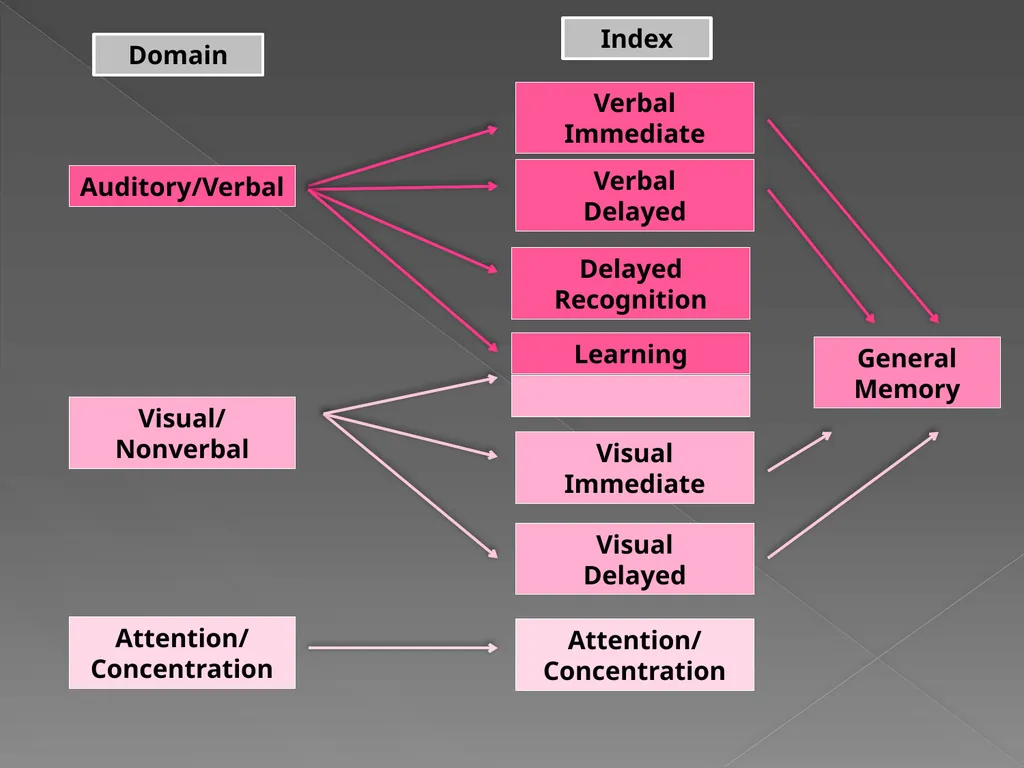
Domain Index Auditory/Verbal Visual/
Nonverbal Attention/Concentration Verbal
Immediate Verbal
Delayed Delayed
Recognition Learning Visual
Immediate Visual
Delayed Attention/
Concentration General
Memory<br>
10
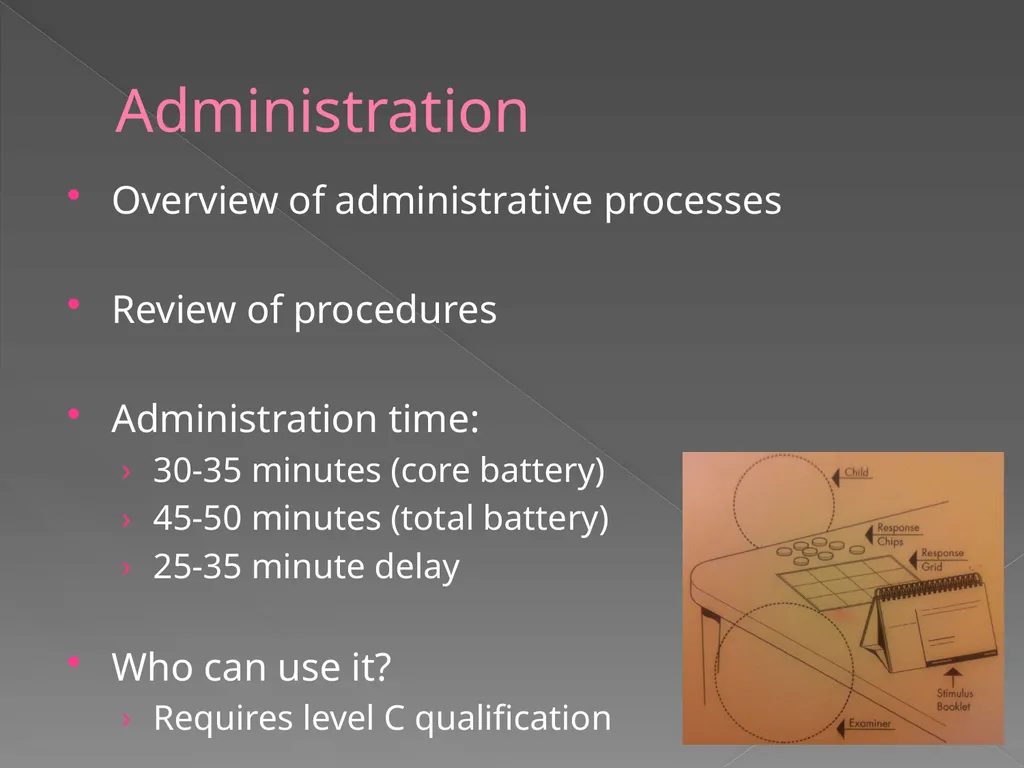
Administration Overview of administrative processes
Review of procedures
Administration time:
30-35 minutes (core battery)
45-50 minutes (total battery)
25-35 minute delay
Who can use it?
Requires level C qualification<br>
11
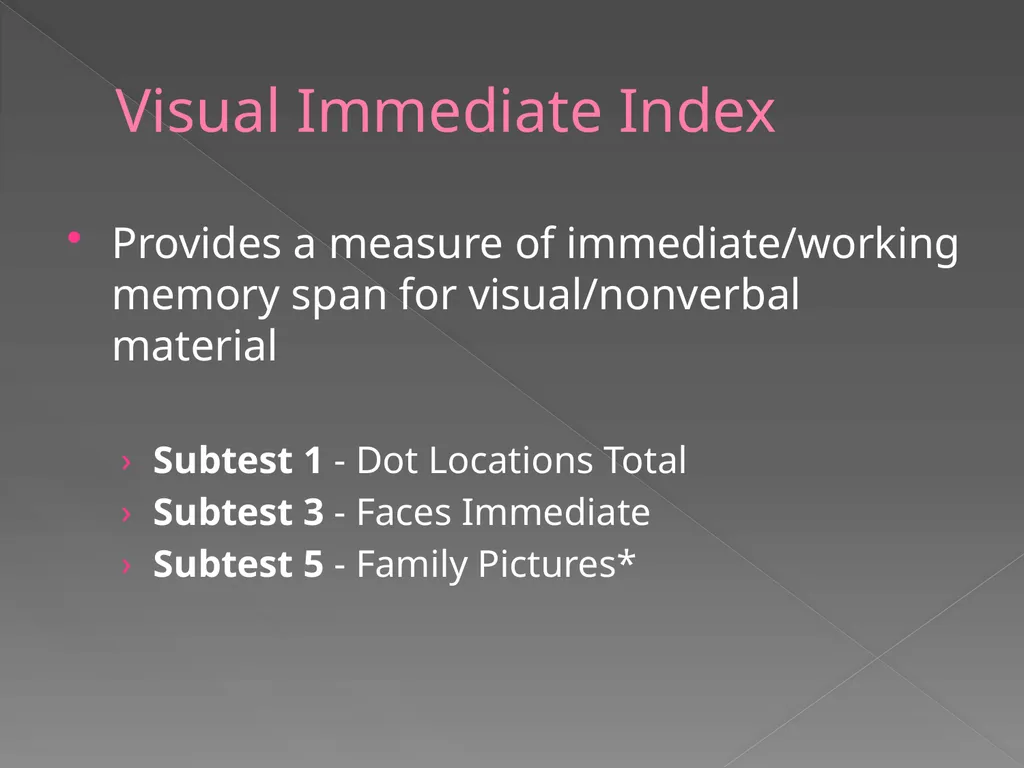
Visual Immediate Index Provides a measure of immediate/working memory span for visual/nonverbal material
Subtest 1 - Dot Locations Total
Subtest 3 - Faces Immediate
Subtest 5 - Family Pictures*<br>
12
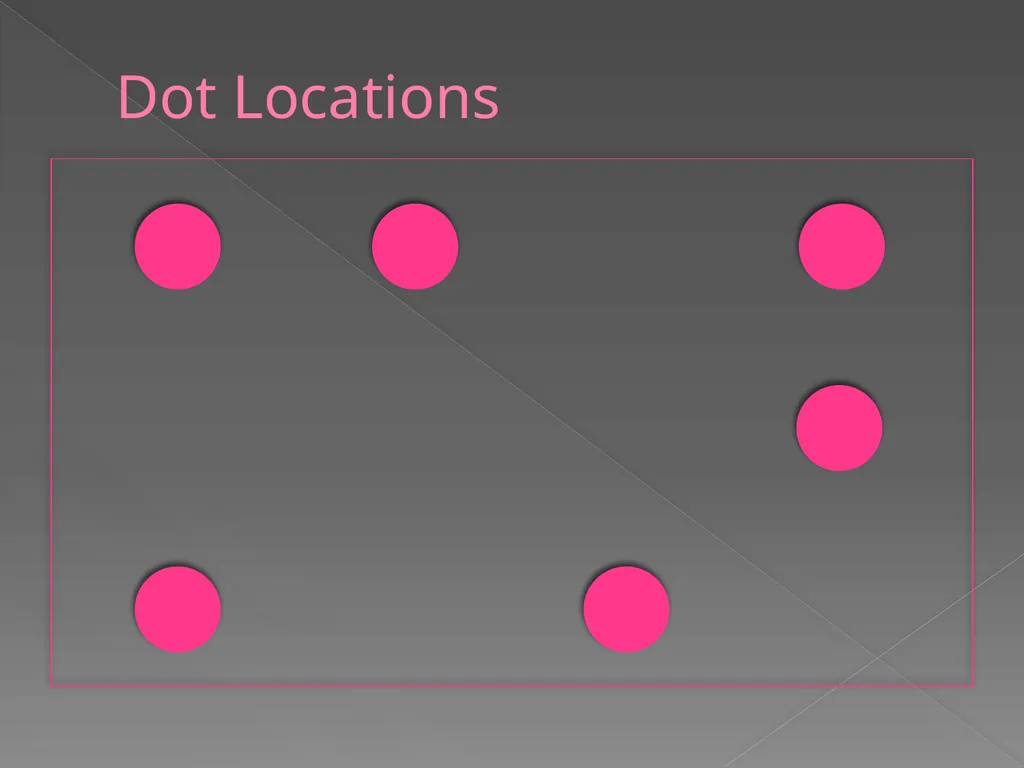
Subtest 1: Dot Locations Assesses the ability to learn the spatial location of an array of dots
Presentation and recall of 3 learning trials of an array
Presentation and recall of distractor array
Recall of the first array
Asked to remember first array for later<br>
15
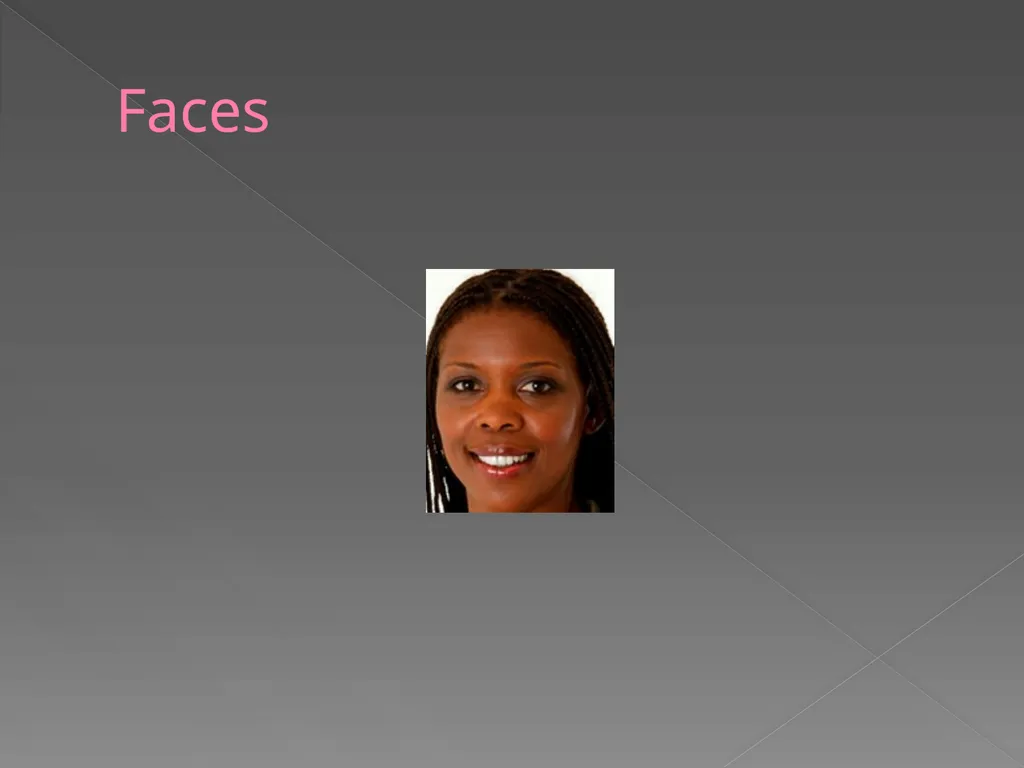
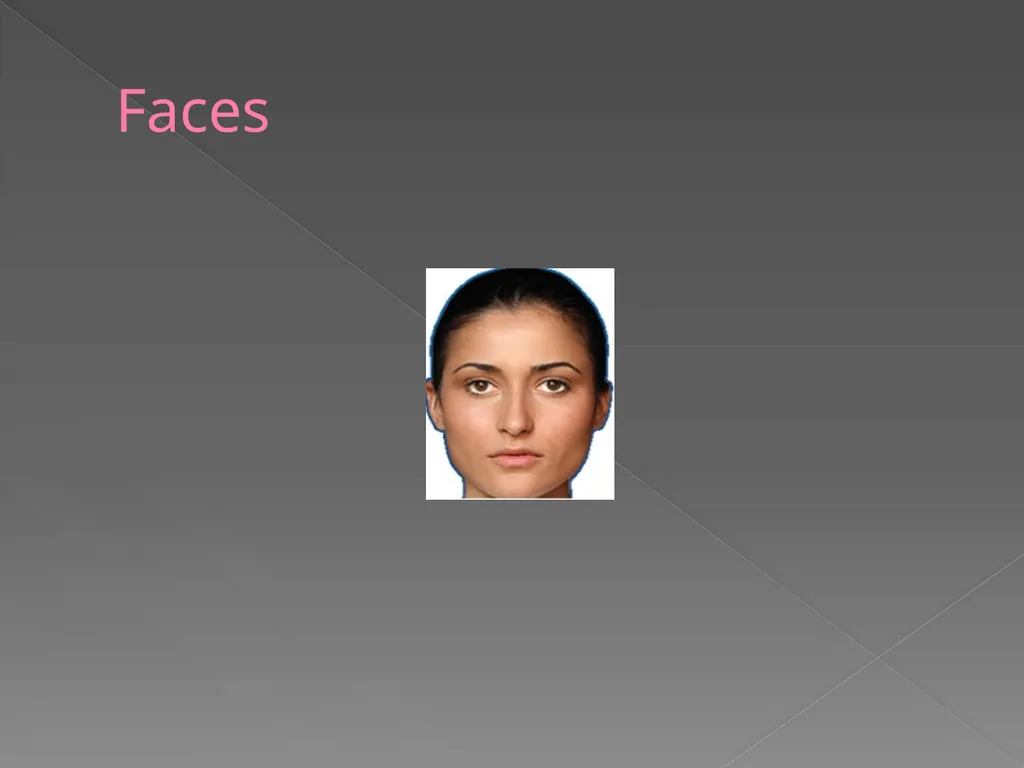
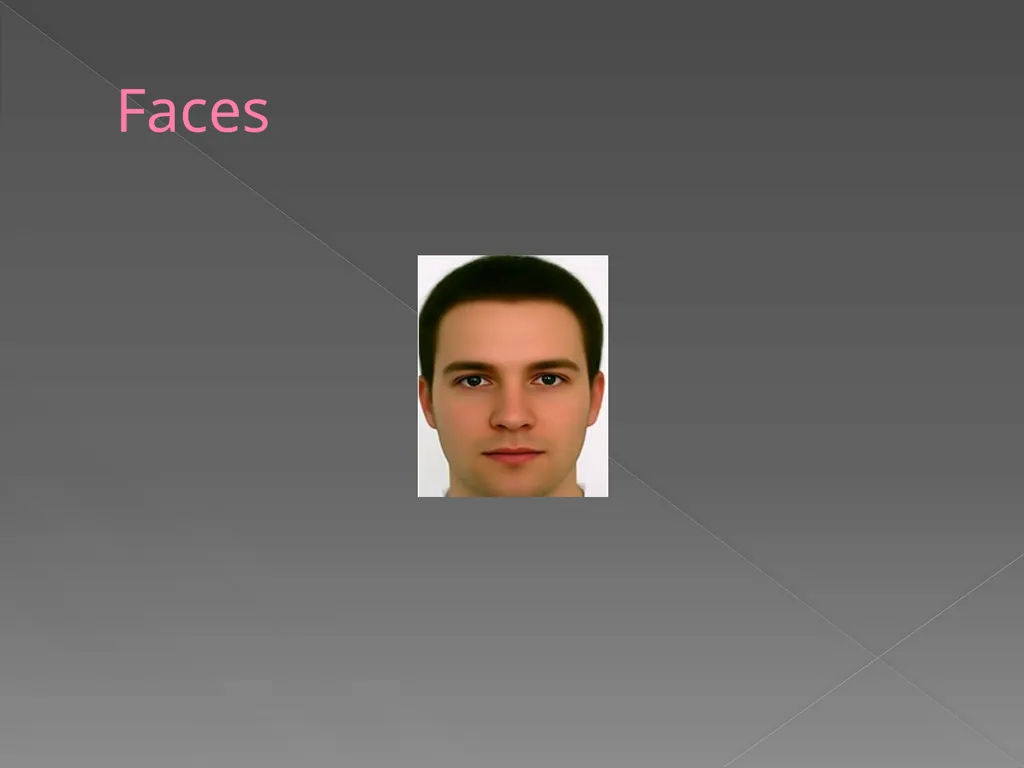
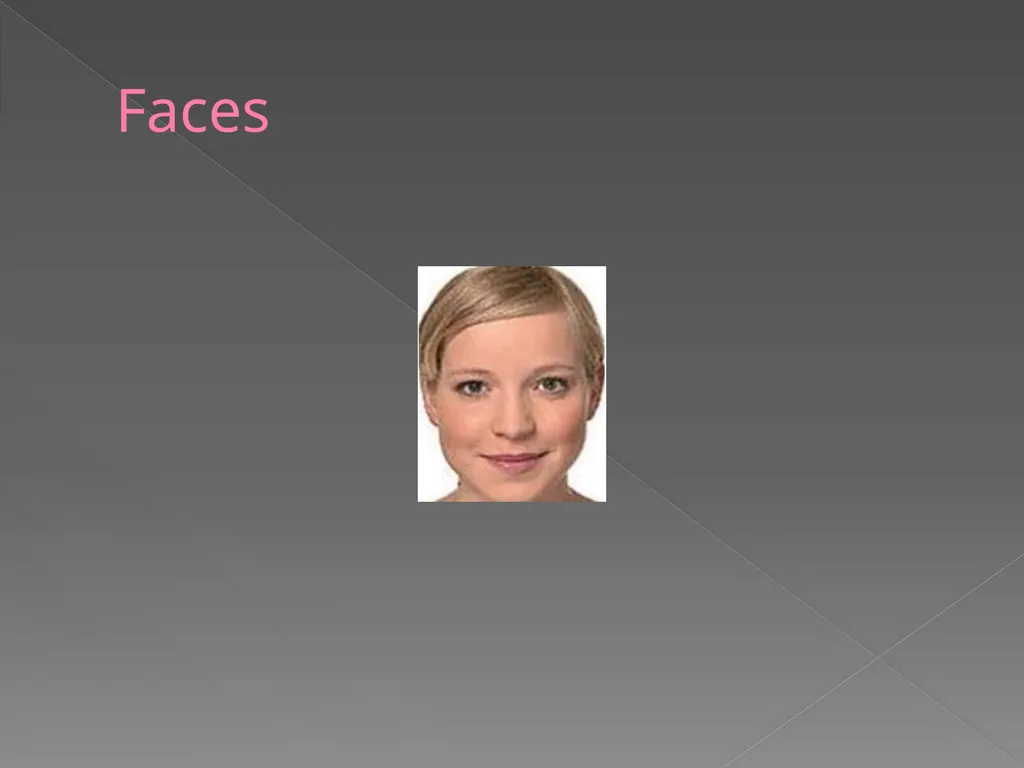
Subtest 3: Faces Assesses the ability to remember and recognize a series of faces
Presentation of a series of faces
Immediate recognition - Presented with the same and distractor faces
Asked to remember the first group of faces for later<br>
20
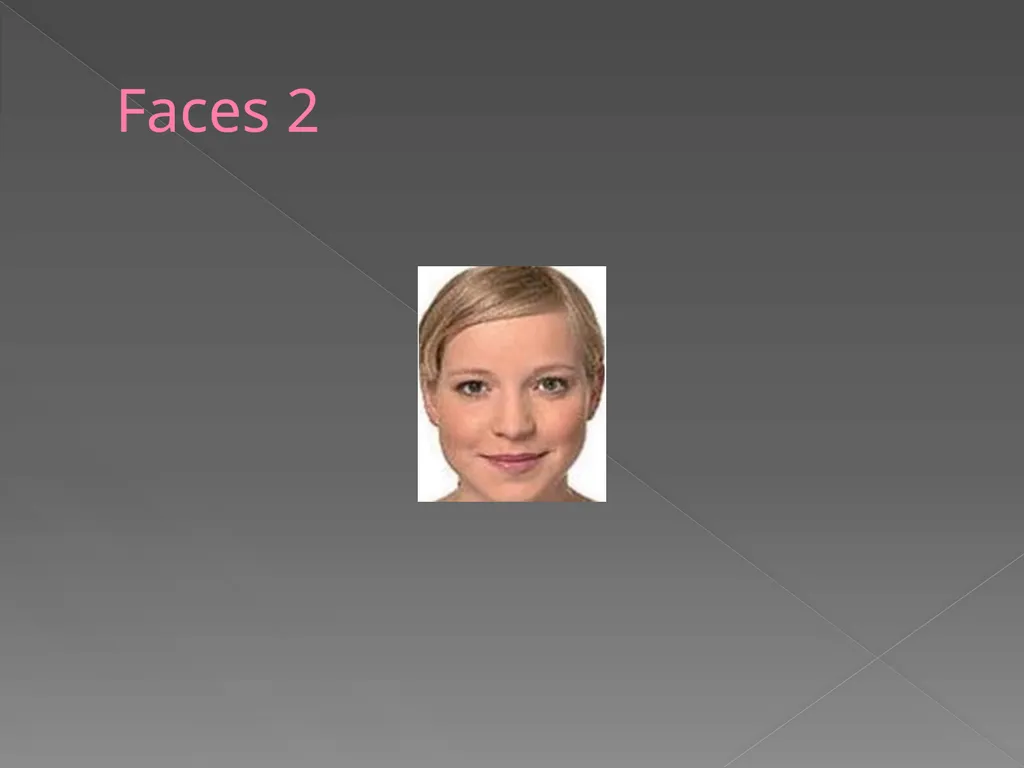
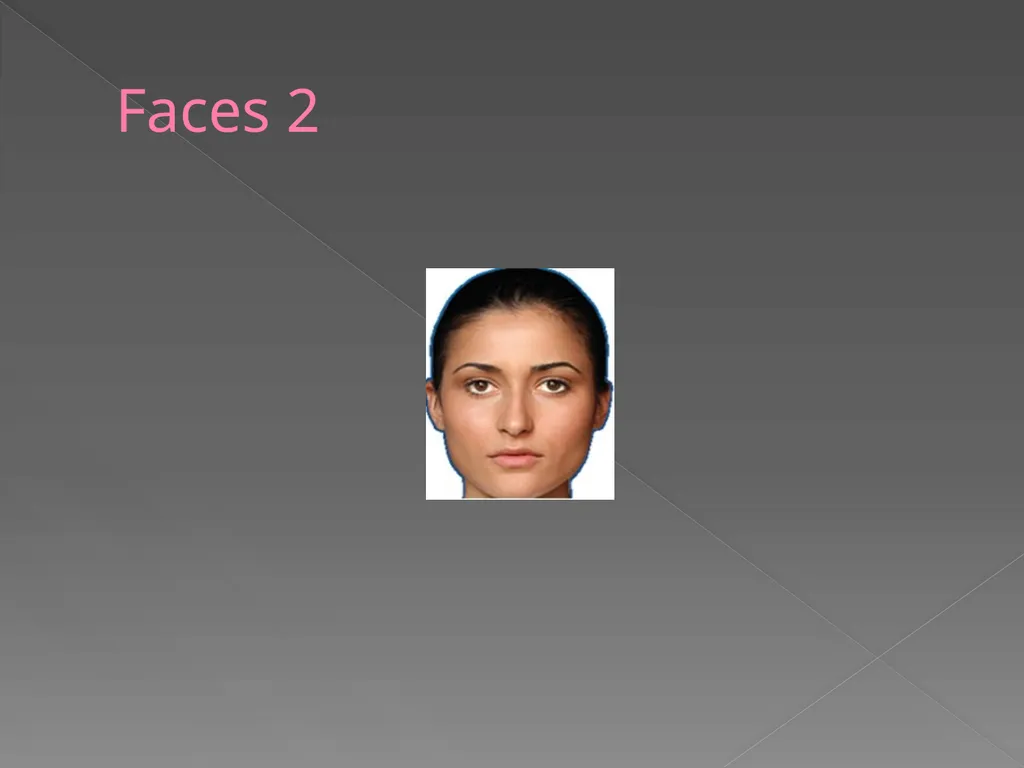
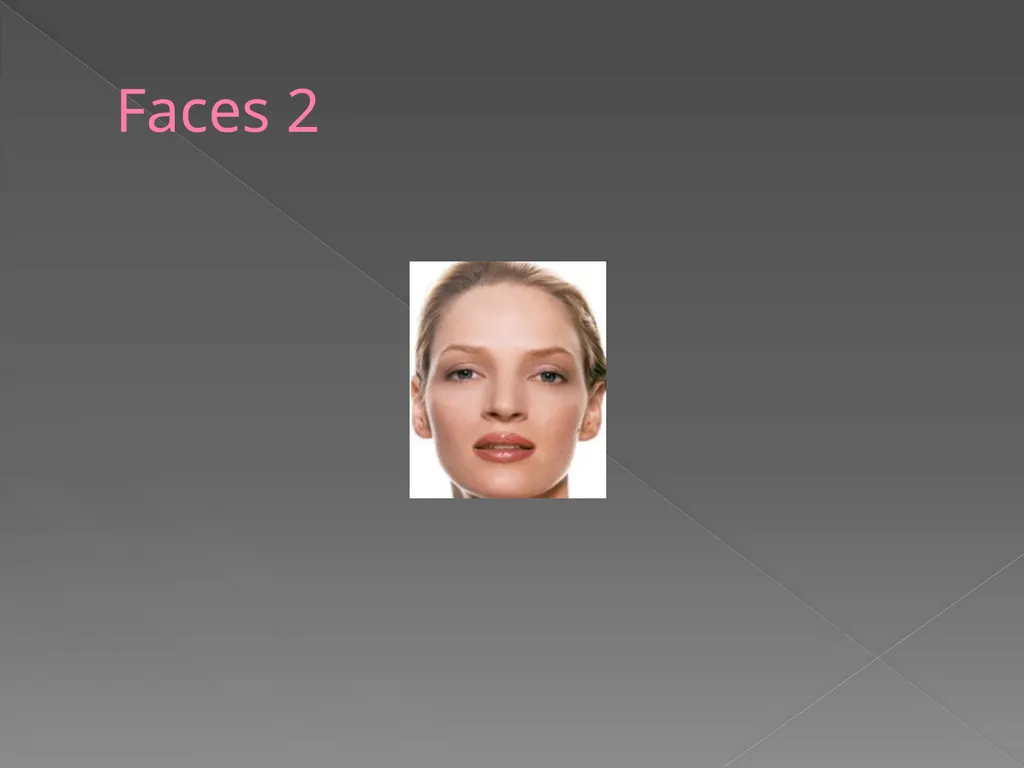
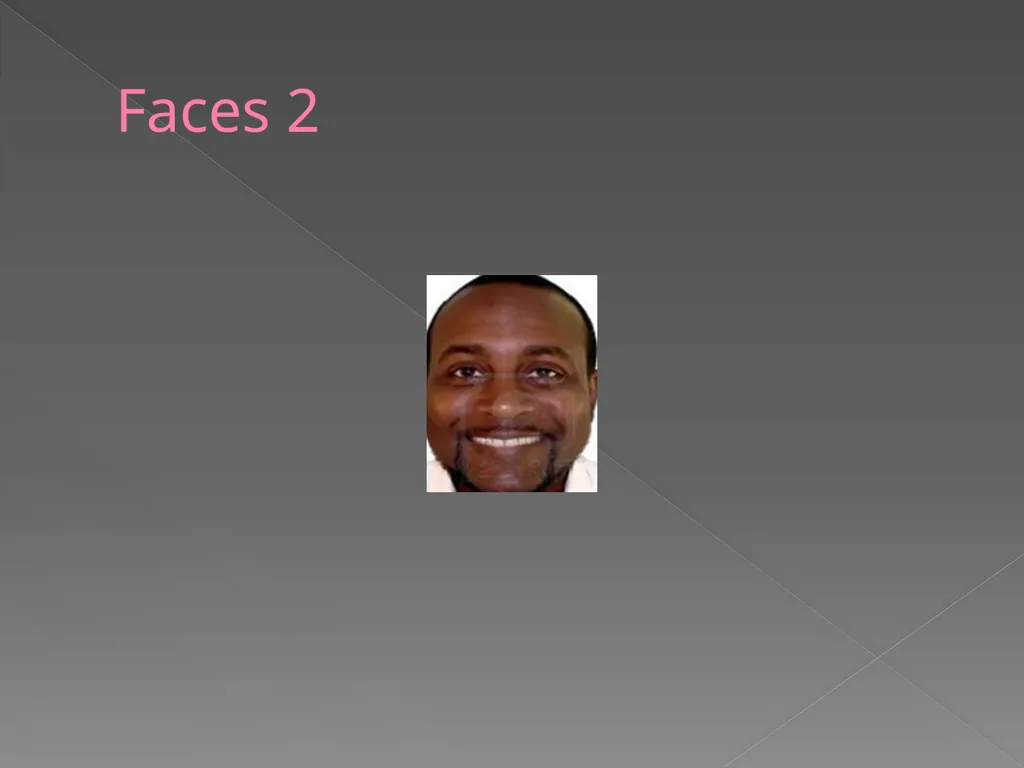
Faces Remember those faces for the delayed subtest!!<br>
21
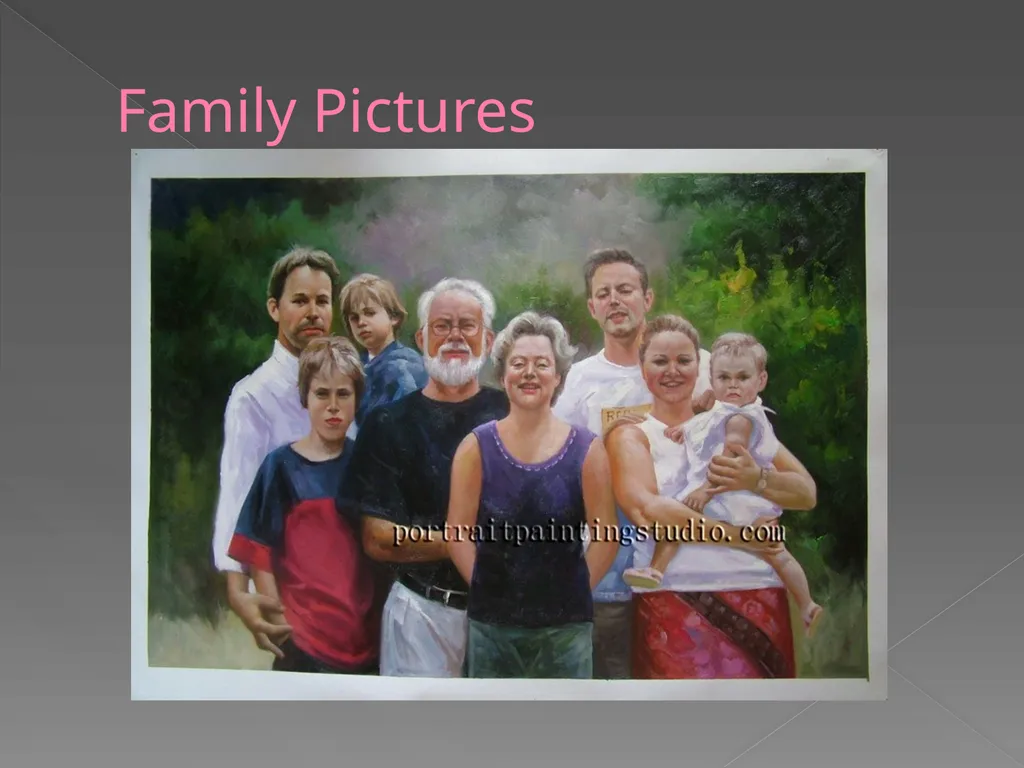
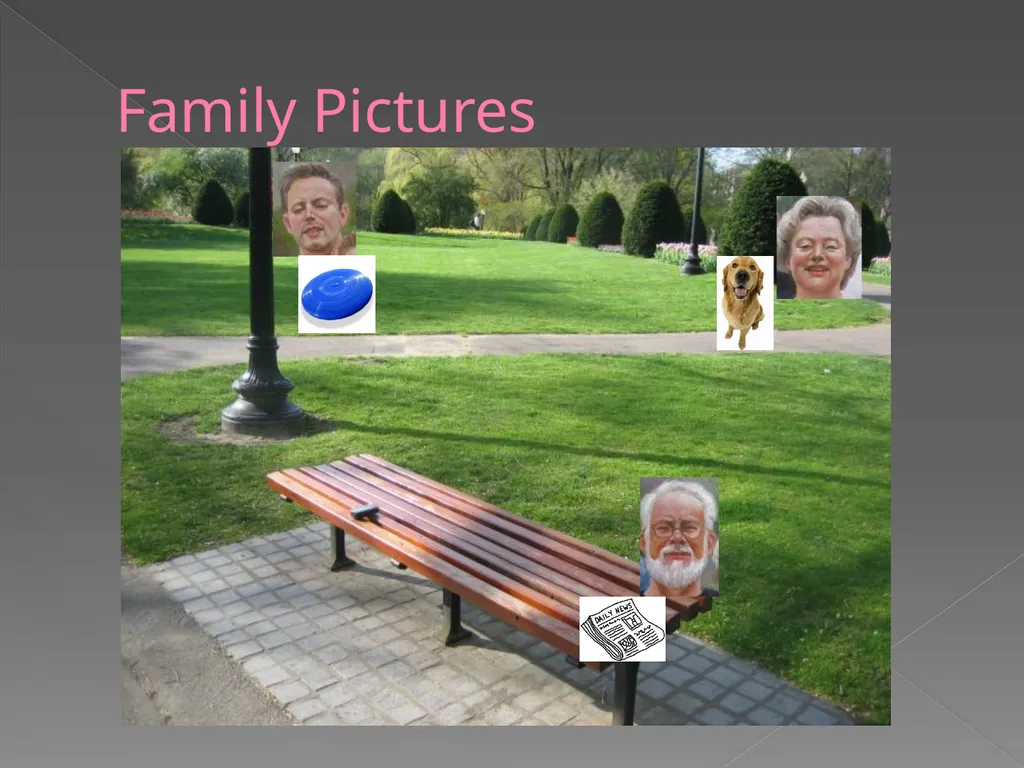
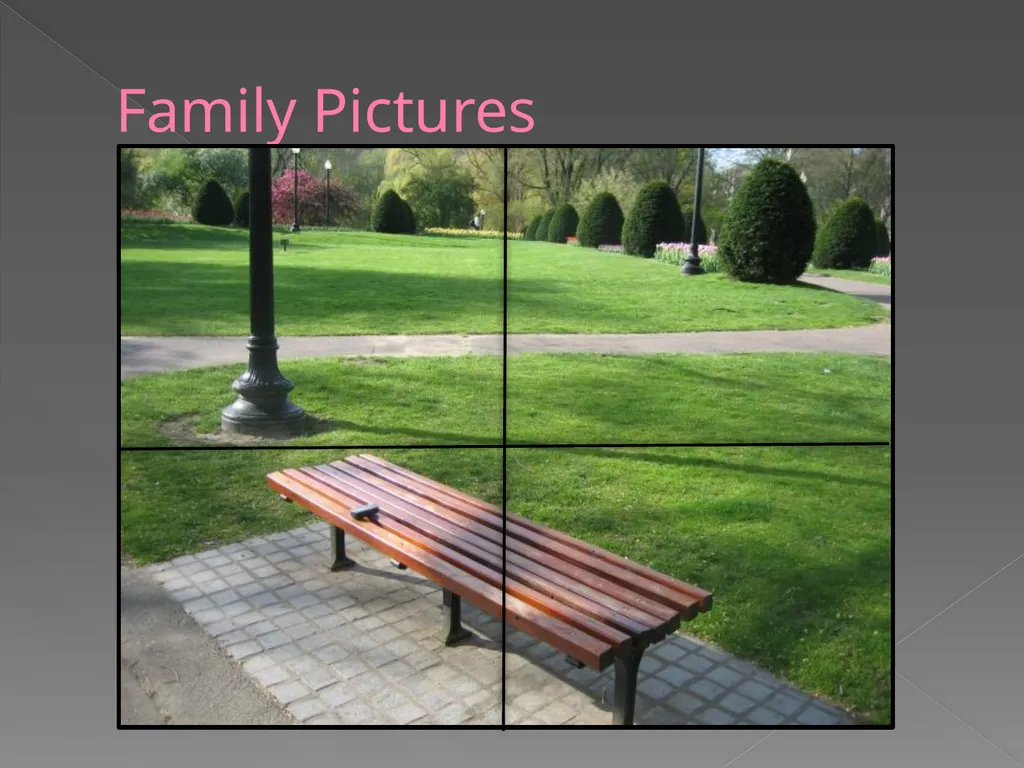
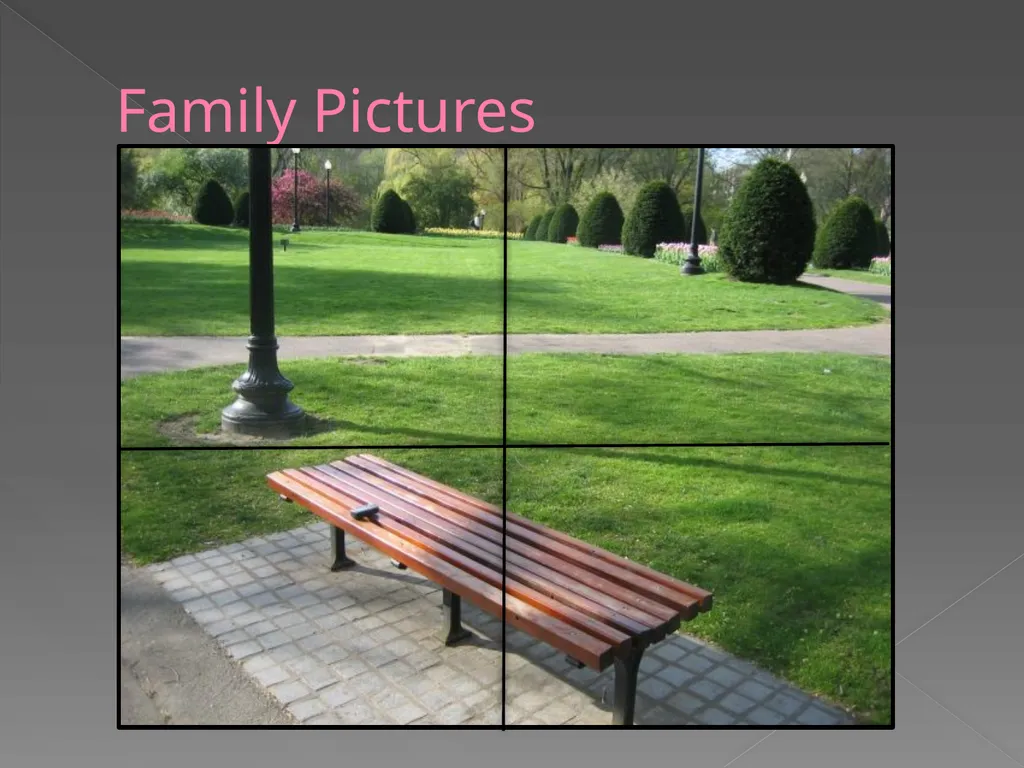
Subtest 5: Family Pictures Assesses the ability to remember scenes of family members doing various activities
Examinee is asked to remember characters presented in four scenes, their position, and action
Asked to remember scenes for later<br>
25
Verbal Immediate Index 2 core and 1 supplemental subtest provide a measure of immediate/working memory span for auditory/verbal material
Subtest 2 – Stories
Subtest 4 - Word Pairs
Subtest 6 - Word Lists*<br>
26
Subtest 2: Stories Assesses the ability to recall meaningful and semantically-related verbal material
Child must re-tell two stories read by the examiner
Asked to remember the stories for later<br>
27
Subtest 4: Word Pairs Assesses the ability to learn a list of word pairs read by the examiner over 3 learning trials, followed by immediate recall
Examinee must provide second word for each pair when prompted with the first
Free recall
Asked to remember the pairs for later<br>
28
Subtest 6: Word Lists Assesses the ability to learn a list of unrelated words over 4 learning trials
Presentation of word list
Free recall
Distracter List
Free recall of first list
Asked to remember first list for later<br>
29
Attention/ Concentration Index 2 core and 1 supplemental subtest assess the ability to sustain/direct attention/concentration, processing speed, and working memory
Subtest 7 – Numbers
Subtest 8 – Sequences
Subtest 9 - Picture Locations*<br>
30
Subtest 7: Numbers Assesses the ability to repeat random digit sequences of increasing length
Forward and Backward
Discontinue rule<br>
31
Subtest 8: Sequences Assesses the ability to mentally manipulate and sequence auditory/verbal information as quickly as possible
Discontinue rule
Scoring<br>
32
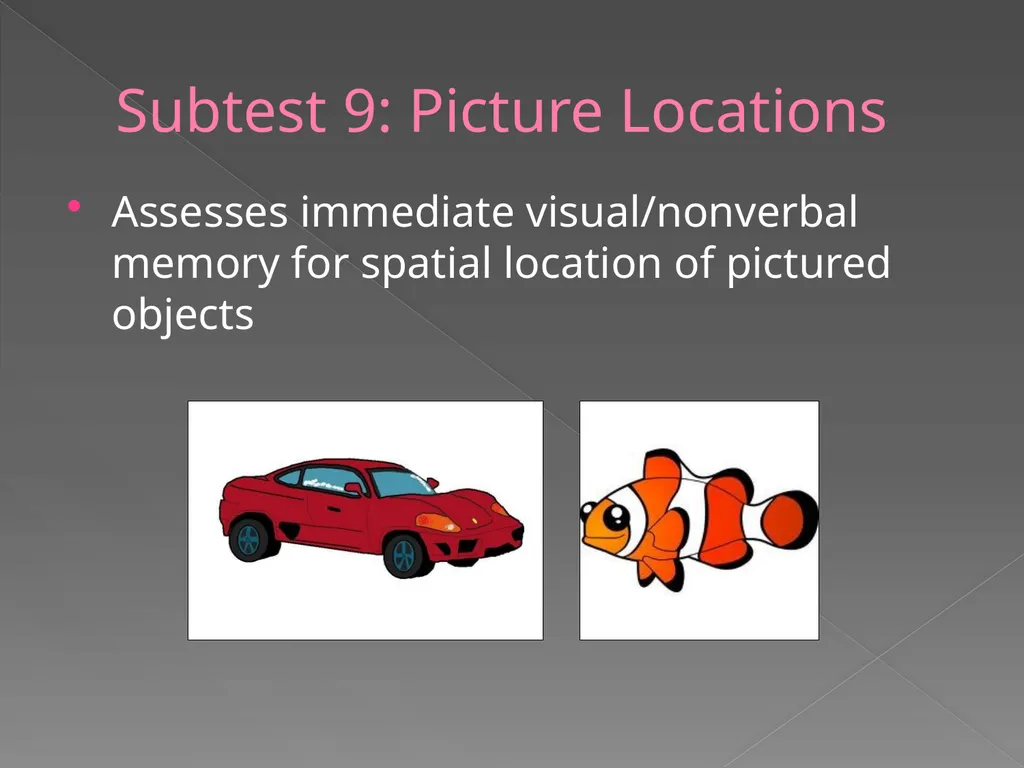
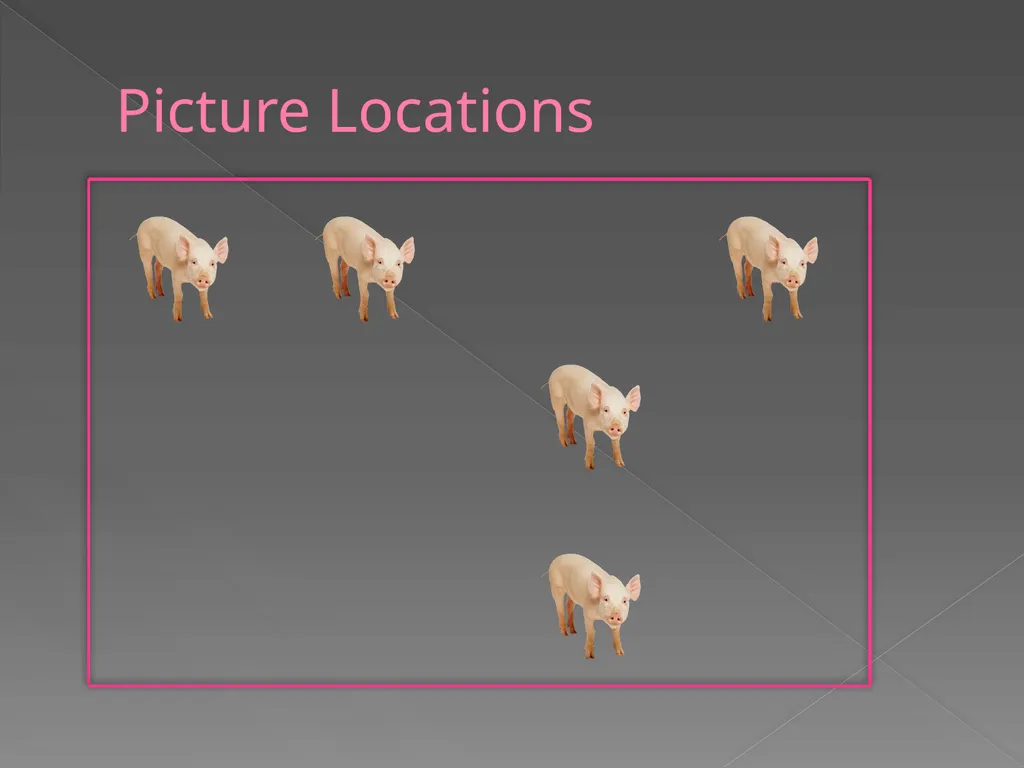
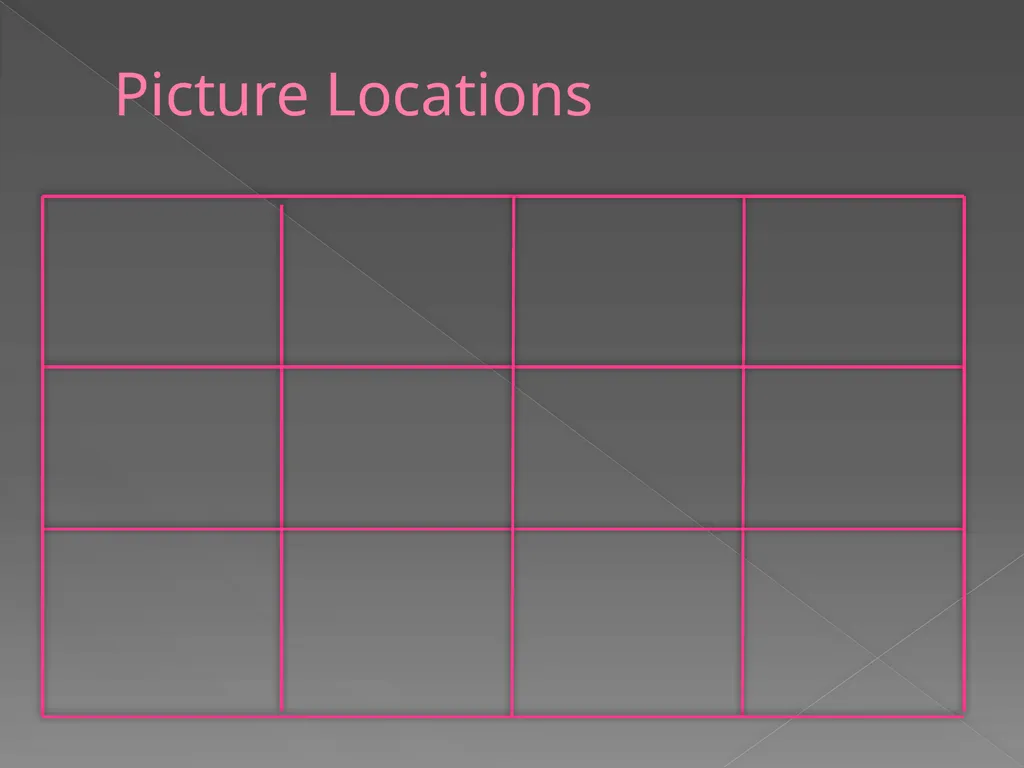
Subtest 9: Picture Locations Assesses immediate visual/nonverbal memory for spatial location of pictured objects<br>
35
Visual Delayed Index Assesses “the ability to consolidate, store, and retrieve newly learned visual/nonverbal material” (Cohen, 1997, p. 150)
Subtest 10 - Dot Locations 2
Subtest 12 - Faces 2
Subtest 14 - Family Pictures 2*<br>
36
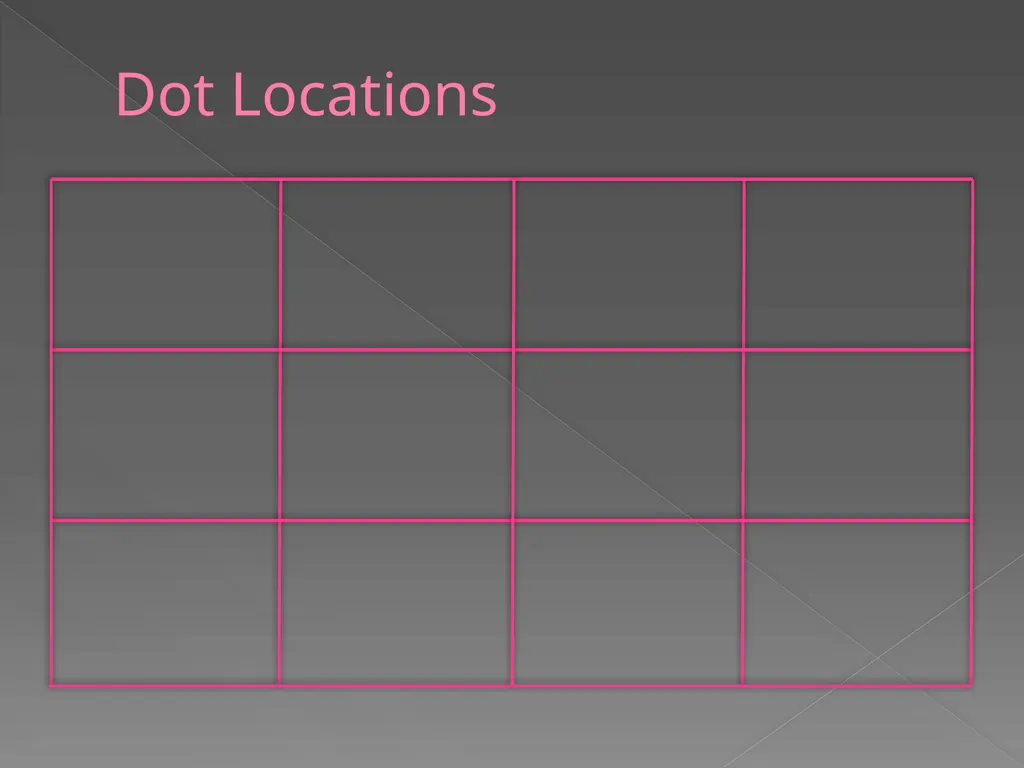
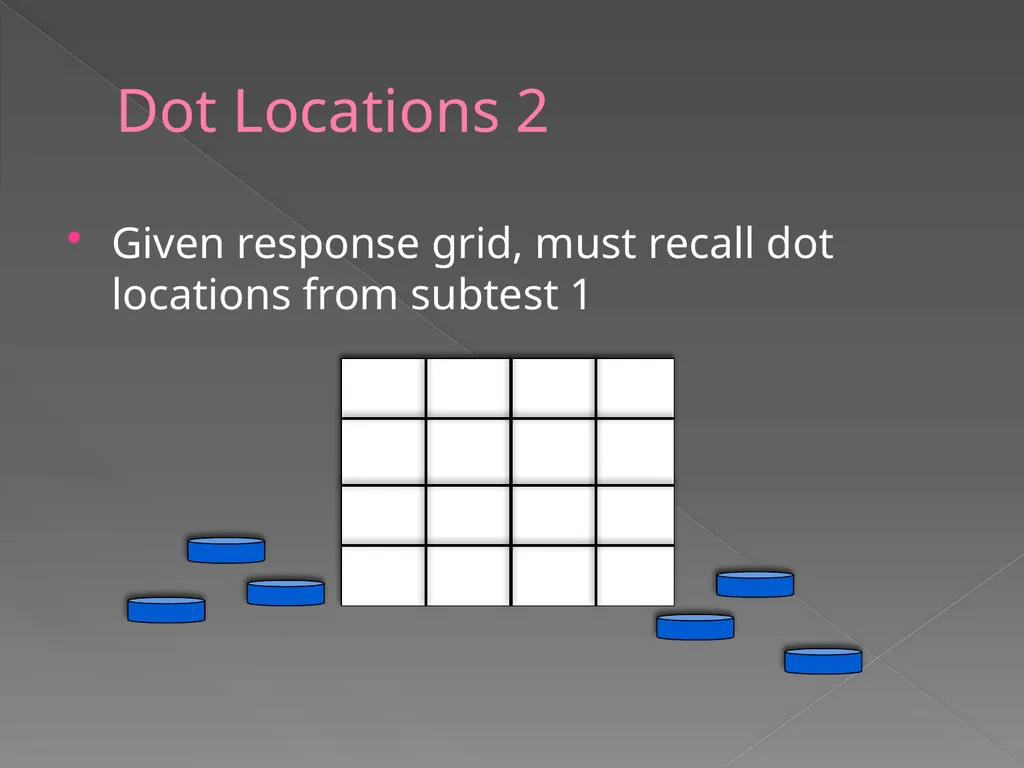
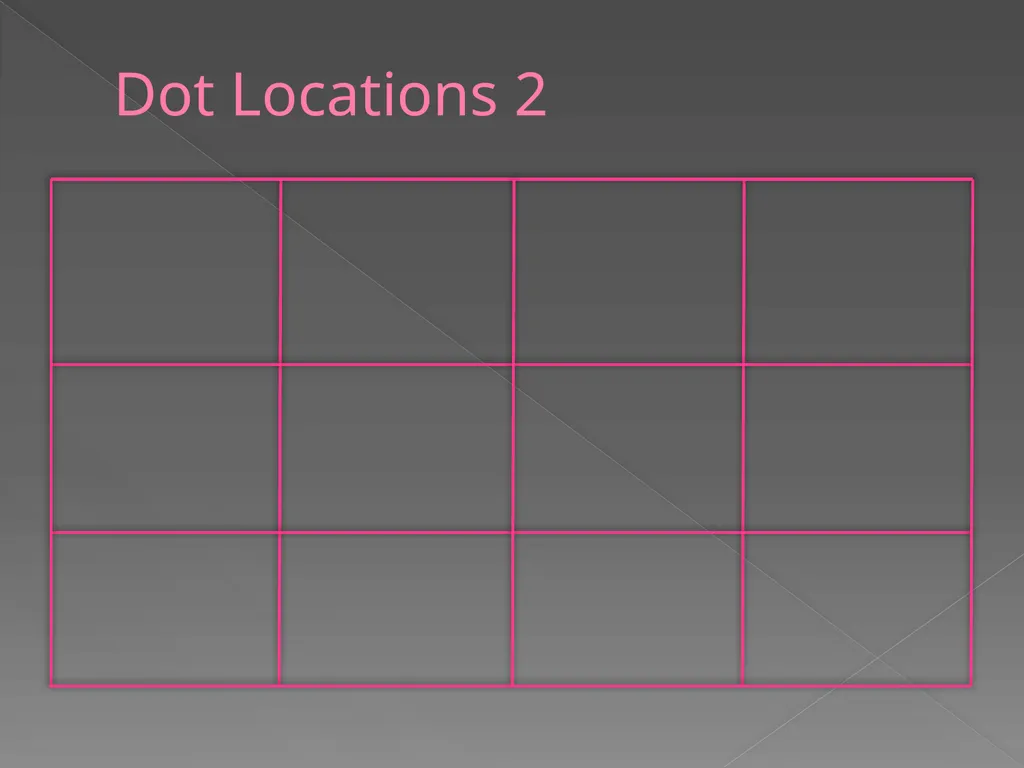
Dot Locations 2 Given response grid, must recall dot locations from subtest 1<br>
38
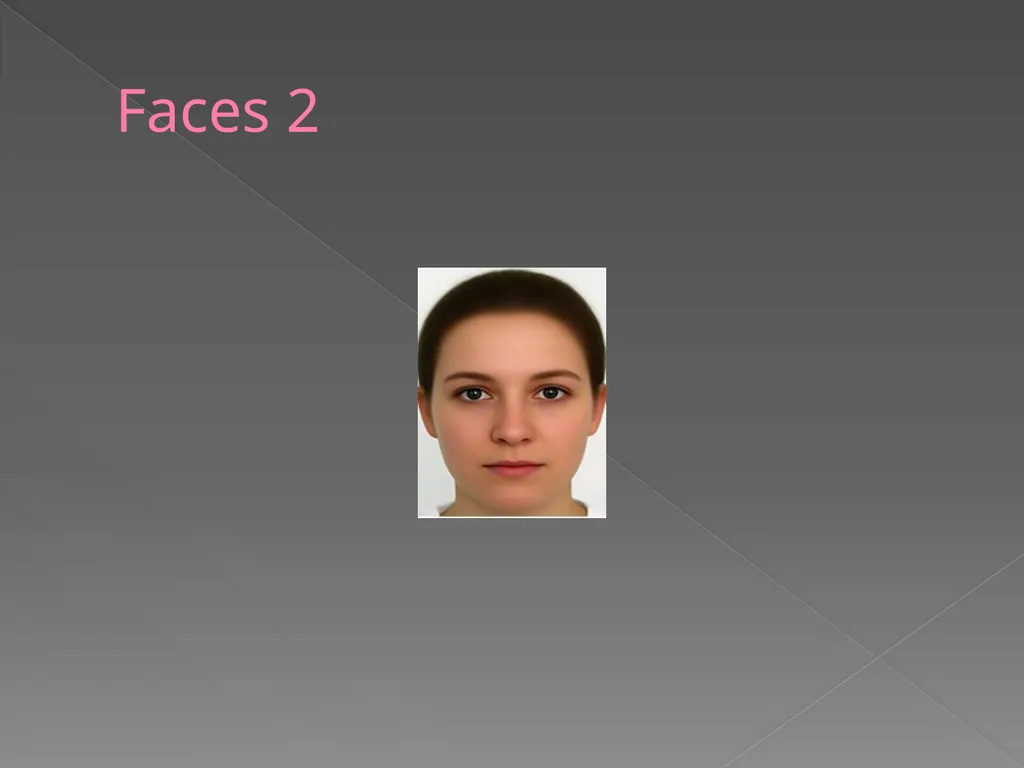
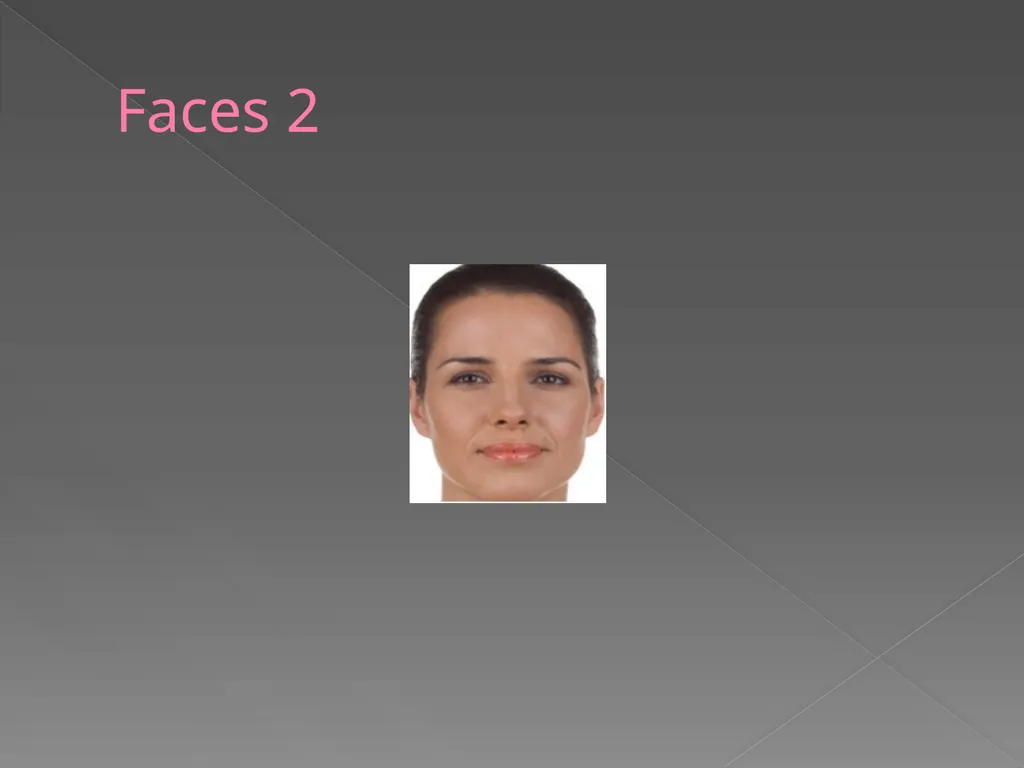
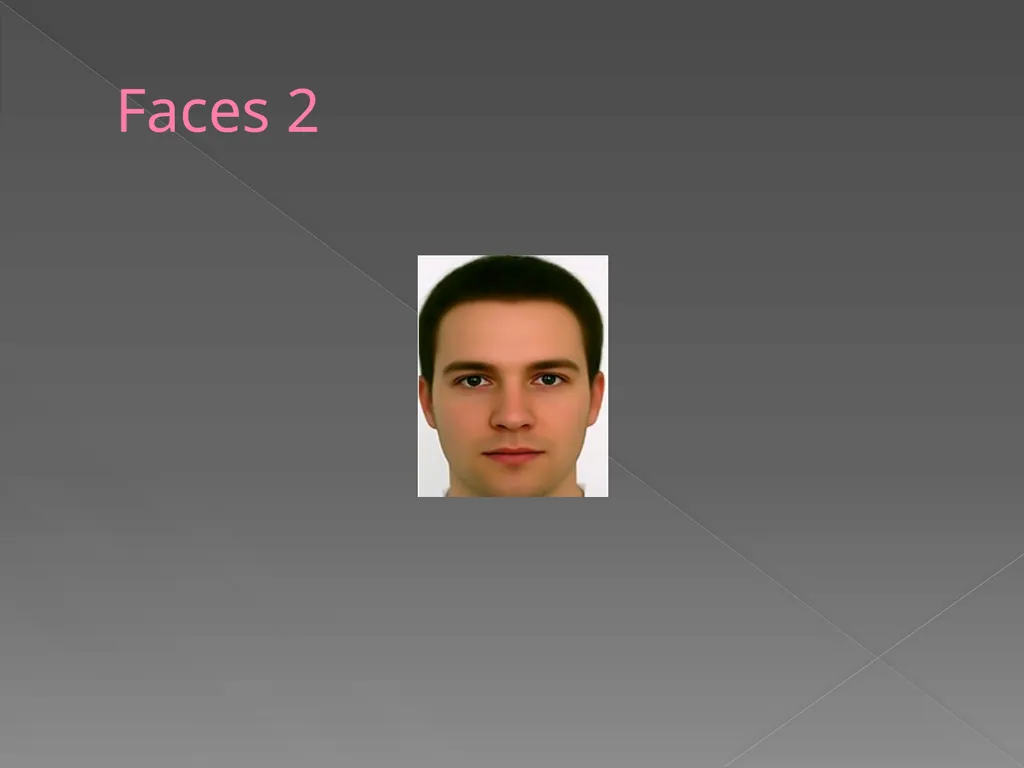
Faces 2 Presented with a series of faces, the child must recall which they were instructed to remember from subtest 3<br>
46
Family Pictures 2 Examinee is asked to remember which characters were in each scene, where they were positioned, and what they were doing from subtest 5<br>
48
Verbal Delayed Index Assesses “the ability to consolidate, store, and retrieve newly learned auditory/verbal material” (p. 149)
Subtest 11 - Stories 2
Subtest 13 - Word Pairs 2
Subtest 15 - Word Lists 2<br>
49
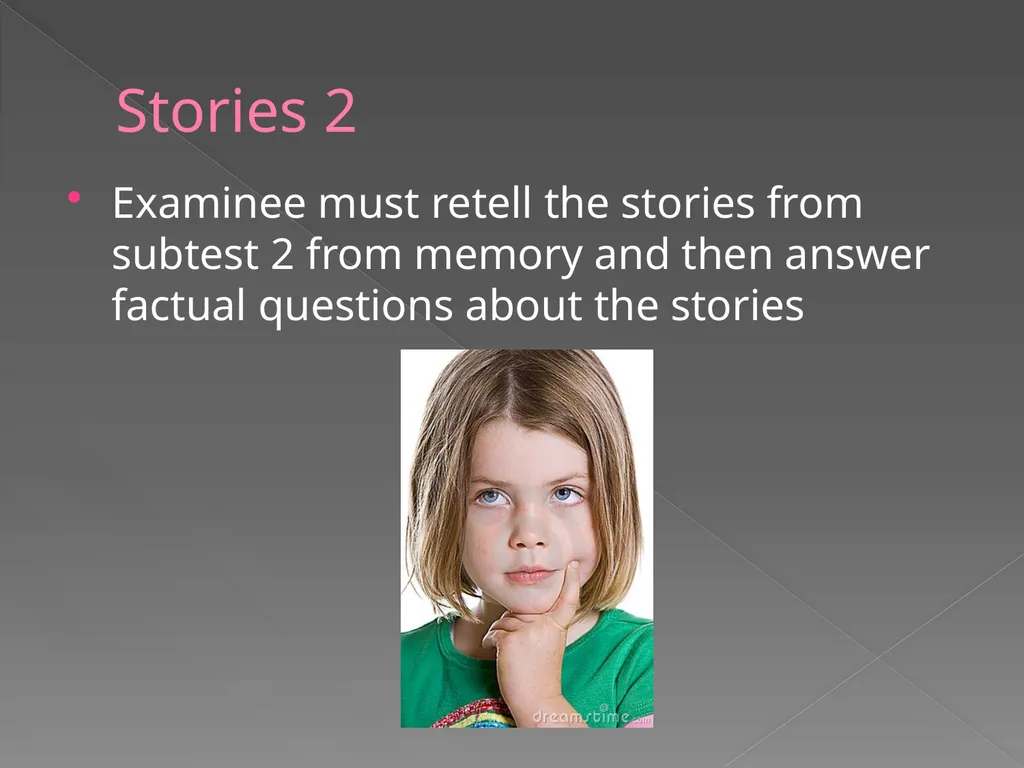
Stories 2 Examinee must retell the stories from subtest 2 from memory and then answer factual questions about the stories<br>
51
Word Pairs 2 Examinee must provide word pairs from subtest 4 from memory and then indicate whether pairs read aloud by the examiner were presented earlier<br>
53
Word Lists 2 Examinee must provide the words from subtest 6 from memory and then indicate whether words read aloud by the examiner were those presented earlier<br>
55
Delayed Recognition Index Helps determine whether impaired performance on verbal delayed index is the result of a deficit in encoding/ storage or retrieval
Delayed recognition portions of Stories 2 and Word Pairs 2<br>
56
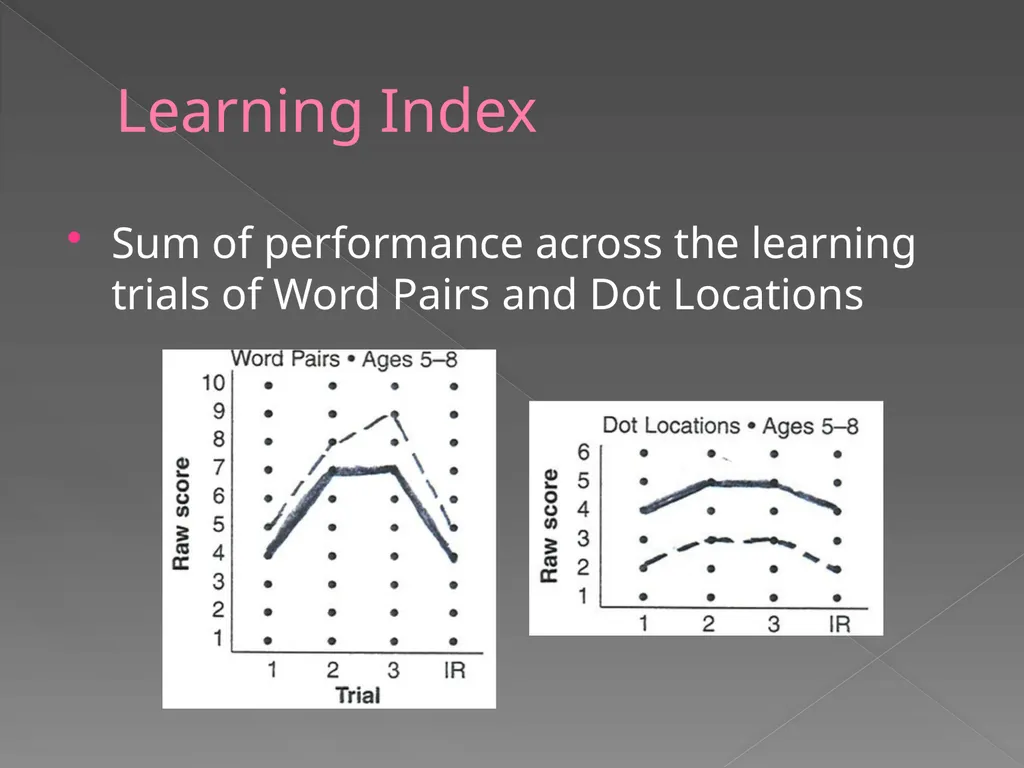
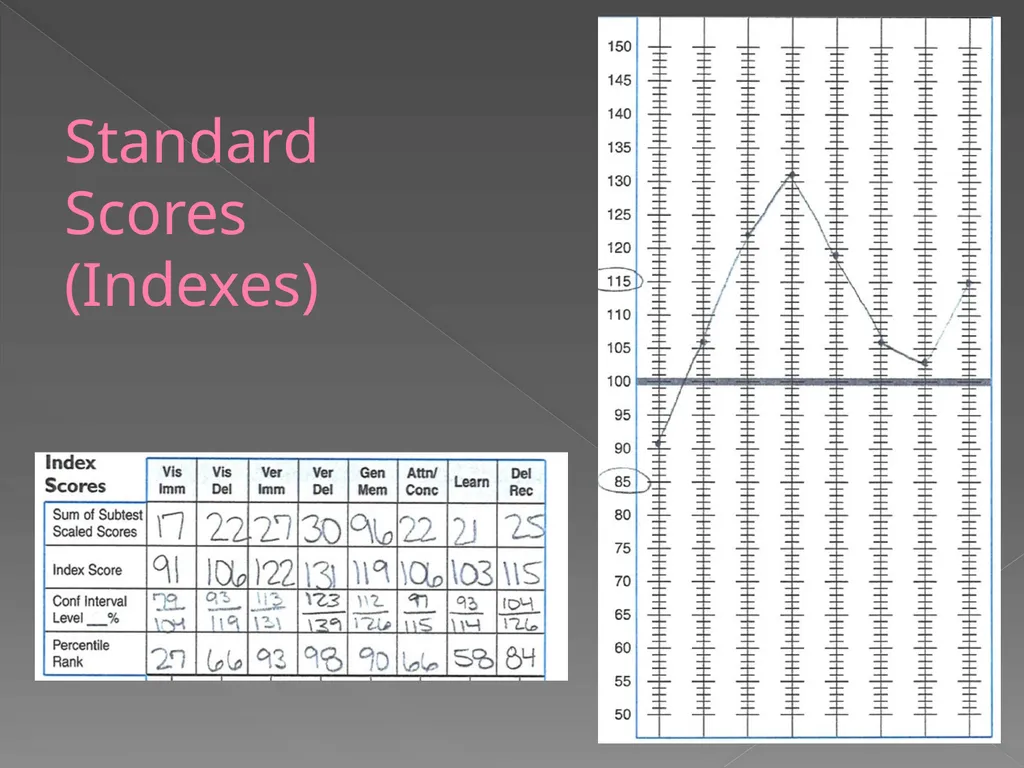
Learning Index Sum of performance across the learning trials of Word Pairs and Dot Locations<br>
57
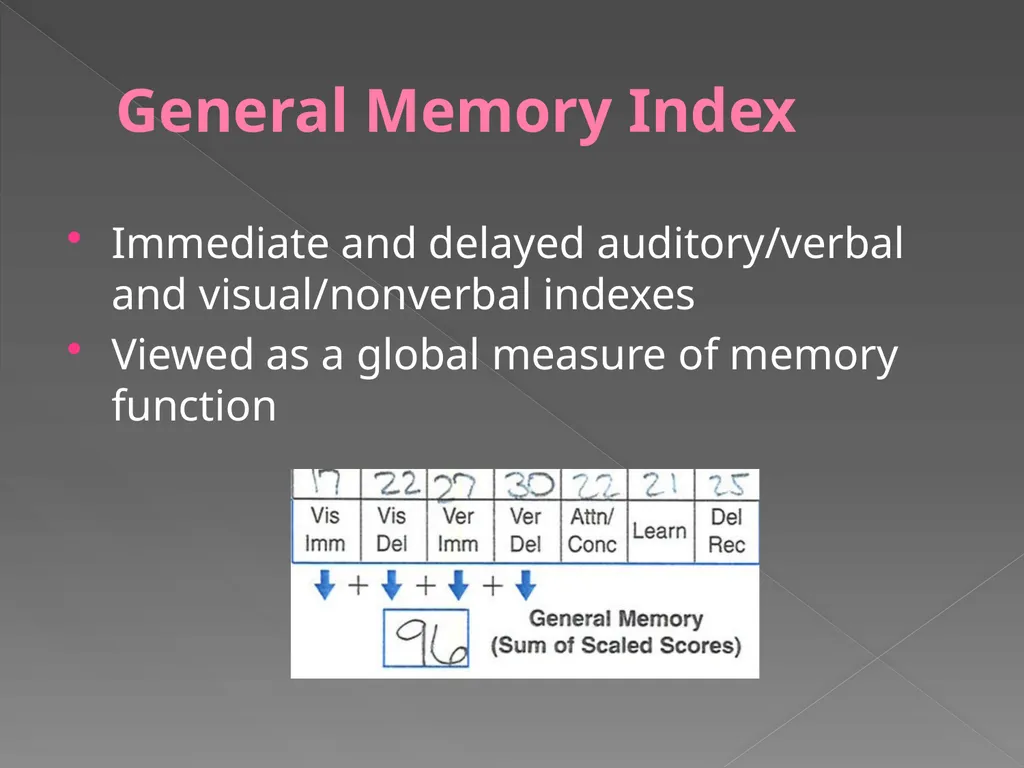
General Memory Index Immediate and delayed auditory/verbal and visual/nonverbal indexes
Viewed as a global measure of memory function<br>
58
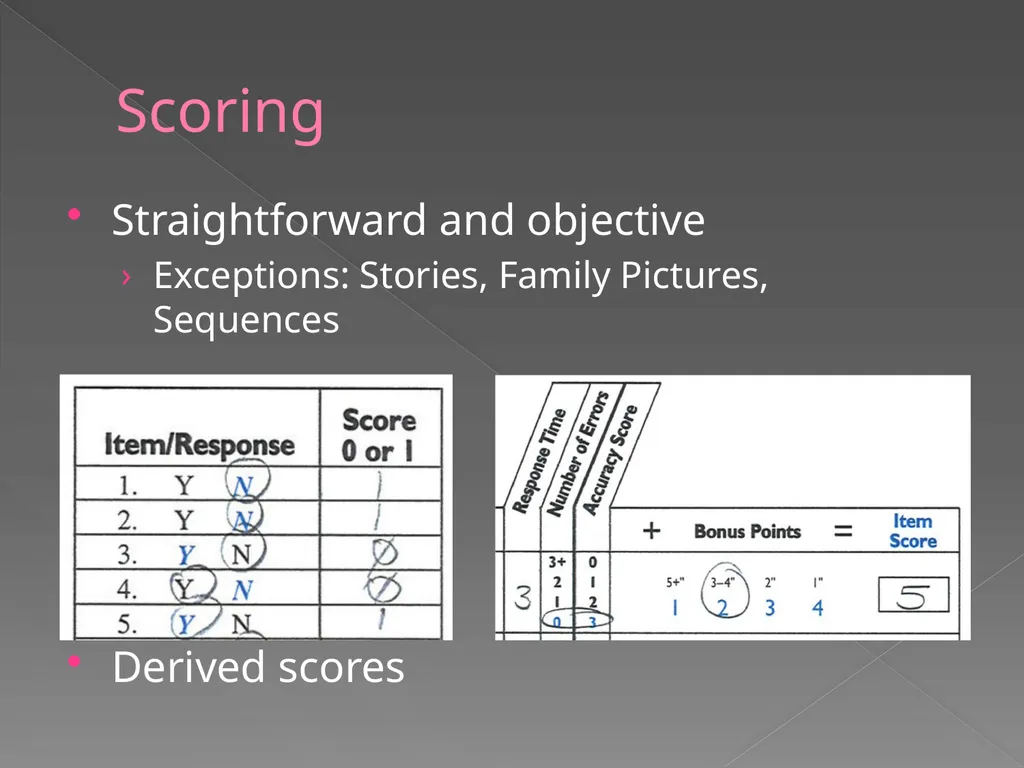
Scoring Straightforward and objective
Exceptions: Stories, Family Pictures, Sequences
Derived scores<br>
59
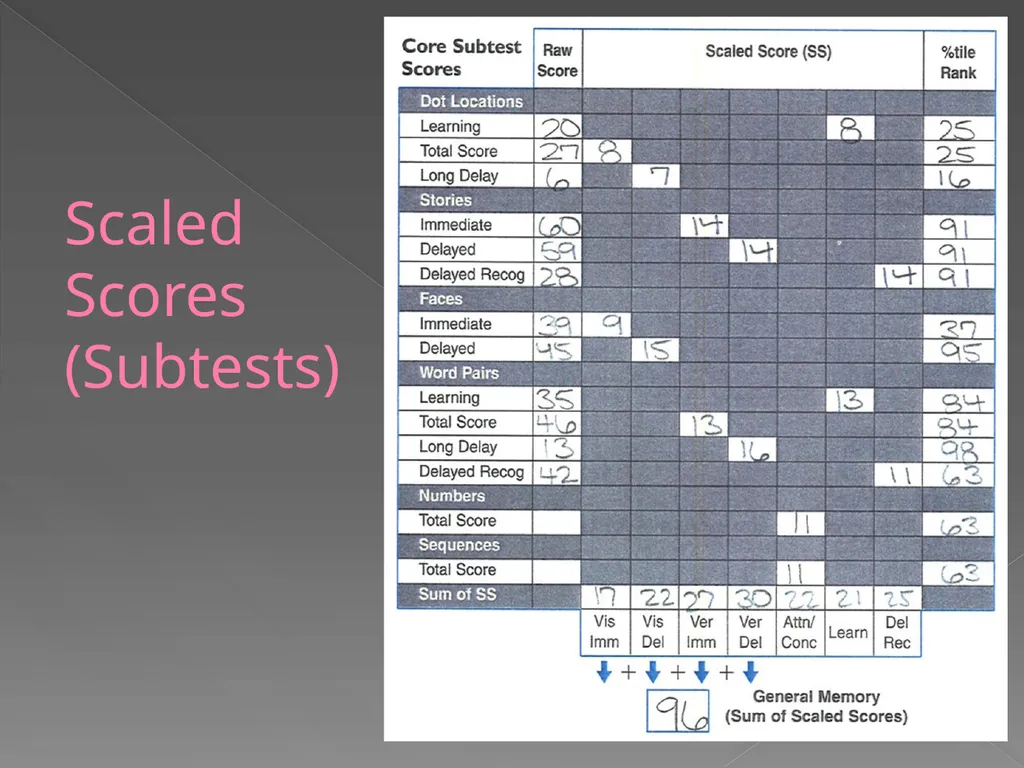
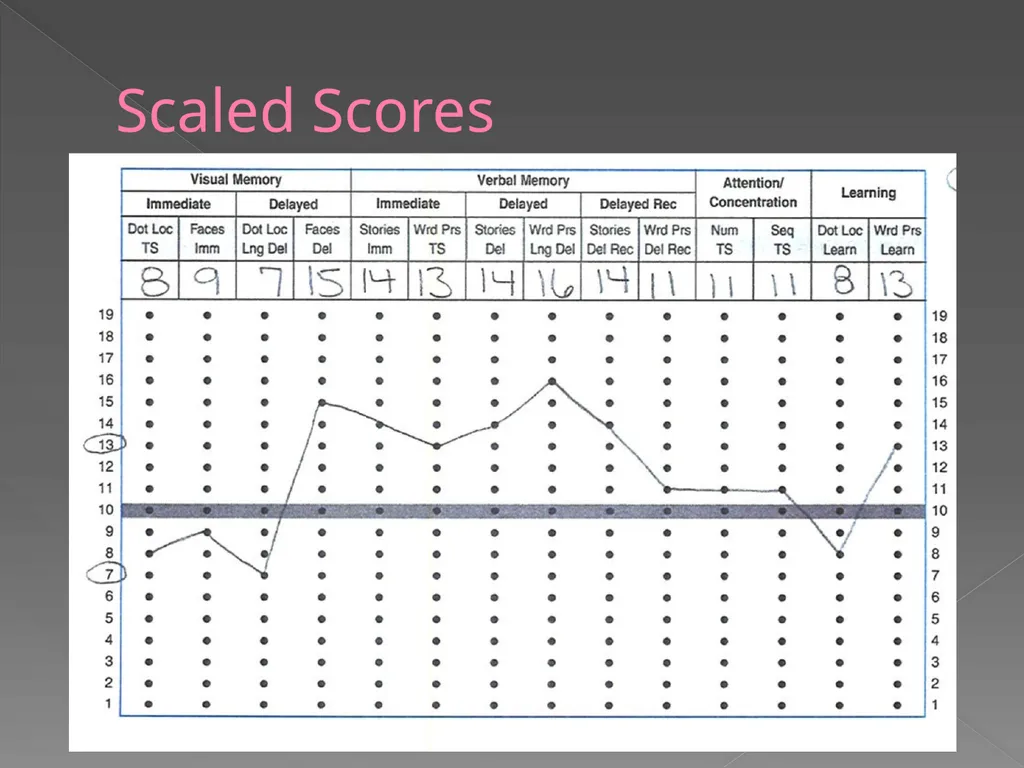
Scaled �Scores�(Subtests)<br>
61
Standard�Scores�(Indexes)<br>
62
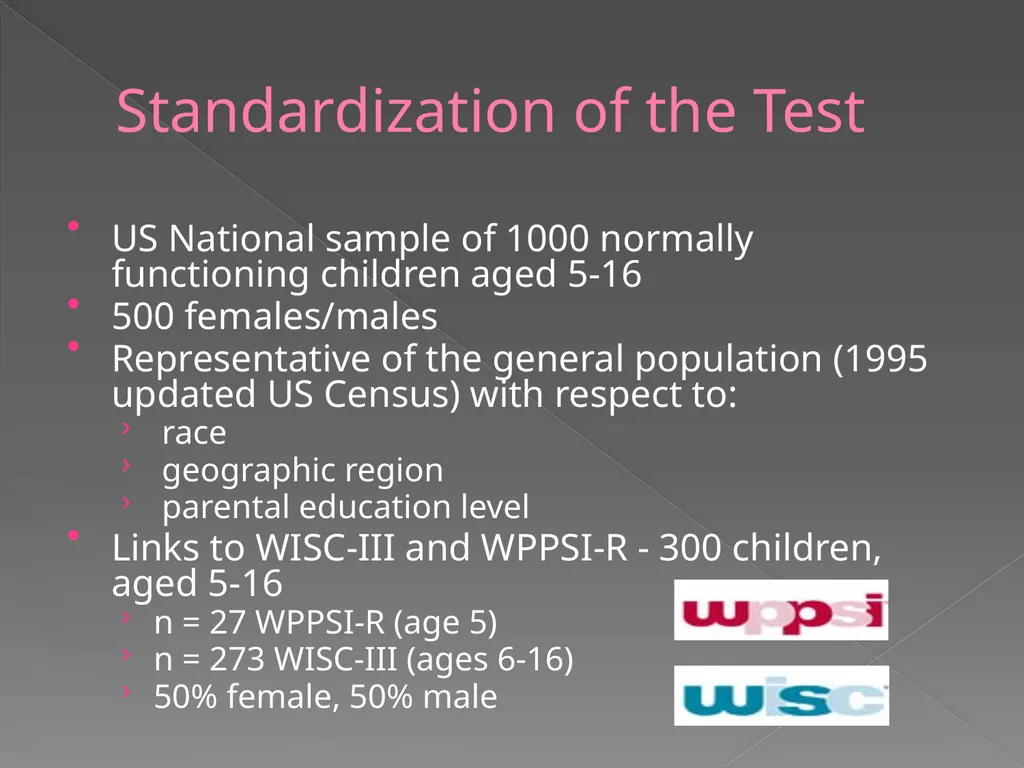
Standardization of the Test US National sample of 1000 normally functioning children aged 5-16
500 females/males
Representative of the general population (1995 updated US Census) with respect to:
race
geographic region
parental education level
Links to WISC-III and WPPSI-R - 300 children, aged 5-16
n = 27 WPPSI-R (age 5)
n = 273 WISC-III (ages 6-16)
50% female, 50% male<br>
63
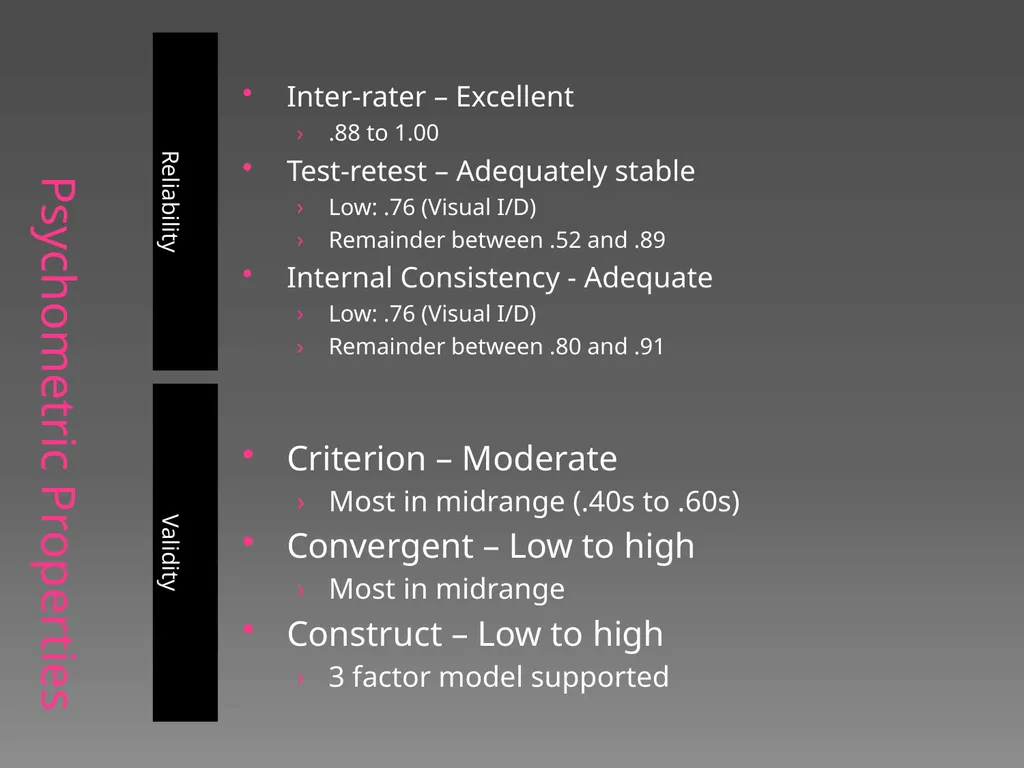
Psychometric Properties Reliability Inter-rater – Excellent
.88 to 1.00
Test-retest – Adequately stable
Low: .76 (Visual I/D)
Remainder between .52 and .89
Internal Consistency - Adequate
Low: .76 (Visual I/D)
Remainder between .80 and .91 Validity Criterion – Moderate
Most in midrange (.40s to .60s)
Convergent – Low to high
Most in midrange
Construct – Low to high
3 factor model supported<br>
64
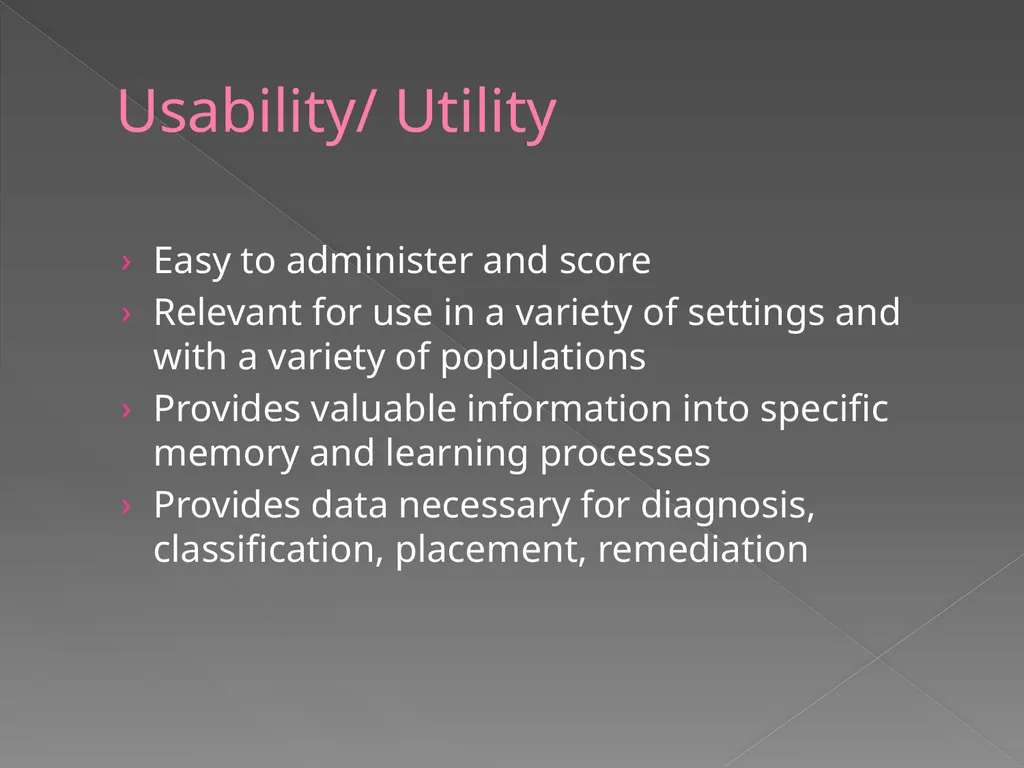
Usability/ Utility Easy to administer and score
Relevant for use in a variety of settings and with a variety of populations
Provides valuable information into specific memory and learning processes
Provides data necessary for diagnosis, classification, placement, remediation<br>
65
Evaluation Strengths:
Test manual is easy to use
Time efficient
Useful for assessment with diverse population of children and adolescents.
Variety of information gained
Useful for intervention planning
Generally psychometrically sound
Computer scoring software<br>
66
Evaluation Limitations:
No provisions for subtest spoilage
Some items may be potentially biased
Further studies needed exploring Visual/Nonverbal Indexes
US norms
Verbal instructions
Does not evaluate procedural memory
Norms and links with “current” intelligence tests outdated<br>
67
References Cohen, M. J. (1997). CMS: Children’s Memory Scale Manual. San Antonio: Harcourt Brace & Company.
Pearson Education Inc.. (n.d.). Children’s Memory Scale (CMS). In Pearson Assessment and Information. Retrieved February 23, 2102 from http://www.pearsonassessments
.com/HAIWEB/Cultures/en-us/Productdetail.htm? Pid=015-8038-002
Vaupel, C. A. (2001). Test reviews: Cohen, M. J. (1997). Children’s Memory Scale. San Antonio, TX: The Psychological Corporation. Journal of Psychoeducational Assessment, 19, 392-400. doi: 10.1177/073428290101900408<br>
68
QUESTIONS? COMMENTS?<br>