
Children’s Rights (UNCRC) Self-evaluation Forth
Description: Childrens Rights (UNCRC) Self-evaluation Forth Valley and West Lothian Introduction UNCRC is set to be incorporated into Scots law This has implications for educational settings It is important that education settings are prepared for this
Related Topics
Download Presentation
"Children’s Rights (UNCRC) Self-evaluation Forth" is the property of its rightful owner. Permission is granted to download and print the materials on this website for personal, non-commercial use only, and to display it on your personal computer provided you do not modify the materials and that you retain all copyright notices contained in the materials. By downloading content from our website, you accept the terms of this agreement.
Presentation Transcript
slide1. Children’s Rights (UNCRC) Self-evaluation Forth Valley and West Lothian<br>
slide2. Introduction UNCRC is set to be incorporated into Scots law
This has implications for educational settings
It is important that education settings are prepared for this incorporation by understanding what it means and how it will affect practice
This resource is designed to support this understanding by providing:
- evaluative statements
- examples of what this looks like in practice
- prompts to RAG each statement<br>
slide3. Format/guidance on the use of this resource The following slides are adapted from the self evaluation document on Education Scotland’s National Improvement hub page: Recognising and realising children’s rights (see notes for link)
The format is as follows:
5 sections, each with around 5 evaluative statements
Evaluative statement and some ideas to consider
Discussion prompts to RAG the evaluative statement
What could RAG look like? (please note these are suggestions and are by no means exhaustive)
At the end of each section – signposts to resources/training and examples of practice
This can be used at in-service or staff meetings, to be discussed in small groups.
You may wish to start with a different section that is most relevant to your setting
A Microsoft Form has been created to enter and collate responses to the evaluative statements (see notes section)
This is designed as a tool to be used in an ongoing way rather than as a whole powerpoint in one go.<br>
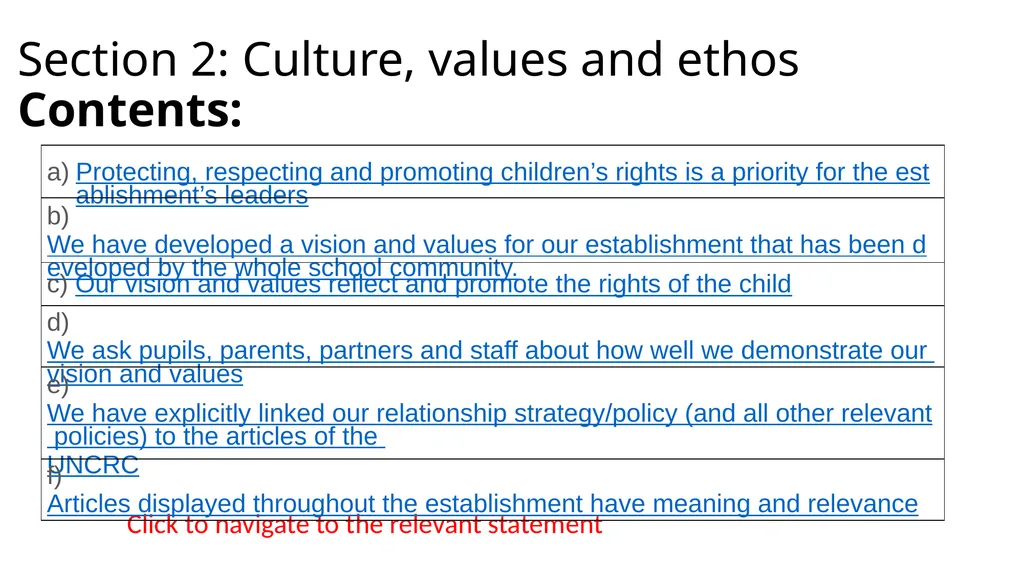
slide4. Section 2: Culture, values and ethos Contents: Click to navigate to the relevant statement<br>
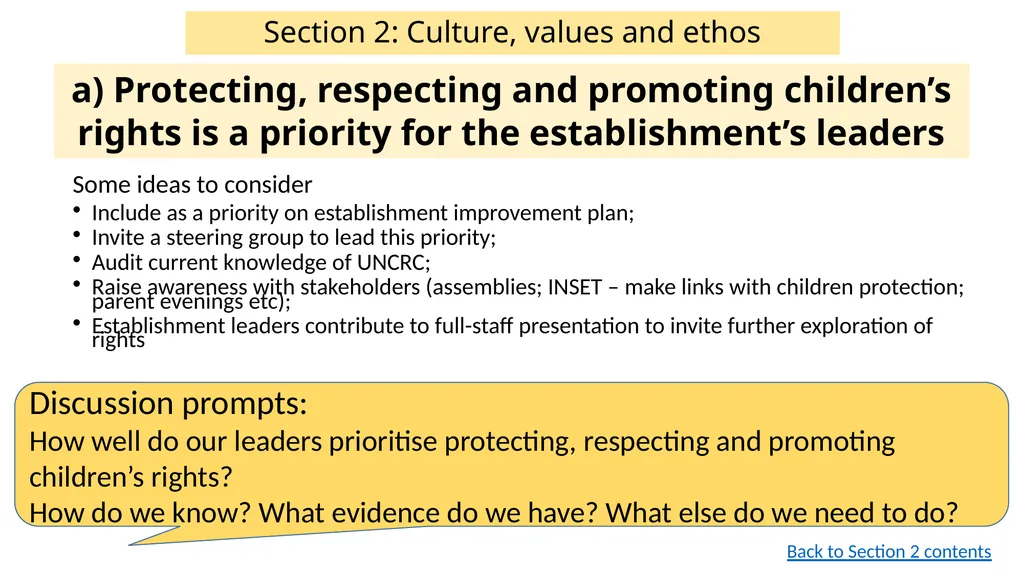
slide5. Section 2: Culture, values and ethos a) Protecting, respecting and promoting children’s rights is a priority for the establishment’s leaders Some ideas to consider
Include as a priority on establishment improvement plan;
Invite a steering group to lead this priority;
Audit current knowledge of UNCRC;
Raise awareness with stakeholders (assemblies; INSET – make links with children protection; parent evenings etc);
Establishment leaders contribute to full-staff presentation to invite further exploration of rights Discussion prompts:
How well do our leaders prioritise protecting, respecting and promoting children’s rights?
How do we know? What evidence do we have? What else do we need to do? Back to Section 2 contents<br>
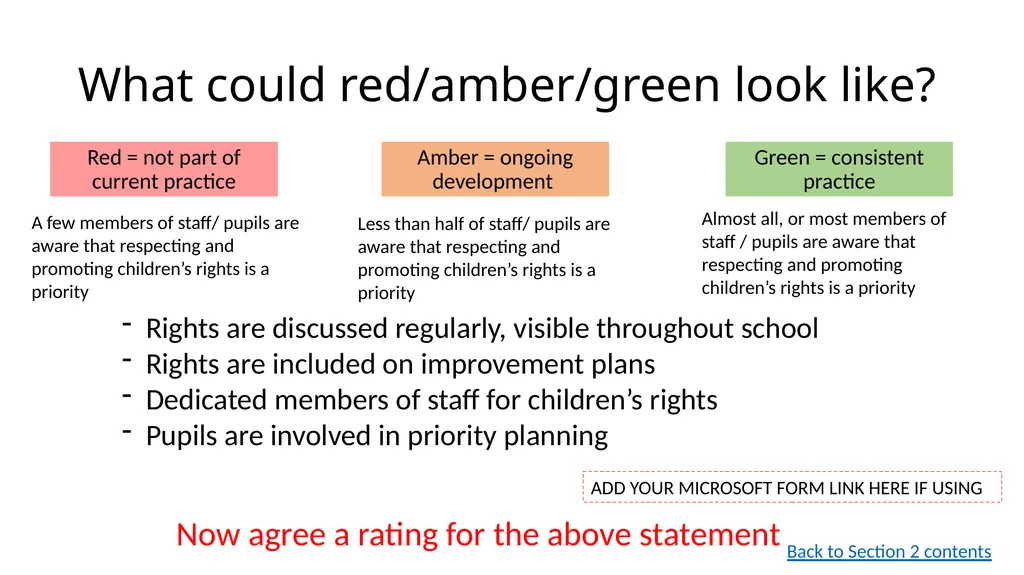
slide6. What could red/amber/green look like? Amber = ongoing development Red = not part of current practice Green = consistent practice A few members of staff/ pupils are aware that respecting and promoting children’s rights is a priority Less than half of staff/ pupils are aware that respecting and promoting children’s rights is a priority Almost all, or most members of staff / pupils are aware that respecting and promoting children’s rights is a priority Rights are discussed regularly, visible throughout school
Rights are included on improvement plans
Dedicated members of staff for children’s rights
Pupils are involved in priority planning Now agree a rating for the above statement ADD YOUR MICROSOFT FORM LINK HERE IF USING Back to Section 2 contents<br>
slide7. Notes to capture discussions/evidence Add your evidence here Back to Section 2 contents<br>
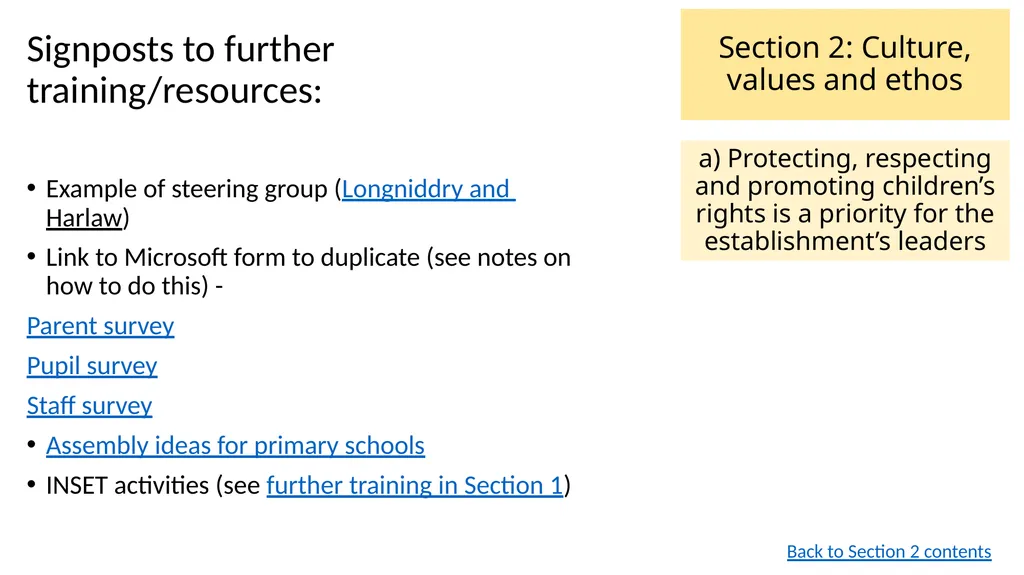
slide8. Section 2: Culture, values and ethos a) Protecting, respecting and promoting children’s rights is a priority for the establishment’s leaders Signposts to further training/resources:
Example of steering group (Longniddry and Harlaw)
Link to Microsoft form to duplicate (see notes on how to do this) -
Parent survey
Pupil survey
Staff survey
Assembly ideas for primary schools
INSET activities (see further training in Section 1) Back to Section 2 contents<br>
slide9. Section 2: Culture, values and ethos a) Protecting, respecting and promoting children’s rights is a priority for the establishment’s leaders Back to Section 2 contents Examples of practice:
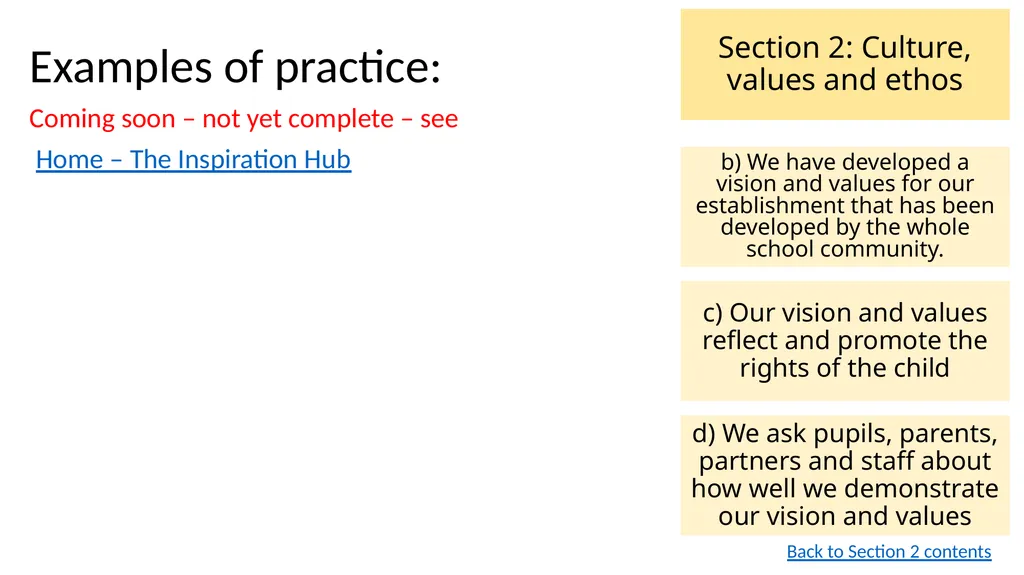
Coming soon – not yet complete – see
Home – The Inspiration Hub<br>
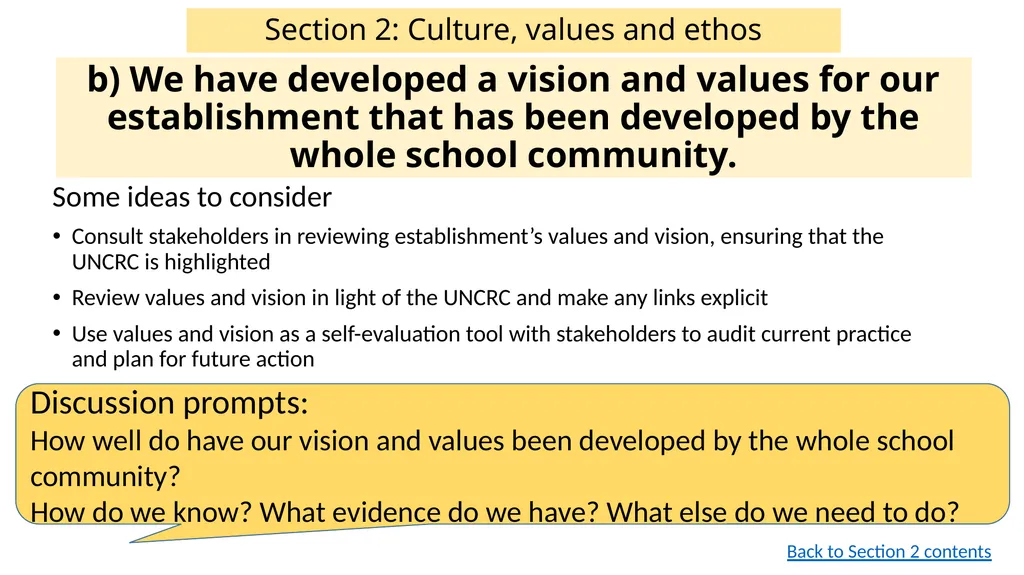
slide10. Section 2: Culture, values and ethos b) We have developed a vision and values for our establishment that has been developed by the whole school community. Some ideas to consider
Consult stakeholders in reviewing establishment’s values and vision, ensuring that the UNCRC is highlighted
Review values and vision in light of the UNCRC and make any links explicit
Use values and vision as a self-evaluation tool with stakeholders to audit current practice and plan for future action Discussion prompts:
How well do have our vision and values been developed by the whole school community?
How do we know? What evidence do we have? What else do we need to do? Back to Section 2 contents<br>
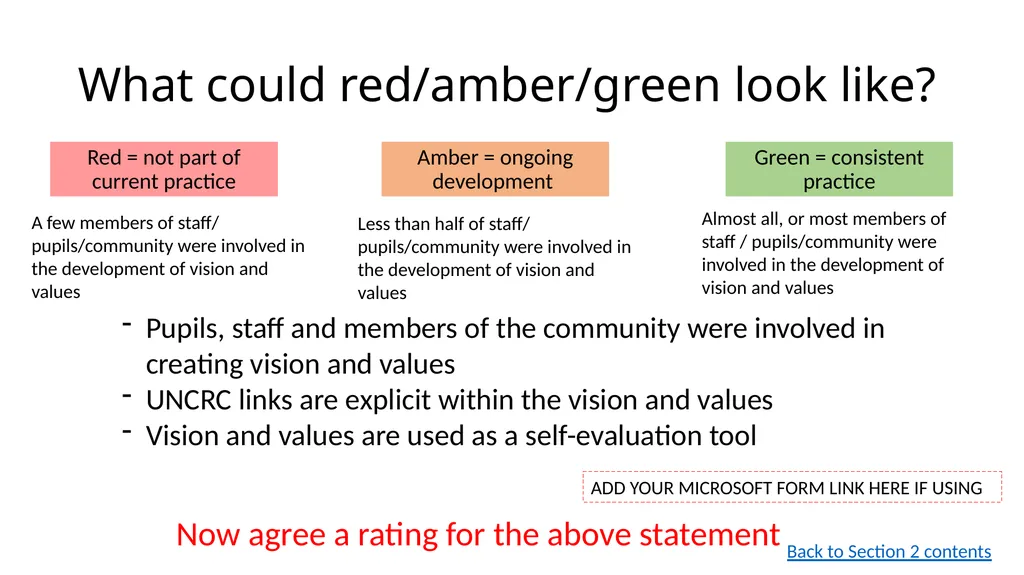
slide11. What could red/amber/green look like? Amber = ongoing development Red = not part of current practice Green = consistent practice A few members of staff/ pupils/community were involved in the development of vision and values Less than half of staff/ pupils/community were involved in the development of vision and values Almost all, or most members of staff / pupils/community were involved in the development of vision and values Pupils, staff and members of the community were involved in creating vision and values
UNCRC links are explicit within the vision and values
Vision and values are used as a self-evaluation tool Now agree a rating for the above statement ADD YOUR MICROSOFT FORM LINK HERE IF USING Back to Section 2 contents<br>
slide12. Notes to capture discussions/evidence Add your evidence here Back to Section 2 contents<br>
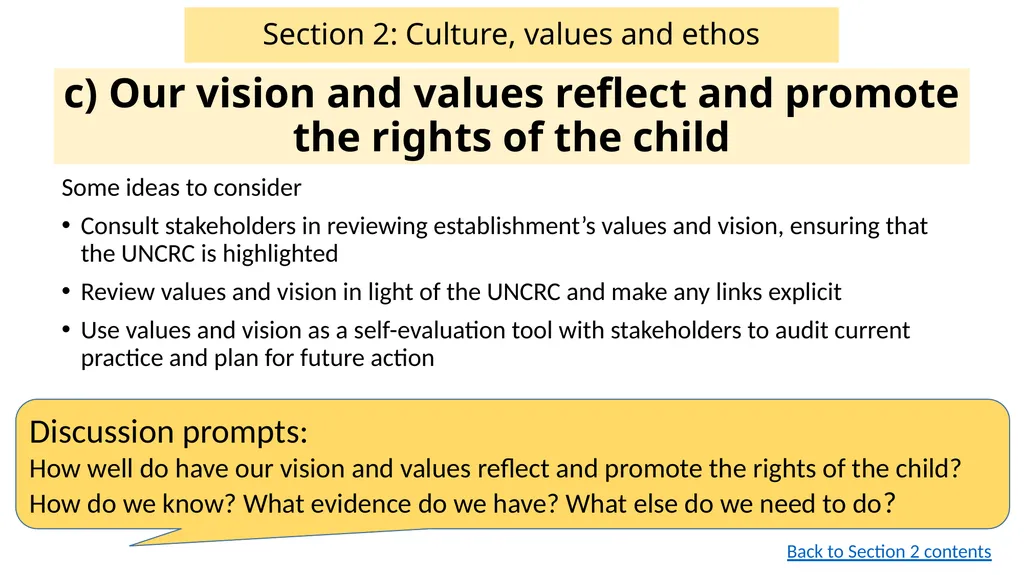
slide13. Section 2: Culture, values and ethos c) Our vision and values reflect and promote the rights of the child Some ideas to consider
Consult stakeholders in reviewing establishment’s values and vision, ensuring that the UNCRC is highlighted
Review values and vision in light of the UNCRC and make any links explicit
Use values and vision as a self-evaluation tool with stakeholders to audit current practice and plan for future action Discussion prompts:
How well do have our vision and values reflect and promote the rights of the child?
How do we know? What evidence do we have? What else do we need to do? Back to Section 2 contents<br>
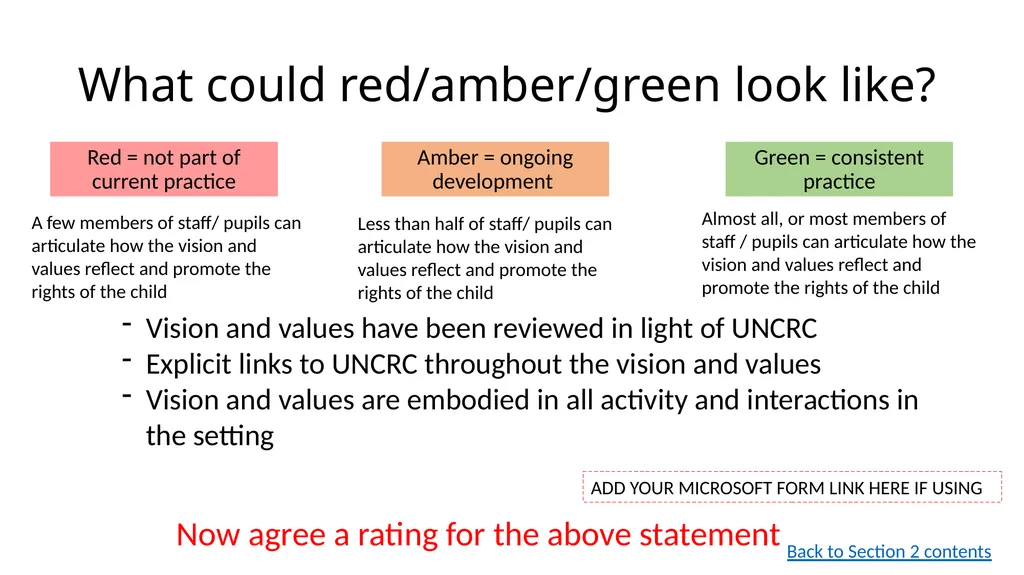
slide14. What could red/amber/green look like? Amber = ongoing development Red = not part of current practice Green = consistent practice A few members of staff/ pupils can articulate how the vision and values reflect and promote the rights of the child Less than half of staff/ pupils can articulate how the vision and values reflect and promote the rights of the child Almost all, or most members of staff / pupils can articulate how the vision and values reflect and promote the rights of the child Vision and values have been reviewed in light of UNCRC
Explicit links to UNCRC throughout the vision and values
Vision and values are embodied in all activity and interactions in the setting Now agree a rating for the above statement ADD YOUR MICROSOFT FORM LINK HERE IF USING Back to Section 2 contents<br>
slide15. Notes to capture discussions/evidence Add your evidence here Back to Section 2 contents<br>
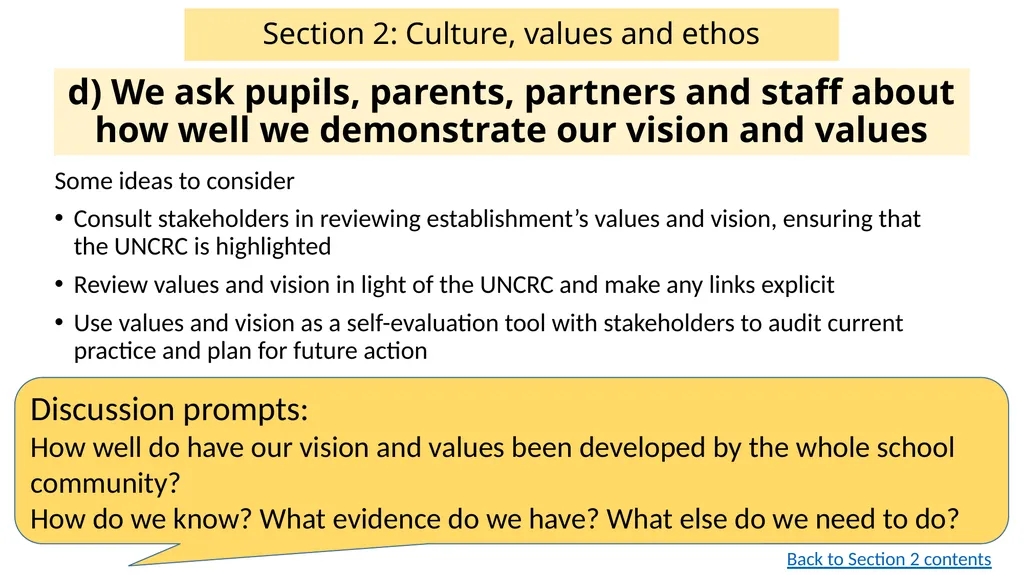
slide16. Section 2: Culture, values and ethos d) We ask pupils, parents, partners and staff about how well we demonstrate our vision and values Some ideas to consider
Consult stakeholders in reviewing establishment’s values and vision, ensuring that the UNCRC is highlighted
Review values and vision in light of the UNCRC and make any links explicit
Use values and vision as a self-evaluation tool with stakeholders to audit current practice and plan for future action Discussion prompts:
How well do have our vision and values been developed by the whole school community?
How do we know? What evidence do we have? What else do we need to do? Back to Section 2 contents<br>
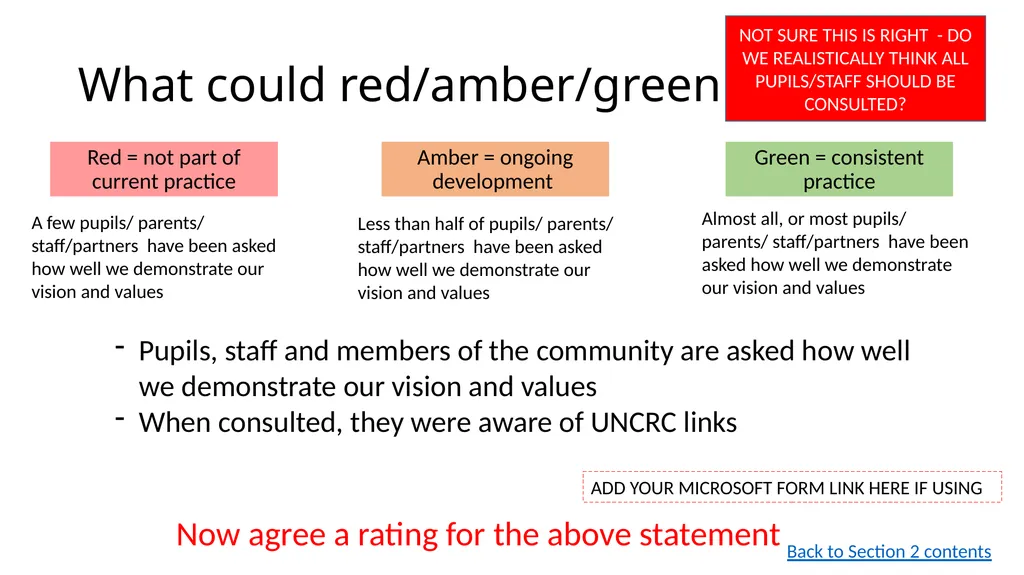
slide17. What could red/amber/green look like? Amber = ongoing development Red = not part of current practice Green = consistent practice A few pupils/ parents/ staff/partners have been asked how well we demonstrate our vision and values Less than half of pupils/ parents/ staff/partners have been asked how well we demonstrate our vision and values Almost all, or most pupils/ parents/ staff/partners have been asked how well we demonstrate our vision and values Pupils, staff and members of the community are asked how well we demonstrate our vision and values
When consulted, they were aware of UNCRC links Now agree a rating for the above statement ADD YOUR MICROSOFT FORM LINK HERE IF USING NOT SURE THIS IS RIGHT - DO WE REALISTICALLY THINK ALL PUPILS/STAFF SHOULD BE CONSULTED? Back to Section 2 contents<br>
slide18. Notes to capture discussions/evidence Add your evidence here Back to Section 2 contents<br>
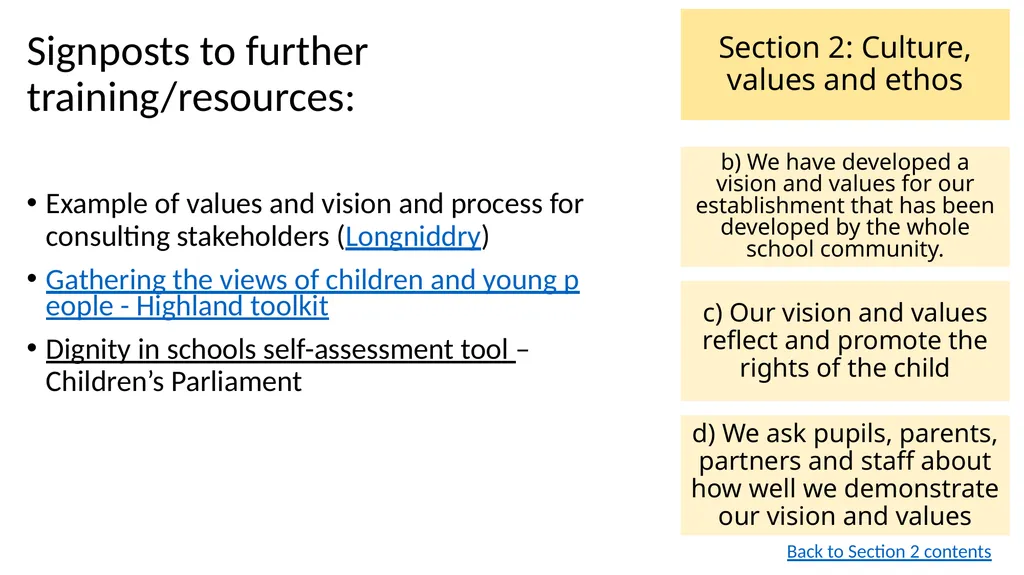
slide19. Section 2: Culture, values and ethos c) Our vision and values reflect and promote the rights of the child Signposts to further training/resources:
Example of values and vision and process for consulting stakeholders (Longniddry)
Gathering the views of children and young people - Highland toolkit
Dignity in schools self-assessment tool – Children’s Parliament b) We have developed a vision and values for our establishment that has been developed by the whole school community. d) We ask pupils, parents, partners and staff about how well we demonstrate our vision and values Back to Section 2 contents<br>
slide20. Section 2: Culture, values and ethos c) Our vision and values reflect and promote the rights of the child b) We have developed a vision and values for our establishment that has been developed by the whole school community. d) We ask pupils, parents, partners and staff about how well we demonstrate our vision and values Back to Section 2 contents Examples of practice:
Coming soon – not yet complete – see
Home – The Inspiration Hub<br>
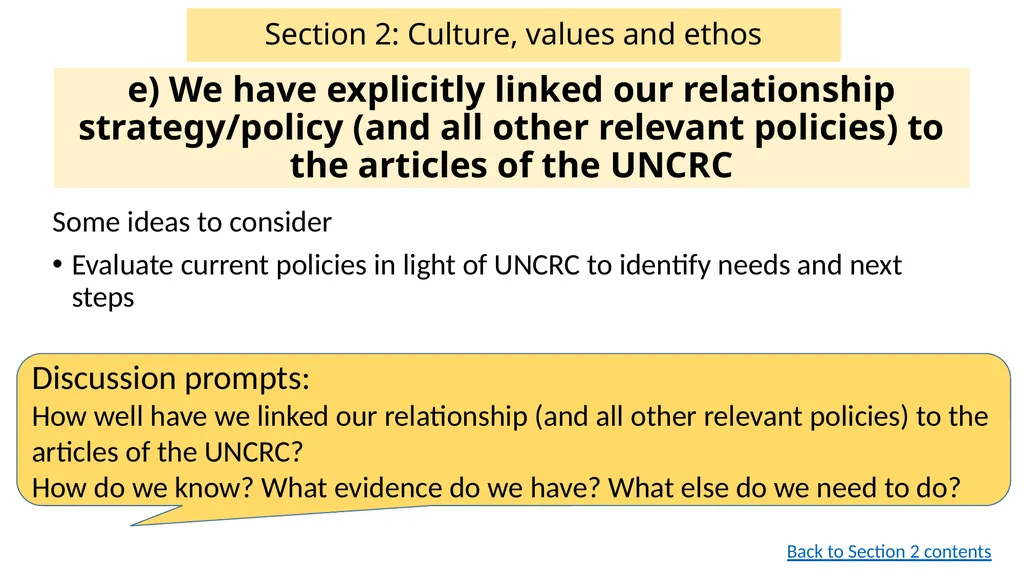
slide21. Section 2: Culture, values and ethos e) We have explicitly linked our relationship strategy/policy (and all other relevant policies) to the articles of the UNCRC Some ideas to consider
Evaluate current policies in light of UNCRC to identify needs and next steps Discussion prompts:
How well have we linked our relationship (and all other relevant policies) to the articles of the UNCRC?
How do we know? What evidence do we have? What else do we need to do? Back to Section 2 contents<br>
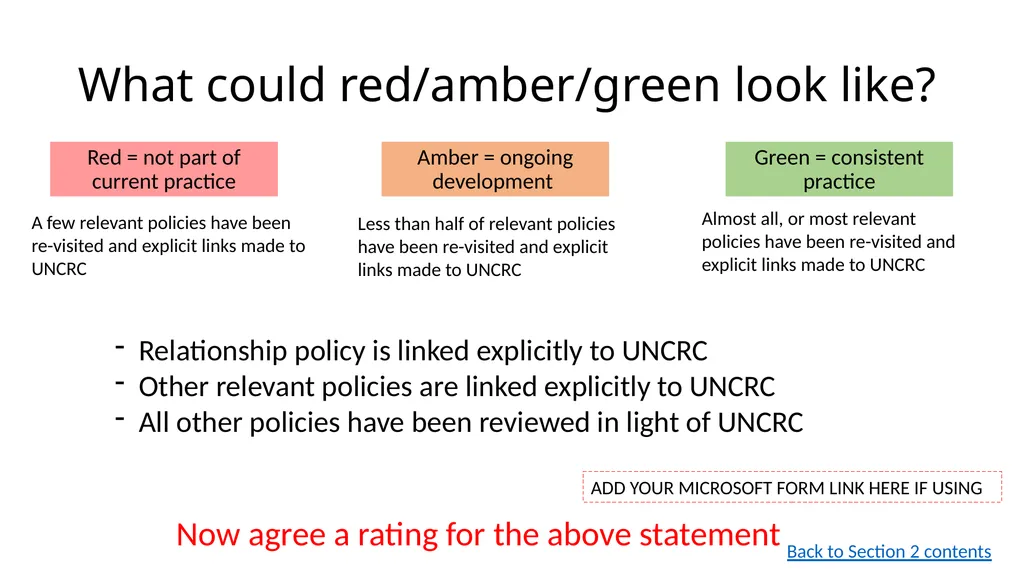
slide22. What could red/amber/green look like? Amber = ongoing development Red = not part of current practice Green = consistent practice A few relevant policies have been re-visited and explicit links made to UNCRC Less than half of relevant policies have been re-visited and explicit links made to UNCRC Almost all, or most relevant policies have been re-visited and explicit links made to UNCRC Relationship policy is linked explicitly to UNCRC
Other relevant policies are linked explicitly to UNCRC
All other policies have been reviewed in light of UNCRC Now agree a rating for the above statement ADD YOUR MICROSOFT FORM LINK HERE IF USING Back to Section 2 contents<br>
slide23. Notes to capture discussions/evidence Add your evidence here Back to Section 2 contents<br>
slide24. Section 2: Culture, values and ethos Signposts to further training/resources:
Policy guidance document e) We have explicitly linked our relationship strategy/policy (and all other relevant policies) to the articles of the UNCRC Back to Section 2 contents<br>
slide25. Section 2: Culture, values and ethos e) We have explicitly linked our relationship strategy/policy (and all other relevant policies) to the articles of the UNCRC Back to Section 2 contents Examples of practice:
Coming soon – not yet complete – see
Home – The Inspiration Hub<br>
slide26. Section 2: Culture, values and ethos f) Articles displayed throughout the establishment have meaning and relevance Some ideas to consider
Explicitly highlight the articles which link to the work and life of the school; explicitly inform stakeholders about your rights-based practice Discussion prompts:
Are articles displayed throughout the establishment? And do they have meaning and relevance?
How do we know? What evidence do we have? What else do we need to do? Back to Section 2 contents<br>
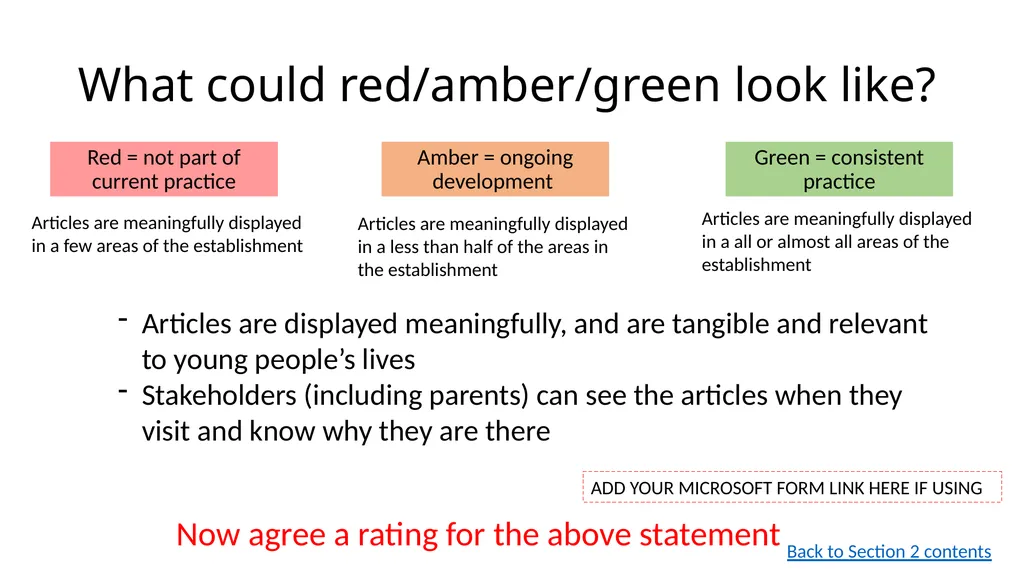
slide27. What could red/amber/green look like? Amber = ongoing development Red = not part of current practice Green = consistent practice Articles are meaningfully displayed in a few areas of the establishment Articles are meaningfully displayed in a less than half of the areas in the establishment Articles are meaningfully displayed in a all or almost all areas of the establishment Articles are displayed meaningfully, and are tangible and relevant to young people’s lives
Stakeholders (including parents) can see the articles when they visit and know why they are there Now agree a rating for the above statement ADD YOUR MICROSOFT FORM LINK HERE IF USING Back to Section 2 contents<br>
slide28. Notes to capture discussions/evidence Add your evidence here Back to Section 2 contents<br>
slide29. Section 2: Culture, values and ethos Signposts to further training/resources:
Underpinning articles: 2, 3, 6, 12 (link to summary of UNCRC)
Example of letter to parents, partners, pupils, support staff (including janitorial, catering staff etc.) communicating rights based practice (STILL TO BE ADDED) f) Articles displayed throughout the establishment have meaning and relevance Back to Section 2 contents<br>
slide30. Section 2: Culture, values and ethos e) We have explicitly linked our relationship strategy/policy (and all other relevant policies) to the articles of the UNCRC Back to Section 2 contents Examples of practice:
Coming soon – not yet complete – see
Home – The Inspiration Hub<br>
slide2. Introduction UNCRC is set to be incorporated into Scots law
This has implications for educational settings
It is important that education settings are prepared for this incorporation by understanding what it means and how it will affect practice
This resource is designed to support this understanding by providing:
- evaluative statements
- examples of what this looks like in practice
- prompts to RAG each statement<br>
slide3. Format/guidance on the use of this resource The following slides are adapted from the self evaluation document on Education Scotland’s National Improvement hub page: Recognising and realising children’s rights (see notes for link)
The format is as follows:
5 sections, each with around 5 evaluative statements
Evaluative statement and some ideas to consider
Discussion prompts to RAG the evaluative statement
What could RAG look like? (please note these are suggestions and are by no means exhaustive)
At the end of each section – signposts to resources/training and examples of practice
This can be used at in-service or staff meetings, to be discussed in small groups.
You may wish to start with a different section that is most relevant to your setting
A Microsoft Form has been created to enter and collate responses to the evaluative statements (see notes section)
This is designed as a tool to be used in an ongoing way rather than as a whole powerpoint in one go.<br>
slide4. Section 2: Culture, values and ethos Contents: Click to navigate to the relevant statement<br>
slide5. Section 2: Culture, values and ethos a) Protecting, respecting and promoting children’s rights is a priority for the establishment’s leaders Some ideas to consider
Include as a priority on establishment improvement plan;
Invite a steering group to lead this priority;
Audit current knowledge of UNCRC;
Raise awareness with stakeholders (assemblies; INSET – make links with children protection; parent evenings etc);
Establishment leaders contribute to full-staff presentation to invite further exploration of rights Discussion prompts:
How well do our leaders prioritise protecting, respecting and promoting children’s rights?
How do we know? What evidence do we have? What else do we need to do? Back to Section 2 contents<br>
slide6. What could red/amber/green look like? Amber = ongoing development Red = not part of current practice Green = consistent practice A few members of staff/ pupils are aware that respecting and promoting children’s rights is a priority Less than half of staff/ pupils are aware that respecting and promoting children’s rights is a priority Almost all, or most members of staff / pupils are aware that respecting and promoting children’s rights is a priority Rights are discussed regularly, visible throughout school
Rights are included on improvement plans
Dedicated members of staff for children’s rights
Pupils are involved in priority planning Now agree a rating for the above statement ADD YOUR MICROSOFT FORM LINK HERE IF USING Back to Section 2 contents<br>
slide7. Notes to capture discussions/evidence Add your evidence here Back to Section 2 contents<br>
slide8. Section 2: Culture, values and ethos a) Protecting, respecting and promoting children’s rights is a priority for the establishment’s leaders Signposts to further training/resources:
Example of steering group (Longniddry and Harlaw)
Link to Microsoft form to duplicate (see notes on how to do this) -
Parent survey
Pupil survey
Staff survey
Assembly ideas for primary schools
INSET activities (see further training in Section 1) Back to Section 2 contents<br>
slide9. Section 2: Culture, values and ethos a) Protecting, respecting and promoting children’s rights is a priority for the establishment’s leaders Back to Section 2 contents Examples of practice:
Coming soon – not yet complete – see
Home – The Inspiration Hub<br>
slide10. Section 2: Culture, values and ethos b) We have developed a vision and values for our establishment that has been developed by the whole school community. Some ideas to consider
Consult stakeholders in reviewing establishment’s values and vision, ensuring that the UNCRC is highlighted
Review values and vision in light of the UNCRC and make any links explicit
Use values and vision as a self-evaluation tool with stakeholders to audit current practice and plan for future action Discussion prompts:
How well do have our vision and values been developed by the whole school community?
How do we know? What evidence do we have? What else do we need to do? Back to Section 2 contents<br>
slide11. What could red/amber/green look like? Amber = ongoing development Red = not part of current practice Green = consistent practice A few members of staff/ pupils/community were involved in the development of vision and values Less than half of staff/ pupils/community were involved in the development of vision and values Almost all, or most members of staff / pupils/community were involved in the development of vision and values Pupils, staff and members of the community were involved in creating vision and values
UNCRC links are explicit within the vision and values
Vision and values are used as a self-evaluation tool Now agree a rating for the above statement ADD YOUR MICROSOFT FORM LINK HERE IF USING Back to Section 2 contents<br>
slide12. Notes to capture discussions/evidence Add your evidence here Back to Section 2 contents<br>
slide13. Section 2: Culture, values and ethos c) Our vision and values reflect and promote the rights of the child Some ideas to consider
Consult stakeholders in reviewing establishment’s values and vision, ensuring that the UNCRC is highlighted
Review values and vision in light of the UNCRC and make any links explicit
Use values and vision as a self-evaluation tool with stakeholders to audit current practice and plan for future action Discussion prompts:
How well do have our vision and values reflect and promote the rights of the child?
How do we know? What evidence do we have? What else do we need to do? Back to Section 2 contents<br>
slide14. What could red/amber/green look like? Amber = ongoing development Red = not part of current practice Green = consistent practice A few members of staff/ pupils can articulate how the vision and values reflect and promote the rights of the child Less than half of staff/ pupils can articulate how the vision and values reflect and promote the rights of the child Almost all, or most members of staff / pupils can articulate how the vision and values reflect and promote the rights of the child Vision and values have been reviewed in light of UNCRC
Explicit links to UNCRC throughout the vision and values
Vision and values are embodied in all activity and interactions in the setting Now agree a rating for the above statement ADD YOUR MICROSOFT FORM LINK HERE IF USING Back to Section 2 contents<br>
slide15. Notes to capture discussions/evidence Add your evidence here Back to Section 2 contents<br>
slide16. Section 2: Culture, values and ethos d) We ask pupils, parents, partners and staff about how well we demonstrate our vision and values Some ideas to consider
Consult stakeholders in reviewing establishment’s values and vision, ensuring that the UNCRC is highlighted
Review values and vision in light of the UNCRC and make any links explicit
Use values and vision as a self-evaluation tool with stakeholders to audit current practice and plan for future action Discussion prompts:
How well do have our vision and values been developed by the whole school community?
How do we know? What evidence do we have? What else do we need to do? Back to Section 2 contents<br>
slide17. What could red/amber/green look like? Amber = ongoing development Red = not part of current practice Green = consistent practice A few pupils/ parents/ staff/partners have been asked how well we demonstrate our vision and values Less than half of pupils/ parents/ staff/partners have been asked how well we demonstrate our vision and values Almost all, or most pupils/ parents/ staff/partners have been asked how well we demonstrate our vision and values Pupils, staff and members of the community are asked how well we demonstrate our vision and values
When consulted, they were aware of UNCRC links Now agree a rating for the above statement ADD YOUR MICROSOFT FORM LINK HERE IF USING NOT SURE THIS IS RIGHT - DO WE REALISTICALLY THINK ALL PUPILS/STAFF SHOULD BE CONSULTED? Back to Section 2 contents<br>
slide18. Notes to capture discussions/evidence Add your evidence here Back to Section 2 contents<br>
slide19. Section 2: Culture, values and ethos c) Our vision and values reflect and promote the rights of the child Signposts to further training/resources:
Example of values and vision and process for consulting stakeholders (Longniddry)
Gathering the views of children and young people - Highland toolkit
Dignity in schools self-assessment tool – Children’s Parliament b) We have developed a vision and values for our establishment that has been developed by the whole school community. d) We ask pupils, parents, partners and staff about how well we demonstrate our vision and values Back to Section 2 contents<br>
slide20. Section 2: Culture, values and ethos c) Our vision and values reflect and promote the rights of the child b) We have developed a vision and values for our establishment that has been developed by the whole school community. d) We ask pupils, parents, partners and staff about how well we demonstrate our vision and values Back to Section 2 contents Examples of practice:
Coming soon – not yet complete – see
Home – The Inspiration Hub<br>
slide21. Section 2: Culture, values and ethos e) We have explicitly linked our relationship strategy/policy (and all other relevant policies) to the articles of the UNCRC Some ideas to consider
Evaluate current policies in light of UNCRC to identify needs and next steps Discussion prompts:
How well have we linked our relationship (and all other relevant policies) to the articles of the UNCRC?
How do we know? What evidence do we have? What else do we need to do? Back to Section 2 contents<br>
slide22. What could red/amber/green look like? Amber = ongoing development Red = not part of current practice Green = consistent practice A few relevant policies have been re-visited and explicit links made to UNCRC Less than half of relevant policies have been re-visited and explicit links made to UNCRC Almost all, or most relevant policies have been re-visited and explicit links made to UNCRC Relationship policy is linked explicitly to UNCRC
Other relevant policies are linked explicitly to UNCRC
All other policies have been reviewed in light of UNCRC Now agree a rating for the above statement ADD YOUR MICROSOFT FORM LINK HERE IF USING Back to Section 2 contents<br>
slide23. Notes to capture discussions/evidence Add your evidence here Back to Section 2 contents<br>
slide24. Section 2: Culture, values and ethos Signposts to further training/resources:
Policy guidance document e) We have explicitly linked our relationship strategy/policy (and all other relevant policies) to the articles of the UNCRC Back to Section 2 contents<br>
slide25. Section 2: Culture, values and ethos e) We have explicitly linked our relationship strategy/policy (and all other relevant policies) to the articles of the UNCRC Back to Section 2 contents Examples of practice:
Coming soon – not yet complete – see
Home – The Inspiration Hub<br>
slide26. Section 2: Culture, values and ethos f) Articles displayed throughout the establishment have meaning and relevance Some ideas to consider
Explicitly highlight the articles which link to the work and life of the school; explicitly inform stakeholders about your rights-based practice Discussion prompts:
Are articles displayed throughout the establishment? And do they have meaning and relevance?
How do we know? What evidence do we have? What else do we need to do? Back to Section 2 contents<br>
slide27. What could red/amber/green look like? Amber = ongoing development Red = not part of current practice Green = consistent practice Articles are meaningfully displayed in a few areas of the establishment Articles are meaningfully displayed in a less than half of the areas in the establishment Articles are meaningfully displayed in a all or almost all areas of the establishment Articles are displayed meaningfully, and are tangible and relevant to young people’s lives
Stakeholders (including parents) can see the articles when they visit and know why they are there Now agree a rating for the above statement ADD YOUR MICROSOFT FORM LINK HERE IF USING Back to Section 2 contents<br>
slide28. Notes to capture discussions/evidence Add your evidence here Back to Section 2 contents<br>
slide29. Section 2: Culture, values and ethos Signposts to further training/resources:
Underpinning articles: 2, 3, 6, 12 (link to summary of UNCRC)
Example of letter to parents, partners, pupils, support staff (including janitorial, catering staff etc.) communicating rights based practice (STILL TO BE ADDED) f) Articles displayed throughout the establishment have meaning and relevance Back to Section 2 contents<br>
slide30. Section 2: Culture, values and ethos e) We have explicitly linked our relationship strategy/policy (and all other relevant policies) to the articles of the UNCRC Back to Section 2 contents Examples of practice:
Coming soon – not yet complete – see
Home – The Inspiration Hub<br>