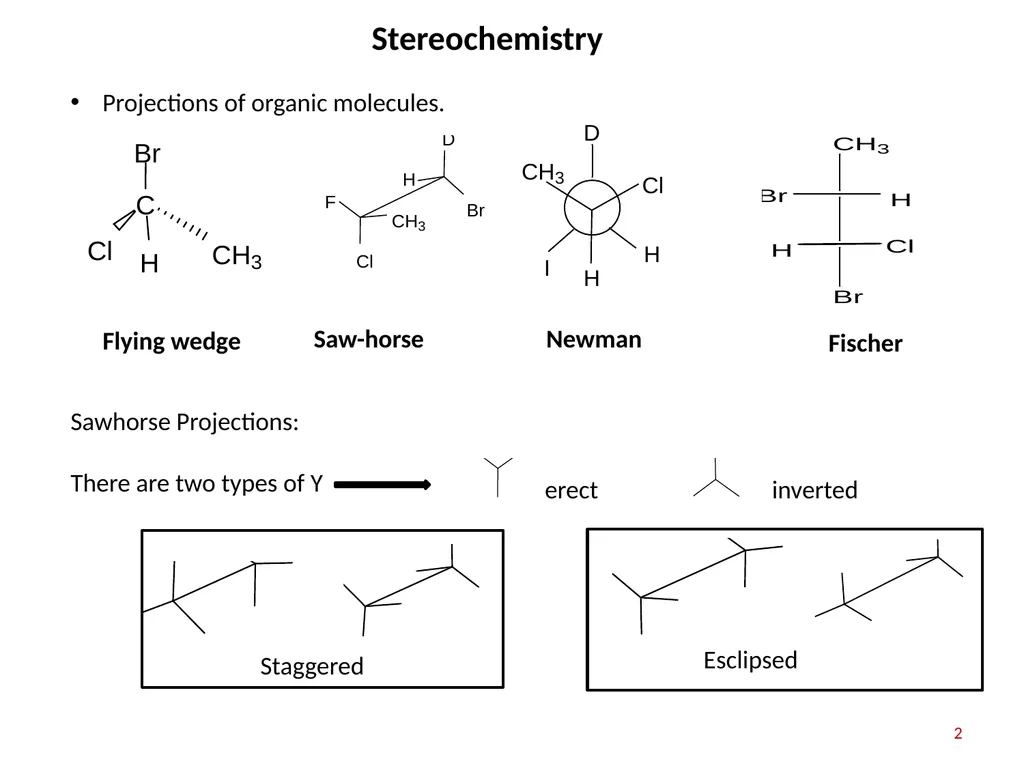
CHM-DSC-151 UNIT-4 STEREOCHEMISTRY AND CONFORMATION ANALYSIS BY: JNYANASHREE DARABDHARA 1 Stereochemistry Fischer Newman Flying wedge Saw-horse Projections of organic molecules. Sawhorse Projections: There are two types of Y erect inverted
"CHM-DSC-151 UNIT-4 STEREOCHEMISTRY AND" is the property of its rightful owner. Permission is granted to
download and print the materials on this website for personal, non-commercial use only, and to display it
on your personal computer provided you do not modify the materials and that you retain all copyright
notices contained in the materials. By downloading content from our website, you accept the terms of this
agreement.
Presentation Transcript
01
CHM-DSC-151
UNIT-4
STEREOCHEMISTRY
AND CONFORMATION ANALYSIS BY:
JNYANASHREE DARABDHARA 1<br>
There are two types of Y erect inverted Esclipsed Staggered 2<br>
03
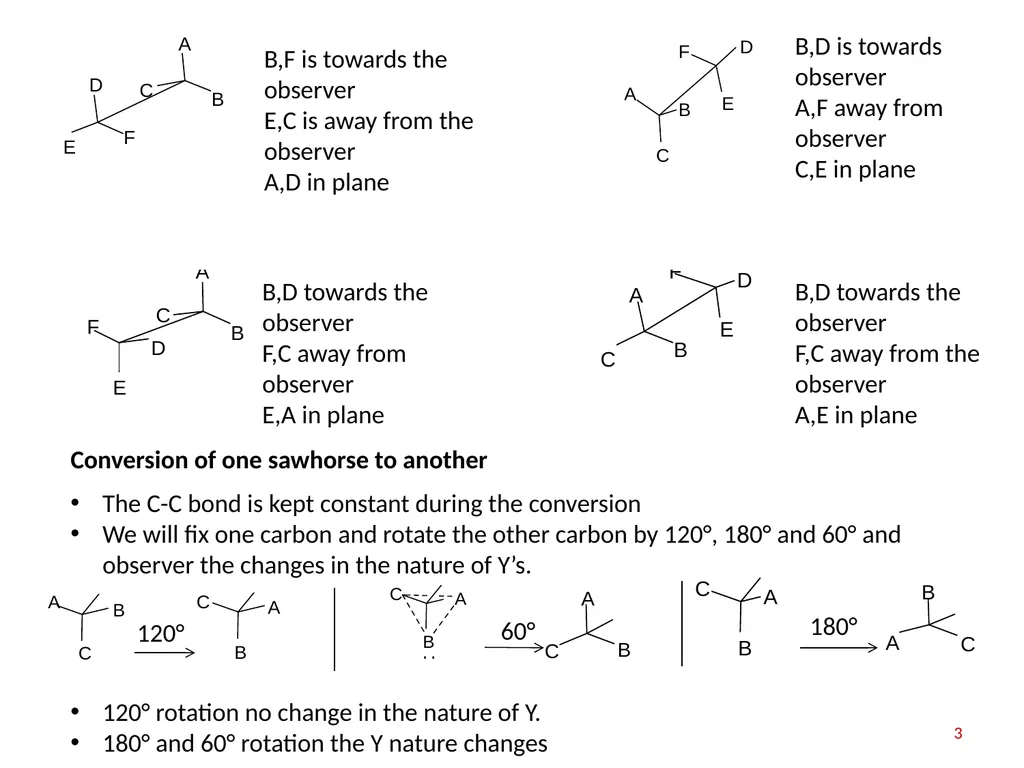
B,F is towards the observer
E,C is away from the observer
A,D in plane B,D is towards observer
A,F away from observer
C,E in plane B,D towards the observer
F,C away from observer
E,A in plane B,D towards the observer
F,C away from the observer
A,E in plane Conversion of one sawhorse to another The C-C bond is kept constant during the conversion
We will fix one carbon and rotate the other carbon by 120°, 180° and 60° and observer the changes in the nature of Y’s. 120° 60° 180° 120° rotation no change in the nature of Y.
180° and 60° rotation the Y nature changes 3<br>
04
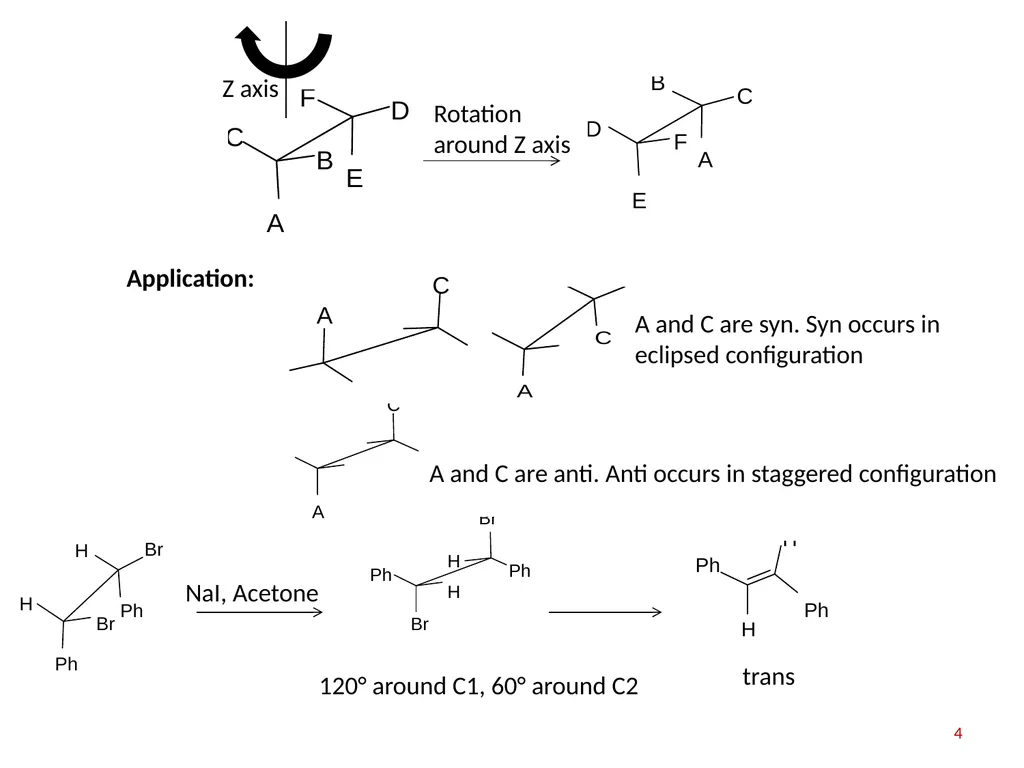
Z axis Rotation around Z axis Application: A and C are syn. Syn occurs in eclipsed configuration A and C are anti. Anti occurs in staggered configuration NaI, Acetone trans 120° around C1, 60° around C2 4<br>
05
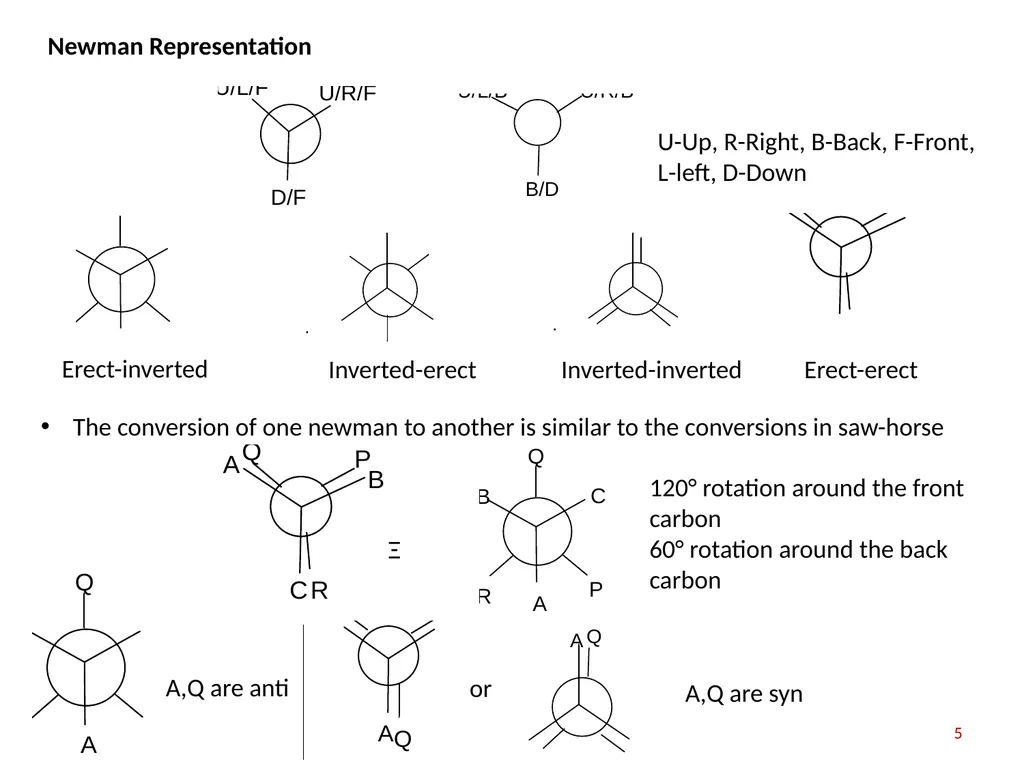
Newman Representation U-Up, R-Right, B-Back, F-Front, L-left, D-Down Erect-inverted Inverted-erect Inverted-inverted Erect-erect The conversion of one newman to another is similar to the conversions in saw-horse Ξ 120° rotation around the front carbon
60° rotation around the back carbon A,Q are anti or A,Q are syn 5<br>
06
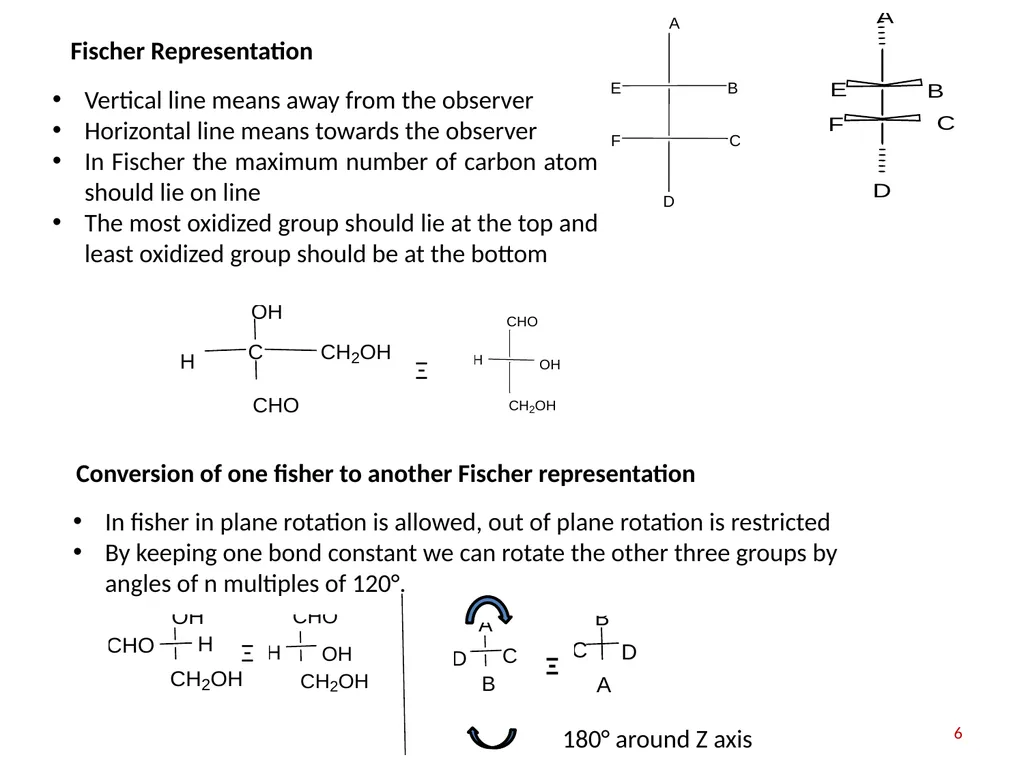
Fischer Representation Vertical line means away from the observer
Horizontal line means towards the observer
In Fischer the maximum number of carbon atom should lie on line
The most oxidized group should lie at the top and least oxidized group should be at the bottom Ξ Conversion of one fisher to another Fischer representation In fisher in plane rotation is allowed, out of plane rotation is restricted
By keeping one bond constant we can rotate the other three groups by angles of n multiples of 120°. Ξ 180° around Z axis Ξ 6<br>
07
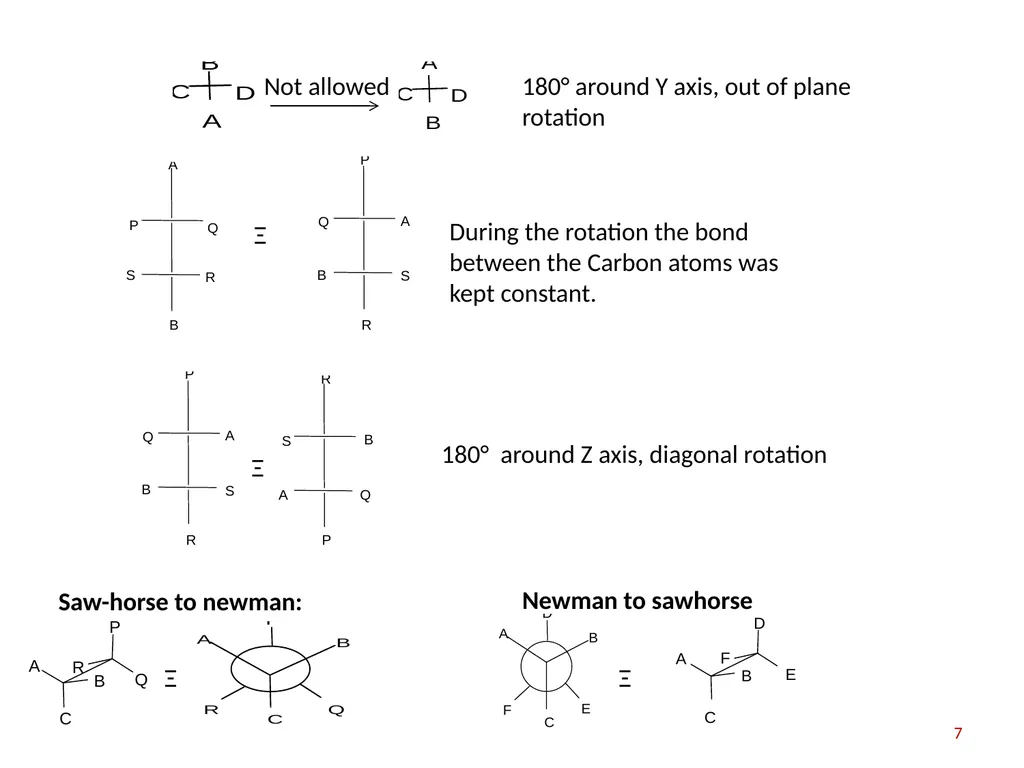
Not allowed 180° around Y axis, out of plane rotation Ξ During the rotation the bond between the Carbon atoms was kept constant. Ξ 180° around Z axis, diagonal rotation Saw-horse to newman: Ξ Newman to sawhorse Ξ 7<br>
08
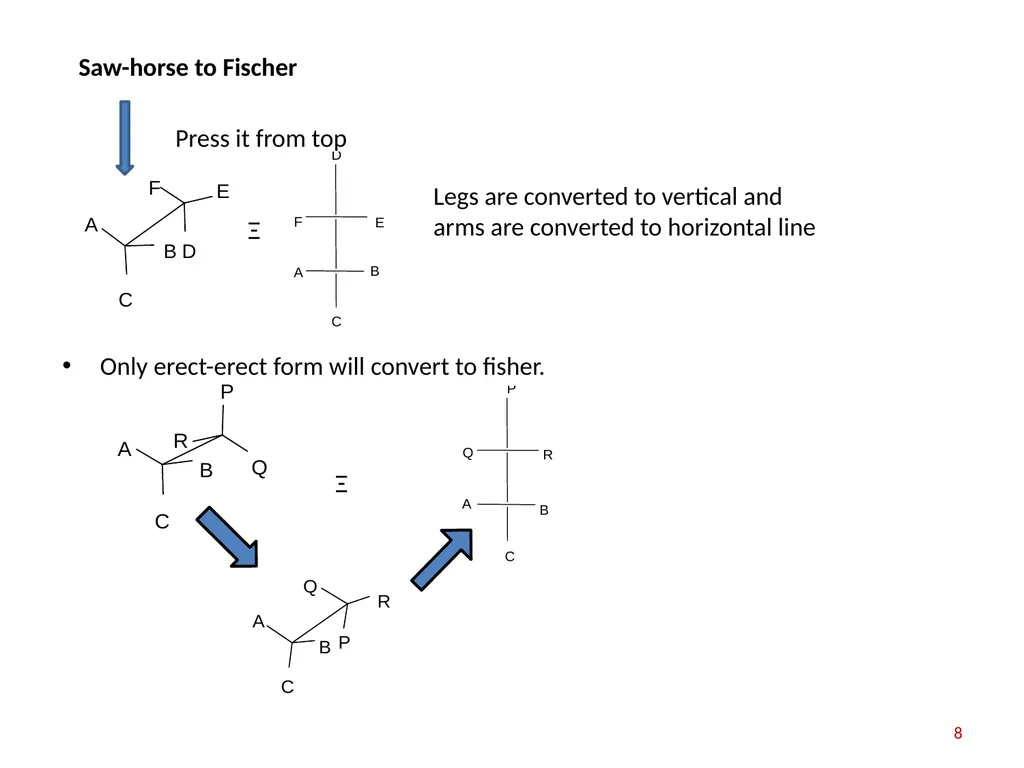
Saw-horse to Fischer Press it from top Ξ Only erect-erect form will convert to fisher. Legs are converted to vertical and arms are converted to horizontal line Ξ 8<br>
09
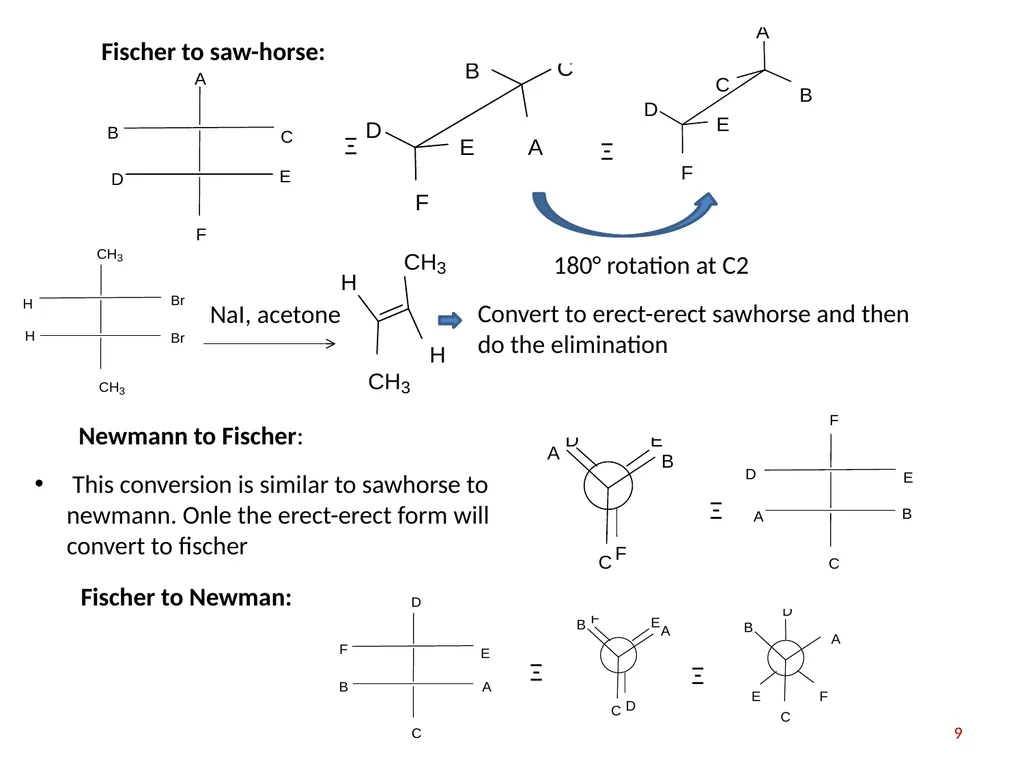
Fischer to saw-horse: Ξ Ξ 180° rotation at C2 NaI, acetone Convert to erect-erect sawhorse and then do the elimination Newmann to Fischer: Ξ This conversion is similar to sawhorse to newmann. Onle the erect-erect form will convert to fischer Fischer to Newman: Ξ Ξ 9<br>
10
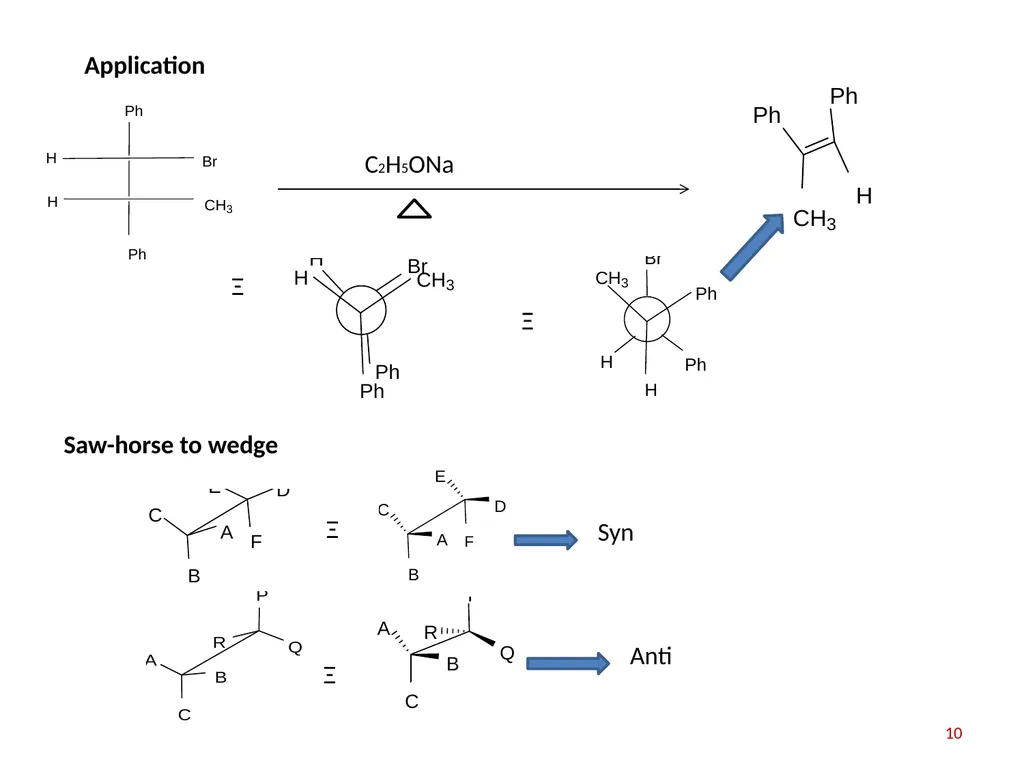
Application C2H5ONa Ξ Saw-horse to wedge Ξ Syn Ξ Anti 10<br>
11
Wedge to saw-horse: Ξ Ξ Ξ Ξ Ξ Fischer to Flying wedge: Wavy line means the configuration is not defined A,R are syn A,D are anti 11<br>
12
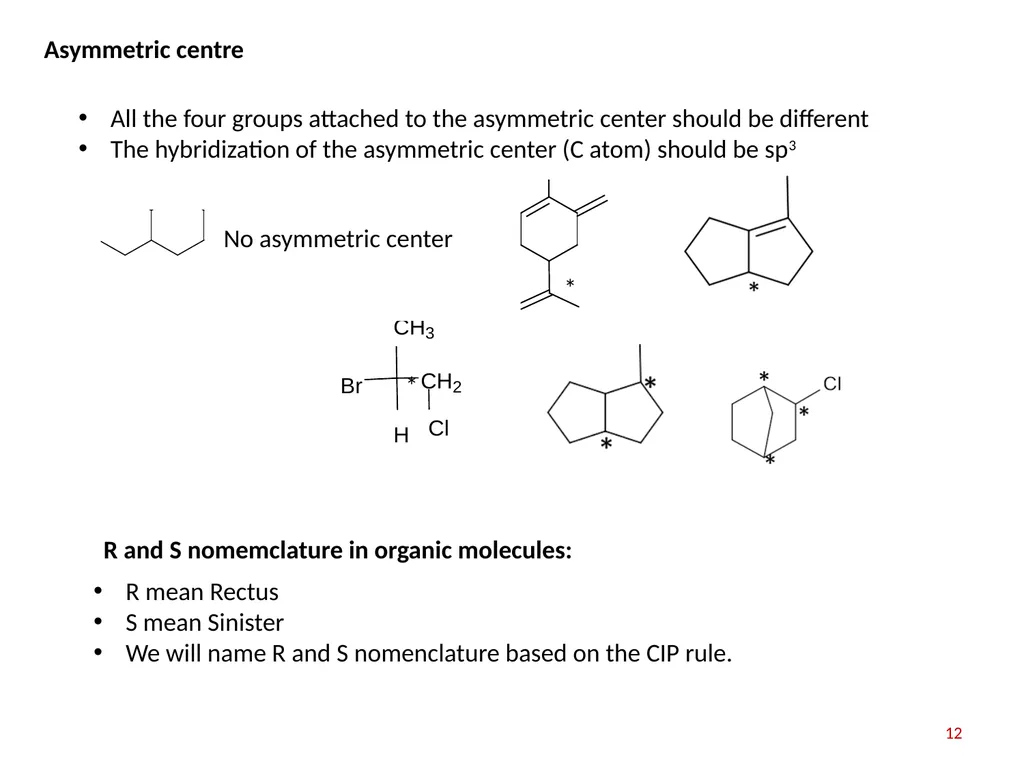
Asymmetric centre All the four groups attached to the asymmetric center should be different
The hybridization of the asymmetric center (C atom) should be sp3 No asymmetric center * * R and S nomemclature in organic molecules: R mean Rectus
S mean Sinister
We will name R and S nomenclature based on the CIP rule. 12<br>
13
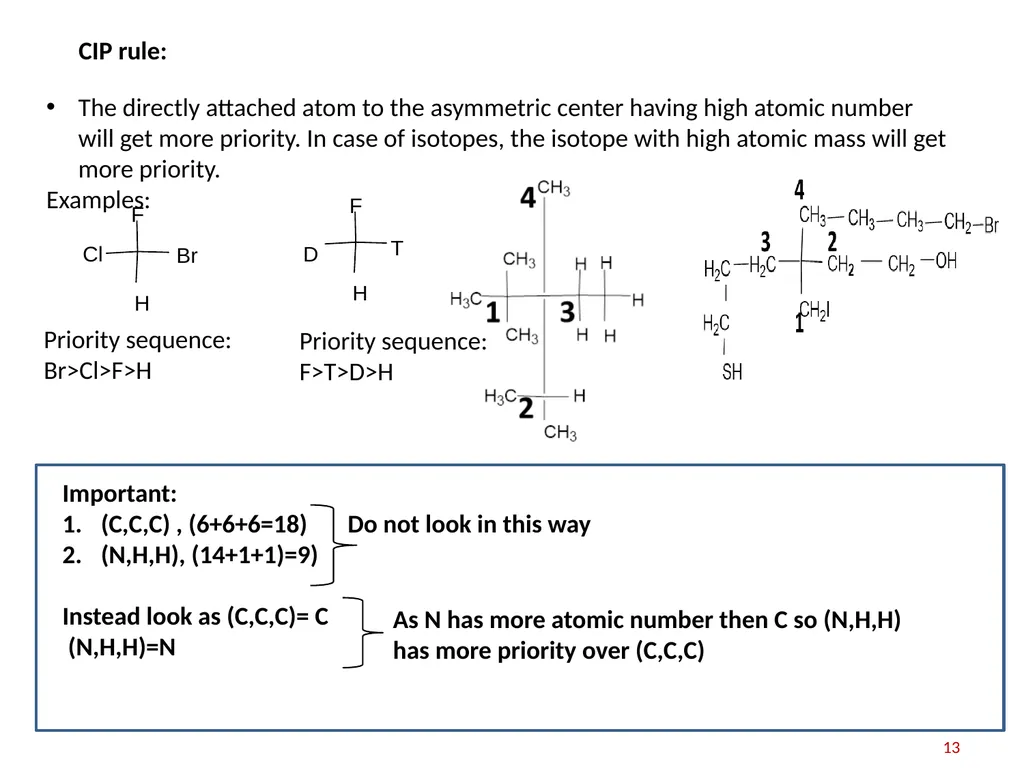
CIP rule: The directly attached atom to the asymmetric center having high atomic number will get more priority. In case of isotopes, the isotope with high atomic mass will get more priority.
Examples: Priority sequence: Br>Cl>F>H Priority sequence: F>T>D>H Important:
(C,C,C) , (6+6+6=18) Do not look in this way
(N,H,H), (14+1+1)=9)
Instead look as (C,C,C)= C
(N,H,H)=N As N has more atomic number then C so (N,H,H) has more priority over (C,C,C) 13<br>
14
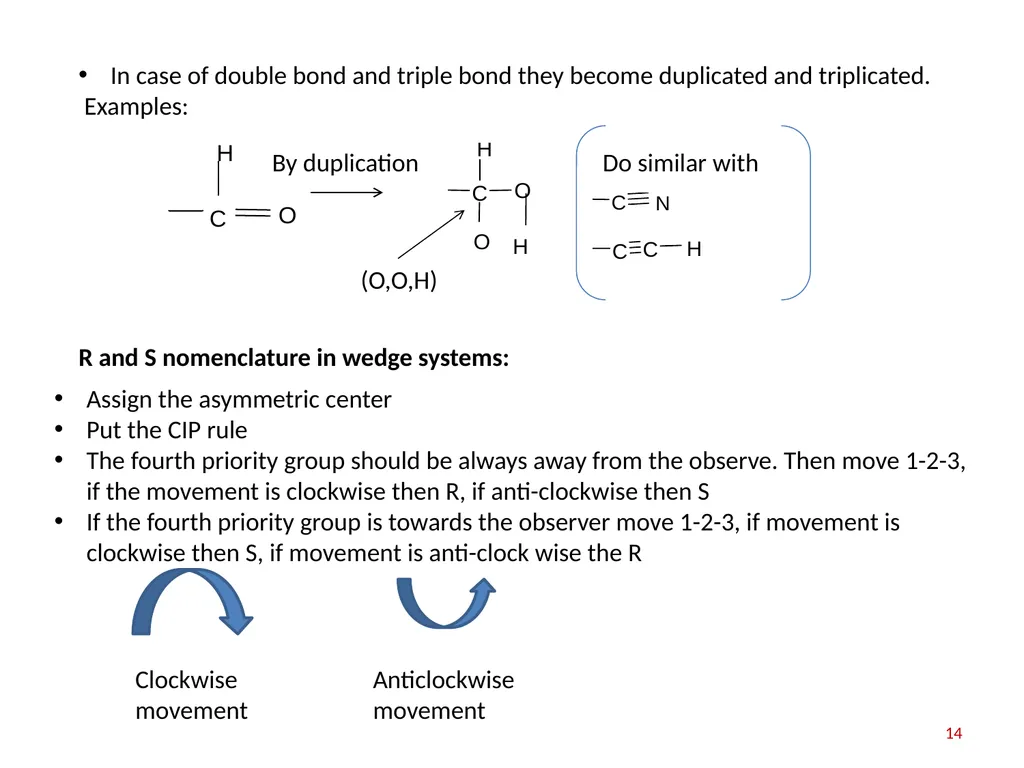
In case of double bond and triple bond they become duplicated and triplicated.
Examples: (O,O,H) By duplication Do similar with R and S nomenclature in wedge systems: Assign the asymmetric center
Put the CIP rule
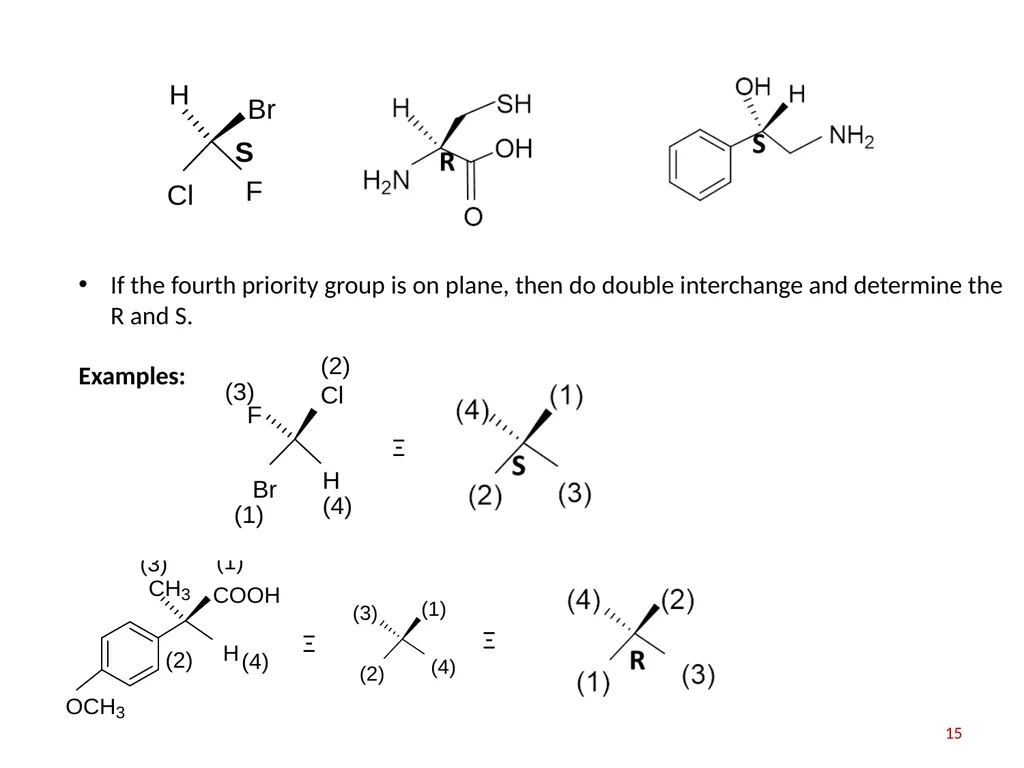
The fourth priority group should be always away from the observe. Then move 1-2-3, if the movement is clockwise then R, if anti-clockwise then S
If the fourth priority group is towards the observer move 1-2-3, if movement is clockwise then S, if movement is anti-clock wise the R Clockwise movement Anticlockwise movement 14<br>
15
If the fourth priority group is on plane, then do double interchange and determine the R and S. Examples: Ξ Ξ Ξ 15<br>