
Classical mechanics Classical mechanics is among
TF
Published · 92 slides · 0 views
1 / 1





Description
Classical mechanics Classical mechanics is among the oldest branches of physics, it is one of the most basic, it describes motion of the objects around us. Limits for use of classical mechanics Classical mechanics is used for speeds, which
Related Topics
Share
Embed code
Download this presentation From Below
"Classical mechanics Classical mechanics is among" is the property of its rightful owner. Permission is granted to download and print the materials on this website for personal, non-commercial use only, and to display it on your personal computer provided you do not modify the materials and that you retain all copyright notices contained in the materials. By downloading content from our website, you accept the terms of this agreement.
Presentation Transcript
01
Classical mechanics<br>
02
Classical mechanics is among the oldest branches of physics,
it is one of the most basic, it describes motion of the objects around us.<br>
it is one of the most basic, it describes motion of the objects around us.<br>
03
Limits for use of classical mechanics Classical mechanics is used for speeds, which are much smaller than speed of light and distances, which are much larger than 1 nano-meter and much smaller than the size of our Galaxy, which is measured in light years (beyond this it is dealt with by relativity theory, quantum physics, astrophysics).
Classical mechanics is usually used for macro objects (from 1 micro-meter to several kilometres) and for speeds between 0 and several speeds of sound).
Question:
Where can classical mechanics be used?<br>
Classical mechanics is usually used for macro objects (from 1 micro-meter to several kilometres) and for speeds between 0 and several speeds of sound).
Question:
Where can classical mechanics be used?<br>
04
Material point Material point is infinitely small, we neglect its sizes.
It is often possible with high accuracy and precision.
Examples of material points in physics can be bullet,
cannon ball, tennis ball, etc.
if we compare their sizes to much bigger objects,
such as Earth, Galaxy, etc.
If object is big enough then we can often consider it as material point,
located in the centre of mass.<br>
It is often possible with high accuracy and precision.
Examples of material points in physics can be bullet,
cannon ball, tennis ball, etc.
if we compare their sizes to much bigger objects,
such as Earth, Galaxy, etc.
If object is big enough then we can often consider it as material point,
located in the centre of mass.<br>
05
One dimensional motion<br>
06
Kinematics<br>
07
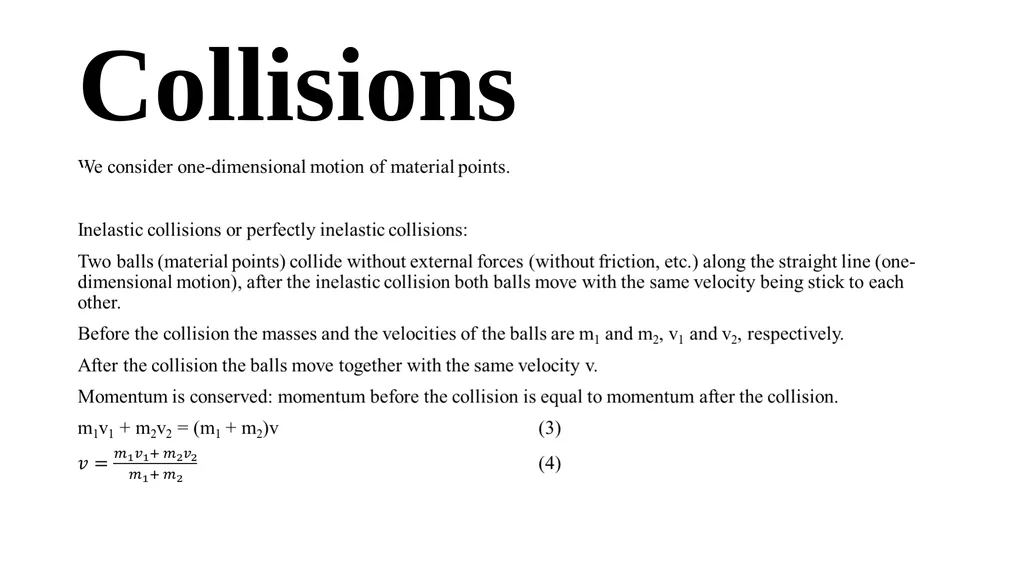
Collisions<br>
08
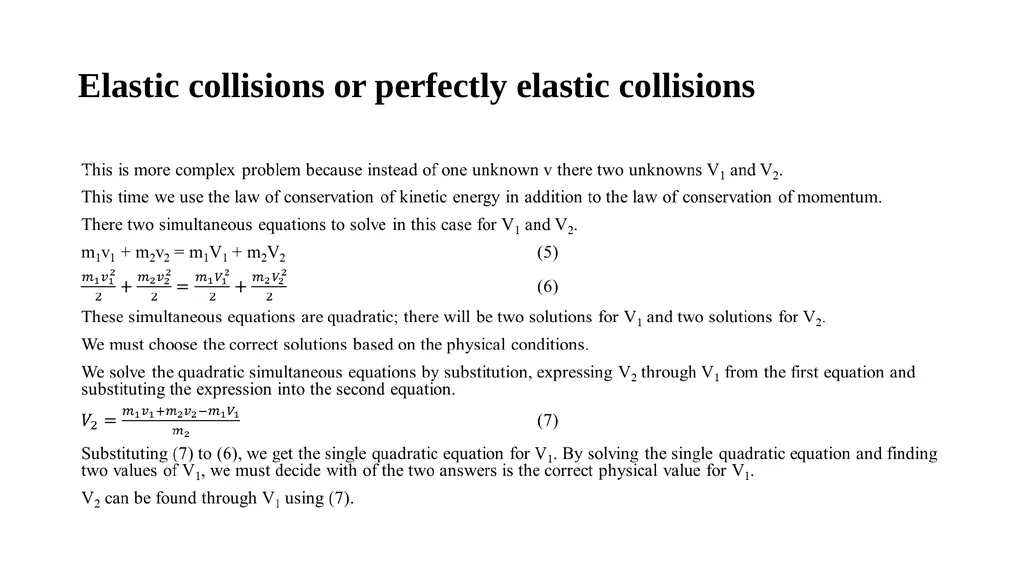
Elastic collisions or perfectly elastic collisions<br>
09
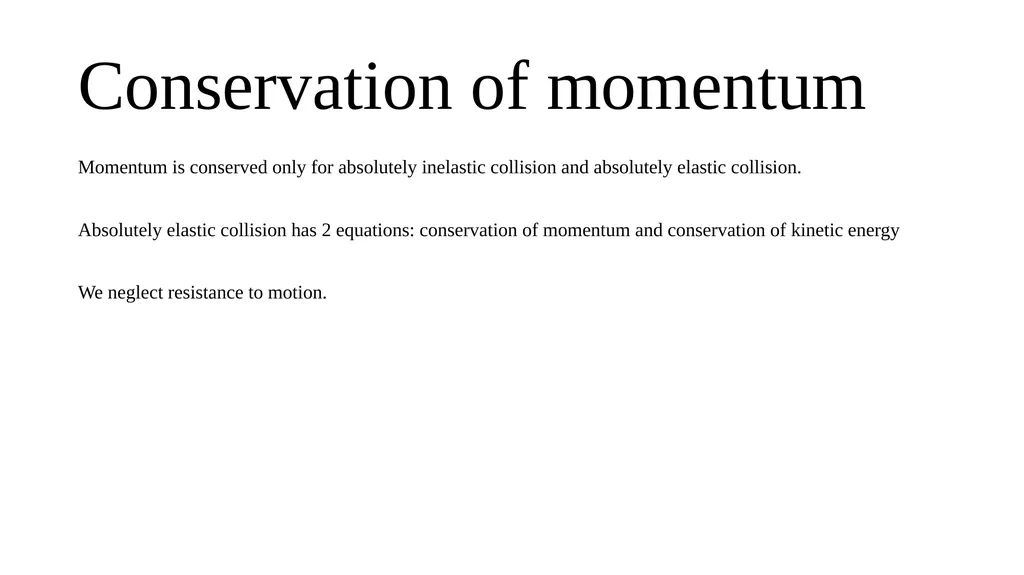
Conservation of momentum Momentum is conserved only for absolutely inelastic collision and absolutely elastic collision.
Absolutely elastic collision has 2 equations: conservation of momentum and conservation of kinetic energy
We neglect resistance to motion.<br>
Absolutely elastic collision has 2 equations: conservation of momentum and conservation of kinetic energy
We neglect resistance to motion.<br>
10
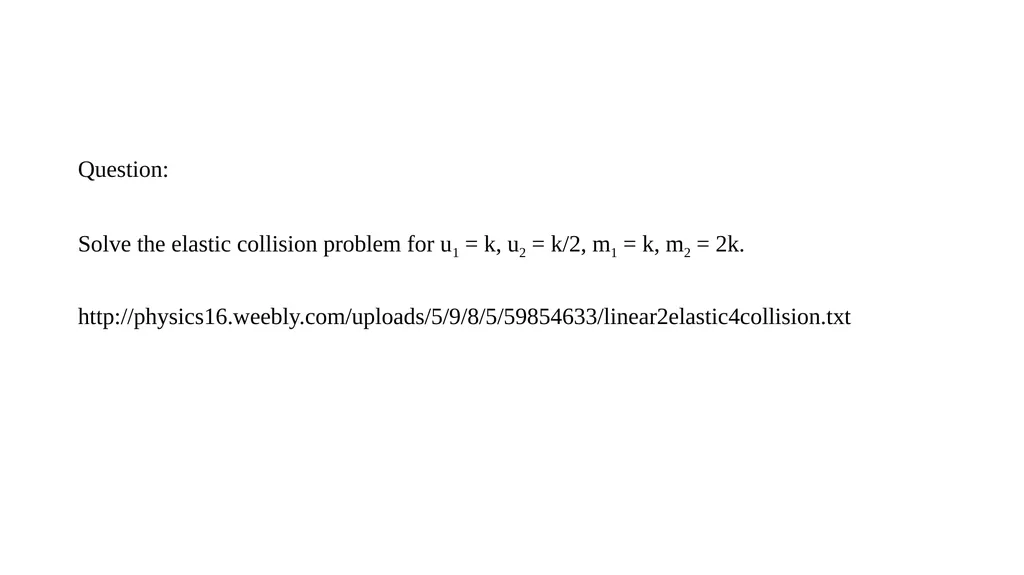
Question:
Solve the elastic collision problem for u1 = k, u2 = k/2, m1 = k, m2 = 2k.
http://physics16.weebly.com/uploads/5/9/8/5/59854633/linear2elastic4collision.txt<br>
Solve the elastic collision problem for u1 = k, u2 = k/2, m1 = k, m2 = 2k.
http://physics16.weebly.com/uploads/5/9/8/5/59854633/linear2elastic4collision.txt<br>
11
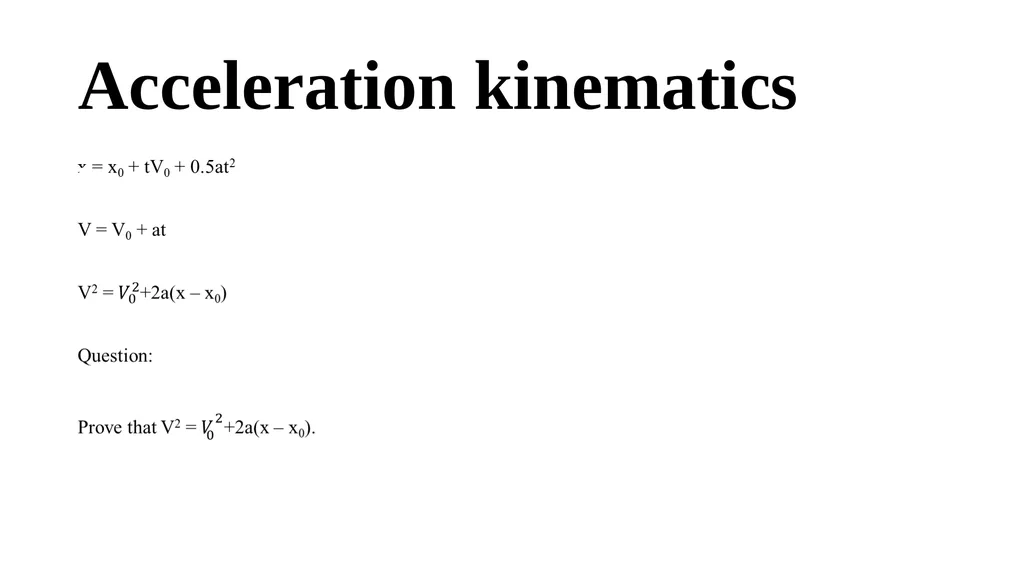
Acceleration kinematics<br>
12
Dynamics Dynamics studies motion of bodies under the influence of forces.<br>
13
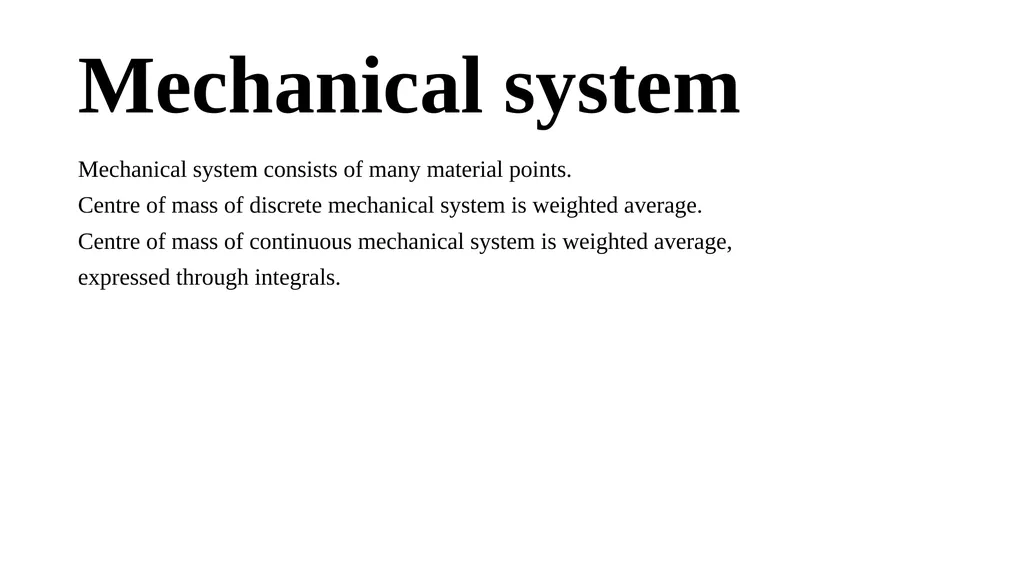
Mechanical system Mechanical system consists of many material points.
Centre of mass of discrete mechanical system is weighted average.
Centre of mass of continuous mechanical system is weighted average,
expressed through integrals.<br>
Centre of mass of discrete mechanical system is weighted average.
Centre of mass of continuous mechanical system is weighted average,
expressed through integrals.<br>
14
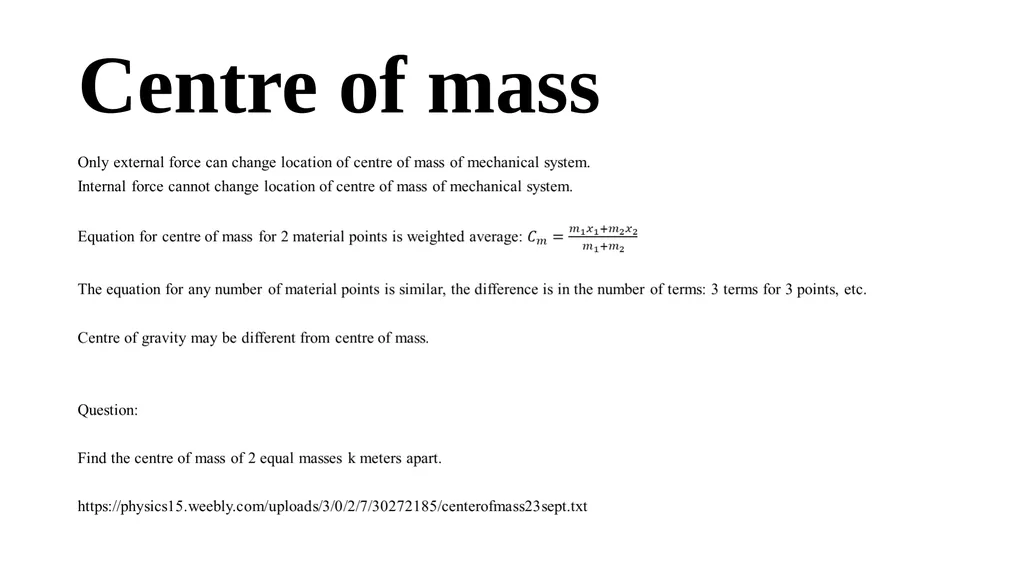
Centre of mass<br>
15
Internal forces and external forces I cannot pull myself out of mud because my force is internal force for the mechanical system.
I can only get out of mud if I use external friction force or get help from other people.
Question:
Can I pull myself out of mud? Why?<br>
I can only get out of mud if I use external friction force or get help from other people.
Question:
Can I pull myself out of mud? Why?<br>
16
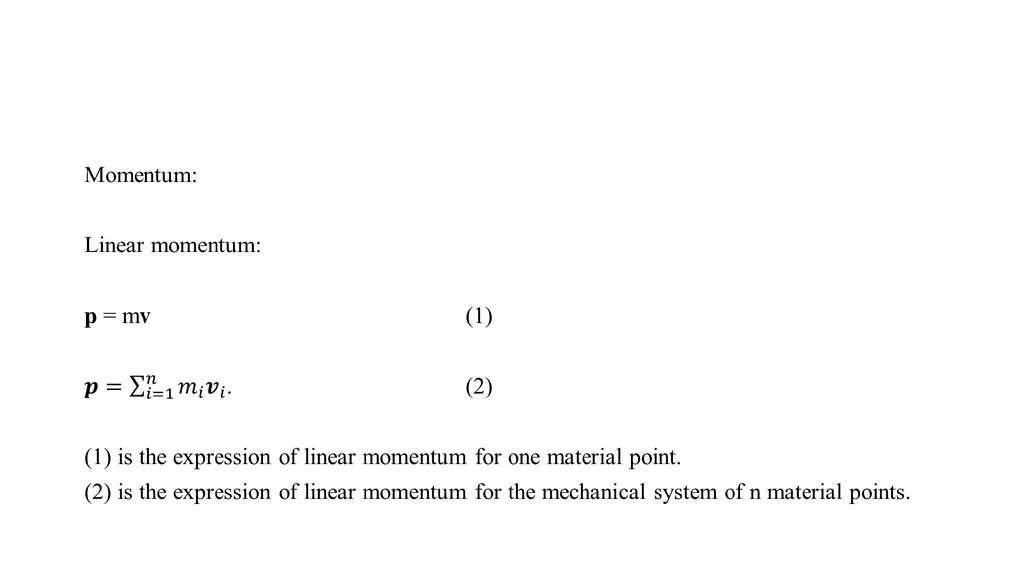
Momentum Momentum of material point is mv.
Here m is mass of material point and V is velocity of material point.<br>
Here m is mass of material point and V is velocity of material point.<br>
17
Kinetic energy Kinetic energy of material point is mv2/2
Note that derivative of kinetic energy with respect to velocity is equal to momentum.
Question:
Prove that derivative of kinetic energy with respect to velocity is equal to momentum.<br>
Note that derivative of kinetic energy with respect to velocity is equal to momentum.
Question:
Prove that derivative of kinetic energy with respect to velocity is equal to momentum.<br>
18
Potential energy is mgh
m is mass.
g is gravity acceleration.
h is heigh.<br>
m is mass.
g is gravity acceleration.
h is heigh.<br>
19
Laws of Newton Laws of Newton describe motion or stationary states of bodies under the influence of forces
First Law of Newton says that there is no acceleration without force, it follows from Second Law of Newton.
Second Law of Newton: F = ma
Third Law of Newton says that action is equal to reaction: F1 = - F2.<br>
First Law of Newton says that there is no acceleration without force, it follows from Second Law of Newton.
Second Law of Newton: F = ma
Third Law of Newton says that action is equal to reaction: F1 = - F2.<br>
20
Mass Mass is the measure of inertial of body, measure of how much body resists acceleration.
There is also gravitational mass, which shows how much body is attracted by other bodies due to gravitational force.
Question:
What is mass?<br>
There is also gravitational mass, which shows how much body is attracted by other bodies due to gravitational force.
Question:
What is mass?<br>
21
Two-dimensional motion<br>
22
Projectile Projectile is particular case of motion with constant acceleration a = -g.
g is gravity acceleration.
Projectile is described by Second Law of Newton in 2 dimensions.
We solve ordinary differential equations of second order.
x: Fx = 0, therefore no acceleration along x, there will be constant velocity along x.
y: Fy = -mg = ma, therefore there is constant acceleration along y.
To get the velocity, we must integrate differential equation of Second Law of Newton once.<br>
g is gravity acceleration.
Projectile is described by Second Law of Newton in 2 dimensions.
We solve ordinary differential equations of second order.
x: Fx = 0, therefore no acceleration along x, there will be constant velocity along x.
y: Fy = -mg = ma, therefore there is constant acceleration along y.
To get the velocity, we must integrate differential equation of Second Law of Newton once.<br>
23
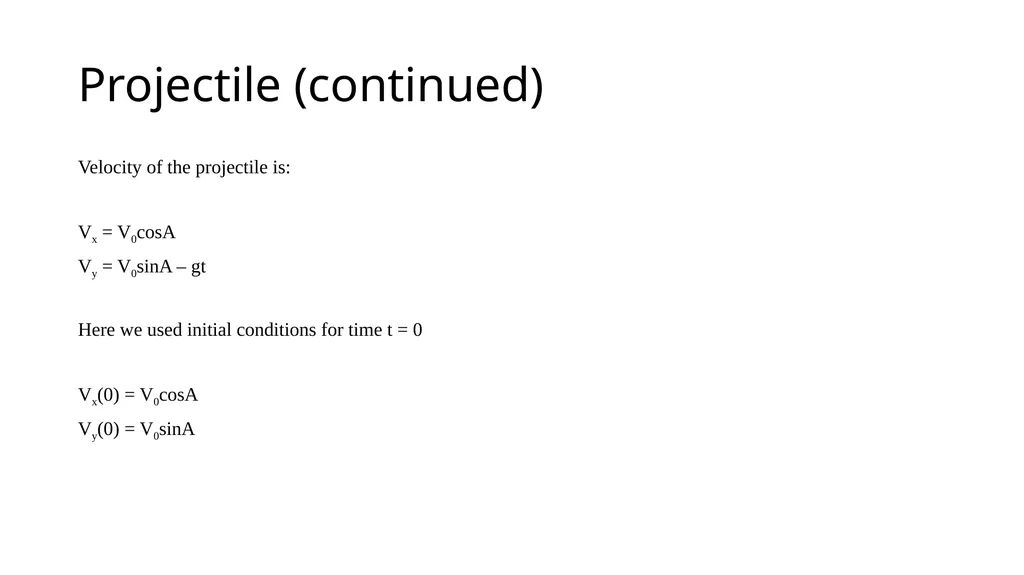
Projectile (continued) Velocity of the projectile is:
Vx = V0cosA
Vy = V0sinA – gt
Here we used initial conditions for time t = 0
Vx(0) = V0cosA
Vy(0) = V0sinA<br>
Vx = V0cosA
Vy = V0sinA – gt
Here we used initial conditions for time t = 0
Vx(0) = V0cosA
Vy(0) = V0sinA<br>
24
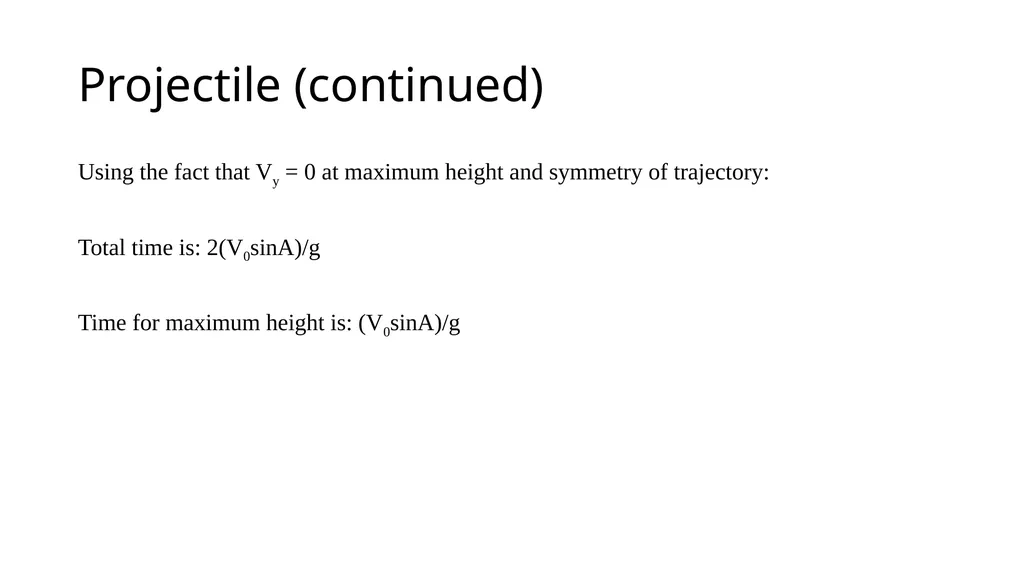
Projectile (continued) Using the fact that Vy = 0 at maximum height and symmetry of trajectory:
Total time is: 2(V0sinA)/g
Time for maximum height is: (V0sinA)/g<br>
Total time is: 2(V0sinA)/g
Time for maximum height is: (V0sinA)/g<br>
25
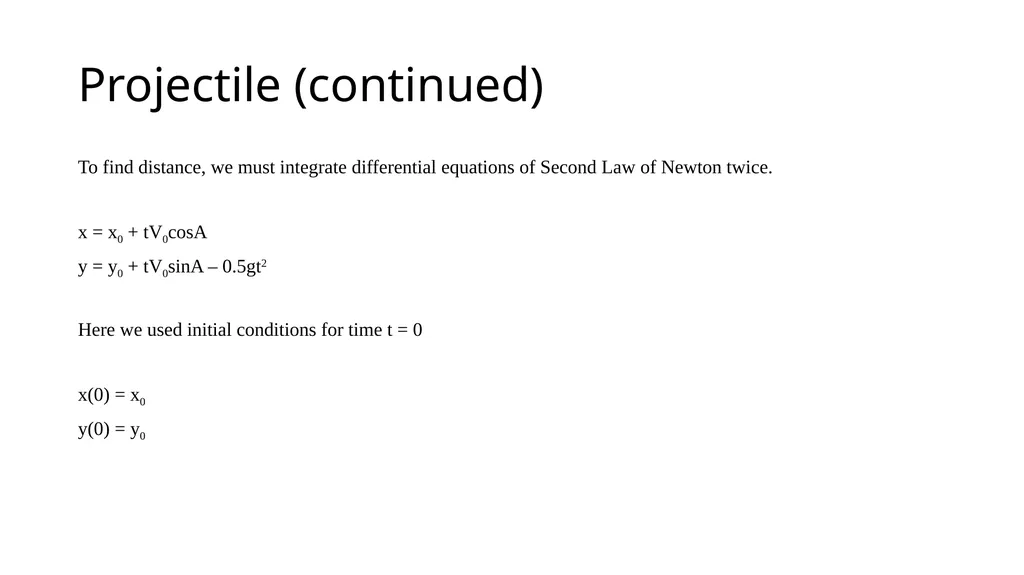
Projectile (continued) To find distance, we must integrate differential equations of Second Law of Newton twice.
x = x0 + tV0cosA
y = y0 + tV0sinA – 0.5gt2
Here we used initial conditions for time t = 0
x(0) = x0
y(0) = y0<br>
x = x0 + tV0cosA
y = y0 + tV0sinA – 0.5gt2
Here we used initial conditions for time t = 0
x(0) = x0
y(0) = y0<br>
26
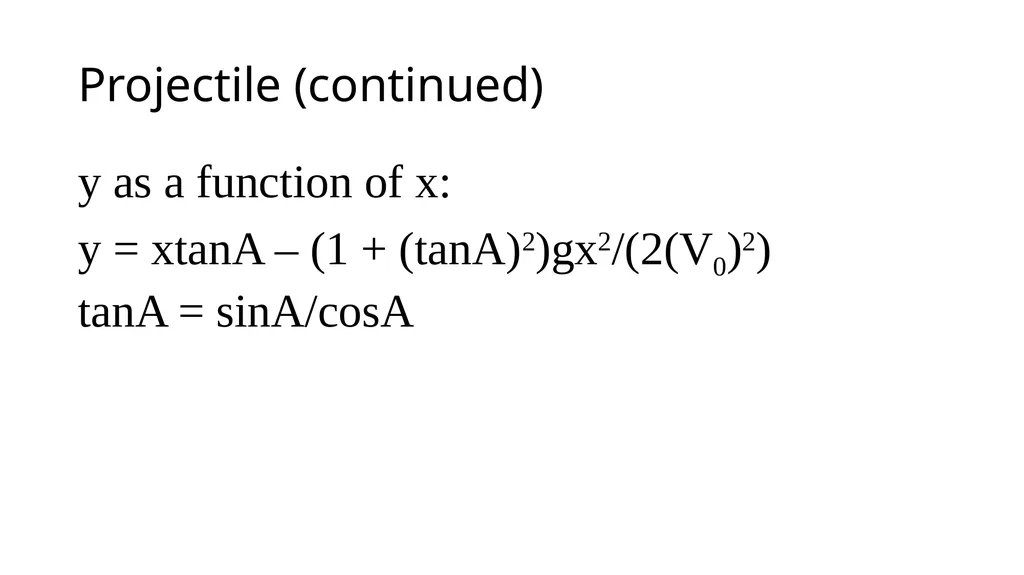
Projectile (continued) y as a function of x:
y = xtanA – (1 + (tanA)2)gx2/(2(V0)2)
tanA = sinA/cosA<br>
y = xtanA – (1 + (tanA)2)gx2/(2(V0)2)
tanA = sinA/cosA<br>
27
Projectile (continued) You can find minimum initial velocity and corresponding angle of release to hit any point in space.<br>
28
Projectile (continued) Question:
Find the velocity at time = T seconds, for angle of release A = T degrees, initial velocity V0 = T meters per second, x0 = y0 = 0 meters for projectile.
https://physics15.weebly.com/uploads/3/0/2/7/30272185/velocityofprojectile23sept.txt<br>
Find the velocity at time = T seconds, for angle of release A = T degrees, initial velocity V0 = T meters per second, x0 = y0 = 0 meters for projectile.
https://physics15.weebly.com/uploads/3/0/2/7/30272185/velocityofprojectile23sept.txt<br>
29
Projectile (continued) Question:
Calculate total time of the motion and time for maximum height for angle of release A = T degrees, initial velocity V0 = T meters per second, x0 = y0 = 0 meters for projectile.
https://physics15.weebly.com/uploads/3/0/2/7/30272185/timeofprojectile23sept.txt<br>
Calculate total time of the motion and time for maximum height for angle of release A = T degrees, initial velocity V0 = T meters per second, x0 = y0 = 0 meters for projectile.
https://physics15.weebly.com/uploads/3/0/2/7/30272185/timeofprojectile23sept.txt<br>
30
One dimensional motion<br>
31
Truck and trolley Torque is applied to wheels of truck, which in more efficient than trolley, which is pushed or pulled.
Question:
Compare efficiency of truck and trolley.
Use what we discussed in our class about pulling trolley and rotating wheels of truck.<br>
Question:
Compare efficiency of truck and trolley.
Use what we discussed in our class about pulling trolley and rotating wheels of truck.<br>
32
Collided eggs Your own speed is the most dangerous for you.
Question:
Is moving or stationary egg more likely to crack after the collision?<br>
Question:
Is moving or stationary egg more likely to crack after the collision?<br>
33
Volume Question:
Air purifier purifies 5 cubic meters of air. How many such air purifiers are needed for a room 5×5×10meters?
https://physics15.weebly.com/uploads/3/0/2/7/30272185/volumeforairpurifier23sept.txt<br>
Air purifier purifies 5 cubic meters of air. How many such air purifiers are needed for a room 5×5×10meters?
https://physics15.weebly.com/uploads/3/0/2/7/30272185/volumeforairpurifier23sept.txt<br>
34
One dimensional motion<br>
35
Pulley problem<br>
36
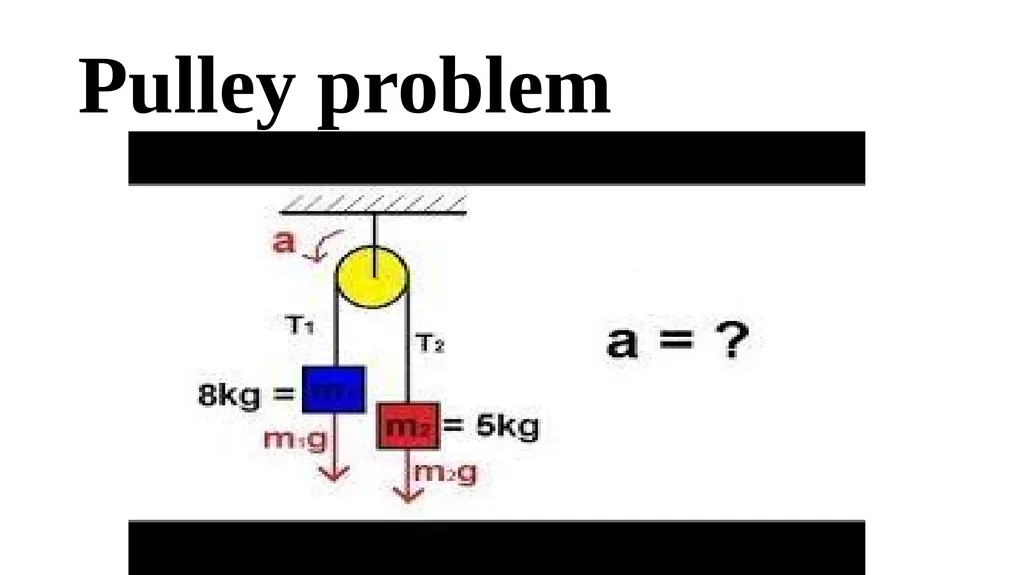
Pulley problem (continued) Pulley problem is solved by projecting all forces to the cord.
Is there are two non-zero different masses, acceleration is not g and not -g, then there will be acceleration a of the masses and tension in the cord.
We neglect the resistance. We assume cord to be massless.
Tension is internal force.
Difference in weights is external force.<br>
Is there are two non-zero different masses, acceleration is not g and not -g, then there will be acceleration a of the masses and tension in the cord.
We neglect the resistance. We assume cord to be massless.
Tension is internal force.
Difference in weights is external force.<br>
37
Pulley problem (continued) If the masses are the same, then there will be no acceleration but there will be tension.
If both masses are zero, then there will be no acceleration and no tension.
If one mass is zero, then there will be acceleration but no tension.
If acceleration is g, then there will be no tension (free fall).<br>
If both masses are zero, then there will be no acceleration and no tension.
If one mass is zero, then there will be acceleration but no tension.
If acceleration is g, then there will be no tension (free fall).<br>
38
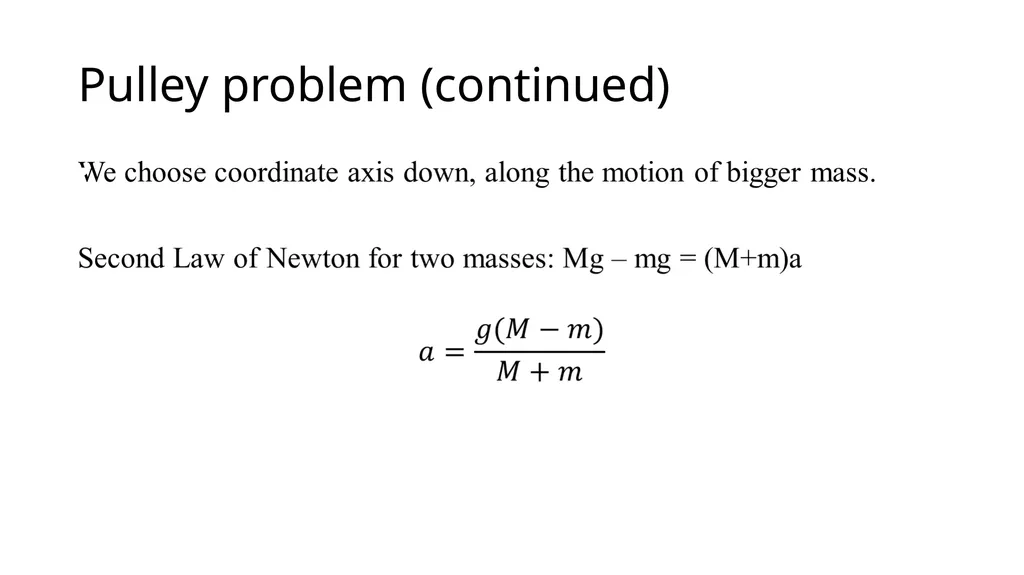
Pulley problem (continued)<br>
39
Pulley problem (continued) T is tension in rope. T is internal force, which can break the rope.
Using free-body diagram for mass M, we will get: Mg – T = Ma
T = M(g - a)
Using free-body diagram for mass m, we will get: T – mg = ma
T = m(g + a)<br>
Using free-body diagram for mass M, we will get: Mg – T = Ma
T = M(g - a)
Using free-body diagram for mass m, we will get: T – mg = ma
T = m(g + a)<br>
40
Pulley problem (continued) Question:
Find the acceleration of a simple pulley and tension in the rope for two masses: L kg and T kg.
http://physics16.weebly.com/uploads/5/9/8/5/59854633/problem4pulleys.txt
youtube.com/watch?v=kvCnjVSpuv0<br>
Find the acceleration of a simple pulley and tension in the rope for two masses: L kg and T kg.
http://physics16.weebly.com/uploads/5/9/8/5/59854633/problem4pulleys.txt
youtube.com/watch?v=kvCnjVSpuv0<br>
41
Friction Friction force is resistance to motion.
We often consider sliding friction, for which friction force F = μN.
μ is coefficient of friction.
N is normal reaction.<br>
We often consider sliding friction, for which friction force F = μN.
μ is coefficient of friction.
N is normal reaction.<br>
42
Friction (continued) Question:
Calculate friction force F = μN. μ = 1/T. N = k.
https://en.wikipedia.org/wiki/Friction
https://physics15.weebly.com/uploads/3/0/2/7/30272185/frictionforce23sept.txt<br>
Calculate friction force F = μN. μ = 1/T. N = k.
https://en.wikipedia.org/wiki/Friction
https://physics15.weebly.com/uploads/3/0/2/7/30272185/frictionforce23sept.txt<br>
43
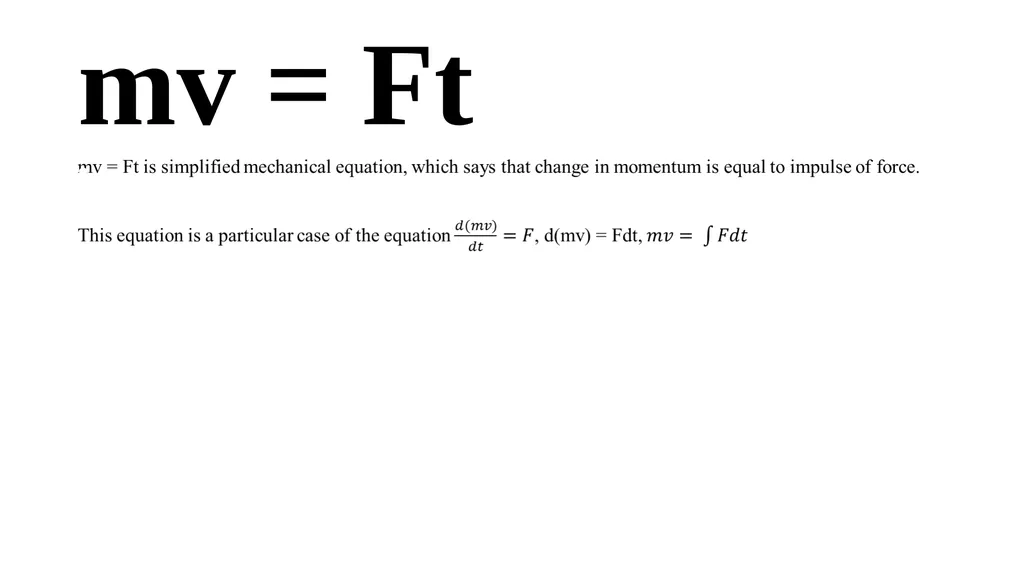
mv = Ft<br>
44
mv = Ft (continued) Question:
A dust particle with mass of 0.00001kg and speed of 5 m/s is subjected to a force of 0.00001N of the filter. How much time will it take to stop the particle?
Use the equations mv = Ft and t = mv/F
https://physics15.weebly.com/uploads/3/0/2/7/30272185/airpurifierproblem23sept.txt<br>
A dust particle with mass of 0.00001kg and speed of 5 m/s is subjected to a force of 0.00001N of the filter. How much time will it take to stop the particle?
Use the equations mv = Ft and t = mv/F
https://physics15.weebly.com/uploads/3/0/2/7/30272185/airpurifierproblem23sept.txt<br>
45
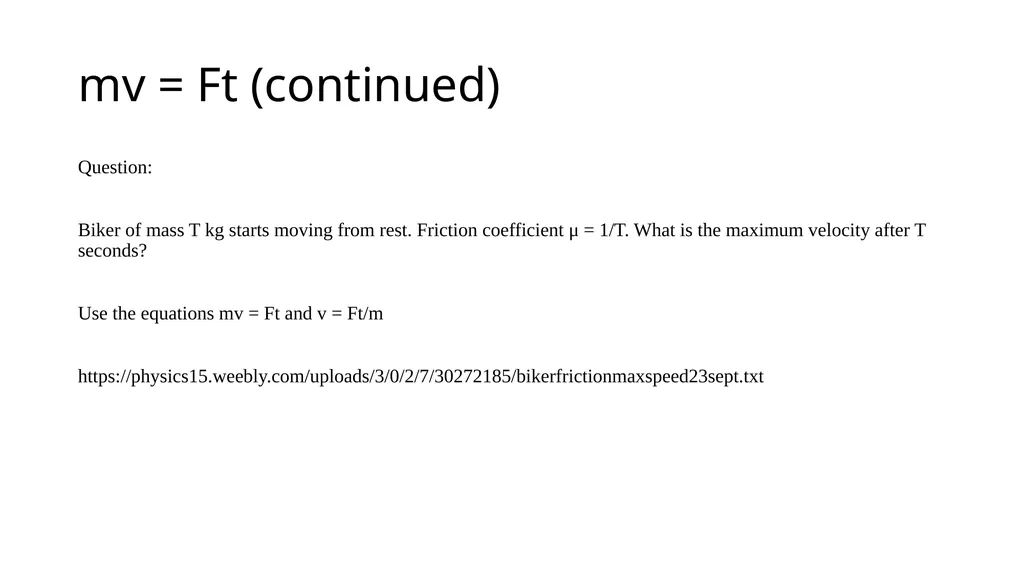
mv = Ft (continued) Question:
Biker of mass T kg starts moving from rest. Friction coefficient μ = 1/T. What is the maximum velocity after T seconds?
Use the equations mv = Ft and v = Ft/m
https://physics15.weebly.com/uploads/3/0/2/7/30272185/bikerfrictionmaxspeed23sept.txt<br>
Biker of mass T kg starts moving from rest. Friction coefficient μ = 1/T. What is the maximum velocity after T seconds?
Use the equations mv = Ft and v = Ft/m
https://physics15.weebly.com/uploads/3/0/2/7/30272185/bikerfrictionmaxspeed23sept.txt<br>
46
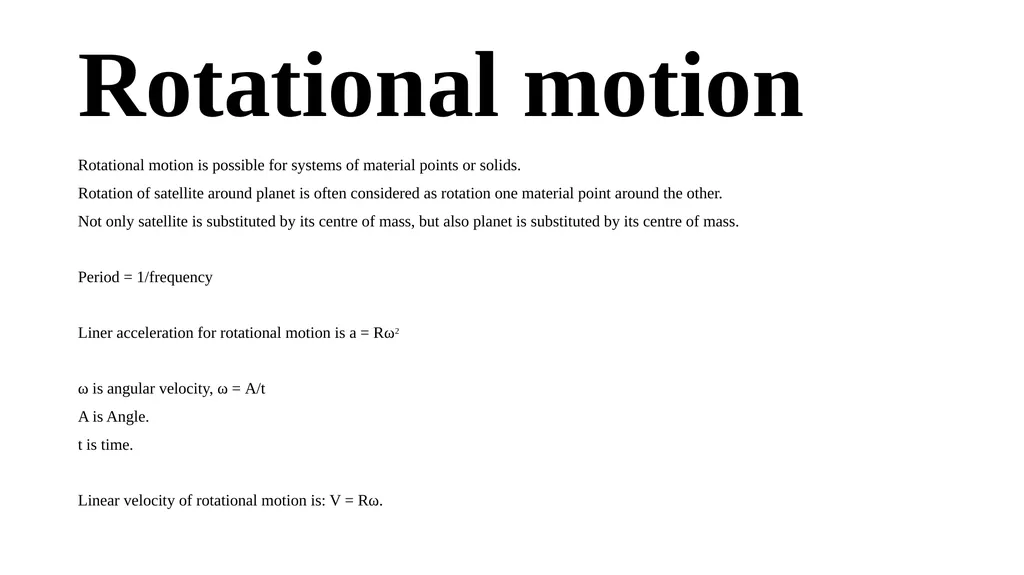
Rotational motion Rotational motion is possible for systems of material points or solids.
Rotation of satellite around planet is often considered as rotation one material point around the other.
Not only satellite is substituted by its centre of mass, but also planet is substituted by its centre of mass.
Period = 1/frequency
Liner acceleration for rotational motion is a = Rω2
ω is angular velocity, ω = A/t
A is Angle.
t is time.
Linear velocity of rotational motion is: V = Rω.<br>
Rotation of satellite around planet is often considered as rotation one material point around the other.
Not only satellite is substituted by its centre of mass, but also planet is substituted by its centre of mass.
Period = 1/frequency
Liner acceleration for rotational motion is a = Rω2
ω is angular velocity, ω = A/t
A is Angle.
t is time.
Linear velocity of rotational motion is: V = Rω.<br>
47
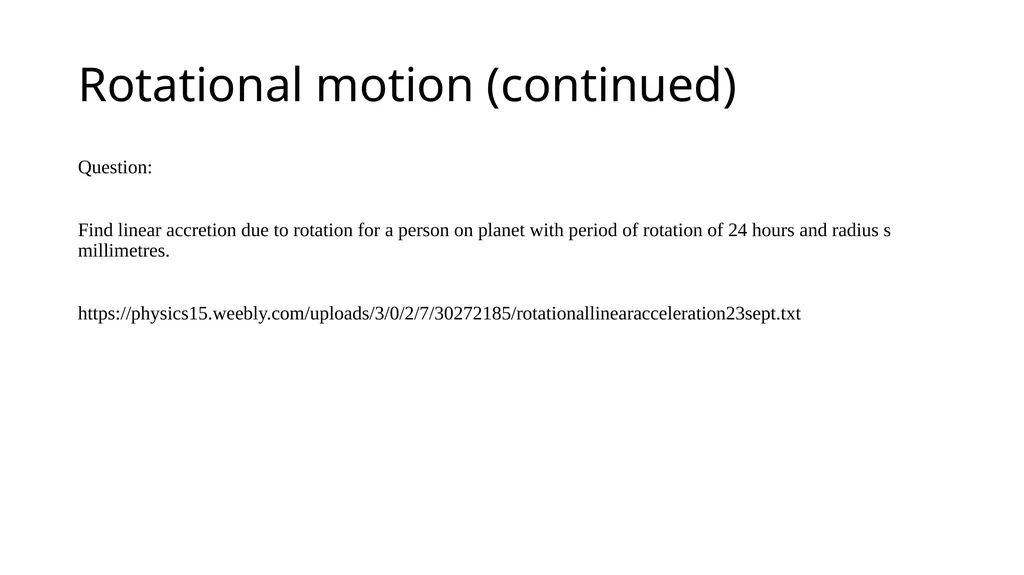
Rotational motion (continued) Question:
Find linear accretion due to rotation for a person on planet with period of rotation of 24 hours and radius s millimetres.
https://physics15.weebly.com/uploads/3/0/2/7/30272185/rotationallinearacceleration23sept.txt<br>
Find linear accretion due to rotation for a person on planet with period of rotation of 24 hours and radius s millimetres.
https://physics15.weebly.com/uploads/3/0/2/7/30272185/rotationallinearacceleration23sept.txt<br>
48
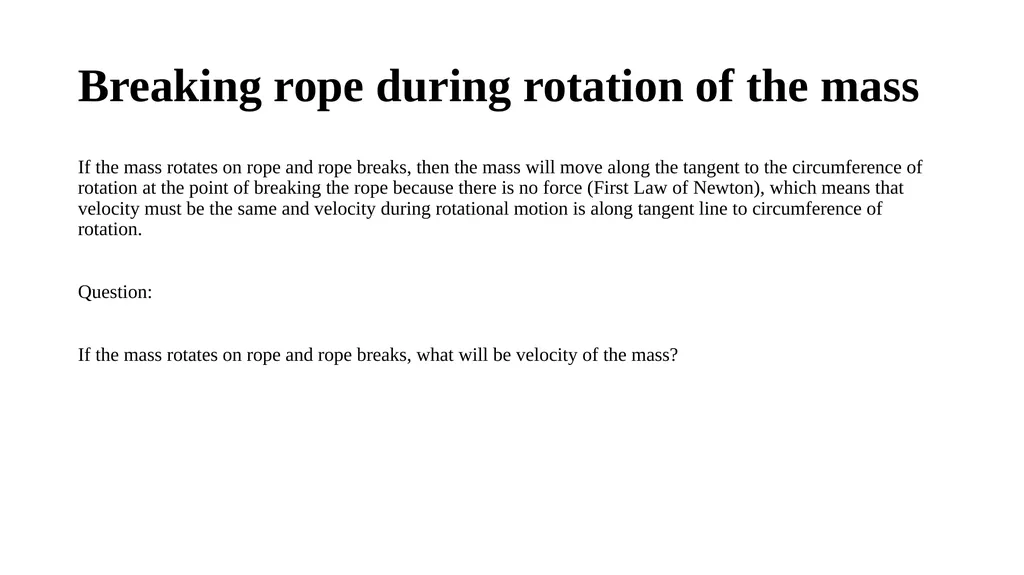
Breaking rope during rotation of the mass If the mass rotates on rope and rope breaks, then the mass will move along the tangent to the circumference of rotation at the point of breaking the rope because there is no force (First Law of Newton), which means that velocity must be the same and velocity during rotational motion is along tangent line to circumference of rotation.
Question:
If the mass rotates on rope and rope breaks, what will be velocity of the mass?<br>
Question:
If the mass rotates on rope and rope breaks, what will be velocity of the mass?<br>
49
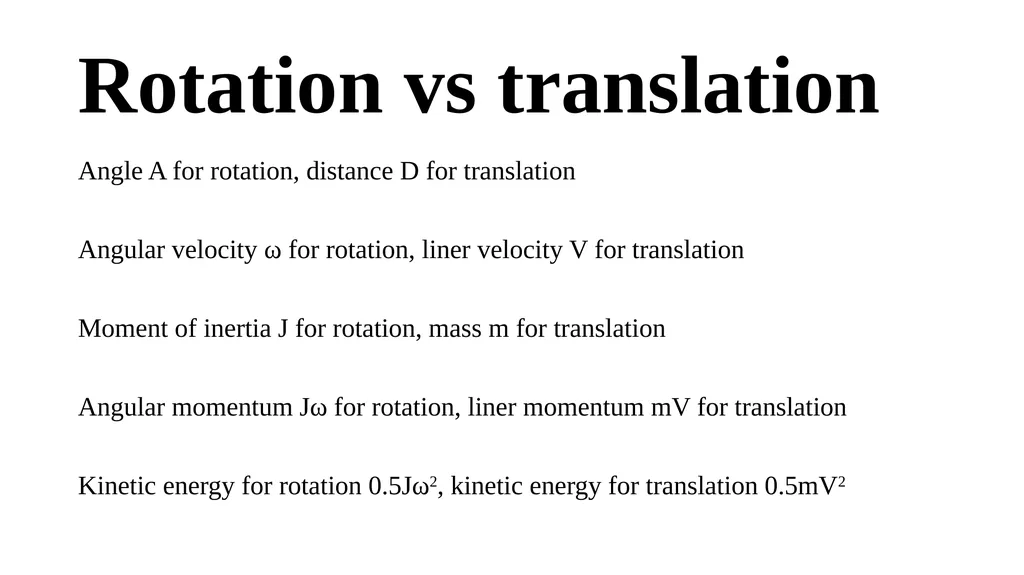
Rotation vs translation Angle A for rotation, distance D for translation
Angular velocity ω for rotation, liner velocity V for translation
Moment of inertia J for rotation, mass m for translation
Angular momentum Jω for rotation, liner momentum mV for translation
Kinetic energy for rotation 0.5Jω2, kinetic energy for translation 0.5mV2<br>
Angular velocity ω for rotation, liner velocity V for translation
Moment of inertia J for rotation, mass m for translation
Angular momentum Jω for rotation, liner momentum mV for translation
Kinetic energy for rotation 0.5Jω2, kinetic energy for translation 0.5mV2<br>
50
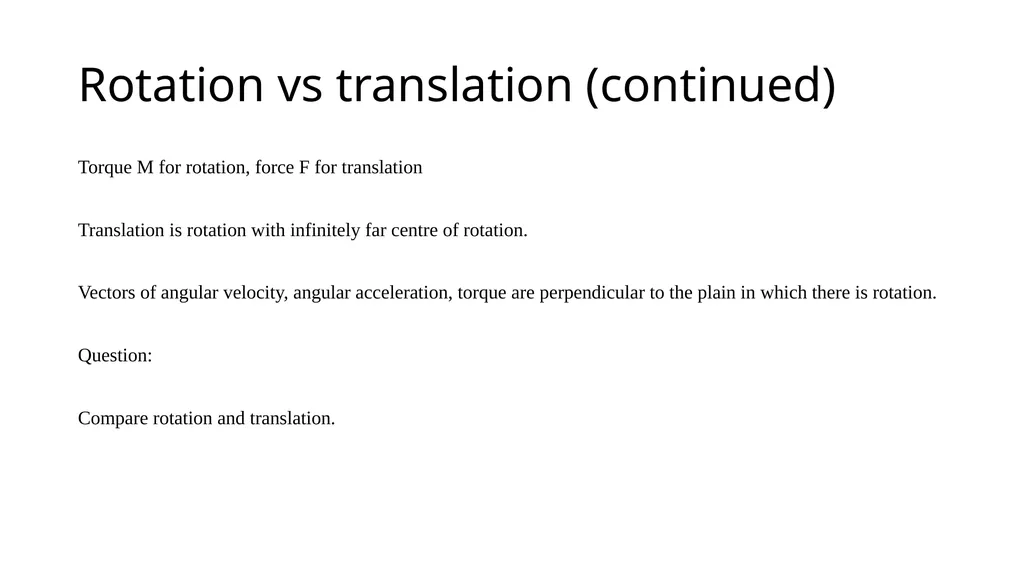
Rotation vs translation (continued) Torque M for rotation, force F for translation
Translation is rotation with infinitely far centre of rotation.
Vectors of angular velocity, angular acceleration, torque are perpendicular to the plain in which there is rotation.
Question:
Compare rotation and translation.<br>
Translation is rotation with infinitely far centre of rotation.
Vectors of angular velocity, angular acceleration, torque are perpendicular to the plain in which there is rotation.
Question:
Compare rotation and translation.<br>
51
Energy, work and power<br>
52
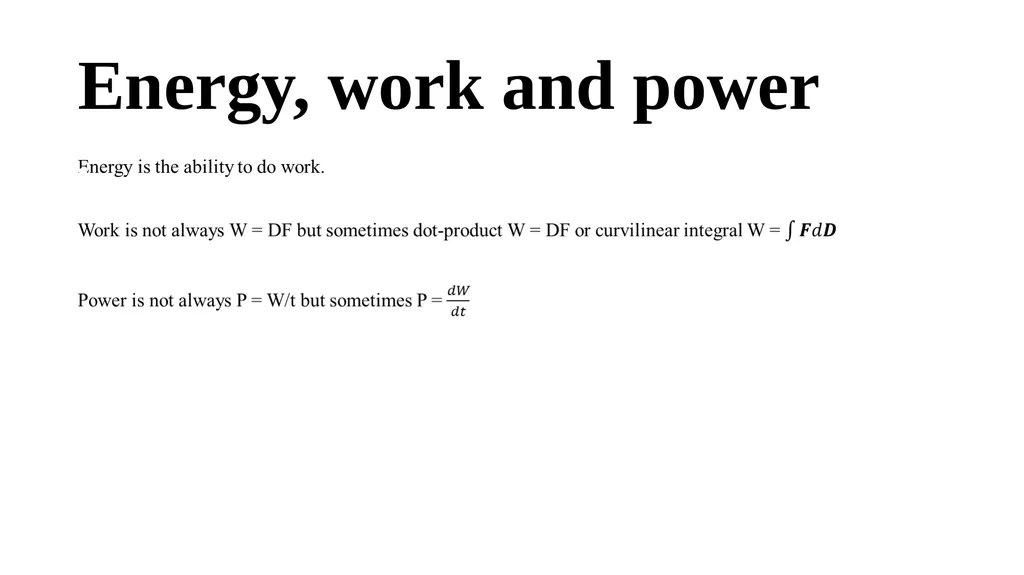
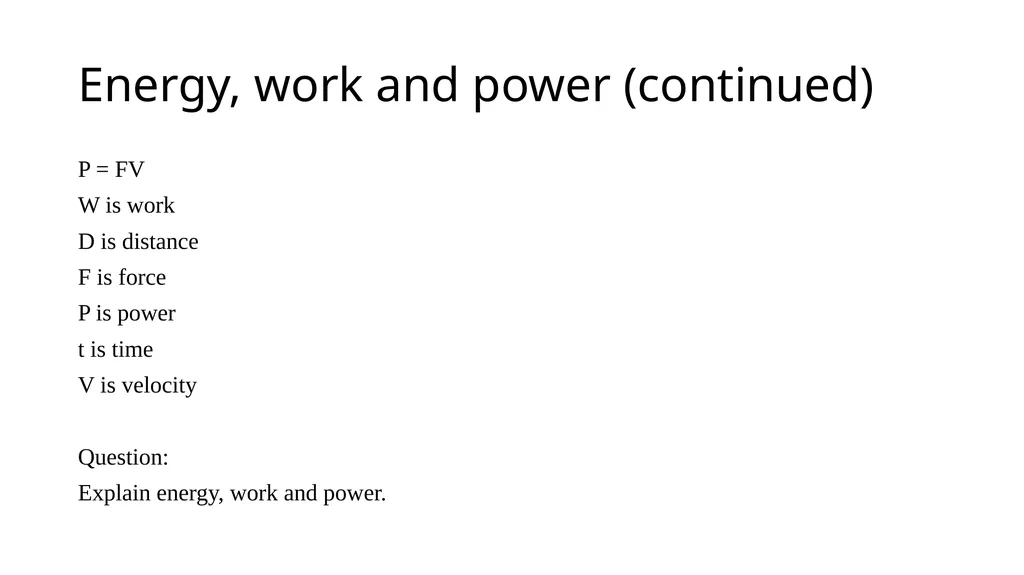
Energy, work and power (continued) P = FV
W is work
D is distance
F is force
P is power
t is time
V is velocity
Question:
Explain energy, work and power.<br>
W is work
D is distance
F is force
P is power
t is time
V is velocity
Question:
Explain energy, work and power.<br>
53
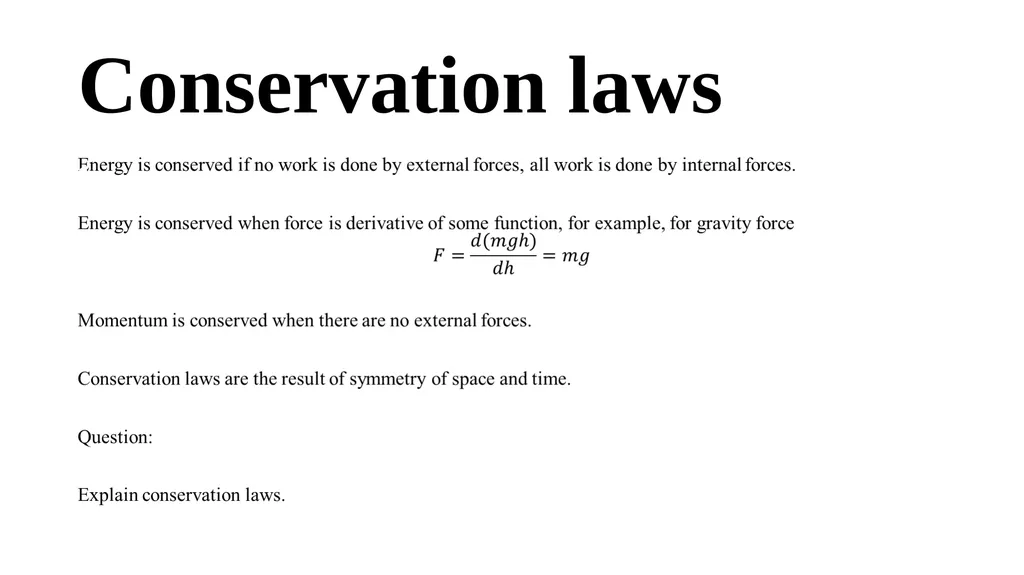
Conservation laws<br>
54
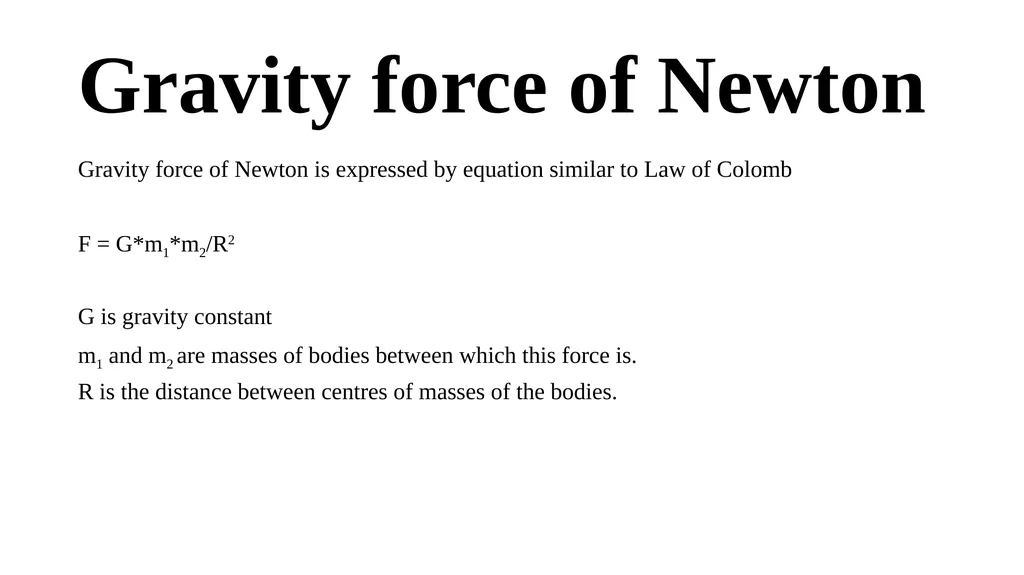
Gravity force of Newton Gravity force of Newton is expressed by equation similar to Law of Colomb
F = G*m1*m2/R2
G is gravity constant
m1 and m2 are masses of bodies between which this force is.
R is the distance between centres of masses of the bodies.<br>
F = G*m1*m2/R2
G is gravity constant
m1 and m2 are masses of bodies between which this force is.
R is the distance between centres of masses of the bodies.<br>
55
Gravity force of Newton (continued) Question:
Calculate the difference in weight on the pole and on the equator of the Earth. Take the difference in the distance from the centre of the Earth as 21km.
https://physics15.weebly.com/uploads/3/0/2/7/30272185/differenceingravityforceduetodistance23sept.txt<br>
Calculate the difference in weight on the pole and on the equator of the Earth. Take the difference in the distance from the centre of the Earth as 21km.
https://physics15.weebly.com/uploads/3/0/2/7/30272185/differenceingravityforceduetodistance23sept.txt<br>
56
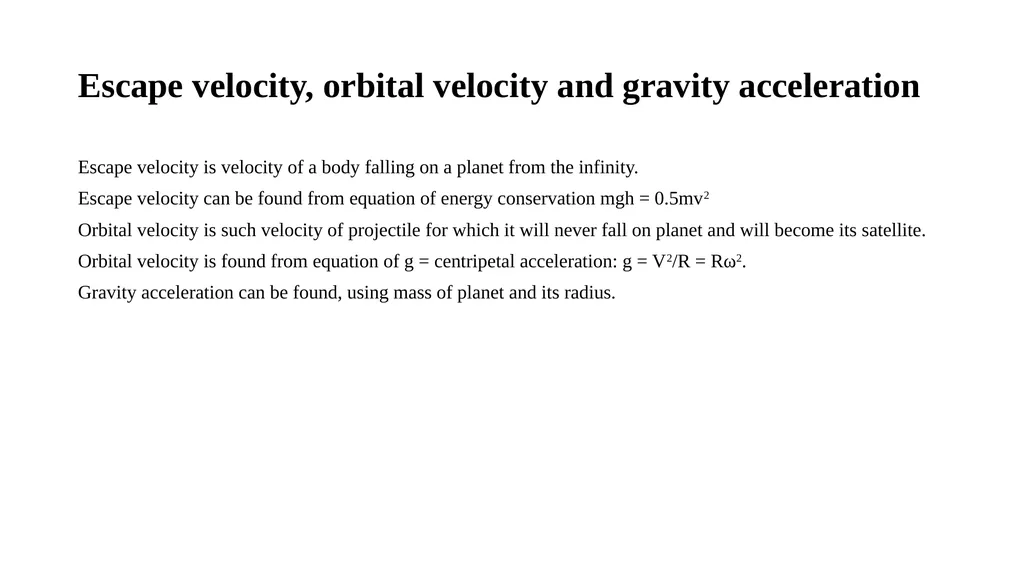
Escape velocity, orbital velocity and gravity acceleration Escape velocity is velocity of a body falling on a planet from the infinity.
Escape velocity can be found from equation of energy conservation mgh = 0.5mv2
Orbital velocity is such velocity of projectile for which it will never fall on planet and will become its satellite.
Orbital velocity is found from equation of g = centripetal acceleration: g = V2/R = Rω2.
Gravity acceleration can be found, using mass of planet and its radius.<br>
Escape velocity can be found from equation of energy conservation mgh = 0.5mv2
Orbital velocity is such velocity of projectile for which it will never fall on planet and will become its satellite.
Orbital velocity is found from equation of g = centripetal acceleration: g = V2/R = Rω2.
Gravity acceleration can be found, using mass of planet and its radius.<br>
57
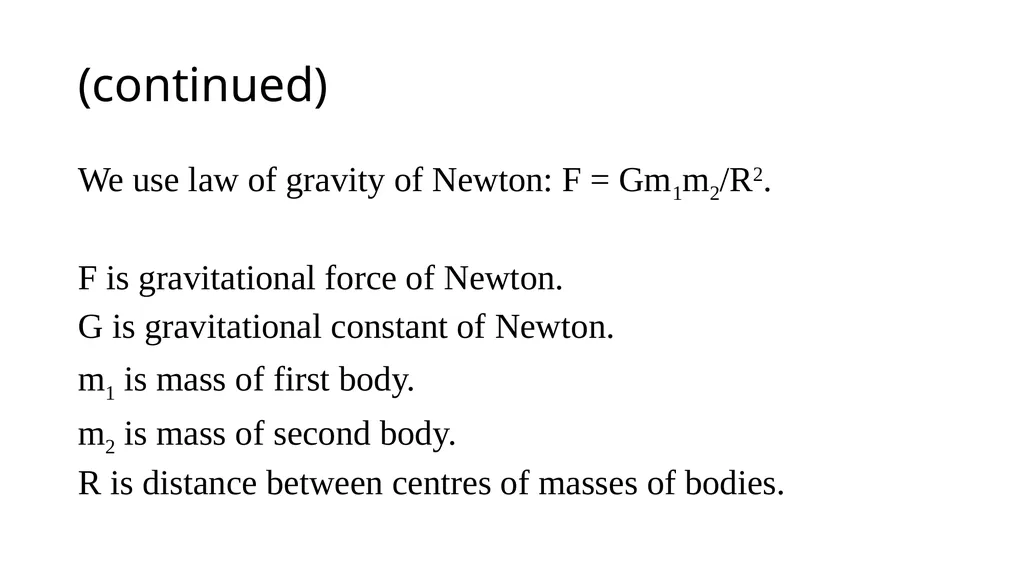
(continued) We use law of gravity of Newton: F = Gm1m2/R2.
F is gravitational force of Newton.
G is gravitational constant of Newton.
m1 is mass of first body.
m2 is mass of second body.
R is distance between centres of masses of bodies.<br>
F is gravitational force of Newton.
G is gravitational constant of Newton.
m1 is mass of first body.
m2 is mass of second body.
R is distance between centres of masses of bodies.<br>
58
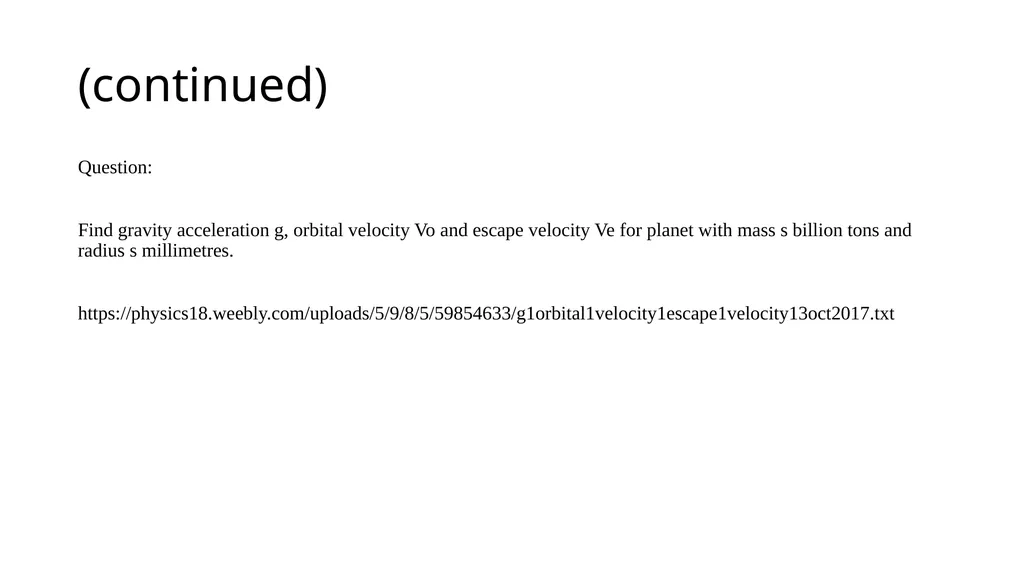
(continued) Question:
Find gravity acceleration g, orbital velocity Vo and escape velocity Ve for planet with mass s billion tons and radius s millimetres.
https://physics18.weebly.com/uploads/5/9/8/5/59854633/g1orbital1velocity1escape1velocity13oct2017.txt<br>
Find gravity acceleration g, orbital velocity Vo and escape velocity Ve for planet with mass s billion tons and radius s millimetres.
https://physics18.weebly.com/uploads/5/9/8/5/59854633/g1orbital1velocity1escape1velocity13oct2017.txt<br>
59
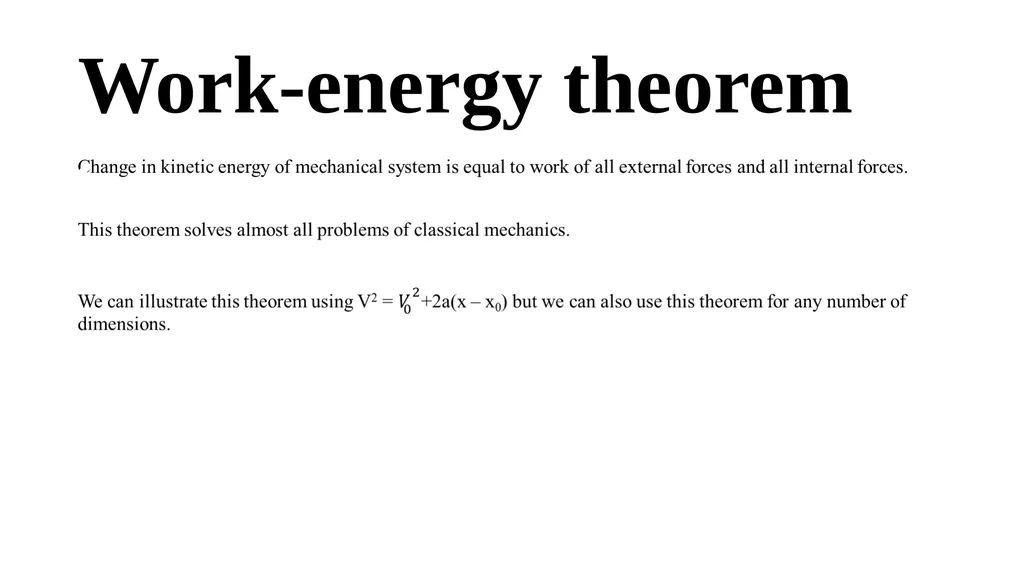
Work-energy theorem<br>
60
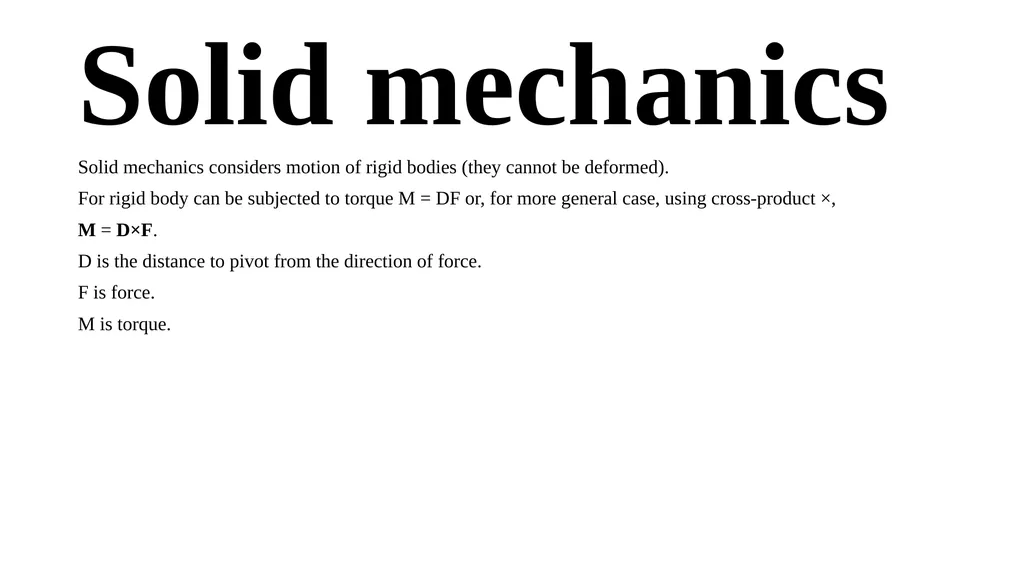
Solid mechanics Solid mechanics considers motion of rigid bodies (they cannot be deformed).
For rigid body can be subjected to torque M = DF or, for more general case, using cross-product ×,
M = D×F.
D is the distance to pivot from the direction of force.
F is force.
M is torque.<br>
For rigid body can be subjected to torque M = DF or, for more general case, using cross-product ×,
M = D×F.
D is the distance to pivot from the direction of force.
F is force.
M is torque.<br>
61
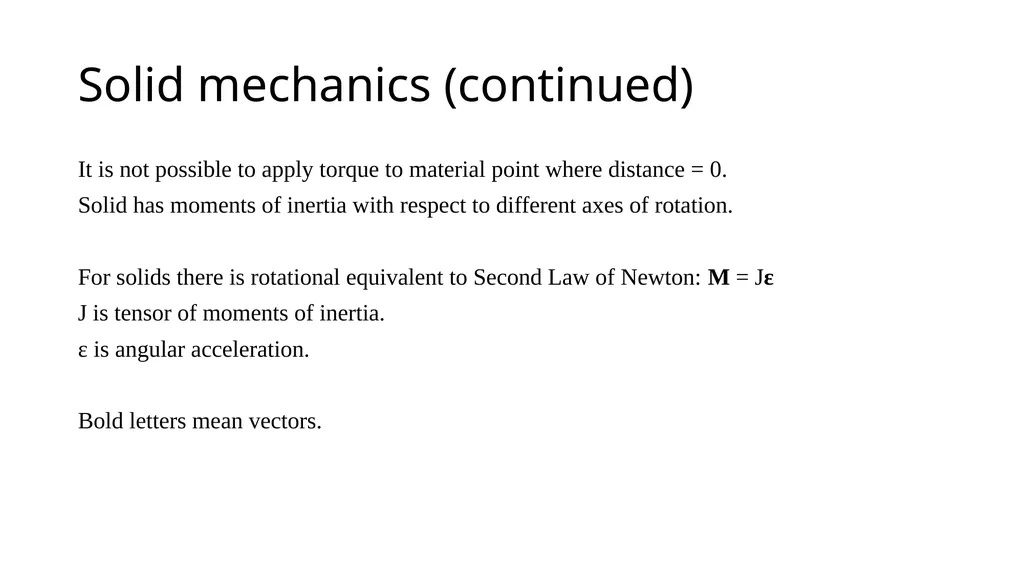
Solid mechanics (continued) It is not possible to apply torque to material point where distance = 0.
Solid has moments of inertia with respect to different axes of rotation.
For solids there is rotational equivalent to Second Law of Newton: M = Jε
J is tensor of moments of inertia.
ε is angular acceleration.
Bold letters mean vectors.<br>
Solid has moments of inertia with respect to different axes of rotation.
For solids there is rotational equivalent to Second Law of Newton: M = Jε
J is tensor of moments of inertia.
ε is angular acceleration.
Bold letters mean vectors.<br>
62
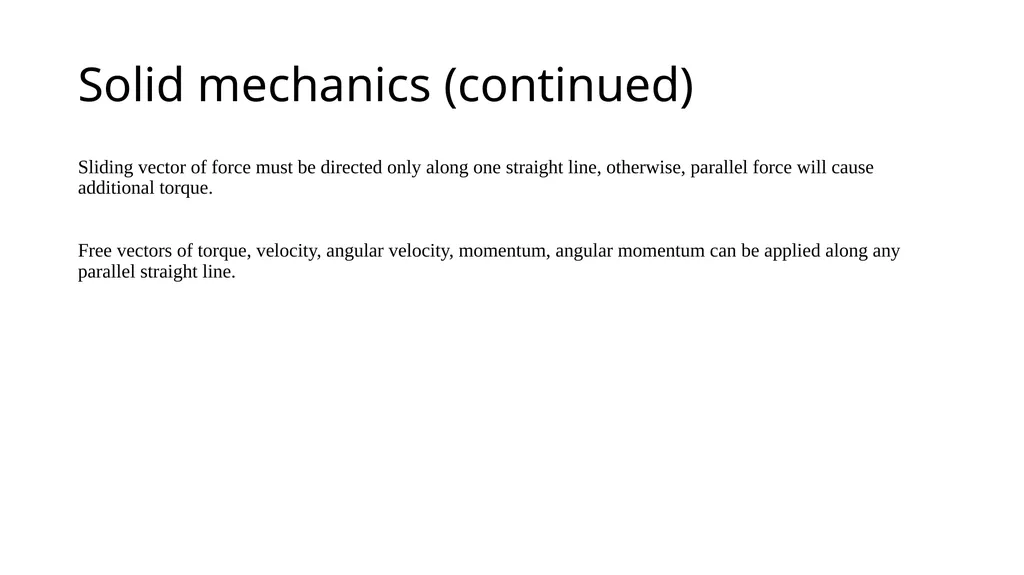
Solid mechanics (continued) Sliding vector of force must be directed only along one straight line, otherwise, parallel force will cause additional torque.
Free vectors of torque, velocity, angular velocity, momentum, angular momentum can be applied along any parallel straight line.<br>
Free vectors of torque, velocity, angular velocity, momentum, angular momentum can be applied along any parallel straight line.<br>
63
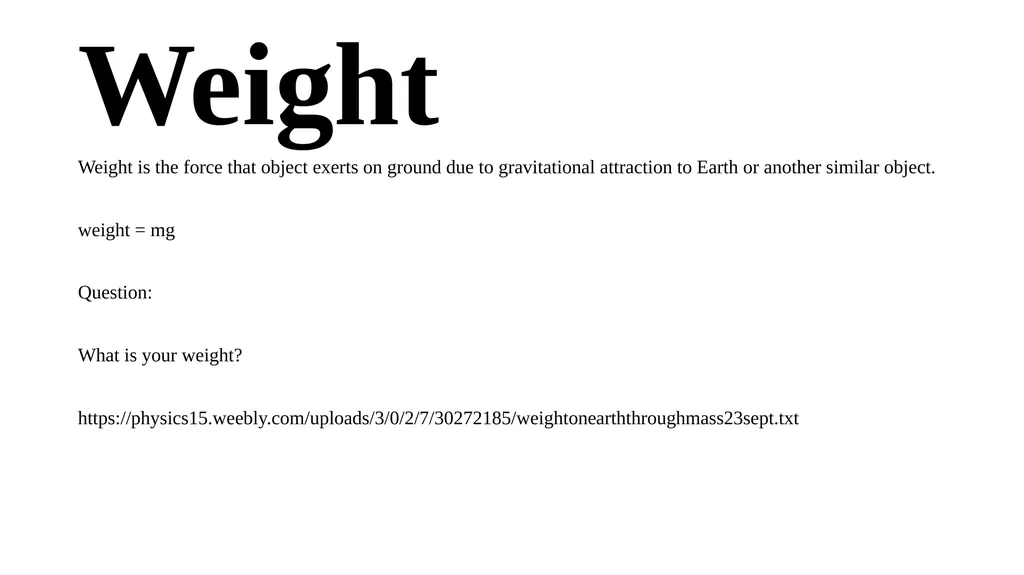
Weight Weight is the force that object exerts on ground due to gravitational attraction to Earth or another similar object.
weight = mg
Question:
What is your weight?
https://physics15.weebly.com/uploads/3/0/2/7/30272185/weightonearththroughmass23sept.txt<br>
weight = mg
Question:
What is your weight?
https://physics15.weebly.com/uploads/3/0/2/7/30272185/weightonearththroughmass23sept.txt<br>
64
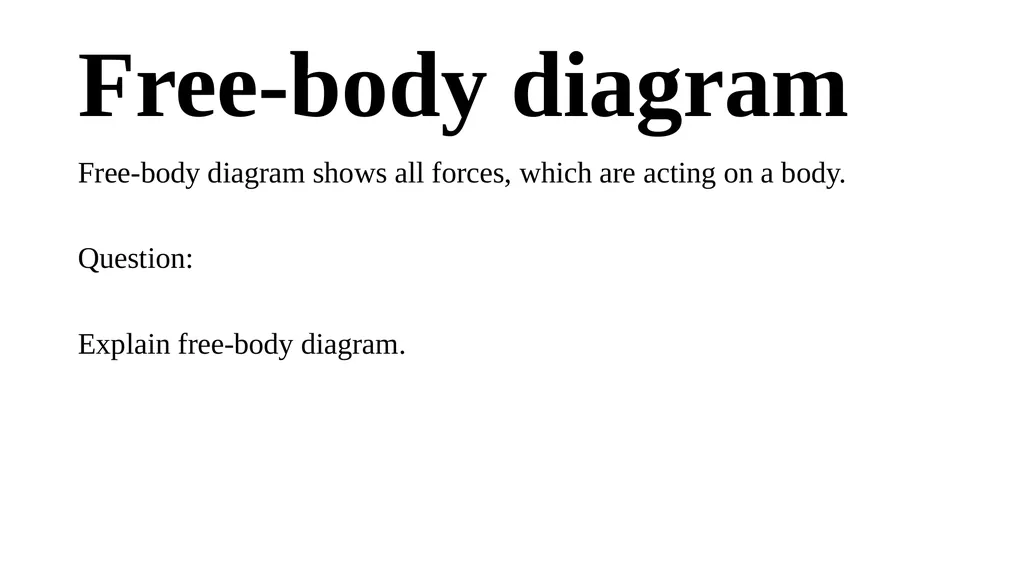
Free-body diagram Free-body diagram shows all forces, which are acting on a body.
Question:
Explain free-body diagram.<br>
Question:
Explain free-body diagram.<br>
65
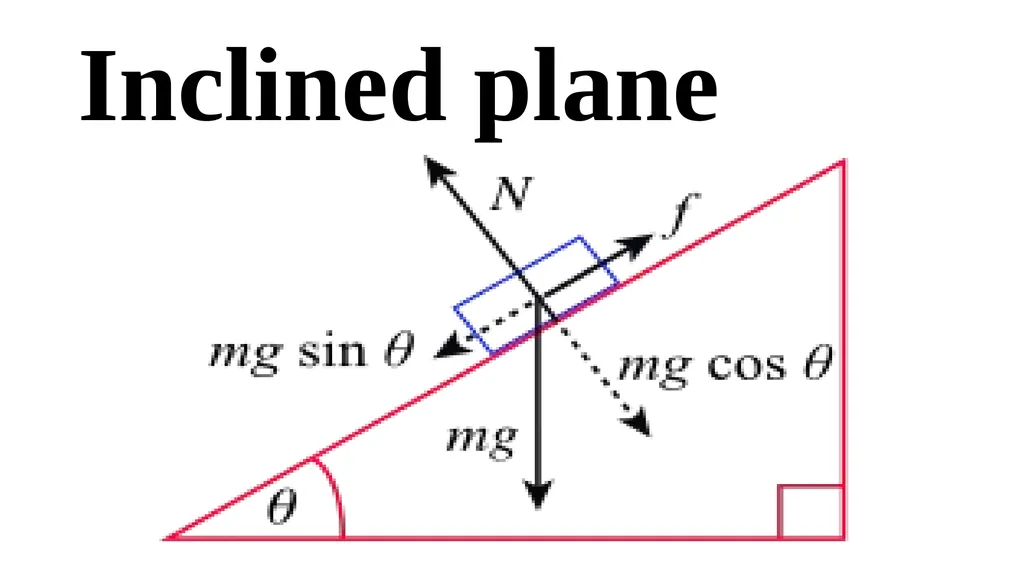
Inclined plane<br>
66
Inclined plane (continued) Inclined plane problem requires adding up all forces as vectors, finding the resulting force.
It includes weight, normal reaction and friction force.<br>
It includes weight, normal reaction and friction force.<br>
67
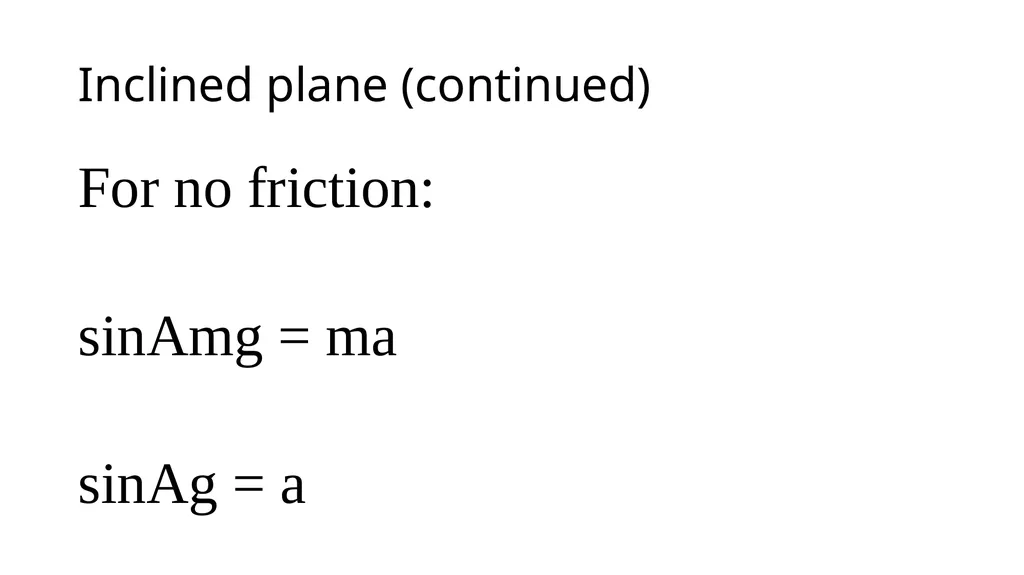
Inclined plane (continued) For no friction:
sinAmg = ma
sinAg = a<br>
sinAmg = ma
sinAg = a<br>
68
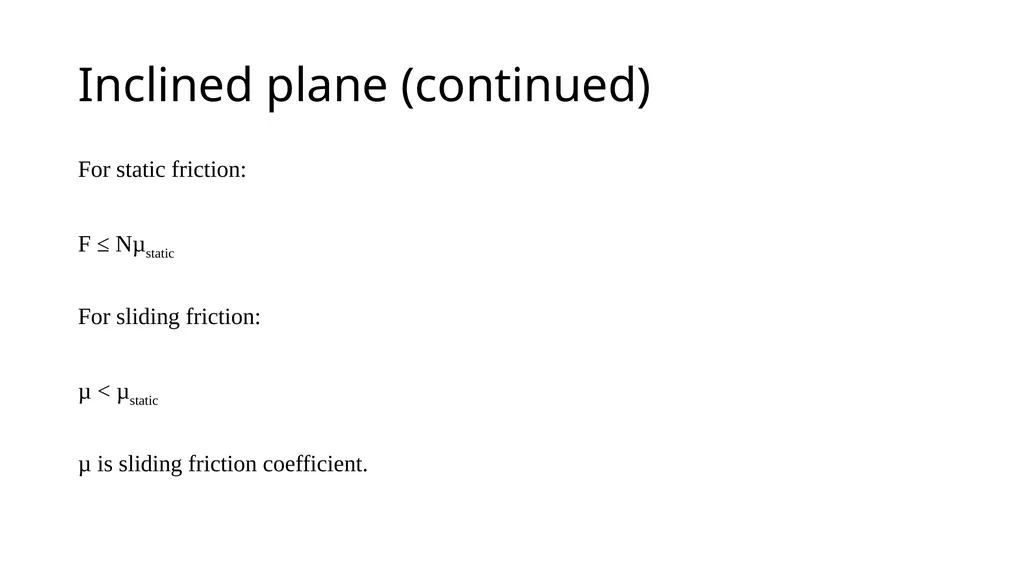
Inclined plane (continued) For static friction:
F ≤ Nµstatic
For sliding friction:
µ < µstatic
µ is sliding friction coefficient.<br>
F ≤ Nµstatic
For sliding friction:
µ < µstatic
µ is sliding friction coefficient.<br>
69
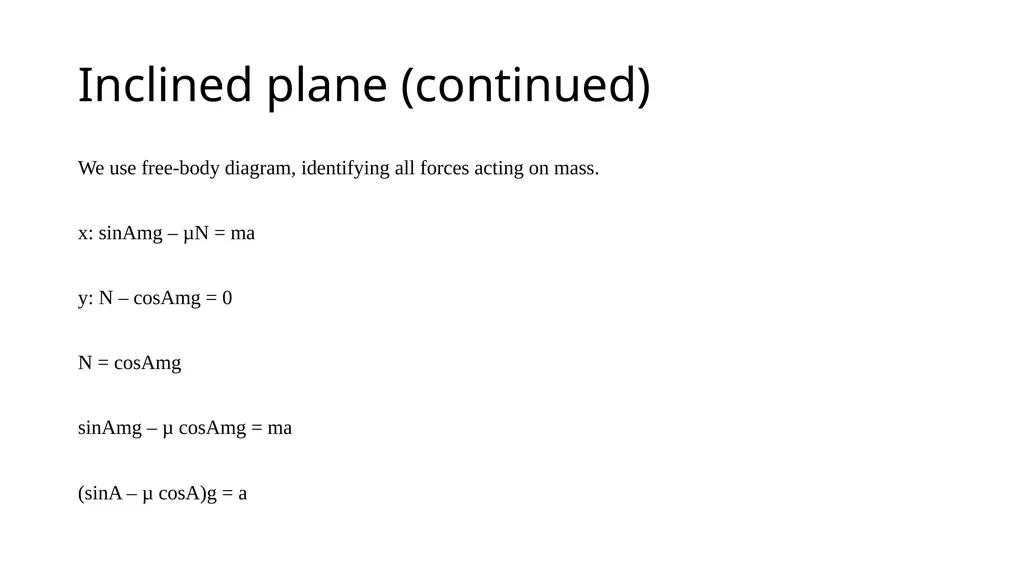
Inclined plane (continued) We use free-body diagram, identifying all forces acting on mass.
x: sinAmg – µN = ma
y: N – cosAmg = 0
N = cosAmg
sinAmg – µ cosAmg = ma
(sinA – µ cosA)g = a<br>
x: sinAmg – µN = ma
y: N – cosAmg = 0
N = cosAmg
sinAmg – µ cosAmg = ma
(sinA – µ cosA)g = a<br>
70
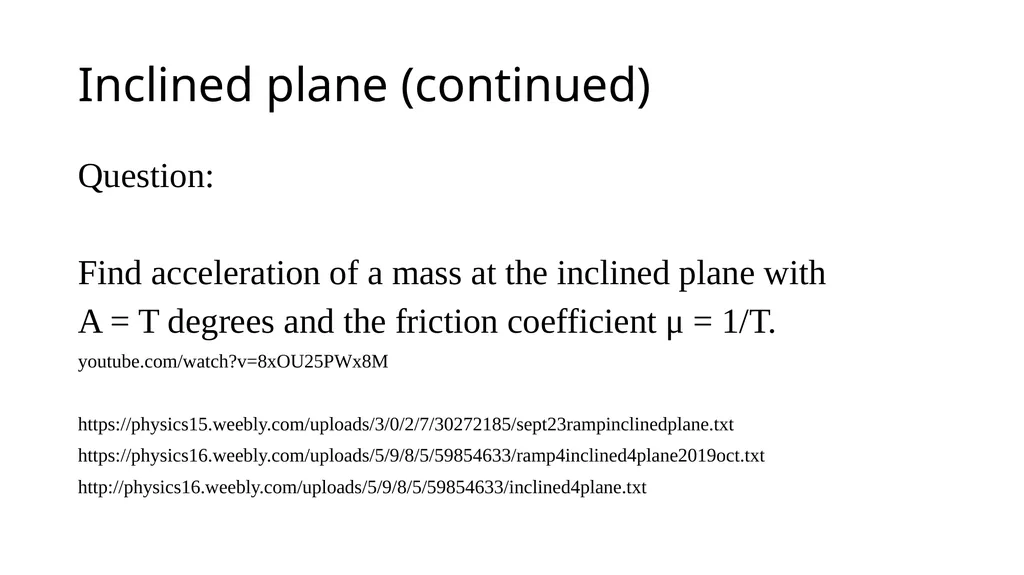
Inclined plane (continued) Question:
Find acceleration of a mass at the inclined plane with
A = T degrees and the friction coefficient μ = 1/T.
youtube.com/watch?v=8xOU25PWx8M
https://physics15.weebly.com/uploads/3/0/2/7/30272185/sept23rampinclinedplane.txt
https://physics16.weebly.com/uploads/5/9/8/5/59854633/ramp4inclined4plane2019oct.txt
http://physics16.weebly.com/uploads/5/9/8/5/59854633/inclined4plane.txt<br>
Find acceleration of a mass at the inclined plane with
A = T degrees and the friction coefficient μ = 1/T.
youtube.com/watch?v=8xOU25PWx8M
https://physics15.weebly.com/uploads/3/0/2/7/30272185/sept23rampinclinedplane.txt
https://physics16.weebly.com/uploads/5/9/8/5/59854633/ramp4inclined4plane2019oct.txt
http://physics16.weebly.com/uploads/5/9/8/5/59854633/inclined4plane.txt<br>
71
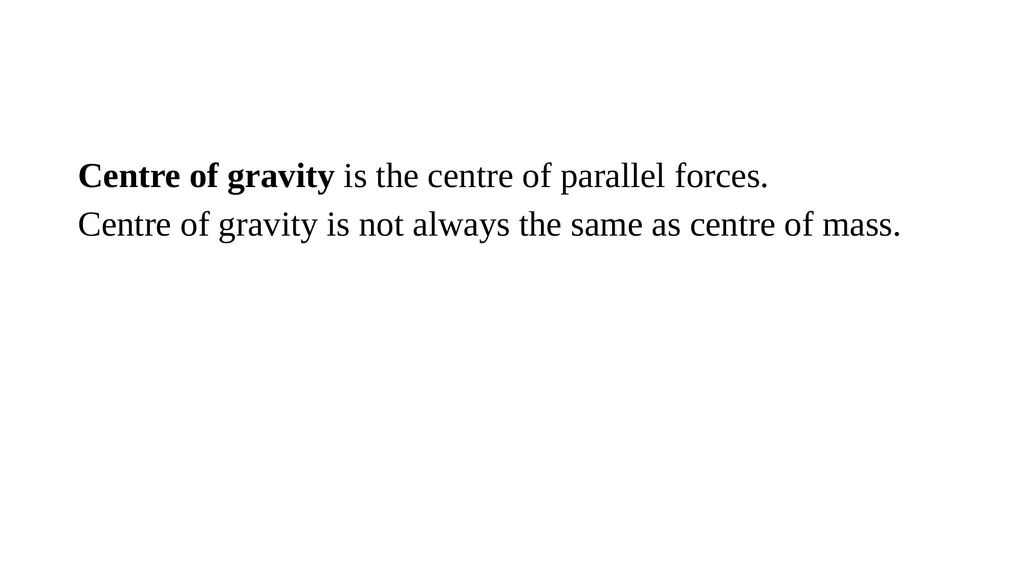
Centre of gravity is the centre of parallel forces.
Centre of gravity is not always the same as centre of mass.<br>
Centre of gravity is not always the same as centre of mass.<br>
72
Statics<br>
73
Blocks stacking problem<br>
74
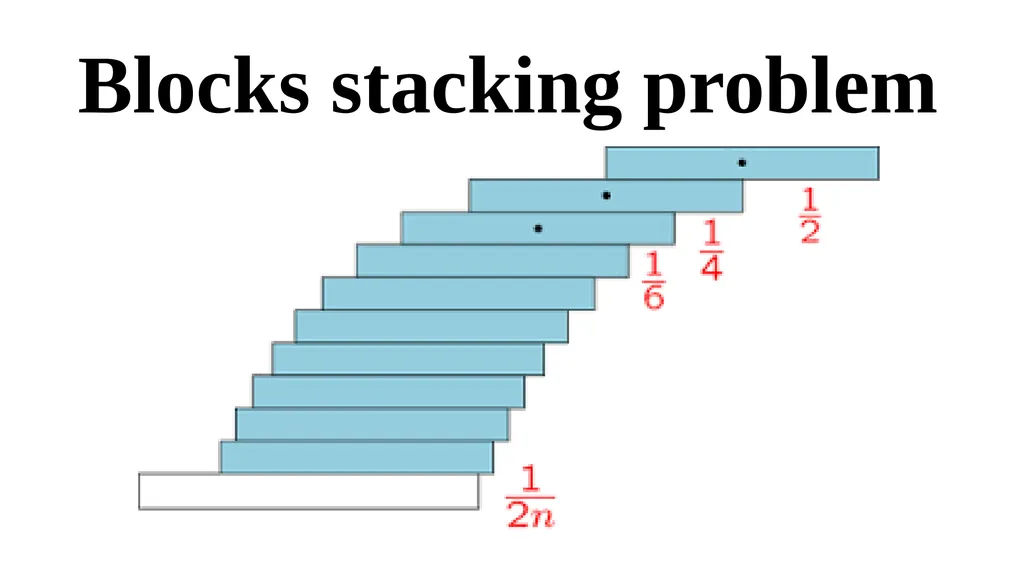
Block stacking problem (continued) Blocks stacking problem finds locations of blocs to make maximum hangover, which follows harmonic series 1/n, which diverges, which means that hangover can be infinitely big.
We use equations of static equilibrium to solve the problem.
This is logistical problem for computer programmers to solve.<br>
We use equations of static equilibrium to solve the problem.
This is logistical problem for computer programmers to solve.<br>
75
Block stacking problem (continued) Question:
Find the hangover for the s blocks in the blocks stacking problem.
http://physics16.weebly.com/uploads/5/9/8/5/59854633/hangover.txt
youtube.com/watch?v=Gaua_V9Fse4<br>
Find the hangover for the s blocks in the blocks stacking problem.
http://physics16.weebly.com/uploads/5/9/8/5/59854633/hangover.txt
youtube.com/watch?v=Gaua_V9Fse4<br>
76
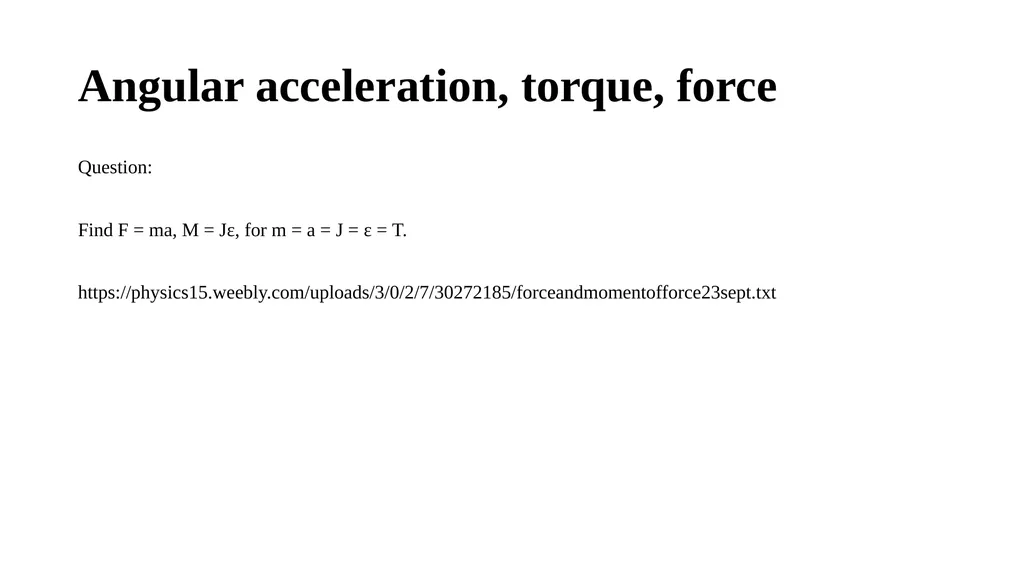
Angular acceleration, torque, force Question:
Find F = ma, M = Jε, for m = a = J = ε = T.
https://physics15.weebly.com/uploads/3/0/2/7/30272185/forceandmomentofforce23sept.txt<br>
Find F = ma, M = Jε, for m = a = J = ε = T.
https://physics15.weebly.com/uploads/3/0/2/7/30272185/forceandmomentofforce23sept.txt<br>
77
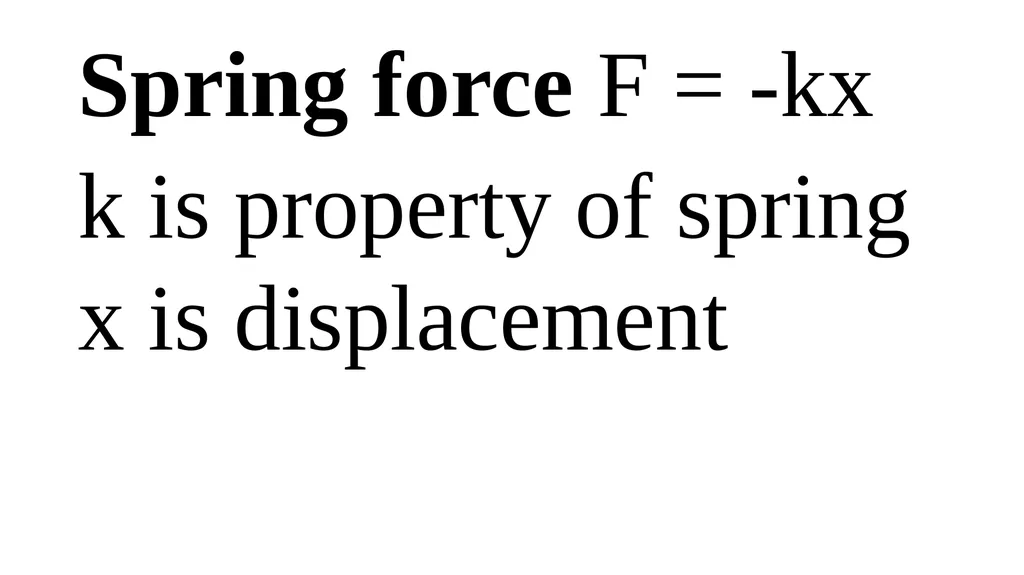
Spring force F = -kx k is property of spring
x is displacement<br>
x is displacement<br>
78
Pendulum Pendulum is used for many useful things: counting time, monitoring rotation of Earth, etc.<br>
79
Oscillation Oscillation is periodic motion.
We solve ordinary differential equation to describe oscillation.
We can describe oscillation of mass, attached to spring.<br>
We solve ordinary differential equation to describe oscillation.
We can describe oscillation of mass, attached to spring.<br>
80
Resonance is when amplitude of oscillation becomes infinite because frequencies of external force and natural frequency of the oscillator are the same.<br>
81
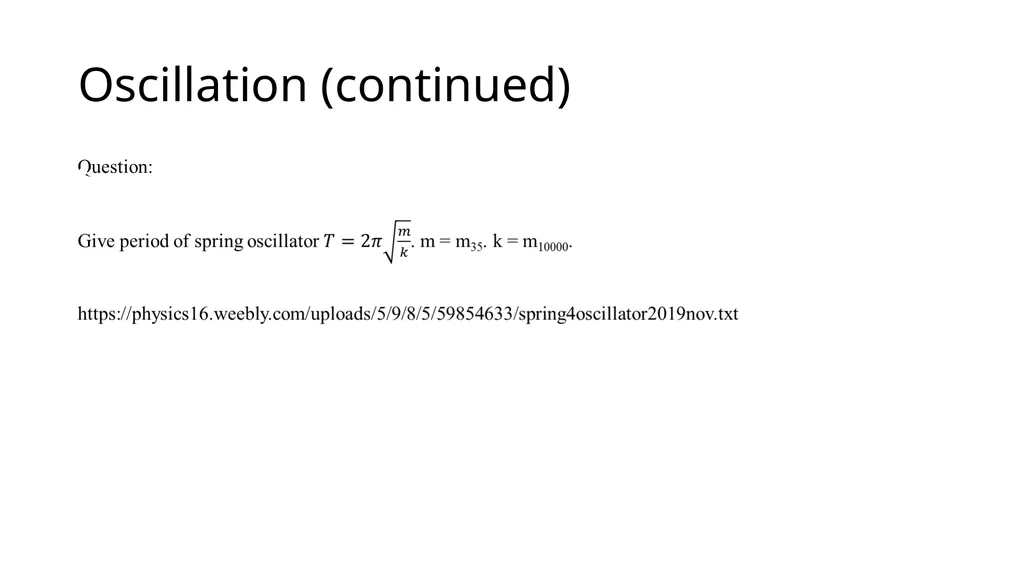
Oscillation (continued)<br>
82
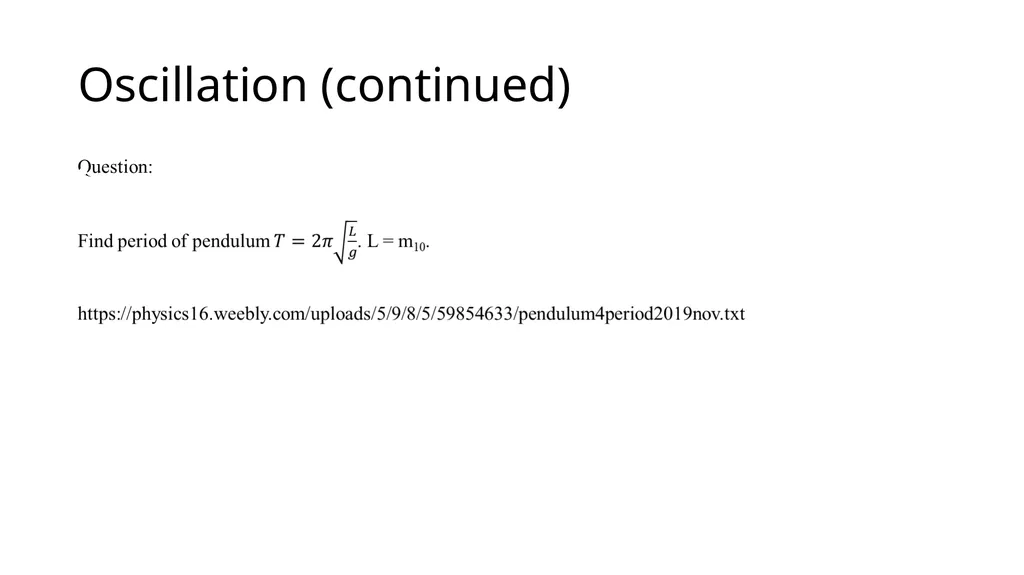
Oscillation (continued)<br>
83
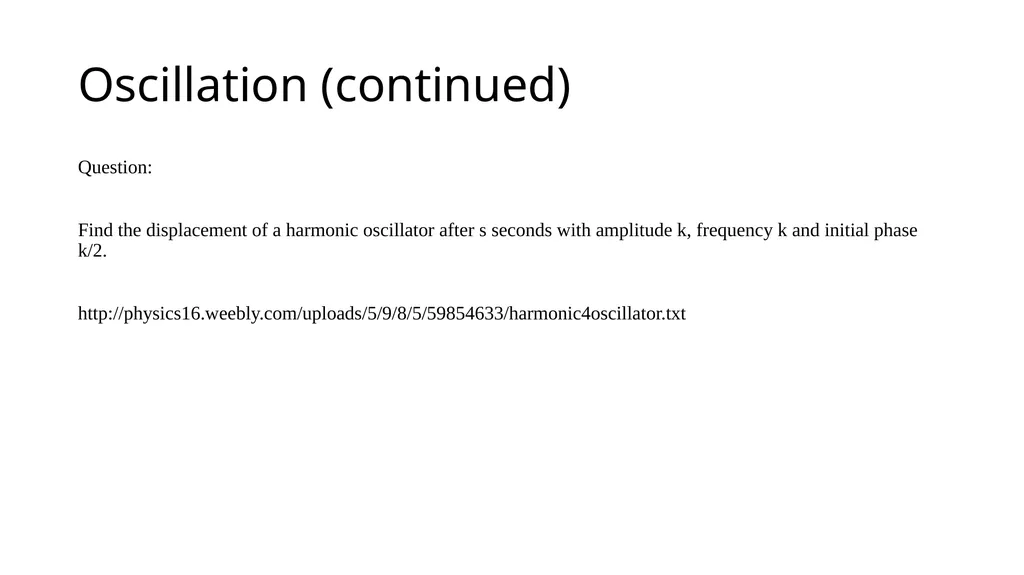
Oscillation (continued) Question:
Find the displacement of a harmonic oscillator after s seconds with amplitude k, frequency k and initial phase k/2.
http://physics16.weebly.com/uploads/5/9/8/5/59854633/harmonic4oscillator.txt<br>
Find the displacement of a harmonic oscillator after s seconds with amplitude k, frequency k and initial phase k/2.
http://physics16.weebly.com/uploads/5/9/8/5/59854633/harmonic4oscillator.txt<br>
84
Oscillation (continued) Question:
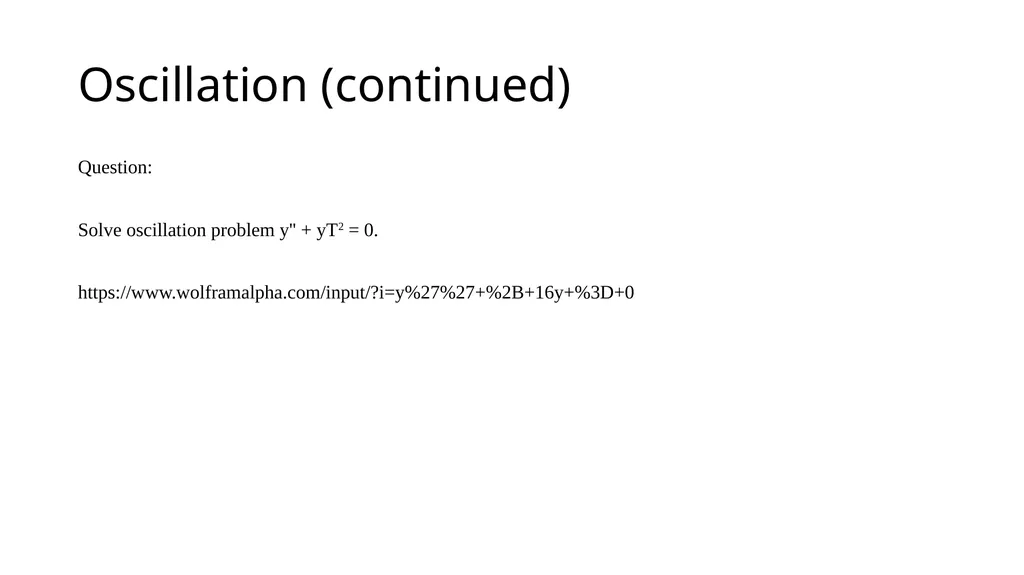
Solve oscillation problem y'' + yT2 = 0.
https://www.wolframalpha.com/input/?i=y%27%27+%2B+16y+%3D+0<br>
Solve oscillation problem y'' + yT2 = 0.
https://www.wolframalpha.com/input/?i=y%27%27+%2B+16y+%3D+0<br>
85
Oscillation (continued) Question:
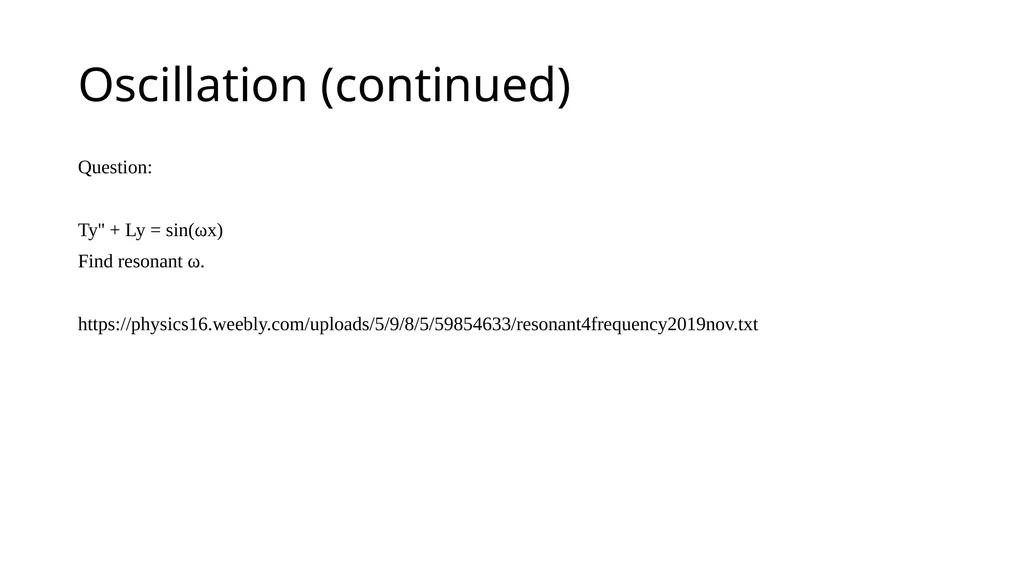
Ty'' + Ly = sin(ωx)
Find resonant ω.
https://physics16.weebly.com/uploads/5/9/8/5/59854633/resonant4frequency2019nov.txt<br>
Ty'' + Ly = sin(ωx)
Find resonant ω.
https://physics16.weebly.com/uploads/5/9/8/5/59854633/resonant4frequency2019nov.txt<br>
86
Oscillation (continued) Question:
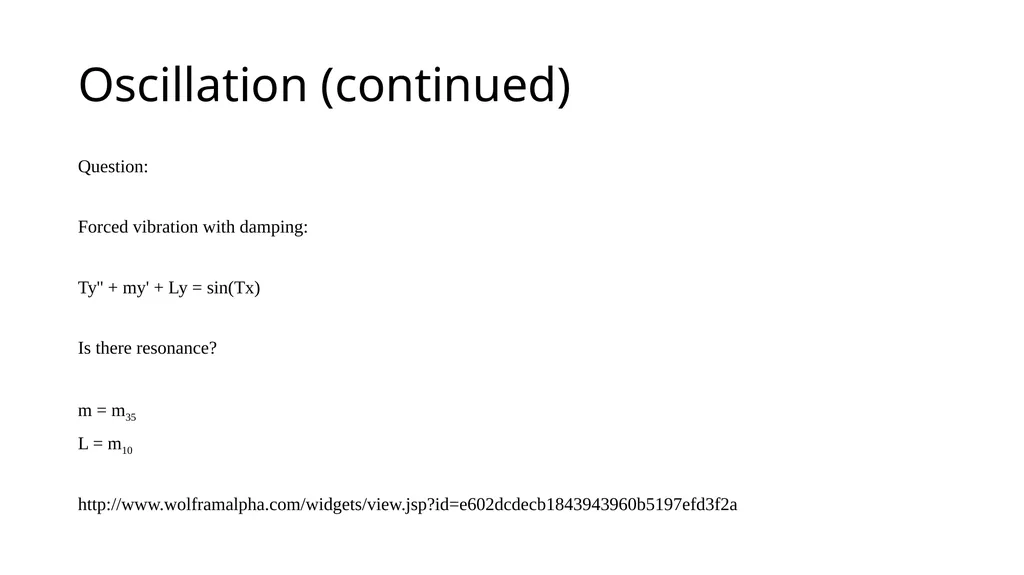
Forced vibration with damping:
Ty'' + my' + Ly = sin(Tx)
Is there resonance?
m = m35
L = m10
http://www.wolframalpha.com/widgets/view.jsp?id=e602dcdecb1843943960b5197efd3f2a<br>
Forced vibration with damping:
Ty'' + my' + Ly = sin(Tx)
Is there resonance?
m = m35
L = m10
http://www.wolframalpha.com/widgets/view.jsp?id=e602dcdecb1843943960b5197efd3f2a<br>
87
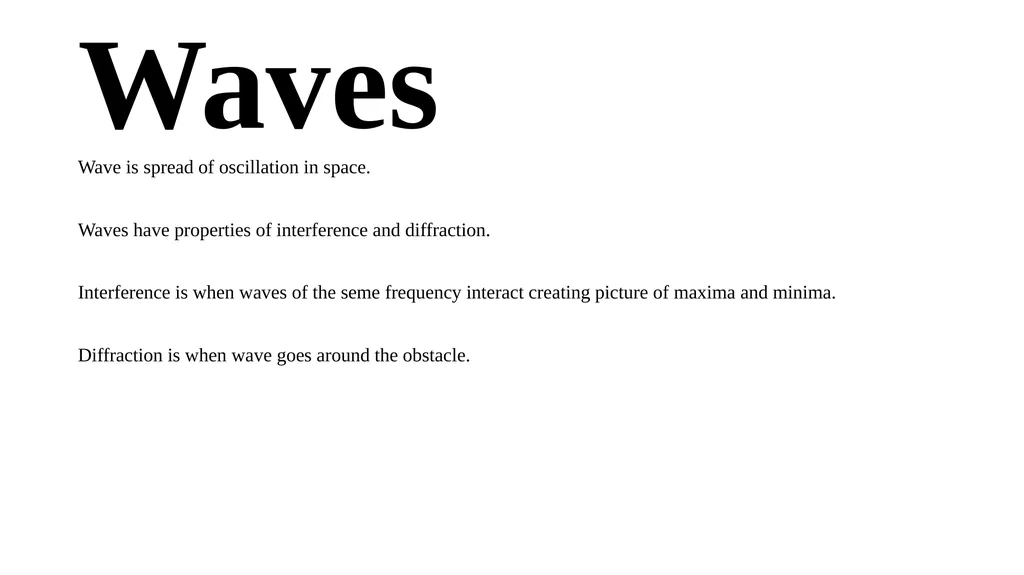
Waves Wave is spread of oscillation in space.
Waves have properties of interference and diffraction.
Interference is when waves of the seme frequency interact creating picture of maxima and minima.
Diffraction is when wave goes around the obstacle.<br>
Waves have properties of interference and diffraction.
Interference is when waves of the seme frequency interact creating picture of maxima and minima.
Diffraction is when wave goes around the obstacle.<br>
88
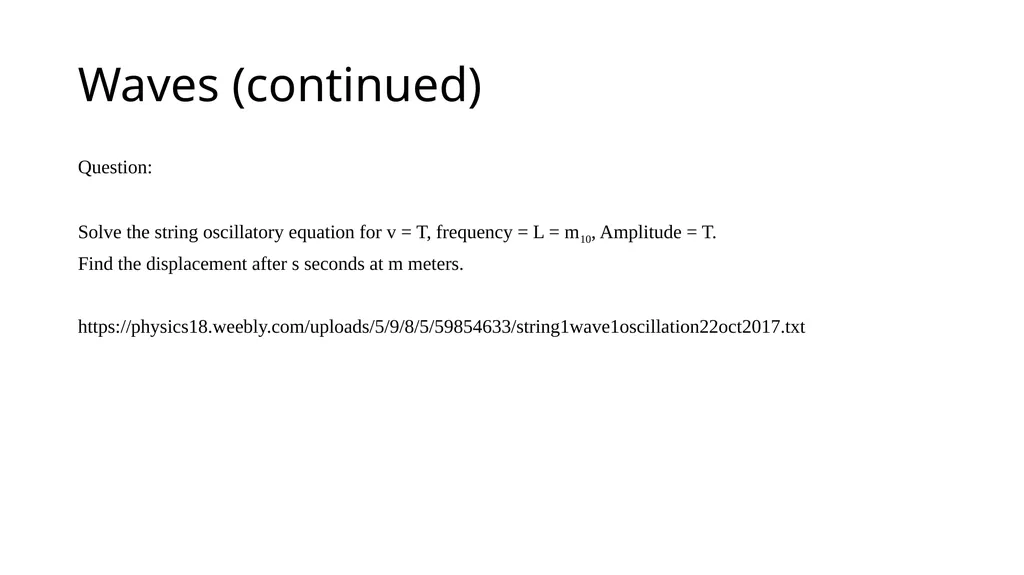
Waves (continued) Question:
Solve the string oscillatory equation for v = T, frequency = L = m10, Amplitude = T.
Find the displacement after s seconds at m meters.
https://physics18.weebly.com/uploads/5/9/8/5/59854633/string1wave1oscillation22oct2017.txt<br>
Solve the string oscillatory equation for v = T, frequency = L = m10, Amplitude = T.
Find the displacement after s seconds at m meters.
https://physics18.weebly.com/uploads/5/9/8/5/59854633/string1wave1oscillation22oct2017.txt<br>
89
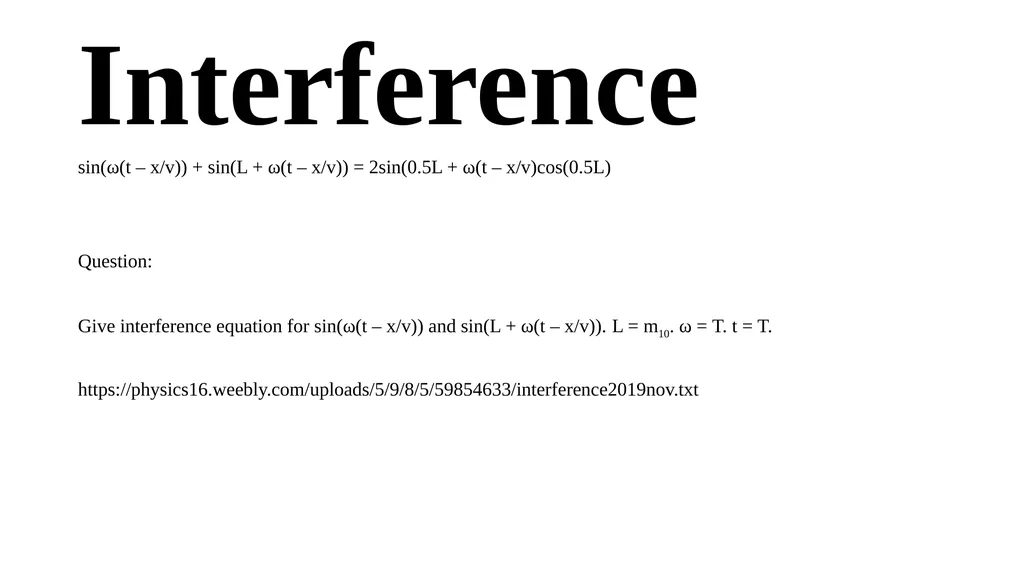
Interference sin(ω(t – x/v)) + sin(L + ω(t – x/v)) = 2sin(0.5L + ω(t – x/v)cos(0.5L)
Question:
Give interference equation for sin(ω(t – x/v)) and sin(L + ω(t – x/v)). L = m10. ω = T. t = T.
https://physics16.weebly.com/uploads/5/9/8/5/59854633/interference2019nov.txt<br>
Question:
Give interference equation for sin(ω(t – x/v)) and sin(L + ω(t – x/v)). L = m10. ω = T. t = T.
https://physics16.weebly.com/uploads/5/9/8/5/59854633/interference2019nov.txt<br>
90
Mathematics for physics Angular calculus
Degrees and radians
Trigonometric calculus
Derivatives and integrals of sin, cos, tan and other trigonometric functions
Differential equations
Functions of many variables
Vector calculus
Add, subtract, multiply vectors (dot-product, cross-product)
Tensor calculus
Multiply tensor by vector<br>
Degrees and radians
Trigonometric calculus
Derivatives and integrals of sin, cos, tan and other trigonometric functions
Differential equations
Functions of many variables
Vector calculus
Add, subtract, multiply vectors (dot-product, cross-product)
Tensor calculus
Multiply tensor by vector<br>
91
Mathematics for physics (continued) Details for mathematics in physics are here:
calculus12s.weebly.com
calculus17.weebly.com
calculus1only.weebly.com
calculus2only.weebly.com
discrete4math.weebly.com
discrete7math.weebly.com
algebra4students.weebly.com
statistics4students.weebly.com
biomath.weebly.com/<br>
calculus12s.weebly.com
calculus17.weebly.com
calculus1only.weebly.com
calculus2only.weebly.com
discrete4math.weebly.com
discrete7math.weebly.com
algebra4students.weebly.com
statistics4students.weebly.com
biomath.weebly.com/<br>