
Climate Proofing the Sandy Bay water service
MJ
Published · 28 slides · 0 views

1 / 1






Description
Climate Proofing the Sandy Bay water service improvement project, St. Vincent Module: Identifying and appraising the costs and benefits of building the climate resilience of a specific water supply system 1 Background This module is a
Related Topics
Share
Embed code
Download this presentation From Below
"Climate Proofing the Sandy Bay water service" is the property of its rightful owner. Permission is granted to download and print the materials on this website for personal, non-commercial use only, and to display it on your personal computer provided you do not modify the materials and that you retain all copyright notices contained in the materials. By downloading content from our website, you accept the terms of this agreement.
Presentation Transcript
01
Climate Proofing the Sandy Bay water service improvement project, St. Vincent
Module: Identifying and appraising the costs and benefits of building the climate resilience of a specific water supply system 1<br>
Module: Identifying and appraising the costs and benefits of building the climate resilience of a specific water supply system 1<br>
02
Background This module is a knowledge product developed as part of the ‘Climate proofing the Sandy Bay water services improvement project, St. Vincent’ funded by
The project aims to assist Central Water and Sewerage Authority in delivering safe and sustainable water supply services to communities in the Sandy Bay area of St. Vincent - focusing on support toward the preparation of a project appraisal document for submission for funding.
Implemented between January 2016 and March 2017 by a consortium made of :
Project partners: 2<br>
The project aims to assist Central Water and Sewerage Authority in delivering safe and sustainable water supply services to communities in the Sandy Bay area of St. Vincent - focusing on support toward the preparation of a project appraisal document for submission for funding.
Implemented between January 2016 and March 2017 by a consortium made of :
Project partners: 2<br>
03
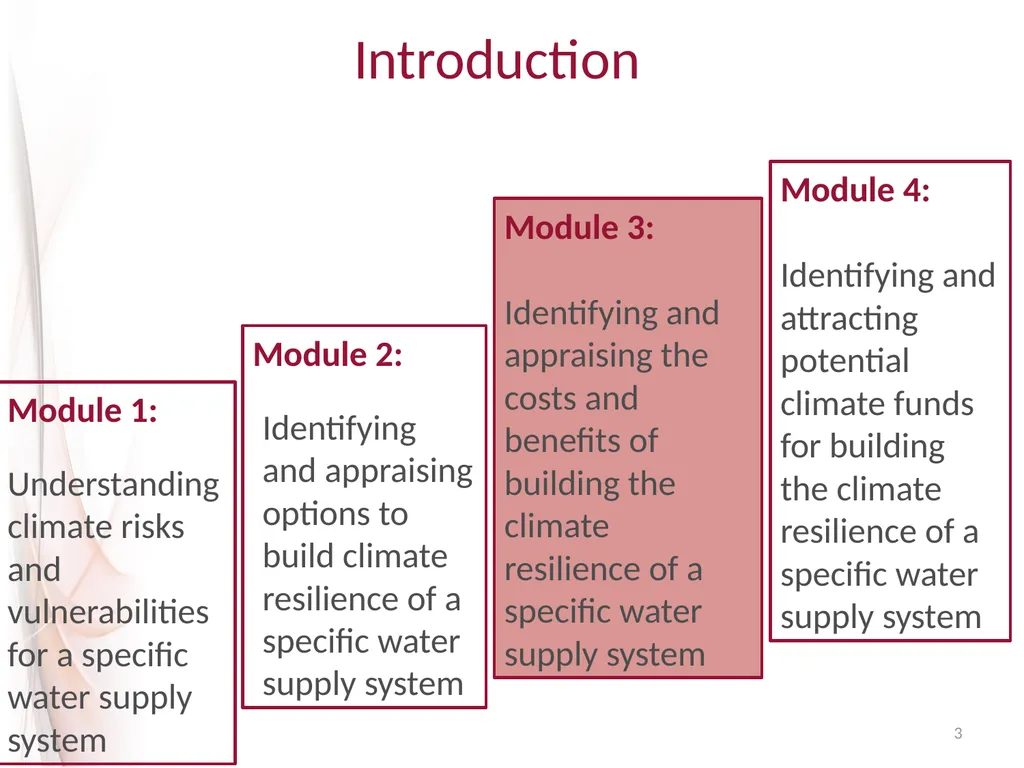
Introduction 3 Module 1:
Understanding climate risks and vulnerabilities for a specific water supply system Module 2:
Identifying and appraising options to build climate resilience of a specific water supply system Module 3:
Identifying and appraising the costs and benefits of building the climate resilience of a specific water supply system Module 4:
Identifying and attracting potential climate funds for building the climate resilience of a specific water supply system<br>
Understanding climate risks and vulnerabilities for a specific water supply system Module 2:
Identifying and appraising options to build climate resilience of a specific water supply system Module 3:
Identifying and appraising the costs and benefits of building the climate resilience of a specific water supply system Module 4:
Identifying and attracting potential climate funds for building the climate resilience of a specific water supply system<br>
04
Objectives of this module Aim: Provide guidance and awareness on identifying and appraising the costs and benefits of adaptation options for water supply projects, focusing on examples from the Sandy Bay project.
Audience: Project developers 4<br>
Audience: Project developers 4<br>
05
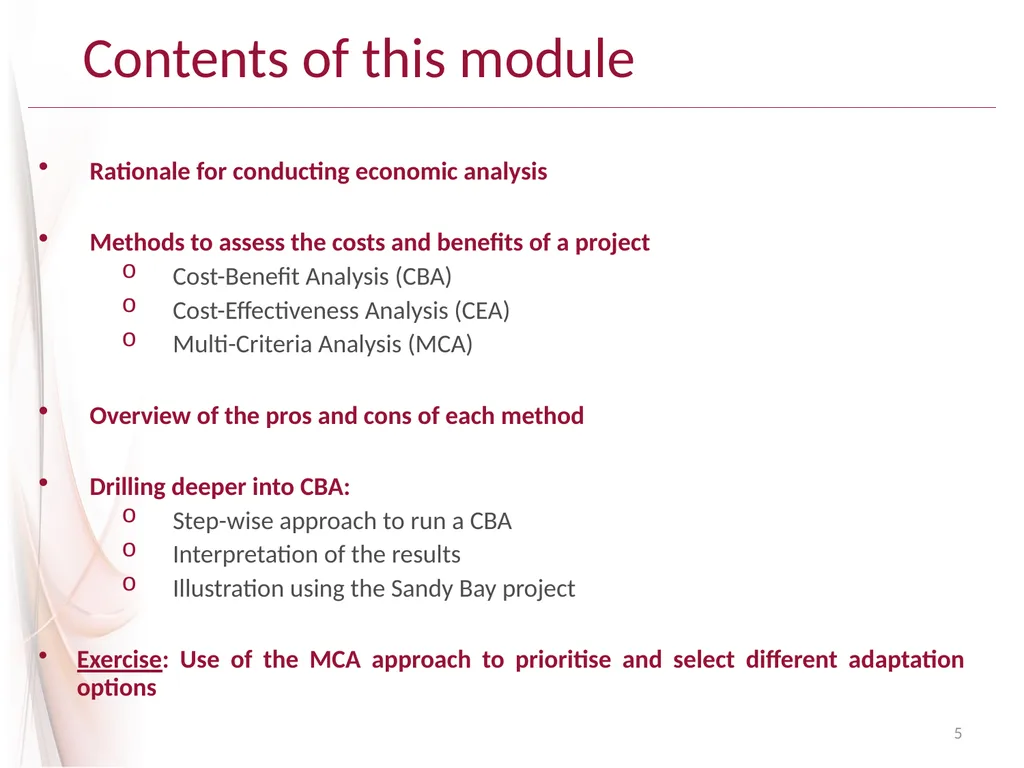
Contents of this module 5 Rationale for conducting economic analysis
Methods to assess the costs and benefits of a project
Cost-Benefit Analysis (CBA)
Cost-Effectiveness Analysis (CEA)
Multi-Criteria Analysis (MCA)
Overview of the pros and cons of each method
Drilling deeper into CBA:
Step-wise approach to run a CBA
Interpretation of the results
Illustration using the Sandy Bay project
Exercise: Use of the MCA approach to prioritise and select different adaptation options<br>
Methods to assess the costs and benefits of a project
Cost-Benefit Analysis (CBA)
Cost-Effectiveness Analysis (CEA)
Multi-Criteria Analysis (MCA)
Overview of the pros and cons of each method
Drilling deeper into CBA:
Step-wise approach to run a CBA
Interpretation of the results
Illustration using the Sandy Bay project
Exercise: Use of the MCA approach to prioritise and select different adaptation options<br>
06
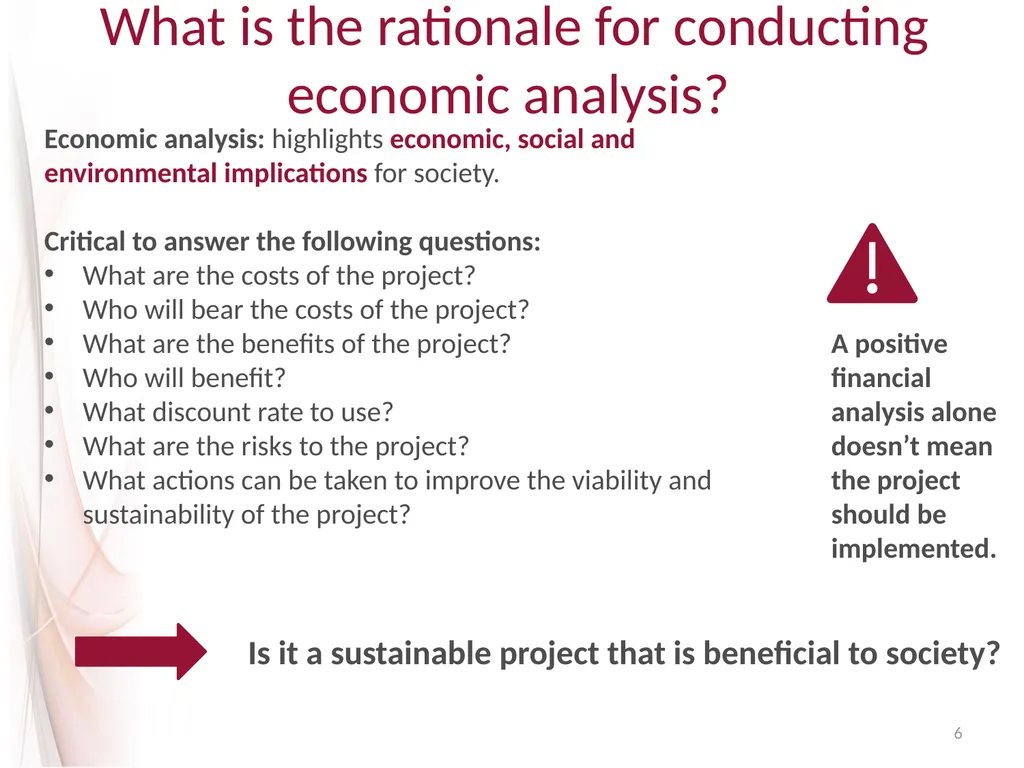
What is the rationale for conducting economic analysis? Economic analysis: highlights economic, social and environmental implications for society.
Critical to answer the following questions:
What are the costs of the project?
Who will bear the costs of the project?
What are the benefits of the project?
Who will benefit?
What discount rate to use?
What are the risks to the project?
What actions can be taken to improve the viability and sustainability of the project? Is it a sustainable project that is beneficial to society? A positive financial analysis alone doesn’t mean the project should be implemented. 6<br>
Critical to answer the following questions:
What are the costs of the project?
Who will bear the costs of the project?
What are the benefits of the project?
Who will benefit?
What discount rate to use?
What are the risks to the project?
What actions can be taken to improve the viability and sustainability of the project? Is it a sustainable project that is beneficial to society? A positive financial analysis alone doesn’t mean the project should be implemented. 6<br>
07
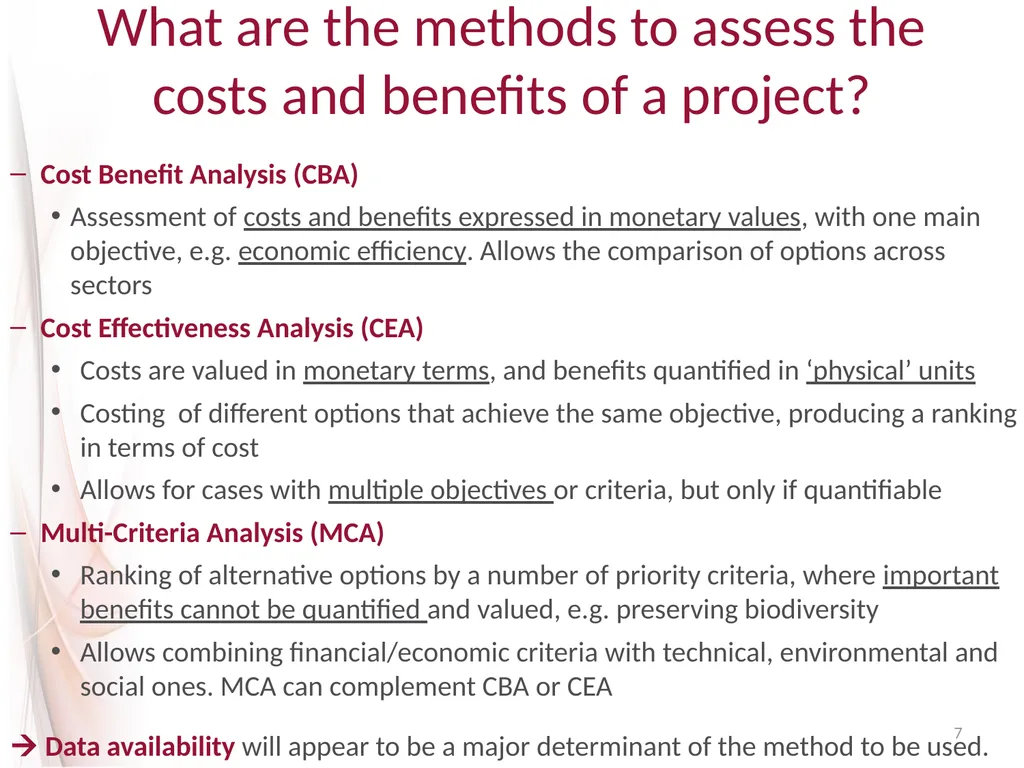
What are the methods to assess the costs and benefits of a project? Cost Benefit Analysis (CBA)
Assessment of costs and benefits expressed in monetary values, with one main objective, e.g. economic efficiency. Allows the comparison of options across sectors
Cost Effectiveness Analysis (CEA)
Costs are valued in monetary terms, and benefits quantified in ‘physical’ units
Costing of different options that achieve the same objective, producing a ranking in terms of cost
Allows for cases with multiple objectives or criteria, but only if quantifiable
Multi-Criteria Analysis (MCA)
Ranking of alternative options by a number of priority criteria, where important benefits cannot be quantified and valued, e.g. preserving biodiversity
Allows combining financial/economic criteria with technical, environmental and social ones. MCA can complement CBA or CEA
Data availability will appear to be a major determinant of the method to be used. 7<br>
Assessment of costs and benefits expressed in monetary values, with one main objective, e.g. economic efficiency. Allows the comparison of options across sectors
Cost Effectiveness Analysis (CEA)
Costs are valued in monetary terms, and benefits quantified in ‘physical’ units
Costing of different options that achieve the same objective, producing a ranking in terms of cost
Allows for cases with multiple objectives or criteria, but only if quantifiable
Multi-Criteria Analysis (MCA)
Ranking of alternative options by a number of priority criteria, where important benefits cannot be quantified and valued, e.g. preserving biodiversity
Allows combining financial/economic criteria with technical, environmental and social ones. MCA can complement CBA or CEA
Data availability will appear to be a major determinant of the method to be used. 7<br>
08
Choose an approach Are all costs and benefits of adaptation measures (including environmental and social benefits) measurable in monetary terms? NO NO NO Is it possible to quantify costs/benefits of adaptation options, at least partially? Is it possible to classify adaptation options in regard to certain criteria, e.g. based on a qualitative evaluation? YES YES YES MCA CBA MCA Other approaches (non-economic)<br>
09
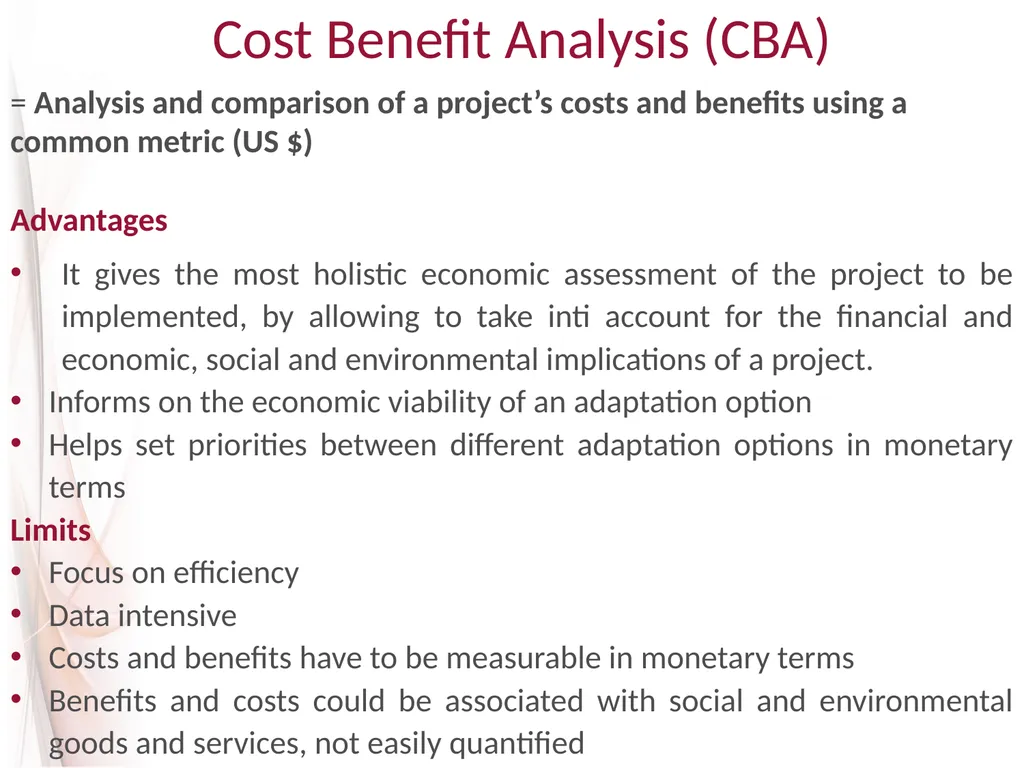
Cost Benefit Analysis (CBA) = Analysis and comparison of a project’s costs and benefits using a common metric (US $)
Advantages
It gives the most holistic economic assessment of the project to be implemented, by allowing to take inti account for the financial and economic, social and environmental implications of a project.
Informs on the economic viability of an adaptation option
Helps set priorities between different adaptation options in monetary terms
Limits
Focus on efficiency
Data intensive
Costs and benefits have to be measurable in monetary terms
Benefits and costs could be associated with social and environmental goods and services, not easily quantified<br>
It gives the most holistic economic assessment of the project to be implemented, by allowing to take inti account for the financial and economic, social and environmental implications of a project.
Informs on the economic viability of an adaptation option
Helps set priorities between different adaptation options in monetary terms
Limits
Focus on efficiency
Data intensive
Costs and benefits have to be measurable in monetary terms
Benefits and costs could be associated with social and environmental goods and services, not easily quantified<br>
10
Cost-Efficiency Analysis (CEA) = Analysis and comparison of different adaptation options’ costs aiming at a same objective.
Advantages
Better than the CBA approach when benefits cannot be measured in monetary terms
Provides information on how an objective can be attained in the most efficient way/ the least cost
Limits
Focus on efficiency
Necessity to set objectives
Costs have to be measured in monetary terms<br>
Advantages
Better than the CBA approach when benefits cannot be measured in monetary terms
Provides information on how an objective can be attained in the most efficient way/ the least cost
Limits
Focus on efficiency
Necessity to set objectives
Costs have to be measured in monetary terms<br>
11
Multi- Criteria Analysis (MCA) = Tool that enables the classification and ranking of different adaptation options
Advantages
The resulting prioritisation is not only based on economic calculations, but a qualitative evaluation of different criteria is also possible – enables contextualisation, weighting etc.
Enables to set priorities and help identify potential compromises and win-win situations!
CBA and CEA results can be integrated as quantitative prioritisation criteria alongside more quantitative criteria (e.g. attractiveness to funders)
Limits
More subjective than two other methods, e.g. what weighing should be given to individual criterion? How to decide what matters the most?
Need to find a common indicator (e.g. scoring system)<br>
Advantages
The resulting prioritisation is not only based on economic calculations, but a qualitative evaluation of different criteria is also possible – enables contextualisation, weighting etc.
Enables to set priorities and help identify potential compromises and win-win situations!
CBA and CEA results can be integrated as quantitative prioritisation criteria alongside more quantitative criteria (e.g. attractiveness to funders)
Limits
More subjective than two other methods, e.g. what weighing should be given to individual criterion? How to decide what matters the most?
Need to find a common indicator (e.g. scoring system)<br>
12
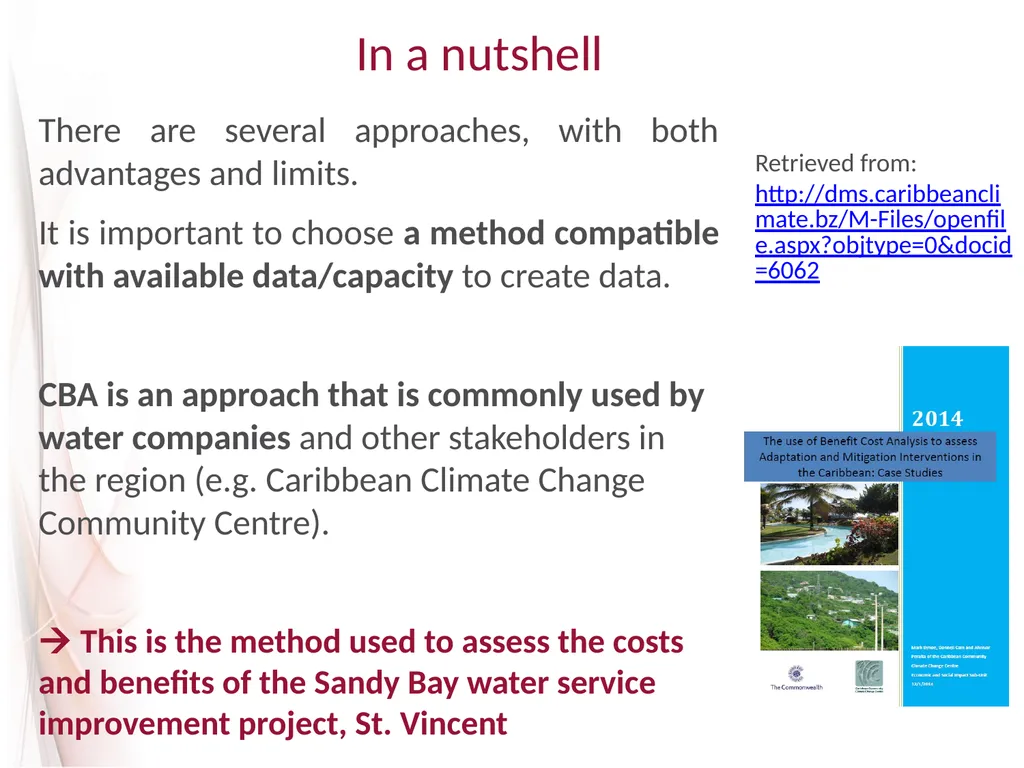
In a nutshell There are several approaches, with both advantages and limits.
It is important to choose a method compatible with available data/capacity to create data.
CBA is an approach that is commonly used by water companies and other stakeholders in the region (e.g. Caribbean Climate Change Community Centre).
This is the method used to assess the costs and benefits of the Sandy Bay water service improvement project, St. Vincent Retrieved from: http://dms.caribbeanclimate.bz/M-Files/openfile.aspx?objtype=0&docid=6062<br>
It is important to choose a method compatible with available data/capacity to create data.
CBA is an approach that is commonly used by water companies and other stakeholders in the region (e.g. Caribbean Climate Change Community Centre).
This is the method used to assess the costs and benefits of the Sandy Bay water service improvement project, St. Vincent Retrieved from: http://dms.caribbeanclimate.bz/M-Files/openfile.aspx?objtype=0&docid=6062<br>
13
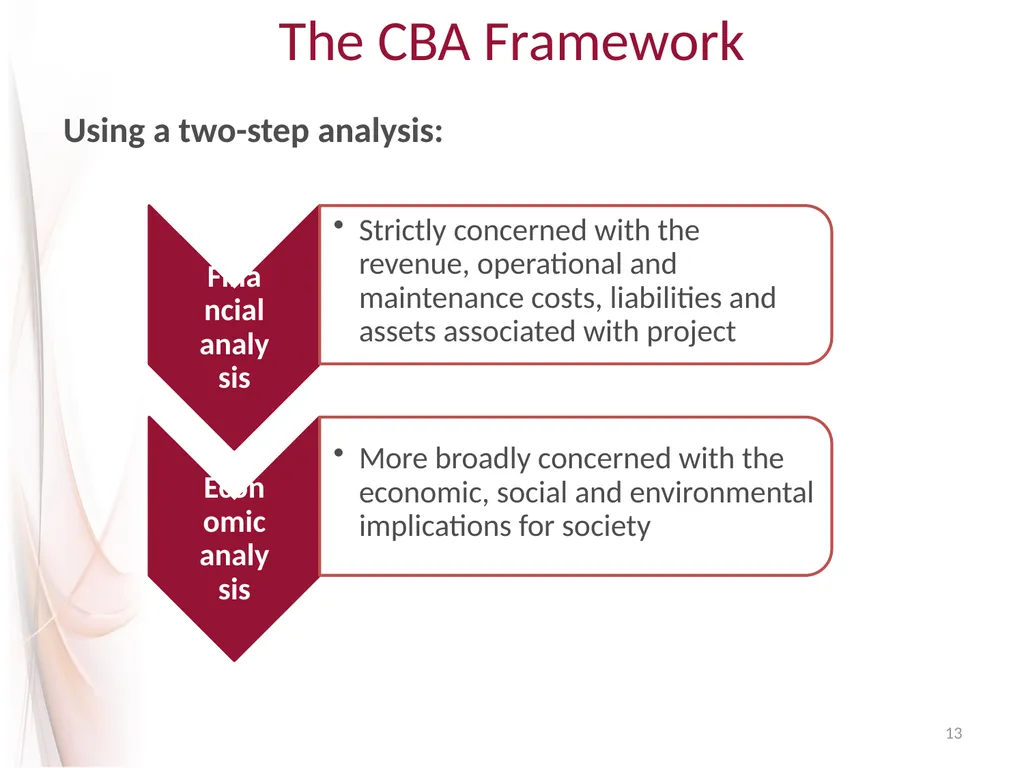
The CBA Framework Using a two-step analysis: 13<br>
14
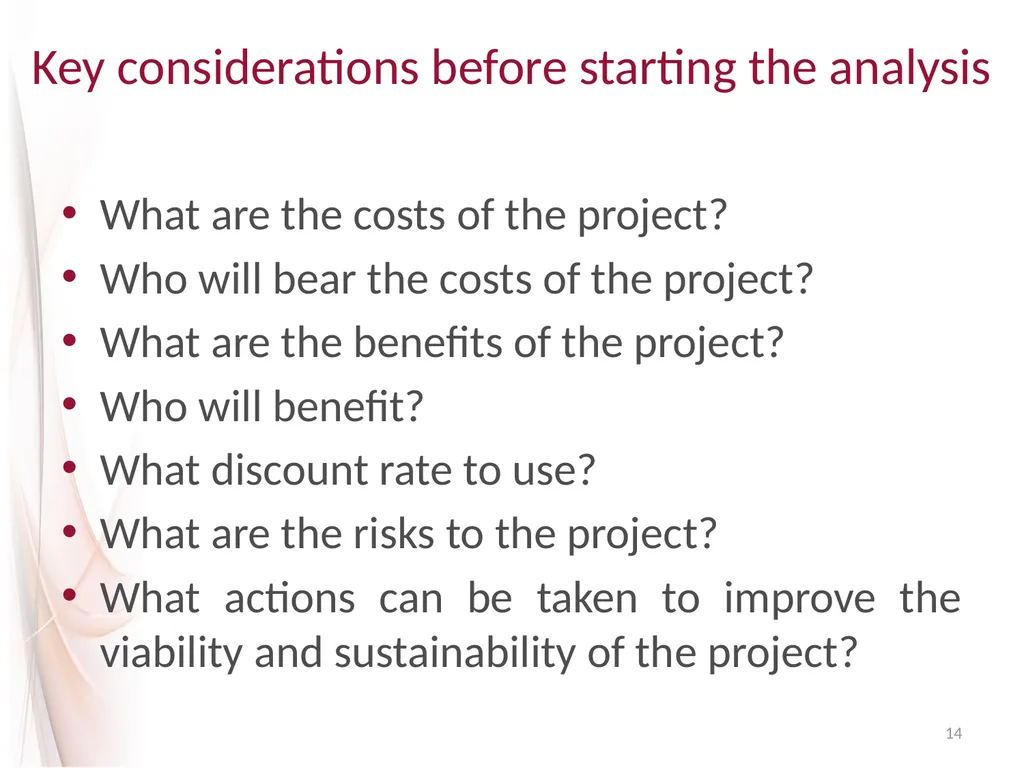
Key considerations before starting the analysis What are the costs of the project?
Who will bear the costs of the project?
What are the benefits of the project?
Who will benefit?
What discount rate to use?
What are the risks to the project?
What actions can be taken to improve the viability and sustainability of the project? 14<br>
Who will bear the costs of the project?
What are the benefits of the project?
Who will benefit?
What discount rate to use?
What are the risks to the project?
What actions can be taken to improve the viability and sustainability of the project? 14<br>
15
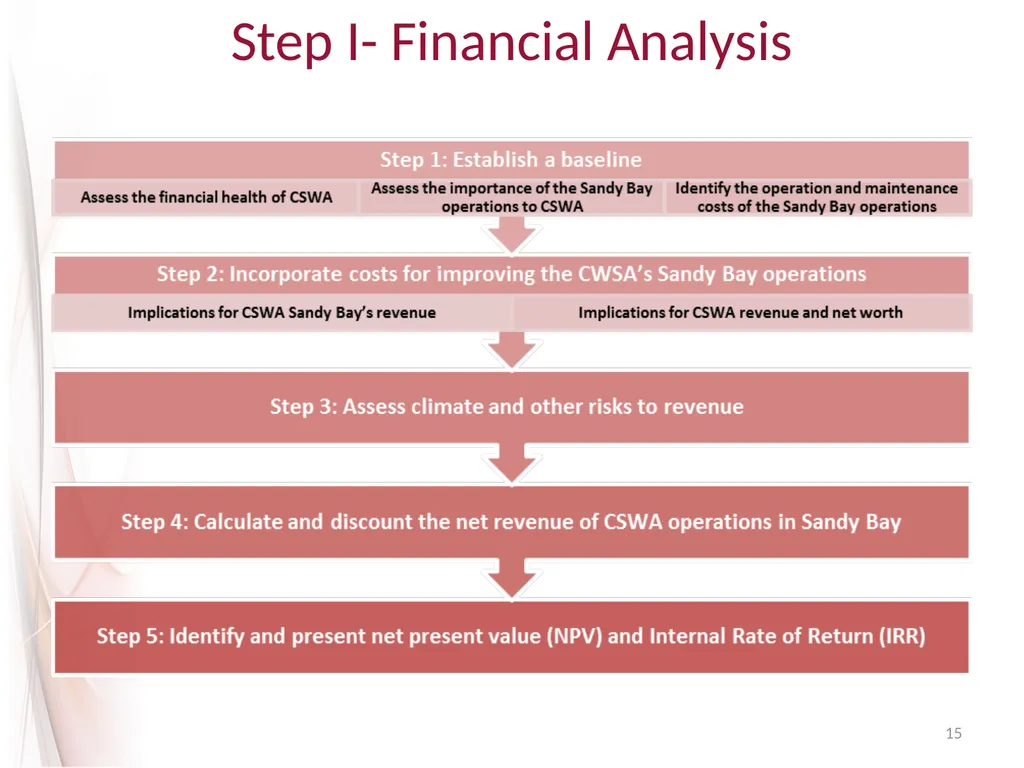
Step I- Financial Analysis 15<br>
16
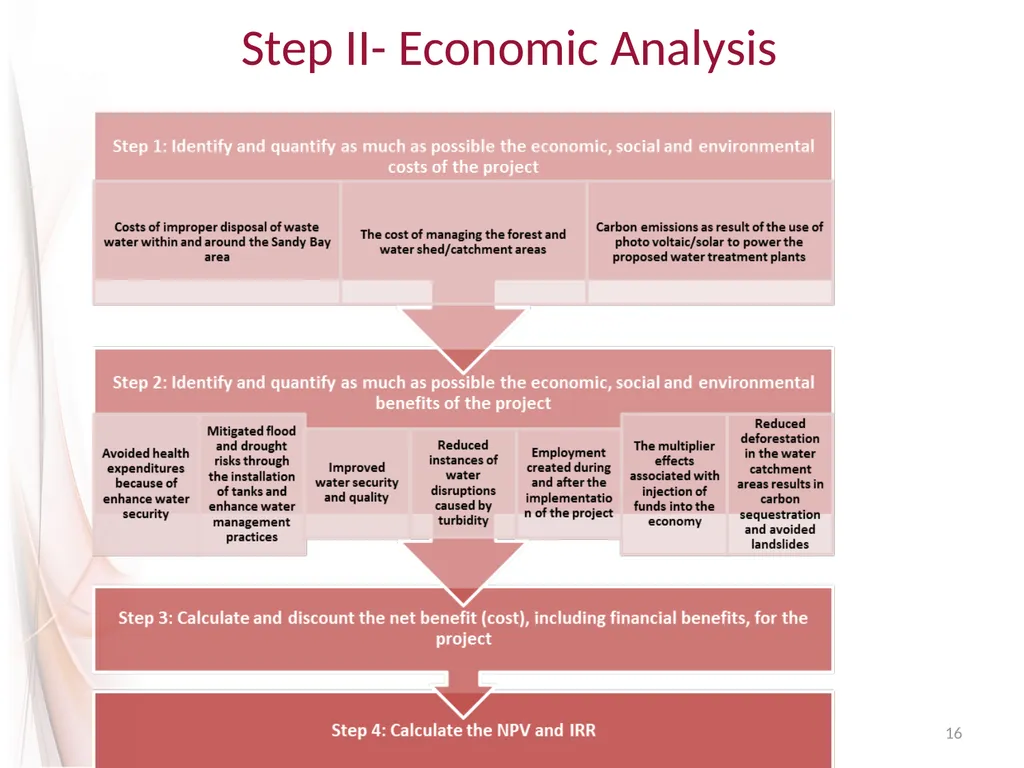
Step II- Economic Analysis 16<br>
17
How to interpret the results 17 STEP I- Financial analysis STEP II- Economic analysis Positive NPV Negative NPV Positive NPV Negative NPV Positive NPV Negative NPV The project should be implemented and is considered sustainable The project should not be implemented unless ways are found to compensate for the socio-economic costs to society The project is beneficial to the society, however, ways must be found to finance the sustainability of the project and or grant funding is required to implement the project The project should not be implemented This approach identifies not only the net benefits (costs) to society, but the potential financial shortfalls that could hamper the sustainability of the project; i.e. identifying from the onset whether additional resources will be required during the implementation stage and or after implementation and from where, how, when and whom such resources could be garnered.<br>
18
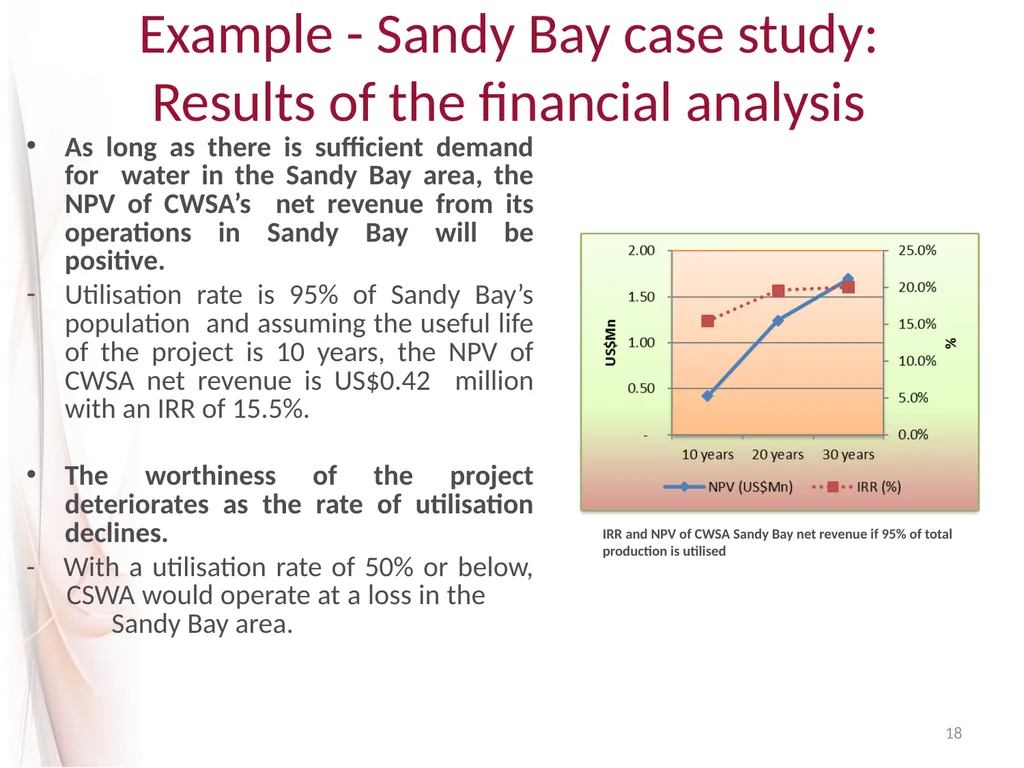
Example - Sandy Bay case study: Results of the financial analysis 18 As long as there is sufficient demand for water in the Sandy Bay area, the NPV of CWSA’s net revenue from its operations in Sandy Bay will be positive.
Utilisation rate is 95% of Sandy Bay’s population and assuming the useful life of the project is 10 years, the NPV of CWSA net revenue is US$0.42 million with an IRR of 15.5%.
The worthiness of the project deteriorates as the rate of utilisation declines.
- With a utilisation rate of 50% or below, CSWA would operate at a loss in the Sandy Bay area. IRR and NPV of CWSA Sandy Bay net revenue if 95% of total production is utilised<br>
Utilisation rate is 95% of Sandy Bay’s population and assuming the useful life of the project is 10 years, the NPV of CWSA net revenue is US$0.42 million with an IRR of 15.5%.
The worthiness of the project deteriorates as the rate of utilisation declines.
- With a utilisation rate of 50% or below, CSWA would operate at a loss in the Sandy Bay area. IRR and NPV of CWSA Sandy Bay net revenue if 95% of total production is utilised<br>
19
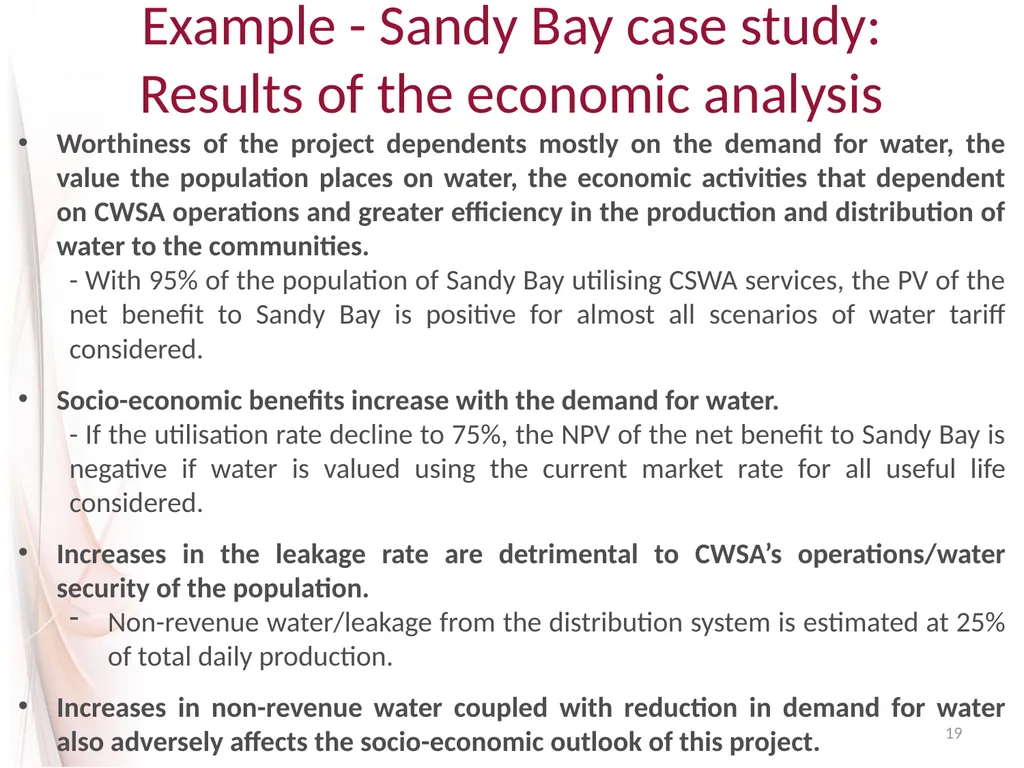
Example - Sandy Bay case study: Results of the economic analysis 19 Worthiness of the project dependents mostly on the demand for water, the value the population places on water, the economic activities that dependent on CWSA operations and greater efficiency in the production and distribution of water to the communities.
- With 95% of the population of Sandy Bay utilising CSWA services, the PV of the net benefit to Sandy Bay is positive for almost all scenarios of water tariff considered.
Socio-economic benefits increase with the demand for water.
- If the utilisation rate decline to 75%, the NPV of the net benefit to Sandy Bay is negative if water is valued using the current market rate for all useful life considered.
Increases in the leakage rate are detrimental to CWSA’s operations/water security of the population.
Non-revenue water/leakage from the distribution system is estimated at 25% of total daily production.
Increases in non-revenue water coupled with reduction in demand for water also adversely affects the socio-economic outlook of this project.<br>
- With 95% of the population of Sandy Bay utilising CSWA services, the PV of the net benefit to Sandy Bay is positive for almost all scenarios of water tariff considered.
Socio-economic benefits increase with the demand for water.
- If the utilisation rate decline to 75%, the NPV of the net benefit to Sandy Bay is negative if water is valued using the current market rate for all useful life considered.
Increases in the leakage rate are detrimental to CWSA’s operations/water security of the population.
Non-revenue water/leakage from the distribution system is estimated at 25% of total daily production.
Increases in non-revenue water coupled with reduction in demand for water also adversely affects the socio-economic outlook of this project.<br>
20
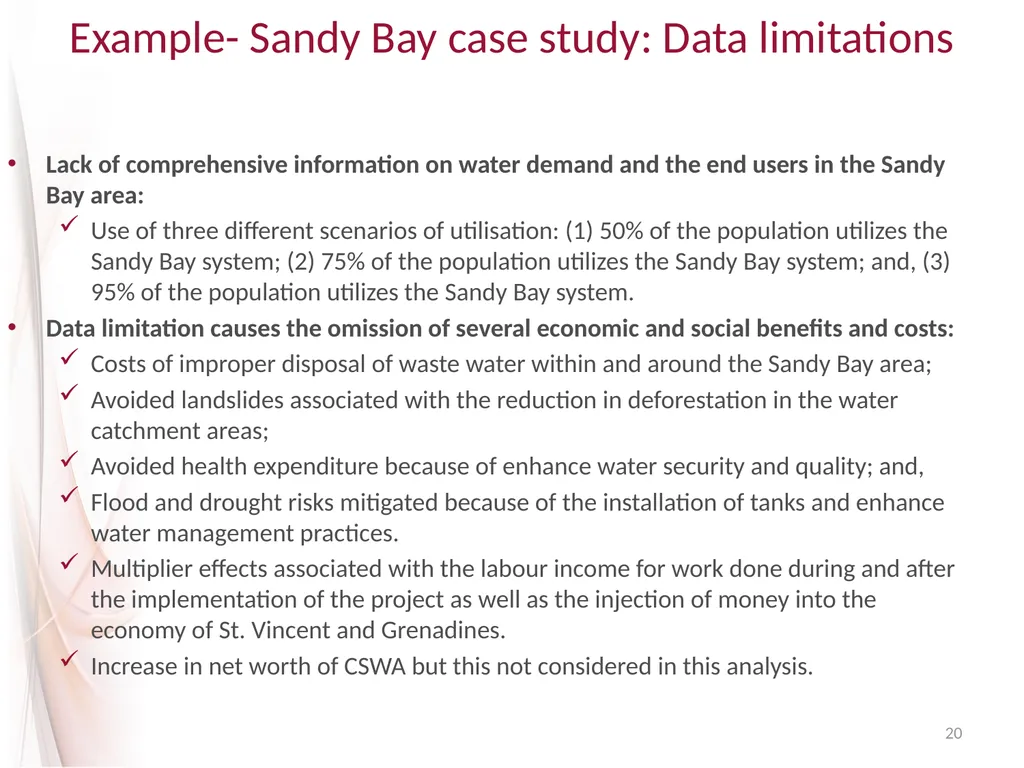
Example- Sandy Bay case study: Data limitations Lack of comprehensive information on water demand and the end users in the Sandy Bay area:
Use of three different scenarios of utilisation: (1) 50% of the population utilizes the Sandy Bay system; (2) 75% of the population utilizes the Sandy Bay system; and, (3) 95% of the population utilizes the Sandy Bay system.
Data limitation causes the omission of several economic and social benefits and costs:
Costs of improper disposal of waste water within and around the Sandy Bay area;
Avoided landslides associated with the reduction in deforestation in the water catchment areas;
Avoided health expenditure because of enhance water security and quality; and,
Flood and drought risks mitigated because of the installation of tanks and enhance water management practices.
Multiplier effects associated with the labour income for work done during and after the implementation of the project as well as the injection of money into the economy of St. Vincent and Grenadines.
Increase in net worth of CSWA but this not considered in this analysis. 20<br>
Use of three different scenarios of utilisation: (1) 50% of the population utilizes the Sandy Bay system; (2) 75% of the population utilizes the Sandy Bay system; and, (3) 95% of the population utilizes the Sandy Bay system.
Data limitation causes the omission of several economic and social benefits and costs:
Costs of improper disposal of waste water within and around the Sandy Bay area;
Avoided landslides associated with the reduction in deforestation in the water catchment areas;
Avoided health expenditure because of enhance water security and quality; and,
Flood and drought risks mitigated because of the installation of tanks and enhance water management practices.
Multiplier effects associated with the labour income for work done during and after the implementation of the project as well as the injection of money into the economy of St. Vincent and Grenadines.
Increase in net worth of CSWA but this not considered in this analysis. 20<br>
21
21 Exercise<br>
22
What you can expect to learn from this exercise To understand how MCA can be used to prioritise and select different adaptation options
To identify potential prioritisation criteria using MCA
To assess potential adaptation options for you project using MCA<br>
To identify potential prioritisation criteria using MCA
To assess potential adaptation options for you project using MCA<br>
23
Criteria for selecting projects
Exercise
Reflections Agenda<br>
Exercise
Reflections Agenda<br>
24
Multi-Criteria Analysis: potential criteria for selecting projects (I) Countries Funders Site-specific context (e.g. urgency, social acceptance)
High-level political support and / or local priorities
Objectives set for mitigation or adaptation planning (e.g. poverty reduction or emission reductions)
Potential for transformational change
Development benefits
Cost-effectiveness
Environmental impacts
Ease of implementation
Stakeholder support
Attractiveness to funders Robust MRV or M&E systems
Potential for transformational change
Embedded in national policy
Share of national co-financing
Private sector leverage
Institutional capacities of implementing entity
Replicability
Innovation Source: Adopted from: Ecofys 2013. MRV Summer School training materials<br>
High-level political support and / or local priorities
Objectives set for mitigation or adaptation planning (e.g. poverty reduction or emission reductions)
Potential for transformational change
Development benefits
Cost-effectiveness
Environmental impacts
Ease of implementation
Stakeholder support
Attractiveness to funders Robust MRV or M&E systems
Potential for transformational change
Embedded in national policy
Share of national co-financing
Private sector leverage
Institutional capacities of implementing entity
Replicability
Innovation Source: Adopted from: Ecofys 2013. MRV Summer School training materials<br>
25
Multi-Criteria Analysis: potential criteria for selecting projects (II) Source: Adopted from: Global Climate Change Alliance: Intra-ACP Programme. Module 5. Costing, assessing and selecting adaptation and mitigation options and measures Scores:
For qualitative criteria: range, e.g. from 1 (poorest performance) to 5 (highest performance)
For quantitative criteria: monetary or physical units<br>
For qualitative criteria: range, e.g. from 1 (poorest performance) to 5 (highest performance)
For quantitative criteria: monetary or physical units<br>
26
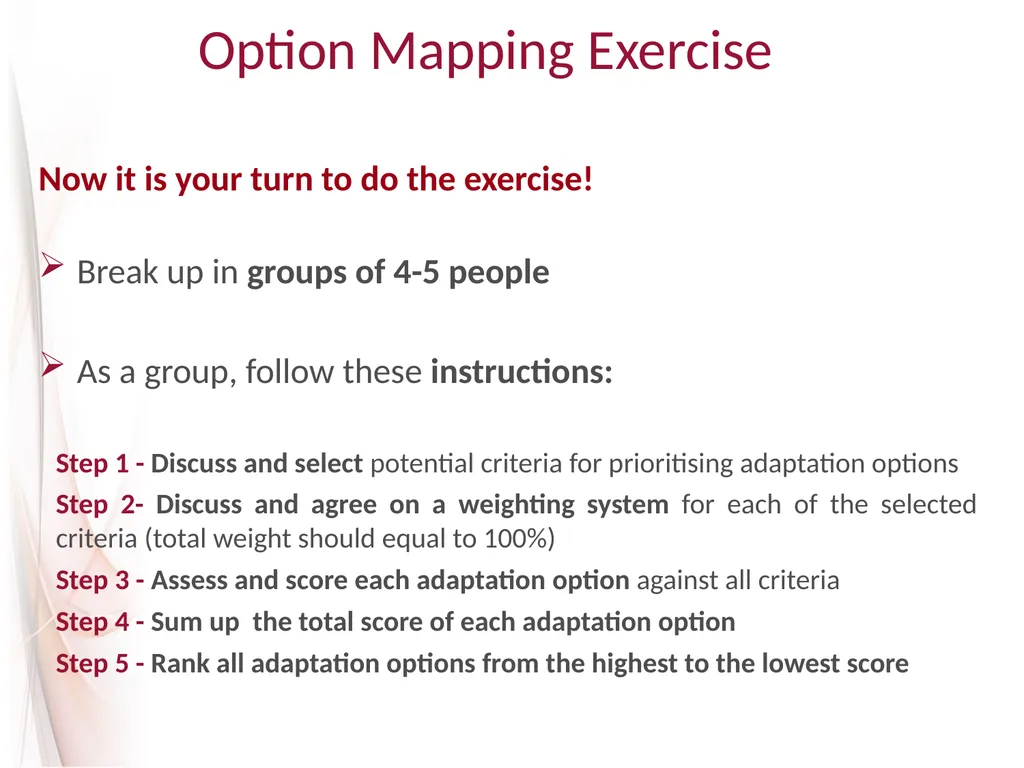
Option Mapping Exercise Now it is your turn to do the exercise!
Break up in groups of 4-5 people
As a group, follow these instructions:
Step 1 - Discuss and select potential criteria for prioritising adaptation options
Step 2- Discuss and agree on a weighting system for each of the selected criteria (total weight should equal to 100%)
Step 3 - Assess and score each adaptation option against all criteria
Step 4 - Sum up the total score of each adaptation option
Step 5 - Rank all adaptation options from the highest to the lowest score<br>
Break up in groups of 4-5 people
As a group, follow these instructions:
Step 1 - Discuss and select potential criteria for prioritising adaptation options
Step 2- Discuss and agree on a weighting system for each of the selected criteria (total weight should equal to 100%)
Step 3 - Assess and score each adaptation option against all criteria
Step 4 - Sum up the total score of each adaptation option
Step 5 - Rank all adaptation options from the highest to the lowest score<br>
27
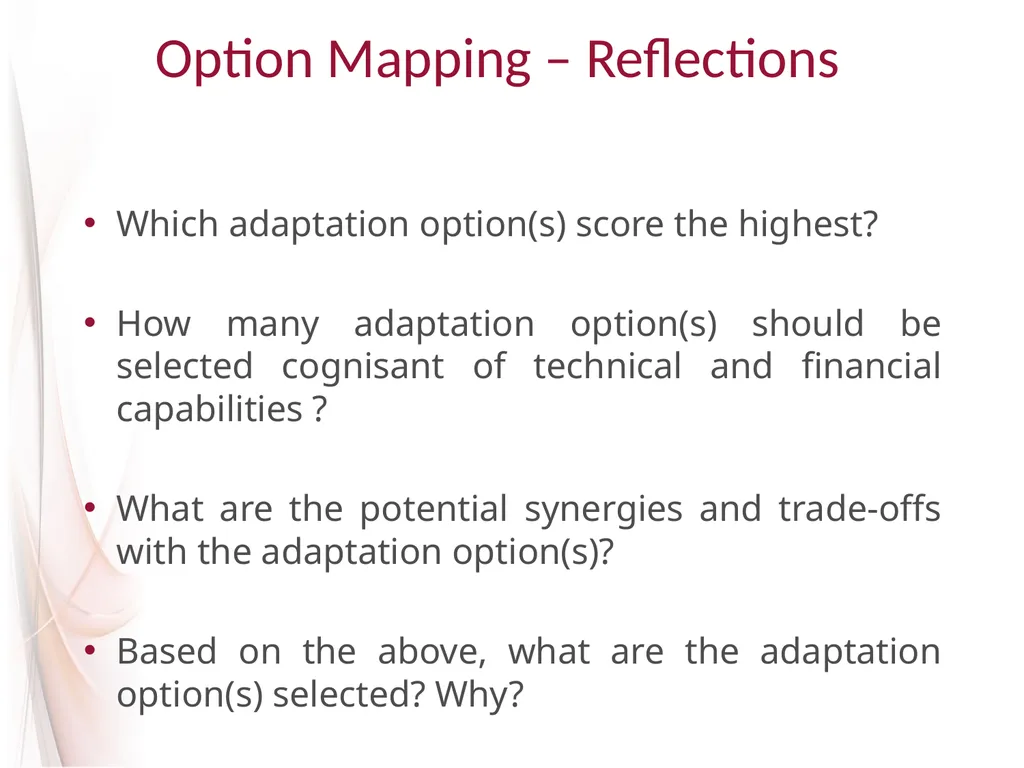
Option Mapping – Reflections Which adaptation option(s) score the highest?
How many adaptation option(s) should be selected cognisant of technical and financial capabilities ?
What are the potential synergies and trade-offs with the adaptation option(s)?
Based on the above, what are the adaptation option(s) selected? Why?<br>
How many adaptation option(s) should be selected cognisant of technical and financial capabilities ?
What are the potential synergies and trade-offs with the adaptation option(s)?
Based on the above, what are the adaptation option(s) selected? Why?<br>
28
Thank you ! 28<br>