
CLOSING THE GAP Module 3a 2018 Recap CTG modules
AM
Published · 58 slides · 0 views
1 / 1



Description
CLOSING THE GAP Module 3a 2018 Recap CTG modules 1-2 Sick notes and benefits Calgary Cambridge framework Role play - explanation Waiting for God caring for the elderly Case scenarios based on EOL care Role play active listening and
Related Topics
Share
Embed code
Download this presentation From Below
"CLOSING THE GAP Module 3a 2018 Recap CTG modules" is the property of its rightful owner. Permission is granted to download and print the materials on this website for personal, non-commercial use only, and to display it on your personal computer provided you do not modify the materials and that you retain all copyright notices contained in the materials. By downloading content from our website, you accept the terms of this agreement.
Presentation Transcript
01
CLOSING THE GAP Module 3a 2018<br>
02
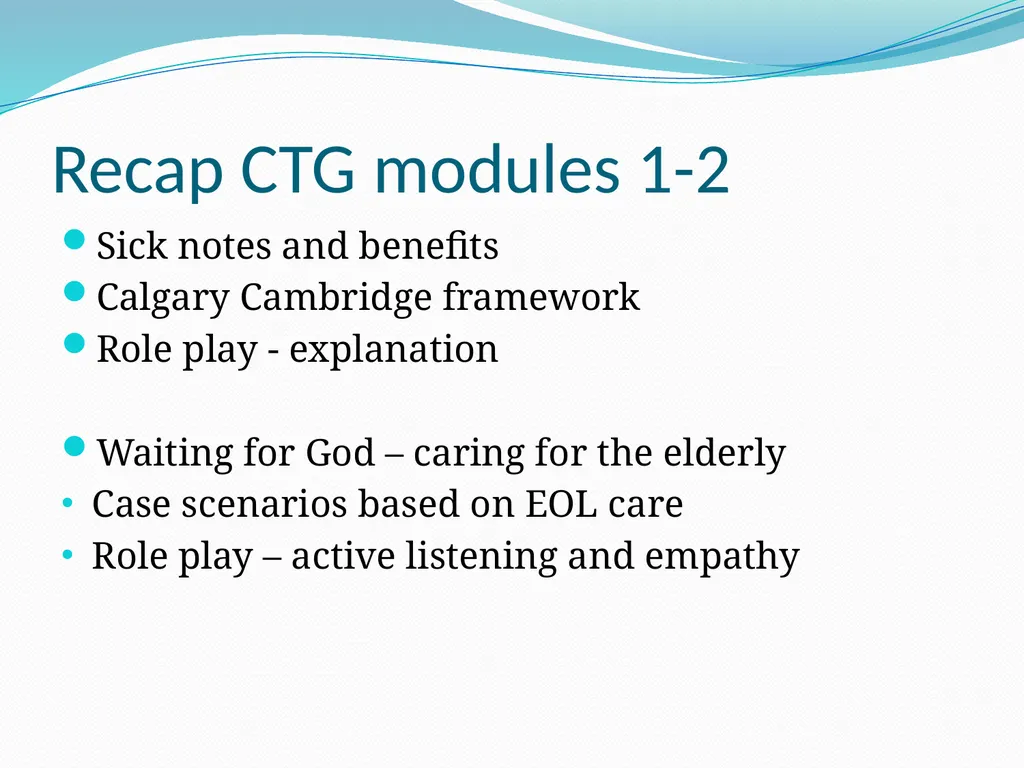
Recap CTG modules 1-2 Sick notes and benefits
Calgary Cambridge framework
Role play - explanation
Waiting for God – caring for the elderly
Case scenarios based on EOL care
Role play – active listening and empathy<br>
Calgary Cambridge framework
Role play - explanation
Waiting for God – caring for the elderly
Case scenarios based on EOL care
Role play – active listening and empathy<br>
03
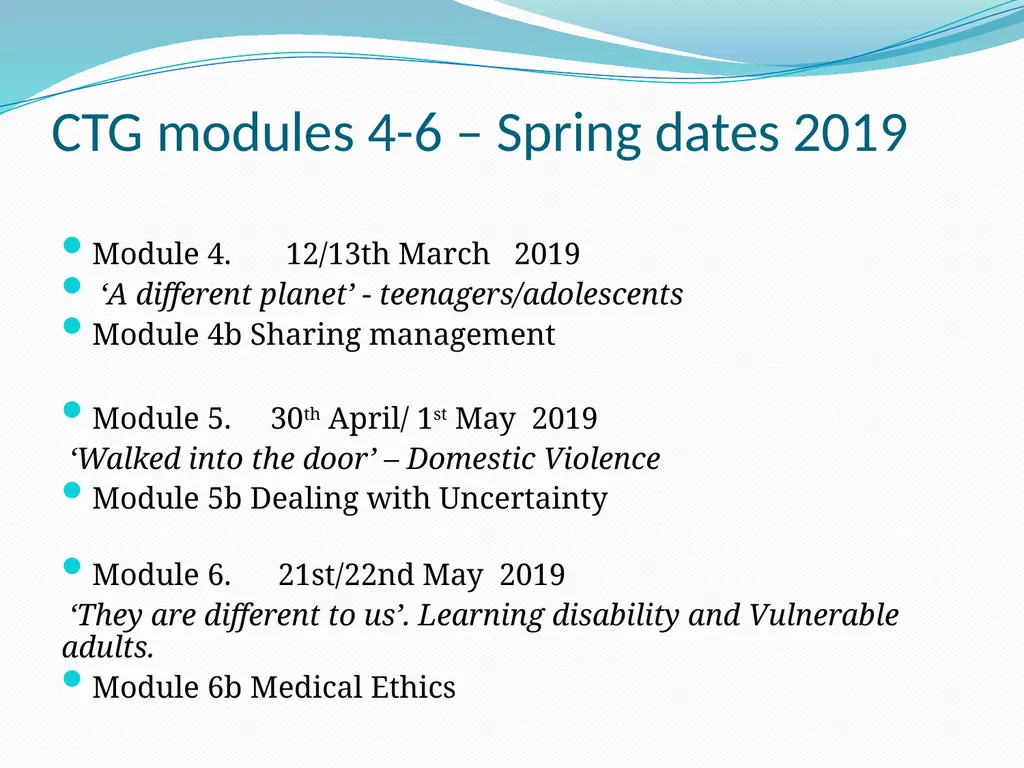
CTG modules 4-6 – Spring dates 2019 Module 4. 12/13th March 2019
‘A different planet’ - teenagers/adolescents
Module 4b Sharing management
Module 5. 30th April/ 1st May 2019
‘Walked into the door’ – Domestic Violence
Module 5b Dealing with Uncertainty
Module 6. 21st/22nd May 2019
‘They are different to us’. Learning disability and Vulnerable adults.
Module 6b Medical Ethics<br>
‘A different planet’ - teenagers/adolescents
Module 4b Sharing management
Module 5. 30th April/ 1st May 2019
‘Walked into the door’ – Domestic Violence
Module 5b Dealing with Uncertainty
Module 6. 21st/22nd May 2019
‘They are different to us’. Learning disability and Vulnerable adults.
Module 6b Medical Ethics<br>
04
Name check and housekeeping.
Sexual health and sexuality
Presentation and case discussion
Coffee
Case discussion/ role play
Module 3b
Case scenarios based on 3a
Role play – on sexual health/ data gathering. Module 3a – 27th November 2018<br>
Sexual health and sexuality
Presentation and case discussion
Coffee
Case discussion/ role play
Module 3b
Case scenarios based on 3a
Role play – on sexual health/ data gathering. Module 3a – 27th November 2018<br>
05
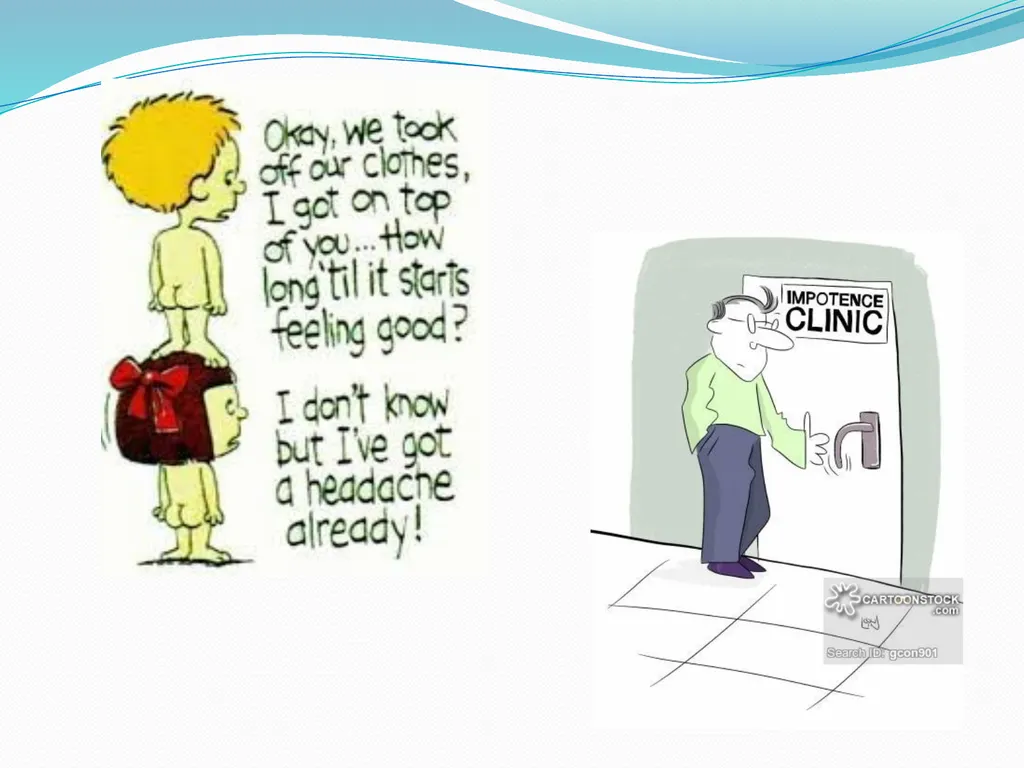
‘Between the Sheets’ - sexual history taking Closing the Gap 2018
Dr David Anderson
With thanks to Dr Andy Downs<br>
Dr David Anderson
With thanks to Dr Andy Downs<br>
06
Quick clip Apologies if some are “near the knuckle”.
https://www.youtube.com/watch?v=XppEzopIahs<br>
https://www.youtube.com/watch?v=XppEzopIahs<br>
07
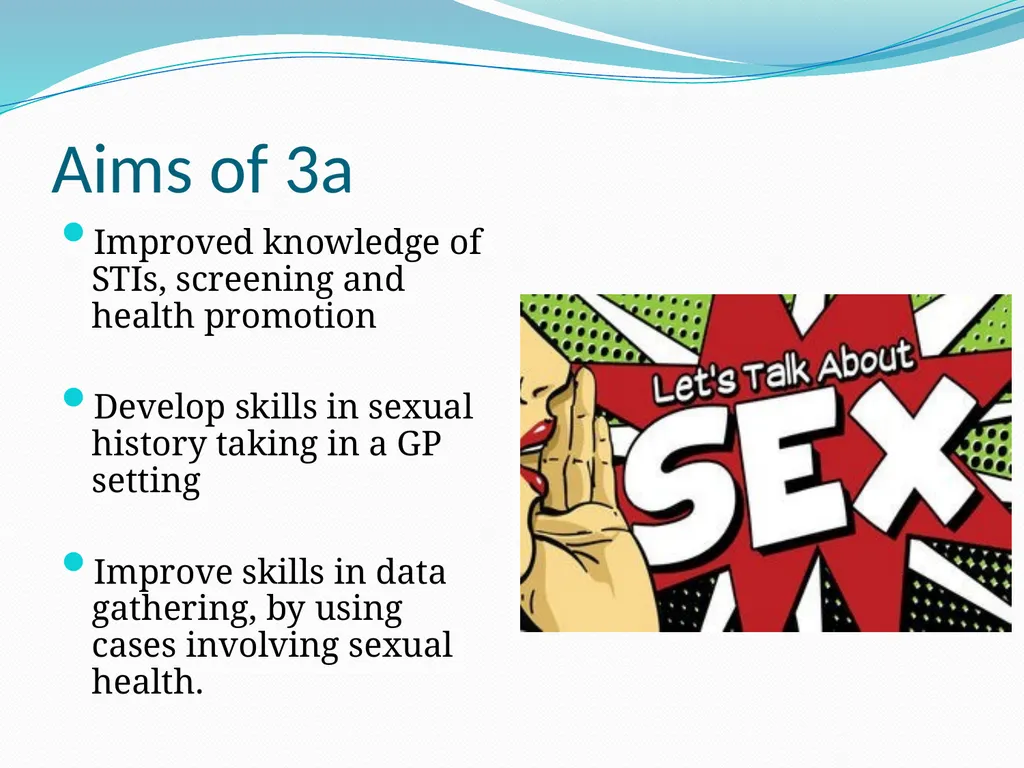
Aims of 3a Improved knowledge of STIs, screening and health promotion
Develop skills in sexual history taking in a GP setting
Improve skills in data gathering, by using cases involving sexual health.<br>
Develop skills in sexual history taking in a GP setting
Improve skills in data gathering, by using cases involving sexual health.<br>
08
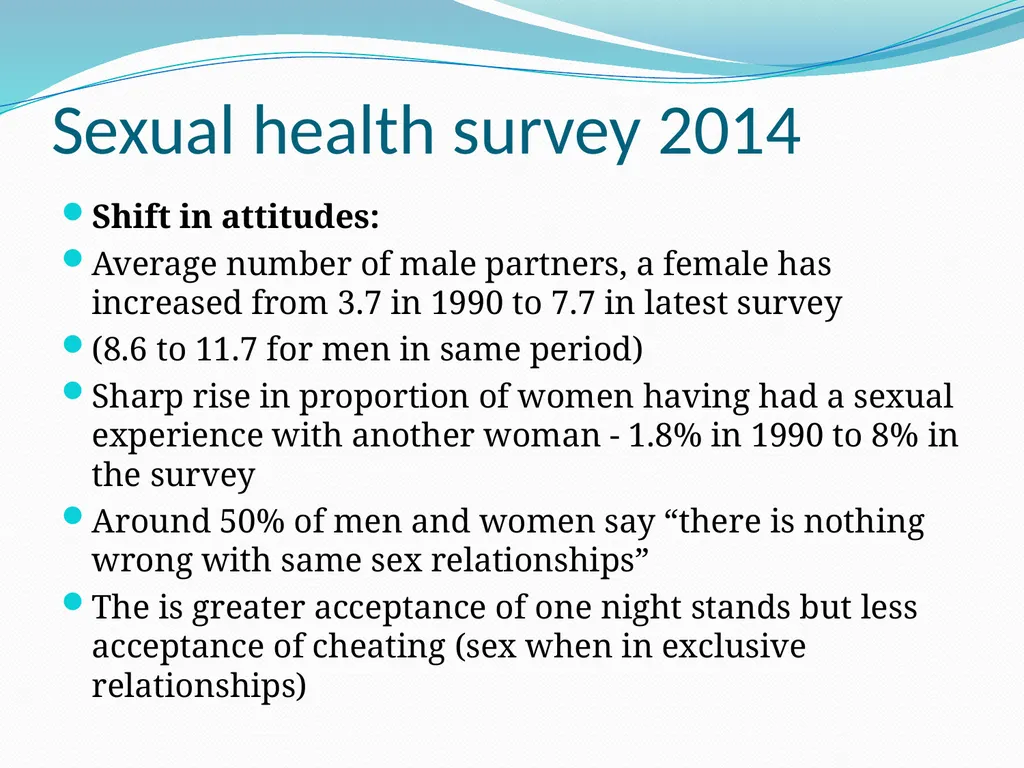
Sexual health survey 2014 Shift in attitudes:
Average number of male partners, a female has increased from 3.7 in 1990 to 7.7 in latest survey
(8.6 to 11.7 for men in same period)
Sharp rise in proportion of women having had a sexual experience with another woman - 1.8% in 1990 to 8% in the survey
Around 50% of men and women say “there is nothing wrong with same sex relationships”
The is greater acceptance of one night stands but less acceptance of cheating (sex when in exclusive relationships)<br>
Average number of male partners, a female has increased from 3.7 in 1990 to 7.7 in latest survey
(8.6 to 11.7 for men in same period)
Sharp rise in proportion of women having had a sexual experience with another woman - 1.8% in 1990 to 8% in the survey
Around 50% of men and women say “there is nothing wrong with same sex relationships”
The is greater acceptance of one night stands but less acceptance of cheating (sex when in exclusive relationships)<br>
09
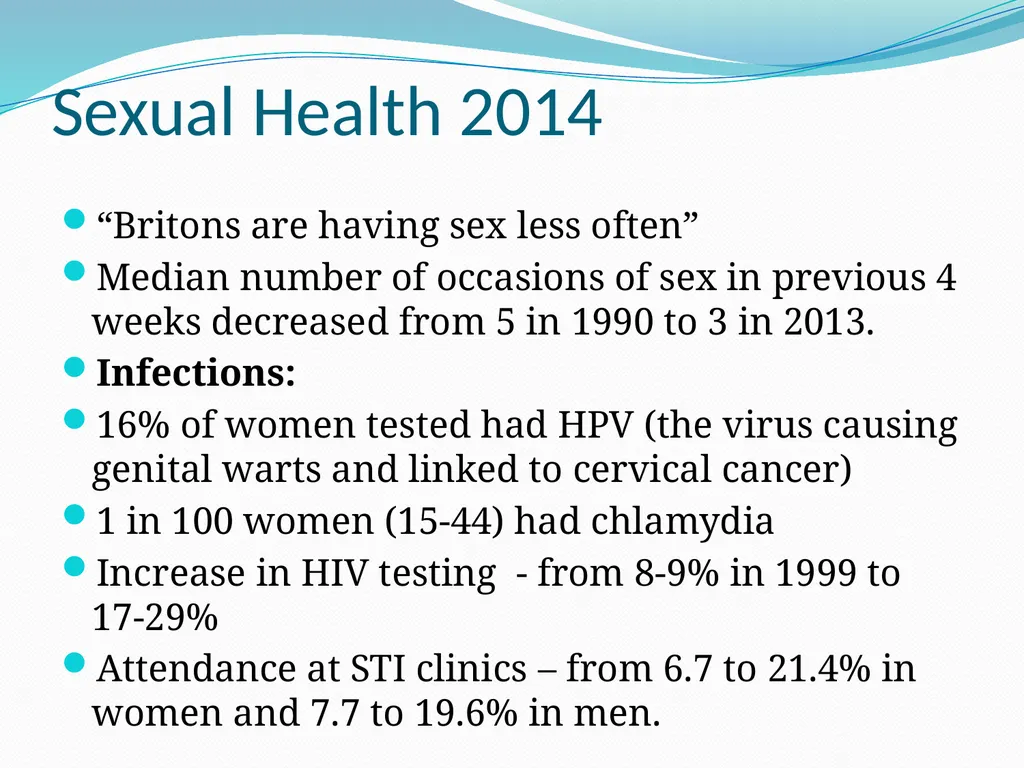
Sexual Health 2014 “Britons are having sex less often”
Median number of occasions of sex in previous 4 weeks decreased from 5 in 1990 to 3 in 2013.
Infections:
16% of women tested had HPV (the virus causing genital warts and linked to cervical cancer)
1 in 100 women (15-44) had chlamydia
Increase in HIV testing - from 8-9% in 1999 to 17-29%
Attendance at STI clinics – from 6.7 to 21.4% in women and 7.7 to 19.6% in men.<br>
Median number of occasions of sex in previous 4 weeks decreased from 5 in 1990 to 3 in 2013.
Infections:
16% of women tested had HPV (the virus causing genital warts and linked to cervical cancer)
1 in 100 women (15-44) had chlamydia
Increase in HIV testing - from 8-9% in 1999 to 17-29%
Attendance at STI clinics – from 6.7 to 21.4% in women and 7.7 to 19.6% in men.<br>
10
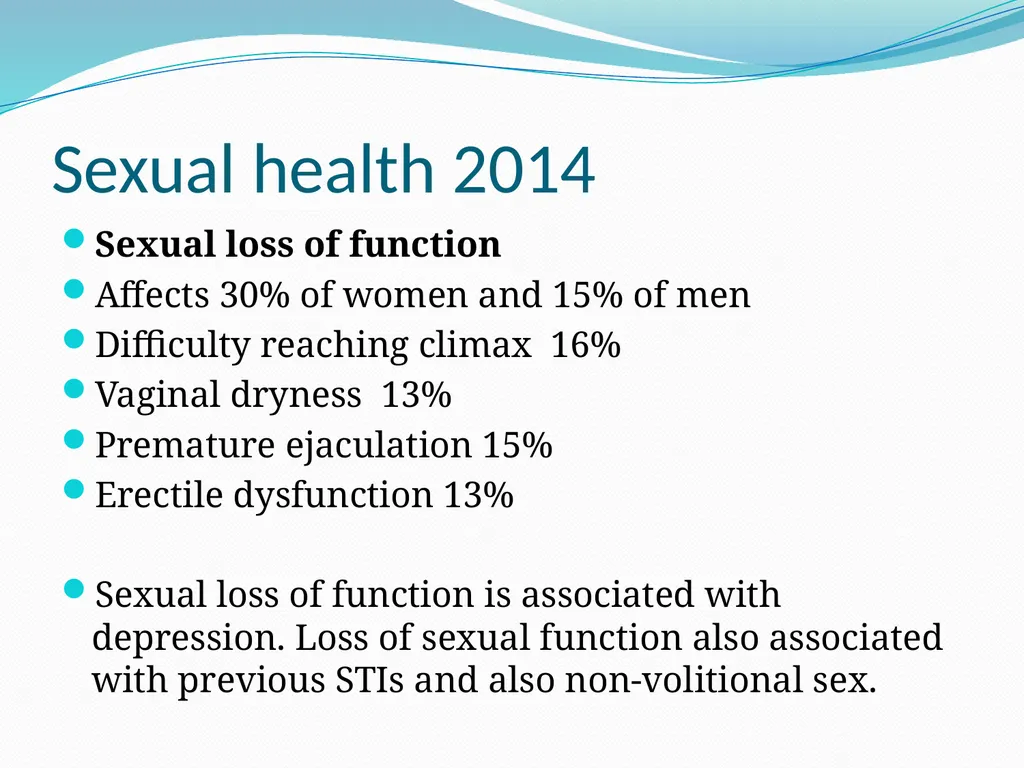
Sexual health 2014 Sexual loss of function
Affects 30% of women and 15% of men
Difficulty reaching climax 16%
Vaginal dryness 13%
Premature ejaculation 15%
Erectile dysfunction 13%
Sexual loss of function is associated with depression. Loss of sexual function also associated with previous STIs and also non-volitional sex.<br>
Affects 30% of women and 15% of men
Difficulty reaching climax 16%
Vaginal dryness 13%
Premature ejaculation 15%
Erectile dysfunction 13%
Sexual loss of function is associated with depression. Loss of sexual function also associated with previous STIs and also non-volitional sex.<br>
11
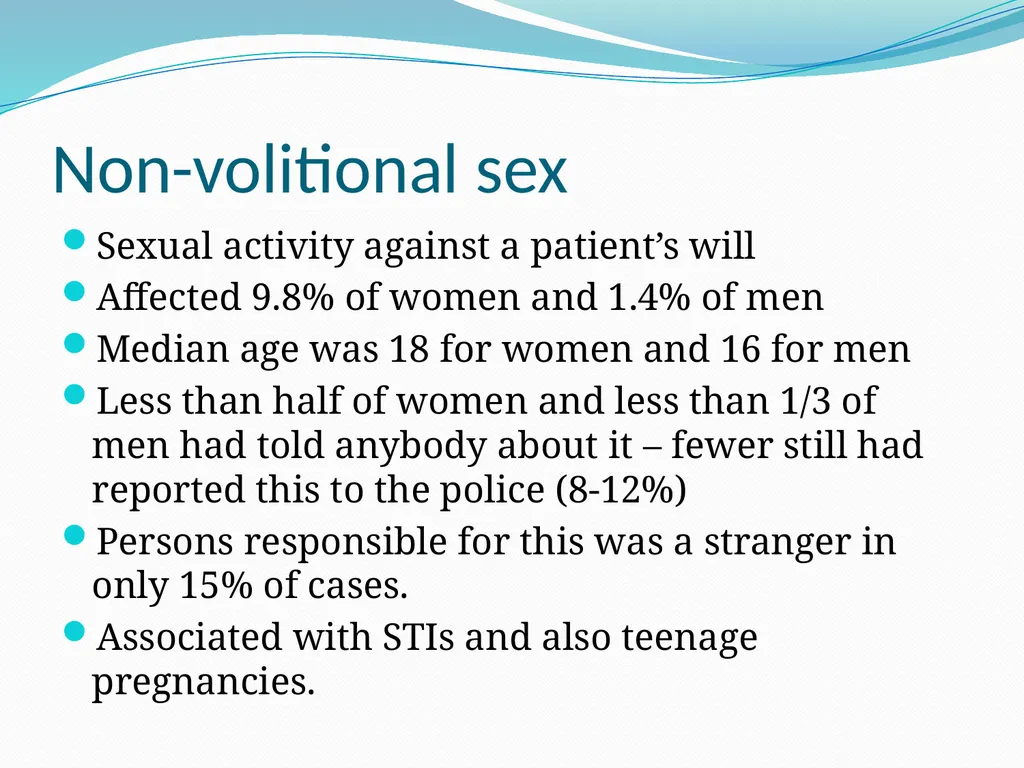
Non-volitional sex Sexual activity against a patient’s will
Affected 9.8% of women and 1.4% of men
Median age was 18 for women and 16 for men
Less than half of women and less than 1/3 of men had told anybody about it – fewer still had reported this to the police (8-12%)
Persons responsible for this was a stranger in only 15% of cases.
Associated with STIs and also teenage pregnancies.<br>
Affected 9.8% of women and 1.4% of men
Median age was 18 for women and 16 for men
Less than half of women and less than 1/3 of men had told anybody about it – fewer still had reported this to the police (8-12%)
Persons responsible for this was a stranger in only 15% of cases.
Associated with STIs and also teenage pregnancies.<br>
12
Primary Factors in Taking a Sexual History Ensure privacy and confidentiality
Establish rapport
Accurately define the problem(s)
Ensure successful patient management
Diagnosis and treat symptomatic disease
Detect asymptomatic disease
Prevent serious sequelae, (i.e. infertility in women)
Promote behavior changes to prevent future infections<br>
Establish rapport
Accurately define the problem(s)
Ensure successful patient management
Diagnosis and treat symptomatic disease
Detect asymptomatic disease
Prevent serious sequelae, (i.e. infertility in women)
Promote behavior changes to prevent future infections<br>
13
Introducing the Sexual History Acknowledge personal nature of the subject matter
Emphasize confidentiality
Stress health issues related to sexual behaviors
Be able to explain how the information will help you care for the patient
“I’m going to ask some questions about your sexual history.
I know this is very personal information, but it involves important health issues and everything we discuss is confidential”<br>
Emphasize confidentiality
Stress health issues related to sexual behaviors
Be able to explain how the information will help you care for the patient
“I’m going to ask some questions about your sexual history.
I know this is very personal information, but it involves important health issues and everything we discuss is confidential”<br>
14
Communication Skills to Facilitate the Sexual History Use open-ended questions rather than leading or “yes/no” questions
Who, what, when, where?
“Tell me about…”
Cone Style of interviewing
Encourage patients to talk, when needed
Permission-giving: “Say it in your own words”
Give range of behaviour (!) and ask for patient’s experience
Active listening cues to urge patient on
Eye contact, nodding, “Yes, go ahead”<br>
Who, what, when, where?
“Tell me about…”
Cone Style of interviewing
Encourage patients to talk, when needed
Permission-giving: “Say it in your own words”
Give range of behaviour (!) and ask for patient’s experience
Active listening cues to urge patient on
Eye contact, nodding, “Yes, go ahead”<br>
15
General Considerations for Taking a Sexual History 1 Make no assumptions
Ask all patient about gender and number of partners
Ask about specific sexual practices
Vaginal, anal and oral sex
Be clear
Avoid medical jargon
Restate and expand
Clarify stories when necessary<br>
Ask all patient about gender and number of partners
Ask about specific sexual practices
Vaginal, anal and oral sex
Be clear
Avoid medical jargon
Restate and expand
Clarify stories when necessary<br>
16
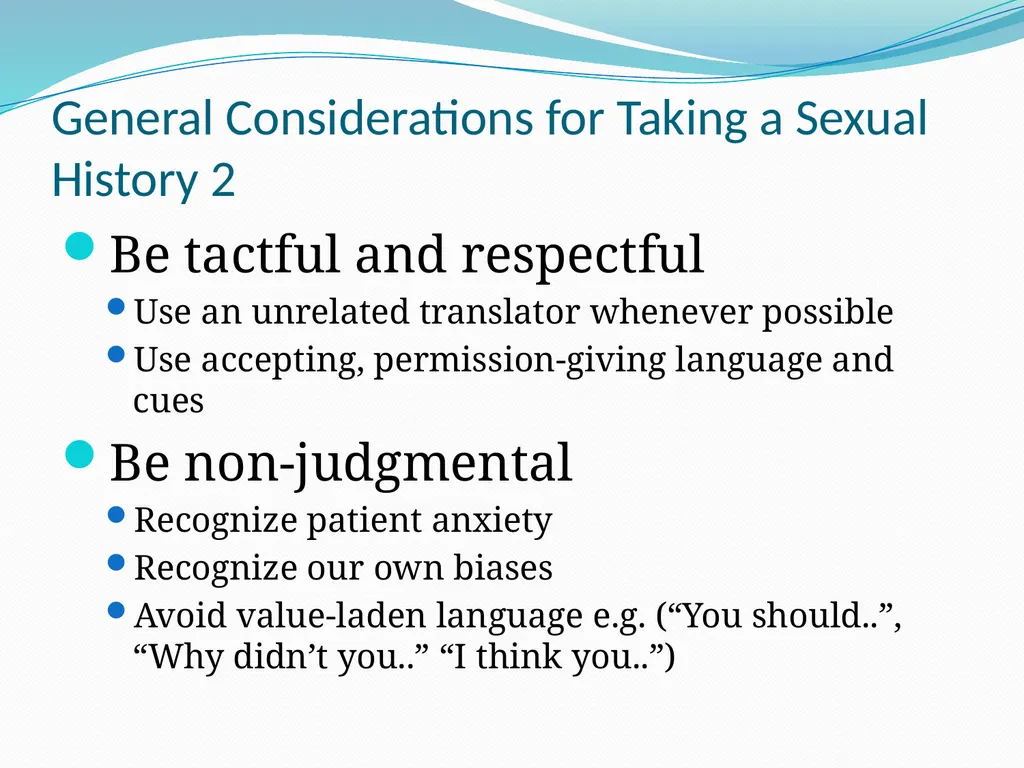
General Considerations for Taking a Sexual History 2 Be tactful and respectful
Use an unrelated translator whenever possible
Use accepting, permission-giving language and cues
Be non-judgmental
Recognize patient anxiety
Recognize our own biases
Avoid value-laden language e.g. (“You should..”, “Why didn’t you..” “I think you..”)<br>
Use an unrelated translator whenever possible
Use accepting, permission-giving language and cues
Be non-judgmental
Recognize patient anxiety
Recognize our own biases
Avoid value-laden language e.g. (“You should..”, “Why didn’t you..” “I think you..”)<br>
17
Video clip Case scenario<br>
18
Thoughts ? In small groups (2-3), discuss your thoughts about this video.<br>
19
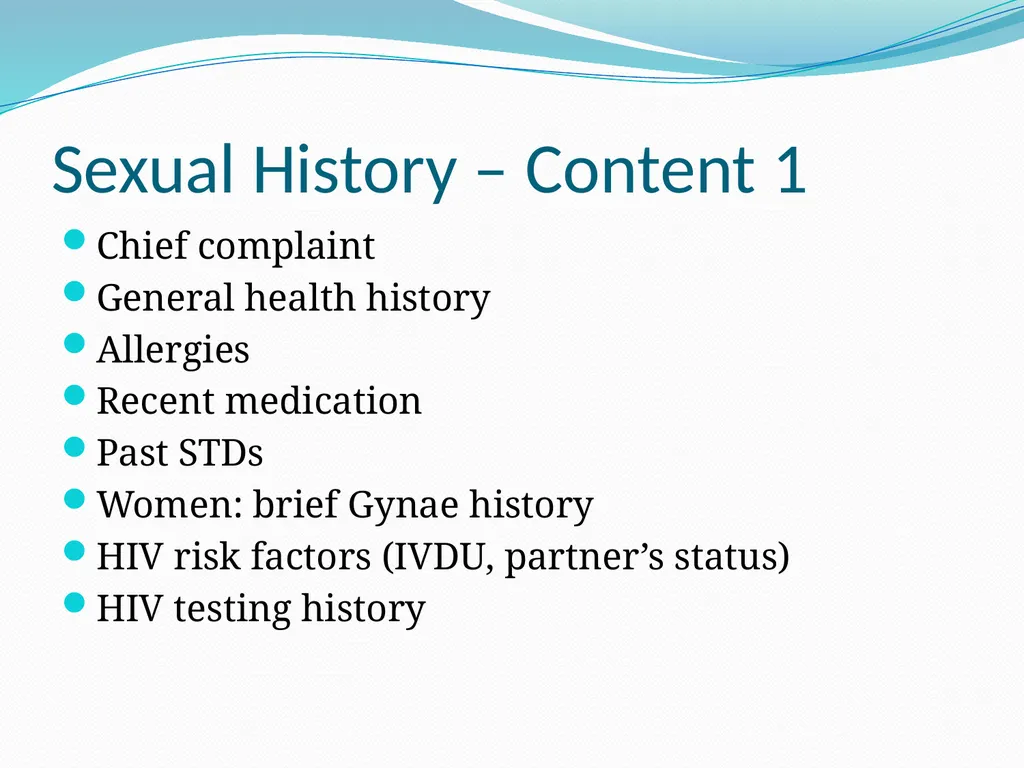
Sexual History – Content 1 Chief complaint
General health history
Allergies
Recent medication
Past STDs
Women: brief Gynae history
HIV risk factors (IVDU, partner’s status)
HIV testing history<br>
General health history
Allergies
Recent medication
Past STDs
Women: brief Gynae history
HIV risk factors (IVDU, partner’s status)
HIV testing history<br>
20
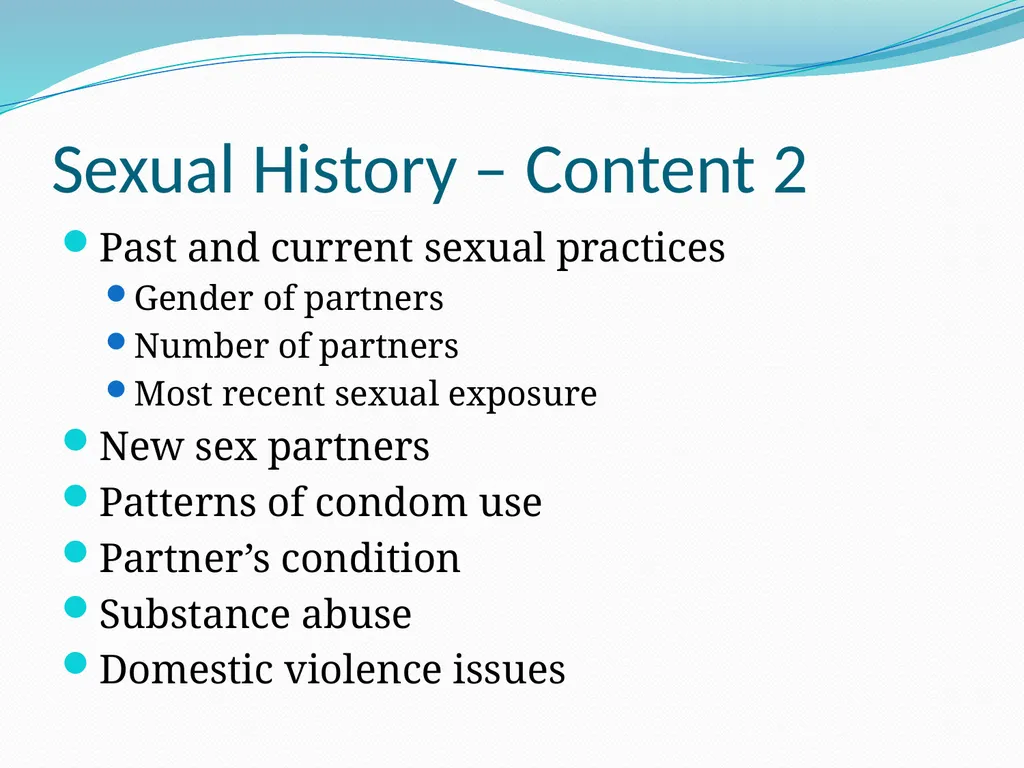
Sexual History – Content 2 Past and current sexual practices
Gender of partners
Number of partners
Most recent sexual exposure
New sex partners
Patterns of condom use
Partner’s condition
Substance abuse
Domestic violence issues<br>
Gender of partners
Number of partners
Most recent sexual exposure
New sex partners
Patterns of condom use
Partner’s condition
Substance abuse
Domestic violence issues<br>
21
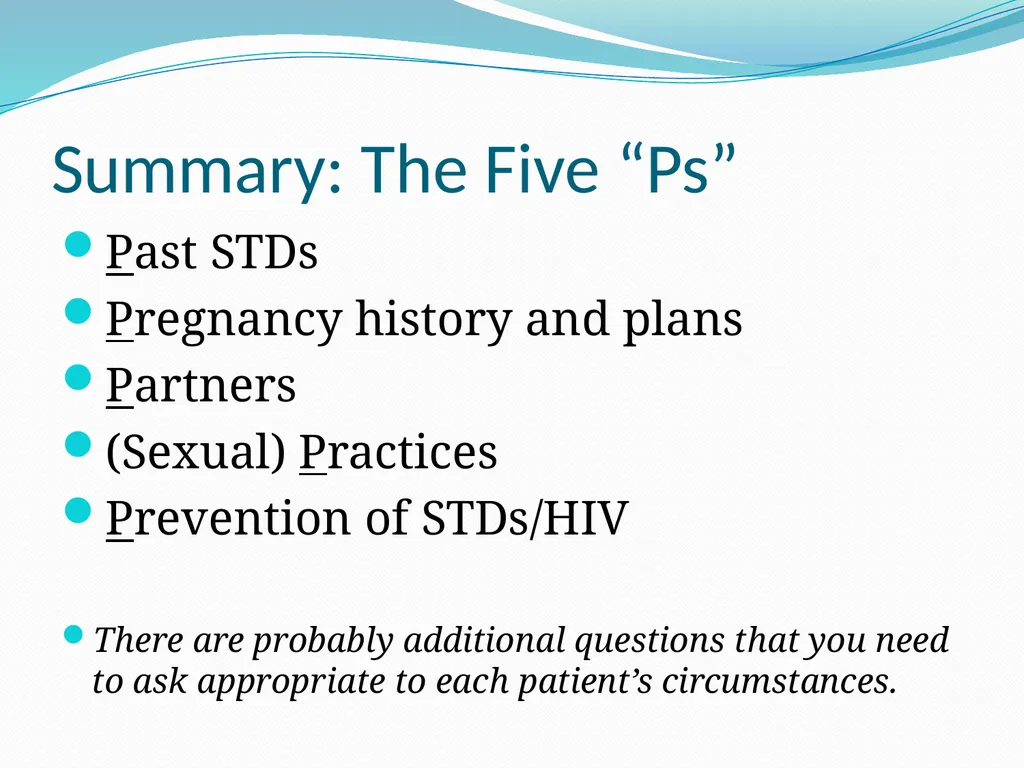
Summary: The Five “Ps” Past STDs
Pregnancy history and plans
Partners
(Sexual) Practices
Prevention of STDs/HIV
There are probably additional questions that you need to ask appropriate to each patient’s circumstances.<br>
Pregnancy history and plans
Partners
(Sexual) Practices
Prevention of STDs/HIV
There are probably additional questions that you need to ask appropriate to each patient’s circumstances.<br>
22
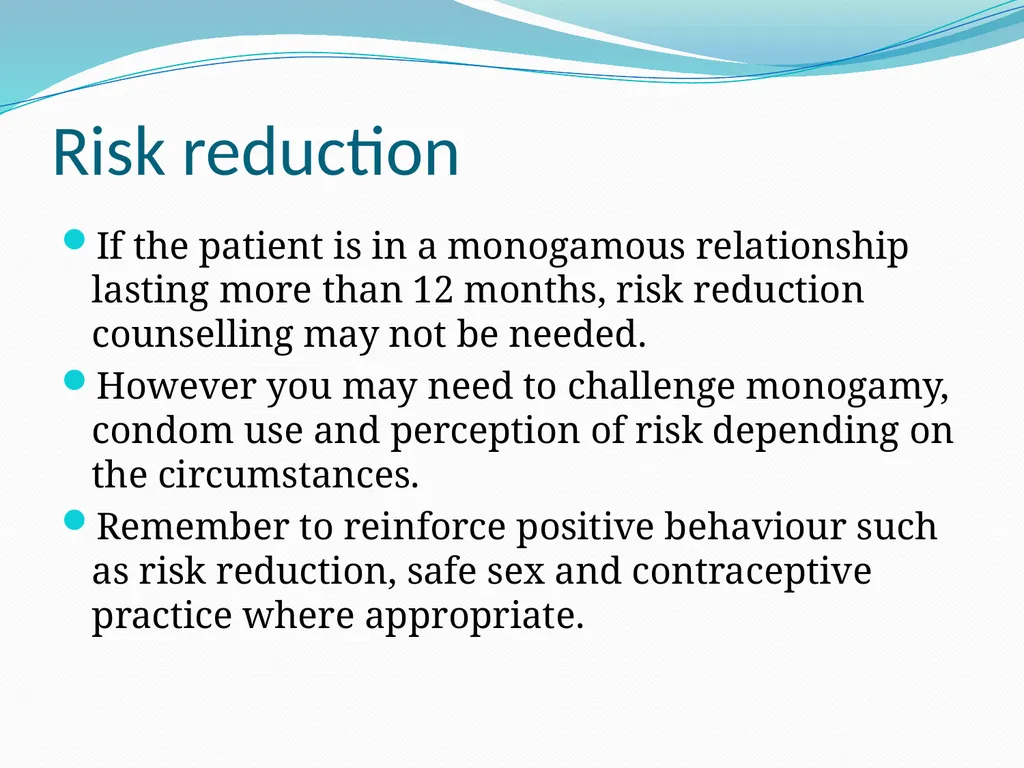
Risk reduction If the patient is in a monogamous relationship lasting more than 12 months, risk reduction counselling may not be needed.
However you may need to challenge monogamy, condom use and perception of risk depending on the circumstances.
Remember to reinforce positive behaviour such as risk reduction, safe sex and contraceptive practice where appropriate.<br>
However you may need to challenge monogamy, condom use and perception of risk depending on the circumstances.
Remember to reinforce positive behaviour such as risk reduction, safe sex and contraceptive practice where appropriate.<br>
23
Ravi Male aged 22.
presents with 4 days of dysuria and no testicular pain.<br>
presents with 4 days of dysuria and no testicular pain.<br>
24
Ravi Does he have a UTI ?
Or could it be a STI ?
What are you going to do
Take a history, sexual hx, PMH and examine penis/ testicles – think warts and ulcers as well.
Increased risk of a STI if under 35, sexually active and recent partner change. Also MSM and/ or unprotected SI.<br>
Or could it be a STI ?
What are you going to do
Take a history, sexual hx, PMH and examine penis/ testicles – think warts and ulcers as well.
Increased risk of a STI if under 35, sexually active and recent partner change. Also MSM and/ or unprotected SI.<br>
25
Ravi Urethral discharge – think chlamydia, gonorrhoea and NSU.
Dysuria and discharge – more likely to be gonorrhoea.
Dysuria and no discharge – probably chlamydia.
Refer GUM clinic for pre-treatment culture and partner screening/ treatment.
In men – first pass urine and more than 1 hr. since last micturition.
In women, ideally swab or urine test.<br>
Dysuria and discharge – more likely to be gonorrhoea.
Dysuria and no discharge – probably chlamydia.
Refer GUM clinic for pre-treatment culture and partner screening/ treatment.
In men – first pass urine and more than 1 hr. since last micturition.
In women, ideally swab or urine test.<br>
26
Chlamydia Incubation window = 2 weeks after last UPSI
Treatment: Azithromycin 1g as single dose
Doxycycline 100mg bd for 7 days
Erythromycin 500mg bd for 14 days if pregnant
And no sex for 7 days (or until partner treated)
Usually no need for repeat testing unless pregnant
But under 25s advised to have another test after 3 months due to risk of new infection.<br>
Treatment: Azithromycin 1g as single dose
Doxycycline 100mg bd for 7 days
Erythromycin 500mg bd for 14 days if pregnant
And no sex for 7 days (or until partner treated)
Usually no need for repeat testing unless pregnant
But under 25s advised to have another test after 3 months due to risk of new infection.<br>
27
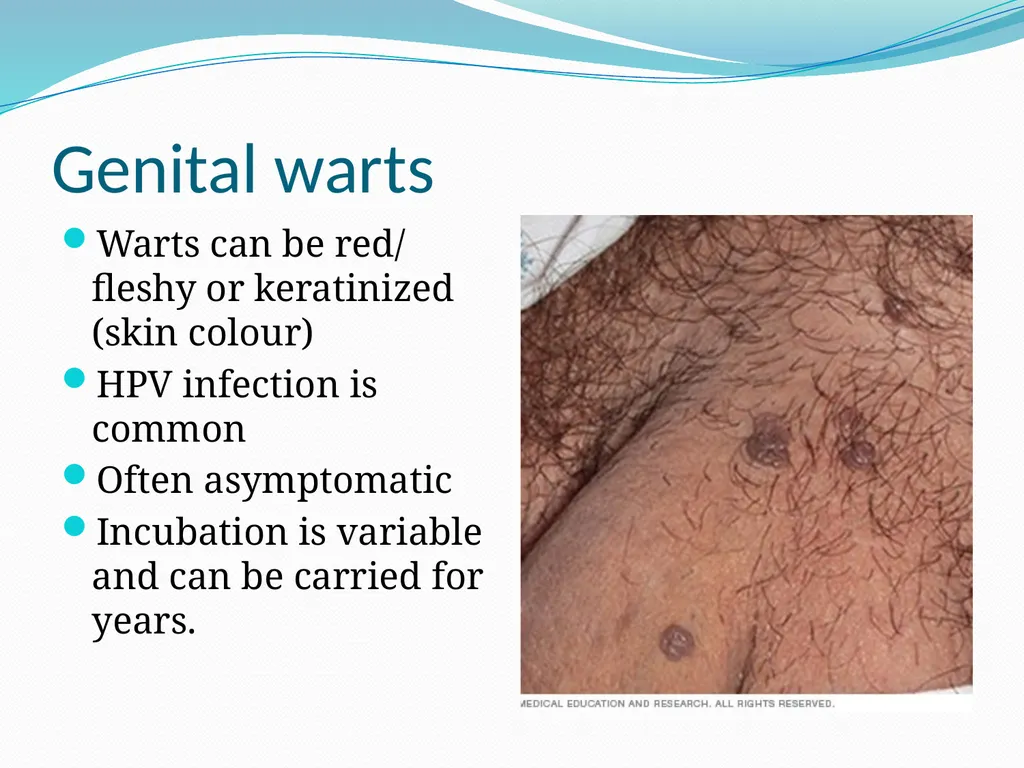
Genital warts Warts can be red/ fleshy or keratinized (skin colour)
HPV infection is common
Often asymptomatic
Incubation is variable and can be carried for years.<br>
HPV infection is common
Often asymptomatic
Incubation is variable and can be carried for years.<br>
28
Genital warts treatment Clinical diagnosis and can be treated in primary care
30% of warts disappear spontaneously within 6 months.
Self applied treatments:
1. podophyllotoxin 0.15% cream (warticon) for 4 weeks – useful if soft external lesions (not anal)
2. imiquimod 5% cream (aldara) for hard and soft extenal warts. Use for 3 days (M/W/F)
Review every month for 4 months.
Cryotherapy – nitrogen every 1-2 weeks<br>
30% of warts disappear spontaneously within 6 months.
Self applied treatments:
1. podophyllotoxin 0.15% cream (warticon) for 4 weeks – useful if soft external lesions (not anal)
2. imiquimod 5% cream (aldara) for hard and soft extenal warts. Use for 3 days (M/W/F)
Review every month for 4 months.
Cryotherapy – nitrogen every 1-2 weeks<br>
29
STI cases - Helena 31 years old lady with recent offensive vaginal discharge – on the pill after having had 2 children.
Married for 8 years – husband works away a lot.
Thinks it is thrush again – wanting “cream”<br>
Married for 8 years – husband works away a lot.
Thinks it is thrush again – wanting “cream”<br>
30
Helena Is this candidiasis or physiological
What are the other possibilities ?
Careful sexual hx and nature of discharge. Associated pain/ dyspareunia and pv bleeding.
When did she last have sex and has she had sex with anybody else. Risk of pregnancy ??
Physiological discharge is white/ clear and non offensive, alters with menstrual cycle.<br>
What are the other possibilities ?
Careful sexual hx and nature of discharge. Associated pain/ dyspareunia and pv bleeding.
When did she last have sex and has she had sex with anybody else. Risk of pregnancy ??
Physiological discharge is white/ clear and non offensive, alters with menstrual cycle.<br>
31
Helena STIs.
Chlamydia – can cause copious purulent vaginal dx but asymptomatic in 80% of women
Gonorrhoea – purulent vaginal dx but asymptomatic in 50% of women
Trichomonas vaginalis – offensive yellow dx which is frothy and often profuse – causing vulval itch and soreness, dysuria and superficial dyspareunia.
Common in young women and Rx = MNZ 400mg bd for 1 week.
Treat current partner and any partner within 4 week period.
Refer GUM clinic – screening for above, HIV and syphilis.<br>
Chlamydia – can cause copious purulent vaginal dx but asymptomatic in 80% of women
Gonorrhoea – purulent vaginal dx but asymptomatic in 50% of women
Trichomonas vaginalis – offensive yellow dx which is frothy and often profuse – causing vulval itch and soreness, dysuria and superficial dyspareunia.
Common in young women and Rx = MNZ 400mg bd for 1 week.
Treat current partner and any partner within 4 week period.
Refer GUM clinic – screening for above, HIV and syphilis.<br>
32
Candida Candidal infections are common but probably over diagnosed and over treated.
Itch due to overgrowth causing vulvo- vaginitis – thick, white dx which is non-offensive and can cause soreness and dysuria/ dyspareunia.
10-20% women are asymptomatic – often found incidentally on swabs - treatment not needed.
Intravaginal antifungal creams/ pessary for uncomplicated infections
Clotrimazole 1-2% cream topically, if vulval symptoms, for 7-14 days
Do not routinely treat asymptomatic sexual partner.<br>
Itch due to overgrowth causing vulvo- vaginitis – thick, white dx which is non-offensive and can cause soreness and dysuria/ dyspareunia.
10-20% women are asymptomatic – often found incidentally on swabs - treatment not needed.
Intravaginal antifungal creams/ pessary for uncomplicated infections
Clotrimazole 1-2% cream topically, if vulval symptoms, for 7-14 days
Do not routinely treat asymptomatic sexual partner.<br>
33
Bacterial vaginosis Bacterial vaginosis is more commonly seen in sexually active women but is not a STI – thin profuse fishy smelling dx without itch/ soreness.
Often asymptomatic and treatment not normally required unless undergoing TOP (CKS) or IUD insertion.
If symptomatic, prescribe metronidazole 400mg bd for 5-7 days.
Alternative is intravaginal MNZ (0.75%) gel for 5 days or intravaginal clindamycin (2%) cream for 7 days.
No need for test of cure (BASHH)
Avoid bubble baths/ shampoos in the bath.<br>
Often asymptomatic and treatment not normally required unless undergoing TOP (CKS) or IUD insertion.
If symptomatic, prescribe metronidazole 400mg bd for 5-7 days.
Alternative is intravaginal MNZ (0.75%) gel for 5 days or intravaginal clindamycin (2%) cream for 7 days.
No need for test of cure (BASHH)
Avoid bubble baths/ shampoos in the bath.<br>
34
Vaginal discharge Take a clinical and sexual hx.
Consider STI if new or > 1 sex partner in the past year.
If risk of STI, refer to GUM or do triple swabs - high and low vaginal swabs, endocervical for chlamydia.
Diagnose candida or BV clinically – do not send swabs
(unless recurrent infections). BV > 50% cases.
Consider vaginal swabs if:
Postnatal, post miscarriage/ TOP/ surgery
Recent coil insertion, vaginitis without discharge
Recurrent sx (4+ per year), previous treatment failure<br>
Consider STI if new or > 1 sex partner in the past year.
If risk of STI, refer to GUM or do triple swabs - high and low vaginal swabs, endocervical for chlamydia.
Diagnose candida or BV clinically – do not send swabs
(unless recurrent infections). BV > 50% cases.
Consider vaginal swabs if:
Postnatal, post miscarriage/ TOP/ surgery
Recent coil insertion, vaginitis without discharge
Recurrent sx (4+ per year), previous treatment failure<br>
35
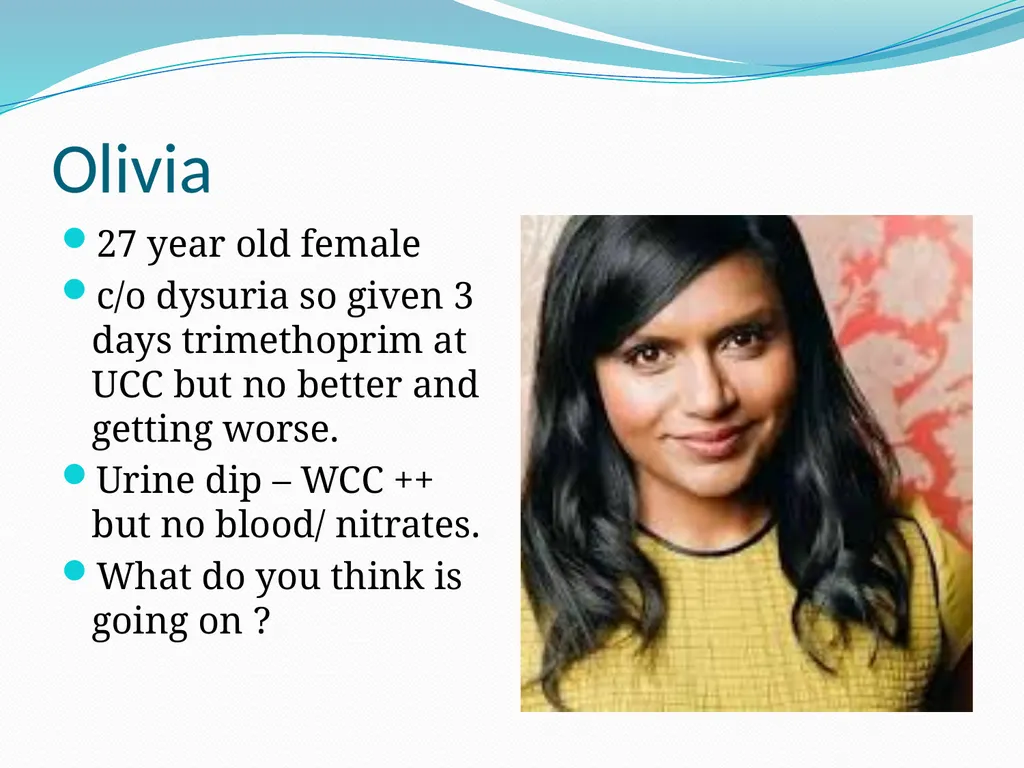
Olivia 27 year old female
c/o dysuria so given 3 days trimethoprim at UCC but no better and getting worse.
Urine dip – WCC ++ but no blood/ nitrates.
What do you think is going on ?<br>
c/o dysuria so given 3 days trimethoprim at UCC but no better and getting worse.
Urine dip – WCC ++ but no blood/ nitrates.
What do you think is going on ?<br>
36
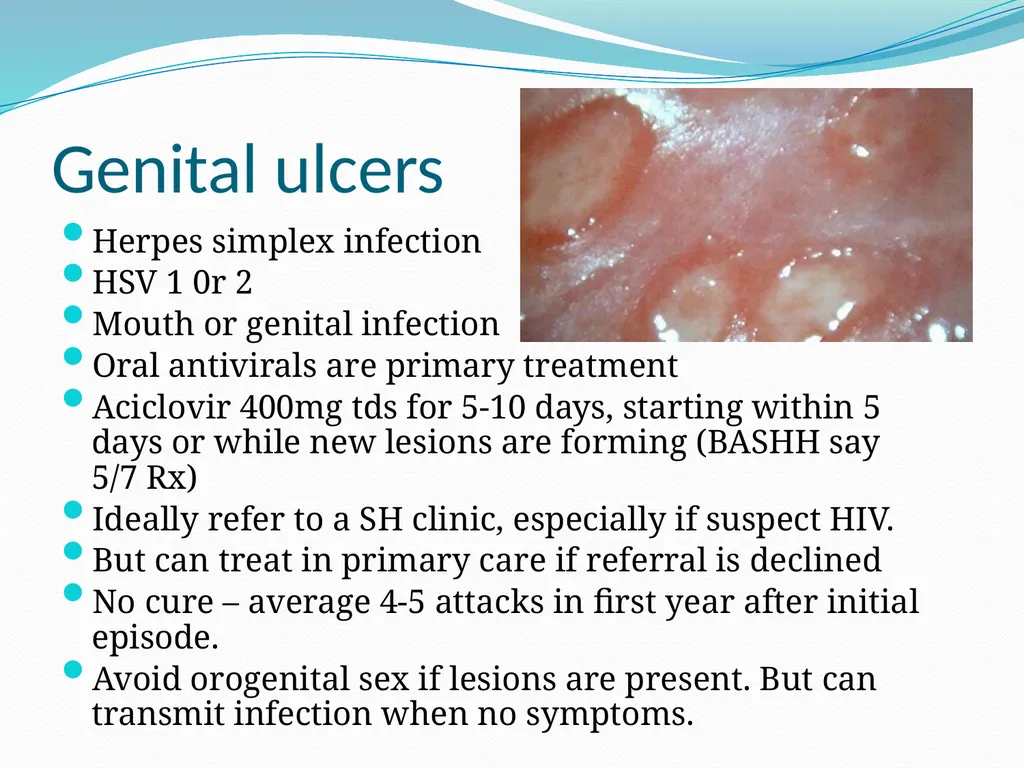
Genital ulcers Herpes simplex infection
HSV 1 0r 2
Mouth or genital infection
Oral antivirals are primary treatment
Aciclovir 400mg tds for 5-10 days, starting within 5 days or while new lesions are forming (BASHH say 5/7 Rx)
Ideally refer to a SH clinic, especially if suspect HIV.
But can treat in primary care if referral is declined
No cure – average 4-5 attacks in first year after initial episode.
Avoid orogenital sex if lesions are present. But can transmit infection when no symptoms.<br>
HSV 1 0r 2
Mouth or genital infection
Oral antivirals are primary treatment
Aciclovir 400mg tds for 5-10 days, starting within 5 days or while new lesions are forming (BASHH say 5/7 Rx)
Ideally refer to a SH clinic, especially if suspect HIV.
But can treat in primary care if referral is declined
No cure – average 4-5 attacks in first year after initial episode.
Avoid orogenital sex if lesions are present. But can transmit infection when no symptoms.<br>
37
Gary 30 year old man
MSM
Presents with mild widespread rash
Also mild fever, malaise and sore throat
Generalised lymphadenopathy on examination.<br>
MSM
Presents with mild widespread rash
Also mild fever, malaise and sore throat
Generalised lymphadenopathy on examination.<br>
38
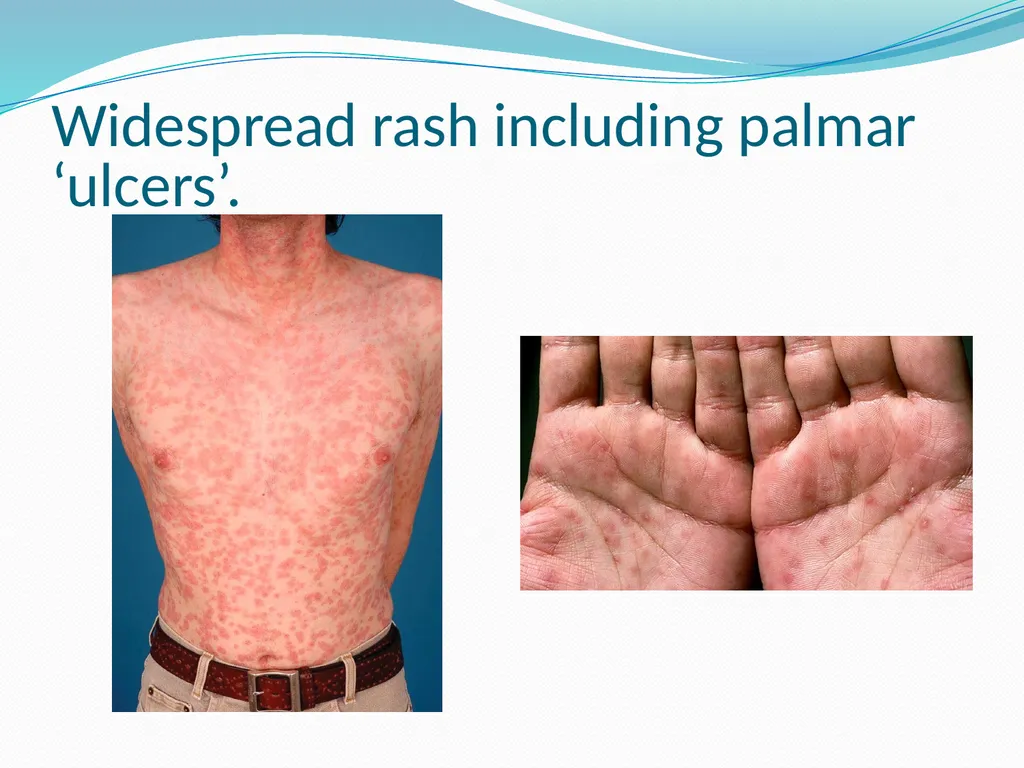
Widespread rash including palmar ‘ulcers’.<br>
39
syphilis Secondary syphilis develop 6 -8 weeks after primary infection (single sore, incubation = 9-90 days, heals within 1 month).
Non-itchy rash with rough reddish-brown spots on soles and palms.
Rash present for 1-2 weeks – need high index of suspicion.
Blood test (serology) will be positive in secondary stage.
Refer to SH clinic – could be open to prosecution if having sex with contacts with known diagnosis of syphilis
Treatment is IM penicillin.<br>
Non-itchy rash with rough reddish-brown spots on soles and palms.
Rash present for 1-2 weeks – need high index of suspicion.
Blood test (serology) will be positive in secondary stage.
Refer to SH clinic – could be open to prosecution if having sex with contacts with known diagnosis of syphilis
Treatment is IM penicillin.<br>
40
STI top tips Urethral dx – think STI, especially if under 25 yrs.
Acute vulval pain – think HSV
Genital ulcers – think herpes simplex or syphilis
Arthritis – think chlamydia/ GC
Viral illness with rash – think primary HIV, especially MSM.
Lower abdo pain – exclude ectopic/ appendix. Think PID.
Swollen painful testes in young man – exclude torsion, then think STI
Vaginal dx in young women – think BV if odour, no itch.<br>
Acute vulval pain – think HSV
Genital ulcers – think herpes simplex or syphilis
Arthritis – think chlamydia/ GC
Viral illness with rash – think primary HIV, especially MSM.
Lower abdo pain – exclude ectopic/ appendix. Think PID.
Swollen painful testes in young man – exclude torsion, then think STI
Vaginal dx in young women – think BV if odour, no itch.<br>
41
https://www.youtube.com/watch?v=mxlZD3oEfsU&list=PLzmtTg5wGBWXwezQxPkpYEskce1prAiVJ&index=56<br>
42
Role play Small groups of 3
One to act as observer
Work through the following case(s)
Feedback as a whole group<br>
One to act as observer
Work through the following case(s)
Feedback as a whole group<br>
43
Case 1 - Ben An 16 yr old man attends. He tells you that he has been ‘passing razor blades’ for the last few days and has a discharge from the end of his ‘willy’.
Discuss!
Issues?
Attitudes?
Thoughts about how to approach this?<br>
Discuss!
Issues?
Attitudes?
Thoughts about how to approach this?<br>
44
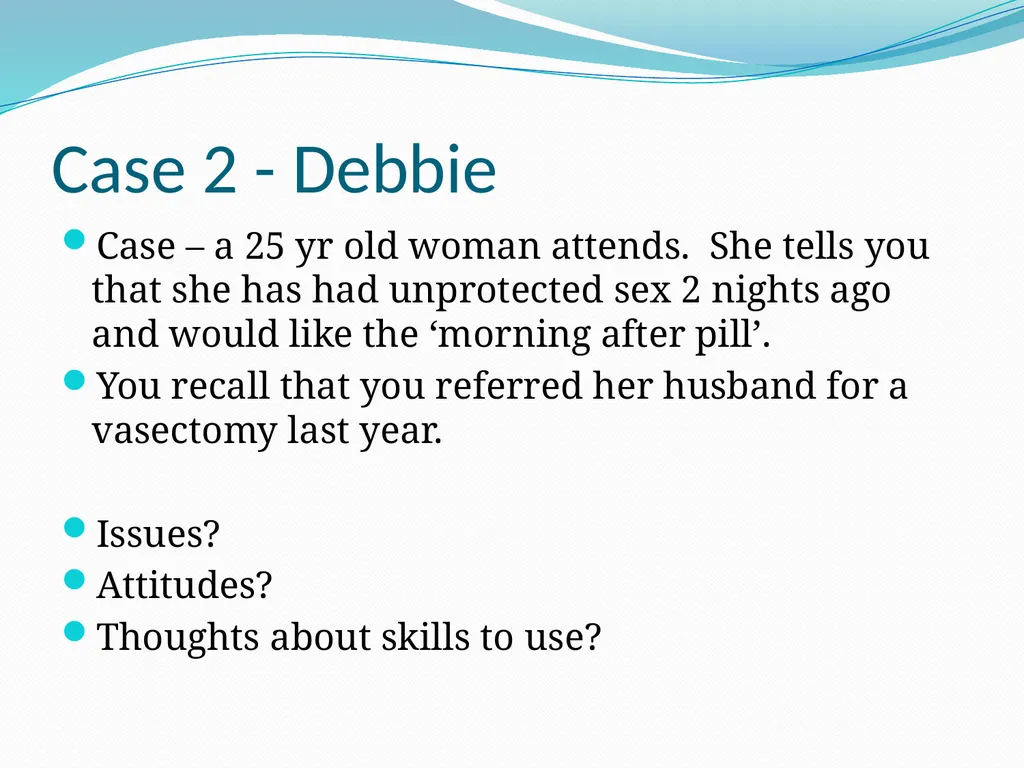
Case 2 - Debbie Case – a 25 yr old woman attends. She tells you that she has had unprotected sex 2 nights ago and would like the ‘morning after pill’.
You recall that you referred her husband for a vasectomy last year.
Issues?
Attitudes?
Thoughts about skills to use?<br>
You recall that you referred her husband for a vasectomy last year.
Issues?
Attitudes?
Thoughts about skills to use?<br>
45
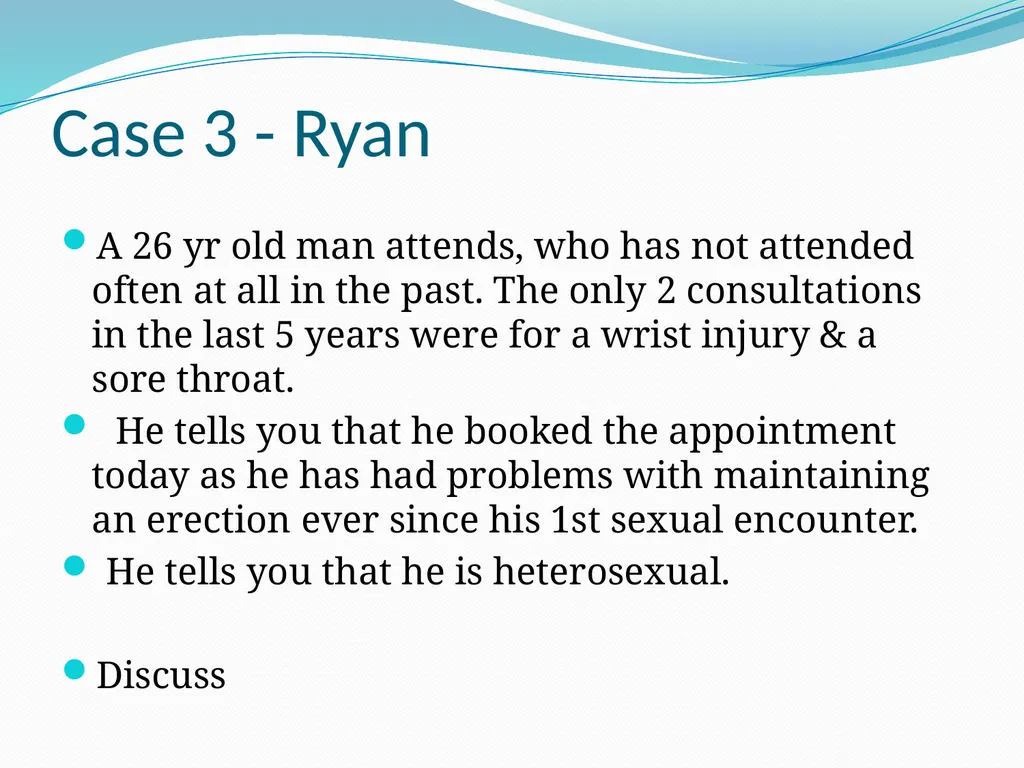
Case 3 - Ryan A 26 yr old man attends, who has not attended often at all in the past. The only 2 consultations in the last 5 years were for a wrist injury & a sore throat.
He tells you that he booked the appointment today as he has had problems with maintaining an erection ever since his 1st sexual encounter.
He tells you that he is heterosexual.
Discuss<br>
He tells you that he booked the appointment today as he has had problems with maintaining an erection ever since his 1st sexual encounter.
He tells you that he is heterosexual.
Discuss<br>
46
Discuss the following cases? Or would you like to do more role play?<br>
47
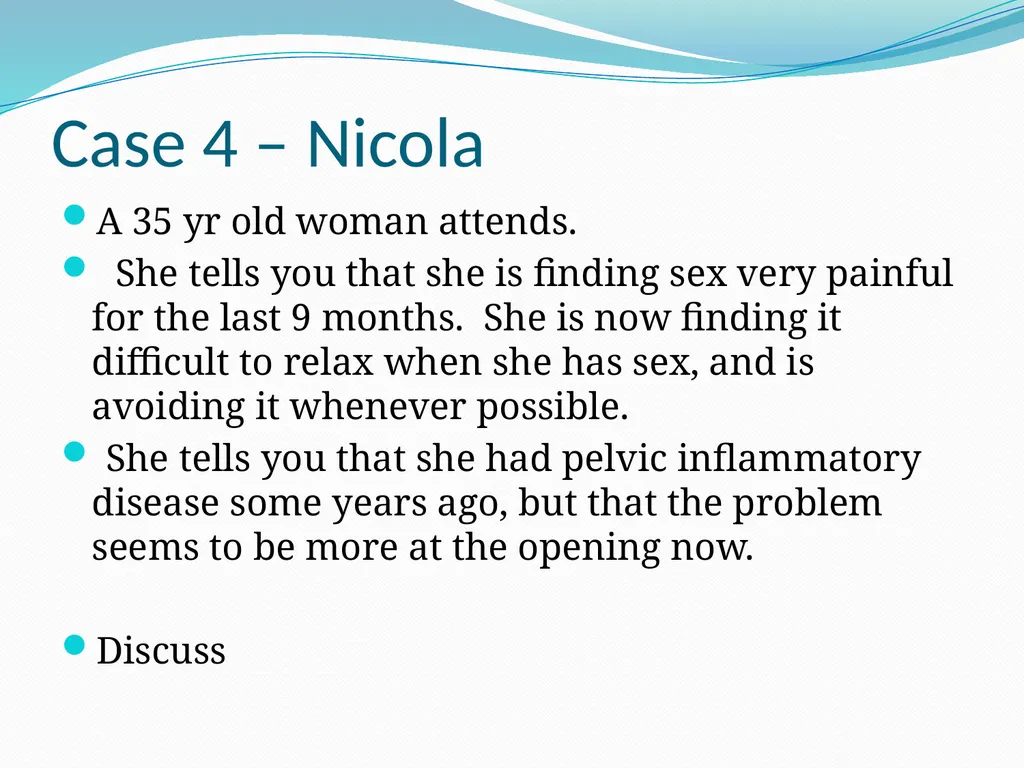
Case 4 – Nicola A 35 yr old woman attends.
She tells you that she is finding sex very painful for the last 9 months. She is now finding it difficult to relax when she has sex, and is avoiding it whenever possible.
She tells you that she had pelvic inflammatory disease some years ago, but that the problem seems to be more at the opening now.
Discuss<br>
She tells you that she is finding sex very painful for the last 9 months. She is now finding it difficult to relax when she has sex, and is avoiding it whenever possible.
She tells you that she had pelvic inflammatory disease some years ago, but that the problem seems to be more at the opening now.
Discuss<br>
48
Case 5 - Chloe A 24 yr old woman attends.
From the notes you can see that she has had 2 TOPs in the last 3 years. There is a previous history of chlamydia infection last year. You note from the records also, that there has been no consultation for contraception in the last 9 months.
After the usual introductions, she tells you that she has come today to request an “abortion”.
Discuss<br>
From the notes you can see that she has had 2 TOPs in the last 3 years. There is a previous history of chlamydia infection last year. You note from the records also, that there has been no consultation for contraception in the last 9 months.
After the usual introductions, she tells you that she has come today to request an “abortion”.
Discuss<br>
49
Video clip https://www.youtube.com/watch?v=xIXX0c01kCA<br>
50
GMC guidance 1 Personal Beliefs and Medical Practice core guidance:
You must make the care of your patient your first concern
You must treat your patients with respect, whatever their life choices and beliefs
You must not unfairly discriminate against patients by allowing your personal views to affect adversely your professional relationship with them or the treatment you provide or arrange<br>
You must make the care of your patient your first concern
You must treat your patients with respect, whatever their life choices and beliefs
You must not unfairly discriminate against patients by allowing your personal views to affect adversely your professional relationship with them or the treatment you provide or arrange<br>
51
GMC guidance 2 If carrying out a particular procedure or giving advice about it conflicts with your religious or moral beliefs, and this conflict might affect the treatment or advice you provide, you must explain this to the patient and tell them they have the right to see another doctor. You must be satisfied that the patient has sufficient information to enable them to exercise that right.
If it is not practical for a patient to arrange to see another doctor, you must ensure that arrangements are made for another suitably qualified colleague to take over your role
You must not express to your patients your personal beliefs, including political, religious or moral beliefs, in ways that exploit their vulnerability or that are likely to cause them distress<br>
If it is not practical for a patient to arrange to see another doctor, you must ensure that arrangements are made for another suitably qualified colleague to take over your role
You must not express to your patients your personal beliefs, including political, religious or moral beliefs, in ways that exploit their vulnerability or that are likely to cause them distress<br>
52
Other situations where doctors’ personal beliefs may affect care Care of patients pre- and post-termination of pregnancy. However, in England, Wales and Scotland the right to refuse to participate in terminations of pregnancy is protected by law.
Where a patient who is awaiting10 or has undergone a termination of pregnancy needs medical care, you have no legal11 or ethical right to refuse to provide it on grounds of a conscientious objection to the procedure.
Clothing and other expressions of religious belief or culture
Completion of cremation forms<br>
Where a patient who is awaiting10 or has undergone a termination of pregnancy needs medical care, you have no legal11 or ethical right to refuse to provide it on grounds of a conscientious objection to the procedure.
Clothing and other expressions of religious belief or culture
Completion of cremation forms<br>
53
Female genital mutilation (FGM) Female genital mutilation - sometimes referred to as female circumcision – is a practice thought to exist for several thousand years, mainly in the horn of Africa and Egypt.
It is a dangerous, potentially life threatening procedure done on women and girls in often unsterile conditions and has been considered a violation of human rights in many countries.
It is a serious crime and a child protection issue, whether undertaken in the UK or abroad (see the Female Genital Mutilation (England, Wales and Northern Ireland) Act 2003 and the Prohibition of Female Genital Mutilation (Scotland) Act 2005)<br>
It is a dangerous, potentially life threatening procedure done on women and girls in often unsterile conditions and has been considered a violation of human rights in many countries.
It is a serious crime and a child protection issue, whether undertaken in the UK or abroad (see the Female Genital Mutilation (England, Wales and Northern Ireland) Act 2003 and the Prohibition of Female Genital Mutilation (Scotland) Act 2005)<br>
54
The Equality Act 2010 consolidates the complicated and numerous array of Acts and Regulations, which formed the basis of anti-discrimination law in Great Britain
protecting against discrimination in employment on grounds of religion or belief, sexual orientation or age
requires equal treatment in access to employment as well as private and public services, regardless of characteristics of age, disability, gender reassignment, marriage and civil partnership, race, religion or belief, sex, and sexual orientation<br>
protecting against discrimination in employment on grounds of religion or belief, sexual orientation or age
requires equal treatment in access to employment as well as private and public services, regardless of characteristics of age, disability, gender reassignment, marriage and civil partnership, race, religion or belief, sex, and sexual orientation<br>
55
Gender reassignment An individual feels that his/ her gender at birth does not match their gender identity – this gender ‘dysphoria’ is a recognised medical condition.
Does not necessarily mean that will be undergoing medical or surgical treatments, to alter their body.
Transition refers to the process/ period of time during which gender reassignment occurs
Sometimes referred to as transgender/ trans.
Do not assume that sexual orientation are interrelated – not necessarily gay and sexual orientation will not necessarily alter after gender reassignment.<br>
Does not necessarily mean that will be undergoing medical or surgical treatments, to alter their body.
Transition refers to the process/ period of time during which gender reassignment occurs
Sometimes referred to as transgender/ trans.
Do not assume that sexual orientation are interrelated – not necessarily gay and sexual orientation will not necessarily alter after gender reassignment.<br>
56
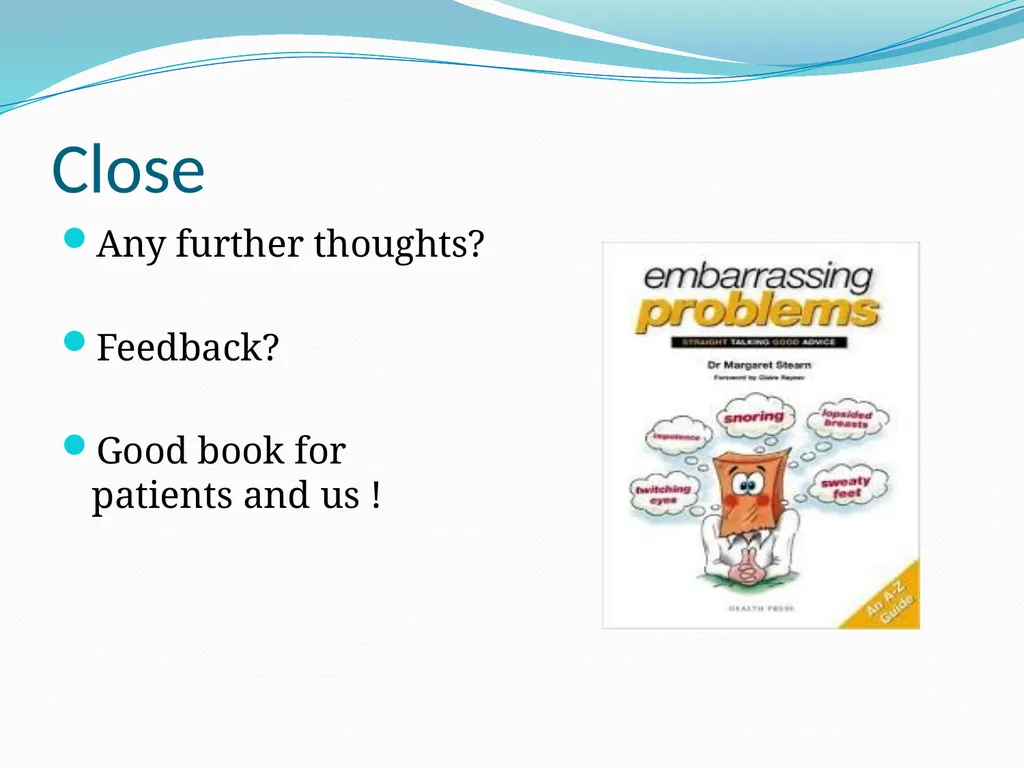
Close Any further thoughts?
Feedback?
Good book for patients and us !<br>
Feedback?
Good book for patients and us !<br>