04
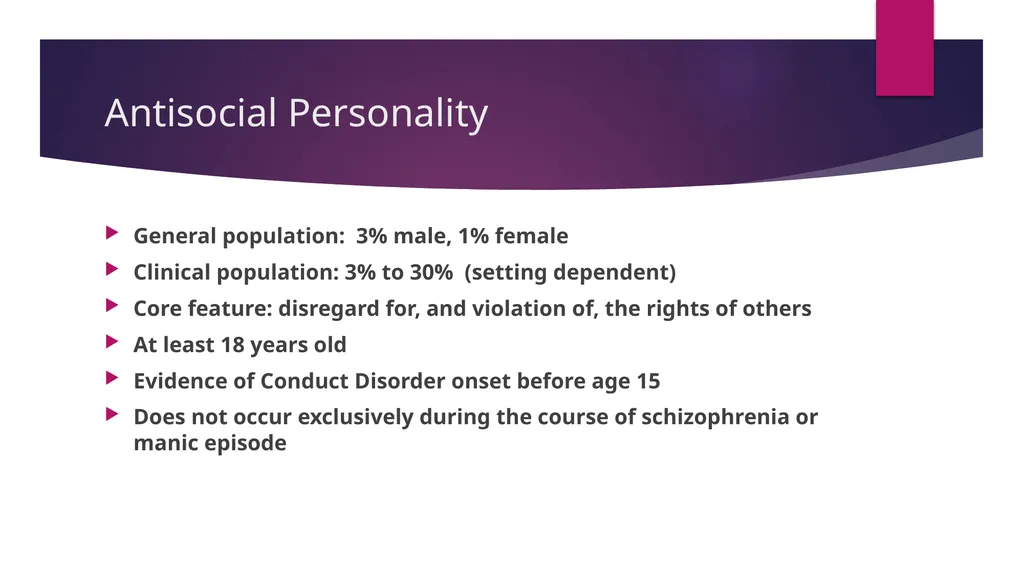
Antisocial Personality General population: 3% male, 1% female
Clinical population: 3% to 30% (setting dependent)
Core feature: disregard for, and violation of, the rights of others
At least 18 years old
Evidence of Conduct Disorder onset before age 15
Does not occur exclusively during the course of schizophrenia or manic episode<br>
05
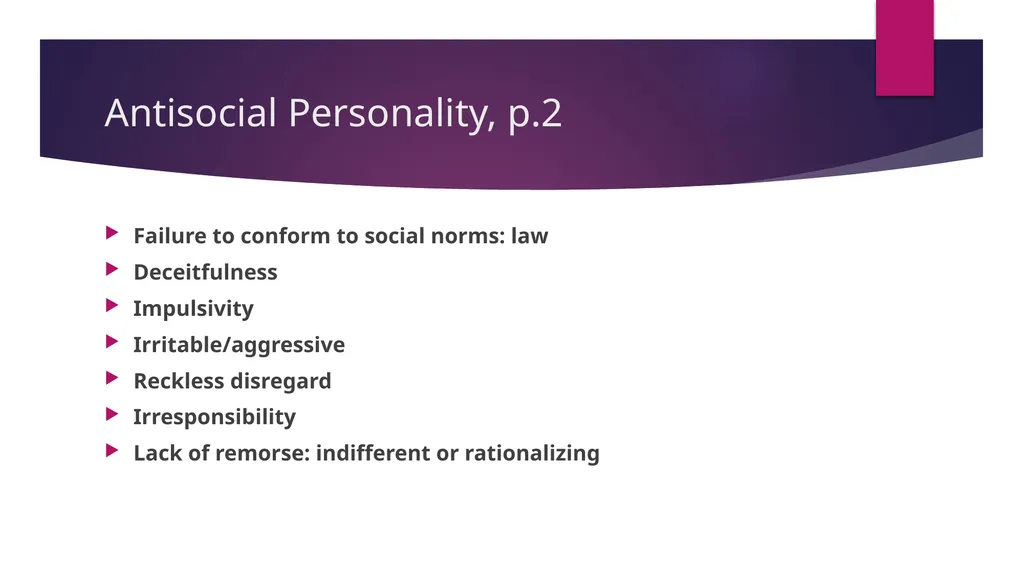
Antisocial Personality, p.2 Failure to conform to social norms: law
Deceitfulness
Impulsivity
Irritable/aggressive
Reckless disregard
Irresponsibility
Lack of remorse: indifferent or rationalizing<br>
06
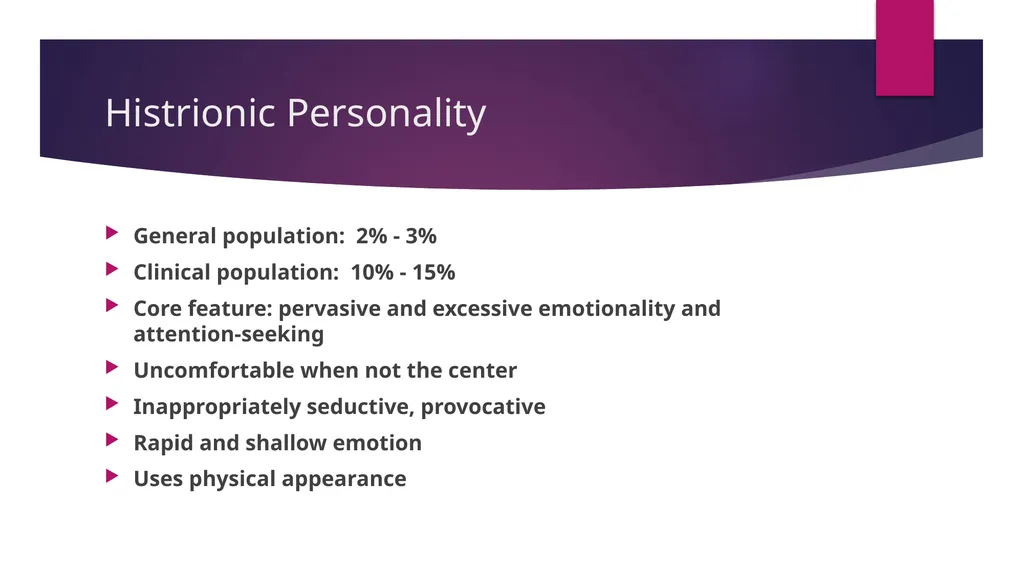
Histrionic Personality General population: 2% - 3%
Clinical population: 10% - 15%
Core feature: pervasive and excessive emotionality and attention-seeking
Uncomfortable when not the center
Inappropriately seductive, provocative
Rapid and shallow emotion
Uses physical appearance<br>
07
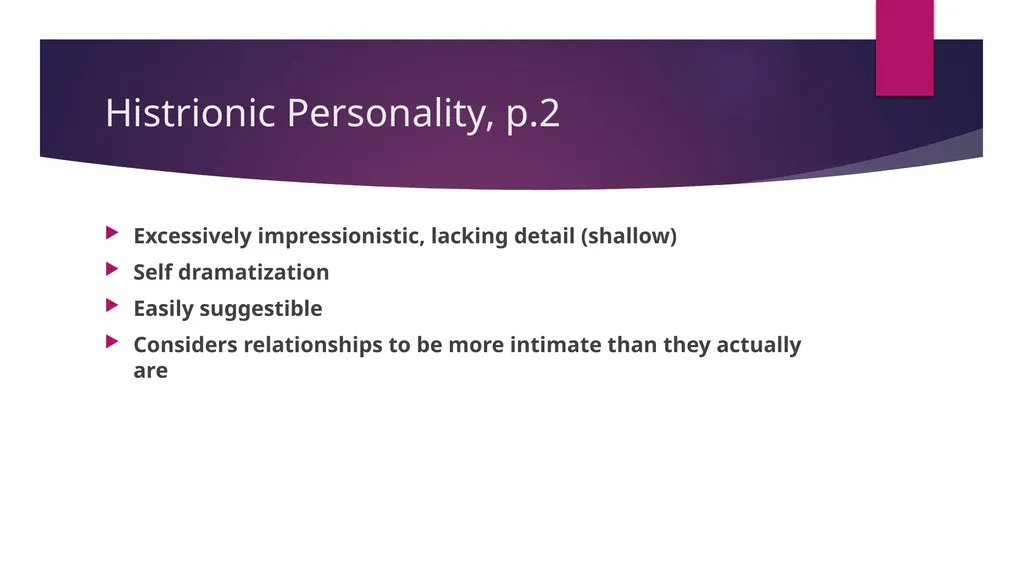
Histrionic Personality, p.2 Excessively impressionistic, lacking detail (shallow)
Self dramatization
Easily suggestible
Considers relationships to be more intimate than they actually are<br>
08
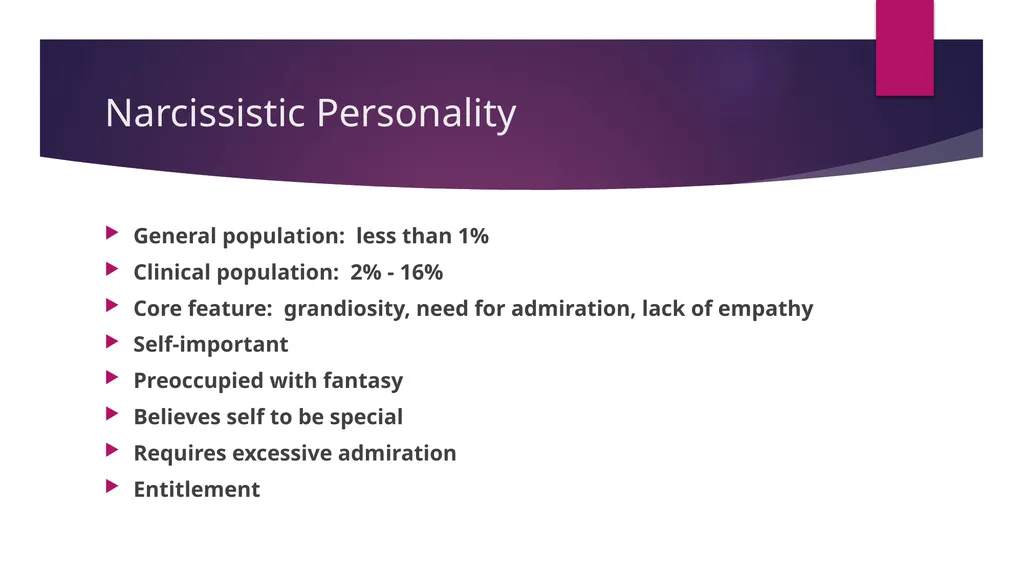
Narcissistic Personality General population: less than 1%
Clinical population: 2% - 16%
Core feature: grandiosity, need for admiration, lack of empathy
Self-important
Preoccupied with fantasy
Believes self to be special
Requires excessive admiration
Entitlement<br>
09
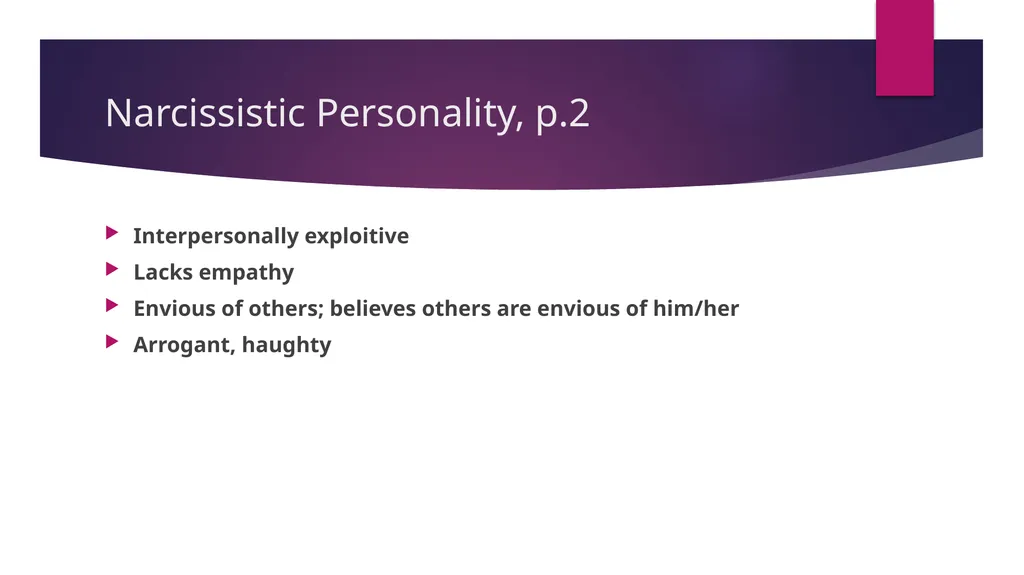
Narcissistic Personality, p.2 Interpersonally exploitive
Lacks empathy
Envious of others; believes others are envious of him/her
Arrogant, haughty<br>
10
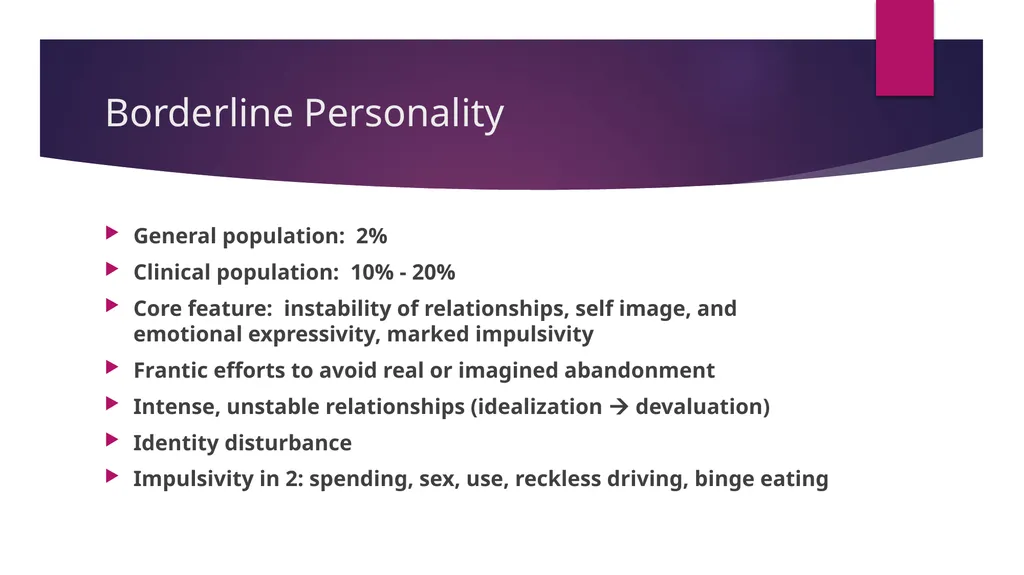
Borderline Personality General population: 2%
Clinical population: 10% - 20%
Core feature: instability of relationships, self image, and emotional expressivity, marked impulsivity
Frantic efforts to avoid real or imagined abandonment
Intense, unstable relationships (idealization devaluation)
Identity disturbance
Impulsivity in 2: spending, sex, use, reckless driving, binge eating<br>
11
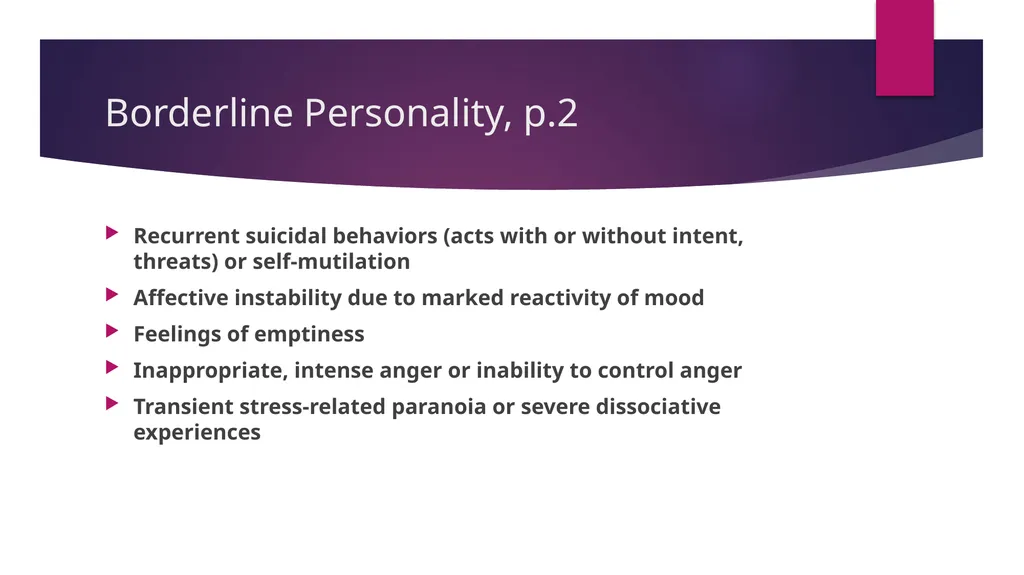
Borderline Personality, p.2 Recurrent suicidal behaviors (acts with or without intent, threats) or self-mutilation
Affective instability due to marked reactivity of mood
Feelings of emptiness
Inappropriate, intense anger or inability to control anger
Transient stress-related paranoia or severe dissociative experiences<br>
12
Getting more specific Millon, Disorders of Personality DSM-IV and Beyond
BPD is one of 3 “structurally defective” personality types (schizotypal, paranoid)
Adaptive inflexibility
Self-perpetuating vicious circles
Tenuous emotional balance<br>
13
BPD: The Unstable Pattern Argues for the lack of utility of the term “borderline” as it does not describe the clinical presentation
Ambivalent personality
Erratic personality
Impulsive personality
Quixotic personality<br>
14
Millon’s diagnostic domains Expressive behavior: spasmodic
Interpersonal conduct: paradoxical
Cognitive style: capricious
Self-image: uncertain
Object-representations: incompatible
Regulatory mechanisms: regressed
Morphologic organization: split
Mood/temperament: labile<br>
15
Millon’s subtypes Discouraged: sad, depressed, submissive, fear-based, insecure, helpless/hopeless alternates with brief periods of cheer, anger outbursts, resentment, fury
Impulsive: capricious, superficial, seductive, evasive, worry turns to agitation, turns to gloom, hypomanic, what was once exciting is now bleak<br>
16
Subtypes, p.2 Petulant: extreme unpredictability, defiant, disgruntled, discontent, sullen, pessimistic, resentful of the love they feel for others, swing from rage to pleading for forgiveness
Self-destructive: perpetual vacillation, vent anger intropunitively (not externally), fear of autonomy, tries to please others (deferential, ingratiating) but do not perceive reciprocity, feel incapable, self harm and suicide<br>
17
BPD: Common co-morbidities Substance use
Mood disorders
Eating disorders
PTSD
AD/HD spectrum
Other PDs<br>
18
Approaches to working with BPD Assess for co-morbid conditions with plan to treat
Integrated care is optimal
Individual, group, psychiatry, case management
Assess risk and prioritize safety planning when needed
Encourage family engagement
DBT
Manipulation?
Schema Therapy<br>
19
What is manipulation? Preplanned or cunning attempt to get someone to do something they ordinarily would not do, often with nefarious intent.
It is a logical fallacy to assume that because you feel a certain way, the other person intended for you to feel that way.<br>
20
Dialectical Behavioral Therapy Marsha Linehan
Chief dialectic: validate and hold out the expectation for change
Mindfulness: wise mind, emotion mind, rational mind
Distress tolerance skills
Interpersonal effectiveness skills
Emotion regulation skills
Formal, informal/modified, inpatient, outpatient<br>
21
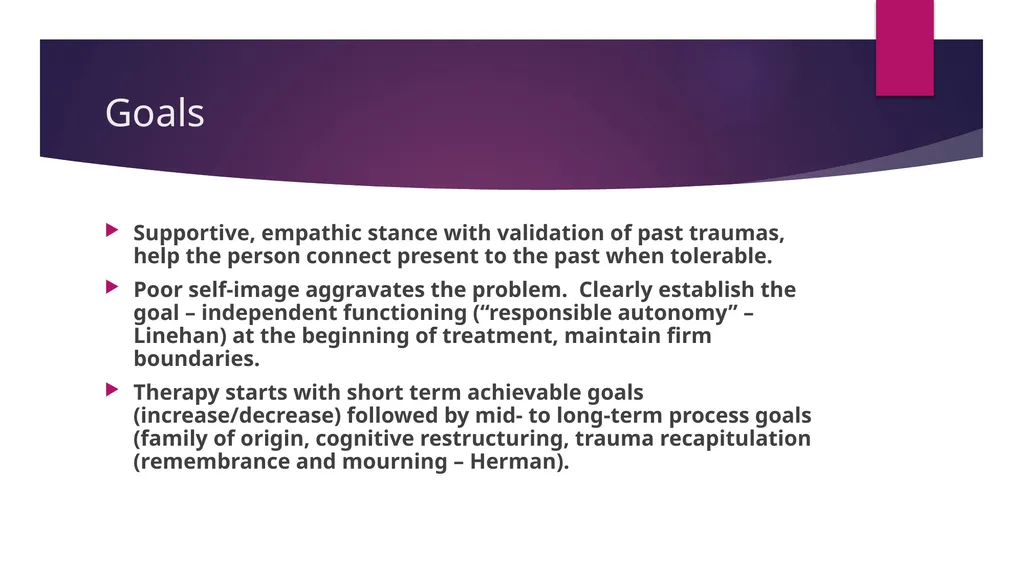
Goals Supportive, empathic stance with validation of past traumas, help the person connect present to the past when tolerable.
Poor self-image aggravates the problem. Clearly establish the goal – independent functioning (“responsible autonomy” – Linehan) at the beginning of treatment, maintain firm boundaries.
Therapy starts with short term achievable goals (increase/decrease) followed by mid- to long-term process goals (family of origin, cognitive restructuring, trauma recapitulation (remembrance and mourning – Herman).<br>
22
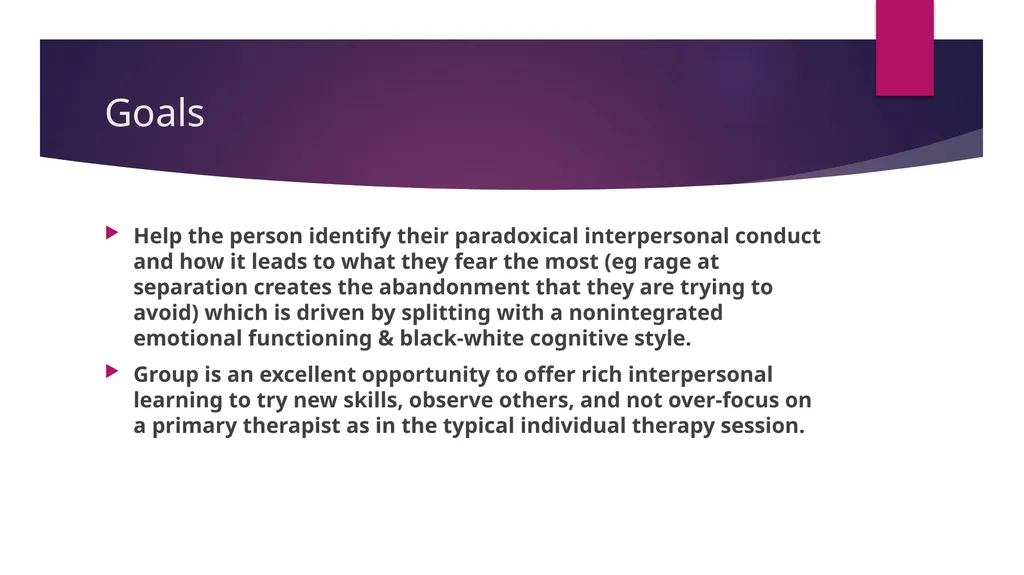
Goals Help the person identify their paradoxical interpersonal conduct and how it leads to what they fear the most (eg rage at separation creates the abandonment that they are trying to avoid) which is driven by splitting with a nonintegrated emotional functioning & black-white cognitive style.
Group is an excellent opportunity to offer rich interpersonal learning to try new skills, observe others, and not over-focus on a primary therapist as in the typical individual therapy session.<br>
23
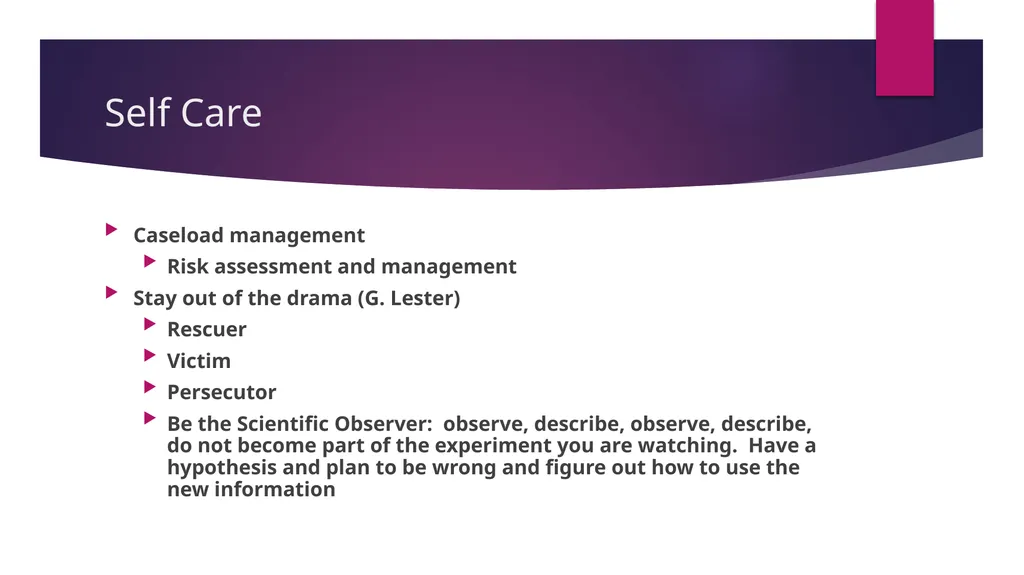
Self Care Caseload management
Risk assessment and management
Stay out of the drama (G. Lester)
Rescuer
Victim
Persecutor
Be the Scientific Observer: observe, describe, observe, describe, do not become part of the experiment you are watching. Have a hypothesis and plan to be wrong and figure out how to use the new information<br>
24
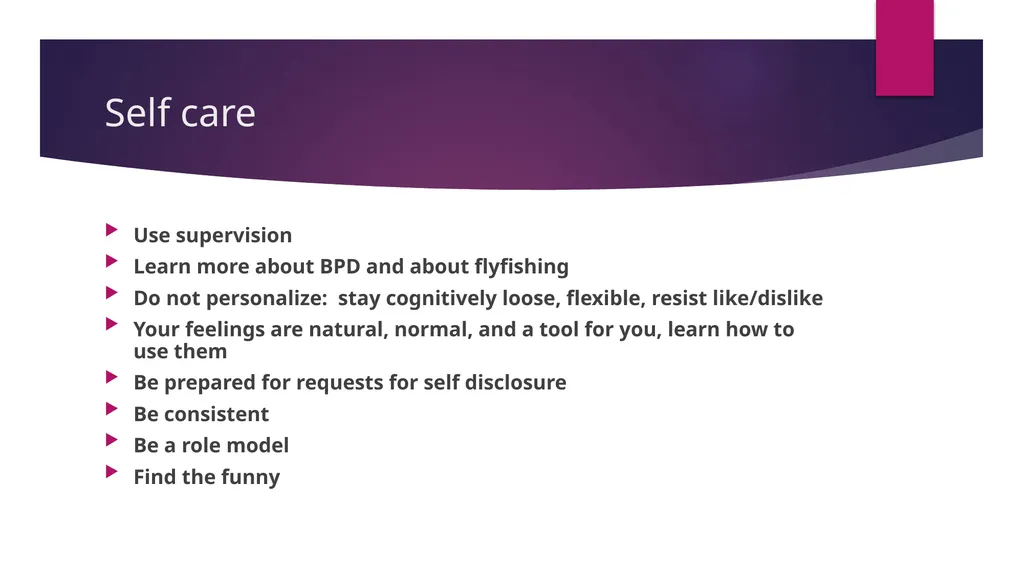
Self care Use supervision
Learn more about BPD and about flyfishing
Do not personalize: stay cognitively loose, flexible, resist like/dislike
Your feelings are natural, normal, and a tool for you, learn how to use them
Be prepared for requests for self disclosure
Be consistent
Be a role model
Find the funny<br>