
“Co-Occurring Disorders and Recovery Support” The
YM
Published · 41 slides · 0 views

1 / 1
Description
Co-Occurring Disorders and Recovery Support The Fletcher Group Presentation July 2nd, 2026 Geoff Wilson, LCSW, LCADC, CCS Agenda 1) Increase knowledge regarding the prevalence and severity of co-occurring mental health and substance use
Related Topics
Share
Embed code
Download this presentation From Below
"“Co-Occurring Disorders and Recovery Support” The" is the property of its rightful owner. Permission is granted to download and print the materials on this website for personal, non-commercial use only, and to display it on your personal computer provided you do not modify the materials and that you retain all copyright notices contained in the materials. By downloading content from our website, you accept the terms of this agreement.
Presentation Transcript
01
“Co-Occurring Disorders and Recovery Support”
The Fletcher Group Presentation
July 2nd, 2026 Geoff Wilson, LCSW, LCADC, CCS<br>
02
Agenda 1) Increase knowledge regarding the prevalence and severity of co-occurring mental health and substance use disorders in the US.
2) Discuss the impact these disorders have on the client and potential obstacles to the client for starting the recovery process.
3) Review additional best practices for intervention and treatment for the client struggling with co-occurring mental health and substance use disorders.<br>
2) Discuss the impact these disorders have on the client and potential obstacles to the client for starting the recovery process.
3) Review additional best practices for intervention and treatment for the client struggling with co-occurring mental health and substance use disorders.<br>
03
Co-occurring Disorders The coexistence of both a mental health disorder and a substance use disorder (SUD) is referred to as co-occurring disorders.
Co-occurring disorders may include any combination of two or more SUDs and mental disorders identified in the Diagnostic and Statistical Manual of Mental Disorders, Fifth Edition (DSM-5-TR).
Importantly, no specific combinations of mental and substance use disorders are uniquely defined as co-occurring disorders.<br>
Co-occurring disorders may include any combination of two or more SUDs and mental disorders identified in the Diagnostic and Statistical Manual of Mental Disorders, Fifth Edition (DSM-5-TR).
Importantly, no specific combinations of mental and substance use disorders are uniquely defined as co-occurring disorders.<br>
04
Significant Symptoms of Substance Use Disorders in patients with Mental Health Disorder *Enhanced Reinforcement
*Mood Change
*Escape
*Hopelessness
*Poor Judgment
*Inability to Appreciate Consequences<br>
*Mood Change
*Escape
*Hopelessness
*Poor Judgment
*Inability to Appreciate Consequences<br>
05
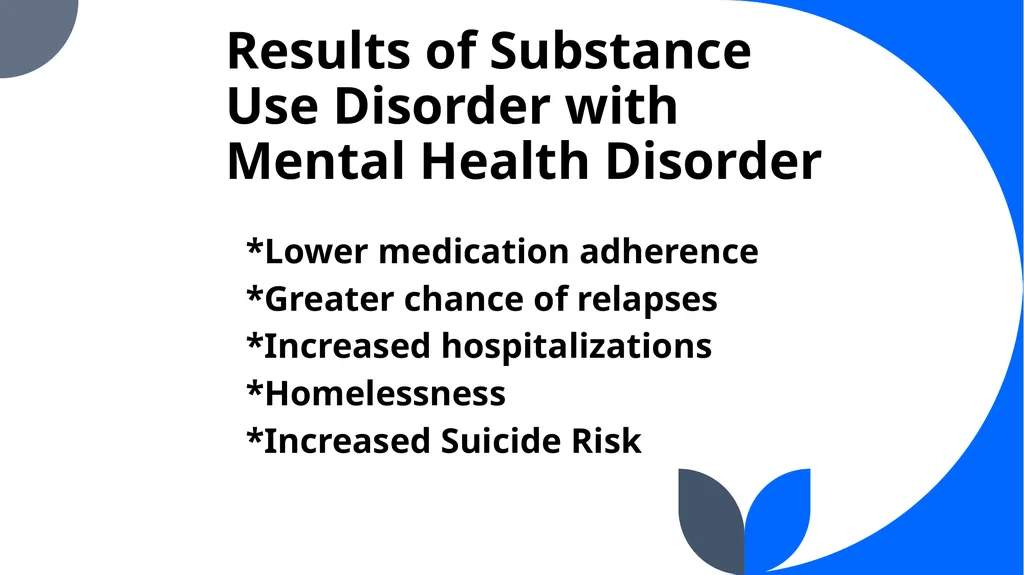
Results of Substance Use Disorder with Mental Health Disorder *Lower medication adherence
*Greater chance of relapses
*Increased hospitalizations
*Homelessness
*Increased Suicide Risk<br>
*Greater chance of relapses
*Increased hospitalizations
*Homelessness
*Increased Suicide Risk<br>
06
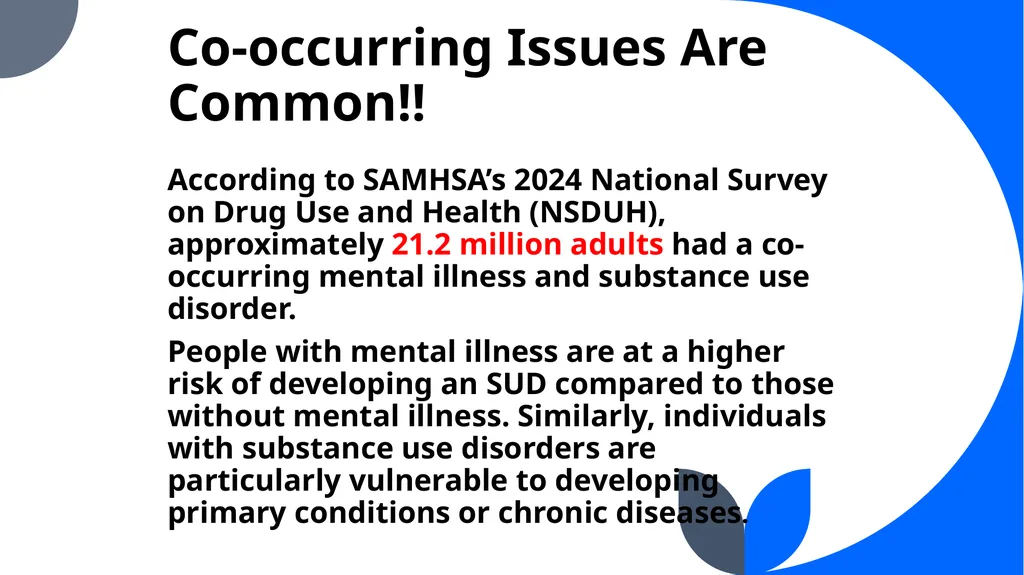
Co-occurring Issues Are Common!! According to SAMHSA’s 2024 National Survey on Drug Use and Health (NSDUH), approximately 21.2 million adults had a co-occurring mental illness and substance use disorder.
People with mental illness are at a higher risk of developing an SUD compared to those without mental illness. Similarly, individuals with substance use disorders are particularly vulnerable to developing primary conditions or chronic diseases.<br>
People with mental illness are at a higher risk of developing an SUD compared to those without mental illness. Similarly, individuals with substance use disorders are particularly vulnerable to developing primary conditions or chronic diseases.<br>
07
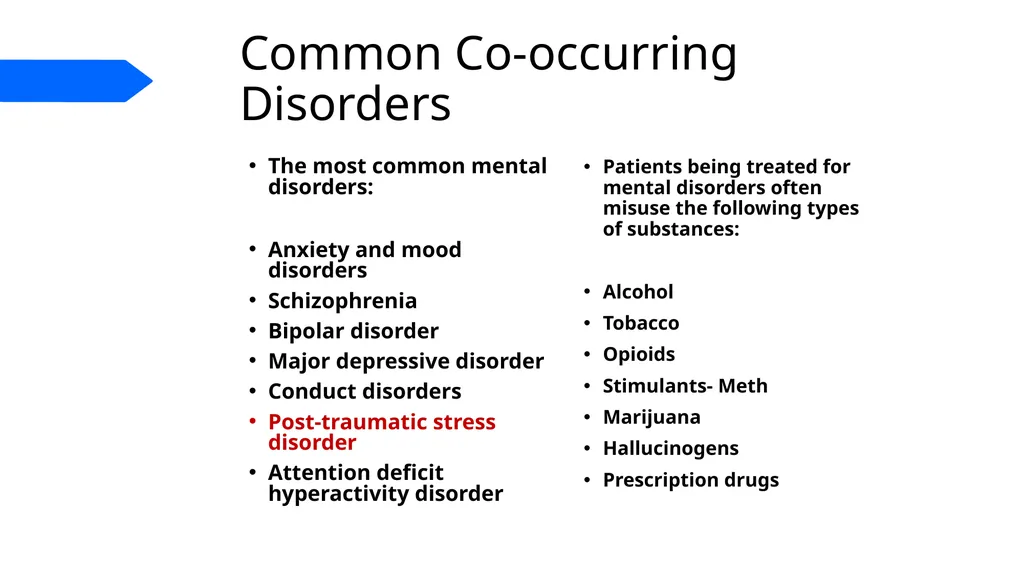
Common Co-occurring Disorders The most common mental disorders:
Anxiety and mood disorders
Schizophrenia
Bipolar disorder
Major depressive disorder
Conduct disorders
Post-traumatic stress disorder
Attention deficit hyperactivity disorder Patients being treated for mental disorders often misuse the following types of substances:
Alcohol
Tobacco
Opioids
Stimulants- Meth
Marijuana
Hallucinogens
Prescription drugs<br>
Anxiety and mood disorders
Schizophrenia
Bipolar disorder
Major depressive disorder
Conduct disorders
Post-traumatic stress disorder
Attention deficit hyperactivity disorder Patients being treated for mental disorders often misuse the following types of substances:
Alcohol
Tobacco
Opioids
Stimulants- Meth
Marijuana
Hallucinogens
Prescription drugs<br>
08
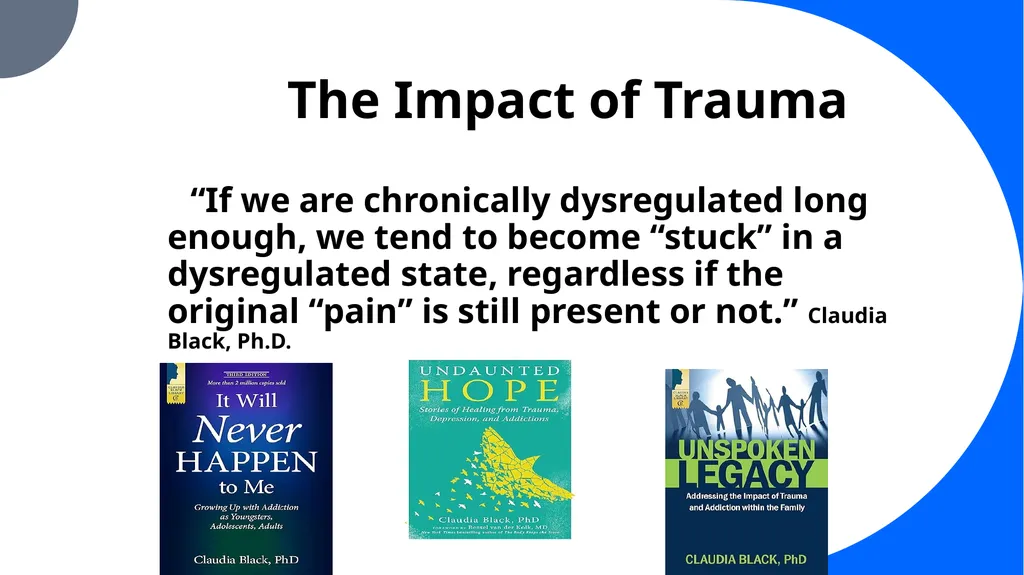
The Impact of Trauma
“If we are chronically dysregulated long enough, we tend to become “stuck” in a dysregulated state, regardless if the original “pain” is still present or not.” Claudia Black, Ph.D.<br>
“If we are chronically dysregulated long enough, we tend to become “stuck” in a dysregulated state, regardless if the original “pain” is still present or not.” Claudia Black, Ph.D.<br>
09
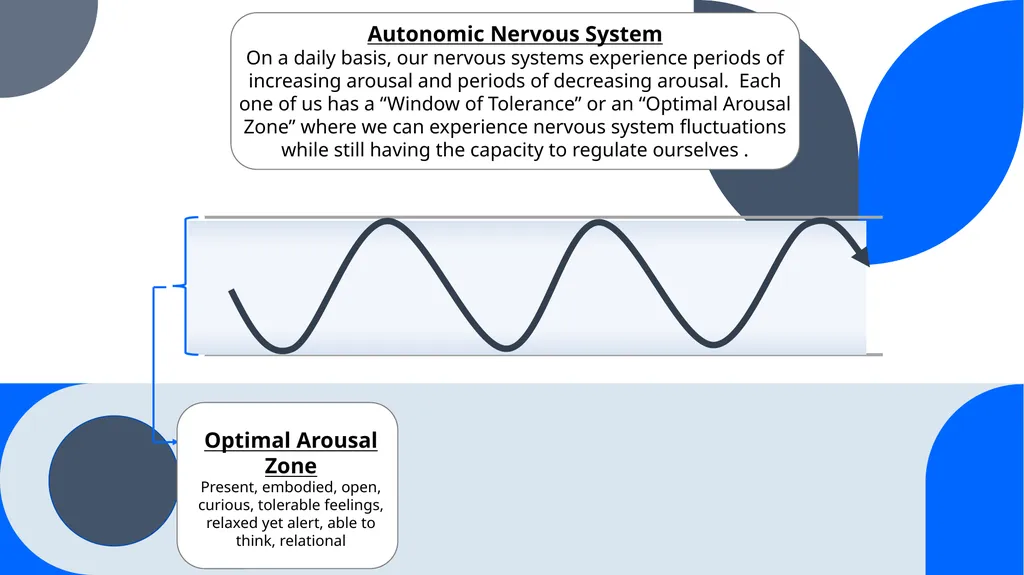
Optimal Arousal Zone
Present, embodied, open,
curious, tolerable feelings,
relaxed yet alert, able to
think, relational Autonomic Nervous System
On a daily basis, our nervous systems experience periods of increasing arousal and periods of decreasing arousal. Each one of us has a “Window of Tolerance” or an “Optimal Arousal Zone” where we can experience nervous system fluctuations while still having the capacity to regulate ourselves .<br>
Present, embodied, open,
curious, tolerable feelings,
relaxed yet alert, able to
think, relational Autonomic Nervous System
On a daily basis, our nervous systems experience periods of increasing arousal and periods of decreasing arousal. Each one of us has a “Window of Tolerance” or an “Optimal Arousal Zone” where we can experience nervous system fluctuations while still having the capacity to regulate ourselves .<br>
10
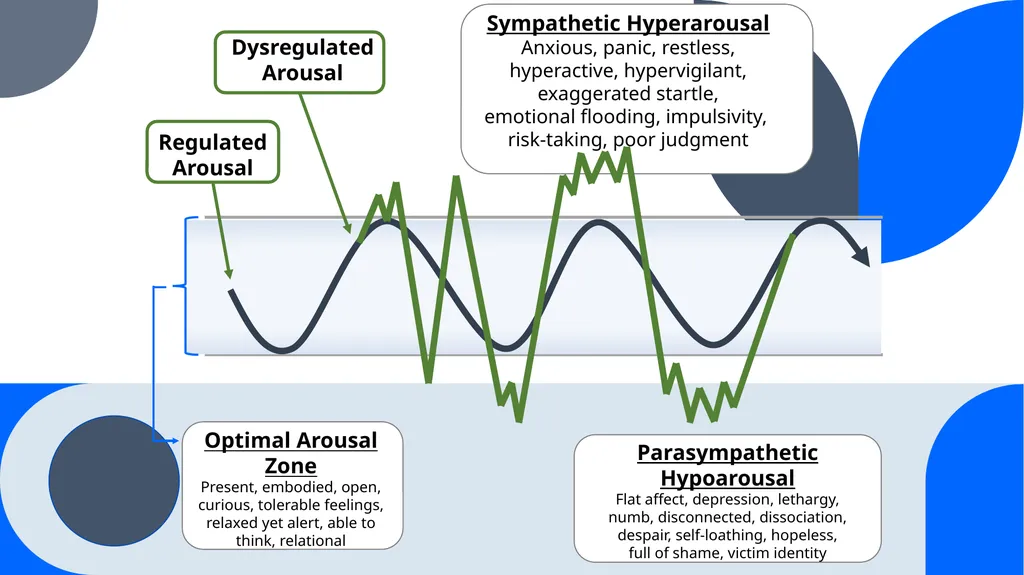
Optimal Arousal Zone
Present, embodied, open,
curious, tolerable feelings,
relaxed yet alert, able to
think, relational Sympathetic Hyperarousal
Anxious, panic, restless, hyperactive, hypervigilant, exaggerated startle,
emotional flooding, impulsivity,
risk-taking, poor judgment Parasympathetic Hypoarousal
Flat affect, depression, lethargy,
numb, disconnected, dissociation,
despair, self-loathing, hopeless,
full of shame, victim identity Regulated
Arousal Dysregulated
Arousal<br>
Present, embodied, open,
curious, tolerable feelings,
relaxed yet alert, able to
think, relational Sympathetic Hyperarousal
Anxious, panic, restless, hyperactive, hypervigilant, exaggerated startle,
emotional flooding, impulsivity,
risk-taking, poor judgment Parasympathetic Hypoarousal
Flat affect, depression, lethargy,
numb, disconnected, dissociation,
despair, self-loathing, hopeless,
full of shame, victim identity Regulated
Arousal Dysregulated
Arousal<br>
11
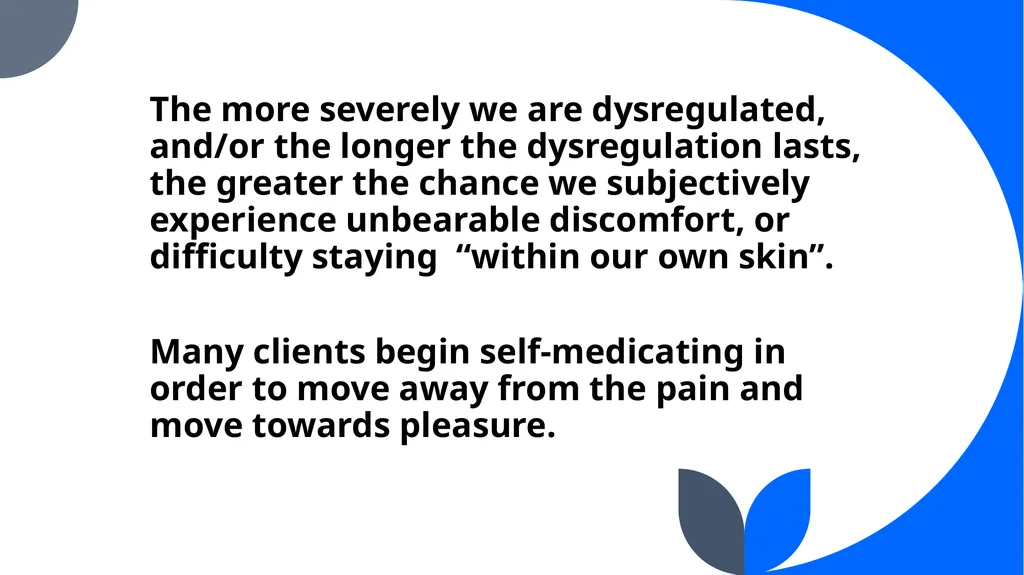
The more severely we are dysregulated, and/or the longer the dysregulation lasts, the greater the chance we subjectively experience unbearable discomfort, or difficulty staying “within our own skin”.
Many clients begin self-medicating in order to move away from the pain and move towards pleasure.<br>
Many clients begin self-medicating in order to move away from the pain and move towards pleasure.<br>
12
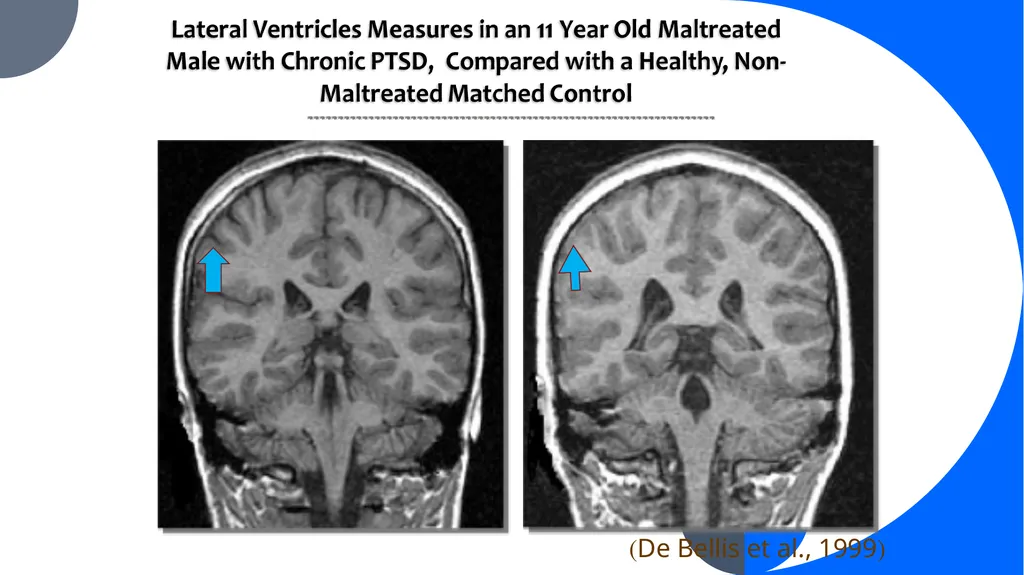
(De Bellis et al., 1999)<br>
13
Long Term Effects of Trauma In the absence of more positive coping strategies, people who have experienced trauma may engage in high risk or destructive behaviors.
These behaviors place them at risk for a range of serious mental and physical health concerns including: Alcohol and Other Drug Use Related Issues, Depression, Suicide Attempts, Sexually Transmitted Diseases, Heart Disease, Cancer, Chronic Lung Disease, Skeletal Fractures.
Give Your Clients an ACES Screening.<br>
These behaviors place them at risk for a range of serious mental and physical health concerns including: Alcohol and Other Drug Use Related Issues, Depression, Suicide Attempts, Sexually Transmitted Diseases, Heart Disease, Cancer, Chronic Lung Disease, Skeletal Fractures.
Give Your Clients an ACES Screening.<br>
14
Trauma Informed Care A definition of trauma-informed approach incorporates three key elements:
(1) Realizing the prevalence of trauma
(2) Recognizing how trauma affects all individuals involved with the program, organization, or system, including its own workforce
(3) Responding by putting this knowledge into practice<br>
(1) Realizing the prevalence of trauma
(2) Recognizing how trauma affects all individuals involved with the program, organization, or system, including its own workforce
(3) Responding by putting this knowledge into practice<br>
15
Universal Precautions as a Core Trauma Informed Concept Presume that every person in your setting has been exposed to abuse, violence, neglect or other traumatic experiences!!!<br>
16
What’s the History?? Sequential Treatment: I’m referred to one form of treatment, and once addressed, I’m referred to another form of treatment. Failed, but common even today.
Parallel Treatment: Treat them at the same time, in two different agencies or sights. If they attempt to talk, it’s called collaborative. This can be productive if everybody stays in consistent contact!!<br>
Parallel Treatment: Treat them at the same time, in two different agencies or sights. If they attempt to talk, it’s called collaborative. This can be productive if everybody stays in consistent contact!!<br>
17
What’s the History “When substance disorder and psychiatric disorder co-exist, each disorder should be considered primary, and integrated dual primary treatment is recommended, where each disorder receives appropriately intensive diagnosis specific treatment.”
(K. Minkoff-”An Integrated Model for the Treatment of People with Co-Occurring Disorders in Managed Care Systems”).<br>
(K. Minkoff-”An Integrated Model for the Treatment of People with Co-Occurring Disorders in Managed Care Systems”).<br>
18
Integrated Treatment: *Provide for both in one place.
*Provider/Treatment team has varied backgrounds.
*Ideally provided by a cross-trained clinician.
*Responsive to the many changing symptoms and disorders of the patient<br>
*Provider/Treatment team has varied backgrounds.
*Ideally provided by a cross-trained clinician.
*Responsive to the many changing symptoms and disorders of the patient<br>
19
Why Integrated Treatment? Among those with co-occurring disorders:
A common cause of psychiatric relapse is resumption of alcohol or drug USE, not necessarily abuse.
A common cause of relapse to alcohol and other drugs is untreated psychiatric disorders, especially depression and anxiety (Kessler, 1996.)<br>
A common cause of psychiatric relapse is resumption of alcohol or drug USE, not necessarily abuse.
A common cause of relapse to alcohol and other drugs is untreated psychiatric disorders, especially depression and anxiety (Kessler, 1996.)<br>
20
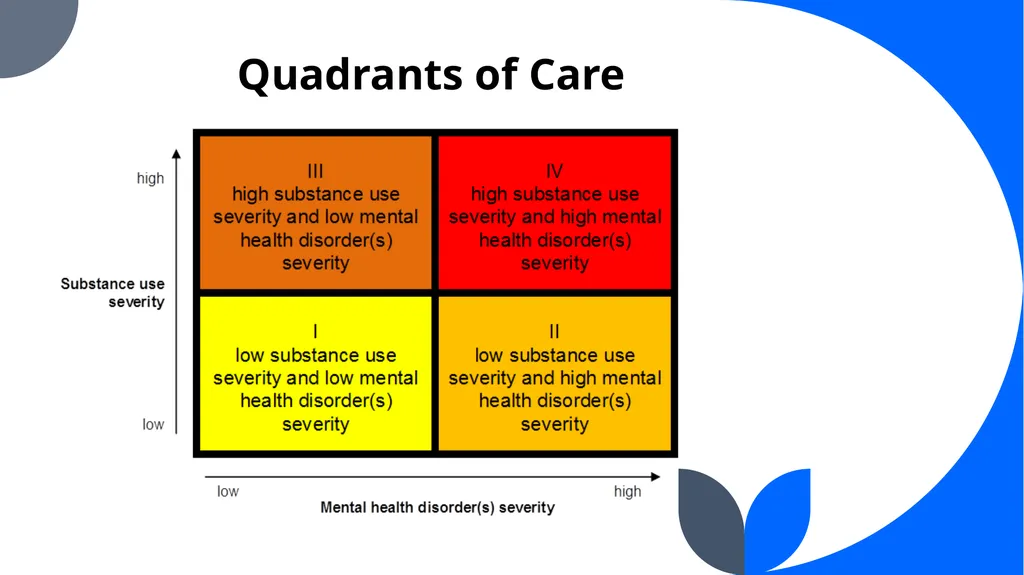
Quadrants of Care<br>
21
Four Quadrants of Co-occurring Disorders Category I: Less severe mental disorder/Less severe substance abuse disorder.
Locus of care: Primary health care settings-Outpatient treatment MH/SA.<br>
Locus of care: Primary health care settings-Outpatient treatment MH/SA.<br>
22
Four Quadrants Category II: More severe mental illness/Less severe substance use disorder.
Locus of care: Mental health system/integrated case mgt.<br>
Locus of care: Mental health system/integrated case mgt.<br>
23
Four Quadrants of
Co-occurring Disorders Category III: Less severe mental disorder/More severe substance abuse disorder.
Locus of Care: Substance abuse system/Coordination and collaboration with affiliated mental health programs.<br>
Locus of Care: Substance abuse system/Coordination and collaboration with affiliated mental health programs.<br>
24
Four Quadrants Category IV: More severe mental disorder/More severe substance abuse disorder.
Locus of care: State hospitals, modified therapeutic communities, jails/prisons, emergency rooms, etc.<br>
Locus of care: State hospitals, modified therapeutic communities, jails/prisons, emergency rooms, etc.<br>
25
Six Guiding Principles in Treating Clients with COD 1. Employ a recovery perspective
Recovery is a long-term process of internal change, and it recognizes that these changes proceed through various stages (Prochaska et al, 1992).
Develop a treatment plan that provides for continuity of care over time. Devise treatment interventions that are specific to the tasks and challenges faced at each stage of the co-occurring disorder recovery process.<br>
Recovery is a long-term process of internal change, and it recognizes that these changes proceed through various stages (Prochaska et al, 1992).
Develop a treatment plan that provides for continuity of care over time. Devise treatment interventions that are specific to the tasks and challenges faced at each stage of the co-occurring disorder recovery process.<br>
26
Six Guiding Principles 2. Adopt a multi-problem viewpoint:
Clients typically have an array of problems.
May need to address housing, work, health care, supportive network, treatment, etc
Substantial rehabilitation and habilitation!<br>
Clients typically have an array of problems.
May need to address housing, work, health care, supportive network, treatment, etc
Substantial rehabilitation and habilitation!<br>
27
Six Guiding Principles 3. Develop a phased approach to treatment:
Clients typically progress through phases; Engagement, stabilization, treatment, aftercare/continuing care, etc.
Use of these phases enables the clinician to develop and use effective, stage-appropriate treatment protocols (SAMHSA, 2005 TIP 42).<br>
Clients typically progress through phases; Engagement, stabilization, treatment, aftercare/continuing care, etc.
Use of these phases enables the clinician to develop and use effective, stage-appropriate treatment protocols (SAMHSA, 2005 TIP 42).<br>
28
Six Guiding Principles 4. Address specific real-life problems early in treatment:
Specialized interventions that target important areas of client need.
Psychosocial rehabilitation, which helps the client develop specific skills and approaches she needs to perform chosen roles.
Solving problems reinforces engagement, a critical part of MH/SA treatment.<br>
Specialized interventions that target important areas of client need.
Psychosocial rehabilitation, which helps the client develop specific skills and approaches she needs to perform chosen roles.
Solving problems reinforces engagement, a critical part of MH/SA treatment.<br>
29
Six Guiding Principles 5. Plan for the client’s cognitive and functional impairments:
Patients with COD often have difficulty comprehending information or completing tasks.
Gradual pacing, visual aids, and repetition are beneficial.
Important to assess for these deficits and treatment plan accordingly.<br>
Patients with COD often have difficulty comprehending information or completing tasks.
Gradual pacing, visual aids, and repetition are beneficial.
Important to assess for these deficits and treatment plan accordingly.<br>
30
Six Guiding Principles 6. Use support systems to maintain and extend treatment effectiveness:
AA/NA/Double Trouble/In Our Own Voices groups.
Family, faith community.
COD issues can “burn bridges” with family, community, etc
Clinicians play a role in educating patients of available support systems.<br>
AA/NA/Double Trouble/In Our Own Voices groups.
Family, faith community.
COD issues can “burn bridges” with family, community, etc
Clinicians play a role in educating patients of available support systems.<br>
31
Parallel Phases of Recovery Both mental illness and addiction can be treated within the philosophical framework of a “disease and recovery model” (Minkoff, 1989).
With parallel phases of recovery
-Acute stabilization
-Motivational enhancement
-Active treatment
-Relapse prevention
-Rehabilitation (recovery), in which interventions are not only diagnosis-specific, but also specific to phase of recovery and stage of change.<br>
With parallel phases of recovery
-Acute stabilization
-Motivational enhancement
-Active treatment
-Relapse prevention
-Rehabilitation (recovery), in which interventions are not only diagnosis-specific, but also specific to phase of recovery and stage of change.<br>
32
Parallels in Recovery & Relapse thinking between Comorbid Disorders “May as well thinking” vs. “It matters what you do”
*Abstinence violation effect vs. stopping taking psychiatric meds when anxious or depressed
*Recovery thinking vs. relapse thinking & acting out
*Remember: you’re always on the road to getting better or getting worse: “It matters what you do!”<br>
*Abstinence violation effect vs. stopping taking psychiatric meds when anxious or depressed
*Recovery thinking vs. relapse thinking & acting out
*Remember: you’re always on the road to getting better or getting worse: “It matters what you do!”<br>
33
STIMULANT PSYCHOSIS Because of the high toxicity of meth, the debilitating effects often persist after extended periods of abstinence. As a result, the cognitive deficits (which are not easy to detect in abstinence) affect how individuals respond to treatment, which is a highly didactic and educational experience.
Therefore, treatment modalities and interventions must be tailored to address the individuals’ unique cognitive and emotional deficits and co-occurring psychiatric and medical disorders.
Gold, Mark. “Methamphetamine Psychosis and Schizophrenia”. Research You Can Use, January 11, 2018.<br>
Therefore, treatment modalities and interventions must be tailored to address the individuals’ unique cognitive and emotional deficits and co-occurring psychiatric and medical disorders.
Gold, Mark. “Methamphetamine Psychosis and Schizophrenia”. Research You Can Use, January 11, 2018.<br>
34
DEVELOPING THE PREFRONTAL CORTEX EXECUTIVE FUNCTIONING EDUCATION
Why give someone with an SUD a 60-minute didactic or video?
A new format!!
*15-20 minute simple didactic
*How to participate in treatment
*10-minute questionnaire
*30-minute discussion group<br>
Why give someone with an SUD a 60-minute didactic or video?
A new format!!
*15-20 minute simple didactic
*How to participate in treatment
*10-minute questionnaire
*30-minute discussion group<br>
35
DEVELOPING THE PREFRONTAL CORTEX EXECUTIVE FUNCTIONING
– Jig saw puzzles, cross word puzzles, etc.
Certain computer games that are nonviolent but demand attention and delayed gratification.
– The puzzles and computer games can be competitive in nature leading to a discussion on winning and losing or maybe the losing team waits on the winning team at dinner, etc<br>
– Jig saw puzzles, cross word puzzles, etc.
Certain computer games that are nonviolent but demand attention and delayed gratification.
– The puzzles and computer games can be competitive in nature leading to a discussion on winning and losing or maybe the losing team waits on the winning team at dinner, etc<br>
36
ENHANCING RELATIONAL ABILITIES – Group oriented program
– Physical exercise: Break a Sweat Daily!
– Ropes course
– Alcoholics Anonymous, Narcotics Anonymous, Crystal Meth Anonymous, Double Trouble Groups.
– Sponsorship
– Therapeutic Relationship<br>
– Physical exercise: Break a Sweat Daily!
– Ropes course
– Alcoholics Anonymous, Narcotics Anonymous, Crystal Meth Anonymous, Double Trouble Groups.
– Sponsorship
– Therapeutic Relationship<br>
37
DEVELOPING THE PREFRONTAL CORTEX YOU/WE ARE NEUROPLASTICIANS!
WHAT ENHANCES PLASTICITY?
*NOVELTY Does!!
*THERAPEUTIC RELATIONSHIPS
*PHYSICAL EXERCISE
*MINDFULNESS ACTIVITIES<br>
WHAT ENHANCES PLASTICITY?
*NOVELTY Does!!
*THERAPEUTIC RELATIONSHIPS
*PHYSICAL EXERCISE
*MINDFULNESS ACTIVITIES<br>
38
Benefits of Mindfulness Practices Reduced rumination
Stress reduction
Boosts working memory
Focus
Less emotional reactivity
More cognitive flexibility
Relationship satisfaction
Health benefits such as: ▪ increased immune functioning ▪ reduced psychological distress ▪ increased information processing speed<br>
Stress reduction
Boosts working memory
Focus
Less emotional reactivity
More cognitive flexibility
Relationship satisfaction
Health benefits such as: ▪ increased immune functioning ▪ reduced psychological distress ▪ increased information processing speed<br>
39
References/Resources SAMHSA’s 2024 National Survey on Drug Use and Health
Claudia Black, Ph.D.
(De Bellis et al., 1999)
(Christine Curtois and Julian Ford, “Treating Complex Traumatic Stress Disorders,” 2009)
(Fallot & Harris, 2002;Cook et al., 2002; Ford, 2003; Cusak et al; Jennings, 1998;, Prescott, 2000).
Dual Diagnosis: An Integrated Model.. Kenneth Minkoff, M.D., 2002
K. Minkoff-”An Integrated Model for the Treatment of People with Co-Occurring Disorders in Managed Care Systems”
Co-occurring Disorders: A current review. Kessler, et al., 1994 Archives of General Psychiatry
SAMHSA/CSAT: Substance Abuse Treatment for Persons With Co-Occurring Disorders TIP 42, 2005
Gold, Mark. “Methamphetamine Psychosis and Schizophrenia”. Research You Can Use, January 11, 2018.
Pope, 1979., P.74
Clifton Mitchell, 2006
SAMHSA- http://modelprograms.samhsa.gov/
Society for Adolescent Substance Abuse Treatment Effectiveness (SASATE) http://www.chestnut.org
The National Institute of Drug Abuse (NIDA) www.nida.nih.gov
National Institute on Alcohol Abuse and Alcoholism www.niaaa.nih.gov.
The National Child Traumatic Stress network- www.nctsn.org.<br>
Claudia Black, Ph.D.
(De Bellis et al., 1999)
(Christine Curtois and Julian Ford, “Treating Complex Traumatic Stress Disorders,” 2009)
(Fallot & Harris, 2002;Cook et al., 2002; Ford, 2003; Cusak et al; Jennings, 1998;, Prescott, 2000).
Dual Diagnosis: An Integrated Model.. Kenneth Minkoff, M.D., 2002
K. Minkoff-”An Integrated Model for the Treatment of People with Co-Occurring Disorders in Managed Care Systems”
Co-occurring Disorders: A current review. Kessler, et al., 1994 Archives of General Psychiatry
SAMHSA/CSAT: Substance Abuse Treatment for Persons With Co-Occurring Disorders TIP 42, 2005
Gold, Mark. “Methamphetamine Psychosis and Schizophrenia”. Research You Can Use, January 11, 2018.
Pope, 1979., P.74
Clifton Mitchell, 2006
SAMHSA- http://modelprograms.samhsa.gov/
Society for Adolescent Substance Abuse Treatment Effectiveness (SASATE) http://www.chestnut.org
The National Institute of Drug Abuse (NIDA) www.nida.nih.gov
National Institute on Alcohol Abuse and Alcoholism www.niaaa.nih.gov.
The National Child Traumatic Stress network- www.nctsn.org.<br>
40
Questions, comments, concerns?? Thank You!!!
Geoff Wilson, LCSW, LCADC, CCS
The Offices of Paul Dalton/Lexington Counseling & Psychiatry
501 Darby Creek, Suite 11
Lexington, KY 40509
859.229.5722
geoffwilson914@gmail.com<br>
Geoff Wilson, LCSW, LCADC, CCS
The Offices of Paul Dalton/Lexington Counseling & Psychiatry
501 Darby Creek, Suite 11
Lexington, KY 40509
859.229.5722
geoffwilson914@gmail.com<br>