
Cohort studies Training course in research
JO
Published · 31 slides · 0 views

1 / 1


Description
Cohort studies Training course in research methodology, research protocol development and scientific writing Geneva 2023 Nguyen Thi My Huong, MD PhD WHOSRHRSIS OUTLINE Overview Definitions Study design Basic measures Advantages and
Related Topics
Share
Embed code
Download this presentation From Below
"Cohort studies Training course in research" is the property of its rightful owner. Permission is granted to download and print the materials on this website for personal, non-commercial use only, and to display it on your personal computer provided you do not modify the materials and that you retain all copyright notices contained in the materials. By downloading content from our website, you accept the terms of this agreement.
Presentation Transcript
01
Cohort studies
Training course in research methodology, research protocol development and scientific writing
Geneva 2023
Nguyen Thi My Huong, MD PhD
WHO/SRHR/SIS<br>
02
OUTLINE Overview
Definitions
Study design
Basic measures
Advantages and disadvantages
When to apply a cohort design
Practical considerations<br>
Definitions
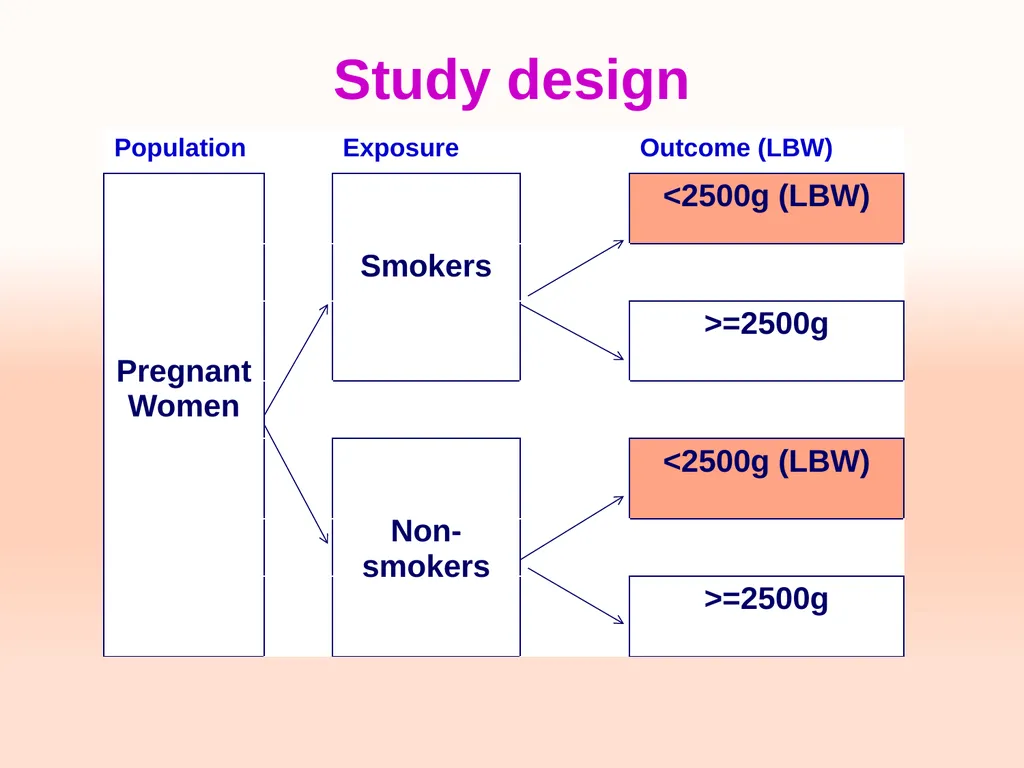
Study design
Basic measures
Advantages and disadvantages
When to apply a cohort design
Practical considerations<br>
03
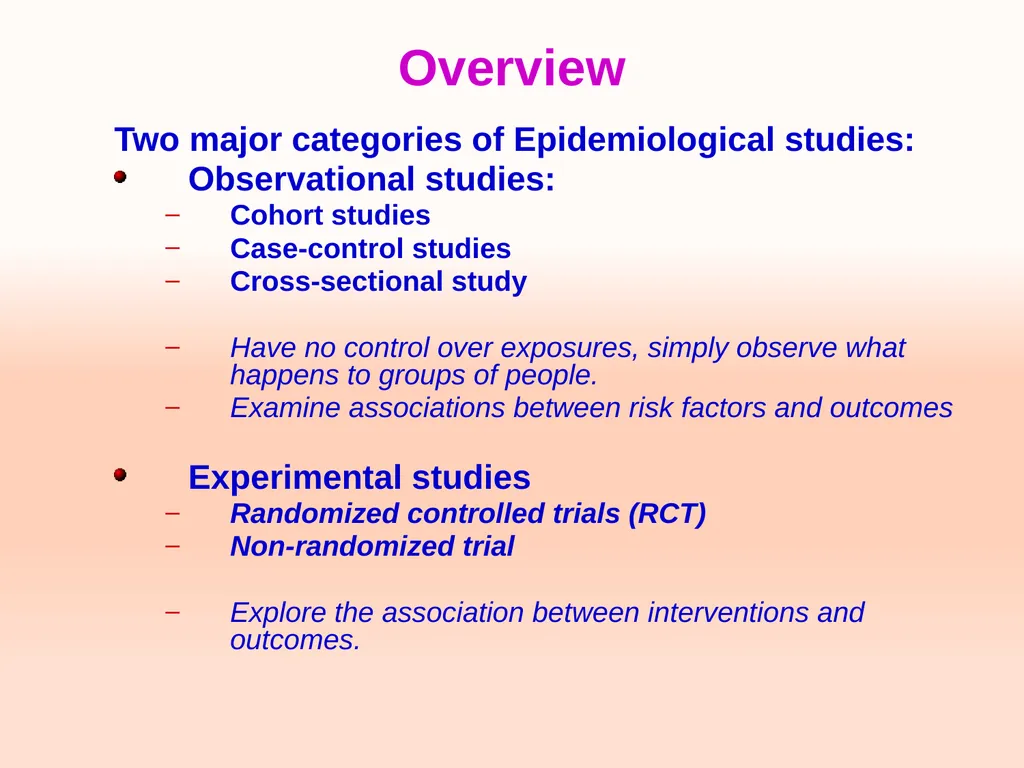
Overview Two major categories of Epidemiological studies:
Observational studies:
Cohort studies
Case-control studies
Cross-sectional study
Have no control over exposures, simply observe what happens to groups of people.
Examine associations between risk factors and outcomes
Experimental studies
Randomized controlled trials (RCT)
Non-randomized trial
Explore the association between interventions and outcomes.<br>
Observational studies:
Cohort studies
Case-control studies
Cross-sectional study
Have no control over exposures, simply observe what happens to groups of people.
Examine associations between risk factors and outcomes
Experimental studies
Randomized controlled trials (RCT)
Non-randomized trial
Explore the association between interventions and outcomes.<br>
04
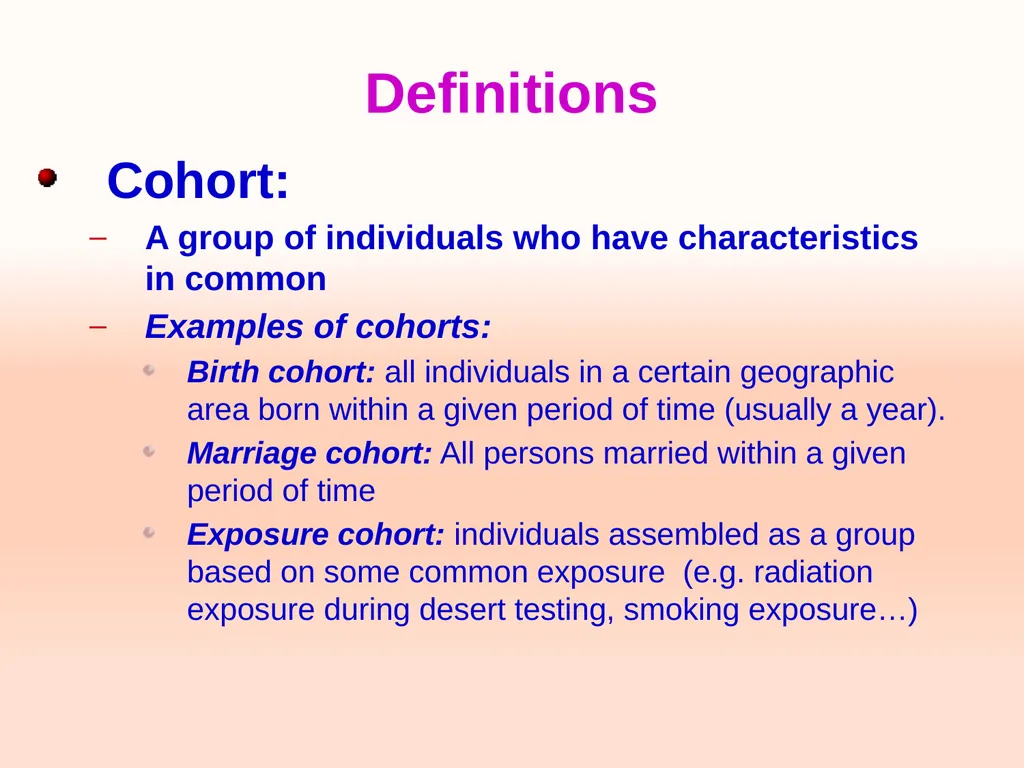
Definitions Cohort:
A group of individuals who have characteristics in common
Examples of cohorts:
Birth cohort: all individuals in a certain geographic area born within a given period of time (usually a year).
Marriage cohort: All persons married within a given period of time
Exposure cohort: individuals assembled as a group based on some common exposure (e.g. radiation exposure during desert testing, smoking exposure…)<br>
A group of individuals who have characteristics in common
Examples of cohorts:
Birth cohort: all individuals in a certain geographic area born within a given period of time (usually a year).
Marriage cohort: All persons married within a given period of time
Exposure cohort: individuals assembled as a group based on some common exposure (e.g. radiation exposure during desert testing, smoking exposure…)<br>
05
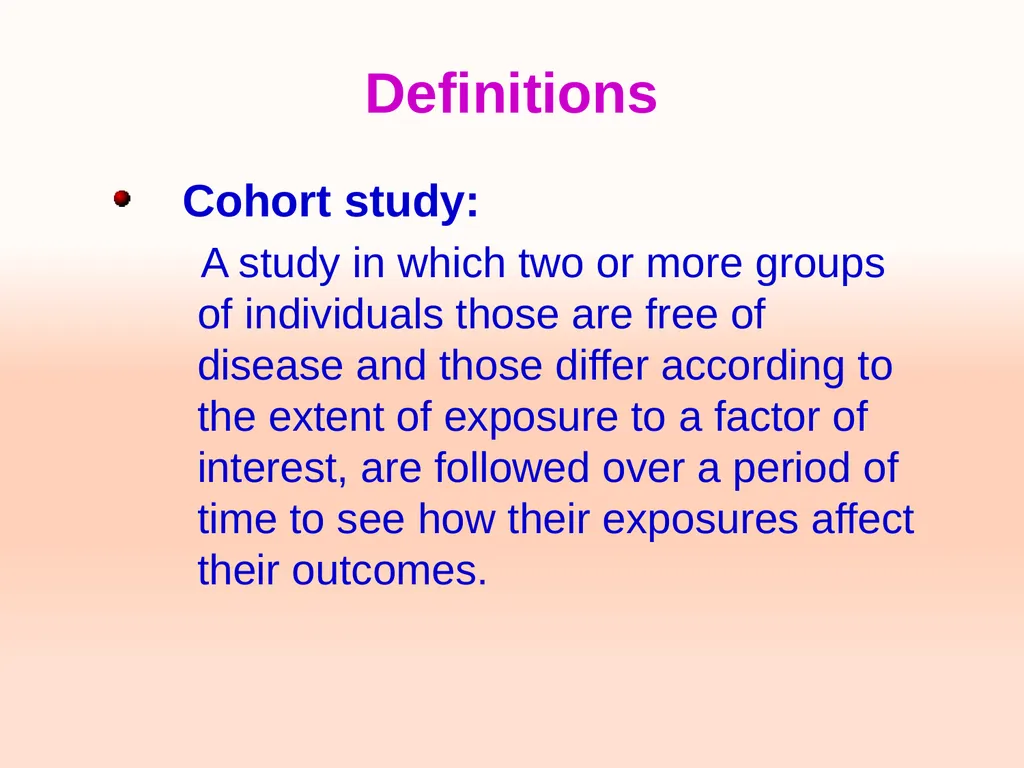
Definitions Cohort study:
A study in which two or more groups of individuals those are free of disease and those differ according to the extent of exposure to a factor of interest, are followed over a period of time to see how their exposures affect their outcomes.<br>
A study in which two or more groups of individuals those are free of disease and those differ according to the extent of exposure to a factor of interest, are followed over a period of time to see how their exposures affect their outcomes.<br>
06
Study design<br>
07
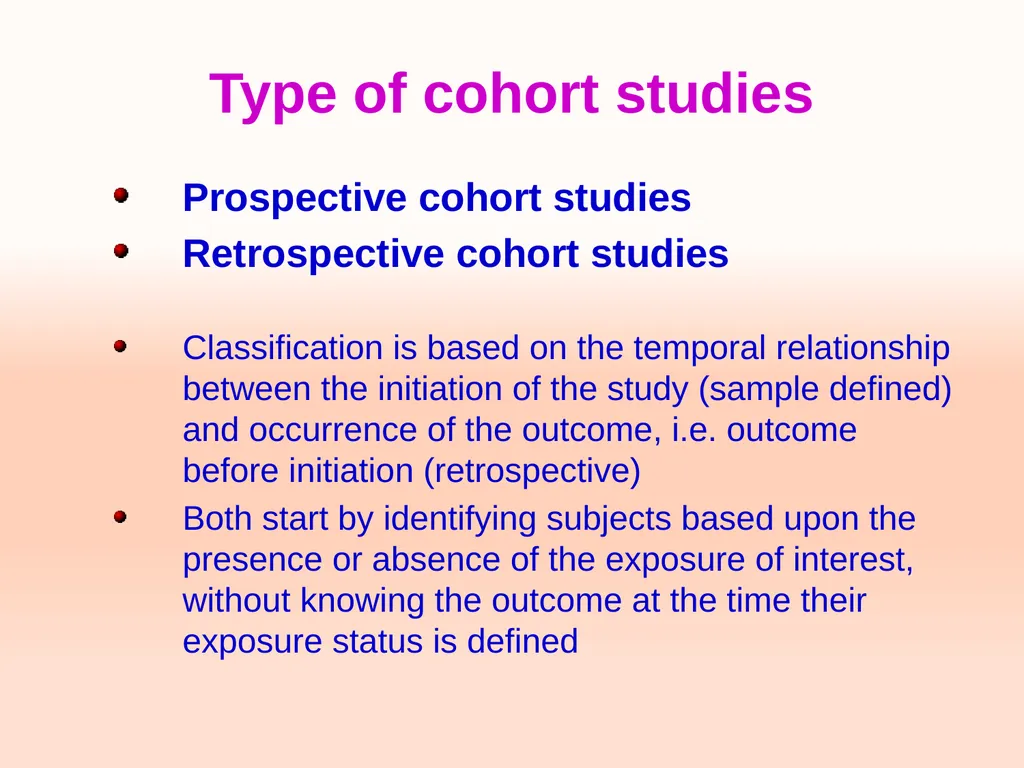
Type of cohort studies Prospective cohort studies
Retrospective cohort studies
Classification is based on the temporal relationship between the initiation of the study (sample defined) and occurrence of the outcome, i.e. outcome before initiation (retrospective)
Both start by identifying subjects based upon the presence or absence of the exposure of interest, without knowing the outcome at the time their exposure status is defined<br>
Retrospective cohort studies
Classification is based on the temporal relationship between the initiation of the study (sample defined) and occurrence of the outcome, i.e. outcome before initiation (retrospective)
Both start by identifying subjects based upon the presence or absence of the exposure of interest, without knowing the outcome at the time their exposure status is defined<br>
08
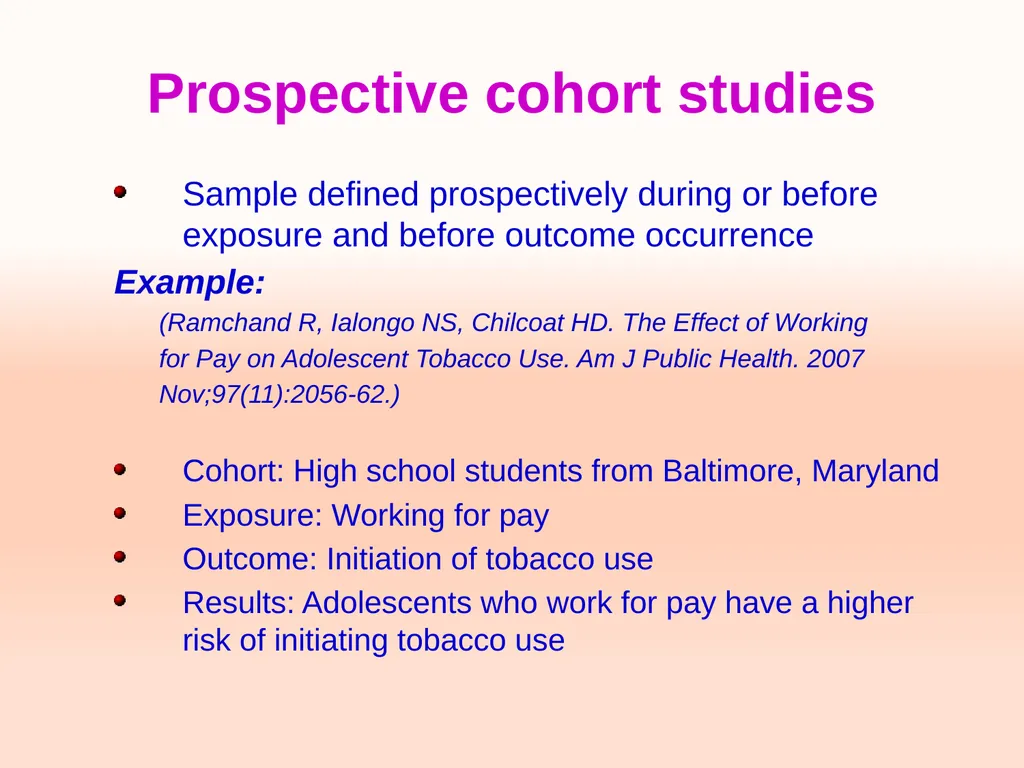
Prospective cohort studies Sample defined prospectively during or before exposure and before outcome occurrence
Example:
(Ramchand R, Ialongo NS, Chilcoat HD. The Effect of Working
for Pay on Adolescent Tobacco Use. Am J Public Health. 2007
Nov;97(11):2056-62.)
Cohort: High school students from Baltimore, Maryland
Exposure: Working for pay
Outcome: Initiation of tobacco use
Results: Adolescents who work for pay have a higher risk of initiating tobacco use<br>
Example:
(Ramchand R, Ialongo NS, Chilcoat HD. The Effect of Working
for Pay on Adolescent Tobacco Use. Am J Public Health. 2007
Nov;97(11):2056-62.)
Cohort: High school students from Baltimore, Maryland
Exposure: Working for pay
Outcome: Initiation of tobacco use
Results: Adolescents who work for pay have a higher risk of initiating tobacco use<br>
09
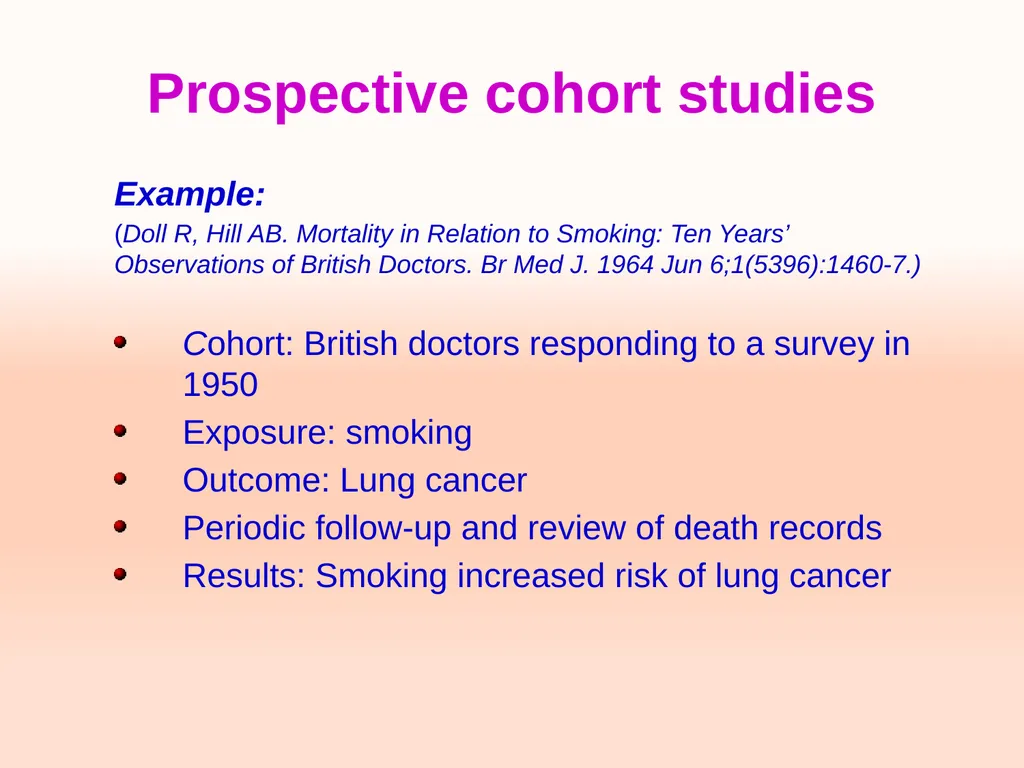
Prospective cohort studies Example:
(Doll R, Hill AB. Mortality in Relation to Smoking: Ten Years’ Observations of British Doctors. Br Med J. 1964 Jun 6;1(5396):1460-7.)
Cohort: British doctors responding to a survey in 1950
Exposure: smoking
Outcome: Lung cancer
Periodic follow-up and review of death records
Results: Smoking increased risk of lung cancer<br>
(Doll R, Hill AB. Mortality in Relation to Smoking: Ten Years’ Observations of British Doctors. Br Med J. 1964 Jun 6;1(5396):1460-7.)
Cohort: British doctors responding to a survey in 1950
Exposure: smoking
Outcome: Lung cancer
Periodic follow-up and review of death records
Results: Smoking increased risk of lung cancer<br>
10
Prospective cohort studies Example:
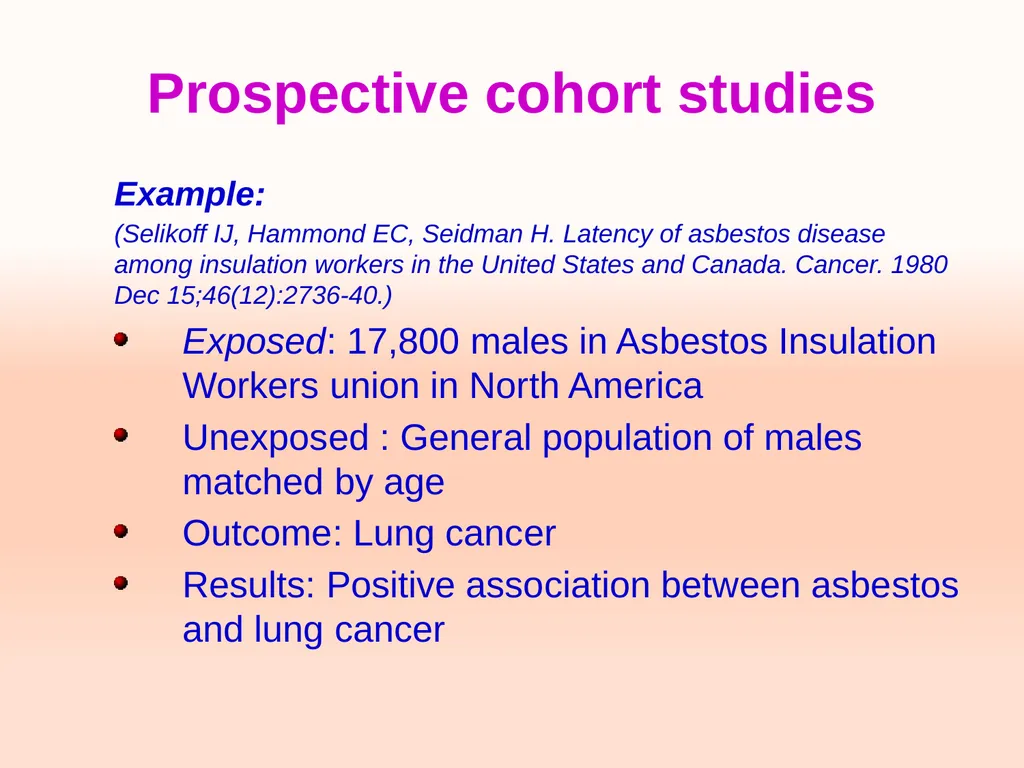
(Selikoff IJ, Hammond EC, Seidman H. Latency of asbestos disease among insulation workers in the United States and Canada. Cancer. 1980 Dec 15;46(12):2736-40.)
Exposed: 17,800 males in Asbestos Insulation Workers union in North America
Unexposed : General population of males matched by age
Outcome: Lung cancer
Results: Positive association between asbestos and lung cancer<br>
(Selikoff IJ, Hammond EC, Seidman H. Latency of asbestos disease among insulation workers in the United States and Canada. Cancer. 1980 Dec 15;46(12):2736-40.)
Exposed: 17,800 males in Asbestos Insulation Workers union in North America
Unexposed : General population of males matched by age
Outcome: Lung cancer
Results: Positive association between asbestos and lung cancer<br>
11
Prospective cohort studies Example:
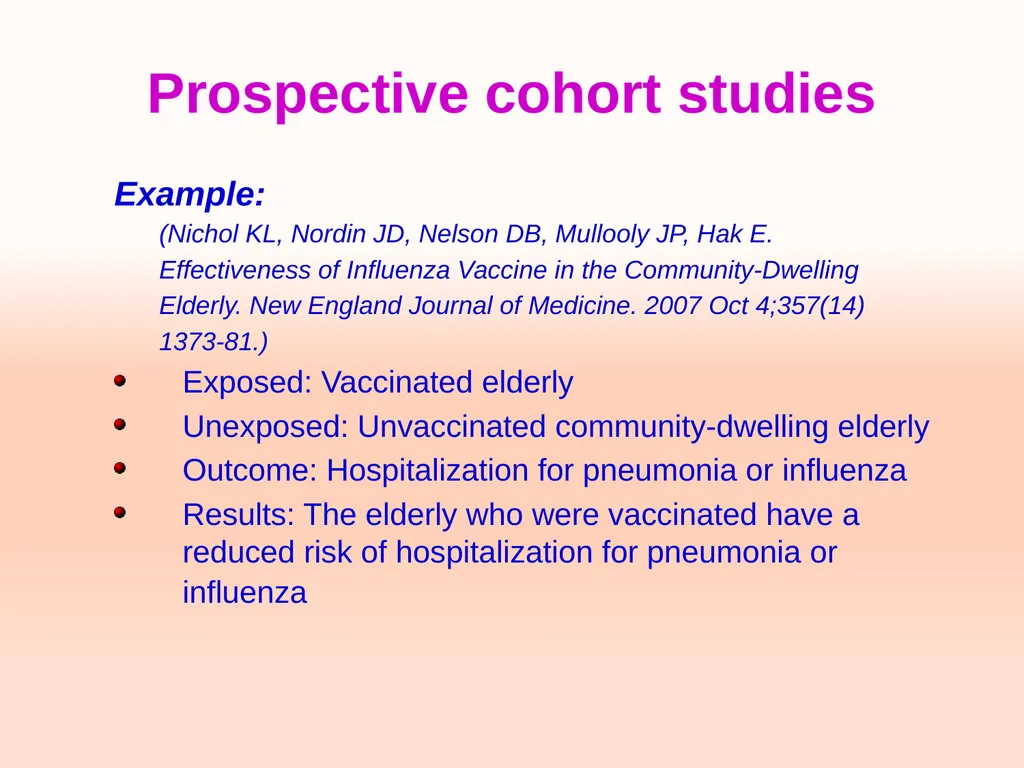
(Nichol KL, Nordin JD, Nelson DB, Mullooly JP, Hak E.
Effectiveness of Influenza Vaccine in the Community-Dwelling
Elderly. New England Journal of Medicine. 2007 Oct 4;357(14)
1373-81.)
Exposed: Vaccinated elderly
Unexposed: Unvaccinated community-dwelling elderly
Outcome: Hospitalization for pneumonia or influenza
Results: The elderly who were vaccinated have a reduced risk of hospitalization for pneumonia or influenza<br>
(Nichol KL, Nordin JD, Nelson DB, Mullooly JP, Hak E.
Effectiveness of Influenza Vaccine in the Community-Dwelling
Elderly. New England Journal of Medicine. 2007 Oct 4;357(14)
1373-81.)
Exposed: Vaccinated elderly
Unexposed: Unvaccinated community-dwelling elderly
Outcome: Hospitalization for pneumonia or influenza
Results: The elderly who were vaccinated have a reduced risk of hospitalization for pneumonia or influenza<br>
12
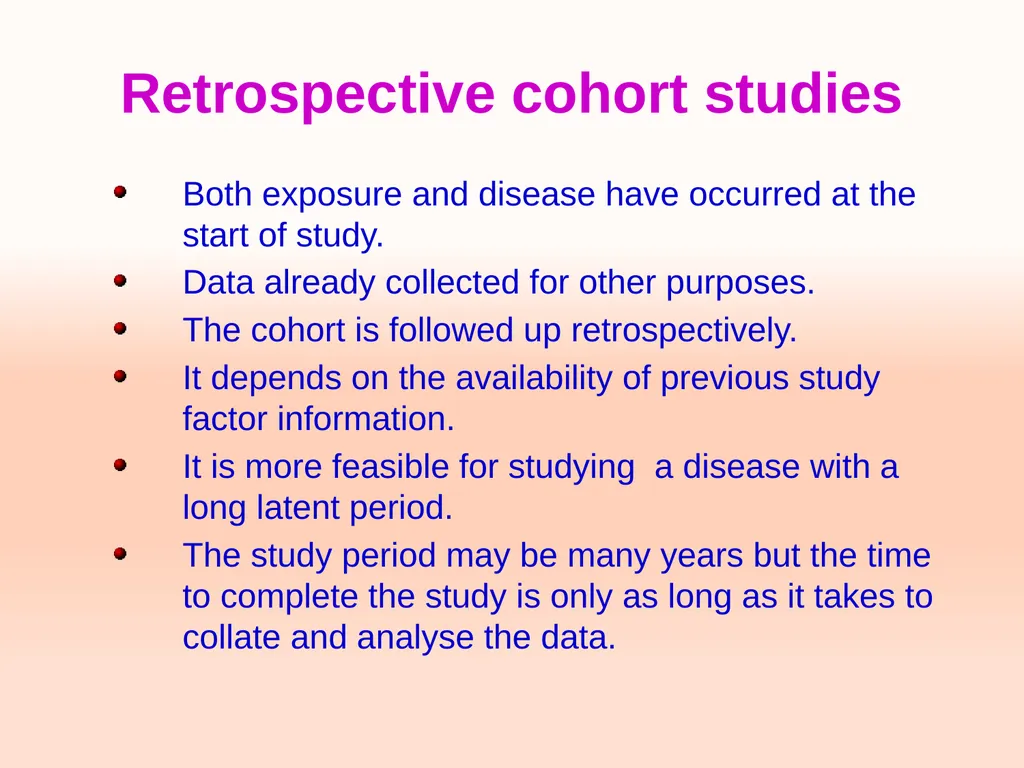
Retrospective cohort studies Both exposure and disease have occurred at the start of study.
Data already collected for other purposes.
The cohort is followed up retrospectively.
It depends on the availability of previous study factor information.
It is more feasible for studying a disease with a long latent period.
The study period may be many years but the time to complete the study is only as long as it takes to collate and analyse the data.<br>
Data already collected for other purposes.
The cohort is followed up retrospectively.
It depends on the availability of previous study factor information.
It is more feasible for studying a disease with a long latent period.
The study period may be many years but the time to complete the study is only as long as it takes to collate and analyse the data.<br>
13
Retrospective cohort studies Example:
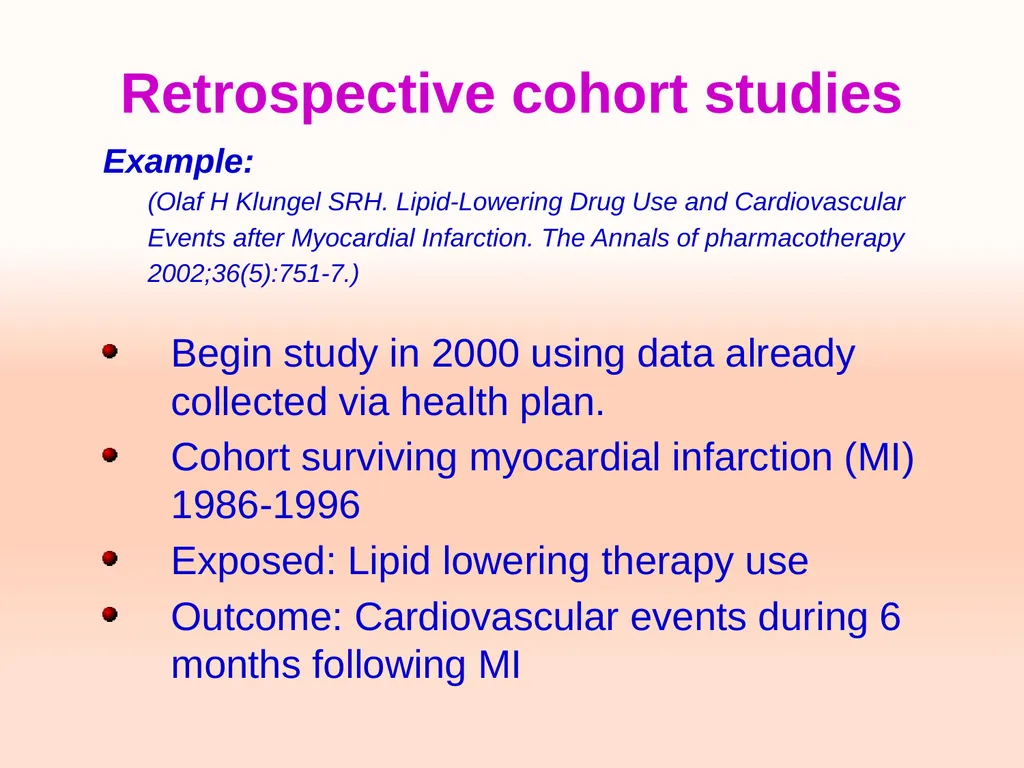
(Olaf H Klungel SRH. Lipid-Lowering Drug Use and Cardiovascular
Events after Myocardial Infarction. The Annals of pharmacotherapy
2002;36(5):751-7.)
Begin study in 2000 using data already collected via health plan.
Cohort surviving myocardial infarction (MI) 1986-1996
Exposed: Lipid lowering therapy use
Outcome: Cardiovascular events during 6 months following MI<br>
(Olaf H Klungel SRH. Lipid-Lowering Drug Use and Cardiovascular
Events after Myocardial Infarction. The Annals of pharmacotherapy
2002;36(5):751-7.)
Begin study in 2000 using data already collected via health plan.
Cohort surviving myocardial infarction (MI) 1986-1996
Exposed: Lipid lowering therapy use
Outcome: Cardiovascular events during 6 months following MI<br>
14
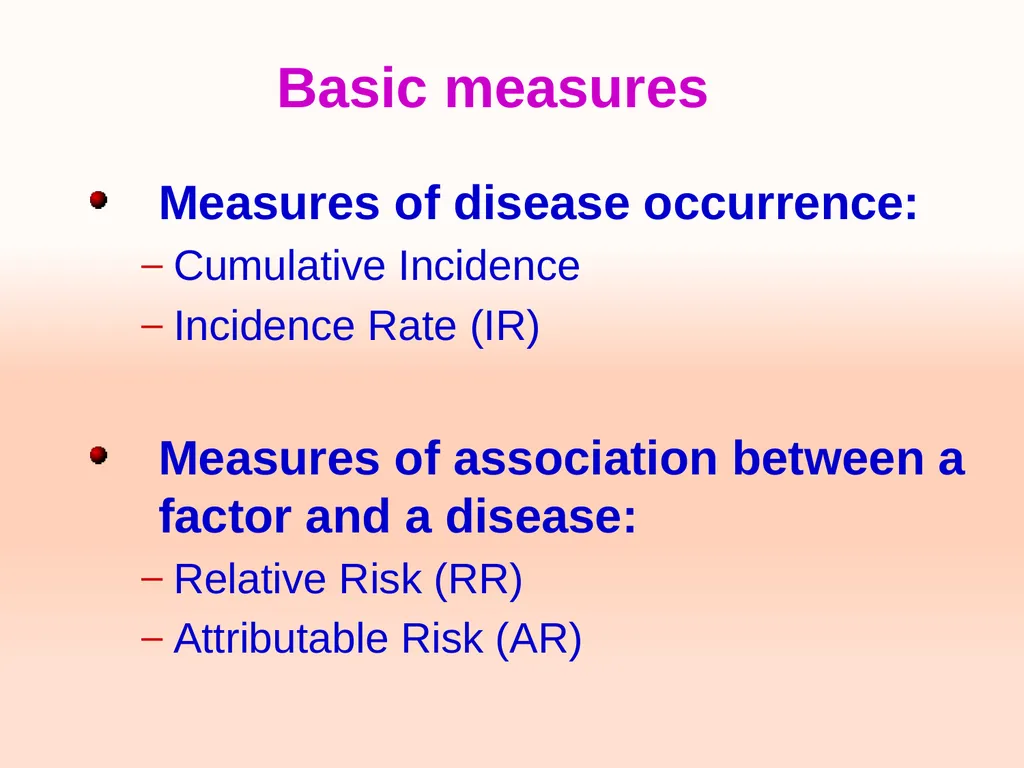
Basic measures Measures of disease occurrence:
Cumulative Incidence
Incidence Rate (IR)
Measures of association between a factor and a disease:
Relative Risk (RR)
Attributable Risk (AR)<br>
Cumulative Incidence
Incidence Rate (IR)
Measures of association between a factor and a disease:
Relative Risk (RR)
Attributable Risk (AR)<br>
15
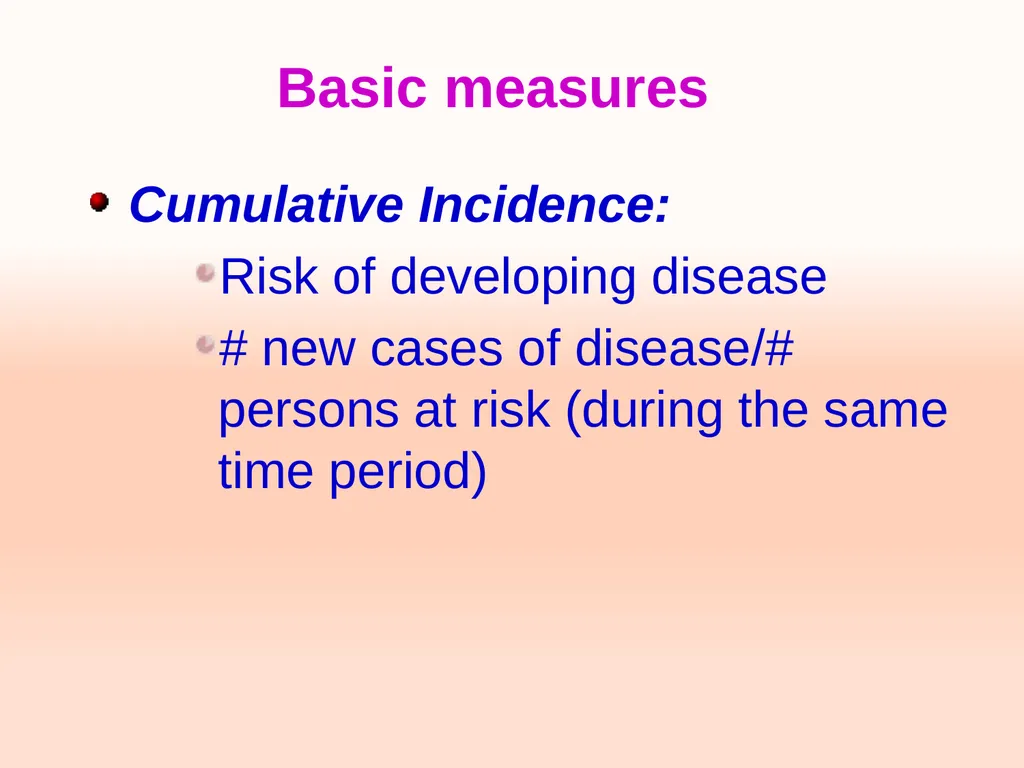
Basic measures Cumulative Incidence:
Risk of developing disease
# new cases of disease/# persons at risk (during the same time period)<br>
Risk of developing disease
# new cases of disease/# persons at risk (during the same time period)<br>
16
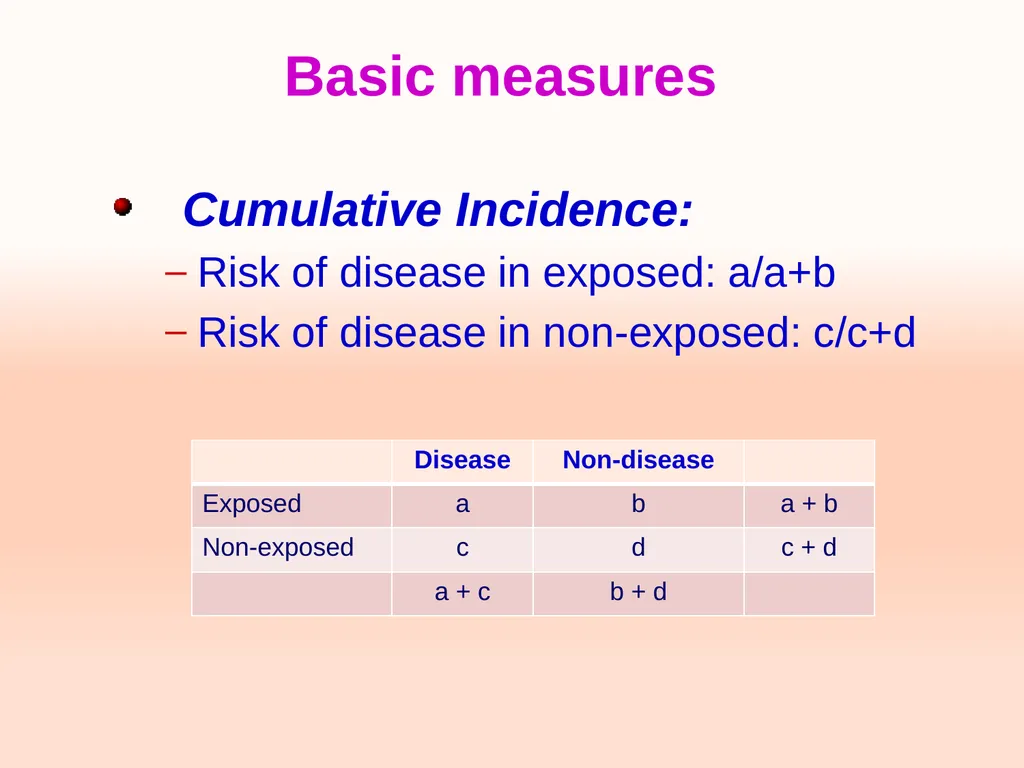
Basic measures Cumulative Incidence:
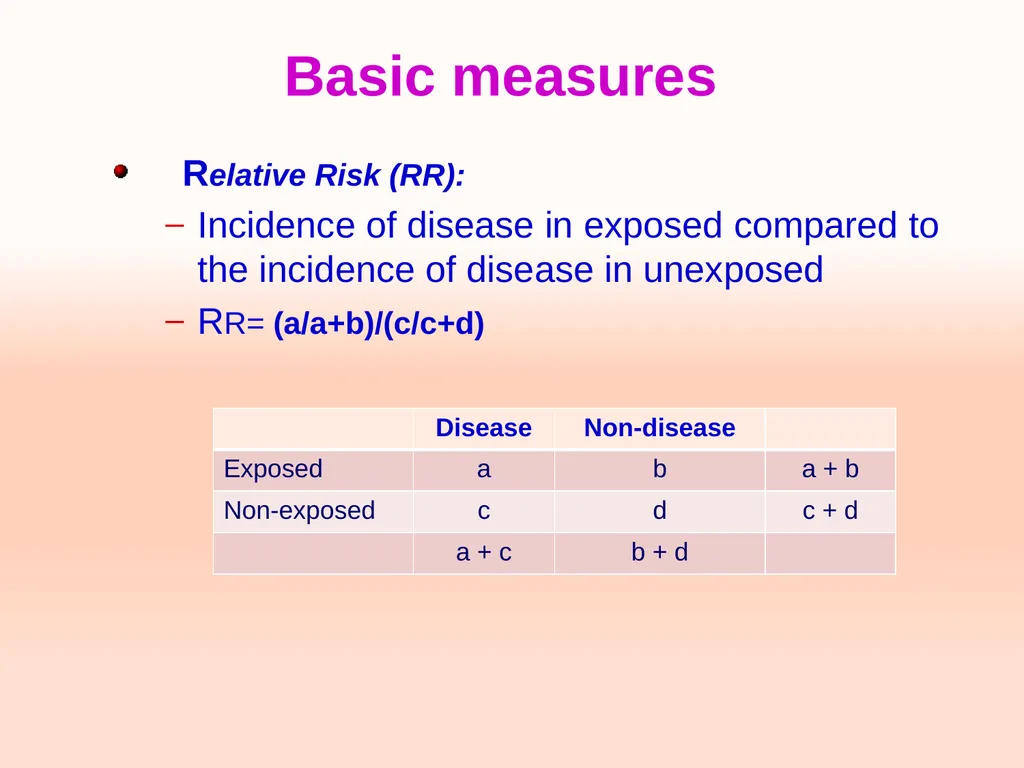
Risk of disease in exposed: a/a+b
Risk of disease in non-exposed: c/c+d<br>
Risk of disease in exposed: a/a+b
Risk of disease in non-exposed: c/c+d<br>
17
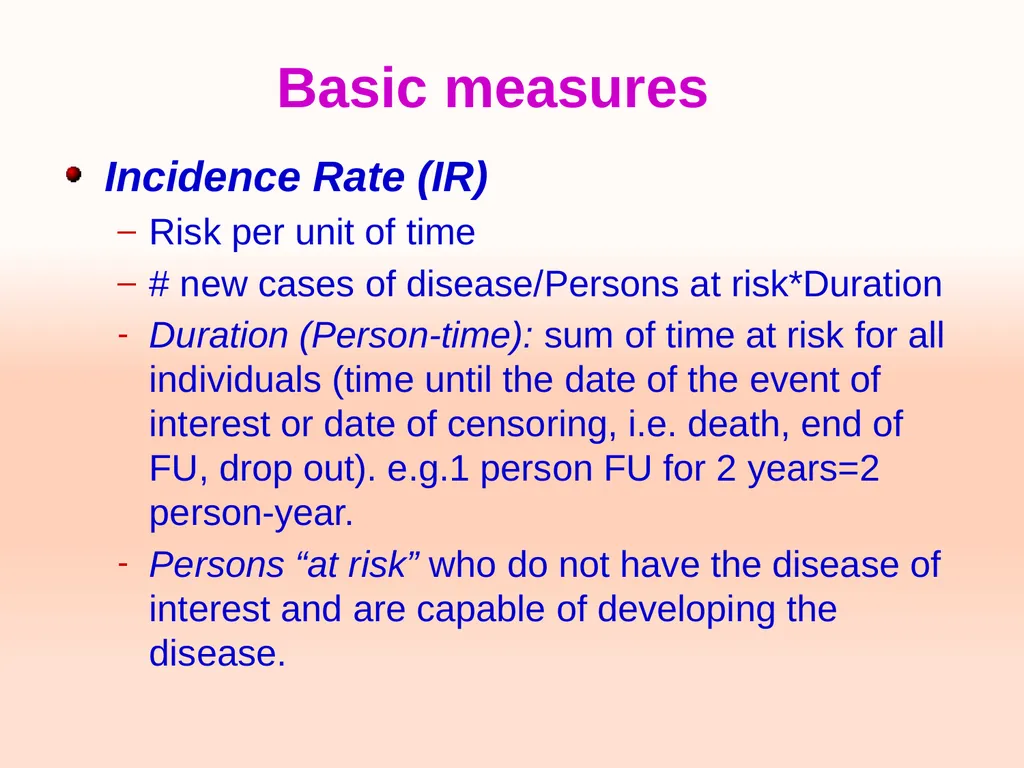
Basic measures Incidence Rate (IR)
Risk per unit of time
# new cases of disease/Persons at risk*Duration
Duration (Person-time): sum of time at risk for all individuals (time until the date of the event of interest or date of censoring, i.e. death, end of FU, drop out). e.g.1 person FU for 2 years=2 person-year.
Persons “at risk” who do not have the disease of interest and are capable of developing the disease.<br>
Risk per unit of time
# new cases of disease/Persons at risk*Duration
Duration (Person-time): sum of time at risk for all individuals (time until the date of the event of interest or date of censoring, i.e. death, end of FU, drop out). e.g.1 person FU for 2 years=2 person-year.
Persons “at risk” who do not have the disease of interest and are capable of developing the disease.<br>
18
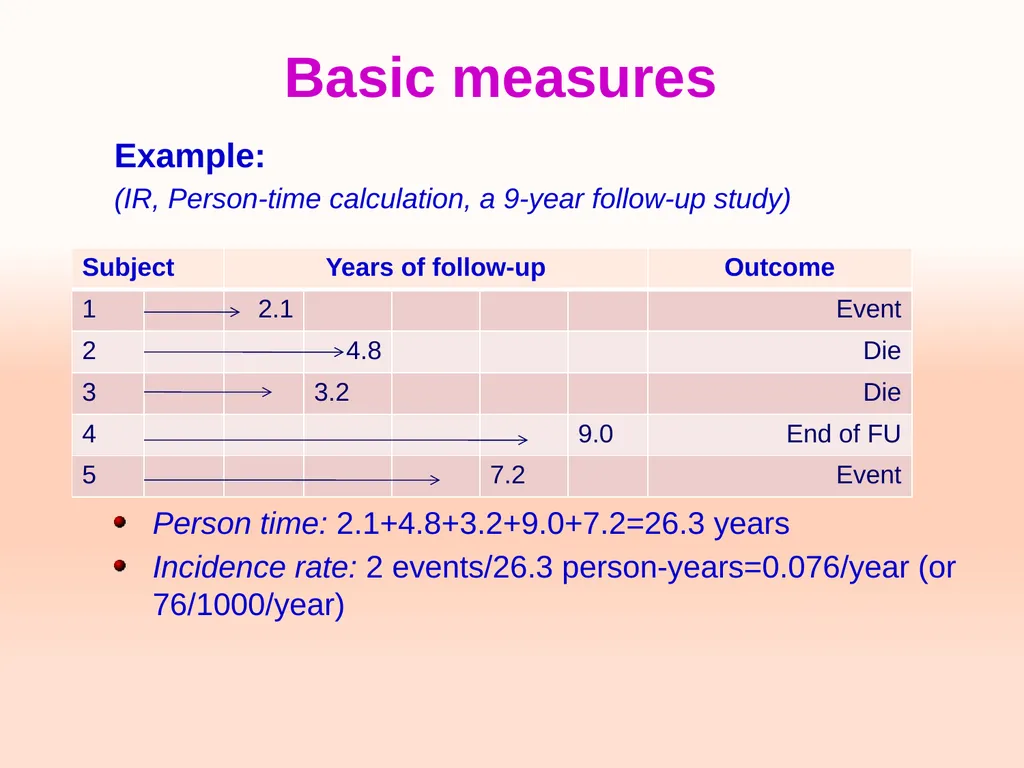
Basic measures Example:
(IR, Person-time calculation, a 9-year follow-up study)
Person time: 2.1+4.8+3.2+9.0+7.2=26.3 years
Incidence rate: 2 events/26.3 person-years=0.076/year (or 76/1000/year)<br>
(IR, Person-time calculation, a 9-year follow-up study)
Person time: 2.1+4.8+3.2+9.0+7.2=26.3 years
Incidence rate: 2 events/26.3 person-years=0.076/year (or 76/1000/year)<br>
19
Basic measures Relative Risk (RR):
Incidence of disease in exposed compared to the incidence of disease in unexposed
RR= (a/a+b)/(c/c+d)<br>
Incidence of disease in exposed compared to the incidence of disease in unexposed
RR= (a/a+b)/(c/c+d)<br>
20
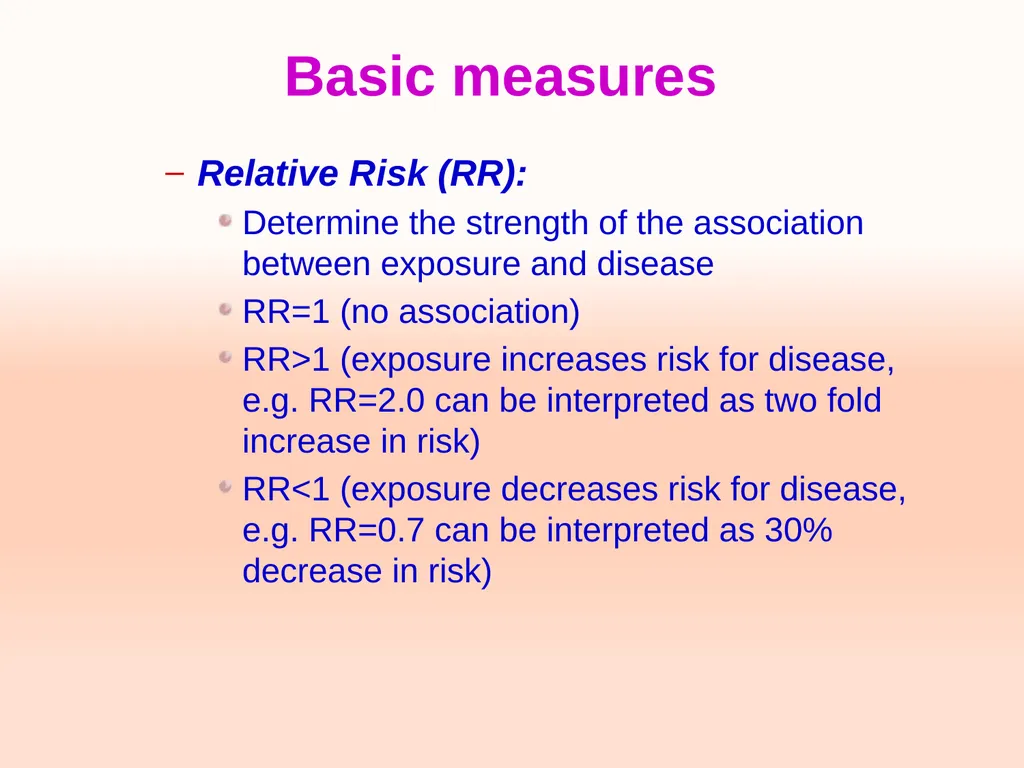
Basic measures Relative Risk (RR):
Determine the strength of the association between exposure and disease
RR=1 (no association)
RR>1 (exposure increases risk for disease, e.g. RR=2.0 can be interpreted as two fold increase in risk)
RR<1 (exposure decreases risk for disease, e.g. RR=0.7 can be interpreted as 30% decrease in risk)<br>
Determine the strength of the association between exposure and disease
RR=1 (no association)
RR>1 (exposure increases risk for disease, e.g. RR=2.0 can be interpreted as two fold increase in risk)
RR<1 (exposure decreases risk for disease, e.g. RR=0.7 can be interpreted as 30% decrease in risk)<br>
21
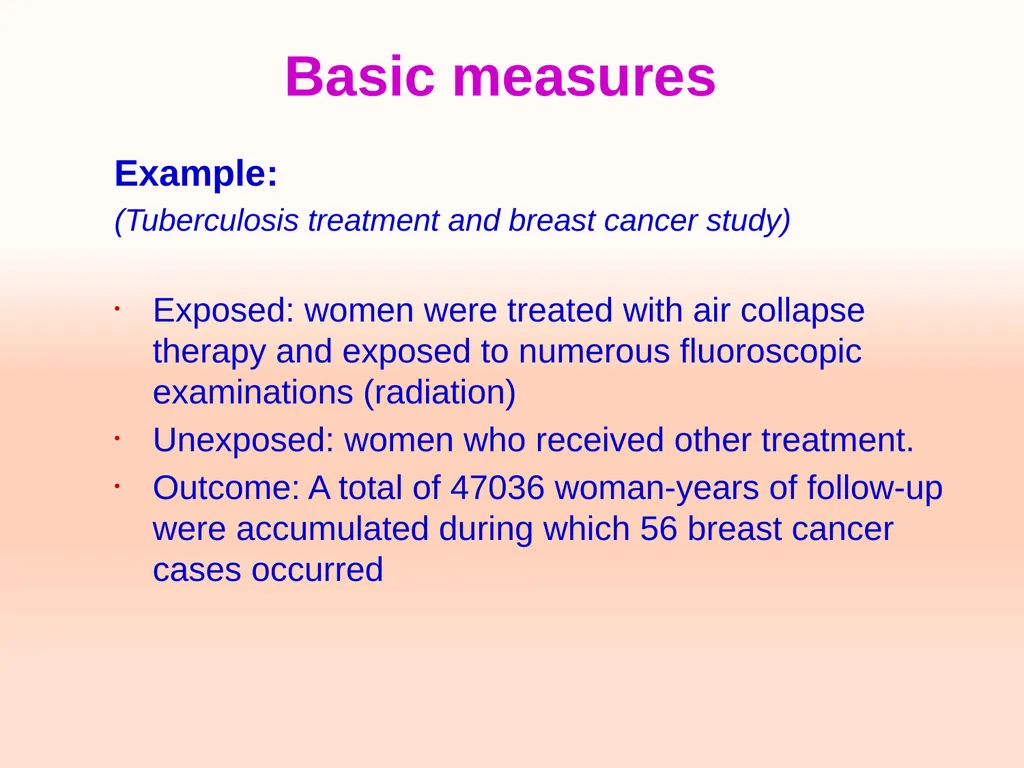
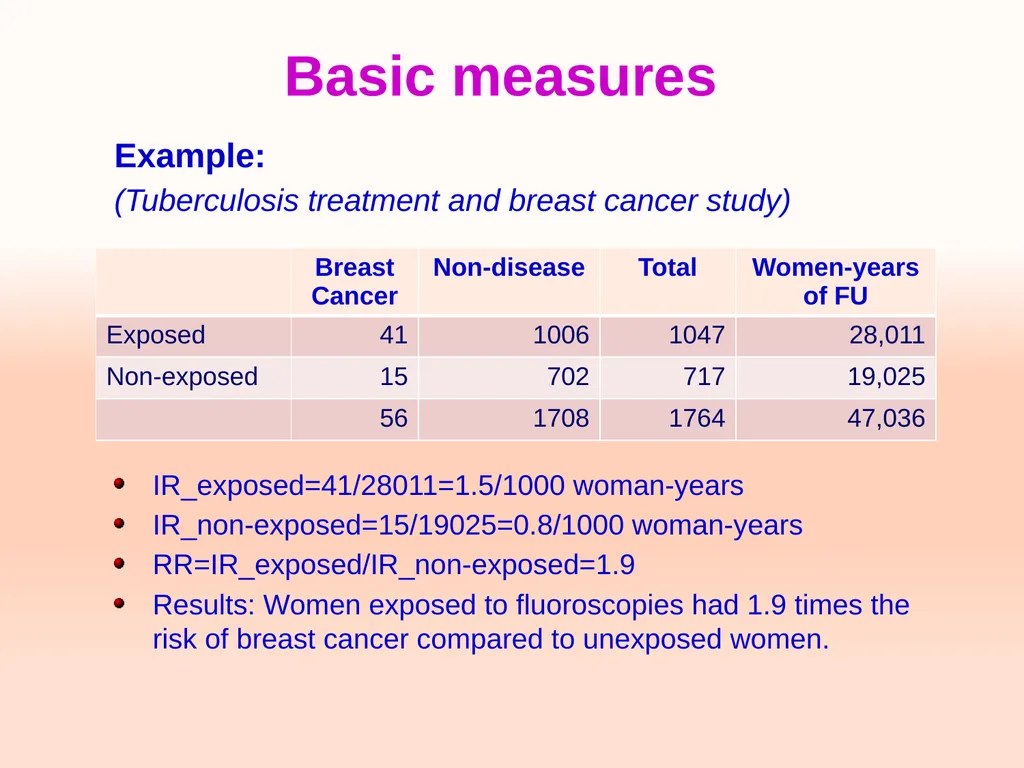
Basic measures Example:
(Tuberculosis treatment and breast cancer study)
Exposed: women were treated with air collapse therapy and exposed to numerous fluoroscopic examinations (radiation)
Unexposed: women who received other treatment.
Outcome: A total of 47036 woman-years of follow-up were accumulated during which 56 breast cancer cases occurred<br>
(Tuberculosis treatment and breast cancer study)
Exposed: women were treated with air collapse therapy and exposed to numerous fluoroscopic examinations (radiation)
Unexposed: women who received other treatment.
Outcome: A total of 47036 woman-years of follow-up were accumulated during which 56 breast cancer cases occurred<br>
22
Basic measures Example:
(Tuberculosis treatment and breast cancer study)
IR_exposed=41/28011=1.5/1000 woman-years
IR_non-exposed=15/19025=0.8/1000 woman-years
RR=IR_exposed/IR_non-exposed=1.9
Results: Women exposed to fluoroscopies had 1.9 times the risk of breast cancer compared to unexposed women.<br>
(Tuberculosis treatment and breast cancer study)
IR_exposed=41/28011=1.5/1000 woman-years
IR_non-exposed=15/19025=0.8/1000 woman-years
RR=IR_exposed/IR_non-exposed=1.9
Results: Women exposed to fluoroscopies had 1.9 times the risk of breast cancer compared to unexposed women.<br>
23
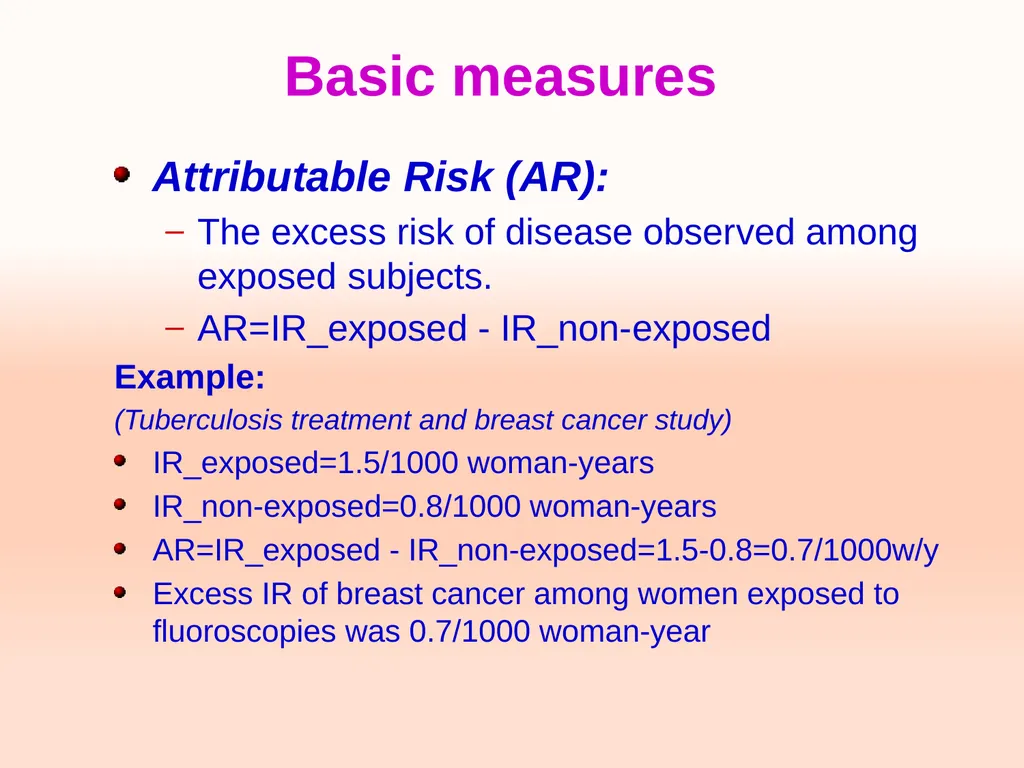
Basic measures Attributable Risk (AR):
The excess risk of disease observed among exposed subjects.
AR=IR_exposed - IR_non-exposed
Example:
(Tuberculosis treatment and breast cancer study)
IR_exposed=1.5/1000 woman-years
IR_non-exposed=0.8/1000 woman-years
AR=IR_exposed - IR_non-exposed=1.5-0.8=0.7/1000w/y
Excess IR of breast cancer among women exposed to fluoroscopies was 0.7/1000 woman-year<br>
The excess risk of disease observed among exposed subjects.
AR=IR_exposed - IR_non-exposed
Example:
(Tuberculosis treatment and breast cancer study)
IR_exposed=1.5/1000 woman-years
IR_non-exposed=0.8/1000 woman-years
AR=IR_exposed - IR_non-exposed=1.5-0.8=0.7/1000w/y
Excess IR of breast cancer among women exposed to fluoroscopies was 0.7/1000 woman-year<br>
24
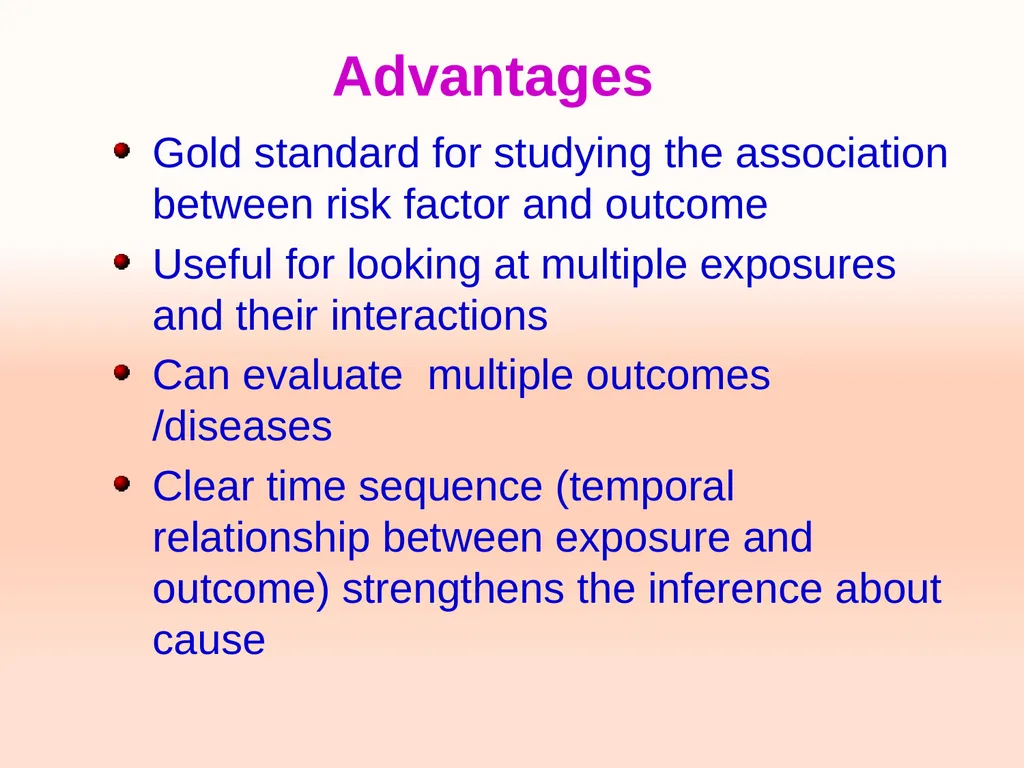
Advantages Gold standard for studying the association between risk factor and outcome
Useful for looking at multiple exposures and their interactions
Can evaluate multiple outcomes /diseases
Clear time sequence (temporal relationship between exposure and outcome) strengthens the inference about cause<br>
Useful for looking at multiple exposures and their interactions
Can evaluate multiple outcomes /diseases
Clear time sequence (temporal relationship between exposure and outcome) strengthens the inference about cause<br>
25
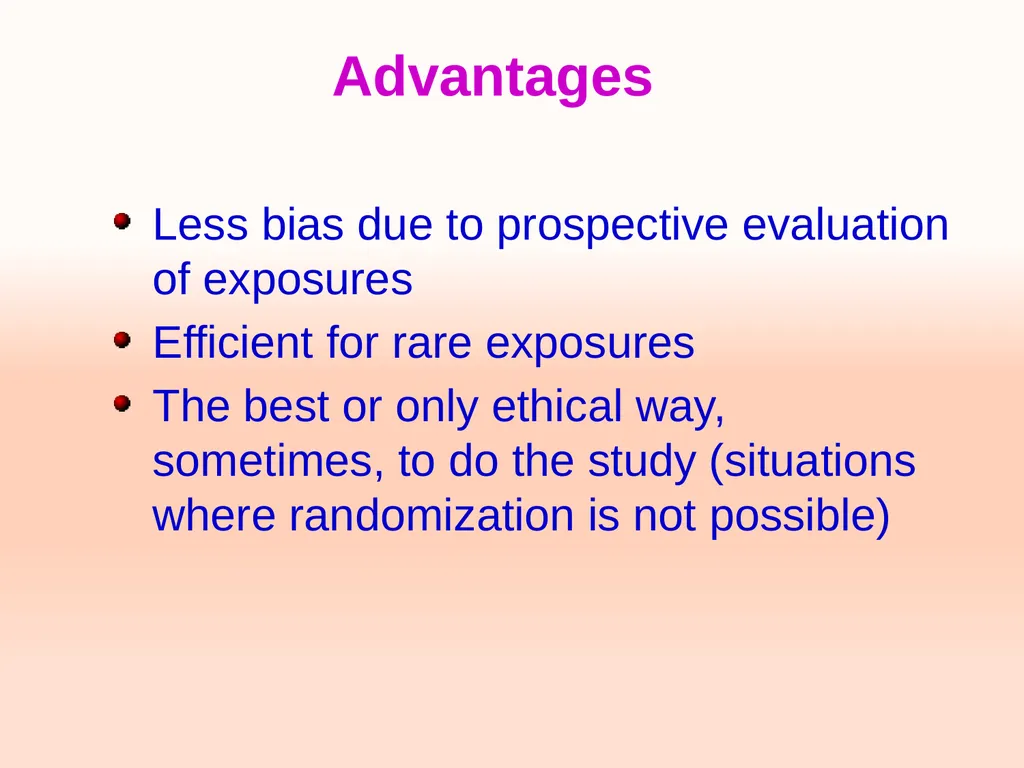
Advantages Less bias due to prospective evaluation of exposures
Efficient for rare exposures
The best or only ethical way, sometimes, to do the study (situations where randomization is not possible)<br>
Efficient for rare exposures
The best or only ethical way, sometimes, to do the study (situations where randomization is not possible)<br>
26
Disadvantages Time consuming
The problem of attrition: loss of subjects (e.g. migration or death from other causes)
Unexpected changes over time:
Changes to the environment can influence the association of disease and possible cause
Changes in diagnostic criteria and methods
Changes of staff
Financial problems: lack of funding and the high costs of record keeping<br>
The problem of attrition: loss of subjects (e.g. migration or death from other causes)
Unexpected changes over time:
Changes to the environment can influence the association of disease and possible cause
Changes in diagnostic criteria and methods
Changes of staff
Financial problems: lack of funding and the high costs of record keeping<br>
27
When to apply a cohort design In many cases, cohort studies are preferred to RCT because they do not require strict random assignment of subjects, which is unethical or improbable.
Sometimes they are the only methods available. (e.g. testing the effect of smoking on health, random assignment would be infeasible and unethical. A reasonable alternative would be a cohort study with two groups smokers and non-smokers and follows them forward through time to see what health problems they develop.<br>
Sometimes they are the only methods available. (e.g. testing the effect of smoking on health, random assignment would be infeasible and unethical. A reasonable alternative would be a cohort study with two groups smokers and non-smokers and follows them forward through time to see what health problems they develop.<br>
28
Practical considerations Selection of comparable groups:
Select a comparison (unexposed) group as similar as possible to the exposed group with respect to all factors except the exposure
Comparable ascertainment of the outcome in both groups:
Blind the investigator conducting follow-up and confirming the outcome<br>
Select a comparison (unexposed) group as similar as possible to the exposed group with respect to all factors except the exposure
Comparable ascertainment of the outcome in both groups:
Blind the investigator conducting follow-up and confirming the outcome<br>
29
Practical considerations Minimize “lost to follow-up”
Exclude those likely to become “lost” (e.g. Planning to move, unwilling to return)
Obtain complete tracking information (address, phone number of subjects as well as of close friends and relative)
Maintain periodic contact (reminders, updates)<br>
Exclude those likely to become “lost” (e.g. Planning to move, unwilling to return)
Obtain complete tracking information (address, phone number of subjects as well as of close friends and relative)
Maintain periodic contact (reminders, updates)<br>
30
References Doll R, Hill AB. Mortality in Relation to Smoking: Ten Years’ Observations of British Doctors. Br Med J. 1964 Jun 6;1(5396):1460-7.
Nichol KL, Nordin JD, Nelson DB, Mullooly JP, Hak E. Effectiveness of Influenza Vaccine in the Community-Dwelling Elderly. New England Journal of Medicine. 2007 Oct 4;357(14):1373-81. https://dx.doi.org/10.1056/NEJMoa070844
Olaf H Klungel SRH. Lipid-Lowering Drug Use and Cardiovascular Events after Myocardial Infarction. The Annals of pharmacotherapy. 2002;36(5):751-7. https://dx.doi.org/10.1345/aph.1A308
Ramchand R, Ialongo NS, Chilcoat HD. The Effect of Working for Pay on Adolescent Tobacco Use. Am J Public Health. 2007 Nov;97(11):2056-62. https://dx.doi.org/10.2105/AJPH.2006.094045
Selikoff IJ, Hammond EC, Seidman H. Latency of asbestos disease among insulation workers in the United States and Canada. Cancer. 1980 Dec 15;46(12):2736-40.<br>
Nichol KL, Nordin JD, Nelson DB, Mullooly JP, Hak E. Effectiveness of Influenza Vaccine in the Community-Dwelling Elderly. New England Journal of Medicine. 2007 Oct 4;357(14):1373-81. https://dx.doi.org/10.1056/NEJMoa070844
Olaf H Klungel SRH. Lipid-Lowering Drug Use and Cardiovascular Events after Myocardial Infarction. The Annals of pharmacotherapy. 2002;36(5):751-7. https://dx.doi.org/10.1345/aph.1A308
Ramchand R, Ialongo NS, Chilcoat HD. The Effect of Working for Pay on Adolescent Tobacco Use. Am J Public Health. 2007 Nov;97(11):2056-62. https://dx.doi.org/10.2105/AJPH.2006.094045
Selikoff IJ, Hammond EC, Seidman H. Latency of asbestos disease among insulation workers in the United States and Canada. Cancer. 1980 Dec 15;46(12):2736-40.<br>
31
THANK YOU
VERY MUCH<br>
VERY MUCH<br>