
Col “MOG” Marvel Marine Corps Warfighting Lab 30


Description: Col MOG Marvel Marine Corps Warfighting Lab 30 Apr 2024 Littoral Mobility in Contested Environments Controlled by: MCWL, CDI, HQMC CUI Category: NA Limited Dissemination Control: NONE POC: MCWL ST, CDI Outline Future Operating Concepts
Related Topics
Download Presentation
"Col “MOG” Marvel Marine Corps Warfighting Lab 30" is the property of its rightful owner. Permission is granted to download and print the materials on this website for personal, non-commercial use only, and to display it on your personal computer provided you do not modify the materials and that you retain all copyright notices contained in the materials. By downloading content from our website, you accept the terms of this agreement.
Presentation Transcript
slide1. Col “MOG” Marvel
Marine Corps Warfighting Lab
30 Apr 2024 Littoral Mobility in Contested Environments Controlled by: MCWL, CD&I, HQMC
CUI Category: NA
Limited Dissemination Control: NONE
POC: MCWL S&T, CD&I<br>
slide2. Outline Future Operating Concepts and tie to Logistics Mobility in Contested Environments
MCWL S&T Initiatives
Industry Partnerships 2<br>
slide3. 3 To advance Naval Integration and Organic Mobility, we will maximize the potential of the Stand-In Forces and their contribution to the Joint Force, while remaining organically mobile, survivable, and sustainable within the littorals..
39th Commandant’s FRAGO 01-2024 “Maintain Momentum” Where we are To succeed on tomorrow’s battlefields, we will need a logistics enterprise fully integrated with the broader objectives of FD2030, capable of supporting multi-domain and distributed operations in contested environments. HQMC I&L 2030 -As the Marine Corps transforms to meet the future force expectation of Force Design 2030, Logistics is a “pacing item”.
-Installation and Logistics 2030, directs the key objectives of
-Diversify Distribution
-Improve Sustainment
-MCWL is focused on an array of technical and tactical approaches that focus on these goals, both of which are fundamental to maneuver and mobility<br>
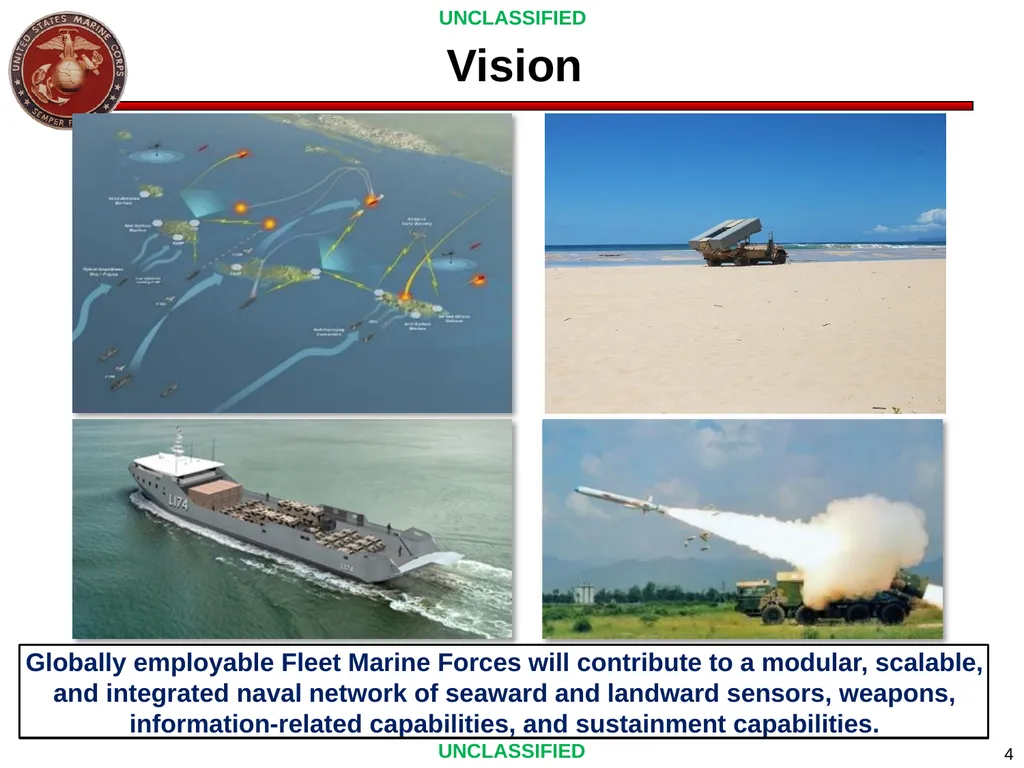
slide4. 4 Globally employable Fleet Marine Forces will contribute to a modular, scalable, and integrated naval network of seaward and landward sensors, weapons, information-related capabilities, and sustainment capabilities. Vision<br>
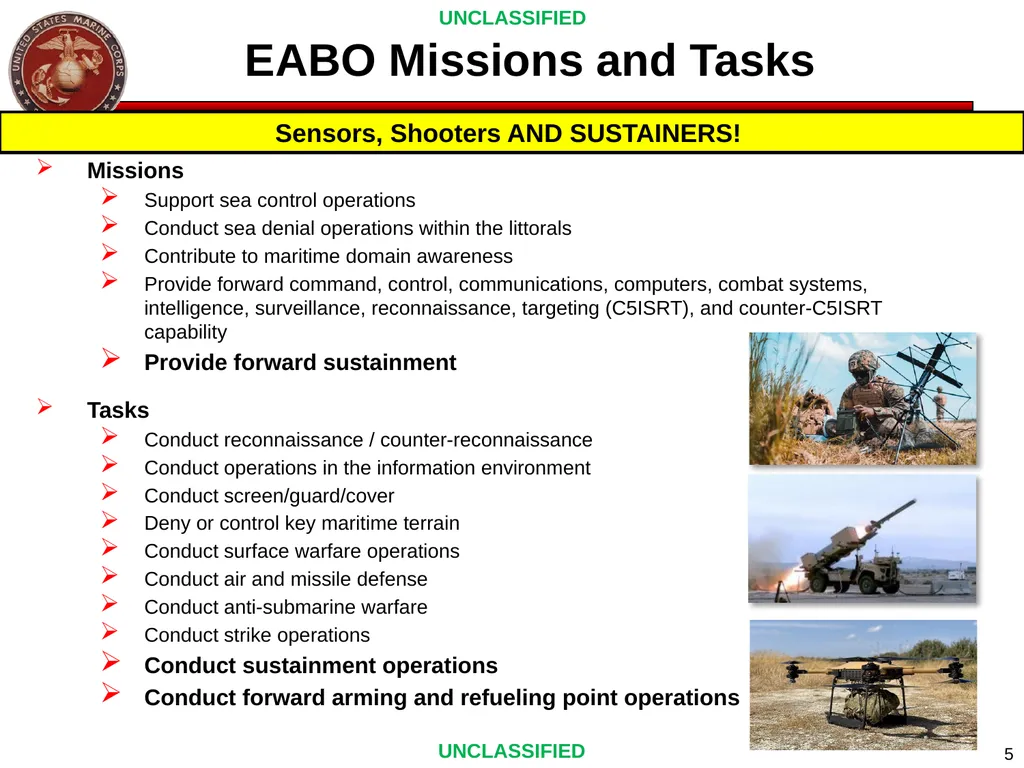
slide5. EABO Missions and Tasks Missions
Support sea control operations
Conduct sea denial operations within the littorals
Contribute to maritime domain awareness
Provide forward command, control, communications, computers, combat systems, intelligence, surveillance, reconnaissance, targeting (C5ISRT), and counter-C5ISRT capability
Provide forward sustainment
Tasks
Conduct reconnaissance / counter-reconnaissance
Conduct operations in the information environment
Conduct screen/guard/cover
Deny or control key maritime terrain
Conduct surface warfare operations
Conduct air and missile defense
Conduct anti-submarine warfare
Conduct strike operations
Conduct sustainment operations
Conduct forward arming and refueling point operations 5 Sensors, Shooters AND SUSTAINERS!<br>
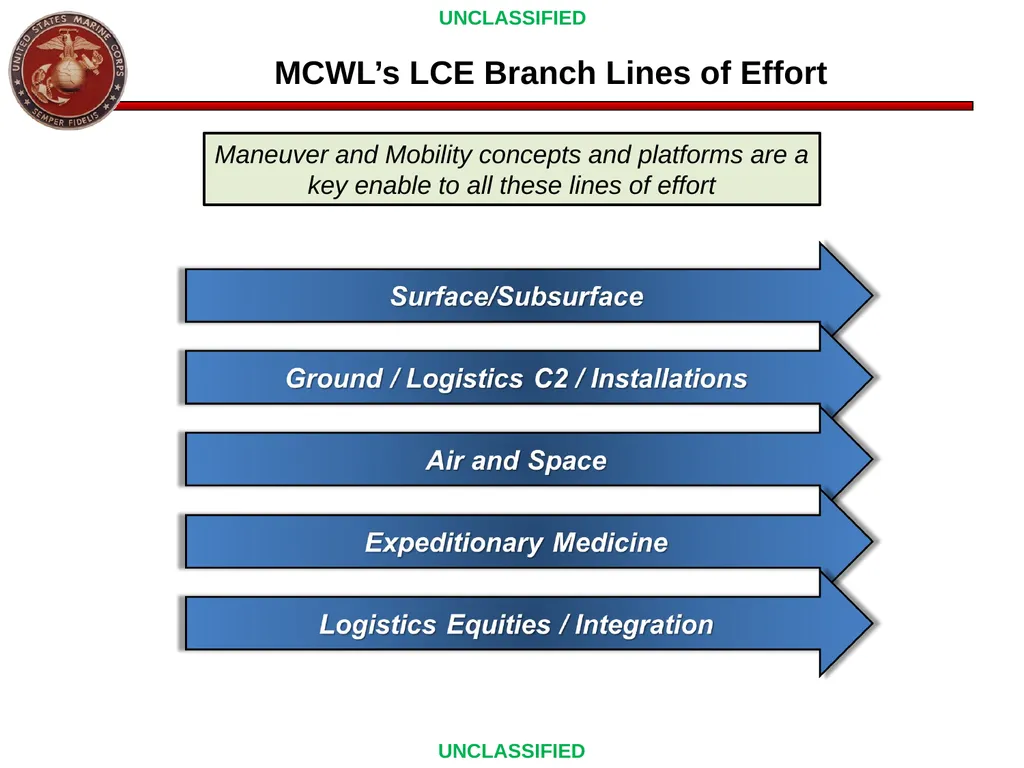
slide6. MCWL’s LCE Branch Lines of Effort Maneuver and Mobility concepts and platforms are a key enable to all these lines of effort<br>
slide7. Current S&T Projects and Efforts for Mobility in the Littorals Air – Ground - Sea 7<br>
slide8. Air/Ground Domain 8<br>
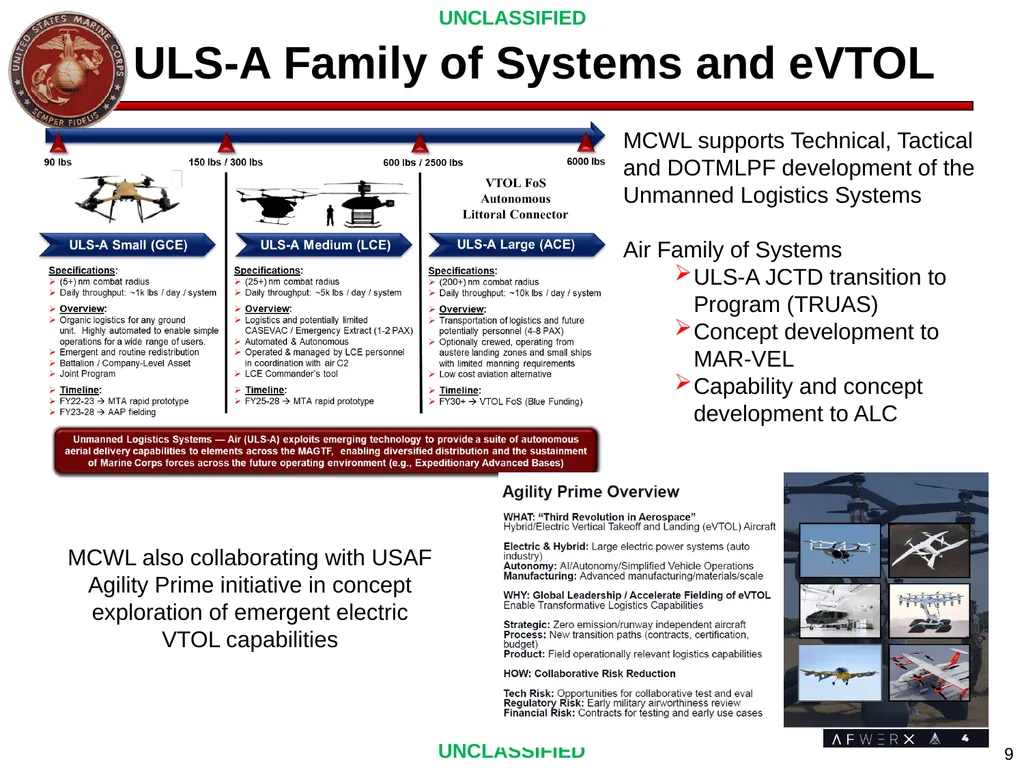
slide9. ULS-A Family of Systems and eVTOL 9 MCWL supports Technical, Tactical and DOTMLPF development of the Unmanned Logistics Systems
Air Family of Systems
ULS-A JCTD transition to Program (TRUAS)
Concept development to MAR-VEL
Capability and concept development to ALC MCWL also collaborating with USAF Agility Prime initiative in concept exploration of emergent electric VTOL capabilities<br>
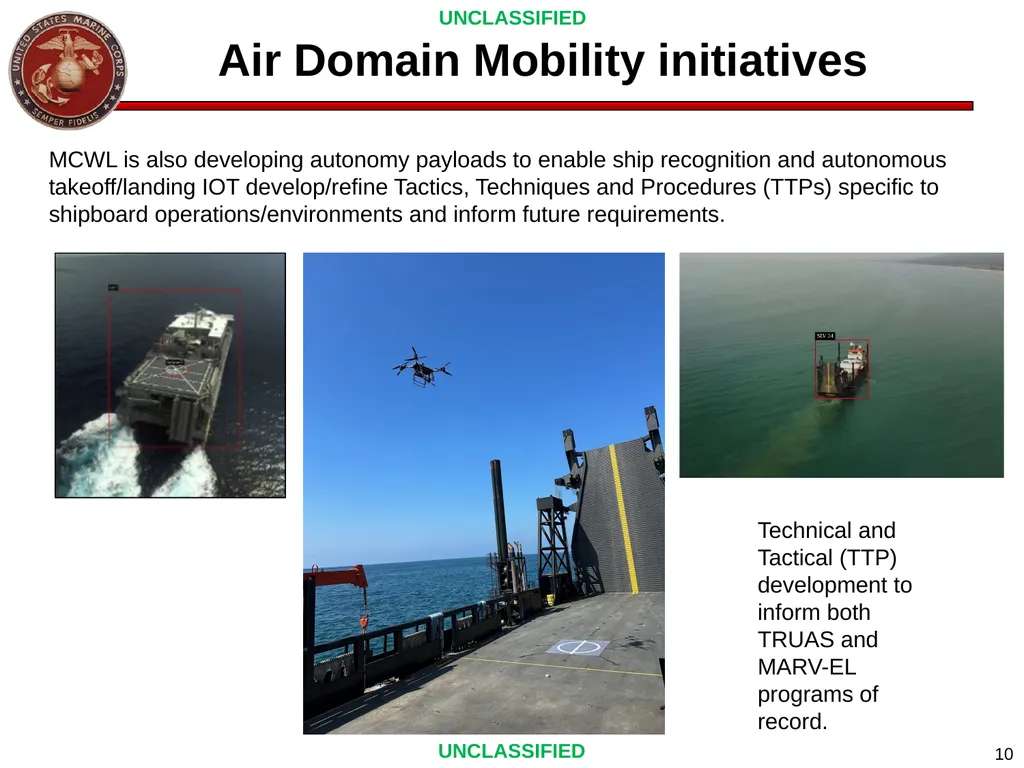
slide10. MCWL is also developing autonomy payloads to enable ship recognition and autonomous takeoff/landing IOT develop/refine Tactics, Techniques and Procedures (TTPs) specific to shipboard operations/environments and inform future requirements. 10 Air Domain Mobility initiatives Technical and Tactical (TTP) development to inform both TRUAS and MARV-EL programs of record.<br>
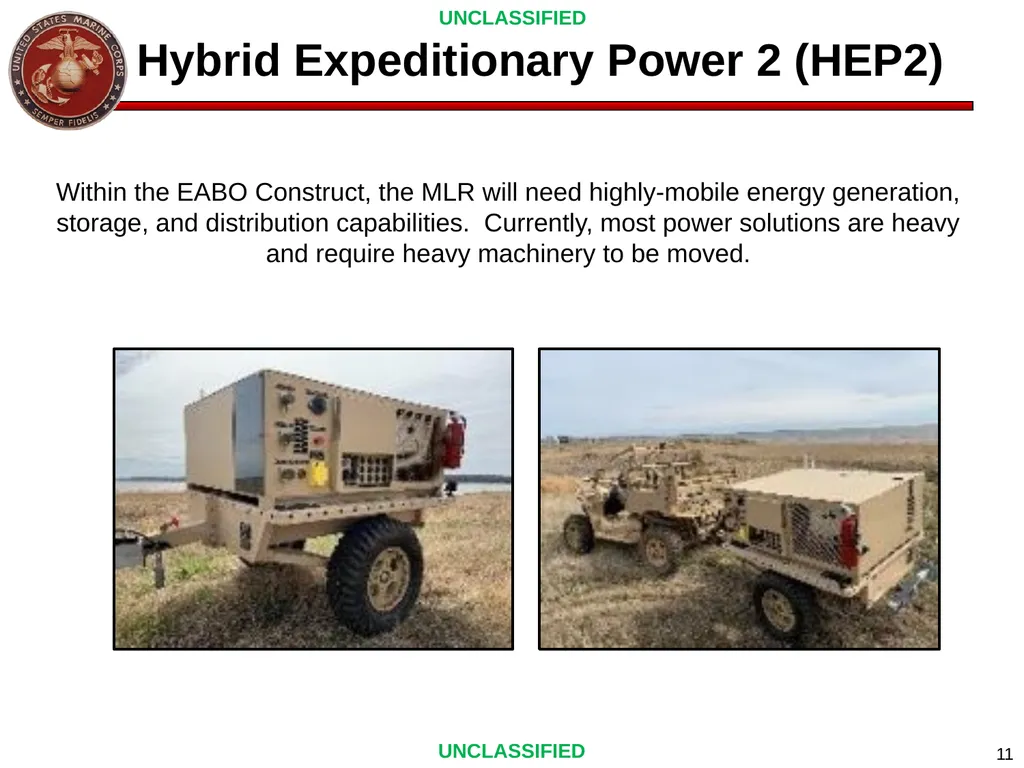
slide11. Hybrid Expeditionary Power 2 (HEP2) 11 Within the EABO Construct, the MLR will need highly-mobile energy generation, storage, and distribution capabilities. Currently, most power solutions are heavy and require heavy machinery to be moved.<br>
slide12. Surface Domain 12<br>
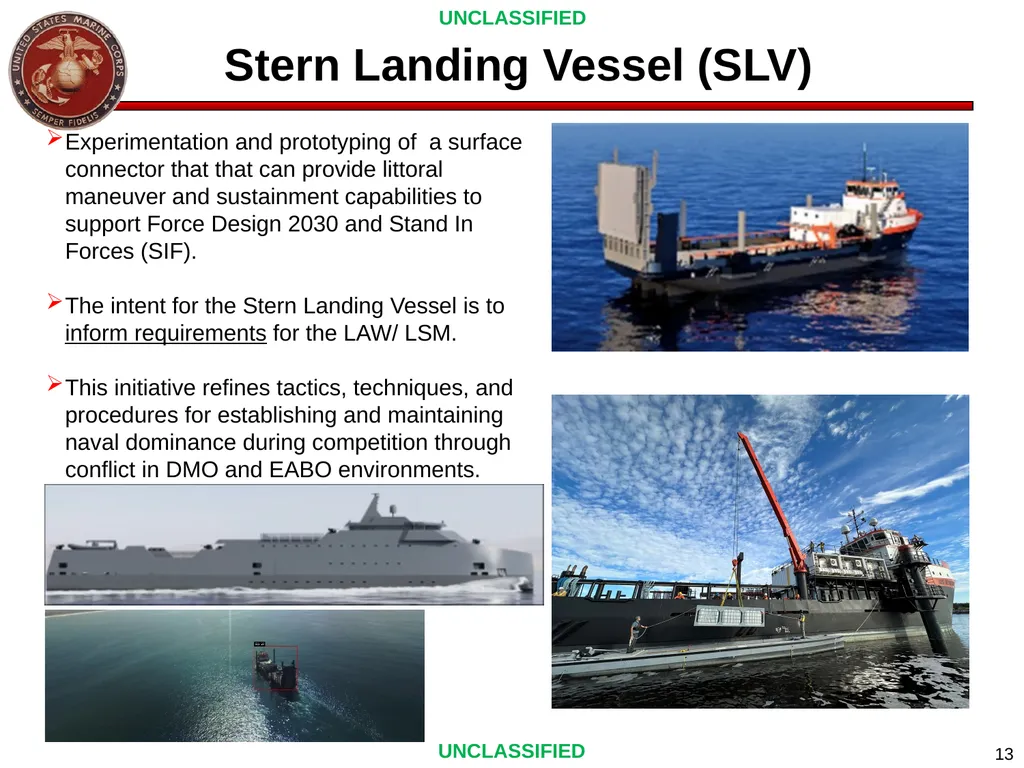
slide13. Stern Landing Vessel (SLV) Experimentation and prototyping of a surface connector that that can provide littoral maneuver and sustainment capabilities to support Force Design 2030 and Stand In Forces (SIF).
The intent for the Stern Landing Vessel is to inform requirements for the LAW/ LSM.
This initiative refines tactics, techniques, and procedures for establishing and maintaining naval dominance during competition through conflict in DMO and EABO environments. 13<br>
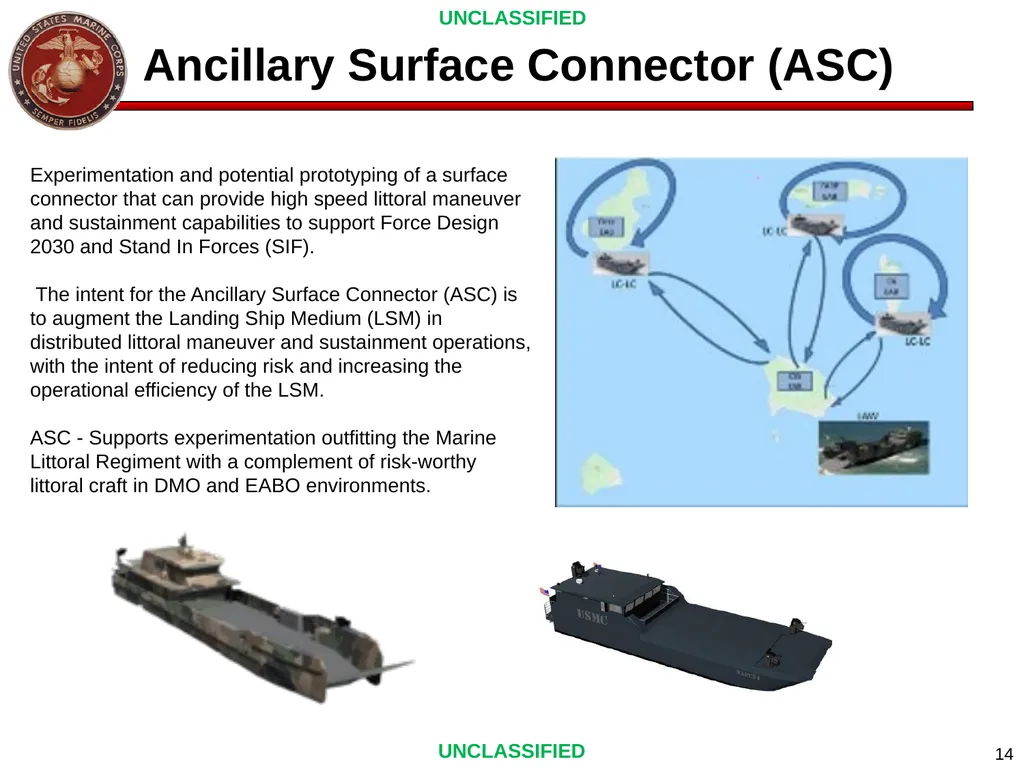
slide14. Ancillary Surface Connector (ASC) Experimentation and potential prototyping of a surface connector that can provide high speed littoral maneuver and sustainment capabilities to support Force Design 2030 and Stand In Forces (SIF).
The intent for the Ancillary Surface Connector (ASC) is to augment the Landing Ship Medium (LSM) in distributed littoral maneuver and sustainment operations, with the intent of reducing risk and increasing the operational efficiency of the LSM.
ASC - Supports experimentation outfitting the Marine Littoral Regiment with a complement of risk-worthy littoral craft in DMO and EABO environments. 14<br>
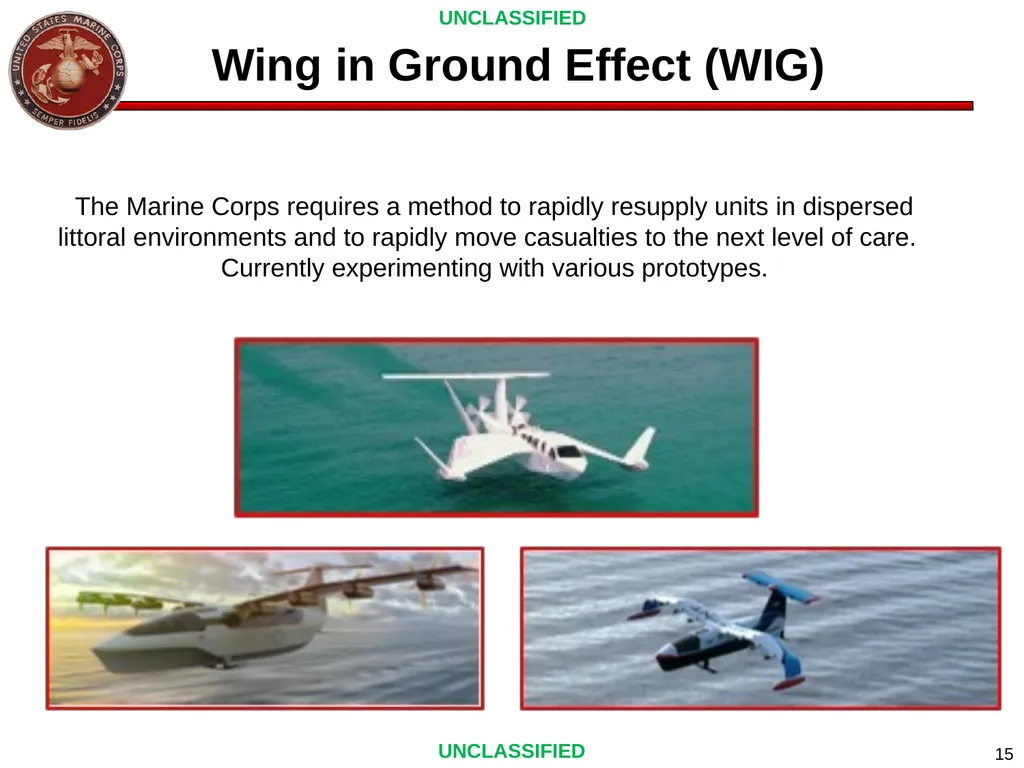
slide15. Wing in Ground Effect (WIG) The Marine Corps requires a method to rapidly resupply units in dispersed littoral environments and to rapidly move casualties to the next level of care. Currently experimenting with various prototypes. 15<br>
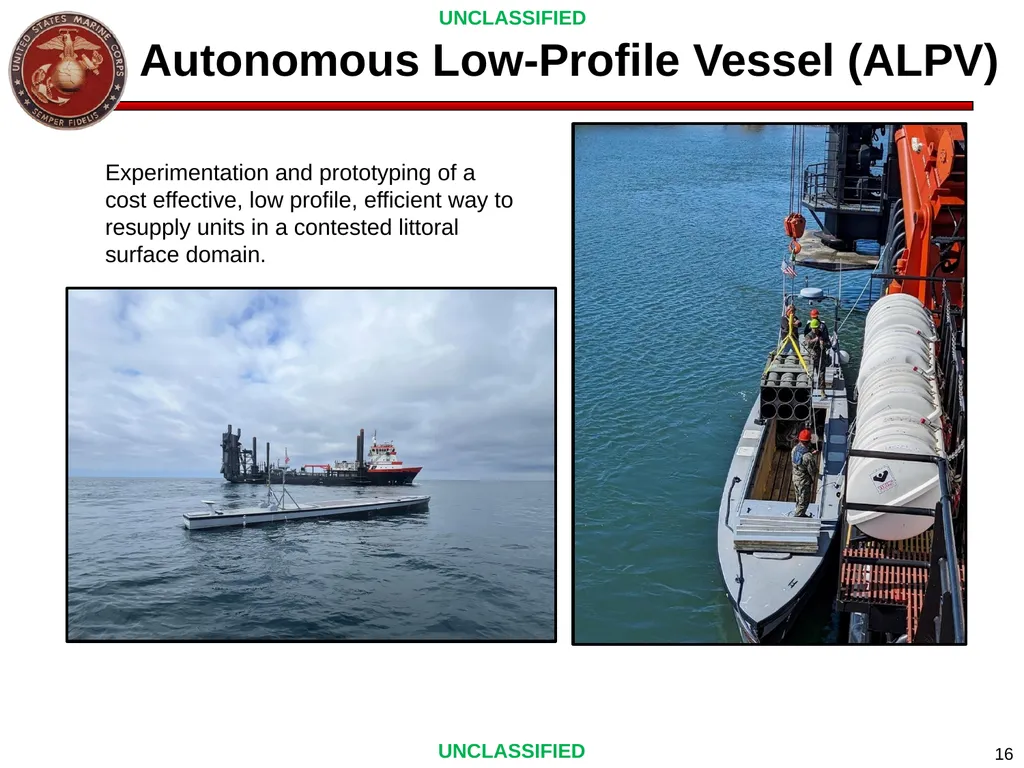
slide16. Autonomous Low-Profile Vessel (ALPV) 16 Experimentation and prototyping of a cost effective, low profile, efficient way to resupply units in a contested littoral surface domain.<br>
slide17. Littoral Maneuver Enabler (LME) Expeditionary Littoral Enabler (ELE) 17 Experimentation of an expedient method to conduct In-stream RO/RO transfer of vehicles and equipment to/from floating platforms or deliver vehicles and equipment with little or no fording capability from ship to shore.
Transformational technology enabling a broader selection of commercial vessels and vehicles with no/low fording capability, to be engaged, thereby enhancing the Joint Force Commander’s ability to employ and sustain warfighting capabilities. Develope an expedient, light weight, easily-deployable temporary pier to load/offload logistical supplies in the littorals.<br>
slide18. Combat Causality Care 18<br>
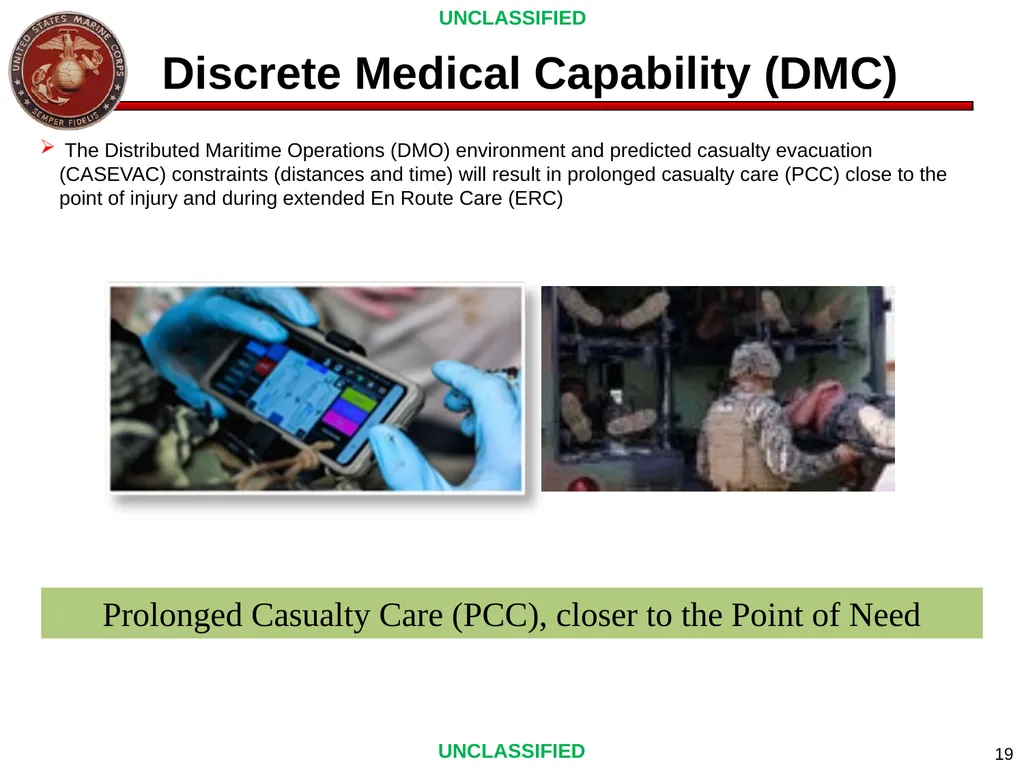
slide19. Discrete Medical Capability (DMC) 19 The Distributed Maritime Operations (DMO) environment and predicted casualty evacuation (CASEVAC) constraints (distances and time) will result in prolonged casualty care (PCC) close to the point of injury and during extended En Route Care (ERC) Prolonged Casualty Care (PCC), closer to the Point of Need<br>
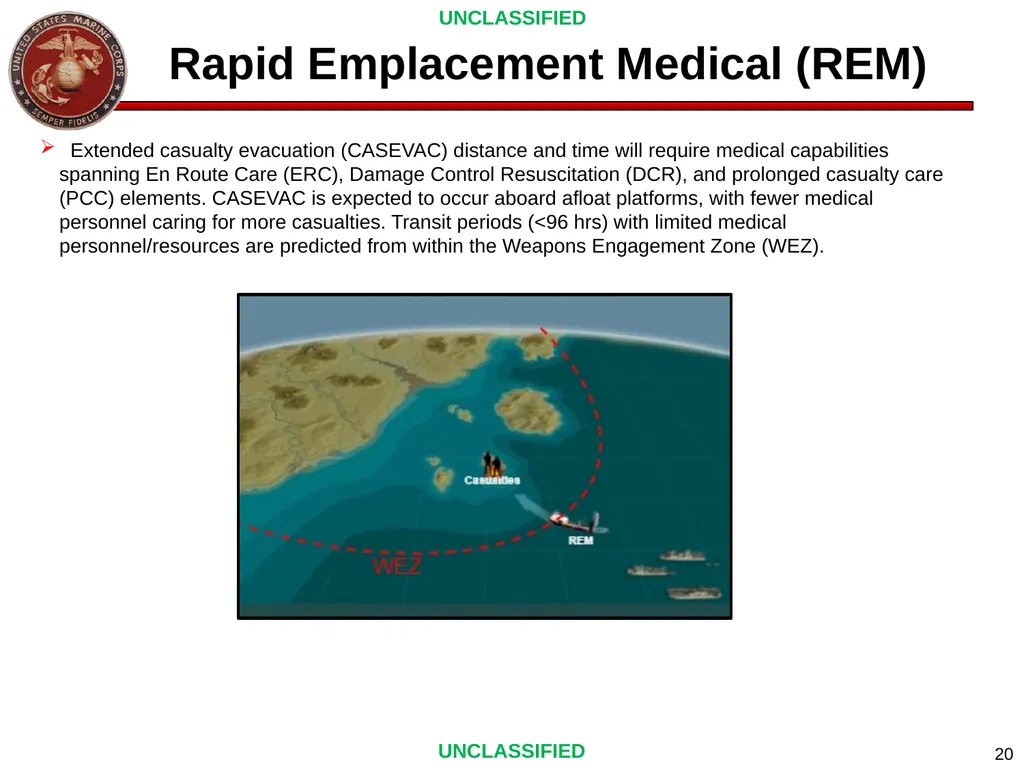
slide20. Rapid Emplacement Medical (REM) 20 Extended casualty evacuation (CASEVAC) distance and time will require medical capabilities spanning En Route Care (ERC), Damage Control Resuscitation (DCR), and prolonged casualty care (PCC) elements. CASEVAC is expected to occur aboard afloat platforms, with fewer medical personnel caring for more casualties. Transit periods (<96 hrs) with limited medical personnel/resources are predicted from within the Weapons Engagement Zone (WEZ).<br>
slide21. Partnership with Industry 21 Transitioning across the Surf Zone
Prolonged Casualty Care – no longer “Golden Hour”
Simplified Operator – Maintainer Concepts, no specialists
Reduction in logistics “tail” to sustain
Healthy industrial base
Industry – DoD collaboration Contested logistics can only be solved through a combination of technology and tactics. Forces will have to coordinate the deliberate application of multi-domain fires and maneuver to create the physical and temporal conditions necessary to support logistics networks....
This is a wicked problem to solve, but for Marines, it is not insurmountable. We became Marines to do hard things.
39th Commandant’s FRAGO 01-2024 “Maintain Momentum”<br>
slide22. Questions?<br>
Marine Corps Warfighting Lab
30 Apr 2024 Littoral Mobility in Contested Environments Controlled by: MCWL, CD&I, HQMC
CUI Category: NA
Limited Dissemination Control: NONE
POC: MCWL S&T, CD&I<br>
slide2. Outline Future Operating Concepts and tie to Logistics Mobility in Contested Environments
MCWL S&T Initiatives
Industry Partnerships 2<br>
slide3. 3 To advance Naval Integration and Organic Mobility, we will maximize the potential of the Stand-In Forces and their contribution to the Joint Force, while remaining organically mobile, survivable, and sustainable within the littorals..
39th Commandant’s FRAGO 01-2024 “Maintain Momentum” Where we are To succeed on tomorrow’s battlefields, we will need a logistics enterprise fully integrated with the broader objectives of FD2030, capable of supporting multi-domain and distributed operations in contested environments. HQMC I&L 2030 -As the Marine Corps transforms to meet the future force expectation of Force Design 2030, Logistics is a “pacing item”.
-Installation and Logistics 2030, directs the key objectives of
-Diversify Distribution
-Improve Sustainment
-MCWL is focused on an array of technical and tactical approaches that focus on these goals, both of which are fundamental to maneuver and mobility<br>
slide4. 4 Globally employable Fleet Marine Forces will contribute to a modular, scalable, and integrated naval network of seaward and landward sensors, weapons, information-related capabilities, and sustainment capabilities. Vision<br>
slide5. EABO Missions and Tasks Missions
Support sea control operations
Conduct sea denial operations within the littorals
Contribute to maritime domain awareness
Provide forward command, control, communications, computers, combat systems, intelligence, surveillance, reconnaissance, targeting (C5ISRT), and counter-C5ISRT capability
Provide forward sustainment
Tasks
Conduct reconnaissance / counter-reconnaissance
Conduct operations in the information environment
Conduct screen/guard/cover
Deny or control key maritime terrain
Conduct surface warfare operations
Conduct air and missile defense
Conduct anti-submarine warfare
Conduct strike operations
Conduct sustainment operations
Conduct forward arming and refueling point operations 5 Sensors, Shooters AND SUSTAINERS!<br>
slide6. MCWL’s LCE Branch Lines of Effort Maneuver and Mobility concepts and platforms are a key enable to all these lines of effort<br>
slide7. Current S&T Projects and Efforts for Mobility in the Littorals Air – Ground - Sea 7<br>
slide8. Air/Ground Domain 8<br>
slide9. ULS-A Family of Systems and eVTOL 9 MCWL supports Technical, Tactical and DOTMLPF development of the Unmanned Logistics Systems
Air Family of Systems
ULS-A JCTD transition to Program (TRUAS)
Concept development to MAR-VEL
Capability and concept development to ALC MCWL also collaborating with USAF Agility Prime initiative in concept exploration of emergent electric VTOL capabilities<br>
slide10. MCWL is also developing autonomy payloads to enable ship recognition and autonomous takeoff/landing IOT develop/refine Tactics, Techniques and Procedures (TTPs) specific to shipboard operations/environments and inform future requirements. 10 Air Domain Mobility initiatives Technical and Tactical (TTP) development to inform both TRUAS and MARV-EL programs of record.<br>
slide11. Hybrid Expeditionary Power 2 (HEP2) 11 Within the EABO Construct, the MLR will need highly-mobile energy generation, storage, and distribution capabilities. Currently, most power solutions are heavy and require heavy machinery to be moved.<br>
slide12. Surface Domain 12<br>
slide13. Stern Landing Vessel (SLV) Experimentation and prototyping of a surface connector that that can provide littoral maneuver and sustainment capabilities to support Force Design 2030 and Stand In Forces (SIF).
The intent for the Stern Landing Vessel is to inform requirements for the LAW/ LSM.
This initiative refines tactics, techniques, and procedures for establishing and maintaining naval dominance during competition through conflict in DMO and EABO environments. 13<br>
slide14. Ancillary Surface Connector (ASC) Experimentation and potential prototyping of a surface connector that can provide high speed littoral maneuver and sustainment capabilities to support Force Design 2030 and Stand In Forces (SIF).
The intent for the Ancillary Surface Connector (ASC) is to augment the Landing Ship Medium (LSM) in distributed littoral maneuver and sustainment operations, with the intent of reducing risk and increasing the operational efficiency of the LSM.
ASC - Supports experimentation outfitting the Marine Littoral Regiment with a complement of risk-worthy littoral craft in DMO and EABO environments. 14<br>
slide15. Wing in Ground Effect (WIG) The Marine Corps requires a method to rapidly resupply units in dispersed littoral environments and to rapidly move casualties to the next level of care. Currently experimenting with various prototypes. 15<br>
slide16. Autonomous Low-Profile Vessel (ALPV) 16 Experimentation and prototyping of a cost effective, low profile, efficient way to resupply units in a contested littoral surface domain.<br>
slide17. Littoral Maneuver Enabler (LME) Expeditionary Littoral Enabler (ELE) 17 Experimentation of an expedient method to conduct In-stream RO/RO transfer of vehicles and equipment to/from floating platforms or deliver vehicles and equipment with little or no fording capability from ship to shore.
Transformational technology enabling a broader selection of commercial vessels and vehicles with no/low fording capability, to be engaged, thereby enhancing the Joint Force Commander’s ability to employ and sustain warfighting capabilities. Develope an expedient, light weight, easily-deployable temporary pier to load/offload logistical supplies in the littorals.<br>
slide18. Combat Causality Care 18<br>
slide19. Discrete Medical Capability (DMC) 19 The Distributed Maritime Operations (DMO) environment and predicted casualty evacuation (CASEVAC) constraints (distances and time) will result in prolonged casualty care (PCC) close to the point of injury and during extended En Route Care (ERC) Prolonged Casualty Care (PCC), closer to the Point of Need<br>
slide20. Rapid Emplacement Medical (REM) 20 Extended casualty evacuation (CASEVAC) distance and time will require medical capabilities spanning En Route Care (ERC), Damage Control Resuscitation (DCR), and prolonged casualty care (PCC) elements. CASEVAC is expected to occur aboard afloat platforms, with fewer medical personnel caring for more casualties. Transit periods (<96 hrs) with limited medical personnel/resources are predicted from within the Weapons Engagement Zone (WEZ).<br>
slide21. Partnership with Industry 21 Transitioning across the Surf Zone
Prolonged Casualty Care – no longer “Golden Hour”
Simplified Operator – Maintainer Concepts, no specialists
Reduction in logistics “tail” to sustain
Healthy industrial base
Industry – DoD collaboration Contested logistics can only be solved through a combination of technology and tactics. Forces will have to coordinate the deliberate application of multi-domain fires and maneuver to create the physical and temporal conditions necessary to support logistics networks....
This is a wicked problem to solve, but for Marines, it is not insurmountable. We became Marines to do hard things.
39th Commandant’s FRAGO 01-2024 “Maintain Momentum”<br>
slide22. Questions?<br>