
Cold Pressor Test Methodology, Interpretation, and
Description: Cold Pressor Test Methodology, Interpretation, and Clinical Significance NAJEM AL-JANABI Introduction The Cold Pressor Test (CPT) is used to assess the bodys autonomic and cardiovascular response to cold stress. It is commonly applied in
Related Topics
Download Presentation
"Cold Pressor Test Methodology, Interpretation, and" is the property of its rightful owner. Permission is granted to download and print the materials on this website for personal, non-commercial use only, and to display it on your personal computer provided you do not modify the materials and that you retain all copyright notices contained in the materials. By downloading content from our website, you accept the terms of this agreement.
Presentation Transcript
slide1. Cold Pressor Test Methodology, Interpretation, and Clinical Significance
NAJEM AL-JANABI<br>
slide2. Introduction The Cold Pressor Test (CPT) is used to assess the body's autonomic and cardiovascular response to cold stress. It is commonly applied in evaluating hypertension, autonomic dysfunction, and pain tolerance.
The cold pressor test measures the sympathetically mediated increase in BP in response to the stress of a controlled environmental temperature change.<br>
slide3. Physiological Basis of CPT Cold exposure activates nociceptors, triggering the sympathetic nervous system.
Leads to vasoconstriction and increased blood pressure (BP).
Increased heart rate (HR) and pain perception due to norepinephrine release.<br>
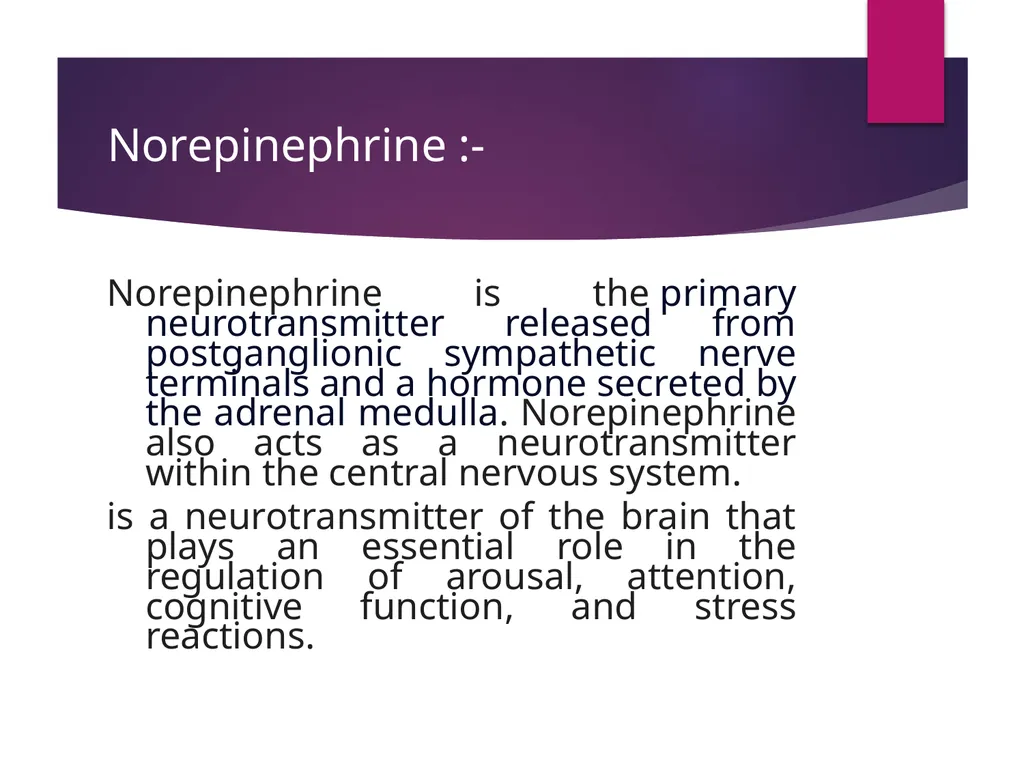
slide4. Norepinephrine :- Norepinephrine is the primary neurotransmitter released from postganglionic sympathetic nerve terminals and a hormone secreted by the adrenal medulla. Norepinephrine also acts as a neurotransmitter within the central nervous system.
is a neurotransmitter of the brain that plays an essential role in the regulation of arousal, attention, cognitive function, and stress reactions.<br>
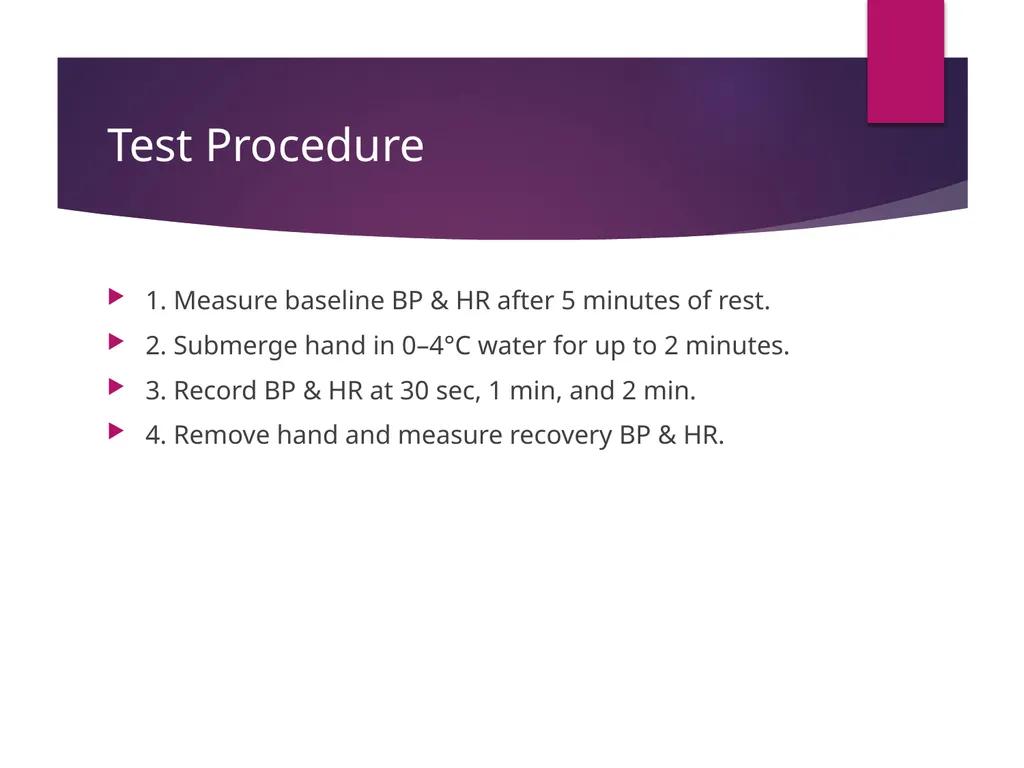
slide5. Test Procedure 1. Measure baseline BP & HR after 5 minutes of rest.
2. Submerge hand in 0–4°C water for up to 2 minutes.
3. Record BP & HR at 30 sec, 1 min, and 2 min.
4. Remove hand and measure recovery BP & HR.<br>
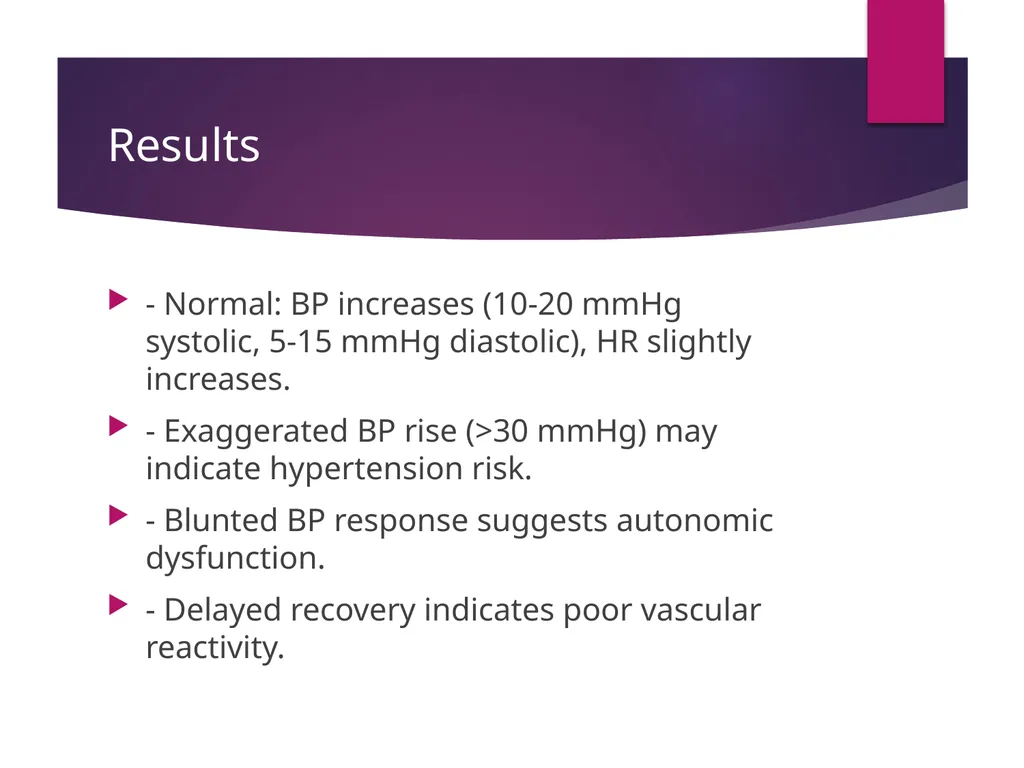
slide6. Results - Normal: BP increases (10-20 mmHg systolic, 5-15 mmHg diastolic), HR slightly increases.
- Exaggerated BP rise (>30 mmHg) may indicate hypertension risk.
- Blunted BP response suggests autonomic dysfunction.
- Delayed recovery indicates poor vascular reactivity.<br>
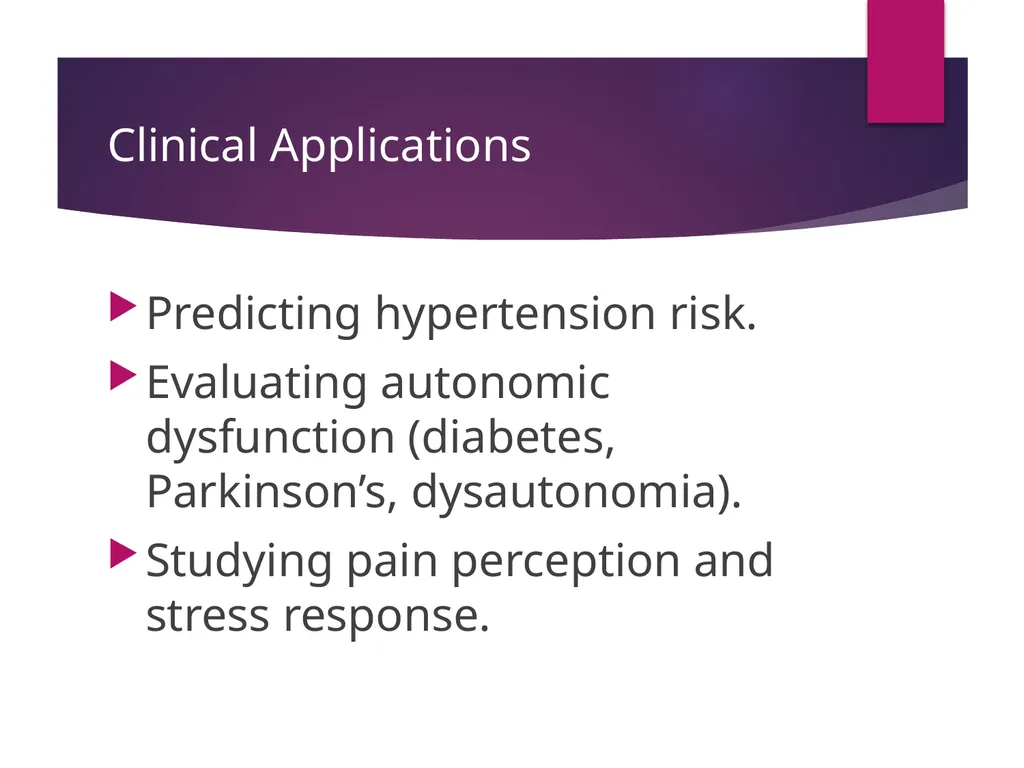
slide7. Clinical Applications Predicting hypertension risk.
Evaluating autonomic dysfunction (diabetes, Parkinson’s, dysautonomia).
Studying pain perception and stress response.<br>
slide8. Conclusion The Cold Pressor Test is a valuable tool for assessing autonomic nervous system function, cardiovascular reactivity, and pain tolerance, providing important clinical insights into blood pressure regulation.<br>
slide9. Effect of sympathetic autonomic stress from the cold pressor test on young healthy adults Clinical and Research Implications
Early Detection of Hypertension: Exaggerated BP response may indicate a predisposition.
Autonomic Nervous System Assessment: HRV changes reflect SNS and parasympathetic balance.<br>
slide10. Effect of sympathetic autonomic stress from the cold pressor test on young healthy adults The Cold Pressor Test is an effective tool for evaluating sympathetic autonomic function in young adults.
Increased BP, HR, and HRV alterations reflect autonomic stress responses.
Future research can explore long-term implications and fitness-related variability.<br>
slide11. Long-Term Effects of Cold Exposure on the Autonomic Nervous System 1. Initial (Acute) Response to Cold Exposure:
When you expose your body to cold (e.g., cold showers, ice baths, or cold pressor tests), the body reacts by activating the sympathetic nervous system (SNS). This leads to:
Vasoconstriction: Blood vessels constrict to preserve heat, which increases blood pressure.
Increased Heart Rate: The heart rate rises as the body tries to increase circulation to vital organs.
Release of Catecholamines: Norepinephrine and epinephrine are released, which further boost heart rate, blood pressure, and overall metabolic rate.<br>
slide12. Long-Term Effects of Cold Exposure on the Autonomic Nervous System 2. Adaptation and Long-Term Effects:
With regular cold exposure, the body begins to adapt to the stress, and this adaptation can enhance parasympathetic nervous system (PNS) activity:
Improved Heart Rate Variability (HRV): HRV is a marker of how well the parasympathetic nervous system can regulate the heart. Over time, cold exposure can increase vagal tone, leading to better control of heart rate and a higher HRV. A higher HRV is associated with better cardiovascular health and a more resilient autonomic nervous system.
Enhanced Recovery: As your body adapts, it becomes better at managing cold-induced stress. This means that while your heart rate and blood pressure may spike during initial cold exposure, they will return to baseline faster due to better parasympathetic recovery.<br>
slide13. Long-Term Effects of Cold Exposure on the Autonomic Nervous System 3. Cardiovascular Health Benefits of Regular Cold Exposure:
Reduced Blood Pressure: Over time, regular cold exposure can lower resting blood pressure because of the enhanced parasympathetic recovery and improved vascular function.
Increased Circulation: Chronic cold exposure helps improve circulation, particularly to the extremities, as your body becomes better at managing the vasoconstriction and vasodilation processes.
Improved Endothelial Function: The endothelium (lining of blood vessels) becomes more efficient at dilating and contracting, which helps regulate blood flow and pressure.<br>
slide14. Long-Term Effects of Cold Exposure on the Autonomic Nervous System 4. Activation of Brown Adipose Tissue (BAT):
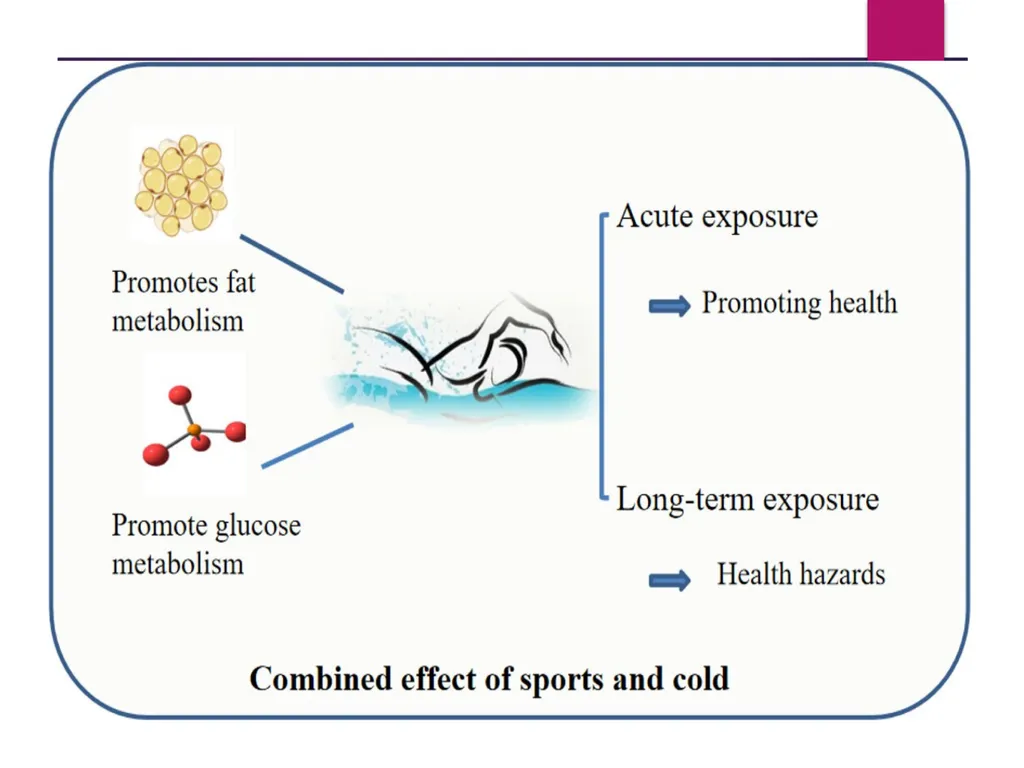
Brown fat is activated by cold exposure and contributes to heat production (thermogenesis). The activation of BAT leads to:
Calorie burning (improving metabolism and fat loss).
Improved insulin sensitivity, which has a cardioprotective effect by lowering the risk of diabetes and reducing inflammation.
5. Enhanced Stress Resilience and Mental Health:
Cold exposure can also improve your stress resilience by promoting the production of endorphins and norepinephrine, which helps the body better cope with stressors. This can have indirect benefits on cardiovascular health by lowering chronic stress levels.<br>
slide15. Long-Term Effects of Cold Exposure on the Autonomic Nervous System Summary:
- Acute cold exposure activates the SNS, increasing HR and BP.
- Regular cold exposure strengthens the PNS, improving HRV, recovery, and cardiovascular health over time.
- Benefits include improved circulation, reduced BP, enhanced metabolism, and stress resilience.<br>
NAJEM AL-JANABI<br>
slide2. Introduction The Cold Pressor Test (CPT) is used to assess the body's autonomic and cardiovascular response to cold stress. It is commonly applied in evaluating hypertension, autonomic dysfunction, and pain tolerance.
The cold pressor test measures the sympathetically mediated increase in BP in response to the stress of a controlled environmental temperature change.<br>
slide3. Physiological Basis of CPT Cold exposure activates nociceptors, triggering the sympathetic nervous system.
Leads to vasoconstriction and increased blood pressure (BP).
Increased heart rate (HR) and pain perception due to norepinephrine release.<br>
slide4. Norepinephrine :- Norepinephrine is the primary neurotransmitter released from postganglionic sympathetic nerve terminals and a hormone secreted by the adrenal medulla. Norepinephrine also acts as a neurotransmitter within the central nervous system.
is a neurotransmitter of the brain that plays an essential role in the regulation of arousal, attention, cognitive function, and stress reactions.<br>
slide5. Test Procedure 1. Measure baseline BP & HR after 5 minutes of rest.
2. Submerge hand in 0–4°C water for up to 2 minutes.
3. Record BP & HR at 30 sec, 1 min, and 2 min.
4. Remove hand and measure recovery BP & HR.<br>
slide6. Results - Normal: BP increases (10-20 mmHg systolic, 5-15 mmHg diastolic), HR slightly increases.
- Exaggerated BP rise (>30 mmHg) may indicate hypertension risk.
- Blunted BP response suggests autonomic dysfunction.
- Delayed recovery indicates poor vascular reactivity.<br>
slide7. Clinical Applications Predicting hypertension risk.
Evaluating autonomic dysfunction (diabetes, Parkinson’s, dysautonomia).
Studying pain perception and stress response.<br>
slide8. Conclusion The Cold Pressor Test is a valuable tool for assessing autonomic nervous system function, cardiovascular reactivity, and pain tolerance, providing important clinical insights into blood pressure regulation.<br>
slide9. Effect of sympathetic autonomic stress from the cold pressor test on young healthy adults Clinical and Research Implications
Early Detection of Hypertension: Exaggerated BP response may indicate a predisposition.
Autonomic Nervous System Assessment: HRV changes reflect SNS and parasympathetic balance.<br>
slide10. Effect of sympathetic autonomic stress from the cold pressor test on young healthy adults The Cold Pressor Test is an effective tool for evaluating sympathetic autonomic function in young adults.
Increased BP, HR, and HRV alterations reflect autonomic stress responses.
Future research can explore long-term implications and fitness-related variability.<br>
slide11. Long-Term Effects of Cold Exposure on the Autonomic Nervous System 1. Initial (Acute) Response to Cold Exposure:
When you expose your body to cold (e.g., cold showers, ice baths, or cold pressor tests), the body reacts by activating the sympathetic nervous system (SNS). This leads to:
Vasoconstriction: Blood vessels constrict to preserve heat, which increases blood pressure.
Increased Heart Rate: The heart rate rises as the body tries to increase circulation to vital organs.
Release of Catecholamines: Norepinephrine and epinephrine are released, which further boost heart rate, blood pressure, and overall metabolic rate.<br>
slide12. Long-Term Effects of Cold Exposure on the Autonomic Nervous System 2. Adaptation and Long-Term Effects:
With regular cold exposure, the body begins to adapt to the stress, and this adaptation can enhance parasympathetic nervous system (PNS) activity:
Improved Heart Rate Variability (HRV): HRV is a marker of how well the parasympathetic nervous system can regulate the heart. Over time, cold exposure can increase vagal tone, leading to better control of heart rate and a higher HRV. A higher HRV is associated with better cardiovascular health and a more resilient autonomic nervous system.
Enhanced Recovery: As your body adapts, it becomes better at managing cold-induced stress. This means that while your heart rate and blood pressure may spike during initial cold exposure, they will return to baseline faster due to better parasympathetic recovery.<br>
slide13. Long-Term Effects of Cold Exposure on the Autonomic Nervous System 3. Cardiovascular Health Benefits of Regular Cold Exposure:
Reduced Blood Pressure: Over time, regular cold exposure can lower resting blood pressure because of the enhanced parasympathetic recovery and improved vascular function.
Increased Circulation: Chronic cold exposure helps improve circulation, particularly to the extremities, as your body becomes better at managing the vasoconstriction and vasodilation processes.
Improved Endothelial Function: The endothelium (lining of blood vessels) becomes more efficient at dilating and contracting, which helps regulate blood flow and pressure.<br>
slide14. Long-Term Effects of Cold Exposure on the Autonomic Nervous System 4. Activation of Brown Adipose Tissue (BAT):
Brown fat is activated by cold exposure and contributes to heat production (thermogenesis). The activation of BAT leads to:
Calorie burning (improving metabolism and fat loss).
Improved insulin sensitivity, which has a cardioprotective effect by lowering the risk of diabetes and reducing inflammation.
5. Enhanced Stress Resilience and Mental Health:
Cold exposure can also improve your stress resilience by promoting the production of endorphins and norepinephrine, which helps the body better cope with stressors. This can have indirect benefits on cardiovascular health by lowering chronic stress levels.<br>
slide15. Long-Term Effects of Cold Exposure on the Autonomic Nervous System Summary:
- Acute cold exposure activates the SNS, increasing HR and BP.
- Regular cold exposure strengthens the PNS, improving HRV, recovery, and cardiovascular health over time.
- Benefits include improved circulation, reduced BP, enhanced metabolism, and stress resilience.<br>