
Colette Gilpin, PMP & ICAgile Certified

Description: Colette Gilpin, PMP ICAgile Certified Professional(ICP) IMA NERC Fall Conference September 23, 2018 Aligning the Journey: Project Change Management Session Plan Interaction encouraged! Have a question, comment? Stop me! No need to wait.
Related Topics
Download Presentation
"Colette Gilpin, PMP & ICAgile Certified" is the property of its rightful owner. Permission is granted to download and print the materials on this website for personal, non-commercial use only, and to display it on your personal computer provided you do not modify the materials and that you retain all copyright notices contained in the materials. By downloading content from our website, you accept the terms of this agreement.
Presentation Transcript
slide1. Colette Gilpin, PMP & ICAgile Certified Professional(ICP)
IMA NERC Fall Conference
September 23, 2018 Aligning the Journey: Project & Change Management<br>
slide2. Session Plan Interaction encouraged!
Have a question, comment? Stop me! No need to wait.
Getting to Know Me
Getting to Know You – project experiences, pit falls, successes
IMA Competency Framework Alignment
Projects – Why we do them?
Aligning the Journey: Stakeholder Change Management
How To Tools and Techniques<br>
slide3. Who I am….. A practitioner of program, project & change management.
Enjoy the diversity that comes with applying the principles to any function, discipline or program.
Avid learner, continuously finding new ways expand knowledge.
A bit of a control freak – certainly a “type A”
Grew up in Rhode Island, live in Massachusetts & Rhode Island
Work at CVS Health currently supporting complex digital change programs<br>
slide4. Getting to Know You & Your Experiences What types of industries do you represent?
What types of projects have been launched at your organizations?
What pit falls have projects you’ve been a part of had?
How successful and fully adopted were the projects? Why?
Let’s share some experiences<br>
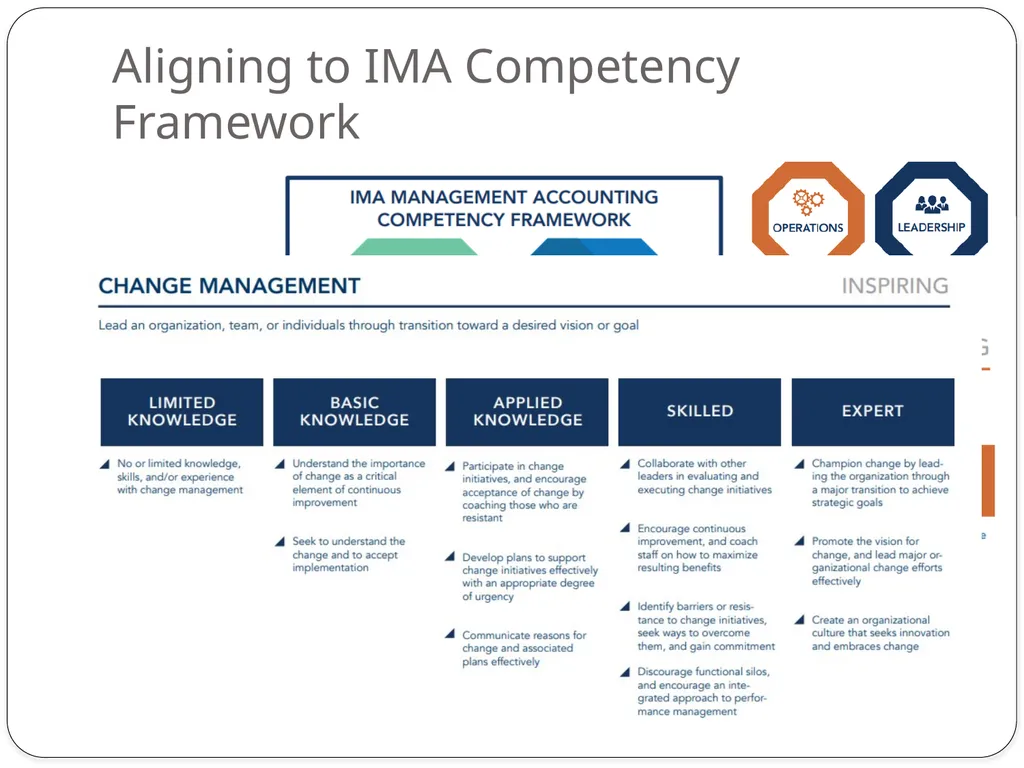
slide5. Aligning to IMA Competency Framework<br>
slide6. Projects & Project Manager Role Traditional Considerations of Projects:
A project has a beginning and an end
It has a discreet and measureable set of objectives to achieve
Usually have a timeline and budget to adhere to
Follows a plan to achieve deliverables
A team assigned to achieve the objectives
Team is responsible to complete implementation and ensure adoption of the project outcomes
Project Manager – lead the team capitalizing on tools and techniques to achieve project objectives<br>
slide7. Projects & Project Manager Role Project Manager’s role
Leads the team capitalizing on tools and techniques to achieve project objectives. Some key activities include:
Meeting management
Facilitates stakeholder analysis and communication planning
Leads building of the project plan – complete or iterative planning
Help identify & track risks and mitigation strategies
Help identify & tracks issues and resolution plans
Escalation management / Facilitate Removal of Barriers
Keeps management apprised of project
Help the team solution the problems by helping to ask “Powerful Questions”
Open-ended to create greater possibility for expanded learning and a fresh perspective
Outcome may lead to changes in the project; the PM/ScrumMaster helps facilitate communicating and managing those project changes<br>
slide8. “Powerful Questions” examples: What will this get you?
If you had free choice in the matter, what would you do?
What is here that you want to explore?
What is the worst thing that can happen?
What is possible here?
What concerns you the most about….?
If you could do anything you wanted, what would you do?
What’s holding you back?
What is the most meaningful action we could take now? * ASPE – ScrumMaster Workshop Course Content - 2018<br>
slide9. Why are projects initiated? What are some of the reasons your organizations have chosen to initiate a project?
Could we align the projects we have individually been part of to either:
Improving value?
Reducing waste?
The filter of deciding to take on a project is shifting more and more to these two decision factors…are we improving our value and reducing our waste by embarking on this project? If not, why are we proceeding?<br>
slide10. Project Fails Many studies continue to state that 70% of projects fail
What does fail mean to you?
If the project manager gets a team to complete deliverables, on-time and on budget is that a successful project?
Why?
Let’s say that team develops a great solution but no one adopts it. Was that project truly successful?
Stakeholder & Change Management is Necessary!
Regardless of the practices/methods used, the team must bring along all impacted stakeholder on the journey to be successful.<br>
slide11. Truths About Change Organizations don’t change, nor do organizations decide to change
Be clear about what is changing
Processes, systems, structure all exist within an organization and can evolve, change or be replaced
What brings them to life in all instances are the people that use them
Decision To Change Results in:
Creating expectations for other people
Asking someone else to do things differently Reference: Mark Mullaly, Ph.D., PMP; PM.com -2018-05 Project Headway “It’s the People Stupid”<br>
slide12. Change is about the people! Changes we contemplate sets an expectation to change:
how we interact
what we do
how we behave
Traditionally “Change Management” language speaks to shifting states (current state, future state)….but actually change tries to shift behaviors
Changing behavior IS NOT easy
Messy, difficult, challenging
Not logical or linear
More emotional than rational Reference: Mark Mullaly, Ph.D., PMP; PM.com -2018-05 Project Headway “It’s the People Stupid”<br>
slide13. Change Reaction Why Do I Need To Change?
This is what we know!
We keep doing what we know until we find a better way.
Change Can Not Be Forced
Can’t control people
Limited compliance with coercion or scrutiny
People revert to old behaviors when attention goes away
Willingness to accept change depends on individuals seeing ways for them to be more successful
Need to see ourselves being more successful using the new approach
If we can’t see it, we won’t do it Reference: Mark Mullaly, Ph.D., PMP; PM.com -2018-05 Project Headway “It’s the People Stupid”<br>
slide14. Change Leaders Help Those Impacted: See how the change can make them more successful
Recognize the improvements from their perspective
Demonstrate the solution works and works well
Pilots
Makes sense and can work in their environment
Realize for a change to be better adopted, it should not be some other organizations “best practice”, it is a tailored solution for ‘us’ Change being embraced requires a sense of ownership and belief it is better than what was in place before and it is uniquely ours. Reference: Mark Mullaly, Ph.D., PMP; PM.com -2018-05 Project Headway “It’s the People Stupid”<br>
slide15. How do we do this? Involve impacted stakeholders along the journey
Listen to input – gather “voice of customer”
Include in pilots and early testing
Demonstrate along the way – What’s working? What do they like? What don’t they like? Ideas to improve?
Keep in mind, managing change should not be an after thought of a project; it is not a marketing plan.
It is not a specific deliverable of a project to be checked off.
It is aligning your stakeholders needs, inputs and impacts throughout the project journey at every step<br>
slide16. Who are your stakeholders? Flip Chart Exercise:
Identify potential stakeholders of any project you have been a part of in your respective organization.
Identify themes about these stakeholders
Similar needs?
Small impacts; Great impacts? Remember….It’s about the people!<br>
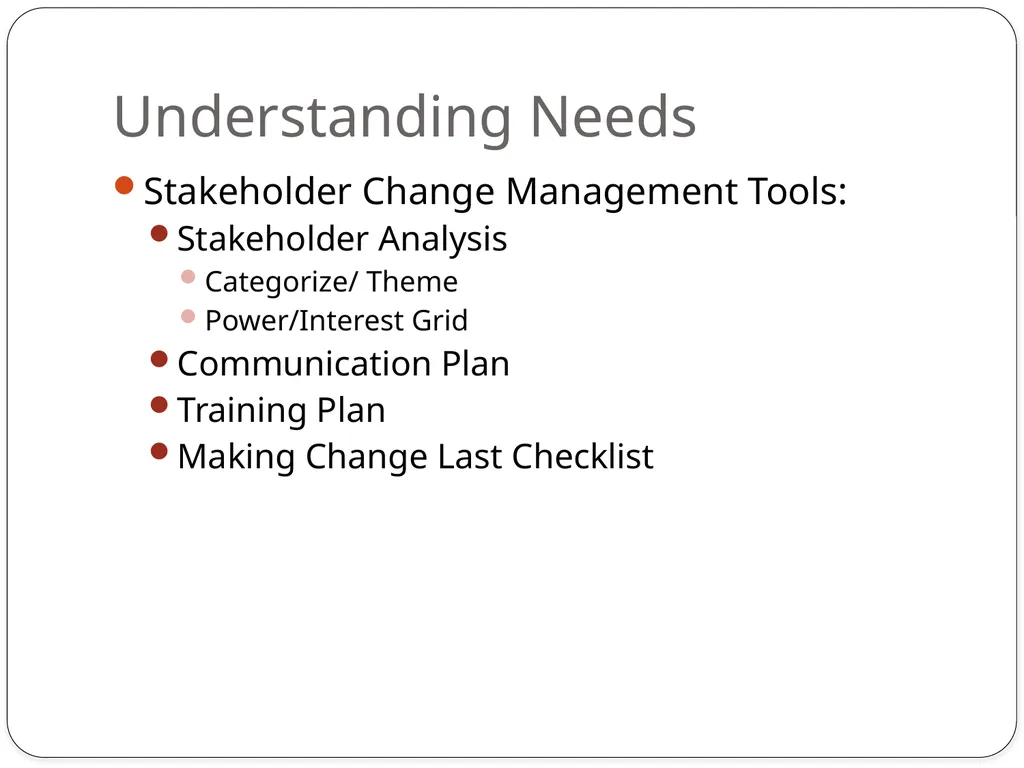
slide17. Understanding Needs Stakeholder Change Management Tools:
Stakeholder Analysis
Categorize/ Theme
Power/Interest Grid
Communication Plan
Training Plan
Making Change Last Checklist<br>
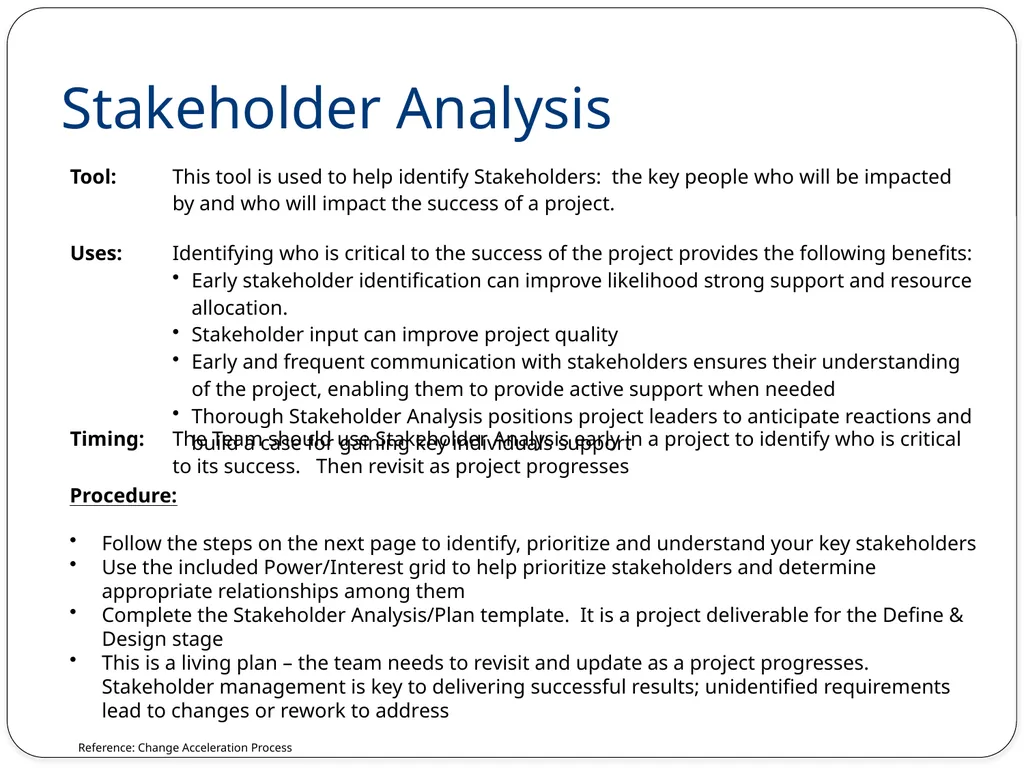
slide18. Procedure:
Follow the steps on the next page to identify, prioritize and understand your key stakeholders
Use the included Power/Interest grid to help prioritize stakeholders and determine appropriate relationships among them
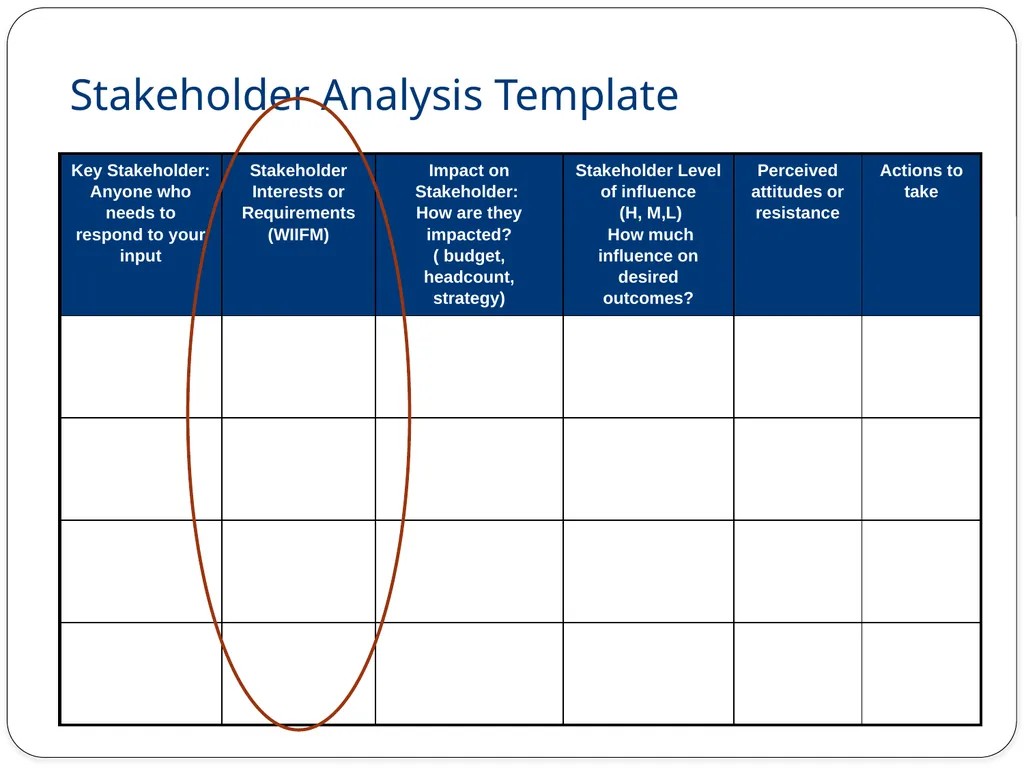
Complete the Stakeholder Analysis/Plan template. It is a project deliverable for the Define & Design stage
This is a living plan – the team needs to revisit and update as a project progresses. Stakeholder management is key to delivering successful results; unidentified requirements lead to changes or rework to address Stakeholder Analysis Reference: Change Acceleration Process<br>
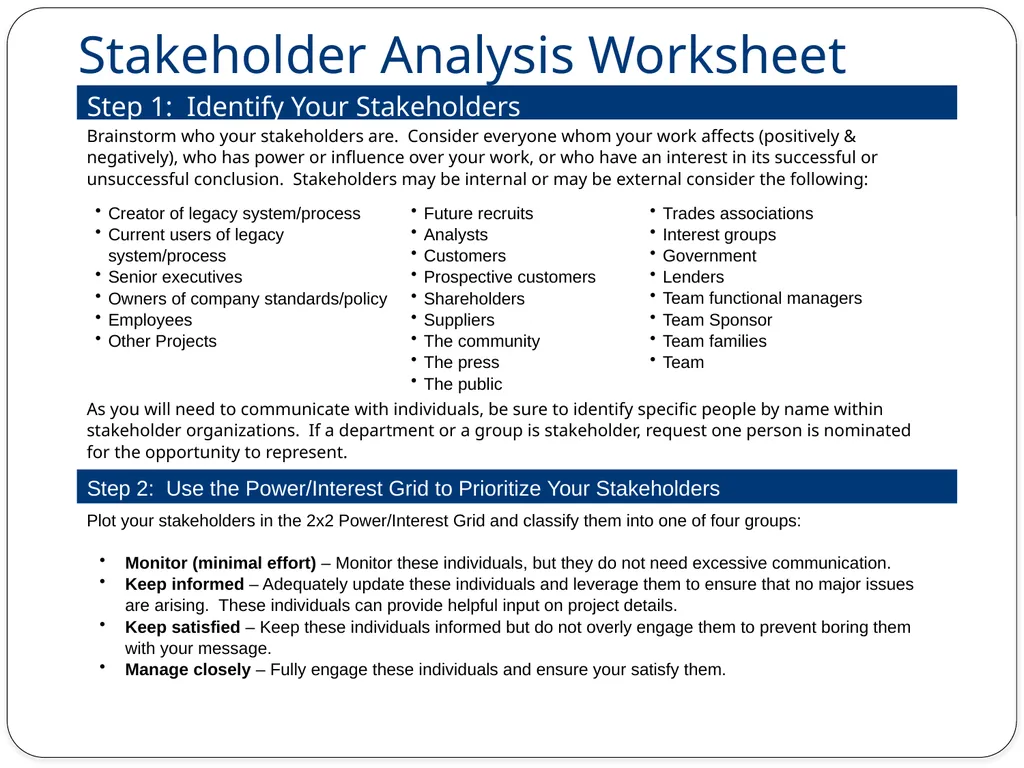
slide19. Stakeholder Analysis Worksheet Step 1: Identify Your Stakeholders Brainstorm who your stakeholders are. Consider everyone whom your work affects (positively & negatively), who has power or influence over your work, or who have an interest in its successful or unsuccessful conclusion. Stakeholders may be internal or may be external consider the following: Creator of legacy system/process
Current users of legacy system/process
Senior executives
Owners of company standards/policy
Employees
Other Projects Future recruits
Analysts
Customers
Prospective customers
Shareholders
Suppliers
The community
The press
The public Trades associations
Interest groups
Government
Lenders
Team functional managers
Team Sponsor
Team families
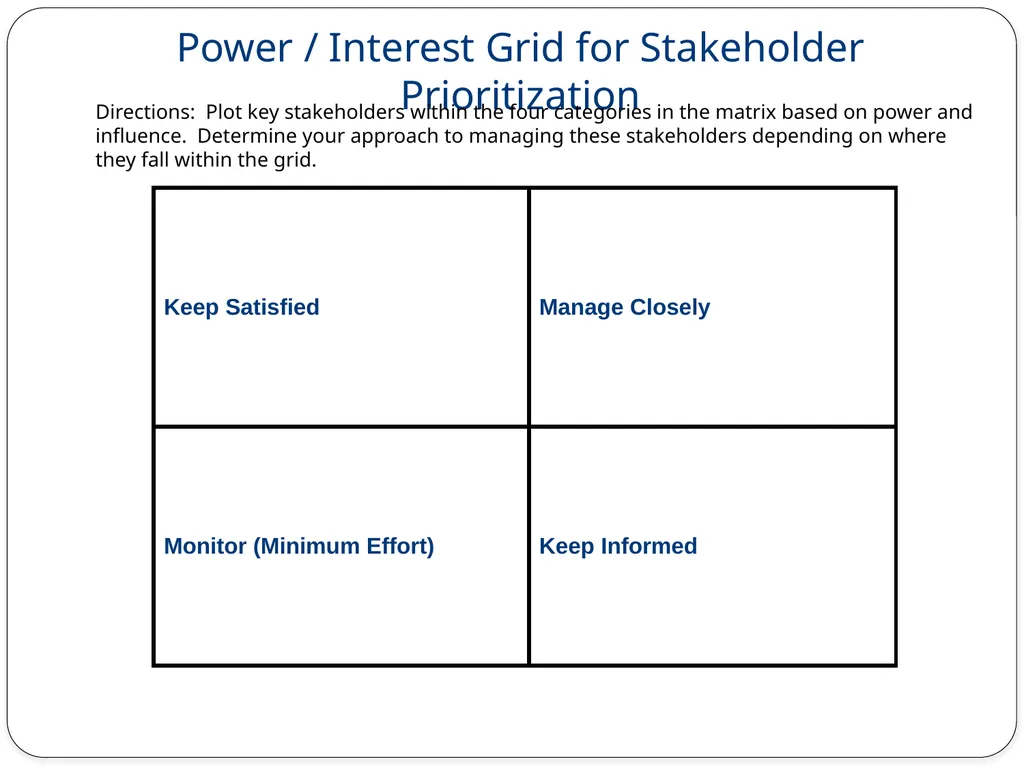
Team As you will need to communicate with individuals, be sure to identify specific people by name within stakeholder organizations. If a department or a group is stakeholder, request one person is nominated for the opportunity to represent. Step 2: Use the Power/Interest Grid to Prioritize Your Stakeholders Plot your stakeholders in the 2x2 Power/Interest Grid and classify them into one of four groups:
Monitor (minimal effort) – Monitor these individuals, but they do not need excessive communication.
Keep informed – Adequately update these individuals and leverage them to ensure that no major issues are arising. These individuals can provide helpful input on project details.
Keep satisfied – Keep these individuals informed but do not overly engage them to prevent boring them with your message.
Manage closely – Fully engage these individuals and ensure your satisfy them.<br>
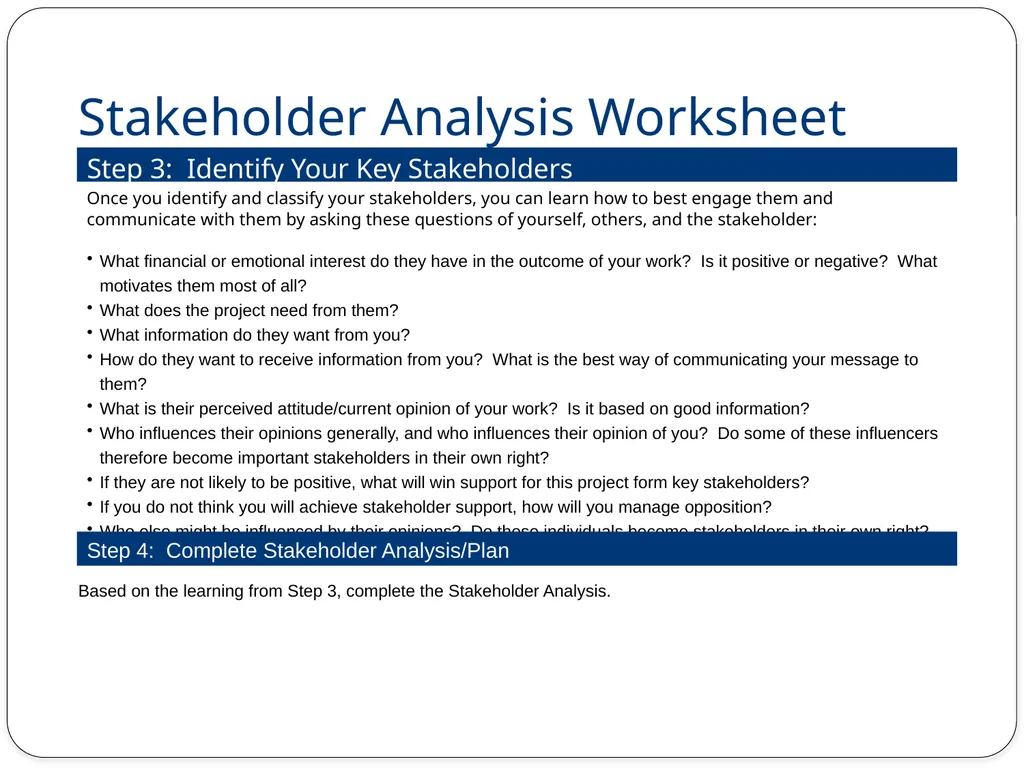
slide20. Stakeholder Analysis Worksheet Step 3: Identify Your Key Stakeholders Once you identify and classify your stakeholders, you can learn how to best engage them and communicate with them by asking these questions of yourself, others, and the stakeholder: What financial or emotional interest do they have in the outcome of your work? Is it positive or negative? What motivates them most of all?
What does the project need from them?
What information do they want from you?
How do they want to receive information from you? What is the best way of communicating your message to them?
What is their perceived attitude/current opinion of your work? Is it based on good information?
Who influences their opinions generally, and who influences their opinion of you? Do some of these influencers therefore become important stakeholders in their own right?
If they are not likely to be positive, what will win support for this project form key stakeholders?
If you do not think you will achieve stakeholder support, how will you manage opposition?
Who else might be influenced by their opinions? Do these individuals become stakeholders in their own right? Step 4: Complete Stakeholder Analysis/Plan Based on the learning from Step 3, complete the Stakeholder Analysis.<br>
slide21. Power / Interest Grid for Stakeholder Prioritization Directions: Plot key stakeholders within the four categories in the matrix based on power and influence. Determine your approach to managing these stakeholders depending on where they fall within the grid.<br>
slide22. Stakeholder Analysis Template<br>
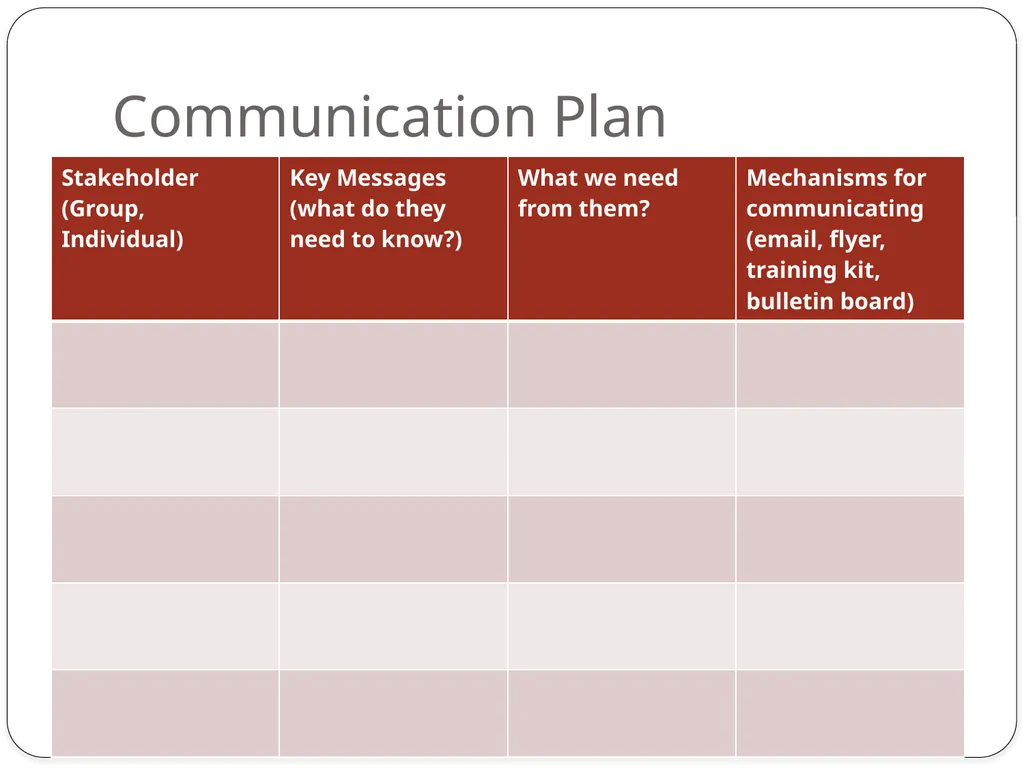
slide23. Communication Plan<br>
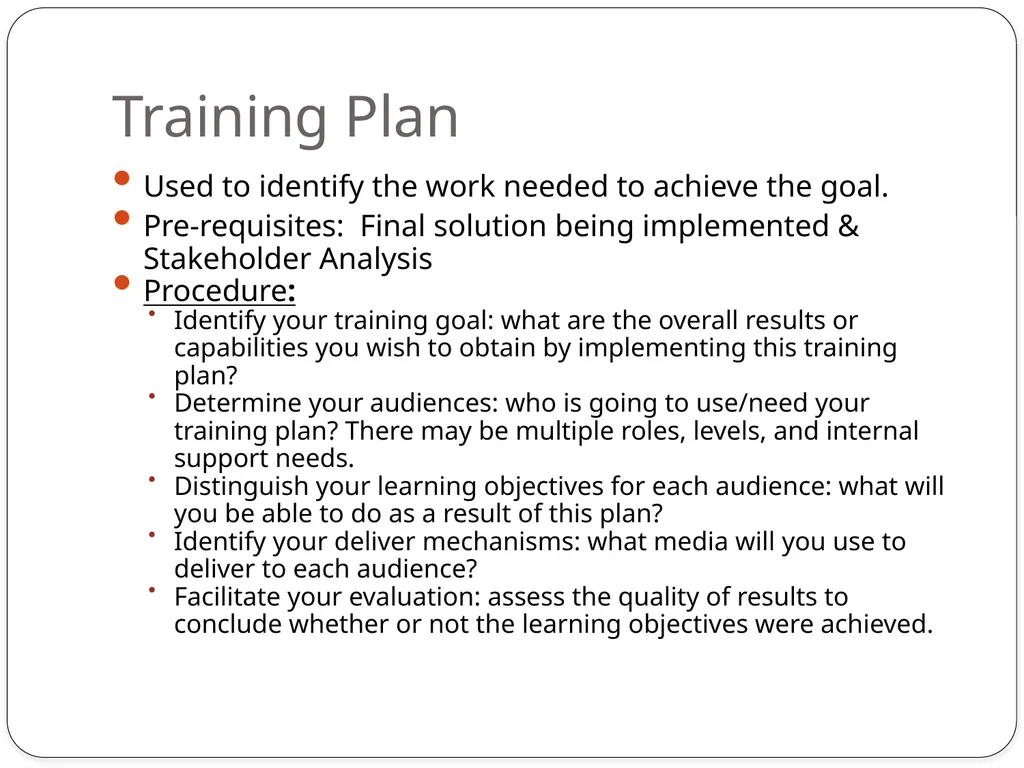
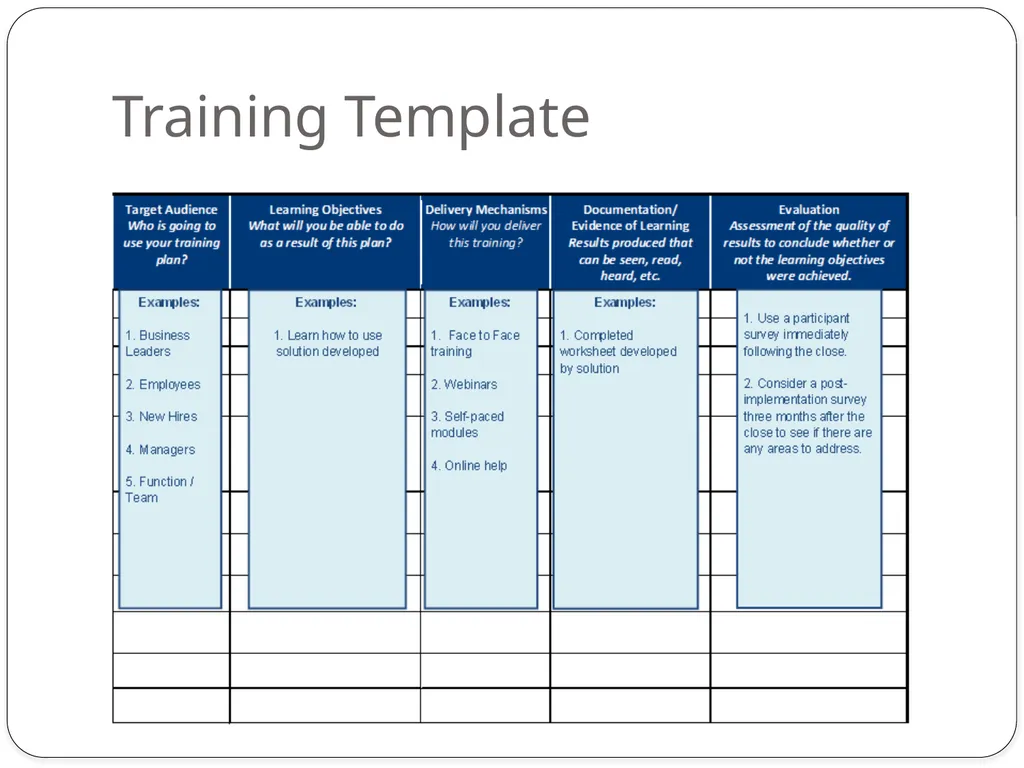
slide24. Training Plan Used to identify the work needed to achieve the goal.
Pre-requisites: Final solution being implemented & Stakeholder Analysis
Procedure:
Identify your training goal: what are the overall results or capabilities you wish to obtain by implementing this training plan?
Determine your audiences: who is going to use/need your training plan? There may be multiple roles, levels, and internal support needs.
Distinguish your learning objectives for each audience: what will you be able to do as a result of this plan?
Identify your deliver mechanisms: what media will you use to deliver to each audience?
Facilitate your evaluation: assess the quality of results to conclude whether or not the learning objectives were achieved.<br>
slide25. Training Template<br>
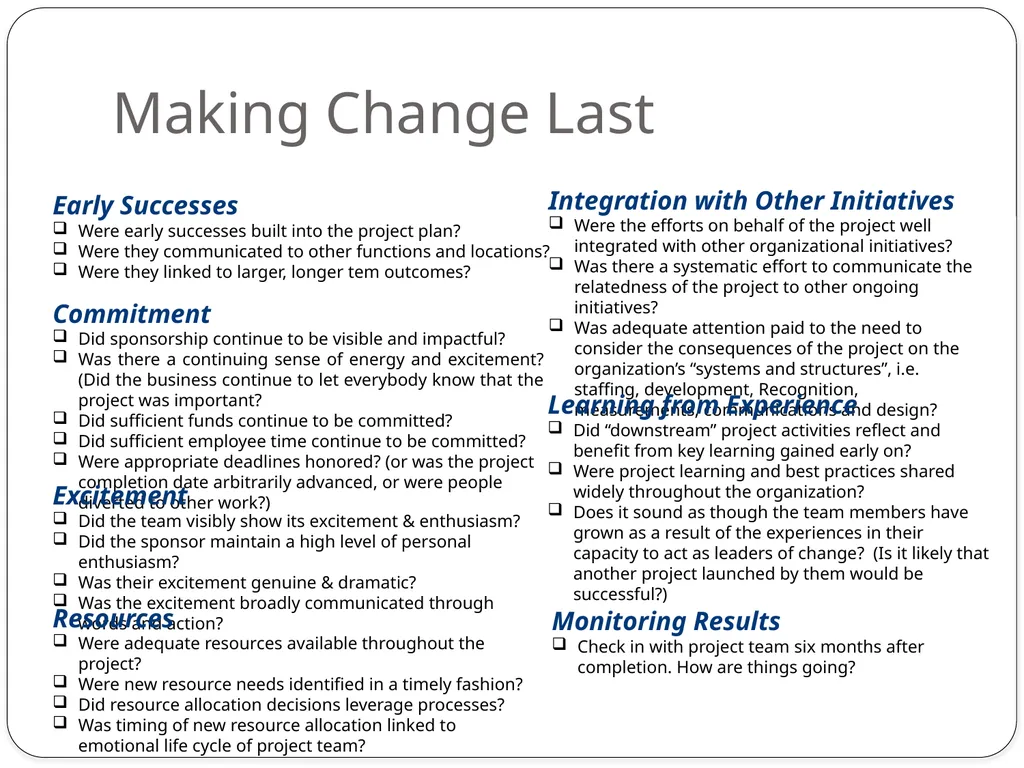
slide26. Making Change Last Early Successes
Were early successes built into the project plan?
Were they communicated to other functions and locations?
Were they linked to larger, longer tem outcomes? Commitment
Did sponsorship continue to be visible and impactful?
Was there a continuing sense of energy and excitement? (Did the business continue to let everybody know that the project was important?
Did sufficient funds continue to be committed?
Did sufficient employee time continue to be committed?
Were appropriate deadlines honored? (or was the project completion date arbitrarily advanced, or were people diverted to other work?) Excitement
Did the team visibly show its excitement & enthusiasm?
Did the sponsor maintain a high level of personal enthusiasm?
Was their excitement genuine & dramatic?
Was the excitement broadly communicated through words and action? Resources
Were adequate resources available throughout the project?
Were new resource needs identified in a timely fashion?
Did resource allocation decisions leverage processes?
Was timing of new resource allocation linked to emotional life cycle of project team? Integration with Other Initiatives
Were the efforts on behalf of the project well integrated with other organizational initiatives?
Was there a systematic effort to communicate the relatedness of the project to other ongoing initiatives?
Was adequate attention paid to the need to consider the consequences of the project on the organization’s “systems and structures”, i.e. staffing, development, Recognition, measurements, communications and design? Learning from Experience
Did “downstream” project activities reflect and benefit from key learning gained early on?
Were project learning and best practices shared widely throughout the organization?
Does it sound as though the team members have grown as a result of the experiences in their capacity to act as leaders of change? (Is it likely that another project launched by them would be successful?) Monitoring Results
Check in with project team six months after completion. How are things going?<br>
IMA NERC Fall Conference
September 23, 2018 Aligning the Journey: Project & Change Management<br>
slide2. Session Plan Interaction encouraged!
Have a question, comment? Stop me! No need to wait.
Getting to Know Me
Getting to Know You – project experiences, pit falls, successes
IMA Competency Framework Alignment
Projects – Why we do them?
Aligning the Journey: Stakeholder Change Management
How To Tools and Techniques<br>
slide3. Who I am….. A practitioner of program, project & change management.
Enjoy the diversity that comes with applying the principles to any function, discipline or program.
Avid learner, continuously finding new ways expand knowledge.
A bit of a control freak – certainly a “type A”
Grew up in Rhode Island, live in Massachusetts & Rhode Island
Work at CVS Health currently supporting complex digital change programs<br>
slide4. Getting to Know You & Your Experiences What types of industries do you represent?
What types of projects have been launched at your organizations?
What pit falls have projects you’ve been a part of had?
How successful and fully adopted were the projects? Why?
Let’s share some experiences<br>
slide5. Aligning to IMA Competency Framework<br>
slide6. Projects & Project Manager Role Traditional Considerations of Projects:
A project has a beginning and an end
It has a discreet and measureable set of objectives to achieve
Usually have a timeline and budget to adhere to
Follows a plan to achieve deliverables
A team assigned to achieve the objectives
Team is responsible to complete implementation and ensure adoption of the project outcomes
Project Manager – lead the team capitalizing on tools and techniques to achieve project objectives<br>
slide7. Projects & Project Manager Role Project Manager’s role
Leads the team capitalizing on tools and techniques to achieve project objectives. Some key activities include:
Meeting management
Facilitates stakeholder analysis and communication planning
Leads building of the project plan – complete or iterative planning
Help identify & track risks and mitigation strategies
Help identify & tracks issues and resolution plans
Escalation management / Facilitate Removal of Barriers
Keeps management apprised of project
Help the team solution the problems by helping to ask “Powerful Questions”
Open-ended to create greater possibility for expanded learning and a fresh perspective
Outcome may lead to changes in the project; the PM/ScrumMaster helps facilitate communicating and managing those project changes<br>
slide8. “Powerful Questions” examples: What will this get you?
If you had free choice in the matter, what would you do?
What is here that you want to explore?
What is the worst thing that can happen?
What is possible here?
What concerns you the most about….?
If you could do anything you wanted, what would you do?
What’s holding you back?
What is the most meaningful action we could take now? * ASPE – ScrumMaster Workshop Course Content - 2018<br>
slide9. Why are projects initiated? What are some of the reasons your organizations have chosen to initiate a project?
Could we align the projects we have individually been part of to either:
Improving value?
Reducing waste?
The filter of deciding to take on a project is shifting more and more to these two decision factors…are we improving our value and reducing our waste by embarking on this project? If not, why are we proceeding?<br>
slide10. Project Fails Many studies continue to state that 70% of projects fail
What does fail mean to you?
If the project manager gets a team to complete deliverables, on-time and on budget is that a successful project?
Why?
Let’s say that team develops a great solution but no one adopts it. Was that project truly successful?
Stakeholder & Change Management is Necessary!
Regardless of the practices/methods used, the team must bring along all impacted stakeholder on the journey to be successful.<br>
slide11. Truths About Change Organizations don’t change, nor do organizations decide to change
Be clear about what is changing
Processes, systems, structure all exist within an organization and can evolve, change or be replaced
What brings them to life in all instances are the people that use them
Decision To Change Results in:
Creating expectations for other people
Asking someone else to do things differently Reference: Mark Mullaly, Ph.D., PMP; PM.com -2018-05 Project Headway “It’s the People Stupid”<br>
slide12. Change is about the people! Changes we contemplate sets an expectation to change:
how we interact
what we do
how we behave
Traditionally “Change Management” language speaks to shifting states (current state, future state)….but actually change tries to shift behaviors
Changing behavior IS NOT easy
Messy, difficult, challenging
Not logical or linear
More emotional than rational Reference: Mark Mullaly, Ph.D., PMP; PM.com -2018-05 Project Headway “It’s the People Stupid”<br>
slide13. Change Reaction Why Do I Need To Change?
This is what we know!
We keep doing what we know until we find a better way.
Change Can Not Be Forced
Can’t control people
Limited compliance with coercion or scrutiny
People revert to old behaviors when attention goes away
Willingness to accept change depends on individuals seeing ways for them to be more successful
Need to see ourselves being more successful using the new approach
If we can’t see it, we won’t do it Reference: Mark Mullaly, Ph.D., PMP; PM.com -2018-05 Project Headway “It’s the People Stupid”<br>
slide14. Change Leaders Help Those Impacted: See how the change can make them more successful
Recognize the improvements from their perspective
Demonstrate the solution works and works well
Pilots
Makes sense and can work in their environment
Realize for a change to be better adopted, it should not be some other organizations “best practice”, it is a tailored solution for ‘us’ Change being embraced requires a sense of ownership and belief it is better than what was in place before and it is uniquely ours. Reference: Mark Mullaly, Ph.D., PMP; PM.com -2018-05 Project Headway “It’s the People Stupid”<br>
slide15. How do we do this? Involve impacted stakeholders along the journey
Listen to input – gather “voice of customer”
Include in pilots and early testing
Demonstrate along the way – What’s working? What do they like? What don’t they like? Ideas to improve?
Keep in mind, managing change should not be an after thought of a project; it is not a marketing plan.
It is not a specific deliverable of a project to be checked off.
It is aligning your stakeholders needs, inputs and impacts throughout the project journey at every step<br>
slide16. Who are your stakeholders? Flip Chart Exercise:
Identify potential stakeholders of any project you have been a part of in your respective organization.
Identify themes about these stakeholders
Similar needs?
Small impacts; Great impacts? Remember….It’s about the people!<br>
slide17. Understanding Needs Stakeholder Change Management Tools:
Stakeholder Analysis
Categorize/ Theme
Power/Interest Grid
Communication Plan
Training Plan
Making Change Last Checklist<br>
slide18. Procedure:
Follow the steps on the next page to identify, prioritize and understand your key stakeholders
Use the included Power/Interest grid to help prioritize stakeholders and determine appropriate relationships among them
Complete the Stakeholder Analysis/Plan template. It is a project deliverable for the Define & Design stage
This is a living plan – the team needs to revisit and update as a project progresses. Stakeholder management is key to delivering successful results; unidentified requirements lead to changes or rework to address Stakeholder Analysis Reference: Change Acceleration Process<br>
slide19. Stakeholder Analysis Worksheet Step 1: Identify Your Stakeholders Brainstorm who your stakeholders are. Consider everyone whom your work affects (positively & negatively), who has power or influence over your work, or who have an interest in its successful or unsuccessful conclusion. Stakeholders may be internal or may be external consider the following: Creator of legacy system/process
Current users of legacy system/process
Senior executives
Owners of company standards/policy
Employees
Other Projects Future recruits
Analysts
Customers
Prospective customers
Shareholders
Suppliers
The community
The press
The public Trades associations
Interest groups
Government
Lenders
Team functional managers
Team Sponsor
Team families
Team As you will need to communicate with individuals, be sure to identify specific people by name within stakeholder organizations. If a department or a group is stakeholder, request one person is nominated for the opportunity to represent. Step 2: Use the Power/Interest Grid to Prioritize Your Stakeholders Plot your stakeholders in the 2x2 Power/Interest Grid and classify them into one of four groups:
Monitor (minimal effort) – Monitor these individuals, but they do not need excessive communication.
Keep informed – Adequately update these individuals and leverage them to ensure that no major issues are arising. These individuals can provide helpful input on project details.
Keep satisfied – Keep these individuals informed but do not overly engage them to prevent boring them with your message.
Manage closely – Fully engage these individuals and ensure your satisfy them.<br>
slide20. Stakeholder Analysis Worksheet Step 3: Identify Your Key Stakeholders Once you identify and classify your stakeholders, you can learn how to best engage them and communicate with them by asking these questions of yourself, others, and the stakeholder: What financial or emotional interest do they have in the outcome of your work? Is it positive or negative? What motivates them most of all?
What does the project need from them?
What information do they want from you?
How do they want to receive information from you? What is the best way of communicating your message to them?
What is their perceived attitude/current opinion of your work? Is it based on good information?
Who influences their opinions generally, and who influences their opinion of you? Do some of these influencers therefore become important stakeholders in their own right?
If they are not likely to be positive, what will win support for this project form key stakeholders?
If you do not think you will achieve stakeholder support, how will you manage opposition?
Who else might be influenced by their opinions? Do these individuals become stakeholders in their own right? Step 4: Complete Stakeholder Analysis/Plan Based on the learning from Step 3, complete the Stakeholder Analysis.<br>
slide21. Power / Interest Grid for Stakeholder Prioritization Directions: Plot key stakeholders within the four categories in the matrix based on power and influence. Determine your approach to managing these stakeholders depending on where they fall within the grid.<br>
slide22. Stakeholder Analysis Template<br>
slide23. Communication Plan<br>
slide24. Training Plan Used to identify the work needed to achieve the goal.
Pre-requisites: Final solution being implemented & Stakeholder Analysis
Procedure:
Identify your training goal: what are the overall results or capabilities you wish to obtain by implementing this training plan?
Determine your audiences: who is going to use/need your training plan? There may be multiple roles, levels, and internal support needs.
Distinguish your learning objectives for each audience: what will you be able to do as a result of this plan?
Identify your deliver mechanisms: what media will you use to deliver to each audience?
Facilitate your evaluation: assess the quality of results to conclude whether or not the learning objectives were achieved.<br>
slide25. Training Template<br>
slide26. Making Change Last Early Successes
Were early successes built into the project plan?
Were they communicated to other functions and locations?
Were they linked to larger, longer tem outcomes? Commitment
Did sponsorship continue to be visible and impactful?
Was there a continuing sense of energy and excitement? (Did the business continue to let everybody know that the project was important?
Did sufficient funds continue to be committed?
Did sufficient employee time continue to be committed?
Were appropriate deadlines honored? (or was the project completion date arbitrarily advanced, or were people diverted to other work?) Excitement
Did the team visibly show its excitement & enthusiasm?
Did the sponsor maintain a high level of personal enthusiasm?
Was their excitement genuine & dramatic?
Was the excitement broadly communicated through words and action? Resources
Were adequate resources available throughout the project?
Were new resource needs identified in a timely fashion?
Did resource allocation decisions leverage processes?
Was timing of new resource allocation linked to emotional life cycle of project team? Integration with Other Initiatives
Were the efforts on behalf of the project well integrated with other organizational initiatives?
Was there a systematic effort to communicate the relatedness of the project to other ongoing initiatives?
Was adequate attention paid to the need to consider the consequences of the project on the organization’s “systems and structures”, i.e. staffing, development, Recognition, measurements, communications and design? Learning from Experience
Did “downstream” project activities reflect and benefit from key learning gained early on?
Were project learning and best practices shared widely throughout the organization?
Does it sound as though the team members have grown as a result of the experiences in their capacity to act as leaders of change? (Is it likely that another project launched by them would be successful?) Monitoring Results
Check in with project team six months after completion. How are things going?<br>