Comments, Bill Goffe, Penn State Fourcade, Ollion,
Description: Comments, Bill Goffe, Penn State Fourcade, Ollion, Algan. The Superiority of Economists. JEP 2015. We understand new things in the context of things we already know, and most of what we know is concrete. People are naturally curious,
Related Topics
Download Presentation
"Comments, Bill Goffe, Penn State Fourcade, Ollion," is the property of its rightful owner. Permission is granted to download and print the materials on this website for personal, non-commercial use only, and to display it on your personal computer provided you do not modify the materials and that you retain all copyright notices contained in the materials. By downloading content from our website, you accept the terms of this agreement.
Presentation Transcript
slide1. Comments, Bill Goffe, Penn State
Fourcade, Ollion, & Algan. “The Superiority of Economists.” JEP 2015.
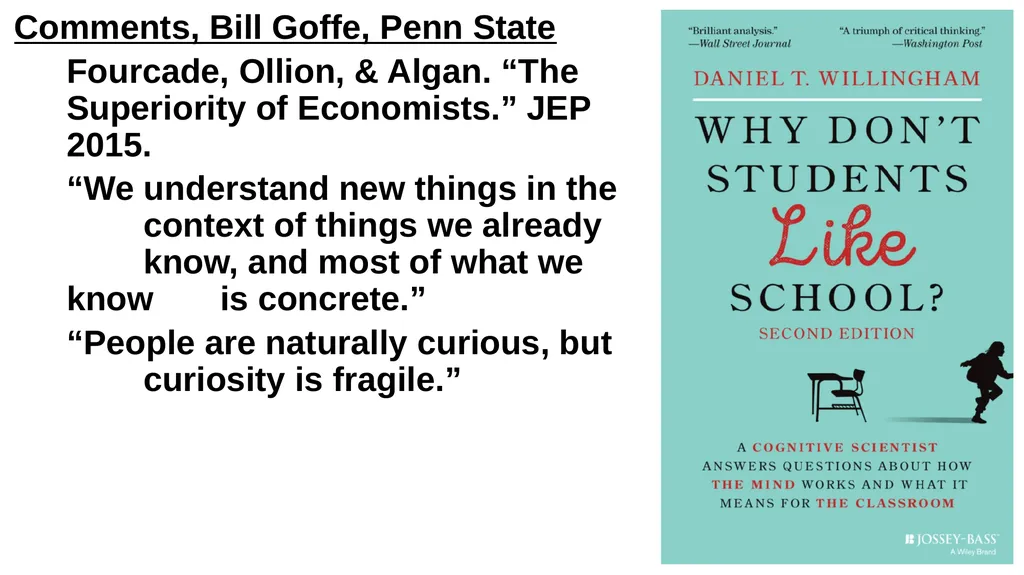
“We understand new things in the context of things we already know, and most of what we know is concrete.”
“People are naturally curious, but curiosity is fragile.”<br>
slide2. Comments, Bill Goffe, Penn State
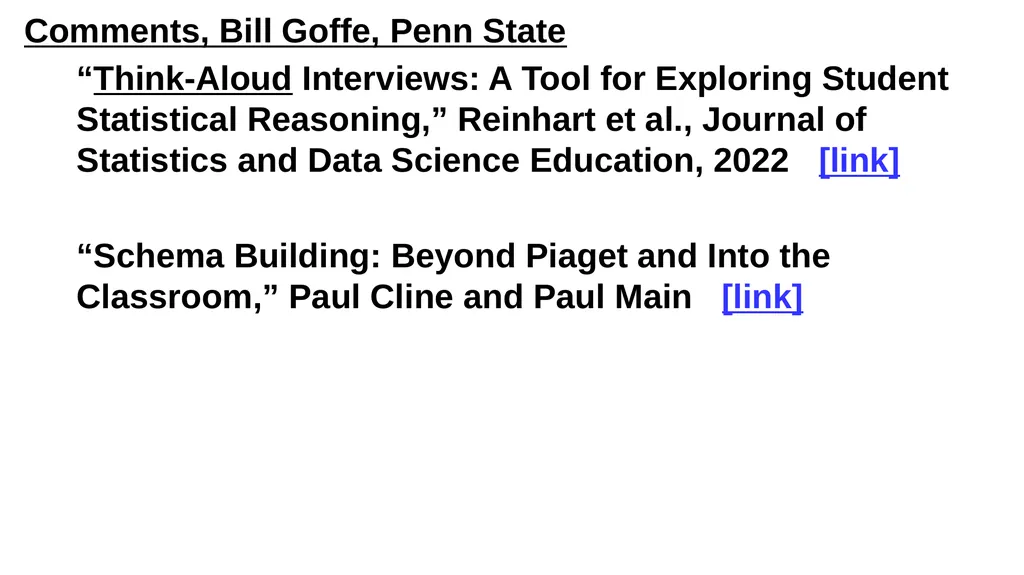
“Think-Aloud Interviews: A Tool for Exploring Student Statistical Reasoning,” Reinhart et al., Journal of Statistics and Data Science Education, 2022 [link]
“Schema Building: Beyond Piaget and Into the Classroom,” Paul Cline and Paul Main [link]<br>
slide3. Comments, Bill Goffe, Penn State
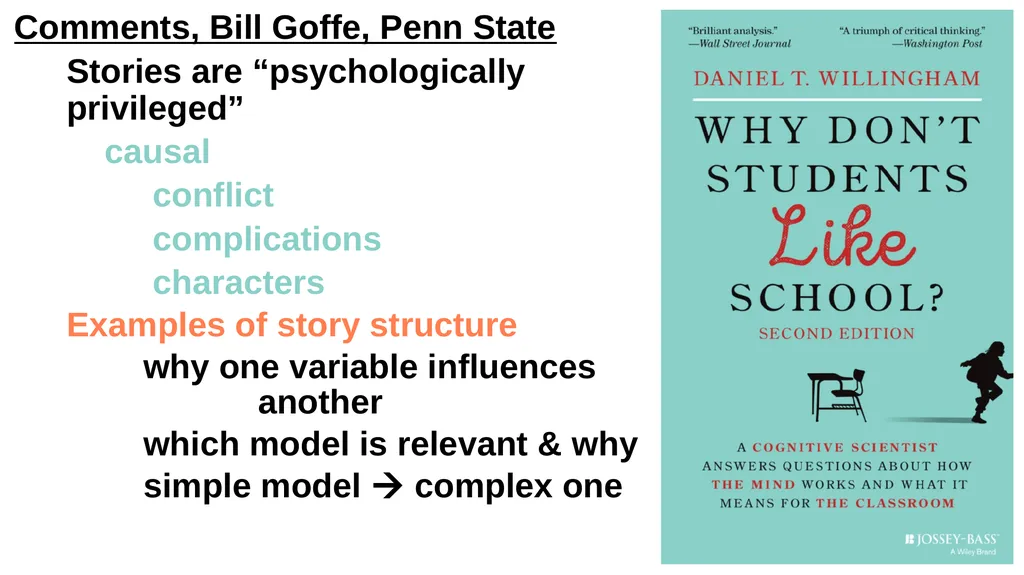
Stories are “psychologically privileged”
causal
conflict
complications
characters
Examples of story structure
why one variable influences another
which model is relevant & why
simple model complex one<br>
slide4. Comments, Bill Goffe, Penn State
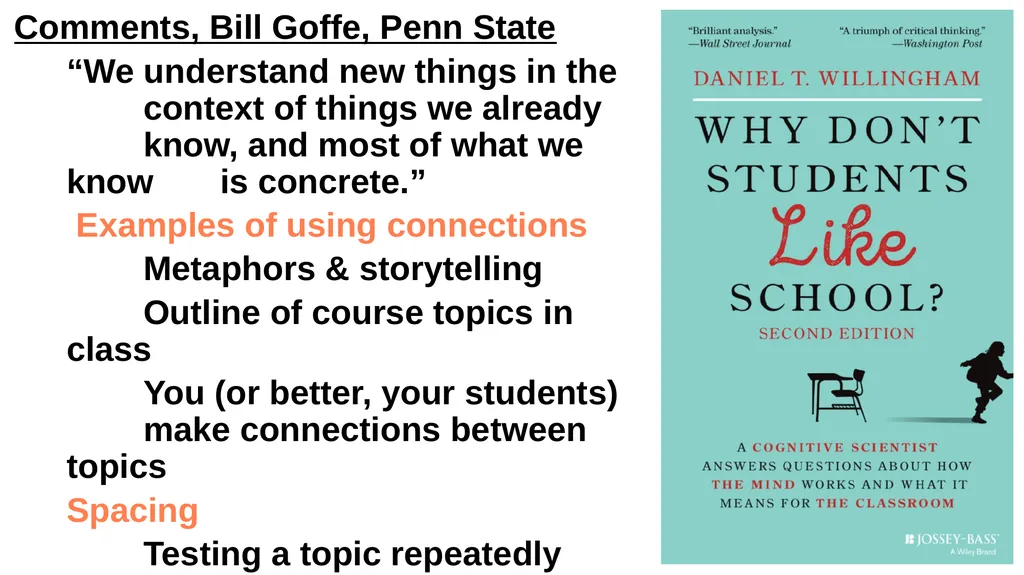
“We understand new things in the context of things we already know, and most of what we know is concrete.”
Examples of using connections
Metaphors & storytelling
Outline of course topics in class
You (or better, your students) make connections between topics
Spacing
Testing a topic repeatedly over time aids retention.<br>
slide5. Comments, Bill Goffe, Penn State
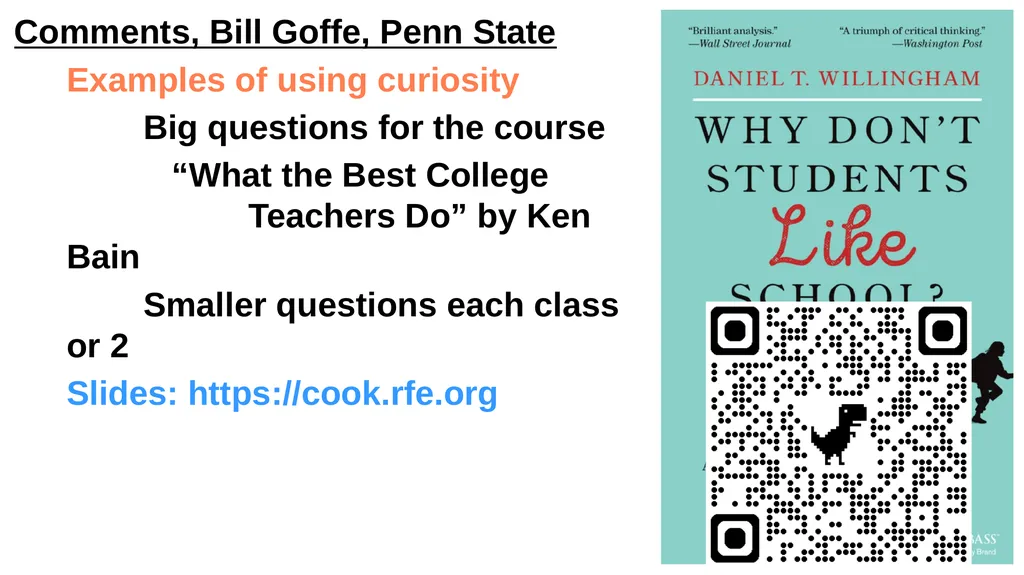
Examples of using curiosity
Big questions for the course
“What the Best College Teachers Do” by Ken Bain
Smaller questions each class or 2
Slides: https://cook.rfe.org<br>
Fourcade, Ollion, & Algan. “The Superiority of Economists.” JEP 2015.
“We understand new things in the context of things we already know, and most of what we know is concrete.”
“People are naturally curious, but curiosity is fragile.”<br>
slide2. Comments, Bill Goffe, Penn State
“Think-Aloud Interviews: A Tool for Exploring Student Statistical Reasoning,” Reinhart et al., Journal of Statistics and Data Science Education, 2022 [link]
“Schema Building: Beyond Piaget and Into the Classroom,” Paul Cline and Paul Main [link]<br>
slide3. Comments, Bill Goffe, Penn State
Stories are “psychologically privileged”
causal
conflict
complications
characters
Examples of story structure
why one variable influences another
which model is relevant & why
simple model complex one<br>
slide4. Comments, Bill Goffe, Penn State
“We understand new things in the context of things we already know, and most of what we know is concrete.”
Examples of using connections
Metaphors & storytelling
Outline of course topics in class
You (or better, your students) make connections between topics
Spacing
Testing a topic repeatedly over time aids retention.<br>
slide5. Comments, Bill Goffe, Penn State
Examples of using curiosity
Big questions for the course
“What the Best College Teachers Do” by Ken Bain
Smaller questions each class or 2
Slides: https://cook.rfe.org<br>