
Commercial wind Commercial wind energy Except
OM
Published · 16 slides · 0 views

1 / 1

Description
Commercial wind Commercial wind energy Except where otherwise noted these materials are licensed Creative Commons Attribution 4.0 (CC BY) Objectives The objective of this unit is to present the student with some basic terms relating to
Related Topics
Share
Embed code
Download this presentation From Below
"Commercial wind Commercial wind energy Except" is the property of its rightful owner. Permission is granted to download and print the materials on this website for personal, non-commercial use only, and to display it on your personal computer provided you do not modify the materials and that you retain all copyright notices contained in the materials. By downloading content from our website, you accept the terms of this agreement.
Presentation Transcript
01
Commercial wind Commercial wind energy Except where otherwise noted these materials
are licensed Creative Commons Attribution 4.0 (CC BY)<br>
02
Objectives The objective of this unit is to present the student with some basic terms relating to energy, efficiency, and conservation. Upon completion, the student will have an understanding of the following:
Electrical generation
HAWT and VAWT
Various component in a turbine
Siting study
Wind quality
Operational limits
Environmental concerns<br>
Electrical generation
HAWT and VAWT
Various component in a turbine
Siting study
Wind quality
Operational limits
Environmental concerns<br>
03
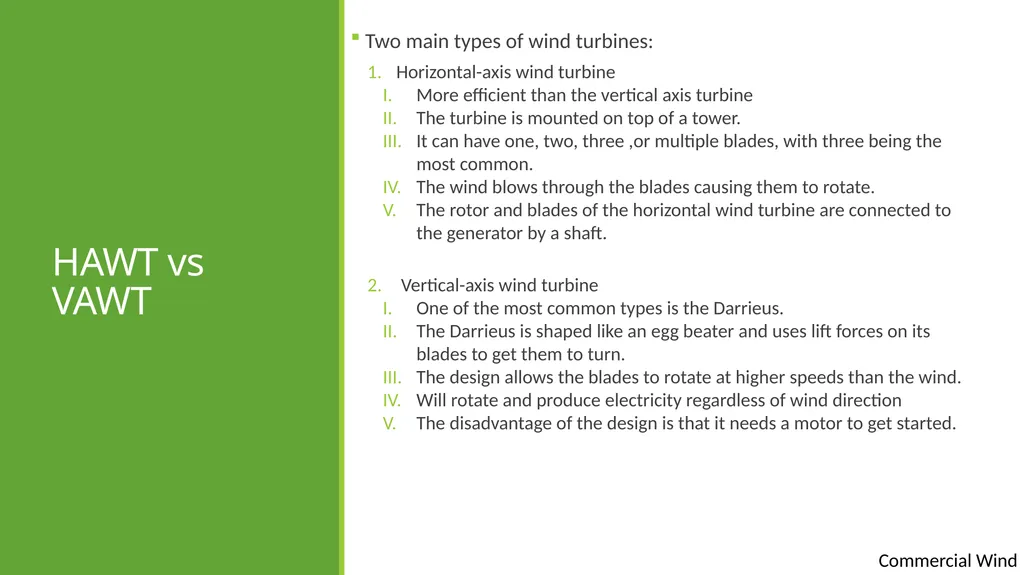
HAWT vs VAWT Two main types of wind turbines:
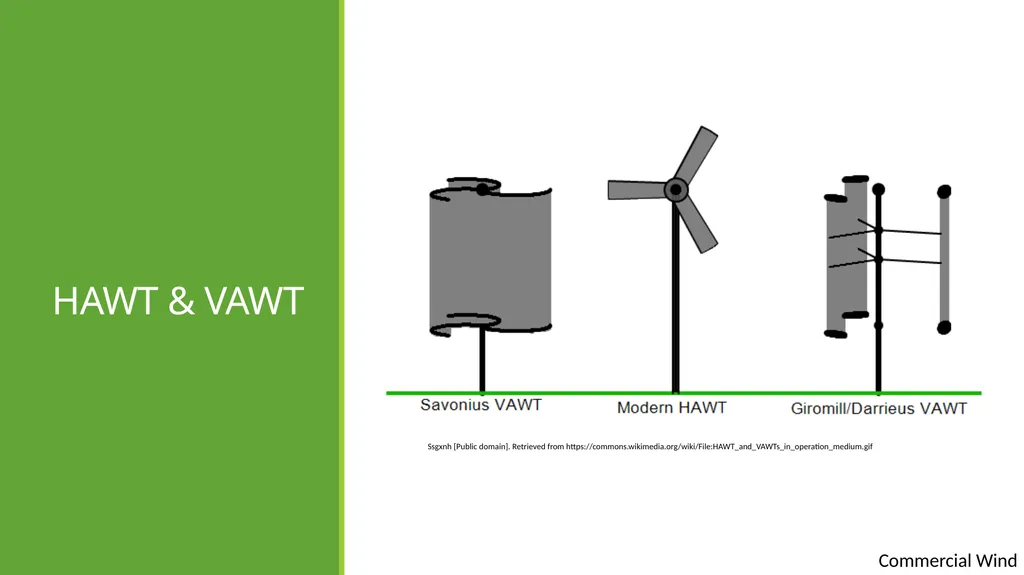
Horizontal-axis wind turbine
More efficient than the vertical axis turbine
The turbine is mounted on top of a tower.
It can have one, two, three ,or multiple blades, with three being the most common.
The wind blows through the blades causing them to rotate.
The rotor and blades of the horizontal wind turbine are connected to the generator by a shaft.
Vertical-axis wind turbine
One of the most common types is the Darrieus.
The Darrieus is shaped like an egg beater and uses lift forces on its blades to get them to turn.
The design allows the blades to rotate at higher speeds than the wind.
Will rotate and produce electricity regardless of wind direction
The disadvantage of the design is that it needs a motor to get started.<br>
Horizontal-axis wind turbine
More efficient than the vertical axis turbine
The turbine is mounted on top of a tower.
It can have one, two, three ,or multiple blades, with three being the most common.
The wind blows through the blades causing them to rotate.
The rotor and blades of the horizontal wind turbine are connected to the generator by a shaft.
Vertical-axis wind turbine
One of the most common types is the Darrieus.
The Darrieus is shaped like an egg beater and uses lift forces on its blades to get them to turn.
The design allows the blades to rotate at higher speeds than the wind.
Will rotate and produce electricity regardless of wind direction
The disadvantage of the design is that it needs a motor to get started.<br>
04
HAWT & VAWT Ssgxnh [Public domain]. Retrieved from https://commons.wikimedia.org/wiki/File:HAWT_and_VAWTs_in_operation_medium.gif<br>
05
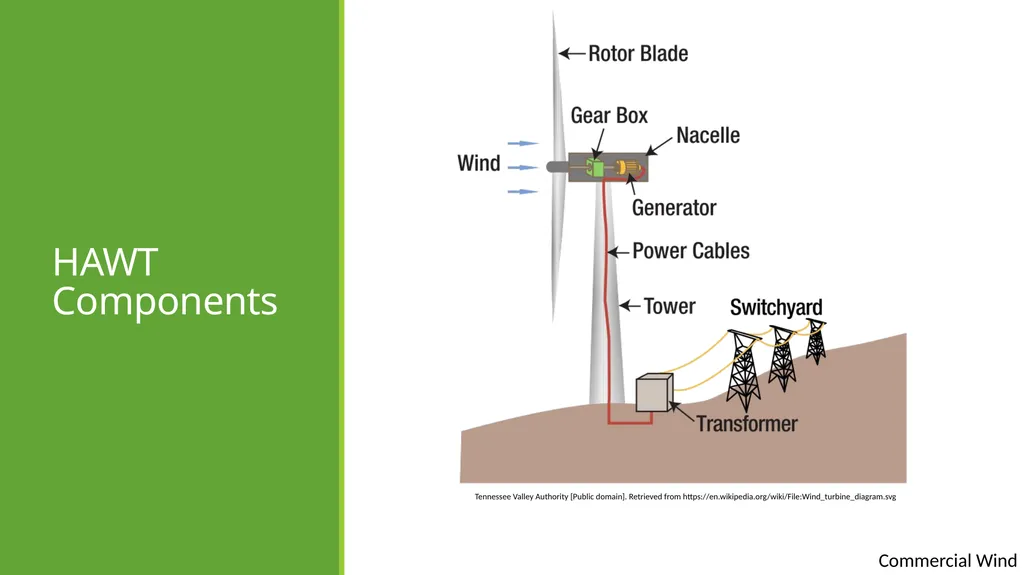
HAWT Components Tennessee Valley Authority [Public domain]. Retrieved from https://en.wikipedia.org/wiki/File:Wind_turbine_diagram.svg<br>
06
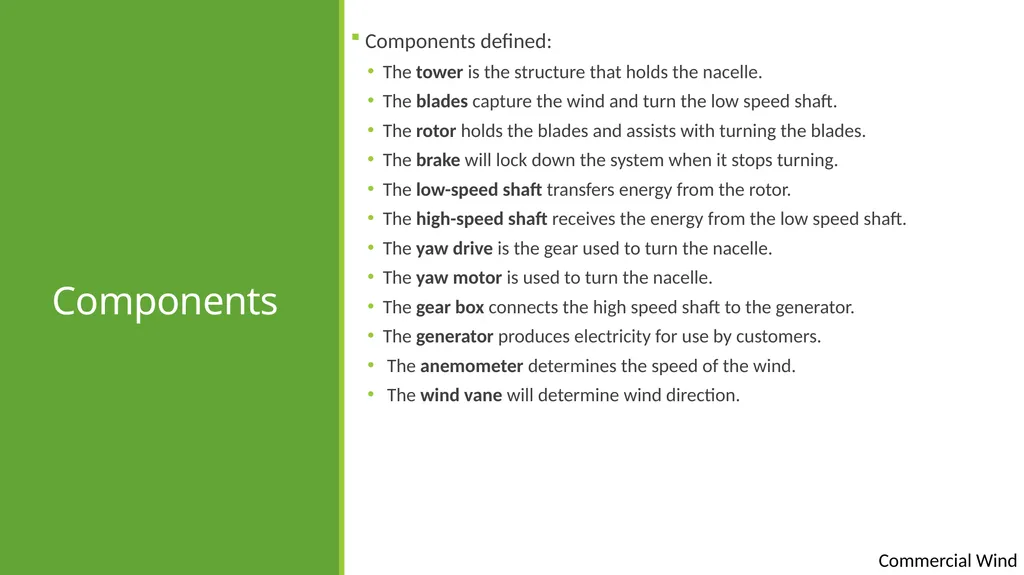
Components Components defined:
The tower is the structure that holds the nacelle.
The blades capture the wind and turn the low speed shaft.
The rotor holds the blades and assists with turning the blades.
The brake will lock down the system when it stops turning.
The low-speed shaft transfers energy from the rotor.
The high-speed shaft receives the energy from the low speed shaft.
The yaw drive is the gear used to turn the nacelle.
The yaw motor is used to turn the nacelle.
The gear box connects the high speed shaft to the generator.
The generator produces electricity for use by customers.
The anemometer determines the speed of the wind.
The wind vane will determine wind direction.<br>
The tower is the structure that holds the nacelle.
The blades capture the wind and turn the low speed shaft.
The rotor holds the blades and assists with turning the blades.
The brake will lock down the system when it stops turning.
The low-speed shaft transfers energy from the rotor.
The high-speed shaft receives the energy from the low speed shaft.
The yaw drive is the gear used to turn the nacelle.
The yaw motor is used to turn the nacelle.
The gear box connects the high speed shaft to the generator.
The generator produces electricity for use by customers.
The anemometer determines the speed of the wind.
The wind vane will determine wind direction.<br>
07
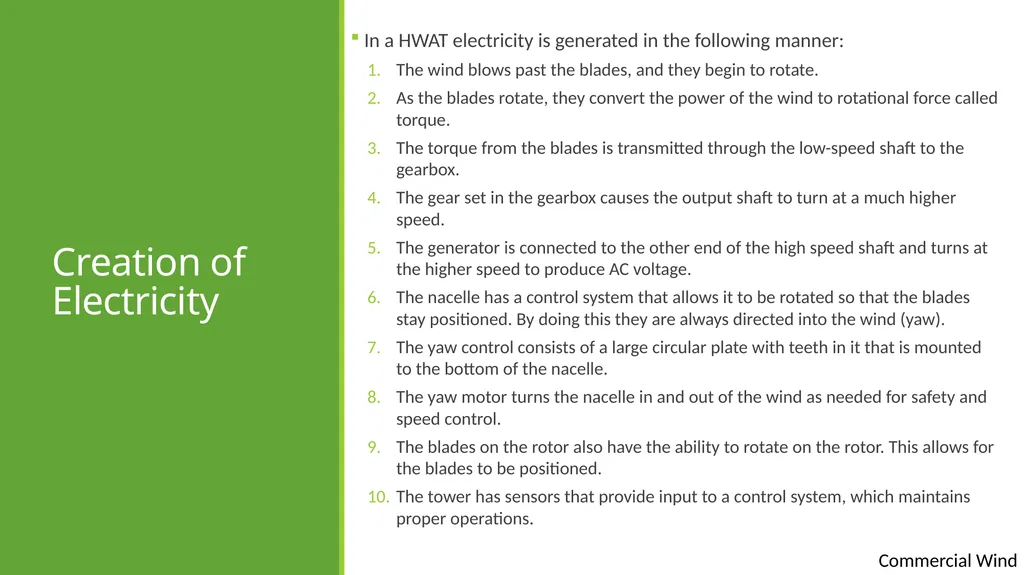
Creation of Electricity In a HWAT electricity is generated in the following manner:
The wind blows past the blades, and they begin to rotate.
As the blades rotate, they convert the power of the wind to rotational force called torque.
The torque from the blades is transmitted through the low-speed shaft to the gearbox.
The gear set in the gearbox causes the output shaft to turn at a much higher speed.
The generator is connected to the other end of the high speed shaft and turns at the higher speed to produce AC voltage.
The nacelle has a control system that allows it to be rotated so that the blades stay positioned. By doing this they are always directed into the wind (yaw).
The yaw control consists of a large circular plate with teeth in it that is mounted to the bottom of the nacelle.
The yaw motor turns the nacelle in and out of the wind as needed for safety and speed control.
The blades on the rotor also have the ability to rotate on the rotor. This allows for the blades to be positioned.
The tower has sensors that provide input to a control system, which maintains proper operations.<br>
The wind blows past the blades, and they begin to rotate.
As the blades rotate, they convert the power of the wind to rotational force called torque.
The torque from the blades is transmitted through the low-speed shaft to the gearbox.
The gear set in the gearbox causes the output shaft to turn at a much higher speed.
The generator is connected to the other end of the high speed shaft and turns at the higher speed to produce AC voltage.
The nacelle has a control system that allows it to be rotated so that the blades stay positioned. By doing this they are always directed into the wind (yaw).
The yaw control consists of a large circular plate with teeth in it that is mounted to the bottom of the nacelle.
The yaw motor turns the nacelle in and out of the wind as needed for safety and speed control.
The blades on the rotor also have the ability to rotate on the rotor. This allows for the blades to be positioned.
The tower has sensors that provide input to a control system, which maintains proper operations.<br>
08
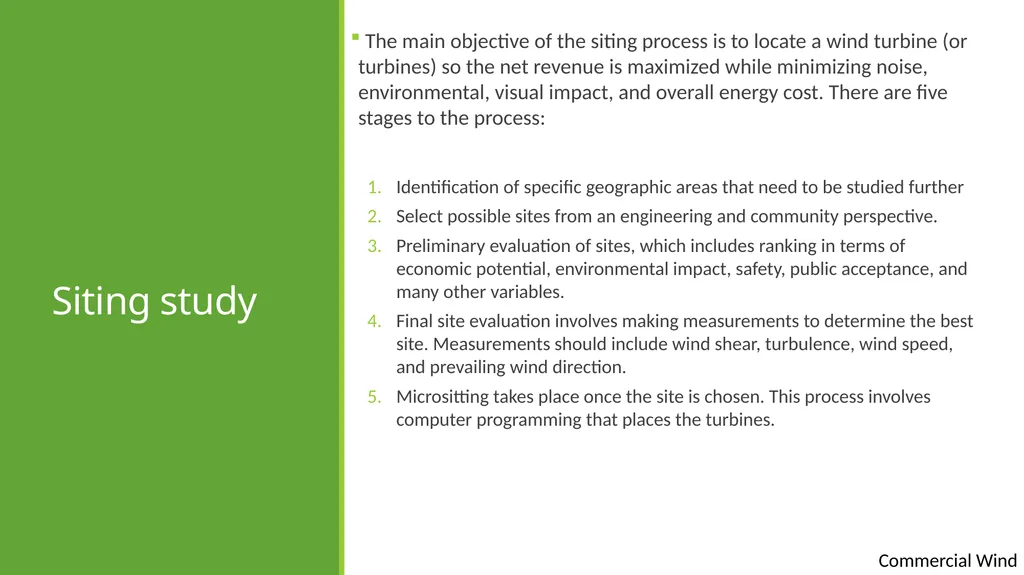
Siting study The main objective of the siting process is to locate a wind turbine (or turbines) so the net revenue is maximized while minimizing noise, environmental, visual impact, and overall energy cost. There are five stages to the process:
Identification of specific geographic areas that need to be studied further
Select possible sites from an engineering and community perspective.
Preliminary evaluation of sites, which includes ranking in terms of economic potential, environmental impact, safety, public acceptance, and many other variables.
Final site evaluation involves making measurements to determine the best site. Measurements should include wind shear, turbulence, wind speed, and prevailing wind direction.
Micrositting takes place once the site is chosen. This process involves computer programming that places the turbines.<br>
Identification of specific geographic areas that need to be studied further
Select possible sites from an engineering and community perspective.
Preliminary evaluation of sites, which includes ranking in terms of economic potential, environmental impact, safety, public acceptance, and many other variables.
Final site evaluation involves making measurements to determine the best site. Measurements should include wind shear, turbulence, wind speed, and prevailing wind direction.
Micrositting takes place once the site is chosen. This process involves computer programming that places the turbines.<br>
09
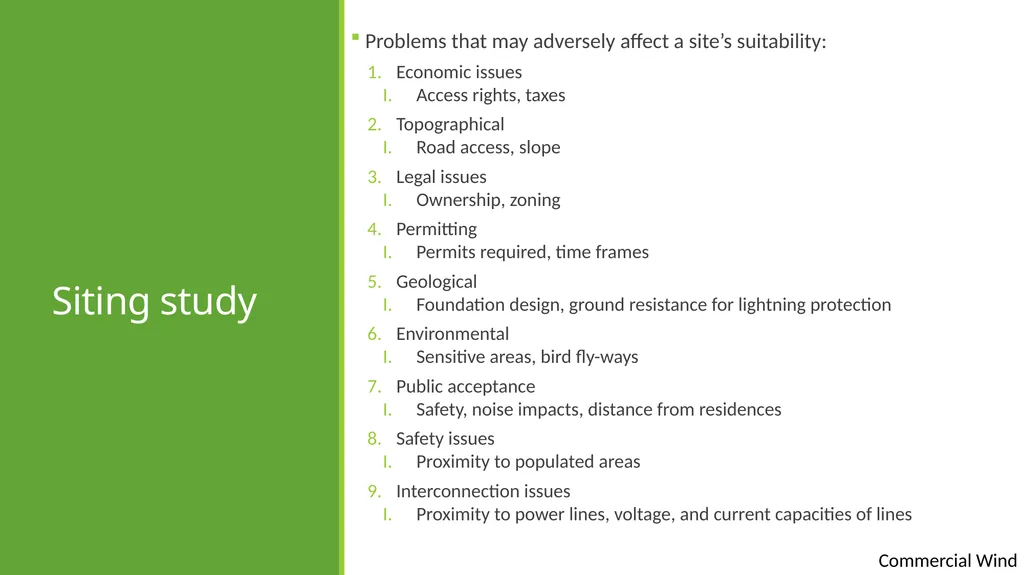
Siting study Problems that may adversely affect a site’s suitability:
Economic issues
Access rights, taxes
Topographical
Road access, slope
Legal issues
Ownership, zoning
Permitting
Permits required, time frames
Geological
Foundation design, ground resistance for lightning protection
Environmental
Sensitive areas, bird fly-ways
Public acceptance
Safety, noise impacts, distance from residences
Safety issues
Proximity to populated areas
Interconnection issues
Proximity to power lines, voltage, and current capacities of lines<br>
Economic issues
Access rights, taxes
Topographical
Road access, slope
Legal issues
Ownership, zoning
Permitting
Permits required, time frames
Geological
Foundation design, ground resistance for lightning protection
Environmental
Sensitive areas, bird fly-ways
Public acceptance
Safety, noise impacts, distance from residences
Safety issues
Proximity to populated areas
Interconnection issues
Proximity to power lines, voltage, and current capacities of lines<br>
10
Wind Quality Wind quality is a measure of the suitability of wind conditions to generate electricity; it depends on a couple parameters:
Strength of wind: wind speed in the range of 10-40 mph will provide suitable power without causing too much fatigue on components. Winds less than 10mph offer minimal power, and wind over 40mph are dangerous and require shutdown.
Uniform flow: The wind needs to be free of turbulence to produce electricity. The rotating blades cannot adjust fast enough, and the kinetic energy in the wind becomes wasted.<br>
Strength of wind: wind speed in the range of 10-40 mph will provide suitable power without causing too much fatigue on components. Winds less than 10mph offer minimal power, and wind over 40mph are dangerous and require shutdown.
Uniform flow: The wind needs to be free of turbulence to produce electricity. The rotating blades cannot adjust fast enough, and the kinetic energy in the wind becomes wasted.<br>
11
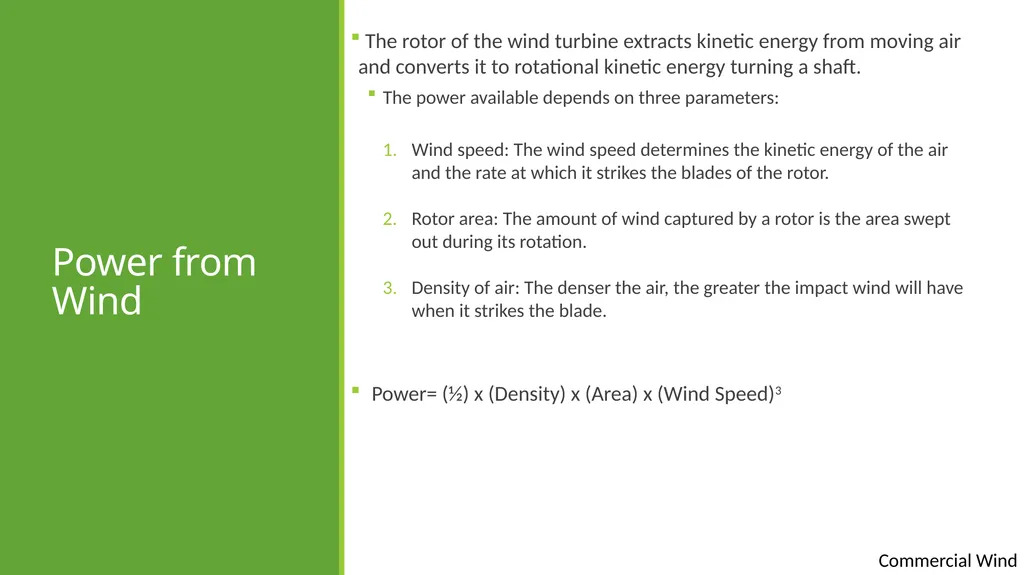
Power from Wind The rotor of the wind turbine extracts kinetic energy from moving air and converts it to rotational kinetic energy turning a shaft.
The power available depends on three parameters:
Wind speed: The wind speed determines the kinetic energy of the air and the rate at which it strikes the blades of the rotor.
Rotor area: The amount of wind captured by a rotor is the area swept out during its rotation.
Density of air: The denser the air, the greater the impact wind will have when it strikes the blade.
Power= (½) x (Density) x (Area) x (Wind Speed)3<br>
The power available depends on three parameters:
Wind speed: The wind speed determines the kinetic energy of the air and the rate at which it strikes the blades of the rotor.
Rotor area: The amount of wind captured by a rotor is the area swept out during its rotation.
Density of air: The denser the air, the greater the impact wind will have when it strikes the blade.
Power= (½) x (Density) x (Area) x (Wind Speed)3<br>
12
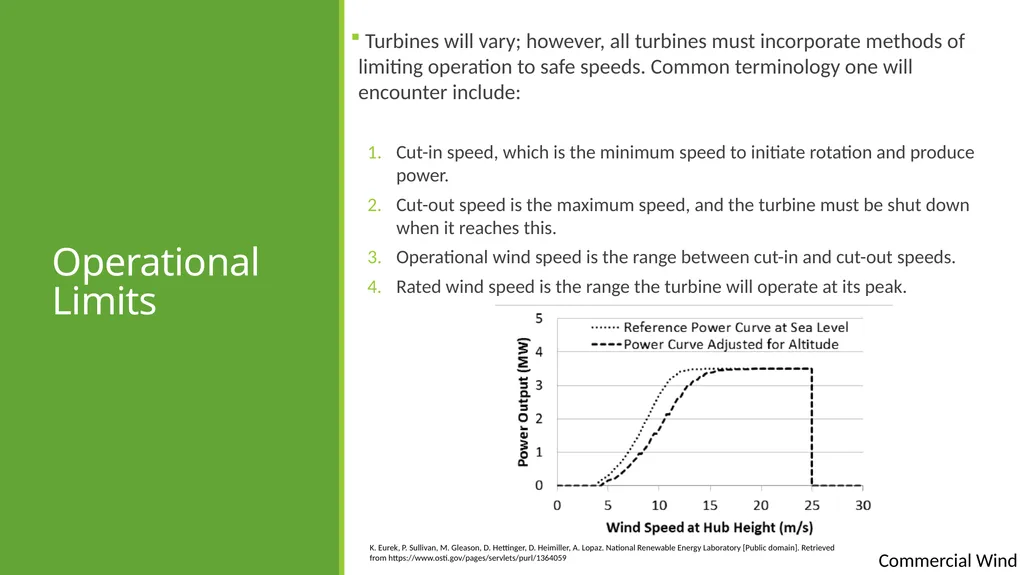
Operational Limits Turbines will vary; however, all turbines must incorporate methods of limiting operation to safe speeds. Common terminology one will encounter include:
Cut-in speed, which is the minimum speed to initiate rotation and produce power.
Cut-out speed is the maximum speed, and the turbine must be shut down when it reaches this.
Operational wind speed is the range between cut-in and cut-out speeds.
Rated wind speed is the range the turbine will operate at its peak. K. Eurek, P. Sullivan, M. Gleason, D. Hettinger, D. Heimiller, A. Lopaz. National Renewable Energy Laboratory [Public domain]. Retrieved from https://www.osti.gov/pages/servlets/purl/1364059<br>
Cut-in speed, which is the minimum speed to initiate rotation and produce power.
Cut-out speed is the maximum speed, and the turbine must be shut down when it reaches this.
Operational wind speed is the range between cut-in and cut-out speeds.
Rated wind speed is the range the turbine will operate at its peak. K. Eurek, P. Sullivan, M. Gleason, D. Hettinger, D. Heimiller, A. Lopaz. National Renewable Energy Laboratory [Public domain]. Retrieved from https://www.osti.gov/pages/servlets/purl/1364059<br>
13
Speed control Large wind turbines limit excess speed in three ways:
Pitch-Control: Variable-pitch turbines will alter the alignment of the blades with respect to the wind, turning them more parallel to the wind so that it slips past without generating lift on the blade.
Stall Control: Variable pitch turbines may alter the blade alignment so they are more perpendicular to the wind direction. The process is known as stalling and creates a lot of stress on the turbine.
Passive stall: Used with a fixed pitch blade where the blades are designed to create turbulence naturally at excessive wind speeds<br>
Pitch-Control: Variable-pitch turbines will alter the alignment of the blades with respect to the wind, turning them more parallel to the wind so that it slips past without generating lift on the blade.
Stall Control: Variable pitch turbines may alter the blade alignment so they are more perpendicular to the wind direction. The process is known as stalling and creates a lot of stress on the turbine.
Passive stall: Used with a fixed pitch blade where the blades are designed to create turbulence naturally at excessive wind speeds<br>
14
Environmental Concerns The environmental impact of wind energy production itself is fairly minimal. Some of the major concerns expressed are:
Noise
All wind turbines make some noise.
Large turbines produce noise at a lower frequency than residential turbines.
Effect on land use
The deforestation of wilderness areas for wind power is a legitimate concern.
Effect on wildlife
Birds and bats are at risk from wind turbines. However, plate glass windows and automobiles pose more of a risk.
Aesthetics
A wind farm will change the appearance of the landscape and should be considered when building a wind farm.<br>
Noise
All wind turbines make some noise.
Large turbines produce noise at a lower frequency than residential turbines.
Effect on land use
The deforestation of wilderness areas for wind power is a legitimate concern.
Effect on wildlife
Birds and bats are at risk from wind turbines. However, plate glass windows and automobiles pose more of a risk.
Aesthetics
A wind farm will change the appearance of the landscape and should be considered when building a wind farm.<br>
15
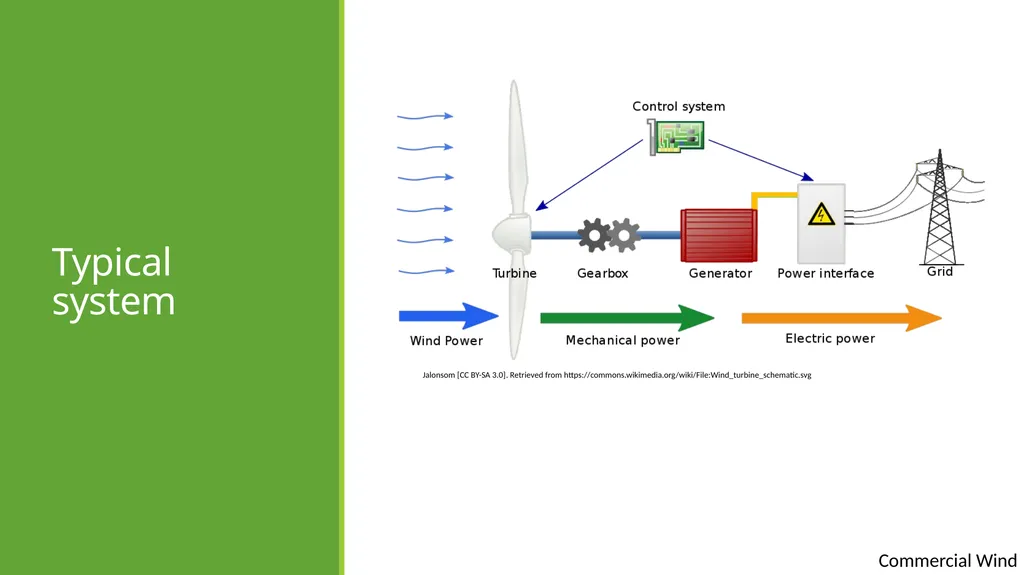
Typical system Jalonsom [CC BY-SA 3.0]. Retrieved from https://commons.wikimedia.org/wiki/File:Wind_turbine_schematic.svg<br>
16
Conclusions Upon completion of this unit, students should be able to
Describe the components in a turbine
Discuss wind quality
Identify operational limits
Summarize the siting process
Explain the basic grid connection “This presentation was prepared by Northeast Iowa Community College under award EG-17-004 from the Iowa Energy Center. Any opinions, findings, and conclusions or recommendations expressed in this material are those of the author(s) and do not necessarily reflect the views of the Iowa Energy Center.”<br>
Describe the components in a turbine
Discuss wind quality
Identify operational limits
Summarize the siting process
Explain the basic grid connection “This presentation was prepared by Northeast Iowa Community College under award EG-17-004 from the Iowa Energy Center. Any opinions, findings, and conclusions or recommendations expressed in this material are those of the author(s) and do not necessarily reflect the views of the Iowa Energy Center.”<br>