04
agenda Online courses as “Communities of Inquiry”
Importance of clarity in communication for blended and online courses
Types of:
Asynchronous communication
Synchronous communication<br>
05
Online Courses as Communities of Inquiry<br>
06
Online Communication Barriers Video
Barriers to online communication in educational settings<br>
07
Activity: Communication Barriers Take a moment to think about your own experiences with communicating online.
What were the barriers to effectively communicating using online tools?<br>
08
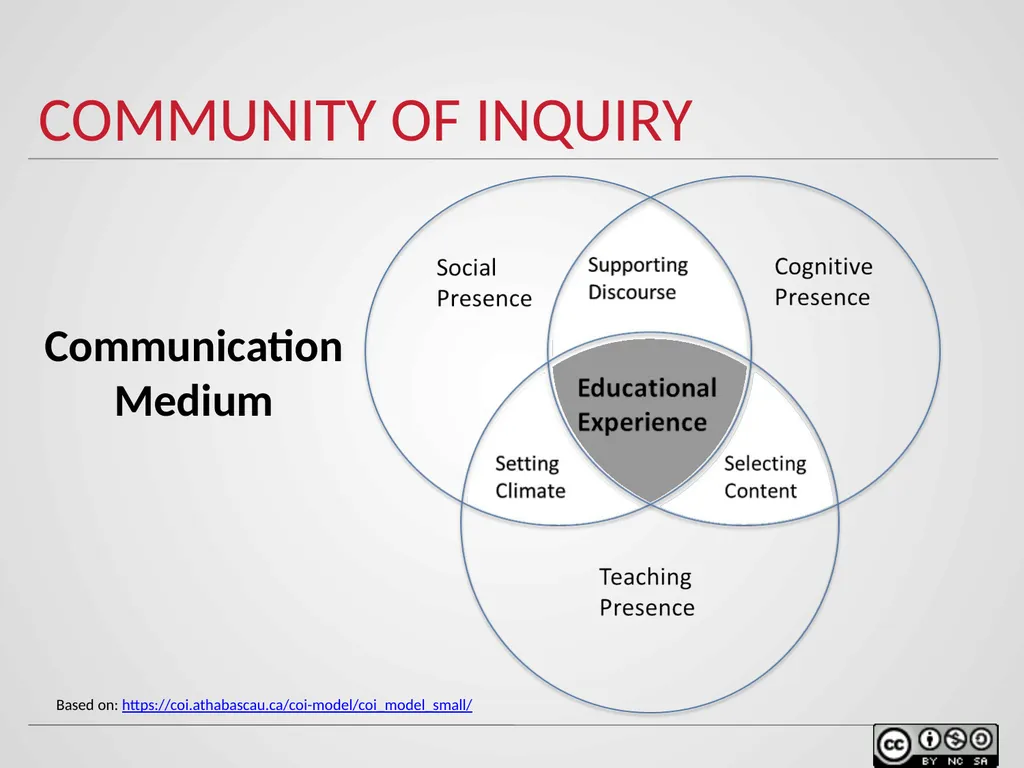
Based on the Garrison, Anderson, Archer (2000) reading you were given, Community of Inquiry (CoI) is based on the interactions and the presence created between Students, Instructors and the Content. What is Community of inquiry?<br>
09
Community of inquiry Based on: https://coi.athabascau.ca/coi-model/coi_model_small/ Communication Medium<br>
10
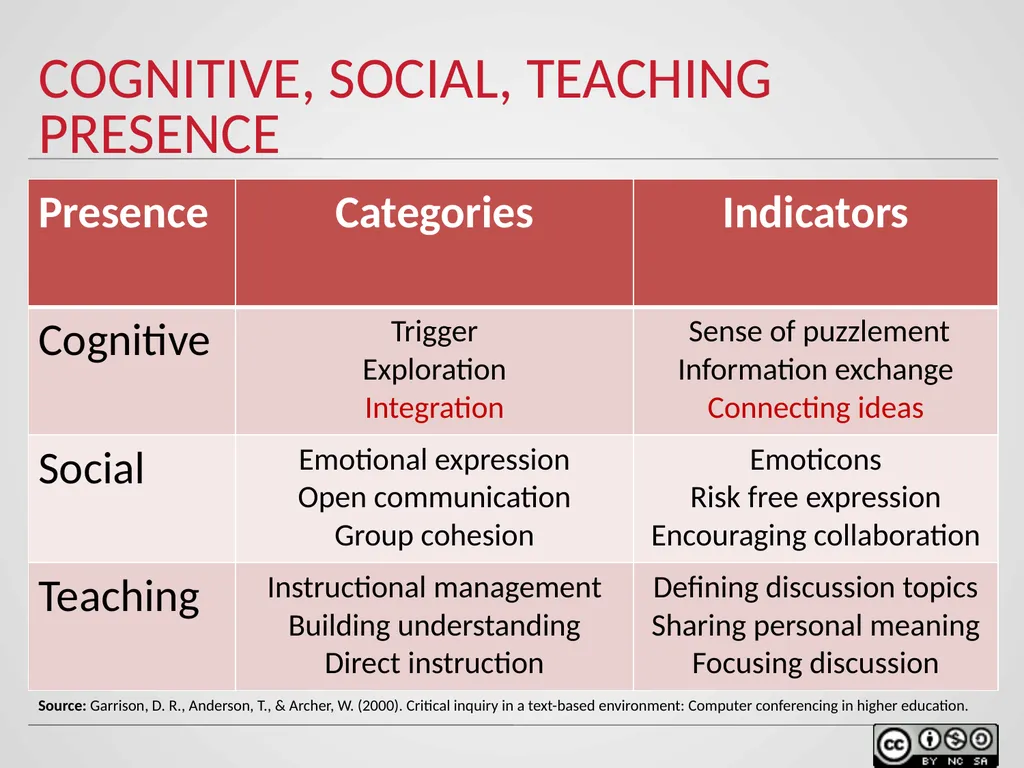
Cognitive, Social, Teaching Presence Source: Garrison, D. R., Anderson, T., & Archer, W. (2000). Critical inquiry in a text-based environment: Computer conferencing in higher education.<br>
11
Developing an Online Community Video
Strategies for developing an online community<br>
12
Discussion How would you apply the community of inquiry model to your course? Think of at least one strategy you can use to establish cognitive presence, social presence and teaching presence in your course.<br>
13
Clarity In Written Expression<br>
14
Interaction with Content Content<br>
15
Clarity of Written Expression Know exactly what the instructor wants
Choose words carefully
Be aware of how “everybody interprets things differently” Source: Vonderwell, S. (2002). An examination of asynchronous communication experiences and perspectives of students in an online course: a case study. The Internet and Higher Education, 6, 77-90. Retrieved from http://www.anitacrawley.net/Articles/Vonderwell(2003).pdf<br>
16
Types of Synchronous and Asynchronous Communication<br>
17
Communication videos Videos
Has education changed since the industrial revolution?�
Effective Online Discussions<br>
18
Activity: Communication videos How can the communication strategies from the second video could be implemented into your course?
How have those ideas been used in this module?<br>
19
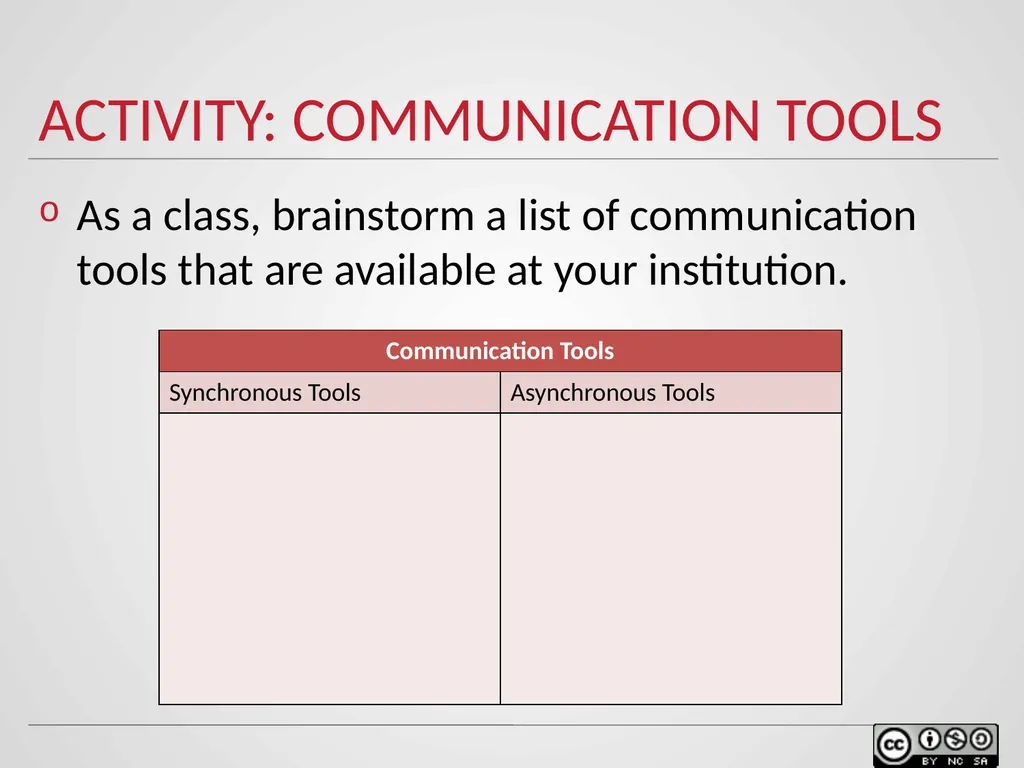
Activity: Communication Tools As a class, brainstorm a list of communication tools that are available at your institution.<br>
20
Activity: Communication Tools Individually, think about a goal/outcome for your course and an activity that will help you reach this goal.
Using the list generated earlier, which communication tools do you think will work for the activity and help you reach your goal?<br>
21
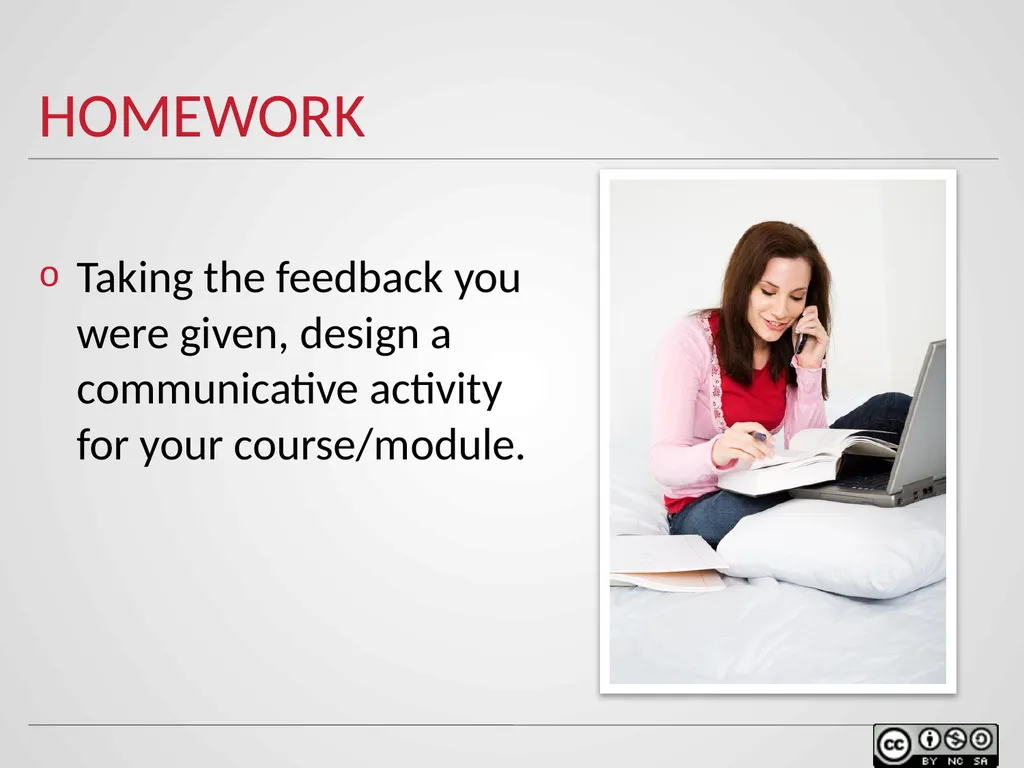
homework Taking the feedback you were given, design a communicative activity for your course/module.<br>
22
summary Community of Inquiry model provides a way to structure interactions in online learning environments based on cognitive, social and teaching presence. �
Establishing and maintaining cognitive, social, and teaching presence is associated with high levels of deep and meaningful learning.<br>
23
summary In online learning, clarify of written expression is so important because students experience stronger interaction with content than with peers and instructors.
There are a variety of synchronous and asynchronous tools you can use to improve online communication and support your learning outcomes.<br>
24
Thank you Questions?
Comments?
Help?
Contact information – facilitator’s and departmental<br>
25
References Chao, T. (2004) Instructional Strategies for Creating Meaningful Online Dialogue. Retrieved from https://faculty.myrru.royalroads.ca/sites/default/files/meaningful online dialogue.pdf
COFA.online. (2011, February 22). Conducting Effective Online Discussions. Retrieved April 9, 2014, from http://online.cofa.unsw.edu.au/learning-to-teach-online/ltto- episodes?view=video&video=235.
drcreyn. (2012, March 10). How do you relate to the CoI? Retrieved April 9, 2014, from https://www.youtube.com/watch?v=pyEQ3as- Q38.<br>
26
References Freedman, S.C., Tello, S.F. & Lewis, D. (2013). Strategies for Improving Instructor-Student Communication in Online Education. In Virtual Education: Cases in Learning and Teaching Technologies (Chapter 10). Retrieved from http://faculty.uml.edu/stello/IRMA0802.pdf.
Garrison, D. R., Anderson, T., & Archer, W. (2000). Critical inquiry in a text-based environment: Computer conferencing in higher education. The Internet and Higher Education, (2), 87-105. Retrieved from http://auspace.athabascau.ca/bitstream/2149/739/1/critical_inqu iry_in_a_text.pdf.
Lewis, J. (2013, May 22). Communication Strategies for Managing Online Teaching. Retrieved April 9, 2014, from http://www.youtube.com/watch?v=F48JylfT7Bk.<br>
27
References MacIntyre, S. (2011). Conducting Effective Online Discussions. Learning to Teach Online. Retrieved from http://online.cofa.unsw.edu.au/sites/default/files/episode- pdf/Discussions_LTTO.pdf.
PSU World Campus Faculty Development. (2010, September 27). Planning Communication Strategies. Retrieved April 9, 2014, from http://www.youtube.com/watch?annotation_id=annotation_1792 62&feature=iv&src_vid=T5vwKFt3B5w&v=PtqX5XqZZJo.
TeacherStream, LLC. (2009). Mastering Online Discussion Board Facilitation. Retrieved from http://www.edutopia.org/pdfs/stw/edutopia-onlinelearning- mastering-online- discussion-board-facilitation.pdf
Vonderwell, S. (2002). An examination of asynchronous communication experiences and perspectives of students in an online course: a case study. The Internet and Higher Education, 6, 77-90. Retrieved from http://www.anitacrawley.net/Articles/Vonderwell(2003).pdf<br>