Communication Strategy and Plan Content Communication Strategy Introduction Communication Strategy Communication Importance Communication Objectives Guiding Principles WPII Stakeholders Communication Development and Delivery Communication
"Communication Strategy and Plan Content" is the property of its rightful owner. Permission is granted to
download and print the materials on this website for personal, non-commercial use only, and to display it
on your personal computer provided you do not modify the materials and that you retain all copyright
notices contained in the materials. By downloading content from our website, you accept the terms of this
agreement.
Presentation Transcript
01
Communication Strategy and Plan<br>
02
Content Communication Strategy
Introduction
Communication Strategy
Communication Importance
Communication Objectives
Guiding Principles
WPII Stakeholders
Communication Development and Delivery
Communication Intake Process
WPII Communication Channel Overview
Communication Roles and Responsibilities
Risks and Issues
Success Factors
Communication Plan
Introduction
Communication Needs Assessment
Communication Plan and Schedule
Communication Delivery 2<br>
03
Introduction WPII is a high-priority of the Department and provides an opportunity for the agency to innovate and streamline its financial systems and processes. The WPII solution will:
Optimize business processes
Modernize outdated technology
Reduce redundancy, increase efficiency, and mitigate risks
Ensuring the WPII Solution is executed effectively and efficiently requires commitment throughout the Department. To help facilitate this, a Communication Strategy will be deployed to:
Keep stakeholders informed of the nature, progress and outcomes of the WPII solution
Drive a communication connection among stakeholders
Help WPII Liaisons fill the information gap for their teams in their respective districts and prepare them for change
Improve and inform stakeholder engagement across FDOT’s Districts, Central Office, and Turnpike 3<br>
04
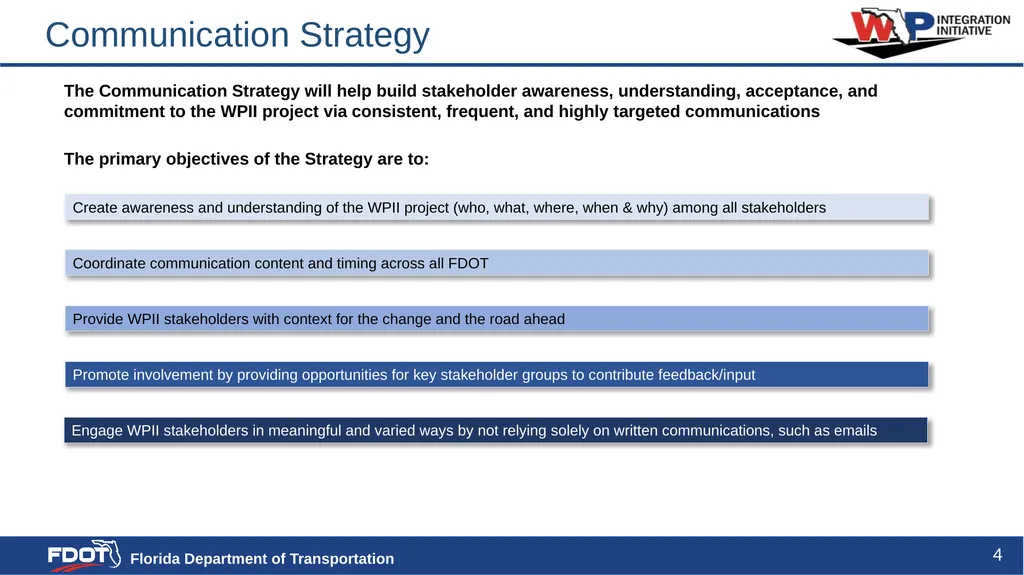
Communication Strategy Create awareness and understanding of the WPII project (who, what, where, when & why) among all stakeholders Coordinate communication content and timing across all FDOT Provide WPII stakeholders with context for the change and the road ahead Promote involvement by providing opportunities for key stakeholder groups to contribute feedback/input Engage WPII stakeholders in meaningful and varied ways by not relying solely on written communications, such as emails The Communication Strategy will help build stakeholder awareness, understanding, acceptance, and commitment to the WPII project via consistent, frequent, and highly targeted communications
The primary objectives of the Strategy are to: 4<br>
05
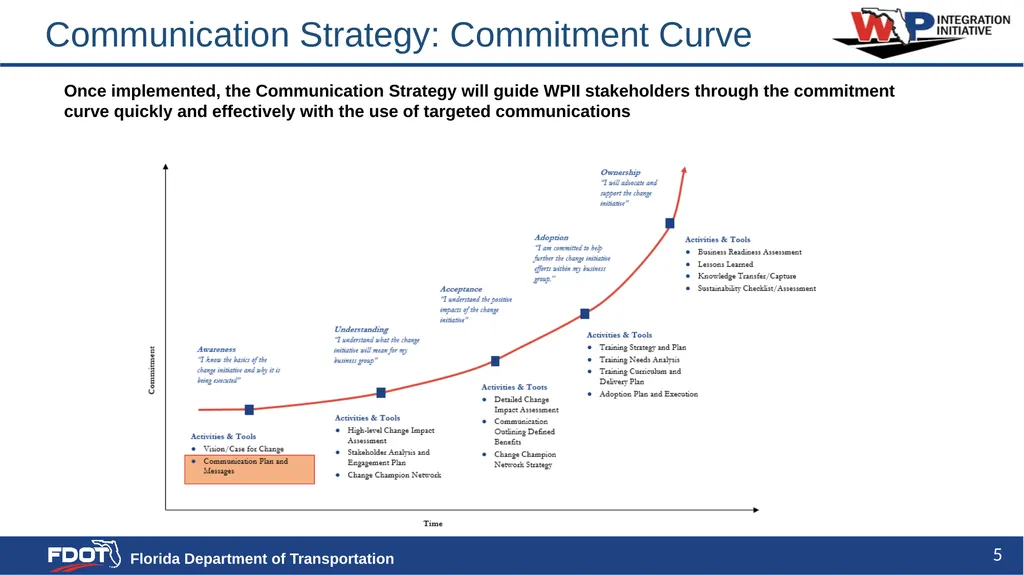
Communication Strategy: Commitment Curve Once implemented, the Communication Strategy will guide WPII stakeholders through the commitment curve quickly and effectively with the use of targeted communications 5<br>
06
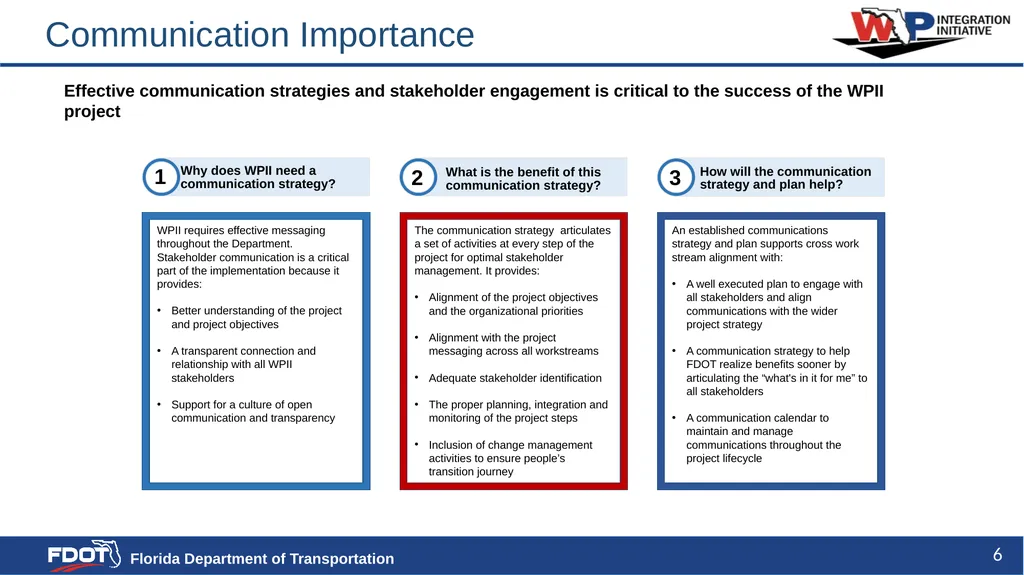
Communication Importance Effective communication strategies and stakeholder engagement is critical to the success of the WPII project 3 Why does WPII need a communication strategy? What is the benefit of this communication strategy? 2 1 How will the communication strategy and plan help? WPII requires effective messaging throughout the Department. Stakeholder communication is a critical part of the implementation because it provides:
Better understanding of the project and project objectives
A transparent connection and relationship with all WPII stakeholders
Support for a culture of open communication and transparency The communication strategy articulates a set of activities at every step of the project for optimal stakeholder management. It provides:
Alignment of the project objectives and the organizational priorities
Alignment with the project messaging across all workstreams
Adequate stakeholder identification
The proper planning, integration and monitoring of the project steps
Inclusion of change management activities to ensure people’s transition journey An established communications strategy and plan supports cross work stream alignment with:
A well executed plan to engage with all stakeholders and align communications with the wider project strategy
A communication strategy to help FDOT realize benefits sooner by articulating the “what's in it for me” to all stakeholders
A communication calendar to maintain and manage communications throughout the project lifecycle 6<br>
07
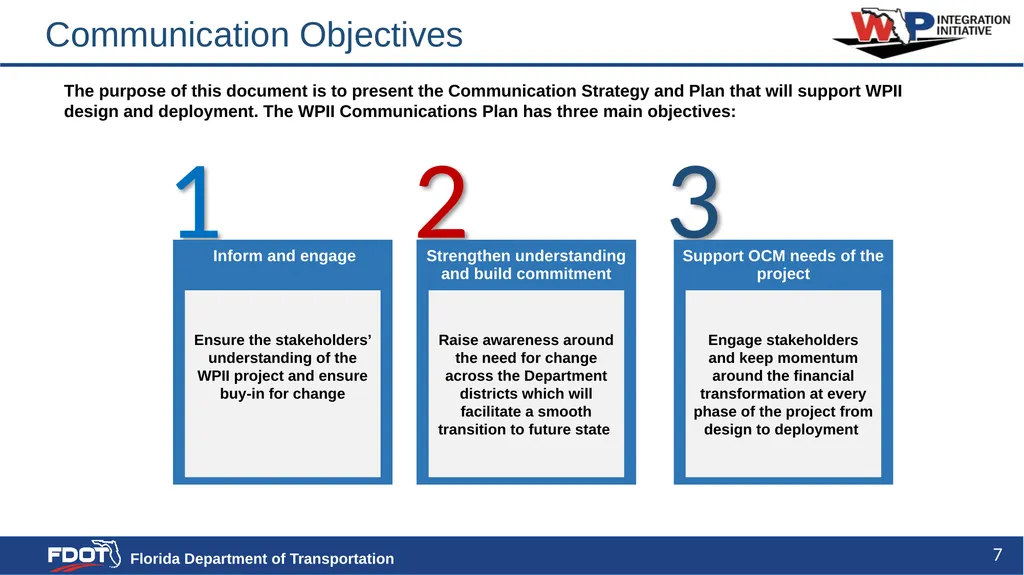
Communication Objectives The purpose of this document is to present the Communication Strategy and Plan that will support WPII design and deployment. The WPII Communications Plan has three main objectives: 1 2 3 7<br>
08
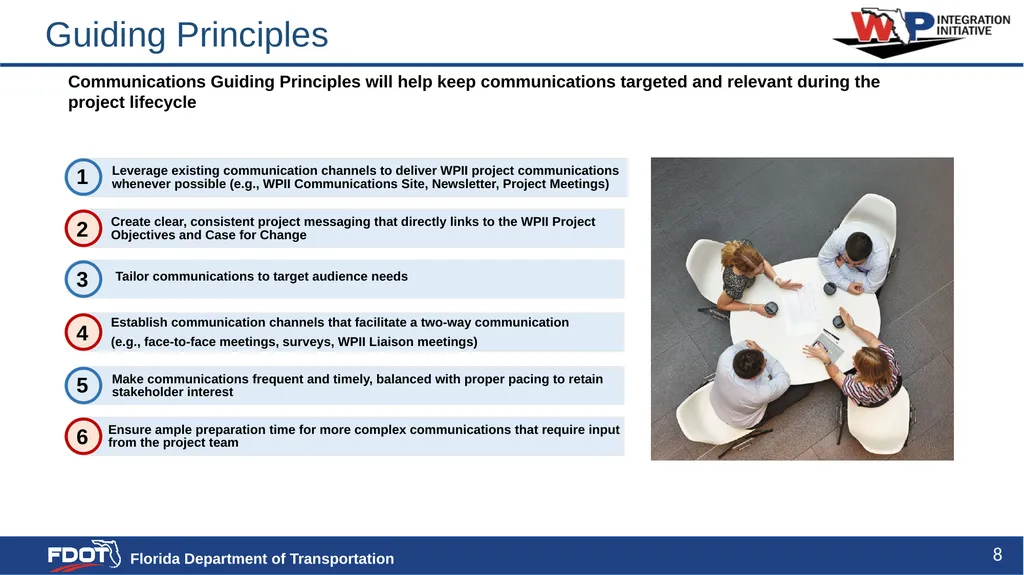
Guiding Principles Communications Guiding Principles will help keep communications targeted and relevant during the project lifecycle 8<br>
09
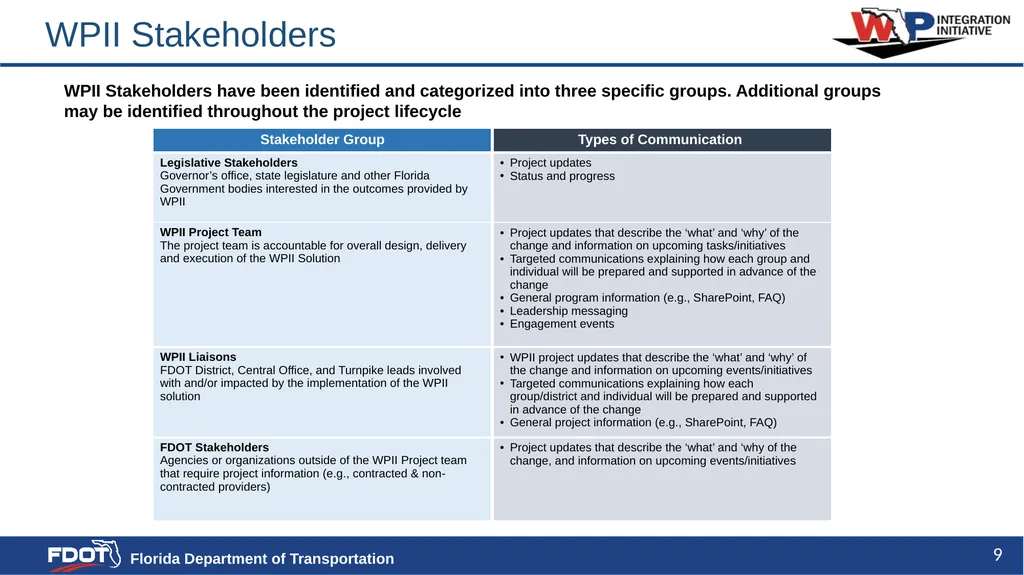
WPII Stakeholders WPII Stakeholders have been identified and categorized into three specific groups. Additional groups may be identified throughout the project lifecycle 9<br>
10
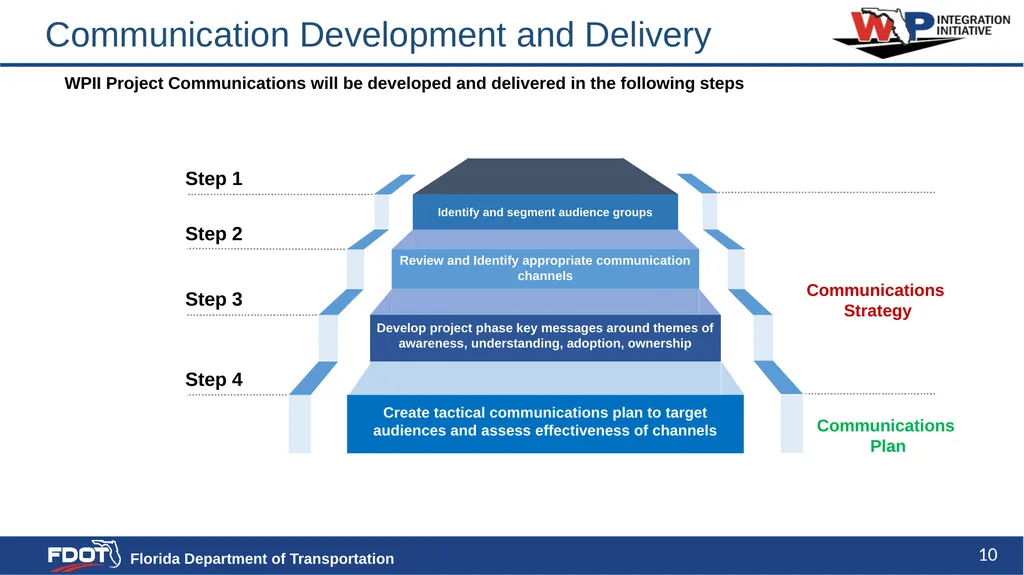
Communication Development and Delivery WPII Project Communications will be developed and delivered in the following steps Communications
Strategy Communications
Plan 10<br>
11
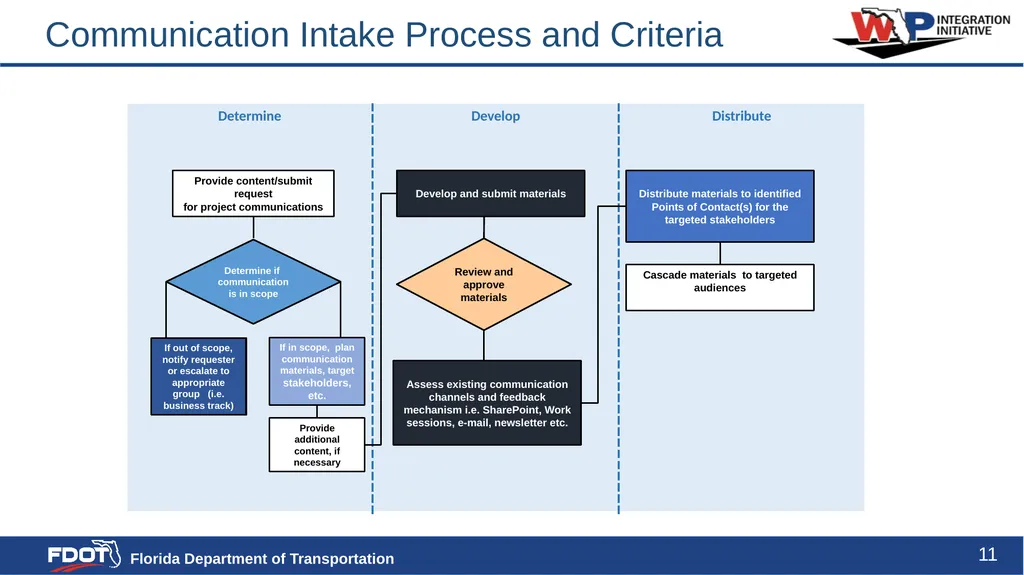
Communication Intake Process and Criteria 11 Provide content/submit request
for project communications Determine if communication is in scope If in scope, plan communication materials, target stakeholders, etc. If out of scope, notify requester or escalate to appropriate group (i.e. business track) Provide additional content, if necessary Develop and submit materials Review and approve materials Distribute materials to identified Points of Contact(s) for the targeted stakeholders Cascade materials to targeted audiences Assess existing communication channels and feedback mechanism i.e. SharePoint, Work sessions, e-mail, newsletter etc.<br>
12
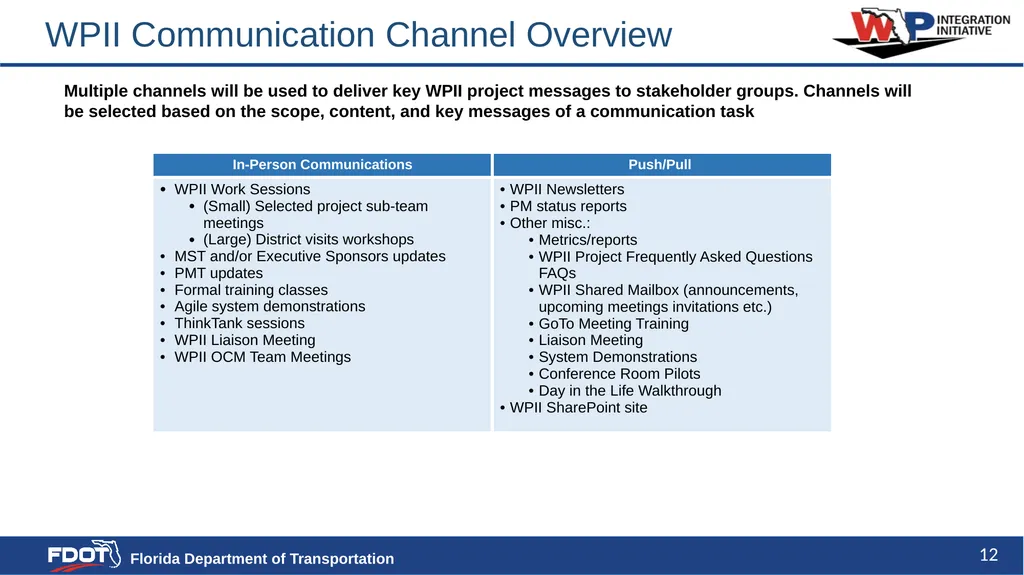
WPII Communication Channel Overview Multiple channels will be used to deliver key WPII project messages to stakeholder groups. Channels will be selected based on the scope, content, and key messages of a communication task 12<br>
13
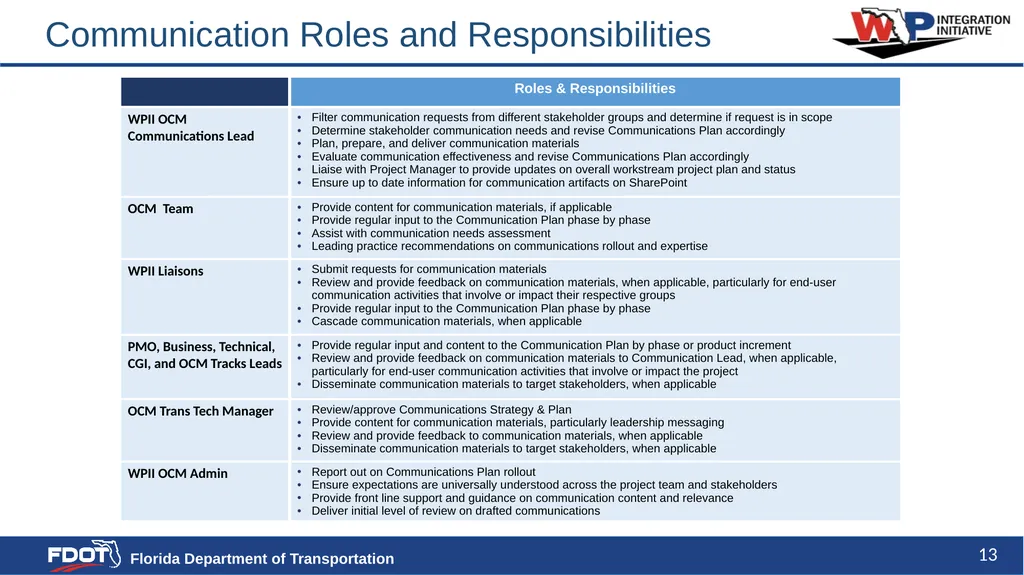
Communication Roles and Responsibilities 13<br>
14
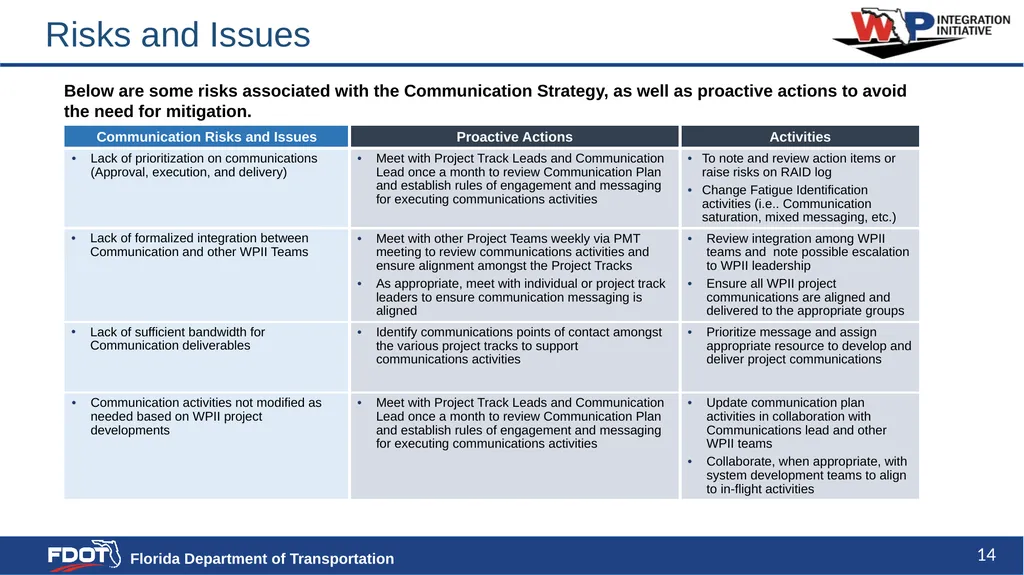
Risks and Issues Below are some risks associated with the Communication Strategy, as well as proactive actions to avoid the need for mitigation. 14<br>
15
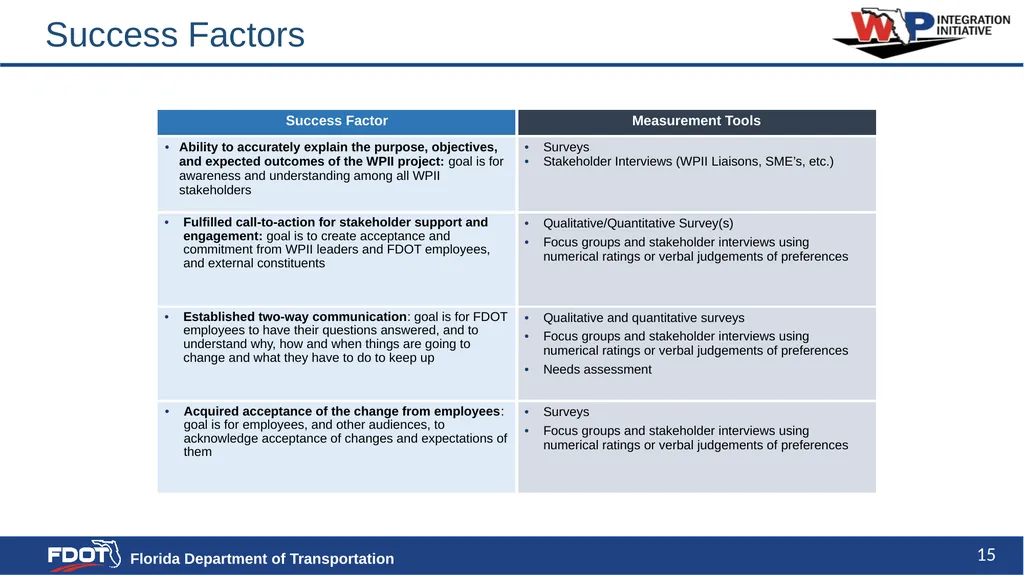
Success Factors 15<br>
16
16 Communication Plan<br>
17
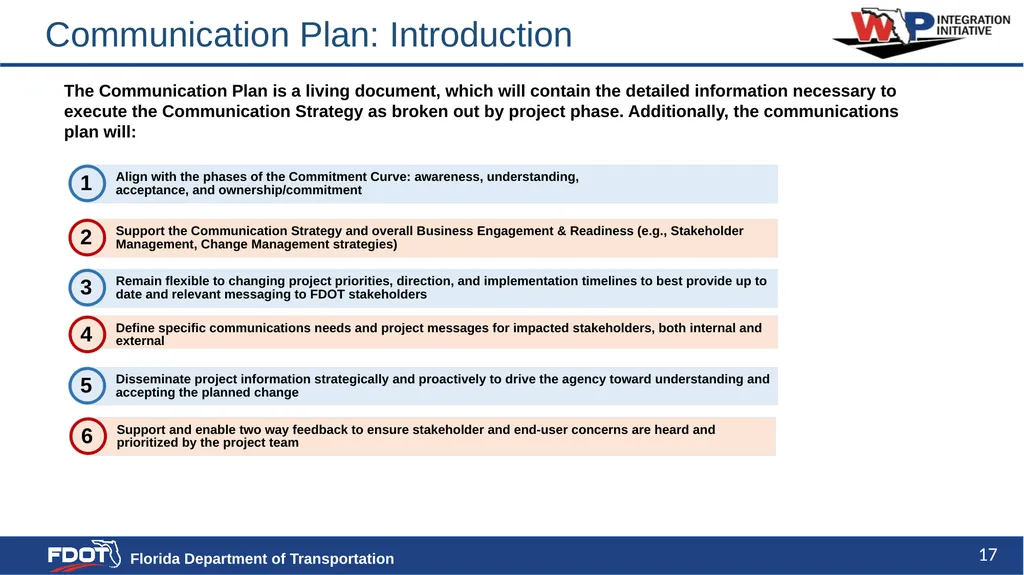
Communication Plan: Introduction The Communication Plan is a living document, which will contain the detailed information necessary to execute the Communication Strategy as broken out by project phase. Additionally, the communications plan will: 17<br>
18
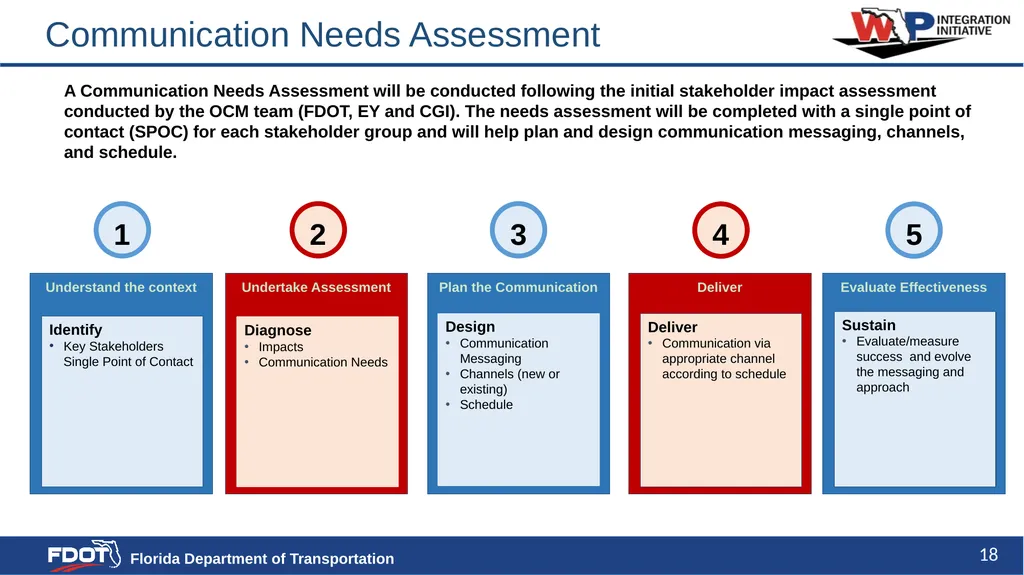
Communication Needs Assessment A Communication Needs Assessment will be conducted following the initial stakeholder impact assessment conducted by the OCM team (FDOT, EY and CGI). The needs assessment will be completed with a single point of contact (SPOC) for each stakeholder group and will help plan and design communication messaging, channels, and schedule. 1 2 3 4 5 Understand the context Identify
Key Stakeholders
Single Point of Contact Undertake Assessment Diagnose
Impacts
Communication Needs Plan the Communication Design
Communication Messaging
Channels (new or existing)
Schedule Deliver Deliver
Communication via appropriate channel according to schedule Evaluate Effectiveness Sustain
Evaluate/measure success and evolve the messaging and approach 18<br>
19
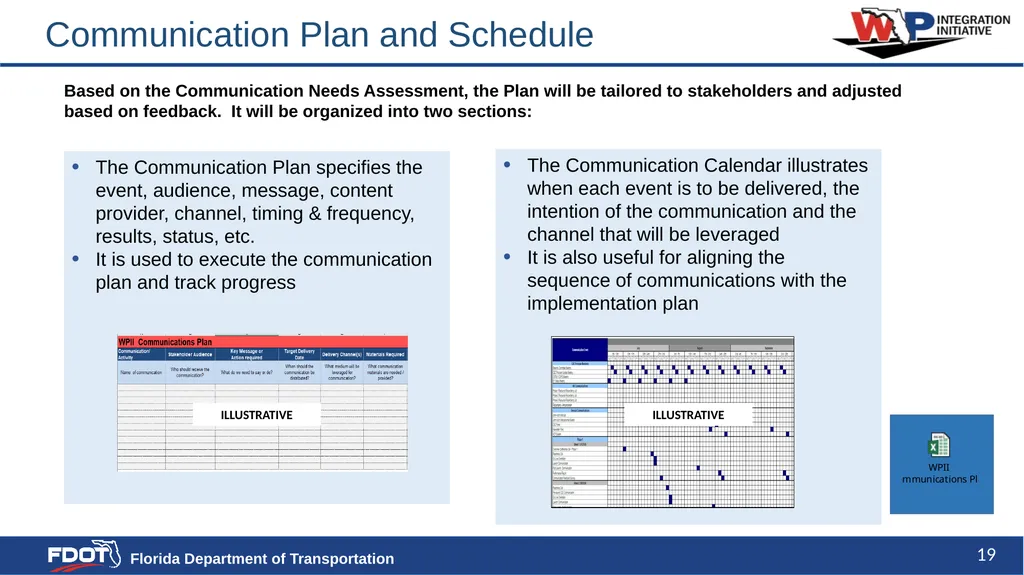
Communication Plan and Schedule Based on the Communication Needs Assessment, the Plan will be tailored to stakeholders and adjusted based on feedback. It will be organized into two sections: The Communication Plan specifies the event, audience, message, content provider, channel, timing & frequency, results, status, etc.
It is used to execute the communication plan and track progress The Communication Calendar illustrates when each event is to be delivered, the intention of the communication and the channel that will be leveraged
It is also useful for aligning the sequence of communications with the implementation plan ILLUSTRATIVE 19 ILLUSTRATIVE<br>
20
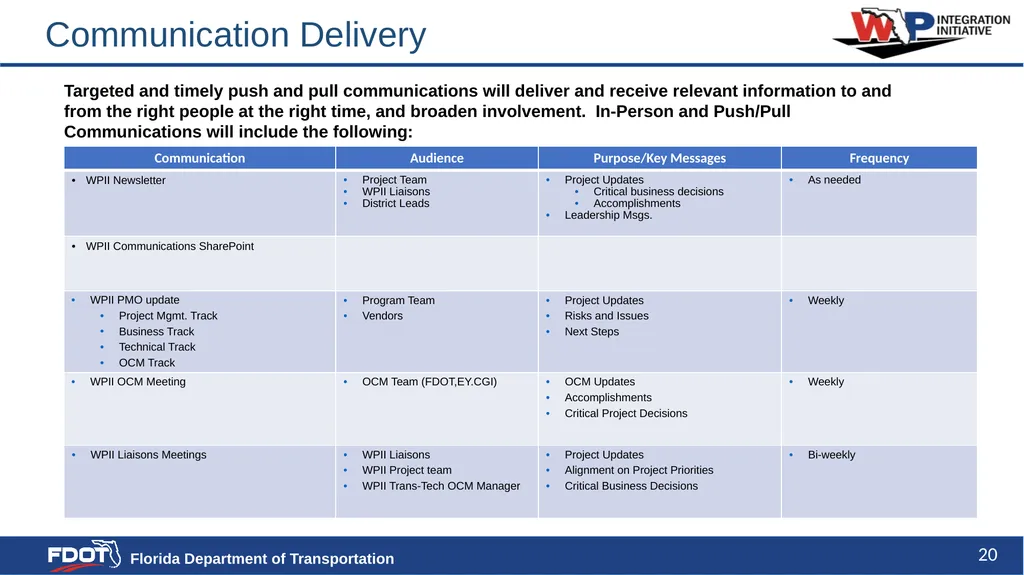
Communication Delivery Targeted and timely push and pull communications will deliver and receive relevant information to and from the right people at the right time, and broaden involvement. In-Person and Push/Pull Communications will include the following: 20<br>