
Comparing Othello and Streetcar Concerns and
FD
Published · 37 slides · 0 views

1 / 1















Description
Comparing Othello and Streetcar Concerns and Methods of Presentation Literature Paper 3 A Sense of the Genre of Drama Reading a Play Studying Drama Responding Writing an essay of Literary Criticism about Drama; What you read on the
Related Topics
Share
Embed code
Download this presentation From Below
"Comparing Othello and Streetcar Concerns and" is the property of its rightful owner. Permission is granted to download and print the materials on this website for personal, non-commercial use only, and to display it on your personal computer provided you do not modify the materials and that you retain all copyright notices contained in the materials. By downloading content from our website, you accept the terms of this agreement.
Presentation Transcript
01
Comparing Othello and Streetcar Concerns and Methods of Presentation Literature Paper 3<br>
02
A Sense of the Genre of Drama Reading a Play – Studying Drama – Responding Writing an essay of Literary Criticism about Drama;
What you read on the pages of a Play?
How all this looks and sounds in performance on the stage before a audience;
Genre Awareness:
Showing awareness of how are you introduced to characters in a play, as against a novel?<br>
What you read on the pages of a Play?
How all this looks and sounds in performance on the stage before a audience;
Genre Awareness:
Showing awareness of how are you introduced to characters in a play, as against a novel?<br>
03
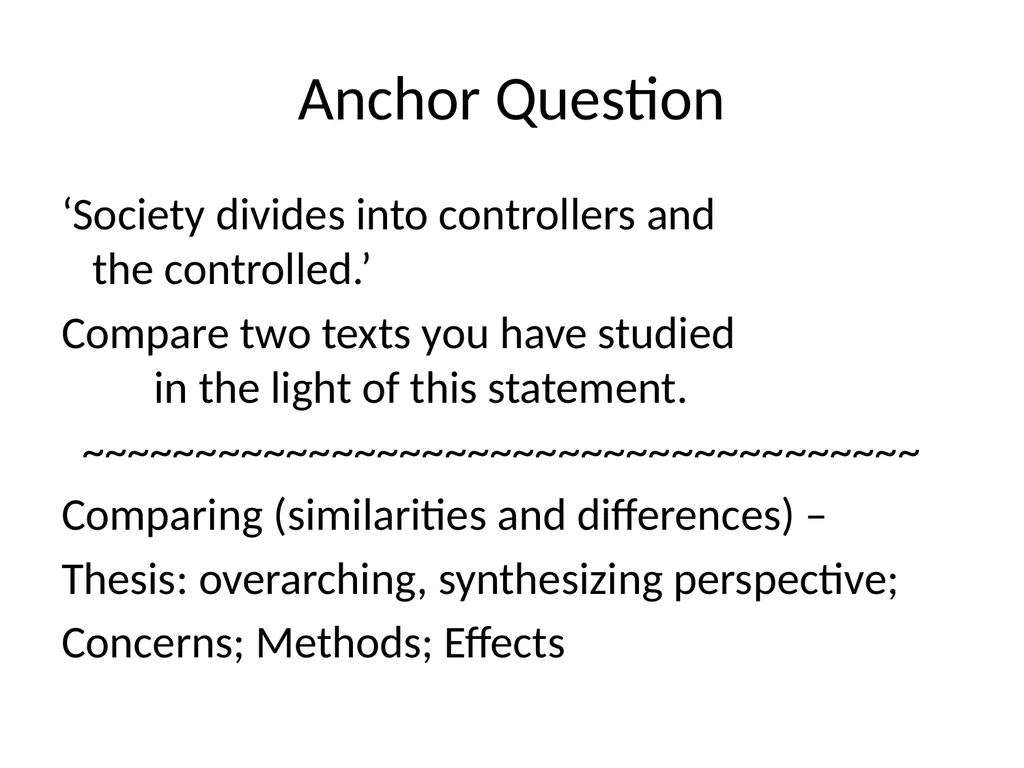
Anchor Question ‘Society divides into controllers and the controlled.’
Compare two texts you have studied in the light of this statement.
~~~~~~~~~~~~~~~~~~~~~~~~~~~~~~~~~~~~~
Comparing (similarities and differences) –
Thesis: overarching, synthesizing perspective;
Concerns; Methods; Effects<br>
Compare two texts you have studied in the light of this statement.
~~~~~~~~~~~~~~~~~~~~~~~~~~~~~~~~~~~~~
Comparing (similarities and differences) –
Thesis: overarching, synthesizing perspective;
Concerns; Methods; Effects<br>
04
Controllers and Followers;
Masters and Slaves; the Strong and the Weak Controllers / Masters / Dominators / Silencers
Open Transparent Controllers; Principled like Othello, and Unprincipled – Stanley; and the Hidden, more devious, subtle manipulative Controllers
Submissives - Followers / Servants – out of weakness, or they are Lackeys - ‘obsequious knee-crooking knaves’
Loyalists / the faithful follower – out of genuine love, regard, respect
Pretenders – pretending to follow and serve; ‘shows of service’<br>
Open Transparent Controllers; Principled like Othello, and Unprincipled – Stanley; and the Hidden, more devious, subtle manipulative Controllers
Submissives - Followers / Servants – out of weakness, or they are Lackeys - ‘obsequious knee-crooking knaves’
Loyalists / the faithful follower – out of genuine love, regard, respect
Pretenders – pretending to follow and serve; ‘shows of service’<br>
05
How to gain Control -
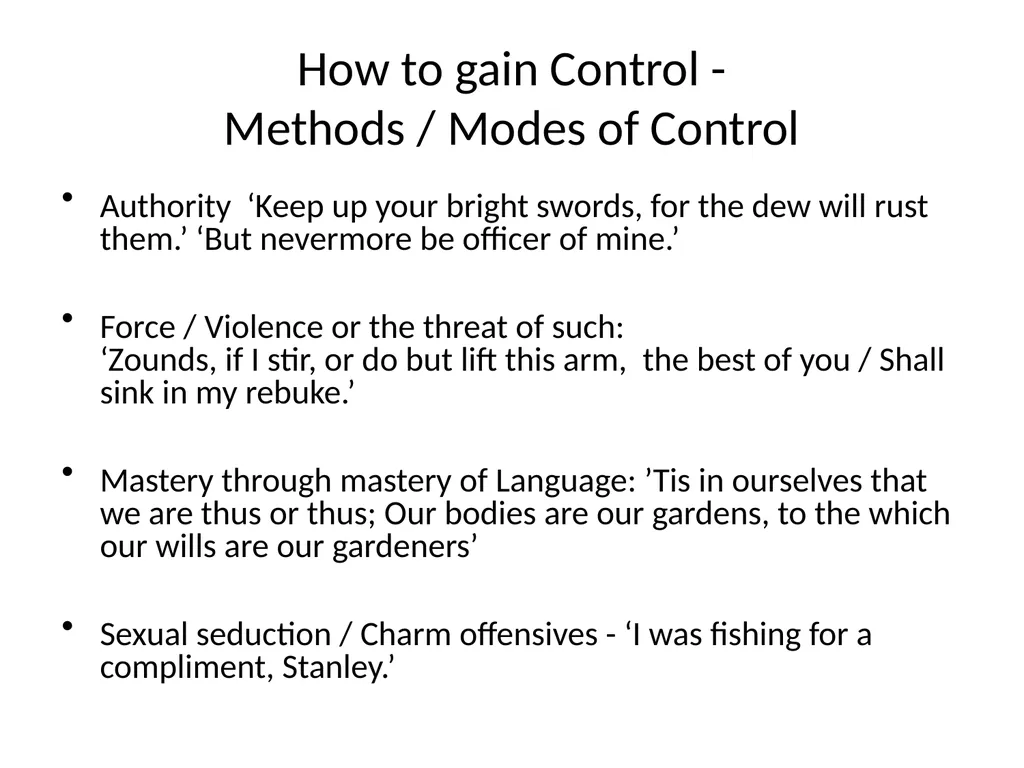
Methods / Modes of Control Authority ‘Keep up your bright swords, for the dew will rust them.’ ‘But nevermore be officer of mine.’
Force / Violence or the threat of such: ‘Zounds, if I stir, or do but lift this arm, the best of you / Shall sink in my rebuke.’
Mastery through mastery of Language: ’Tis in ourselves that we are thus or thus; Our bodies are our gardens, to the which our wills are our gardeners’
Sexual seduction / Charm offensives - ‘I was fishing for a compliment, Stanley.’<br>
Force / Violence or the threat of such: ‘Zounds, if I stir, or do but lift this arm, the best of you / Shall sink in my rebuke.’
Mastery through mastery of Language: ’Tis in ourselves that we are thus or thus; Our bodies are our gardens, to the which our wills are our gardeners’
Sexual seduction / Charm offensives - ‘I was fishing for a compliment, Stanley.’<br>
06
Iago – conceals his character Iago:
I follow him to serve my turn upon him.
We cannot all be masters, nor all masters Cannot be truly followed. You shall mark Many a duteous and knee-crooking knave That doting on his own obsequious bondage
Wears out his time, much like his master’s ass,
In following him, I follow but myself.
I am not what I am.<br>
I follow him to serve my turn upon him.
We cannot all be masters, nor all masters Cannot be truly followed. You shall mark Many a duteous and knee-crooking knave That doting on his own obsequious bondage
Wears out his time, much like his master’s ass,
In following him, I follow but myself.
I am not what I am.<br>
07
Voices – of Men and Women in
The Public and Private Sphere I want to start very near the beginning of Western literature, and its first recorded example of a man telling a woman to shut up; telling her that her voice was not to be heard in public. (At the start of Homer’s Odyssey)
Telemachus addresses his mother: ‘Mother, go back up into your quarters and take up your own work, the loom and the distaff…speech will be the business of men, all men, and of me most of all; for mine in the power in this household.’<br>
Telemachus addresses his mother: ‘Mother, go back up into your quarters and take up your own work, the loom and the distaff…speech will be the business of men, all men, and of me most of all; for mine in the power in this household.’<br>
08
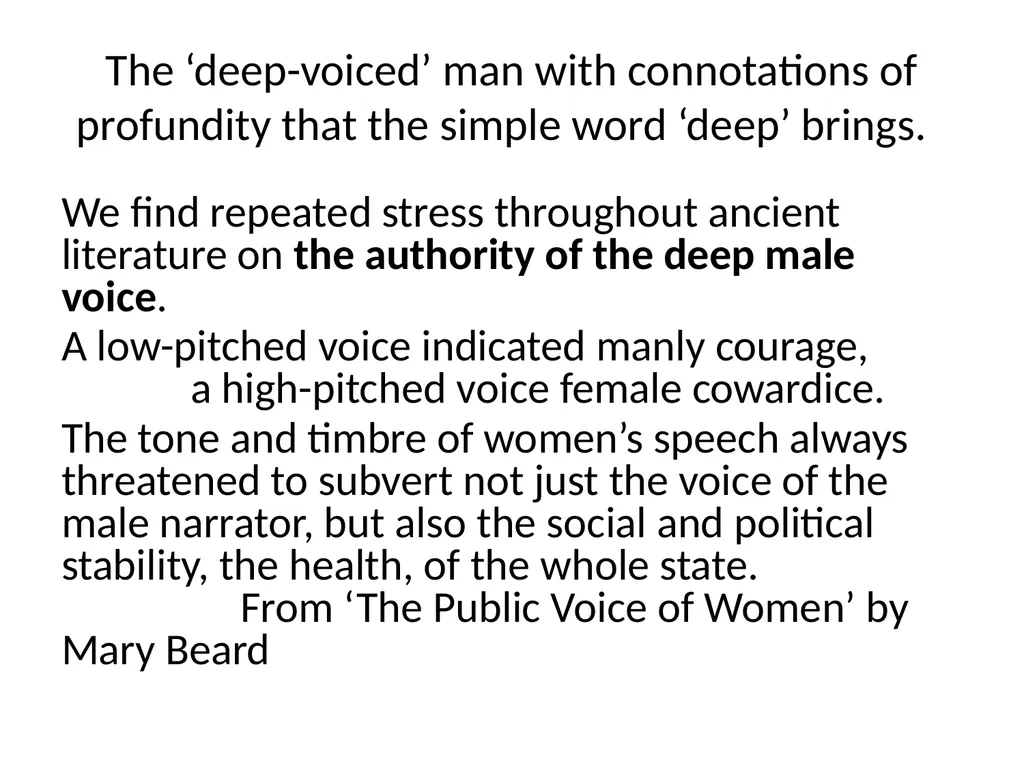
The ‘deep-voiced’ man with connotations of profundity that the simple word ‘deep’ brings. We find repeated stress throughout ancient literature on the authority of the deep male voice.
A low-pitched voice indicated manly courage, a high-pitched voice female cowardice.
The tone and timbre of women’s speech always threatened to subvert not just the voice of the male narrator, but also the social and political stability, the health, of the whole state. From ‘The Public Voice of Women’ by Mary Beard<br>
A low-pitched voice indicated manly courage, a high-pitched voice female cowardice.
The tone and timbre of women’s speech always threatened to subvert not just the voice of the male narrator, but also the social and political stability, the health, of the whole state. From ‘The Public Voice of Women’ by Mary Beard<br>
09
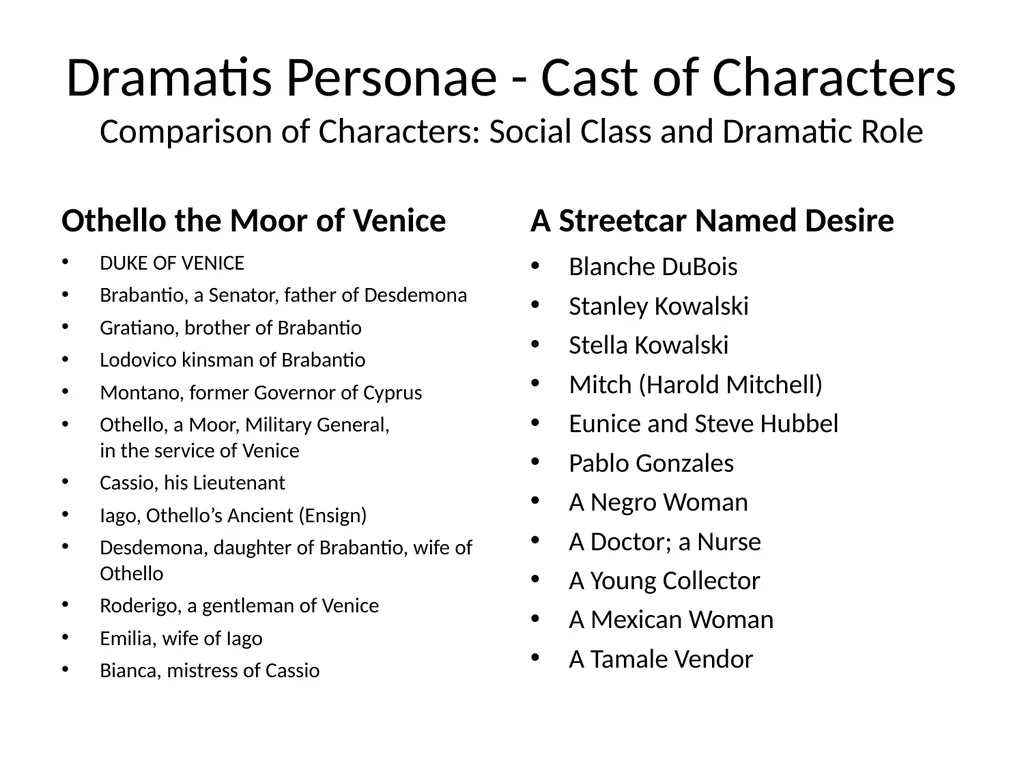
Dramatis Personae - Cast of Characters
Comparison of Characters: Social Class and Dramatic Role Othello the Moor of Venice DUKE OF VENICE
Brabantio, a Senator, father of Desdemona
Gratiano, brother of Brabantio
Lodovico kinsman of Brabantio
Montano, former Governor of Cyprus
Othello, a Moor, Military General, in the service of Venice
Cassio, his Lieutenant
Iago, Othello’s Ancient (Ensign)
Desdemona, daughter of Brabantio, wife of Othello
Roderigo, a gentleman of Venice
Emilia, wife of Iago
Bianca, mistress of Cassio A Streetcar Named Desire Blanche DuBois
Stanley Kowalski
Stella Kowalski
Mitch (Harold Mitchell)
Eunice and Steve Hubbel
Pablo Gonzales
A Negro Woman
A Doctor; a Nurse
A Young Collector
A Mexican Woman
A Tamale Vendor<br>
Brabantio, a Senator, father of Desdemona
Gratiano, brother of Brabantio
Lodovico kinsman of Brabantio
Montano, former Governor of Cyprus
Othello, a Moor, Military General, in the service of Venice
Cassio, his Lieutenant
Iago, Othello’s Ancient (Ensign)
Desdemona, daughter of Brabantio, wife of Othello
Roderigo, a gentleman of Venice
Emilia, wife of Iago
Bianca, mistress of Cassio A Streetcar Named Desire Blanche DuBois
Stanley Kowalski
Stella Kowalski
Mitch (Harold Mitchell)
Eunice and Steve Hubbel
Pablo Gonzales
A Negro Woman
A Doctor; a Nurse
A Young Collector
A Mexican Woman
A Tamale Vendor<br>
10
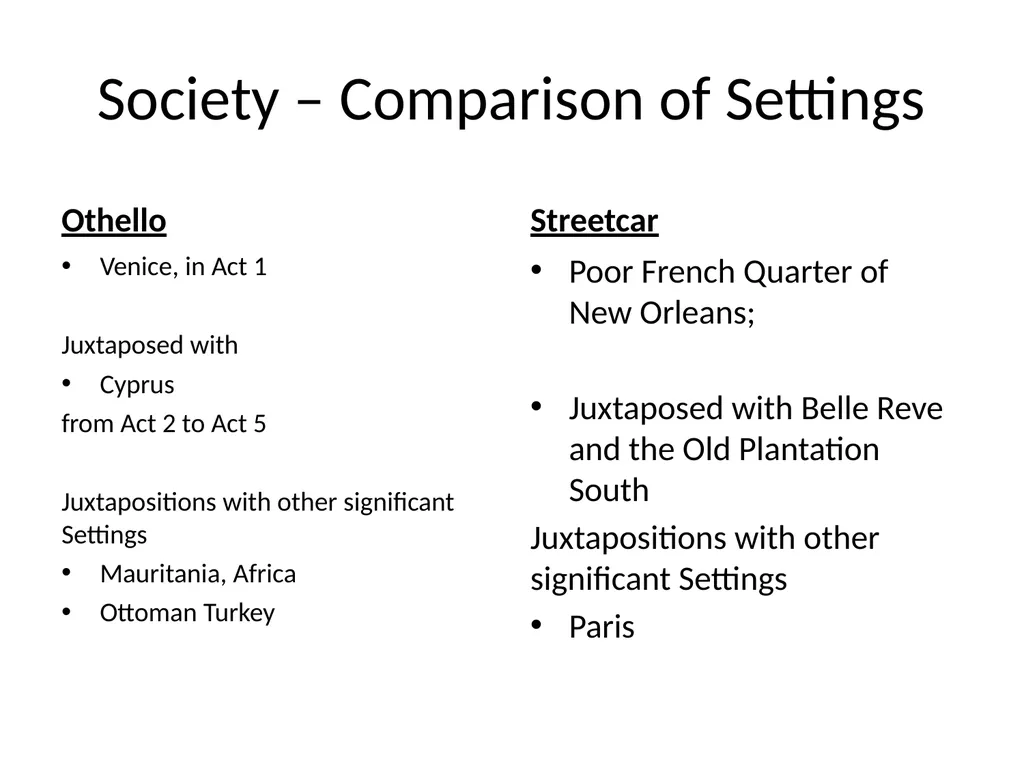
Society – Comparison of Settings Othello Venice, in Act 1
Juxtaposed with
Cyprus
from Act 2 to Act 5
Juxtapositions with other significant Settings
Mauritania, Africa
Ottoman Turkey Streetcar Poor French Quarter of New Orleans;
Juxtaposed with Belle Reve and the Old Plantation South
Juxtapositions with other significant Settings
Paris<br>
Juxtaposed with
Cyprus
from Act 2 to Act 5
Juxtapositions with other significant Settings
Mauritania, Africa
Ottoman Turkey Streetcar Poor French Quarter of New Orleans;
Juxtaposed with Belle Reve and the Old Plantation South
Juxtapositions with other significant Settings
Paris<br>
11
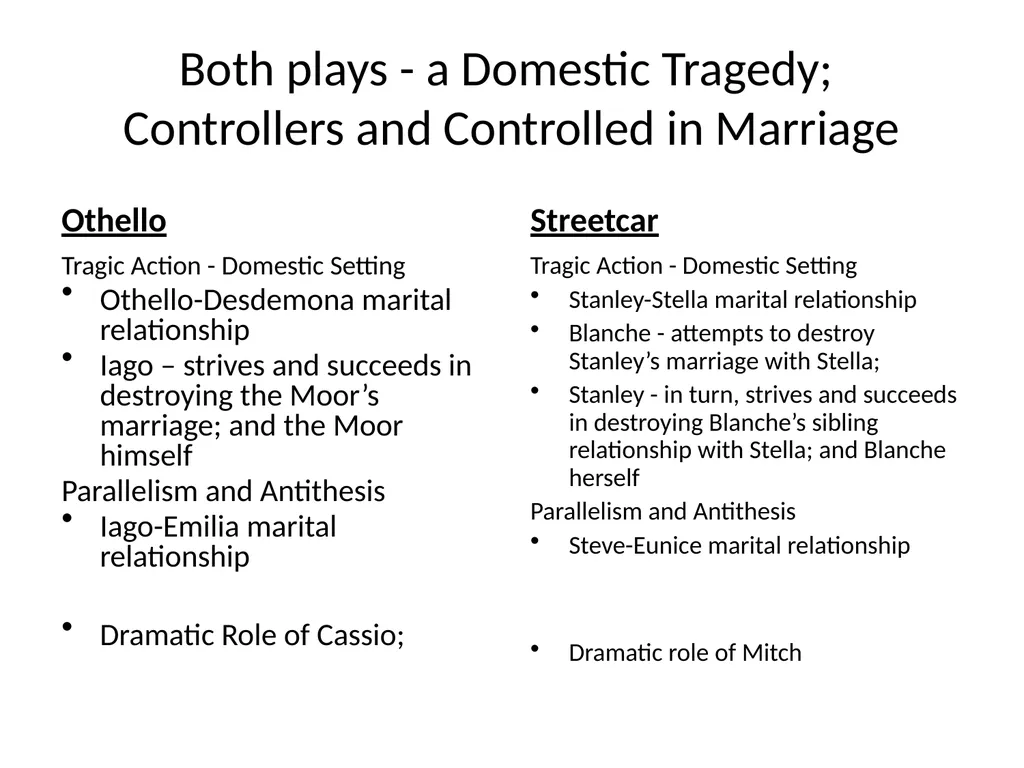
Both plays - a Domestic Tragedy;
Controllers and Controlled in Marriage Othello Tragic Action - Domestic Setting
Othello-Desdemona marital relationship
Iago – strives and succeeds in destroying the Moor’s marriage; and the Moor himself
Parallelism and Antithesis
Iago-Emilia marital relationship
Dramatic Role of Cassio; Streetcar Tragic Action - Domestic Setting
Stanley-Stella marital relationship
Blanche - attempts to destroy Stanley’s marriage with Stella;
Stanley - in turn, strives and succeeds in destroying Blanche’s sibling relationship with Stella; and Blanche herself
Parallelism and Antithesis
Steve-Eunice marital relationship
Dramatic role of Mitch<br>
Othello-Desdemona marital relationship
Iago – strives and succeeds in destroying the Moor’s marriage; and the Moor himself
Parallelism and Antithesis
Iago-Emilia marital relationship
Dramatic Role of Cassio; Streetcar Tragic Action - Domestic Setting
Stanley-Stella marital relationship
Blanche - attempts to destroy Stanley’s marriage with Stella;
Stanley - in turn, strives and succeeds in destroying Blanche’s sibling relationship with Stella; and Blanche herself
Parallelism and Antithesis
Steve-Eunice marital relationship
Dramatic role of Mitch<br>
12
[By the way – en passant]
Framing Devices - Streetcar? And so it was I entered the broken world
To trace the visionary company of love, its voice
An instant in the wind [I know not whither hurled]
But not for long to hold each desperate choice.
- from The Broken Tower by Hart Crane
Note
This epigraph sums up the world of the play – It’s a broken world;
and the elusive search of Blanche for love;<br>
To trace the visionary company of love, its voice
An instant in the wind [I know not whither hurled]
But not for long to hold each desperate choice.
- from The Broken Tower by Hart Crane
Note
This epigraph sums up the world of the play – It’s a broken world;
and the elusive search of Blanche for love;<br>
13
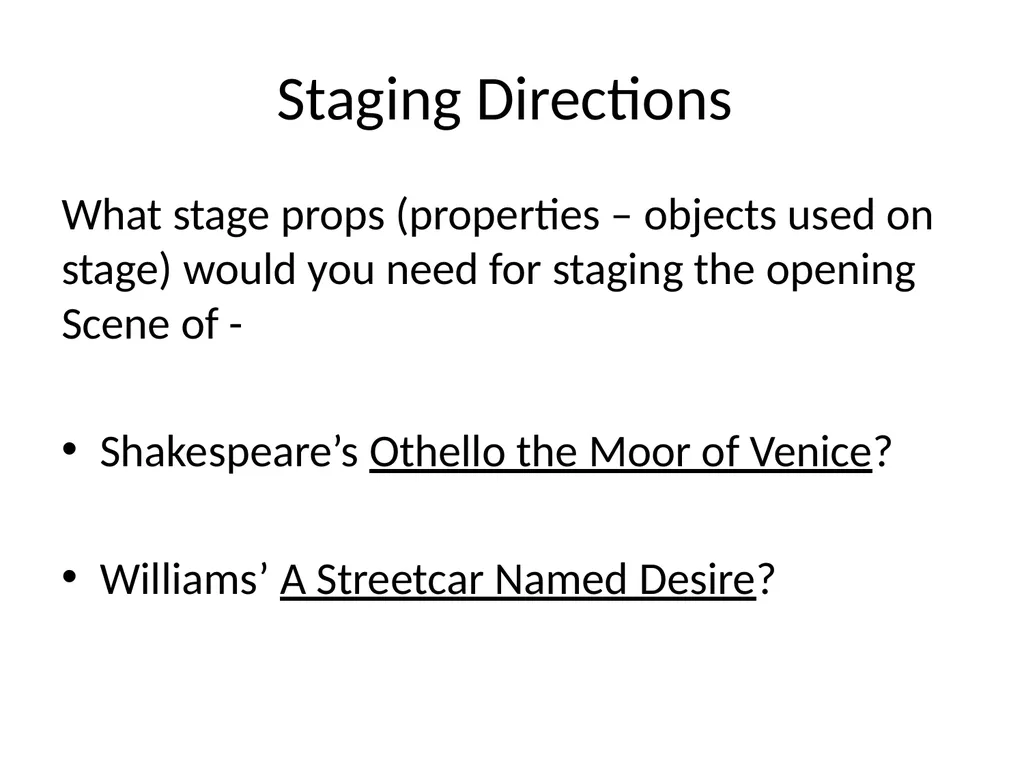
Staging Directions What stage props (properties – objects used on stage) would you need for staging the opening Scene of -
Shakespeare’s Othello the Moor of Venice?
Williams’ A Streetcar Named Desire?<br>
Shakespeare’s Othello the Moor of Venice?
Williams’ A Streetcar Named Desire?<br>
14
Williams’ Staging Directions
Opening Scene of Streetcar p3 The exterior of a two-storey corner building on a street in New Orleans, named Elysian Fields…
The section is poor; has a raffish charm.
Atmosphere of decay;
The music of Negro entertainers at a bar-room around the corner.
In this part of New Orleans you are practically always just around the corner, or a few doors down the street, from a tinny piano being played with the infatuated fluency of brown fingers.
This “Blue Piano” expresses the spirit of the life which goes on here.<br>
The section is poor; has a raffish charm.
Atmosphere of decay;
The music of Negro entertainers at a bar-room around the corner.
In this part of New Orleans you are practically always just around the corner, or a few doors down the street, from a tinny piano being played with the infatuated fluency of brown fingers.
This “Blue Piano” expresses the spirit of the life which goes on here.<br>
15
Visual and Sound Experience;
Theatrical Effects on the Audience Visual Techniques (as Directed by the Playwright)
Stage Set Design to convey a visual sense of the poorness and ramshackle appearance of this section of New Orleans
The close proximity of the dwelling places;
The brown river and railroad tracks;
Sound Devices
The sound of the Blue Piano
The noisy low life chatter of low life characters on this low life street in this section of New Orleans<br>
Stage Set Design to convey a visual sense of the poorness and ramshackle appearance of this section of New Orleans
The close proximity of the dwelling places;
The brown river and railroad tracks;
Sound Devices
The sound of the Blue Piano
The noisy low life chatter of low life characters on this low life street in this section of New Orleans<br>
16
Exploiting Notes from the Text p91 Williams’ Stage Directions are extremely detailed; almost cinematic in scope;
The French Quarter of New Orleans (the Setting of the play) to look poor and run down;
Yet Williams manages to invest it with considerable beauty and poetry.
The atmospheric jazz piano, a strong leitmotif in the play;
The river and the L&N railroad tracks (Louisiana and Nashville) symbolically suggestive of transportation — of mechanization, materialism, commerce, a world only briefly glimpsed at, in what is primarily a domestic play;<br>
The French Quarter of New Orleans (the Setting of the play) to look poor and run down;
Yet Williams manages to invest it with considerable beauty and poetry.
The atmospheric jazz piano, a strong leitmotif in the play;
The river and the L&N railroad tracks (Louisiana and Nashville) symbolically suggestive of transportation — of mechanization, materialism, commerce, a world only briefly glimpsed at, in what is primarily a domestic play;<br>
17
Hellenic Allusion to Elysium Elysian Fields, symbolically considered — an appropriate name for the street;
Why?
Classical allusion to Elysium (the Elysium Fields) – the resting place for the blessed in ancient Greek mythology; a place of ideal happiness;
Irony?
A heaven that Blanche DuBois will be denied - when she comes to stay with the Kowalskis;
What major and central theme - is surfaced at this point in Scene 1?<br>
Why?
Classical allusion to Elysium (the Elysium Fields) – the resting place for the blessed in ancient Greek mythology; a place of ideal happiness;
Irony?
A heaven that Blanche DuBois will be denied - when she comes to stay with the Kowalskis;
What major and central theme - is surfaced at this point in Scene 1?<br>
18
Death in Venice and New Orleans From the opening Scene -
Death is a prominent theme in the play A Streetcar Named Desire.
How is this theme further developed?
What of the play Othello, comparatively considered, with regard to this theme?<br>
Death is a prominent theme in the play A Streetcar Named Desire.
How is this theme further developed?
What of the play Othello, comparatively considered, with regard to this theme?<br>
19
Begins with an Ongoing Conversation
as a Dramatic Device Negro Woman: [to Eunice]: . . . she says St. Barnabas would send his dog to lick her and when he did she’d feel an icy cold wave all up an’ down her. Well, that night when—
We enter the play through an ongoing conversation, between the Negro Woman and Eunice, a neigbour of the Kowalskis;
Williams thus immediately establishes the licentious atmosphere of this poor section of New Orleans;
NOTE: St Barnabas converted from Judaism to Christianity – Williams’ image is therefore an irreverent coupling of Sex and Religion;
Do we see an irreverent coupling of Sex and Religion in Othello?<br>
We enter the play through an ongoing conversation, between the Negro Woman and Eunice, a neigbour of the Kowalskis;
Williams thus immediately establishes the licentious atmosphere of this poor section of New Orleans;
NOTE: St Barnabas converted from Judaism to Christianity – Williams’ image is therefore an irreverent coupling of Sex and Religion;
Do we see an irreverent coupling of Sex and Religion in Othello?<br>
20
Staging Directions for Stanley’s first Encounter with Blanche - Scene 1 Stanley throws the screen door open and comes in. Strongly, compactly built.
Since earliest manhood the centre of his life has been pleasure with women, the giving and taking of it, not with weak indulgence, dependently, but with the power and pride of a richly feathered bird among hens. Branching out from this complete and satisfying centre are all the auxiliary channels of his life, such as his heartiness with men, his appreciation of rough humour, his love of good drink and food and games…
He sizes women up at a glance, with sexual classifications, crude images flashing into his mind and determining the way he smiles at them.
Stanley to Blanche: Where you from, Blanche?
In Laurel, huh? Oh, yeah. Yeah, in Laurel, that’s right. Not in my territory.<br>
Since earliest manhood the centre of his life has been pleasure with women, the giving and taking of it, not with weak indulgence, dependently, but with the power and pride of a richly feathered bird among hens. Branching out from this complete and satisfying centre are all the auxiliary channels of his life, such as his heartiness with men, his appreciation of rough humour, his love of good drink and food and games…
He sizes women up at a glance, with sexual classifications, crude images flashing into his mind and determining the way he smiles at them.
Stanley to Blanche: Where you from, Blanche?
In Laurel, huh? Oh, yeah. Yeah, in Laurel, that’s right. Not in my territory.<br>
21
Othello from Page to Stage?
Also begins in Mid-Conversation As an audience in the theatre, what would be our visual experience of the beginning of Othello as stage directed by Shakespeare?
What dramatic techniques are used to convey this theatrical / dramatic experience?
Dramatic / Theatrical Effects on the Audience?<br>
What dramatic techniques are used to convey this theatrical / dramatic experience?
Dramatic / Theatrical Effects on the Audience?<br>
22
Opening Scene of Othello
Staging Directions Venice. A street.
Enter IAGO and RODERIGO
~~~~~~~~~~~~~~~~~~~~~~~~~~~~~~~~~~
Other Staging Directions?
How are they communicated to facilitate the manner in which the play is to be performed, as intended by the playwright?<br>
Enter IAGO and RODERIGO
~~~~~~~~~~~~~~~~~~~~~~~~~~~~~~~~~~
Other Staging Directions?
How are they communicated to facilitate the manner in which the play is to be performed, as intended by the playwright?<br>
23
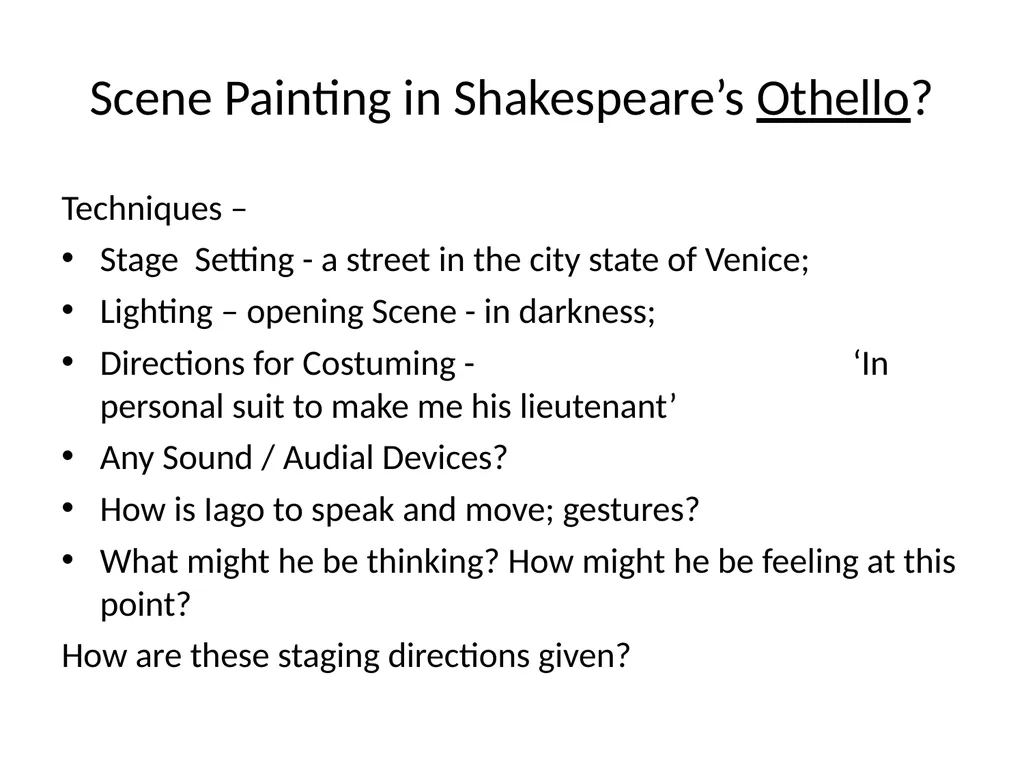
Scene Painting in Shakespeare’s Othello? Techniques –
Stage Setting - a street in the city state of Venice;
Lighting – opening Scene - in darkness;
Directions for Costuming - ‘In personal suit to make me his lieutenant’
Any Sound / Audial Devices?
How is Iago to speak and move; gestures?
What might he be thinking? How might he be feeling at this point?
How are these staging directions given?<br>
Stage Setting - a street in the city state of Venice;
Lighting – opening Scene - in darkness;
Directions for Costuming - ‘In personal suit to make me his lieutenant’
Any Sound / Audial Devices?
How is Iago to speak and move; gestures?
What might he be thinking? How might he be feeling at this point?
How are these staging directions given?<br>
24
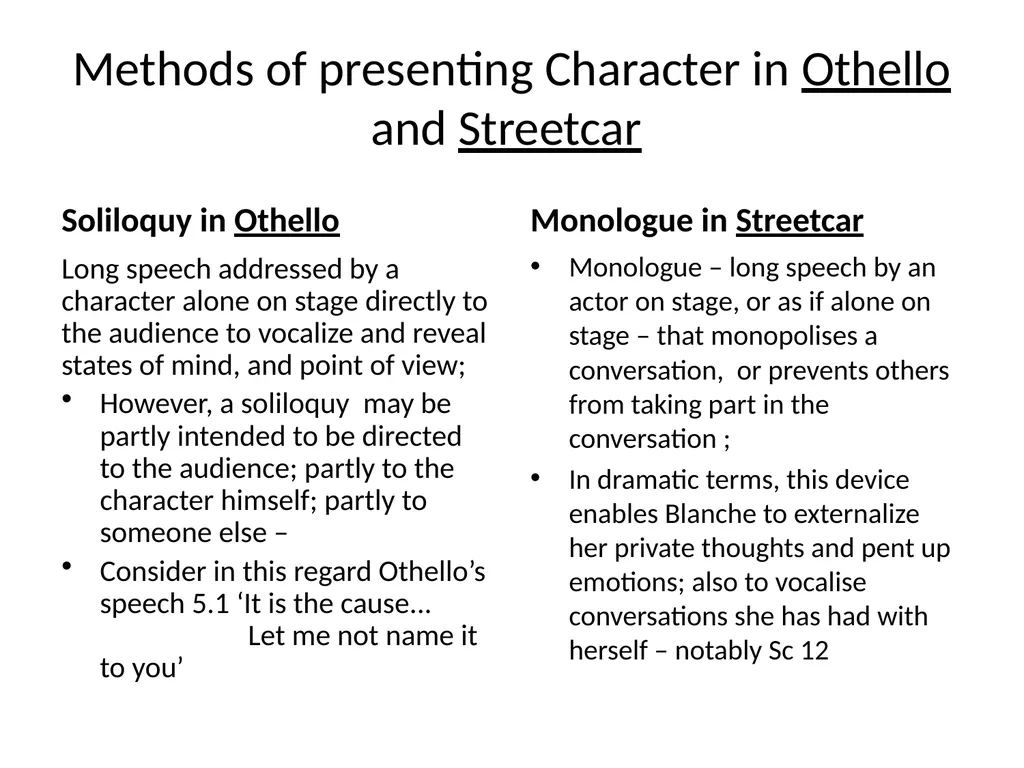
Methods of presenting Character in Othello and Streetcar Soliloquy in Othello Long speech addressed by a character alone on stage directly to the audience to vocalize and reveal states of mind, and point of view;
However, a soliloquy may be partly intended to be directed to the audience; partly to the character himself; partly to someone else –
Consider in this regard Othello’s speech 5.1 ‘It is the cause... Let me not name it to you’ Monologue in Streetcar Monologue – long speech by an actor on stage, or as if alone on stage – that monopolises a conversation, or prevents others from taking part in the conversation ;
In dramatic terms, this device enables Blanche to externalize her private thoughts and pent up emotions; also to vocalise conversations she has had with herself – notably Sc 12<br>
However, a soliloquy may be partly intended to be directed to the audience; partly to the character himself; partly to someone else –
Consider in this regard Othello’s speech 5.1 ‘It is the cause... Let me not name it to you’ Monologue in Streetcar Monologue – long speech by an actor on stage, or as if alone on stage – that monopolises a conversation, or prevents others from taking part in the conversation ;
In dramatic terms, this device enables Blanche to externalize her private thoughts and pent up emotions; also to vocalise conversations she has had with herself – notably Sc 12<br>
25
Dramatic Techniques
Soliloquies and Monologues Soliloquies of Othello Othello’s first soliloquy?
Critical significance in relation to plot progression?
Juxtaposed with
Soliloquies of Iago
Iago’s first soliloquy? Monologues of Blanche Monologues of Blanche notably
Sc 1 p12, 13
Sc 4 p40, 41
Sc 6 p56
Sc 10 p78
Sc 11 p85<br>
Critical significance in relation to plot progression?
Juxtaposed with
Soliloquies of Iago
Iago’s first soliloquy? Monologues of Blanche Monologues of Blanche notably
Sc 1 p12, 13
Sc 4 p40, 41
Sc 6 p56
Sc 10 p78
Sc 11 p85<br>
26
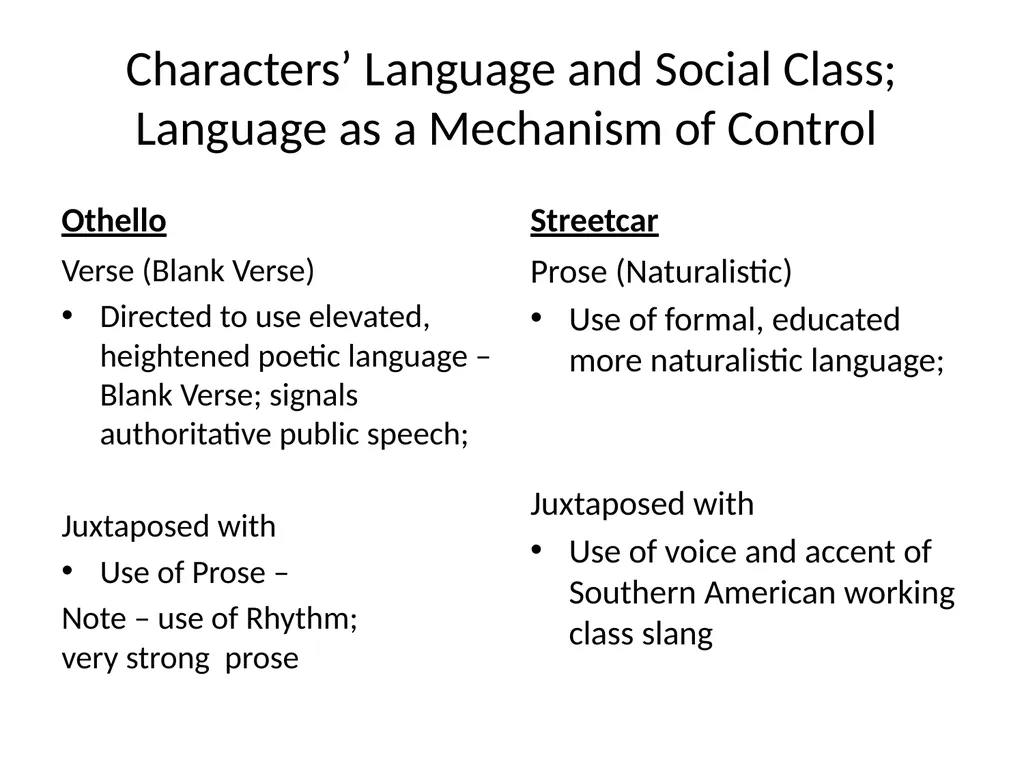
Characters’ Language and Social Class;
Language as a Mechanism of Control Othello Verse (Blank Verse)
Directed to use elevated, heightened poetic language – Blank Verse; signals authoritative public speech;
Juxtaposed with
Use of Prose –
Note – use of Rhythm; very strong prose Streetcar Prose (Naturalistic)
Use of formal, educated more naturalistic language;
Juxtaposed with
Use of voice and accent of Southern American working class slang<br>
Directed to use elevated, heightened poetic language – Blank Verse; signals authoritative public speech;
Juxtaposed with
Use of Prose –
Note – use of Rhythm; very strong prose Streetcar Prose (Naturalistic)
Use of formal, educated more naturalistic language;
Juxtaposed with
Use of voice and accent of Southern American working class slang<br>
27
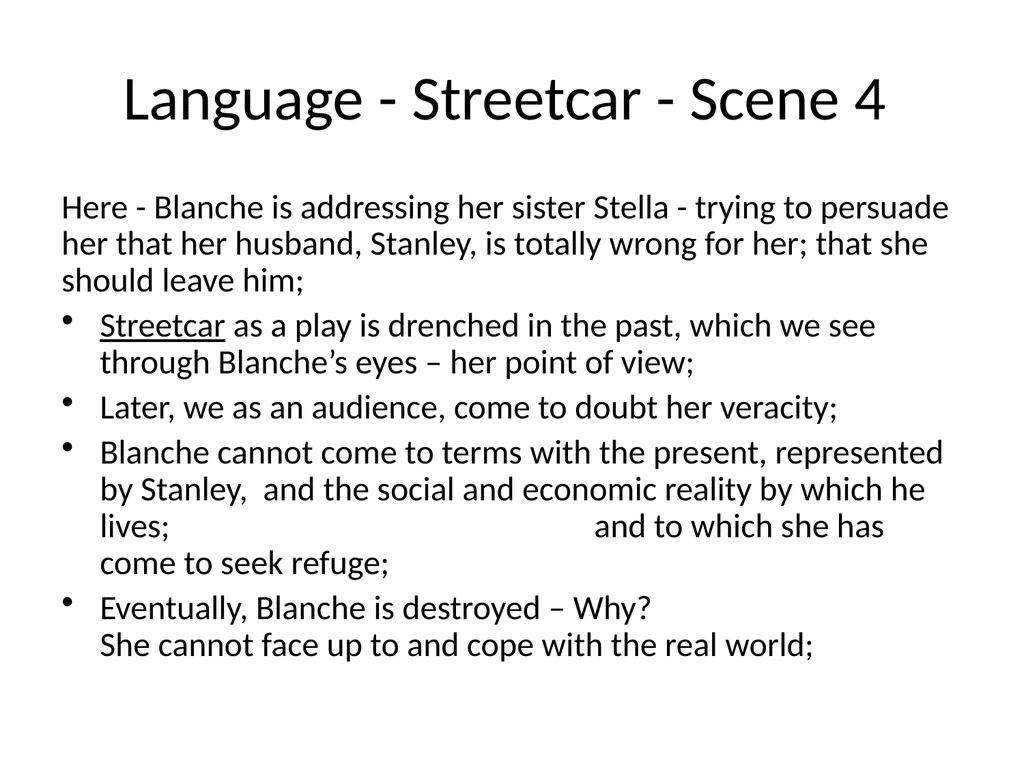
Language - Streetcar - Scene 4 Here - Blanche is addressing her sister Stella - trying to persuade her that her husband, Stanley, is totally wrong for her; that she should leave him;
Streetcar as a play is drenched in the past, which we see through Blanche’s eyes – her point of view;
Later, we as an audience, come to doubt her veracity;
Blanche cannot come to terms with the present, represented by Stanley, and the social and economic reality by which he lives; and to which she has come to seek refuge;
Eventually, Blanche is destroyed – Why? She cannot face up to and cope with the real world;<br>
Streetcar as a play is drenched in the past, which we see through Blanche’s eyes – her point of view;
Later, we as an audience, come to doubt her veracity;
Blanche cannot come to terms with the present, represented by Stanley, and the social and economic reality by which he lives; and to which she has come to seek refuge;
Eventually, Blanche is destroyed – Why? She cannot face up to and cope with the real world;<br>
28
Blanche striving to gain control of Stella’s mind -
How? Through the Rhetorical use of Language Blanche: Well—if you’ll forgive me—he’s common.
Stella: Why, yes, I suppose he is.
Blanche: Suppose! You can’t have forgotten that much of our bringing up, Stella, that you just suppose that any part of a gentleman’s in his nature! Not one particle, no! Oh, if he was just – ordinary! Just plain—but good and wholesome, but—no. There’s something downright—bestial—about him! You’re hating me saying this, aren’t you?<br>
Stella: Why, yes, I suppose he is.
Blanche: Suppose! You can’t have forgotten that much of our bringing up, Stella, that you just suppose that any part of a gentleman’s in his nature! Not one particle, no! Oh, if he was just – ordinary! Just plain—but good and wholesome, but—no. There’s something downright—bestial—about him! You’re hating me saying this, aren’t you?<br>
29
Gaining Control through the Rhetorical Power of Words - Iago [3.3] I am glad of this: for now I shall have reason
To show the love and duty that I bear you
With a franker spirit. Therefore, as I am bound,
Receive it from me. I speak not yet of proof.
Look to your wife; observe her well with Cassio.
Wear your eye thus: not jealous, nor secure.
I would not have your free and noble nature,
Out of self-bounty, be abused. Look to’t.
I know our country disposition well:
In Venice they do let God see the pranks
They dare not show their husbands; their best
conscience
Is not to leave’t undone, but keep it unknown.<br>
To show the love and duty that I bear you
With a franker spirit. Therefore, as I am bound,
Receive it from me. I speak not yet of proof.
Look to your wife; observe her well with Cassio.
Wear your eye thus: not jealous, nor secure.
I would not have your free and noble nature,
Out of self-bounty, be abused. Look to’t.
I know our country disposition well:
In Venice they do let God see the pranks
They dare not show their husbands; their best
conscience
Is not to leave’t undone, but keep it unknown.<br>
30
Effects of Iago’s Rhetorical Language -
Othello’s first Soliloquy 3.3 This fellow’s of exceeding honesty,
And knows all qualities, with a learned spirit,
Of human dealings. If I do prove her haggard,
Though that her jesses were my dear heart-strings,
I’d whistle her off, and let her down the wind
To prey at fortune. Haply for I am black,
And have not those soft parts of conversation
That chamberers have; or for I am declined
Into a vale of years—yet that’s not much—
She’s gone: I am abused, and my relief
Must be to loath her. O curse of marriage,
That we can call these delicate creatures ours
And not their appetites! I had rather be a toad
And live upon the vapour of a dungeon
Than a keep a corner in the thing I love
For others’ uses.<br>
And knows all qualities, with a learned spirit,
Of human dealings. If I do prove her haggard,
Though that her jesses were my dear heart-strings,
I’d whistle her off, and let her down the wind
To prey at fortune. Haply for I am black,
And have not those soft parts of conversation
That chamberers have; or for I am declined
Into a vale of years—yet that’s not much—
She’s gone: I am abused, and my relief
Must be to loath her. O curse of marriage,
That we can call these delicate creatures ours
And not their appetites! I had rather be a toad
And live upon the vapour of a dungeon
Than a keep a corner in the thing I love
For others’ uses.<br>
31
Control through physical force 4.1 Ludovico arrives from Venice with a letter from the Duke
Desdemona: A most unhappy one. I would do much / T’atone them, for the love I bear to Cassio.
Othello: Fire and brimstone!
Desdemona: My lord?
Othello: Are you wise?
Desdemona: Why, sweet Othello - (a charm offensive)
[Strikes her] Devil!
Desdemona: I have not deserved this.<br>
Desdemona: A most unhappy one. I would do much / T’atone them, for the love I bear to Cassio.
Othello: Fire and brimstone!
Desdemona: My lord?
Othello: Are you wise?
Desdemona: Why, sweet Othello - (a charm offensive)
[Strikes her] Devil!
Desdemona: I have not deserved this.<br>
32
Iago-Emilia relationship [3.3]
Juxtaposed with Othello –Desdemona Emilia: I am glad I have found this napkin.
This was her first remembrance of the Moor.
Iago: How now, what do you here alone?
Emilia: Do not chide; I have a thing for you.
Iago: A thing for me? It is a common thing –
Emilia: Ha?
Iago: To have a foolish wife.
Emilia: O, is that all? What will you give me now For that same handkerchief?
Iago: A good wench; give it to me.
Emilia: What will you do with’t?
Iago: [Snatching it] Why, what is it to you?<br>
This was her first remembrance of the Moor.
Iago: How now, what do you here alone?
Emilia: Do not chide; I have a thing for you.
Iago: A thing for me? It is a common thing –
Emilia: Ha?
Iago: To have a foolish wife.
Emilia: O, is that all? What will you give me now For that same handkerchief?
Iago: A good wench; give it to me.
Emilia: What will you do with’t?
Iago: [Snatching it] Why, what is it to you?<br>
33
Control through the use of
Physical Force - Streetcar - Scene 3 Stella: Drunk—drunk—animal thing, you!
Blanche [wildly]: Stella, watch out, he’s—
Men [feebly]: Take it easy, Stanley. Easy fellow—Let’s all—
Stella: You lay your hands on me and I’ll—
She backs out of sight. He advances and disappears. There is the sound of a blow. STELLA cries out.
Blanche: [shrilly] My sister is going to have a baby!
Mitch: This is terrible.<br>
Blanche [wildly]: Stella, watch out, he’s—
Men [feebly]: Take it easy, Stanley. Easy fellow—Let’s all—
Stella: You lay your hands on me and I’ll—
She backs out of sight. He advances and disappears. There is the sound of a blow. STELLA cries out.
Blanche: [shrilly] My sister is going to have a baby!
Mitch: This is terrible.<br>
34
Control: Physical Force - the Hubbel Apartment - Scene 5 p42 - Parallelism Eunice: I heard about you and that blonde!
Steve: That’s a damn lie!
Eunice [shrieking]: I’m gonna call the police!
A clatter of aluminium striking a wall is heard, followed by a man’s angry roar, shouts and overturned furniture. There is a crash; then a relative hush.
Eunice appears on the steps in daemonic disorder.
NOTE: Later on, in Scene 11 – Eunice remarks to Stanley –
‘I always did say that men are callous things with no feelings…’<br>
Steve: That’s a damn lie!
Eunice [shrieking]: I’m gonna call the police!
A clatter of aluminium striking a wall is heard, followed by a man’s angry roar, shouts and overturned furniture. There is a crash; then a relative hush.
Eunice appears on the steps in daemonic disorder.
NOTE: Later on, in Scene 11 – Eunice remarks to Stanley –
‘I always did say that men are callous things with no feelings…’<br>
35
Control through the Fury of Words
4.2 Desdemona: I understand a fury in your words.
Othello: Are you not a strumpet?
Desdemona: No, as I am a Christian.
Othello: What, not a whore?
I took you for that cunning whore of Venice
That married with Othello. [Raises his voice] You, mistress, / That have the opposite to St Peter, / And keep the gate of hell -<br>
Othello: Are you not a strumpet?
Desdemona: No, as I am a Christian.
Othello: What, not a whore?
I took you for that cunning whore of Venice
That married with Othello. [Raises his voice] You, mistress, / That have the opposite to St Peter, / And keep the gate of hell -<br>
36
Control through the Fury of Words and Physical Violence - Streetcar Scene 8 Stanley: That’s how I’ll clear the table! [He seizes her arm.] Don’t ever talk that way to me! “Pig—Polack—disgusting—vulgar—greasy!”—them kind of words have been on your tongue and your sister’s too much around here! What do you think you are? A pair of queens? Remember what Huey Long said—“Every Man is a King! And I am the king around here, so don’t forget it!
[He hurls a cup and saucer to the floor.] My place is cleared!<br>
[He hurls a cup and saucer to the floor.] My place is cleared!<br>
37
Incarceration and Execution –
Ultimate Forms of Social Control Streetcar
Institutions of Social Control – the Lunatic Asylum –
Agents of institutionalized state control – the doctor and the matron
Othello
Appeals to Religiously inspired Institutionalized Execution – an agent of divine justice - for sexually ‘out-of-control’ women - ‘Yet she must die, else she’ll betray more men.’ [5.2] – sacrificing her for an ideal rather than murdering in vengeful hatred;<br>
Institutions of Social Control – the Lunatic Asylum –
Agents of institutionalized state control – the doctor and the matron
Othello
Appeals to Religiously inspired Institutionalized Execution – an agent of divine justice - for sexually ‘out-of-control’ women - ‘Yet she must die, else she’ll betray more men.’ [5.2] – sacrificing her for an ideal rather than murdering in vengeful hatred;<br>