
Competence-Based Social Work: The Profession of
T
Published · 45 slides · 0 views
1 / 1


Description
Competence-Based Social Work: The Profession of Caring, Knowing, and Serving Chapter 7: The Historical Emergence of Social Work as a Profession Michael E. Sherr, Ph.D Johnny M. Jones, Ph.D. Understanding the History of the Profession The
Related Topics
Share
Embed code
Download this presentation From Below
"Competence-Based Social Work: The Profession of" is the property of its rightful owner. Permission is granted to download and print the materials on this website for personal, non-commercial use only, and to display it on your personal computer provided you do not modify the materials and that you retain all copyright notices contained in the materials. By downloading content from our website, you accept the terms of this agreement.
Presentation Transcript
01
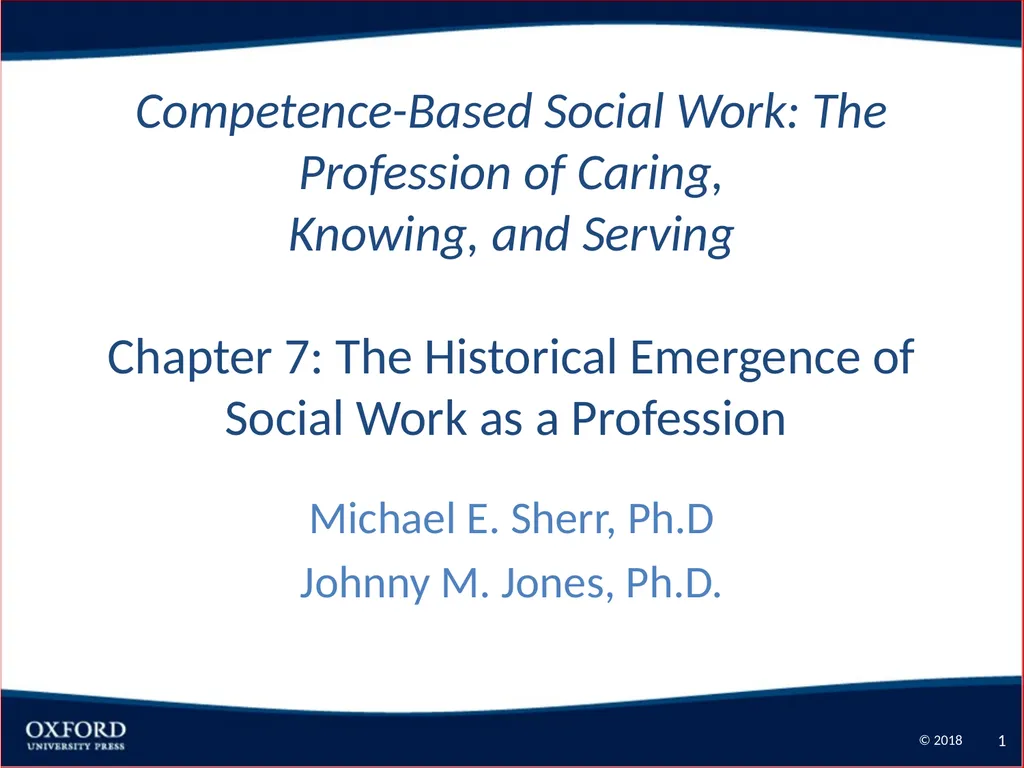
Competence-Based Social Work: The Profession of Caring,
Knowing, and Serving
Chapter 7: The Historical Emergence of Social Work as a Profession Michael E. Sherr, Ph.D
Johnny M. Jones, Ph.D.<br>
Johnny M. Jones, Ph.D.<br>
02
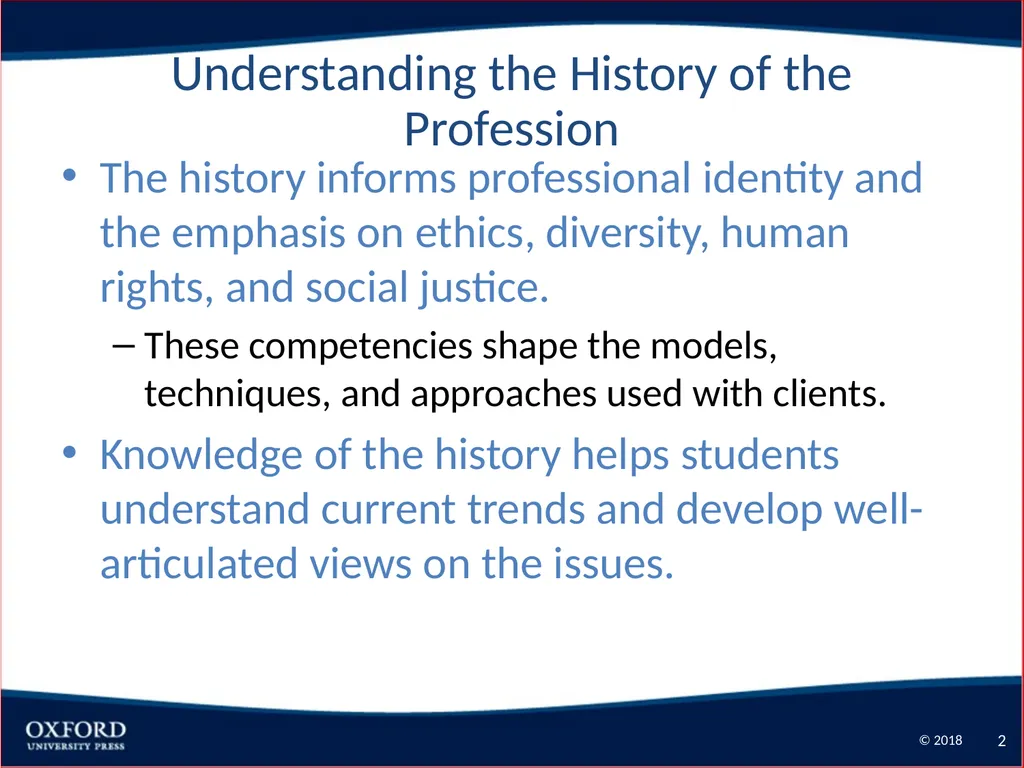
Understanding the History of the Profession The history informs professional identity and the emphasis on ethics, diversity, human rights, and social justice.
These competencies shape the models, techniques, and approaches used with clients.
Knowledge of the history helps students understand current trends and develop well-articulated views on the issues.<br>
These competencies shape the models, techniques, and approaches used with clients.
Knowledge of the history helps students understand current trends and develop well-articulated views on the issues.<br>
03
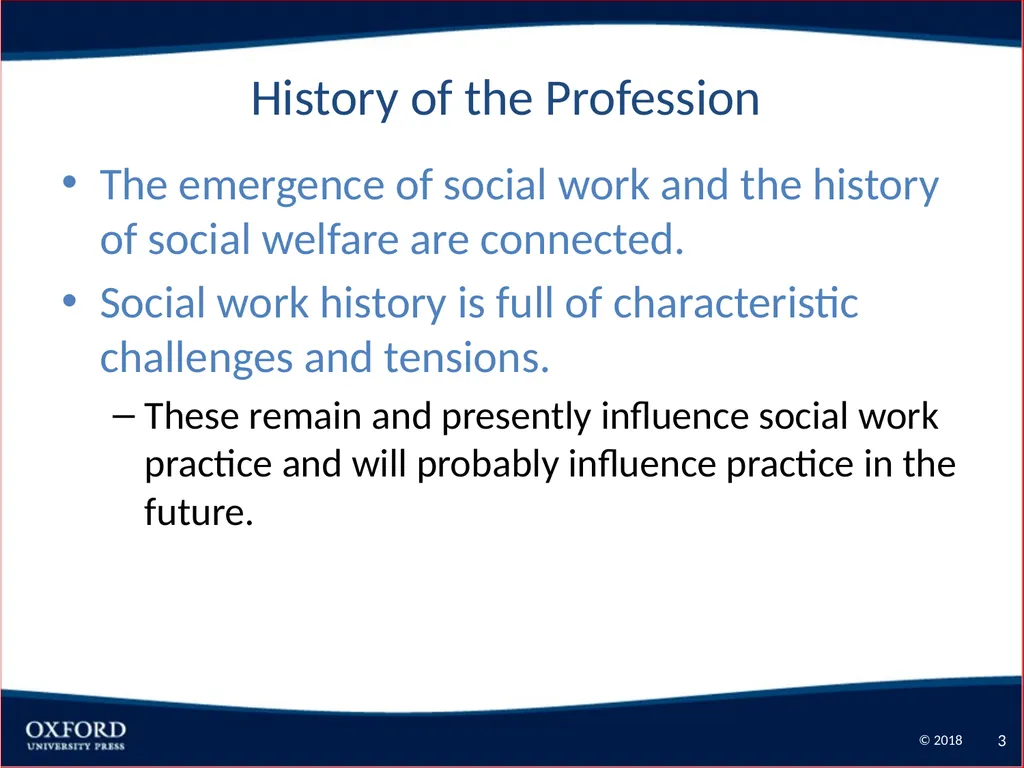
History of the Profession The emergence of social work and the history of social welfare are connected.
Social work history is full of characteristic challenges and tensions.
These remain and presently influence social work practice and will probably influence practice in the future.<br>
Social work history is full of characteristic challenges and tensions.
These remain and presently influence social work practice and will probably influence practice in the future.<br>
04
History of the Profession Cont. Students must understand these challenges as they join the profession.
They include:
Critiques of the profession
Balancing the purpose of social work and the pursuit of professional status
Appreciating the broad scope of the profession (social workers don’t do just one thing)
Our internal views about types of practice (direct and indirect) and the role of public, private and volunteer sector in providing social welfare<br>
They include:
Critiques of the profession
Balancing the purpose of social work and the pursuit of professional status
Appreciating the broad scope of the profession (social workers don’t do just one thing)
Our internal views about types of practice (direct and indirect) and the role of public, private and volunteer sector in providing social welfare<br>
05
Elizabeth Poor Law of 1601 Most social workers identify this historical event as the foundation of the profession.
Difficult to say that ONE event defined social welfare and indirectly social work.
In England before 1601, events occurred which informed the enactment of the poor laws.<br>
Difficult to say that ONE event defined social welfare and indirectly social work.
In England before 1601, events occurred which informed the enactment of the poor laws.<br>
06
Elizabeth Poor Law Cont. Edward III issued the Statute of Laborers in 1349.
First of many poor laws that began the process of shifting the responsibility of the poor away from the church to the government (Kurzman, 1970).
In 1530, Henry VIII enacted a statute in which the poor were divided into two groups:
Vagrants that were to be punished
Impotent poor that were to be granted license to beg for assistance
Henry VIII enacted a second statute that allowed volunteers to raise funds to care for the poor.<br>
First of many poor laws that began the process of shifting the responsibility of the poor away from the church to the government (Kurzman, 1970).
In 1530, Henry VIII enacted a statute in which the poor were divided into two groups:
Vagrants that were to be punished
Impotent poor that were to be granted license to beg for assistance
Henry VIII enacted a second statute that allowed volunteers to raise funds to care for the poor.<br>
07
Elizabeth Poor Law Cont. The enactment of the law occurs after years of severe economic depression in the early 1590’s in England.
The government recognized there were people willing and able to work, but simply could not find employment.
They molded a series of reforms and previous statutes into the first comprehensive uniform system of poor laws for the country.<br>
The government recognized there were people willing and able to work, but simply could not find employment.
They molded a series of reforms and previous statutes into the first comprehensive uniform system of poor laws for the country.<br>
08
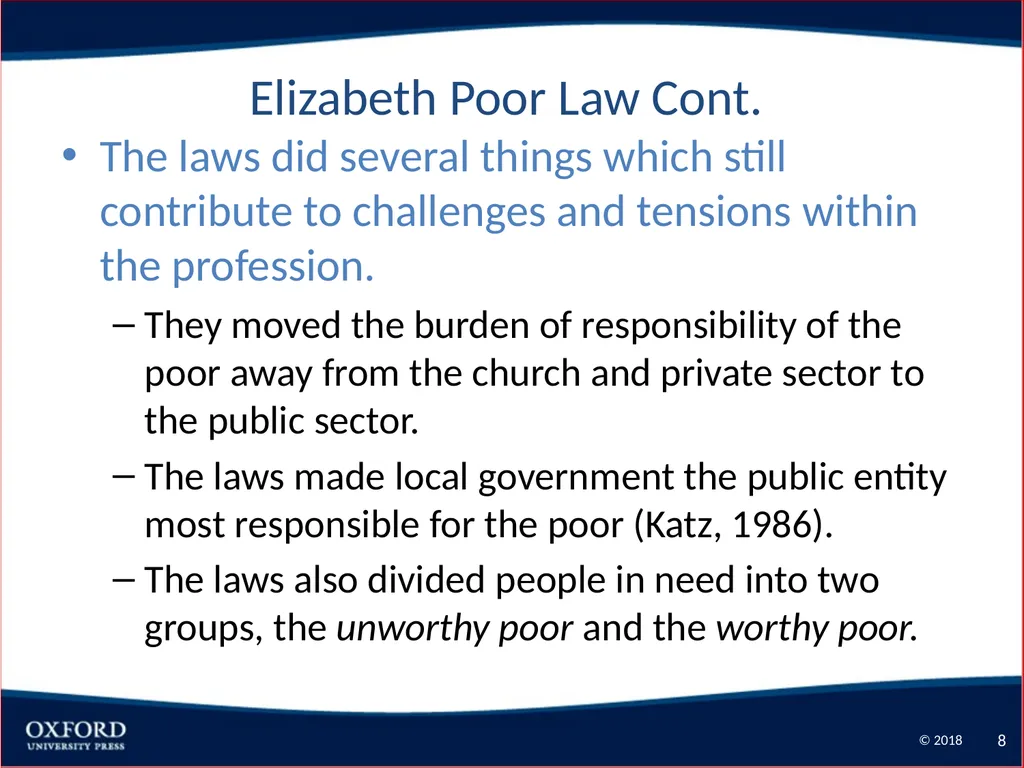
Elizabeth Poor Law Cont. The laws did several things which still contribute to challenges and tensions within the profession.
They moved the burden of responsibility of the poor away from the church and private sector to the public sector.
The laws made local government the public entity most responsible for the poor (Katz, 1986).
The laws also divided people in need into two groups, the unworthy poor and the worthy poor.<br>
They moved the burden of responsibility of the poor away from the church and private sector to the public sector.
The laws made local government the public entity most responsible for the poor (Katz, 1986).
The laws also divided people in need into two groups, the unworthy poor and the worthy poor.<br>
09
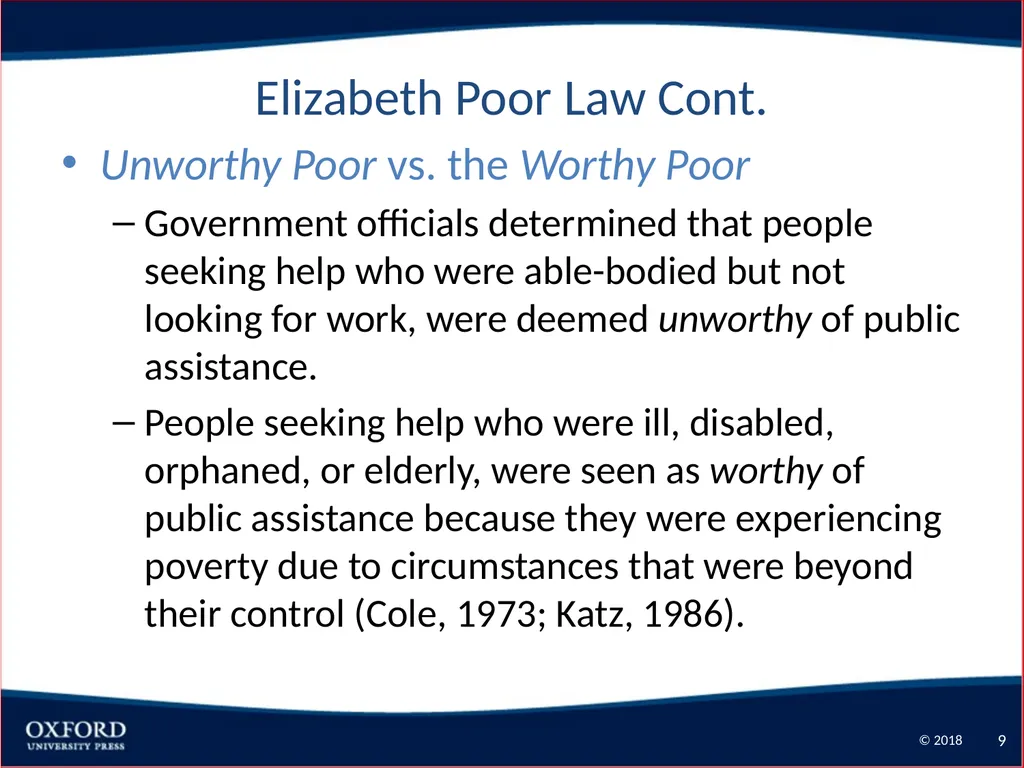
Elizabeth Poor Law Cont. Unworthy Poor vs. the Worthy Poor
Government officials determined that people seeking help who were able-bodied but not looking for work, were deemed unworthy of public assistance.
People seeking help who were ill, disabled, orphaned, or elderly, were seen as worthy of public assistance because they were experiencing poverty due to circumstances that were beyond their control (Cole, 1973; Katz, 1986).<br>
Government officials determined that people seeking help who were able-bodied but not looking for work, were deemed unworthy of public assistance.
People seeking help who were ill, disabled, orphaned, or elderly, were seen as worthy of public assistance because they were experiencing poverty due to circumstances that were beyond their control (Cole, 1973; Katz, 1986).<br>
10
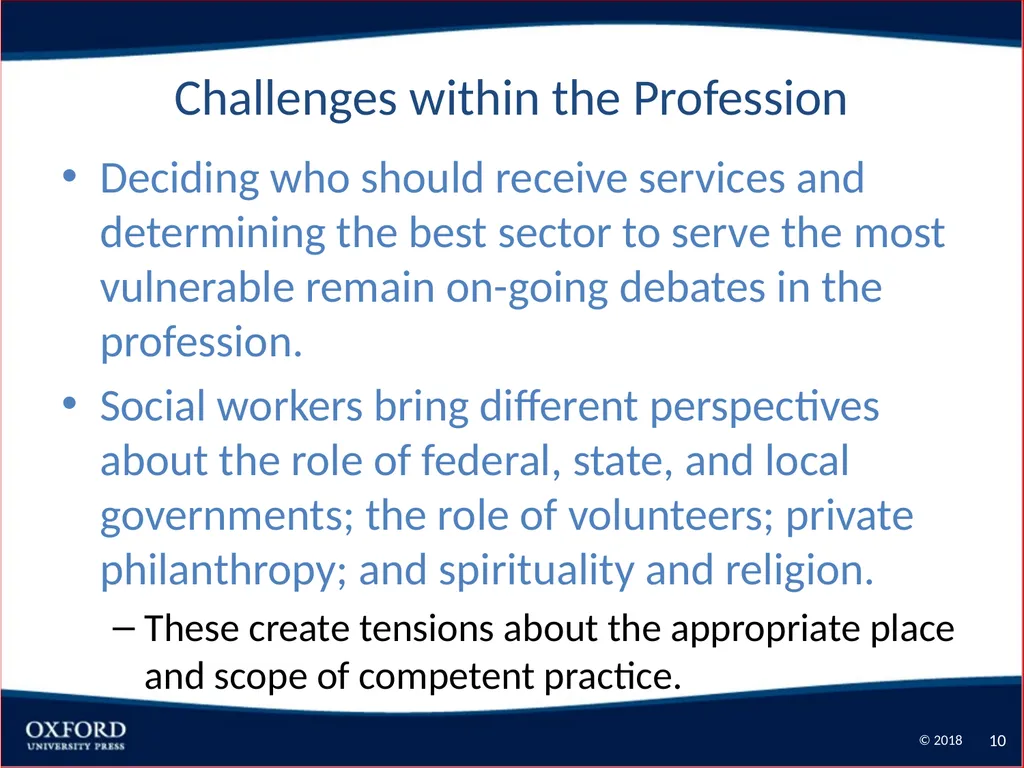
Challenges within the Profession Deciding who should receive services and determining the best sector to serve the most vulnerable remain on-going debates in the profession.
Social workers bring different perspectives about the role of federal, state, and local governments; the role of volunteers; private philanthropy; and spirituality and religion.
These create tensions about the appropriate place and scope of competent practice.<br>
Social workers bring different perspectives about the role of federal, state, and local governments; the role of volunteers; private philanthropy; and spirituality and religion.
These create tensions about the appropriate place and scope of competent practice.<br>
11
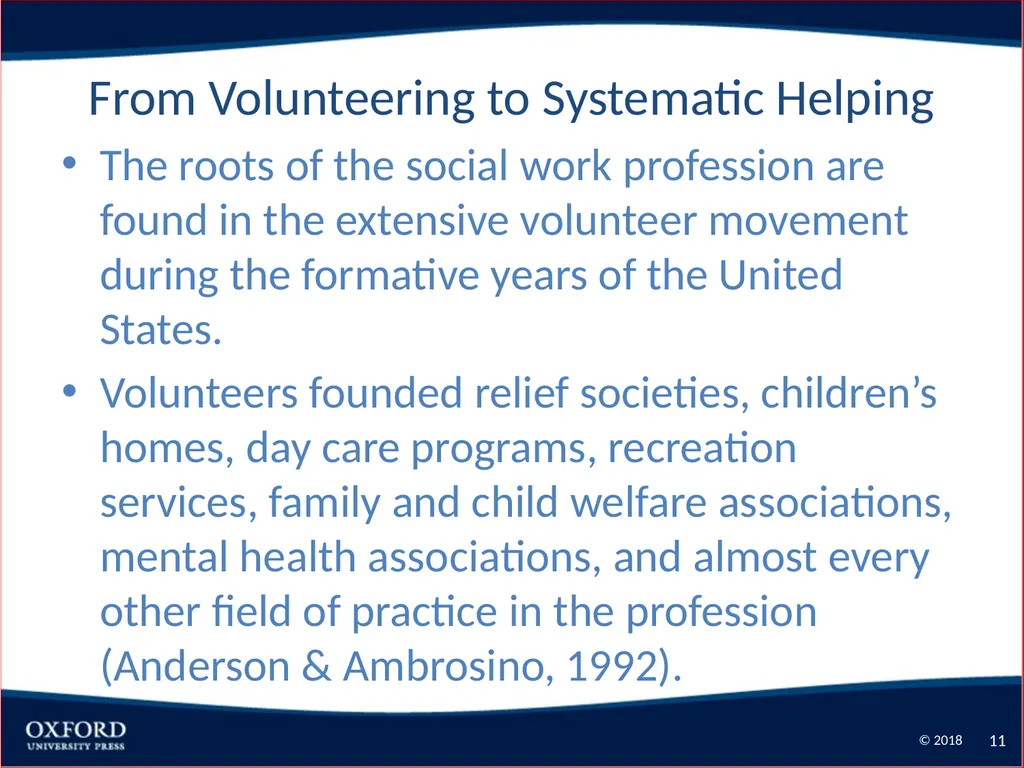
From Volunteering to Systematic Helping The roots of the social work profession are found in the extensive volunteer movement during the formative years of the United States.
Volunteers founded relief societies, children’s homes, day care programs, recreation services, family and child welfare associations, mental health associations, and almost every other field of practice in the profession (Anderson & Ambrosino, 1992).<br>
Volunteers founded relief societies, children’s homes, day care programs, recreation services, family and child welfare associations, mental health associations, and almost every other field of practice in the profession (Anderson & Ambrosino, 1992).<br>
12
From Volunteering to Systematic Helping Cont. Having the freedom to organize, associate, and serve people as volunteers is vital to a functioning democracy.
When Alex de Tocqueville visited the United States in 1835, he observed that the key to democracy was the freedom and disposition of Americans to come together as volunteers for the common good.
Gathering in volunteer societies was the initial way of caring for the poor beyond the church and the family.<br>
When Alex de Tocqueville visited the United States in 1835, he observed that the key to democracy was the freedom and disposition of Americans to come together as volunteers for the common good.
Gathering in volunteer societies was the initial way of caring for the poor beyond the church and the family.<br>
13
From Volunteering to Systematic Helping Cont. Social reform advances of the Progressive Era depended on volunteer societies (Hofstadter, 1963).
Volunteer societies lobbied for:
1) Government to take more responsibility for social welfare.
2) Communities to temper the zealousness for economic prosperity with the protection of human rights.
3) Efforts to care for the poor/disenfranchised to become more systematic.<br>
Volunteer societies lobbied for:
1) Government to take more responsibility for social welfare.
2) Communities to temper the zealousness for economic prosperity with the protection of human rights.
3) Efforts to care for the poor/disenfranchised to become more systematic.<br>
14
Volunteer Efforts The Charitable Organizational Society (COS) Movement
The settlement house movement
Volunteer efforts that applied systematic methods to serve the poor.<br>
The settlement house movement
Volunteer efforts that applied systematic methods to serve the poor.<br>
15
The Charitable Organization Society Movement (COS) Consisted of volunteers who assisted families in meeting their physical, economic, emotional, and spiritual needs.
In 1877, the Reverend S. Humphrey Gurteen established the first COS in Buffalo, New York, to provide an alternative method to indiscriminate giving for helping the poor (Pumphrey & Pumphrey, 1961)<br>
In 1877, the Reverend S. Humphrey Gurteen established the first COS in Buffalo, New York, to provide an alternative method to indiscriminate giving for helping the poor (Pumphrey & Pumphrey, 1961)<br>
16
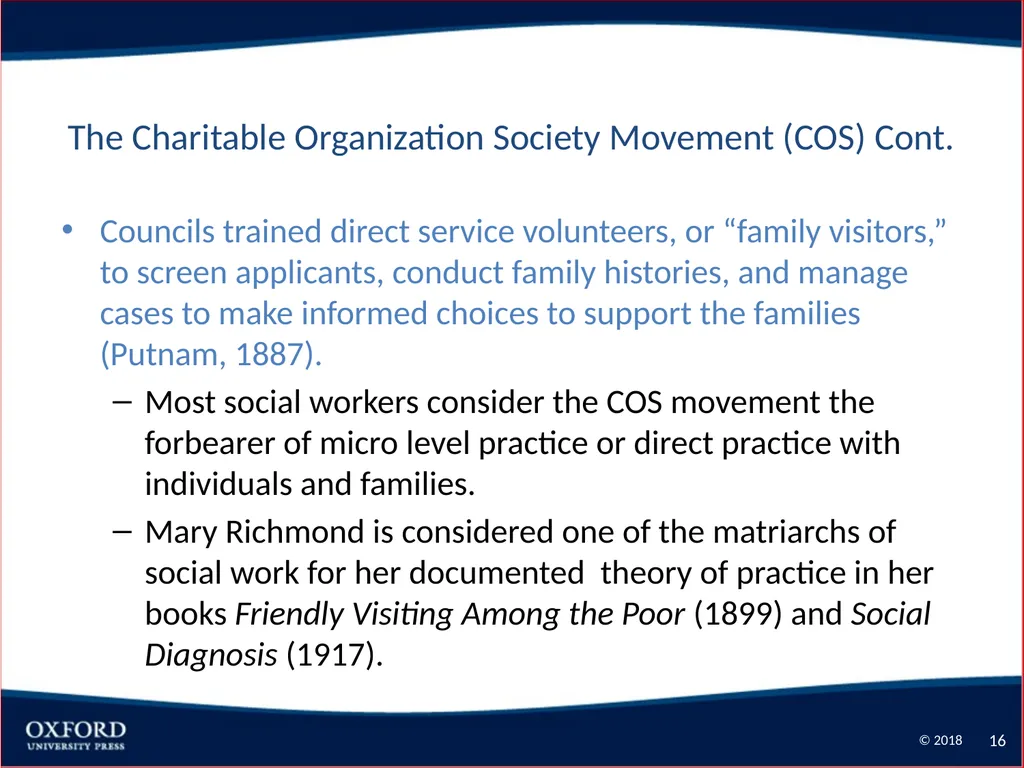
The Charitable Organization Society Movement (COS) Cont. Councils trained direct service volunteers, or “family visitors,” to screen applicants, conduct family histories, and manage cases to make informed choices to support the families (Putnam, 1887).
Most social workers consider the COS movement the forbearer of micro level practice or direct practice with individuals and families.
Mary Richmond is considered one of the matriarchs of social work for her documented theory of practice in her books Friendly Visiting Among the Poor (1899) and Social Diagnosis (1917).<br>
Most social workers consider the COS movement the forbearer of micro level practice or direct practice with individuals and families.
Mary Richmond is considered one of the matriarchs of social work for her documented theory of practice in her books Friendly Visiting Among the Poor (1899) and Social Diagnosis (1917).<br>
17
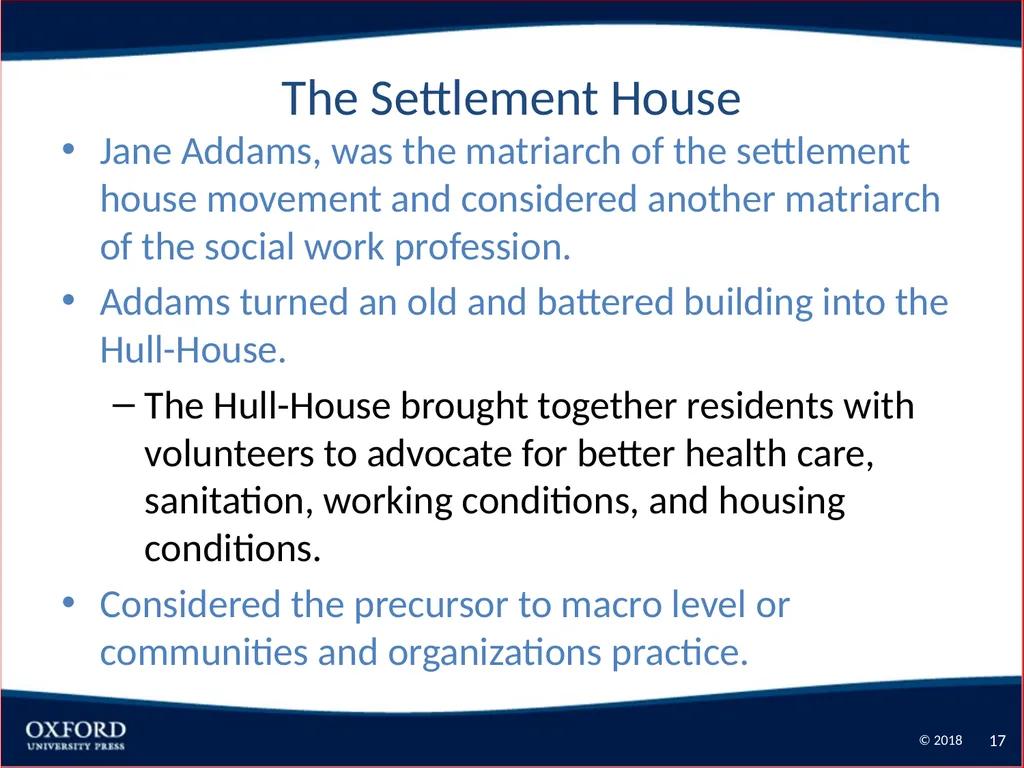
The Settlement House Jane Addams, was the matriarch of the settlement house movement and considered another matriarch of the social work profession.
Addams turned an old and battered building into the Hull-House.
The Hull-House brought together residents with volunteers to advocate for better health care, sanitation, working conditions, and housing conditions.
Considered the precursor to macro level or communities and organizations practice.<br>
Addams turned an old and battered building into the Hull-House.
The Hull-House brought together residents with volunteers to advocate for better health care, sanitation, working conditions, and housing conditions.
Considered the precursor to macro level or communities and organizations practice.<br>
18
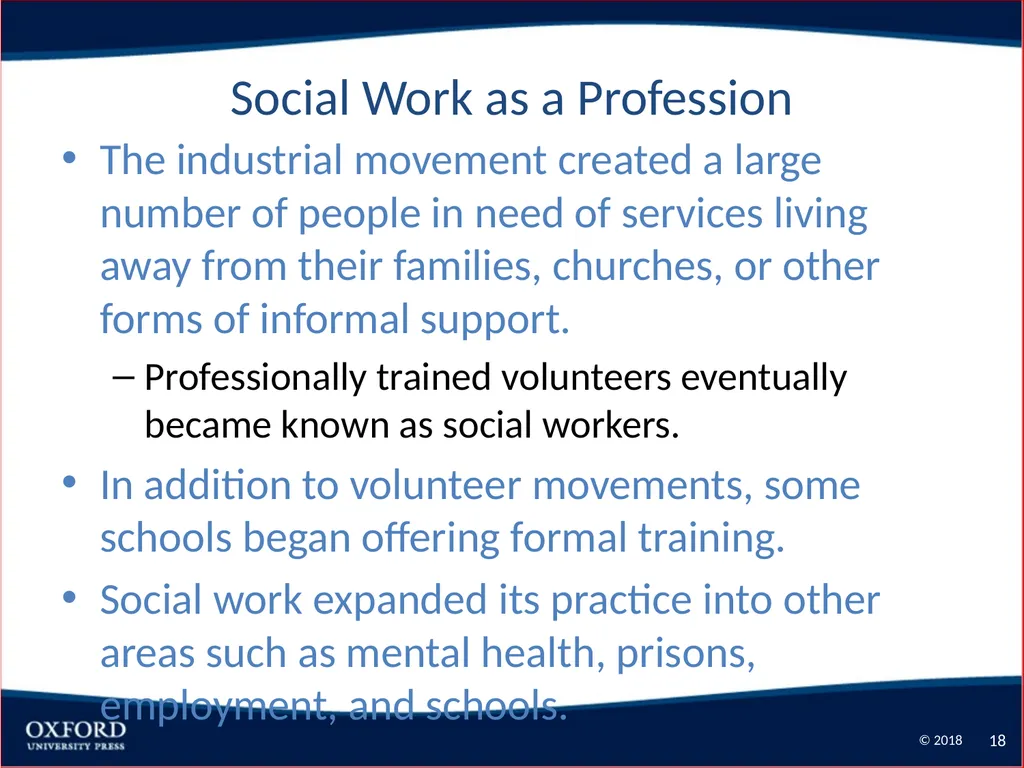
Social Work as a Profession The industrial movement created a large number of people in need of services living away from their families, churches, or other forms of informal support.
Professionally trained volunteers eventually became known as social workers.
In addition to volunteer movements, some schools began offering formal training.
Social work expanded its practice into other areas such as mental health, prisons, employment, and schools.<br>
Professionally trained volunteers eventually became known as social workers.
In addition to volunteer movements, some schools began offering formal training.
Social work expanded its practice into other areas such as mental health, prisons, employment, and schools.<br>
19
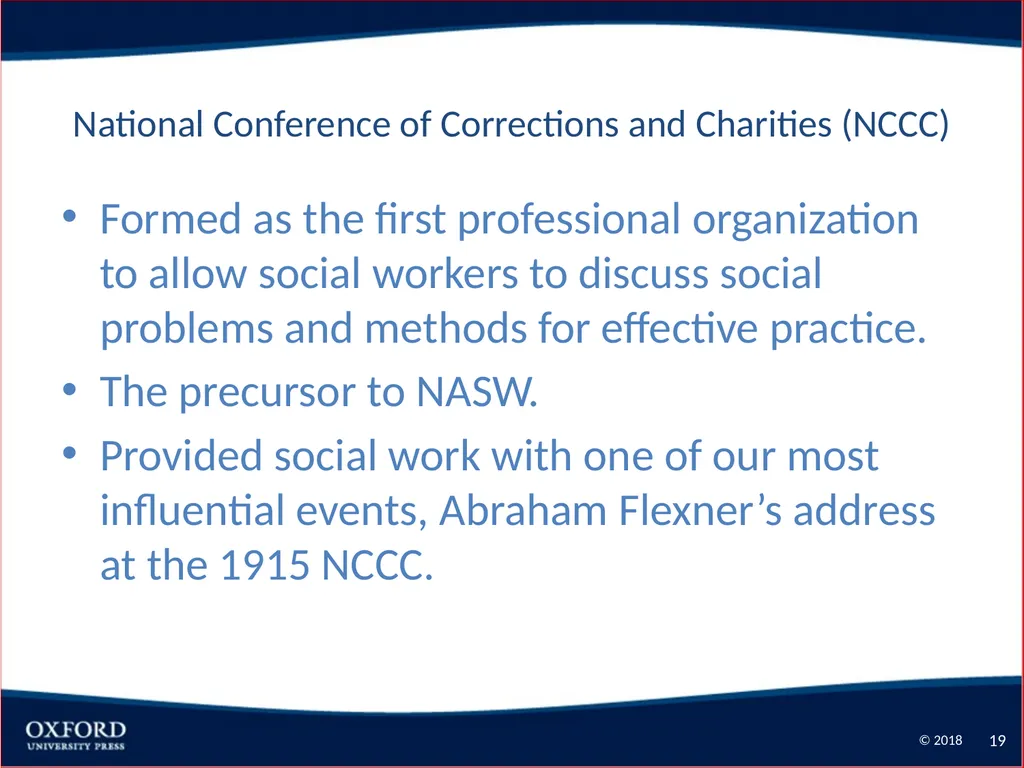
National Conference of Corrections and Charities (NCCC) Formed as the first professional organization to allow social workers to discuss social problems and methods for effective practice.
The precursor to NASW.
Provided social work with one of our most influential events, Abraham Flexner’s address at the 1915 NCCC.<br>
The precursor to NASW.
Provided social work with one of our most influential events, Abraham Flexner’s address at the 1915 NCCC.<br>
20
Abraham Flexner at the 1915 NCCC Invited to present his analysis of whether social work was a profession.
Organizers of the conference were not prepared for the possibility that he would draw the opposite conclusion.
Flexner (1915) distinguished between the relative use of the term “professional” and the absolute use of the term “profession.”<br>
Organizers of the conference were not prepared for the possibility that he would draw the opposite conclusion.
Flexner (1915) distinguished between the relative use of the term “professional” and the absolute use of the term “profession.”<br>
21
Abraham Flexner at the 1915 NCCC Cont. Professional vs. Profession
According to Flexner, the term “professional” loosely describes someone who devotes his or her time to a specific activity.
He considered the term “profession” to describe a limited group of activities that meet a certain predetermined set of objective criteria.
He listed six criteria that separate a profession from all other occupations.<br>
According to Flexner, the term “professional” loosely describes someone who devotes his or her time to a specific activity.
He considered the term “profession” to describe a limited group of activities that meet a certain predetermined set of objective criteria.
He listed six criteria that separate a profession from all other occupations.<br>
22
Abraham Flexner at the 1915 NCCC Cont. The six criteria:
Professions involve activities that are essentially intellectual—the thinking process is the main instrument applied to address problems.
Professions derive their own raw material from science and learning—the thinking process uses information specifically learned for the given field instead of drawing upon knowledge and experience.
Professions apply learning in a way that is practical—the thinking process and the development of raw knowledge have a clear-cut end that is recognized and sanctioned by society.<br>
Professions involve activities that are essentially intellectual—the thinking process is the main instrument applied to address problems.
Professions derive their own raw material from science and learning—the thinking process uses information specifically learned for the given field instead of drawing upon knowledge and experience.
Professions apply learning in a way that is practical—the thinking process and the development of raw knowledge have a clear-cut end that is recognized and sanctioned by society.<br>
23
Abraham Flexner at the 1915 NCCC Cont. The six criteria cont.-
Professions use a transmittable technique that requires education—there are specific objects a practitioner must master before gaining entry into the profession.
Professions are self-organized—the activities of a profession are so definitive, so absorbing in interest, so richly engaging in duties and responsibilities that individuals and their families tend to organize around a strong nucleus
Professions become increasingly altruistic in motivation—as time goes on, devotion to the common well-being of society will become more and more an accepted mark of the professional activities.<br>
Professions use a transmittable technique that requires education—there are specific objects a practitioner must master before gaining entry into the profession.
Professions are self-organized—the activities of a profession are so definitive, so absorbing in interest, so richly engaging in duties and responsibilities that individuals and their families tend to organize around a strong nucleus
Professions become increasingly altruistic in motivation—as time goes on, devotion to the common well-being of society will become more and more an accepted mark of the professional activities.<br>
24
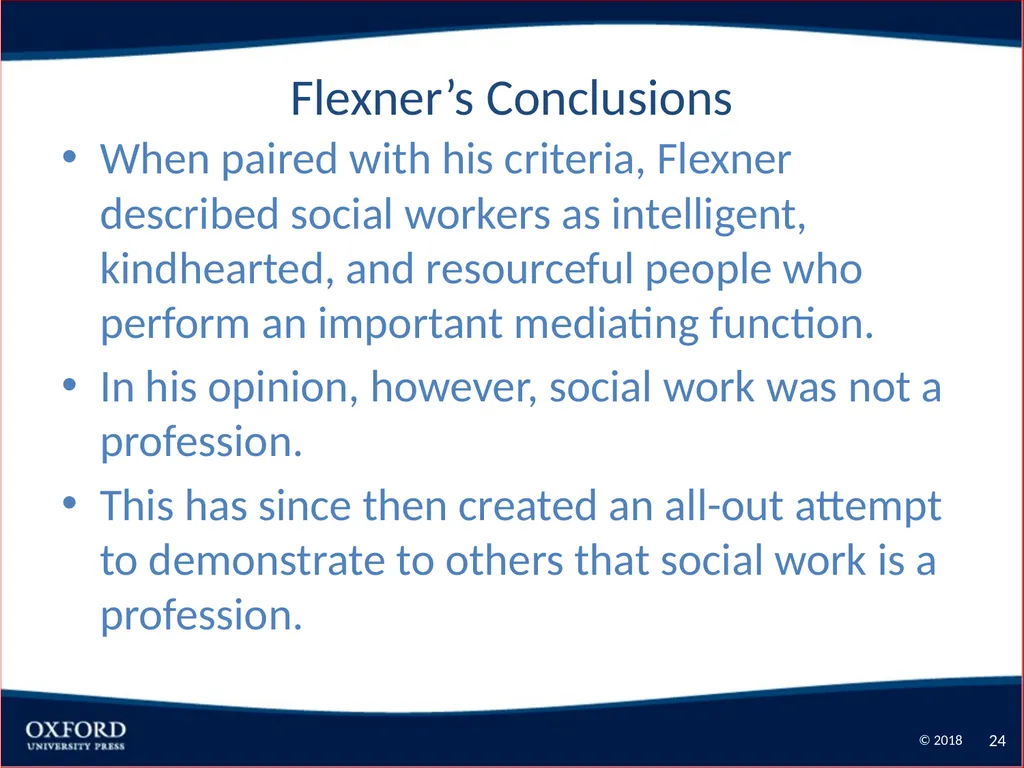
Flexner’s Conclusions When paired with his criteria, Flexner described social workers as intelligent, kindhearted, and resourceful people who perform an important mediating function.
In his opinion, however, social work was not a profession.
This has since then created an all-out attempt to demonstrate to others that social work is a profession.<br>
In his opinion, however, social work was not a profession.
This has since then created an all-out attempt to demonstrate to others that social work is a profession.<br>
25
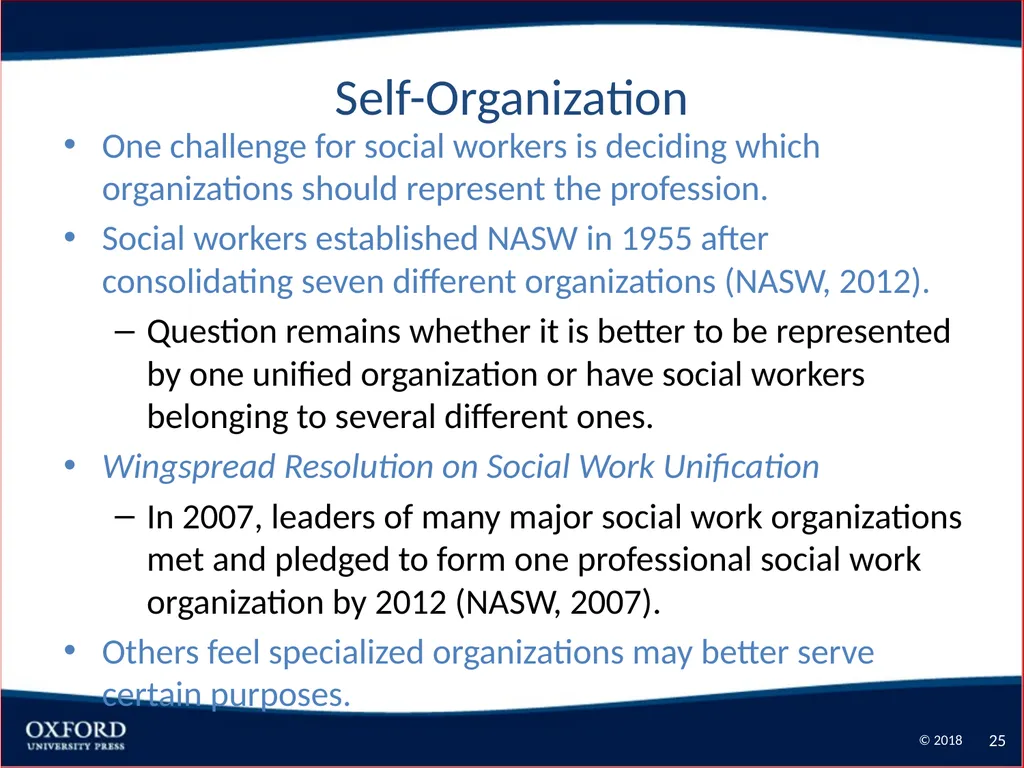
Self-Organization One challenge for social workers is deciding which organizations should represent the profession.
Social workers established NASW in 1955 after consolidating seven different organizations (NASW, 2012).
Question remains whether it is better to be represented by one unified organization or have social workers belonging to several different ones.
Wingspread Resolution on Social Work Unification
In 2007, leaders of many major social work organizations met and pledged to form one professional social work organization by 2012 (NASW, 2007).
Others feel specialized organizations may better serve certain purposes.<br>
Social workers established NASW in 1955 after consolidating seven different organizations (NASW, 2012).
Question remains whether it is better to be represented by one unified organization or have social workers belonging to several different ones.
Wingspread Resolution on Social Work Unification
In 2007, leaders of many major social work organizations met and pledged to form one professional social work organization by 2012 (NASW, 2007).
Others feel specialized organizations may better serve certain purposes.<br>
26
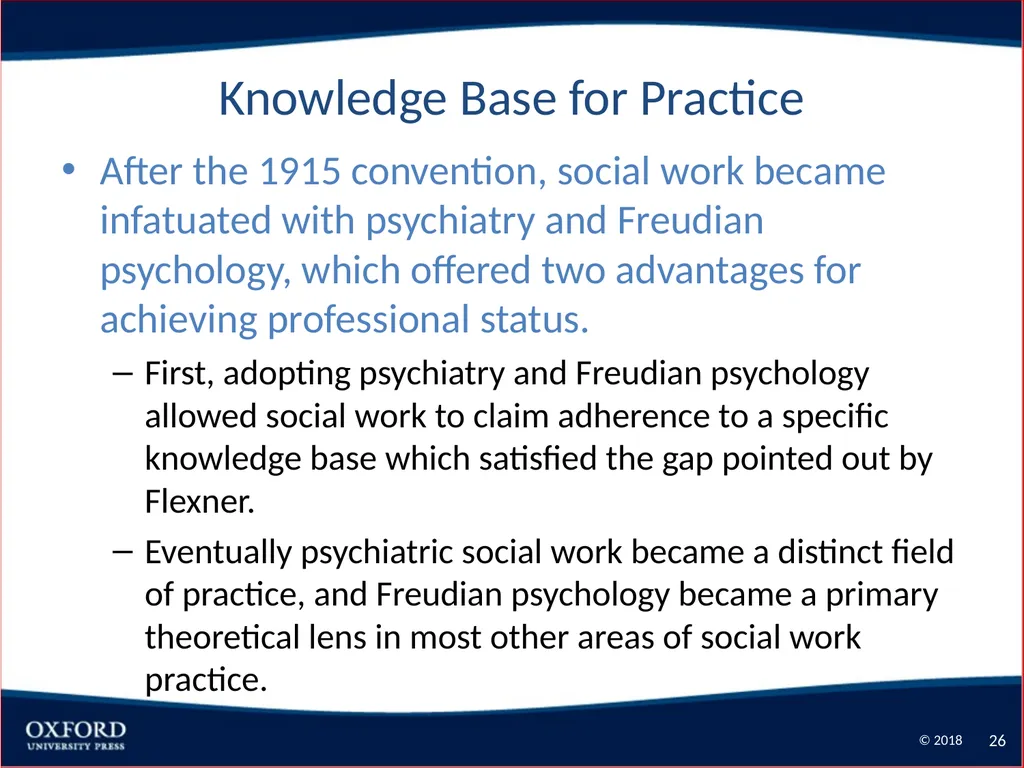
Knowledge Base for Practice After the 1915 convention, social work became infatuated with psychiatry and Freudian psychology, which offered two advantages for achieving professional status.
First, adopting psychiatry and Freudian psychology allowed social work to claim adherence to a specific knowledge base which satisfied the gap pointed out by Flexner.
Eventually psychiatric social work became a distinct field of practice, and Freudian psychology became a primary theoretical lens in most other areas of social work practice.<br>
First, adopting psychiatry and Freudian psychology allowed social work to claim adherence to a specific knowledge base which satisfied the gap pointed out by Flexner.
Eventually psychiatric social work became a distinct field of practice, and Freudian psychology became a primary theoretical lens in most other areas of social work practice.<br>
27
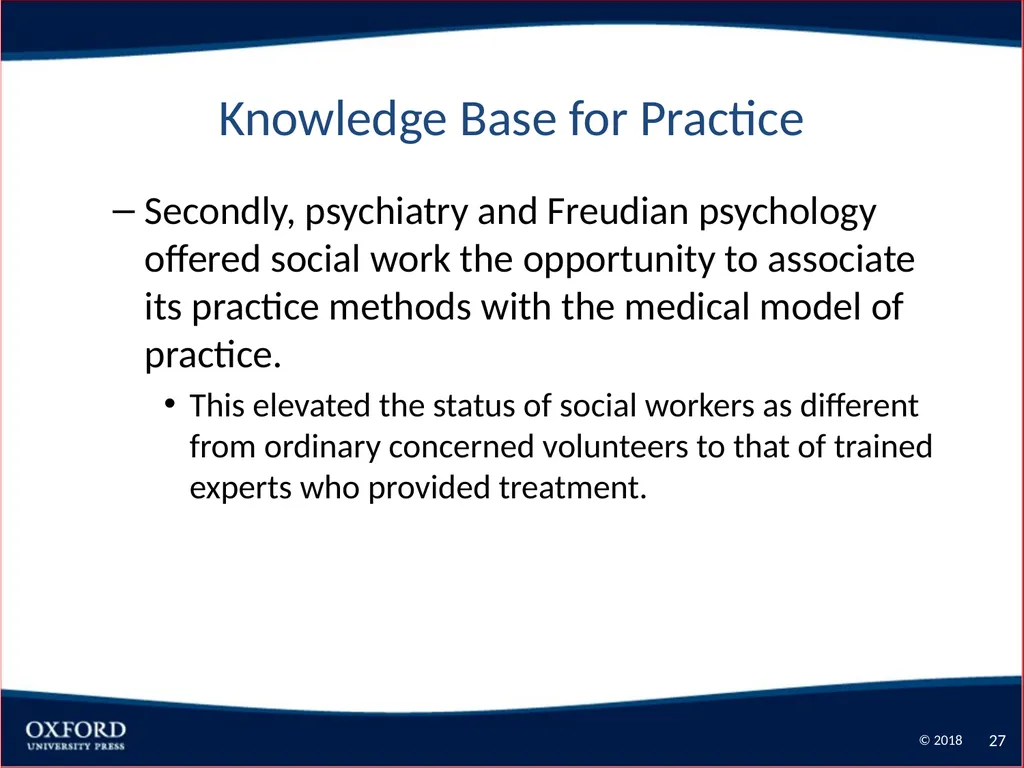
Knowledge Base for Practice Secondly, psychiatry and Freudian psychology offered social work the opportunity to associate its practice methods with the medical model of practice.
This elevated the status of social workers as different from ordinary concerned volunteers to that of trained experts who provided treatment.<br>
This elevated the status of social workers as different from ordinary concerned volunteers to that of trained experts who provided treatment.<br>
28
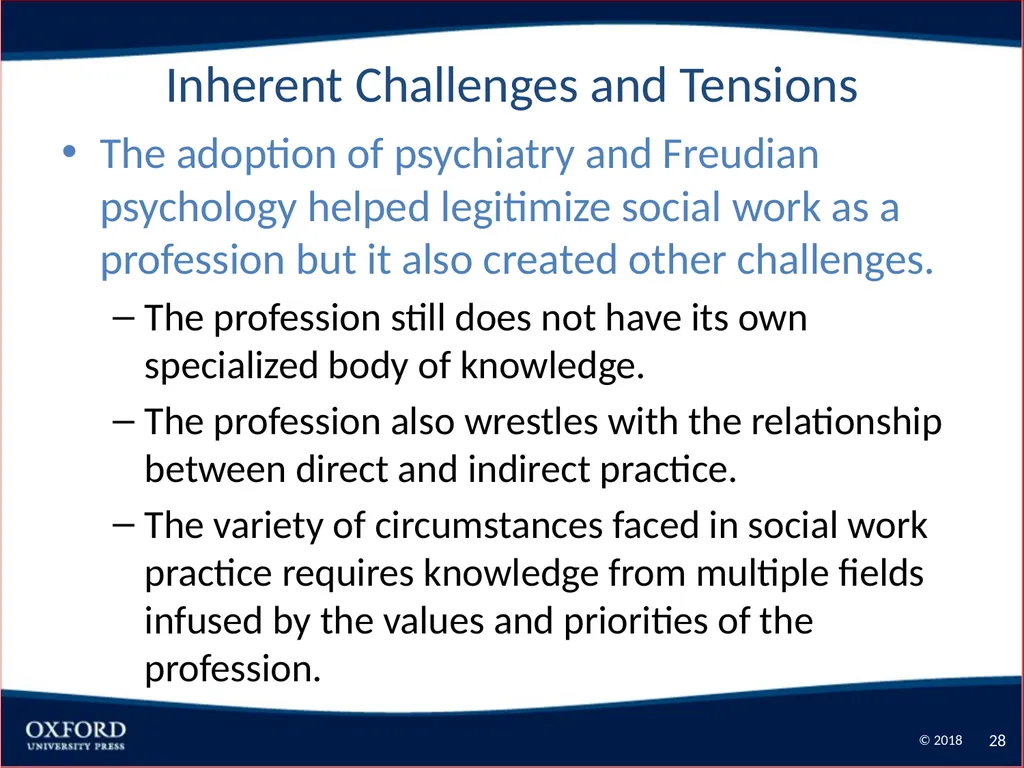
Inherent Challenges and Tensions The adoption of psychiatry and Freudian psychology helped legitimize social work as a profession but it also created other challenges.
The profession still does not have its own specialized body of knowledge.
The profession also wrestles with the relationship between direct and indirect practice.
The variety of circumstances faced in social work practice requires knowledge from multiple fields infused by the values and priorities of the profession.<br>
The profession still does not have its own specialized body of knowledge.
The profession also wrestles with the relationship between direct and indirect practice.
The variety of circumstances faced in social work practice requires knowledge from multiple fields infused by the values and priorities of the profession.<br>
29
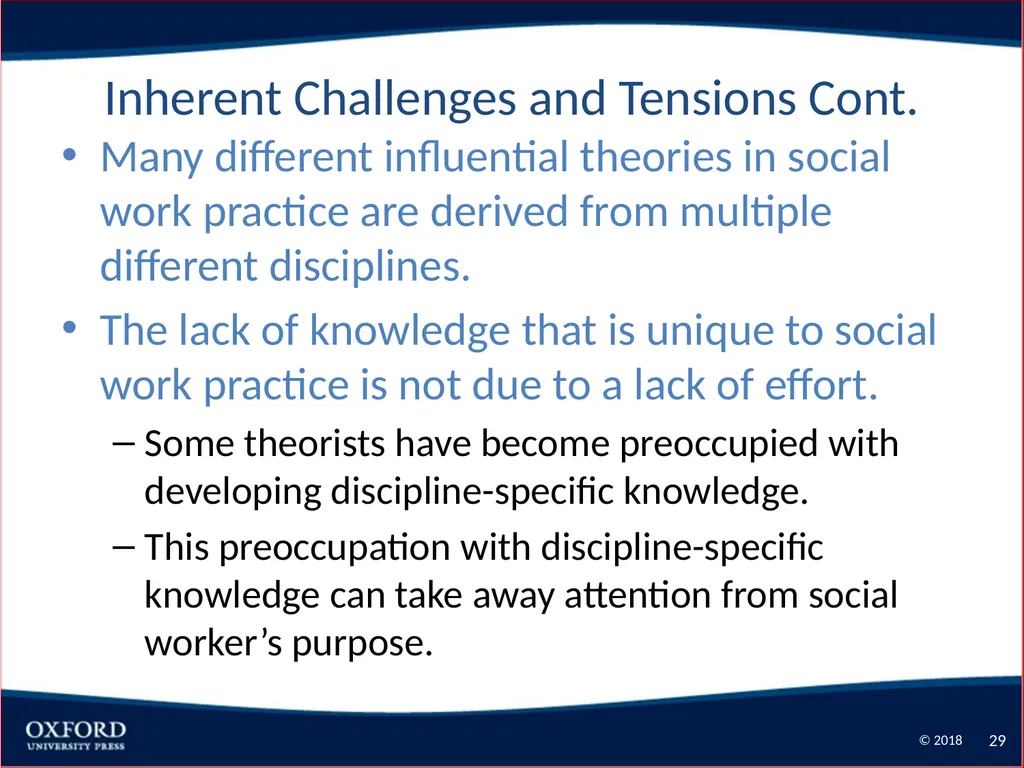
Inherent Challenges and Tensions Cont. Many different influential theories in social work practice are derived from multiple different disciplines.
The lack of knowledge that is unique to social work practice is not due to a lack of effort.
Some theorists have become preoccupied with developing discipline-specific knowledge.
This preoccupation with discipline-specific knowledge can take away attention from social worker’s purpose.<br>
The lack of knowledge that is unique to social work practice is not due to a lack of effort.
Some theorists have become preoccupied with developing discipline-specific knowledge.
This preoccupation with discipline-specific knowledge can take away attention from social worker’s purpose.<br>
30
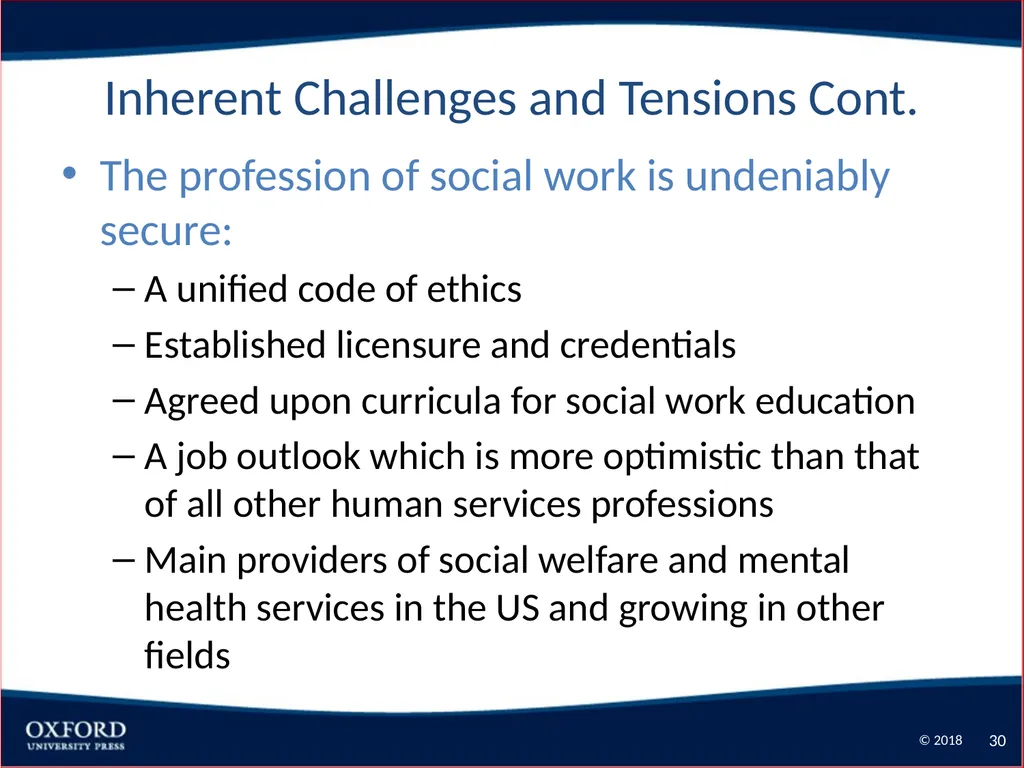
Inherent Challenges and Tensions Cont. The profession of social work is undeniably secure:
A unified code of ethics
Established licensure and credentials
Agreed upon curricula for social work education
A job outlook which is more optimistic than that of all other human services professions
Main providers of social welfare and mental health services in the US and growing in other fields<br>
A unified code of ethics
Established licensure and credentials
Agreed upon curricula for social work education
A job outlook which is more optimistic than that of all other human services professions
Main providers of social welfare and mental health services in the US and growing in other fields<br>
31
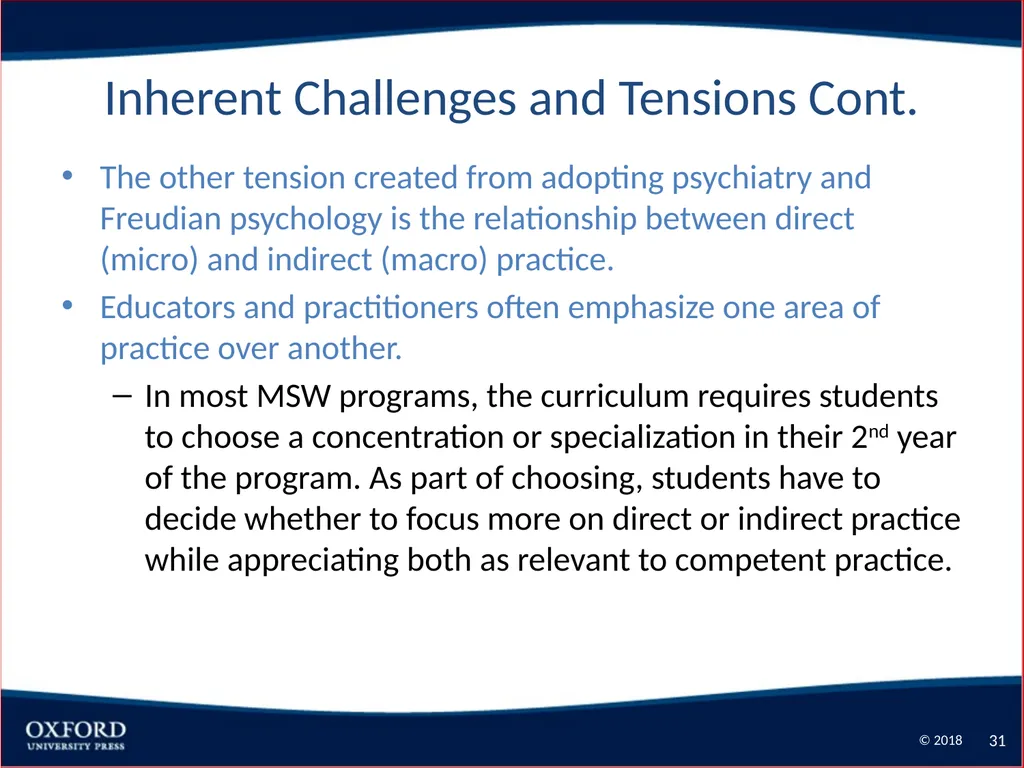
Inherent Challenges and Tensions Cont. The other tension created from adopting psychiatry and Freudian psychology is the relationship between direct (micro) and indirect (macro) practice.
Educators and practitioners often emphasize one area of practice over another.
In most MSW programs, the curriculum requires students to choose a concentration or specialization in their 2nd year of the program. As part of choosing, students have to decide whether to focus more on direct or indirect practice while appreciating both as relevant to competent practice.<br>
Educators and practitioners often emphasize one area of practice over another.
In most MSW programs, the curriculum requires students to choose a concentration or specialization in their 2nd year of the program. As part of choosing, students have to decide whether to focus more on direct or indirect practice while appreciating both as relevant to competent practice.<br>
32
Current Trends in the Profession Globalization—Decisions of one community about the environment, the economy, and the culture affect everyone (Midgley, 1997).
The ability to exchange information with social workers from different countries also makes it possible to learn from each other and improve practice outcomes.
Also brings about challenges.
Different countries have diverse views and approaches to understanding and addressing social issues.
They may also have different conceptions of the role of social workers.<br>
The ability to exchange information with social workers from different countries also makes it possible to learn from each other and improve practice outcomes.
Also brings about challenges.
Different countries have diverse views and approaches to understanding and addressing social issues.
They may also have different conceptions of the role of social workers.<br>
33
Evidence-Based Practice The need to demonstrate service effectiveness is greater than at any other time in our profession.
The public expects the expenditure of financial resources to produce tangible benefits.
Programs have to prove that funds will result in measured outcomes, gathered from empirical research.
The profession has maintained an uneasy relationship between empirical research and social work practice.<br>
The public expects the expenditure of financial resources to produce tangible benefits.
Programs have to prove that funds will result in measured outcomes, gathered from empirical research.
The profession has maintained an uneasy relationship between empirical research and social work practice.<br>
34
Evidence-Based Practice Cont. Evidence-Based Practice creates a step towards bridging the gap between researchers and practitioners.
Social workers combine practice expertise with the best scientific evidence available to make their practice decisions.<br>
Social workers combine practice expertise with the best scientific evidence available to make their practice decisions.<br>
35
Evidence-Based Practice Cont. Barker (2003) defines EBP in social work as:
A type of intervention in which the professional social worker uses research as a practice and problem-solving tool; collects data systematically to monitor the intervention; specifies problems, techniques, and outcomes in measurable terms; and systematically evaluates the effectiveness of the intervention used (p. 141).<br>
A type of intervention in which the professional social worker uses research as a practice and problem-solving tool; collects data systematically to monitor the intervention; specifies problems, techniques, and outcomes in measurable terms; and systematically evaluates the effectiveness of the intervention used (p. 141).<br>
36
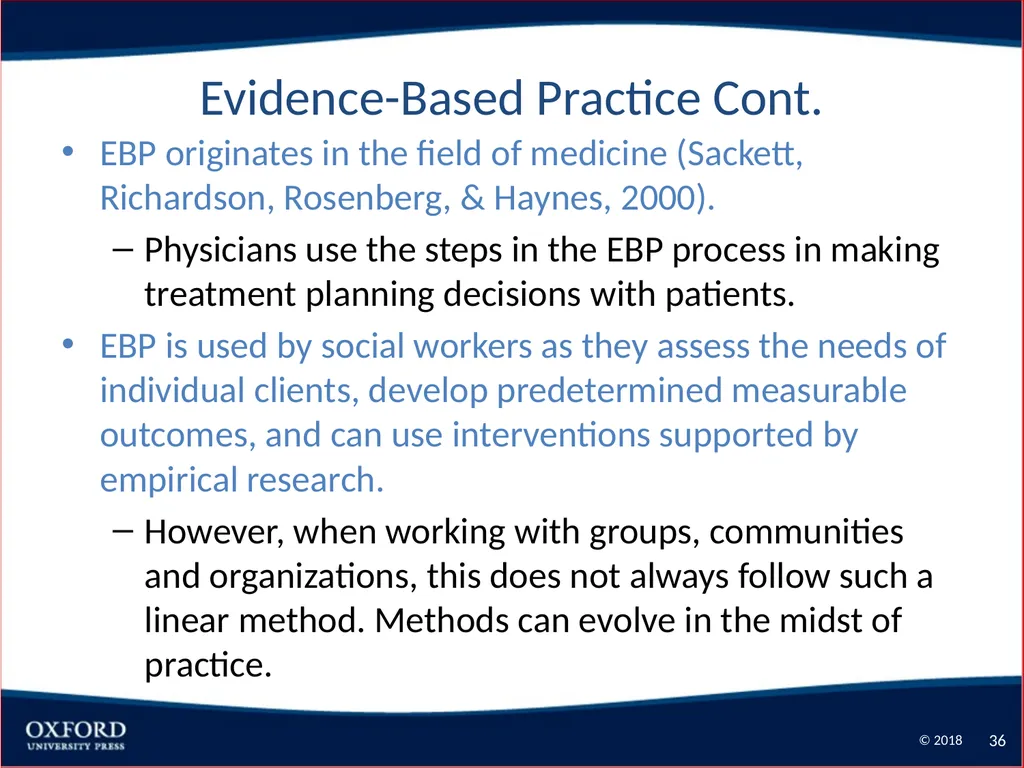
Evidence-Based Practice Cont. EBP originates in the field of medicine (Sackett, Richardson, Rosenberg, & Haynes, 2000).
Physicians use the steps in the EBP process in making treatment planning decisions with patients.
EBP is used by social workers as they assess the needs of individual clients, develop predetermined measurable outcomes, and can use interventions supported by empirical research.
However, when working with groups, communities and organizations, this does not always follow such a linear method. Methods can evolve in the midst of practice.<br>
Physicians use the steps in the EBP process in making treatment planning decisions with patients.
EBP is used by social workers as they assess the needs of individual clients, develop predetermined measurable outcomes, and can use interventions supported by empirical research.
However, when working with groups, communities and organizations, this does not always follow such a linear method. Methods can evolve in the midst of practice.<br>
37
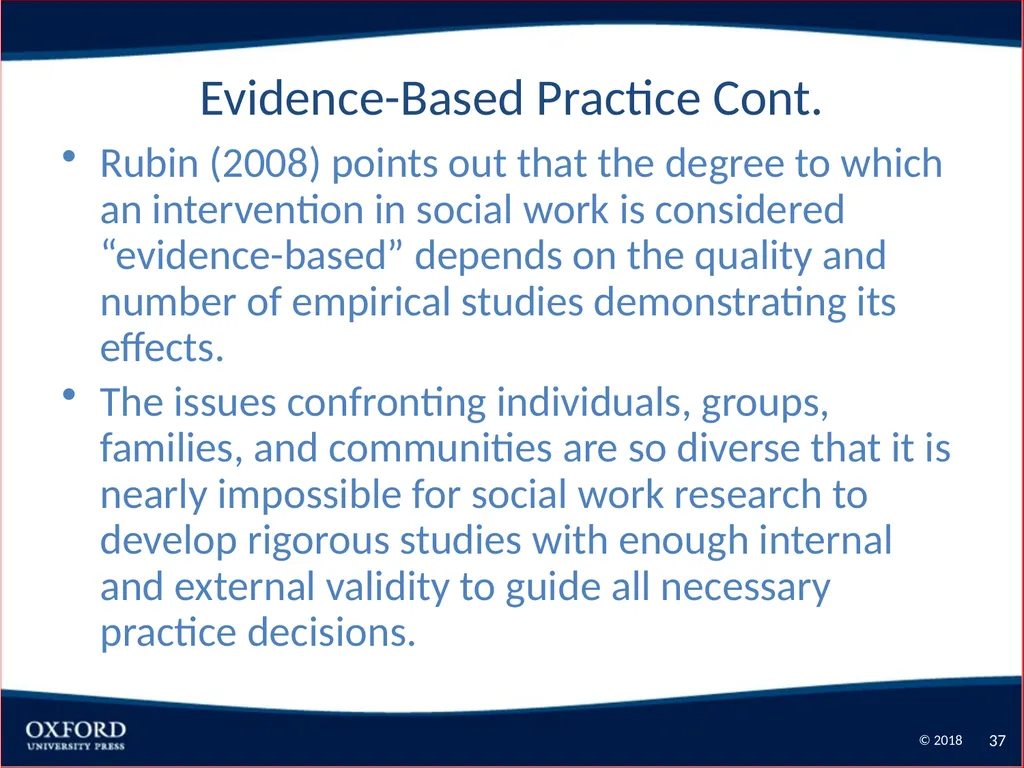
Evidence-Based Practice Cont. Rubin (2008) points out that the degree to which an intervention in social work is considered “evidence-based” depends on the quality and number of empirical studies demonstrating its effects.
The issues confronting individuals, groups, families, and communities are so diverse that it is nearly impossible for social work research to develop rigorous studies with enough internal and external validity to guide all necessary practice decisions.<br>
The issues confronting individuals, groups, families, and communities are so diverse that it is nearly impossible for social work research to develop rigorous studies with enough internal and external validity to guide all necessary practice decisions.<br>
38
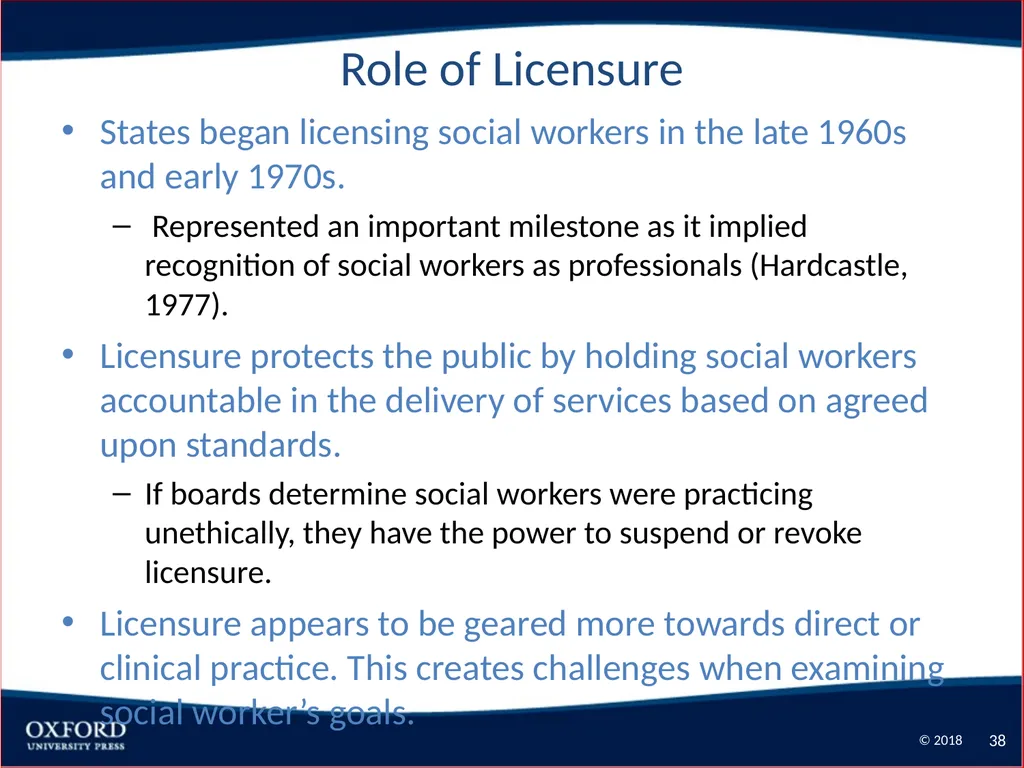
Role of Licensure States began licensing social workers in the late 1960s and early 1970s.
Represented an important milestone as it implied recognition of social workers as professionals (Hardcastle, 1977).
Licensure protects the public by holding social workers accountable in the delivery of services based on agreed upon standards.
If boards determine social workers were practicing unethically, they have the power to suspend or revoke licensure.
Licensure appears to be geared more towards direct or clinical practice. This creates challenges when examining social worker’s goals.<br>
Represented an important milestone as it implied recognition of social workers as professionals (Hardcastle, 1977).
Licensure protects the public by holding social workers accountable in the delivery of services based on agreed upon standards.
If boards determine social workers were practicing unethically, they have the power to suspend or revoke licensure.
Licensure appears to be geared more towards direct or clinical practice. This creates challenges when examining social worker’s goals.<br>
39
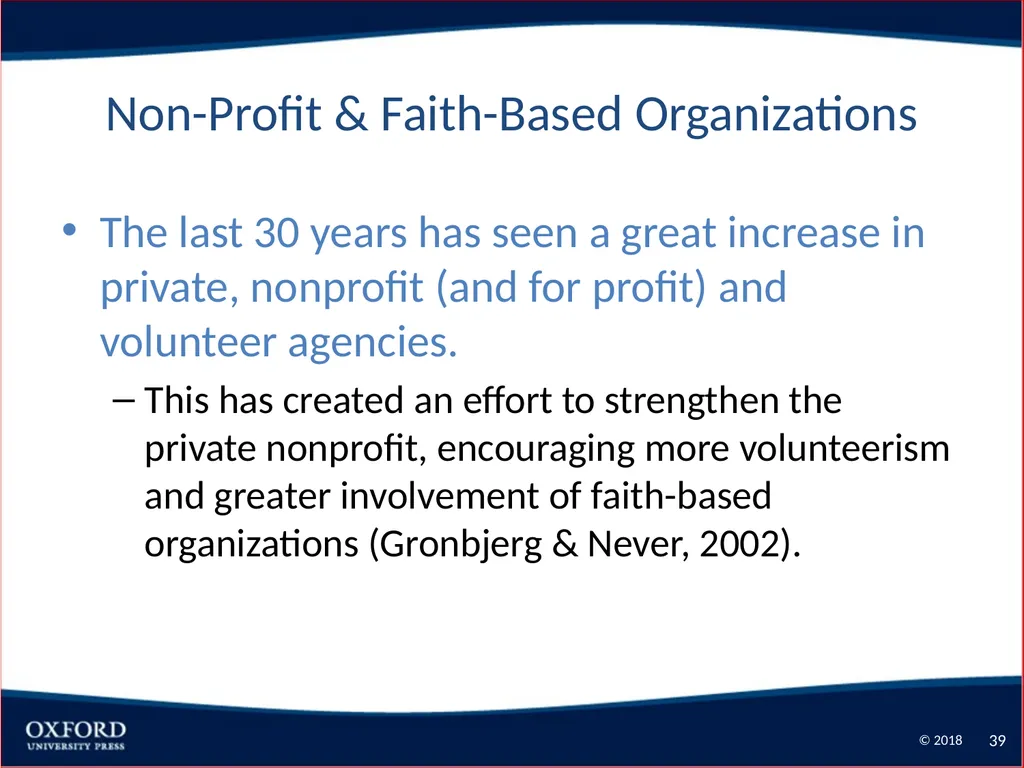
Non-Profit & Faith-Based Organizations The last 30 years has seen a great increase in private, nonprofit (and for profit) and volunteer agencies.
This has created an effort to strengthen the private nonprofit, encouraging more volunteerism and greater involvement of faith-based organizations (Gronbjerg & Never, 2002).<br>
This has created an effort to strengthen the private nonprofit, encouraging more volunteerism and greater involvement of faith-based organizations (Gronbjerg & Never, 2002).<br>
40
Non-Profit & Faith-Based Organizations Cont. Religious organizations and other private volunteer groups were encouraged to accept greater responsibility for the needy (Denton, 1982).
Democrat and Republican leaders welcomed faith-based organizations into the circle of service providers by including Charitable Choice in section § 104 of the Personal Responsibility and Work Reconciliation Act of 1996 (P.L. 104-193).<br>
Democrat and Republican leaders welcomed faith-based organizations into the circle of service providers by including Charitable Choice in section § 104 of the Personal Responsibility and Work Reconciliation Act of 1996 (P.L. 104-193).<br>
41
Non-Profit & Faith-Based Organizations Cont. President George W. Bush established the White House Office of Faith-based and Community Initiatives (Cnaan & Boddie, 2002).
President Obama created the Office of Faith-Based and Neighborhood Partnerships (2012).<br>
President Obama created the Office of Faith-Based and Neighborhood Partnerships (2012).<br>
42
Non-Profit & Faith-Based Organizations Cont. Office of Faith-Based and Neighborhood Partnerships (2012)
1) Strengthens the role of community organizations in the economic recovery.
2) Reduces unintended pregnancies by supporting maternal and child health, and reducing the need for abortion.
3) Promotes responsible fatherhood and strong communities.
4) Promotes interfaith dialogue and cooperation (“Policy Goals,” para. 1).<br>
1) Strengthens the role of community organizations in the economic recovery.
2) Reduces unintended pregnancies by supporting maternal and child health, and reducing the need for abortion.
3) Promotes responsible fatherhood and strong communities.
4) Promotes interfaith dialogue and cooperation (“Policy Goals,” para. 1).<br>
43
Summary Recognizing and embracing the historical roots of social work are part of developing one’s professional identity.
One must understand the historical challenges and tensions which shape the profession and continue to influence our practice today.<br>
One must understand the historical challenges and tensions which shape the profession and continue to influence our practice today.<br>
44
Engaged Learning:
Discussion Questions Self-reflection questions regarding historical and current context:
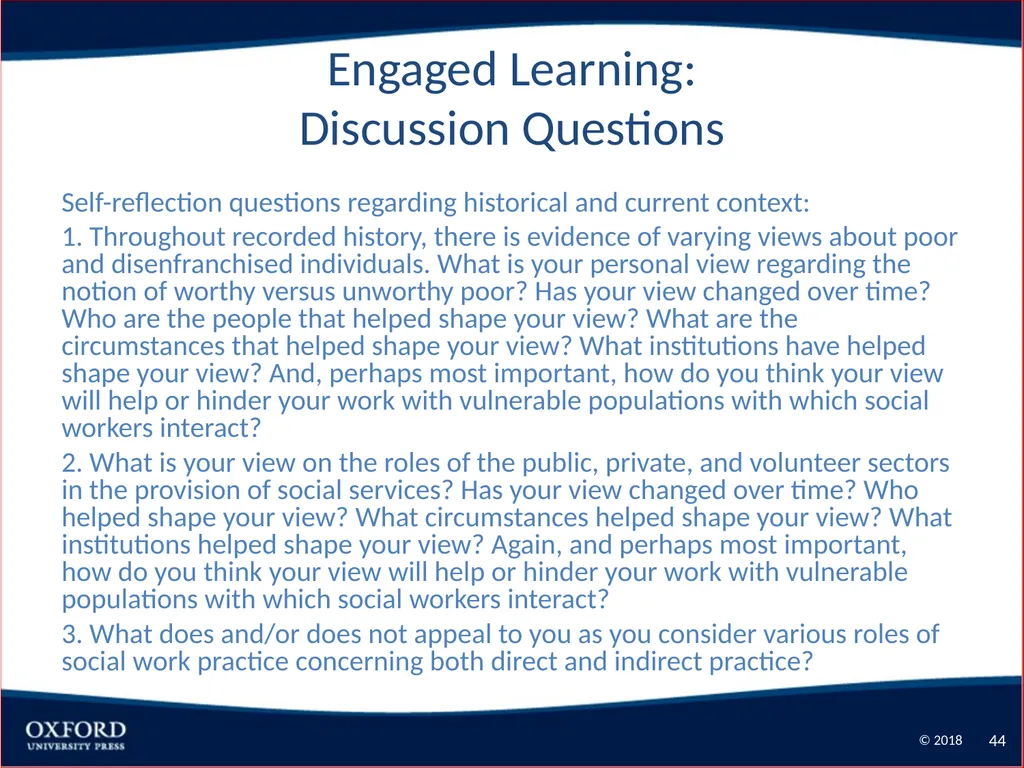
1. Throughout recorded history, there is evidence of varying views about poor and disenfranchised individuals. What is your personal view regarding the notion of worthy versus unworthy poor? Has your view changed over time? Who are the people that helped shape your view? What are the circumstances that helped shape your view? What institutions have helped shape your view? And, perhaps most important, how do you think your view will help or hinder your work with vulnerable populations with which social workers interact?
2. What is your view on the roles of the public, private, and volunteer sectors in the provision of social services? Has your view changed over time? Who helped shape your view? What circumstances helped shape your view? What institutions helped shape your view? Again, and perhaps most important, how do you think your view will help or hinder your work with vulnerable populations with which social workers interact?
3. What does and/or does not appeal to you as you consider various roles of social work practice concerning both direct and indirect practice?<br>
1. Throughout recorded history, there is evidence of varying views about poor and disenfranchised individuals. What is your personal view regarding the notion of worthy versus unworthy poor? Has your view changed over time? Who are the people that helped shape your view? What are the circumstances that helped shape your view? What institutions have helped shape your view? And, perhaps most important, how do you think your view will help or hinder your work with vulnerable populations with which social workers interact?
2. What is your view on the roles of the public, private, and volunteer sectors in the provision of social services? Has your view changed over time? Who helped shape your view? What circumstances helped shape your view? What institutions helped shape your view? Again, and perhaps most important, how do you think your view will help or hinder your work with vulnerable populations with which social workers interact?
3. What does and/or does not appeal to you as you consider various roles of social work practice concerning both direct and indirect practice?<br>
45
Engaged Learning:
Discussion Questions (Continued) Self-reflection questions regarding historical and current context:
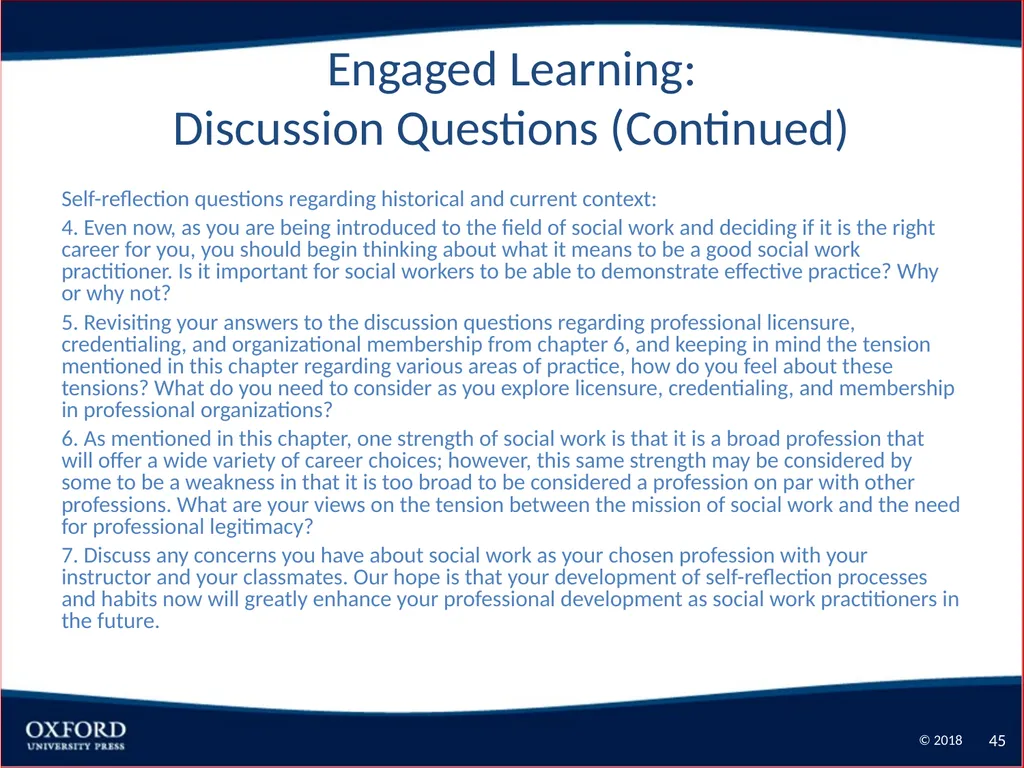
4. Even now, as you are being introduced to the field of social work and deciding if it is the right career for you, you should begin thinking about what it means to be a good social work practitioner. Is it important for social workers to be able to demonstrate effective practice? Why or why not?
5. Revisiting your answers to the discussion questions regarding professional licensure, credentialing, and organizational membership from chapter 6, and keeping in mind the tension mentioned in this chapter regarding various areas of practice, how do you feel about these tensions? What do you need to consider as you explore licensure, credentialing, and membership in professional organizations?
6. As mentioned in this chapter, one strength of social work is that it is a broad profession that will offer a wide variety of career choices; however, this same strength may be considered by some to be a weakness in that it is too broad to be considered a profession on par with other professions. What are your views on the tension between the mission of social work and the need for professional legitimacy?
7. Discuss any concerns you have about social work as your chosen profession with your instructor and your classmates. Our hope is that your development of self-reflection processes and habits now will greatly enhance your professional development as social work practitioners in the future.<br>
4. Even now, as you are being introduced to the field of social work and deciding if it is the right career for you, you should begin thinking about what it means to be a good social work practitioner. Is it important for social workers to be able to demonstrate effective practice? Why or why not?
5. Revisiting your answers to the discussion questions regarding professional licensure, credentialing, and organizational membership from chapter 6, and keeping in mind the tension mentioned in this chapter regarding various areas of practice, how do you feel about these tensions? What do you need to consider as you explore licensure, credentialing, and membership in professional organizations?
6. As mentioned in this chapter, one strength of social work is that it is a broad profession that will offer a wide variety of career choices; however, this same strength may be considered by some to be a weakness in that it is too broad to be considered a profession on par with other professions. What are your views on the tension between the mission of social work and the need for professional legitimacy?
7. Discuss any concerns you have about social work as your chosen profession with your instructor and your classmates. Our hope is that your development of self-reflection processes and habits now will greatly enhance your professional development as social work practitioners in the future.<br>