
Computer Architecture and Organization Dr. John P.
DP
Published · 51 slides · 0 views
1 / 1
Description
Computer Architecture and Organization Dr. John P. Abraham UTRGV Credit for the slides All slides are taken from Stallings published power points. I only modified some slides. Computer Architecture Organization Computer Architecture Those
Related Topics
Share
Embed code
Download this presentation From Below
"Computer Architecture and Organization Dr. John P." is the property of its rightful owner. Permission is granted to download and print the materials on this website for personal, non-commercial use only, and to display it on your personal computer provided you do not modify the materials and that you retain all copyright notices contained in the materials. By downloading content from our website, you accept the terms of this agreement.
Presentation Transcript
01
Computer Architecture and Organization Dr. John P. Abraham
UTRGV<br>
UTRGV<br>
02
Credit for the slides All slides are taken from Stallings published power points. I only modified some slides.<br>
03
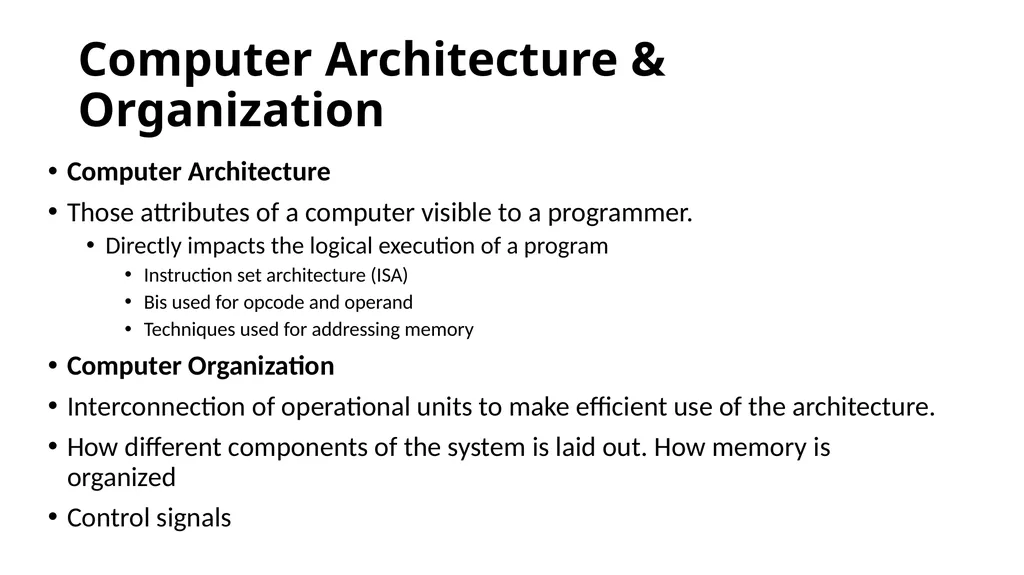
Computer Architecture & Organization Computer Architecture
Those attributes of a computer visible to a programmer.
Directly impacts the logical execution of a program
Instruction set architecture (ISA)
Bis used for opcode and operand
Techniques used for addressing memory
Computer Organization
Interconnection of operational units to make efficient use of the architecture.
How different components of the system is laid out. How memory is organized
Control signals<br>
Those attributes of a computer visible to a programmer.
Directly impacts the logical execution of a program
Instruction set architecture (ISA)
Bis used for opcode and operand
Techniques used for addressing memory
Computer Organization
Interconnection of operational units to make efficient use of the architecture.
How different components of the system is laid out. How memory is organized
Control signals<br>
04
Explained An architectural design issue might be whether computer will have a multiply instruction.
The organizational decision may be if multiplication is achieved by numerous adding or having a special multiplication unit. The organizational decision may be based on the anticipated frequency of use of the multiply instruction, the relative speed of the two approaches, and the cost and physical size of a special multiply unit.
Many computer manufacturers offer a family of computer models, all with the same architecture but with differences in organization. Consequently, the different models in the family have different price and performance characteristics. Furthermore, a particular architecture may span many years and encompass a number of different computer models, its organization changing with changing technology. A good example is IBM/370 models. 1970 to now, same architecture. PC family, the x86 family share the same basic architecture, giving backward code compatibility.<br>
The organizational decision may be if multiplication is achieved by numerous adding or having a special multiplication unit. The organizational decision may be based on the anticipated frequency of use of the multiply instruction, the relative speed of the two approaches, and the cost and physical size of a special multiply unit.
Many computer manufacturers offer a family of computer models, all with the same architecture but with differences in organization. Consequently, the different models in the family have different price and performance characteristics. Furthermore, a particular architecture may span many years and encompass a number of different computer models, its organization changing with changing technology. A good example is IBM/370 models. 1970 to now, same architecture. PC family, the x86 family share the same basic architecture, giving backward code compatibility.<br>
05
Structure & Function Structure is the way in which components relate to each other
Function is the operation of individual components as part of the structure. Basic functions are: data processing, data storage, data movement and data communication, and control
This book begins with the major components of a computer, describing their structure and function, and proceed to successively lower layers of the hierarchy.<br>
Function is the operation of individual components as part of the structure. Basic functions are: data processing, data storage, data movement and data communication, and control
This book begins with the major components of a computer, describing their structure and function, and proceed to successively lower layers of the hierarchy.<br>
06
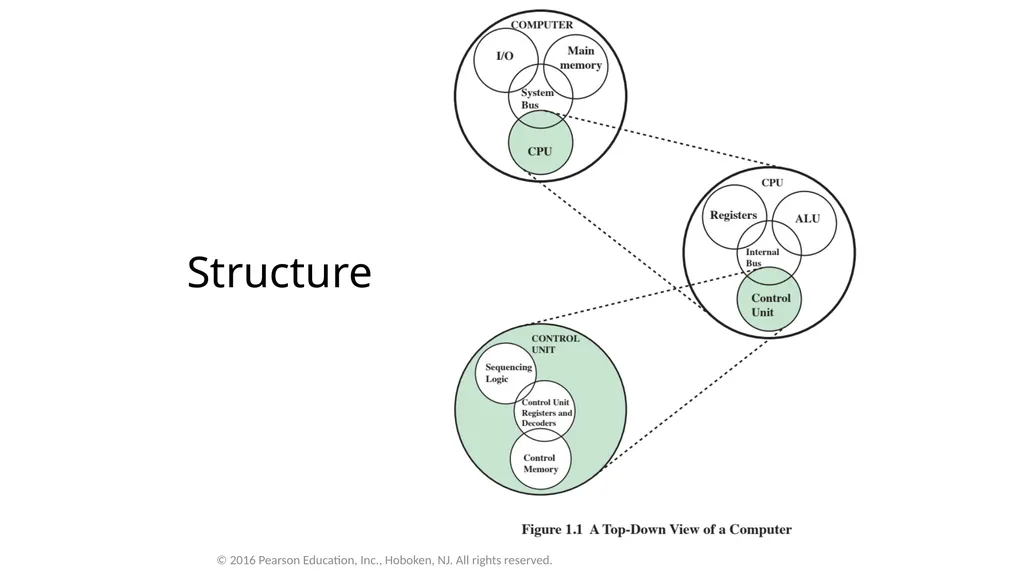
Structure © 2016 Pearson Education, Inc., Hoboken, NJ. All rights reserved.<br>
07
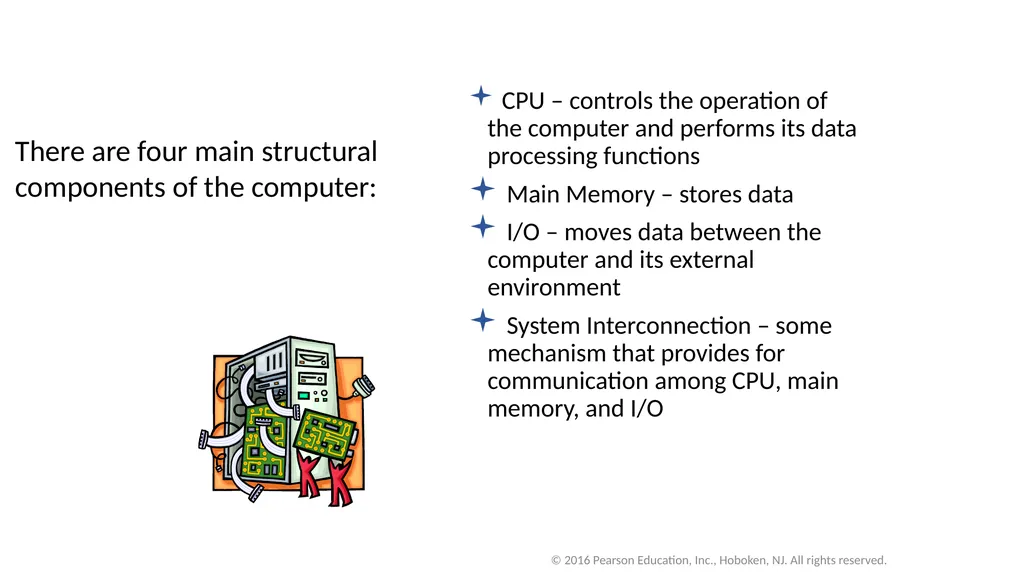
CPU – controls the operation of the computer and performs its data processing functions
Main Memory – stores data
I/O – moves data between the computer and its external environment
System Interconnection – some mechanism that provides for communication among CPU, main memory, and I/O There are four main structural components of the computer: © 2016 Pearson Education, Inc., Hoboken, NJ. All rights reserved.<br>
Main Memory – stores data
I/O – moves data between the computer and its external environment
System Interconnection – some mechanism that provides for communication among CPU, main memory, and I/O There are four main structural components of the computer: © 2016 Pearson Education, Inc., Hoboken, NJ. All rights reserved.<br>
08
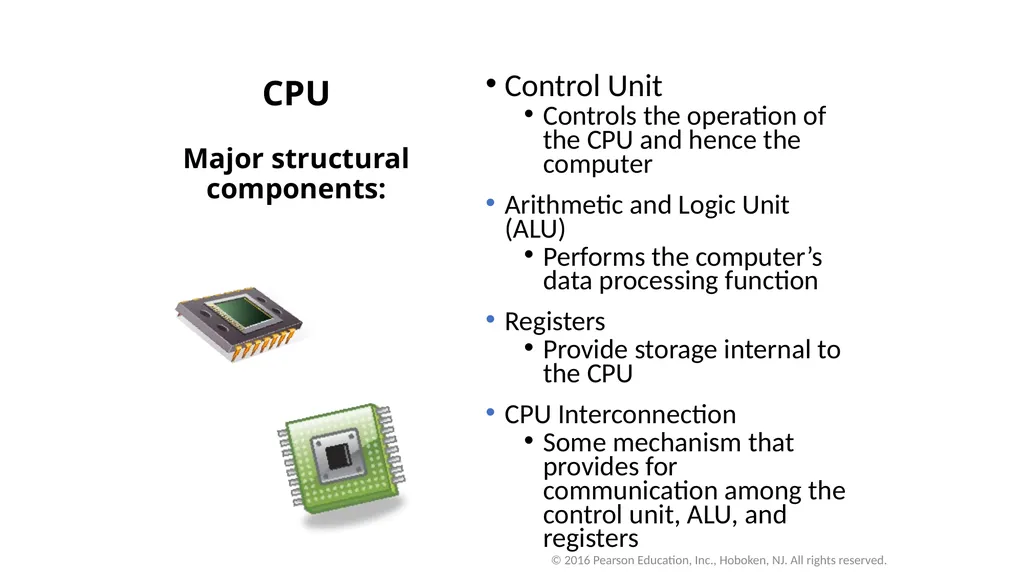
CPU Control Unit
Controls the operation of the CPU and hence the computer
Arithmetic and Logic Unit (ALU)
Performs the computer’s data processing function
Registers
Provide storage internal to the CPU
CPU Interconnection
Some mechanism that provides for communication among the control unit, ALU, and registers Major structural components: © 2016 Pearson Education, Inc., Hoboken, NJ. All rights reserved.<br>
Controls the operation of the CPU and hence the computer
Arithmetic and Logic Unit (ALU)
Performs the computer’s data processing function
Registers
Provide storage internal to the CPU
CPU Interconnection
Some mechanism that provides for communication among the control unit, ALU, and registers Major structural components: © 2016 Pearson Education, Inc., Hoboken, NJ. All rights reserved.<br>
09
Multicore Computer Structure Central processing unit (CPU)
Portion of the computer that fetches and executes instructions
Consists of an ALU, a control unit, and registers
Referred to as a processor in a system with a single processing unit
Core
An individual processing unit on a processor chip
May be equivalent in functionality to a CPU on a single-CPU system
Specialized processing units are also referred to as cores
Processor
A physical piece of silicon containing one or more cores
Is the computer component that interprets and executes instructions
Referred to as a multicore processor if it contains multiple cores © 2016 Pearson Education, Inc., Hoboken, NJ. All rights reserved.<br>
Portion of the computer that fetches and executes instructions
Consists of an ALU, a control unit, and registers
Referred to as a processor in a system with a single processing unit
Core
An individual processing unit on a processor chip
May be equivalent in functionality to a CPU on a single-CPU system
Specialized processing units are also referred to as cores
Processor
A physical piece of silicon containing one or more cores
Is the computer component that interprets and executes instructions
Referred to as a multicore processor if it contains multiple cores © 2016 Pearson Education, Inc., Hoboken, NJ. All rights reserved.<br>
10
Cache Memory Multiple layers of memory between the processor and main memory
Is smaller and faster than main memory
Used to speed up memory access by placing in the cache data from main memory that is likely to be used in the near future
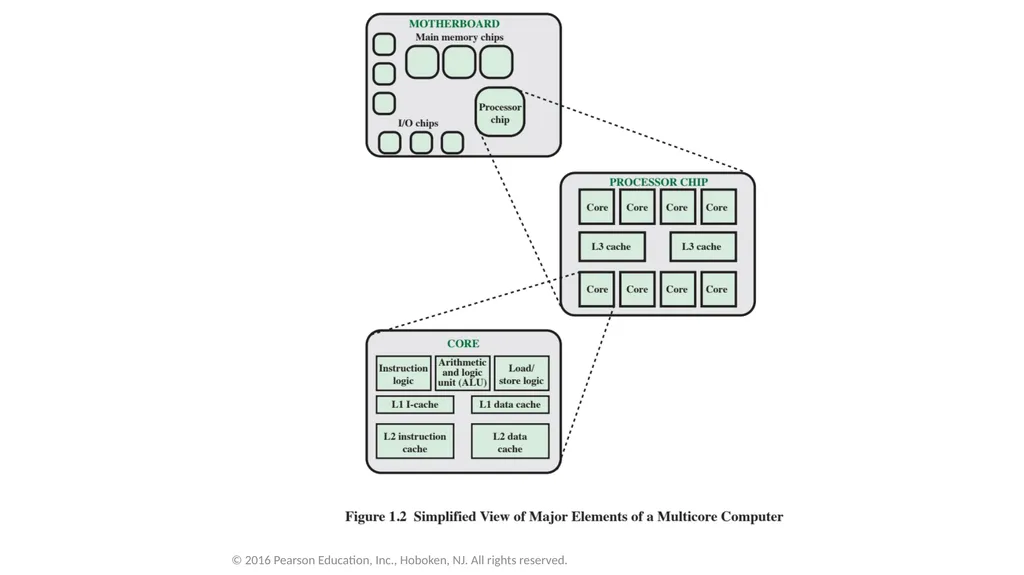
A greater performance improvement may be obtained by using multiple levels of cache, with level 1 (L1) closest to the core and additional levels (L2, L3, etc.) progressively farther from the core © 2016 Pearson Education, Inc., Hoboken, NJ. All rights reserved.<br>
Is smaller and faster than main memory
Used to speed up memory access by placing in the cache data from main memory that is likely to be used in the near future
A greater performance improvement may be obtained by using multiple levels of cache, with level 1 (L1) closest to the core and additional levels (L2, L3, etc.) progressively farther from the core © 2016 Pearson Education, Inc., Hoboken, NJ. All rights reserved.<br>
11
© 2016 Pearson Education, Inc., Hoboken, NJ. All rights reserved.<br>
12
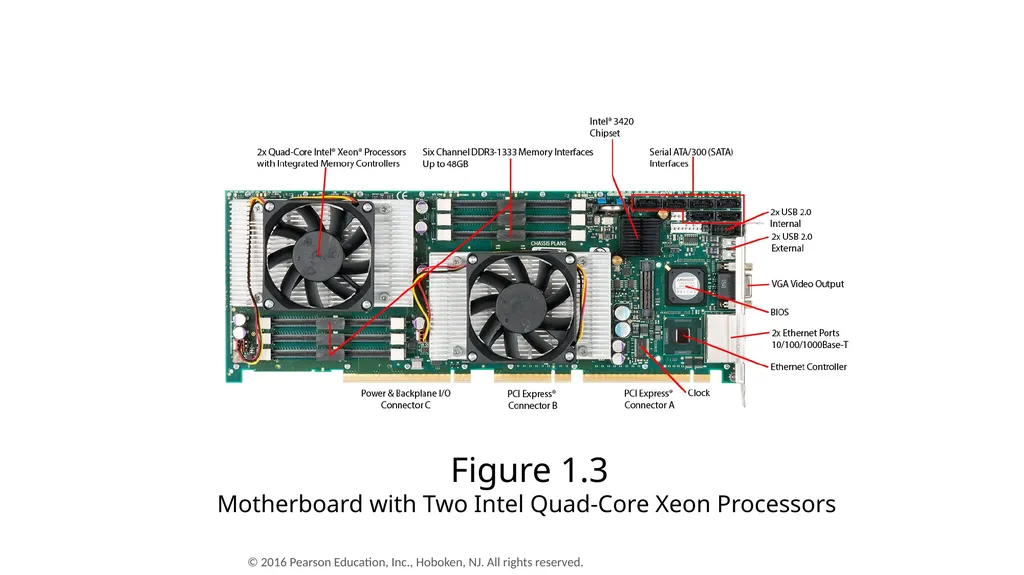
Figure 1.3
Motherboard with Two Intel Quad-Core Xeon Processors © 2016 Pearson Education, Inc., Hoboken, NJ. All rights reserved.<br>
Motherboard with Two Intel Quad-Core Xeon Processors © 2016 Pearson Education, Inc., Hoboken, NJ. All rights reserved.<br>
13
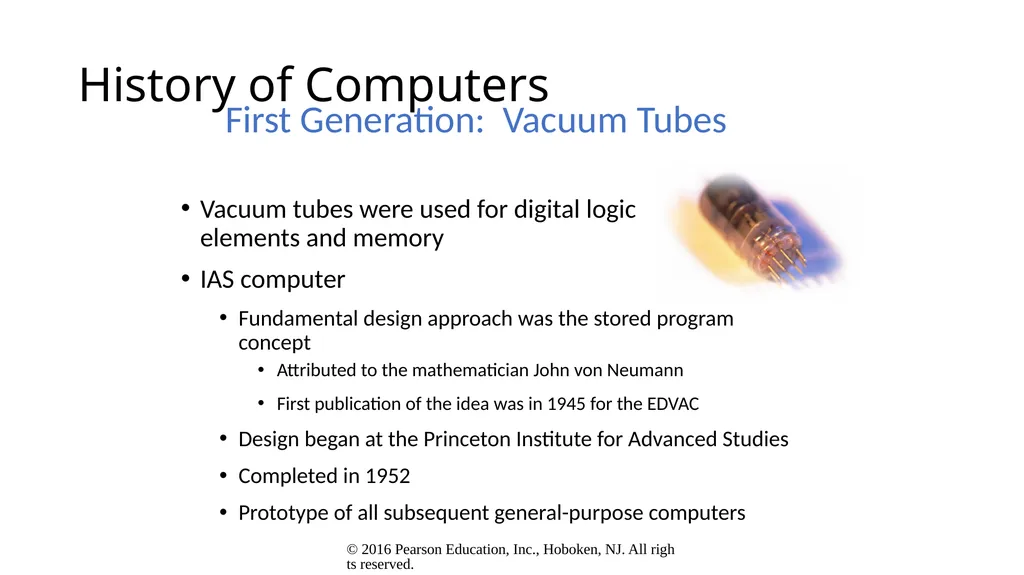
History of Computers Vacuum tubes were used for digital logic elements and memory
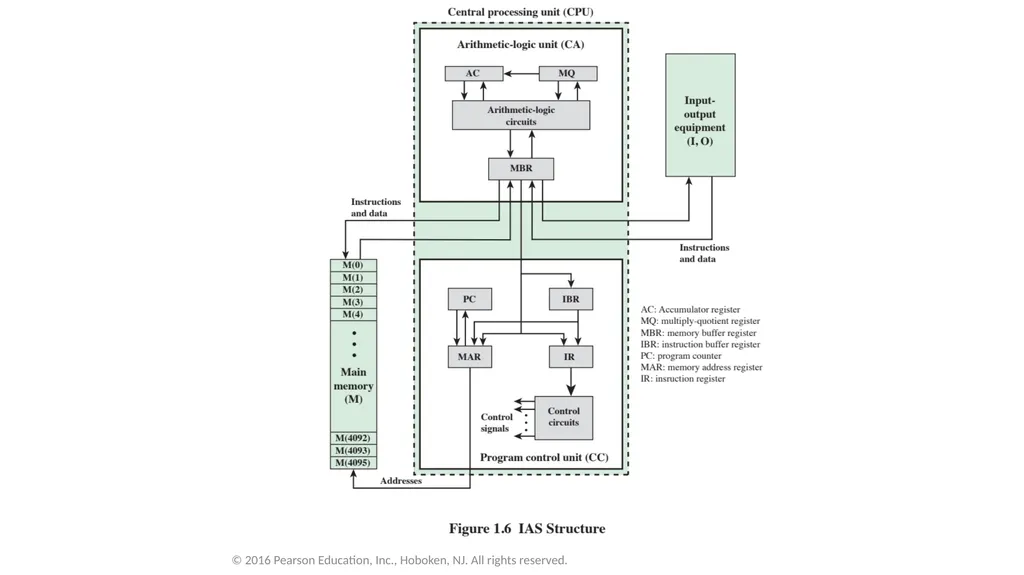
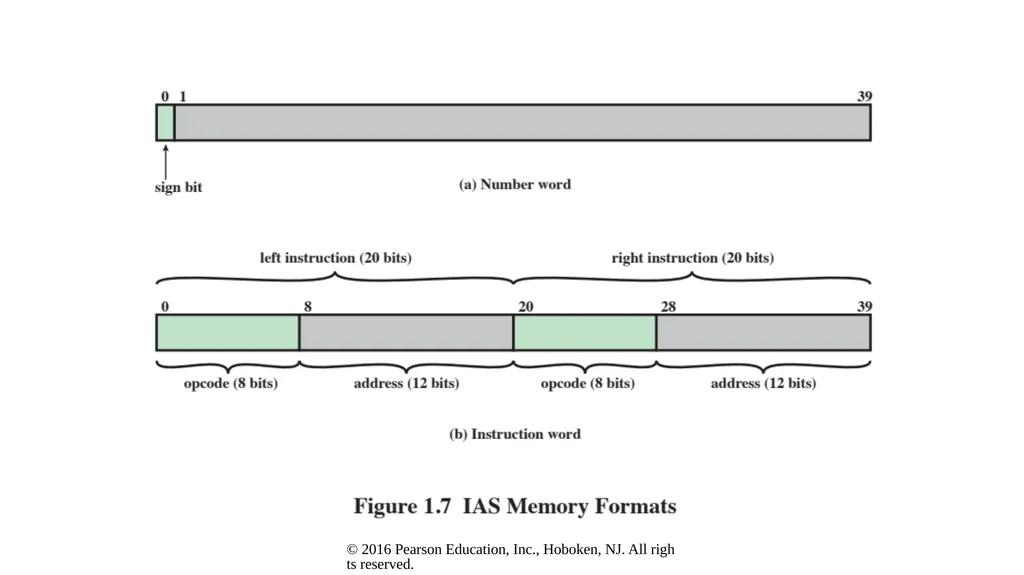
IAS computer
Fundamental design approach was the stored program concept
Attributed to the mathematician John von Neumann
First publication of the idea was in 1945 for the EDVAC
Design began at the Princeton Institute for Advanced Studies
Completed in 1952
Prototype of all subsequent general-purpose computers First Generation: Vacuum Tubes © 2016 Pearson Education, Inc., Hoboken, NJ. All rights reserved.<br>
IAS computer
Fundamental design approach was the stored program concept
Attributed to the mathematician John von Neumann
First publication of the idea was in 1945 for the EDVAC
Design began at the Princeton Institute for Advanced Studies
Completed in 1952
Prototype of all subsequent general-purpose computers First Generation: Vacuum Tubes © 2016 Pearson Education, Inc., Hoboken, NJ. All rights reserved.<br>
14
© 2016 Pearson Education, Inc., Hoboken, NJ. All rights reserved.<br>
15
© 2016 Pearson Education, Inc., Hoboken, NJ. All rights reserved.<br>
16
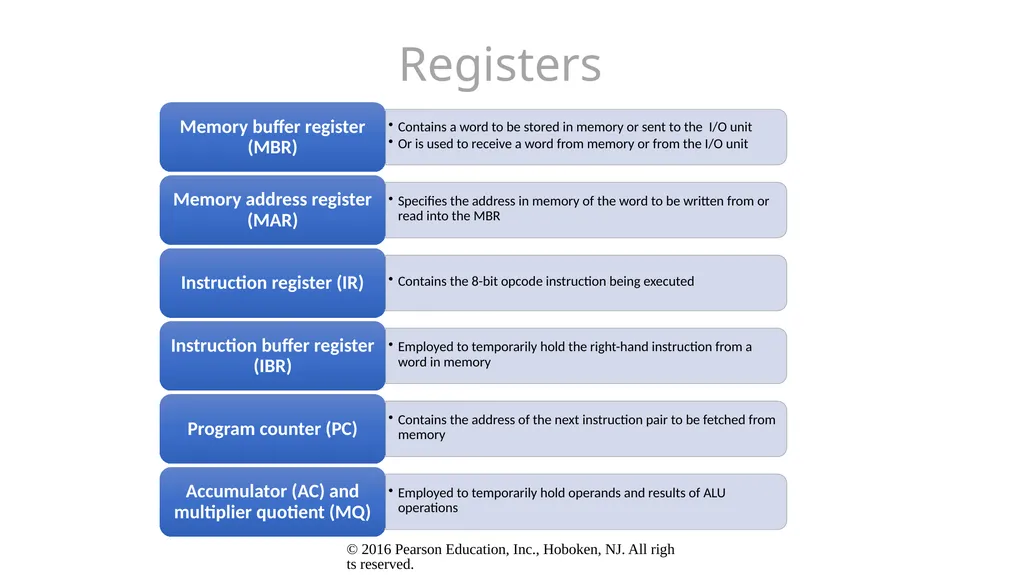
Registers © 2016 Pearson Education, Inc., Hoboken, NJ. All rights reserved.<br>
17
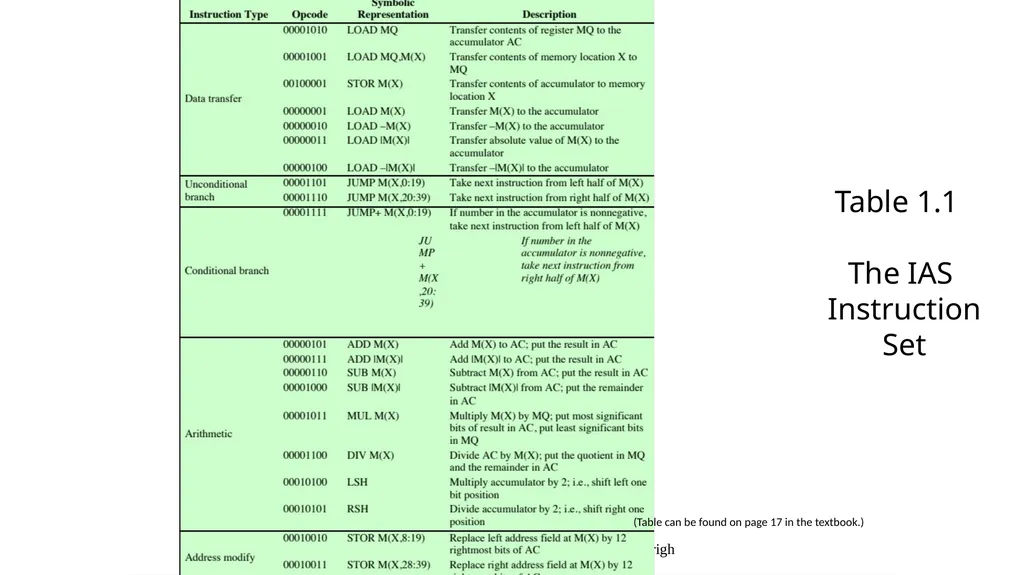
Table 1.1
The IAS
Instruction Set © 2016 Pearson Education, Inc., Hoboken, NJ. All rights reserved. (Table can be found on page 17 in the textbook.)<br>
The IAS
Instruction Set © 2016 Pearson Education, Inc., Hoboken, NJ. All rights reserved. (Table can be found on page 17 in the textbook.)<br>
18
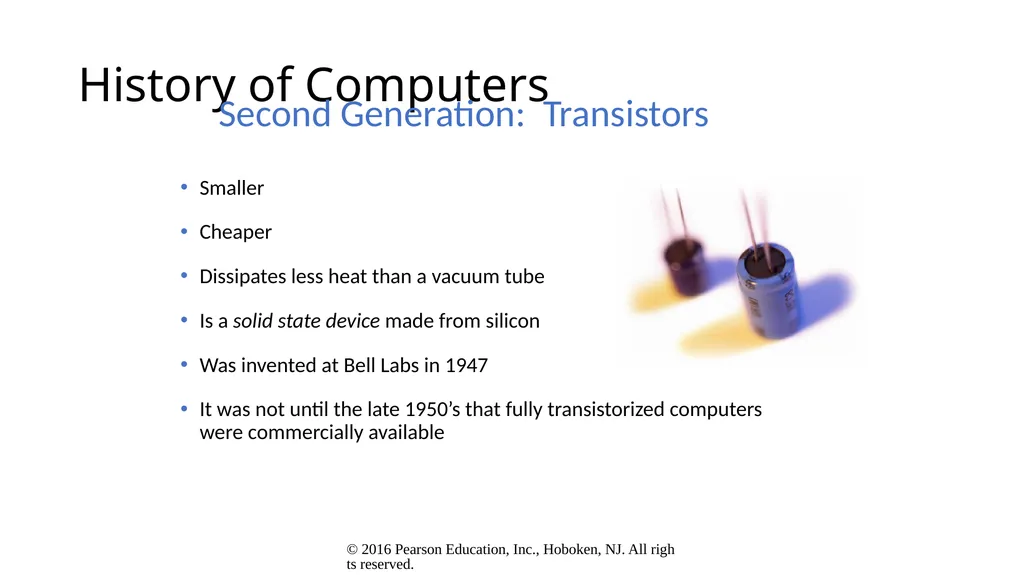
History of Computers Smaller
Cheaper
Dissipates less heat than a vacuum tube
Is a solid state device made from silicon
Was invented at Bell Labs in 1947
It was not until the late 1950’s that fully transistorized computers were commercially available Second Generation: Transistors © 2016 Pearson Education, Inc., Hoboken, NJ. All rights reserved.<br>
Cheaper
Dissipates less heat than a vacuum tube
Is a solid state device made from silicon
Was invented at Bell Labs in 1947
It was not until the late 1950’s that fully transistorized computers were commercially available Second Generation: Transistors © 2016 Pearson Education, Inc., Hoboken, NJ. All rights reserved.<br>
19
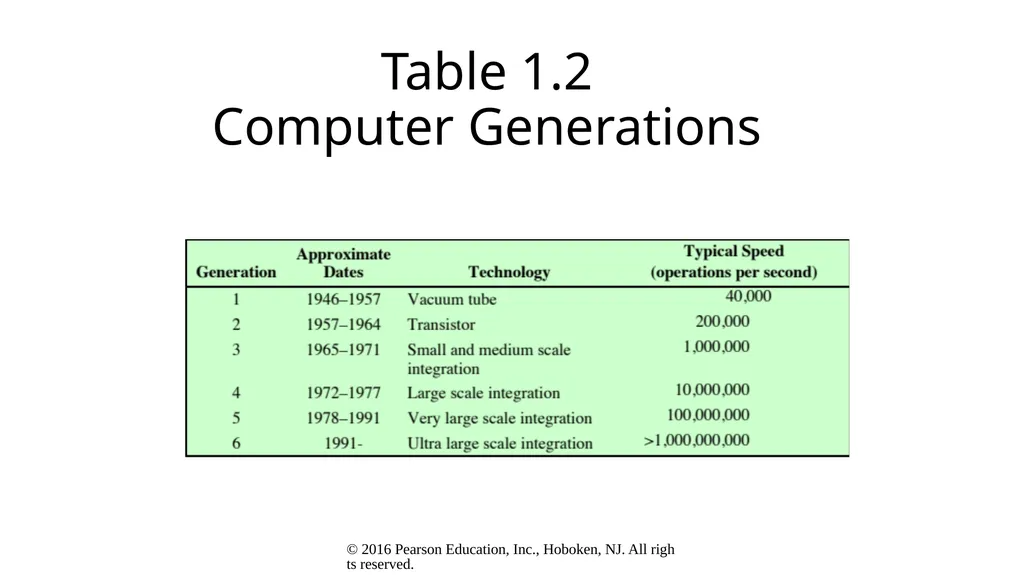
Table 1.2
Computer Generations © 2016 Pearson Education, Inc., Hoboken, NJ. All rights reserved.<br>
20
Second Generation Computers Introduced:
More complex arithmetic and logic units and control units
The use of high-level programming languages
Provision of system software which provided the ability to:
Load programs
Move data to peripherals
Libraries perform common computations © 2016 Pearson Education, Inc., Hoboken, NJ. All rights reserved.<br>
More complex arithmetic and logic units and control units
The use of high-level programming languages
Provision of system software which provided the ability to:
Load programs
Move data to peripherals
Libraries perform common computations © 2016 Pearson Education, Inc., Hoboken, NJ. All rights reserved.<br>
21
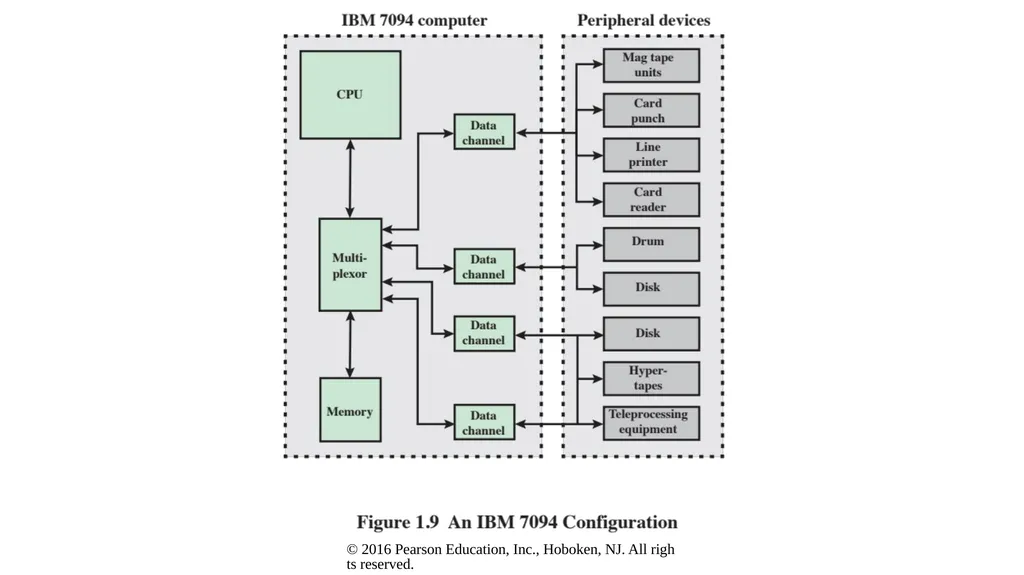
© 2016 Pearson Education, Inc., Hoboken, NJ. All rights reserved.<br>
22
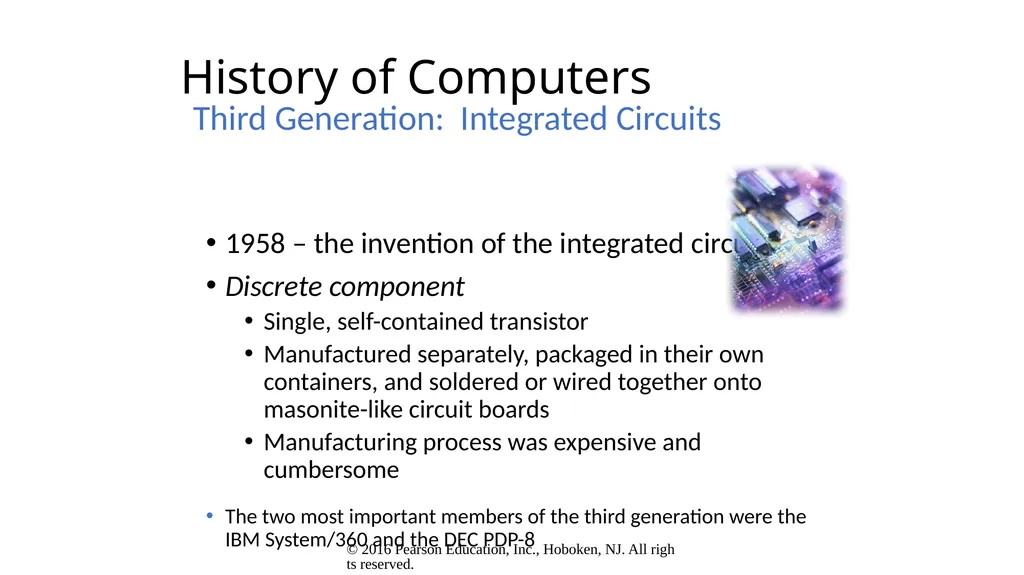
Third Generation: Integrated Circuits History of Computers 1958 – the invention of the integrated circuit
Discrete component
Single, self-contained transistor
Manufactured separately, packaged in their own containers, and soldered or wired together onto masonite-like circuit boards
Manufacturing process was expensive and cumbersome
The two most important members of the third generation were the IBM System/360 and the DEC PDP-8 © 2016 Pearson Education, Inc., Hoboken, NJ. All rights reserved.<br>
Discrete component
Single, self-contained transistor
Manufactured separately, packaged in their own containers, and soldered or wired together onto masonite-like circuit boards
Manufacturing process was expensive and cumbersome
The two most important members of the third generation were the IBM System/360 and the DEC PDP-8 © 2016 Pearson Education, Inc., Hoboken, NJ. All rights reserved.<br>
23
© 2016 Pearson Education, Inc., Hoboken, NJ. All rights reserved.<br>
24
Integrated
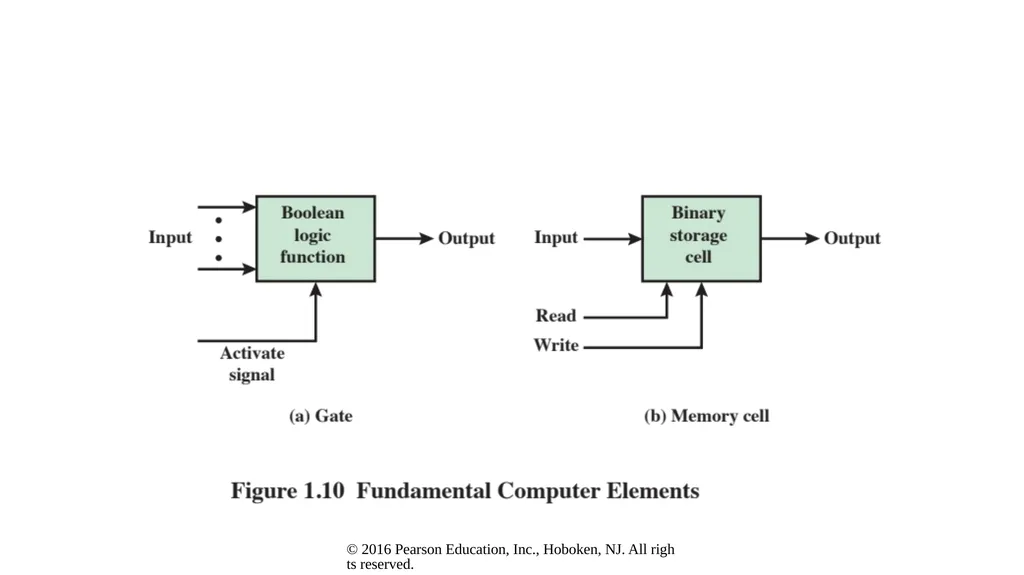
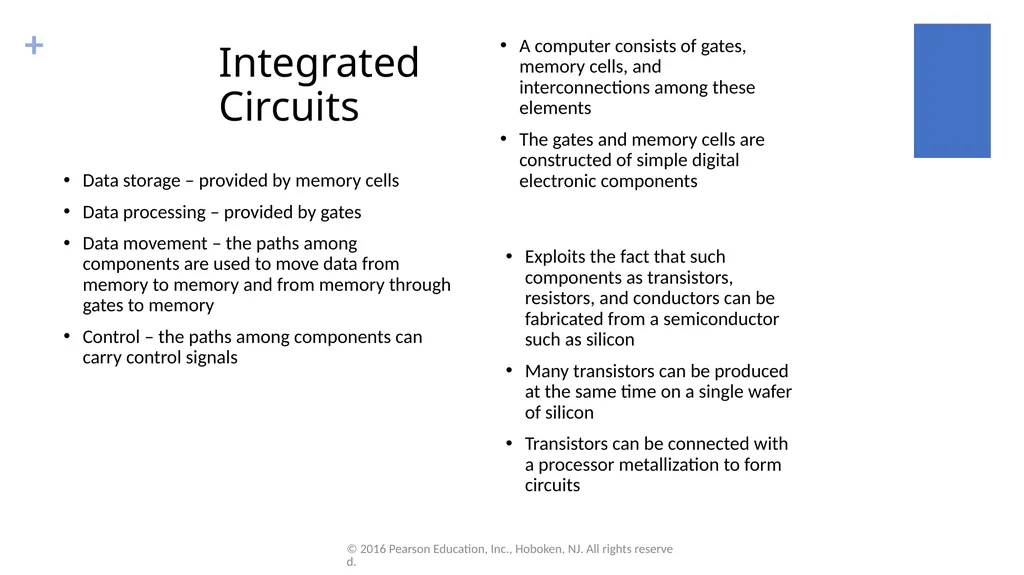
Circuits A computer consists of gates, memory cells, and interconnections among these elements
The gates and memory cells are constructed of simple digital electronic components Data storage – provided by memory cells
Data processing – provided by gates
Data movement – the paths among components are used to move data from memory to memory and from memory through gates to memory
Control – the paths among components can carry control signals Exploits the fact that such components as transistors, resistors, and conductors can be fabricated from a semiconductor such as silicon
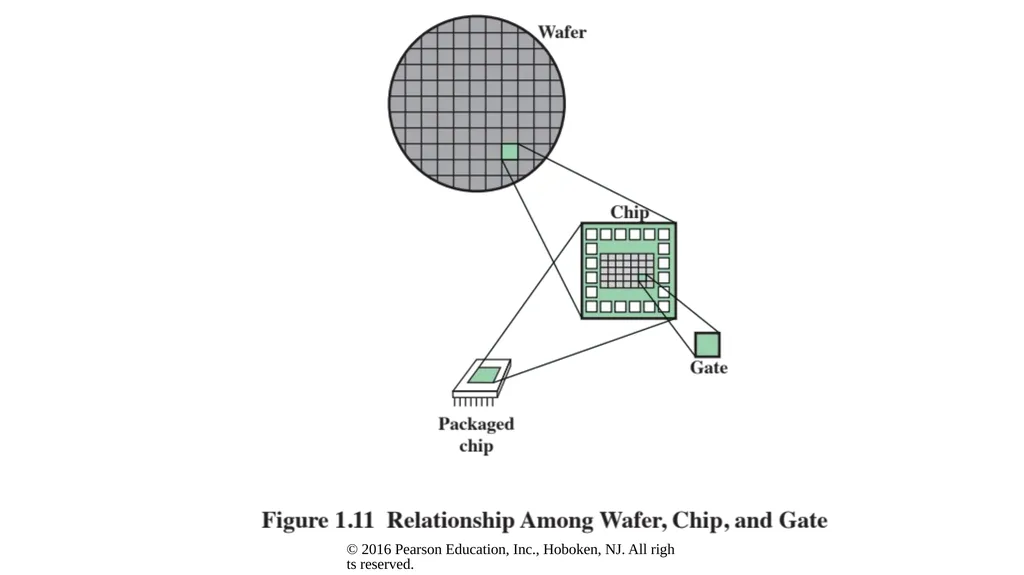
Many transistors can be produced at the same time on a single wafer of silicon
Transistors can be connected with a processor metallization to form circuits © 2016 Pearson Education, Inc., Hoboken, NJ. All rights reserved.<br>
The gates and memory cells are constructed of simple digital electronic components Data storage – provided by memory cells
Data processing – provided by gates
Data movement – the paths among components are used to move data from memory to memory and from memory through gates to memory
Control – the paths among components can carry control signals Exploits the fact that such components as transistors, resistors, and conductors can be fabricated from a semiconductor such as silicon
Many transistors can be produced at the same time on a single wafer of silicon
Transistors can be connected with a processor metallization to form circuits © 2016 Pearson Education, Inc., Hoboken, NJ. All rights reserved.<br>
25
© 2016 Pearson Education, Inc., Hoboken, NJ. All rights reserved.<br>
26
© 2016 Pearson Education, Inc., Hoboken, NJ. All rights reserved.<br>
27
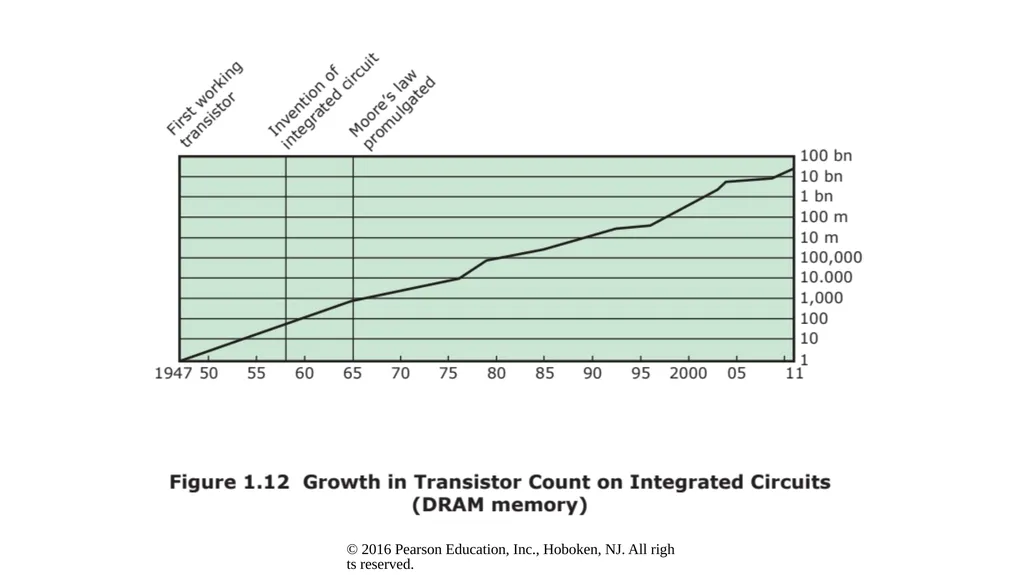
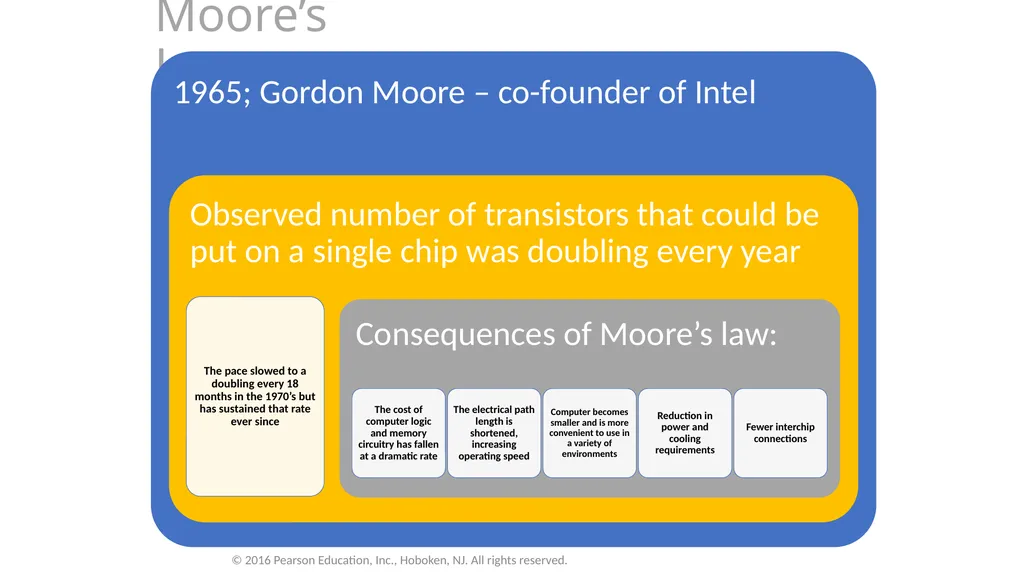
Moore’s Law © 2016 Pearson Education, Inc., Hoboken, NJ. All rights reserved.<br>
28
IBM System/360 Announced in 1964
Product line was incompatible with older IBM machines
Was the success of the decade and cemented IBM as the overwhelmingly dominant computer vendor
The architecture remains to this day the architecture of IBM’s mainframe computers
Was the industry’s first planned family of computers
Models were compatible in the sense that a program written for one model should be capable of being executed by another model in the series © 2016 Pearson Education, Inc., Hoboken, NJ. All rights reserved.<br>
Product line was incompatible with older IBM machines
Was the success of the decade and cemented IBM as the overwhelmingly dominant computer vendor
The architecture remains to this day the architecture of IBM’s mainframe computers
Was the industry’s first planned family of computers
Models were compatible in the sense that a program written for one model should be capable of being executed by another model in the series © 2016 Pearson Education, Inc., Hoboken, NJ. All rights reserved.<br>
29
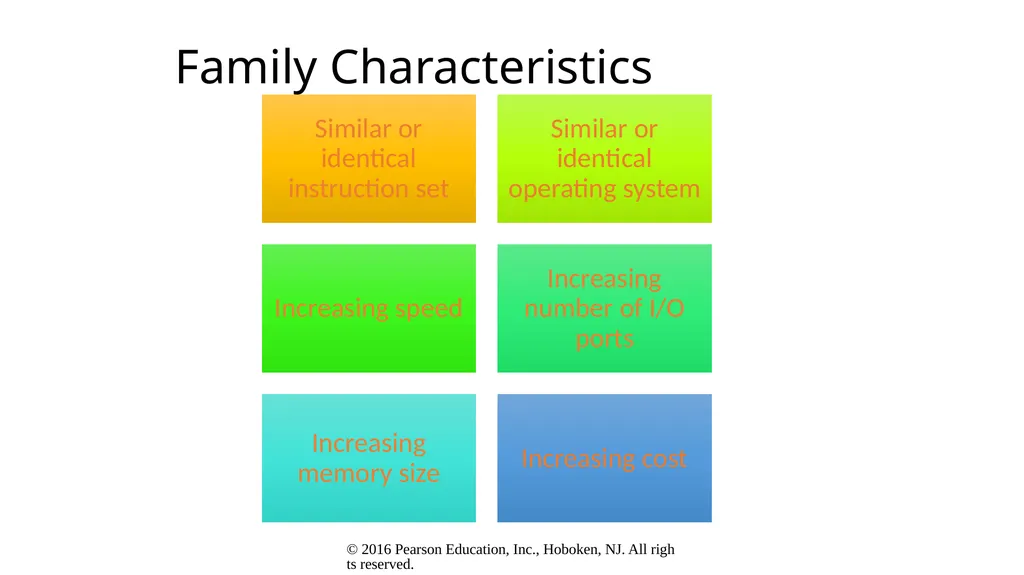
Family Characteristics © 2016 Pearson Education, Inc., Hoboken, NJ. All rights reserved.<br>
30
© 2016 Pearson Education, Inc., Hoboken, NJ. All rights reserved.<br>
31
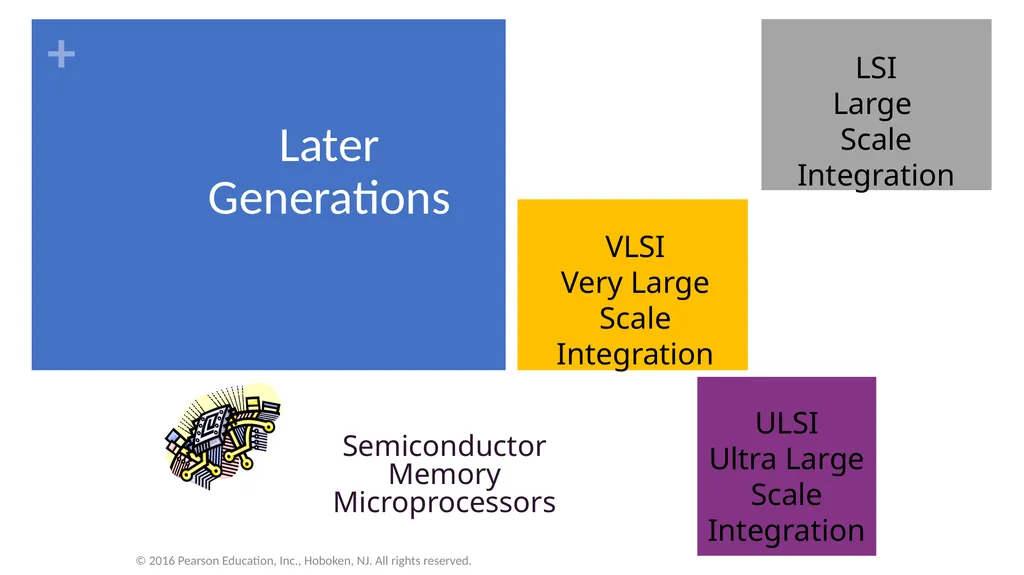
Later
Generations LSI
Large
Scale Integration VLSI
Very Large Scale Integration ULSI
Ultra Large
Scale
Integration Semiconductor Memory Microprocessors © 2016 Pearson Education, Inc., Hoboken, NJ. All rights reserved.<br>
Generations LSI
Large
Scale Integration VLSI
Very Large Scale Integration ULSI
Ultra Large
Scale
Integration Semiconductor Memory Microprocessors © 2016 Pearson Education, Inc., Hoboken, NJ. All rights reserved.<br>
32
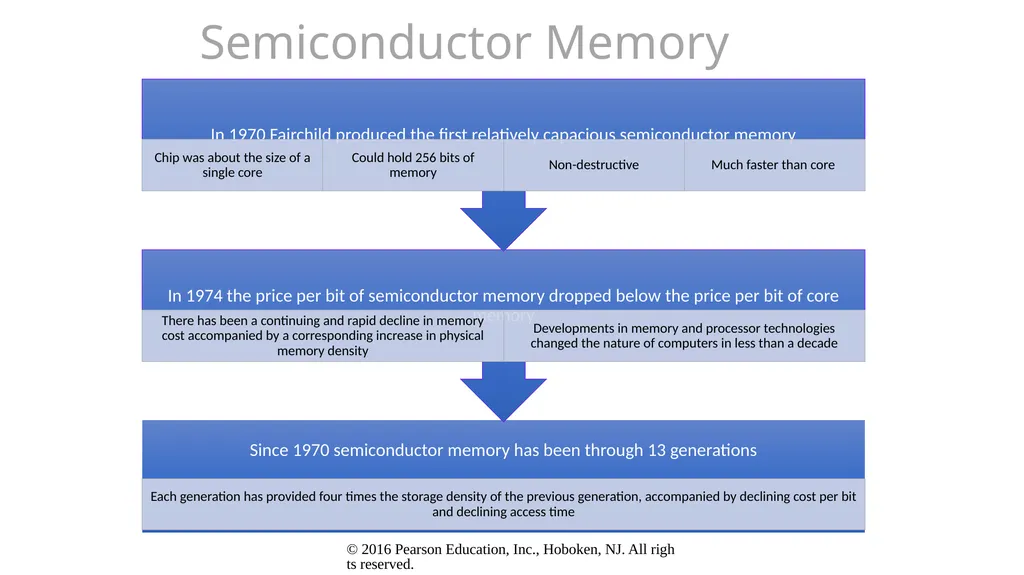
© 2016 Pearson Education, Inc., Hoboken, NJ. All rights reserved. Semiconductor Memory<br>
33
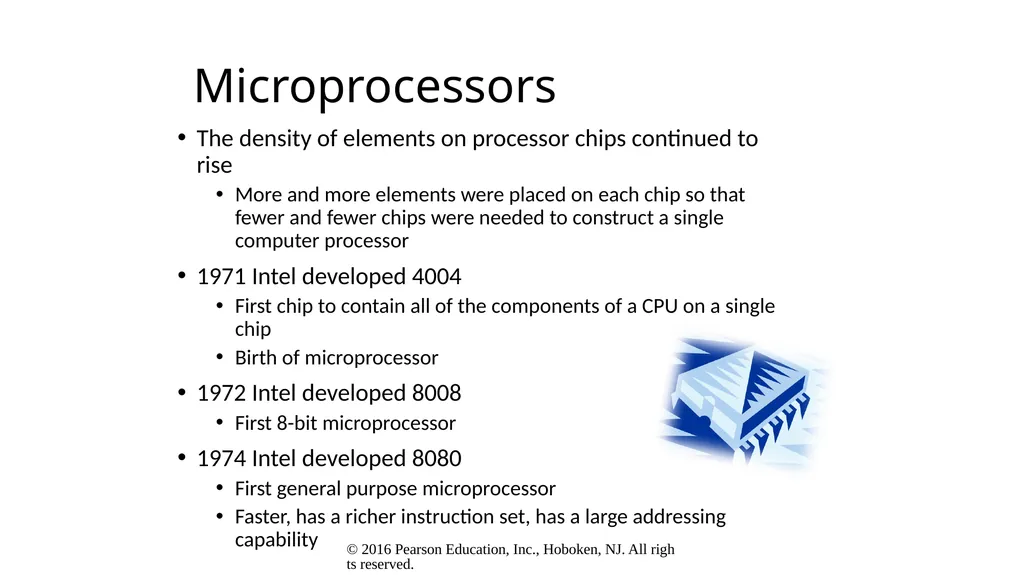
Microprocessors The density of elements on processor chips continued to rise
More and more elements were placed on each chip so that fewer and fewer chips were needed to construct a single computer processor
1971 Intel developed 4004
First chip to contain all of the components of a CPU on a single chip
Birth of microprocessor
1972 Intel developed 8008
First 8-bit microprocessor
1974 Intel developed 8080
First general purpose microprocessor
Faster, has a richer instruction set, has a large addressing capability © 2016 Pearson Education, Inc., Hoboken, NJ. All rights reserved.<br>
More and more elements were placed on each chip so that fewer and fewer chips were needed to construct a single computer processor
1971 Intel developed 4004
First chip to contain all of the components of a CPU on a single chip
Birth of microprocessor
1972 Intel developed 8008
First 8-bit microprocessor
1974 Intel developed 8080
First general purpose microprocessor
Faster, has a richer instruction set, has a large addressing capability © 2016 Pearson Education, Inc., Hoboken, NJ. All rights reserved.<br>
34
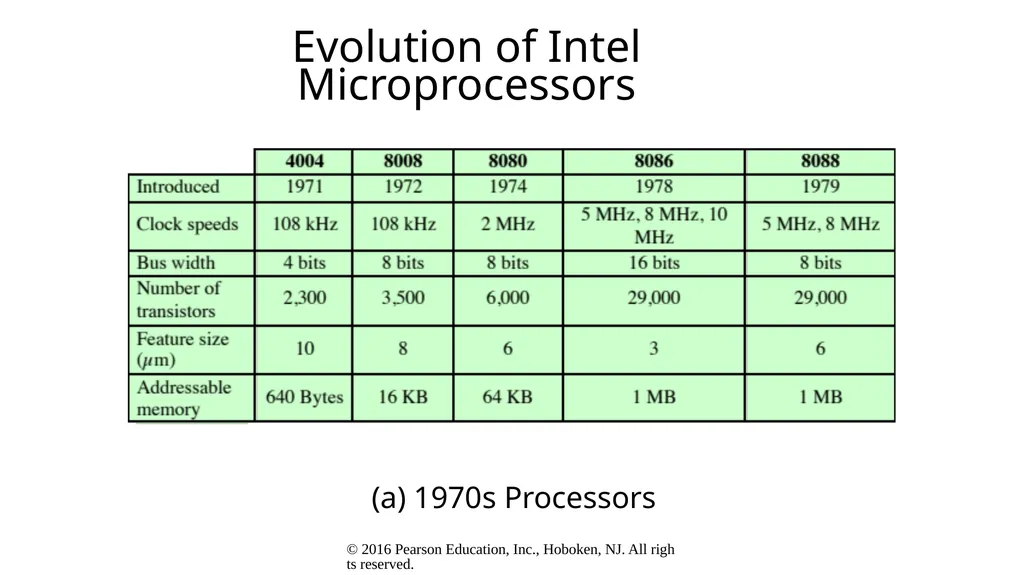
Evolution of Intel Microprocessors (a) 1970s Processors © 2016 Pearson Education, Inc., Hoboken, NJ. All rights reserved.<br>
35
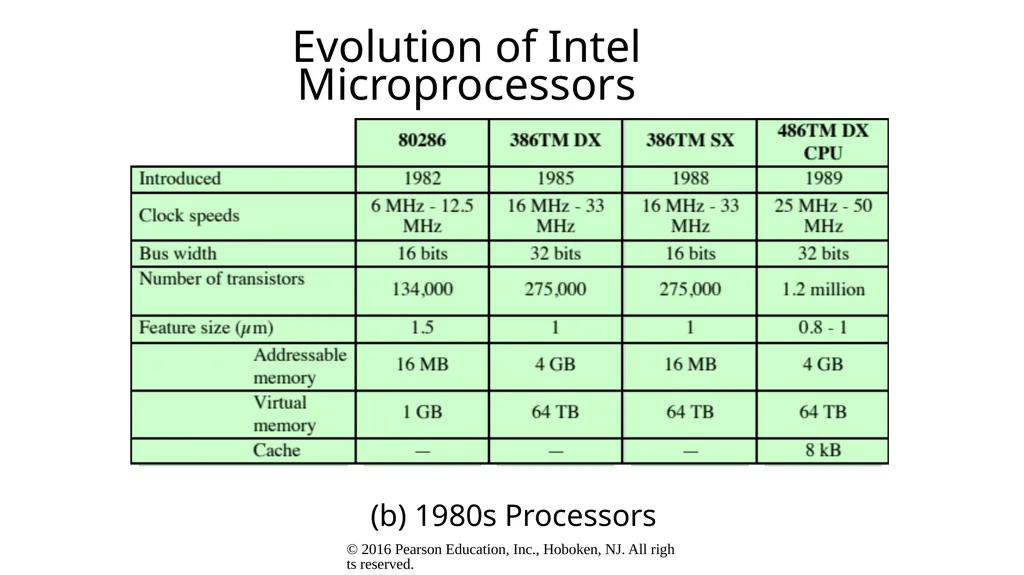
Evolution of Intel Microprocessors (b) 1980s Processors © 2016 Pearson Education, Inc., Hoboken, NJ. All rights reserved.<br>
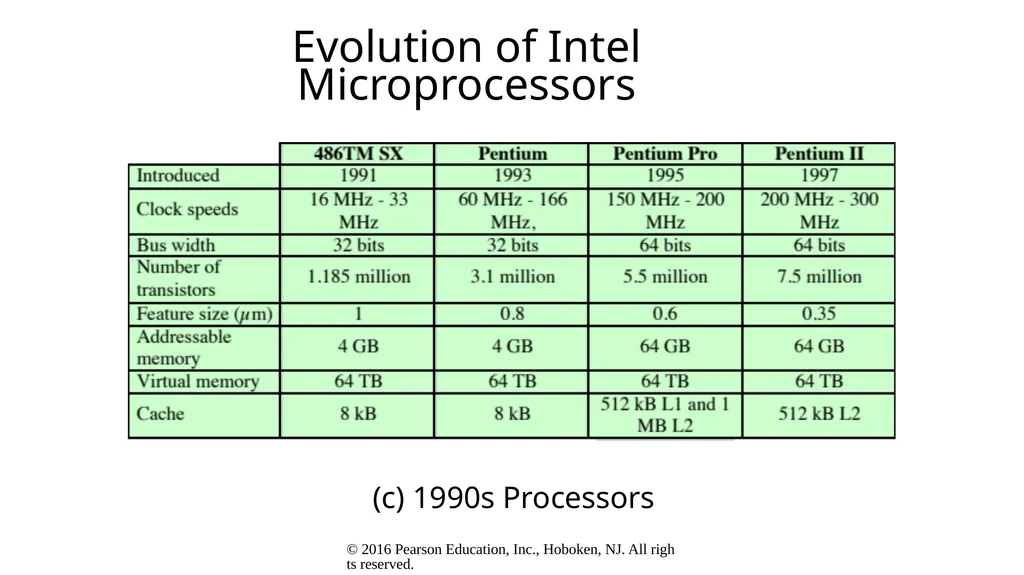
36
Evolution of Intel Microprocessors (c) 1990s Processors © 2016 Pearson Education, Inc., Hoboken, NJ. All rights reserved.<br>
37
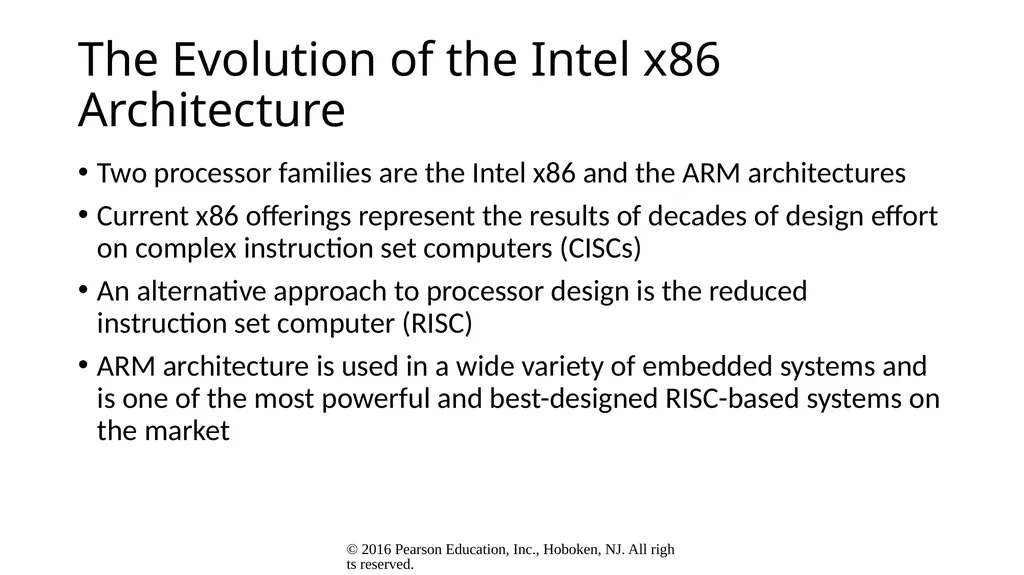
The Evolution of the Intel x86 Architecture Two processor families are the Intel x86 and the ARM architectures
Current x86 offerings represent the results of decades of design effort on complex instruction set computers (CISCs)
An alternative approach to processor design is the reduced instruction set computer (RISC)
ARM architecture is used in a wide variety of embedded systems and is one of the most powerful and best-designed RISC-based systems on the market © 2016 Pearson Education, Inc., Hoboken, NJ. All rights reserved.<br>
Current x86 offerings represent the results of decades of design effort on complex instruction set computers (CISCs)
An alternative approach to processor design is the reduced instruction set computer (RISC)
ARM architecture is used in a wide variety of embedded systems and is one of the most powerful and best-designed RISC-based systems on the market © 2016 Pearson Education, Inc., Hoboken, NJ. All rights reserved.<br>
38
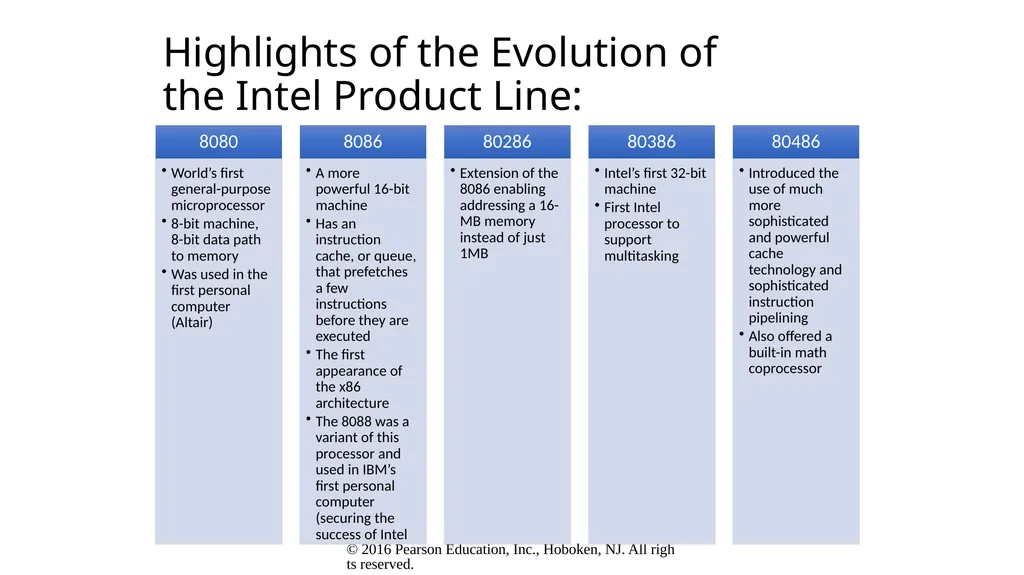
Highlights of the Evolution of the Intel Product Line: © 2016 Pearson Education, Inc., Hoboken, NJ. All rights reserved.<br>
39
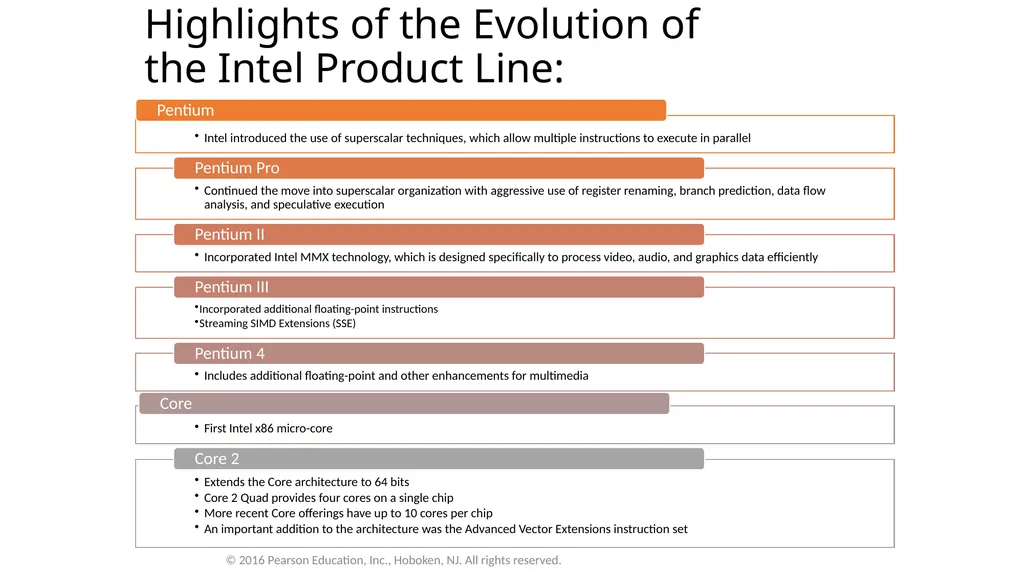
Highlights of the Evolution of the Intel Product Line: © 2016 Pearson Education, Inc., Hoboken, NJ. All rights reserved.<br>
40
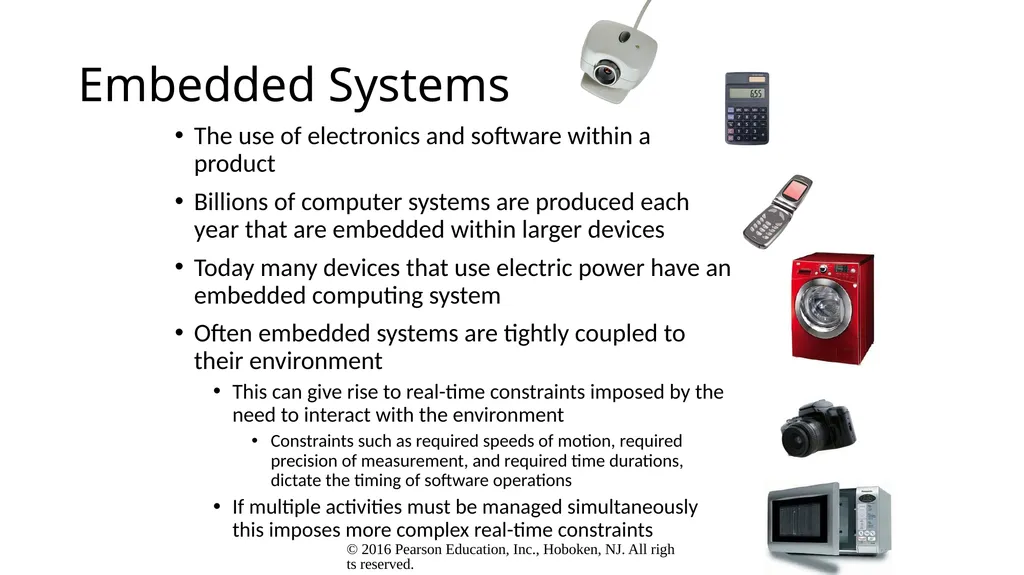
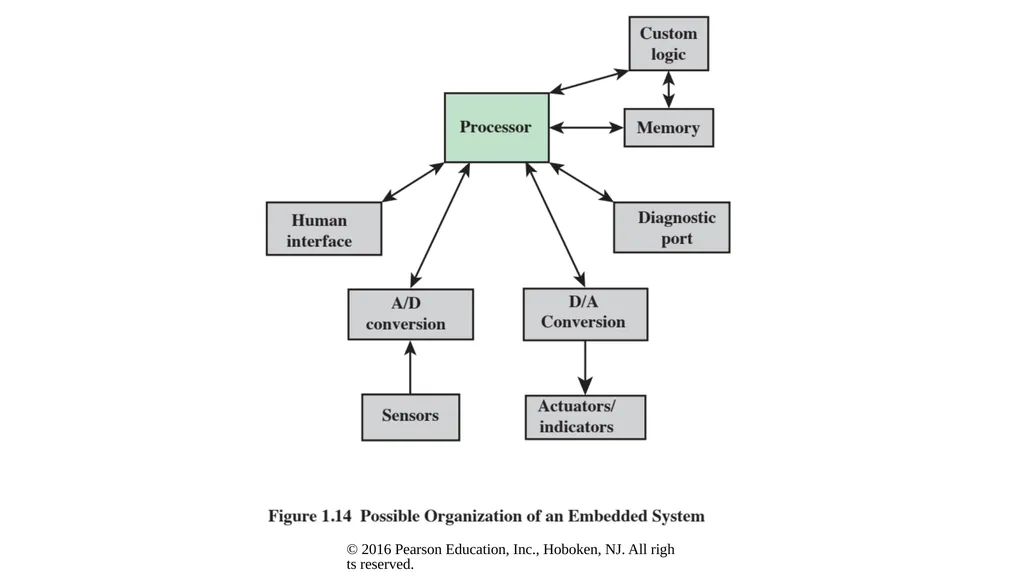
Embedded Systems The use of electronics and software within a product
Billions of computer systems are produced each year that are embedded within larger devices
Today many devices that use electric power have an embedded computing system
Often embedded systems are tightly coupled to their environment
This can give rise to real-time constraints imposed by the need to interact with the environment
Constraints such as required speeds of motion, required precision of measurement, and required time durations, dictate the timing of software operations
If multiple activities must be managed simultaneously this imposes more complex real-time constraints © 2016 Pearson Education, Inc., Hoboken, NJ. All rights reserved.<br>
Billions of computer systems are produced each year that are embedded within larger devices
Today many devices that use electric power have an embedded computing system
Often embedded systems are tightly coupled to their environment
This can give rise to real-time constraints imposed by the need to interact with the environment
Constraints such as required speeds of motion, required precision of measurement, and required time durations, dictate the timing of software operations
If multiple activities must be managed simultaneously this imposes more complex real-time constraints © 2016 Pearson Education, Inc., Hoboken, NJ. All rights reserved.<br>
41
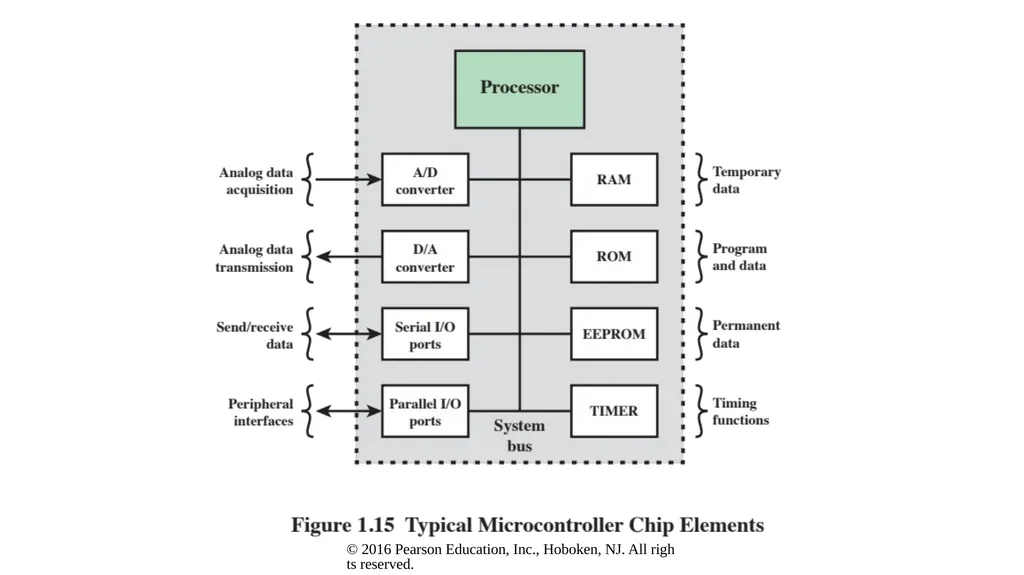
© 2016 Pearson Education, Inc., Hoboken, NJ. All rights reserved.<br>
42
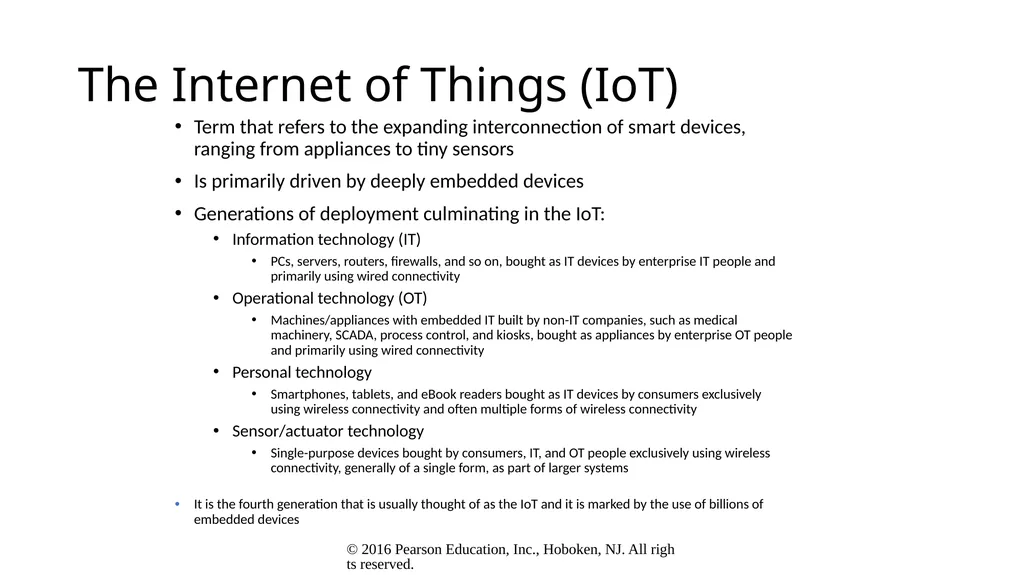
The Internet of Things (IoT) Term that refers to the expanding interconnection of smart devices, ranging from appliances to tiny sensors
Is primarily driven by deeply embedded devices
Generations of deployment culminating in the IoT:
Information technology (IT)
PCs, servers, routers, firewalls, and so on, bought as IT devices by enterprise IT people and primarily using wired connectivity
Operational technology (OT)
Machines/appliances with embedded IT built by non-IT companies, such as medical machinery, SCADA, process control, and kiosks, bought as appliances by enterprise OT people and primarily using wired connectivity
Personal technology
Smartphones, tablets, and eBook readers bought as IT devices by consumers exclusively using wireless connectivity and often multiple forms of wireless connectivity
Sensor/actuator technology
Single-purpose devices bought by consumers, IT, and OT people exclusively using wireless connectivity, generally of a single form, as part of larger systems
It is the fourth generation that is usually thought of as the IoT and it is marked by the use of billions of embedded devices © 2016 Pearson Education, Inc., Hoboken, NJ. All rights reserved.<br>
Is primarily driven by deeply embedded devices
Generations of deployment culminating in the IoT:
Information technology (IT)
PCs, servers, routers, firewalls, and so on, bought as IT devices by enterprise IT people and primarily using wired connectivity
Operational technology (OT)
Machines/appliances with embedded IT built by non-IT companies, such as medical machinery, SCADA, process control, and kiosks, bought as appliances by enterprise OT people and primarily using wired connectivity
Personal technology
Smartphones, tablets, and eBook readers bought as IT devices by consumers exclusively using wireless connectivity and often multiple forms of wireless connectivity
Sensor/actuator technology
Single-purpose devices bought by consumers, IT, and OT people exclusively using wireless connectivity, generally of a single form, as part of larger systems
It is the fourth generation that is usually thought of as the IoT and it is marked by the use of billions of embedded devices © 2016 Pearson Education, Inc., Hoboken, NJ. All rights reserved.<br>
43
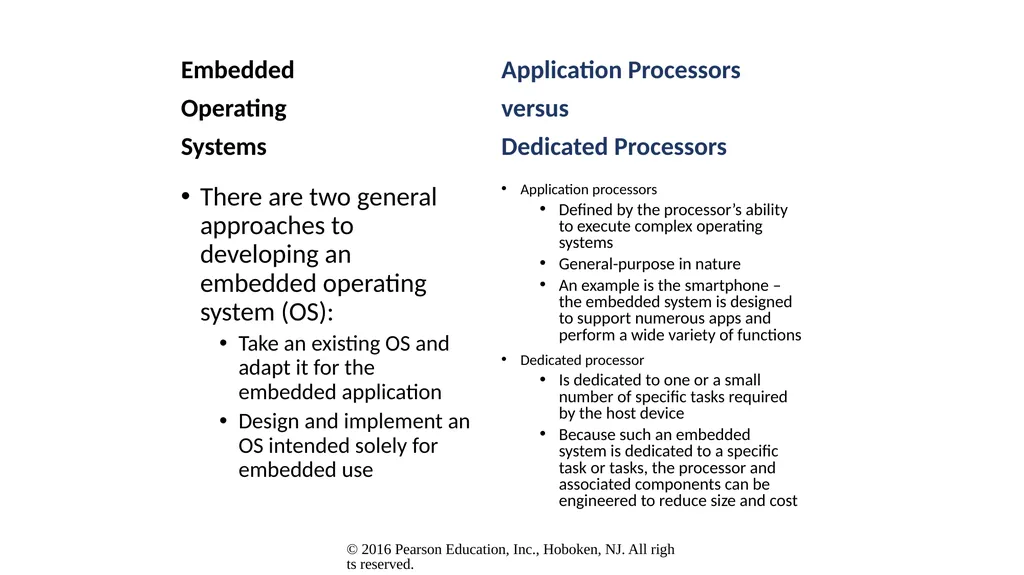
There are two general approaches to developing an embedded operating system (OS):
Take an existing OS and adapt it for the embedded application
Design and implement an OS intended solely for embedded use Application processors
Defined by the processor’s ability to execute complex operating systems
General-purpose in nature
An example is the smartphone – the embedded system is designed to support numerous apps and perform a wide variety of functions
Dedicated processor
Is dedicated to one or a small number of specific tasks required by the host device
Because such an embedded system is dedicated to a specific task or tasks, the processor and associated components can be engineered to reduce size and cost Embedded
Operating
Systems Application Processors
versus
Dedicated Processors © 2016 Pearson Education, Inc., Hoboken, NJ. All rights reserved.<br>
Take an existing OS and adapt it for the embedded application
Design and implement an OS intended solely for embedded use Application processors
Defined by the processor’s ability to execute complex operating systems
General-purpose in nature
An example is the smartphone – the embedded system is designed to support numerous apps and perform a wide variety of functions
Dedicated processor
Is dedicated to one or a small number of specific tasks required by the host device
Because such an embedded system is dedicated to a specific task or tasks, the processor and associated components can be engineered to reduce size and cost Embedded
Operating
Systems Application Processors
versus
Dedicated Processors © 2016 Pearson Education, Inc., Hoboken, NJ. All rights reserved.<br>
44
© 2016 Pearson Education, Inc., Hoboken, NJ. All rights reserved.<br>
45
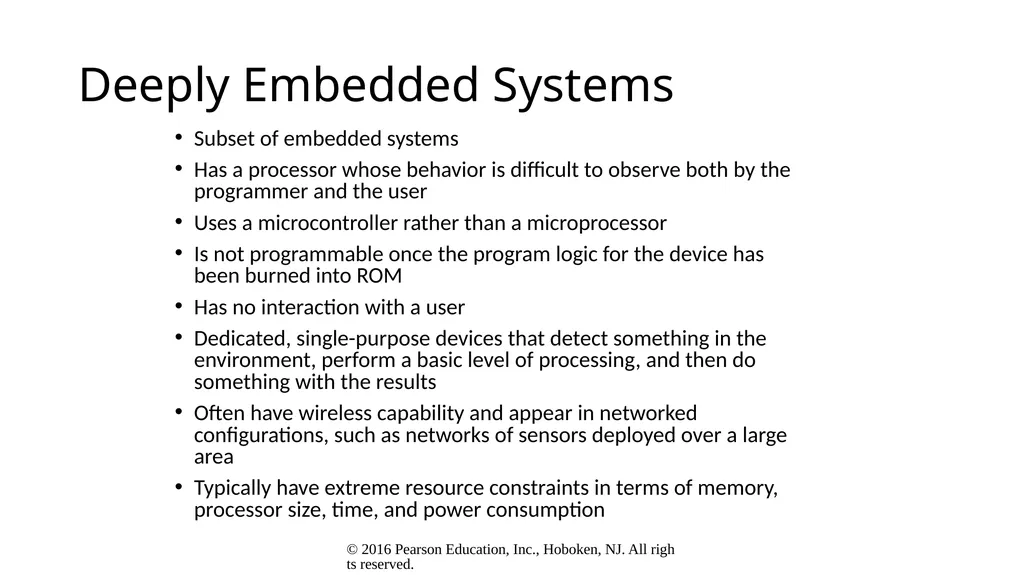
Deeply Embedded Systems Subset of embedded systems
Has a processor whose behavior is difficult to observe both by the programmer and the user
Uses a microcontroller rather than a microprocessor
Is not programmable once the program logic for the device has been burned into ROM
Has no interaction with a user
Dedicated, single-purpose devices that detect something in the environment, perform a basic level of processing, and then do something with the results
Often have wireless capability and appear in networked configurations, such as networks of sensors deployed over a large area
Typically have extreme resource constraints in terms of memory, processor size, time, and power consumption © 2016 Pearson Education, Inc., Hoboken, NJ. All rights reserved.<br>
Has a processor whose behavior is difficult to observe both by the programmer and the user
Uses a microcontroller rather than a microprocessor
Is not programmable once the program logic for the device has been burned into ROM
Has no interaction with a user
Dedicated, single-purpose devices that detect something in the environment, perform a basic level of processing, and then do something with the results
Often have wireless capability and appear in networked configurations, such as networks of sensors deployed over a large area
Typically have extreme resource constraints in terms of memory, processor size, time, and power consumption © 2016 Pearson Education, Inc., Hoboken, NJ. All rights reserved.<br>
46
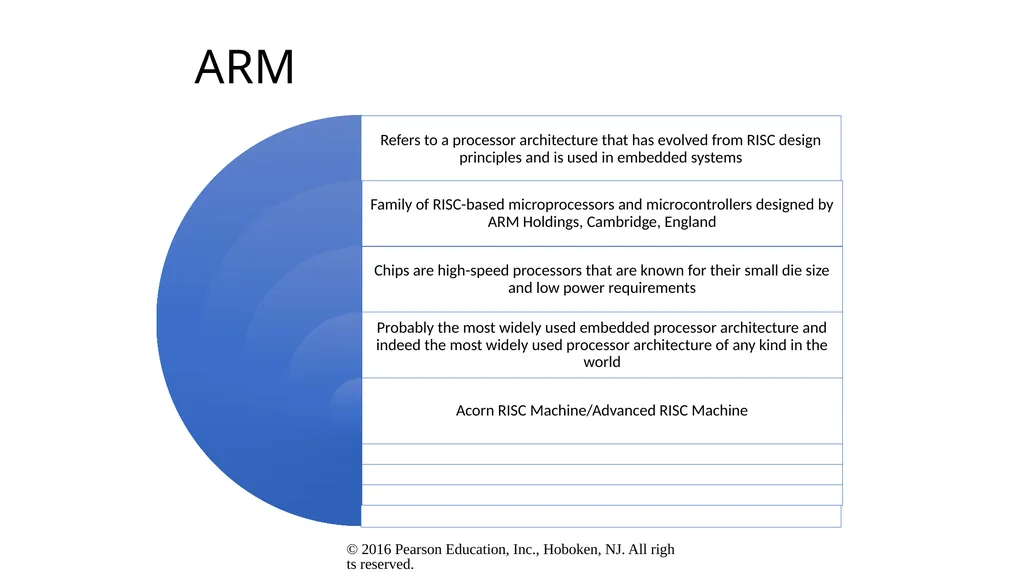
ARM © 2016 Pearson Education, Inc., Hoboken, NJ. All rights reserved.<br>
47
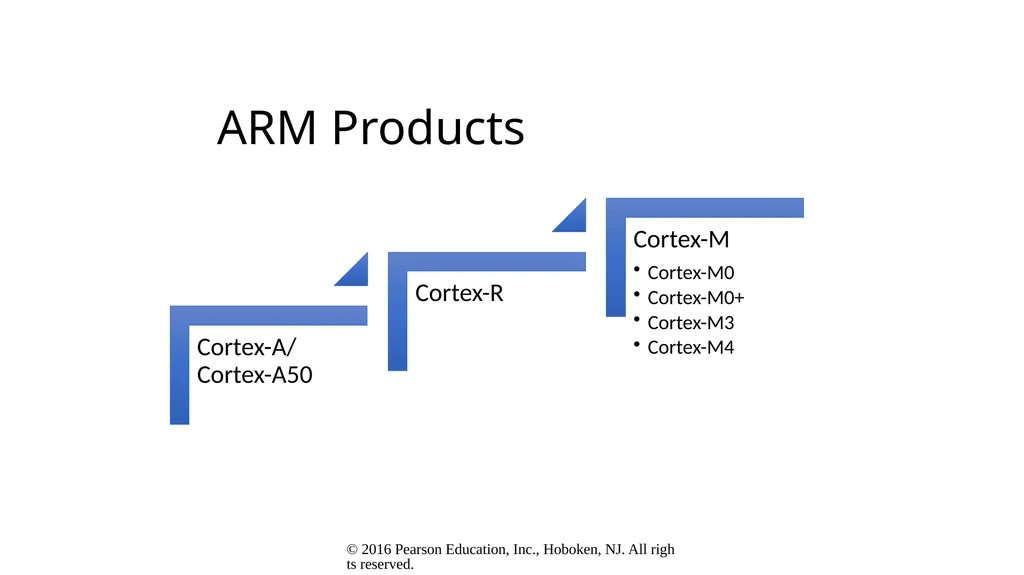
ARM Products © 2016 Pearson Education, Inc., Hoboken, NJ. All rights reserved.<br>
48
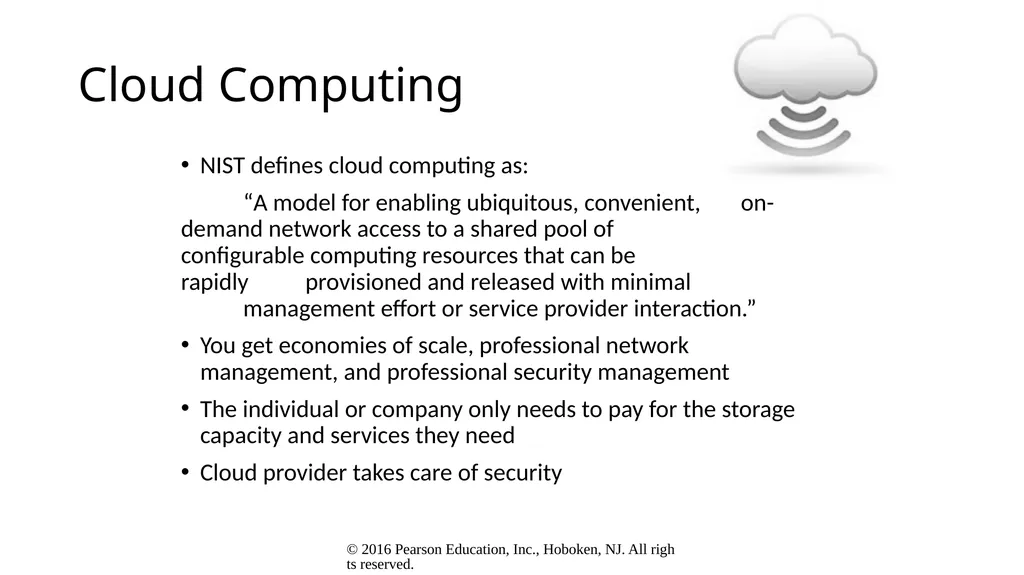
Cloud Computing NIST defines cloud computing as:
“A model for enabling ubiquitous, convenient, on-demand network access to a shared pool of configurable computing resources that can be rapidly provisioned and released with minimal management effort or service provider interaction.”
You get economies of scale, professional network management, and professional security management
The individual or company only needs to pay for the storage capacity and services they need
Cloud provider takes care of security © 2016 Pearson Education, Inc., Hoboken, NJ. All rights reserved.<br>
“A model for enabling ubiquitous, convenient, on-demand network access to a shared pool of configurable computing resources that can be rapidly provisioned and released with minimal management effort or service provider interaction.”
You get economies of scale, professional network management, and professional security management
The individual or company only needs to pay for the storage capacity and services they need
Cloud provider takes care of security © 2016 Pearson Education, Inc., Hoboken, NJ. All rights reserved.<br>
49
Cloud Networking Refers to the networks and network management functionality that must be in place to enable cloud computing
One example is the provisioning of high-performance and/or high-reliability networking between the provider and subscriber
The collection of network capabilities required to access a cloud, including making use of specialized services over the Internet, linking enterprise data center to a cloud, and using firewalls and other network security devices at critical points to enforce access security policies
Cloud Storage
Subset of cloud computing
Consists of database storage and database applications hosted remotely on cloud servers
Enables small businesses and individual users to take advantage of data storage that scales with their needs and to take advantage of a variety of database applications without having to buy, maintain, and manage the storage assets © 2016 Pearson Education, Inc., Hoboken, NJ. All rights reserved.<br>
One example is the provisioning of high-performance and/or high-reliability networking between the provider and subscriber
The collection of network capabilities required to access a cloud, including making use of specialized services over the Internet, linking enterprise data center to a cloud, and using firewalls and other network security devices at critical points to enforce access security policies
Cloud Storage
Subset of cloud computing
Consists of database storage and database applications hosted remotely on cloud servers
Enables small businesses and individual users to take advantage of data storage that scales with their needs and to take advantage of a variety of database applications without having to buy, maintain, and manage the storage assets © 2016 Pearson Education, Inc., Hoboken, NJ. All rights reserved.<br>
50
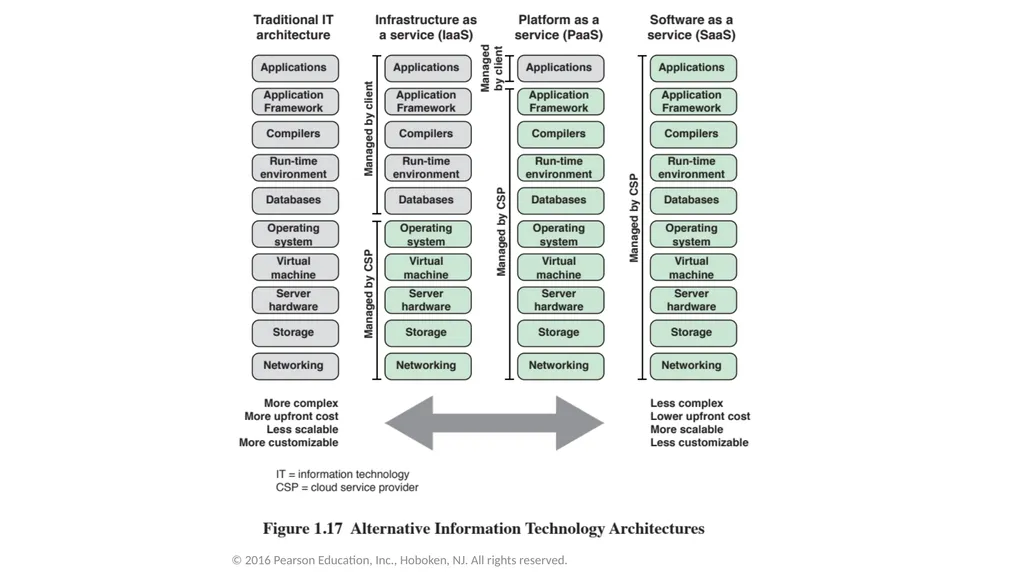
© 2016 Pearson Education, Inc., Hoboken, NJ. All rights reserved.<br>
51
Summary Organization and architecture
Structure and function
Brief history of computers
The First Generation: Vacuum tubes
The Second Generation: Transistors
The Third Generation: Integrated Circuits
Later generations
The evolution of the Intel x86 architecture
Cloud computing
Basic concepts
Cloud services Embedded systems
The Internet of things
Embedded operating systems
Application processors versus dedicated processors
Microprocessors versus microcontrollers
Embedded versus deeply embedded systems
ARM architecture
ARM evolution
Instruction set architecture
ARM products Chapter 1 Basic Concepts and Computer Evolution © 2016 Pearson Education, Inc., Hoboken, NJ. All rights reserved.<br>
Structure and function
Brief history of computers
The First Generation: Vacuum tubes
The Second Generation: Transistors
The Third Generation: Integrated Circuits
Later generations
The evolution of the Intel x86 architecture
Cloud computing
Basic concepts
Cloud services Embedded systems
The Internet of things
Embedded operating systems
Application processors versus dedicated processors
Microprocessors versus microcontrollers
Embedded versus deeply embedded systems
ARM architecture
ARM evolution
Instruction set architecture
ARM products Chapter 1 Basic Concepts and Computer Evolution © 2016 Pearson Education, Inc., Hoboken, NJ. All rights reserved.<br>