
Connecting Indigenous Knowledge and Outdoor
FD
Published · 27 slides · 0 views
1 / 1
Description
Connecting Indigenous Knowledge and Outdoor Learning We will talk about: Pacific Northwest plant Cards Indigenous stories Indigenous resources Engaging Imagination in Ecological Learning (Gillian Judson) and Walkig Curriculum Acknowledging
Related Topics
Download this presentation From Below
"Connecting Indigenous Knowledge and Outdoor" is the property of its rightful owner. Permission is granted to download and print the materials on this website for personal, non-commercial use only, and to display it on your personal computer provided you do not modify the materials and that you retain all copyright notices contained in the materials. By downloading content from our website, you accept the terms of this agreement.
Share
Embed code
Presentation Transcript
01
Connecting Indigenous Knowledge and Outdoor Learning We will talk about:
Pacific Northwest plant Cards
Indigenous stories
Indigenous resources
Engaging Imagination in Ecological Learning (Gillian Judson) and Walkig Curriculum<br>
Pacific Northwest plant Cards
Indigenous stories
Indigenous resources
Engaging Imagination in Ecological Learning (Gillian Judson) and Walkig Curriculum<br>
02
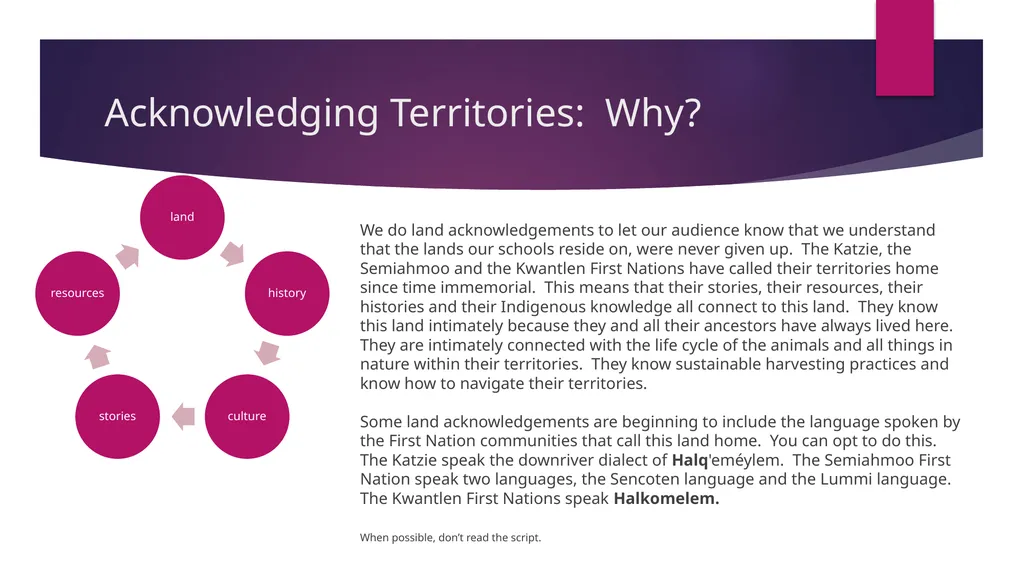
Acknowledging Territories: Why? We do land acknowledgements to let our audience know that we understand that the lands our schools reside on, were never given up. The Katzie, the Semiahmoo and the Kwantlen First Nations have called their territories home since time immemorial. This means that their stories, their resources, their histories and their Indigenous knowledge all connect to this land. They know this land intimately because they and all their ancestors have always lived here. They are intimately connected with the life cycle of the animals and all things in nature within their territories. They know sustainable harvesting practices and know how to navigate their territories.
Some land acknowledgements are beginning to include the language spoken by the First Nation communities that call this land home. You can opt to do this. The Katzie speak the downriver dialect of Halq'eméylem. The Semiahmoo First Nation speak two languages, the Sencoten language and the Lummi language. The Kwantlen First Nations speak Halkomelem.
When possible, don’t read the script.<br>
When possible, don’t read the script.<br>
03
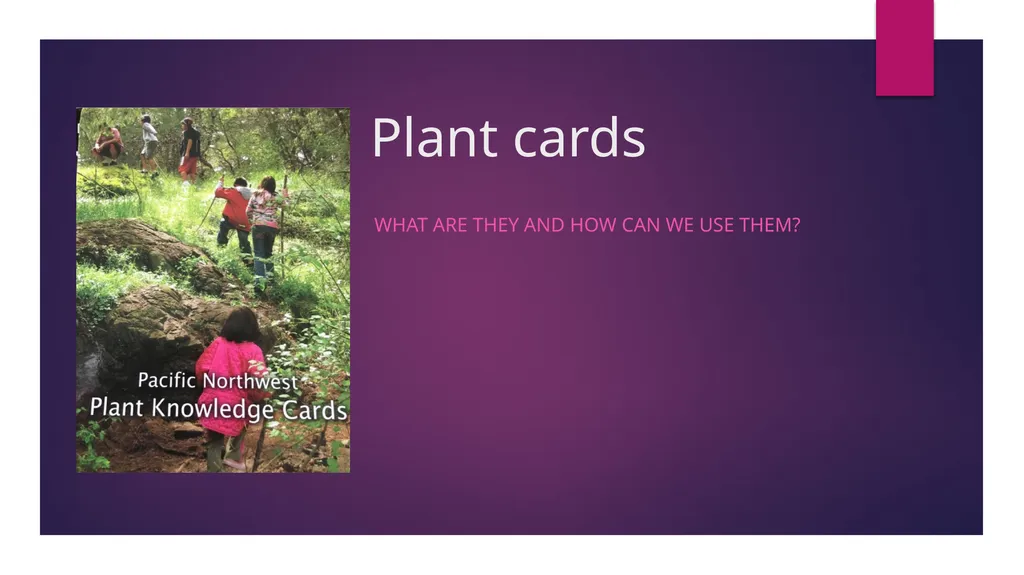
Plant cards What are they and how can we use them?<br>
04
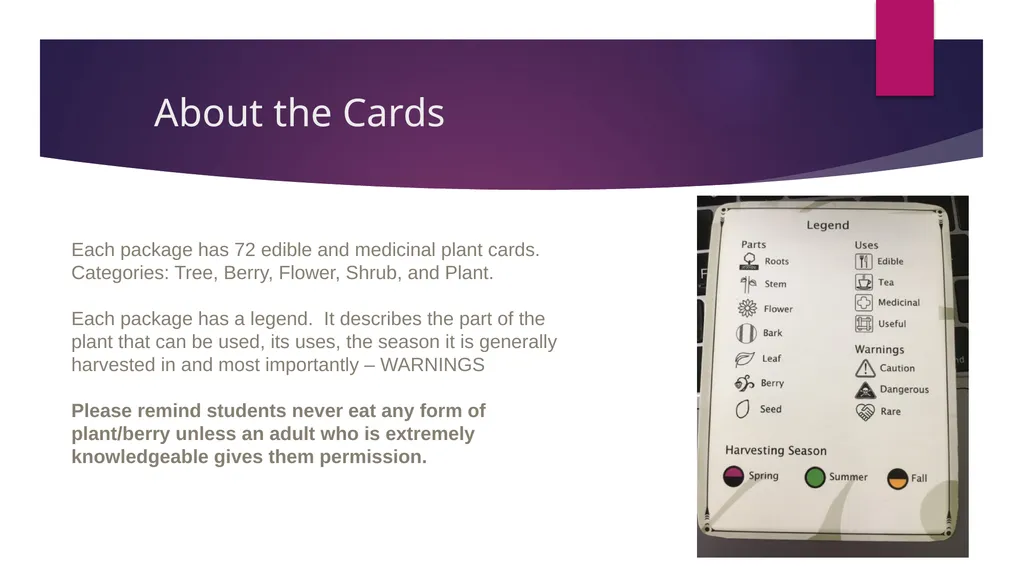
About the Cards Each package has 72 edible and medicinal plant cards. Categories: Tree, Berry, Flower, Shrub, and Plant.
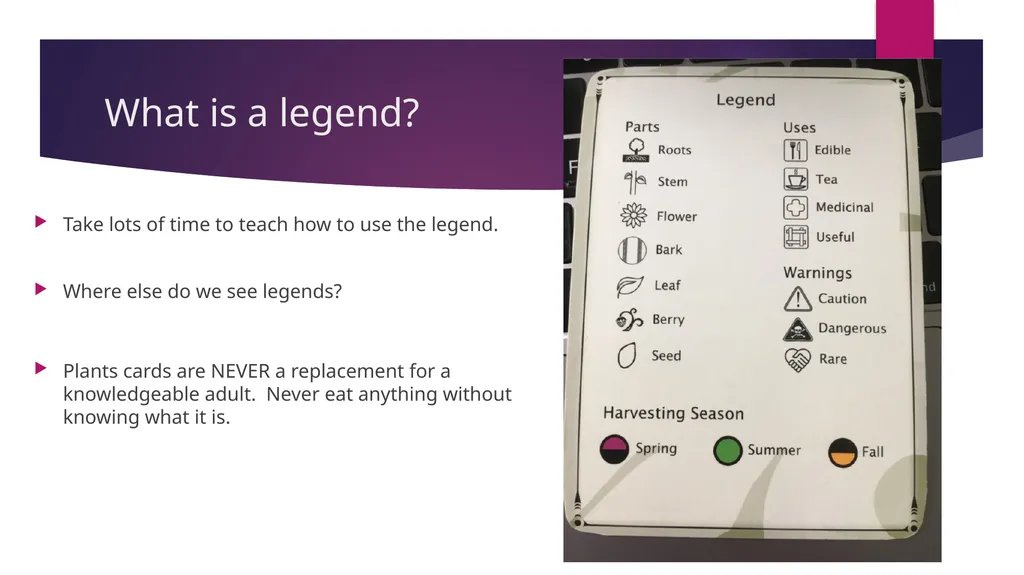
Each package has a legend. It describes the part of the plant that can be used, its uses, the season it is generally harvested in and most importantly – WARNINGS
Please remind students never eat any form of plant/berry unless an adult who is extremely knowledgeable gives them permission.<br>
Each package has a legend. It describes the part of the plant that can be used, its uses, the season it is generally harvested in and most importantly – WARNINGS
Please remind students never eat any form of plant/berry unless an adult who is extremely knowledgeable gives them permission.<br>
05
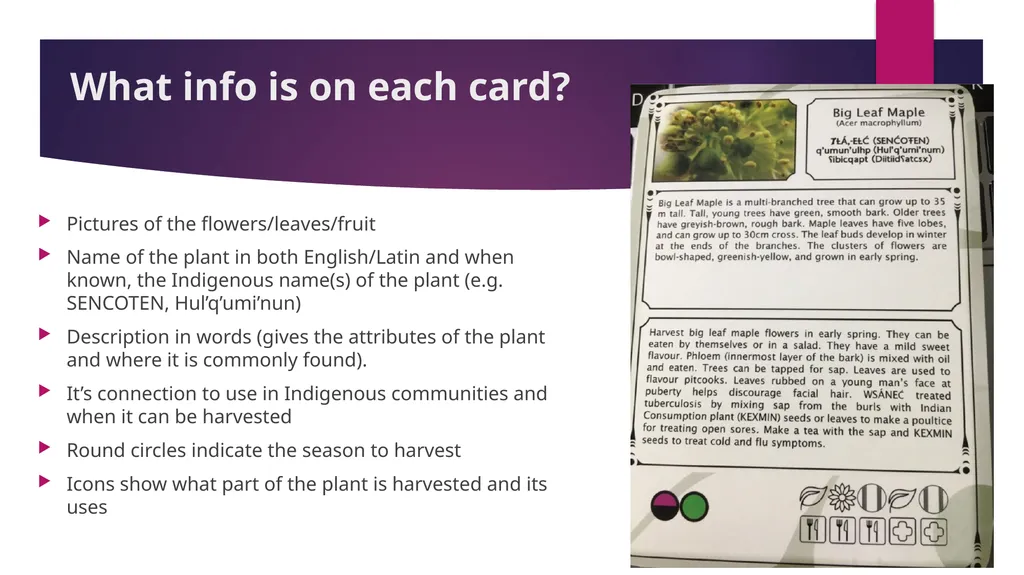
What info is on each card? Pictures of the flowers/leaves/fruit
Name of the plant in both English/Latin and when known, the Indigenous name(s) of the plant (e.g. SENCOTEN, Hul’q’umi’nun)
Description in words (gives the attributes of the plant and where it is commonly found).
It’s connection to use in Indigenous communities and when it can be harvested
Round circles indicate the season to harvest
Icons show what part of the plant is harvested and its uses<br>
Name of the plant in both English/Latin and when known, the Indigenous name(s) of the plant (e.g. SENCOTEN, Hul’q’umi’nun)
Description in words (gives the attributes of the plant and where it is commonly found).
It’s connection to use in Indigenous communities and when it can be harvested
Round circles indicate the season to harvest
Icons show what part of the plant is harvested and its uses<br>
06
Pre-teaching the cards Know the readability of the cards.
These cards are not your only source of information but they are a good introduction to understanding how Indigenous peoples harvested local resources for multiple purposes.
They are an excellent introduction to Indigenous knowledge.<br>
These cards are not your only source of information but they are a good introduction to understanding how Indigenous peoples harvested local resources for multiple purposes.
They are an excellent introduction to Indigenous knowledge.<br>
07
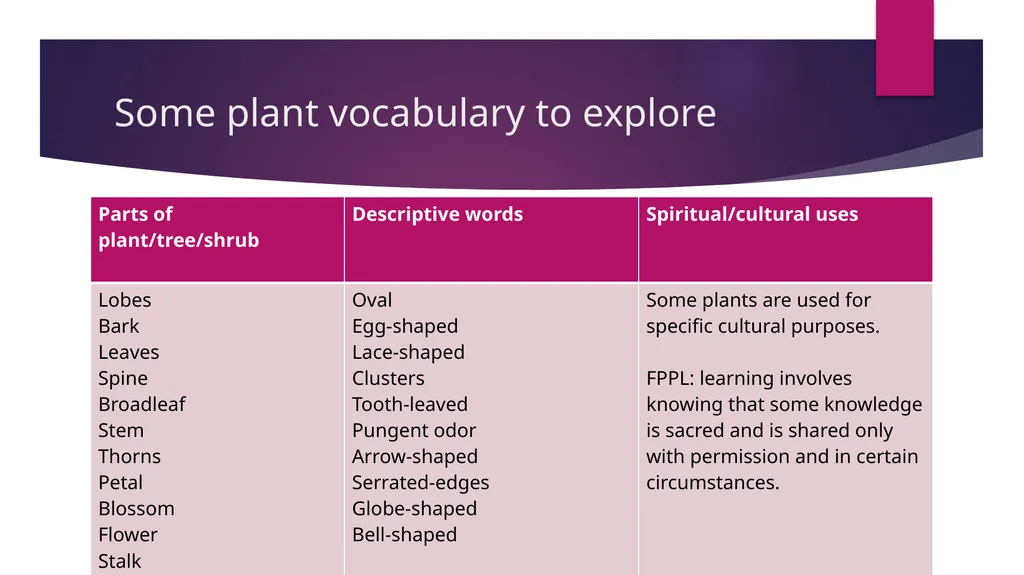
Some plant vocabulary to explore<br>
08
What is a legend? Take lots of time to teach how to use the legend.
Where else do we see legends?
Plants cards are NEVER a replacement for a knowledgeable adult. Never eat anything without knowing what it is.<br>
Where else do we see legends?
Plants cards are NEVER a replacement for a knowledgeable adult. Never eat anything without knowing what it is.<br>
09
Making the Indigenous connection – Indigenous Knowledge Why do the cards have First Nation languages on it?
Why would First Nation people in this area know so much about plants?
How did they know what was safe to eat?
How did they know which plants would work as medicines?
How was this information passed down?
Do First Nation People still harvest plants for food/medicine today?
Tea Blends unit in FNESC Guide<br>
Why would First Nation people in this area know so much about plants?
How did they know what was safe to eat?
How did they know which plants would work as medicines?
How was this information passed down?
Do First Nation People still harvest plants for food/medicine today?
Tea Blends unit in FNESC Guide<br>
10
Know what is growing near your school Take time to survey the things that are living near or around your school. There are apps that can help
Use the plant cards to help
After teaching the students to use the plant cards, have them complete a survey (see attached).
Have intermediate students make their own version of the cards for primary aged students. Use an ipad and an app like book creator to create these cards.<br>
Use the plant cards to help
After teaching the students to use the plant cards, have them complete a survey (see attached).
Have intermediate students make their own version of the cards for primary aged students. Use an ipad and an app like book creator to create these cards.<br>
11
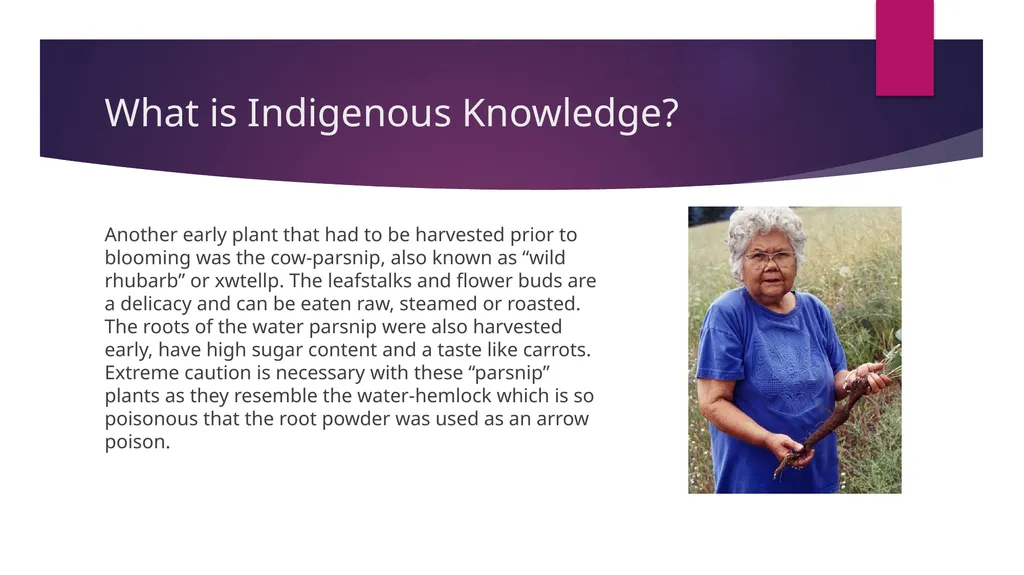
What is Indigenous Knowledge? Another early plant that had to be harvested prior to blooming was the cow-parsnip, also known as “wild rhubarb” or xwtellp. The leafstalks and flower buds are a delicacy and can be eaten raw, steamed or roasted. The roots of the water parsnip were also harvested early, have high sugar content and a taste like carrots. Extreme caution is necessary with these “parsnip” plants as they resemble the water-hemlock which is so poisonous that the root powder was used as an arrow poison.<br>
12
Defining Indigenous Knowledge https://www.ictinc.ca/blog/what-does-indigenous-knowledge-mean
Indigenous peoples have their own ways of knowing, being, valuing and living in this world (Brayboy and Maughan, 2009). Indigenous knowledge represents the local and culturally specific knowledge of a people that is dynamic, adapting over time and place (Battiste, 2005).Oct 16, 2011
The plant Diva video - NFB: https://www.nfb.ca/film/indigenous_plant_diva/<br>
Indigenous peoples have their own ways of knowing, being, valuing and living in this world (Brayboy and Maughan, 2009). Indigenous knowledge represents the local and culturally specific knowledge of a people that is dynamic, adapting over time and place (Battiste, 2005).Oct 16, 2011
The plant Diva video - NFB: https://www.nfb.ca/film/indigenous_plant_diva/<br>
13
Connecting Indigenous Knowledge to Story – IK is shared through story Number of titles in Strong Stories (Berries of the Dakelh Territory, Berry Picking with Atsoo, The Story of the Tamarack Tree, Metis and Dandelions, Pemmican Berries, Our Traditional Medicines, The Cedar Tree Our Culture Our Tree, Traditional Berry Picking)
Cedar: The Tree of Life (Strong Readers: 11- 20 set)
The Little Cedar Tree (Strong Readers: Set A: Level 7)
The Old Cedar Tree (Strong Readers: Level 15)
Look on ARC: https://aboriginalresourcesforteachers.weebly.com/resource-centre.html<br>
Cedar: The Tree of Life (Strong Readers: 11- 20 set)
The Little Cedar Tree (Strong Readers: Set A: Level 7)
The Old Cedar Tree (Strong Readers: Level 15)
Look on ARC: https://aboriginalresourcesforteachers.weebly.com/resource-centre.html<br>
14
More Resources Stand Like a Cedar – Nicola I. Campbell
The Sasquatch, the Fire and the Cedar Baskets – Joseph Dandurand
Acorns for Wilaiya, Nadine McSpadden
Can You Hear The Trees Talking – peter Wohlleben
A Walk In the Forest, Maria Dek
The Secret Life of Trees<br>
The Sasquatch, the Fire and the Cedar Baskets – Joseph Dandurand
Acorns for Wilaiya, Nadine McSpadden
Can You Hear The Trees Talking – peter Wohlleben
A Walk In the Forest, Maria Dek
The Secret Life of Trees<br>
15
Some Other Resources - Trees, plants First Nations Science and Ethnobotany Unit – K – 10
Medicines to Help Us Kit (Métis Resource)
Sannich Ethnobotany, Culturally Important plants of the WSANEC People
Science First Peoples Teachers Resource (FNESC)
Numerous apps available for plants, trees, mushrooms and more.
Food Plants of Coastal First Peoples by Nancy Turner
Edible and Medicinal Flora of the West Coast by Collin Varner
Pacific Northwest plant Cards<br>
Medicines to Help Us Kit (Métis Resource)
Sannich Ethnobotany, Culturally Important plants of the WSANEC People
Science First Peoples Teachers Resource (FNESC)
Numerous apps available for plants, trees, mushrooms and more.
Food Plants of Coastal First Peoples by Nancy Turner
Edible and Medicinal Flora of the West Coast by Collin Varner
Pacific Northwest plant Cards<br>
16
DCF Videos https://aboriginalresourcesforteachers.weebly.com/videos-from-our-dcf.html Cedar Harvesting: https://aboriginalresourcesforteachers.weebly.com/videos-from-our-dcf.html#cedarharvesting
Working with Cedar: https://aboriginalresourcesforteachers.weebly.com/videos-from-our-dcf.html#Working%20With%20Cedar
More about Cedar: https://aboriginalresourcesforteachers.weebly.com/videos-from-our-dcf.html#morecedar<br>
Working with Cedar: https://aboriginalresourcesforteachers.weebly.com/videos-from-our-dcf.html#Working%20With%20Cedar
More about Cedar: https://aboriginalresourcesforteachers.weebly.com/videos-from-our-dcf.html#morecedar<br>
17
To carry on this work, ‘A Walking Curriculum’ by Gillian Judson Evoking Wonder and Developing Sense of Place
Later, we will address ‘connecting place’ from an Indigenous Perspective.
When students connect to ‘place’, they develop a desire to serve as stewards of the land.
become familiar with all the plants, animals, birds, trees, and ecosystems living within that ‘place’.
Become keenly aware of the small changes that occur based on time of year, human impact
Most importantly, they can create their own stories related to this place.<br>
Later, we will address ‘connecting place’ from an Indigenous Perspective.
When students connect to ‘place’, they develop a desire to serve as stewards of the land.
become familiar with all the plants, animals, birds, trees, and ecosystems living within that ‘place’.
Become keenly aware of the small changes that occur based on time of year, human impact
Most importantly, they can create their own stories related to this place.<br>
18
Why the Walking Curriculum? The Walking Curriculum … engages the body, emotions and imagination in ways that can increase students’ familiarity with the local natural context in which they go to school;
increase students’ attention to detail and their attunement with Place;
connects Place-based learning activities with cross-curricular goals;
serves as examples for your own, Place-inspired teaching ideas. (pg. 3)<br>
increase students’ attention to detail and their attunement with Place;
connects Place-based learning activities with cross-curricular goals;
serves as examples for your own, Place-inspired teaching ideas. (pg. 3)<br>
19
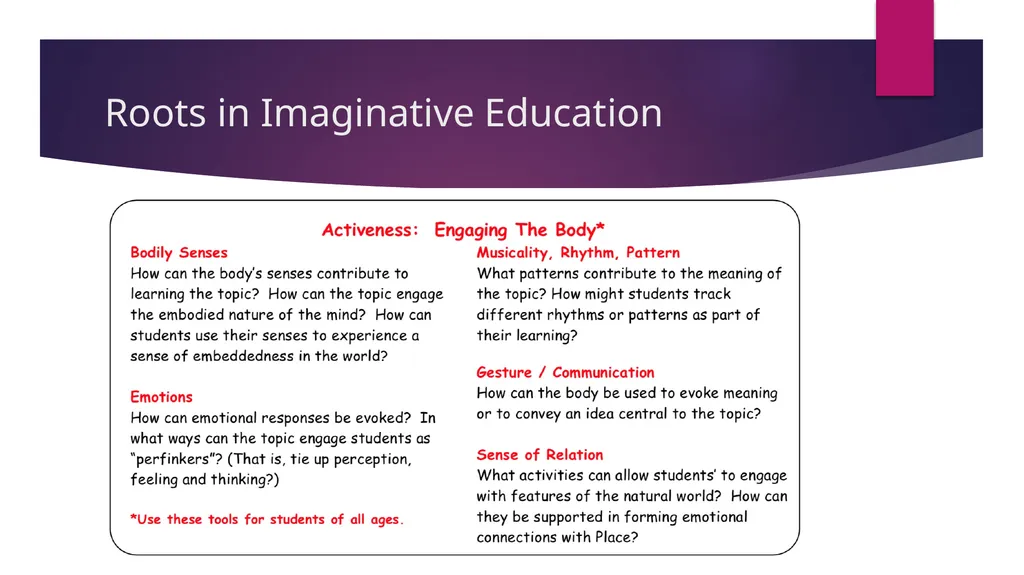
Roots in Imaginative Education<br>
20
Indigenizing Sense of Place
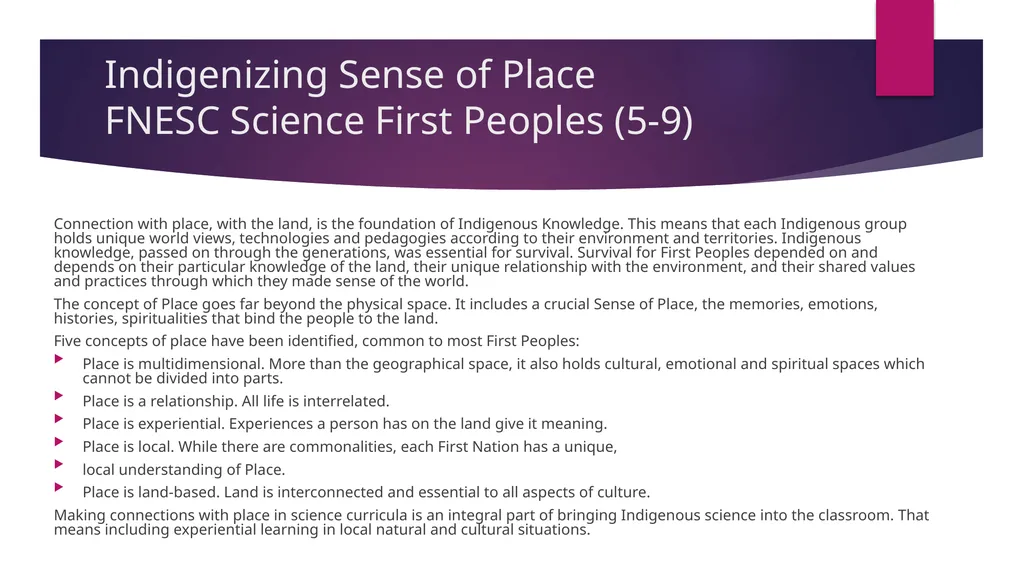
FNESC Science First Peoples (5-9) Connection with place, with the land, is the foundation of Indigenous Knowledge. This means that each Indigenous group holds unique world views, technologies and pedagogies according to their environment and territories. Indigenous knowledge, passed on through the generations, was essential for survival. Survival for First Peoples depended on and depends on their particular knowledge of the land, their unique relationship with the environment, and their shared values and practices through which they made sense of the world.
The concept of Place goes far beyond the physical space. It includes a crucial Sense of Place, the memories, emotions, histories, spiritualities that bind the people to the land.
Five concepts of place have been identified, common to most First Peoples:
Place is multidimensional. More than the geographical space, it also holds cultural, emotional and spiritual spaces which cannot be divided into parts.
Place is a relationship. All life is interrelated.
Place is experiential. Experiences a person has on the land give it meaning.
Place is local. While there are commonalities, each First Nation has a unique,
local understanding of Place.
Place is land-based. Land is interconnected and essential to all aspects of culture.
Making connections with place in science curricula is an integral part of bringing Indigenous science into the classroom. That means including experiential learning in local natural and cultural situations.<br>
The concept of Place goes far beyond the physical space. It includes a crucial Sense of Place, the memories, emotions, histories, spiritualities that bind the people to the land.
Five concepts of place have been identified, common to most First Peoples:
Place is multidimensional. More than the geographical space, it also holds cultural, emotional and spiritual spaces which cannot be divided into parts.
Place is a relationship. All life is interrelated.
Place is experiential. Experiences a person has on the land give it meaning.
Place is local. While there are commonalities, each First Nation has a unique,
local understanding of Place.
Place is land-based. Land is interconnected and essential to all aspects of culture.
Making connections with place in science curricula is an integral part of bringing Indigenous science into the classroom. That means including experiential learning in local natural and cultural situations.<br>
21
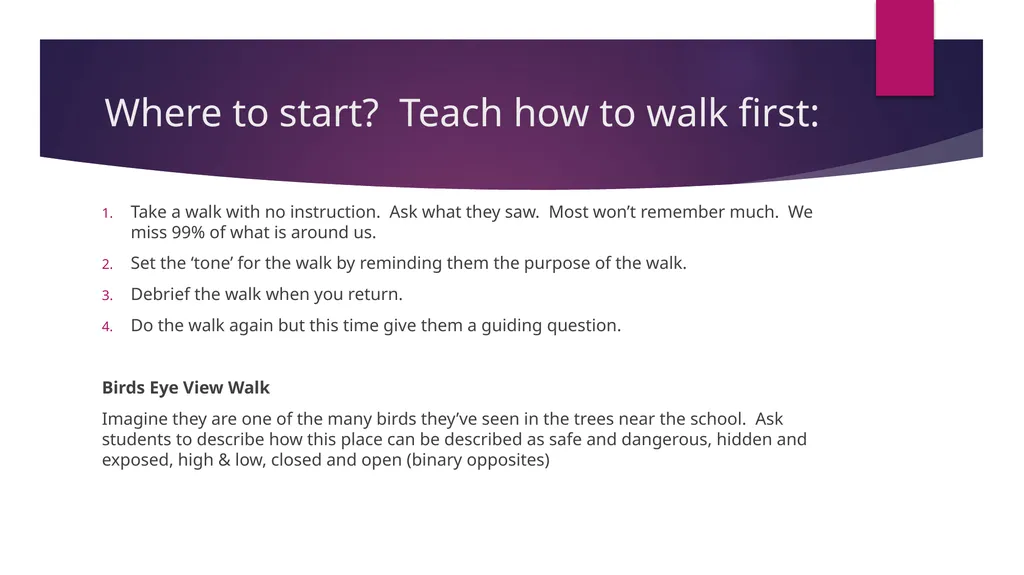
Where to start? Teach how to walk first: Take a walk with no instruction. Ask what they saw. Most won’t remember much. We miss 99% of what is around us.
Set the ‘tone’ for the walk by reminding them the purpose of the walk.
Debrief the walk when you return.
Do the walk again but this time give them a guiding question.
Birds Eye View Walk
Imagine they are one of the many birds they’ve seen in the trees near the school. Ask students to describe how this place can be described as safe and dangerous, hidden and exposed, high & low, closed and open (binary opposites)<br>
Set the ‘tone’ for the walk by reminding them the purpose of the walk.
Debrief the walk when you return.
Do the walk again but this time give them a guiding question.
Birds Eye View Walk
Imagine they are one of the many birds they’ve seen in the trees near the school. Ask students to describe how this place can be described as safe and dangerous, hidden and exposed, high & low, closed and open (binary opposites)<br>
22
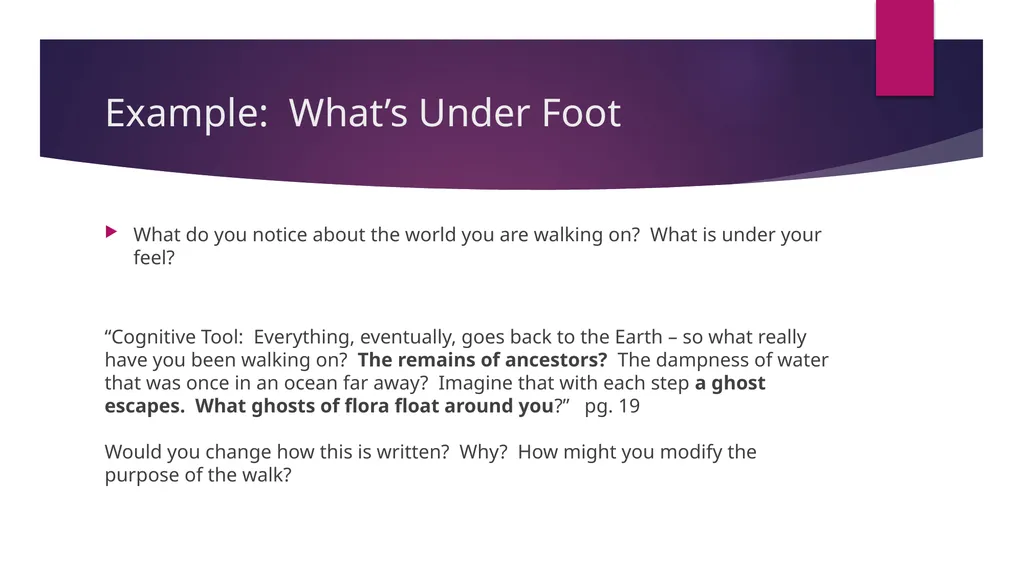
Example: What’s Under Foot What do you notice about the world you are walking on? What is under your feel?
“Cognitive Tool: Everything, eventually, goes back to the Earth – so what really have you been walking on? The remains of ancestors? The dampness of water that was once in an ocean far away? Imagine that with each step a ghost escapes. What ghosts of flora float around you?” pg. 19 Would you change how this is written? Why? How might you modify the purpose of the walk?<br>
“Cognitive Tool: Everything, eventually, goes back to the Earth – so what really have you been walking on? The remains of ancestors? The dampness of water that was once in an ocean far away? Imagine that with each step a ghost escapes. What ghosts of flora float around you?” pg. 19 Would you change how this is written? Why? How might you modify the purpose of the walk?<br>
23
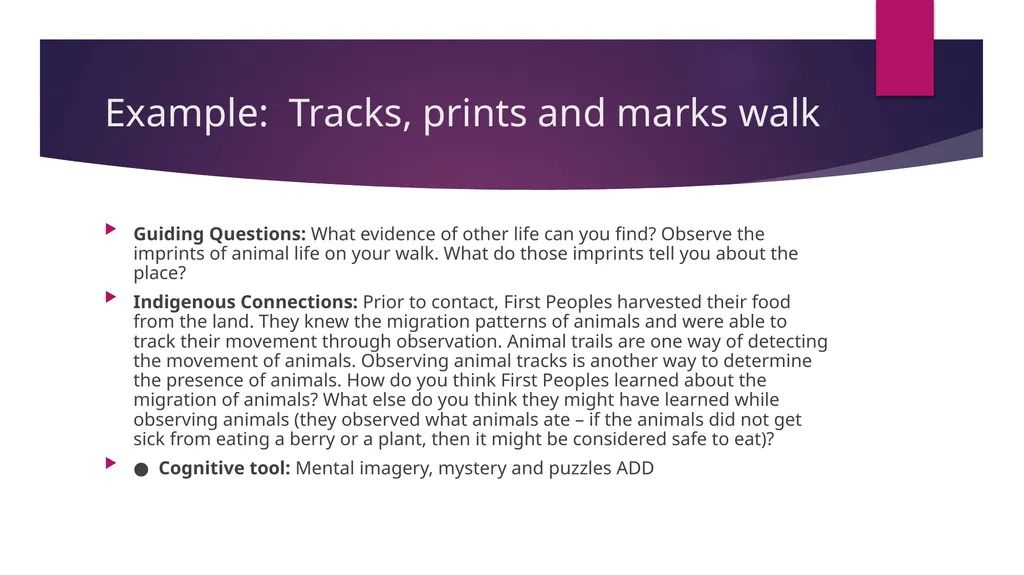
Example: Tracks, prints and marks walk Guiding Questions: What evidence of other life can you find? Observe the imprints of animal life on your walk. What do those imprints tell you about the place?
Indigenous Connections: Prior to contact, First Peoples harvested their food from the land. They knew the migration patterns of animals and were able to track their movement through observation. Animal trails are one way of detecting the movement of animals. Observing animal tracks is another way to determine the presence of animals. How do you think First Peoples learned about the migration of animals? What else do you think they might have learned while observing animals (they observed what animals ate – if the animals did not get sick from eating a berry or a plant, then it might be considered safe to eat)?
● Cognitive tool: Mental imagery, mystery and puzzles ADD<br>
Indigenous Connections: Prior to contact, First Peoples harvested their food from the land. They knew the migration patterns of animals and were able to track their movement through observation. Animal trails are one way of detecting the movement of animals. Observing animal tracks is another way to determine the presence of animals. How do you think First Peoples learned about the migration of animals? What else do you think they might have learned while observing animals (they observed what animals ate – if the animals did not get sick from eating a berry or a plant, then it might be considered safe to eat)?
● Cognitive tool: Mental imagery, mystery and puzzles ADD<br>
24
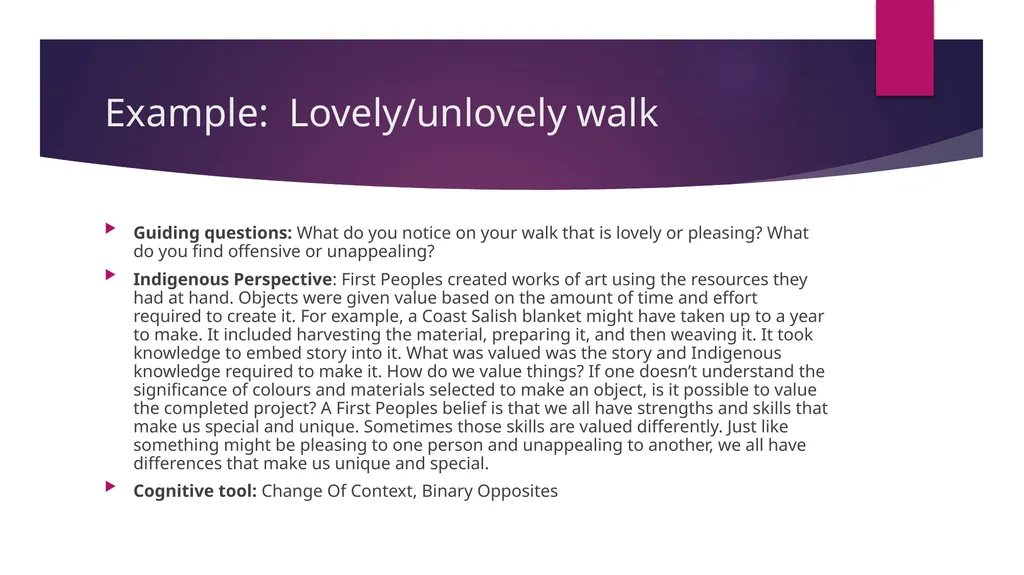
Example: Lovely/unlovely walk Guiding questions: What do you notice on your walk that is lovely or pleasing? What do you find offensive or unappealing?
Indigenous Perspective: First Peoples created works of art using the resources they had at hand. Objects were given value based on the amount of time and effort required to create it. For example, a Coast Salish blanket might have taken up to a year to make. It included harvesting the material, preparing it, and then weaving it. It took knowledge to embed story into it. What was valued was the story and Indigenous knowledge required to make it. How do we value things? If one doesn’t understand the significance of colours and materials selected to make an object, is it possible to value the completed project? A First Peoples belief is that we all have strengths and skills that make us special and unique. Sometimes those skills are valued differently. Just like something might be pleasing to one person and unappealing to another, we all have differences that make us unique and special.
Cognitive tool: Change Of Context, Binary Opposites<br>
Indigenous Perspective: First Peoples created works of art using the resources they had at hand. Objects were given value based on the amount of time and effort required to create it. For example, a Coast Salish blanket might have taken up to a year to make. It included harvesting the material, preparing it, and then weaving it. It took knowledge to embed story into it. What was valued was the story and Indigenous knowledge required to make it. How do we value things? If one doesn’t understand the significance of colours and materials selected to make an object, is it possible to value the completed project? A First Peoples belief is that we all have strengths and skills that make us special and unique. Sometimes those skills are valued differently. Just like something might be pleasing to one person and unappealing to another, we all have differences that make us unique and special.
Cognitive tool: Change Of Context, Binary Opposites<br>
25
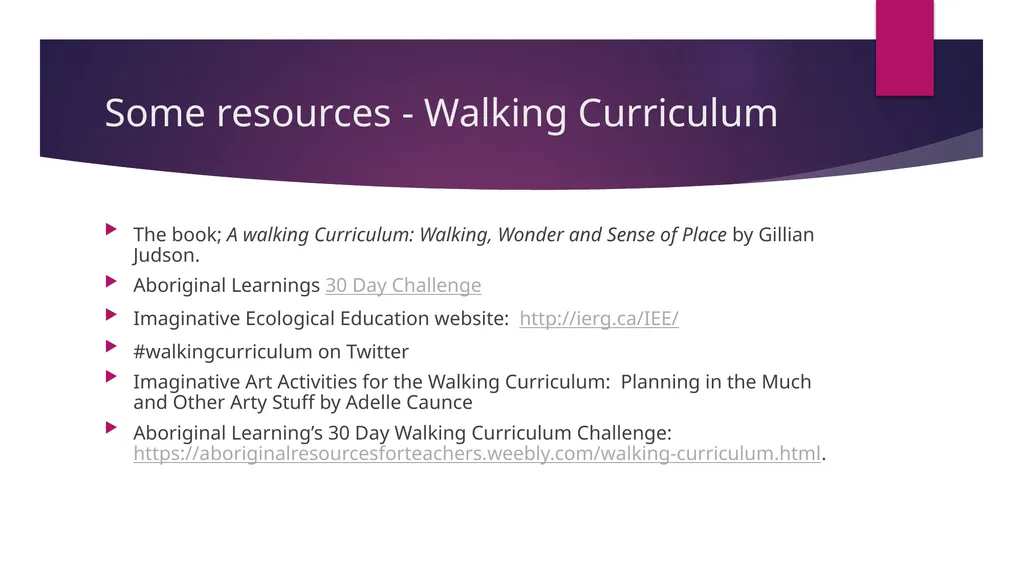
Some resources - Walking Curriculum The book; A walking Curriculum: Walking, Wonder and Sense of Place by Gillian Judson.
Aboriginal Learnings 30 Day Challenge
Imaginative Ecological Education website: http://ierg.ca/IEE/
#walkingcurriculum on Twitter
Imaginative Art Activities for the Walking Curriculum: Planning in the Much and Other Arty Stuff by Adelle Caunce
Aboriginal Learning’s 30 Day Walking Curriculum Challenge: https://aboriginalresourcesforteachers.weebly.com/walking-curriculum.html.<br>
Aboriginal Learnings 30 Day Challenge
Imaginative Ecological Education website: http://ierg.ca/IEE/
#walkingcurriculum on Twitter
Imaginative Art Activities for the Walking Curriculum: Planning in the Much and Other Arty Stuff by Adelle Caunce
Aboriginal Learning’s 30 Day Walking Curriculum Challenge: https://aboriginalresourcesforteachers.weebly.com/walking-curriculum.html.<br>
26
Another Good Resource! Engaging Imagination in Ecological Education, Gillian Judson<br>
27
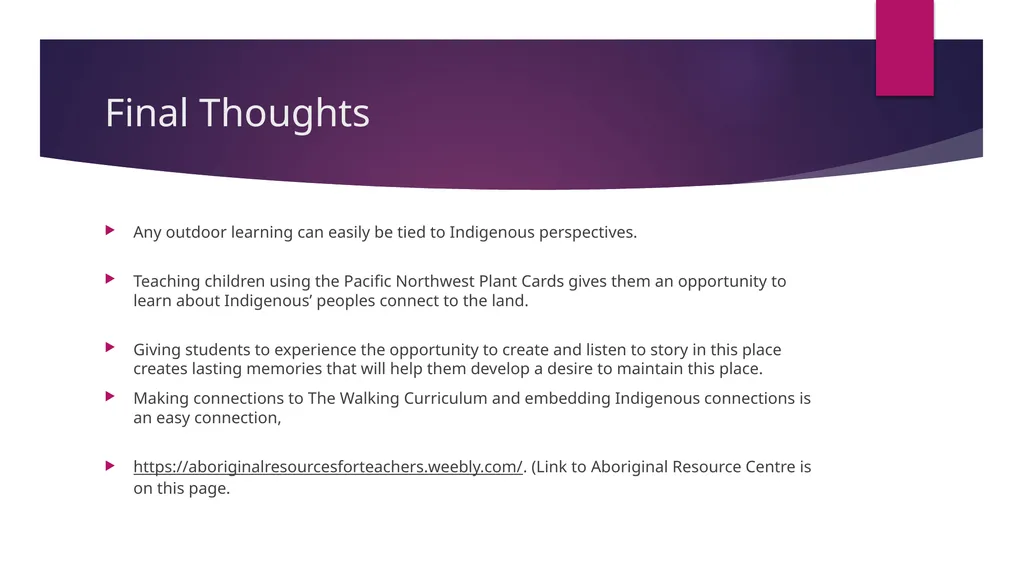
Final Thoughts Any outdoor learning can easily be tied to Indigenous perspectives.
Teaching children using the Pacific Northwest Plant Cards gives them an opportunity to learn about Indigenous’ peoples connect to the land.
Giving students to experience the opportunity to create and listen to story in this place creates lasting memories that will help them develop a desire to maintain this place.
Making connections to The Walking Curriculum and embedding Indigenous connections is an easy connection,
https://aboriginalresourcesforteachers.weebly.com/. (Link to Aboriginal Resource Centre is on this page.<br>
Teaching children using the Pacific Northwest Plant Cards gives them an opportunity to learn about Indigenous’ peoples connect to the land.
Giving students to experience the opportunity to create and listen to story in this place creates lasting memories that will help them develop a desire to maintain this place.
Making connections to The Walking Curriculum and embedding Indigenous connections is an easy connection,
https://aboriginalresourcesforteachers.weebly.com/. (Link to Aboriginal Resource Centre is on this page.<br>