
Contents Aims Learning outcome 1 – be able to use
CS
Published · 26 slides · 0 views

1 / 1
Description
Contents Aims Learning outcome 1 be able to use skills, techniques and tactics strategies compositional ideas as an individual performer in a sporting activity Learning outcome 2 be able to use skills, techniques and tactics
Related Topics
Share
Embed code
Download this presentation From Below
"Contents Aims Learning outcome 1 – be able to use" is the property of its rightful owner. Permission is granted to download and print the materials on this website for personal, non-commercial use only, and to display it on your personal computer provided you do not modify the materials and that you retain all copyright notices contained in the materials. By downloading content from our website, you accept the terms of this agreement.
Presentation Transcript
01
Contents Aims
Learning outcome 1 – be able to use skills, techniques and tactics / strategies / compositional ideas as an individual performer in a sporting activity
Learning outcome 2 – be able to use skills, techniques and tactics / strategies / compositional ideas as a team performer in sporting activity
Learning outcome 3 – be able to officiate in a sporting activity
Learning outcome 4 – be able to apply practice methods to support improvement in a sporting activity<br>
Learning outcome 1 – be able to use skills, techniques and tactics / strategies / compositional ideas as an individual performer in a sporting activity
Learning outcome 2 – be able to use skills, techniques and tactics / strategies / compositional ideas as a team performer in sporting activity
Learning outcome 3 – be able to officiate in a sporting activity
Learning outcome 4 – be able to apply practice methods to support improvement in a sporting activity<br>
02
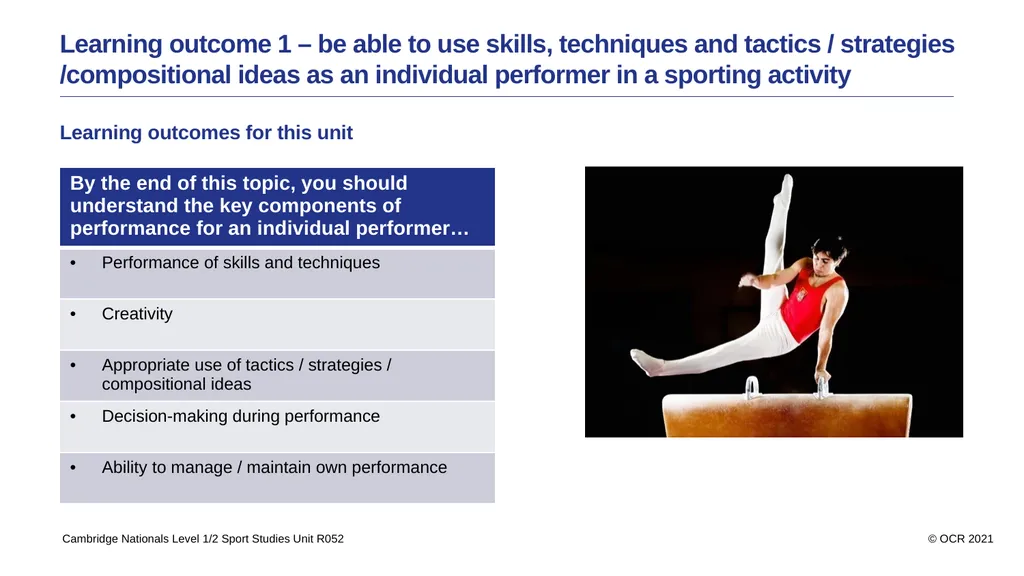
Learning outcome 1 – be able to use skills, techniques and tactics / strategies /compositional ideas as an individual performer in a sporting activity Learning outcomes for this unit<br>
03
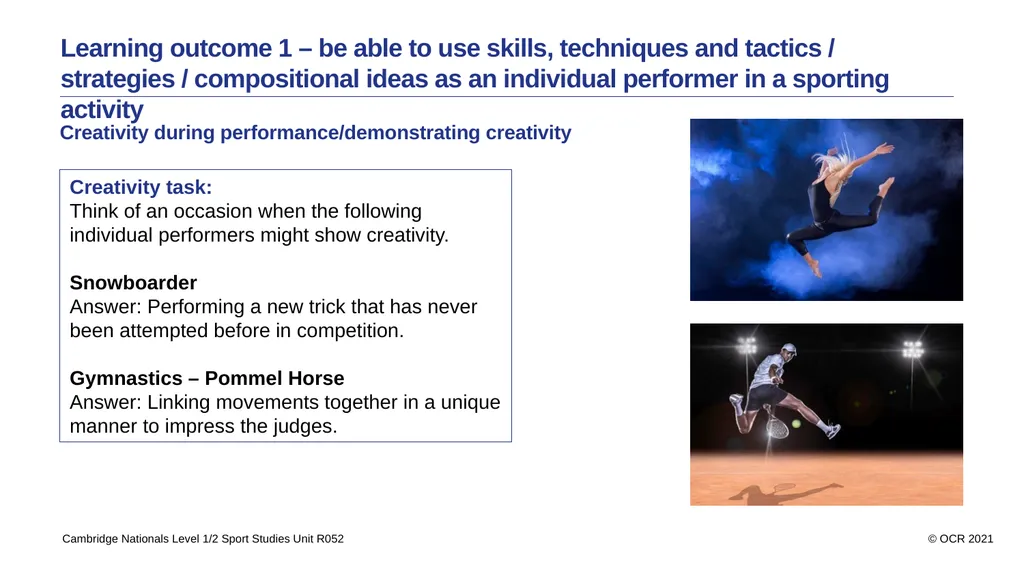
Learning outcome 1 – be able to use skills, techniques and tactics / strategies / compositional ideas as an individual performer in a sporting activity Creativity during performance/demonstrating creativity Creativity task:
Think of an occasion when the following individual performers might show creativity.
Snowboarder
Answer: Performing a new trick that has never been attempted before in competition.
Gymnastics – Pommel Horse
Answer: Linking movements together in a unique manner to impress the judges.<br>
Think of an occasion when the following individual performers might show creativity.
Snowboarder
Answer: Performing a new trick that has never been attempted before in competition.
Gymnastics – Pommel Horse
Answer: Linking movements together in a unique manner to impress the judges.<br>
04
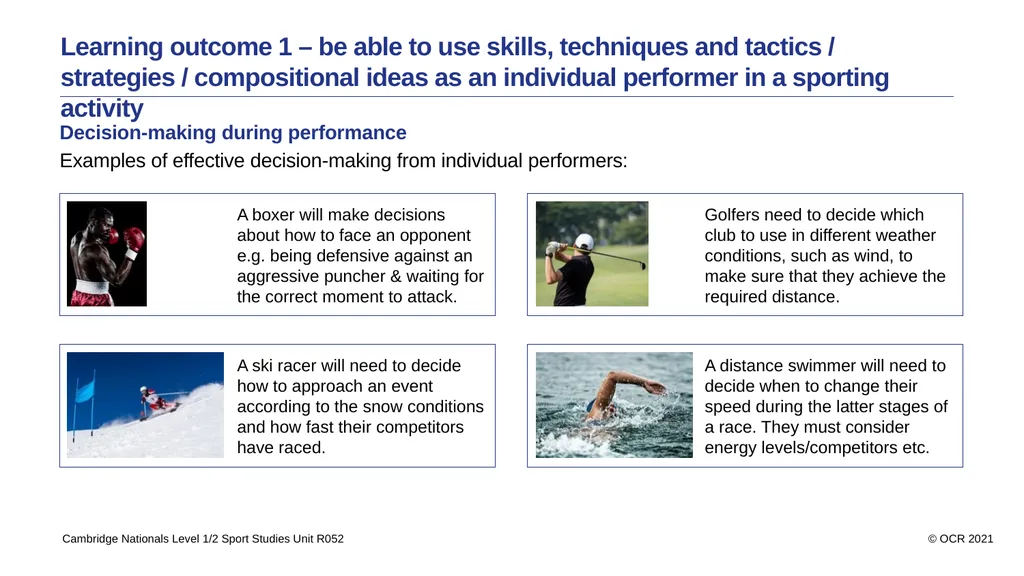
Learning outcome 1 – be able to use skills, techniques and tactics / strategies / compositional ideas as an individual performer in a sporting activity Decision-making during performance
Examples of effective decision-making from individual performers: A boxer will make decisions about how to face an opponent e.g. being defensive against an aggressive puncher & waiting for the correct moment to attack. Golfers need to decide which club to use in different weather conditions, such as wind, to make sure that they achieve the required distance. A ski racer will need to decide how to approach an event according to the snow conditions and how fast their competitors have raced. A distance swimmer will need to decide when to change their speed during the latter stages of a race. They must consider energy levels/competitors etc.<br>
Examples of effective decision-making from individual performers: A boxer will make decisions about how to face an opponent e.g. being defensive against an aggressive puncher & waiting for the correct moment to attack. Golfers need to decide which club to use in different weather conditions, such as wind, to make sure that they achieve the required distance. A ski racer will need to decide how to approach an event according to the snow conditions and how fast their competitors have raced. A distance swimmer will need to decide when to change their speed during the latter stages of a race. They must consider energy levels/competitors etc.<br>
05
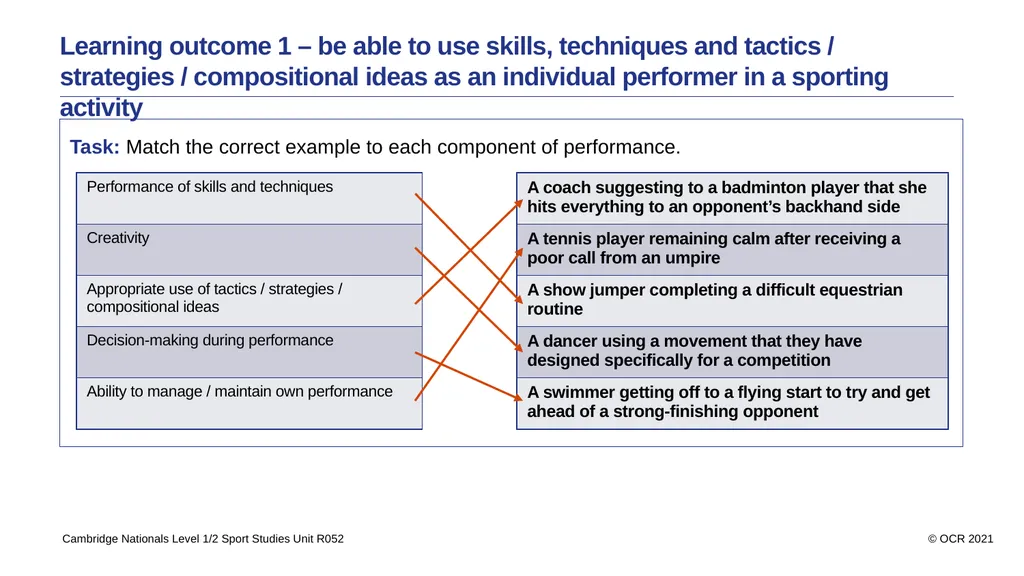
Learning outcome 1 – be able to use skills, techniques and tactics / strategies / compositional ideas as an individual performer in a sporting activity Task: Match the correct example to each component of performance.<br>
06
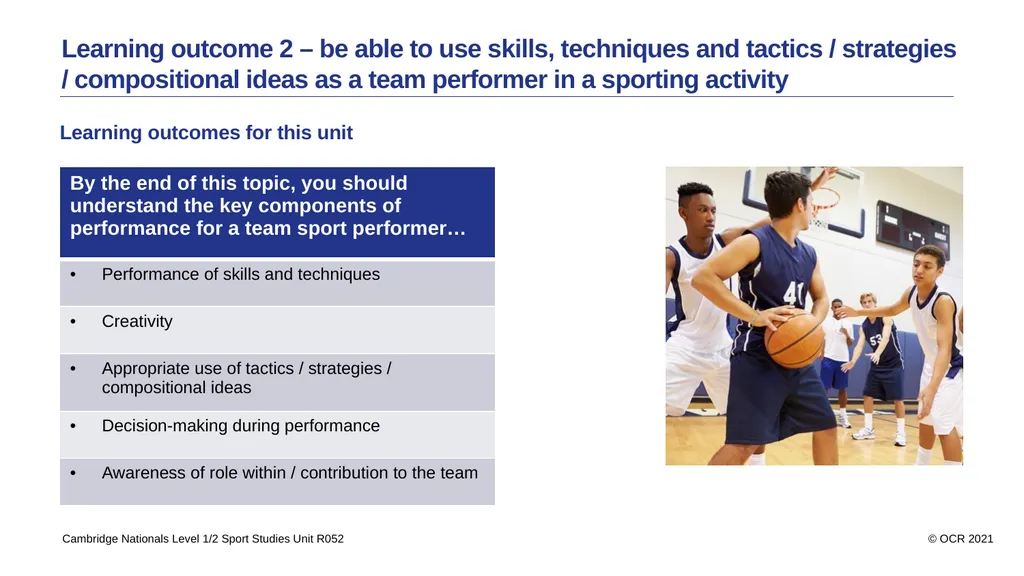
Learning outcome 2 – be able to use skills, techniques and tactics / strategies / compositional ideas as a team performer in a sporting activity Learning outcomes for this unit<br>
07
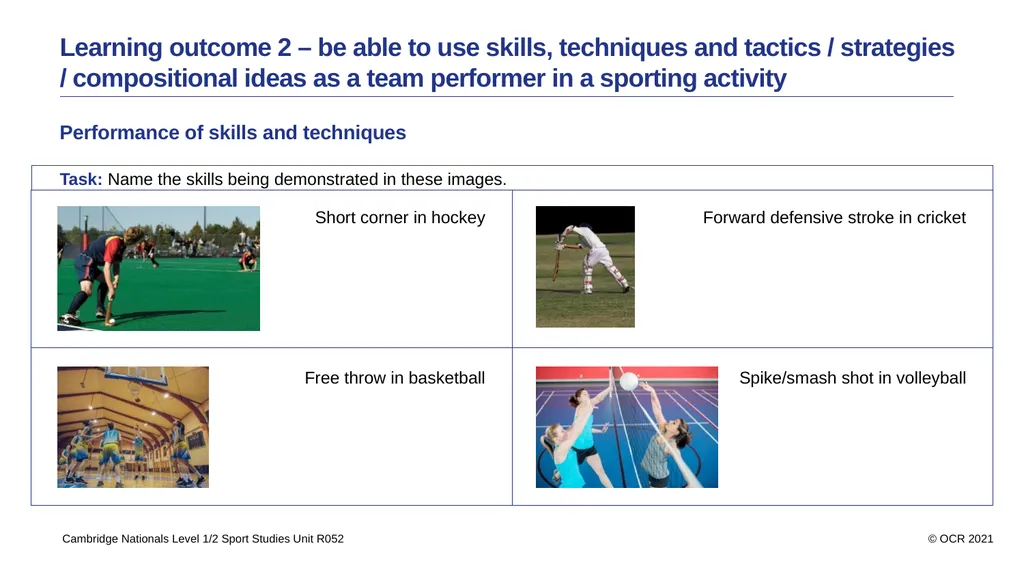
Learning outcome 2 – be able to use skills, techniques and tactics / strategies / compositional ideas as a team performer in a sporting activity Performance of skills and techniques Task: Name the skills being demonstrated in these images. Short corner in hockey Free throw in basketball Spike/smash shot in volleyball Forward defensive stroke in cricket<br>
08
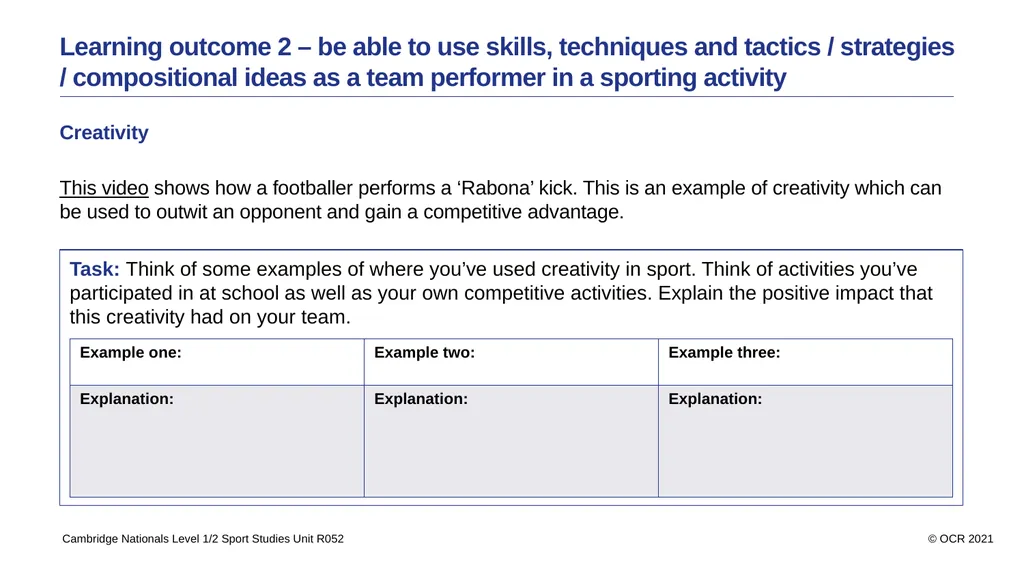
Learning outcome 2 – be able to use skills, techniques and tactics / strategies / compositional ideas as a team performer in a sporting activity Creativity
This video shows how a footballer performs a ‘Rabona’ kick. This is an example of creativity which can be used to outwit an opponent and gain a competitive advantage. Task: Think of some examples of where you’ve used creativity in sport. Think of activities you’ve participated in at school as well as your own competitive activities. Explain the positive impact that this creativity had on your team.<br>
This video shows how a footballer performs a ‘Rabona’ kick. This is an example of creativity which can be used to outwit an opponent and gain a competitive advantage. Task: Think of some examples of where you’ve used creativity in sport. Think of activities you’ve participated in at school as well as your own competitive activities. Explain the positive impact that this creativity had on your team.<br>
09
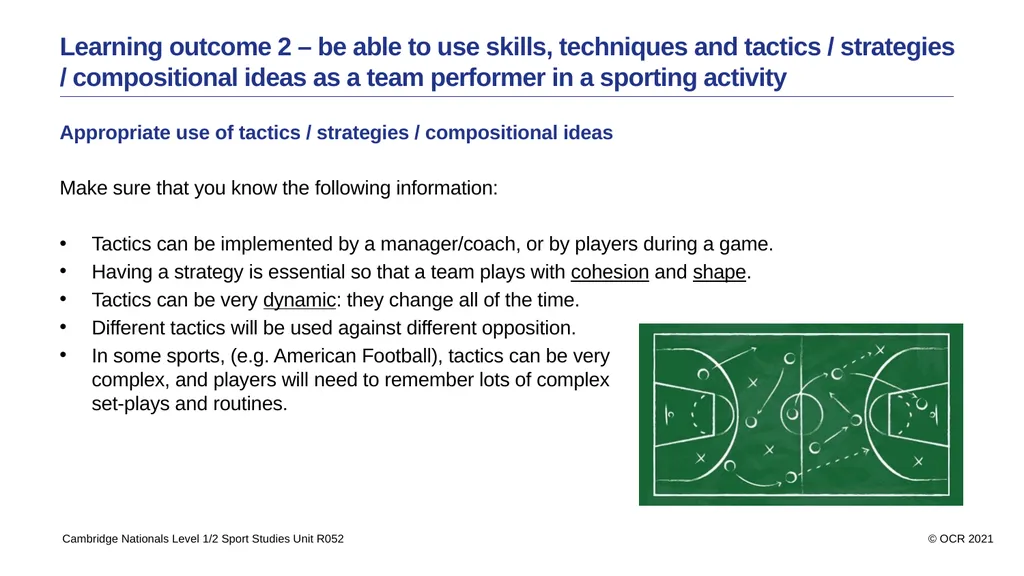
Learning outcome 2 – be able to use skills, techniques and tactics / strategies / compositional ideas as a team performer in a sporting activity Appropriate use of tactics / strategies / compositional ideas
Make sure that you know the following information:
Tactics can be implemented by a manager/coach, or by players during a game.
Having a strategy is essential so that a team plays with cohesion and shape.
Tactics can be very dynamic: they change all of the time.
Different tactics will be used against different opposition.
In some sports, (e.g. American Football), tactics can be very complex, and players will need to remember lots of complex set-plays and routines.<br>
Make sure that you know the following information:
Tactics can be implemented by a manager/coach, or by players during a game.
Having a strategy is essential so that a team plays with cohesion and shape.
Tactics can be very dynamic: they change all of the time.
Different tactics will be used against different opposition.
In some sports, (e.g. American Football), tactics can be very complex, and players will need to remember lots of complex set-plays and routines.<br>
10
Learning outcome 2 – be able to use skills, techniques and tactics / strategies / compositional ideas as a team performer in a sporting activity Decision-making during performance / awareness of role within team
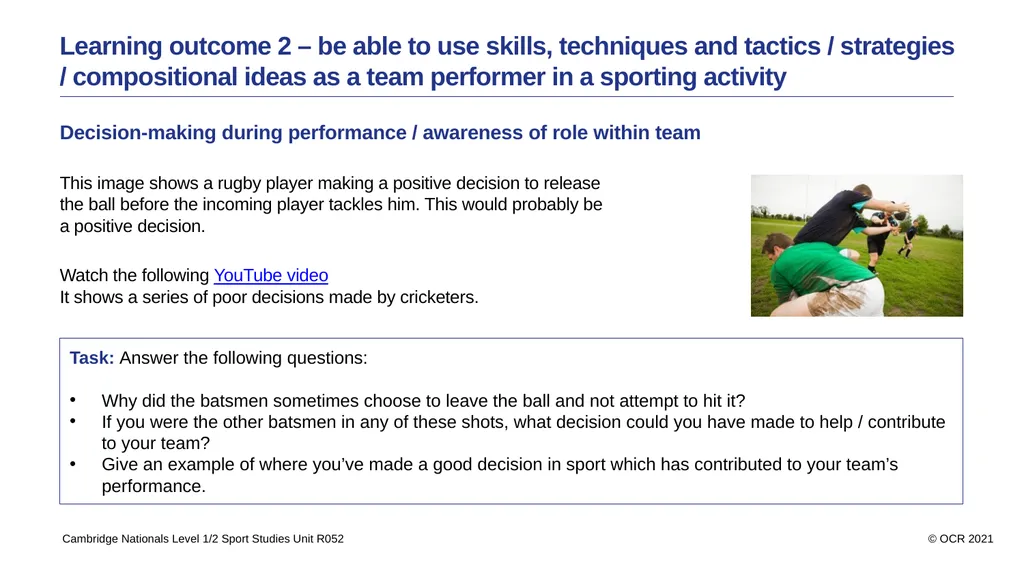
This image shows a rugby player making a positive decision to release the ball before the incoming player tackles him. This would probably be a positive decision.
Watch the following YouTube video It shows a series of poor decisions made by cricketers. Task: Answer the following questions:
Why did the batsmen sometimes choose to leave the ball and not attempt to hit it?
If you were the other batsmen in any of these shots, what decision could you have made to help / contribute to your team?
Give an example of where you’ve made a good decision in sport which has contributed to your team’s performance.<br>
This image shows a rugby player making a positive decision to release the ball before the incoming player tackles him. This would probably be a positive decision.
Watch the following YouTube video It shows a series of poor decisions made by cricketers. Task: Answer the following questions:
Why did the batsmen sometimes choose to leave the ball and not attempt to hit it?
If you were the other batsmen in any of these shots, what decision could you have made to help / contribute to your team?
Give an example of where you’ve made a good decision in sport which has contributed to your team’s performance.<br>
11
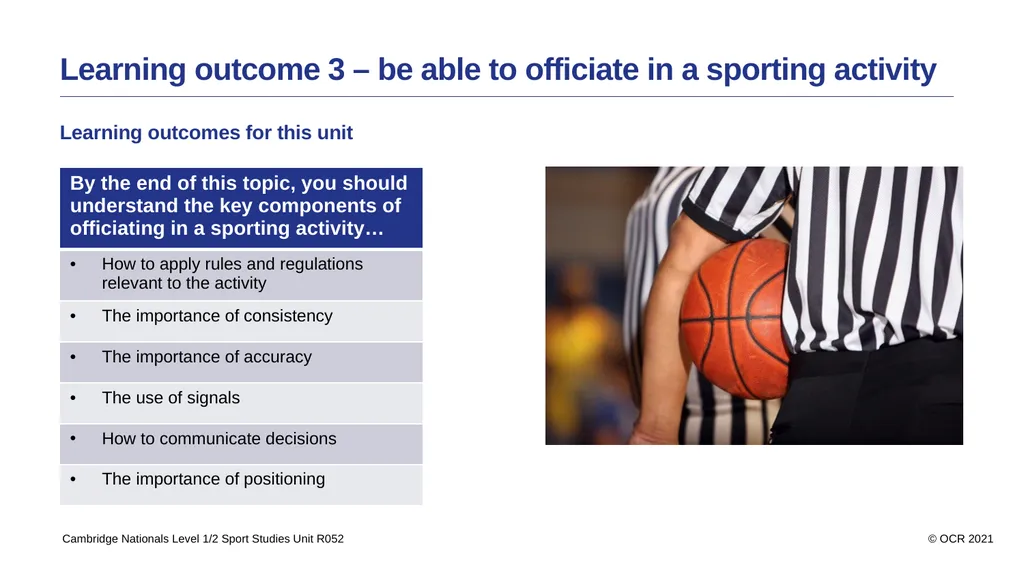
Learning outcome 3 – be able to officiate in a sporting activity Learning outcomes for this unit<br>
12
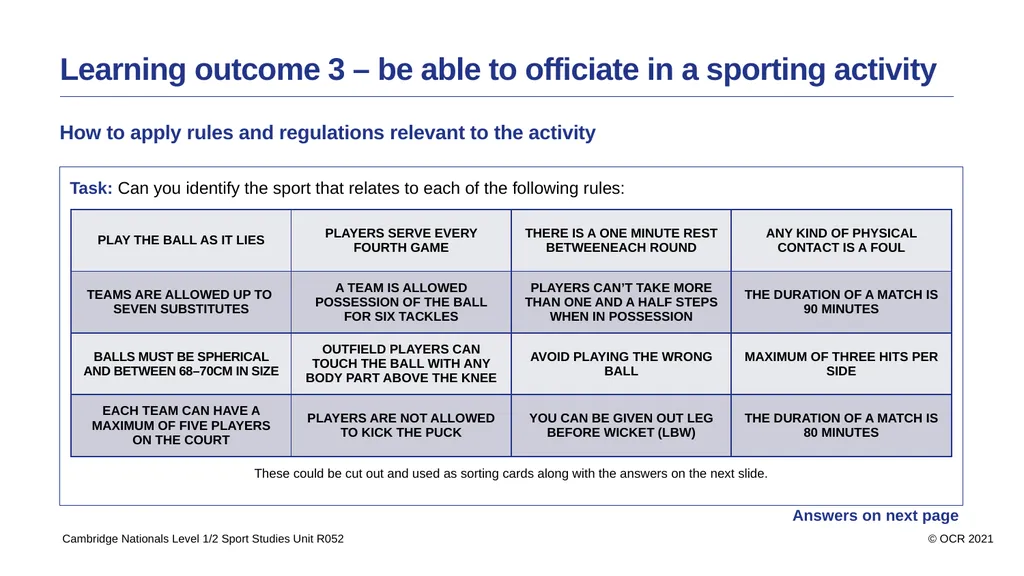
Learning outcome 3 – be able to officiate in a sporting activity How to apply rules and regulations relevant to the activity Task: Can you identify the sport that relates to each of the following rules: Answers on next page These could be cut out and used as sorting cards along with the answers on the next slide.<br>
13
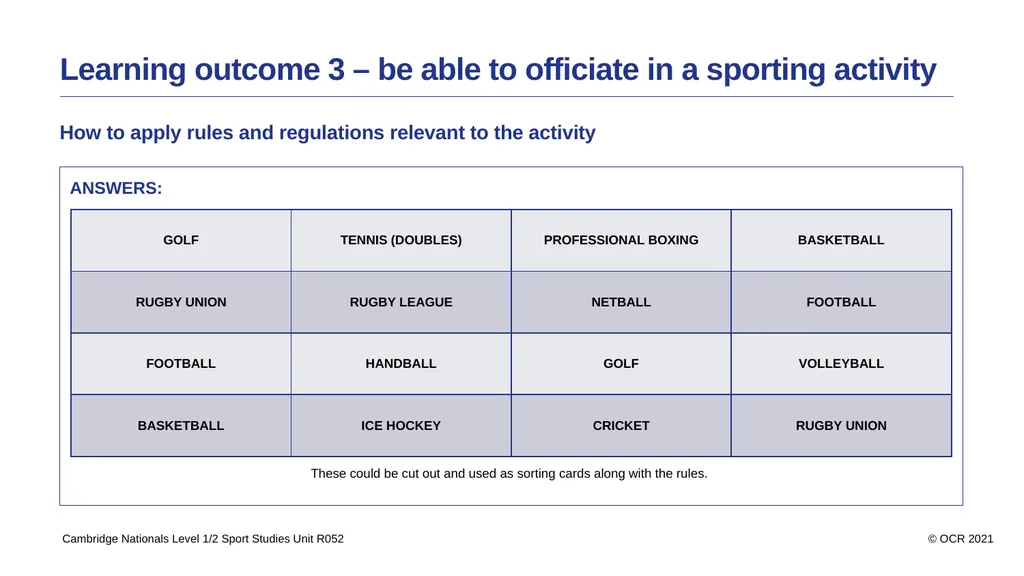
Learning outcome 3 – be able to officiate in a sporting activity How to apply rules and regulations relevant to the activity ANSWERS: These could be cut out and used as sorting cards along with the rules.<br>
14
Learning outcome 3 – be able to officiate in a sporting activity The importance of consistency and accuracy
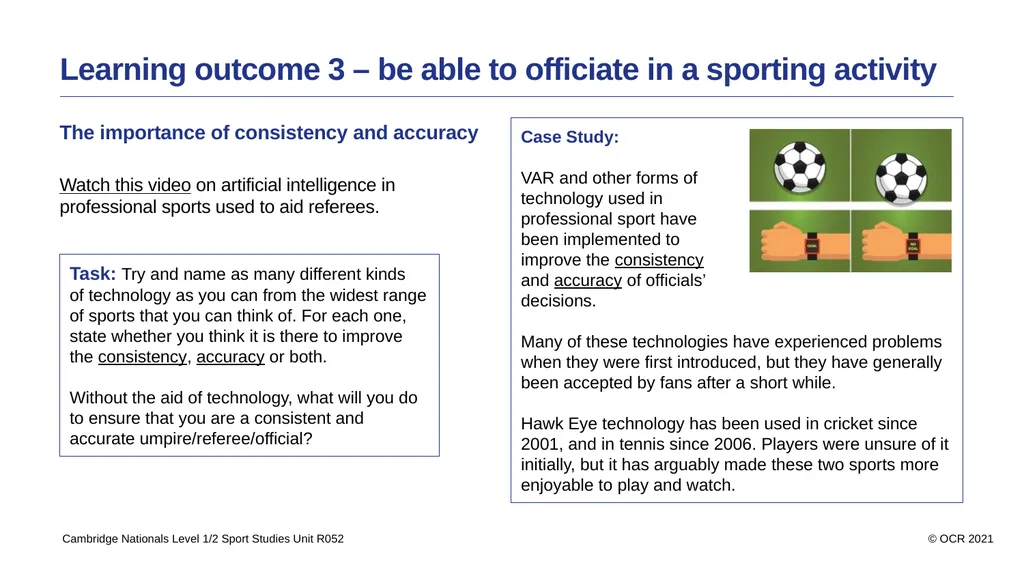
Watch this video on artificial intelligence in professional sports used to aid referees. Task: Try and name as many different kinds of technology as you can from the widest range of sports that you can think of. For each one, state whether you think it is there to improve the consistency, accuracy or both.
Without the aid of technology, what will you do to ensure that you are a consistent and accurate umpire/referee/official? Case Study:
VAR and other forms of technology used in professional sport have been implemented to improve the consistency and accuracy of officials’ decisions.
Many of these technologies have experienced problems when they were first introduced, but they have generally been accepted by fans after a short while.
Hawk Eye technology has been used in cricket since 2001, and in tennis since 2006. Players were unsure of it initially, but it has arguably made these two sports more enjoyable to play and watch.<br>
Watch this video on artificial intelligence in professional sports used to aid referees. Task: Try and name as many different kinds of technology as you can from the widest range of sports that you can think of. For each one, state whether you think it is there to improve the consistency, accuracy or both.
Without the aid of technology, what will you do to ensure that you are a consistent and accurate umpire/referee/official? Case Study:
VAR and other forms of technology used in professional sport have been implemented to improve the consistency and accuracy of officials’ decisions.
Many of these technologies have experienced problems when they were first introduced, but they have generally been accepted by fans after a short while.
Hawk Eye technology has been used in cricket since 2001, and in tennis since 2006. Players were unsure of it initially, but it has arguably made these two sports more enjoyable to play and watch.<br>
15
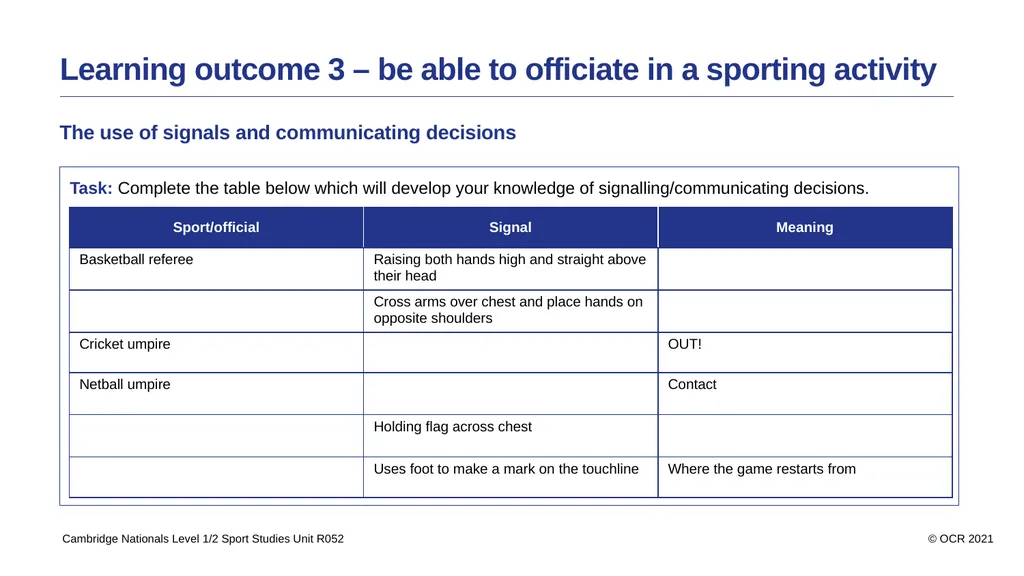
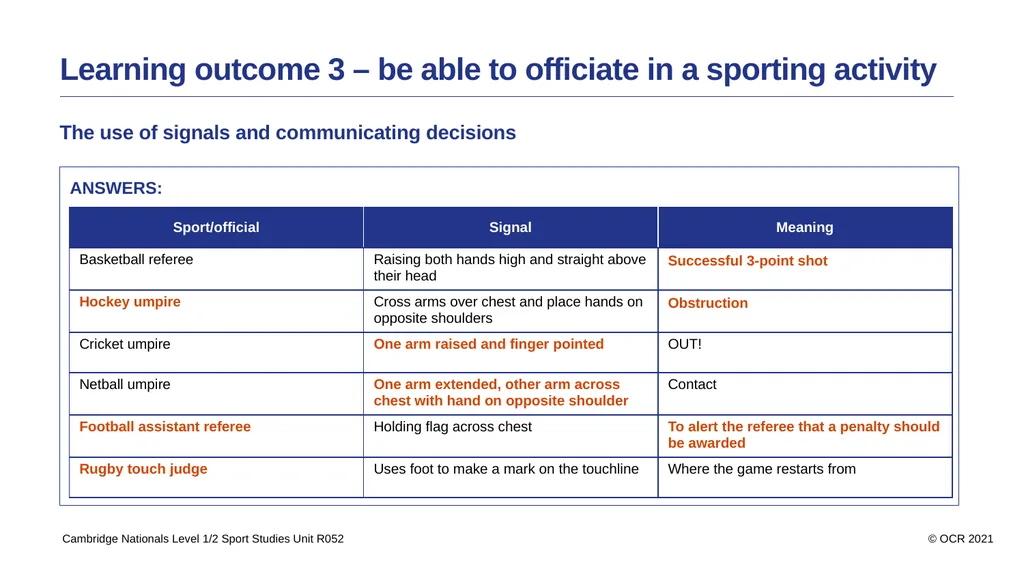
Learning outcome 3 – be able to officiate in a sporting activity The use of signals and communicating decisions Task: Complete the table below which will develop your knowledge of signalling/communicating decisions.<br>
16
Learning outcome 3 – be able to officiate in a sporting activity The use of signals and communicating decisions ANSWERS:<br>
17
Learning outcome 3 – be able to officiate in a sporting activity The importance of positioning
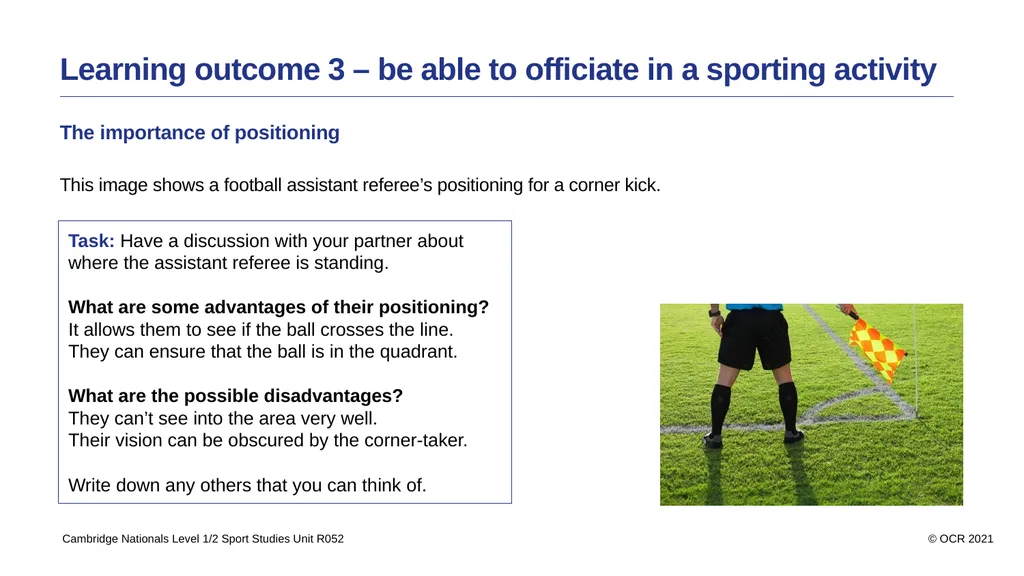
This image shows a football assistant referee’s positioning for a corner kick. Task: Have a discussion with your partner about where the assistant referee is standing.
What are some advantages of their positioning?
It allows them to see if the ball crosses the line. They can ensure that the ball is in the quadrant.
What are the possible disadvantages?
They can’t see into the area very well.
Their vision can be obscured by the corner-taker.
Write down any others that you can think of.<br>
This image shows a football assistant referee’s positioning for a corner kick. Task: Have a discussion with your partner about where the assistant referee is standing.
What are some advantages of their positioning?
It allows them to see if the ball crosses the line. They can ensure that the ball is in the quadrant.
What are the possible disadvantages?
They can’t see into the area very well.
Their vision can be obscured by the corner-taker.
Write down any others that you can think of.<br>
18
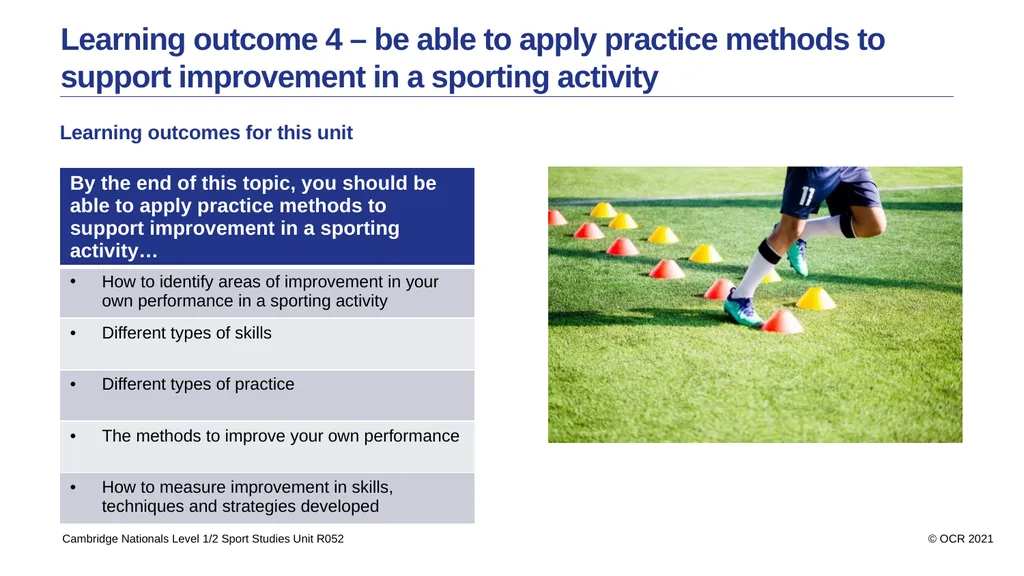
Learning outcome 4 – be able to apply practice methods to support improvement in a sporting activity Learning outcomes for this unit<br>
19
Learning outcome 4 – be able to apply practice methods to support improvement in a sporting activity How to identify areas of improvement in your own performance
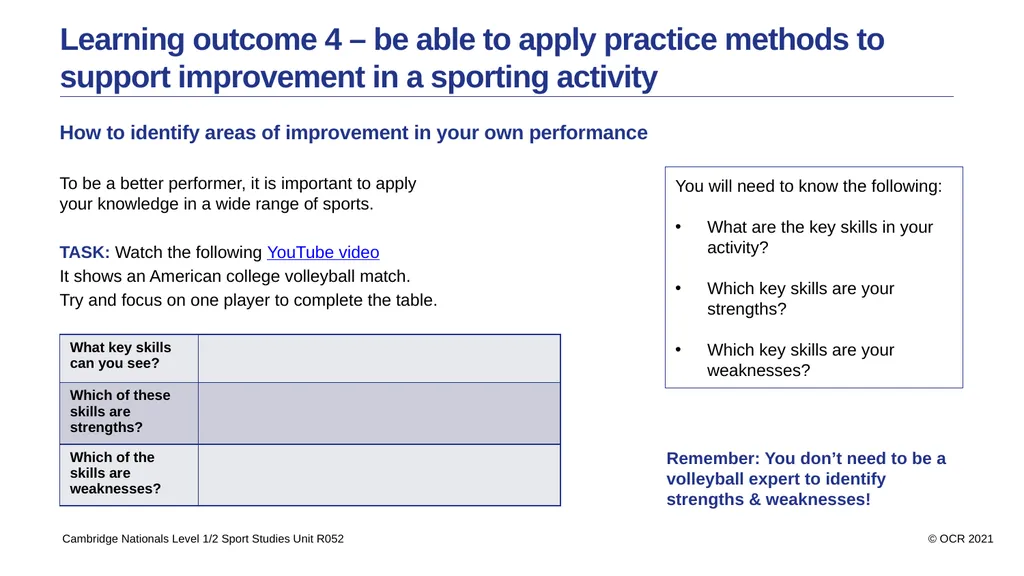
To be a better performer, it is important to apply your knowledge in a wide range of sports.
TASK: Watch the following YouTube video
It shows an American college volleyball match.
Try and focus on one player to complete the table. You will need to know the following:
What are the key skills in your activity?
Which key skills are your strengths?
Which key skills are your weaknesses? Remember: You don’t need to be a volleyball expert to identify strengths & weaknesses!<br>
To be a better performer, it is important to apply your knowledge in a wide range of sports.
TASK: Watch the following YouTube video
It shows an American college volleyball match.
Try and focus on one player to complete the table. You will need to know the following:
What are the key skills in your activity?
Which key skills are your strengths?
Which key skills are your weaknesses? Remember: You don’t need to be a volleyball expert to identify strengths & weaknesses!<br>
20
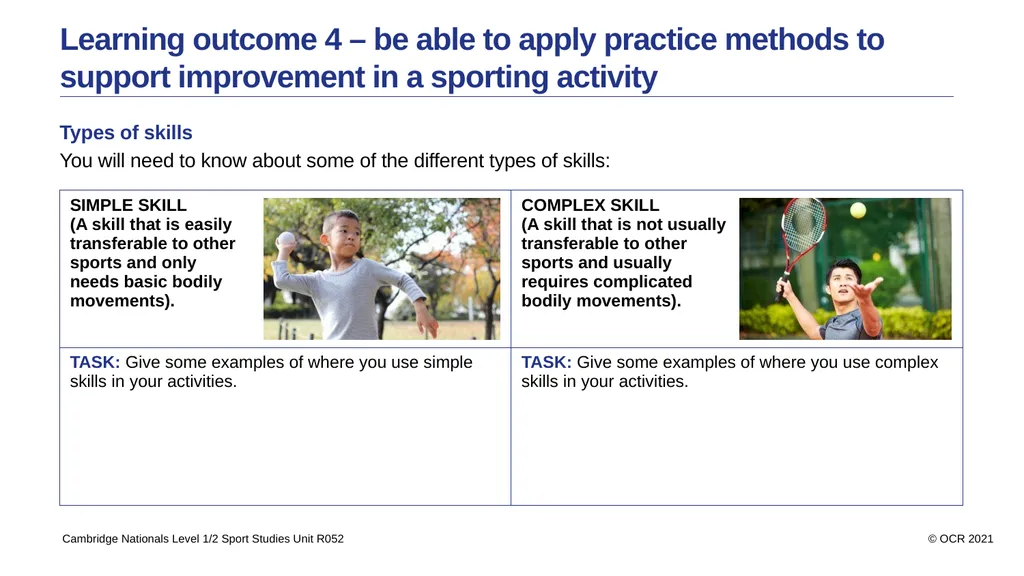
Learning outcome 4 – be able to apply practice methods to support improvement in a sporting activity Types of skills
You will need to know about some of the different types of skills:<br>
You will need to know about some of the different types of skills:<br>
21
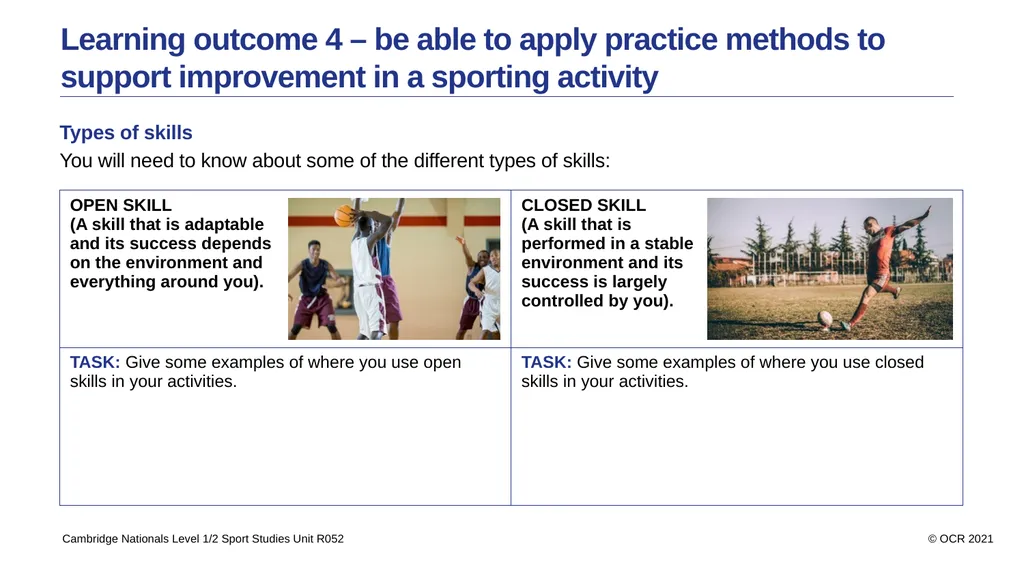
Learning outcome 4 – be able to apply practice methods to support improvement in a sporting activity Types of skills
You will need to know about some of the different types of skills:<br>
You will need to know about some of the different types of skills:<br>
22
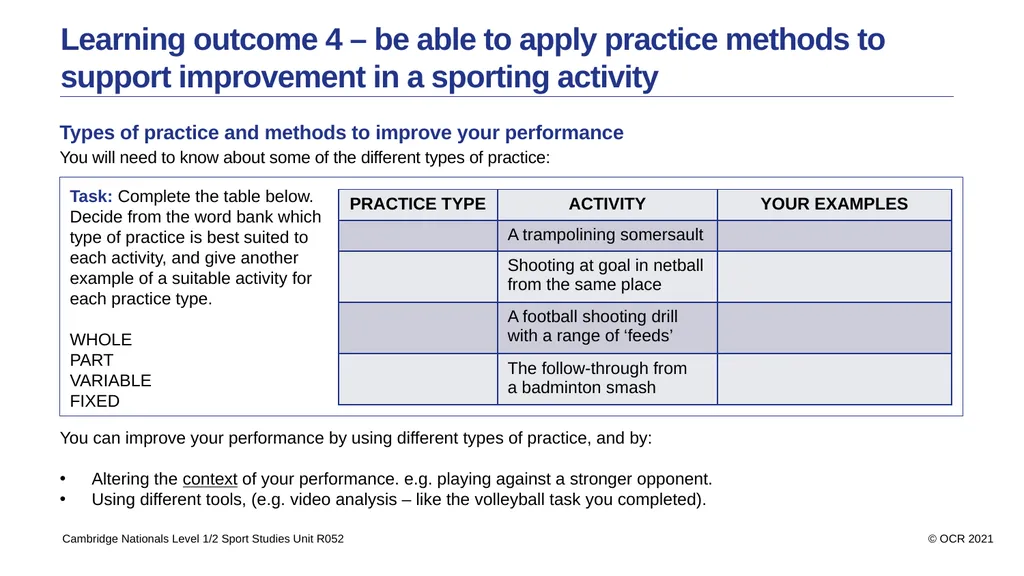
Learning outcome 4 – be able to apply practice methods to support improvement in a sporting activity Types of practice and methods to improve your performance
You will need to know about some of the different types of practice: Task: Complete the table below. Decide from the word bank which type of practice is best suited to each activity, and give another example of a suitable activity for each practice type.
WHOLE
PART
VARIABLE
FIXED You can improve your performance by using different types of practice, and by:
Altering the context of your performance. e.g. playing against a stronger opponent.
Using different tools, (e.g. video analysis – like the volleyball task you completed).<br>
You will need to know about some of the different types of practice: Task: Complete the table below. Decide from the word bank which type of practice is best suited to each activity, and give another example of a suitable activity for each practice type.
WHOLE
PART
VARIABLE
FIXED You can improve your performance by using different types of practice, and by:
Altering the context of your performance. e.g. playing against a stronger opponent.
Using different tools, (e.g. video analysis – like the volleyball task you completed).<br>
23
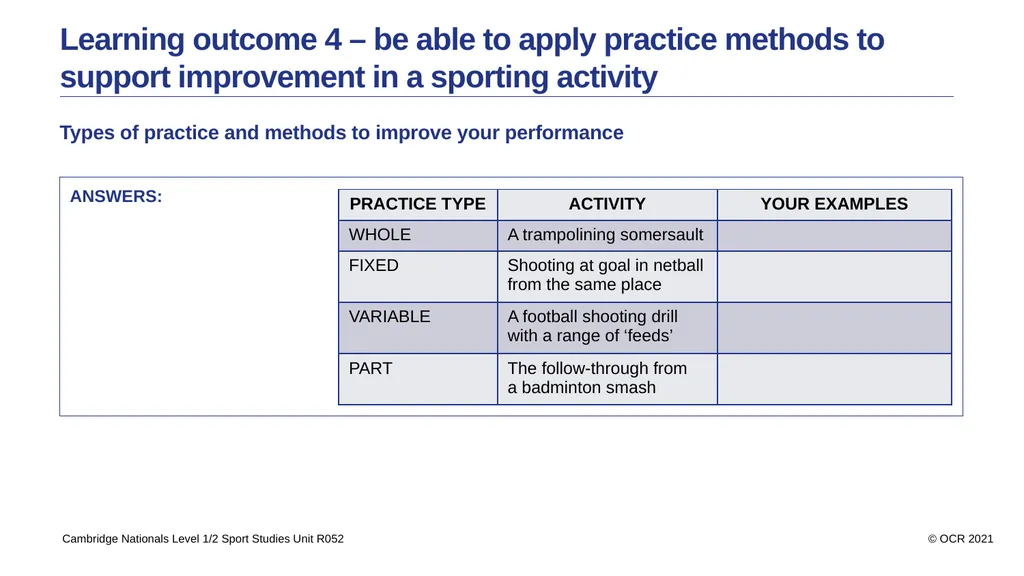
Learning outcome 4 – be able to apply practice methods to support improvement in a sporting activity Types of practice and methods to improve your performance ANSWERS:<br>
24
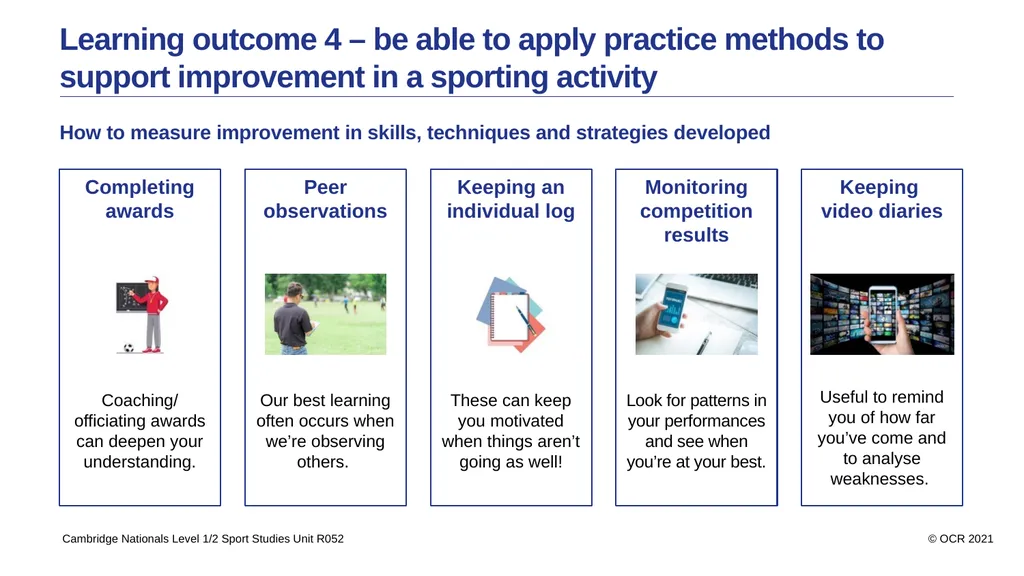
Learning outcome 4 – be able to apply practice methods to support improvement in a sporting activity How to measure improvement in skills, techniques and strategies developed Completing awards
Coaching/ officiating awards can deepen your understanding. Peer observations
Our best learning often occurs when we’re observing others. Keeping an individual log
These can keep you motivated when things aren’t going as well! Monitoring competition results
Look for patterns in your performances and see when you’re at your best. Keeping video diaries
Useful to remind you of how far you’ve come and to analyse weaknesses.<br>
Coaching/ officiating awards can deepen your understanding. Peer observations
Our best learning often occurs when we’re observing others. Keeping an individual log
These can keep you motivated when things aren’t going as well! Monitoring competition results
Look for patterns in your performances and see when you’re at your best. Keeping video diaries
Useful to remind you of how far you’ve come and to analyse weaknesses.<br>
25
We’d like to know your view on the resources we produce. Click ‘Like’ or ‘Dislike’ to send us an auto generated email about this resource. Add comments if you want to. Let us know how we can improve this resource or what else you need. Your email will not be used or shared for any marketing purposes.
Looking for another resource? There is now a quick and easy search tool to help find free resources for your qualification.
OCR is part of Cambridge Assessment, a department of the University of Cambridge. For staff training purposes and as part of our quality assurance programme your call may be recorded or monitored. Oxford Cambridge and RSA Examinations is a Company Limited by Guarantee. Registered in England. Registered office The Triangle Building, Shaftesbury Road, Cambridge, CB2 8EA. Registered company number 3484466. OCR is an exempt charity.
OCR operates academic and vocational qualifications regulated by Ofqual, Qualifications Wales and CCEA as listed in their qualifications registers including A Levels, GCSEs, Cambridge Technicals and Cambridge Nationals.
OCR provides resources to help you deliver our qualifications. These resources do not represent any particular teaching method we expect you to use. We update our resources regularly and aim to make sure content is accurate but please check the OCR website so that you have the most up to date version. OCR cannot be held responsible for any errors or omissions in these resources.
Though we make every effort to check our resources, there may be contradictions between published support and the specification, so it is important that you always use information in the latest specification. We indicate any specification changes within the document itself, change the version number and provide a summary of the changes. If you do notice a discrepancy between the specification and a resource, please contact us.
© OCR 2020 You can copy and distribute this resource freely if you keep the OCR logo and this small print intact and you acknowledge OCR as the originator of the resource.
OCR acknowledges the use of the following content: Slide 3: Gymnast on pommel horse, skynesher/Getty Images; Slide 4: Ballet dancer, skynesher/Getty Images: Tennis player, PaSta77/Getty Images; Slide 5: Boxer, aluxum/Getty Images: Golfer, nattrass/Getty Images: Downhill skier, amirphoto/Getty Images: Long distance swimmer, microgen/Getty Images; Slide 7: High school basketball, monkeybusinessimages/Getty Images; Slide 8: Playing hockey, Zengineer/Getty Images: Playing cricket, jacojvr/Getty Images: Basketball game, South_agency/Getty Images: Volleyball game, FatCamera/Getty Images; Slide 9: Footballer, master1305/Getty Images; Slide 10: Basketball strategy, Bigmouse108/Getty Images; Slide 11: Rugby tackle, Image Source/Getty Images; Slide 12: Basketball referee, xjben/Getty Images; Slide 15: Goal line technology, lumyaisweet/Getty Images; Slide 18: Football assistant referee, Brasil2/Getty Images; Slide 19: Football training, Koonsiri Boonnak/Getty Images; Slide 20: Volleyball player, Dimitrius Ramos/Getty Images; Slide 21: boy throwing a ball, ziggy_mars/Getty Images: Young boy playing tennis, imtmphoto/Getty Images; Slide 22: Playing basketball, FatCamera/Getty Images: Rugby kick, South_agency/Getty Images; Slide 25: Football strategy, IconicBestiary/Getty Images: Notepad and pen, Ciripasca/Getty Images: Video archives concept, metamorworks/Getty Images: Football coach, Chai_pagchong/Getty Images: Performance concept, cnythzl/Getty Images.
Whether you already offer OCR qualifications, are new to OCR or are thinking about switching, you can request more information using our Expression of Interest form.
Please get in touch if you want to discuss the accessibility of resources we offer to support you in delivering our qualifications.<br>
Looking for another resource? There is now a quick and easy search tool to help find free resources for your qualification.
OCR is part of Cambridge Assessment, a department of the University of Cambridge. For staff training purposes and as part of our quality assurance programme your call may be recorded or monitored. Oxford Cambridge and RSA Examinations is a Company Limited by Guarantee. Registered in England. Registered office The Triangle Building, Shaftesbury Road, Cambridge, CB2 8EA. Registered company number 3484466. OCR is an exempt charity.
OCR operates academic and vocational qualifications regulated by Ofqual, Qualifications Wales and CCEA as listed in their qualifications registers including A Levels, GCSEs, Cambridge Technicals and Cambridge Nationals.
OCR provides resources to help you deliver our qualifications. These resources do not represent any particular teaching method we expect you to use. We update our resources regularly and aim to make sure content is accurate but please check the OCR website so that you have the most up to date version. OCR cannot be held responsible for any errors or omissions in these resources.
Though we make every effort to check our resources, there may be contradictions between published support and the specification, so it is important that you always use information in the latest specification. We indicate any specification changes within the document itself, change the version number and provide a summary of the changes. If you do notice a discrepancy between the specification and a resource, please contact us.
© OCR 2020 You can copy and distribute this resource freely if you keep the OCR logo and this small print intact and you acknowledge OCR as the originator of the resource.
OCR acknowledges the use of the following content: Slide 3: Gymnast on pommel horse, skynesher/Getty Images; Slide 4: Ballet dancer, skynesher/Getty Images: Tennis player, PaSta77/Getty Images; Slide 5: Boxer, aluxum/Getty Images: Golfer, nattrass/Getty Images: Downhill skier, amirphoto/Getty Images: Long distance swimmer, microgen/Getty Images; Slide 7: High school basketball, monkeybusinessimages/Getty Images; Slide 8: Playing hockey, Zengineer/Getty Images: Playing cricket, jacojvr/Getty Images: Basketball game, South_agency/Getty Images: Volleyball game, FatCamera/Getty Images; Slide 9: Footballer, master1305/Getty Images; Slide 10: Basketball strategy, Bigmouse108/Getty Images; Slide 11: Rugby tackle, Image Source/Getty Images; Slide 12: Basketball referee, xjben/Getty Images; Slide 15: Goal line technology, lumyaisweet/Getty Images; Slide 18: Football assistant referee, Brasil2/Getty Images; Slide 19: Football training, Koonsiri Boonnak/Getty Images; Slide 20: Volleyball player, Dimitrius Ramos/Getty Images; Slide 21: boy throwing a ball, ziggy_mars/Getty Images: Young boy playing tennis, imtmphoto/Getty Images; Slide 22: Playing basketball, FatCamera/Getty Images: Rugby kick, South_agency/Getty Images; Slide 25: Football strategy, IconicBestiary/Getty Images: Notepad and pen, Ciripasca/Getty Images: Video archives concept, metamorworks/Getty Images: Football coach, Chai_pagchong/Getty Images: Performance concept, cnythzl/Getty Images.
Whether you already offer OCR qualifications, are new to OCR or are thinking about switching, you can request more information using our Expression of Interest form.
Please get in touch if you want to discuss the accessibility of resources we offer to support you in delivering our qualifications.<br>