
Contents Aims Learning outcome 1 – understand the

Description: Contents Aims Learning outcome 1 understand the relationship between personality and sports performance Learning outcome 2 know how motivation can affect sports performance Learning outcome 3 know how aggression can affect sports
Related Topics
Download Presentation
"Contents Aims Learning outcome 1 – understand the" is the property of its rightful owner. Permission is granted to download and print the materials on this website for personal, non-commercial use only, and to display it on your personal computer provided you do not modify the materials and that you retain all copyright notices contained in the materials. By downloading content from our website, you accept the terms of this agreement.
Presentation Transcript
slide2. Contents Aims
Learning outcome 1 – understand the relationship between personality and sports performance
Learning outcome 2 – know how motivation can affect sports performance
Learning outcome 3 – know how aggression can affect sports performance
Learning outcome 4 – understand the impact of arousal and anxiety on sports performance
Learning outcome 5 – be able to apply sport psychology strategies to enhance sports performance<br>
slide3. Learning outcome 1 – understand the relationship between personality and sports performance By the end of this learning outcome you should know:
The definition of personality
Extrovert and introvert personality types
The links between personality and involvement and performance in sport
The trait approach
Observed or social learning theories.<br>
slide4. Learning outcome 1 – understand the relationship between personality and sports performance Definition of personality
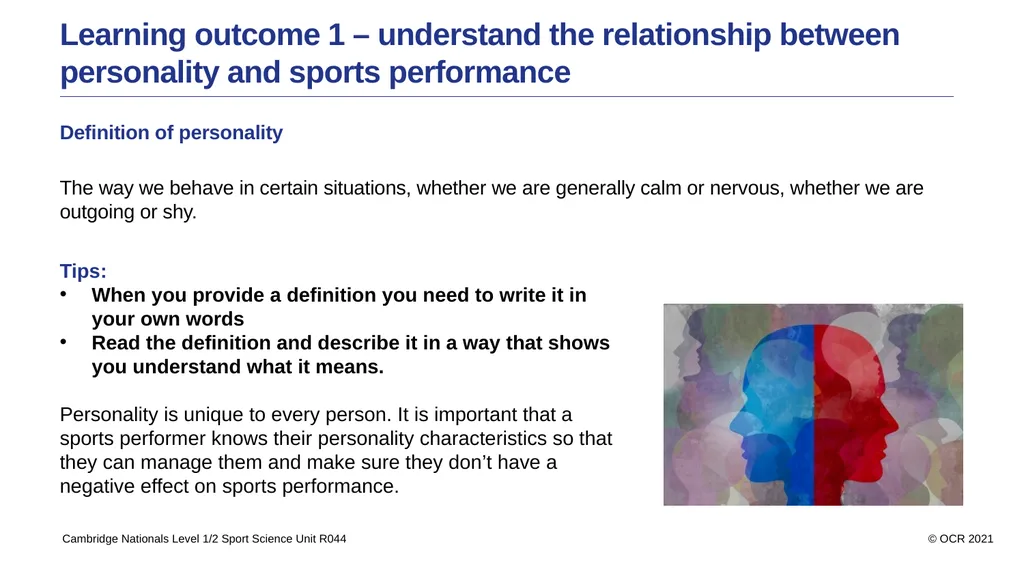
The way we behave in certain situations, whether we are generally calm or nervous, whether we are outgoing or shy. Tips:
When you provide a definition you need to write it in your own words
Read the definition and describe it in a way that shows you understand what it means.
Personality is unique to every person. It is important that a sports performer knows their personality characteristics so that they can manage them and make sure they don’t have a negative effect on sports performance.<br>
slide5. Learning outcome 1 – understand the relationship between personality and sports performance Extrovert personality types
People who have an extrovert personality are outgoing and prefer to be with other people
They often perform better under pressure
They enjoy working as a team and playing team sports
They like a challenge and taking on roles of responsibility.
Introvert personality types
People who have an introvert personality are often shy and prefer to be on their own
They often perform better without pressure
They enjoy working on their own and in individual sports
They like activities which require accuracy and patience.<br>
slide6. Learning outcome 1 – understand the relationship between personality and sports performance Extrovert and introvert personality types
Task:
Why would it be useful for a sports coach to know what personality type and characteristics their athletes have?
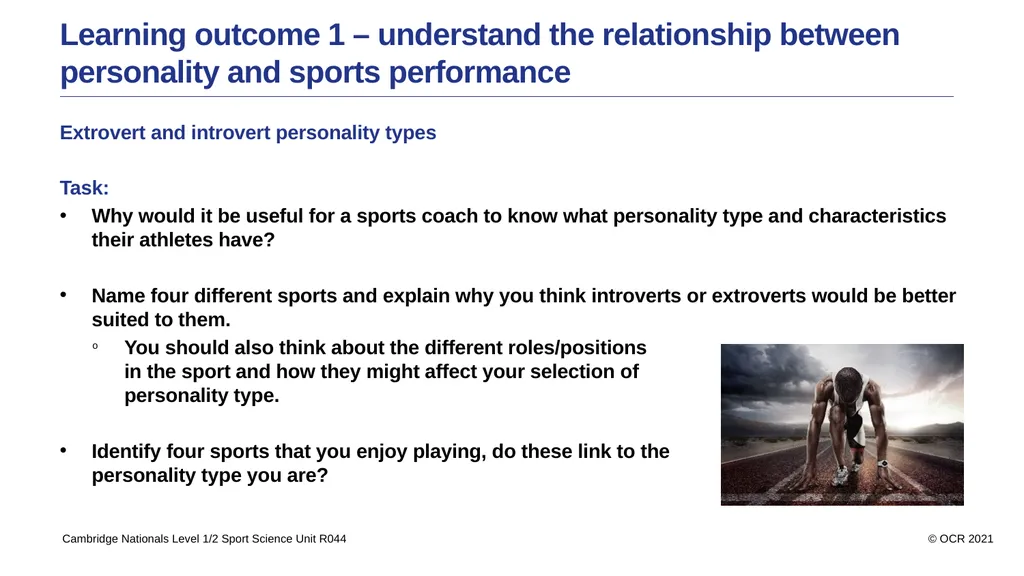
Name four different sports and explain why you think introverts or extroverts would be better suited to them.
You should also think about the different roles/positions in the sport and how they might affect your selection of personality type.
Identify four sports that you enjoy playing, do these link to the personality type you are?<br>
slide7. Learning outcome 1 – understand the relationship between personality and sports performance The links between personality and involvement and performance in sport
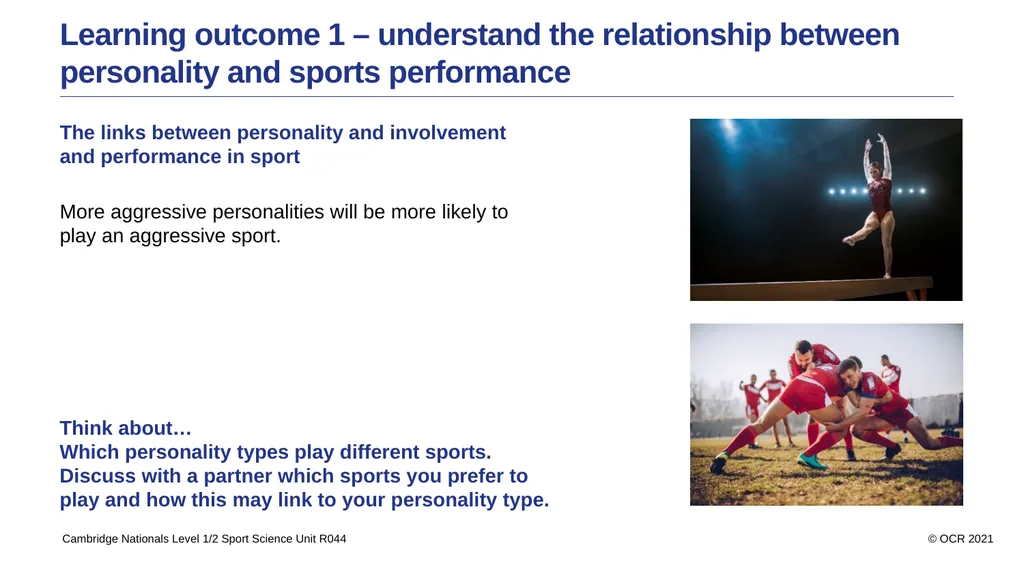
More aggressive personalities will be more likely to play an aggressive sport. Think about…
Which personality types play different sports. Discuss with a partner which sports you prefer to play and how this may link to your personality type.<br>
slide8. Learning outcome 1 – understand the relationship between personality and sports performance The trait approach
The Trait theory suggests that people have certain personality traits or characteristics and these determine how the person will behave
The traits are stable or consistent and will stay the same in different environments or situations
For example, if you are a calm person you will behave calmly in a stressful situation like a competition as you would in training
A sports performer who is naturally aggressive will be aggressive in a competition
This theory says that aggression is seen as a desirable trait for a rugby team captain. The captain needs to be vocal and an extrovert. Think about… Which personality traits or characteristics do you show and how do these suit the sports you like to perform.<br>
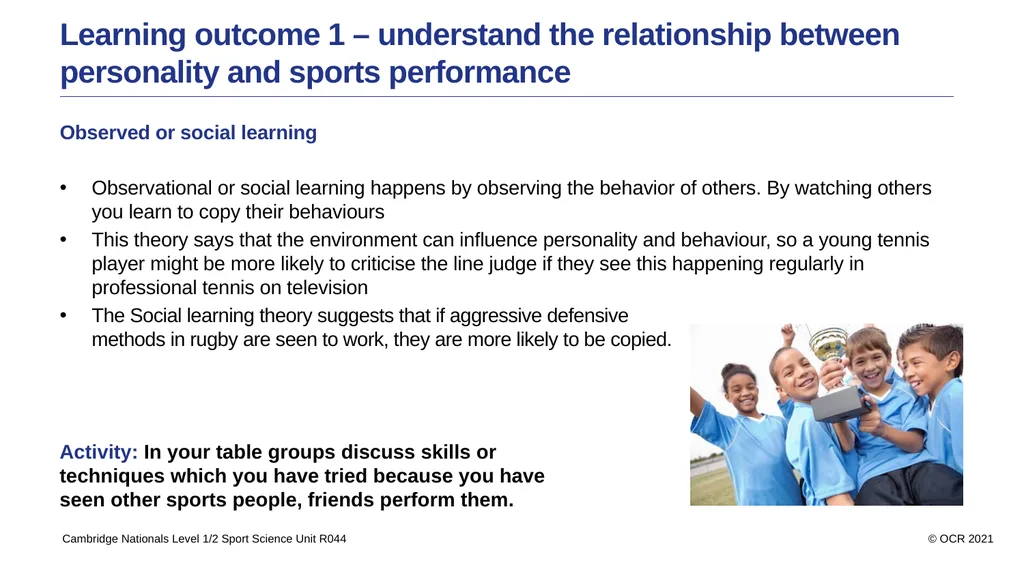
slide9. Learning outcome 1 – understand the relationship between personality and sports performance Observed or social learning
Observational or social learning happens by observing the behavior of others. By watching others you learn to copy their behaviours
This theory says that the environment can influence personality and behaviour, so a young tennis player might be more likely to criticise the line judge if they see this happening regularly in professional tennis on television
The Social learning theory suggests that if aggressive defensive methods in rugby are seen to work, they are more likely to be copied. Activity: In your table groups discuss skills or techniques which you have tried because you have seen other sports people, friends perform them.<br>
slide10. Learning outcome 2 – know how motivation can affect sports performance By the end of this learning outcome you should know:
The definition of motivation
Intrinsic motivation
Extrinsic motivation
Achievement motivation
The implications of motivation for sport and exercise involvement<br>
slide11. Learning outcome 2 – know how motivation can affect sports performance Definition of motivation
The desire to do something and move toward a goal.
Tips:
When you provide a definition, you need to write it in your own words
Read the definition and describe it in a way that shows you understand what it means.
Only a certain type of person is motivated to participate in sport.
These people want to participate
They want to achieve a goal
They want the challenge of training and competing.<br>
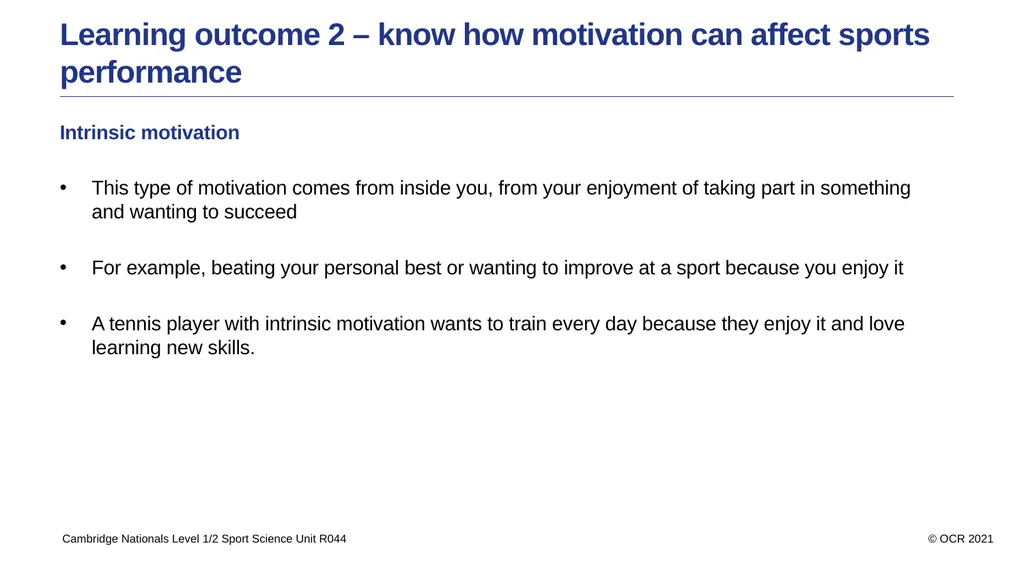
slide12. Learning outcome 2 – know how motivation can affect sports performance Intrinsic motivation
This type of motivation comes from inside you, from your enjoyment of taking part in something and wanting to succeed
For example, beating your personal best or wanting to improve at a sport because you enjoy it
A tennis player with intrinsic motivation wants to train every day because they enjoy it and love learning new skills.<br>
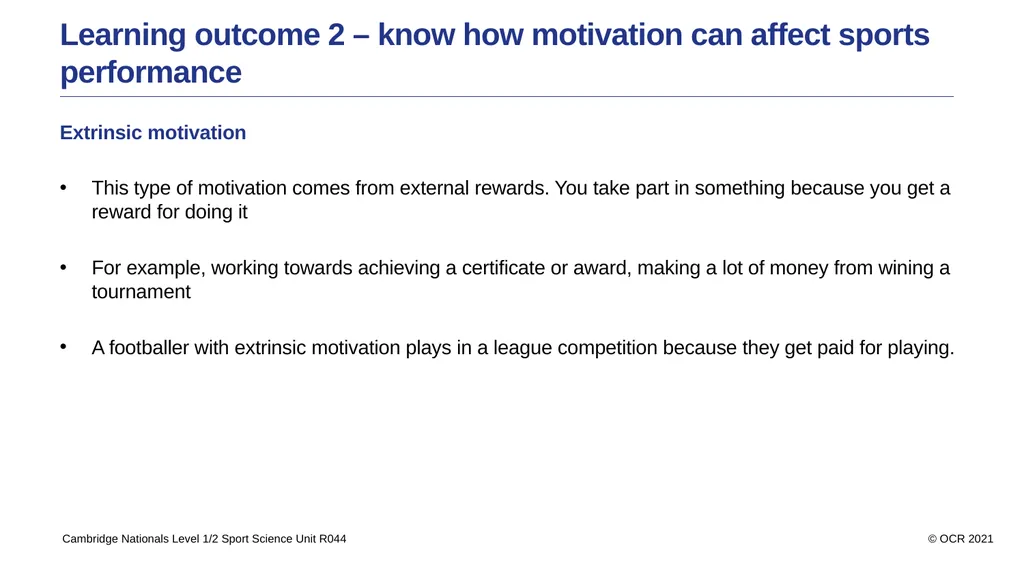
slide13. Learning outcome 2 – know how motivation can affect sports performance Extrinsic motivation
This type of motivation comes from external rewards. You take part in something because you get a reward for doing it
For example, working towards achieving a certificate or award, making a lot of money from wining a tournament
A footballer with extrinsic motivation plays in a league competition because they get paid for playing.<br>
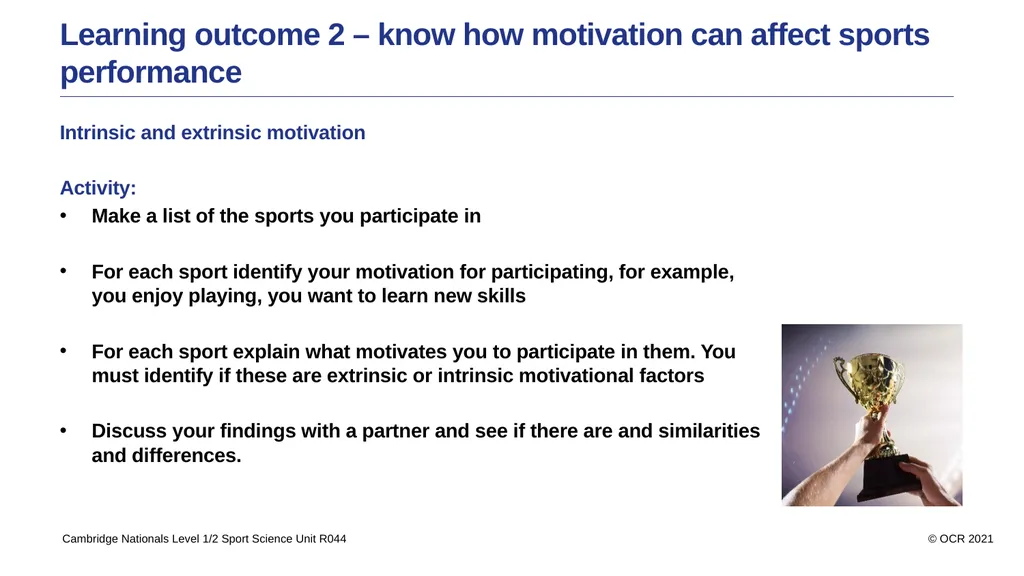
slide14. Learning outcome 2 – know how motivation can affect sports performance Intrinsic and extrinsic motivation
Activity:
Make a list of the sports you participate in
For each sport identify your motivation for participating, for example, you enjoy playing, you want to learn new skills
For each sport explain what motivates you to participate in them. You must identify if these are extrinsic or intrinsic motivational factors
Discuss your findings with a partner and see if there are and similarities and differences.<br>
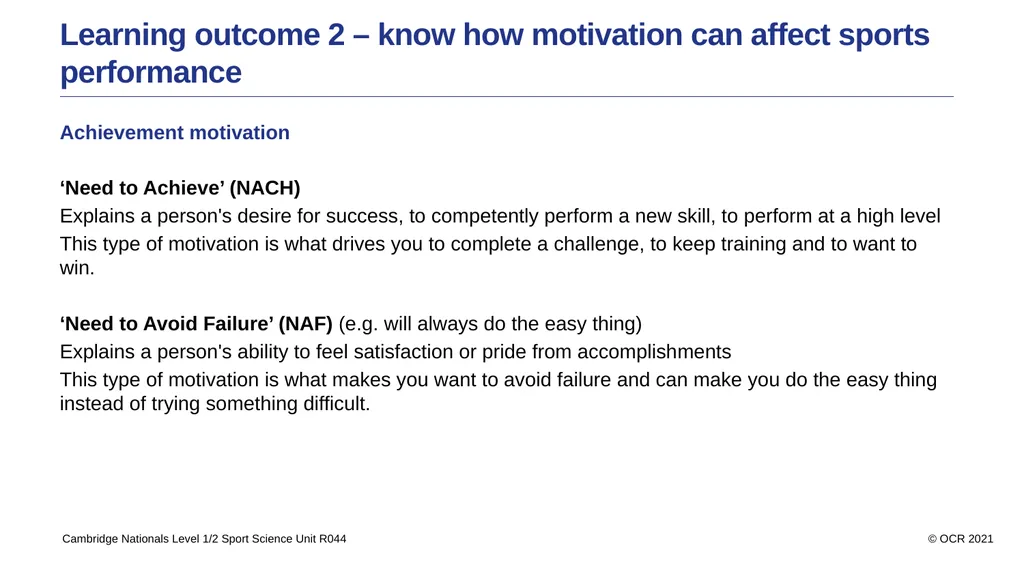
slide15. Learning outcome 2 – know how motivation can affect sports performance Achievement motivation
‘Need to Achieve’ (NACH)
Explains a person's desire for success, to competently perform a new skill, to perform at a high level
This type of motivation is what drives you to complete a challenge, to keep training and to want to win.
‘Need to Avoid Failure’ (NAF) (e.g. will always do the easy thing)
Explains a person's ability to feel satisfaction or pride from accomplishments
This type of motivation is what makes you want to avoid failure and can make you do the easy thing instead of trying something difficult.<br>
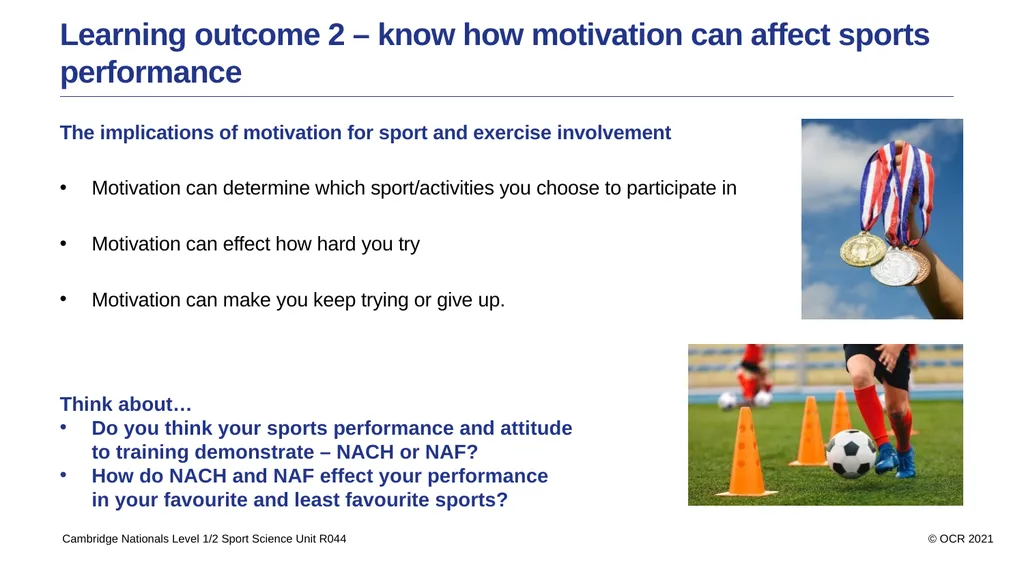
slide16. Learning outcome 2 – know how motivation can affect sports performance The implications of motivation for sport and exercise involvement
Motivation can determine which sport/activities you choose to participate in
Motivation can effect how hard you try
Motivation can make you keep trying or give up. Think about…
Do you think your sports performance and attitude to training demonstrate – NACH or NAF?
How do NACH and NAF effect your performance in your favourite and least favourite sports?<br>
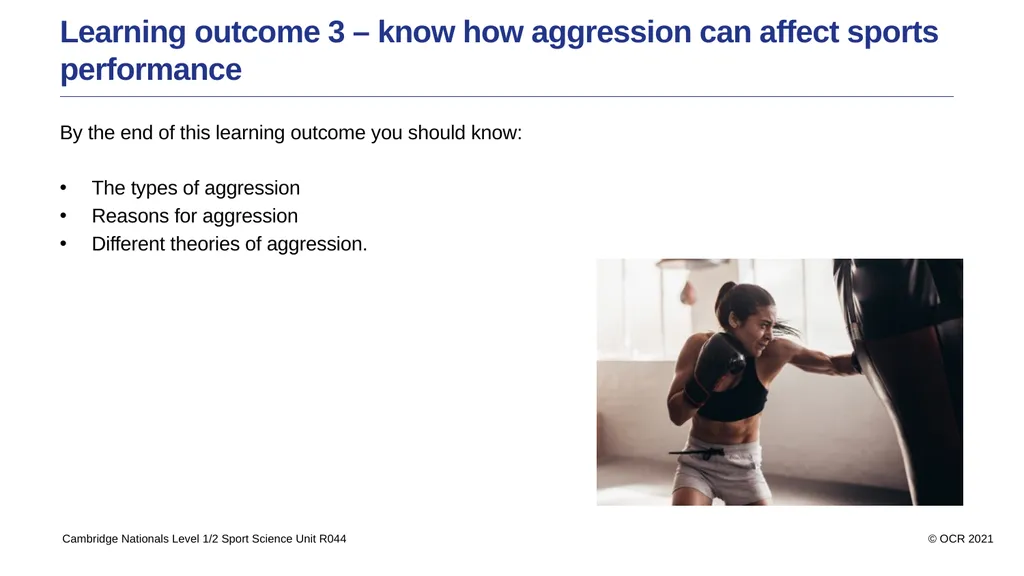
slide17. Learning outcome 3 – know how aggression can affect sports performance By the end of this learning outcome you should know:
The types of aggression
Reasons for aggression
Different theories of aggression.<br>
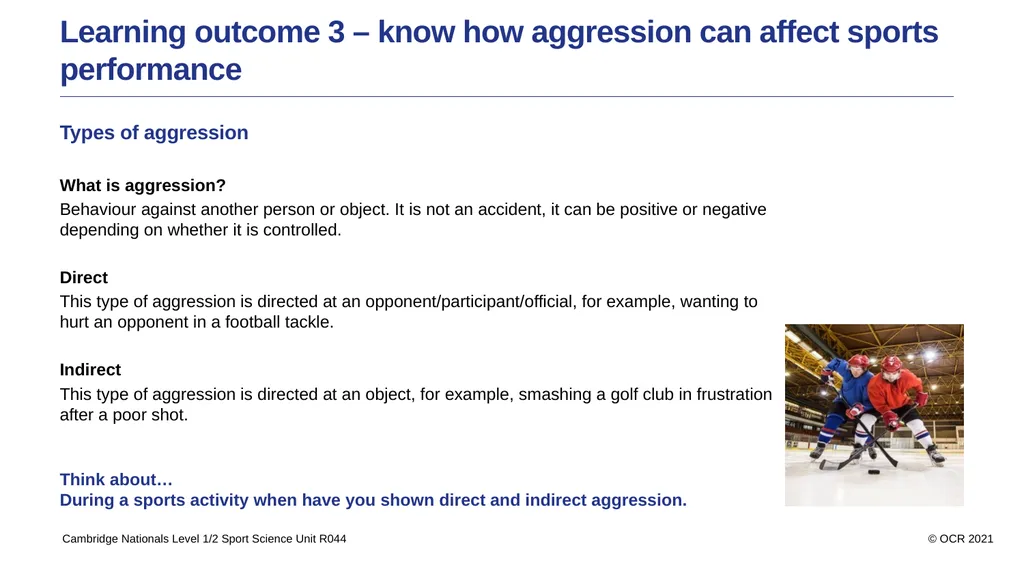
slide18. Learning outcome 3 – know how aggression can affect sports performance Types of aggression
What is aggression?
Behaviour against another person or object. It is not an accident, it can be positive or negative depending on whether it is controlled.
Direct
This type of aggression is directed at an opponent/participant/official, for example, wanting to hurt an opponent in a football tackle.
Indirect
This type of aggression is directed at an object, for example, smashing a golf club in frustration after a poor shot. Think about…
During a sports activity when have you shown direct and indirect aggression.<br>
slide19. Learning outcome 3 – know how aggression can affect sports performance Reasons for aggression
Rivalry
During a boxing weigh-in or national rivalry such as England vs. Scotland.
Pressures to win
Playing in a cup final match or relegation battle.
Over-arousal during play
A football player becoming too ‘pumped up’ and launching into a reckless tackle.
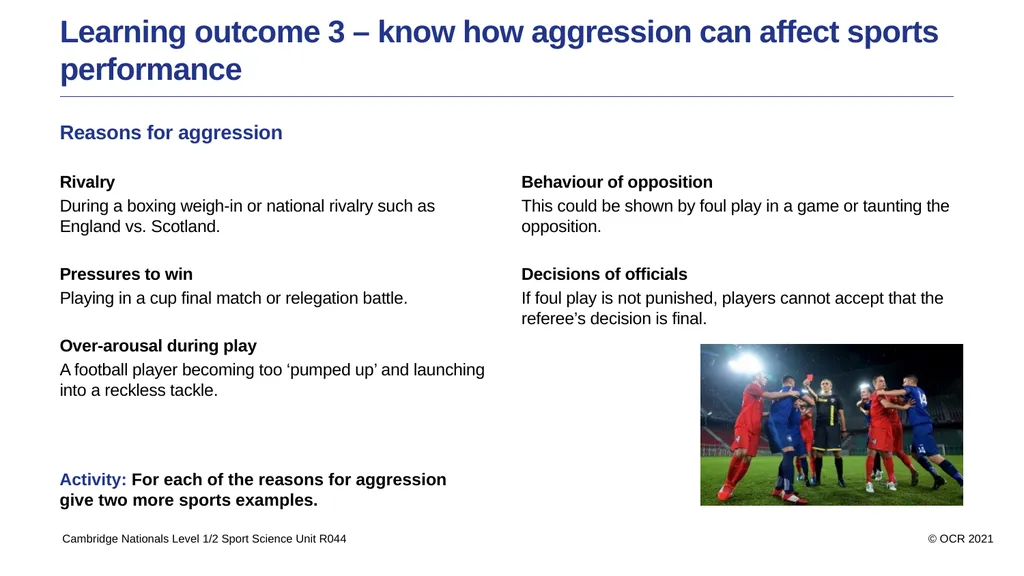
Behaviour of opposition
This could be shown by foul play in a game or taunting the opposition.
Decisions of officials
If foul play is not punished, players cannot accept that the referee’s decision is final. Activity: For each of the reasons for aggression give two more sports examples.<br>
slide20. Learning outcome 3 – know how aggression can affect sports performance Theories of aggression
Social learning theory
This theory suggests that new behaviours can be learned from observing and copying others
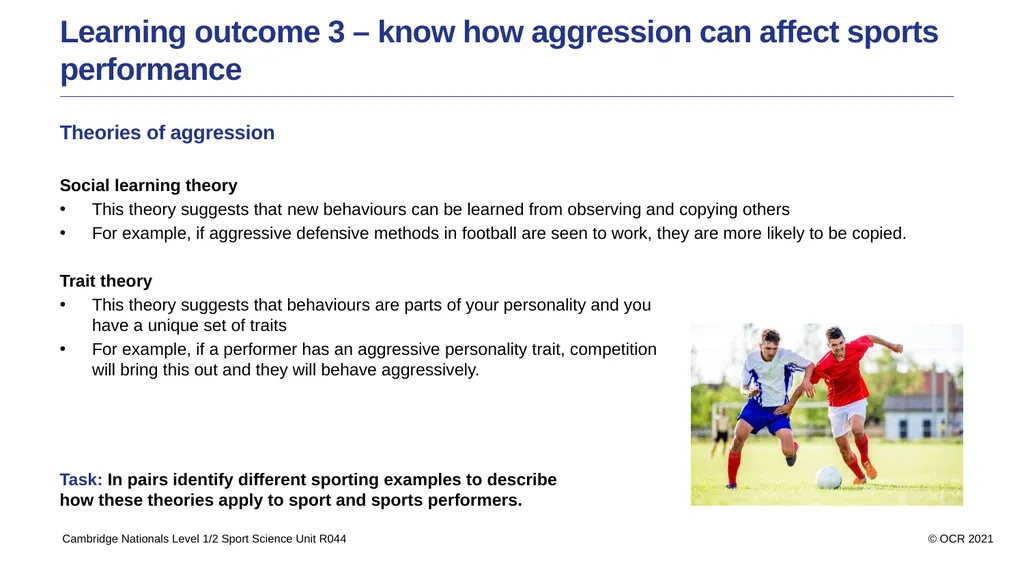
For example, if aggressive defensive methods in football are seen to work, they are more likely to be copied.
Trait theory
This theory suggests that behaviours are parts of your personality and you have a unique set of traits
For example, if a performer has an aggressive personality trait, competition will bring this out and they will behave aggressively. Task: In pairs identify different sporting examples to describe how these theories apply to sport and sports performers.<br>
slide21. Learning outcome 4 – understand the impact of arousal and anxiety on sports performance By the end of this learning outcome you should know:
The explanations of arousal
Theories of how arousal/anxiety affects performance
How to apply these theories to sporting examples
Different methods for measuring anxiety.<br>
slide22. Learning outcome 4 – understand the impact of arousal and anxiety on sports performance Explanations of arousal
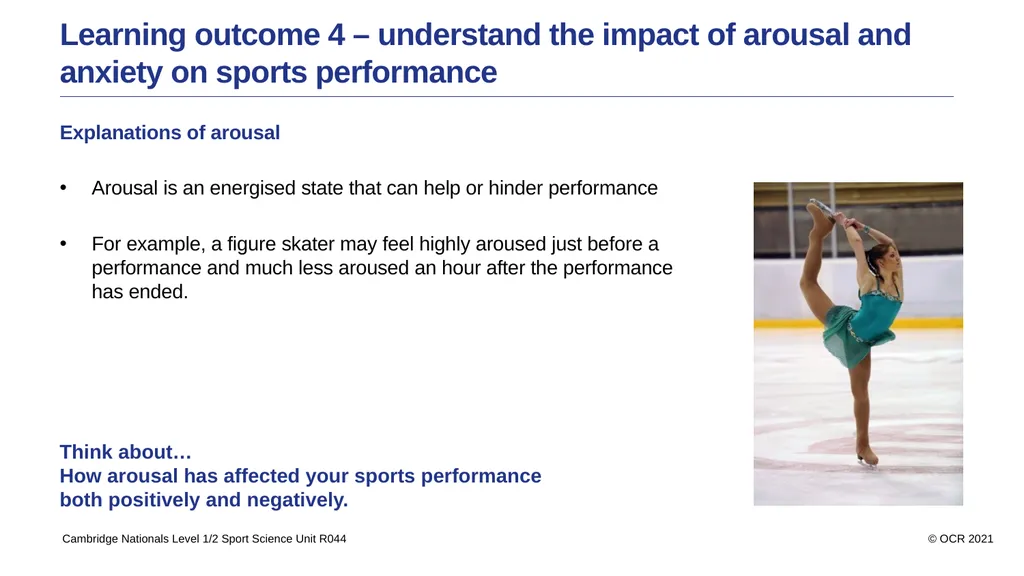
Arousal is an energised state that can help or hinder performance
For example, a figure skater may feel highly aroused just before a performance and much less aroused an hour after the performance has ended. Think about… How arousal has affected your sports performance both positively and negatively.<br>
slide23. Learning outcome 4 – understand the impact of arousal and anxiety on sports performance Theories of how arousal/anxiety affects performance and how to apply the theories of how arousal/anxiety affects performance to sporting examples
Drive theory
This theory suggest that there is a link between arousal/anxiety and performance
For example, a sports performer needs arousal/anxiety to perform at their best
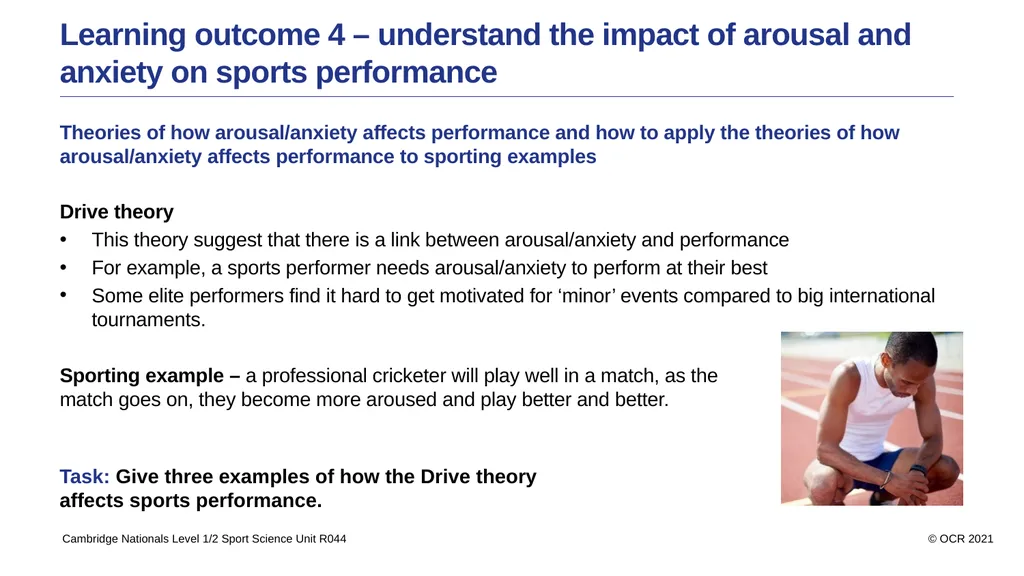
Some elite performers find it hard to get motivated for ‘minor’ events compared to big international tournaments.
Sporting example – a professional cricketer will play well in a match, as the match goes on, they become more aroused and play better and better. Task: Give three examples of how the Drive theory affects sports performance.<br>
slide24. Learning outcome 4 – understand the impact of arousal and anxiety on sports performance Theories of how arousal/anxiety affects performance and how to apply the theories of how arousal/anxiety affects performance to sporting examples
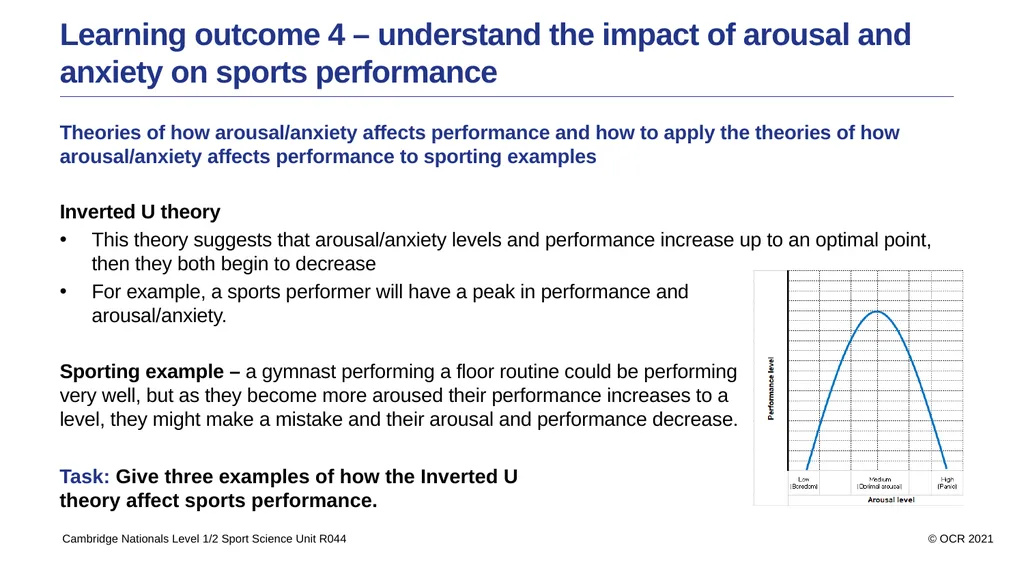
Inverted U theory
This theory suggests that arousal/anxiety levels and performance increase up to an optimal point, then they both begin to decrease
For example, a sports performer will have a peak in performance and arousal/anxiety.
Sporting example – a gymnast performing a floor routine could be performing very well, but as they become more aroused their performance increases to a level, they might make a mistake and their arousal and performance decrease. Task: Give three examples of how the Inverted U theory affect sports performance.<br>
slide25. Learning outcome 4 – understand the impact of arousal and anxiety on sports performance Theories of how arousal/anxiety affects performance and how to apply the theories of how arousal/anxiety affects performance to sporting examples
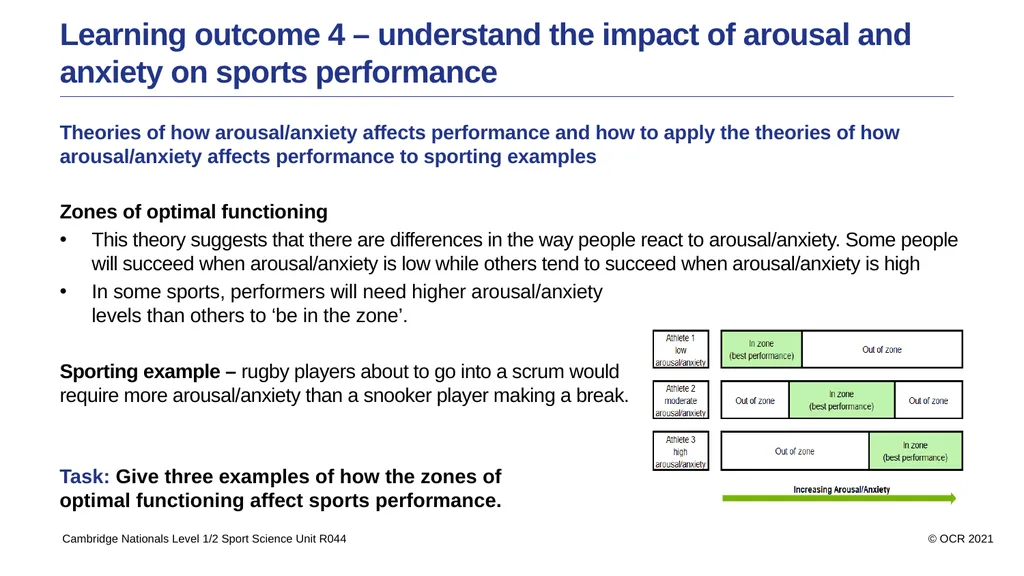
Zones of optimal functioning
This theory suggests that there are differences in the way people react to arousal/anxiety. Some people will succeed when arousal/anxiety is low while others tend to succeed when arousal/anxiety is high
In some sports, performers will need higher arousal/anxiety levels than others to ‘be in the zone’.
Sporting example – rugby players about to go into a scrum would require more arousal/anxiety than a snooker player making a break. Task: Give three examples of how the zones of optimal functioning affect sports performance.<br>
slide26. Learning outcome 4 – understand the impact of arousal and anxiety on sports performance Methods for measuring anxiety
Sport Competition Anxiety Test (SCAT)
A SCAT test is carried out by completing a questionnaire about anxiety
The questionnaire usually contains 15 questions about how they feel in competitive situations
The results of a SCAT test can be analysed to predict a sports person's level of anxiety.
Task: Use the internet to research scat tests.
Carry out a SCAT test and discuss your results with a partner.<br>
slide27. Learning outcome 4 – understand the impact of arousal and anxiety on sports performance Methods for measuring anxiety
State Anxiety Inventory Test
A State Anxiety Inventory Test is a test/questionnaire which can be used to identify how strongly a person feels anxious
The results form the test can be used to detect levels of anxiety in a sports performer.
Task: Use the internet to research State Anxiety Inventory Test. Carry out a State Anxiety Inventory Test and discuss your results with a partner. An example can be found here.<br>
slide28. Learning outcome 5 – be able to apply sport psychology strategies to enhance sports performance By the end of this learning outcome you should know:
The use of goal setting for motivation in sport
The use of mental rehearsal and imagery in sport
The use of relaxation techniques in sport
How to apply appropriate strategies for specific subject(s)
How to assess whether strategies have had an impact on sports performance.<br>
slide29. Learning outcome 5 – be able to apply sport psychology strategies to enhance sports performance The use of goal setting for motivation in sport
SMART targets can be used to set useful goals for sports performers
For targets to be useful they need to be relevant and designed for the individual performer.
Specific The goal needs to address what it is that you want to achieve.
Measurable The goal should have a starting and end point or benchmark so that progress can be recorded.
Achievable The goal must be something that the spots person can actually do, or be able to do with time and practise.
Realistic The goal must be something that the sports person has the time, resources and ability to do.
Time-bound The goal needs a clear start and finish.<br>
slide30. Learning outcome 5 – be able to apply sport psychology strategies to enhance sports performance The use of goal setting for motivation in sport
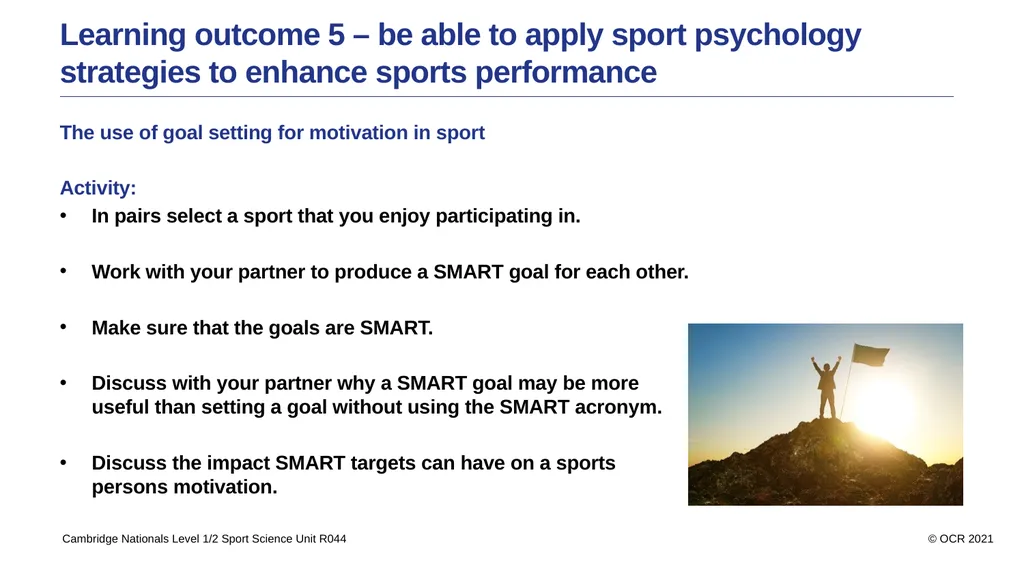
Activity:
In pairs select a sport that you enjoy participating in.
Work with your partner to produce a SMART goal for each other.
Make sure that the goals are SMART.
Discuss with your partner why a SMART goal may be more useful than setting a goal without using the SMART acronym.
Discuss the impact SMART targets can have on a sports persons motivation.<br>
slide31. Learning outcome 5 – be able to apply sport psychology strategies to enhance sports performance The use of mental rehearsal and imagery in sport
Going through the phases of the performance
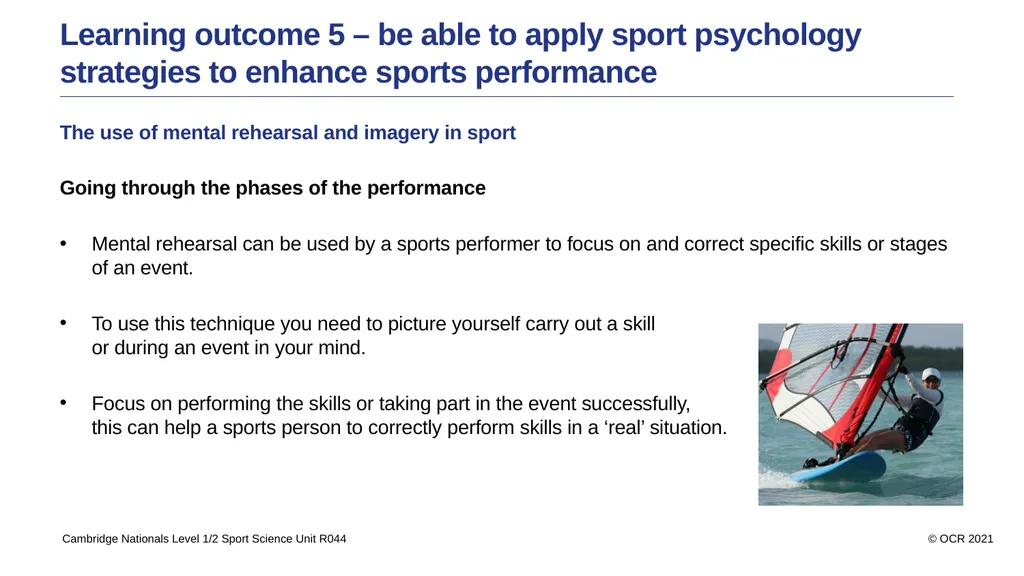
Mental rehearsal can be used by a sports performer to focus on and correct specific skills or stages of an event.
To use this technique you need to picture yourself carry out a skill or during an event in your mind.
Focus on performing the skills or taking part in the event successfully, this can help a sports person to correctly perform skills in a ‘real’ situation.<br>
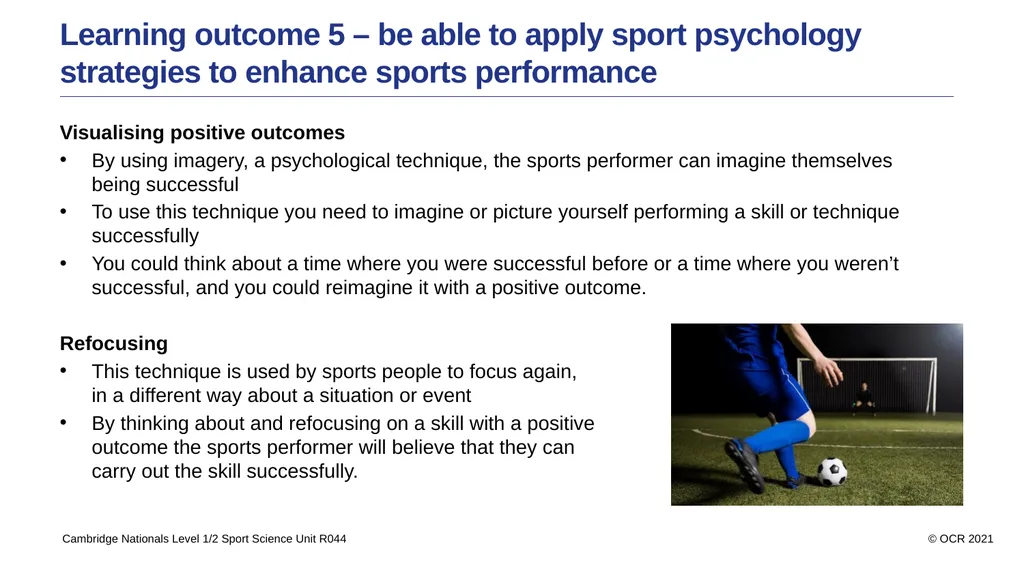
slide32. Learning outcome 5 – be able to apply sport psychology strategies to enhance sports performance Visualising positive outcomes
By using imagery, a psychological technique, the sports performer can imagine themselves being successful
To use this technique you need to imagine or picture yourself performing a skill or technique successfully
You could think about a time where you were successful before or a time where you weren’t successful, and you could reimagine it with a positive outcome.
Refocusing
This technique is used by sports people to focus again, in a different way about a situation or event
By thinking about and refocusing on a skill with a positive outcome the sports performer will believe that they can carry out the skill successfully.<br>
slide33. Learning outcome 5 – be able to apply sport psychology strategies to enhance sports performance The use of mental rehearsal and imagery in sport
Activity: Give an example for how a sports performer can use each of the following to improve their sports performance:
Going through the phases of the performance
Visualising positive outcomes
Refocusing.
Make sure that your example describes what the sports person would do, name the skill or technique and the spot they are participating in.<br>
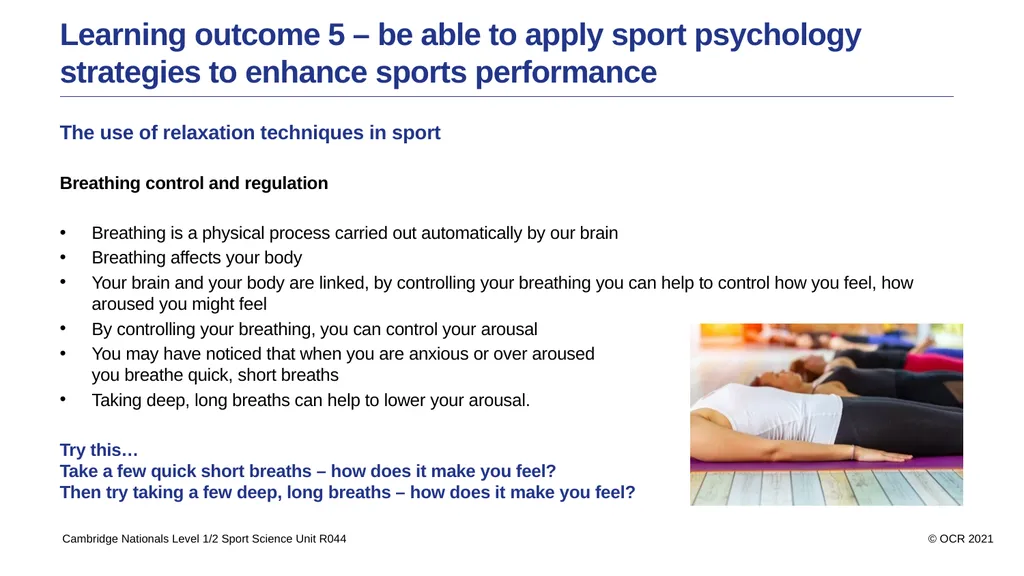
slide34. Learning outcome 5 – be able to apply sport psychology strategies to enhance sports performance The use of relaxation techniques in sport
Breathing control and regulation
Breathing is a physical process carried out automatically by our brain
Breathing affects your body
Your brain and your body are linked, by controlling your breathing you can help to control how you feel, how aroused you might feel
By controlling your breathing, you can control your arousal
You may have noticed that when you are anxious or over aroused you breathe quick, short breaths
Taking deep, long breaths can help to lower your arousal.
Try this… Take a few quick short breaths – how does it make you feel? Then try taking a few deep, long breaths – how does it make you feel?<br>
slide35. Learning outcome 5 – be able to apply sport psychology strategies to enhance sports performance The use of relaxation techniques in sport
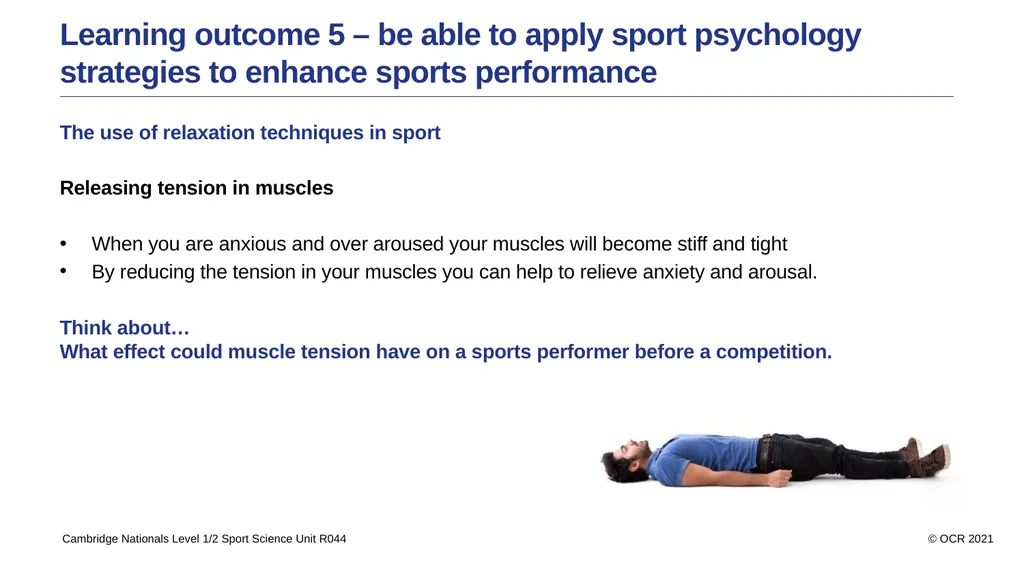
Releasing tension in muscles
When you are anxious and over aroused your muscles will become stiff and tight
By reducing the tension in your muscles you can help to relieve anxiety and arousal.
Think about… What effect could muscle tension have on a sports performer before a competition.<br>
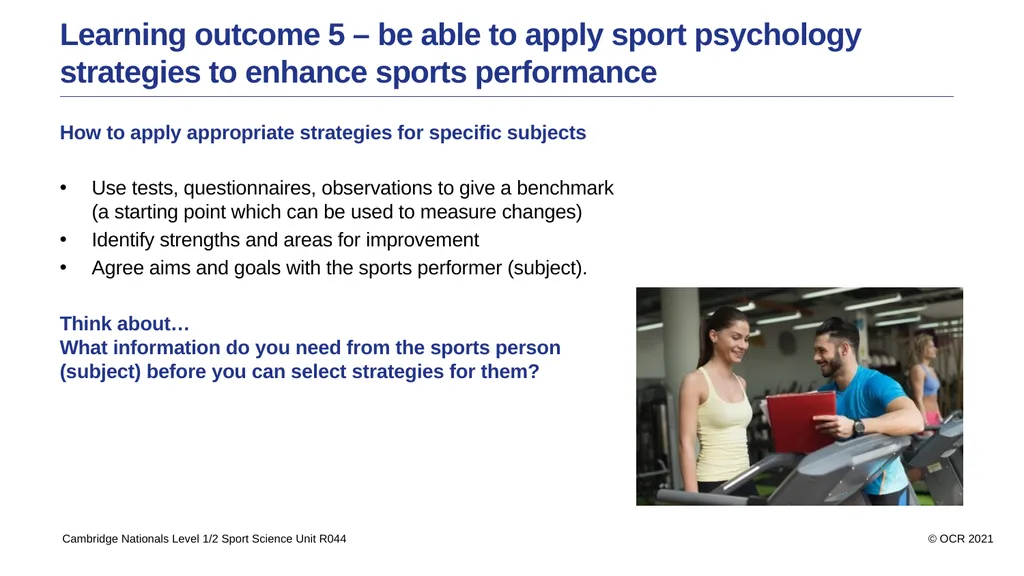
slide36. Learning outcome 5 – be able to apply sport psychology strategies to enhance sports performance How to apply appropriate strategies for specific subjects
Use tests, questionnaires, observations to give a benchmark (a starting point which can be used to measure changes)
Identify strengths and areas for improvement
Agree aims and goals with the sports performer (subject).
Think about… What information do you need from the sports person (subject) before you can select strategies for them?<br>
slide37. Learning outcome 5 – be able to apply sport psychology strategies to enhance sports performance How to assess whether strategies have had an impact on sports performance
Pre and post-testing and basic measures of performance
Results collected before the strategies are applied and again after it has been completed
Tests could include SCAT test to identify the level of arousal/anxiety
Fitness or skill tests to show the current level of ability.
Task: For a sport of your choice select suitable pre and post tests.<br>
slide38. Learning outcome 5 – be able to apply sport psychology strategies to enhance sports performance How to assess whether strategies have had an impact on sports performance
Observation
Are the strategies working?
You can monitor the success of the strategies you have recommend by observing the sports performer
You could carry out observations during training and in competitive situations
You could observe how the performer uses the strategies
You can observe if the strategies are having any impact on sports performance.<br>
slide39. Learning outcome 5 – be able to apply sport psychology strategies to enhance sports performance How to assess whether strategies have had an impact on sports performance
Evaluation of strategies
Were the goals, SMART targets, successful and did the sports performer meet their goals?
Use the test results and observations carried out before the strategies were applied to identify any impacts on sports performance
Assess whether any of the strategies were more successful than others
Discuss the strategies applied with the sports performer and analyse their assessment of the impact on their sports performance.
Task: You could use a role play scenario to evaluate the strategies used by the sports performer to improve their performance.<br>
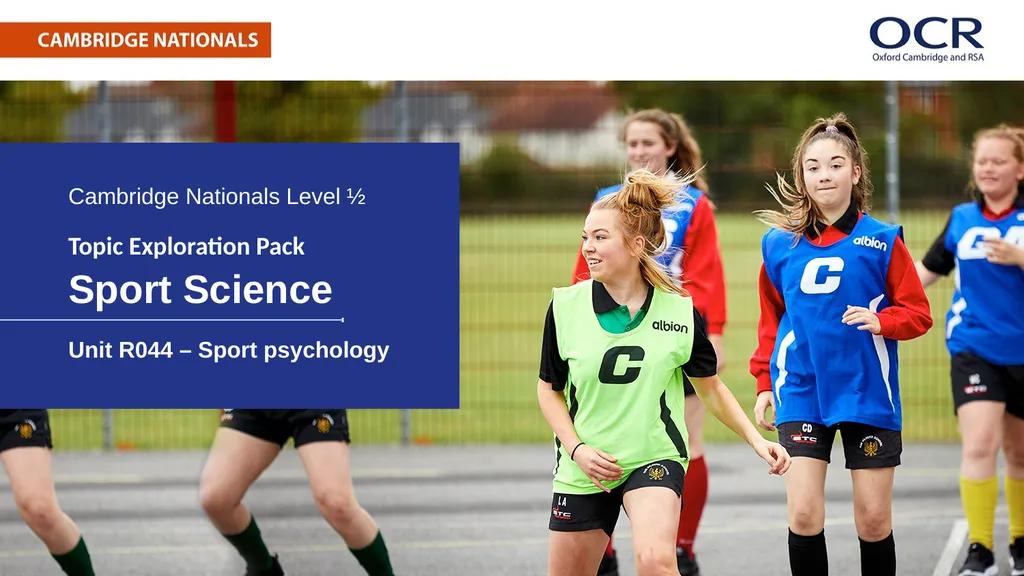
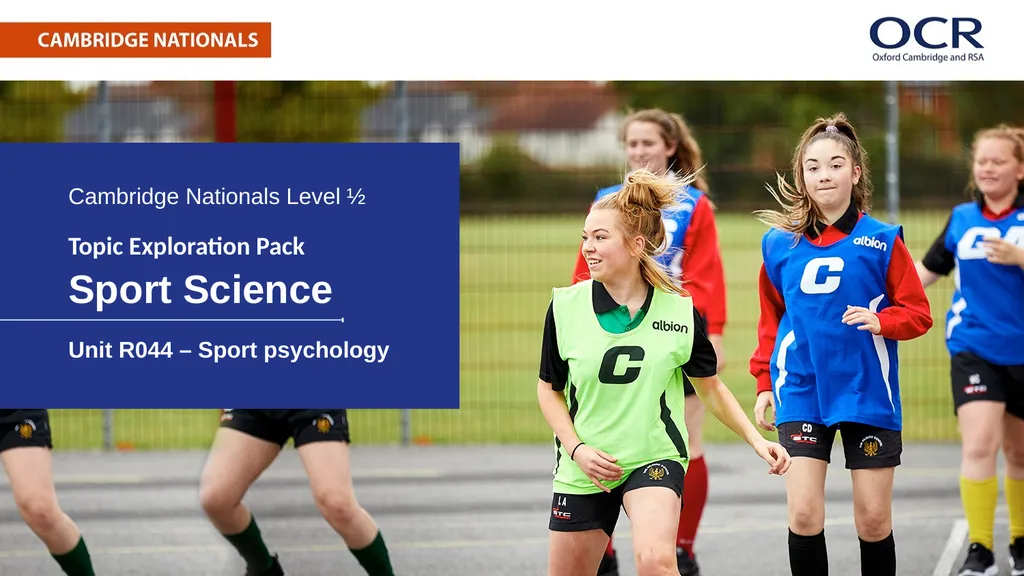
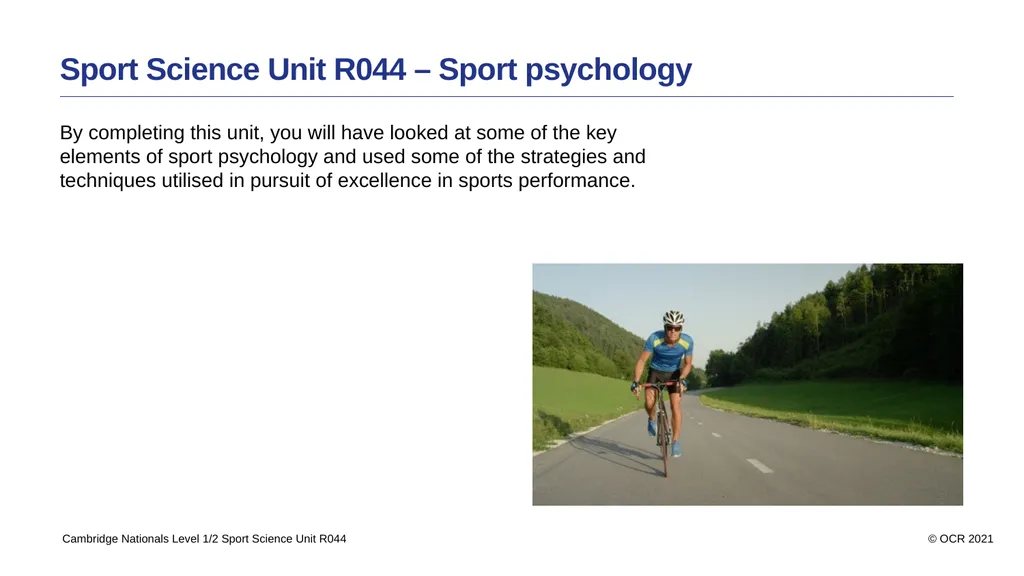
slide40. Sport Science Unit R044 – Sport psychology By completing this unit, you will have looked at some of the key elements of sport psychology and used some of the strategies and techniques utilised in pursuit of excellence in sports performance.<br>
slide41. We’d like to know your view on the resources we produce. Click ‘Like’ or ‘Dislike’ to send us an auto generated email about this resource. Add comments if you want to. Let us know how we can improve this resource or what else you need. Your email will not be used or shared for any marketing purposes.
Looking for another resource? There is now a quick and easy search tool to help find free resources for your qualification.
OCR is part of Cambridge Assessment, a department of the University of Cambridge. For staff training purposes and as part of our quality assurance programme your call may be recorded or monitored. Oxford Cambridge and RSA Examinations is a Company Limited by Guarantee. Registered in England. Registered office The Triangle Building, Shaftesbury Road, Cambridge, CB2 8EA. Registered company number 3484466. OCR is an exempt charity.
OCR operates academic and vocational qualifications regulated by Ofqual, Qualifications Wales and CCEA as listed in their qualifications registers including A Levels, GCSEs, Cambridge Technicals and Cambridge Nationals.
OCR provides resources to help you deliver our qualifications. These resources do not represent any particular teaching method we expect you to use. We update our resources regularly and aim to make sure content is accurate but please check the OCR website so that you have the most up to date version. OCR cannot be held responsible for any errors or omissions in these resources.
Though we make every effort to check our resources, there may be contradictions between published support and the specification, so it is important that you always use information in the latest specification. We indicate any specification changes within the document itself, change the version number and provide a summary of the changes. If you do notice a discrepancy between the specification and a resource, please contact us.
© OCR 2021 You can copy and distribute this resource freely if you keep the OCR logo and this small print intact and you acknowledge OCR as the originator of the resource.
OCR acknowledges the use of the following content: Slide 4: Schizophrenia, wildpix/Getty Images; Slide 6: Sprinter, Mel-nik/Getty Images: Slide 7: gymnast on balance beam/simonkr/Getty Images, rugby players/South_agency/Getty Images; Slide 9: Young footballers holding trophy, SDI Productions/Getty Images; Slide 10: Sprinter, peepo/Getty Images; Slide 14: Man holding trophy, FangXiaNuo/Getty Images; Slide 16: Gold, silver and bronze medals, PeskyMonkey/Getty Images: Football training, matimix/Getty Images; Slide 17: Female boxer, jacoblund/Getty Images; Slide 18: Ice Hockey players, GoodLifeStudio/Getty Images; Slide 19: Football referee, simonkr/Getty Images; Slide 20: Football tackle, skynesher/Getty Images; Slide 21: Ladies football team celebrating, PeopleImages/Getty Images; Slide 22: Ice Skater, technotr/Getty Images; Slide 23: Sprinter disappointed, Tassii/Getty Images; Slide 24: Gymnast, Aksonov/Getty Images; Slide 25: Rugby scrum, mikedabell/Getty Images; Slide 28: Head icon with cloud, Sudowoodo/Getty Images; Slide 30: Businessman on top of mountain, jamesteohart/Getty Images; Slide 31: Windsurfer, windjunki/Getty Images; Slide 32: Playing football, Antonio_Diaz/Getty Images; Slide 34: Yoga class, southtownboy/Getty Images; Slide 35: Man lying down, sjenner13/Getty Images; Slide 36: Woman with gym instructor, skynesher/Getty Images; Slide 40: Cyclist on empty road, helivideo/Getty Images.
Whether you already offer OCR qualifications, are new to OCR or are thinking about switching, you can request more information using our Expression of Interest form.
Please get in touch if you want to discuss the accessibility of resources we offer to support you in delivering our qualifications.<br>
Learning outcome 1 – understand the relationship between personality and sports performance
Learning outcome 2 – know how motivation can affect sports performance
Learning outcome 3 – know how aggression can affect sports performance
Learning outcome 4 – understand the impact of arousal and anxiety on sports performance
Learning outcome 5 – be able to apply sport psychology strategies to enhance sports performance<br>
slide3. Learning outcome 1 – understand the relationship between personality and sports performance By the end of this learning outcome you should know:
The definition of personality
Extrovert and introvert personality types
The links between personality and involvement and performance in sport
The trait approach
Observed or social learning theories.<br>
slide4. Learning outcome 1 – understand the relationship between personality and sports performance Definition of personality
The way we behave in certain situations, whether we are generally calm or nervous, whether we are outgoing or shy. Tips:
When you provide a definition you need to write it in your own words
Read the definition and describe it in a way that shows you understand what it means.
Personality is unique to every person. It is important that a sports performer knows their personality characteristics so that they can manage them and make sure they don’t have a negative effect on sports performance.<br>
slide5. Learning outcome 1 – understand the relationship between personality and sports performance Extrovert personality types
People who have an extrovert personality are outgoing and prefer to be with other people
They often perform better under pressure
They enjoy working as a team and playing team sports
They like a challenge and taking on roles of responsibility.
Introvert personality types
People who have an introvert personality are often shy and prefer to be on their own
They often perform better without pressure
They enjoy working on their own and in individual sports
They like activities which require accuracy and patience.<br>
slide6. Learning outcome 1 – understand the relationship between personality and sports performance Extrovert and introvert personality types
Task:
Why would it be useful for a sports coach to know what personality type and characteristics their athletes have?
Name four different sports and explain why you think introverts or extroverts would be better suited to them.
You should also think about the different roles/positions in the sport and how they might affect your selection of personality type.
Identify four sports that you enjoy playing, do these link to the personality type you are?<br>
slide7. Learning outcome 1 – understand the relationship between personality and sports performance The links between personality and involvement and performance in sport
More aggressive personalities will be more likely to play an aggressive sport. Think about…
Which personality types play different sports. Discuss with a partner which sports you prefer to play and how this may link to your personality type.<br>
slide8. Learning outcome 1 – understand the relationship between personality and sports performance The trait approach
The Trait theory suggests that people have certain personality traits or characteristics and these determine how the person will behave
The traits are stable or consistent and will stay the same in different environments or situations
For example, if you are a calm person you will behave calmly in a stressful situation like a competition as you would in training
A sports performer who is naturally aggressive will be aggressive in a competition
This theory says that aggression is seen as a desirable trait for a rugby team captain. The captain needs to be vocal and an extrovert. Think about… Which personality traits or characteristics do you show and how do these suit the sports you like to perform.<br>
slide9. Learning outcome 1 – understand the relationship between personality and sports performance Observed or social learning
Observational or social learning happens by observing the behavior of others. By watching others you learn to copy their behaviours
This theory says that the environment can influence personality and behaviour, so a young tennis player might be more likely to criticise the line judge if they see this happening regularly in professional tennis on television
The Social learning theory suggests that if aggressive defensive methods in rugby are seen to work, they are more likely to be copied. Activity: In your table groups discuss skills or techniques which you have tried because you have seen other sports people, friends perform them.<br>
slide10. Learning outcome 2 – know how motivation can affect sports performance By the end of this learning outcome you should know:
The definition of motivation
Intrinsic motivation
Extrinsic motivation
Achievement motivation
The implications of motivation for sport and exercise involvement<br>
slide11. Learning outcome 2 – know how motivation can affect sports performance Definition of motivation
The desire to do something and move toward a goal.
Tips:
When you provide a definition, you need to write it in your own words
Read the definition and describe it in a way that shows you understand what it means.
Only a certain type of person is motivated to participate in sport.
These people want to participate
They want to achieve a goal
They want the challenge of training and competing.<br>
slide12. Learning outcome 2 – know how motivation can affect sports performance Intrinsic motivation
This type of motivation comes from inside you, from your enjoyment of taking part in something and wanting to succeed
For example, beating your personal best or wanting to improve at a sport because you enjoy it
A tennis player with intrinsic motivation wants to train every day because they enjoy it and love learning new skills.<br>
slide13. Learning outcome 2 – know how motivation can affect sports performance Extrinsic motivation
This type of motivation comes from external rewards. You take part in something because you get a reward for doing it
For example, working towards achieving a certificate or award, making a lot of money from wining a tournament
A footballer with extrinsic motivation plays in a league competition because they get paid for playing.<br>
slide14. Learning outcome 2 – know how motivation can affect sports performance Intrinsic and extrinsic motivation
Activity:
Make a list of the sports you participate in
For each sport identify your motivation for participating, for example, you enjoy playing, you want to learn new skills
For each sport explain what motivates you to participate in them. You must identify if these are extrinsic or intrinsic motivational factors
Discuss your findings with a partner and see if there are and similarities and differences.<br>
slide15. Learning outcome 2 – know how motivation can affect sports performance Achievement motivation
‘Need to Achieve’ (NACH)
Explains a person's desire for success, to competently perform a new skill, to perform at a high level
This type of motivation is what drives you to complete a challenge, to keep training and to want to win.
‘Need to Avoid Failure’ (NAF) (e.g. will always do the easy thing)
Explains a person's ability to feel satisfaction or pride from accomplishments
This type of motivation is what makes you want to avoid failure and can make you do the easy thing instead of trying something difficult.<br>
slide16. Learning outcome 2 – know how motivation can affect sports performance The implications of motivation for sport and exercise involvement
Motivation can determine which sport/activities you choose to participate in
Motivation can effect how hard you try
Motivation can make you keep trying or give up. Think about…
Do you think your sports performance and attitude to training demonstrate – NACH or NAF?
How do NACH and NAF effect your performance in your favourite and least favourite sports?<br>
slide17. Learning outcome 3 – know how aggression can affect sports performance By the end of this learning outcome you should know:
The types of aggression
Reasons for aggression
Different theories of aggression.<br>
slide18. Learning outcome 3 – know how aggression can affect sports performance Types of aggression
What is aggression?
Behaviour against another person or object. It is not an accident, it can be positive or negative depending on whether it is controlled.
Direct
This type of aggression is directed at an opponent/participant/official, for example, wanting to hurt an opponent in a football tackle.
Indirect
This type of aggression is directed at an object, for example, smashing a golf club in frustration after a poor shot. Think about…
During a sports activity when have you shown direct and indirect aggression.<br>
slide19. Learning outcome 3 – know how aggression can affect sports performance Reasons for aggression
Rivalry
During a boxing weigh-in or national rivalry such as England vs. Scotland.
Pressures to win
Playing in a cup final match or relegation battle.
Over-arousal during play
A football player becoming too ‘pumped up’ and launching into a reckless tackle.
Behaviour of opposition
This could be shown by foul play in a game or taunting the opposition.
Decisions of officials
If foul play is not punished, players cannot accept that the referee’s decision is final. Activity: For each of the reasons for aggression give two more sports examples.<br>
slide20. Learning outcome 3 – know how aggression can affect sports performance Theories of aggression
Social learning theory
This theory suggests that new behaviours can be learned from observing and copying others
For example, if aggressive defensive methods in football are seen to work, they are more likely to be copied.
Trait theory
This theory suggests that behaviours are parts of your personality and you have a unique set of traits
For example, if a performer has an aggressive personality trait, competition will bring this out and they will behave aggressively. Task: In pairs identify different sporting examples to describe how these theories apply to sport and sports performers.<br>
slide21. Learning outcome 4 – understand the impact of arousal and anxiety on sports performance By the end of this learning outcome you should know:
The explanations of arousal
Theories of how arousal/anxiety affects performance
How to apply these theories to sporting examples
Different methods for measuring anxiety.<br>
slide22. Learning outcome 4 – understand the impact of arousal and anxiety on sports performance Explanations of arousal
Arousal is an energised state that can help or hinder performance
For example, a figure skater may feel highly aroused just before a performance and much less aroused an hour after the performance has ended. Think about… How arousal has affected your sports performance both positively and negatively.<br>
slide23. Learning outcome 4 – understand the impact of arousal and anxiety on sports performance Theories of how arousal/anxiety affects performance and how to apply the theories of how arousal/anxiety affects performance to sporting examples
Drive theory
This theory suggest that there is a link between arousal/anxiety and performance
For example, a sports performer needs arousal/anxiety to perform at their best
Some elite performers find it hard to get motivated for ‘minor’ events compared to big international tournaments.
Sporting example – a professional cricketer will play well in a match, as the match goes on, they become more aroused and play better and better. Task: Give three examples of how the Drive theory affects sports performance.<br>
slide24. Learning outcome 4 – understand the impact of arousal and anxiety on sports performance Theories of how arousal/anxiety affects performance and how to apply the theories of how arousal/anxiety affects performance to sporting examples
Inverted U theory
This theory suggests that arousal/anxiety levels and performance increase up to an optimal point, then they both begin to decrease
For example, a sports performer will have a peak in performance and arousal/anxiety.
Sporting example – a gymnast performing a floor routine could be performing very well, but as they become more aroused their performance increases to a level, they might make a mistake and their arousal and performance decrease. Task: Give three examples of how the Inverted U theory affect sports performance.<br>
slide25. Learning outcome 4 – understand the impact of arousal and anxiety on sports performance Theories of how arousal/anxiety affects performance and how to apply the theories of how arousal/anxiety affects performance to sporting examples
Zones of optimal functioning
This theory suggests that there are differences in the way people react to arousal/anxiety. Some people will succeed when arousal/anxiety is low while others tend to succeed when arousal/anxiety is high
In some sports, performers will need higher arousal/anxiety levels than others to ‘be in the zone’.
Sporting example – rugby players about to go into a scrum would require more arousal/anxiety than a snooker player making a break. Task: Give three examples of how the zones of optimal functioning affect sports performance.<br>
slide26. Learning outcome 4 – understand the impact of arousal and anxiety on sports performance Methods for measuring anxiety
Sport Competition Anxiety Test (SCAT)
A SCAT test is carried out by completing a questionnaire about anxiety
The questionnaire usually contains 15 questions about how they feel in competitive situations
The results of a SCAT test can be analysed to predict a sports person's level of anxiety.
Task: Use the internet to research scat tests.
Carry out a SCAT test and discuss your results with a partner.<br>
slide27. Learning outcome 4 – understand the impact of arousal and anxiety on sports performance Methods for measuring anxiety
State Anxiety Inventory Test
A State Anxiety Inventory Test is a test/questionnaire which can be used to identify how strongly a person feels anxious
The results form the test can be used to detect levels of anxiety in a sports performer.
Task: Use the internet to research State Anxiety Inventory Test. Carry out a State Anxiety Inventory Test and discuss your results with a partner. An example can be found here.<br>
slide28. Learning outcome 5 – be able to apply sport psychology strategies to enhance sports performance By the end of this learning outcome you should know:
The use of goal setting for motivation in sport
The use of mental rehearsal and imagery in sport
The use of relaxation techniques in sport
How to apply appropriate strategies for specific subject(s)
How to assess whether strategies have had an impact on sports performance.<br>
slide29. Learning outcome 5 – be able to apply sport psychology strategies to enhance sports performance The use of goal setting for motivation in sport
SMART targets can be used to set useful goals for sports performers
For targets to be useful they need to be relevant and designed for the individual performer.
Specific The goal needs to address what it is that you want to achieve.
Measurable The goal should have a starting and end point or benchmark so that progress can be recorded.
Achievable The goal must be something that the spots person can actually do, or be able to do with time and practise.
Realistic The goal must be something that the sports person has the time, resources and ability to do.
Time-bound The goal needs a clear start and finish.<br>
slide30. Learning outcome 5 – be able to apply sport psychology strategies to enhance sports performance The use of goal setting for motivation in sport
Activity:
In pairs select a sport that you enjoy participating in.
Work with your partner to produce a SMART goal for each other.
Make sure that the goals are SMART.
Discuss with your partner why a SMART goal may be more useful than setting a goal without using the SMART acronym.
Discuss the impact SMART targets can have on a sports persons motivation.<br>
slide31. Learning outcome 5 – be able to apply sport psychology strategies to enhance sports performance The use of mental rehearsal and imagery in sport
Going through the phases of the performance
Mental rehearsal can be used by a sports performer to focus on and correct specific skills or stages of an event.
To use this technique you need to picture yourself carry out a skill or during an event in your mind.
Focus on performing the skills or taking part in the event successfully, this can help a sports person to correctly perform skills in a ‘real’ situation.<br>
slide32. Learning outcome 5 – be able to apply sport psychology strategies to enhance sports performance Visualising positive outcomes
By using imagery, a psychological technique, the sports performer can imagine themselves being successful
To use this technique you need to imagine or picture yourself performing a skill or technique successfully
You could think about a time where you were successful before or a time where you weren’t successful, and you could reimagine it with a positive outcome.
Refocusing
This technique is used by sports people to focus again, in a different way about a situation or event
By thinking about and refocusing on a skill with a positive outcome the sports performer will believe that they can carry out the skill successfully.<br>
slide33. Learning outcome 5 – be able to apply sport psychology strategies to enhance sports performance The use of mental rehearsal and imagery in sport
Activity: Give an example for how a sports performer can use each of the following to improve their sports performance:
Going through the phases of the performance
Visualising positive outcomes
Refocusing.
Make sure that your example describes what the sports person would do, name the skill or technique and the spot they are participating in.<br>
slide34. Learning outcome 5 – be able to apply sport psychology strategies to enhance sports performance The use of relaxation techniques in sport
Breathing control and regulation
Breathing is a physical process carried out automatically by our brain
Breathing affects your body
Your brain and your body are linked, by controlling your breathing you can help to control how you feel, how aroused you might feel
By controlling your breathing, you can control your arousal
You may have noticed that when you are anxious or over aroused you breathe quick, short breaths
Taking deep, long breaths can help to lower your arousal.
Try this… Take a few quick short breaths – how does it make you feel? Then try taking a few deep, long breaths – how does it make you feel?<br>
slide35. Learning outcome 5 – be able to apply sport psychology strategies to enhance sports performance The use of relaxation techniques in sport
Releasing tension in muscles
When you are anxious and over aroused your muscles will become stiff and tight
By reducing the tension in your muscles you can help to relieve anxiety and arousal.
Think about… What effect could muscle tension have on a sports performer before a competition.<br>
slide36. Learning outcome 5 – be able to apply sport psychology strategies to enhance sports performance How to apply appropriate strategies for specific subjects
Use tests, questionnaires, observations to give a benchmark (a starting point which can be used to measure changes)
Identify strengths and areas for improvement
Agree aims and goals with the sports performer (subject).
Think about… What information do you need from the sports person (subject) before you can select strategies for them?<br>
slide37. Learning outcome 5 – be able to apply sport psychology strategies to enhance sports performance How to assess whether strategies have had an impact on sports performance
Pre and post-testing and basic measures of performance
Results collected before the strategies are applied and again after it has been completed
Tests could include SCAT test to identify the level of arousal/anxiety
Fitness or skill tests to show the current level of ability.
Task: For a sport of your choice select suitable pre and post tests.<br>
slide38. Learning outcome 5 – be able to apply sport psychology strategies to enhance sports performance How to assess whether strategies have had an impact on sports performance
Observation
Are the strategies working?
You can monitor the success of the strategies you have recommend by observing the sports performer
You could carry out observations during training and in competitive situations
You could observe how the performer uses the strategies
You can observe if the strategies are having any impact on sports performance.<br>
slide39. Learning outcome 5 – be able to apply sport psychology strategies to enhance sports performance How to assess whether strategies have had an impact on sports performance
Evaluation of strategies
Were the goals, SMART targets, successful and did the sports performer meet their goals?
Use the test results and observations carried out before the strategies were applied to identify any impacts on sports performance
Assess whether any of the strategies were more successful than others
Discuss the strategies applied with the sports performer and analyse their assessment of the impact on their sports performance.
Task: You could use a role play scenario to evaluate the strategies used by the sports performer to improve their performance.<br>
slide40. Sport Science Unit R044 – Sport psychology By completing this unit, you will have looked at some of the key elements of sport psychology and used some of the strategies and techniques utilised in pursuit of excellence in sports performance.<br>
slide41. We’d like to know your view on the resources we produce. Click ‘Like’ or ‘Dislike’ to send us an auto generated email about this resource. Add comments if you want to. Let us know how we can improve this resource or what else you need. Your email will not be used or shared for any marketing purposes.
Looking for another resource? There is now a quick and easy search tool to help find free resources for your qualification.
OCR is part of Cambridge Assessment, a department of the University of Cambridge. For staff training purposes and as part of our quality assurance programme your call may be recorded or monitored. Oxford Cambridge and RSA Examinations is a Company Limited by Guarantee. Registered in England. Registered office The Triangle Building, Shaftesbury Road, Cambridge, CB2 8EA. Registered company number 3484466. OCR is an exempt charity.
OCR operates academic and vocational qualifications regulated by Ofqual, Qualifications Wales and CCEA as listed in their qualifications registers including A Levels, GCSEs, Cambridge Technicals and Cambridge Nationals.
OCR provides resources to help you deliver our qualifications. These resources do not represent any particular teaching method we expect you to use. We update our resources regularly and aim to make sure content is accurate but please check the OCR website so that you have the most up to date version. OCR cannot be held responsible for any errors or omissions in these resources.
Though we make every effort to check our resources, there may be contradictions between published support and the specification, so it is important that you always use information in the latest specification. We indicate any specification changes within the document itself, change the version number and provide a summary of the changes. If you do notice a discrepancy between the specification and a resource, please contact us.
© OCR 2021 You can copy and distribute this resource freely if you keep the OCR logo and this small print intact and you acknowledge OCR as the originator of the resource.
OCR acknowledges the use of the following content: Slide 4: Schizophrenia, wildpix/Getty Images; Slide 6: Sprinter, Mel-nik/Getty Images: Slide 7: gymnast on balance beam/simonkr/Getty Images, rugby players/South_agency/Getty Images; Slide 9: Young footballers holding trophy, SDI Productions/Getty Images; Slide 10: Sprinter, peepo/Getty Images; Slide 14: Man holding trophy, FangXiaNuo/Getty Images; Slide 16: Gold, silver and bronze medals, PeskyMonkey/Getty Images: Football training, matimix/Getty Images; Slide 17: Female boxer, jacoblund/Getty Images; Slide 18: Ice Hockey players, GoodLifeStudio/Getty Images; Slide 19: Football referee, simonkr/Getty Images; Slide 20: Football tackle, skynesher/Getty Images; Slide 21: Ladies football team celebrating, PeopleImages/Getty Images; Slide 22: Ice Skater, technotr/Getty Images; Slide 23: Sprinter disappointed, Tassii/Getty Images; Slide 24: Gymnast, Aksonov/Getty Images; Slide 25: Rugby scrum, mikedabell/Getty Images; Slide 28: Head icon with cloud, Sudowoodo/Getty Images; Slide 30: Businessman on top of mountain, jamesteohart/Getty Images; Slide 31: Windsurfer, windjunki/Getty Images; Slide 32: Playing football, Antonio_Diaz/Getty Images; Slide 34: Yoga class, southtownboy/Getty Images; Slide 35: Man lying down, sjenner13/Getty Images; Slide 36: Woman with gym instructor, skynesher/Getty Images; Slide 40: Cyclist on empty road, helivideo/Getty Images.
Whether you already offer OCR qualifications, are new to OCR or are thinking about switching, you can request more information using our Expression of Interest form.
Please get in touch if you want to discuss the accessibility of resources we offer to support you in delivering our qualifications.<br>