
Core Competency Clusters Quality & Service
CB
Published · 18 slides · 0 views
1 / 1
Description
Core Competency Clusters Quality Service Orientated A demonstrated aptitude for understanding and satisfying internal and external customers. Provision of effective solutions Results FocusedAction Orientated A drive to plan and deliver
Related Topics
Share
Embed code
Download this presentation From Below
"Core Competency Clusters Quality & Service" is the property of its rightful owner. Permission is granted to download and print the materials on this website for personal, non-commercial use only, and to display it on your personal computer provided you do not modify the materials and that you retain all copyright notices contained in the materials. By downloading content from our website, you accept the terms of this agreement.
Presentation Transcript
01
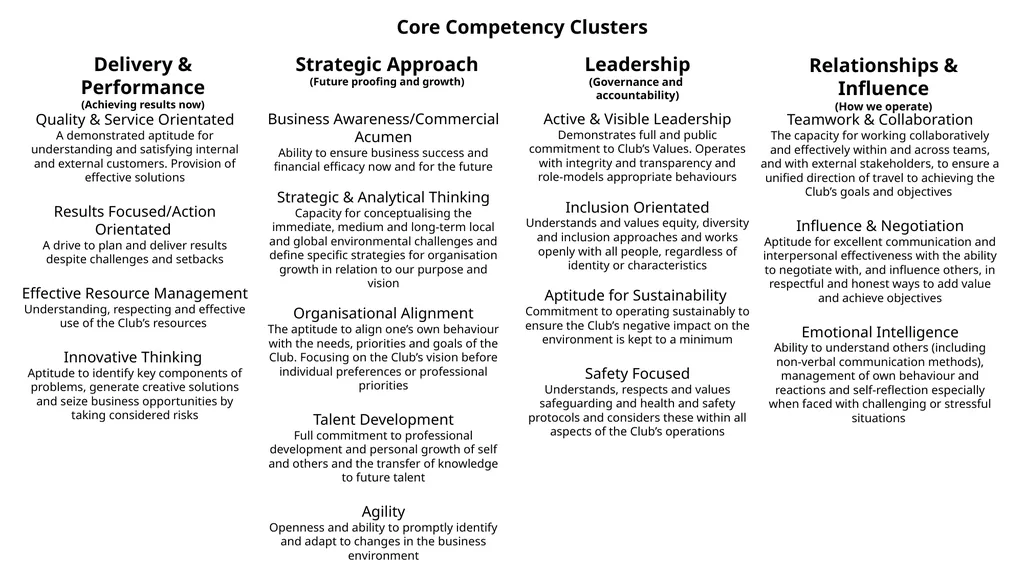
Core Competency Clusters Quality & Service Orientated
A demonstrated aptitude for understanding and satisfying internal and external customers. Provision of effective solutions
Results Focused/Action Orientated
A drive to plan and deliver results despite challenges and setbacks
Effective Resource Management
Understanding, respecting and effective use of the Club’s resources
Innovative Thinking
Aptitude to identify key components of problems, generate creative solutions and seize business opportunities by taking considered risks Delivery & Performance
(Achieving results now) Leadership
(Governance and
accountability) Relationships & Influence
(How we operate) Strategic Approach
(Future proofing and growth) Business Awareness/Commercial Acumen
Ability to ensure business success and financial efficacy now and for the future
Strategic & Analytical Thinking
Capacity for conceptualising the immediate, medium and long-term local and global environmental challenges and define specific strategies for organisation growth in relation to our purpose and vision
Organisational Alignment
The aptitude to align one’s own behaviour with the needs, priorities and goals of the Club. Focusing on the Club’s vision before individual preferences or professional priorities
Talent Development
Full commitment to professional development and personal growth of self and others and the transfer of knowledge to future talent
Agility
Openness and ability to promptly identify and adapt to changes in the business environment Active & Visible Leadership
Demonstrates full and public commitment to Club’s Values. Operates with integrity and transparency and role-models appropriate behaviours
Inclusion Orientated
Understands and values equity, diversity and inclusion approaches and works openly with all people, regardless of identity or characteristics
Aptitude for Sustainability
Commitment to operating sustainably to ensure the Club’s negative impact on the environment is kept to a minimum
Safety Focused
Understands, respects and values safeguarding and health and safety protocols and considers these within all aspects of the Club’s operations Teamwork & Collaboration
The capacity for working collaboratively and effectively within and across teams, and with external stakeholders, to ensure a unified direction of travel to achieving the Club’s goals and objectives
Influence & Negotiation
Aptitude for excellent communication and interpersonal effectiveness with the ability to negotiate with, and influence others, in respectful and honest ways to add value and achieve objectives
Emotional Intelligence
Ability to understand others (including non-verbal communication methods), management of own behaviour and reactions and self-reflection especially when faced with challenging or stressful situations<br>
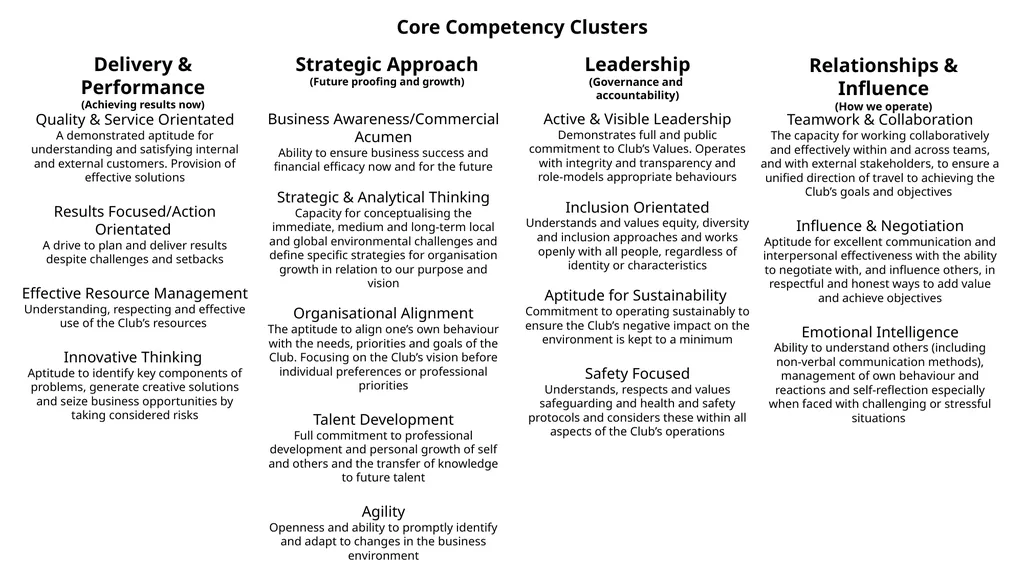
A demonstrated aptitude for understanding and satisfying internal and external customers. Provision of effective solutions
Results Focused/Action Orientated
A drive to plan and deliver results despite challenges and setbacks
Effective Resource Management
Understanding, respecting and effective use of the Club’s resources
Innovative Thinking
Aptitude to identify key components of problems, generate creative solutions and seize business opportunities by taking considered risks Delivery & Performance
(Achieving results now) Leadership
(Governance and
accountability) Relationships & Influence
(How we operate) Strategic Approach
(Future proofing and growth) Business Awareness/Commercial Acumen
Ability to ensure business success and financial efficacy now and for the future
Strategic & Analytical Thinking
Capacity for conceptualising the immediate, medium and long-term local and global environmental challenges and define specific strategies for organisation growth in relation to our purpose and vision
Organisational Alignment
The aptitude to align one’s own behaviour with the needs, priorities and goals of the Club. Focusing on the Club’s vision before individual preferences or professional priorities
Talent Development
Full commitment to professional development and personal growth of self and others and the transfer of knowledge to future talent
Agility
Openness and ability to promptly identify and adapt to changes in the business environment Active & Visible Leadership
Demonstrates full and public commitment to Club’s Values. Operates with integrity and transparency and role-models appropriate behaviours
Inclusion Orientated
Understands and values equity, diversity and inclusion approaches and works openly with all people, regardless of identity or characteristics
Aptitude for Sustainability
Commitment to operating sustainably to ensure the Club’s negative impact on the environment is kept to a minimum
Safety Focused
Understands, respects and values safeguarding and health and safety protocols and considers these within all aspects of the Club’s operations Teamwork & Collaboration
The capacity for working collaboratively and effectively within and across teams, and with external stakeholders, to ensure a unified direction of travel to achieving the Club’s goals and objectives
Influence & Negotiation
Aptitude for excellent communication and interpersonal effectiveness with the ability to negotiate with, and influence others, in respectful and honest ways to add value and achieve objectives
Emotional Intelligence
Ability to understand others (including non-verbal communication methods), management of own behaviour and reactions and self-reflection especially when faced with challenging or stressful situations<br>
02
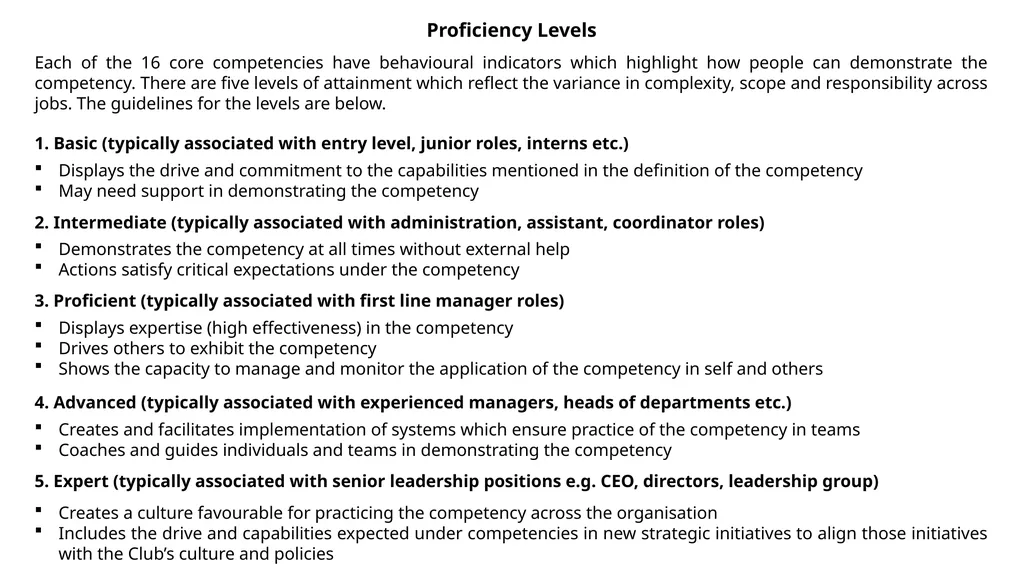
Proficiency Levels Each of the 16 core competencies have behavioural indicators which highlight how people can demonstrate the competency. There are five levels of attainment which reflect the variance in complexity, scope and responsibility across jobs. The guidelines for the levels are below.<br>
03
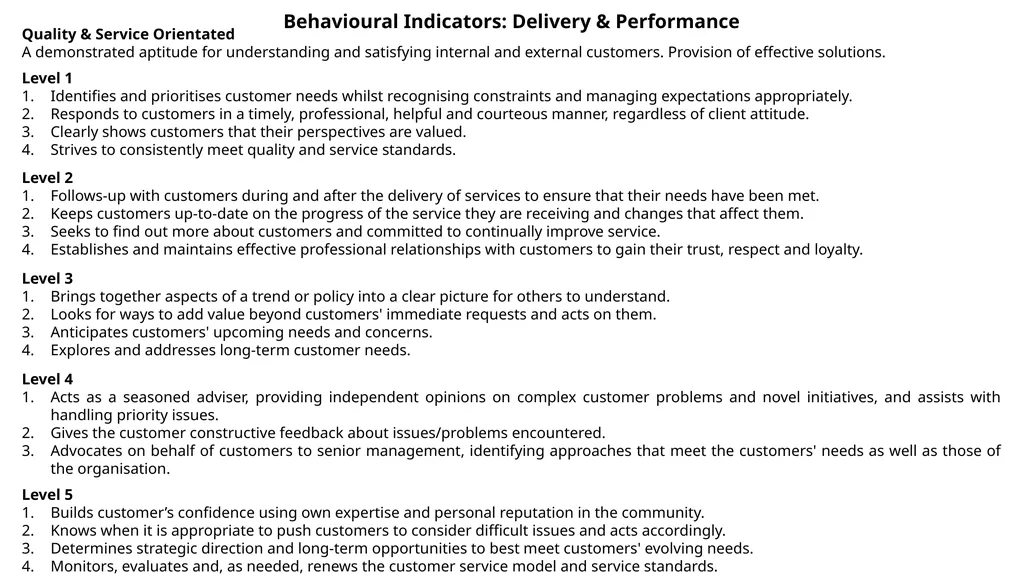
Behavioural Indicators: Delivery & Performance<br>
04
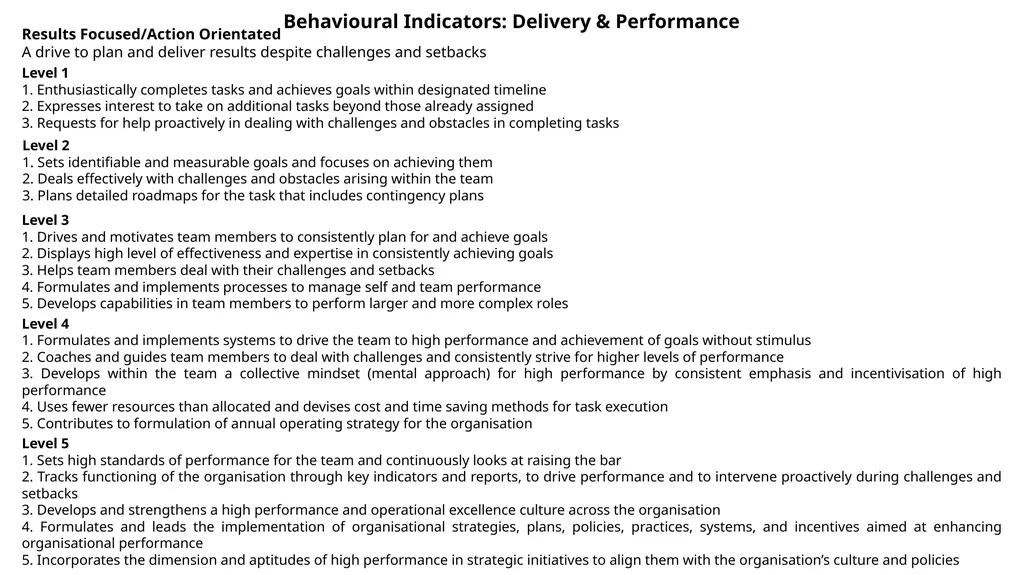
Behavioural Indicators: Delivery & Performance Results Focused/Action Orientated
A drive to plan and deliver results despite challenges and setbacks Level 1
1. Enthusiastically completes tasks and achieves goals within designated timeline
2. Expresses interest to take on additional tasks beyond those already assigned
3. Requests for help proactively in dealing with challenges and obstacles in completing tasks Level 2
1. Sets identifiable and measurable goals and focuses on achieving them
2. Deals effectively with challenges and obstacles arising within the team
3. Plans detailed roadmaps for the task that includes contingency plans Level 3
1. Drives and motivates team members to consistently plan for and achieve goals
2. Displays high level of effectiveness and expertise in consistently achieving goals
3. Helps team members deal with their challenges and setbacks
4. Formulates and implements processes to manage self and team performance
5. Develops capabilities in team members to perform larger and more complex roles Level 4
1. Formulates and implements systems to drive the team to high performance and achievement of goals without stimulus
2. Coaches and guides team members to deal with challenges and consistently strive for higher levels of performance
3. Develops within the team a collective mindset (mental approach) for high performance by consistent emphasis and incentivisation of high performance
4. Uses fewer resources than allocated and devises cost and time saving methods for task execution
5. Contributes to formulation of annual operating strategy for the organisation Level 5
1. Sets high standards of performance for the team and continuously looks at raising the bar
2. Tracks functioning of the organisation through key indicators and reports, to drive performance and to intervene proactively during challenges and setbacks
3. Develops and strengthens a high performance and operational excellence culture across the organisation
4. Formulates and leads the implementation of organisational strategies, plans, policies, practices, systems, and incentives aimed at enhancing organisational performance
5. Incorporates the dimension and aptitudes of high performance in strategic initiatives to align them with the organisation’s culture and policies<br>
A drive to plan and deliver results despite challenges and setbacks Level 1
1. Enthusiastically completes tasks and achieves goals within designated timeline
2. Expresses interest to take on additional tasks beyond those already assigned
3. Requests for help proactively in dealing with challenges and obstacles in completing tasks Level 2
1. Sets identifiable and measurable goals and focuses on achieving them
2. Deals effectively with challenges and obstacles arising within the team
3. Plans detailed roadmaps for the task that includes contingency plans Level 3
1. Drives and motivates team members to consistently plan for and achieve goals
2. Displays high level of effectiveness and expertise in consistently achieving goals
3. Helps team members deal with their challenges and setbacks
4. Formulates and implements processes to manage self and team performance
5. Develops capabilities in team members to perform larger and more complex roles Level 4
1. Formulates and implements systems to drive the team to high performance and achievement of goals without stimulus
2. Coaches and guides team members to deal with challenges and consistently strive for higher levels of performance
3. Develops within the team a collective mindset (mental approach) for high performance by consistent emphasis and incentivisation of high performance
4. Uses fewer resources than allocated and devises cost and time saving methods for task execution
5. Contributes to formulation of annual operating strategy for the organisation Level 5
1. Sets high standards of performance for the team and continuously looks at raising the bar
2. Tracks functioning of the organisation through key indicators and reports, to drive performance and to intervene proactively during challenges and setbacks
3. Develops and strengthens a high performance and operational excellence culture across the organisation
4. Formulates and leads the implementation of organisational strategies, plans, policies, practices, systems, and incentives aimed at enhancing organisational performance
5. Incorporates the dimension and aptitudes of high performance in strategic initiatives to align them with the organisation’s culture and policies<br>
05
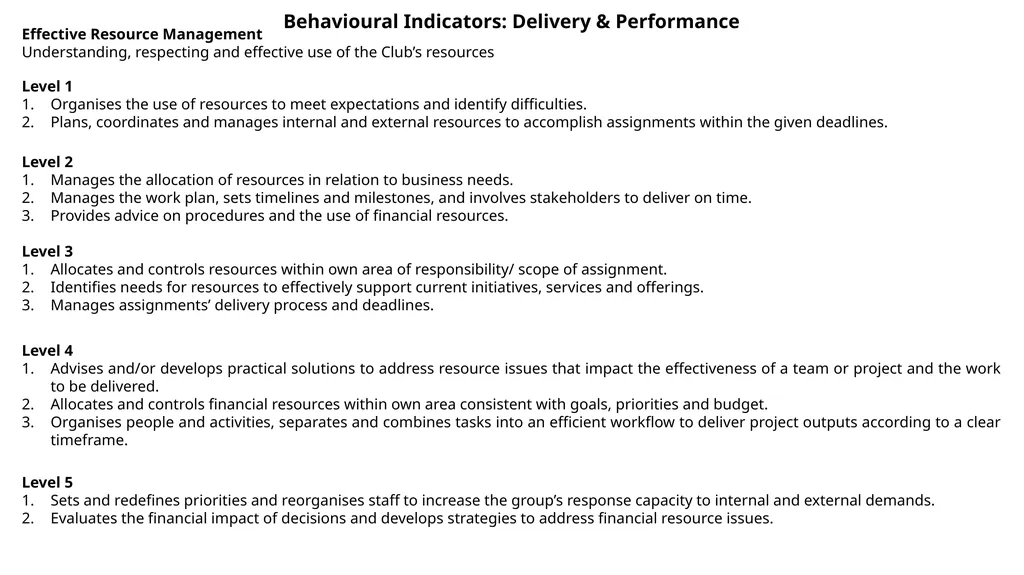
Behavioural Indicators: Delivery & Performance Effective Resource Management
Understanding, respecting and effective use of the Club’s resources Level 1
Organises the use of resources to meet expectations and identify difficulties.
Plans, coordinates and manages internal and external resources to accomplish assignments within the given deadlines. Level 2
Manages the allocation of resources in relation to business needs.
Manages the work plan, sets timelines and milestones, and involves stakeholders to deliver on time.
Provides advice on procedures and the use of financial resources. Level 3
Allocates and controls resources within own area of responsibility/ scope of assignment.
Identifies needs for resources to effectively support current initiatives, services and offerings.
Manages assignments’ delivery process and deadlines. Level 4
Advises and/or develops practical solutions to address resource issues that impact the effectiveness of a team or project and the work to be delivered.
Allocates and controls financial resources within own area consistent with goals, priorities and budget.
Organises people and activities, separates and combines tasks into an efficient workflow to deliver project outputs according to a clear timeframe. Level 5
Sets and redefines priorities and reorganises staff to increase the group’s response capacity to internal and external demands.
Evaluates the financial impact of decisions and develops strategies to address financial resource issues.<br>
Understanding, respecting and effective use of the Club’s resources Level 1
Organises the use of resources to meet expectations and identify difficulties.
Plans, coordinates and manages internal and external resources to accomplish assignments within the given deadlines. Level 2
Manages the allocation of resources in relation to business needs.
Manages the work plan, sets timelines and milestones, and involves stakeholders to deliver on time.
Provides advice on procedures and the use of financial resources. Level 3
Allocates and controls resources within own area of responsibility/ scope of assignment.
Identifies needs for resources to effectively support current initiatives, services and offerings.
Manages assignments’ delivery process and deadlines. Level 4
Advises and/or develops practical solutions to address resource issues that impact the effectiveness of a team or project and the work to be delivered.
Allocates and controls financial resources within own area consistent with goals, priorities and budget.
Organises people and activities, separates and combines tasks into an efficient workflow to deliver project outputs according to a clear timeframe. Level 5
Sets and redefines priorities and reorganises staff to increase the group’s response capacity to internal and external demands.
Evaluates the financial impact of decisions and develops strategies to address financial resource issues.<br>
06
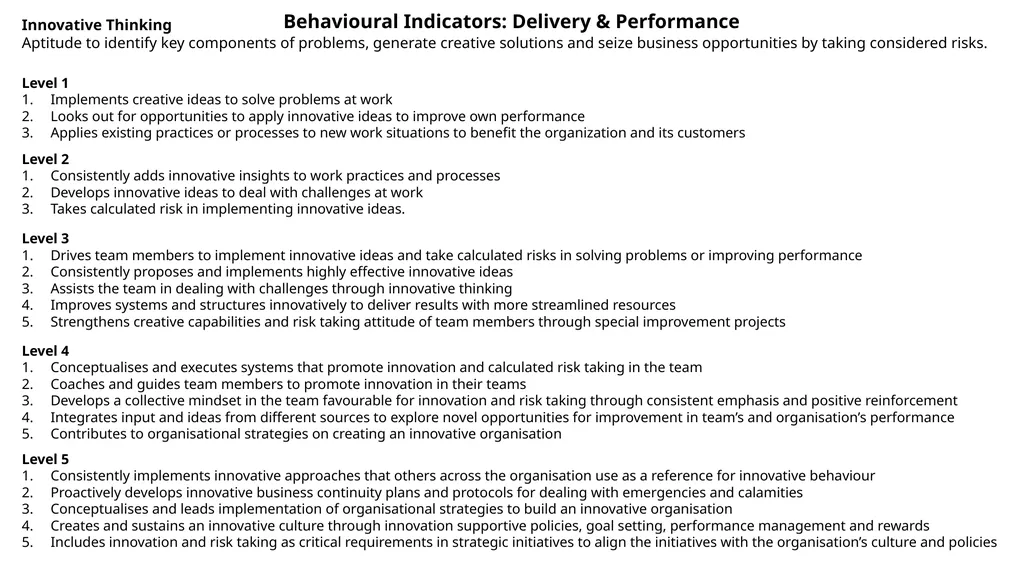
Behavioural Indicators: Delivery & Performance Innovative Thinking
Aptitude to identify key components of problems, generate creative solutions and seize business opportunities by taking considered risks. Level 1
Implements creative ideas to solve problems at work
Looks out for opportunities to apply innovative ideas to improve own performance
Applies existing practices or processes to new work situations to benefit the organization and its customers Level 2
Consistently adds innovative insights to work practices and processes
Develops innovative ideas to deal with challenges at work
Takes calculated risk in implementing innovative ideas. Level 3
Drives team members to implement innovative ideas and take calculated risks in solving problems or improving performance
Consistently proposes and implements highly effective innovative ideas
Assists the team in dealing with challenges through innovative thinking
Improves systems and structures innovatively to deliver results with more streamlined resources
Strengthens creative capabilities and risk taking attitude of team members through special improvement projects Level 4
Conceptualises and executes systems that promote innovation and calculated risk taking in the team
Coaches and guides team members to promote innovation in their teams
Develops a collective mindset in the team favourable for innovation and risk taking through consistent emphasis and positive reinforcement
Integrates input and ideas from different sources to explore novel opportunities for improvement in team’s and organisation’s performance
Contributes to organisational strategies on creating an innovative organisation Level 5
Consistently implements innovative approaches that others across the organisation use as a reference for innovative behaviour
Proactively develops innovative business continuity plans and protocols for dealing with emergencies and calamities
Conceptualises and leads implementation of organisational strategies to build an innovative organisation
Creates and sustains an innovative culture through innovation supportive policies, goal setting, performance management and rewards
Includes innovation and risk taking as critical requirements in strategic initiatives to align the initiatives with the organisation’s culture and policies<br>
Aptitude to identify key components of problems, generate creative solutions and seize business opportunities by taking considered risks. Level 1
Implements creative ideas to solve problems at work
Looks out for opportunities to apply innovative ideas to improve own performance
Applies existing practices or processes to new work situations to benefit the organization and its customers Level 2
Consistently adds innovative insights to work practices and processes
Develops innovative ideas to deal with challenges at work
Takes calculated risk in implementing innovative ideas. Level 3
Drives team members to implement innovative ideas and take calculated risks in solving problems or improving performance
Consistently proposes and implements highly effective innovative ideas
Assists the team in dealing with challenges through innovative thinking
Improves systems and structures innovatively to deliver results with more streamlined resources
Strengthens creative capabilities and risk taking attitude of team members through special improvement projects Level 4
Conceptualises and executes systems that promote innovation and calculated risk taking in the team
Coaches and guides team members to promote innovation in their teams
Develops a collective mindset in the team favourable for innovation and risk taking through consistent emphasis and positive reinforcement
Integrates input and ideas from different sources to explore novel opportunities for improvement in team’s and organisation’s performance
Contributes to organisational strategies on creating an innovative organisation Level 5
Consistently implements innovative approaches that others across the organisation use as a reference for innovative behaviour
Proactively develops innovative business continuity plans and protocols for dealing with emergencies and calamities
Conceptualises and leads implementation of organisational strategies to build an innovative organisation
Creates and sustains an innovative culture through innovation supportive policies, goal setting, performance management and rewards
Includes innovation and risk taking as critical requirements in strategic initiatives to align the initiatives with the organisation’s culture and policies<br>
07
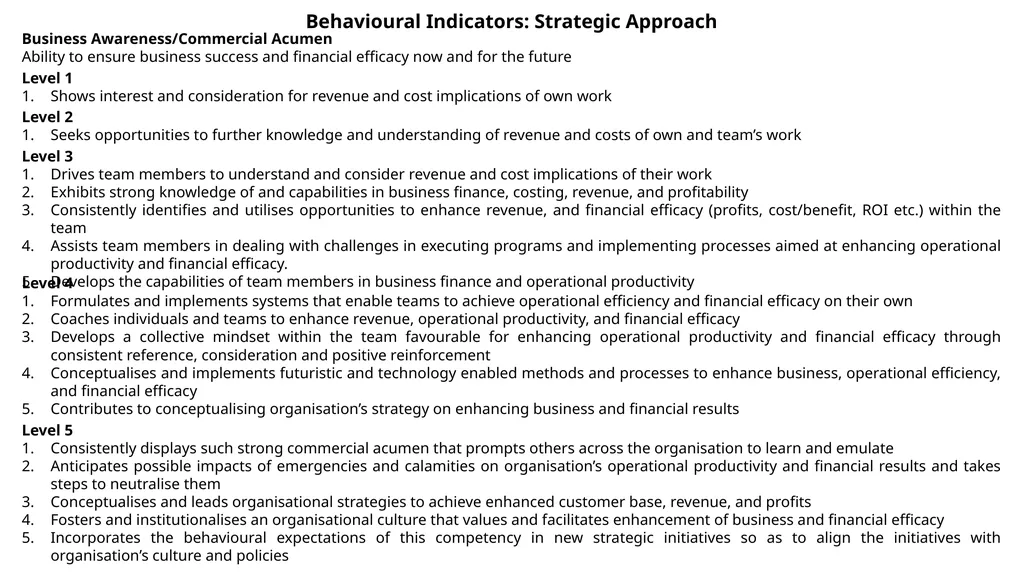
Behavioural Indicators: Strategic Approach Business Awareness/Commercial Acumen
Ability to ensure business success and financial efficacy now and for the future Level 1
Shows interest and consideration for revenue and cost implications of own work Level 2
Seeks opportunities to further knowledge and understanding of revenue and costs of own and team’s work Level 3
Drives team members to understand and consider revenue and cost implications of their work
Exhibits strong knowledge of and capabilities in business finance, costing, revenue, and profitability
Consistently identifies and utilises opportunities to enhance revenue, and financial efficacy (profits, cost/benefit, ROI etc.) within the team
Assists team members in dealing with challenges in executing programs and implementing processes aimed at enhancing operational productivity and financial efficacy.
Develops the capabilities of team members in business finance and operational productivity Level 4
Formulates and implements systems that enable teams to achieve operational efficiency and financial efficacy on their own
Coaches individuals and teams to enhance revenue, operational productivity, and financial efficacy
Develops a collective mindset within the team favourable for enhancing operational productivity and financial efficacy through consistent reference, consideration and positive reinforcement
Conceptualises and implements futuristic and technology enabled methods and processes to enhance business, operational efficiency, and financial efficacy
Contributes to conceptualising organisation’s strategy on enhancing business and financial results Level 5
Consistently displays such strong commercial acumen that prompts others across the organisation to learn and emulate
Anticipates possible impacts of emergencies and calamities on organisation’s operational productivity and financial results and takes steps to neutralise them
Conceptualises and leads organisational strategies to achieve enhanced customer base, revenue, and profits
Fosters and institutionalises an organisational culture that values and facilitates enhancement of business and financial efficacy
Incorporates the behavioural expectations of this competency in new strategic initiatives so as to align the initiatives with organisation’s culture and policies<br>
Ability to ensure business success and financial efficacy now and for the future Level 1
Shows interest and consideration for revenue and cost implications of own work Level 2
Seeks opportunities to further knowledge and understanding of revenue and costs of own and team’s work Level 3
Drives team members to understand and consider revenue and cost implications of their work
Exhibits strong knowledge of and capabilities in business finance, costing, revenue, and profitability
Consistently identifies and utilises opportunities to enhance revenue, and financial efficacy (profits, cost/benefit, ROI etc.) within the team
Assists team members in dealing with challenges in executing programs and implementing processes aimed at enhancing operational productivity and financial efficacy.
Develops the capabilities of team members in business finance and operational productivity Level 4
Formulates and implements systems that enable teams to achieve operational efficiency and financial efficacy on their own
Coaches individuals and teams to enhance revenue, operational productivity, and financial efficacy
Develops a collective mindset within the team favourable for enhancing operational productivity and financial efficacy through consistent reference, consideration and positive reinforcement
Conceptualises and implements futuristic and technology enabled methods and processes to enhance business, operational efficiency, and financial efficacy
Contributes to conceptualising organisation’s strategy on enhancing business and financial results Level 5
Consistently displays such strong commercial acumen that prompts others across the organisation to learn and emulate
Anticipates possible impacts of emergencies and calamities on organisation’s operational productivity and financial results and takes steps to neutralise them
Conceptualises and leads organisational strategies to achieve enhanced customer base, revenue, and profits
Fosters and institutionalises an organisational culture that values and facilitates enhancement of business and financial efficacy
Incorporates the behavioural expectations of this competency in new strategic initiatives so as to align the initiatives with organisation’s culture and policies<br>
08
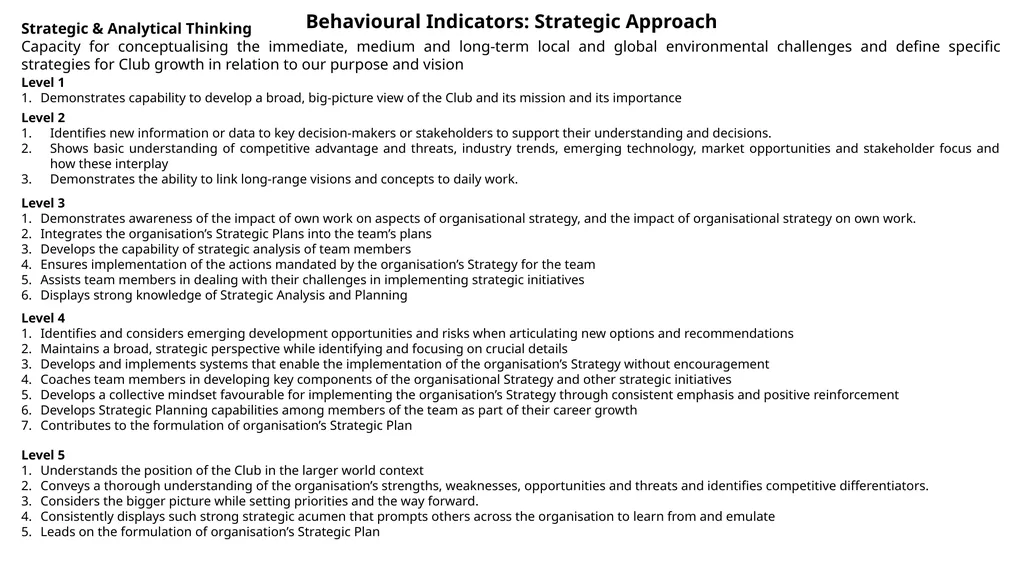
Behavioural Indicators: Strategic Approach Strategic & Analytical Thinking
Capacity for conceptualising the immediate, medium and long-term local and global environmental challenges and define specific strategies for Club growth in relation to our purpose and vision Level 1
Demonstrates capability to develop a broad, big-picture view of the Club and its mission and its importance Level 2
Identifies new information or data to key decision-makers or stakeholders to support their understanding and decisions.
Shows basic understanding of competitive advantage and threats, industry trends, emerging technology, market opportunities and stakeholder focus and how these interplay
Demonstrates the ability to link long-range visions and concepts to daily work. Level 3
Demonstrates awareness of the impact of own work on aspects of organisational strategy, and the impact of organisational strategy on own work.
Integrates the organisation’s Strategic Plans into the team’s plans
Develops the capability of strategic analysis of team members
Ensures implementation of the actions mandated by the organisation’s Strategy for the team
Assists team members in dealing with their challenges in implementing strategic initiatives
Displays strong knowledge of Strategic Analysis and Planning Level 4
Identifies and considers emerging development opportunities and risks when articulating new options and recommendations
Maintains a broad, strategic perspective while identifying and focusing on crucial details
Develops and implements systems that enable the implementation of the organisation’s Strategy without encouragement
Coaches team members in developing key components of the organisational Strategy and other strategic initiatives
Develops a collective mindset favourable for implementing the organisation’s Strategy through consistent emphasis and positive reinforcement
Develops Strategic Planning capabilities among members of the team as part of their career growth
Contributes to the formulation of organisation’s Strategic Plan Level 5
Understands the position of the Club in the larger world context
Conveys a thorough understanding of the organisation’s strengths, weaknesses, opportunities and threats and identifies competitive differentiators.
Considers the bigger picture while setting priorities and the way forward.
Consistently displays such strong strategic acumen that prompts others across the organisation to learn from and emulate
Leads on the formulation of organisation’s Strategic Plan<br>
Capacity for conceptualising the immediate, medium and long-term local and global environmental challenges and define specific strategies for Club growth in relation to our purpose and vision Level 1
Demonstrates capability to develop a broad, big-picture view of the Club and its mission and its importance Level 2
Identifies new information or data to key decision-makers or stakeholders to support their understanding and decisions.
Shows basic understanding of competitive advantage and threats, industry trends, emerging technology, market opportunities and stakeholder focus and how these interplay
Demonstrates the ability to link long-range visions and concepts to daily work. Level 3
Demonstrates awareness of the impact of own work on aspects of organisational strategy, and the impact of organisational strategy on own work.
Integrates the organisation’s Strategic Plans into the team’s plans
Develops the capability of strategic analysis of team members
Ensures implementation of the actions mandated by the organisation’s Strategy for the team
Assists team members in dealing with their challenges in implementing strategic initiatives
Displays strong knowledge of Strategic Analysis and Planning Level 4
Identifies and considers emerging development opportunities and risks when articulating new options and recommendations
Maintains a broad, strategic perspective while identifying and focusing on crucial details
Develops and implements systems that enable the implementation of the organisation’s Strategy without encouragement
Coaches team members in developing key components of the organisational Strategy and other strategic initiatives
Develops a collective mindset favourable for implementing the organisation’s Strategy through consistent emphasis and positive reinforcement
Develops Strategic Planning capabilities among members of the team as part of their career growth
Contributes to the formulation of organisation’s Strategic Plan Level 5
Understands the position of the Club in the larger world context
Conveys a thorough understanding of the organisation’s strengths, weaknesses, opportunities and threats and identifies competitive differentiators.
Considers the bigger picture while setting priorities and the way forward.
Consistently displays such strong strategic acumen that prompts others across the organisation to learn from and emulate
Leads on the formulation of organisation’s Strategic Plan<br>
09
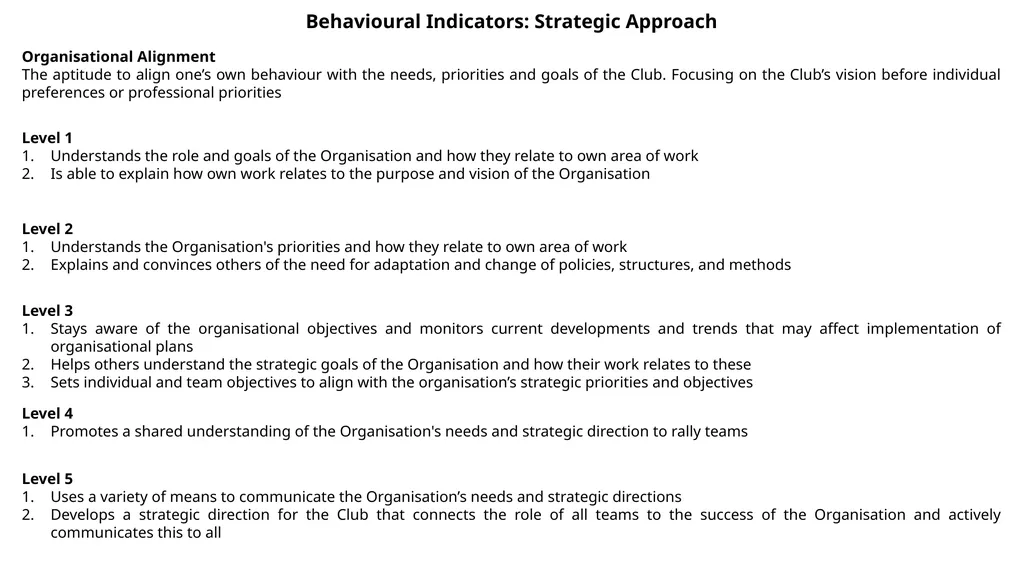
Behavioural Indicators: Strategic Approach Organisational Alignment
The aptitude to align one’s own behaviour with the needs, priorities and goals of the Club. Focusing on the Club’s vision before individual preferences or professional priorities Level 1
Understands the role and goals of the Organisation and how they relate to own area of work
Is able to explain how own work relates to the purpose and vision of the Organisation Level 2
Understands the Organisation's priorities and how they relate to own area of work
Explains and convinces others of the need for adaptation and change of policies, structures, and methods Level 3
Stays aware of the organisational objectives and monitors current developments and trends that may affect implementation of organisational plans
Helps others understand the strategic goals of the Organisation and how their work relates to these
Sets individual and team objectives to align with the organisation’s strategic priorities and objectives Level 4
Promotes a shared understanding of the Organisation's needs and strategic direction to rally teams Level 5
Uses a variety of means to communicate the Organisation’s needs and strategic directions
Develops a strategic direction for the Club that connects the role of all teams to the success of the Organisation and actively communicates this to all<br>
The aptitude to align one’s own behaviour with the needs, priorities and goals of the Club. Focusing on the Club’s vision before individual preferences or professional priorities Level 1
Understands the role and goals of the Organisation and how they relate to own area of work
Is able to explain how own work relates to the purpose and vision of the Organisation Level 2
Understands the Organisation's priorities and how they relate to own area of work
Explains and convinces others of the need for adaptation and change of policies, structures, and methods Level 3
Stays aware of the organisational objectives and monitors current developments and trends that may affect implementation of organisational plans
Helps others understand the strategic goals of the Organisation and how their work relates to these
Sets individual and team objectives to align with the organisation’s strategic priorities and objectives Level 4
Promotes a shared understanding of the Organisation's needs and strategic direction to rally teams Level 5
Uses a variety of means to communicate the Organisation’s needs and strategic directions
Develops a strategic direction for the Club that connects the role of all teams to the success of the Organisation and actively communicates this to all<br>
10
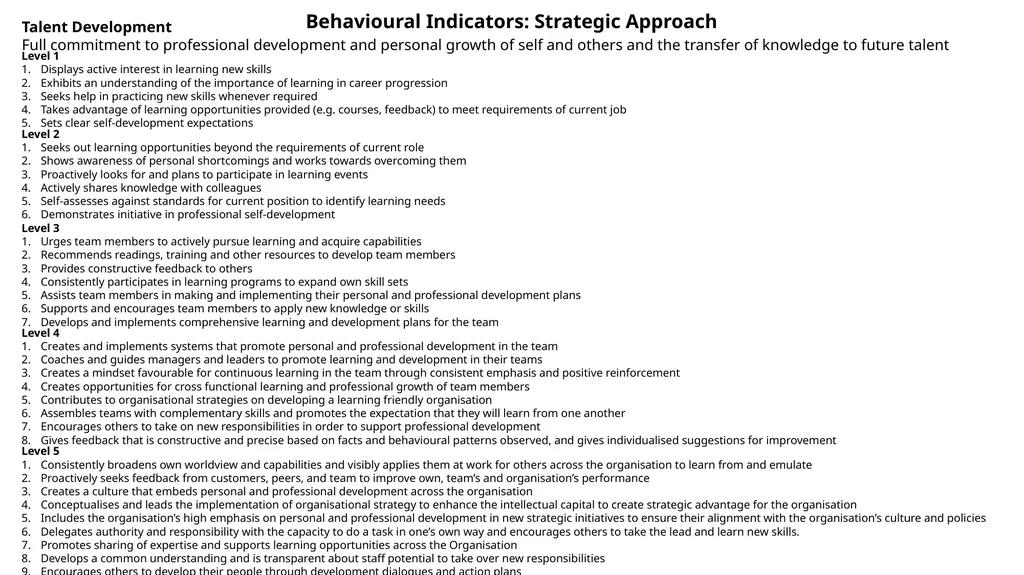
Behavioural Indicators: Strategic Approach Talent Development
Full commitment to professional development and personal growth of self and others and the transfer of knowledge to future talent Level 1
Displays active interest in learning new skills
Exhibits an understanding of the importance of learning in career progression
Seeks help in practicing new skills whenever required
Takes advantage of learning opportunities provided (e.g. courses, feedback) to meet requirements of current job
Sets clear self-development expectations Level 2
Seeks out learning opportunities beyond the requirements of current role
Shows awareness of personal shortcomings and works towards overcoming them
Proactively looks for and plans to participate in learning events
Actively shares knowledge with colleagues
Self-assesses against standards for current position to identify learning needs
Demonstrates initiative in professional self-development Level 3
Urges team members to actively pursue learning and acquire capabilities
Recommends readings, training and other resources to develop team members
Provides constructive feedback to others
Consistently participates in learning programs to expand own skill sets
Assists team members in making and implementing their personal and professional development plans
Supports and encourages team members to apply new knowledge or skills
Develops and implements comprehensive learning and development plans for the team Level 4
Creates and implements systems that promote personal and professional development in the team
Coaches and guides managers and leaders to promote learning and development in their teams
Creates a mindset favourable for continuous learning in the team through consistent emphasis and positive reinforcement
Creates opportunities for cross functional learning and professional growth of team members
Contributes to organisational strategies on developing a learning friendly organisation
Assembles teams with complementary skills and promotes the expectation that they will learn from one another
Encourages others to take on new responsibilities in order to support professional development
Gives feedback that is constructive and precise based on facts and behavioural patterns observed, and gives individualised suggestions for improvement Level 5
Consistently broadens own worldview and capabilities and visibly applies them at work for others across the organisation to learn from and emulate
Proactively seeks feedback from customers, peers, and team to improve own, team’s and organisation’s performance
Creates a culture that embeds personal and professional development across the organisation
Conceptualises and leads the implementation of organisational strategy to enhance the intellectual capital to create strategic advantage for the organisation
Includes the organisation’s high emphasis on personal and professional development in new strategic initiatives to ensure their alignment with the organisation’s culture and policies
Delegates authority and responsibility with the capacity to do a task in one’s own way and encourages others to take the lead and learn new skills.
Promotes sharing of expertise and supports learning opportunities across the Organisation
Develops a common understanding and is transparent about staff potential to take over new responsibilities
Encourages others to develop their people through development dialogues and action plans<br>
Full commitment to professional development and personal growth of self and others and the transfer of knowledge to future talent Level 1
Displays active interest in learning new skills
Exhibits an understanding of the importance of learning in career progression
Seeks help in practicing new skills whenever required
Takes advantage of learning opportunities provided (e.g. courses, feedback) to meet requirements of current job
Sets clear self-development expectations Level 2
Seeks out learning opportunities beyond the requirements of current role
Shows awareness of personal shortcomings and works towards overcoming them
Proactively looks for and plans to participate in learning events
Actively shares knowledge with colleagues
Self-assesses against standards for current position to identify learning needs
Demonstrates initiative in professional self-development Level 3
Urges team members to actively pursue learning and acquire capabilities
Recommends readings, training and other resources to develop team members
Provides constructive feedback to others
Consistently participates in learning programs to expand own skill sets
Assists team members in making and implementing their personal and professional development plans
Supports and encourages team members to apply new knowledge or skills
Develops and implements comprehensive learning and development plans for the team Level 4
Creates and implements systems that promote personal and professional development in the team
Coaches and guides managers and leaders to promote learning and development in their teams
Creates a mindset favourable for continuous learning in the team through consistent emphasis and positive reinforcement
Creates opportunities for cross functional learning and professional growth of team members
Contributes to organisational strategies on developing a learning friendly organisation
Assembles teams with complementary skills and promotes the expectation that they will learn from one another
Encourages others to take on new responsibilities in order to support professional development
Gives feedback that is constructive and precise based on facts and behavioural patterns observed, and gives individualised suggestions for improvement Level 5
Consistently broadens own worldview and capabilities and visibly applies them at work for others across the organisation to learn from and emulate
Proactively seeks feedback from customers, peers, and team to improve own, team’s and organisation’s performance
Creates a culture that embeds personal and professional development across the organisation
Conceptualises and leads the implementation of organisational strategy to enhance the intellectual capital to create strategic advantage for the organisation
Includes the organisation’s high emphasis on personal and professional development in new strategic initiatives to ensure their alignment with the organisation’s culture and policies
Delegates authority and responsibility with the capacity to do a task in one’s own way and encourages others to take the lead and learn new skills.
Promotes sharing of expertise and supports learning opportunities across the Organisation
Develops a common understanding and is transparent about staff potential to take over new responsibilities
Encourages others to develop their people through development dialogues and action plans<br>
11
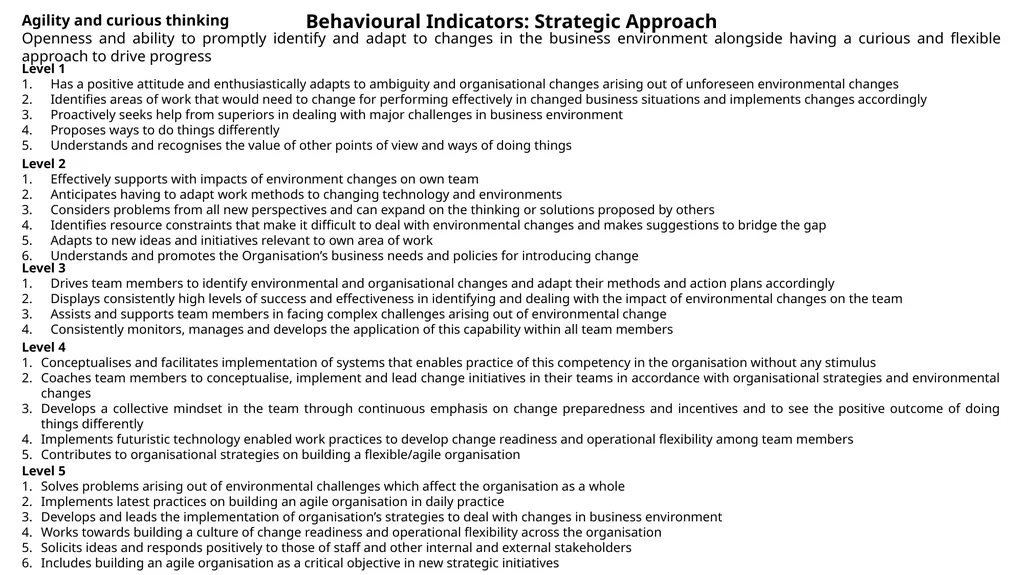
Behavioural Indicators: Strategic Approach Agility and curious thinking
Openness and ability to promptly identify and adapt to changes in the business environment alongside having a curious and flexible approach to drive progress Level 1
Has a positive attitude and enthusiastically adapts to ambiguity and organisational changes arising out of unforeseen environmental changes
Identifies areas of work that would need to change for performing effectively in changed business situations and implements changes accordingly
Proactively seeks help from superiors in dealing with major challenges in business environment
Proposes ways to do things differently
Understands and recognises the value of other points of view and ways of doing things Level 2
Effectively supports with impacts of environment changes on own team
Anticipates having to adapt work methods to changing technology and environments
Considers problems from all new perspectives and can expand on the thinking or solutions proposed by others
Identifies resource constraints that make it difficult to deal with environmental changes and makes suggestions to bridge the gap
Adapts to new ideas and initiatives relevant to own area of work
Understands and promotes the Organisation’s business needs and policies for introducing change Level 3
Drives team members to identify environmental and organisational changes and adapt their methods and action plans accordingly
Displays consistently high levels of success and effectiveness in identifying and dealing with the impact of environmental changes on the team
Assists and supports team members in facing complex challenges arising out of environmental change
Consistently monitors, manages and develops the application of this capability within all team members Level 4
Conceptualises and facilitates implementation of systems that enables practice of this competency in the organisation without any stimulus
Coaches team members to conceptualise, implement and lead change initiatives in their teams in accordance with organisational strategies and environmental changes
Develops a collective mindset in the team through continuous emphasis on change preparedness and incentives and to see the positive outcome of doing things differently
Implements futuristic technology enabled work practices to develop change readiness and operational flexibility among team members
Contributes to organisational strategies on building a flexible/agile organisation Level 5
Solves problems arising out of environmental challenges which affect the organisation as a whole
Implements latest practices on building an agile organisation in daily practice
Develops and leads the implementation of organisation’s strategies to deal with changes in business environment
Works towards building a culture of change readiness and operational flexibility across the organisation
Solicits ideas and responds positively to those of staff and other internal and external stakeholders
Includes building an agile organisation as a critical objective in new strategic initiatives<br>
Openness and ability to promptly identify and adapt to changes in the business environment alongside having a curious and flexible approach to drive progress Level 1
Has a positive attitude and enthusiastically adapts to ambiguity and organisational changes arising out of unforeseen environmental changes
Identifies areas of work that would need to change for performing effectively in changed business situations and implements changes accordingly
Proactively seeks help from superiors in dealing with major challenges in business environment
Proposes ways to do things differently
Understands and recognises the value of other points of view and ways of doing things Level 2
Effectively supports with impacts of environment changes on own team
Anticipates having to adapt work methods to changing technology and environments
Considers problems from all new perspectives and can expand on the thinking or solutions proposed by others
Identifies resource constraints that make it difficult to deal with environmental changes and makes suggestions to bridge the gap
Adapts to new ideas and initiatives relevant to own area of work
Understands and promotes the Organisation’s business needs and policies for introducing change Level 3
Drives team members to identify environmental and organisational changes and adapt their methods and action plans accordingly
Displays consistently high levels of success and effectiveness in identifying and dealing with the impact of environmental changes on the team
Assists and supports team members in facing complex challenges arising out of environmental change
Consistently monitors, manages and develops the application of this capability within all team members Level 4
Conceptualises and facilitates implementation of systems that enables practice of this competency in the organisation without any stimulus
Coaches team members to conceptualise, implement and lead change initiatives in their teams in accordance with organisational strategies and environmental changes
Develops a collective mindset in the team through continuous emphasis on change preparedness and incentives and to see the positive outcome of doing things differently
Implements futuristic technology enabled work practices to develop change readiness and operational flexibility among team members
Contributes to organisational strategies on building a flexible/agile organisation Level 5
Solves problems arising out of environmental challenges which affect the organisation as a whole
Implements latest practices on building an agile organisation in daily practice
Develops and leads the implementation of organisation’s strategies to deal with changes in business environment
Works towards building a culture of change readiness and operational flexibility across the organisation
Solicits ideas and responds positively to those of staff and other internal and external stakeholders
Includes building an agile organisation as a critical objective in new strategic initiatives<br>
12
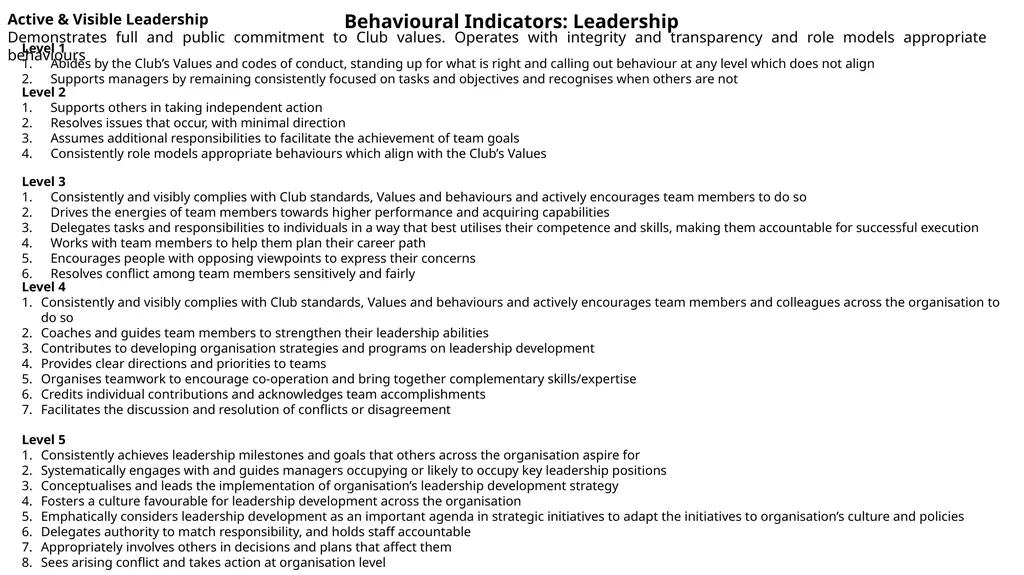
Behavioural Indicators: Leadership Active & Visible Leadership
Demonstrates full and public commitment to Club values. Operates with integrity and transparency and role models appropriate behaviours Level 1
Abides by the Club’s Values and codes of conduct, standing up for what is right and calling out behaviour at any level which does not align
Supports managers by remaining consistently focused on tasks and objectives and recognises when others are not Level 2
Supports others in taking independent action
Resolves issues that occur, with minimal direction
Assumes additional responsibilities to facilitate the achievement of team goals
Consistently role models appropriate behaviours which align with the Club’s Values Level 3
Consistently and visibly complies with Club standards, Values and behaviours and actively encourages team members to do so
Drives the energies of team members towards higher performance and acquiring capabilities
Delegates tasks and responsibilities to individuals in a way that best utilises their competence and skills, making them accountable for successful execution
Works with team members to help them plan their career path
Encourages people with opposing viewpoints to express their concerns
Resolves conflict among team members sensitively and fairly Level 4
Consistently and visibly complies with Club standards, Values and behaviours and actively encourages team members and colleagues across the organisation to do so
Coaches and guides team members to strengthen their leadership abilities
Contributes to developing organisation strategies and programs on leadership development
Provides clear directions and priorities to teams
Organises teamwork to encourage co-operation and bring together complementary skills/expertise
Credits individual contributions and acknowledges team accomplishments
Facilitates the discussion and resolution of conflicts or disagreement Level 5
Consistently achieves leadership milestones and goals that others across the organisation aspire for
Systematically engages with and guides managers occupying or likely to occupy key leadership positions
Conceptualises and leads the implementation of organisation’s leadership development strategy
Fosters a culture favourable for leadership development across the organisation
Emphatically considers leadership development as an important agenda in strategic initiatives to adapt the initiatives to organisation’s culture and policies
Delegates authority to match responsibility, and holds staff accountable
Appropriately involves others in decisions and plans that affect them
Sees arising conflict and takes action at organisation level<br>
Demonstrates full and public commitment to Club values. Operates with integrity and transparency and role models appropriate behaviours Level 1
Abides by the Club’s Values and codes of conduct, standing up for what is right and calling out behaviour at any level which does not align
Supports managers by remaining consistently focused on tasks and objectives and recognises when others are not Level 2
Supports others in taking independent action
Resolves issues that occur, with minimal direction
Assumes additional responsibilities to facilitate the achievement of team goals
Consistently role models appropriate behaviours which align with the Club’s Values Level 3
Consistently and visibly complies with Club standards, Values and behaviours and actively encourages team members to do so
Drives the energies of team members towards higher performance and acquiring capabilities
Delegates tasks and responsibilities to individuals in a way that best utilises their competence and skills, making them accountable for successful execution
Works with team members to help them plan their career path
Encourages people with opposing viewpoints to express their concerns
Resolves conflict among team members sensitively and fairly Level 4
Consistently and visibly complies with Club standards, Values and behaviours and actively encourages team members and colleagues across the organisation to do so
Coaches and guides team members to strengthen their leadership abilities
Contributes to developing organisation strategies and programs on leadership development
Provides clear directions and priorities to teams
Organises teamwork to encourage co-operation and bring together complementary skills/expertise
Credits individual contributions and acknowledges team accomplishments
Facilitates the discussion and resolution of conflicts or disagreement Level 5
Consistently achieves leadership milestones and goals that others across the organisation aspire for
Systematically engages with and guides managers occupying or likely to occupy key leadership positions
Conceptualises and leads the implementation of organisation’s leadership development strategy
Fosters a culture favourable for leadership development across the organisation
Emphatically considers leadership development as an important agenda in strategic initiatives to adapt the initiatives to organisation’s culture and policies
Delegates authority to match responsibility, and holds staff accountable
Appropriately involves others in decisions and plans that affect them
Sees arising conflict and takes action at organisation level<br>
13
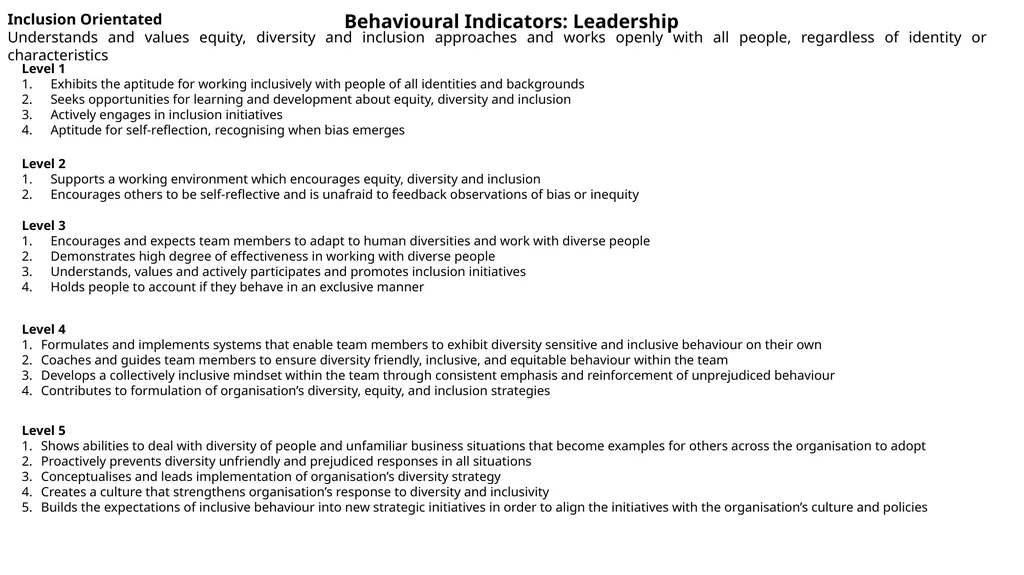
Behavioural Indicators: Leadership Inclusion Orientated
Understands and values equity, diversity and inclusion approaches and works openly with all people, regardless of identity or characteristics Level 1
Exhibits the aptitude for working inclusively with people of all identities and backgrounds
Seeks opportunities for learning and development about equity, diversity and inclusion
Actively engages in inclusion initiatives
Aptitude for self-reflection, recognising when bias emerges Level 2
Supports a working environment which encourages equity, diversity and inclusion
Encourages others to be self-reflective and is unafraid to feedback observations of bias or inequity Level 3
Encourages and expects team members to adapt to human diversities and work with diverse people
Demonstrates high degree of effectiveness in working with diverse people
Understands, values and actively participates and promotes inclusion initiatives
Holds people to account if they behave in an exclusive manner Level 4
Formulates and implements systems that enable team members to exhibit diversity sensitive and inclusive behaviour on their own
Coaches and guides team members to ensure diversity friendly, inclusive, and equitable behaviour within the team
Develops a collectively inclusive mindset within the team through consistent emphasis and reinforcement of unprejudiced behaviour
Contributes to formulation of organisation’s diversity, equity, and inclusion strategies Level 5
Shows abilities to deal with diversity of people and unfamiliar business situations that become examples for others across the organisation to adopt
Proactively prevents diversity unfriendly and prejudiced responses in all situations
Conceptualises and leads implementation of organisation’s diversity strategy
Creates a culture that strengthens organisation’s response to diversity and inclusivity
Builds the expectations of inclusive behaviour into new strategic initiatives in order to align the initiatives with the organisation’s culture and policies<br>
Understands and values equity, diversity and inclusion approaches and works openly with all people, regardless of identity or characteristics Level 1
Exhibits the aptitude for working inclusively with people of all identities and backgrounds
Seeks opportunities for learning and development about equity, diversity and inclusion
Actively engages in inclusion initiatives
Aptitude for self-reflection, recognising when bias emerges Level 2
Supports a working environment which encourages equity, diversity and inclusion
Encourages others to be self-reflective and is unafraid to feedback observations of bias or inequity Level 3
Encourages and expects team members to adapt to human diversities and work with diverse people
Demonstrates high degree of effectiveness in working with diverse people
Understands, values and actively participates and promotes inclusion initiatives
Holds people to account if they behave in an exclusive manner Level 4
Formulates and implements systems that enable team members to exhibit diversity sensitive and inclusive behaviour on their own
Coaches and guides team members to ensure diversity friendly, inclusive, and equitable behaviour within the team
Develops a collectively inclusive mindset within the team through consistent emphasis and reinforcement of unprejudiced behaviour
Contributes to formulation of organisation’s diversity, equity, and inclusion strategies Level 5
Shows abilities to deal with diversity of people and unfamiliar business situations that become examples for others across the organisation to adopt
Proactively prevents diversity unfriendly and prejudiced responses in all situations
Conceptualises and leads implementation of organisation’s diversity strategy
Creates a culture that strengthens organisation’s response to diversity and inclusivity
Builds the expectations of inclusive behaviour into new strategic initiatives in order to align the initiatives with the organisation’s culture and policies<br>
14
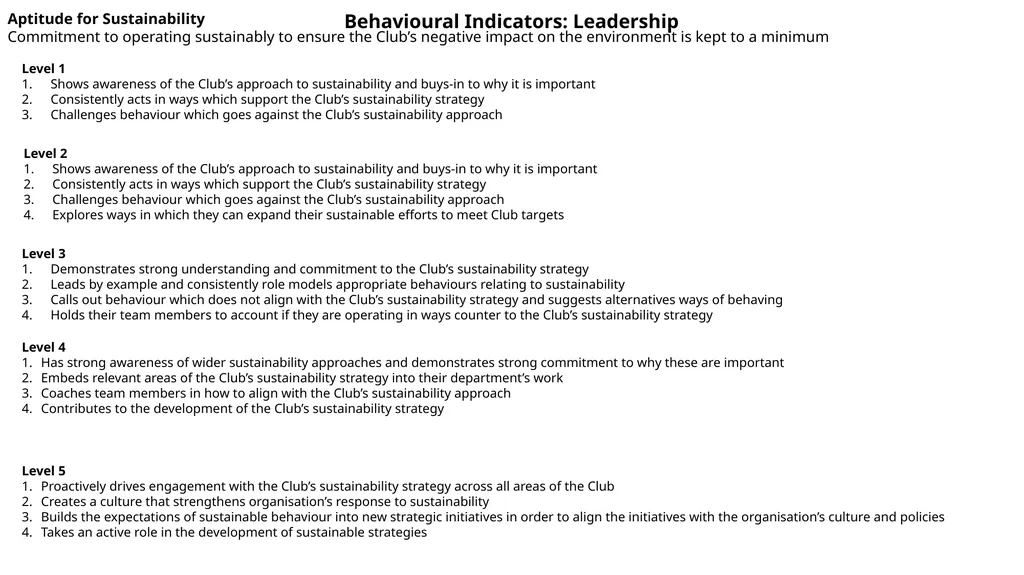
Behavioural Indicators: Leadership Aptitude for Sustainability
Commitment to operating sustainably to ensure the Club’s negative impact on the environment is kept to a minimum Level 1
Shows awareness of the Club’s approach to sustainability and buys-in to why it is important
Consistently acts in ways which support the Club’s sustainability strategy
Challenges behaviour which goes against the Club’s sustainability approach Level 3
Demonstrates strong understanding and commitment to the Club’s sustainability strategy
Leads by example and consistently role models appropriate behaviours relating to sustainability
Calls out behaviour which does not align with the Club’s sustainability strategy and suggests alternatives ways of behaving
Holds their team members to account if they are operating in ways counter to the Club’s sustainability strategy Level 4
Has strong awareness of wider sustainability approaches and demonstrates strong commitment to why these are important
Embeds relevant areas of the Club’s sustainability strategy into their department’s work
Coaches team members in how to align with the Club’s sustainability approach
Contributes to the development of the Club’s sustainability strategy Level 5
Proactively drives engagement with the Club’s sustainability strategy across all areas of the Club
Creates a culture that strengthens organisation’s response to sustainability
Builds the expectations of sustainable behaviour into new strategic initiatives in order to align the initiatives with the organisation’s culture and policies
Takes an active role in the development of sustainable strategies Level 2
Shows awareness of the Club’s approach to sustainability and buys-in to why it is important
Consistently acts in ways which support the Club’s sustainability strategy
Challenges behaviour which goes against the Club’s sustainability approach
Explores ways in which they can expand their sustainable efforts to meet Club targets<br>
Commitment to operating sustainably to ensure the Club’s negative impact on the environment is kept to a minimum Level 1
Shows awareness of the Club’s approach to sustainability and buys-in to why it is important
Consistently acts in ways which support the Club’s sustainability strategy
Challenges behaviour which goes against the Club’s sustainability approach Level 3
Demonstrates strong understanding and commitment to the Club’s sustainability strategy
Leads by example and consistently role models appropriate behaviours relating to sustainability
Calls out behaviour which does not align with the Club’s sustainability strategy and suggests alternatives ways of behaving
Holds their team members to account if they are operating in ways counter to the Club’s sustainability strategy Level 4
Has strong awareness of wider sustainability approaches and demonstrates strong commitment to why these are important
Embeds relevant areas of the Club’s sustainability strategy into their department’s work
Coaches team members in how to align with the Club’s sustainability approach
Contributes to the development of the Club’s sustainability strategy Level 5
Proactively drives engagement with the Club’s sustainability strategy across all areas of the Club
Creates a culture that strengthens organisation’s response to sustainability
Builds the expectations of sustainable behaviour into new strategic initiatives in order to align the initiatives with the organisation’s culture and policies
Takes an active role in the development of sustainable strategies Level 2
Shows awareness of the Club’s approach to sustainability and buys-in to why it is important
Consistently acts in ways which support the Club’s sustainability strategy
Challenges behaviour which goes against the Club’s sustainability approach
Explores ways in which they can expand their sustainable efforts to meet Club targets<br>
15
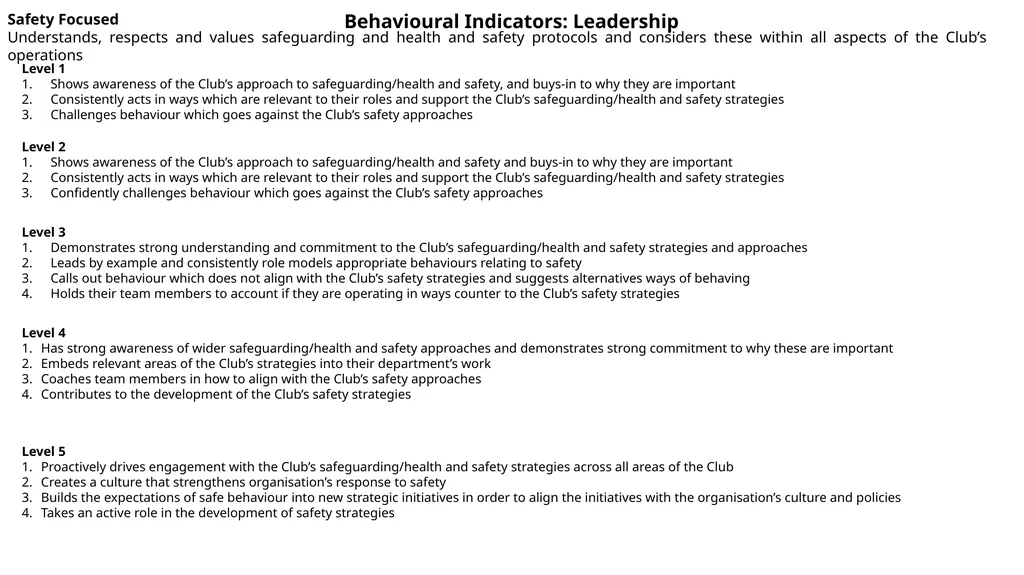
Behavioural Indicators: Leadership Safety Focused
Understands, respects and values safeguarding and health and safety protocols and considers these within all aspects of the Club’s operations Level 1
Shows awareness of the Club’s approach to safeguarding/health and safety, and buys-in to why they are important
Consistently acts in ways which are relevant to their roles and support the Club’s safeguarding/health and safety strategies
Challenges behaviour which goes against the Club’s safety approaches Level 2
Shows awareness of the Club’s approach to safeguarding/health and safety and buys-in to why they are important
Consistently acts in ways which are relevant to their roles and support the Club’s safeguarding/health and safety strategies
Confidently challenges behaviour which goes against the Club’s safety approaches Level 3
Demonstrates strong understanding and commitment to the Club’s safeguarding/health and safety strategies and approaches
Leads by example and consistently role models appropriate behaviours relating to safety
Calls out behaviour which does not align with the Club’s safety strategies and suggests alternatives ways of behaving
Holds their team members to account if they are operating in ways counter to the Club’s safety strategies Level 4
Has strong awareness of wider safeguarding/health and safety approaches and demonstrates strong commitment to why these are important
Embeds relevant areas of the Club’s strategies into their department’s work
Coaches team members in how to align with the Club’s safety approaches
Contributes to the development of the Club’s safety strategies Level 5
Proactively drives engagement with the Club’s safeguarding/health and safety strategies across all areas of the Club
Creates a culture that strengthens organisation’s response to safety
Builds the expectations of safe behaviour into new strategic initiatives in order to align the initiatives with the organisation’s culture and policies
Takes an active role in the development of safety strategies<br>
Understands, respects and values safeguarding and health and safety protocols and considers these within all aspects of the Club’s operations Level 1
Shows awareness of the Club’s approach to safeguarding/health and safety, and buys-in to why they are important
Consistently acts in ways which are relevant to their roles and support the Club’s safeguarding/health and safety strategies
Challenges behaviour which goes against the Club’s safety approaches Level 2
Shows awareness of the Club’s approach to safeguarding/health and safety and buys-in to why they are important
Consistently acts in ways which are relevant to their roles and support the Club’s safeguarding/health and safety strategies
Confidently challenges behaviour which goes against the Club’s safety approaches Level 3
Demonstrates strong understanding and commitment to the Club’s safeguarding/health and safety strategies and approaches
Leads by example and consistently role models appropriate behaviours relating to safety
Calls out behaviour which does not align with the Club’s safety strategies and suggests alternatives ways of behaving
Holds their team members to account if they are operating in ways counter to the Club’s safety strategies Level 4
Has strong awareness of wider safeguarding/health and safety approaches and demonstrates strong commitment to why these are important
Embeds relevant areas of the Club’s strategies into their department’s work
Coaches team members in how to align with the Club’s safety approaches
Contributes to the development of the Club’s safety strategies Level 5
Proactively drives engagement with the Club’s safeguarding/health and safety strategies across all areas of the Club
Creates a culture that strengthens organisation’s response to safety
Builds the expectations of safe behaviour into new strategic initiatives in order to align the initiatives with the organisation’s culture and policies
Takes an active role in the development of safety strategies<br>
16
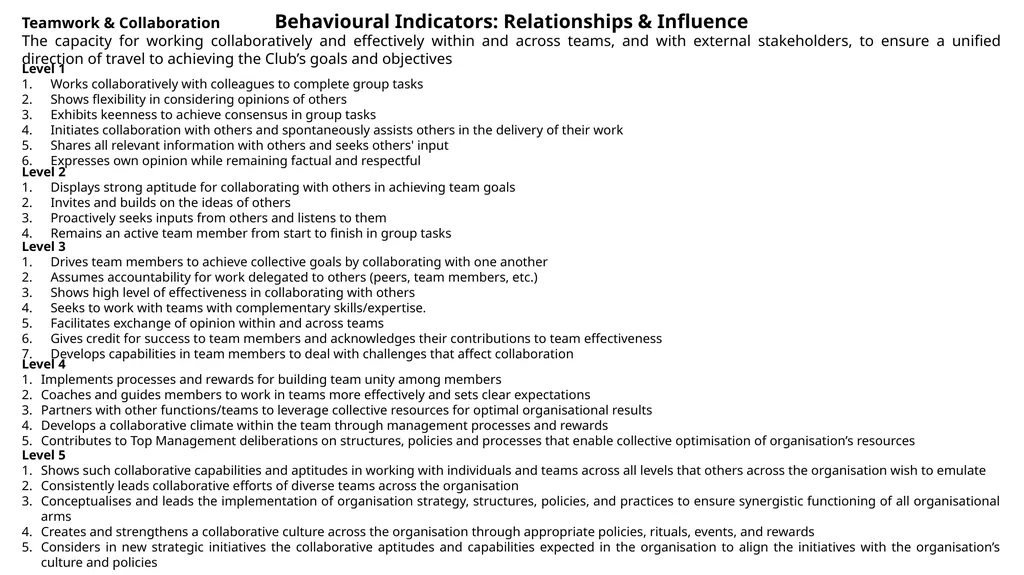
Behavioural Indicators: Relationships & Influence Teamwork & Collaboration
The capacity for working collaboratively and effectively within and across teams, and with external stakeholders, to ensure a unified direction of travel to achieving the Club’s goals and objectives Level 1
Works collaboratively with colleagues to complete group tasks
Shows flexibility in considering opinions of others
Exhibits keenness to achieve consensus in group tasks
Initiates collaboration with others and spontaneously assists others in the delivery of their work
Shares all relevant information with others and seeks others' input
Expresses own opinion while remaining factual and respectful Level 2
Displays strong aptitude for collaborating with others in achieving team goals
Invites and builds on the ideas of others
Proactively seeks inputs from others and listens to them
Remains an active team member from start to finish in group tasks Level 3
Drives team members to achieve collective goals by collaborating with one another
Assumes accountability for work delegated to others (peers, team members, etc.)
Shows high level of effectiveness in collaborating with others
Seeks to work with teams with complementary skills/expertise.
Facilitates exchange of opinion within and across teams
Gives credit for success to team members and acknowledges their contributions to team effectiveness
Develops capabilities in team members to deal with challenges that affect collaboration Level 4
Implements processes and rewards for building team unity among members
Coaches and guides members to work in teams more effectively and sets clear expectations
Partners with other functions/teams to leverage collective resources for optimal organisational results
Develops a collaborative climate within the team through management processes and rewards
Contributes to Top Management deliberations on structures, policies and processes that enable collective optimisation of organisation’s resources Level 5
Shows such collaborative capabilities and aptitudes in working with individuals and teams across all levels that others across the organisation wish to emulate
Consistently leads collaborative efforts of diverse teams across the organisation
Conceptualises and leads the implementation of organisation strategy, structures, policies, and practices to ensure synergistic functioning of all organisational arms
Creates and strengthens a collaborative culture across the organisation through appropriate policies, rituals, events, and rewards
Considers in new strategic initiatives the collaborative aptitudes and capabilities expected in the organisation to align the initiatives with the organisation’s culture and policies<br>
The capacity for working collaboratively and effectively within and across teams, and with external stakeholders, to ensure a unified direction of travel to achieving the Club’s goals and objectives Level 1
Works collaboratively with colleagues to complete group tasks
Shows flexibility in considering opinions of others
Exhibits keenness to achieve consensus in group tasks
Initiates collaboration with others and spontaneously assists others in the delivery of their work
Shares all relevant information with others and seeks others' input
Expresses own opinion while remaining factual and respectful Level 2
Displays strong aptitude for collaborating with others in achieving team goals
Invites and builds on the ideas of others
Proactively seeks inputs from others and listens to them
Remains an active team member from start to finish in group tasks Level 3
Drives team members to achieve collective goals by collaborating with one another
Assumes accountability for work delegated to others (peers, team members, etc.)
Shows high level of effectiveness in collaborating with others
Seeks to work with teams with complementary skills/expertise.
Facilitates exchange of opinion within and across teams
Gives credit for success to team members and acknowledges their contributions to team effectiveness
Develops capabilities in team members to deal with challenges that affect collaboration Level 4
Implements processes and rewards for building team unity among members
Coaches and guides members to work in teams more effectively and sets clear expectations
Partners with other functions/teams to leverage collective resources for optimal organisational results
Develops a collaborative climate within the team through management processes and rewards
Contributes to Top Management deliberations on structures, policies and processes that enable collective optimisation of organisation’s resources Level 5
Shows such collaborative capabilities and aptitudes in working with individuals and teams across all levels that others across the organisation wish to emulate
Consistently leads collaborative efforts of diverse teams across the organisation
Conceptualises and leads the implementation of organisation strategy, structures, policies, and practices to ensure synergistic functioning of all organisational arms
Creates and strengthens a collaborative culture across the organisation through appropriate policies, rituals, events, and rewards
Considers in new strategic initiatives the collaborative aptitudes and capabilities expected in the organisation to align the initiatives with the organisation’s culture and policies<br>
17
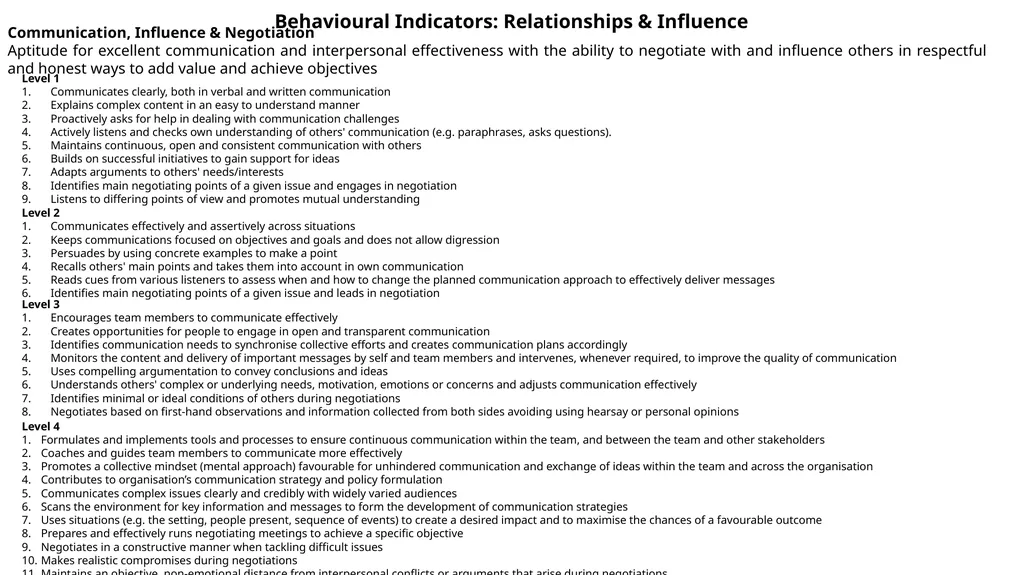
Behavioural Indicators: Relationships & Influence Communication, Influence & Negotiation
Aptitude for excellent communication and interpersonal effectiveness with the ability to negotiate with and influence others in respectful and honest ways to add value and achieve objectives Level 1
Communicates clearly, both in verbal and written communication
Explains complex content in an easy to understand manner
Proactively asks for help in dealing with communication challenges
Actively listens and checks own understanding of others' communication (e.g. paraphrases, asks questions).
Maintains continuous, open and consistent communication with others
Builds on successful initiatives to gain support for ideas
Adapts arguments to others' needs/interests
Identifies main negotiating points of a given issue and engages in negotiation
Listens to differing points of view and promotes mutual understanding Level 2
Communicates effectively and assertively across situations
Keeps communications focused on objectives and goals and does not allow digression
Persuades by using concrete examples to make a point
Recalls others' main points and takes them into account in own communication
Reads cues from various listeners to assess when and how to change the planned communication approach to effectively deliver messages
Identifies main negotiating points of a given issue and leads in negotiation Level 3
Encourages team members to communicate effectively
Creates opportunities for people to engage in open and transparent communication
Identifies communication needs to synchronise collective efforts and creates communication plans accordingly
Monitors the content and delivery of important messages by self and team members and intervenes, whenever required, to improve the quality of communication
Uses compelling argumentation to convey conclusions and ideas
Understands others' complex or underlying needs, motivation, emotions or concerns and adjusts communication effectively
Identifies minimal or ideal conditions of others during negotiations
Negotiates based on first-hand observations and information collected from both sides avoiding using hearsay or personal opinions Level 4
Formulates and implements tools and processes to ensure continuous communication within the team, and between the team and other stakeholders
Coaches and guides team members to communicate more effectively
Promotes a collective mindset (mental approach) favourable for unhindered communication and exchange of ideas within the team and across the organisation
Contributes to organisation’s communication strategy and policy formulation
Communicates complex issues clearly and credibly with widely varied audiences
Scans the environment for key information and messages to form the development of communication strategies
Uses situations (e.g. the setting, people present, sequence of events) to create a desired impact and to maximise the chances of a favourable outcome
Prepares and effectively runs negotiating meetings to achieve a specific objective
Negotiates in a constructive manner when tackling difficult issues
Makes realistic compromises during negotiations
Maintains an objective, non-emotional distance from interpersonal conflicts or arguments that arise during negotiations
Focuses on achieving value-added results during negotiations Level 5
Consistently sets high standards in own communication that others want to emulate
Creates a culture of facilitative interactions among individuals and teams across the organisation
Actively contributes to formulating organisational policies, systems, processes, and programs to institutionalise result oriented communication across the organisation
Incorporates the organisation’s expectations of effective communication in strategic initiatives to align them with the organisation’s culture and policies
Handles strategic communication issues for the Organisation in highly-exposed situations
Handles difficult on-the-spot questions (e.g. from senior executives, public officials, interest groups, or the media)
Anticipates and builds on others' reactions to keep momentum and support for an approach
Uses experts or other third parties to influence (e.g. takes multiple actions to make staged arguments, assembles political coalitions, builds "behind-the-scenes" support for ideas
Takes well thought-out impactful actions to win a point or reach an agreement
Constructively works towards a win-win solution during negotiations
Explores creative solutions with others to overcome antagonism and to develop partnerships
Successfully leads negotiations
Demonstrates more than one preferred negotiating style (e.g. competing, co-operative, avoiding, compromise, accommodating) and adapts depending on the counterpart and context
Demonstrates an ability to step back when necessary from the negotiation process while staying focused on the objective<br>
Aptitude for excellent communication and interpersonal effectiveness with the ability to negotiate with and influence others in respectful and honest ways to add value and achieve objectives Level 1
Communicates clearly, both in verbal and written communication
Explains complex content in an easy to understand manner
Proactively asks for help in dealing with communication challenges
Actively listens and checks own understanding of others' communication (e.g. paraphrases, asks questions).
Maintains continuous, open and consistent communication with others
Builds on successful initiatives to gain support for ideas
Adapts arguments to others' needs/interests
Identifies main negotiating points of a given issue and engages in negotiation
Listens to differing points of view and promotes mutual understanding Level 2
Communicates effectively and assertively across situations
Keeps communications focused on objectives and goals and does not allow digression
Persuades by using concrete examples to make a point
Recalls others' main points and takes them into account in own communication
Reads cues from various listeners to assess when and how to change the planned communication approach to effectively deliver messages
Identifies main negotiating points of a given issue and leads in negotiation Level 3
Encourages team members to communicate effectively
Creates opportunities for people to engage in open and transparent communication
Identifies communication needs to synchronise collective efforts and creates communication plans accordingly
Monitors the content and delivery of important messages by self and team members and intervenes, whenever required, to improve the quality of communication
Uses compelling argumentation to convey conclusions and ideas
Understands others' complex or underlying needs, motivation, emotions or concerns and adjusts communication effectively
Identifies minimal or ideal conditions of others during negotiations
Negotiates based on first-hand observations and information collected from both sides avoiding using hearsay or personal opinions Level 4
Formulates and implements tools and processes to ensure continuous communication within the team, and between the team and other stakeholders
Coaches and guides team members to communicate more effectively
Promotes a collective mindset (mental approach) favourable for unhindered communication and exchange of ideas within the team and across the organisation
Contributes to organisation’s communication strategy and policy formulation
Communicates complex issues clearly and credibly with widely varied audiences
Scans the environment for key information and messages to form the development of communication strategies
Uses situations (e.g. the setting, people present, sequence of events) to create a desired impact and to maximise the chances of a favourable outcome
Prepares and effectively runs negotiating meetings to achieve a specific objective
Negotiates in a constructive manner when tackling difficult issues
Makes realistic compromises during negotiations
Maintains an objective, non-emotional distance from interpersonal conflicts or arguments that arise during negotiations
Focuses on achieving value-added results during negotiations Level 5
Consistently sets high standards in own communication that others want to emulate
Creates a culture of facilitative interactions among individuals and teams across the organisation
Actively contributes to formulating organisational policies, systems, processes, and programs to institutionalise result oriented communication across the organisation
Incorporates the organisation’s expectations of effective communication in strategic initiatives to align them with the organisation’s culture and policies
Handles strategic communication issues for the Organisation in highly-exposed situations
Handles difficult on-the-spot questions (e.g. from senior executives, public officials, interest groups, or the media)
Anticipates and builds on others' reactions to keep momentum and support for an approach
Uses experts or other third parties to influence (e.g. takes multiple actions to make staged arguments, assembles political coalitions, builds "behind-the-scenes" support for ideas
Takes well thought-out impactful actions to win a point or reach an agreement
Constructively works towards a win-win solution during negotiations
Explores creative solutions with others to overcome antagonism and to develop partnerships
Successfully leads negotiations
Demonstrates more than one preferred negotiating style (e.g. competing, co-operative, avoiding, compromise, accommodating) and adapts depending on the counterpart and context
Demonstrates an ability to step back when necessary from the negotiation process while staying focused on the objective<br>
18
Behavioural Indicators: Relationships & Influence Emotional Intelligence
Ability to understand others (including non-verbal communication methods), management of own behaviour and reactions and self-reflection especially when faced with challenging or stressful situations Level 1
Listens actively, considers people’s concerns and adjusts own behaviour in a helpful manner
Understands the reason behind, or motivation for someone’s actions
Is attentive when doing projects and assignments, or when interacting with people from different cultures and backgrounds
Expresses negative feelings constructively Level 2
Reflective and self aware within challenging and stressful situations and is able to manage their and others’ reactions appropriately Level 3
Maintains objectivity when one’s own positions or opinions are challenged by peers or stakeholders
Encourages others to contribute by overcoming cultural barriers and background differences
Remains objective when facing criticism
Coaches team members in self-reflection and self-awareness Level 4
Identifies and responds to underlying attitudes or behaviour patterns such as cultural norms and personality differences
Phrases ideas in a way that avoids negative reactions (internally as well as externally)
Reacts purposefully to frustrations Level 5
Makes one’s case tactfully, especially when dealing with the highest level of stakeholder
Knows when to stand firm and when to accommodate
Accurately hears and understands the unspoken thoughts or feelings of others and acts purposefully<br>
Ability to understand others (including non-verbal communication methods), management of own behaviour and reactions and self-reflection especially when faced with challenging or stressful situations Level 1
Listens actively, considers people’s concerns and adjusts own behaviour in a helpful manner
Understands the reason behind, or motivation for someone’s actions
Is attentive when doing projects and assignments, or when interacting with people from different cultures and backgrounds
Expresses negative feelings constructively Level 2
Reflective and self aware within challenging and stressful situations and is able to manage their and others’ reactions appropriately Level 3
Maintains objectivity when one’s own positions or opinions are challenged by peers or stakeholders
Encourages others to contribute by overcoming cultural barriers and background differences
Remains objective when facing criticism
Coaches team members in self-reflection and self-awareness Level 4
Identifies and responds to underlying attitudes or behaviour patterns such as cultural norms and personality differences
Phrases ideas in a way that avoids negative reactions (internally as well as externally)
Reacts purposefully to frustrations Level 5
Makes one’s case tactfully, especially when dealing with the highest level of stakeholder
Knows when to stand firm and when to accommodate
Accurately hears and understands the unspoken thoughts or feelings of others and acts purposefully<br>