04
Corrective Actions Are . . . Preventative measures taken
to promote compliance with established agency rules and expectations;
to change unacceptable behavior.<br>
05
Benefits of Corrective Action Communication
Provides Opportunity to Adjust
Accountability
Standardizes Process<br>
06
Disciplinary Actions are . . . Formal, pay affecting actions, taken when either
corrective measures fail to correct problem OR
seriousness of offense warrants more formal measures
Imposed only by appointing authority �(per BPPM 60.10. See HRS webpage to find out who the AA for your area is)<br>
07
Progressive Typically, both corrective and disciplinary actions are “progressive” -- starting at the lowest level, and then progressing up the steps.
However, this depends on the specifics of each case<br>
08
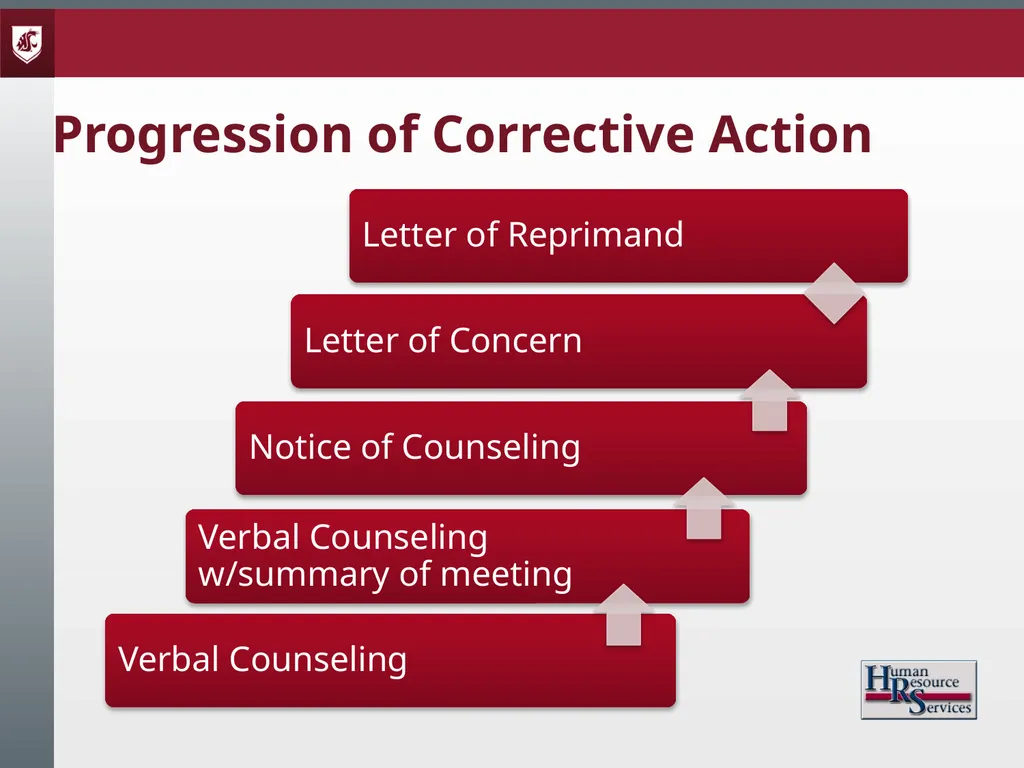
Progression of Corrective Action<br>
09
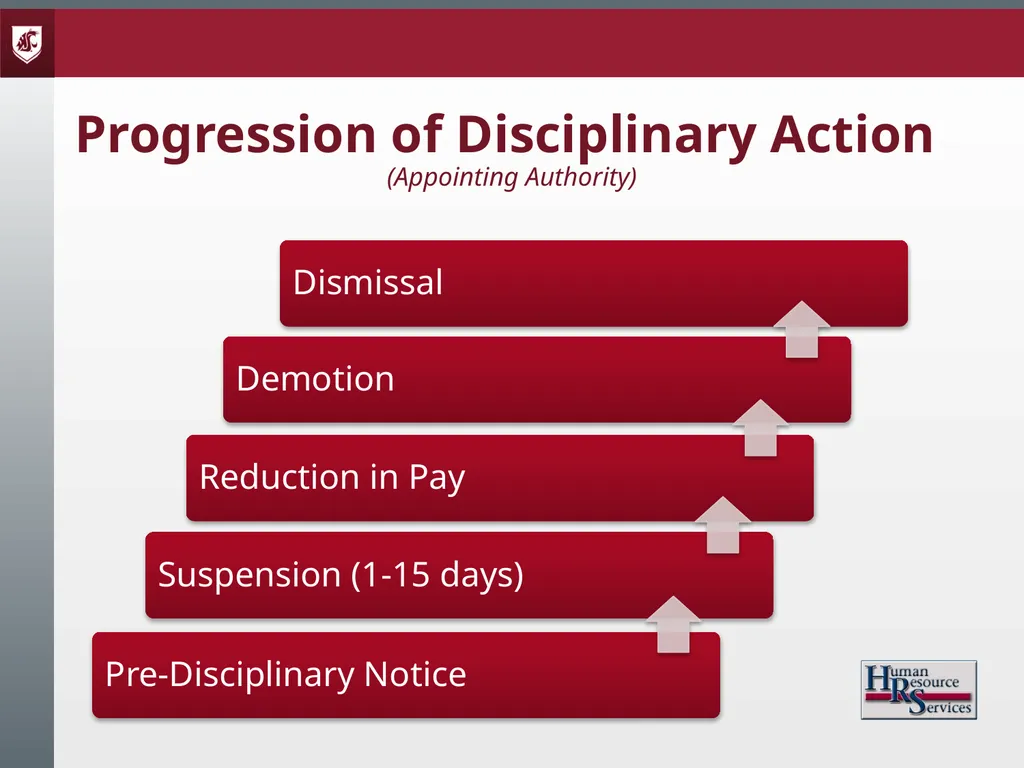
Progression of Disciplinary Action �(Appointing Authority)<br>
10
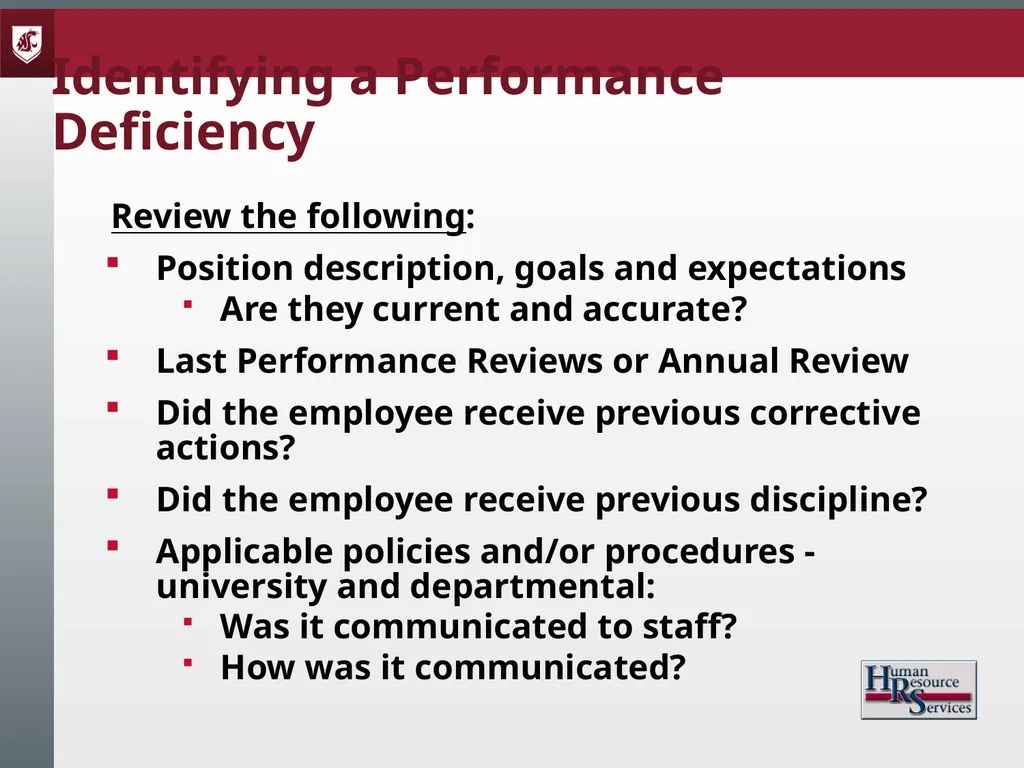
Identifying a Performance Deficiency Review the following:
Position description, goals and expectations
Are they current and accurate?
Last Performance Reviews or Annual Review
Did the employee receive previous corrective actions?
Did the employee receive previous discipline?
Applicable policies and/or procedures -university and departmental:
Was it communicated to staff?
How was it communicated?<br>
11
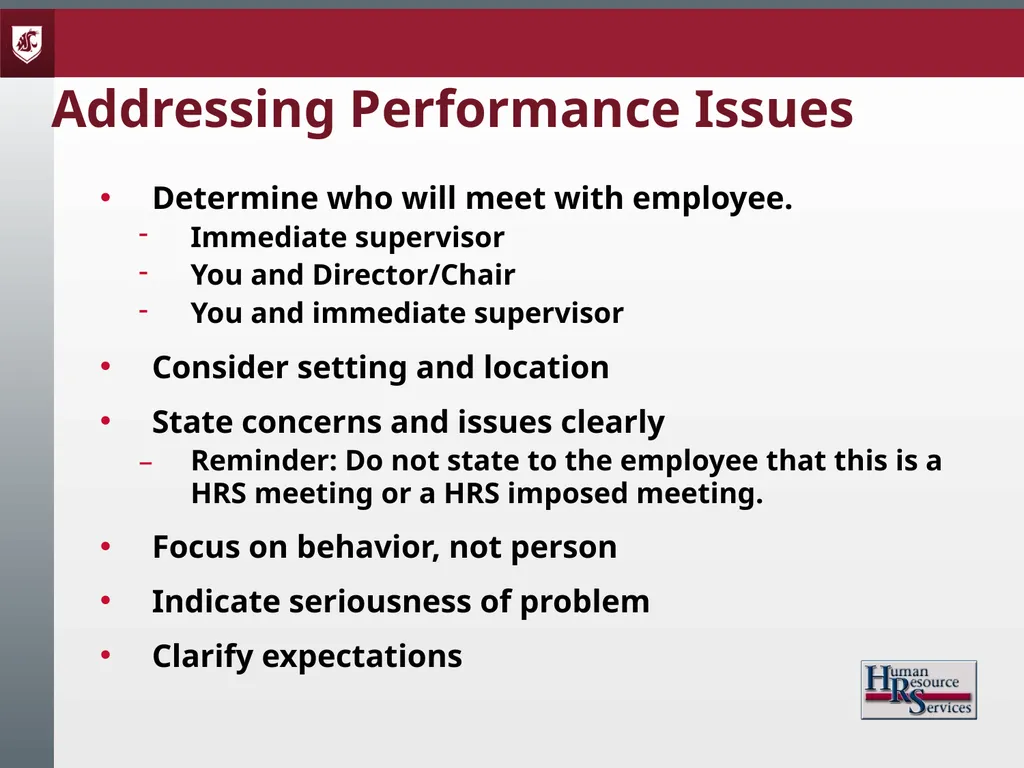
Addressing Performance Issues Determine who will meet with employee.
Immediate supervisor
You and Director/Chair
You and immediate supervisor
Consider setting and location
State concerns and issues clearly
Reminder: Do not state to the employee that this is a HRS meeting or a HRS imposed meeting.
Focus on behavior, not person
Indicate seriousness of problem
Clarify expectations<br>
12
Clear Rules & Guidelines Are more effective when they are:�
Needed
Communicated
Understood
Written/Recorded
Applied equally
Enforced<br>
13
Department Expectations Typical examples of department expectations:
Hours of work
Overtime rules
Dress Code
Requesting annual leave
Call-in procedures for sick leave<br>
14
Examples Your employee Jane Doe Smith is the receptionist for the department. Her work schedule is 8 am to 5 pm. For the last month she arrives to work around 8:15 am at least 1-day per week.
How would you address the situation?<br>
15
Your employee Jane Doe Smith continues to be late to work. She is now taking longer breaks and extending her lunch period.
How would you handle this situation? Examples<br>
16
The Wrong Way to Document… On June 5, met with Joe Adams, verbally counseled about improper behavior.
As written – will you remember the “behavior”?<br>
17
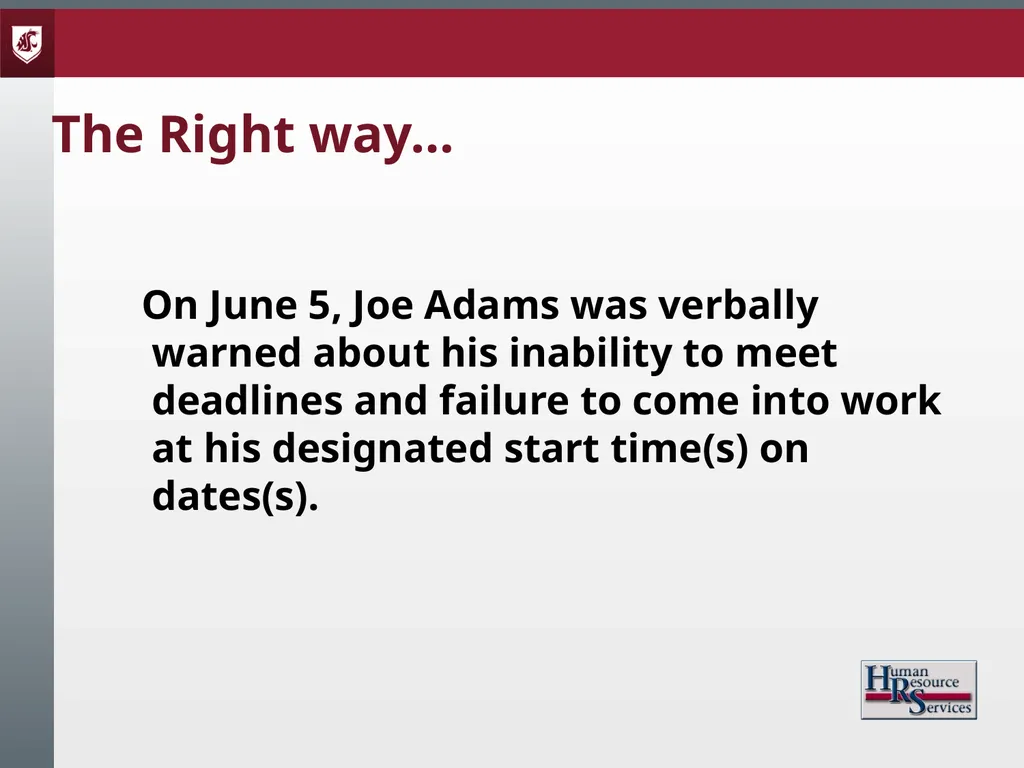
The Right way… On June 5, Joe Adams was verbally warned about his inability to meet deadlines and failure to come into work at his designated start time(s) on dates(s).<br>
18
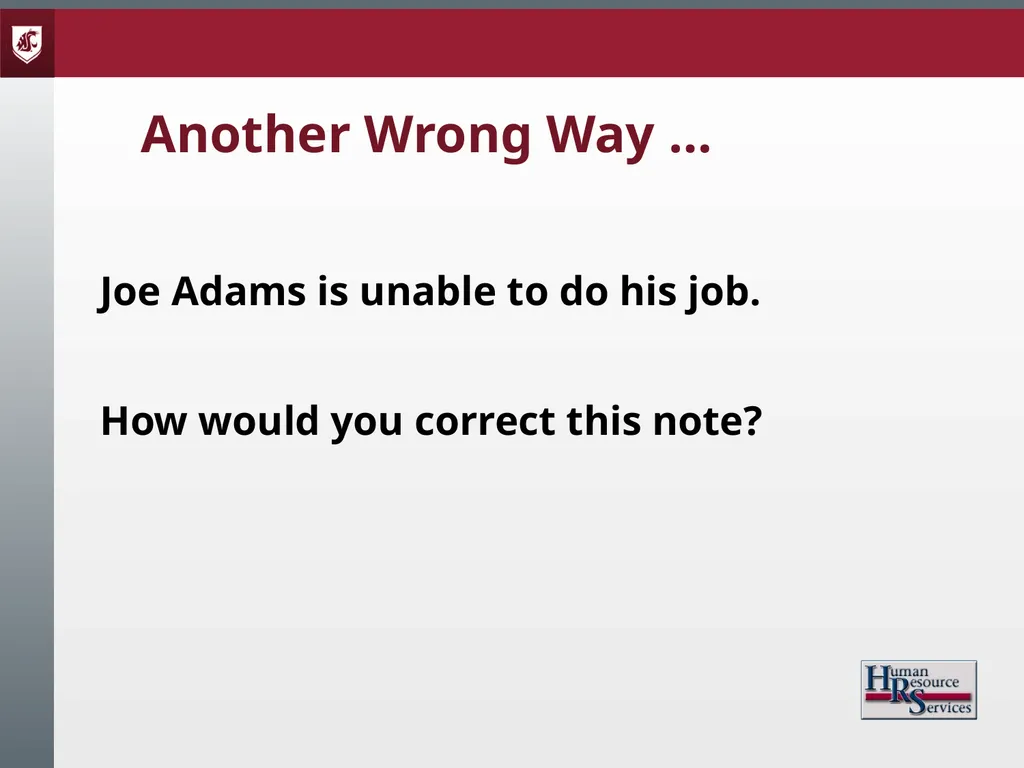
Another Wrong Way … Joe Adams is unable to do his job.
How would you correct this note?<br>
19
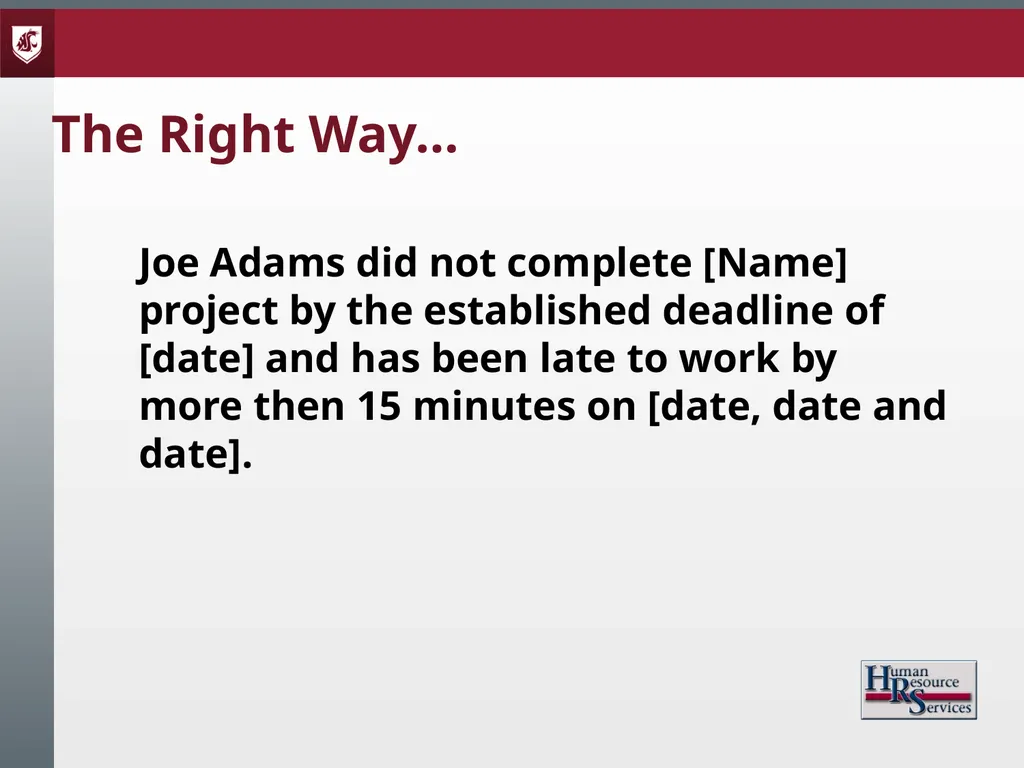
The Right Way… Joe Adams did not complete [Name] project by the established deadline of [date] and has been late to work by more then 15 minutes on [date, date and date].<br>
20
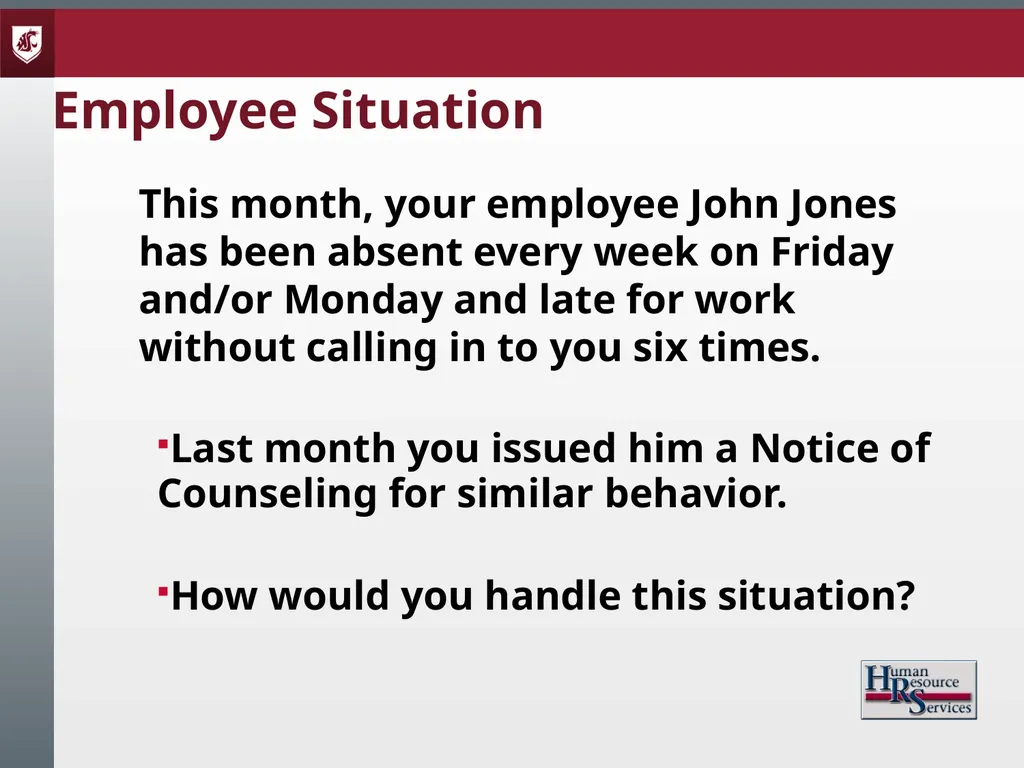
Employee Situation This month, your employee John Jones has been absent every week on Friday and/or Monday and late for work without calling in to you six times.
Last month you issued him a Notice of Counseling for similar behavior.
How would you handle this situation?<br>
21
Let the employee respond
Listen
Don’t Interrupt
Don’t lose your temper
Don’t argue
Consider/Reconsider course of action based on employee input During a Corrective Action Meeting<br>
22
Tips Apply corrective consistently, fairly and impartially
Set a good example
Don’t “save up” concerns
Praise in public—criticize in private
Contact HRS for guidance<br>
23
Things to be Aware of… Notice of Investigation
Timeliness
Double Discipline
Due Process
Union Contract<br>
24
Notice of Investigation Depending on the issue/situation a Notice of Investigation (NOI) may be appropriate to give.
Bargaining unit covered employees must receive a written NOI within 10 working days from the date the supervisor or manager becomes aware of the situation.<br>
25
More… Samples of Investigations:
Allegations of inappropriate use of state resources
Allegation of workplace violence
Office for Equal Opportunity (OEO): Allegation of harassment or discrimination<br>
26
Double Discipline Cannot discipline for conduct which was previously addressed as corrective action (verbal or written).<br>
27
Considering Disciplinary Action Contact HRS for guidance
Issue a Pre-Disciplinary Notice
Schedule a Pre-Disciplinary Meeting
Appointing Authority should attend meeting
HRS attends the meeting<br>
28
Examples Employee John Smith over the past month has been consistently late for work and on two separate occasions was �a no-call no-show.
How would you handle this situation?<br>
29
Pre-Disciplinary Meeting This is the Employee’s meeting
Employee is allowed to have a union representative or co-worker attend
Meeting is voluntary, employee can respond in writing or not attend
After the meeting, the Appointing Authority makes decision, taking into consideration employee’s input<br>
30
Considerations Does the proposed discipline fit the violation?
Is the proposed discipline likely to correct behavior?
Review prior performance issues
Review performance evaluations
Extenuating circumstances
Seriousness of the offense<br>
31
Disciplinary Action Letter Action is decided AFTER employee has had the opportunity to respond
If disciplinary action is decided, the appointing authority notifies employee in writing of action.
HRS drafts the letters.<br>
32
How Would You Handle… Your employee walks off the job without permission:
The employee requests use of annual leave the next day to cover time missed.
Should you approve use of annual leave?<br>
33
More… You send your employee home due to inappropriate behavior:
Are you required to pay the employee?<br>
34
More… You gave your employee a pre-disciplinary notice.
Employee calls in sick the next day, completes Family Medical Leave (FML) paperwork and is approved.
What happens to the pre-disciplinary process?<br>
35
Memo & Letter Templates HR Consultants are available to provide guidance with employee issues including verbal counseling, and writing corrective action memos or letters.
HRS and the appointing authority draft disciplinary action letters.
Web resources are also available in the Managers Section at www.hrs.wsu.edu<br>
36
Probationary & Trial Service Probationary Employees
Performance concerns
Previously discussed – behavior continues
Requires 1 day written notice (WAC 357-46)
Template of notification letter on HRS website
Trial Service Employees
Recommended that employee is notified of deficiency AND allowed a reasonable amount of time for improvement before reversion
Requires 7 calendar days written notice for civil service, 15 calendar days for BU<br>
37
Question… What are the possible implications of an employee not performing at highest standards passing a probationary or trial service period?<br>
38
WAC 357-37, 38
Collective Bargaining Unit Agreements
HRS Website –� hrs.wsu.edu
Corrective/Discipline Guide Resources For assistance and answers to questions contact HRS at 335-4521, or hrs@wsu.edu<br>
39
If you attended this live training session and wish to have your attendance documented in your training history, �please notify Human Resource Services� within 24 hours of today's date: ��hrstraining@wsu.edu This has been a WSU Training Videoconference<br>