
COS 433: Cryptography Princeton University Spring
TA
Published · 24 slides · 0 views

1 / 1
Description
COS 433: Cryptography Princeton University Spring 2010 Boaz Barak Please stop me if you have questions! 2 Cryptography History of 2500- 4000 years. Recurring theme: (until 1970s) Secret code invented Typically claimed unbreakable by
Related Topics
Share
Embed code
Download this presentation From Below
"COS 433: Cryptography Princeton University Spring" is the property of its rightful owner. Permission is granted to download and print the materials on this website for personal, non-commercial use only, and to display it on your personal computer provided you do not modify the materials and that you retain all copyright notices contained in the materials. By downloading content from our website, you accept the terms of this agreement.
Presentation Transcript
01
COS 433: Cryptography Princeton University
Spring 2010
Boaz Barak Please stop me if you have questions!<br>
Boaz Barak Please stop me if you have questions!<br>
02
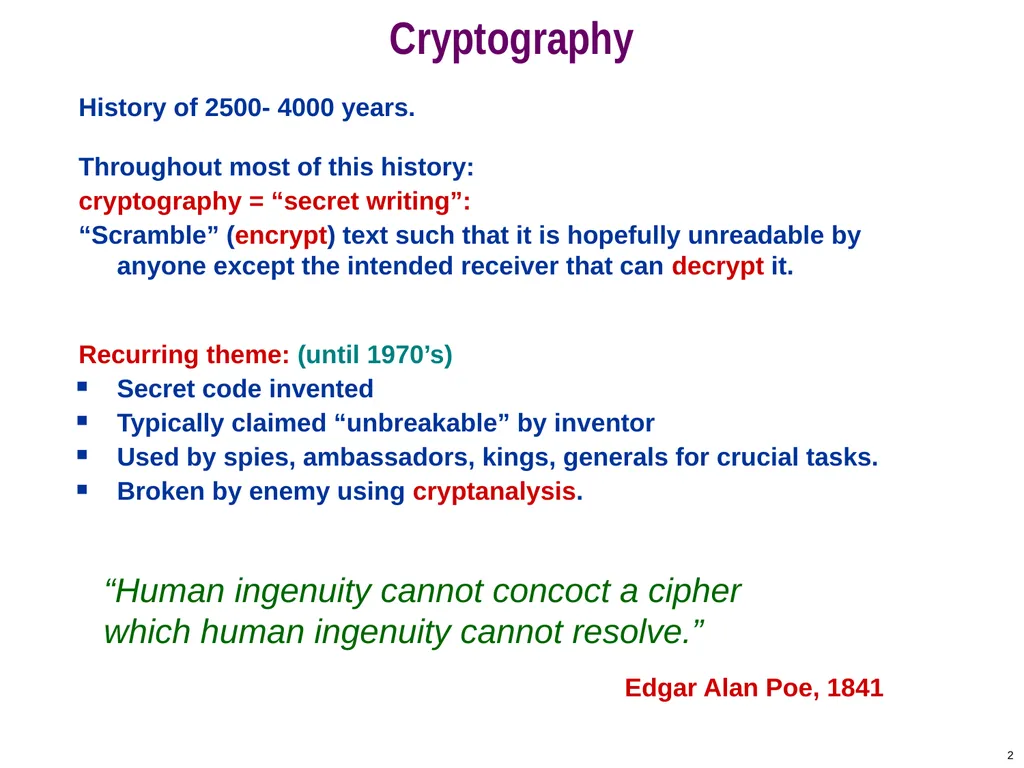
2 Cryptography History of 2500- 4000 years. Recurring theme: (until 1970’s)
Secret code invented
Typically claimed “unbreakable” by inventor
Used by spies, ambassadors, kings, generals for crucial tasks.
Broken by enemy using cryptanalysis. Throughout most of this history:
cryptography = “secret writing”:
“Scramble” (encrypt) text such that it is hopefully unreadable by anyone except the intended receiver that can decrypt it. “Human ingenuity cannot concoct a cipher
which human ingenuity cannot resolve.” Edgar Alan Poe, 1841<br>
Secret code invented
Typically claimed “unbreakable” by inventor
Used by spies, ambassadors, kings, generals for crucial tasks.
Broken by enemy using cryptanalysis. Throughout most of this history:
cryptography = “secret writing”:
“Scramble” (encrypt) text such that it is hopefully unreadable by anyone except the intended receiver that can decrypt it. “Human ingenuity cannot concoct a cipher
which human ingenuity cannot resolve.” Edgar Alan Poe, 1841<br>
03
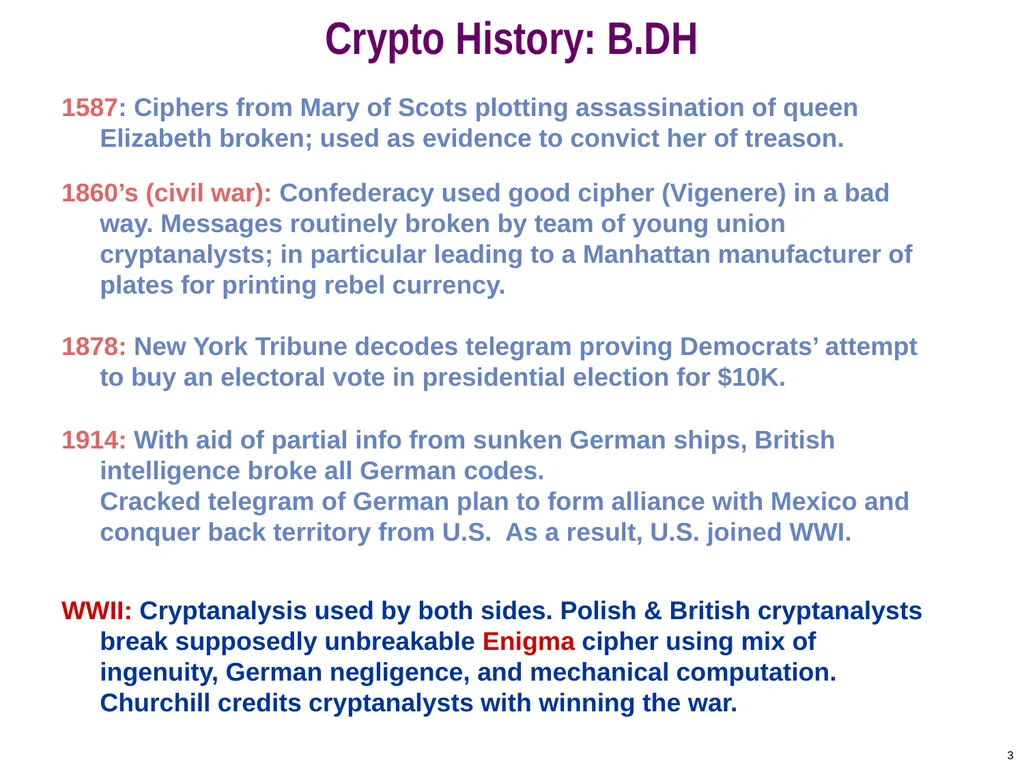
3 Crypto History: B.DH 1587: Ciphers from Mary of Scots plotting assassination of queen Elizabeth broken; used as evidence to convict her of treason. 1860’s (civil war): Confederacy used good cipher (Vigenere) in a bad way. Messages routinely broken by team of young union cryptanalysts; in particular leading to a Manhattan manufacturer of plates for printing rebel currency. 1878: New York Tribune decodes telegram proving Democrats’ attempt to buy an electoral vote in presidential election for $10K. 1914: With aid of partial info from sunken German ships, British intelligence broke all German codes.
Cracked telegram of German plan to form alliance with Mexico and conquer back territory from U.S. As a result, U.S. joined WWI. WWII: Cryptanalysis used by both sides. Polish & British cryptanalysts break supposedly unbreakable Enigma cipher using mix of ingenuity, German negligence, and mechanical computation.
Churchill credits cryptanalysts with winning the war.<br>
04
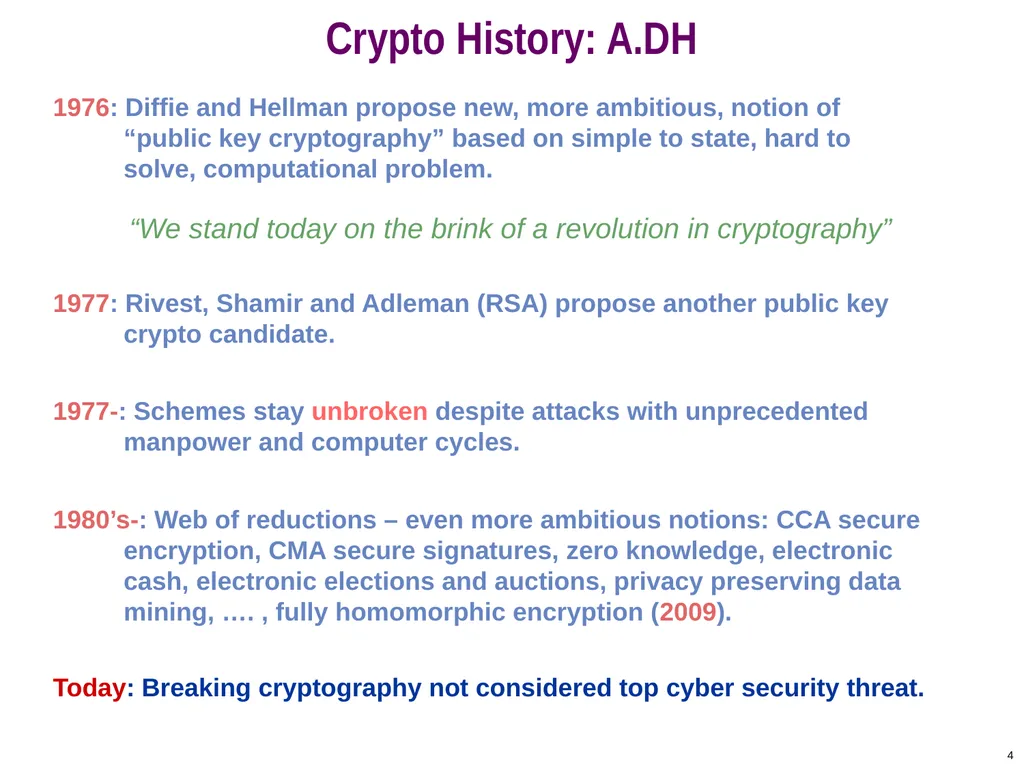
4 Crypto History: A.DH 1976: Diffie and Hellman propose new, more ambitious, notion of “public key cryptography” based on simple to state, hard to solve, computational problem. 1977: Rivest, Shamir and Adleman (RSA) propose another public key crypto candidate. 1977-: Schemes stay unbroken despite attacks with unprecedented manpower and computer cycles. 1980’s-: Web of reductions – even more ambitious notions: CCA secure encryption, CMA secure signatures, zero knowledge, electronic cash, electronic elections and auctions, privacy preserving data mining, …. , fully homomorphic encryption (2009). Today: Breaking cryptography not considered top cyber security threat. “We stand today on the brink of a revolution in cryptography”<br>
05
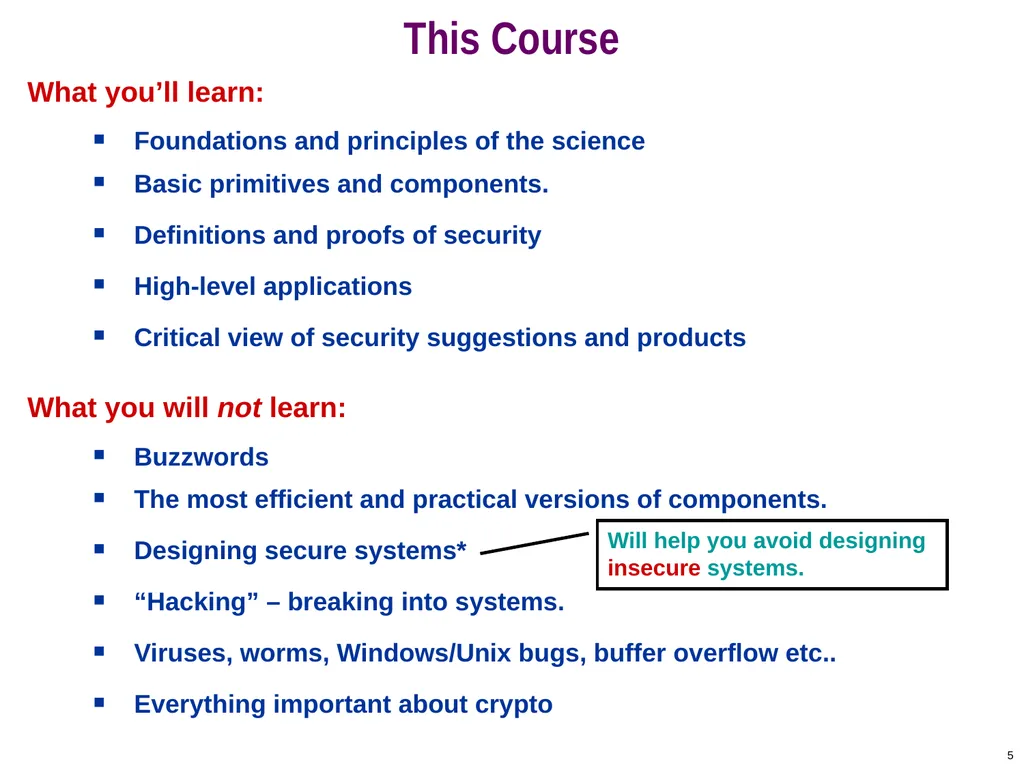
5 This Course What you’ll learn: Foundations and principles of the science Definitions and proofs of security High-level applications Critical view of security suggestions and products What you will not learn: The most efficient and practical versions of components. Designing secure systems* “Hacking” – breaking into systems. Everything important about crypto Basic primitives and components. Viruses, worms, Windows/Unix bugs, buffer overflow etc.. Buzzwords Will help you avoid designing insecure systems.<br>
06
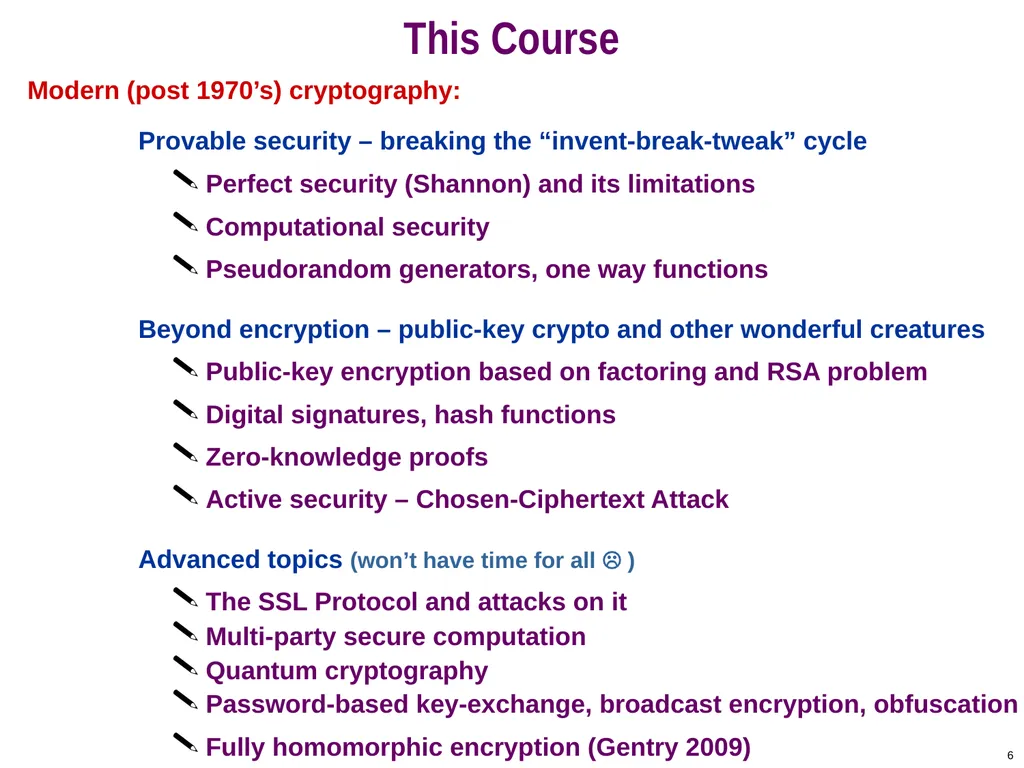
6 This Course Modern (post 1970’s) cryptography: Provable security – breaking the “invent-break-tweak” cycle Perfect security (Shannon) and its limitations Computational security Pseudorandom generators, one way functions Beyond encryption – public-key crypto and other wonderful creatures Public-key encryption based on factoring and RSA problem Digital signatures, hash functions Zero-knowledge proofs Active security – Chosen-Ciphertext Attack Advanced topics (won’t have time for all ) The SSL Protocol and attacks on it Multi-party secure computation Quantum cryptography Password-based key-exchange, broadcast encryption, obfuscation Fully homomorphic encryption (Gentry 2009)<br>
07
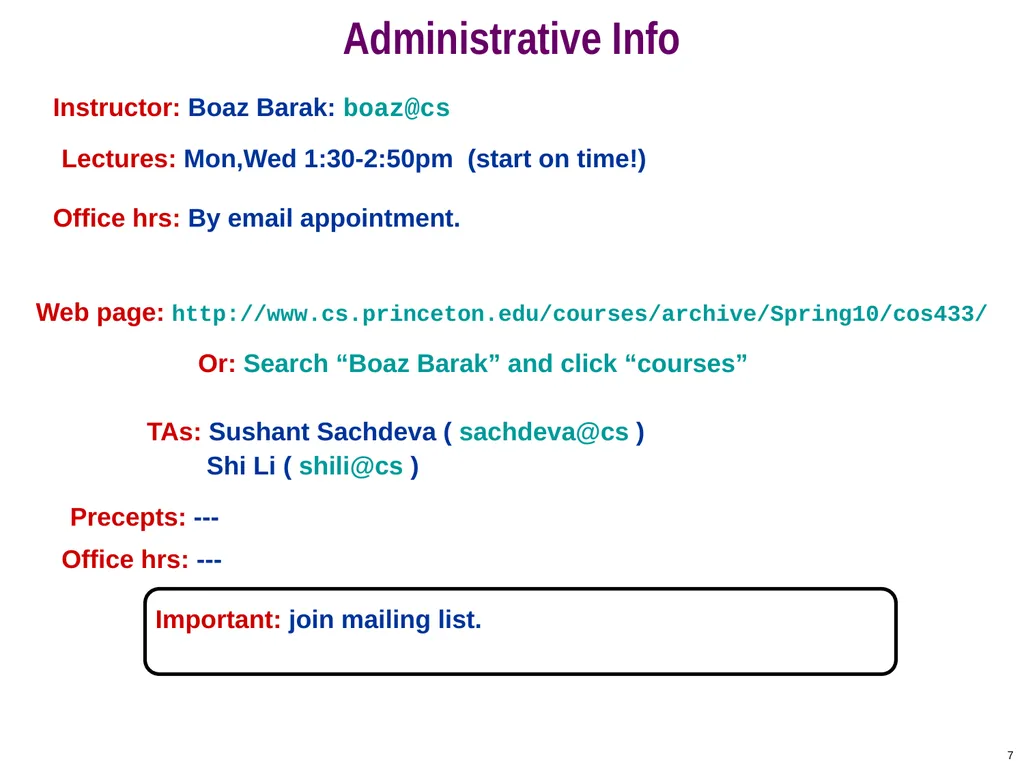
7 Administrative Info Lectures: Mon,Wed 1:30-2:50pm (start on time!) Instructor: Boaz Barak: boaz@cs Web page: http://www.cs.princeton.edu/courses/archive/Spring10/cos433/ Or: Search “Boaz Barak” and click “courses” TAs: Sushant Sachdeva ( sachdeva@cs ) Important: join mailing list. Office hrs: By email appointment. Precepts: --- Office hrs: --- Shi Li ( shili@cs )<br>
08
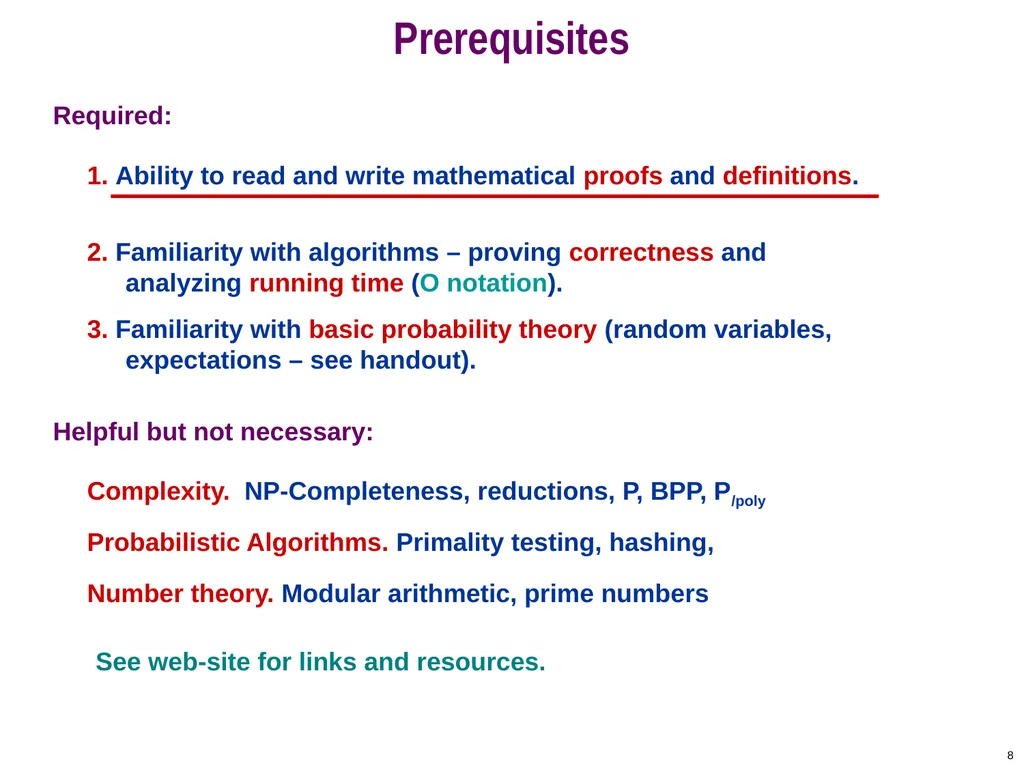
8 Prerequisites 1. Ability to read and write mathematical proofs and definitions. 2. Familiarity with algorithms – proving correctness and analyzing running time (O notation). Required: Helpful but not necessary: Complexity. NP-Completeness, reductions, P, BPP, P/poly Probabilistic Algorithms. Primality testing, hashing, Number theory. Modular arithmetic, prime numbers See web-site for links and resources. 3. Familiarity with basic probability theory (random variables, expectations – see handout).<br>
09
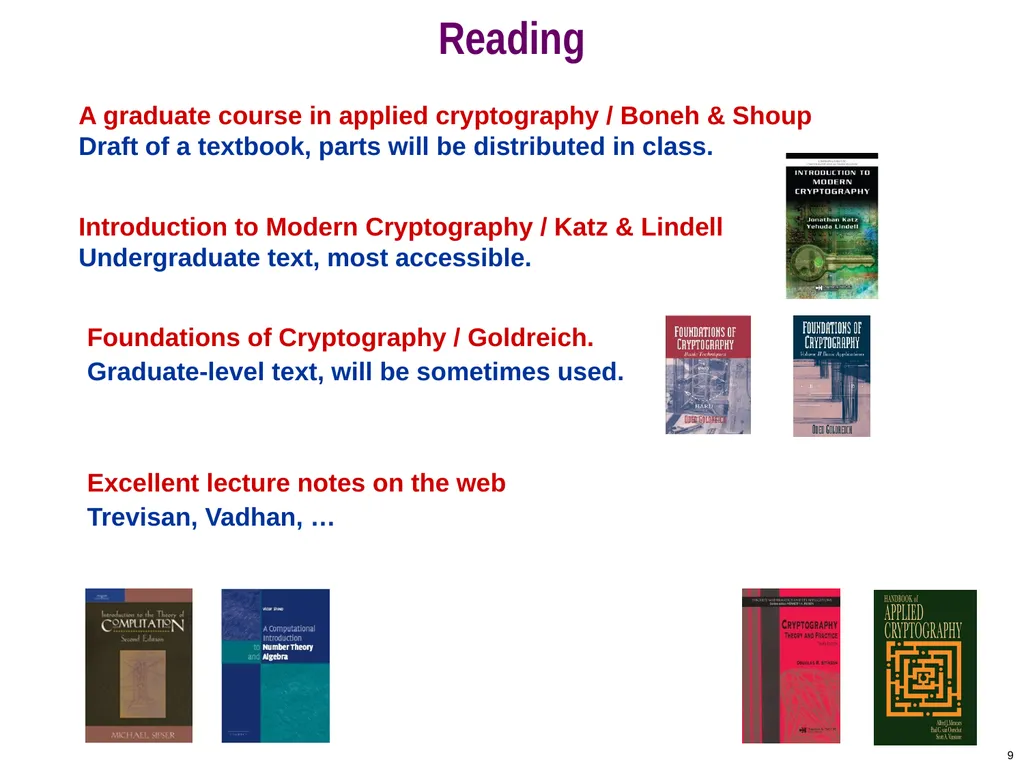
9 Reading Foundations of Cryptography / Goldreich.
Graduate-level text, will be sometimes used. Introduction to Modern Cryptography / Katz & Lindell Undergraduate text, most accessible. A graduate course in applied cryptography / Boneh & Shoup Draft of a textbook, parts will be distributed in class. Excellent lecture notes on the web
Trevisan, Vadhan, …<br>
Graduate-level text, will be sometimes used. Introduction to Modern Cryptography / Katz & Lindell Undergraduate text, most accessible. A graduate course in applied cryptography / Boneh & Shoup Draft of a textbook, parts will be distributed in class. Excellent lecture notes on the web
Trevisan, Vadhan, …<br>
10
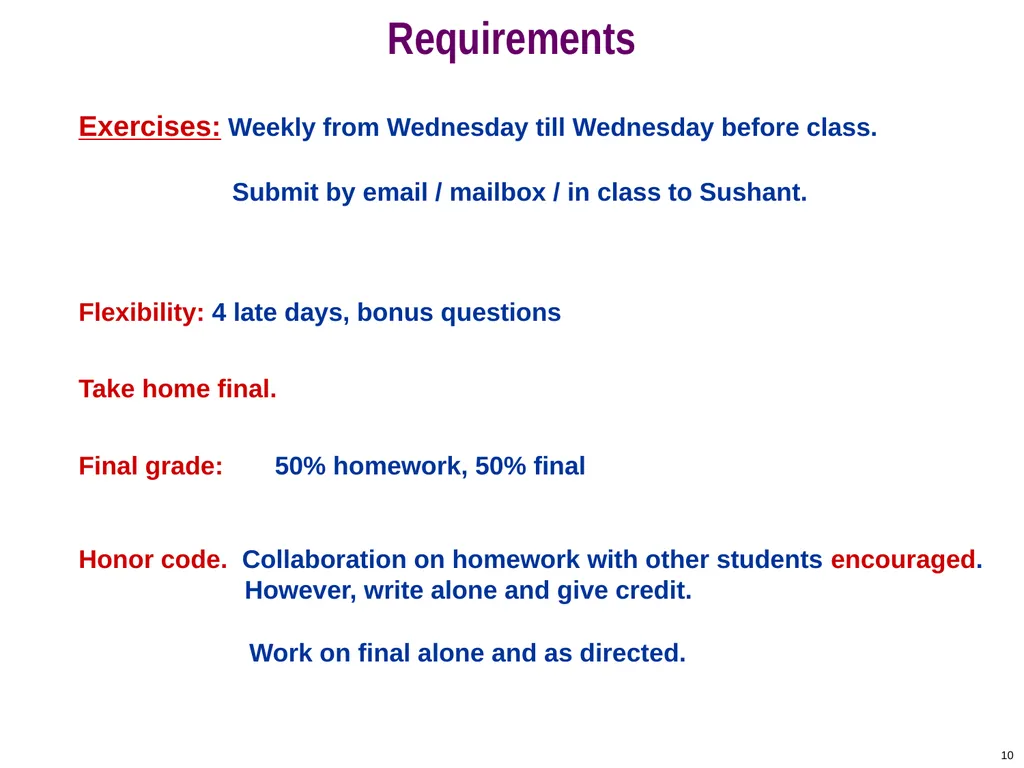
10 Requirements Exercises: Weekly from Wednesday till Wednesday before class. Submit by email / mailbox / in class to Sushant. Flexibility: 4 late days, bonus questions Take home final. Final grade: 50% homework, 50% final Honor code. Collaboration on homework with other students encouraged.
However, write alone and give credit. Work on final alone and as directed.<br>
11
11 This course is hard Challenging weekly exercises
Emphasis on mathematical proofs
Counterintuitive concepts.
Extensive use of quantifiers/probability But it’s not my fault :) Good coverage of crypto (meat, vegetables and desert) takes a year.
Simulation / experimentation can’t be used to show security.
Need to acquire “crypto-intuition”
Quantifiers, proofs by contradiction, reductions, probability are inherent. Mitigating hardness Avoid excessive exercises – only questions that teach you something.
Try best to explain intuition behind proofs
Me, Shi & Sushant available for any questions and clarifications.<br>
Emphasis on mathematical proofs
Counterintuitive concepts.
Extensive use of quantifiers/probability But it’s not my fault :) Good coverage of crypto (meat, vegetables and desert) takes a year.
Simulation / experimentation can’t be used to show security.
Need to acquire “crypto-intuition”
Quantifiers, proofs by contradiction, reductions, probability are inherent. Mitigating hardness Avoid excessive exercises – only questions that teach you something.
Try best to explain intuition behind proofs
Me, Shi & Sushant available for any questions and clarifications.<br>
12
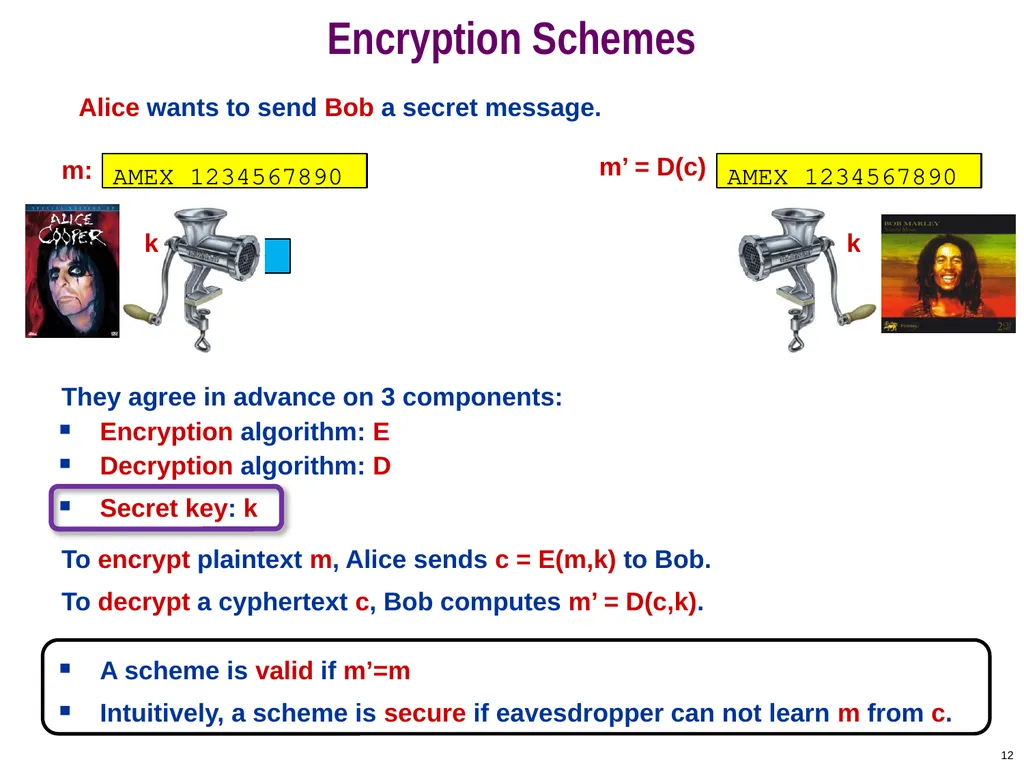
12 Encryption Schemes Alice wants to send Bob a secret message. They agree in advance on 3 components:
Encryption algorithm: E
Decryption algorithm: D To encrypt plaintext m, Alice sends c = E(m,k) to Bob. To decrypt a cyphertext c, Bob computes m’ = D(c,k). A scheme is valid if m’=m Intuitively, a scheme is secure if eavesdropper can not learn m from c. Secret key: k k k<br>
Encryption algorithm: E
Decryption algorithm: D To encrypt plaintext m, Alice sends c = E(m,k) to Bob. To decrypt a cyphertext c, Bob computes m’ = D(c,k). A scheme is valid if m’=m Intuitively, a scheme is secure if eavesdropper can not learn m from c. Secret key: k k k<br>
13
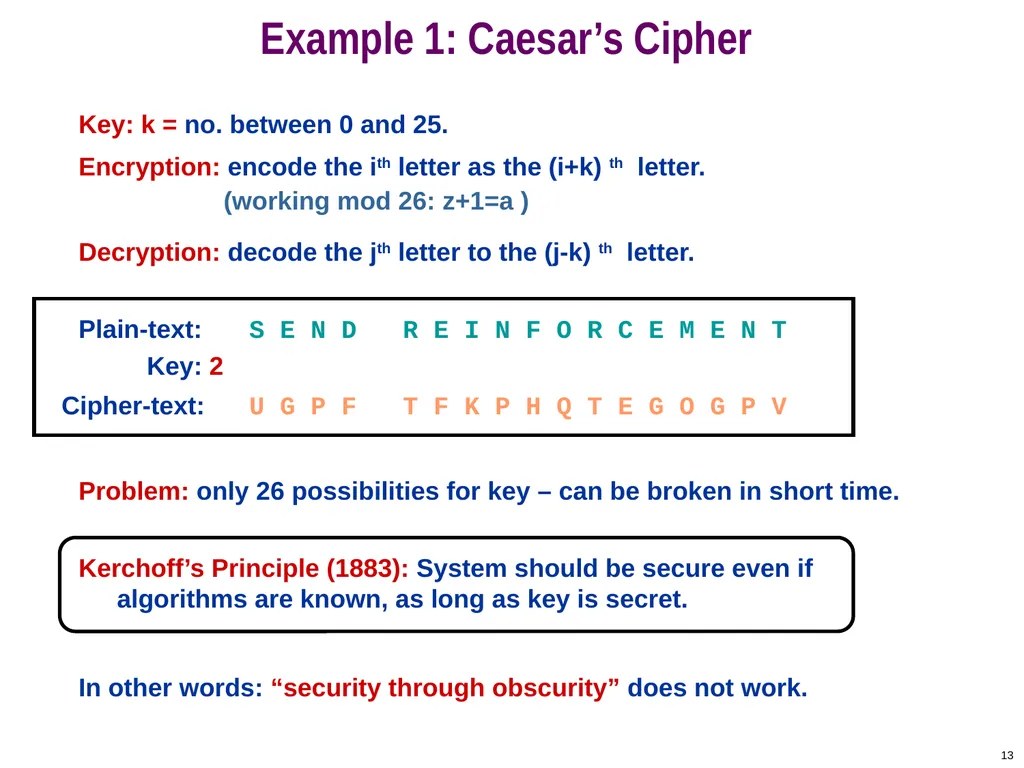
13 Example 1: Caesar’s Cipher Key: k = no. between 0 and 25. Encryption: encode the ith letter as the (i+k) th letter. (working mod 26: z+1=a ) Decryption: decode the jth letter to the (j-k) th letter. S E N D R E I N F O R C E M E N T Plain-text: Key: 2 Cipher-text: U G P F T F K P H Q T E G O G P V Problem: only 26 possibilities for key – can be broken in short time. In other words: “security through obscurity” does not work.<br>
14
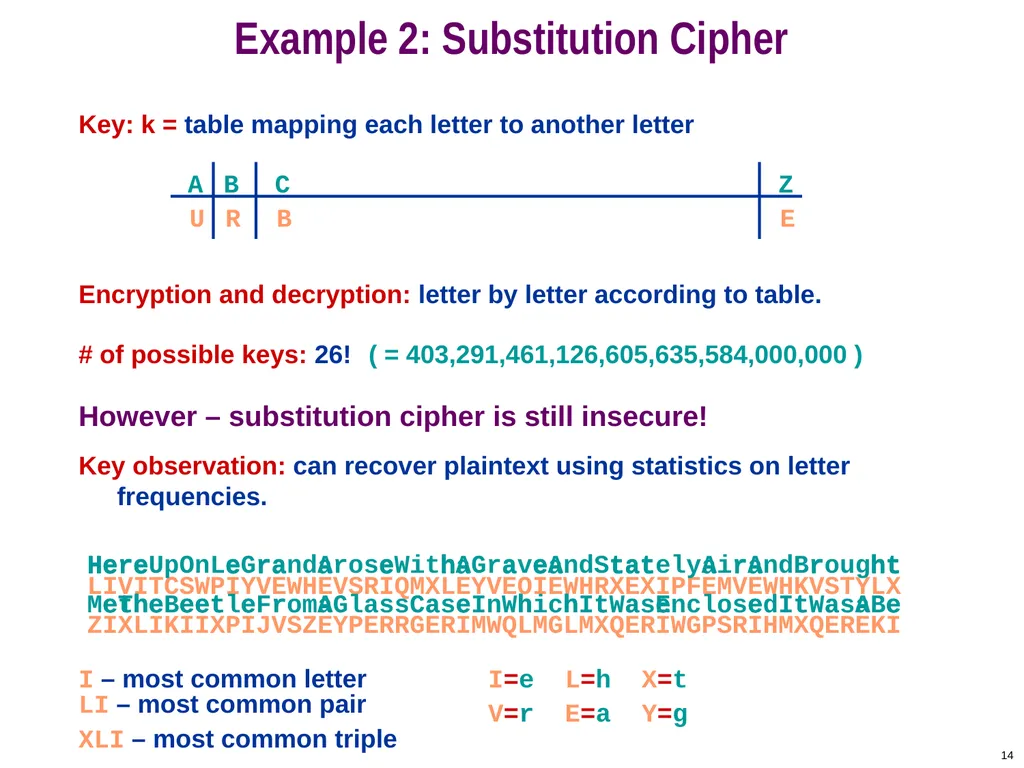
14 Example 2: Substitution Cipher Key: k = table mapping each letter to another letter A B C Z U R B E Encryption and decryption: letter by letter according to table. # of possible keys: 26! ( = 403,291,461,126,605,635,584,000,000 ) However – substitution cipher is still insecure! Key observation: can recover plaintext using statistics on letter frequencies. LIVITCSWPIYVEWHEVSRIQMXLEYVEOIEWHRXEXIPFEMVEWHKVSTYLX
ZIXLIKIIXPIJVSZEYPERRGERIMWQLMGLMXQERIWGPSRIHMXQEREKI He e e e h e t t ht
ethe eet e e h h t e e t e I – most common letter LI – most common pair XLI – most common triple Here e r e h e t t r r ht
ethe eet e r e h h t e e t e I=e L=h X=t Here e ra a e ha a ea tat a ra r ht
ethe eet e r a a e h h t a e e t a a e V=r E=a Y=g HereUpOnLeGrandAroseWithAGraveAndStatelyAirAndBrought
MeTheBeetleFromAGlassCaseInWhichItWasEnclosedItWasABe<br>
ZIXLIKIIXPIJVSZEYPERRGERIMWQLMGLMXQERIWGPSRIHMXQEREKI He e e e h e t t ht
ethe eet e e h h t e e t e I – most common letter LI – most common pair XLI – most common triple Here e r e h e t t r r ht
ethe eet e r e h h t e e t e I=e L=h X=t Here e ra a e ha a ea tat a ra r ht
ethe eet e r a a e h h t a e e t a a e V=r E=a Y=g HereUpOnLeGrandAroseWithAGraveAndStatelyAirAndBrought
MeTheBeetleFromAGlassCaseInWhichItWasEnclosedItWasABe<br>
15
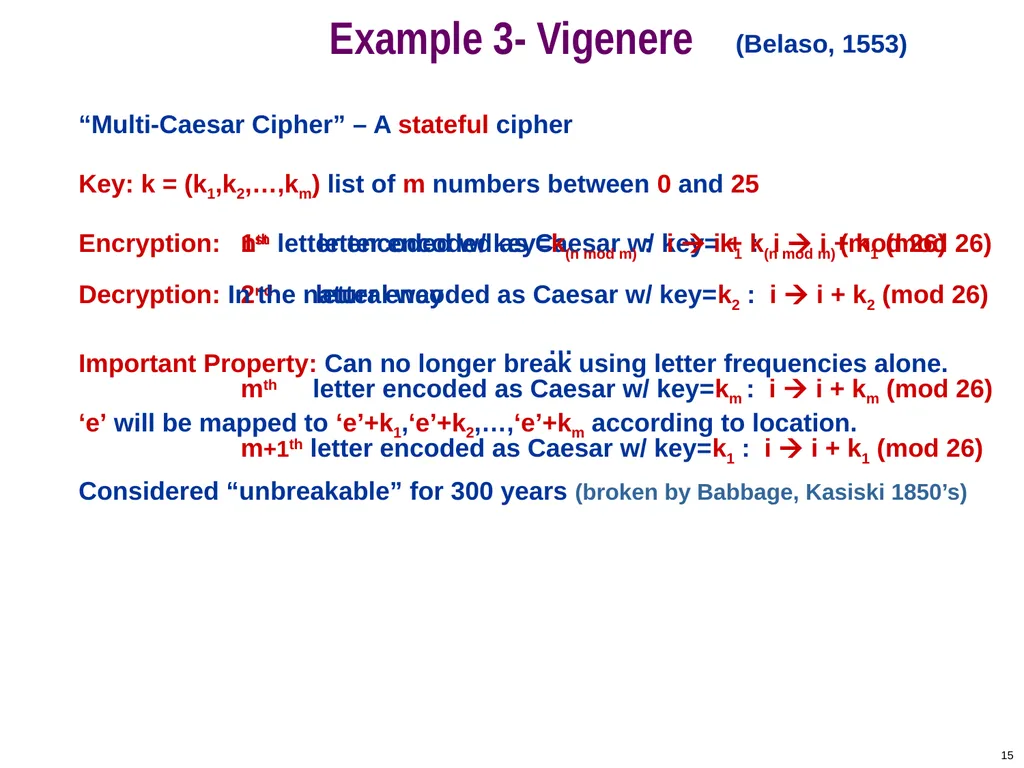
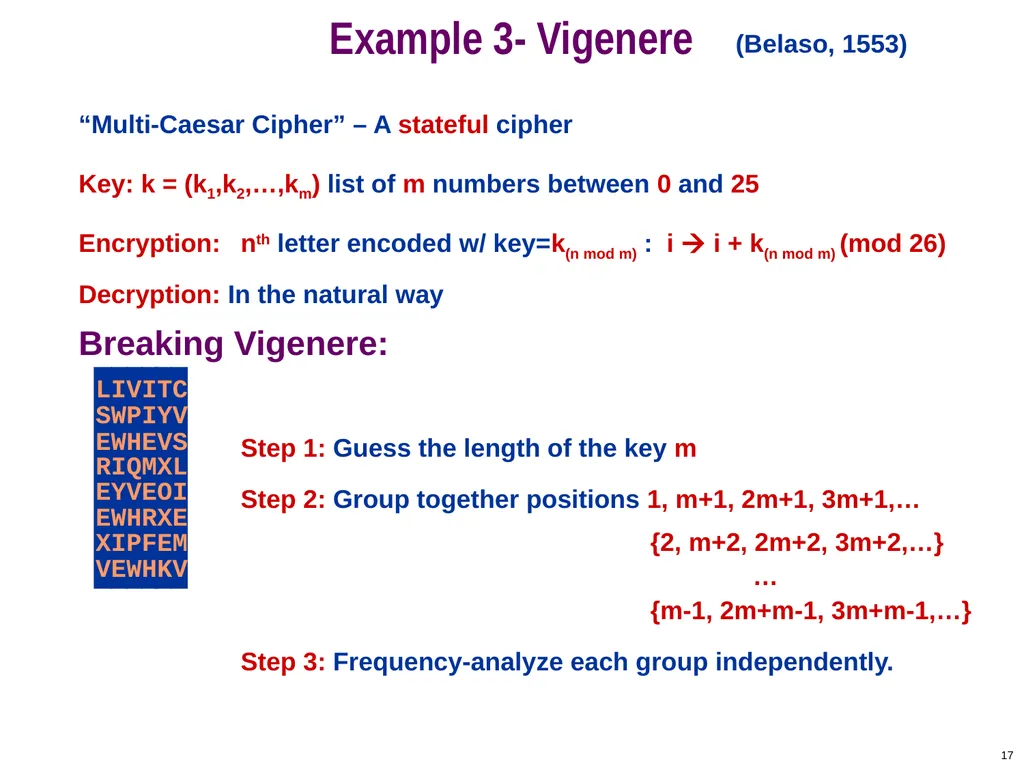
15 Example 3- Vigenere “Multi-Caesar Cipher” – A stateful cipher Key: k = (k1,k2,…,km) list of m numbers between 0 and 25 Encryption: 1st letter encoded as Caesar w/ key=k1 : i i + k1 (mod 26) 2nd letter encoded as Caesar w/ key=k2 : i i + k2 (mod 26) mth letter encoded as Caesar w/ key=km : i i + km (mod 26) m+1th letter encoded as Caesar w/ key=k1 : i i + k1 (mod 26) Decryption: In the natural way … Important Property: Can no longer break using letter frequencies alone. ‘e’ will be mapped to ‘e’+k1,‘e’+k2,…,‘e’+km according to location. nth letter encoded w/ key=k(n mod m) : i i + k(n mod m) (mod 26) Considered “unbreakable” for 300 years (broken by Babbage, Kasiski 1850’s) (Belaso, 1553)<br>
16
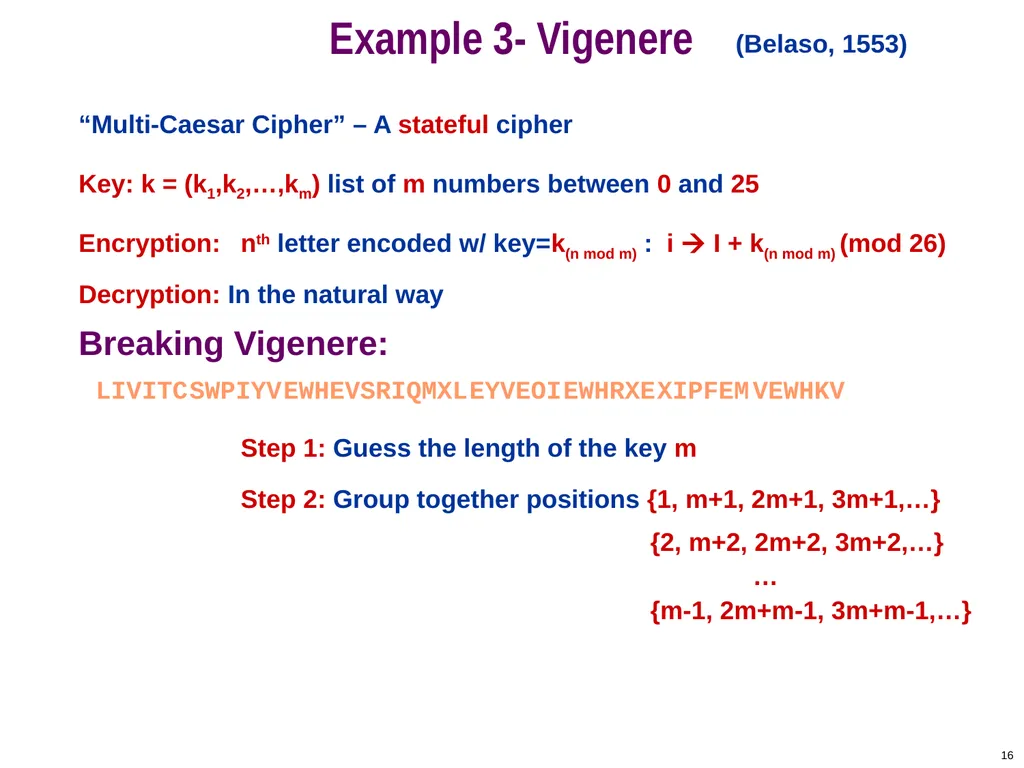
16 Example 3- Vigenere “Multi-Caesar Cipher” – A stateful cipher Key: k = (k1,k2,…,km) list of m numbers between 0 and 25 Encryption: Breaking Vigenere: nth letter encoded w/ key=k(n mod m) : i I + k(n mod m) (mod 26) (Belaso, 1553) LIVITC SWPIYV EWHEVS RIQMXL EYVEOI EWHRXE XIPFEM VEWHKV Step 1: Guess the length of the key m Step 2: Group together positions {1, m+1, 2m+1, 3m+1,…} {m-1, 2m+m-1, 3m+m-1,…} Decryption: In the natural way … {2, m+2, 2m+2, 3m+2,…}<br>
17
17 Example 3- Vigenere “Multi-Caesar Cipher” – A stateful cipher Key: k = (k1,k2,…,km) list of m numbers between 0 and 25 Encryption: Breaking Vigenere: nth letter encoded w/ key=k(n mod m) : i i + k(n mod m) (mod 26) (Belaso, 1553) LIVITC SWPIYV EWHEVS RIQMXL EYVEOI EWHRXE XIPFEM VEWHKV Step 1: Guess the length of the key m Step 2: Group together positions 1, m+1, 2m+1, 3m+1,… Step 3: Frequency-analyze each group independently. Decryption: In the natural way {m-1, 2m+m-1, 3m+m-1,…} … {2, m+2, 2m+2, 3m+2,…}<br>
18
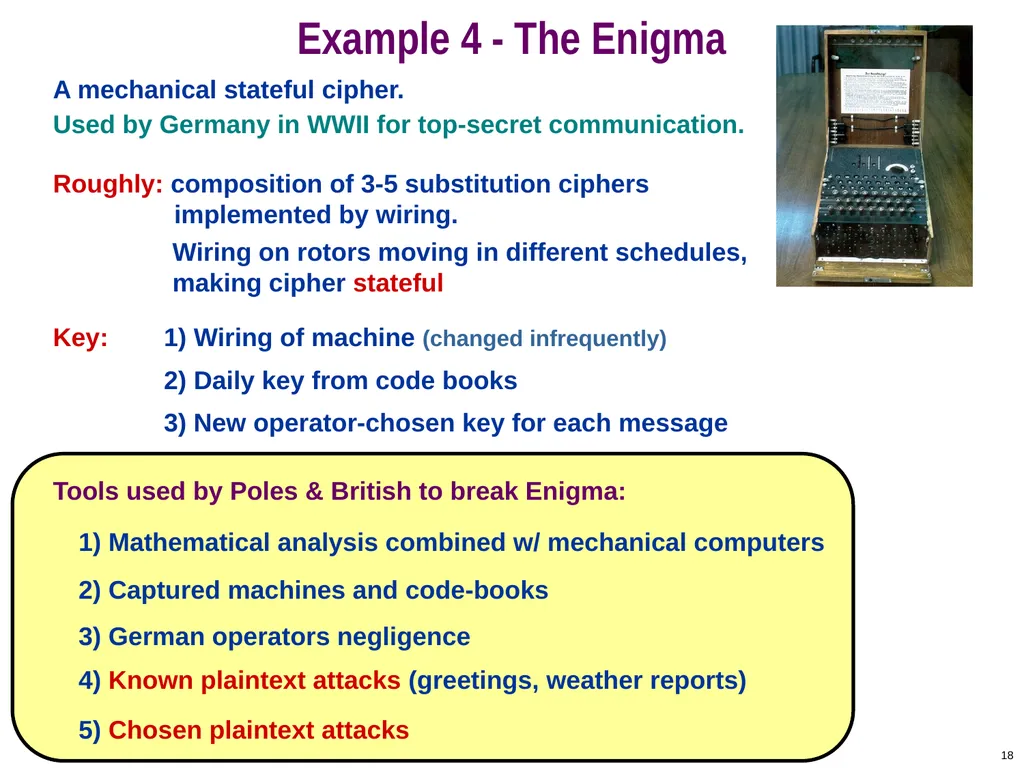
18 Example 4 - The Enigma A mechanical stateful cipher. Roughly: composition of 3-5 substitution ciphers implemented by wiring. Wiring on rotors moving in different schedules,
making cipher stateful Key: 1) Wiring of machine (changed infrequently) 2) Daily key from code books 3) New operator-chosen key for each message Tools used by Poles & British to break Enigma: 1) Mathematical analysis combined w/ mechanical computers 2) Captured machines and code-books 3) German operators negligence 4) Known plaintext attacks (greetings, weather reports) 5) Chosen plaintext attacks Used by Germany in WWII for top-secret communication.<br>
19
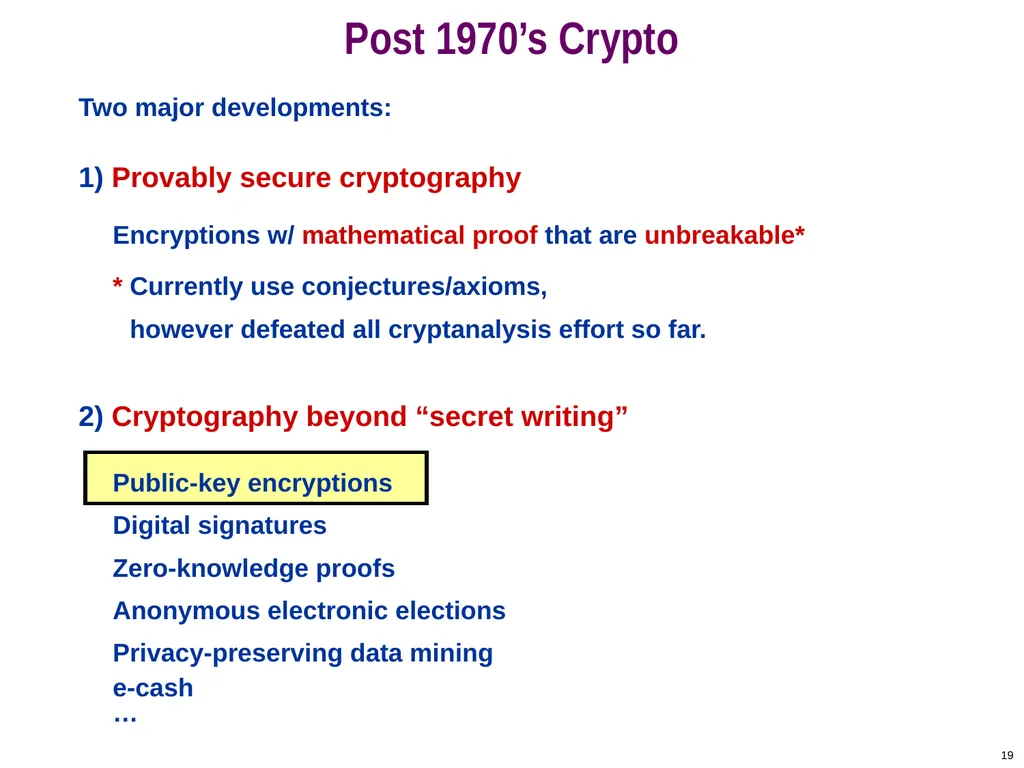
19 Post 1970’s Crypto Two major developments: 1) Provably secure cryptography Encryptions w/ mathematical proof that are unbreakable* * Currently use conjectures/axioms, however defeated all cryptanalysis effort so far. 2) Cryptography beyond “secret writing” Public-key encryptions Digital signatures Zero-knowledge proofs Anonymous electronic elections Privacy-preserving data mining e-cash …<br>
20
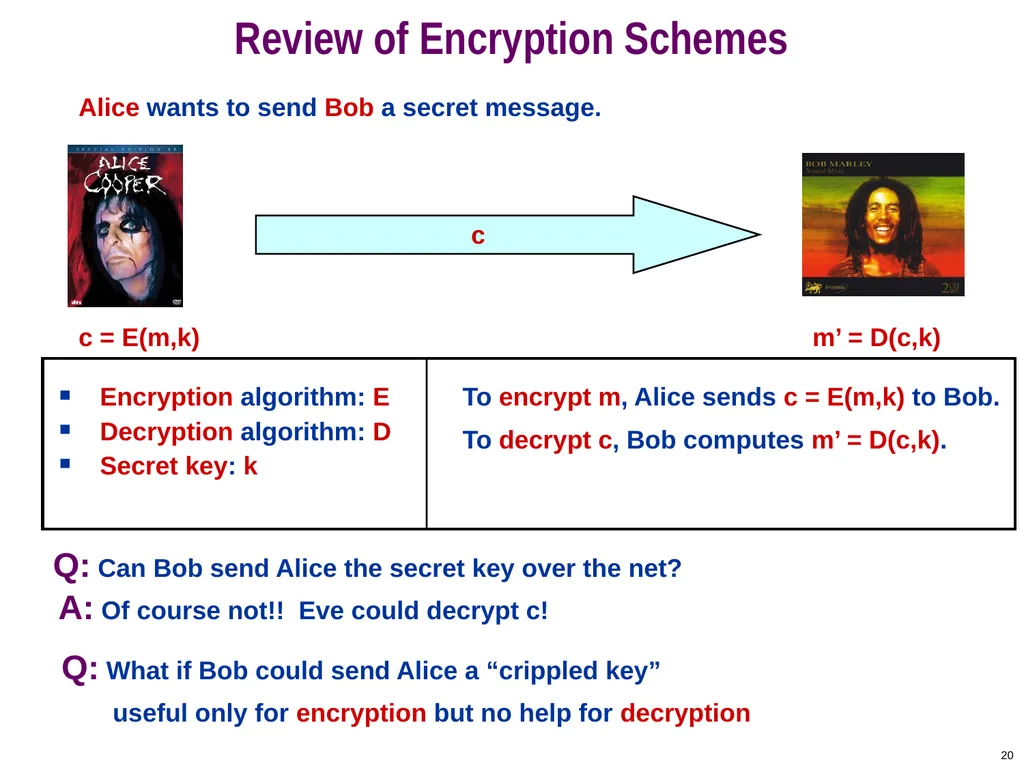
20 Review of Encryption Schemes Alice wants to send Bob a secret message. Encryption algorithm: E
Decryption algorithm: D
Secret key: k To encrypt m, Alice sends c = E(m,k) to Bob. To decrypt c, Bob computes m’ = D(c,k). c = E(m,k) m’ = D(c,k) Q: Can Bob send Alice the secret key over the net? A: Of course not!! Eve could decrypt c! Q: What if Bob could send Alice a “crippled key” useful only for encryption but no help for decryption<br>
Decryption algorithm: D
Secret key: k To encrypt m, Alice sends c = E(m,k) to Bob. To decrypt c, Bob computes m’ = D(c,k). c = E(m,k) m’ = D(c,k) Q: Can Bob send Alice the secret key over the net? A: Of course not!! Eve could decrypt c! Q: What if Bob could send Alice a “crippled key” useful only for encryption but no help for decryption<br>
21
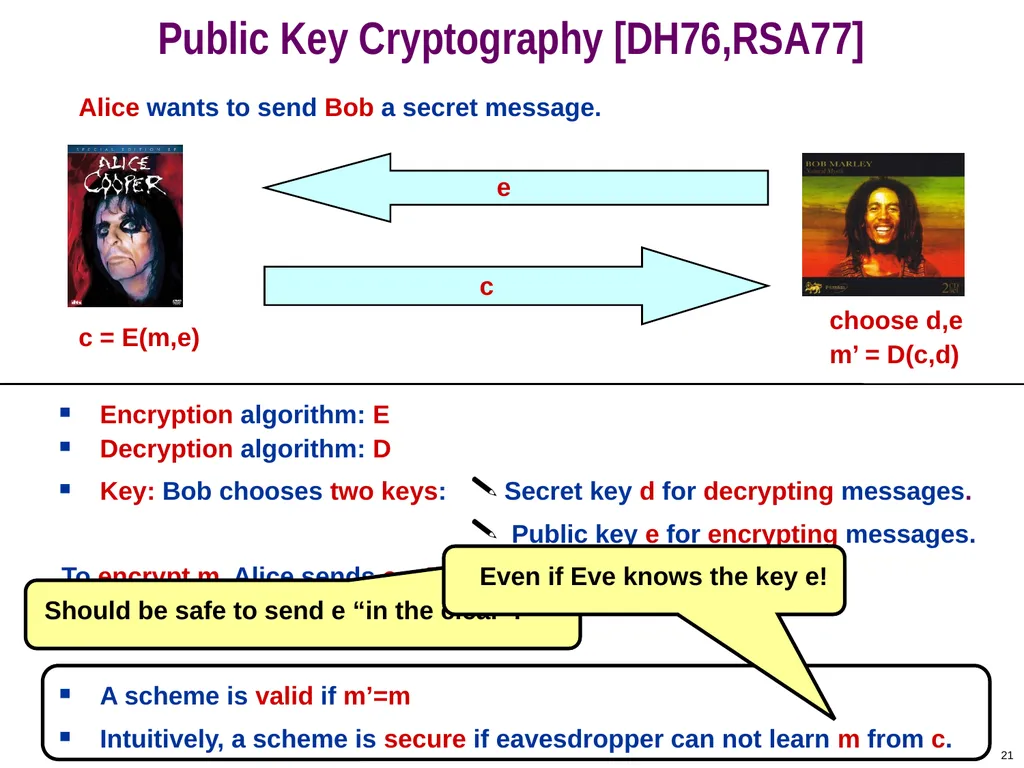
21 Public Key Cryptography [DH76,RSA77] Alice wants to send Bob a secret message. Encryption algorithm: E
Decryption algorithm: D To encrypt m, Alice sends c = E(m,e) to Bob. To decrypt c, Bob computes m’ = D(c,d). c = E(m,e) m’ = D(c,d) Key: Bob chooses two keys: Secret key d for decrypting messages. Public key e for encrypting messages. choose d,e<br>
Decryption algorithm: D To encrypt m, Alice sends c = E(m,e) to Bob. To decrypt c, Bob computes m’ = D(c,d). c = E(m,e) m’ = D(c,d) Key: Bob chooses two keys: Secret key d for decrypting messages. Public key e for encrypting messages. choose d,e<br>
22
22 Other Crypto Wonders Digital Signatures. Electronically sign documents in unforgeable way. Zero-knowledge proofs. Alice proves to Bob that she earns <$50K without Bob learning her income. Privacy-preserving data mining. Bob holds DB. Alice gets answer to one query, without Bob knowing what she asked. Playing poker over the net. Alice, Bob, Carol and David can play poker over the net without trusting each other or any central server. Distributed systems. Distribute sensitive data to 7 servers
s.t. as long as <3 are broken, no harm to security occurs. Electronic auctions. Can run auctions s.t. no one (even not seller)
learns anything other than winning party and bid. Fully homomorphic encryption. Encrypt E(m) in a way that allows anyone to compute E(f(m)) for every function f.<br>
23
23 Cryptography & Security Prev slides: Have provably secure algorithm for every crypto task imaginable. Q: How come nothing is secure? A1: Not all of these are used or used correctly: Strange tendency to use “home-brewed” cryptosystems. Combining secure primitives in insecure way Strict efficiency requirements for crypto/security: Many provably secure algs not efficient enough The cost is visible but benefit invisible. Easy to get implementation wrong – many subtleties Compatibility issues, legacy systems, Misunderstanding properties of crypto components.<br>
24
24 For Wednesday 2) Think how would you try to (mathematically) define the notion that a pair of functions (E,D) is a secure encryption scheme. Then read Katz-Lindell pp 18-24 (see also Goldreich) 1) Join the course mailing list. 3) Go over mathematical background handout<br>