
Course Code: 21GNH101J Course Name: Philosophy of
YM
Published · 43 slides · 0 views
1 / 1

Description
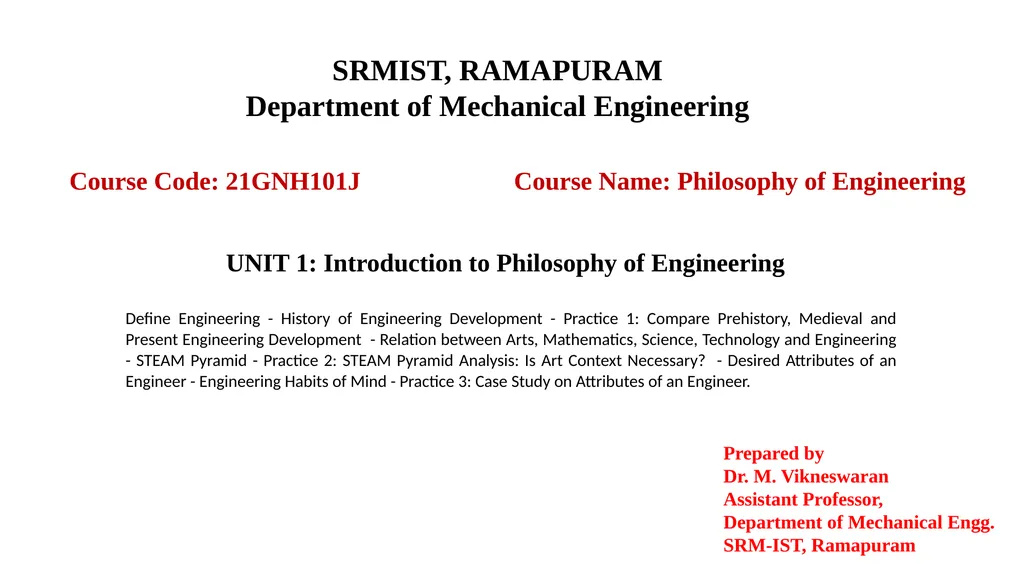
Course Code: 21GNH101J Course Name: Philosophy of Engineering SRMIST, RAMAPURAM Department of Mechanical Engineering UNIT 1: Introduction to Philosophy of Engineering Prepared by Dr. M. Vikneswaran Assistant Professor, Department of
Related Topics
Share
Embed code
Download this presentation From Below
"Course Code: 21GNH101J Course Name: Philosophy of" is the property of its rightful owner. Permission is granted to download and print the materials on this website for personal, non-commercial use only, and to display it on your personal computer provided you do not modify the materials and that you retain all copyright notices contained in the materials. By downloading content from our website, you accept the terms of this agreement.
Presentation Transcript
01
Course Code: 21GNH101J Course Name: Philosophy of Engineering SRMIST, RAMAPURAM
Department of Mechanical Engineering UNIT 1: Introduction to Philosophy of Engineering Prepared by
Dr. M. Vikneswaran
Assistant Professor,
Department of Mechanical Engg.
SRM-IST, Ramapuram<br>
Department of Mechanical Engineering UNIT 1: Introduction to Philosophy of Engineering Prepared by
Dr. M. Vikneswaran
Assistant Professor,
Department of Mechanical Engg.
SRM-IST, Ramapuram<br>
02
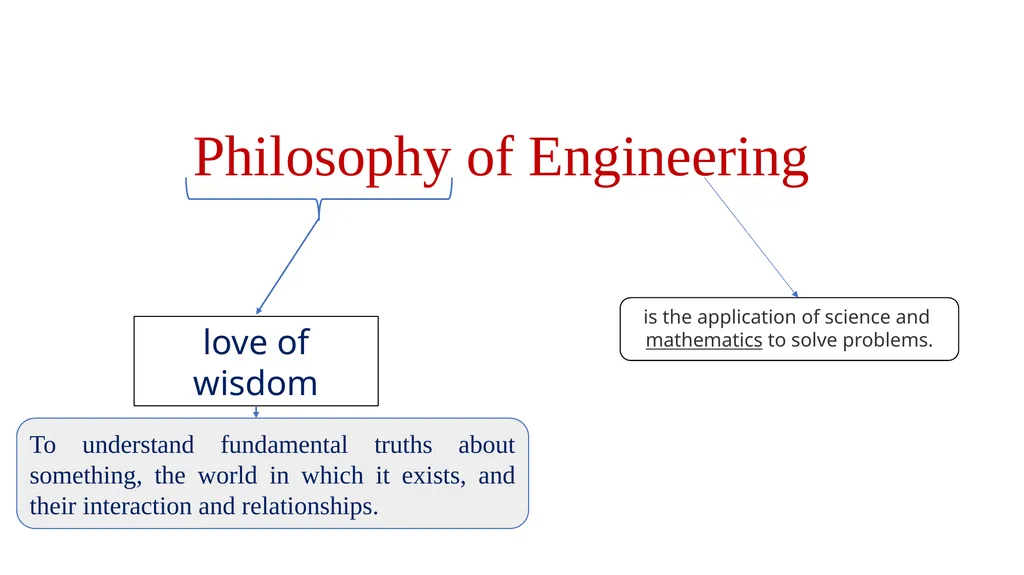
Philosophy of Engineering love of wisdom To understand fundamental truths about something, the world in which it exists, and their interaction and relationships. is the application of science and mathematics to solve problems.<br>
03
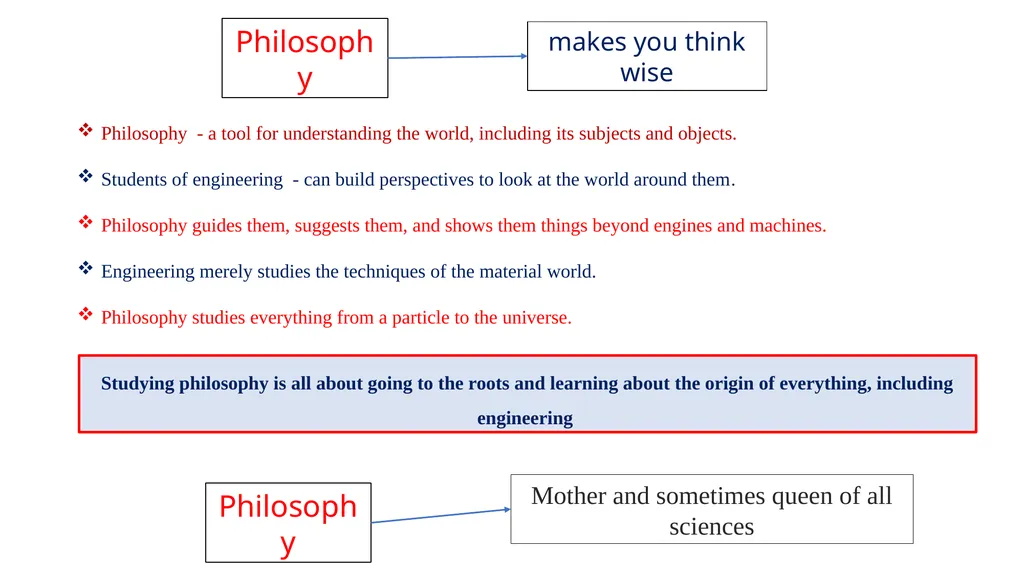
Philosophy - a tool for understanding the world, including its subjects and objects.
Students of engineering - can build perspectives to look at the world around them.
Philosophy guides them, suggests them, and shows them things beyond engines and machines.
Engineering merely studies the techniques of the material world.
Philosophy studies everything from a particle to the universe. Studying philosophy is all about going to the roots and learning about the origin of everything, including engineering<br>
Students of engineering - can build perspectives to look at the world around them.
Philosophy guides them, suggests them, and shows them things beyond engines and machines.
Engineering merely studies the techniques of the material world.
Philosophy studies everything from a particle to the universe. Studying philosophy is all about going to the roots and learning about the origin of everything, including engineering<br>
04
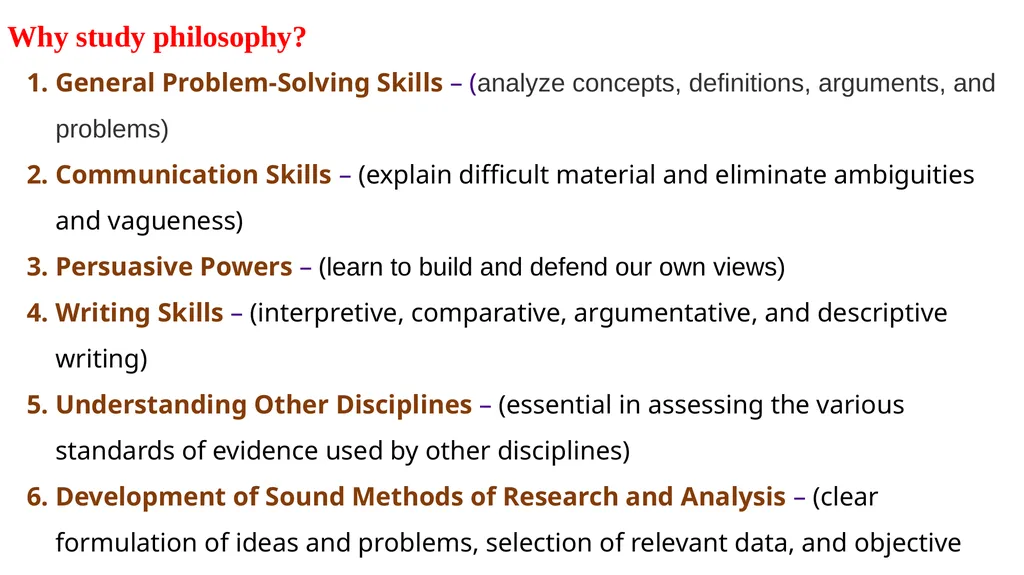
Why study philosophy? General Problem-Solving Skills – (analyze concepts, definitions, arguments, and problems)
Communication Skills – (explain difficult material and eliminate ambiguities and vagueness)
Persuasive Powers – (learn to build and defend our own views)
Writing Skills – (interpretive, comparative, argumentative, and descriptive writing)
Understanding Other Disciplines – (essential in assessing the various standards of evidence used by other disciplines)
Development of Sound Methods of Research and Analysis – (clear formulation of ideas and problems, selection of relevant data, and objective methods for assessing ideas and proposals<br>
Communication Skills – (explain difficult material and eliminate ambiguities and vagueness)
Persuasive Powers – (learn to build and defend our own views)
Writing Skills – (interpretive, comparative, argumentative, and descriptive writing)
Understanding Other Disciplines – (essential in assessing the various standards of evidence used by other disciplines)
Development of Sound Methods of Research and Analysis – (clear formulation of ideas and problems, selection of relevant data, and objective methods for assessing ideas and proposals<br>
05
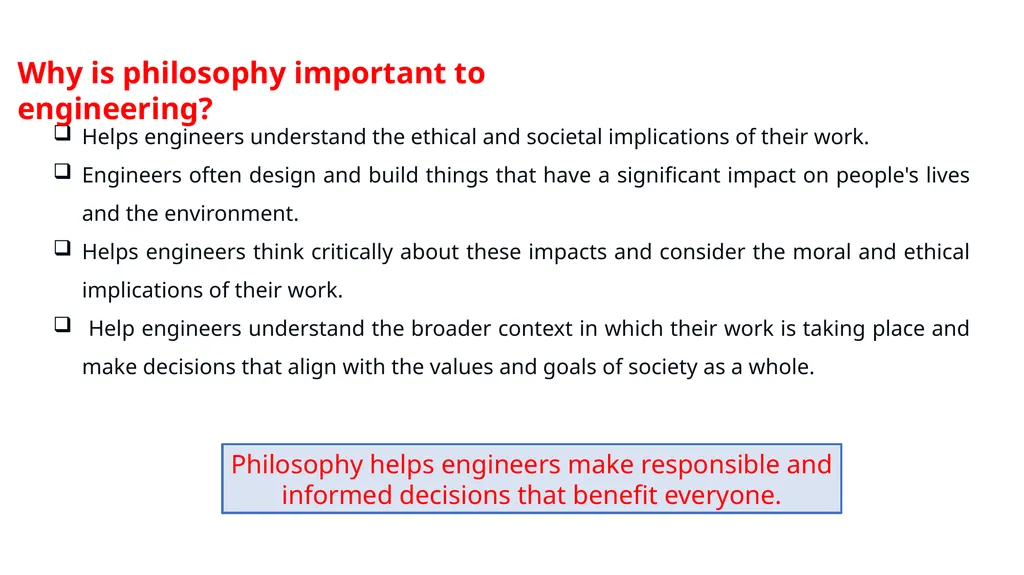
Helps engineers understand the ethical and societal implications of their work.
Engineers often design and build things that have a significant impact on people's lives and the environment.
Helps engineers think critically about these impacts and consider the moral and ethical implications of their work.
Help engineers understand the broader context in which their work is taking place and make decisions that align with the values and goals of society as a whole. Why is philosophy important to engineering? Philosophy helps engineers make responsible and informed decisions that benefit everyone.<br>
Engineers often design and build things that have a significant impact on people's lives and the environment.
Helps engineers think critically about these impacts and consider the moral and ethical implications of their work.
Help engineers understand the broader context in which their work is taking place and make decisions that align with the values and goals of society as a whole. Why is philosophy important to engineering? Philosophy helps engineers make responsible and informed decisions that benefit everyone.<br>
06
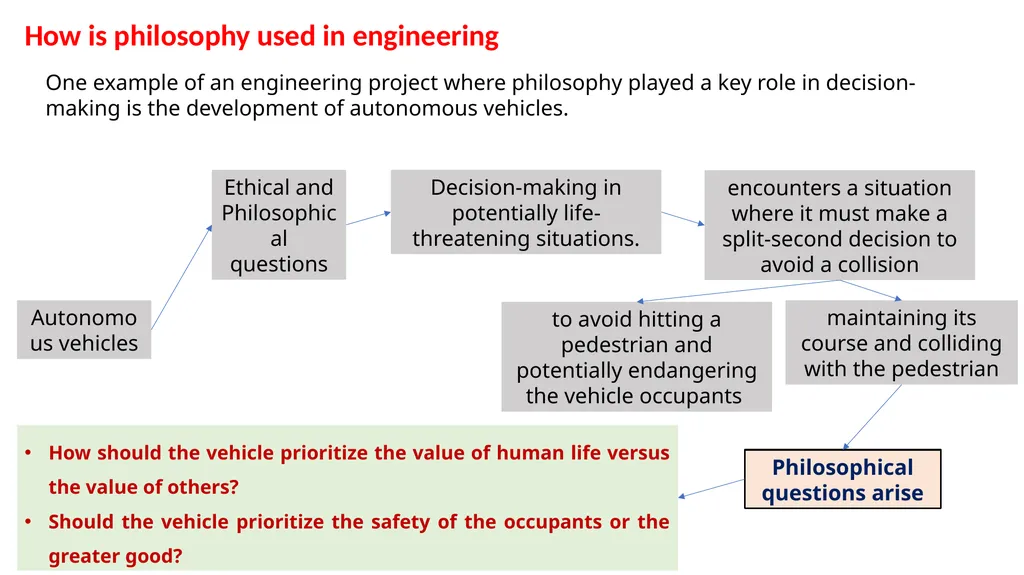
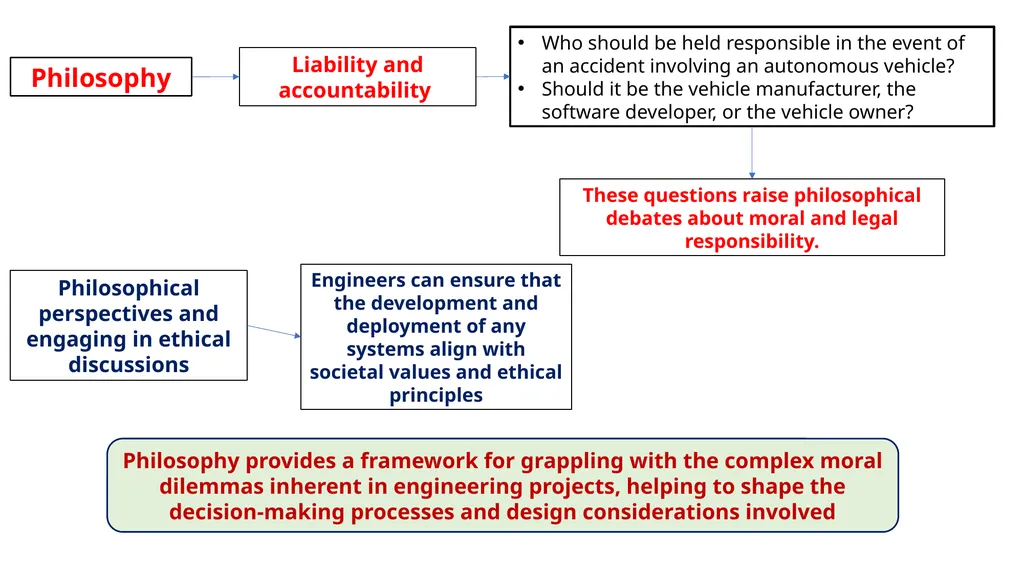
How is philosophy used in engineering How should the vehicle prioritize the value of human life versus the value of others?
Should the vehicle prioritize the safety of the occupants or the greater good? One example of an engineering project where philosophy played a key role in decision-making is the development of autonomous vehicles. Autonomous vehicles Ethical and Philosophical questions Decision-making in potentially life-threatening situations. encounters a situation where it must make a split-second decision to avoid a collision to avoid hitting a pedestrian and potentially endangering the vehicle occupants maintaining its course and colliding with the pedestrian Philosophical questions arise<br>
Should the vehicle prioritize the safety of the occupants or the greater good? One example of an engineering project where philosophy played a key role in decision-making is the development of autonomous vehicles. Autonomous vehicles Ethical and Philosophical questions Decision-making in potentially life-threatening situations. encounters a situation where it must make a split-second decision to avoid a collision to avoid hitting a pedestrian and potentially endangering the vehicle occupants maintaining its course and colliding with the pedestrian Philosophical questions arise<br>
07
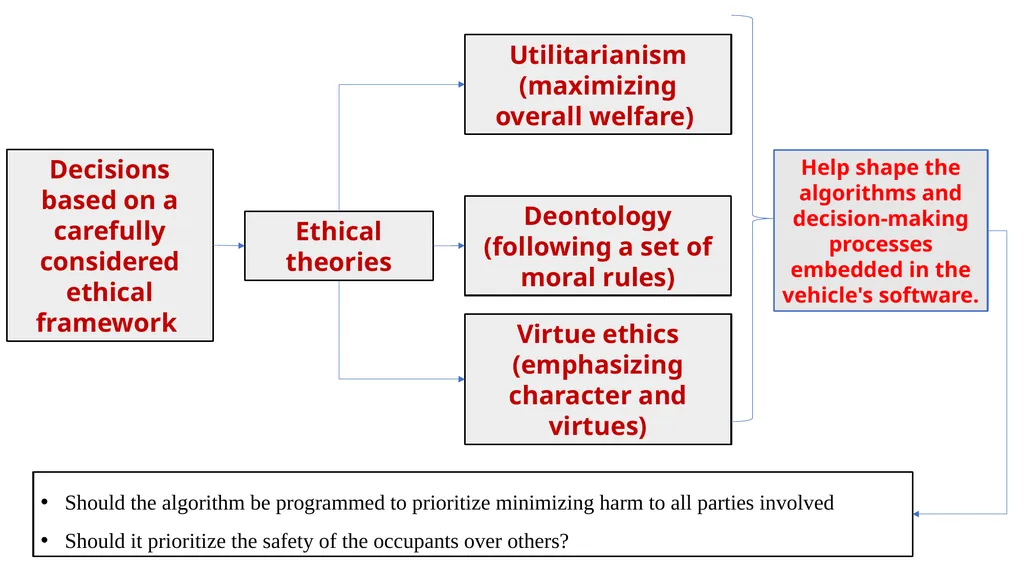
Should the algorithm be programmed to prioritize minimizing harm to all parties involved
Should it prioritize the safety of the occupants over others?<br>
Should it prioritize the safety of the occupants over others?<br>
08
Philosophy provides a framework for grappling with the complex moral dilemmas inherent in engineering projects, helping to shape the decision-making processes and design considerations involved<br>
09
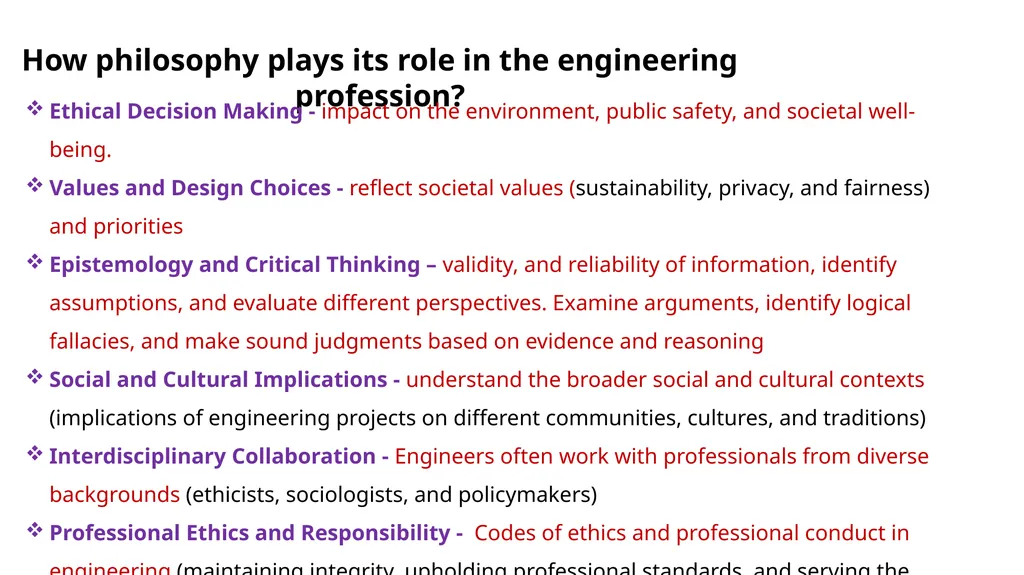
How philosophy plays its role in the engineering profession? Ethical Decision Making - impact on the environment, public safety, and societal well-being.
Values and Design Choices - reflect societal values (sustainability, privacy, and fairness) and priorities
Epistemology and Critical Thinking – validity, and reliability of information, identify assumptions, and evaluate different perspectives. Examine arguments, identify logical fallacies, and make sound judgments based on evidence and reasoning
Social and Cultural Implications - understand the broader social and cultural contexts (implications of engineering projects on different communities, cultures, and traditions)
Interdisciplinary Collaboration - Engineers often work with professionals from diverse backgrounds (ethicists, sociologists, and policymakers)
Professional Ethics and Responsibility - Codes of ethics and professional conduct in engineering (maintaining integrity, upholding professional standards, and serving the public interest)<br>
Values and Design Choices - reflect societal values (sustainability, privacy, and fairness) and priorities
Epistemology and Critical Thinking – validity, and reliability of information, identify assumptions, and evaluate different perspectives. Examine arguments, identify logical fallacies, and make sound judgments based on evidence and reasoning
Social and Cultural Implications - understand the broader social and cultural contexts (implications of engineering projects on different communities, cultures, and traditions)
Interdisciplinary Collaboration - Engineers often work with professionals from diverse backgrounds (ethicists, sociologists, and policymakers)
Professional Ethics and Responsibility - Codes of ethics and professional conduct in engineering (maintaining integrity, upholding professional standards, and serving the public interest)<br>
10
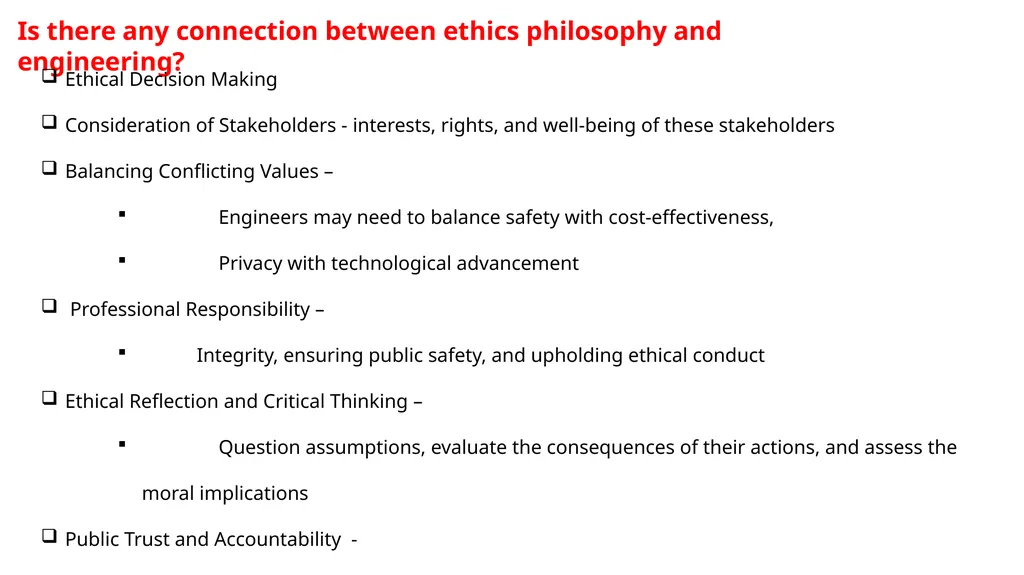
Is there any connection between ethics philosophy and engineering? Ethical Decision Making
Consideration of Stakeholders - interests, rights, and well-being of these stakeholders
Balancing Conflicting Values –
Engineers may need to balance safety with cost-effectiveness,
Privacy with technological advancement
Professional Responsibility –
Integrity, ensuring public safety, and upholding ethical conduct
Ethical Reflection and Critical Thinking –
Question assumptions, evaluate the consequences of their actions, and assess the moral implications
Public Trust and Accountability -
Responsibilities to society, fostering transparency, and accountability in their work<br>
Consideration of Stakeholders - interests, rights, and well-being of these stakeholders
Balancing Conflicting Values –
Engineers may need to balance safety with cost-effectiveness,
Privacy with technological advancement
Professional Responsibility –
Integrity, ensuring public safety, and upholding ethical conduct
Ethical Reflection and Critical Thinking –
Question assumptions, evaluate the consequences of their actions, and assess the moral implications
Public Trust and Accountability -
Responsibilities to society, fostering transparency, and accountability in their work<br>
11
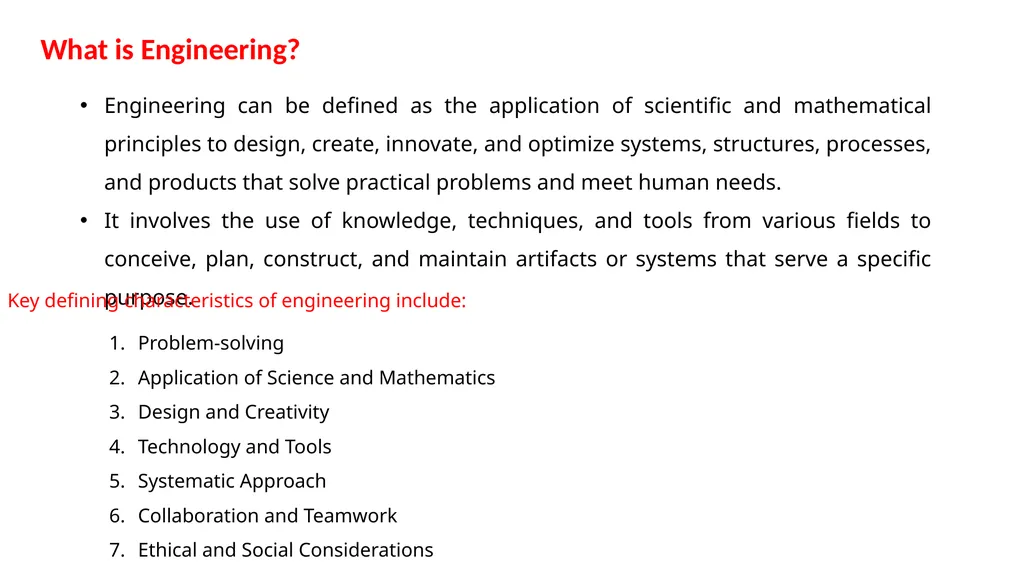
What is Engineering? Engineering can be defined as the application of scientific and mathematical principles to design, create, innovate, and optimize systems, structures, processes, and products that solve practical problems and meet human needs.
It involves the use of knowledge, techniques, and tools from various fields to conceive, plan, construct, and maintain artifacts or systems that serve a specific purpose. Key defining characteristics of engineering include: Problem-solving
Application of Science and Mathematics
Design and Creativity
Technology and Tools
Systematic Approach
Collaboration and Teamwork
Ethical and Social Considerations<br>
It involves the use of knowledge, techniques, and tools from various fields to conceive, plan, construct, and maintain artifacts or systems that serve a specific purpose. Key defining characteristics of engineering include: Problem-solving
Application of Science and Mathematics
Design and Creativity
Technology and Tools
Systematic Approach
Collaboration and Teamwork
Ethical and Social Considerations<br>
12
History of Engineering Development Ancient Engineering: Prehistoric Era:
Humans developed simple tools and techniques for hunting, agriculture, and shelter construction.
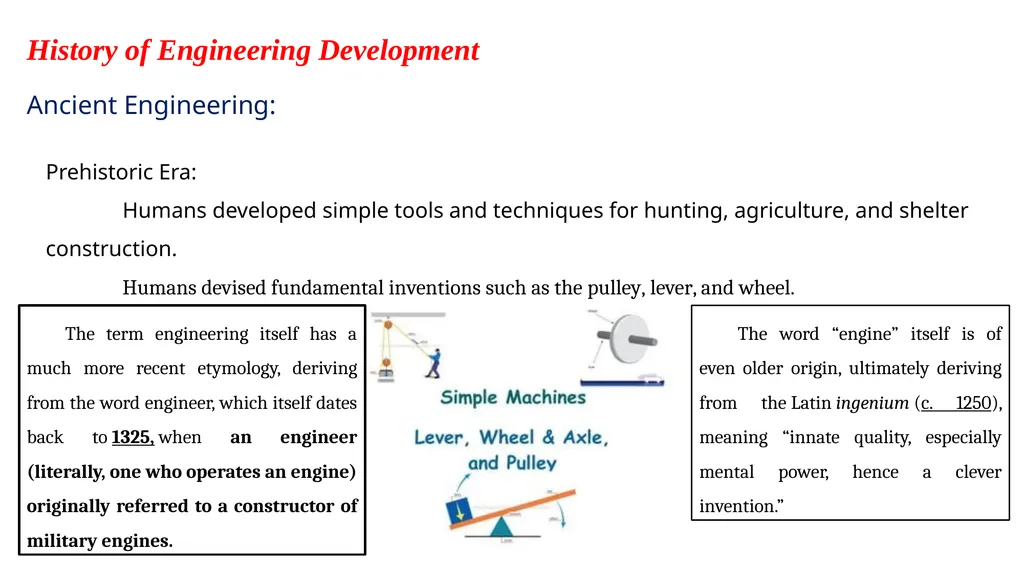
Humans devised fundamental inventions such as the pulley, lever, and wheel. The term engineering itself has a much more recent etymology, deriving from the word engineer, which itself dates back to 1325, when an engineer (literally, one who operates an engine) originally referred to a constructor of military engines. The word “engine” itself is of even older origin, ultimately deriving from the Latin ingenium (c. 1250), meaning “innate quality, especially mental power, hence a clever invention.”<br>
Humans developed simple tools and techniques for hunting, agriculture, and shelter construction.
Humans devised fundamental inventions such as the pulley, lever, and wheel. The term engineering itself has a much more recent etymology, deriving from the word engineer, which itself dates back to 1325, when an engineer (literally, one who operates an engine) originally referred to a constructor of military engines. The word “engine” itself is of even older origin, ultimately deriving from the Latin ingenium (c. 1250), meaning “innate quality, especially mental power, hence a clever invention.”<br>
13
Ancient Engineering: (CIVIL Engineering started to evolve)
Ancient Mesopotamia (3500-300 BC) : Mesopotamian civilizations, such as the Sumerians and Babylonians, made significant engineering contributions in areas like irrigation systems, city planning, and architectural structures.
Ancient Egypt (3100-332 BC) : The Egyptians built monumental structures like the pyramids, temples, and sphinxes, employing advanced techniques in quarrying, construction, and surveying.
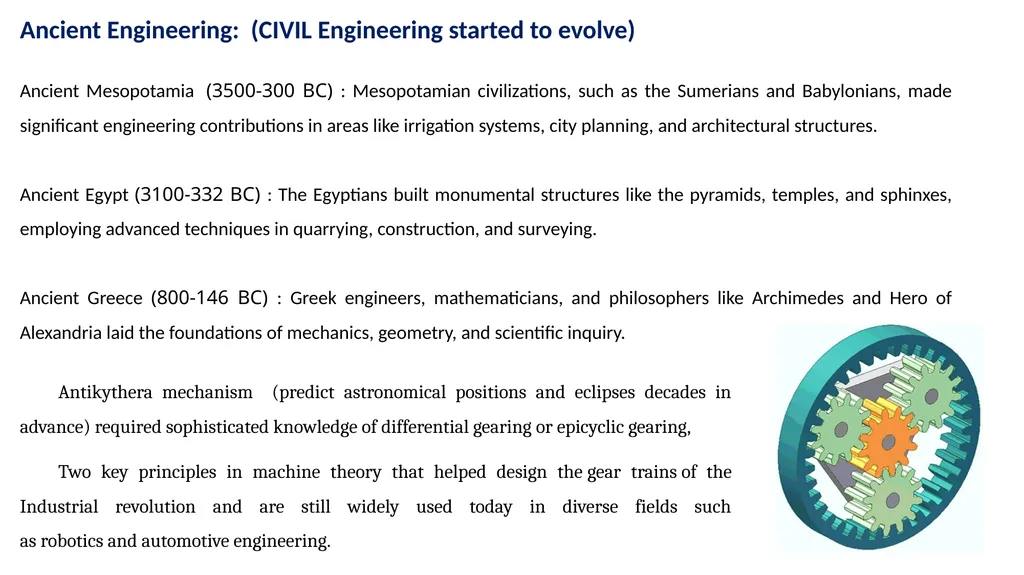
Ancient Greece (800-146 BC) : Greek engineers, mathematicians, and philosophers like Archimedes and Hero of Alexandria laid the foundations of mechanics, geometry, and scientific inquiry. Antikythera mechanism (predict astronomical positions and eclipses decades in advance) required sophisticated knowledge of differential gearing or epicyclic gearing,
Two key principles in machine theory that helped design the gear trains of the Industrial revolution and are still widely used today in diverse fields such as robotics and automotive engineering.<br>
Ancient Mesopotamia (3500-300 BC) : Mesopotamian civilizations, such as the Sumerians and Babylonians, made significant engineering contributions in areas like irrigation systems, city planning, and architectural structures.
Ancient Egypt (3100-332 BC) : The Egyptians built monumental structures like the pyramids, temples, and sphinxes, employing advanced techniques in quarrying, construction, and surveying.
Ancient Greece (800-146 BC) : Greek engineers, mathematicians, and philosophers like Archimedes and Hero of Alexandria laid the foundations of mechanics, geometry, and scientific inquiry. Antikythera mechanism (predict astronomical positions and eclipses decades in advance) required sophisticated knowledge of differential gearing or epicyclic gearing,
Two key principles in machine theory that helped design the gear trains of the Industrial revolution and are still widely used today in diverse fields such as robotics and automotive engineering.<br>
14
Classical and Medieval Periods:
Roman Empire (27 BC-476 AD):
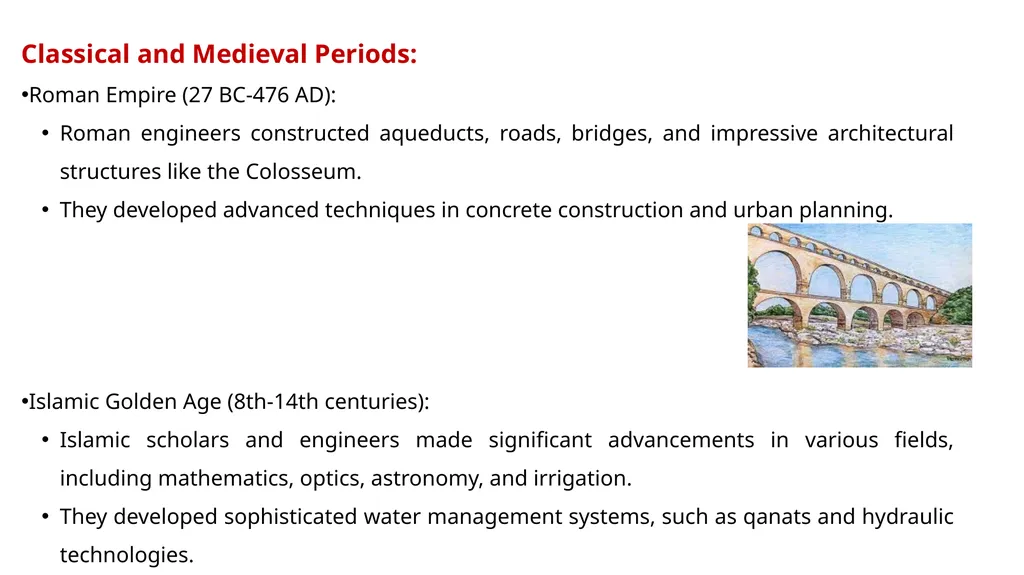
Roman engineers constructed aqueducts, roads, bridges, and impressive architectural structures like the Colosseum.
They developed advanced techniques in concrete construction and urban planning.
Islamic Golden Age (8th-14th centuries):
Islamic scholars and engineers made significant advancements in various fields, including mathematics, optics, astronomy, and irrigation.
They developed sophisticated water management systems, such as qanats and hydraulic technologies.<br>
Roman Empire (27 BC-476 AD):
Roman engineers constructed aqueducts, roads, bridges, and impressive architectural structures like the Colosseum.
They developed advanced techniques in concrete construction and urban planning.
Islamic Golden Age (8th-14th centuries):
Islamic scholars and engineers made significant advancements in various fields, including mathematics, optics, astronomy, and irrigation.
They developed sophisticated water management systems, such as qanats and hydraulic technologies.<br>
15
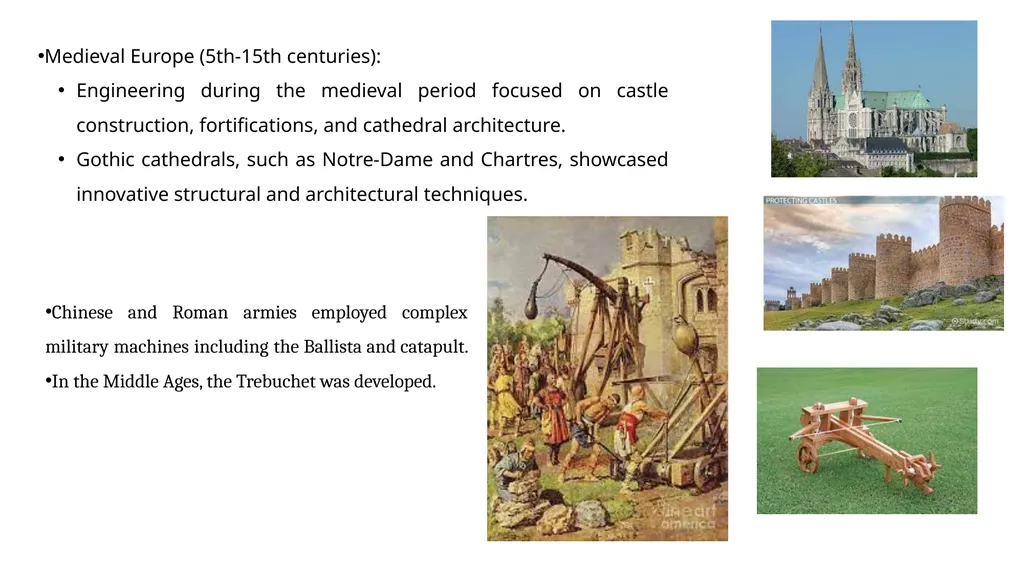
Chinese and Roman armies employed complex military machines including the Ballista and catapult.
In the Middle Ages, the Trebuchet was developed. Medieval Europe (5th-15th centuries):
Engineering during the medieval period focused on castle construction, fortifications, and cathedral architecture.
Gothic cathedrals, such as Notre-Dame and Chartres, showcased innovative structural and architectural techniques.<br>
In the Middle Ages, the Trebuchet was developed. Medieval Europe (5th-15th centuries):
Engineering during the medieval period focused on castle construction, fortifications, and cathedral architecture.
Gothic cathedrals, such as Notre-Dame and Chartres, showcased innovative structural and architectural techniques.<br>
16
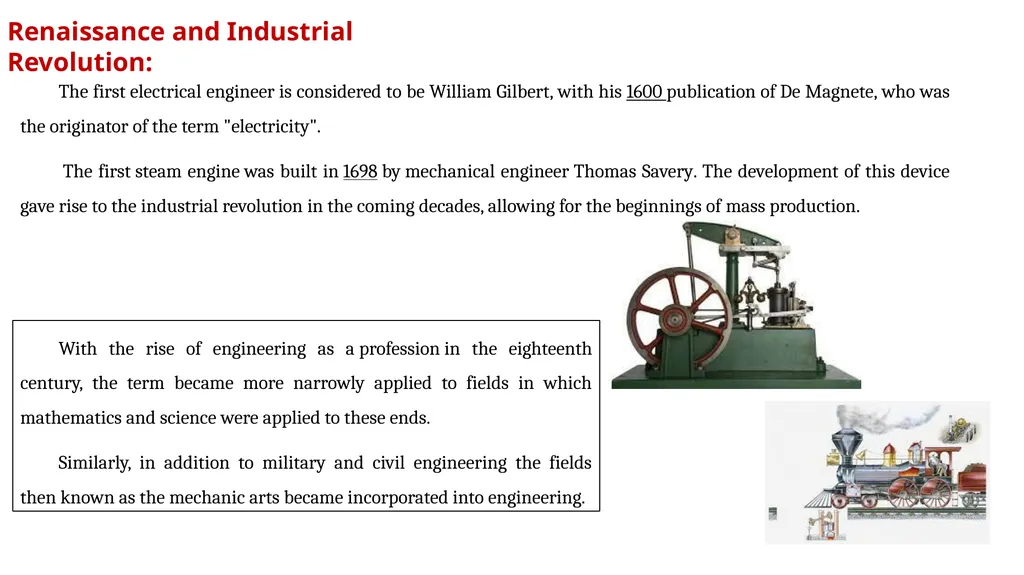
Renaissance and Industrial Revolution: The first electrical engineer is considered to be William Gilbert, with his 1600 publication of De Magnete, who was the originator of the term "electricity".
The first steam engine was built in 1698 by mechanical engineer Thomas Savery. The development of this device gave rise to the industrial revolution in the coming decades, allowing for the beginnings of mass production. With the rise of engineering as a profession in the eighteenth century, the term became more narrowly applied to fields in which mathematics and science were applied to these ends.
Similarly, in addition to military and civil engineering the fields then known as the mechanic arts became incorporated into engineering.<br>
The first steam engine was built in 1698 by mechanical engineer Thomas Savery. The development of this device gave rise to the industrial revolution in the coming decades, allowing for the beginnings of mass production. With the rise of engineering as a profession in the eighteenth century, the term became more narrowly applied to fields in which mathematics and science were applied to these ends.
Similarly, in addition to military and civil engineering the fields then known as the mechanic arts became incorporated into engineering.<br>
17
Modern Era Electrical Engineering can trace its origins in the experiments of Alessandro Volta in the 1800s, the experiments of Michael Faraday, Georg Ohm and others and the invention of the electric motor in 1872.
The work of James Maxwell and Heinrich Hertz in the late 19th century gave rise to the field of Electronics.
The later inventions of the vacuum tube and the transistor further accelerated the development of Electronics to such an extent that electrical and electronics engineers currently outnumber their colleagues of any other Engineering specialty.<br>
The work of James Maxwell and Heinrich Hertz in the late 19th century gave rise to the field of Electronics.
The later inventions of the vacuum tube and the transistor further accelerated the development of Electronics to such an extent that electrical and electronics engineers currently outnumber their colleagues of any other Engineering specialty.<br>
18
Chemical Engineering, developed in the nineteenth century during the Industrial Revolution.
Industrial scale manufacturing demanded new materials and new processes and by 1880 the need for large scale production of chemicals was such that a new industry was created, dedicated to the development and large scale manufacturing of chemicals in new industrial plants.
The role of the chemical engineer was the design of these chemical plants and processes. Aeronautical Engineering deals with aircraft design while Aerospace Engineering is a more modern term that expands the reach envelope of the discipline by including spacecraft design.
the development of airplanes, helicopters, spacecraft, and satellite technology.<br>
Industrial scale manufacturing demanded new materials and new processes and by 1880 the need for large scale production of chemicals was such that a new industry was created, dedicated to the development and large scale manufacturing of chemicals in new industrial plants.
The role of the chemical engineer was the design of these chemical plants and processes. Aeronautical Engineering deals with aircraft design while Aerospace Engineering is a more modern term that expands the reach envelope of the discipline by including spacecraft design.
the development of airplanes, helicopters, spacecraft, and satellite technology.<br>
19
Computer and Information Technology:
The digital age brought about rapid advancements in computer science, software engineering, telecommunications, and information technology, leading to the birth of the internet and the digital revolution. Contemporary Engineering:
Environmental Engineering: The need for sustainable practices and environmental protection has spurred the growth of environmental engineering, focusing on areas such as waste management, pollution control, and renewable energy.
Biomedical Engineering: Advances in medical technology and healthcare have driven the emergence of biomedical engineering, encompassing areas such as medical devices, imaging technologies, and prosthetics.
Emerging Technologies: Modern engineering is witnessing rapid advancements in fields such as artificial intelligence, robotics, nanotechnology, and materials science, opening up new possibilities for innovation and problem-solving.<br>
The digital age brought about rapid advancements in computer science, software engineering, telecommunications, and information technology, leading to the birth of the internet and the digital revolution. Contemporary Engineering:
Environmental Engineering: The need for sustainable practices and environmental protection has spurred the growth of environmental engineering, focusing on areas such as waste management, pollution control, and renewable energy.
Biomedical Engineering: Advances in medical technology and healthcare have driven the emergence of biomedical engineering, encompassing areas such as medical devices, imaging technologies, and prosthetics.
Emerging Technologies: Modern engineering is witnessing rapid advancements in fields such as artificial intelligence, robotics, nanotechnology, and materials science, opening up new possibilities for innovation and problem-solving.<br>
20
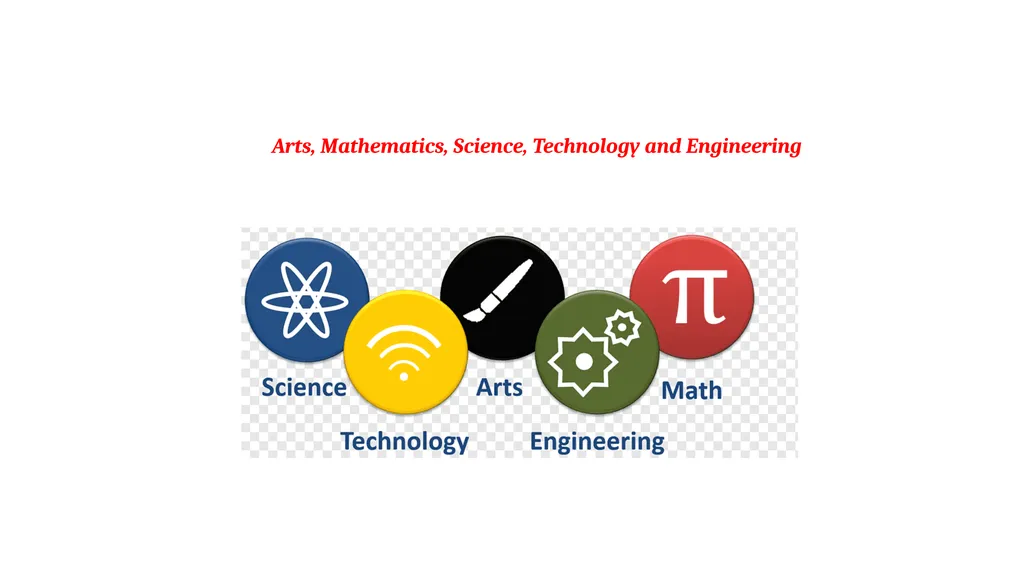
Arts, Mathematics, Science, Technology and Engineering<br>
21
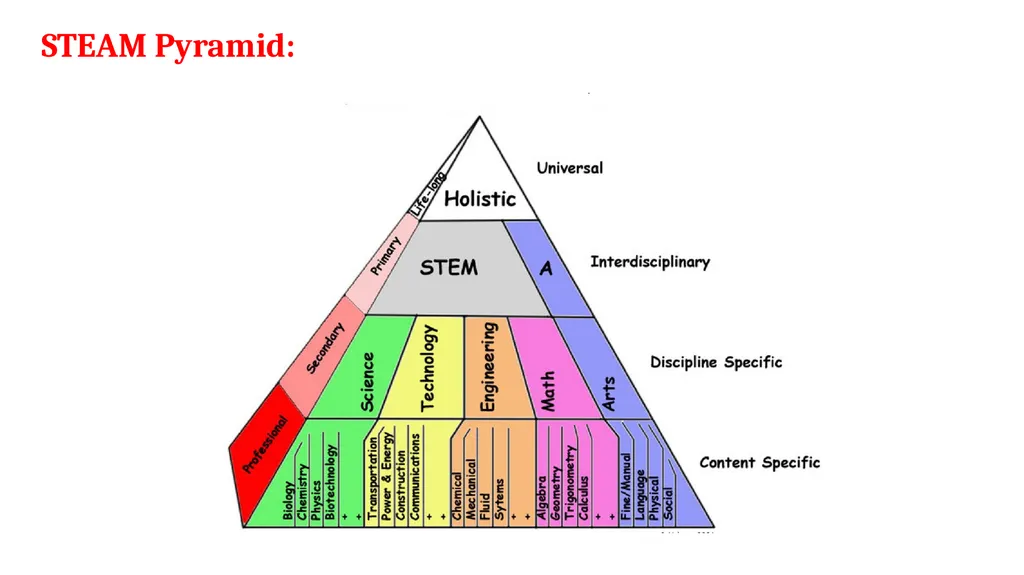
STEAM Pyramid:<br>
22
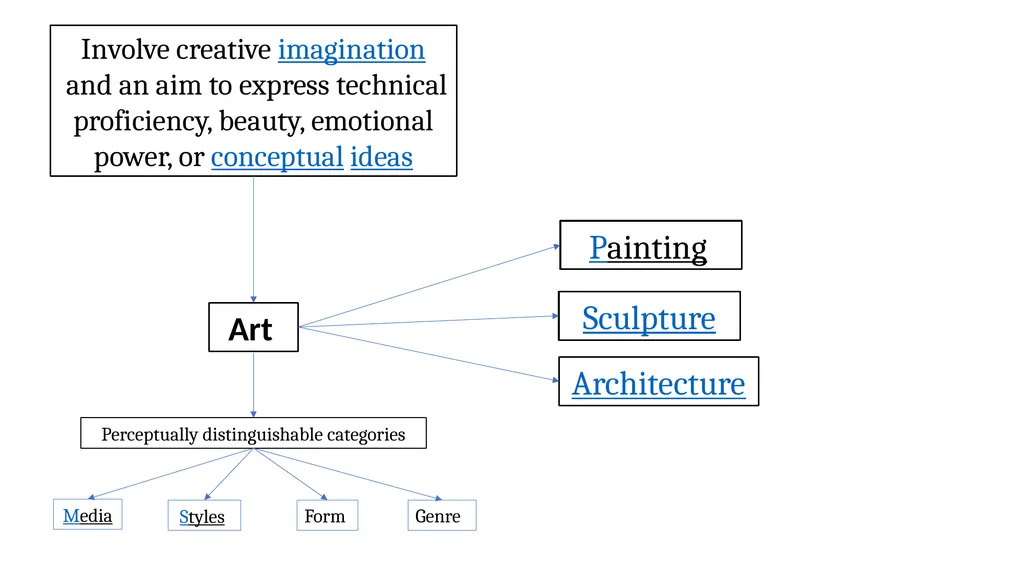
Perceptually distinguishable categories Art Involve creative imagination and an aim to express technical proficiency, beauty, emotional power, or conceptual ideas Painting Sculpture Architecture Media Genre Styles Form<br>
23
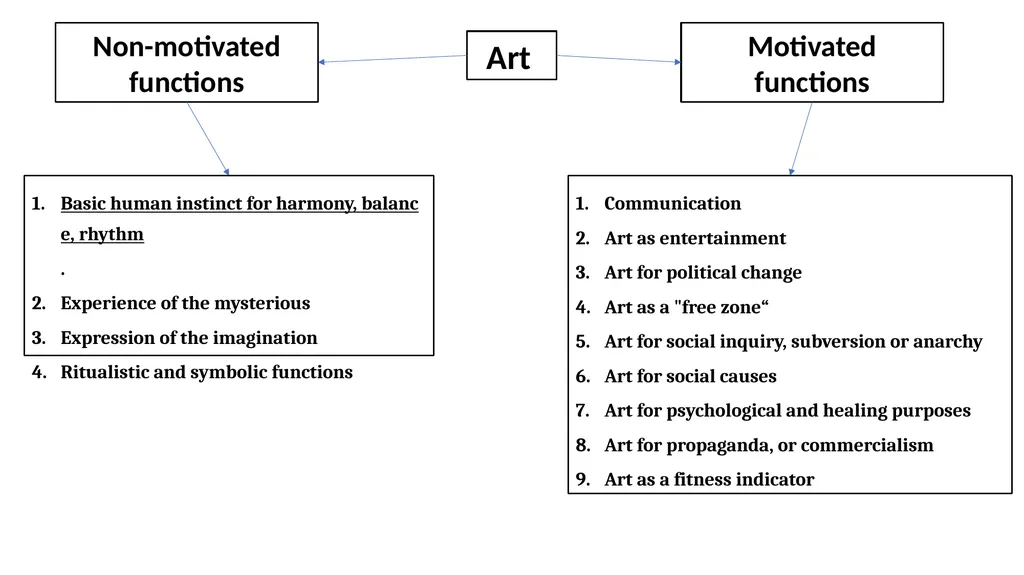
Art Non-motivated functions Motivated functions Basic human instinct for harmony, balance, rhythm.
Experience of the mysterious
Expression of the imagination
Ritualistic and symbolic functions Communication
Art as entertainment
Art for political change
Art as a "free zone“
Art for social inquiry, subversion or anarchy
Art for social causes
Art for psychological and healing purposes
Art for propaganda, or commercialism
Art as a fitness indicator<br>
Experience of the mysterious
Expression of the imagination
Ritualistic and symbolic functions Communication
Art as entertainment
Art for political change
Art as a "free zone“
Art for social inquiry, subversion or anarchy
Art for social causes
Art for psychological and healing purposes
Art for propaganda, or commercialism
Art as a fitness indicator<br>
24
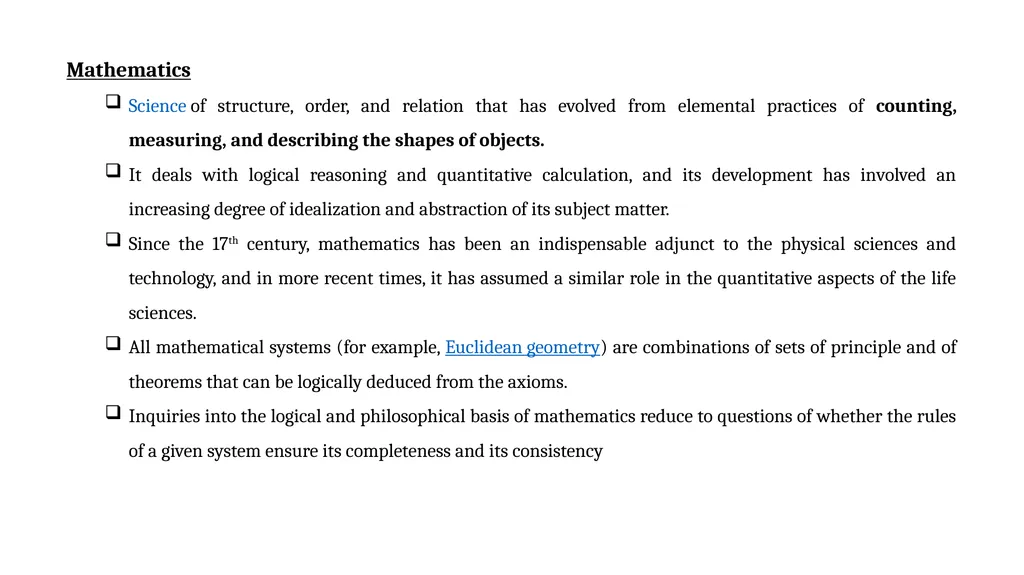
Mathematics
Science of structure, order, and relation that has evolved from elemental practices of counting, measuring, and describing the shapes of objects.
It deals with logical reasoning and quantitative calculation, and its development has involved an increasing degree of idealization and abstraction of its subject matter.
Since the 17th century, mathematics has been an indispensable adjunct to the physical sciences and technology, and in more recent times, it has assumed a similar role in the quantitative aspects of the life sciences.
All mathematical systems (for example, Euclidean geometry) are combinations of sets of principle and of theorems that can be logically deduced from the axioms.
Inquiries into the logical and philosophical basis of mathematics reduce to questions of whether the rules of a given system ensure its completeness and its consistency<br>
Science of structure, order, and relation that has evolved from elemental practices of counting, measuring, and describing the shapes of objects.
It deals with logical reasoning and quantitative calculation, and its development has involved an increasing degree of idealization and abstraction of its subject matter.
Since the 17th century, mathematics has been an indispensable adjunct to the physical sciences and technology, and in more recent times, it has assumed a similar role in the quantitative aspects of the life sciences.
All mathematical systems (for example, Euclidean geometry) are combinations of sets of principle and of theorems that can be logically deduced from the axioms.
Inquiries into the logical and philosophical basis of mathematics reduce to questions of whether the rules of a given system ensure its completeness and its consistency<br>
25
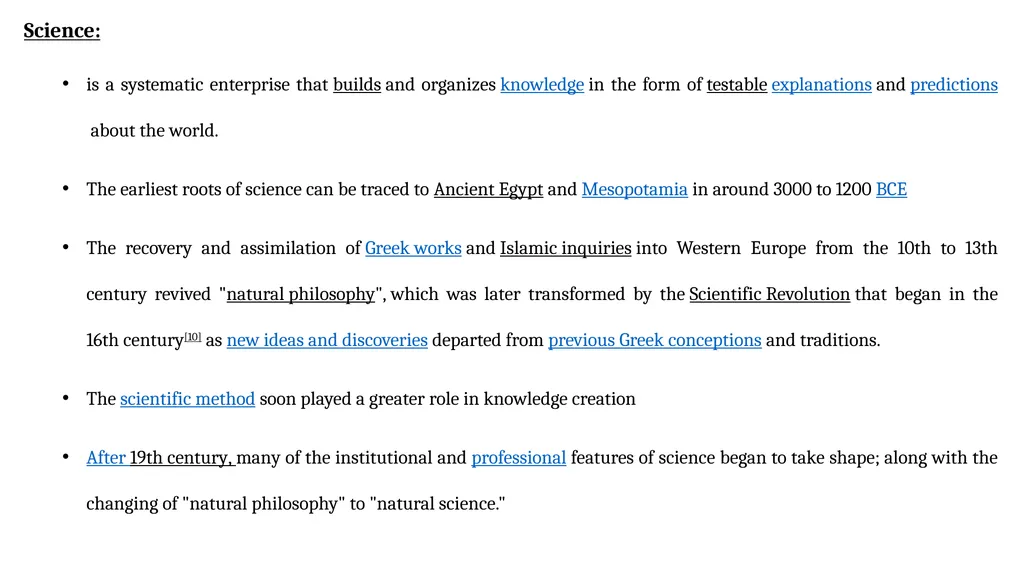
Science:
is a systematic enterprise that builds and organizes knowledge in the form of testable explanations and predictions about the world.
The earliest roots of science can be traced to Ancient Egypt and Mesopotamia in around 3000 to 1200 BCE
The recovery and assimilation of Greek works and Islamic inquiries into Western Europe from the 10th to 13th century revived "natural philosophy", which was later transformed by the Scientific Revolution that began in the 16th century[10] as new ideas and discoveries departed from previous Greek conceptions and traditions.
The scientific method soon played a greater role in knowledge creation
After 19th century, many of the institutional and professional features of science began to take shape; along with the changing of "natural philosophy" to "natural science."<br>
is a systematic enterprise that builds and organizes knowledge in the form of testable explanations and predictions about the world.
The earliest roots of science can be traced to Ancient Egypt and Mesopotamia in around 3000 to 1200 BCE
The recovery and assimilation of Greek works and Islamic inquiries into Western Europe from the 10th to 13th century revived "natural philosophy", which was later transformed by the Scientific Revolution that began in the 16th century[10] as new ideas and discoveries departed from previous Greek conceptions and traditions.
The scientific method soon played a greater role in knowledge creation
After 19th century, many of the institutional and professional features of science began to take shape; along with the changing of "natural philosophy" to "natural science."<br>
26
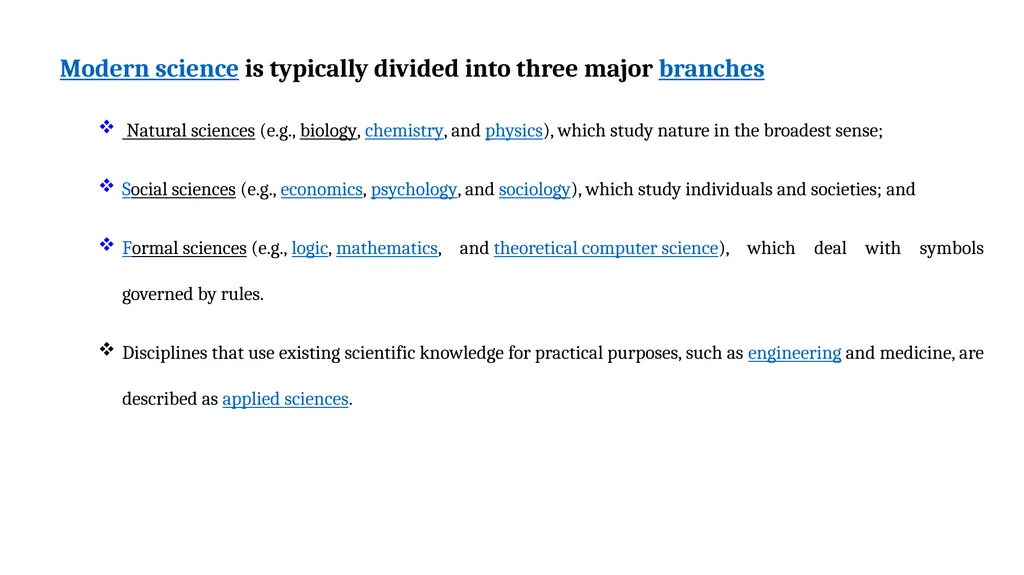
Modern science is typically divided into three major branches
Natural sciences (e.g., biology, chemistry, and physics), which study nature in the broadest sense;
Social sciences (e.g., economics, psychology, and sociology), which study individuals and societies; and
Formal sciences (e.g., logic, mathematics, and theoretical computer science), which deal with symbols governed by rules.
Disciplines that use existing scientific knowledge for practical purposes, such as engineering and medicine, are described as applied sciences.<br>
Natural sciences (e.g., biology, chemistry, and physics), which study nature in the broadest sense;
Social sciences (e.g., economics, psychology, and sociology), which study individuals and societies; and
Formal sciences (e.g., logic, mathematics, and theoretical computer science), which deal with symbols governed by rules.
Disciplines that use existing scientific knowledge for practical purposes, such as engineering and medicine, are described as applied sciences.<br>
27
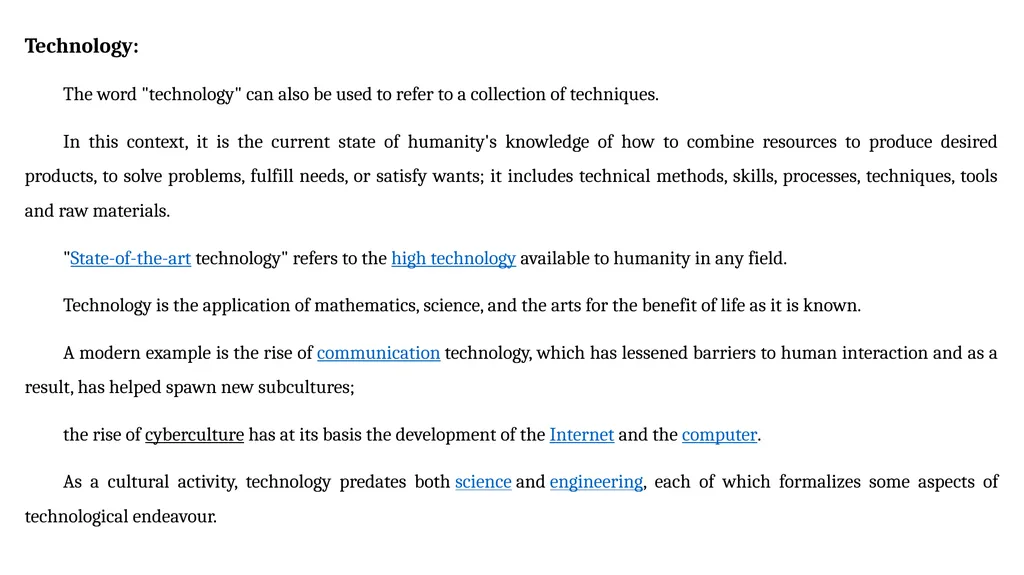
Technology:
The word "technology" can also be used to refer to a collection of techniques.
In this context, it is the current state of humanity's knowledge of how to combine resources to produce desired products, to solve problems, fulfill needs, or satisfy wants; it includes technical methods, skills, processes, techniques, tools and raw materials.
"State-of-the-art technology" refers to the high technology available to humanity in any field.
Technology is the application of mathematics, science, and the arts for the benefit of life as it is known.
A modern example is the rise of communication technology, which has lessened barriers to human interaction and as a result, has helped spawn new subcultures;
the rise of cyberculture has at its basis the development of the Internet and the computer.
As a cultural activity, technology predates both science and engineering, each of which formalizes some aspects of technological endeavour.<br>
The word "technology" can also be used to refer to a collection of techniques.
In this context, it is the current state of humanity's knowledge of how to combine resources to produce desired products, to solve problems, fulfill needs, or satisfy wants; it includes technical methods, skills, processes, techniques, tools and raw materials.
"State-of-the-art technology" refers to the high technology available to humanity in any field.
Technology is the application of mathematics, science, and the arts for the benefit of life as it is known.
A modern example is the rise of communication technology, which has lessened barriers to human interaction and as a result, has helped spawn new subcultures;
the rise of cyberculture has at its basis the development of the Internet and the computer.
As a cultural activity, technology predates both science and engineering, each of which formalizes some aspects of technological endeavour.<br>
28
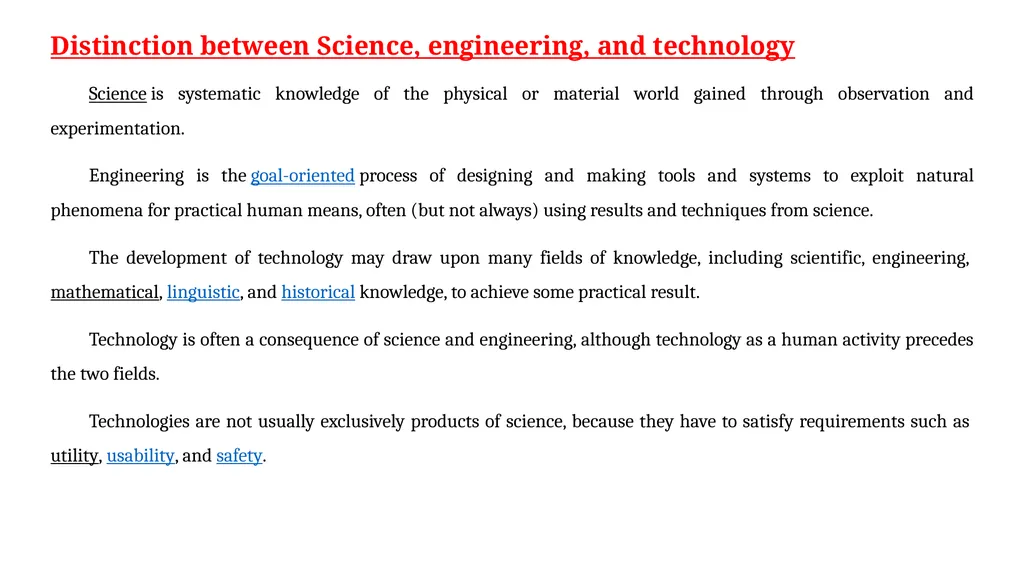
Distinction between Science, engineering, and technology
Science is systematic knowledge of the physical or material world gained through observation and experimentation.
Engineering is the goal-oriented process of designing and making tools and systems to exploit natural phenomena for practical human means, often (but not always) using results and techniques from science.
The development of technology may draw upon many fields of knowledge, including scientific, engineering, mathematical, linguistic, and historical knowledge, to achieve some practical result.
Technology is often a consequence of science and engineering, although technology as a human activity precedes the two fields.
Technologies are not usually exclusively products of science, because they have to satisfy requirements such as utility, usability, and safety.<br>
Science is systematic knowledge of the physical or material world gained through observation and experimentation.
Engineering is the goal-oriented process of designing and making tools and systems to exploit natural phenomena for practical human means, often (but not always) using results and techniques from science.
The development of technology may draw upon many fields of knowledge, including scientific, engineering, mathematical, linguistic, and historical knowledge, to achieve some practical result.
Technology is often a consequence of science and engineering, although technology as a human activity precedes the two fields.
Technologies are not usually exclusively products of science, because they have to satisfy requirements such as utility, usability, and safety.<br>
29
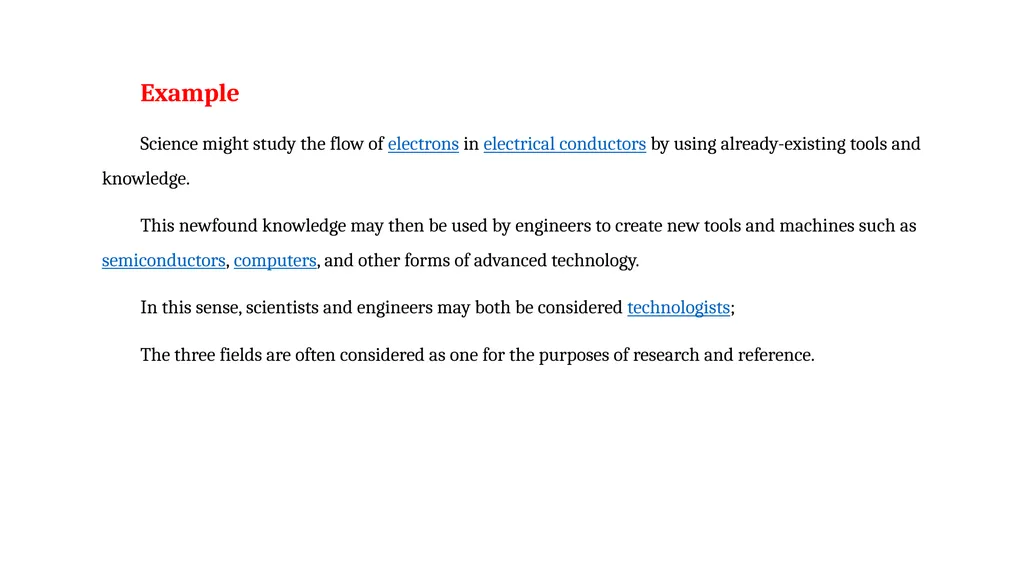
Example
Science might study the flow of electrons in electrical conductors by using already-existing tools and knowledge.
This newfound knowledge may then be used by engineers to create new tools and machines such as semiconductors, computers, and other forms of advanced technology.
In this sense, scientists and engineers may both be considered technologists;
The three fields are often considered as one for the purposes of research and reference.<br>
Science might study the flow of electrons in electrical conductors by using already-existing tools and knowledge.
This newfound knowledge may then be used by engineers to create new tools and machines such as semiconductors, computers, and other forms of advanced technology.
In this sense, scientists and engineers may both be considered technologists;
The three fields are often considered as one for the purposes of research and reference.<br>
30
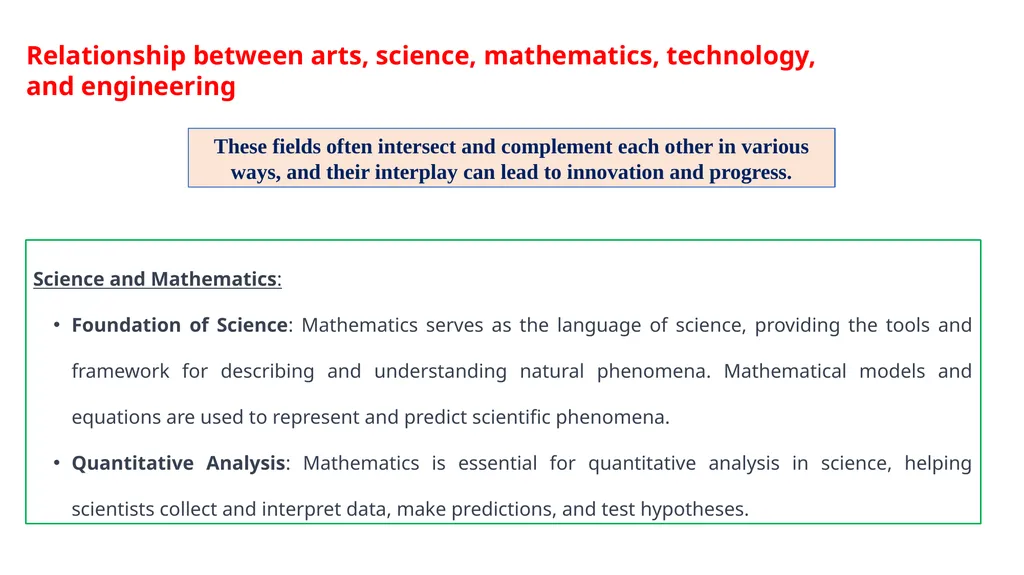
Relationship between arts, science, mathematics, technology, and engineering These fields often intersect and complement each other in various ways, and their interplay can lead to innovation and progress. Science and Mathematics:
Foundation of Science: Mathematics serves as the language of science, providing the tools and framework for describing and understanding natural phenomena. Mathematical models and equations are used to represent and predict scientific phenomena.
Quantitative Analysis: Mathematics is essential for quantitative analysis in science, helping scientists collect and interpret data, make predictions, and test hypotheses.<br>
Foundation of Science: Mathematics serves as the language of science, providing the tools and framework for describing and understanding natural phenomena. Mathematical models and equations are used to represent and predict scientific phenomena.
Quantitative Analysis: Mathematics is essential for quantitative analysis in science, helping scientists collect and interpret data, make predictions, and test hypotheses.<br>
31
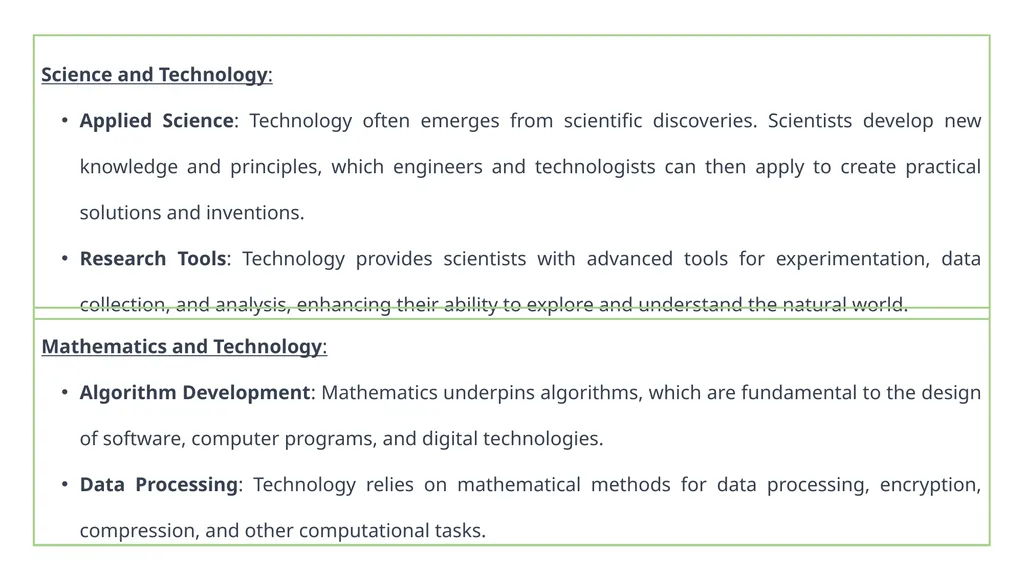
Science and Technology:
Applied Science: Technology often emerges from scientific discoveries. Scientists develop new knowledge and principles, which engineers and technologists can then apply to create practical solutions and inventions.
Research Tools: Technology provides scientists with advanced tools for experimentation, data collection, and analysis, enhancing their ability to explore and understand the natural world. Mathematics and Technology:
Algorithm Development: Mathematics underpins algorithms, which are fundamental to the design of software, computer programs, and digital technologies.
Data Processing: Technology relies on mathematical methods for data processing, encryption, compression, and other computational tasks.<br>
Applied Science: Technology often emerges from scientific discoveries. Scientists develop new knowledge and principles, which engineers and technologists can then apply to create practical solutions and inventions.
Research Tools: Technology provides scientists with advanced tools for experimentation, data collection, and analysis, enhancing their ability to explore and understand the natural world. Mathematics and Technology:
Algorithm Development: Mathematics underpins algorithms, which are fundamental to the design of software, computer programs, and digital technologies.
Data Processing: Technology relies on mathematical methods for data processing, encryption, compression, and other computational tasks.<br>
32
Technology and Engineering:
Application of Technology: Engineering applies technological principles and tools to design and build practical systems, products, and infrastructure. Engineers use technology to solve real-world problems.
Innovation and Development: Engineers often push the boundaries of existing technology to create new and improved products and systems. Science, Mathematics, and Engineering:
Collaboration: Scientists, mathematicians, and engineers often collaborate to solve complex problems. For example, in fields like aerospace engineering, physics, and materials science, multidisciplinary teams work together to develop new technologies and innovations.<br>
Application of Technology: Engineering applies technological principles and tools to design and build practical systems, products, and infrastructure. Engineers use technology to solve real-world problems.
Innovation and Development: Engineers often push the boundaries of existing technology to create new and improved products and systems. Science, Mathematics, and Engineering:
Collaboration: Scientists, mathematicians, and engineers often collaborate to solve complex problems. For example, in fields like aerospace engineering, physics, and materials science, multidisciplinary teams work together to develop new technologies and innovations.<br>
33
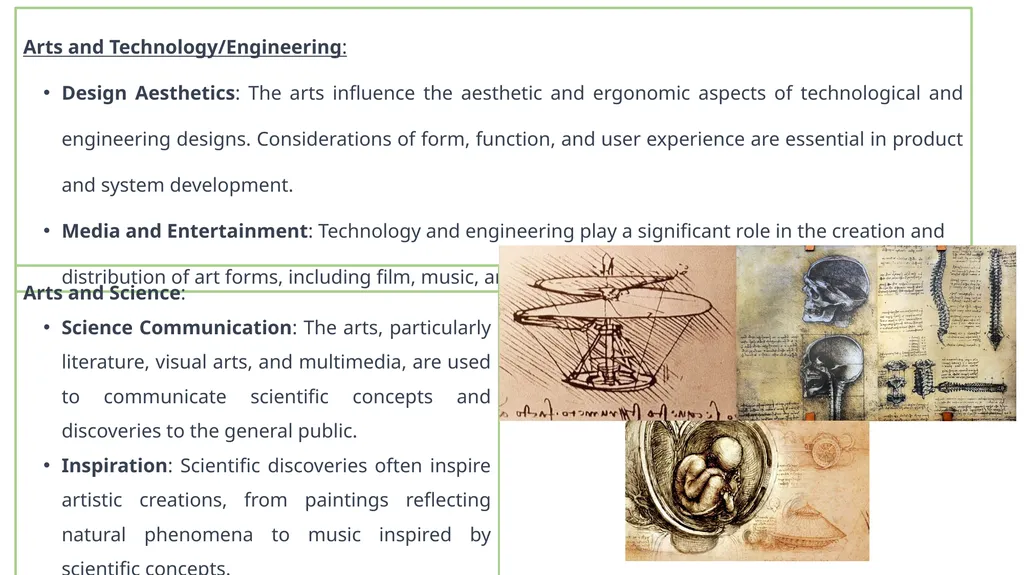
Arts and Technology/Engineering:
Design Aesthetics: The arts influence the aesthetic and ergonomic aspects of technological and engineering designs. Considerations of form, function, and user experience are essential in product and system development.
Media and Entertainment: Technology and engineering play a significant role in the creation and distribution of art forms, including film, music, and digital media. Arts and Science:
Science Communication: The arts, particularly literature, visual arts, and multimedia, are used to communicate scientific concepts and discoveries to the general public.
Inspiration: Scientific discoveries often inspire artistic creations, from paintings reflecting natural phenomena to music inspired by scientific concepts.<br>
Design Aesthetics: The arts influence the aesthetic and ergonomic aspects of technological and engineering designs. Considerations of form, function, and user experience are essential in product and system development.
Media and Entertainment: Technology and engineering play a significant role in the creation and distribution of art forms, including film, music, and digital media. Arts and Science:
Science Communication: The arts, particularly literature, visual arts, and multimedia, are used to communicate scientific concepts and discoveries to the general public.
Inspiration: Scientific discoveries often inspire artistic creations, from paintings reflecting natural phenomena to music inspired by scientific concepts.<br>
34
Summary
These fields are interdependent and mutually supportive.
Science and mathematics provide the foundation for understanding the natural world,
Technology and engineering turn that understanding into practical applications
The arts often help bridge the gap between these disciplines, making science and technology more accessible and relatable to a broader audience.
This interconnectedness fosters innovation and drives progress in various aspects of human society.<br>
These fields are interdependent and mutually supportive.
Science and mathematics provide the foundation for understanding the natural world,
Technology and engineering turn that understanding into practical applications
The arts often help bridge the gap between these disciplines, making science and technology more accessible and relatable to a broader audience.
This interconnectedness fosters innovation and drives progress in various aspects of human society.<br>
35
Engineer Engineers are the inventors, designers, analysers, and builders of our modern age.
They create the machines, structures, and systems we use on a daily basis.
Things Engineers must take into account when designing
The constraints of physics,
The confines of the manufacturing technology of the modern age,
The limitations imposed by current material properties,
Requirements in terms of health, safety and cost.
Luckily, engineers are trained to recognize and solve these problems, but in order to recognize and solve them, engineers have to have a very particular set of skills, skills acquired over a long career. What are these skills? Make things that work or Make things work better<br>
They create the machines, structures, and systems we use on a daily basis.
Things Engineers must take into account when designing
The constraints of physics,
The confines of the manufacturing technology of the modern age,
The limitations imposed by current material properties,
Requirements in terms of health, safety and cost.
Luckily, engineers are trained to recognize and solve these problems, but in order to recognize and solve them, engineers have to have a very particular set of skills, skills acquired over a long career. What are these skills? Make things that work or Make things work better<br>
36
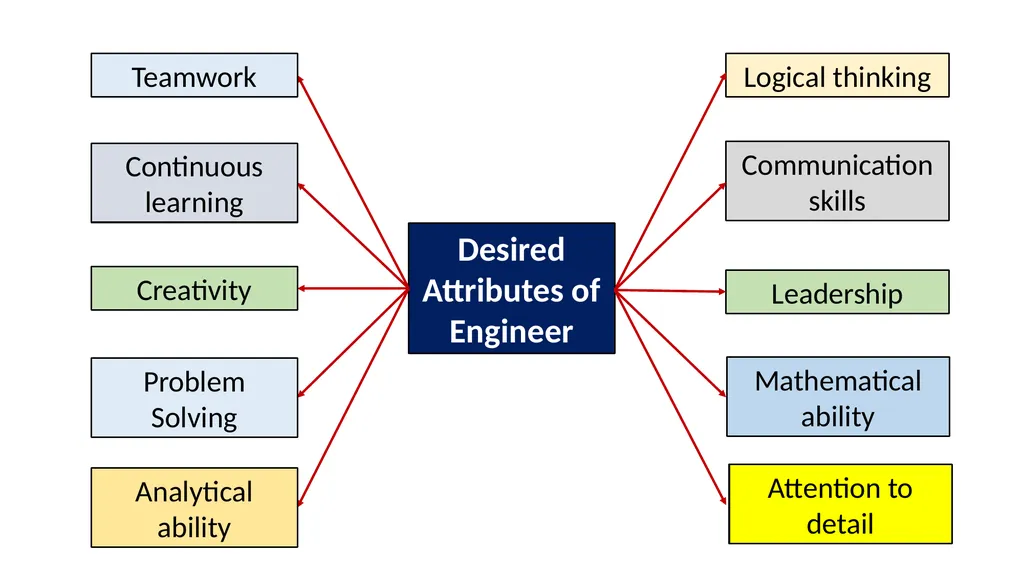
Desired Attributes of Engineer<br>
37
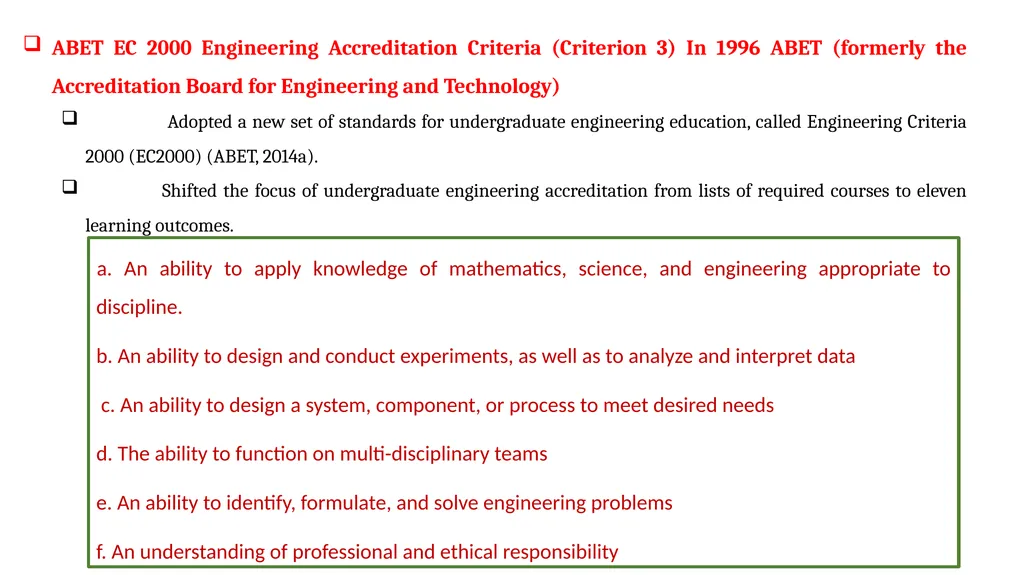
ABET EC 2000 Engineering Accreditation Criteria (Criterion 3) In 1996 ABET (formerly the Accreditation Board for Engineering and Technology)
Adopted a new set of standards for undergraduate engineering education, called Engineering Criteria 2000 (EC2000) (ABET, 2014a).
Shifted the focus of undergraduate engineering accreditation from lists of required courses to eleven learning outcomes. a. An ability to apply knowledge of mathematics, science, and engineering appropriate to discipline.
b. An ability to design and conduct experiments, as well as to analyze and interpret data
c. An ability to design a system, component, or process to meet desired needs
d. The ability to function on multi-disciplinary teams
e. An ability to identify, formulate, and solve engineering problems
f. An understanding of professional and ethical responsibility<br>
Adopted a new set of standards for undergraduate engineering education, called Engineering Criteria 2000 (EC2000) (ABET, 2014a).
Shifted the focus of undergraduate engineering accreditation from lists of required courses to eleven learning outcomes. a. An ability to apply knowledge of mathematics, science, and engineering appropriate to discipline.
b. An ability to design and conduct experiments, as well as to analyze and interpret data
c. An ability to design a system, component, or process to meet desired needs
d. The ability to function on multi-disciplinary teams
e. An ability to identify, formulate, and solve engineering problems
f. An understanding of professional and ethical responsibility<br>
38
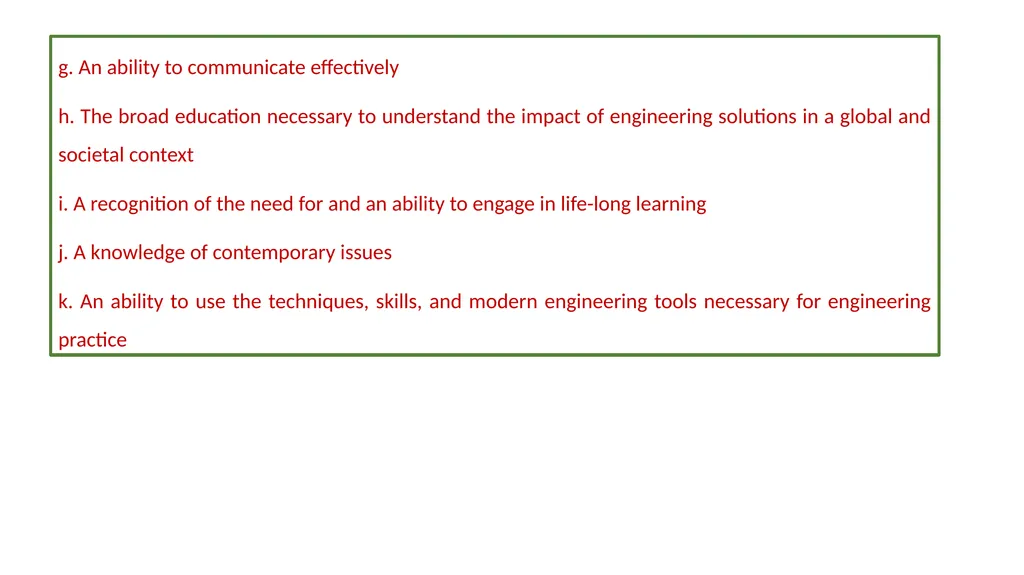
g. An ability to communicate effectively
h. The broad education necessary to understand the impact of engineering solutions in a global and societal context
i. A recognition of the need for and an ability to engage in life-long learning
j. A knowledge of contemporary issues
k. An ability to use the techniques, skills, and modern engineering tools necessary for engineering practice<br>
h. The broad education necessary to understand the impact of engineering solutions in a global and societal context
i. A recognition of the need for and an ability to engage in life-long learning
j. A knowledge of contemporary issues
k. An ability to use the techniques, skills, and modern engineering tools necessary for engineering practice<br>
39
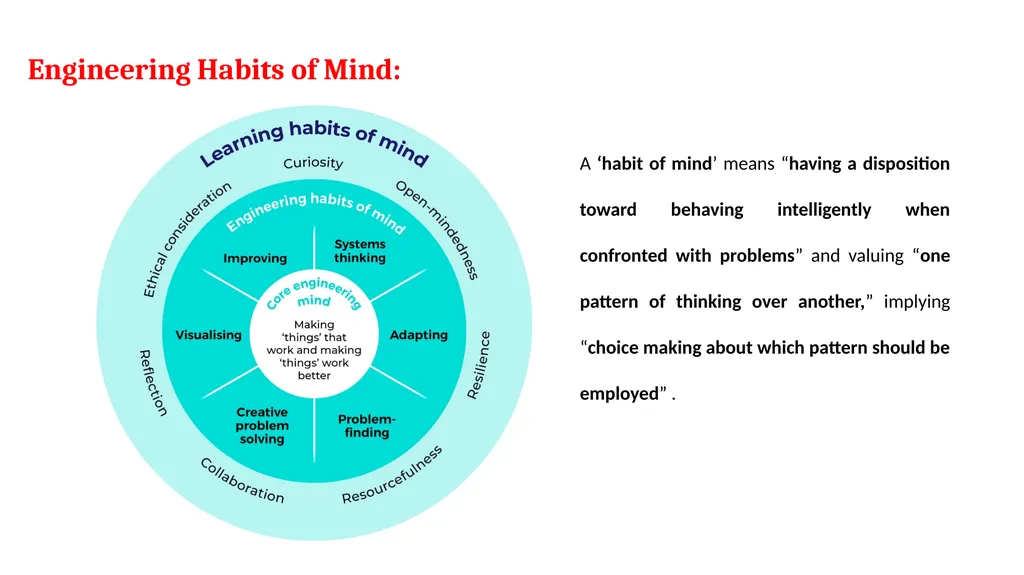
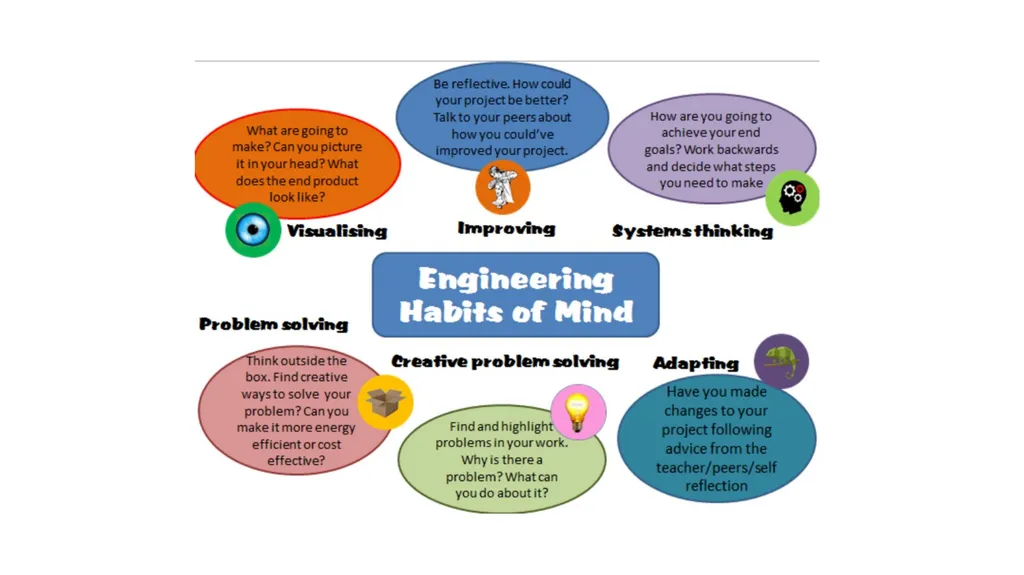
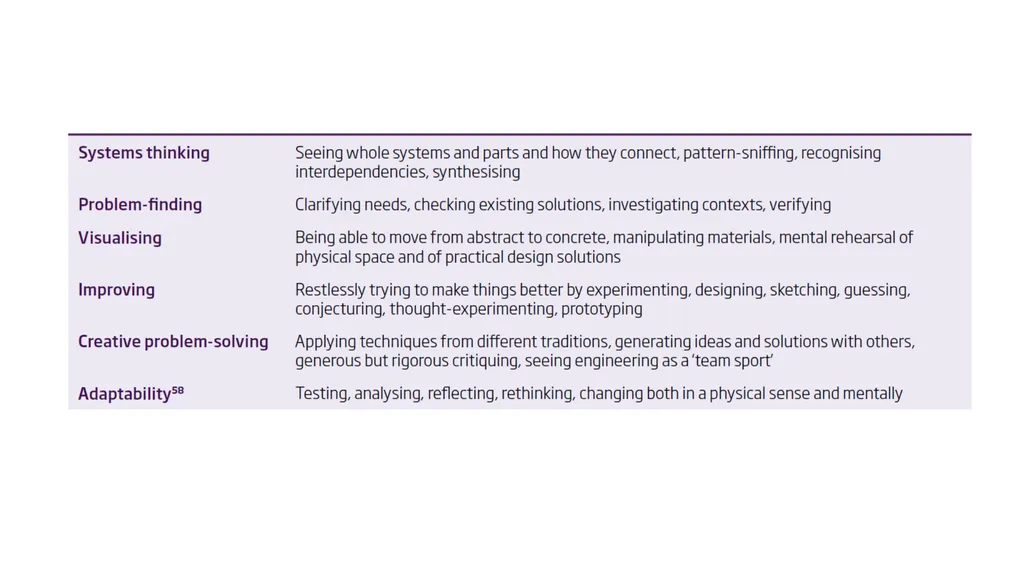
Engineering Habits of Mind: A ‘habit of mind’ means “having a disposition toward behaving intelligently when confronted with problems” and valuing “one pattern of thinking over another,” implying “choice making about which pattern should be employed” .<br>
40
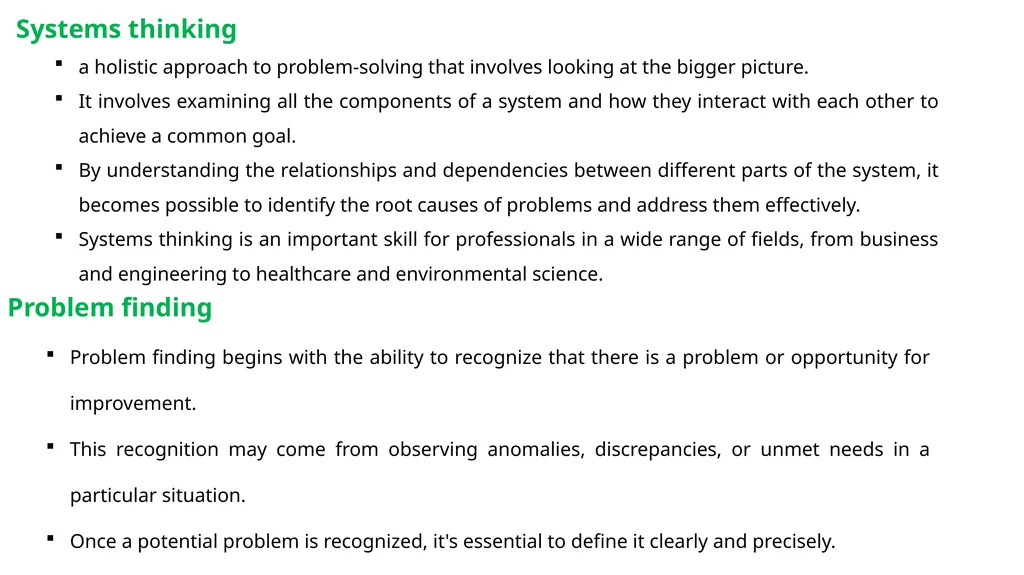
Systems thinking
a holistic approach to problem-solving that involves looking at the bigger picture.
It involves examining all the components of a system and how they interact with each other to achieve a common goal.
By understanding the relationships and dependencies between different parts of the system, it becomes possible to identify the root causes of problems and address them effectively.
Systems thinking is an important skill for professionals in a wide range of fields, from business and engineering to healthcare and environmental science. Problem finding
Problem finding begins with the ability to recognize that there is a problem or opportunity for improvement.
This recognition may come from observing anomalies, discrepancies, or unmet needs in a particular situation.
Once a potential problem is recognized, it's essential to define it clearly and precisely.
This involves breaking down the broader issue into its specific components, understanding its scope, and identifying any constraints or limitations.<br>
a holistic approach to problem-solving that involves looking at the bigger picture.
It involves examining all the components of a system and how they interact with each other to achieve a common goal.
By understanding the relationships and dependencies between different parts of the system, it becomes possible to identify the root causes of problems and address them effectively.
Systems thinking is an important skill for professionals in a wide range of fields, from business and engineering to healthcare and environmental science. Problem finding
Problem finding begins with the ability to recognize that there is a problem or opportunity for improvement.
This recognition may come from observing anomalies, discrepancies, or unmet needs in a particular situation.
Once a potential problem is recognized, it's essential to define it clearly and precisely.
This involves breaking down the broader issue into its specific components, understanding its scope, and identifying any constraints or limitations.<br>
41
Thank you<br>