
COVID-19 PANDEMIC AND IMPACT ON
FD
Published · 18 slides · 0 views

1 / 1




Description
COVID-19 PANDEMIC AND IMPACT ON CHILDRENSADOLESCENTS MENTAL HEALTH Prof. G. KOLAITIS Head, Department of Child Psychiatry, Aghia Sophia Childrens Hospital School of Medicine, National and Kapodistrian University, Athens, Greece
Related Topics
Share
Embed code
Download this presentation From Below
"COVID-19 PANDEMIC AND IMPACT ON" is the property of its rightful owner. Permission is granted to download and print the materials on this website for personal, non-commercial use only, and to display it on your personal computer provided you do not modify the materials and that you retain all copyright notices contained in the materials. By downloading content from our website, you accept the terms of this agreement.
Presentation Transcript
01
COVID-19 PANDEMIC AND IMPACT ON CHILDREN’S/ADOLESCENTS’ MENTAL HEALTH Prof. G. KOLAITIS
Head, Department of Child Psychiatry,
“Aghia Sophia” Children’s Hospital
School of Medicine, National and Kapodistrian University, Athens, Greece<br>
Head, Department of Child Psychiatry,
“Aghia Sophia” Children’s Hospital
School of Medicine, National and Kapodistrian University, Athens, Greece<br>
02
Covid-19 pandemic and mental health of children/adolescents Since the end of 2019, the coronavirus disease (COVID-19) outbreak rapidly became a pandemic
SARS-CoV-2 is profoundly impacting lives of 1.6 billions of children and adolescents around the globe
Isolation, contact restrictions and economic shutdown impose a complete change to our psychosocial environment
Not many studies in the general population, especially on children/adolescents (Lee 2020)
The first non-representative studies from China, India, USA, Spain, Italy, Germany show negative impact on mental health<br>
SARS-CoV-2 is profoundly impacting lives of 1.6 billions of children and adolescents around the globe
Isolation, contact restrictions and economic shutdown impose a complete change to our psychosocial environment
Not many studies in the general population, especially on children/adolescents (Lee 2020)
The first non-representative studies from China, India, USA, Spain, Italy, Germany show negative impact on mental health<br>
03
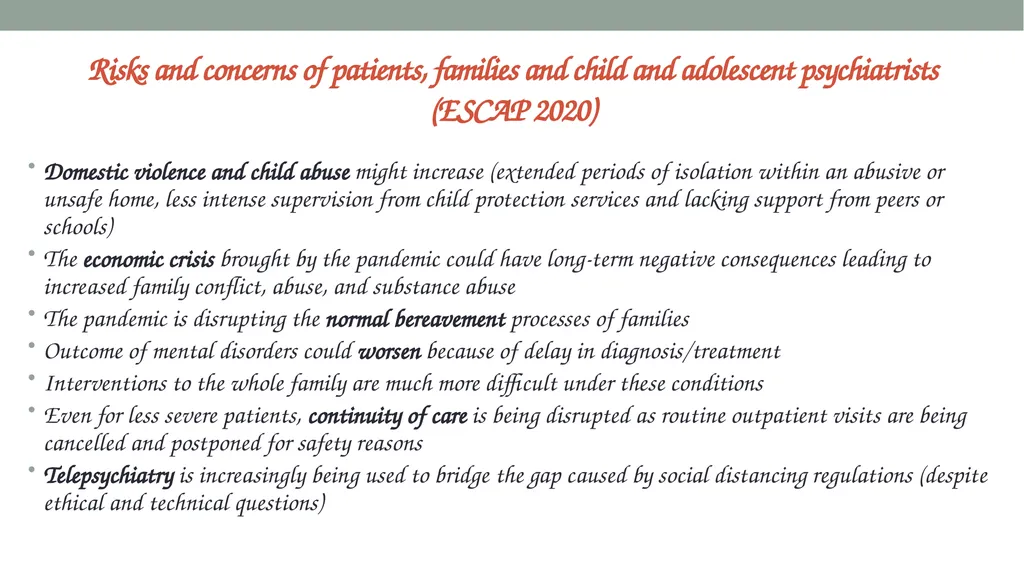
Risks and concerns of patients, families and child and adolescent psychiatrists (ESCAP 2020) Domestic violence and child abuse might increase (extended periods of isolation within an abusive or unsafe home, less intense supervision from child protection services and lacking support from peers or schools)
The economic crisis brought by the pandemic could have long-term negative consequences leading to increased family conflict, abuse, and substance abuse
The pandemic is disrupting the normal bereavement processes of families
Outcome of mental disorders could worsen because of delay in diagnosis/treatment
Interventions to the whole family are much more difficult under these conditions
Even for less severe patients, continuity of care is being disrupted as routine outpatient visits are being cancelled and postponed for safety reasons
Telepsychiatry is increasingly being used to bridge the gap caused by social distancing regulations (despite ethical and technical questions)<br>
The economic crisis brought by the pandemic could have long-term negative consequences leading to increased family conflict, abuse, and substance abuse
The pandemic is disrupting the normal bereavement processes of families
Outcome of mental disorders could worsen because of delay in diagnosis/treatment
Interventions to the whole family are much more difficult under these conditions
Even for less severe patients, continuity of care is being disrupted as routine outpatient visits are being cancelled and postponed for safety reasons
Telepsychiatry is increasingly being used to bridge the gap caused by social distancing regulations (despite ethical and technical questions)<br>
04
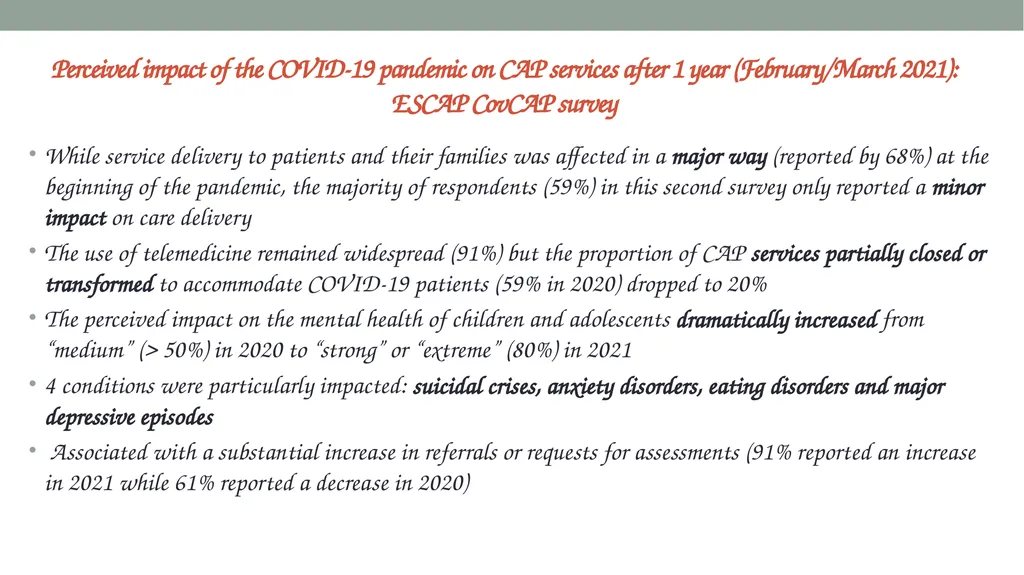
Perceived impact of the COVID-19 pandemic on CAP services after 1 year (February/March 2021): ESCAP CovCAP survey While service delivery to patients and their families was affected in a major way (reported by 68%) at the beginning of the pandemic, the majority of respondents (59%) in this second survey only reported a minor impact on care delivery
The use of telemedicine remained widespread (91%) but the proportion of CAP services partially closed or transformed to accommodate COVID-19 patients (59% in 2020) dropped to 20%
The perceived impact on the mental health of children and adolescents dramatically increased from “medium” (> 50%) in 2020 to “strong” or “extreme” (80%) in 2021
4 conditions were particularly impacted: suicidal crises, anxiety disorders, eating disorders and major depressive episodes
Associated with a substantial increase in referrals or requests for assessments (91% reported an increase in 2021 while 61% reported a decrease in 2020)<br>
The use of telemedicine remained widespread (91%) but the proportion of CAP services partially closed or transformed to accommodate COVID-19 patients (59% in 2020) dropped to 20%
The perceived impact on the mental health of children and adolescents dramatically increased from “medium” (> 50%) in 2020 to “strong” or “extreme” (80%) in 2021
4 conditions were particularly impacted: suicidal crises, anxiety disorders, eating disorders and major depressive episodes
Associated with a substantial increase in referrals or requests for assessments (91% reported an increase in 2021 while 61% reported a decrease in 2020)<br>
05
Impact of the COVID-19 pandemic on quality of life and mental health in children and adolescents in Germany
(Ravens-Sieberer et al 2021) First national representative study in Germany
Online study of n = 1586 families with offspring 7-17y
Measures: HRQoL (KIDSCREEN-10), mental health difficulties (SDQ), anxiety (SCARED) and depression (CES-DC).
Comparison with BELLA cohort (n = 1556) (before pandemic)
2/3 of children and adolescents were impacted by pandemic
Significantly worse HRQoL (40.2% vs 15.3%), more mental health problems (17.8% vs 9.9%) and higher levels of anxiety (24.1% vs 14.9%)
Greater pandemic impact on children of lower SES, immigrants and worse living conditions<br>
Online study of n = 1586 families with offspring 7-17y
Measures: HRQoL (KIDSCREEN-10), mental health difficulties (SDQ), anxiety (SCARED) and depression (CES-DC).
Comparison with BELLA cohort (n = 1556) (before pandemic)
2/3 of children and adolescents were impacted by pandemic
Significantly worse HRQoL (40.2% vs 15.3%), more mental health problems (17.8% vs 9.9%) and higher levels of anxiety (24.1% vs 14.9%)
Greater pandemic impact on children of lower SES, immigrants and worse living conditions<br>
06
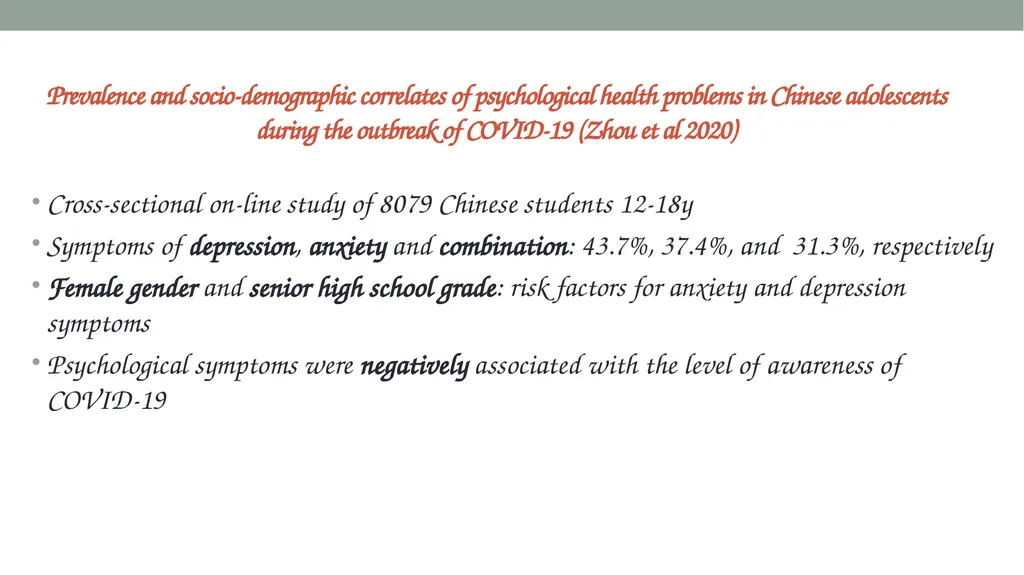
Prevalence and socio-demographic correlates of psychological health problems in Chinese adolescents during the outbreak of COVID-19 (Zhou et al 2020) Cross-sectional on-line study of 8079 Chinese students 12-18y
Symptoms of depression, anxiety and combination: 43.7%, 37.4%, and 31.3%, respectively
Female gender and senior high school grade: risk factors for anxiety and depression symptoms
Psychological symptoms were negatively associated with the level of awareness of COVID-19<br>
Symptoms of depression, anxiety and combination: 43.7%, 37.4%, and 31.3%, respectively
Female gender and senior high school grade: risk factors for anxiety and depression symptoms
Psychological symptoms were negatively associated with the level of awareness of COVID-19<br>
07
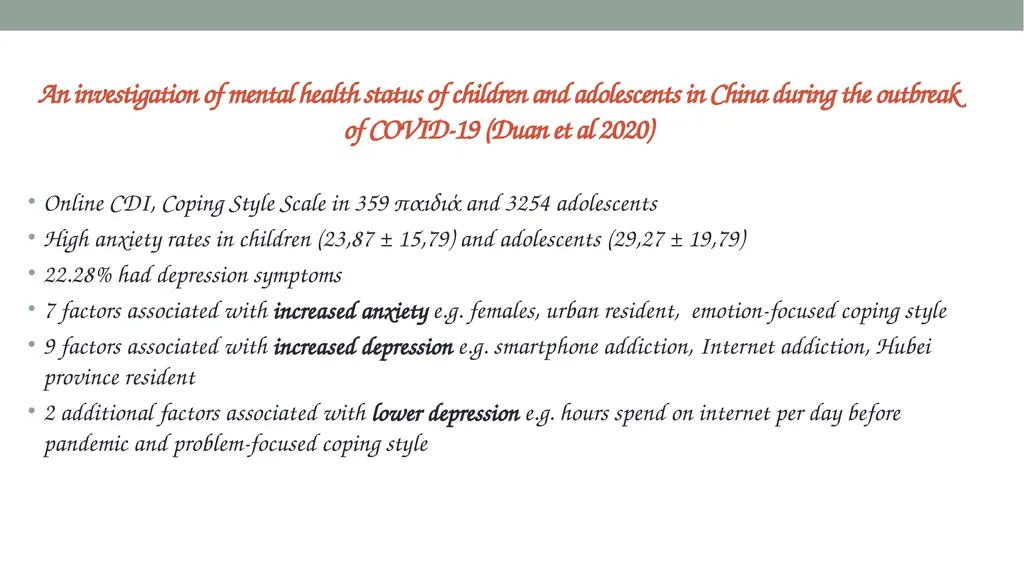
An investigation of mental health status of children and adolescents in China during the outbreak of COVID-19 (Duan et al 2020) Online CDI, Coping Style Scale in 359 παιδιά and 3254 adolescents
High anxiety rates in children (23,87 ± 15,79) and adolescents (29,27 ± 19,79)
22.28% had depression symptoms
7 factors associated with increased anxiety e.g. females, urban resident, emotion-focused coping style
9 factors associated with increased depression e.g. smartphone addiction, Internet addiction, Hubei province resident
2 additional factors associated with lower depression e.g. hours spend on internet per day before pandemic and problem-focused coping style<br>
High anxiety rates in children (23,87 ± 15,79) and adolescents (29,27 ± 19,79)
22.28% had depression symptoms
7 factors associated with increased anxiety e.g. females, urban resident, emotion-focused coping style
9 factors associated with increased depression e.g. smartphone addiction, Internet addiction, Hubei province resident
2 additional factors associated with lower depression e.g. hours spend on internet per day before pandemic and problem-focused coping style<br>
08
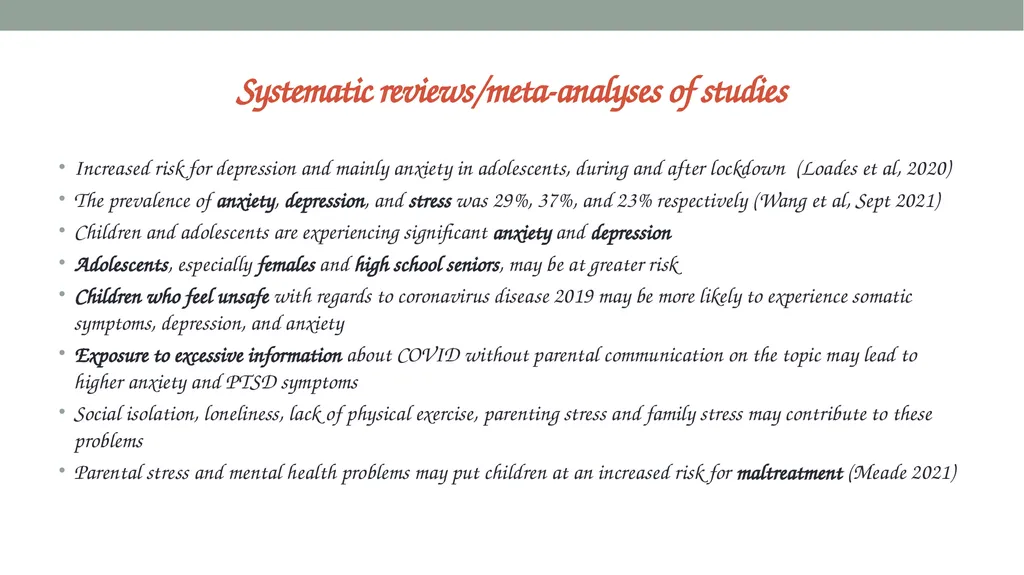
Systematic reviews/meta-analyses of studies Increased risk for depression and mainly anxiety in adolescents, during and after lockdown (Loades et al, 2020)
The prevalence of anxiety, depression, and stress was 29%, 37%, and 23% respectively (Wang et al, Sept 2021)
Children and adolescents are experiencing significant anxiety and depression
Adolescents, especially females and high school seniors, may be at greater risk
Children who feel unsafe with regards to coronavirus disease 2019 may be more likely to experience somatic symptoms, depression, and anxiety
Exposure to excessive information about COVID without parental communication on the topic may lead to higher anxiety and PTSD symptoms
Social isolation, loneliness, lack of physical exercise, parenting stress and family stress may contribute to these problems
Parental stress and mental health problems may put children at an increased risk for maltreatment (Meade 2021)<br>
The prevalence of anxiety, depression, and stress was 29%, 37%, and 23% respectively (Wang et al, Sept 2021)
Children and adolescents are experiencing significant anxiety and depression
Adolescents, especially females and high school seniors, may be at greater risk
Children who feel unsafe with regards to coronavirus disease 2019 may be more likely to experience somatic symptoms, depression, and anxiety
Exposure to excessive information about COVID without parental communication on the topic may lead to higher anxiety and PTSD symptoms
Social isolation, loneliness, lack of physical exercise, parenting stress and family stress may contribute to these problems
Parental stress and mental health problems may put children at an increased risk for maltreatment (Meade 2021)<br>
09
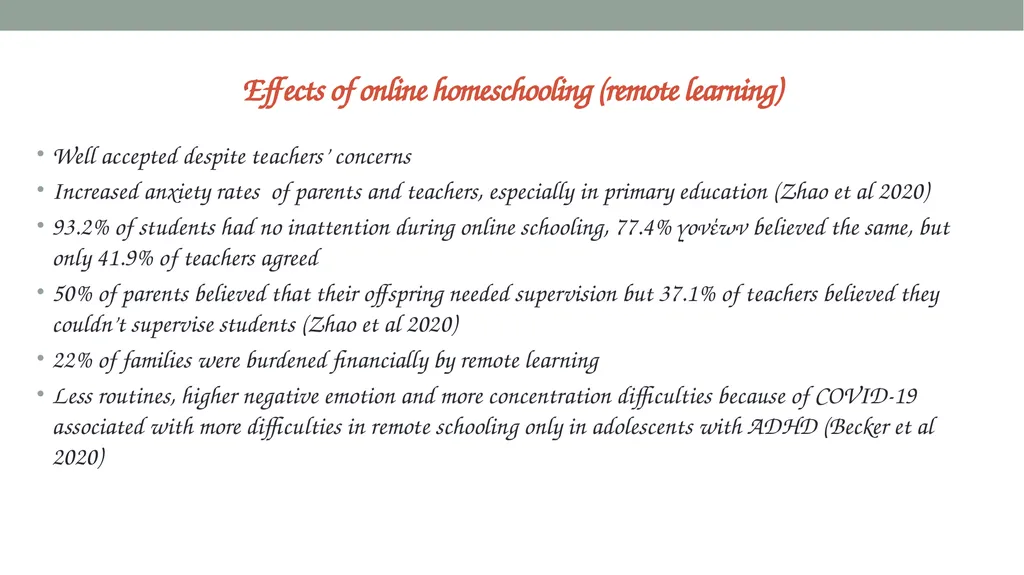
Effects of online homeschooling (remote learning) Well accepted despite teachers’ concerns
Increased anxiety rates of parents and teachers, especially in primary education (Zhao et al 2020)
93.2% of students had no inattention during online schooling, 77.4% γονέων believed the same, but only 41.9% of teachers agreed
50% of parents believed that their offspring needed supervision but 37.1% of teachers believed they couldn’t supervise students (Zhao et al 2020)
22% of families were burdened financially by remote learning
Less routines, higher negative emotion and more concentration difficulties because of COVID-19 associated with more difficulties in remote schooling only in adolescents with ADHD (Becker et al 2020)<br>
Increased anxiety rates of parents and teachers, especially in primary education (Zhao et al 2020)
93.2% of students had no inattention during online schooling, 77.4% γονέων believed the same, but only 41.9% of teachers agreed
50% of parents believed that their offspring needed supervision but 37.1% of teachers believed they couldn’t supervise students (Zhao et al 2020)
22% of families were burdened financially by remote learning
Less routines, higher negative emotion and more concentration difficulties because of COVID-19 associated with more difficulties in remote schooling only in adolescents with ADHD (Becker et al 2020)<br>
10
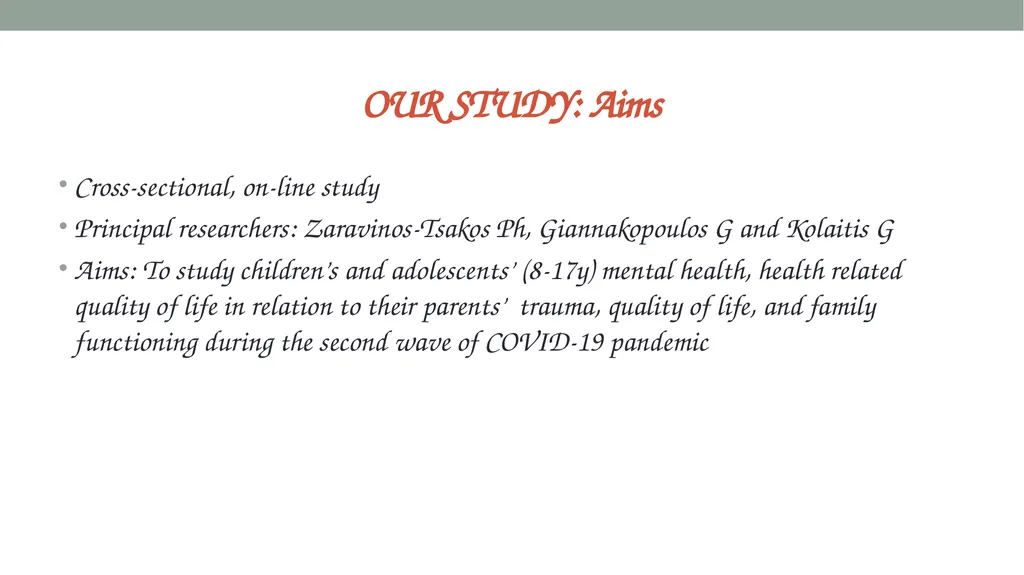
OUR STUDY: Aims Cross-sectional, on-line study
Principal researchers: Zaravinos-Tsakos Ph, Giannakopoulos G and Kolaitis G
Aims: To study children’s and adolescents’ (8-17y) mental health, health related quality of life in relation to their parents’ trauma, quality of life, and family functioning during the second wave of COVID-19 pandemic<br>
Principal researchers: Zaravinos-Tsakos Ph, Giannakopoulos G and Kolaitis G
Aims: To study children’s and adolescents’ (8-17y) mental health, health related quality of life in relation to their parents’ trauma, quality of life, and family functioning during the second wave of COVID-19 pandemic<br>
11
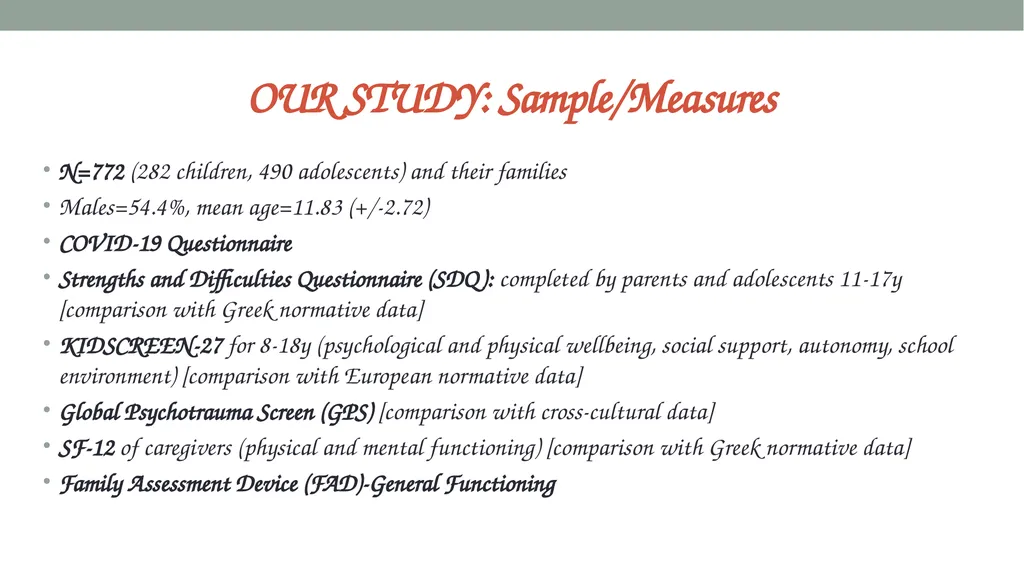
OUR STUDY: Sample/Measures N=772 (282 children, 490 adolescents) and their families
Males=54.4%, mean age=11.83 (+/-2.72)
COVID-19 Questionnaire
Strengths and Difficulties Questionnaire (SDQ): completed by parents and adolescents 11-17y [comparison with Greek normative data]
KIDSCREEN-27 for 8-18y (psychological and physical wellbeing, social support, autonomy, school environment) [comparison with European normative data]
Global Psychotrauma Screen (GPS) [comparison with cross-cultural data]
SF-12 of caregivers (physical and mental functioning) [comparison with Greek normative data]
Family Assessment Device (FAD)-General Functioning<br>
Males=54.4%, mean age=11.83 (+/-2.72)
COVID-19 Questionnaire
Strengths and Difficulties Questionnaire (SDQ): completed by parents and adolescents 11-17y [comparison with Greek normative data]
KIDSCREEN-27 for 8-18y (psychological and physical wellbeing, social support, autonomy, school environment) [comparison with European normative data]
Global Psychotrauma Screen (GPS) [comparison with cross-cultural data]
SF-12 of caregivers (physical and mental functioning) [comparison with Greek normative data]
Family Assessment Device (FAD)-General Functioning<br>
12
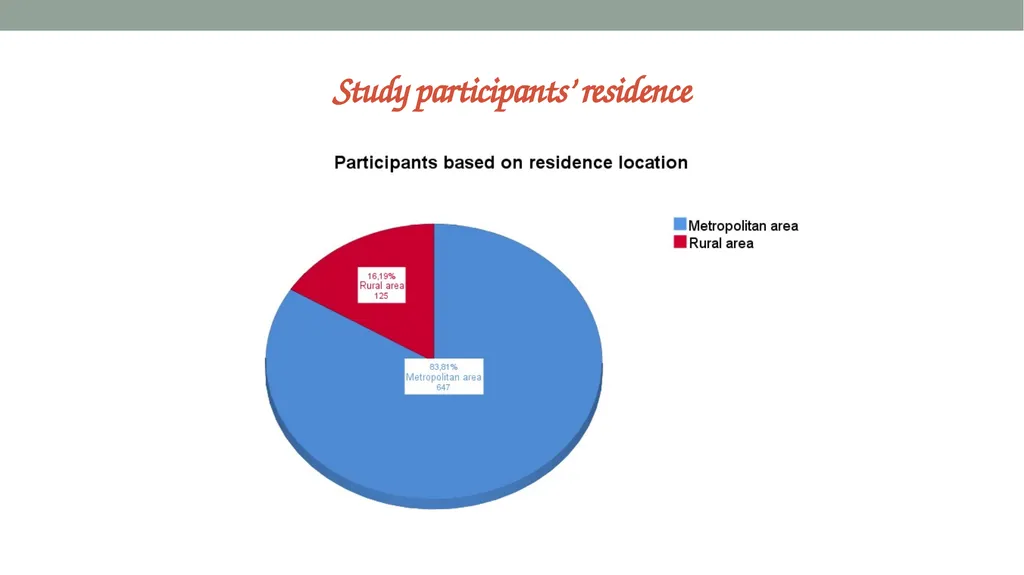
Study participants’ residence<br>
13
Results: SDQ (mental health)<br>
14
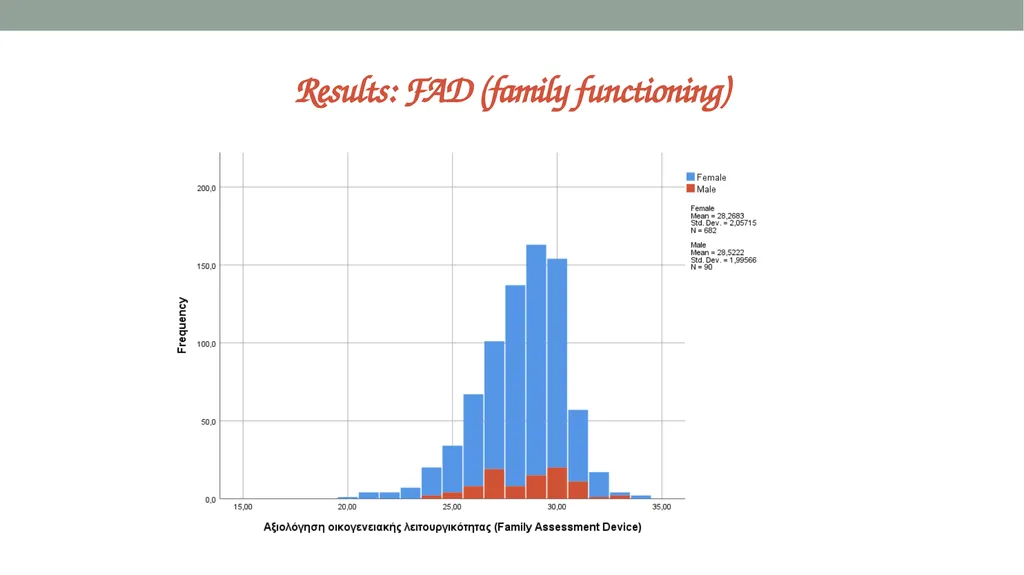
Results: FAD (family functioning)<br>
15
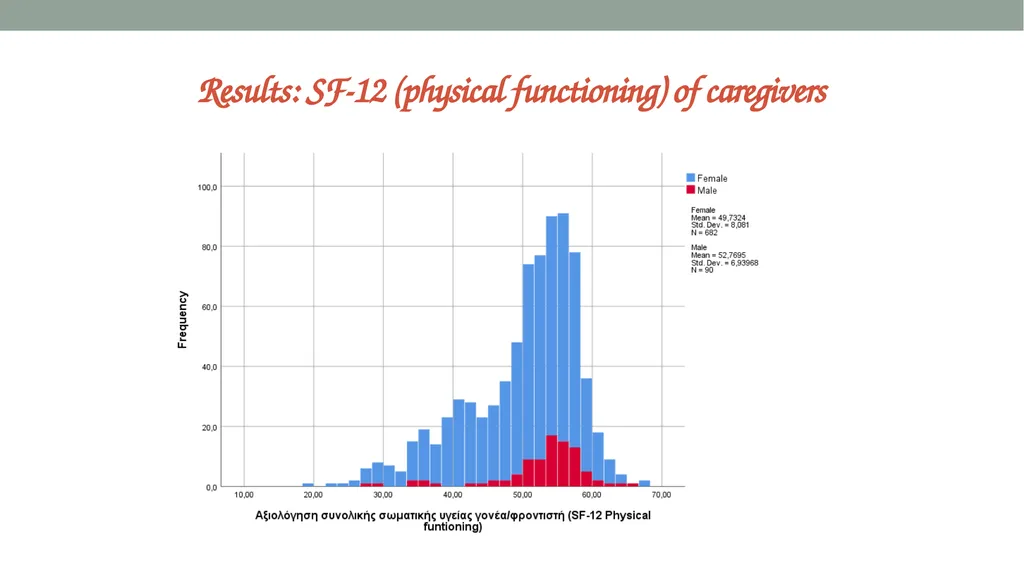
Results: SF-12 (physical functioning) of caregivers<br>
16
Results: SF-12 (psychological functioning) of caregivers<br>
17
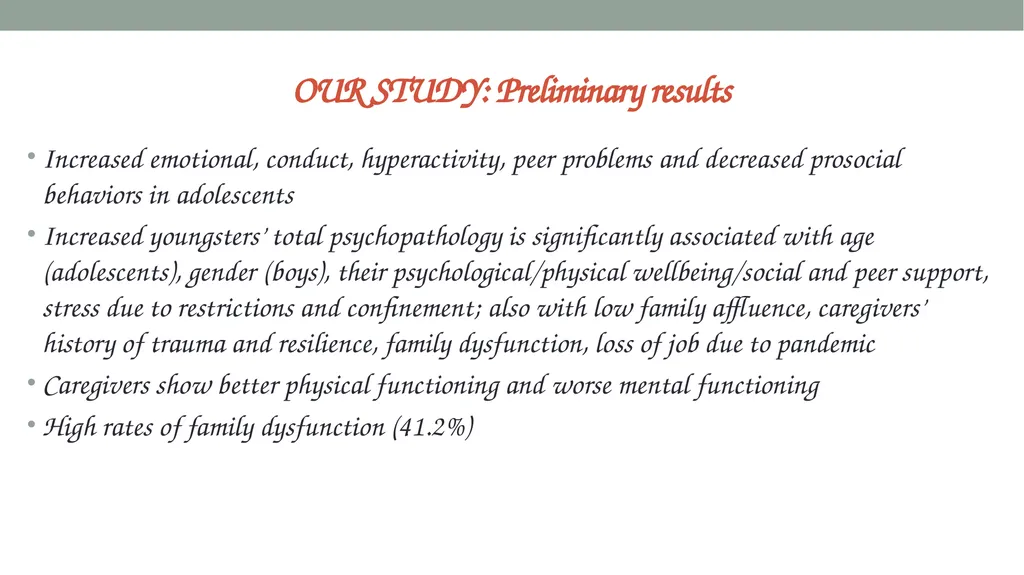
OUR STUDY: Preliminary results Increased emotional, conduct, hyperactivity, peer problems and decreased prosocial behaviors in adolescents
Increased youngsters’ total psychopathology is significantly associated with age (adolescents), gender (boys), their psychological/physical wellbeing/social and peer support, stress due to restrictions and confinement; also with low family affluence, caregivers’ history of trauma and resilience, family dysfunction, loss of job due to pandemic
Caregivers show better physical functioning and worse mental functioning
High rates of family dysfunction (41.2%)<br>
Increased youngsters’ total psychopathology is significantly associated with age (adolescents), gender (boys), their psychological/physical wellbeing/social and peer support, stress due to restrictions and confinement; also with low family affluence, caregivers’ history of trauma and resilience, family dysfunction, loss of job due to pandemic
Caregivers show better physical functioning and worse mental functioning
High rates of family dysfunction (41.2%)<br>
18
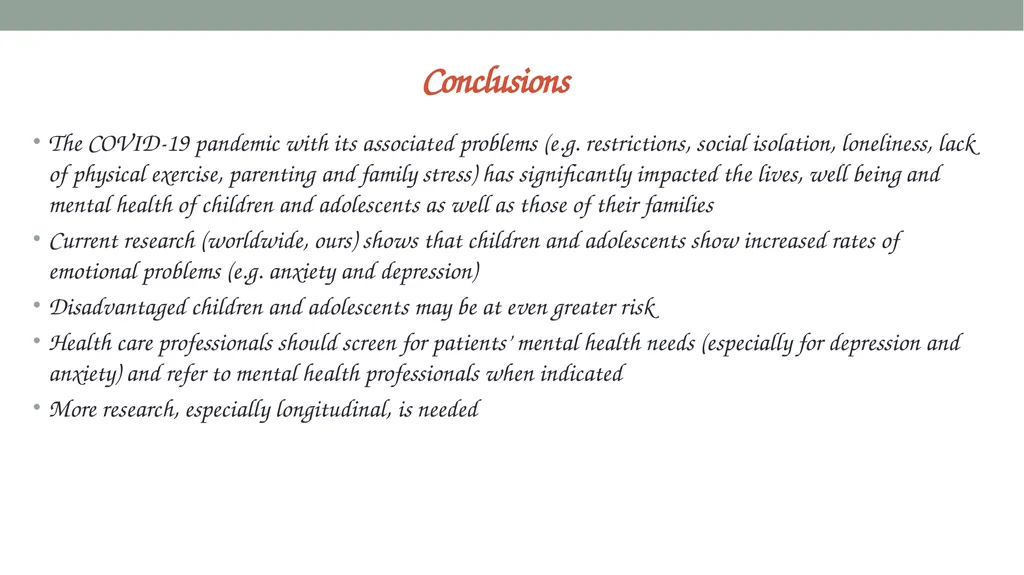
Conclusions The COVID-19 pandemic with its associated problems (e.g. restrictions, social isolation, loneliness, lack of physical exercise, parenting and family stress) has significantly impacted the lives, well being and mental health of children and adolescents as well as those of their families
Current research (worldwide, ours) shows that children and adolescents show increased rates of emotional problems (e.g. anxiety and depression)
Disadvantaged children and adolescents may be at even greater risk
Health care professionals should screen for patients’ mental health needs (especially for depression and anxiety) and refer to mental health professionals when indicated
More research, especially longitudinal, is needed<br>
Current research (worldwide, ours) shows that children and adolescents show increased rates of emotional problems (e.g. anxiety and depression)
Disadvantaged children and adolescents may be at even greater risk
Health care professionals should screen for patients’ mental health needs (especially for depression and anxiety) and refer to mental health professionals when indicated
More research, especially longitudinal, is needed<br>