
Crack the Code: Driving Learning at BAC Through
Description: Crack the Code: Driving Learning at BAC Through Action Learning 2 Crack the Code: Driving Learning at BAC Through Action Learning Crack the Code: Driving Learning at BAC Through Action Learning 3 Development Objectives As a result of
Related Topics
Download Presentation
"Crack the Code: Driving Learning at BAC Through" is the property of its rightful owner. Permission is granted to download and print the materials on this website for personal, non-commercial use only, and to display it on your personal computer provided you do not modify the materials and that you retain all copyright notices contained in the materials. By downloading content from our website, you accept the terms of this agreement.
Presentation Transcript
slide1. Crack the Code:
Driving Learning at BAC Through Action Learning<br>
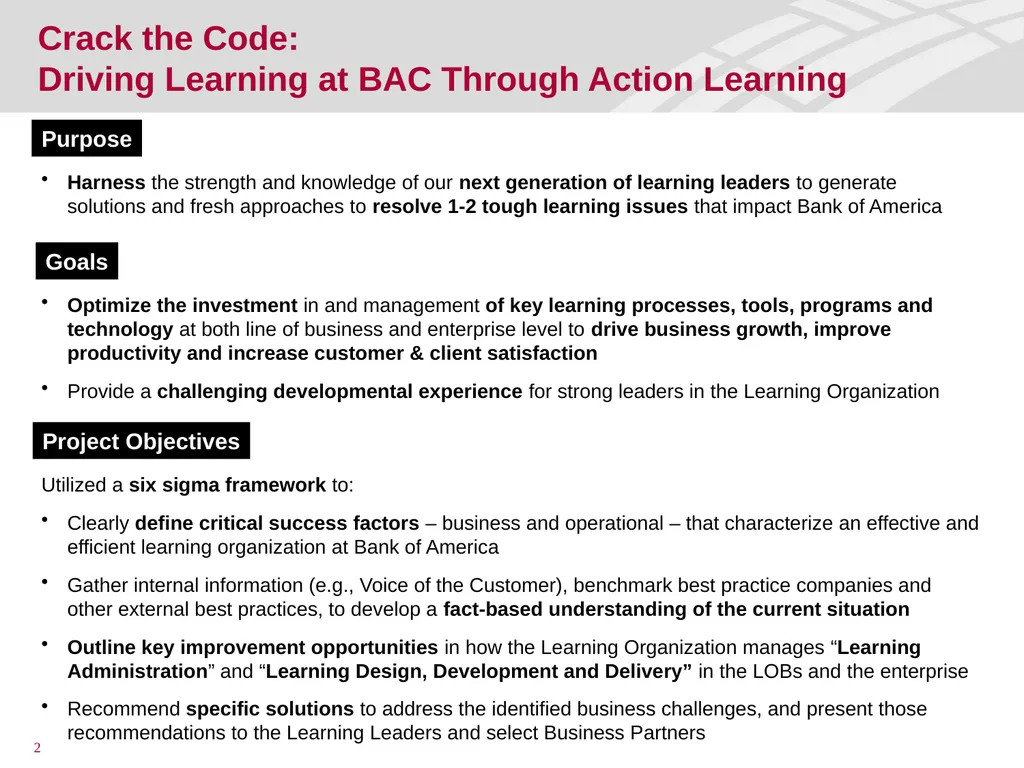
slide2. 2 Crack the Code: Driving Learning at BAC Through Action Learning<br>
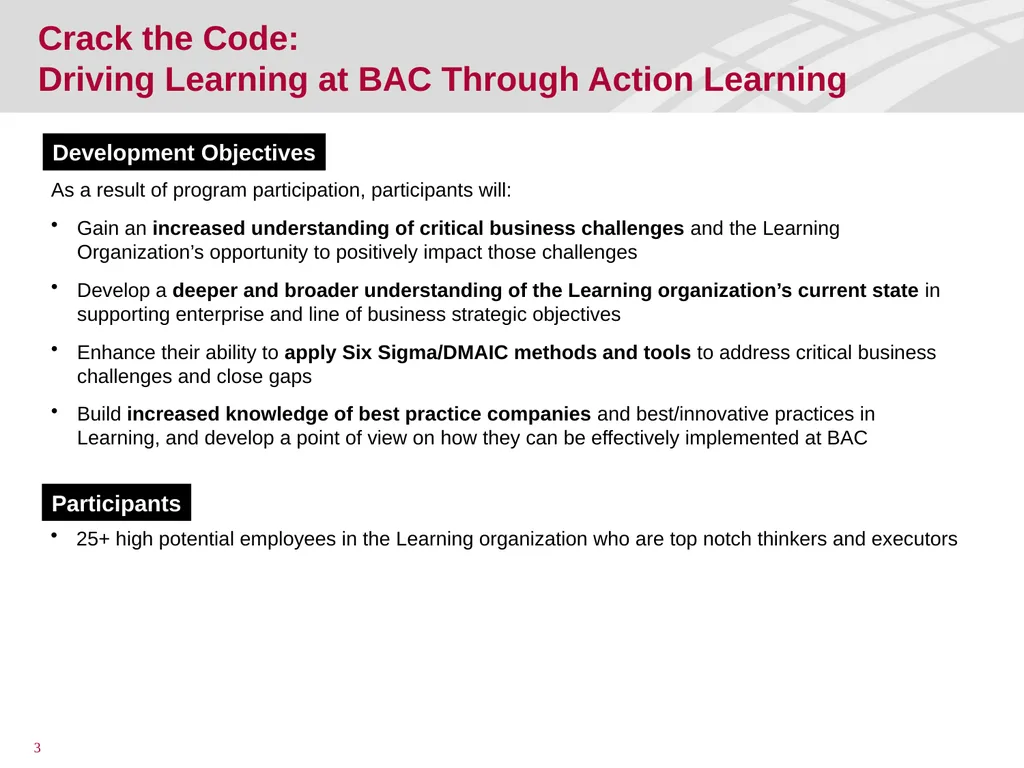
slide3. Crack the Code: Driving Learning at BAC Through Action Learning 3 Development Objectives As a result of program participation, participants will:
Gain an increased understanding of critical business challenges and the Learning Organization’s opportunity to positively impact those challenges
Develop a deeper and broader understanding of the Learning organization’s current state in supporting enterprise and line of business strategic objectives
Enhance their ability to apply Six Sigma/DMAIC methods and tools to address critical business challenges and close gaps
Build increased knowledge of best practice companies and best/innovative practices in Learning, and develop a point of view on how they can be effectively implemented at BAC 25+ high potential employees in the Learning organization who are top notch thinkers and executors Participants<br>
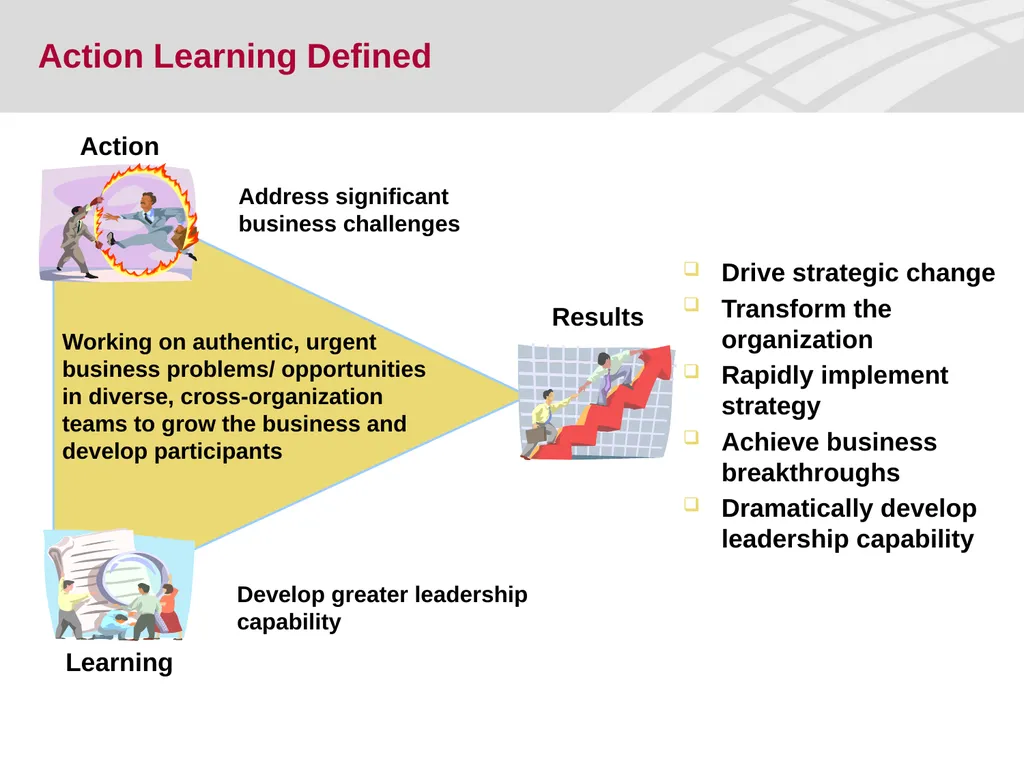
slide4. Action Learning Defined Working on authentic, urgent business problems/ opportunities in diverse, cross-organization teams to grow the business and develop participants<br>
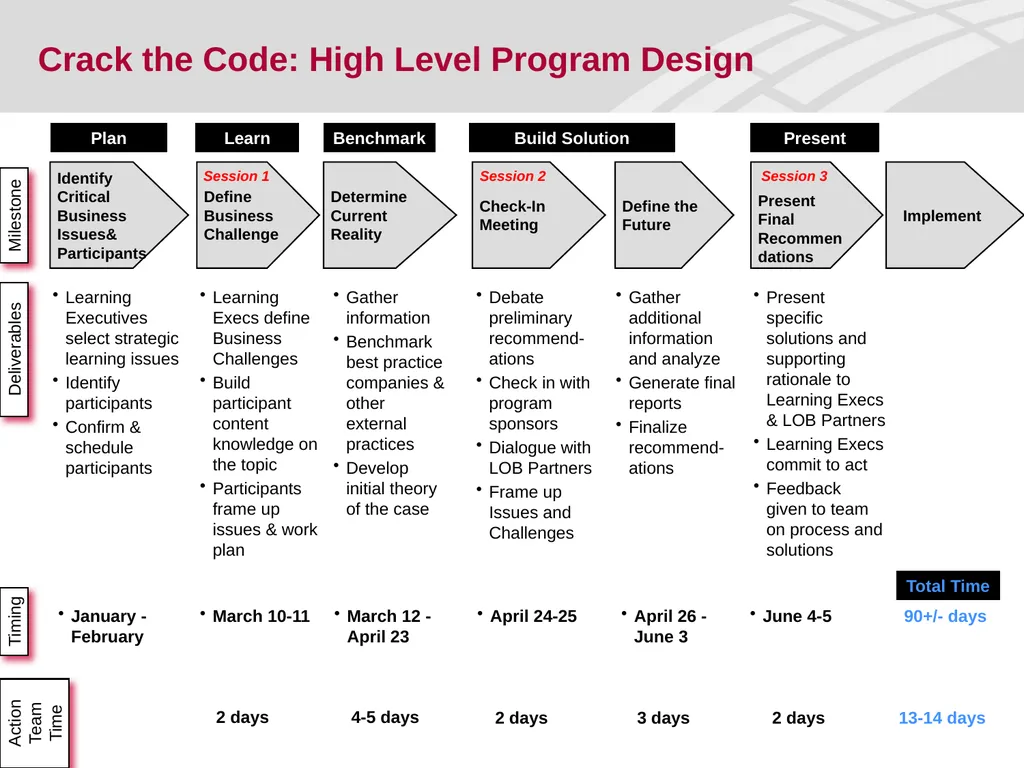
slide5. Crack the Code: High Level Program Design 5 Define Business Challenge Identify Critical Business Issues& Participants Determine Current Reality Deliverables Learning Execs define Business Challenges
Build participant content knowledge on the topic
Participants frame up issues & work plan Check-In Meeting Debate preliminary recommend-ations
Check in with program sponsors
Dialogue with LOB Partners
Frame up Issues and Challenges Present Final Recommendations Define the Future Gather additional information and analyze
Generate final reports
Finalize recommend-ations Implement Gather information
Benchmark best practice companies & other external practices
Develop initial theory of the case Present specific solutions and supporting rationale to Learning Execs & LOB Partners
Learning Execs commit to act
Feedback given to team on process and solutions Plan Present Learn Learning Executives select strategic learning issues
Identify participants
Confirm & schedule participants Benchmark Build Solution Timing March 10-11 April 24-25 April 26 - June 3 June 4-5 Action Team Time 2 days 4-5 days 2 days 3 days March 12 - April 23 2 days 13-14 days 90+/- days Total Time Milestone January - February Session 1 Session 2 Session 3<br>
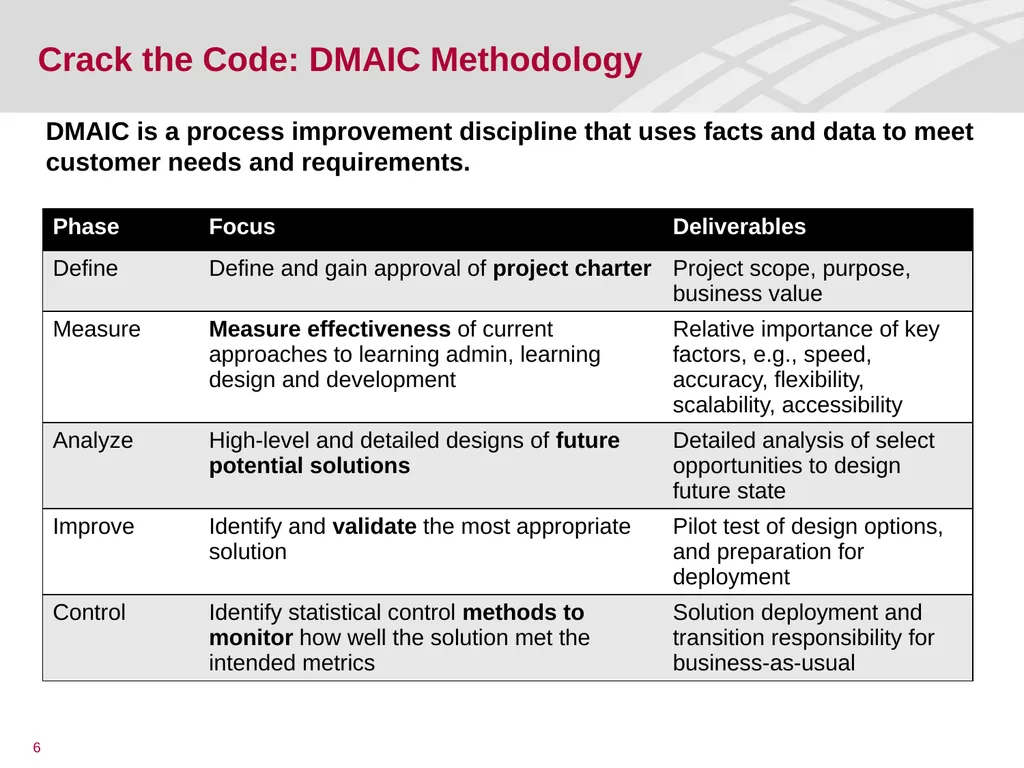
slide6. Crack the Code: DMAIC Methodology 6 DMAIC is a process improvement discipline that uses facts and data to meet customer needs and requirements.<br>
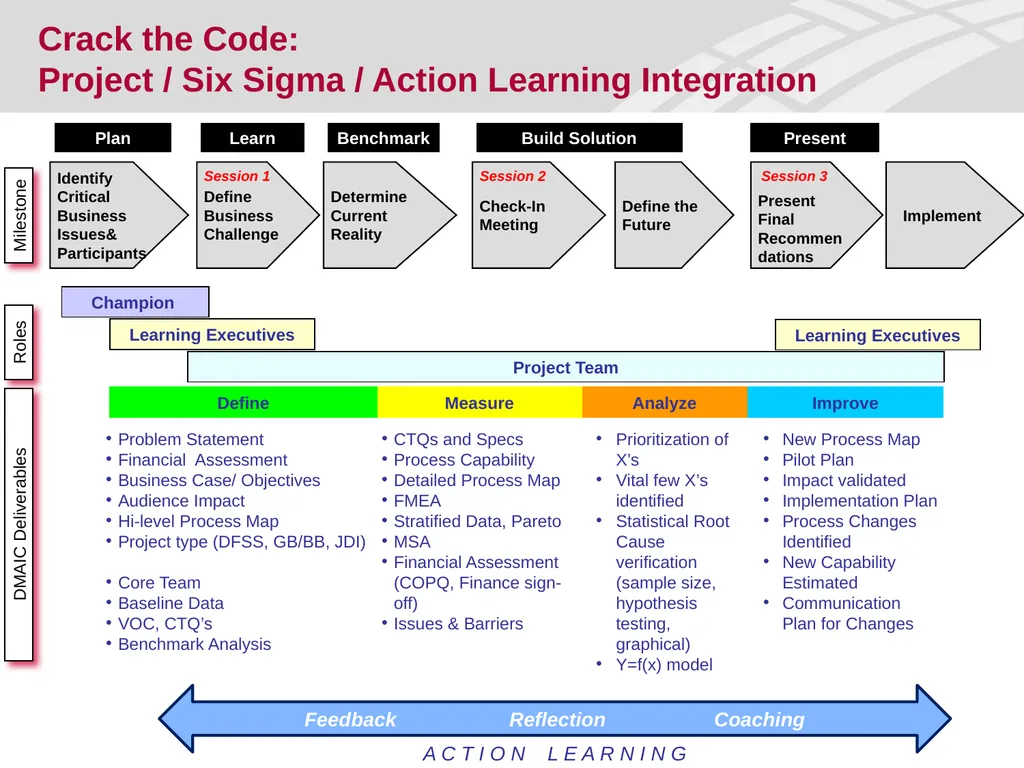
slide7. Crack the Code: Project / Six Sigma / Action Learning Integration DMAIC Deliverables Analyze Improve Champion Project Team Learning Executives Roles Problem Statement
Financial Assessment
Business Case/ Objectives
Audience Impact
Hi-level Process Map
Project type (DFSS, GB/BB, JDI)
Core Team
Baseline Data
VOC, CTQ’s
Benchmark Analysis CTQs and Specs
Process Capability
Detailed Process Map
FMEA
Stratified Data, Pareto
MSA
Financial Assessment (COPQ, Finance sign-off)
Issues & Barriers Prioritization of X’s
Vital few X’s identified
Statistical Root Cause verification (sample size, hypothesis testing, graphical)
Y=f(x) model New Process Map
Pilot Plan
Impact validated
Implementation Plan
Process Changes Identified
New Capability Estimated
Communication Plan for Changes Measure Define Learning Executives Define Business Challenge Identify Critical Business Issues& Participants Determine Current Reality Check-In Meeting Present Final Recommendations Define the Future Implement Plan Present Learn Benchmark Build Solution Milestone Session 1 Session 2 Session 3 Feedback Reflection Coaching A C T I O N L E A R N I N G<br>
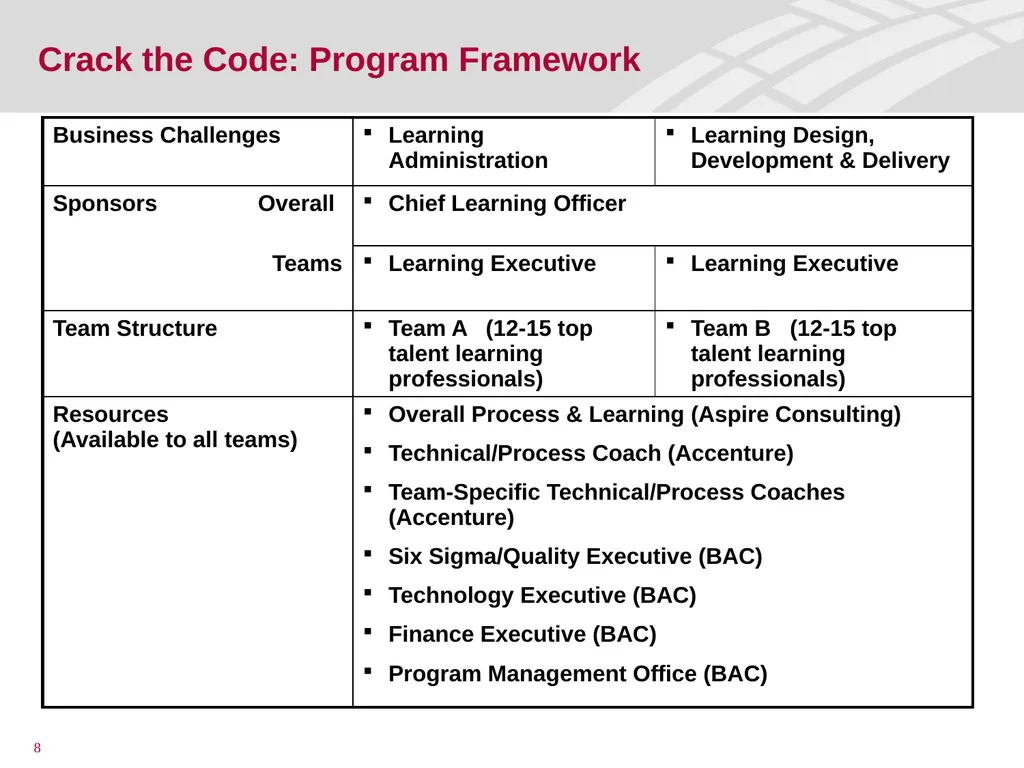
slide8. Crack the Code: Program Framework 8<br>
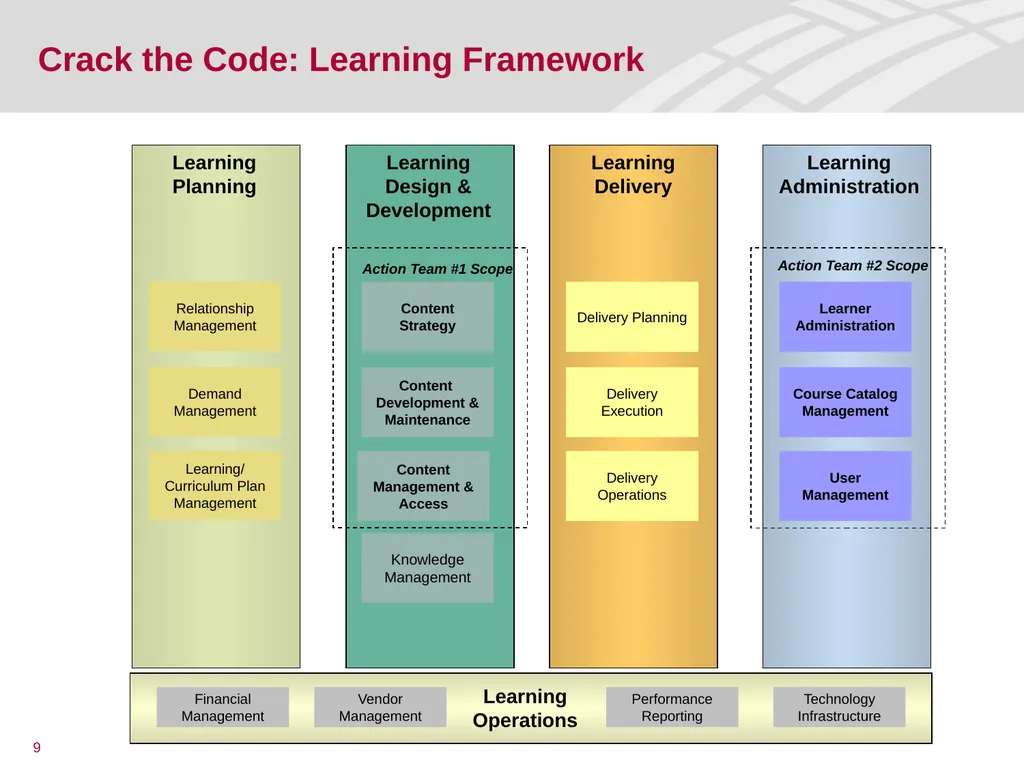
slide9. Crack the Code: Learning Framework 9 Learning
Planning Learning Design & Development Learning Delivery Learning Administration Relationship Management Demand Management Learning/ Curriculum Plan Management Content Development & Maintenance Knowledge Management Content Strategy Content Management & Access Delivery Execution Delivery Planning Delivery Operations Course Catalog Management Learner Administration User Management Learning
Operations Vendor Management Performance Reporting Financial Management Technology Infrastructure Action Team #1 Scope Action Team #2 Scope<br>
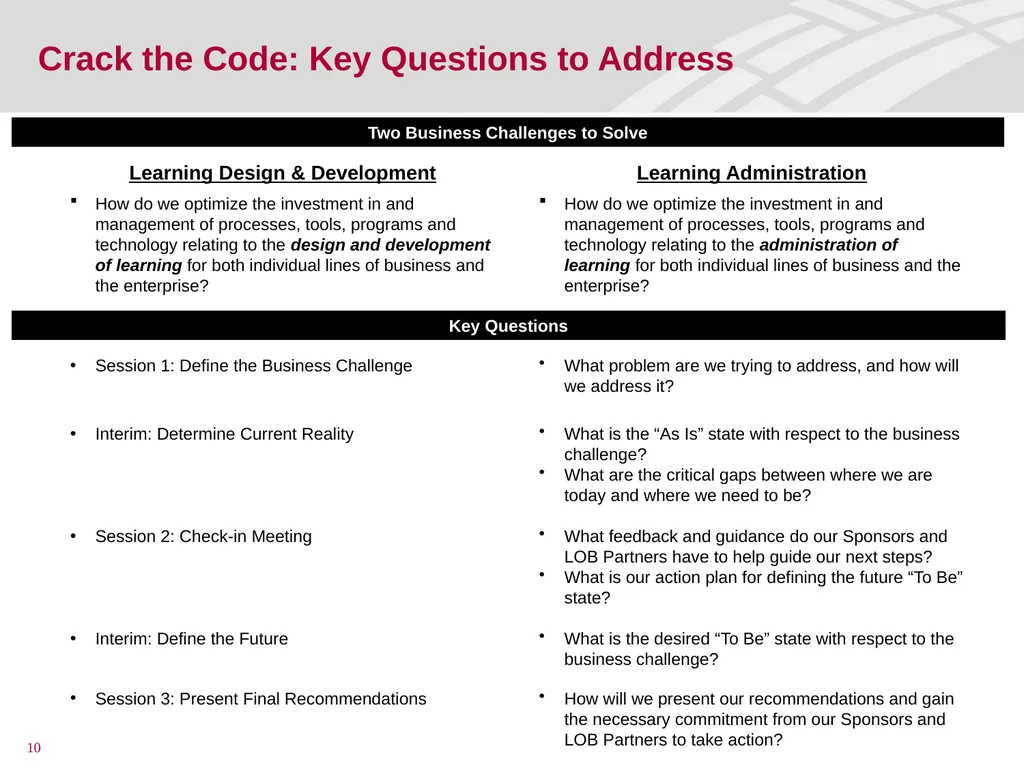
slide10. Crack the Code: Key Questions to Address 10 Learning Design & Development
How do we optimize the investment in and management of processes, tools, programs and technology relating to the design and development of learning for both individual lines of business and the enterprise? Learning Administration
How do we optimize the investment in and management of processes, tools, programs and technology relating to the administration of learning for both individual lines of business and the enterprise? Two Business Challenges to Solve Key Questions Session 1: Define the Business Challenge What problem are we trying to address, and how will we address it? Interim: Determine Current Reality What is the “As Is” state with respect to the business challenge?
What are the critical gaps between where we are today and where we need to be? Session 2: Check-in Meeting What feedback and guidance do our Sponsors and LOB Partners have to help guide our next steps?
What is our action plan for defining the future “To Be” state? Interim: Define the Future What is the desired “To Be” state with respect to the business challenge? Session 3: Present Final Recommendations How will we present our recommendations and gain the necessary commitment from our Sponsors and LOB Partners to take action?<br>
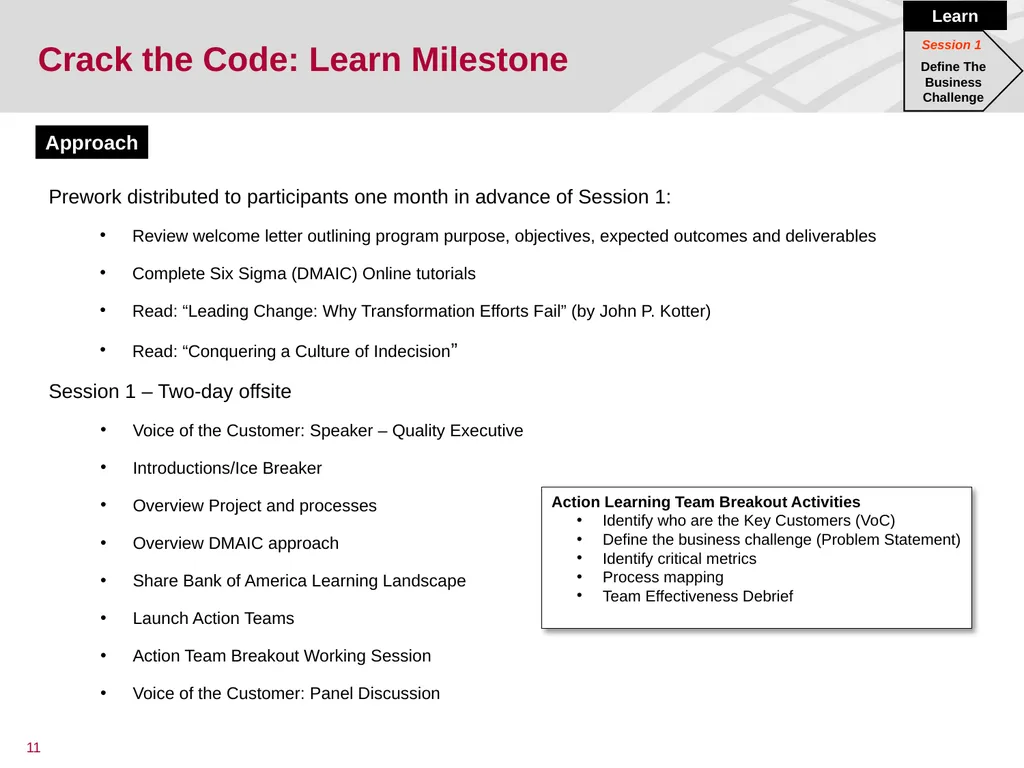
slide11. Crack the Code: Learn Milestone 11 Session 1
Define The Business Challenge Learn Approach Prework distributed to participants one month in advance of Session 1:
Review welcome letter outlining program purpose, objectives, expected outcomes and deliverables
Complete Six Sigma (DMAIC) Online tutorials
Read: “Leading Change: Why Transformation Efforts Fail” (by John P. Kotter)
Read: “Conquering a Culture of Indecision”
Session 1 – Two-day offsite
Voice of the Customer: Speaker – Quality Executive
Introductions/Ice Breaker
Overview Project and processes
Overview DMAIC approach
Share Bank of America Learning Landscape
Launch Action Teams
Action Team Breakout Working Session
Voice of the Customer: Panel Discussion Action Learning Team Breakout Activities
Identify who are the Key Customers (VoC)
Define the business challenge (Problem Statement)
Identify critical metrics
Process mapping
Team Effectiveness Debrief<br>
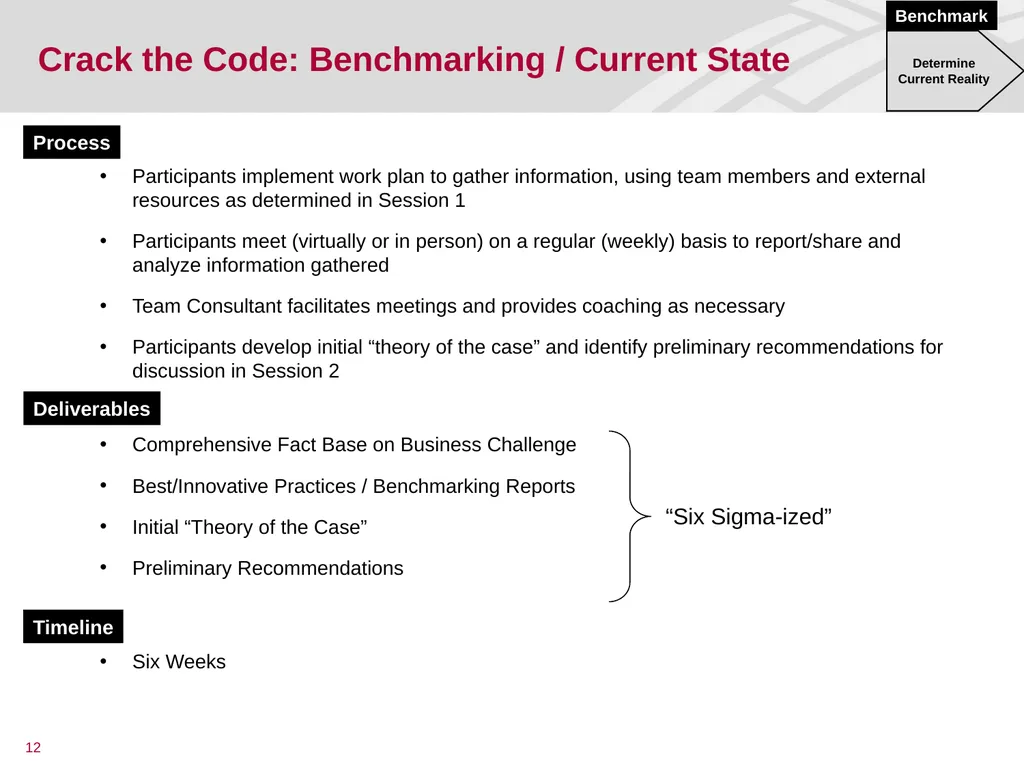
slide12. Crack the Code: Benchmarking / Current State 12 Process Participants implement work plan to gather information, using team members and external resources as determined in Session 1
Participants meet (virtually or in person) on a regular (weekly) basis to report/share and analyze information gathered
Team Consultant facilitates meetings and provides coaching as necessary
Participants develop initial “theory of the case” and identify preliminary recommendations for discussion in Session 2 Determine Current Reality Benchmark Deliverables Comprehensive Fact Base on Business Challenge
Best/Innovative Practices / Benchmarking Reports
Initial “Theory of the Case”
Preliminary Recommendations “Six Sigma-ized” Timeline Six Weeks<br>
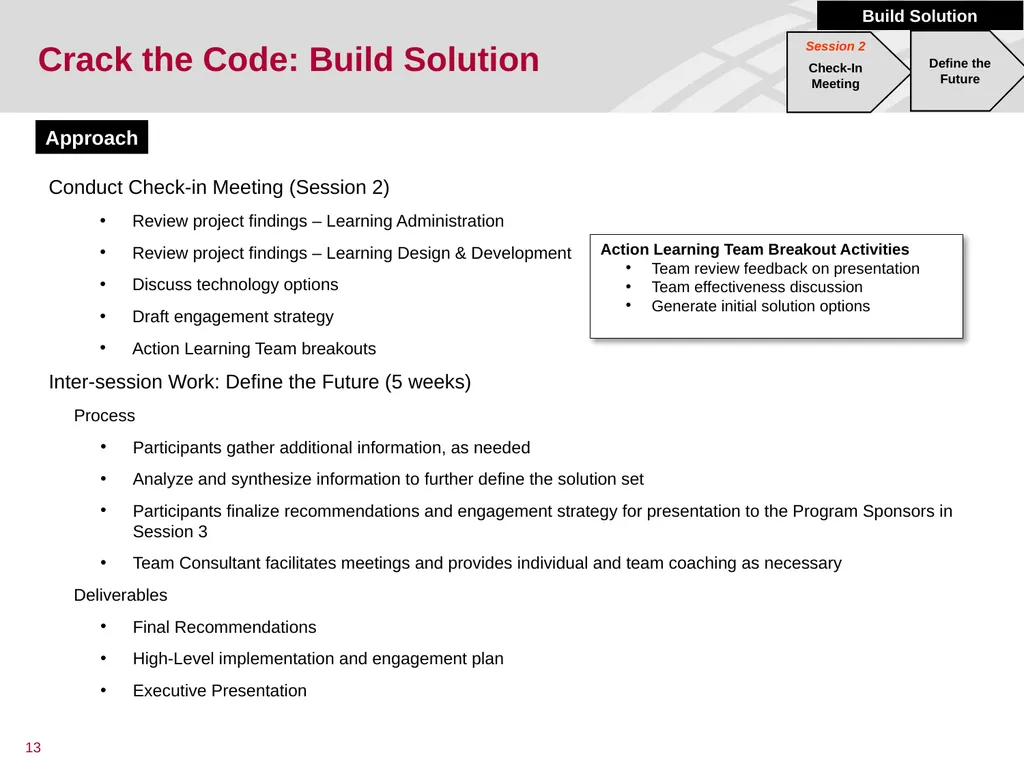
slide13. Crack the Code: Build Solution 13 Approach Conduct Check-in Meeting (Session 2)
Review project findings – Learning Administration
Review project findings – Learning Design & Development
Discuss technology options
Draft engagement strategy
Action Learning Team breakouts
Inter-session Work: Define the Future (5 weeks)
Process
Participants gather additional information, as needed
Analyze and synthesize information to further define the solution set
Participants finalize recommendations and engagement strategy for presentation to the Program Sponsors in Session 3
Team Consultant facilitates meetings and provides individual and team coaching as necessary
Deliverables
Final Recommendations
High-Level implementation and engagement plan
Executive Presentation Action Learning Team Breakout Activities
Team review feedback on presentation
Team effectiveness discussion
Generate initial solution options Session 2
Check-In Meeting Build Solution Define the Future<br>
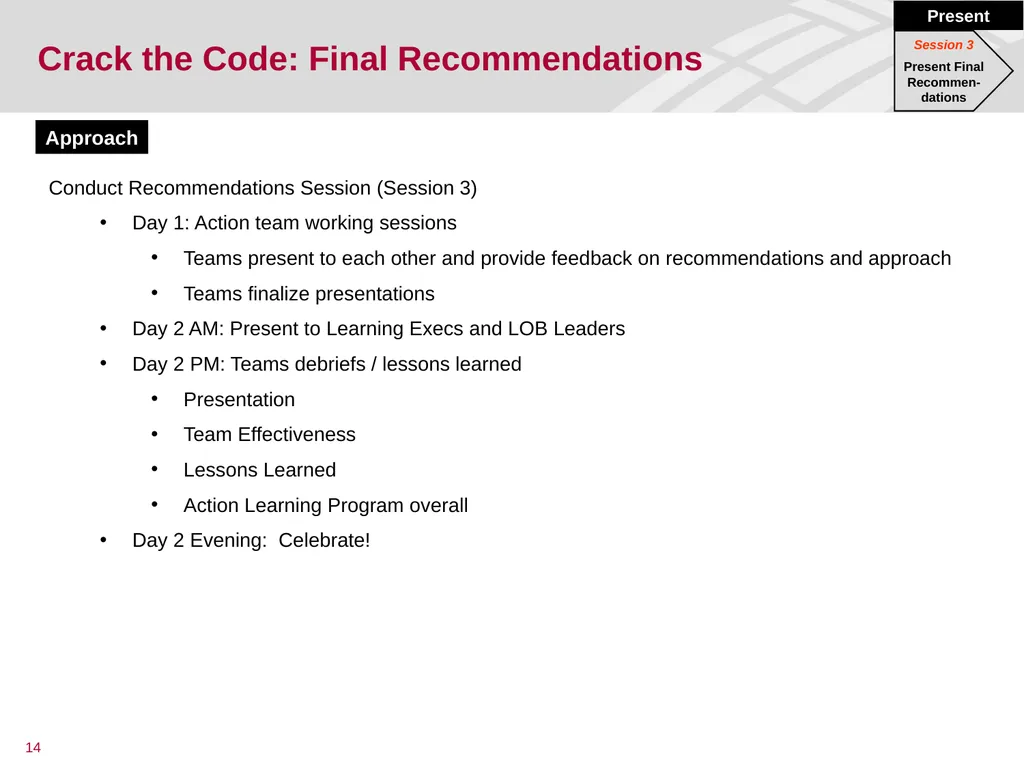
slide14. Crack the Code: Final Recommendations 14 Approach Conduct Recommendations Session (Session 3)
Day 1: Action team working sessions
Teams present to each other and provide feedback on recommendations and approach
Teams finalize presentations
Day 2 AM: Present to Learning Execs and LOB Leaders
Day 2 PM: Teams debriefs / lessons learned
Presentation
Team Effectiveness
Lessons Learned
Action Learning Program overall
Day 2 Evening: Celebrate! Session 3
Present Final Recommen-dations Present<br>
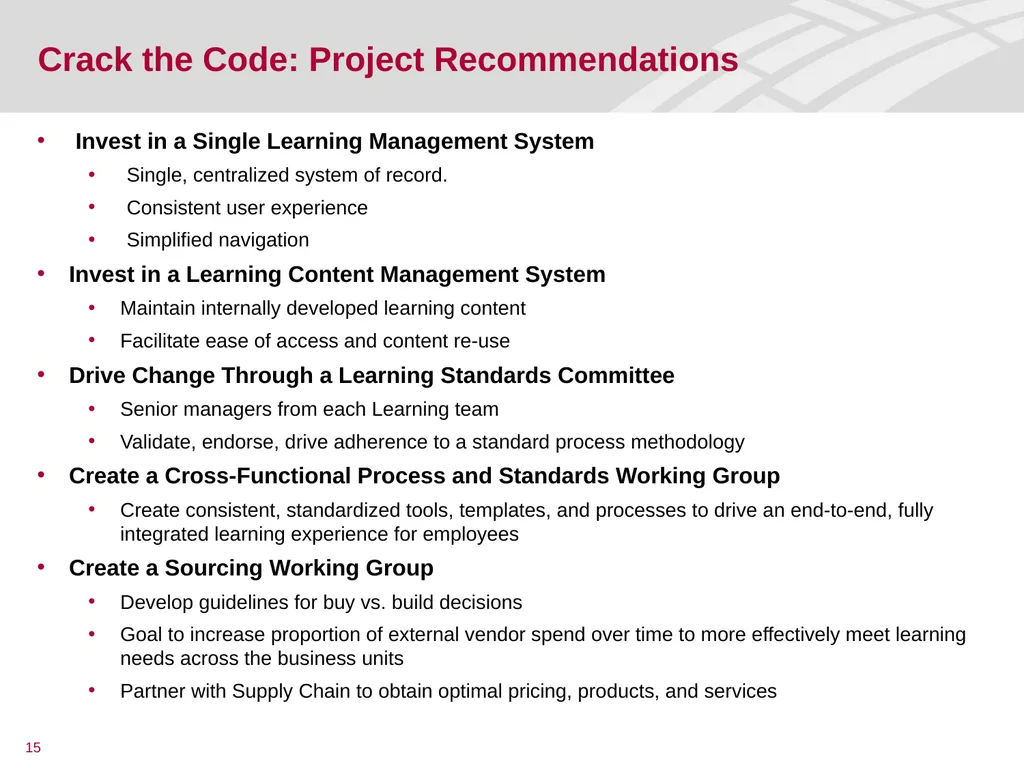
slide15. Crack the Code: Project Recommendations 15 Invest in a Single Learning Management System
Single, centralized system of record.
Consistent user experience
Simplified navigation
Invest in a Learning Content Management System
Maintain internally developed learning content
Facilitate ease of access and content re-use
Drive Change Through a Learning Standards Committee
Senior managers from each Learning team
Validate, endorse, drive adherence to a standard process methodology
Create a Cross-Functional Process and Standards Working Group
Create consistent, standardized tools, templates, and processes to drive an end-to-end, fully integrated learning experience for employees
Create a Sourcing Working Group
Develop guidelines for buy vs. build decisions
Goal to increase proportion of external vendor spend over time to more effectively meet learning needs across the business units
Partner with Supply Chain to obtain optimal pricing, products, and services<br>
slide16. Crack the Code: Key Learnings - Six Sigma 16 Provided a clear, data-driven structure to ensure that the right level of facts, rigor, and discipline were put in place around the process.
Enabled the teams to avoid jumping to solutions too quickly, and to identify and implement solutions that address what is most critical to success.
Most challenging piece to follow through on is the control plan, due to emphasis on execution.<br>
slide17. Crack the Code: Key Learnings - Action Learning 17 Useful framework for high potential learning leaders to address significant business issues that are of strategic importance to the company.
Importance of building the discipline of reflection into the program, facilitated by team coaches, in order to achieve the program’s dual objectives.
A live “testing ground” to see who emerged as a leader for the future.
Enabled leaders to establish effective, mutually respectful working relationships with teammates across the organization to facilitate the integration and partnership necessary for the changes ahead.
Helped key talent form relationships with stakeholders that extended long after the project ended.
Team members learned the importance of identifying stakeholders early and manage them proactively throughout the process<br>
slide18. Conclusion Action Learning Works! 18<br>
slide2. 2 Crack the Code: Driving Learning at BAC Through Action Learning<br>
slide3. Crack the Code: Driving Learning at BAC Through Action Learning 3 Development Objectives As a result of program participation, participants will:
Gain an increased understanding of critical business challenges and the Learning Organization’s opportunity to positively impact those challenges
Develop a deeper and broader understanding of the Learning organization’s current state in supporting enterprise and line of business strategic objectives
Enhance their ability to apply Six Sigma/DMAIC methods and tools to address critical business challenges and close gaps
Build increased knowledge of best practice companies and best/innovative practices in Learning, and develop a point of view on how they can be effectively implemented at BAC 25+ high potential employees in the Learning organization who are top notch thinkers and executors Participants<br>
slide4. Action Learning Defined Working on authentic, urgent business problems/ opportunities in diverse, cross-organization teams to grow the business and develop participants<br>
slide5. Crack the Code: High Level Program Design 5 Define Business Challenge Identify Critical Business Issues& Participants Determine Current Reality Deliverables Learning Execs define Business Challenges
Build participant content knowledge on the topic
Participants frame up issues & work plan Check-In Meeting Debate preliminary recommend-ations
Check in with program sponsors
Dialogue with LOB Partners
Frame up Issues and Challenges Present Final Recommendations Define the Future Gather additional information and analyze
Generate final reports
Finalize recommend-ations Implement Gather information
Benchmark best practice companies & other external practices
Develop initial theory of the case Present specific solutions and supporting rationale to Learning Execs & LOB Partners
Learning Execs commit to act
Feedback given to team on process and solutions Plan Present Learn Learning Executives select strategic learning issues
Identify participants
Confirm & schedule participants Benchmark Build Solution Timing March 10-11 April 24-25 April 26 - June 3 June 4-5 Action Team Time 2 days 4-5 days 2 days 3 days March 12 - April 23 2 days 13-14 days 90+/- days Total Time Milestone January - February Session 1 Session 2 Session 3<br>
slide6. Crack the Code: DMAIC Methodology 6 DMAIC is a process improvement discipline that uses facts and data to meet customer needs and requirements.<br>
slide7. Crack the Code: Project / Six Sigma / Action Learning Integration DMAIC Deliverables Analyze Improve Champion Project Team Learning Executives Roles Problem Statement
Financial Assessment
Business Case/ Objectives
Audience Impact
Hi-level Process Map
Project type (DFSS, GB/BB, JDI)
Core Team
Baseline Data
VOC, CTQ’s
Benchmark Analysis CTQs and Specs
Process Capability
Detailed Process Map
FMEA
Stratified Data, Pareto
MSA
Financial Assessment (COPQ, Finance sign-off)
Issues & Barriers Prioritization of X’s
Vital few X’s identified
Statistical Root Cause verification (sample size, hypothesis testing, graphical)
Y=f(x) model New Process Map
Pilot Plan
Impact validated
Implementation Plan
Process Changes Identified
New Capability Estimated
Communication Plan for Changes Measure Define Learning Executives Define Business Challenge Identify Critical Business Issues& Participants Determine Current Reality Check-In Meeting Present Final Recommendations Define the Future Implement Plan Present Learn Benchmark Build Solution Milestone Session 1 Session 2 Session 3 Feedback Reflection Coaching A C T I O N L E A R N I N G<br>
slide8. Crack the Code: Program Framework 8<br>
slide9. Crack the Code: Learning Framework 9 Learning
Planning Learning Design & Development Learning Delivery Learning Administration Relationship Management Demand Management Learning/ Curriculum Plan Management Content Development & Maintenance Knowledge Management Content Strategy Content Management & Access Delivery Execution Delivery Planning Delivery Operations Course Catalog Management Learner Administration User Management Learning
Operations Vendor Management Performance Reporting Financial Management Technology Infrastructure Action Team #1 Scope Action Team #2 Scope<br>
slide10. Crack the Code: Key Questions to Address 10 Learning Design & Development
How do we optimize the investment in and management of processes, tools, programs and technology relating to the design and development of learning for both individual lines of business and the enterprise? Learning Administration
How do we optimize the investment in and management of processes, tools, programs and technology relating to the administration of learning for both individual lines of business and the enterprise? Two Business Challenges to Solve Key Questions Session 1: Define the Business Challenge What problem are we trying to address, and how will we address it? Interim: Determine Current Reality What is the “As Is” state with respect to the business challenge?
What are the critical gaps between where we are today and where we need to be? Session 2: Check-in Meeting What feedback and guidance do our Sponsors and LOB Partners have to help guide our next steps?
What is our action plan for defining the future “To Be” state? Interim: Define the Future What is the desired “To Be” state with respect to the business challenge? Session 3: Present Final Recommendations How will we present our recommendations and gain the necessary commitment from our Sponsors and LOB Partners to take action?<br>
slide11. Crack the Code: Learn Milestone 11 Session 1
Define The Business Challenge Learn Approach Prework distributed to participants one month in advance of Session 1:
Review welcome letter outlining program purpose, objectives, expected outcomes and deliverables
Complete Six Sigma (DMAIC) Online tutorials
Read: “Leading Change: Why Transformation Efforts Fail” (by John P. Kotter)
Read: “Conquering a Culture of Indecision”
Session 1 – Two-day offsite
Voice of the Customer: Speaker – Quality Executive
Introductions/Ice Breaker
Overview Project and processes
Overview DMAIC approach
Share Bank of America Learning Landscape
Launch Action Teams
Action Team Breakout Working Session
Voice of the Customer: Panel Discussion Action Learning Team Breakout Activities
Identify who are the Key Customers (VoC)
Define the business challenge (Problem Statement)
Identify critical metrics
Process mapping
Team Effectiveness Debrief<br>
slide12. Crack the Code: Benchmarking / Current State 12 Process Participants implement work plan to gather information, using team members and external resources as determined in Session 1
Participants meet (virtually or in person) on a regular (weekly) basis to report/share and analyze information gathered
Team Consultant facilitates meetings and provides coaching as necessary
Participants develop initial “theory of the case” and identify preliminary recommendations for discussion in Session 2 Determine Current Reality Benchmark Deliverables Comprehensive Fact Base on Business Challenge
Best/Innovative Practices / Benchmarking Reports
Initial “Theory of the Case”
Preliminary Recommendations “Six Sigma-ized” Timeline Six Weeks<br>
slide13. Crack the Code: Build Solution 13 Approach Conduct Check-in Meeting (Session 2)
Review project findings – Learning Administration
Review project findings – Learning Design & Development
Discuss technology options
Draft engagement strategy
Action Learning Team breakouts
Inter-session Work: Define the Future (5 weeks)
Process
Participants gather additional information, as needed
Analyze and synthesize information to further define the solution set
Participants finalize recommendations and engagement strategy for presentation to the Program Sponsors in Session 3
Team Consultant facilitates meetings and provides individual and team coaching as necessary
Deliverables
Final Recommendations
High-Level implementation and engagement plan
Executive Presentation Action Learning Team Breakout Activities
Team review feedback on presentation
Team effectiveness discussion
Generate initial solution options Session 2
Check-In Meeting Build Solution Define the Future<br>
slide14. Crack the Code: Final Recommendations 14 Approach Conduct Recommendations Session (Session 3)
Day 1: Action team working sessions
Teams present to each other and provide feedback on recommendations and approach
Teams finalize presentations
Day 2 AM: Present to Learning Execs and LOB Leaders
Day 2 PM: Teams debriefs / lessons learned
Presentation
Team Effectiveness
Lessons Learned
Action Learning Program overall
Day 2 Evening: Celebrate! Session 3
Present Final Recommen-dations Present<br>
slide15. Crack the Code: Project Recommendations 15 Invest in a Single Learning Management System
Single, centralized system of record.
Consistent user experience
Simplified navigation
Invest in a Learning Content Management System
Maintain internally developed learning content
Facilitate ease of access and content re-use
Drive Change Through a Learning Standards Committee
Senior managers from each Learning team
Validate, endorse, drive adherence to a standard process methodology
Create a Cross-Functional Process and Standards Working Group
Create consistent, standardized tools, templates, and processes to drive an end-to-end, fully integrated learning experience for employees
Create a Sourcing Working Group
Develop guidelines for buy vs. build decisions
Goal to increase proportion of external vendor spend over time to more effectively meet learning needs across the business units
Partner with Supply Chain to obtain optimal pricing, products, and services<br>
slide16. Crack the Code: Key Learnings - Six Sigma 16 Provided a clear, data-driven structure to ensure that the right level of facts, rigor, and discipline were put in place around the process.
Enabled the teams to avoid jumping to solutions too quickly, and to identify and implement solutions that address what is most critical to success.
Most challenging piece to follow through on is the control plan, due to emphasis on execution.<br>
slide17. Crack the Code: Key Learnings - Action Learning 17 Useful framework for high potential learning leaders to address significant business issues that are of strategic importance to the company.
Importance of building the discipline of reflection into the program, facilitated by team coaches, in order to achieve the program’s dual objectives.
A live “testing ground” to see who emerged as a leader for the future.
Enabled leaders to establish effective, mutually respectful working relationships with teammates across the organization to facilitate the integration and partnership necessary for the changes ahead.
Helped key talent form relationships with stakeholders that extended long after the project ended.
Team members learned the importance of identifying stakeholders early and manage them proactively throughout the process<br>
slide18. Conclusion Action Learning Works! 18<br>