04
Impact of reduction in noise and reverberation time After acoustic treatment in their classrooms, teachers and communication support workers reported:
“Overwhelming improvement in working conditions”
“Quieter and calmer”<br>
05
Impact of reduction in noise and reverberation time “Less stress”
“Improvement in behaviour of all children including deaf children”
“Profound effect on the educational experience”<br>
06
Sound simulation Hear for yourself how improving with your classroom’s acoustics can help a child with a high frequency hearing loss
www.ndcs.org.uk/simulation<br>
07
Acoustic requirements To have good listening and speaking conditions a classroom must have:
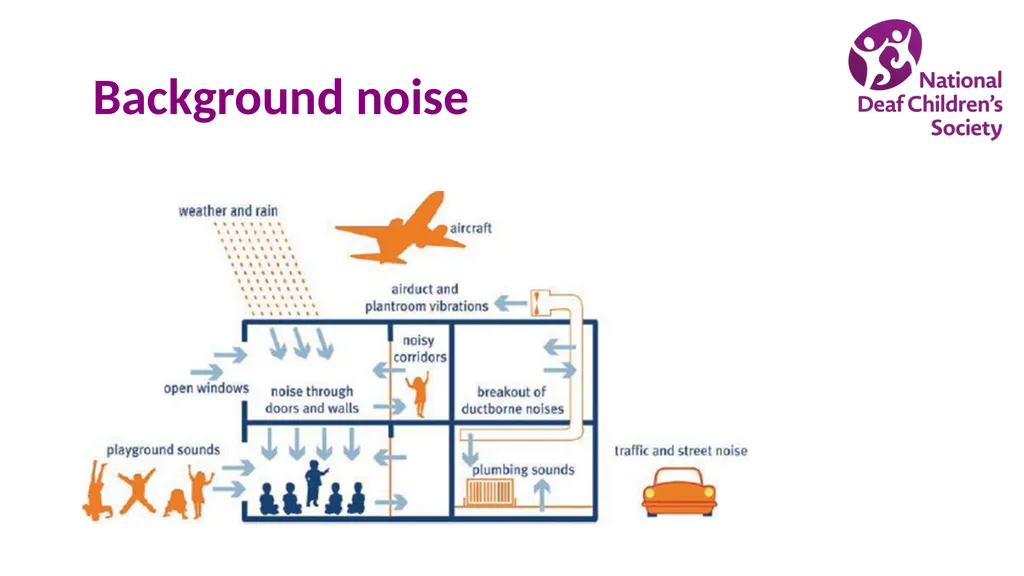
low background noise
shorter reverberation time (reduction in echo)
good sound insulation between classrooms and outside.<br>
08
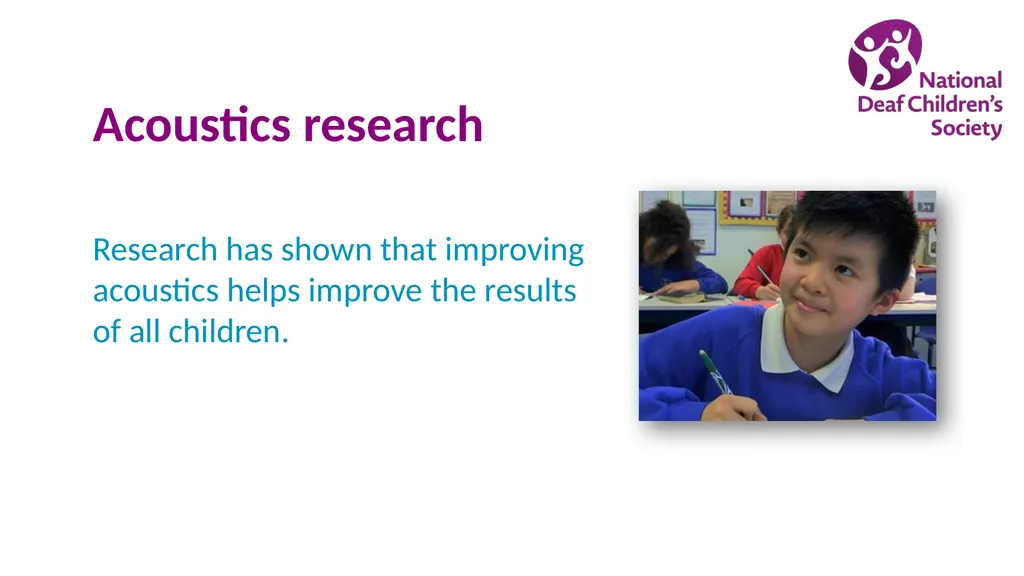
Acoustics research Research has shown that improving acoustics helps improve the results �of all children.<br>
09
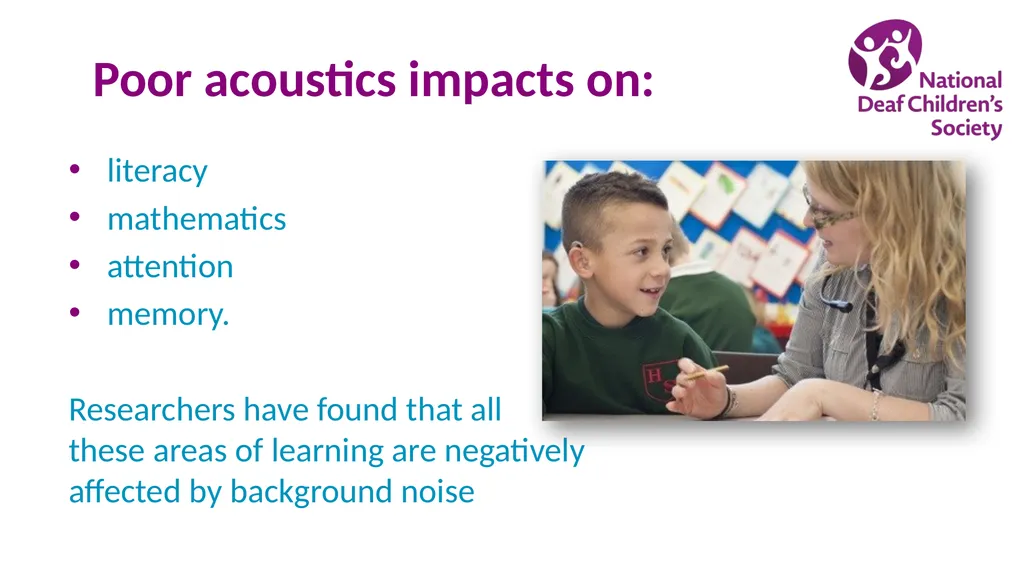
Poor acoustics impacts on: literacy
mathematics
attention
memory.
Researchers have found that all these areas of learning are negatively affected by background noise<br>
10
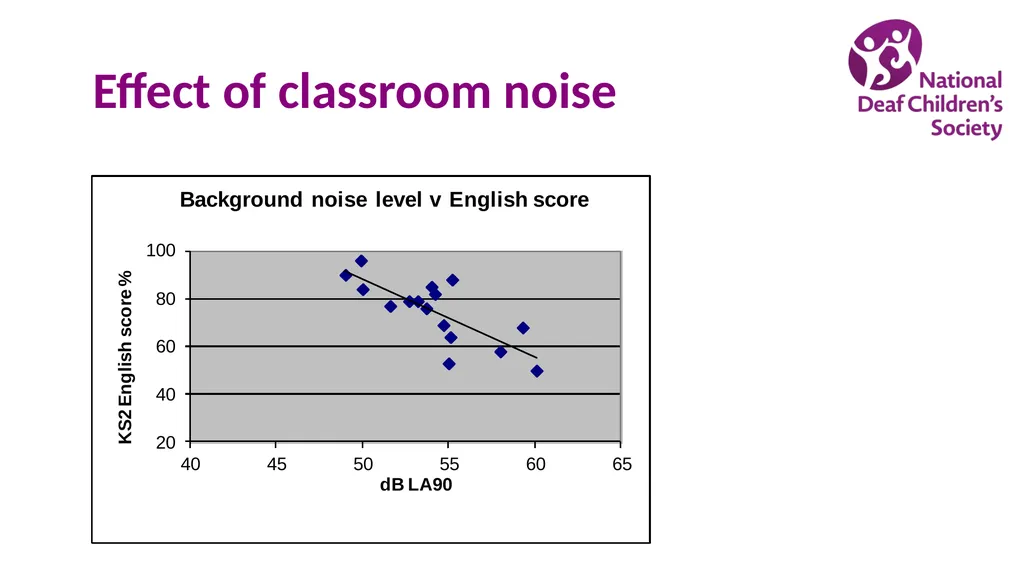
The problem with noise Tasks that involve language, such as reading and word problems in mathematics, and those that have high cognitive processing demands involving attention, problem solving and memory appear to be particularly vulnerable to exposure to noise<br>
11
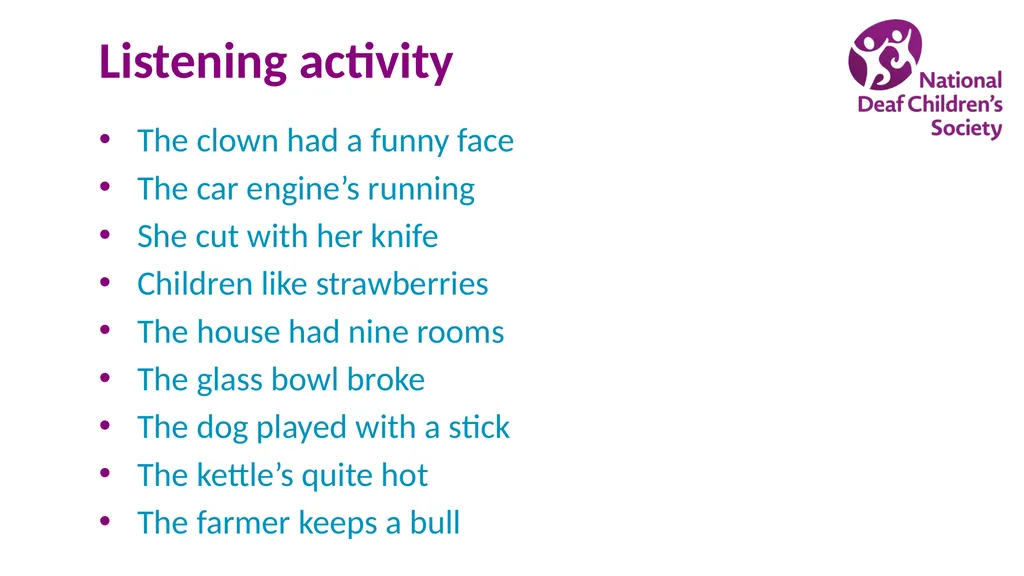
Listening activity Have a pen and some scrap paper ready
Listening in quiet
Listening in simulated classroom noise
Listening in noise with no access to lip-reading<br>
12
Listening activity The clown had a funny face
The car engine’s running
She cut with her knife
Children like strawberries
The house had nine rooms
The glass bowl broke
The dog played with a stick
The kettle’s quite hot
The farmer keeps a bull<br>
13
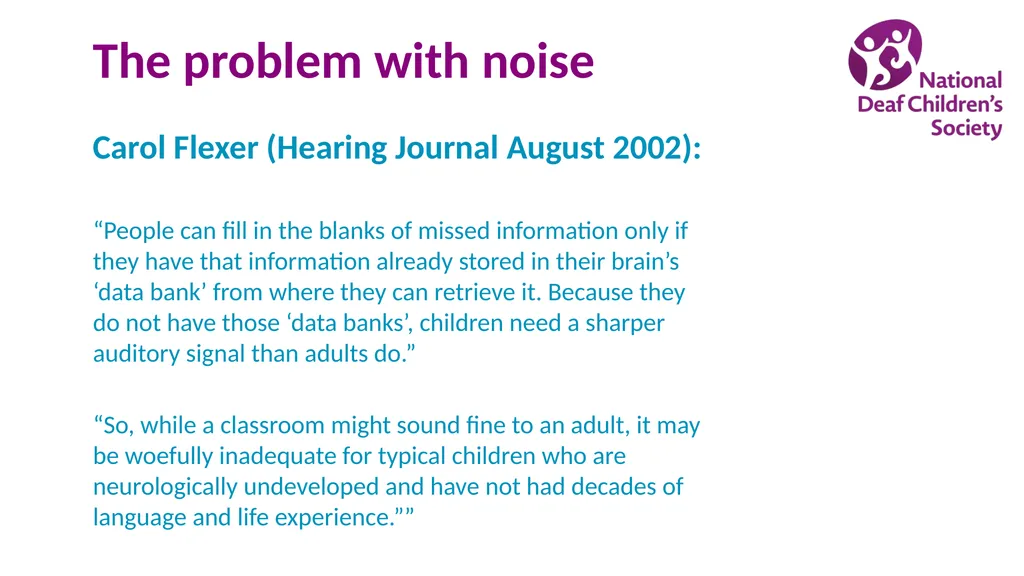
The problem with noise Carol Flexer (Hearing Journal August 2002):
�“People can fill in the blanks of missed information only if they have that information already stored in their brain’s ‘data bank’ from where they can retrieve it. Because they do not have those ‘data banks’, children need a sharper auditory signal than adults do.”
“So, while a classroom might sound fine to an adult, it may be woefully inadequate for typical children who are neurologically undeveloped and have not had decades of language and life experience.””<br>
14
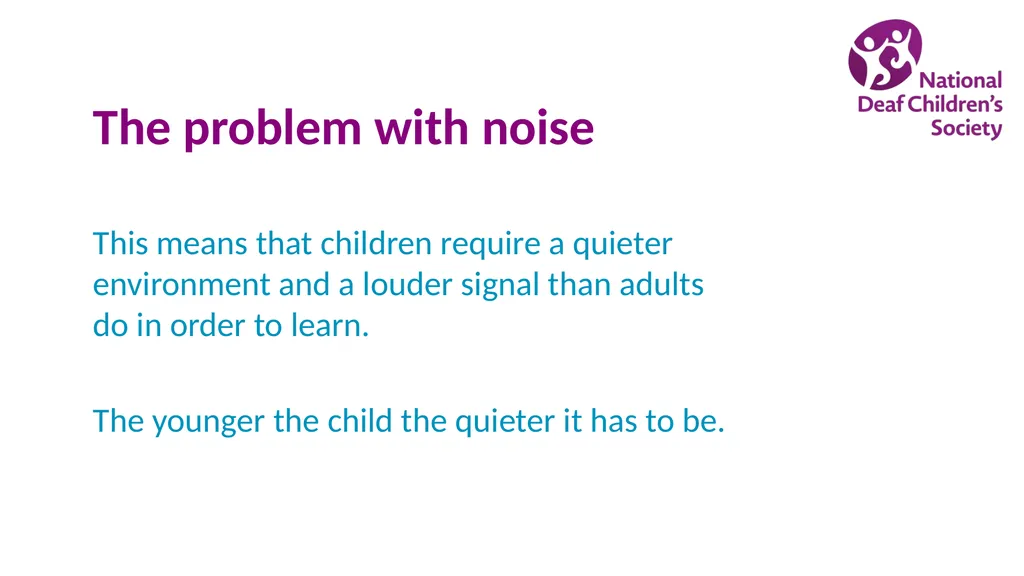
The problem with noise This means that children require a quieter environment and a louder signal than adults do in order to learn.
The younger the child the quieter it has to be.<br>
15
Effect of classroom noise<br>
16
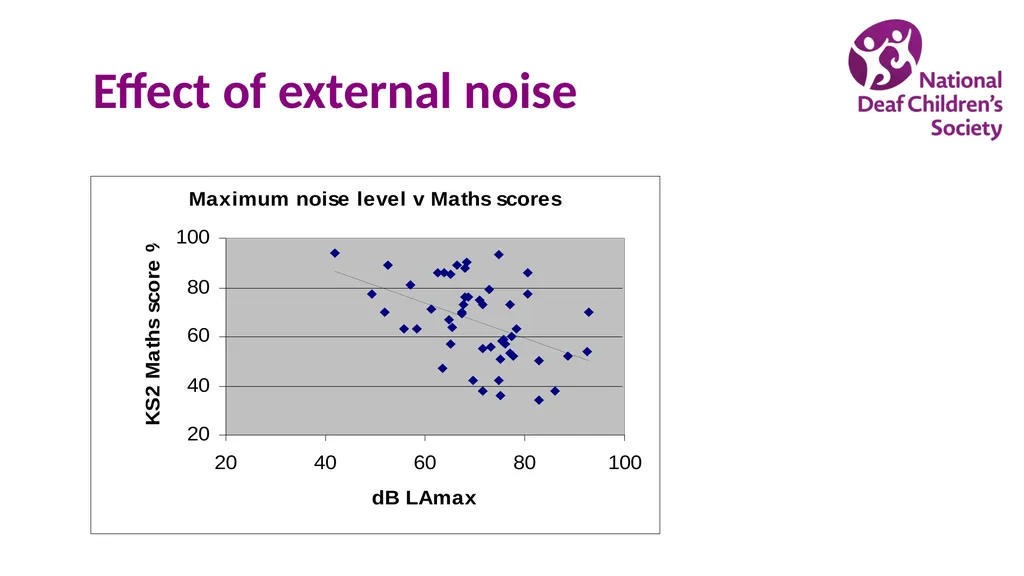
Effect of external noise<br>
17
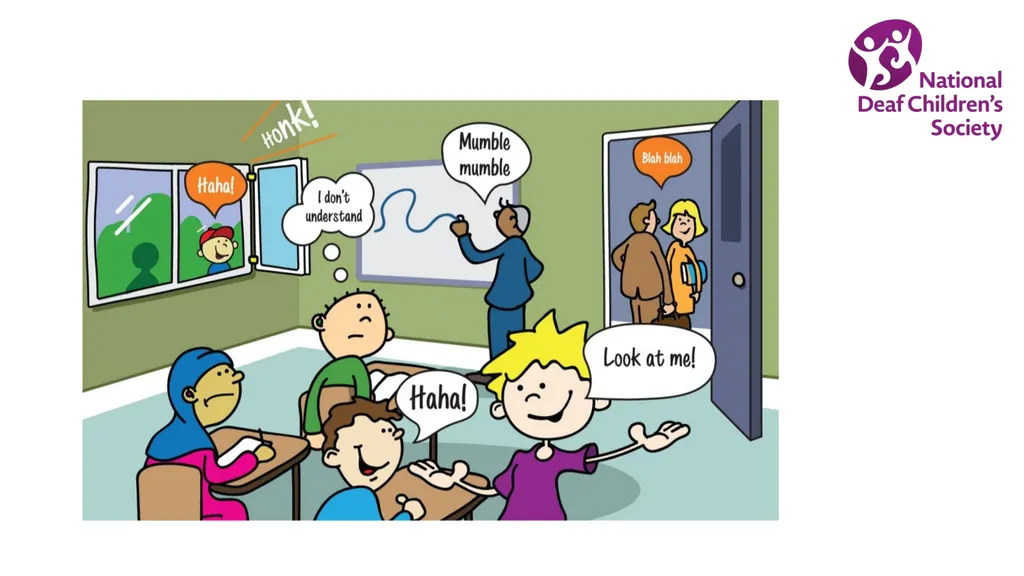
Look at the following picture List how many sources of noise there are in the picture
Think of your classroom or school
Repeat the list for your classroom<br>
19
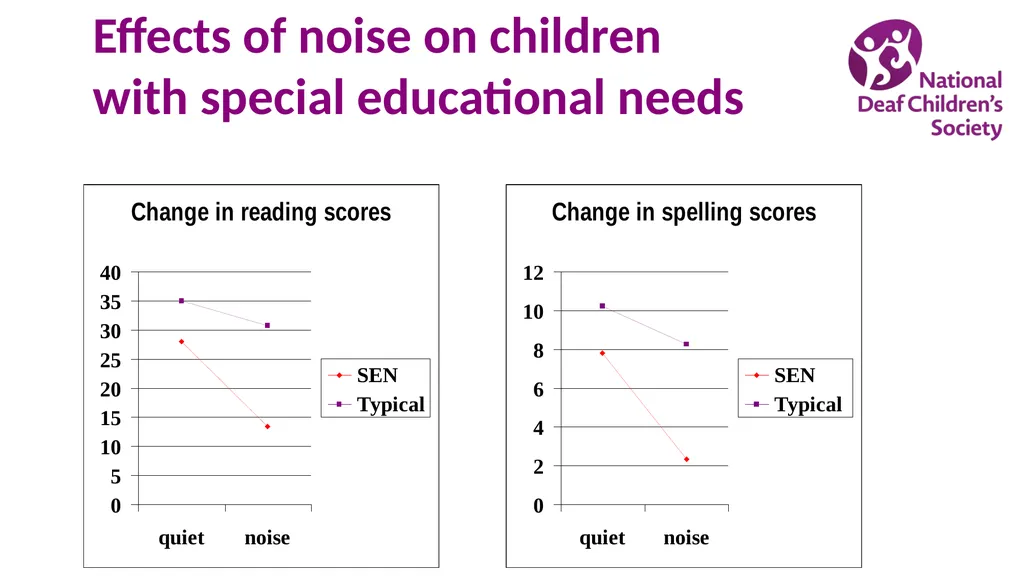
Effects of noise on children with special educational needs<br>
20
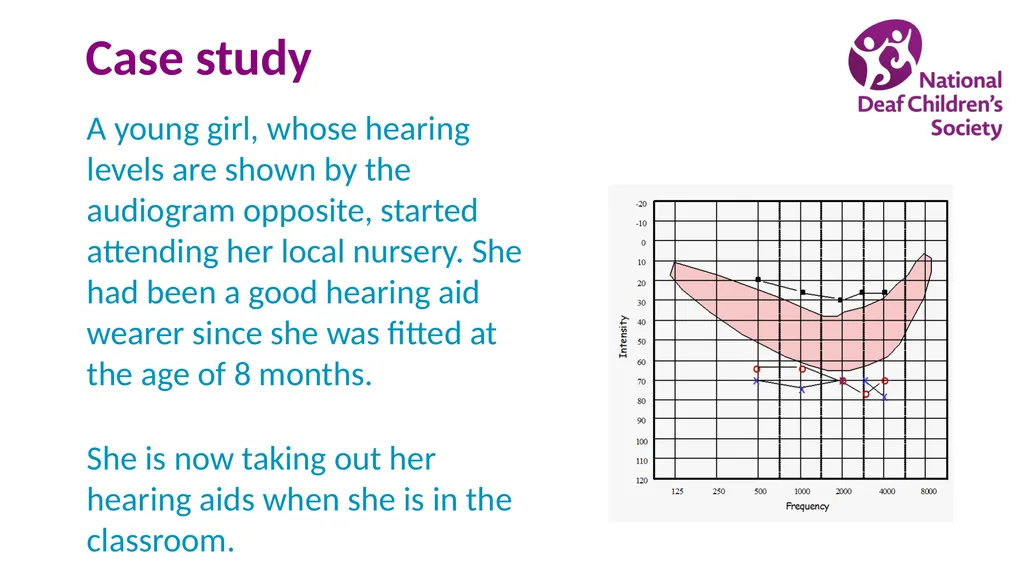
Case study A young girl, whose hearing levels are shown by the audiogram opposite, started attending her local nursery. She had been a good hearing aid wearer since she was fitted at the age of 8 months. She is now taking out her hearing aids when she is in the classroom.<br>
21
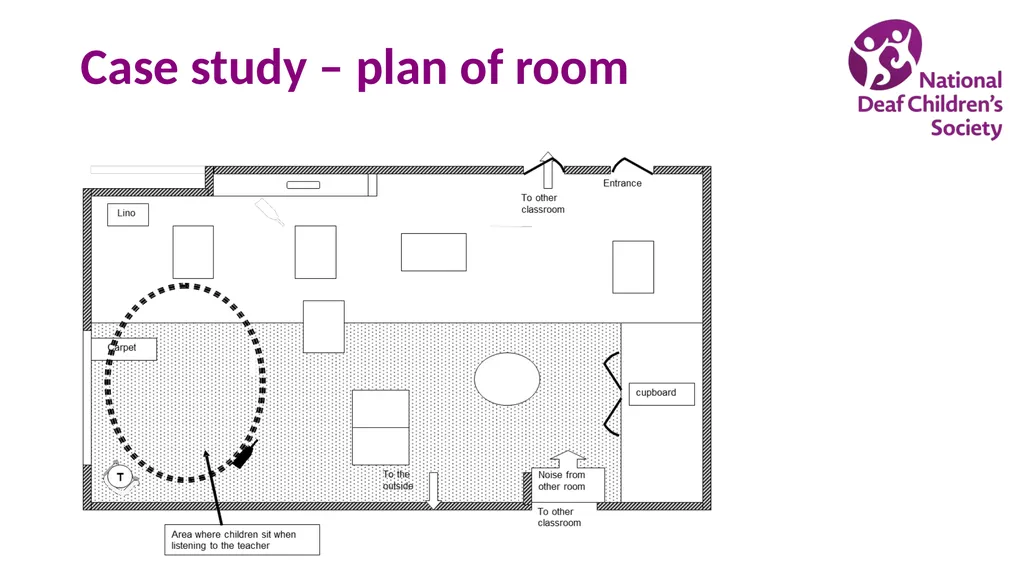
Case study – plan of room<br>
22
Case study It was noticed that:
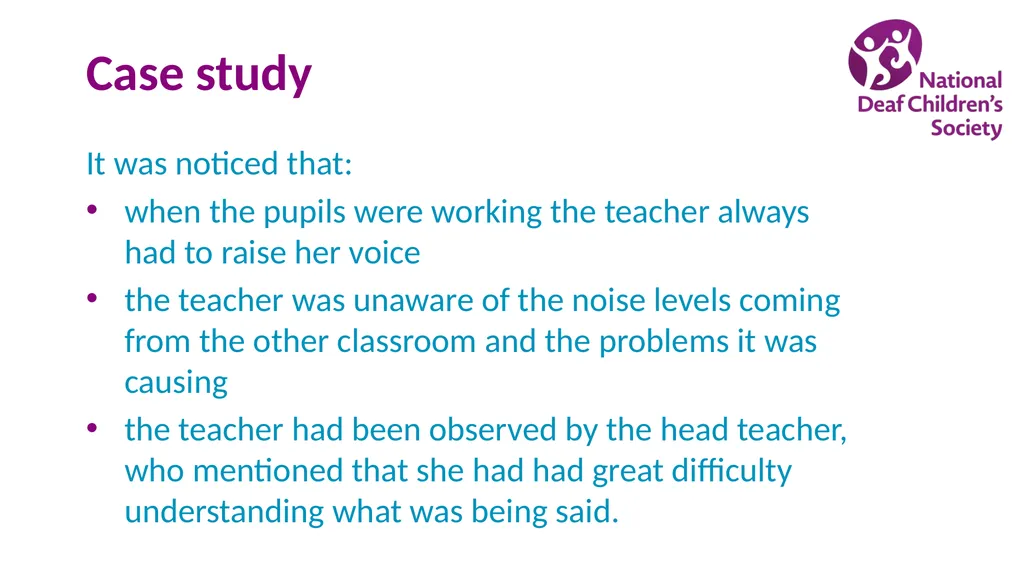
when the pupils were working the teacher always had to raise her voice
the teacher was unaware of the noise levels coming from the other classroom and the problems it was causing
the teacher had been observed by the head teacher, who mentioned that she had had great difficulty understanding what was being said.<br>
23
Case study So imagine being a deaf child in that class...
The Teacher of the Deaf advised on improving the acoustics to reduce background noise, and the girl’s hearing aid use improved.<br>
24
Signal to noise ratio The signal to noise ratio is a measure of how loud a sound is in relation to background noise.
This is usually the teacher’s voice against background noise, but it could be information from the interactive smart board or from other children in the group<br>
25
Signal to noise ratio British Association of Teachers of the Deaf:
For hearing impaired students of all ages the teacher’s voice needs to be at least 20dB louder than the background noise in a classroom.<br>
26
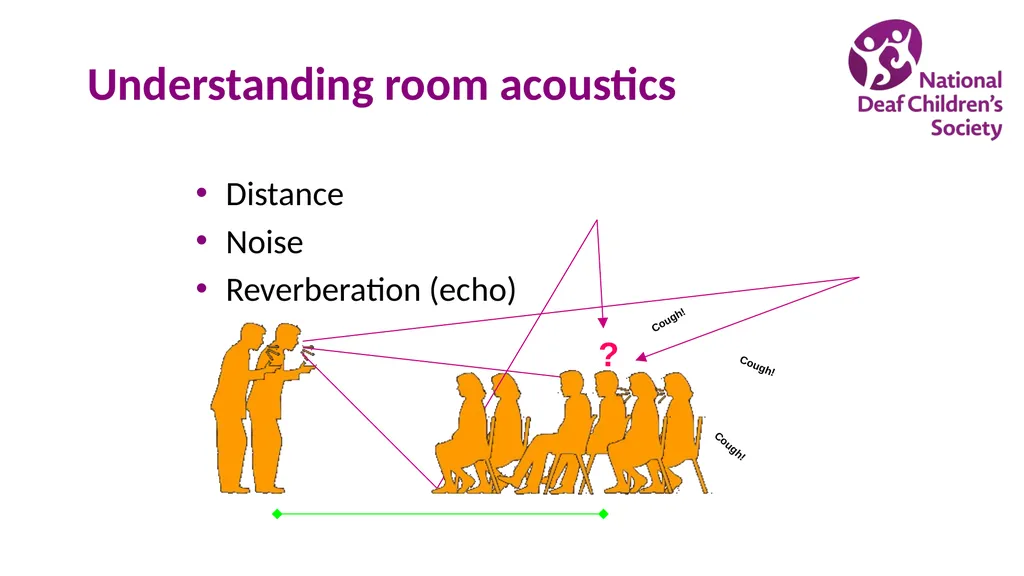
Reverberation (echo)�times Reverberation occurs when the sound from the source has stopped, but echoes from the sound continue in the room.
If the surfaces have a low absorbency then the sound may bounce around the room, arriving at the child’s ear at different times and making it difficult to listen to the message.<br>
27
Understanding room acoustics Distance
Noise
Reverberation (echo) ? Cough! Cough! Cough!<br>
28
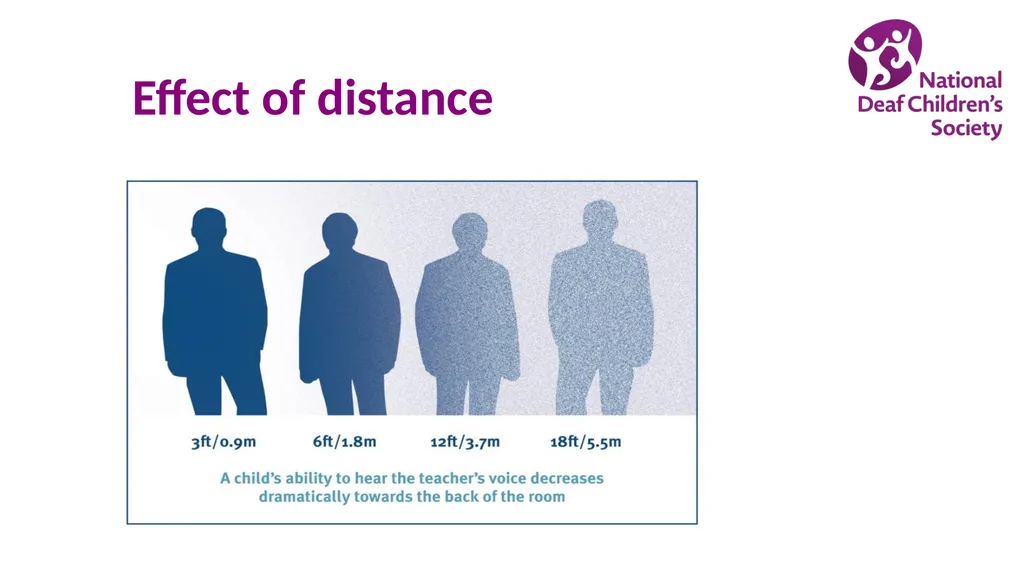
Effect of distance<br>
29
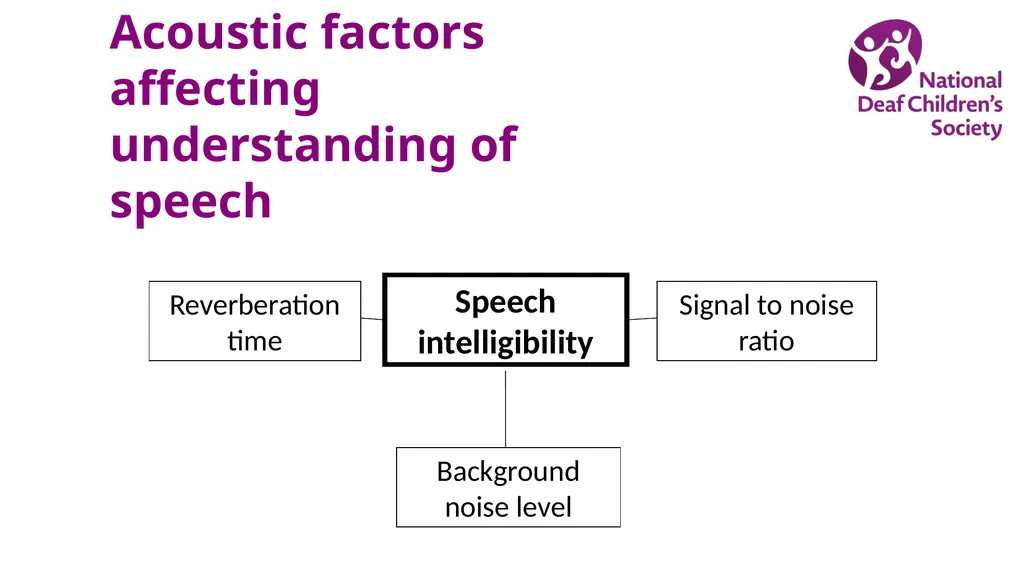
Speech intelligibility Reverberation time Signal to noise ratio Background noise level Acoustic factors affecting understanding of speech<br>
30
Video summary https://www.ndcs.org.uk/information-and-support/being-deaf-friendly/information-for-professionals/here-to-learn/watch-our-here-to-learn-videos/reducing-background-noise/
National Deaf Children’s Society, Here to Learn<br>
31
Apps to help Too Noisy app
itunes.apple.com/gb/app/id521646496?mt=8&affId=1720307<br>
32
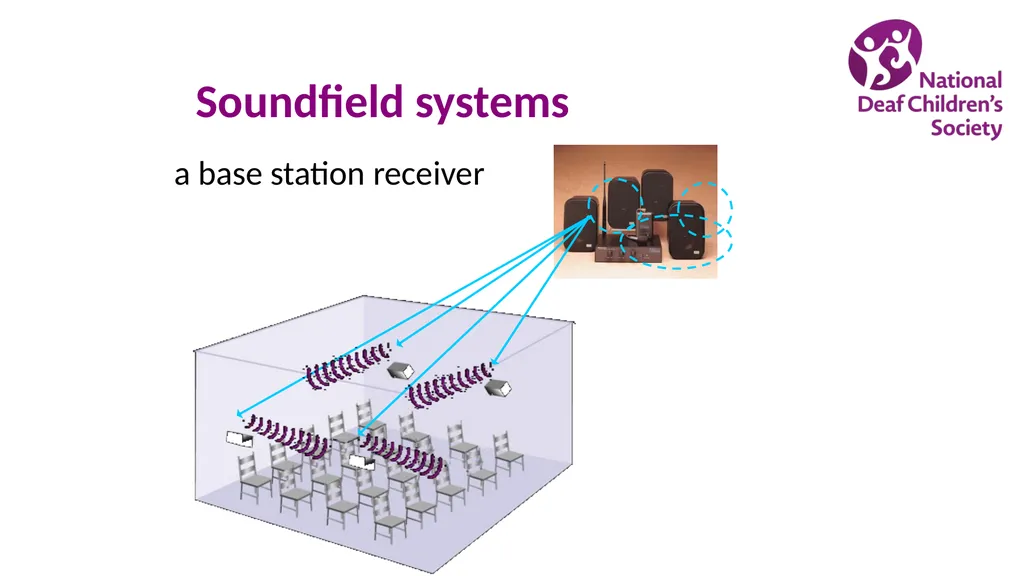
Amplification in the classroom Soundfield systems help to provide all children in the classroom with an equal sound signal wherever they are sitting.
These systems are useful, but they need to be regularly checked and maintained, and do not solve all acoustical problems.
They must be installed correctly and the teachers trained in their use.<br>
33
a base station receiver Soundfield systems<br>
34
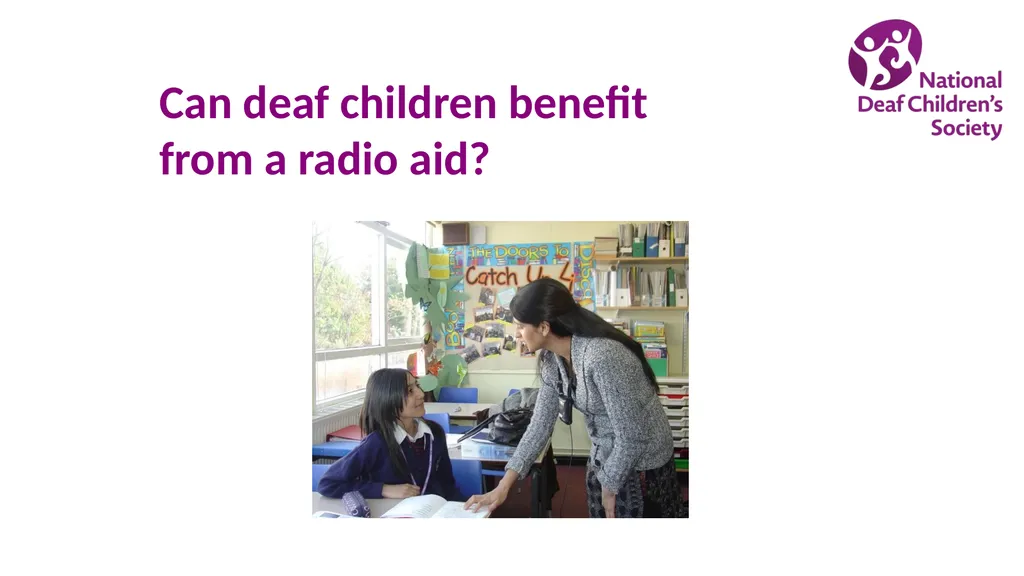
Can deaf children benefit from a radio aid?<br>
35
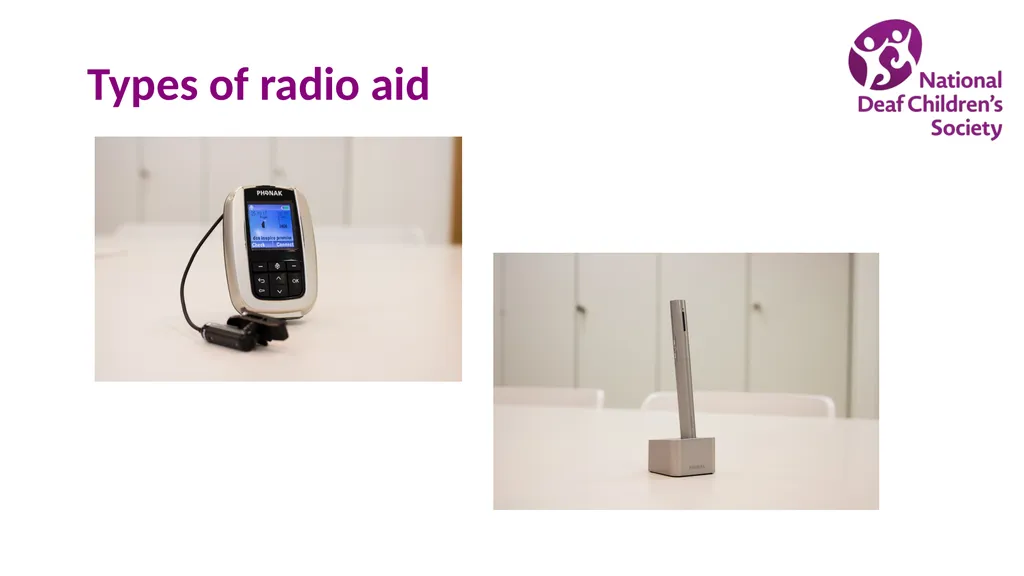
Types of radio aid<br>
36
Can deaf children benefit from a radio aid? A radio aid, set for a particular child’s hearing loss, will help to reduce the effects of background noise and improve the signal to noise ratio. It needs to be used in a good acoustic learning environment for the child to benefit from its use.
Video:
www.youtube.com/watch?v=McOiYgBGf0s<br>
37
Can deaf children benefit from a radio aid? “The teacher’s voices are very clear most of the time, even when my friends are talking in class. Lip-reading is much easier as there is no delay between the lip movements and hearing the teacher’s voice.” (deaf pupil, aged 13)
“Classrooms are loud and busy places. Using a radio aid helped my daughter feel involved.”<br>
38
Can deaf children benefit from a radio aid? “The radio aid has made a huge difference to him. Everything has changed – his attitude and behaviour. He was struggling with school, he was below average and now he’s above average.”
“She can hear people better through the sound of screaming children (at Brownies). She’s able to communicate more directly when surrounded by other people.”<br>
39
Statutory The Education (School Premises) Regulations 2012
www.legislation.gov.uk/uksi/2012/1943/made<br>
40
Guidance Acoustic Design of Schools: Performance Standards
(Building Bulletin 93)
https://www.gov.uk/government/publications/bb93-acoustic-design-of-schools-performance-standards<br>
41
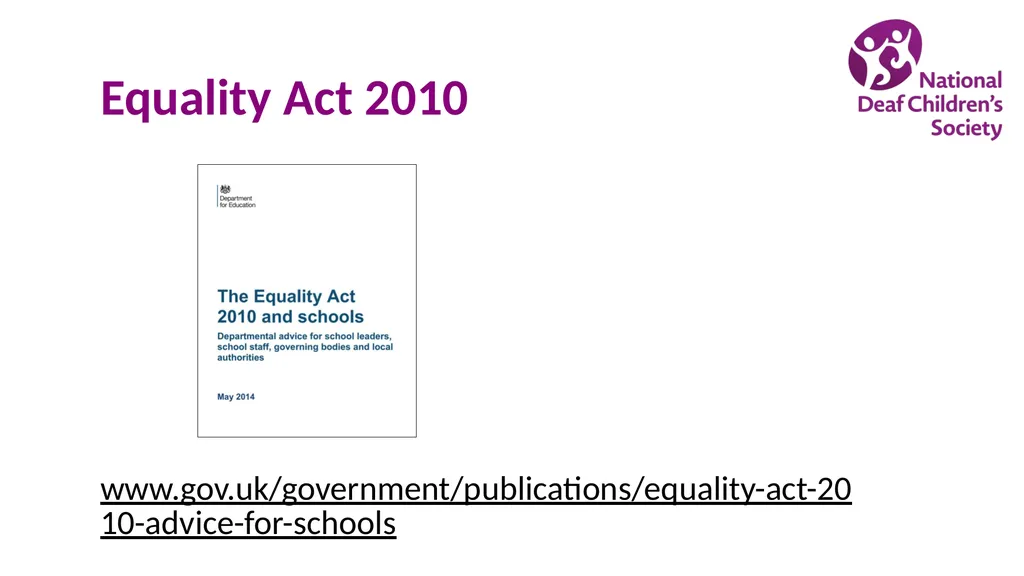
Equality Act 2010 www.gov.uk/government/publications/equality-act-2010-advice-for-schools<br>
42
What can we do Interviewi pupils and teachers using documents on the National Deaf Children’s Society website at www.ndcs.org.uk/acoustics.
Look at practical suggestions to help, as suggested in the National Deaf Children’s Society’s resource for teachers at www.ndcs.org.uk/acoustics.<br>
43
What can we do Discuss your concerns with a Teacher of the Deaf and your school leaders.
Consider an acoustic survey of the school by a qualified acoustician.<br>
44
More information More information on all the following is available on the National Deaf Children’s Society website
www.ndcs.org.uk<br>
45
Video Why Architects Need to Use Their Ears
www.ted.com/talks/julian_treasure_why_architects_need_to_use_their_ears<br>