
Critical Policy Analysis: “What’s the Problem
PT
Published · 36 slides · 0 views
1 / 1



Description
Critical Policy Analysis: Whats the Problem Represented to be? Carol Bacchi, Politics Department C I The tasks for today: To encourage us to rethink the meaning of a problem, especially (but not only) as it is used in relation to talk
Related Topics
Share
Embed code
Download this presentation From Below
"Critical Policy Analysis: “What’s the Problem" is the property of its rightful owner. Permission is granted to download and print the materials on this website for personal, non-commercial use only, and to display it on your personal computer provided you do not modify the materials and that you retain all copyright notices contained in the materials. By downloading content from our website, you accept the terms of this agreement.
Presentation Transcript
01
Critical Policy Analysis:
“What’s the Problem Represented to be?”
Carol Bacchi, Politics Department C
I<br>
I<br>
02
The tasks for today: To encourage us to rethink the meaning of a ‘problem’, especially (but not only) as it is used in relation to talk about policy
To highlight the political implications of how ‘problems’ are constituted as particular sorts of problems within policies.
Carol Bacchi
Professor Emerita of Politics
University of Adelaide, SA University of Adelaide 2<br>
To highlight the political implications of how ‘problems’ are constituted as particular sorts of problems within policies.
Carol Bacchi
Professor Emerita of Politics
University of Adelaide, SA University of Adelaide 2<br>
03
Conventional view of ‘problems’ and policy ‘Public policy addresses societal problems and is about what governments do, why they do it, and what difference it makes’.
Ref: Edwards, Meredith. 2004. Social Science Research and Public Policy: Narrowing the Divide. ASSA Policy Paper 2/2004. Canberra: Academy of the Social Sciences in Australia. University of Adelaide 3<br>
Ref: Edwards, Meredith. 2004. Social Science Research and Public Policy: Narrowing the Divide. ASSA Policy Paper 2/2004. Canberra: Academy of the Social Sciences in Australia. University of Adelaide 3<br>
04
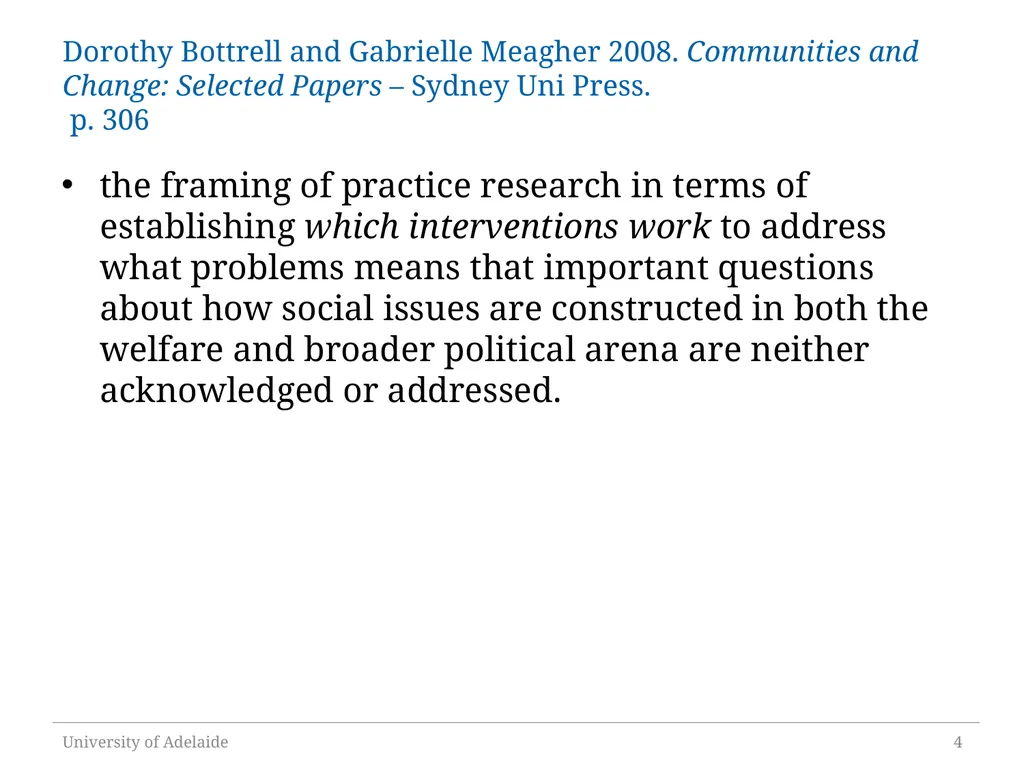
Dorothy Bottrell and Gabrielle Meagher 2008. Communities and Change: Selected Papers – Sydney Uni Press.
p. 306 the framing of practice research in terms of establishing which interventions work to address what problems means that important questions about how social issues are constructed in both the welfare and broader political arena are neither acknowledged or addressed. University of Adelaide 4<br>
05
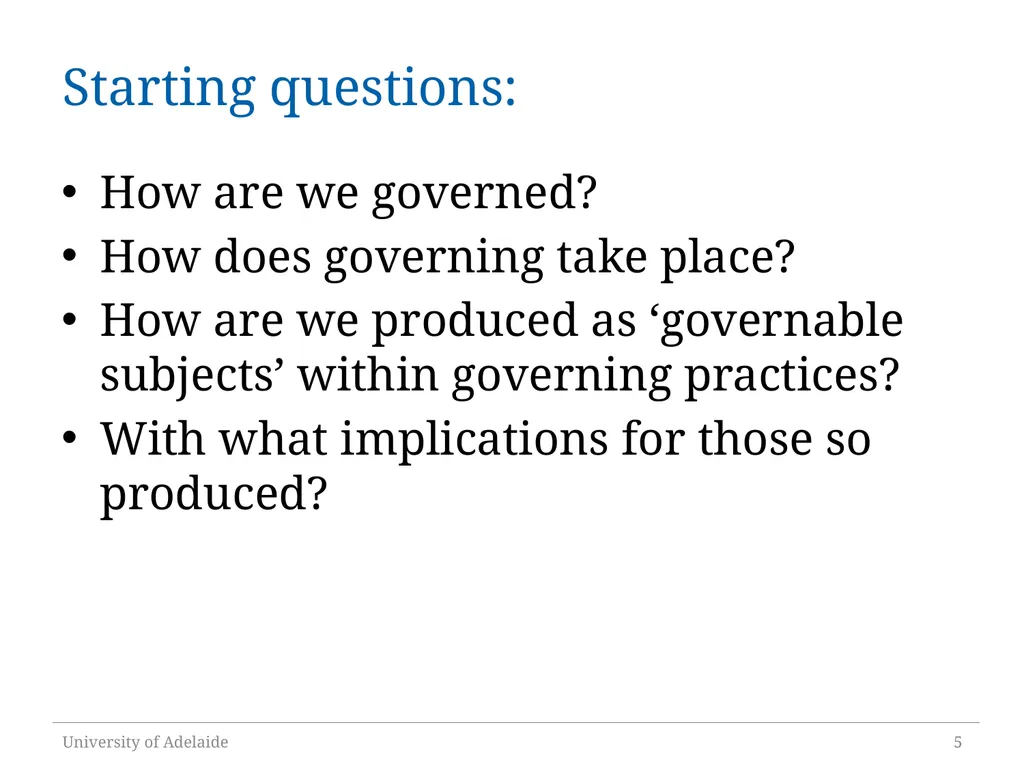
Starting questions: How are we governed?
How does governing take place?
How are we produced as ‘governable subjects’ within governing practices?
With what implications for those so produced? University of Adelaide 5<br>
How does governing take place?
How are we produced as ‘governable subjects’ within governing practices?
With what implications for those so produced? University of Adelaide 5<br>
06
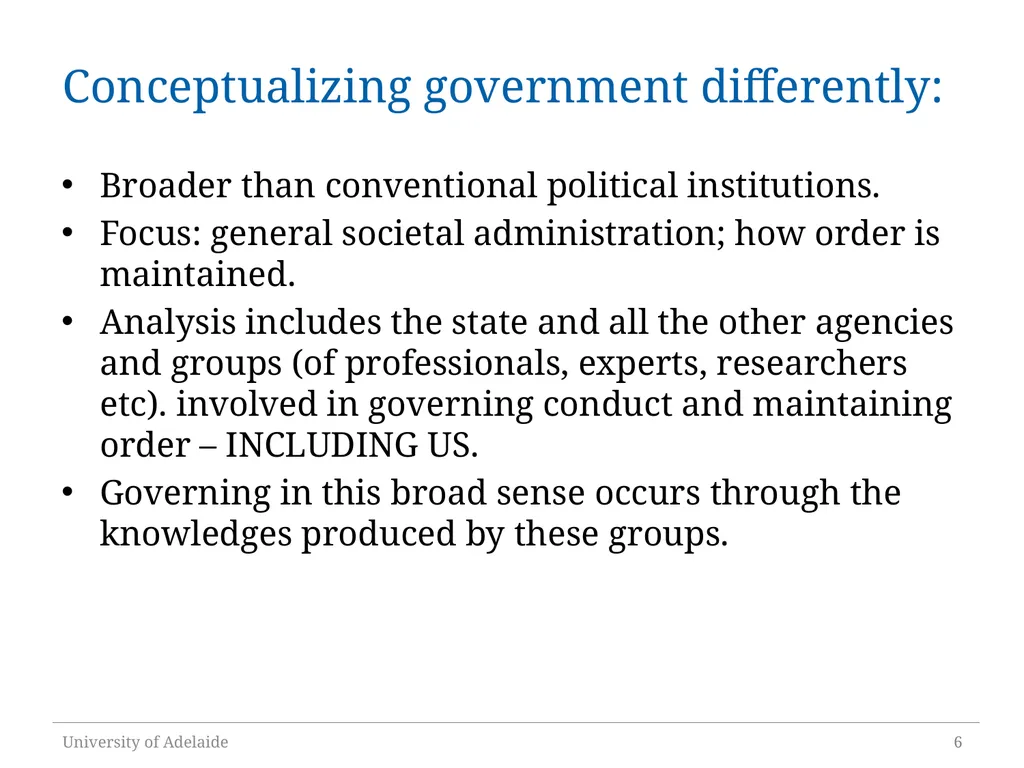
Conceptualizing government differently: Broader than conventional political institutions.
Focus: general societal administration; how order is maintained.
Analysis includes the state and all the other agencies and groups (of professionals, experts, researchers etc). involved in governing conduct and maintaining order – INCLUDING US.
Governing in this broad sense occurs through the knowledges produced by these groups. University of Adelaide 6<br>
Focus: general societal administration; how order is maintained.
Analysis includes the state and all the other agencies and groups (of professionals, experts, researchers etc). involved in governing conduct and maintaining order – INCLUDING US.
Governing in this broad sense occurs through the knowledges produced by these groups. University of Adelaide 6<br>
07
Advancing Women in Stem Strategy 2020 ACTION AREAS:
Enabling STEM (science, technology, engineering, mathematics) Potential Through Education
Targets “Australia’s education system, from early education to tertiary”
Supporting Women in STEM Careers
Targets “Australian STEM workplaces”
Making Women in STEM visible
Identify “Superstars” – “a critical mass of celebrity Australian women who work as scientists and technologists” to act as “role models for young women” University of Adelaide 7<br>
Enabling STEM (science, technology, engineering, mathematics) Potential Through Education
Targets “Australia’s education system, from early education to tertiary”
Supporting Women in STEM Careers
Targets “Australian STEM workplaces”
Making Women in STEM visible
Identify “Superstars” – “a critical mass of celebrity Australian women who work as scientists and technologists” to act as “role models for young women” University of Adelaide 7<br>
08
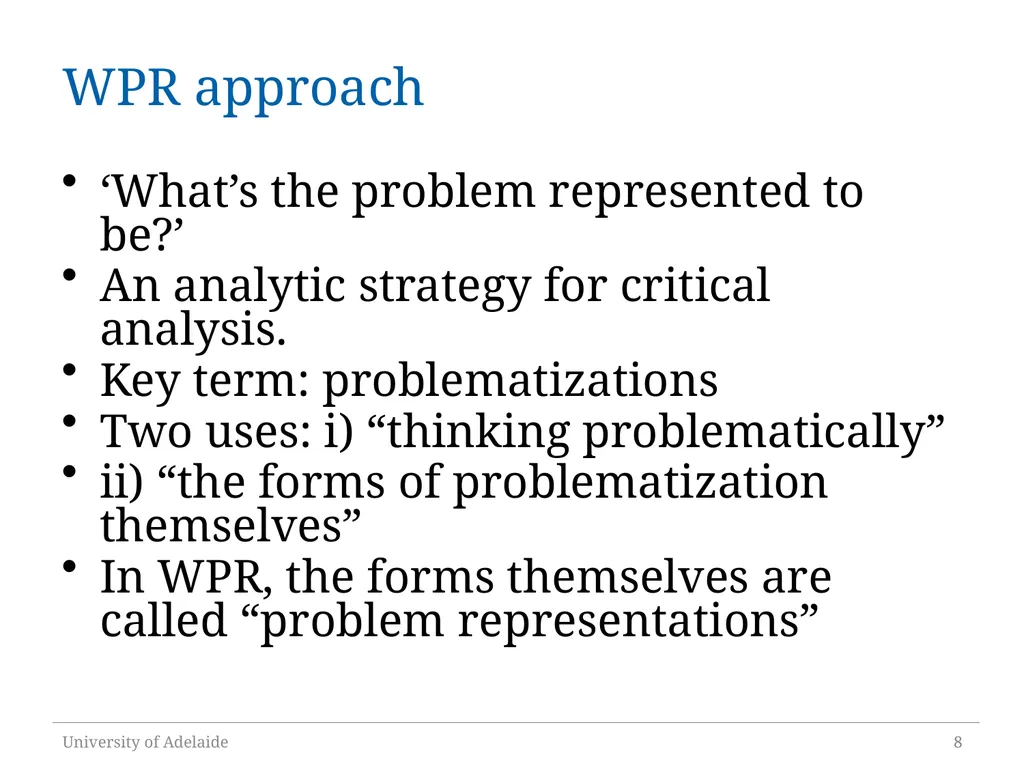
WPR approach ‘What’s the problem represented to be?’
An analytic strategy for critical analysis.
Key term: problematizations
Two uses: i) “thinking problematically”
ii) “the forms of problematization themselves”
In WPR, the forms themselves are called “problem representations” University of Adelaide 8<br>
An analytic strategy for critical analysis.
Key term: problematizations
Two uses: i) “thinking problematically”
ii) “the forms of problematization themselves”
In WPR, the forms themselves are called “problem representations” University of Adelaide 8<br>
09
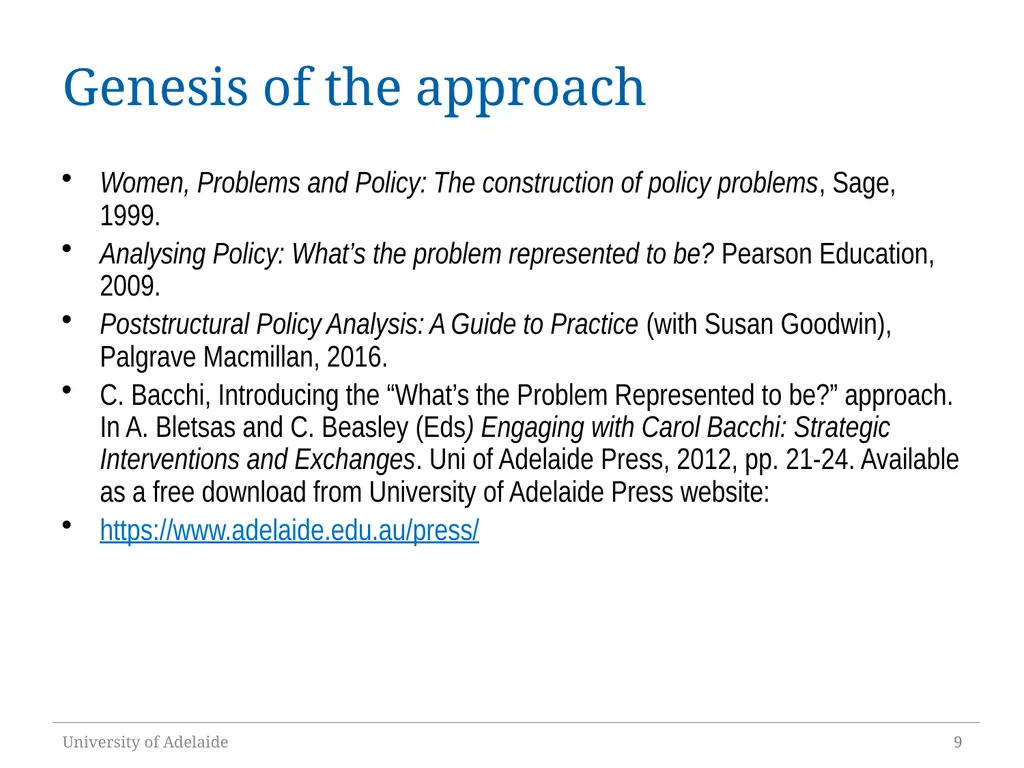
Genesis of the approach Women, Problems and Policy: The construction of policy problems, Sage, 1999.
Analysing Policy: What’s the problem represented to be? Pearson Education, 2009.
Poststructural Policy Analysis: A Guide to Practice (with Susan Goodwin), Palgrave Macmillan, 2016.
C. Bacchi, Introducing the “What’s the Problem Represented to be?” approach. In A. Bletsas and C. Beasley (Eds) Engaging with Carol Bacchi: Strategic Interventions and Exchanges. Uni of Adelaide Press, 2012, pp. 21-24. Available as a free download from University of Adelaide Press website:
https://www.adelaide.edu.au/press/ University of Adelaide 9<br>
Analysing Policy: What’s the problem represented to be? Pearson Education, 2009.
Poststructural Policy Analysis: A Guide to Practice (with Susan Goodwin), Palgrave Macmillan, 2016.
C. Bacchi, Introducing the “What’s the Problem Represented to be?” approach. In A. Bletsas and C. Beasley (Eds) Engaging with Carol Bacchi: Strategic Interventions and Exchanges. Uni of Adelaide Press, 2012, pp. 21-24. Available as a free download from University of Adelaide Press website:
https://www.adelaide.edu.au/press/ University of Adelaide 9<br>
10
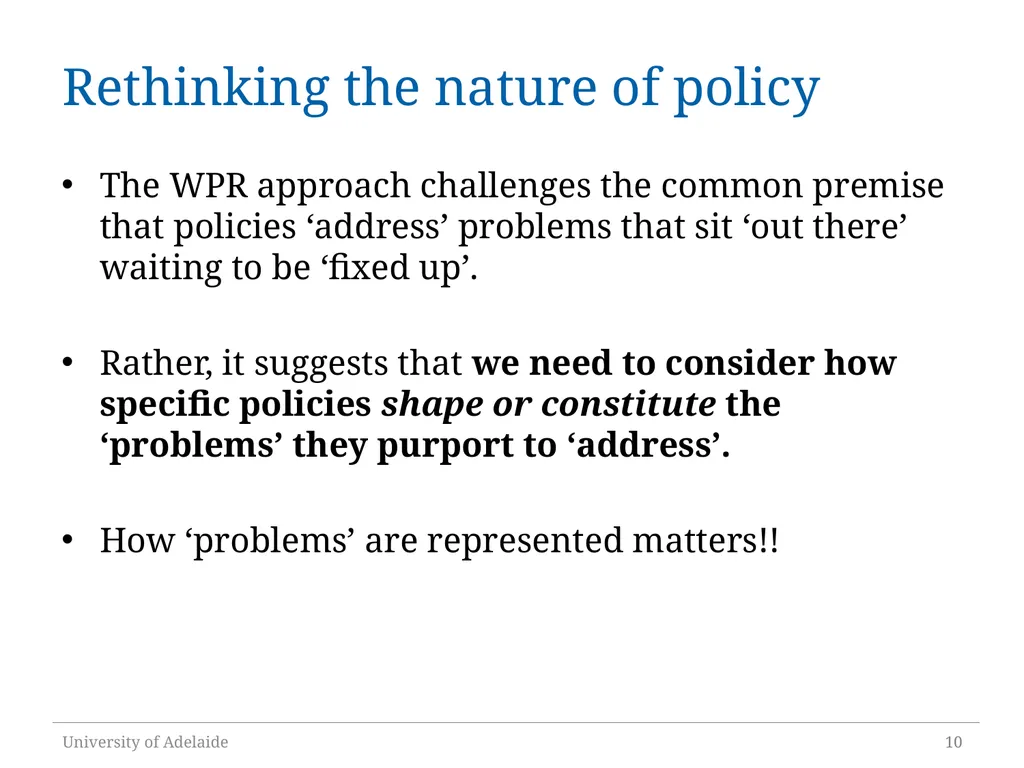
Rethinking the nature of policy The WPR approach challenges the common premise that policies ‘address’ problems that sit ‘out there’ waiting to be ‘fixed up’.
Rather, it suggests that we need to consider how specific policies shape or constitute the ‘problems’ they purport to ‘address’.
How ‘problems’ are represented matters!! University of Adelaide 10<br>
Rather, it suggests that we need to consider how specific policies shape or constitute the ‘problems’ they purport to ‘address’.
How ‘problems’ are represented matters!! University of Adelaide 10<br>
11
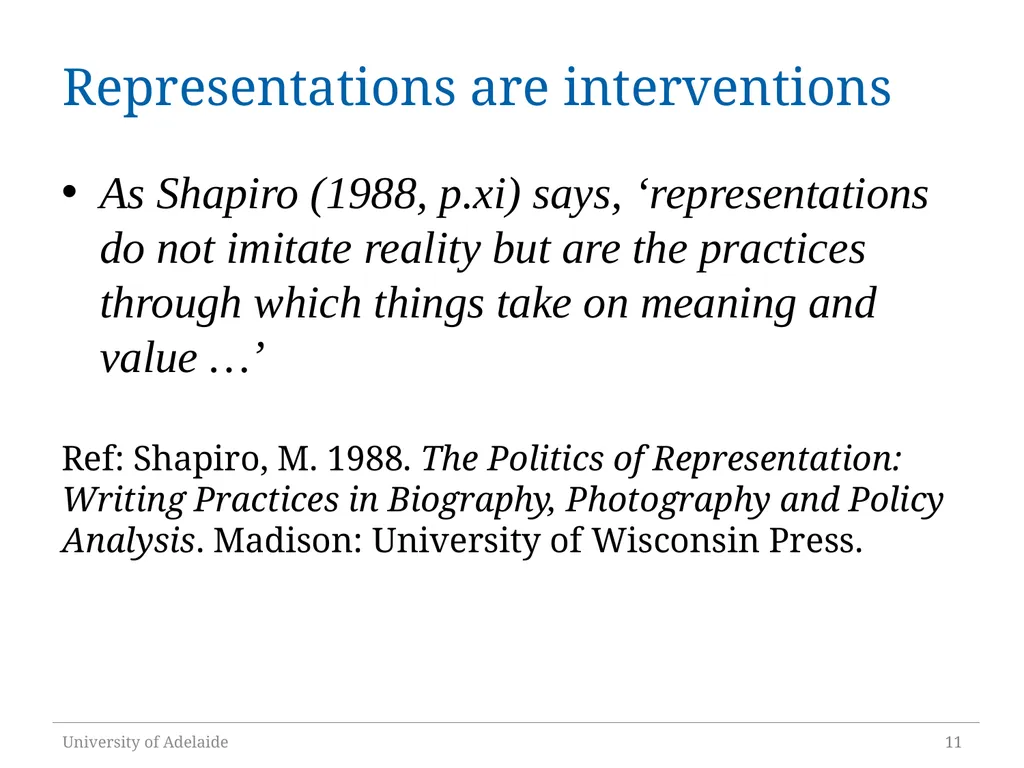
Representations are interventions As Shapiro (1988, p.xi) says, ‘representations do not imitate reality but are the practices through which things take on meaning and value …’
Ref: Shapiro, M. 1988. The Politics of Representation: Writing Practices in Biography, Photography and Policy Analysis. Madison: University of Wisconsin Press. University of Adelaide 11<br>
Ref: Shapiro, M. 1988. The Politics of Representation: Writing Practices in Biography, Photography and Policy Analysis. Madison: University of Wisconsin Press. University of Adelaide 11<br>
12
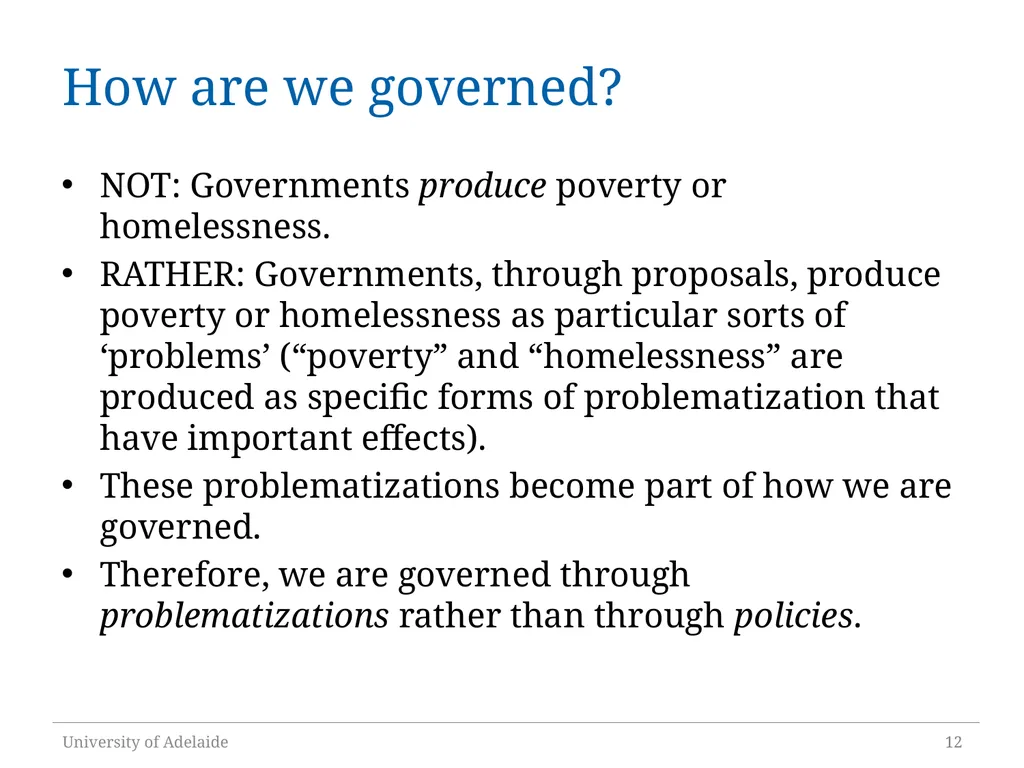
How are we governed? NOT: Governments produce poverty or homelessness.
RATHER: Governments, through proposals, produce poverty or homelessness as particular sorts of ‘problems’ (“poverty” and “homelessness” are produced as specific forms of problematization that have important effects).
These problematizations become part of how we are governed.
Therefore, we are governed through problematizations rather than through policies. University of Adelaide 12<br>
RATHER: Governments, through proposals, produce poverty or homelessness as particular sorts of ‘problems’ (“poverty” and “homelessness” are produced as specific forms of problematization that have important effects).
These problematizations become part of how we are governed.
Therefore, we are governed through problematizations rather than through policies. University of Adelaide 12<br>
13
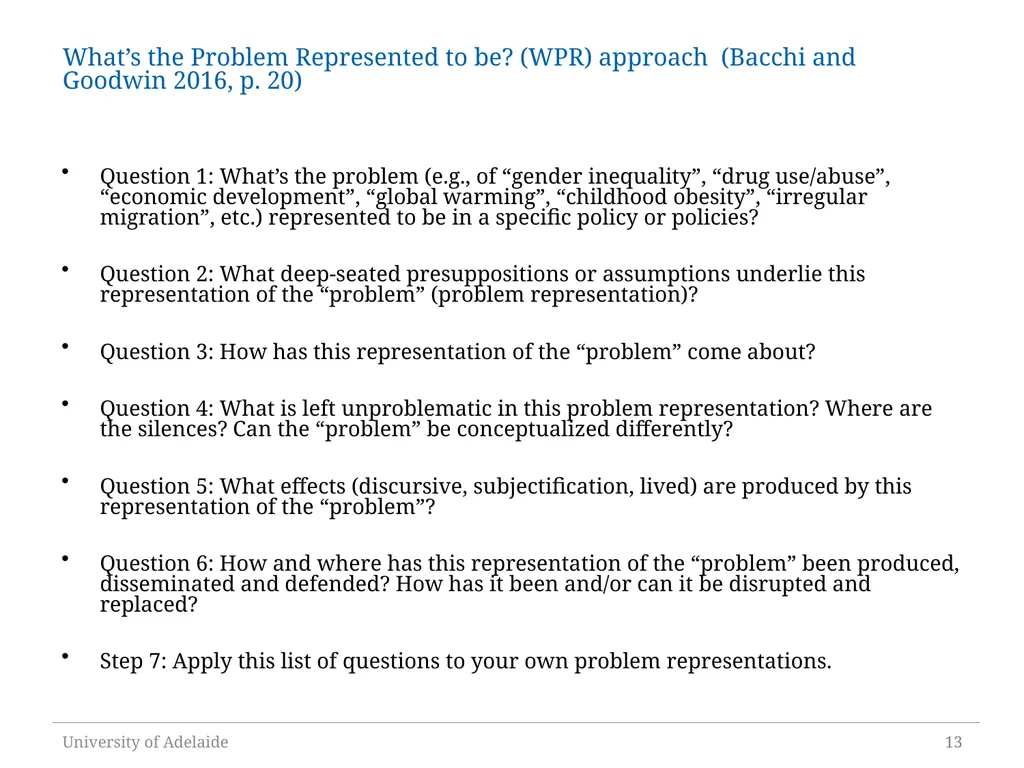
What’s the Problem Represented to be? (WPR) approach (Bacchi and Goodwin 2016, p. 20) Question 1: What’s the problem (e.g., of “gender inequality”, “drug use/abuse”, “economic development”, “global warming”, “childhood obesity”, “irregular migration”, etc.) represented to be in a specific policy or policies?
Question 2: What deep-seated presuppositions or assumptions underlie this representation of the “problem” (problem representation)?
Question 3: How has this representation of the “problem” come about?
Question 4: What is left unproblematic in this problem representation? Where are the silences? Can the “problem” be conceptualized differently?
Question 5: What effects (discursive, subjectification, lived) are produced by this representation of the “problem”?
Question 6: How and where has this representation of the “problem” been produced, disseminated and defended? How has it been and/or can it be disrupted and replaced?
Step 7: Apply this list of questions to your own problem representations. University of Adelaide 13<br>
Question 2: What deep-seated presuppositions or assumptions underlie this representation of the “problem” (problem representation)?
Question 3: How has this representation of the “problem” come about?
Question 4: What is left unproblematic in this problem representation? Where are the silences? Can the “problem” be conceptualized differently?
Question 5: What effects (discursive, subjectification, lived) are produced by this representation of the “problem”?
Question 6: How and where has this representation of the “problem” been produced, disseminated and defended? How has it been and/or can it be disrupted and replaced?
Step 7: Apply this list of questions to your own problem representations. University of Adelaide 13<br>
14
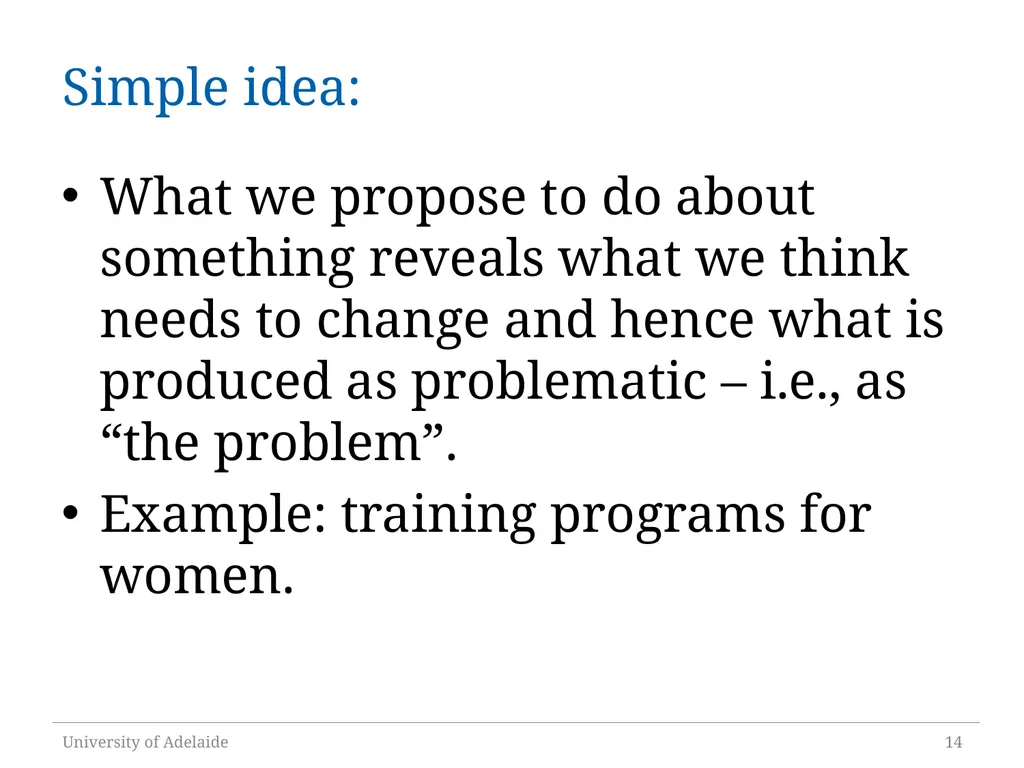
Simple idea: What we propose to do about something reveals what we think needs to change and hence what is produced as problematic – i.e., as “the problem”.
Example: training programs for women. University of Adelaide 14<br>
Example: training programs for women. University of Adelaide 14<br>
15
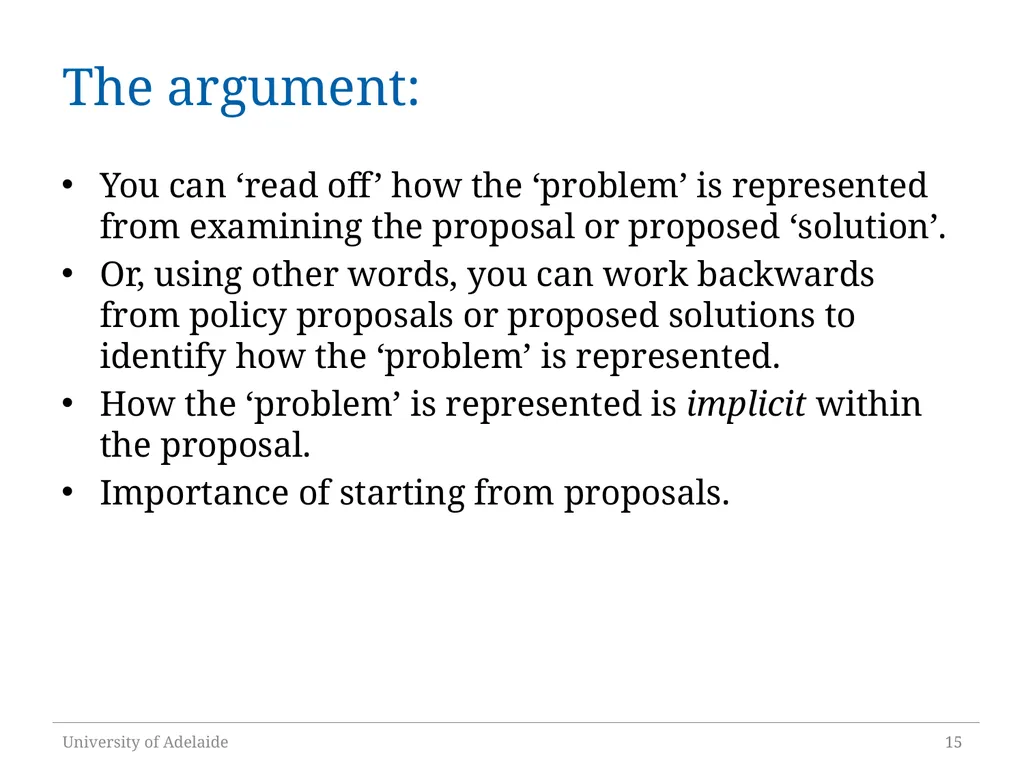
The argument: You can ‘read off’ how the ‘problem’ is represented from examining the proposal or proposed ‘solution’.
Or, using other words, you can work backwards from policy proposals or proposed solutions to identify how the ‘problem’ is represented.
How the ‘problem’ is represented is implicit within the proposal.
Importance of starting from proposals. University of Adelaide 15<br>
Or, using other words, you can work backwards from policy proposals or proposed solutions to identify how the ‘problem’ is represented.
How the ‘problem’ is represented is implicit within the proposal.
Importance of starting from proposals. University of Adelaide 15<br>
16
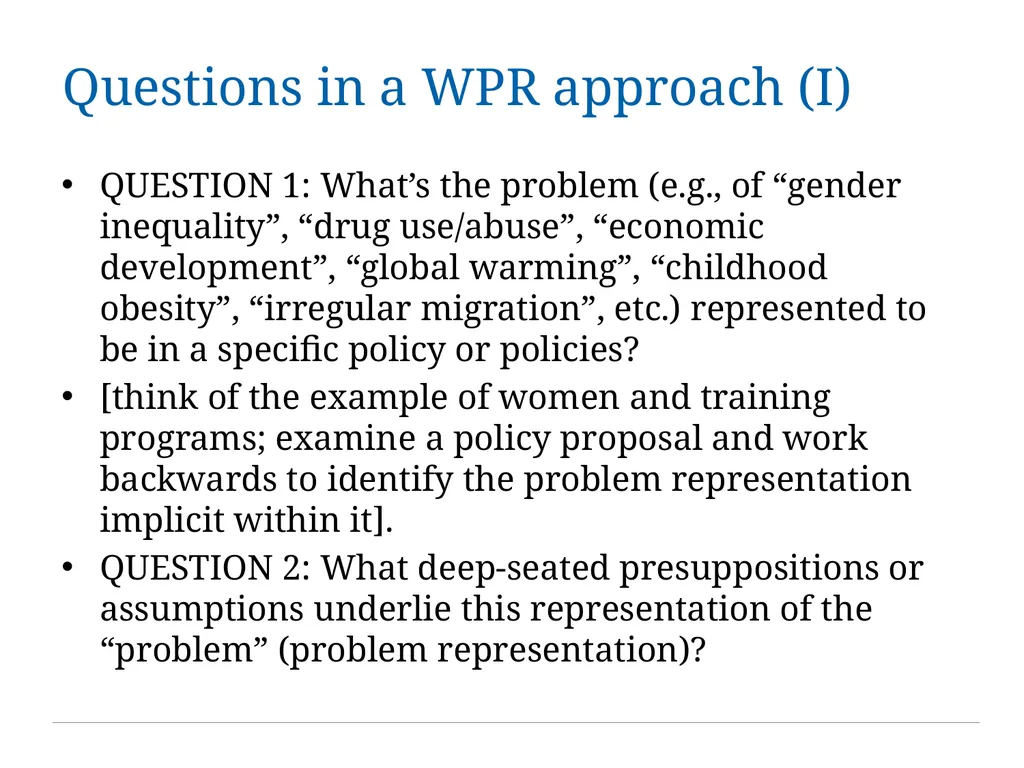
Questions in a WPR approach (I) QUESTION 1: What’s the problem (e.g., of “gender inequality”, “drug use/abuse”, “economic development”, “global warming”, “childhood obesity”, “irregular migration”, etc.) represented to be in a specific policy or policies?
[think of the example of women and training programs; examine a policy proposal and work backwards to identify the problem representation implicit within it].
QUESTION 2: What deep-seated presuppositions or assumptions underlie this representation of the “problem” (problem representation)?<br>
[think of the example of women and training programs; examine a policy proposal and work backwards to identify the problem representation implicit within it].
QUESTION 2: What deep-seated presuppositions or assumptions underlie this representation of the “problem” (problem representation)?<br>
17
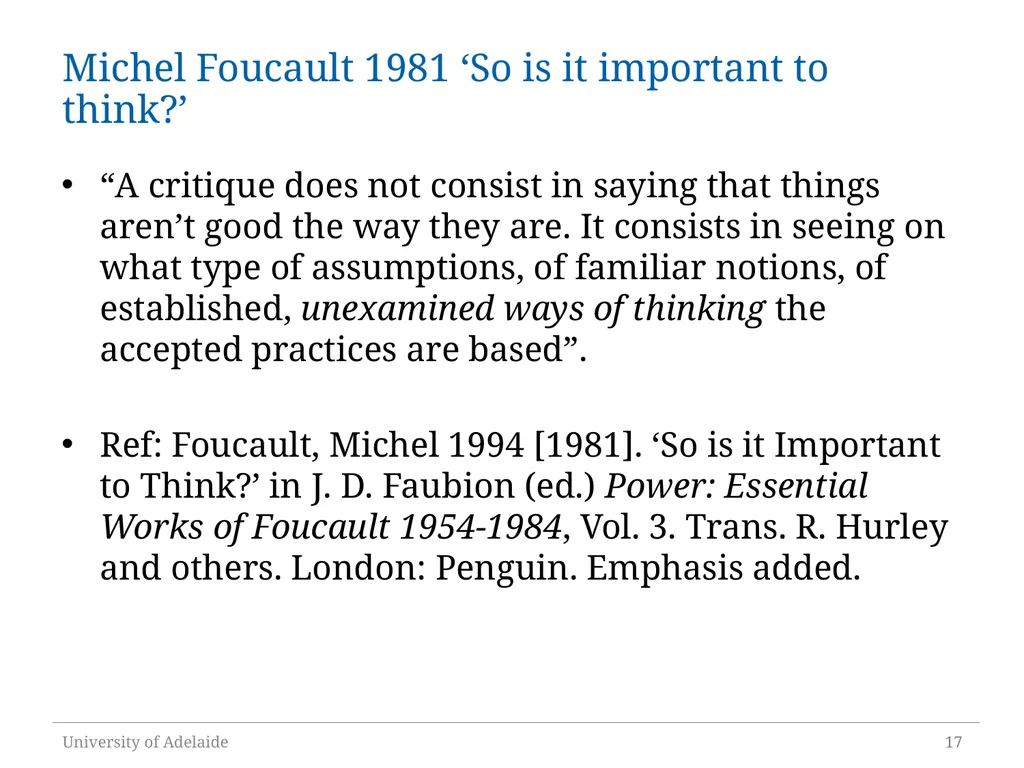
Michel Foucault 1981 ‘So is it important to think?’ “A critique does not consist in saying that things aren’t good the way they are. It consists in seeing on what type of assumptions, of familiar notions, of established, unexamined ways of thinking the accepted practices are based”.
Ref: Foucault, Michel 1994 [1981]. ‘So is it Important to Think?’ in J. D. Faubion (ed.) Power: Essential Works of Foucault 1954-1984, Vol. 3. Trans. R. Hurley and others. London: Penguin. Emphasis added. University of Adelaide 17<br>
Ref: Foucault, Michel 1994 [1981]. ‘So is it Important to Think?’ in J. D. Faubion (ed.) Power: Essential Works of Foucault 1954-1984, Vol. 3. Trans. R. Hurley and others. London: Penguin. Emphasis added. University of Adelaide 17<br>
18
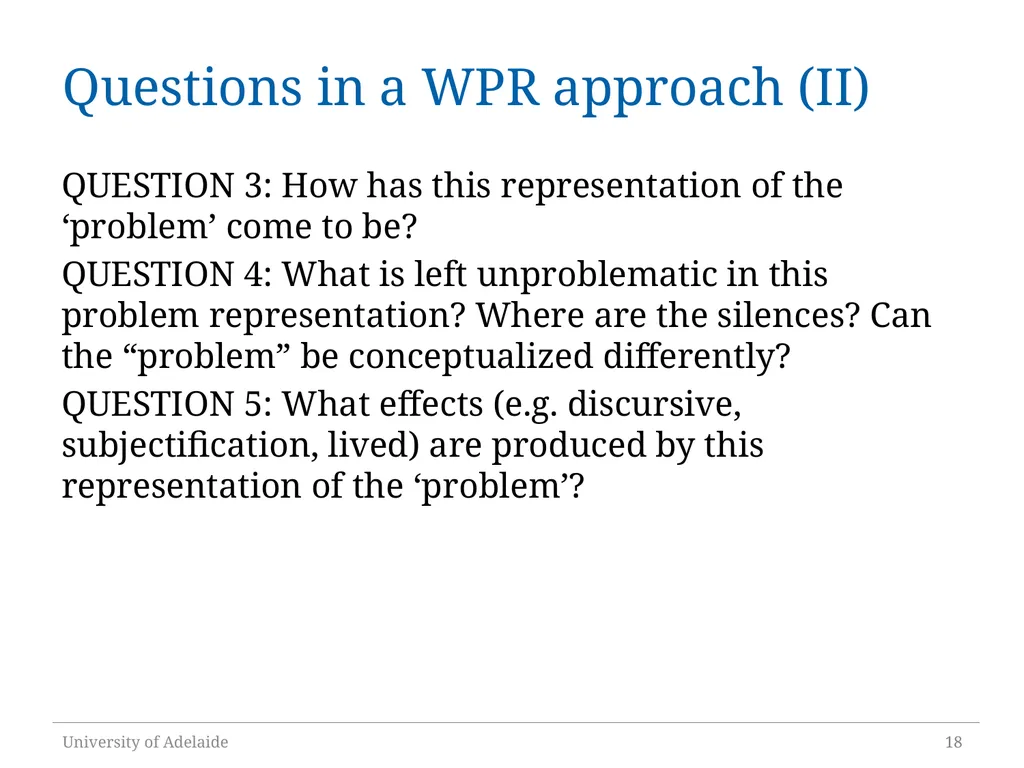
Questions in a WPR approach (II) QUESTION 3: How has this representation of the ‘problem’ come to be?
QUESTION 4: What is left unproblematic in this problem representation? Where are the silences? Can the “problem” be conceptualized differently?
QUESTION 5: What effects (e.g. discursive, subjectification, lived) are produced by this representation of the ‘problem’? University of Adelaide 18<br>
QUESTION 4: What is left unproblematic in this problem representation? Where are the silences? Can the “problem” be conceptualized differently?
QUESTION 5: What effects (e.g. discursive, subjectification, lived) are produced by this representation of the ‘problem’? University of Adelaide 18<br>
19
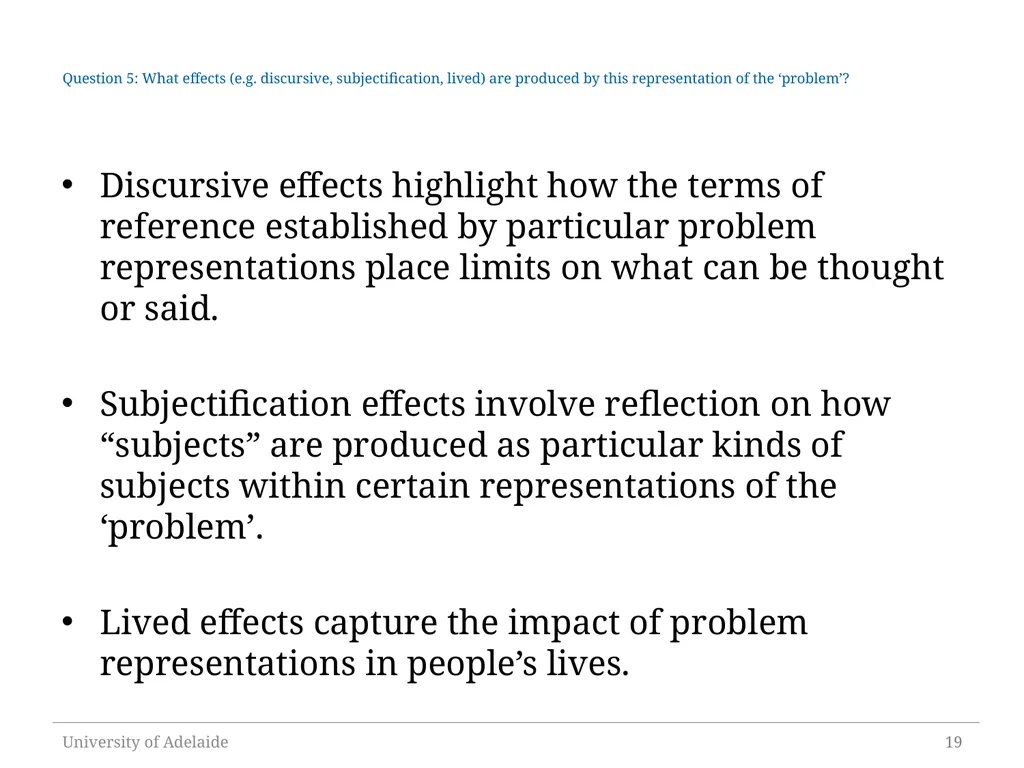
Question 5: What effects (e.g. discursive, subjectification, lived) are produced by this representation of the ‘problem’? Discursive effects highlight how the terms of reference established by particular problem representations place limits on what can be thought or said.
Subjectification effects involve reflection on how “subjects” are produced as particular kinds of subjects within certain representations of the ‘problem’.
Lived effects capture the impact of problem representations in people’s lives. University of Adelaide 19<br>
Subjectification effects involve reflection on how “subjects” are produced as particular kinds of subjects within certain representations of the ‘problem’.
Lived effects capture the impact of problem representations in people’s lives. University of Adelaide 19<br>
20
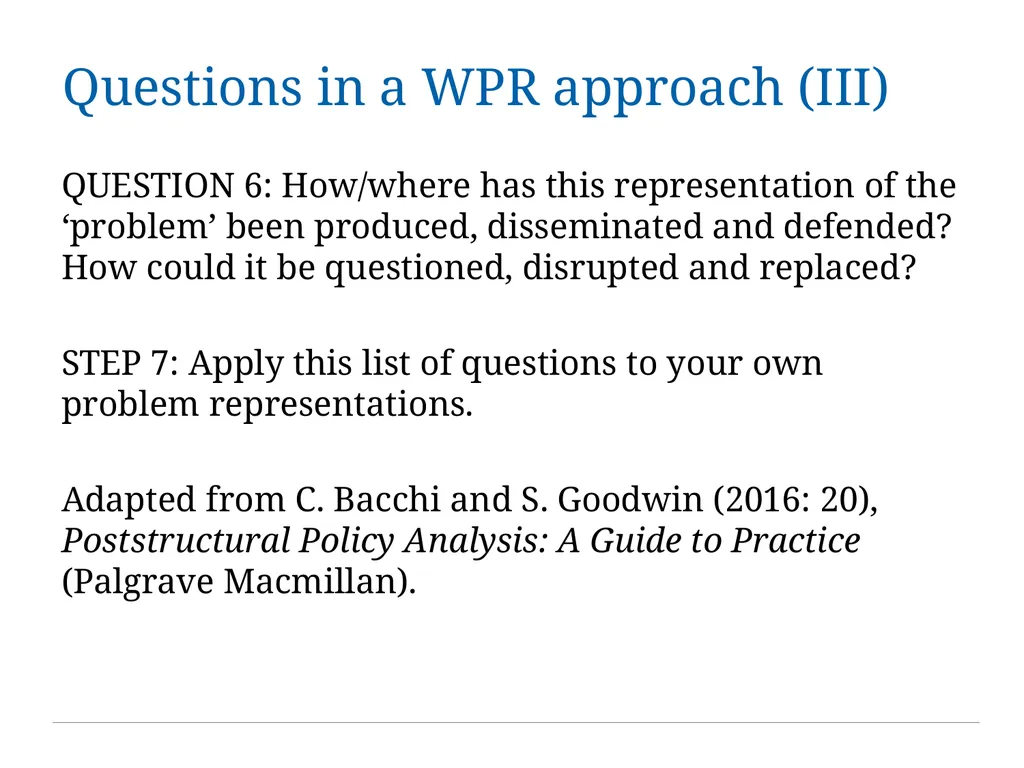
Questions in a WPR approach (III) QUESTION 6: How/where has this representation of the ‘problem’ been produced, disseminated and defended? How could it be questioned, disrupted and replaced?
STEP 7: Apply this list of questions to your own problem representations.
Adapted from C. Bacchi and S. Goodwin (2016: 20), Poststructural Policy Analysis: A Guide to Practice (Palgrave Macmillan).<br>
STEP 7: Apply this list of questions to your own problem representations.
Adapted from C. Bacchi and S. Goodwin (2016: 20), Poststructural Policy Analysis: A Guide to Practice (Palgrave Macmillan).<br>
21
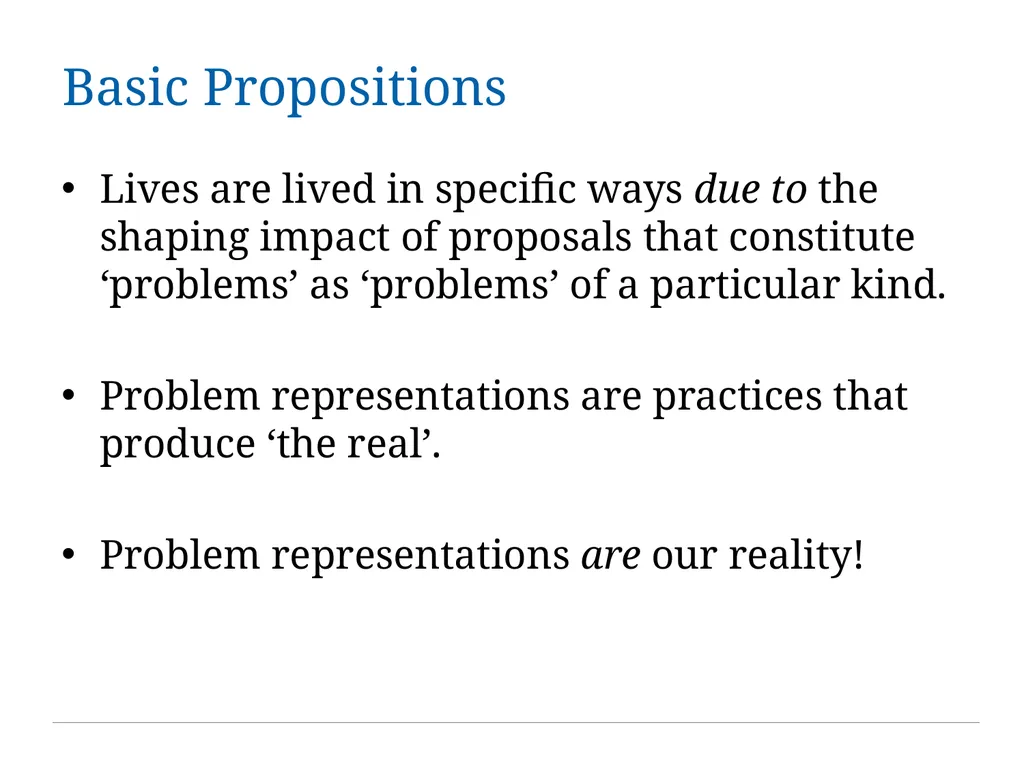
Basic Propositions Lives are lived in specific ways due to the shaping impact of proposals that constitute ‘problems’ as ‘problems’ of a particular kind.
Problem representations are practices that produce ‘the real’.
Problem representations are our reality!<br>
Problem representations are practices that produce ‘the real’.
Problem representations are our reality!<br>
22
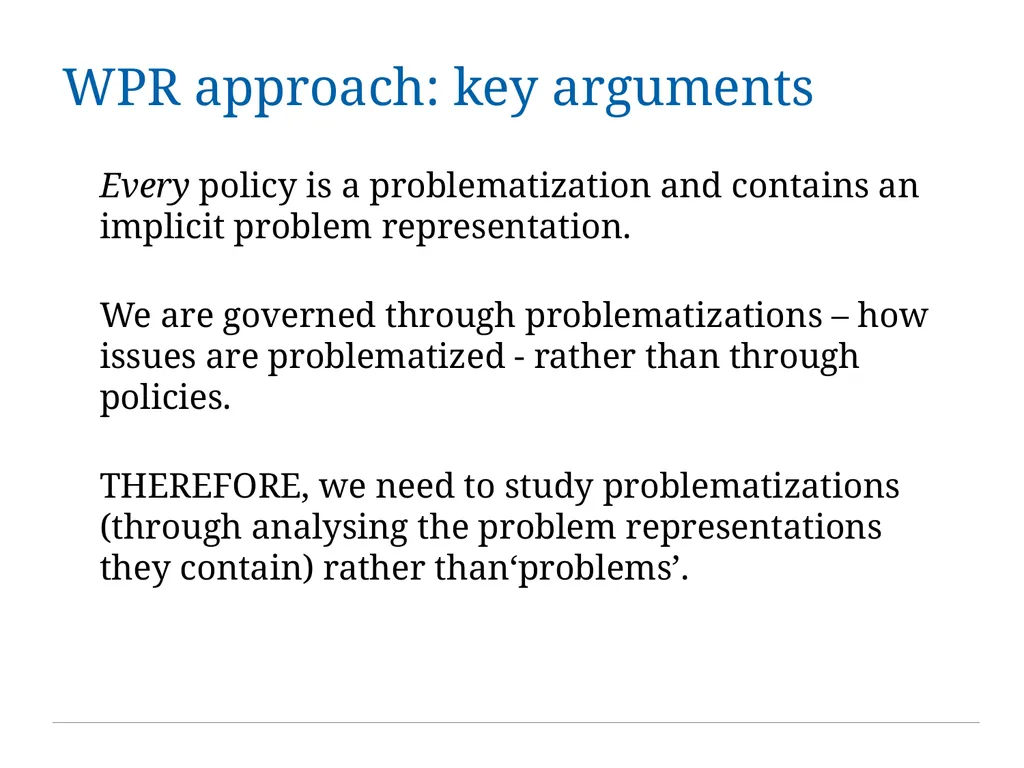
WPR approach: key arguments Every policy is a problematization and contains an implicit problem representation.
We are governed through problematizations – how issues are problematized - rather than through policies.
THEREFORE, we need to study problematizations (through analysing the problem representations they contain) rather than‘problems’.<br>
We are governed through problematizations – how issues are problematized - rather than through policies.
THEREFORE, we need to study problematizations (through analysing the problem representations they contain) rather than‘problems’.<br>
23
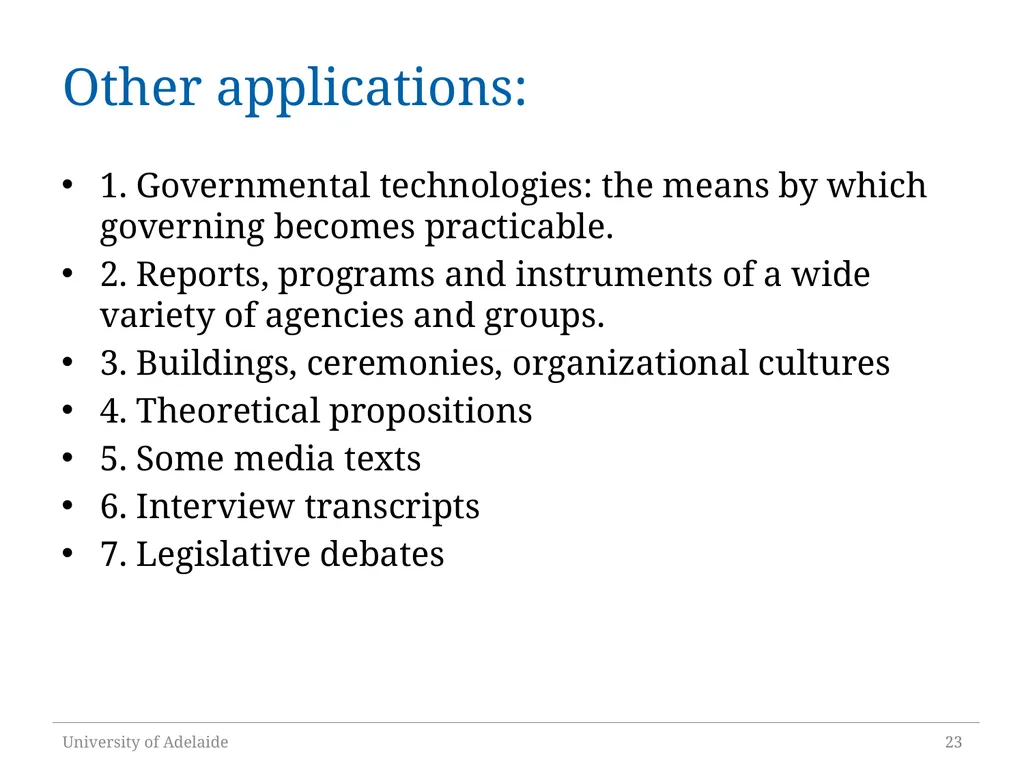
Other applications: 1. Governmental technologies: the means by which governing becomes practicable.
2. Reports, programs and instruments of a wide variety of agencies and groups.
3. Buildings, ceremonies, organizational cultures
4. Theoretical propositions
5. Some media texts
6. Interview transcripts
7. Legislative debates University of Adelaide 23<br>
2. Reports, programs and instruments of a wide variety of agencies and groups.
3. Buildings, ceremonies, organizational cultures
4. Theoretical propositions
5. Some media texts
6. Interview transcripts
7. Legislative debates University of Adelaide 23<br>
24
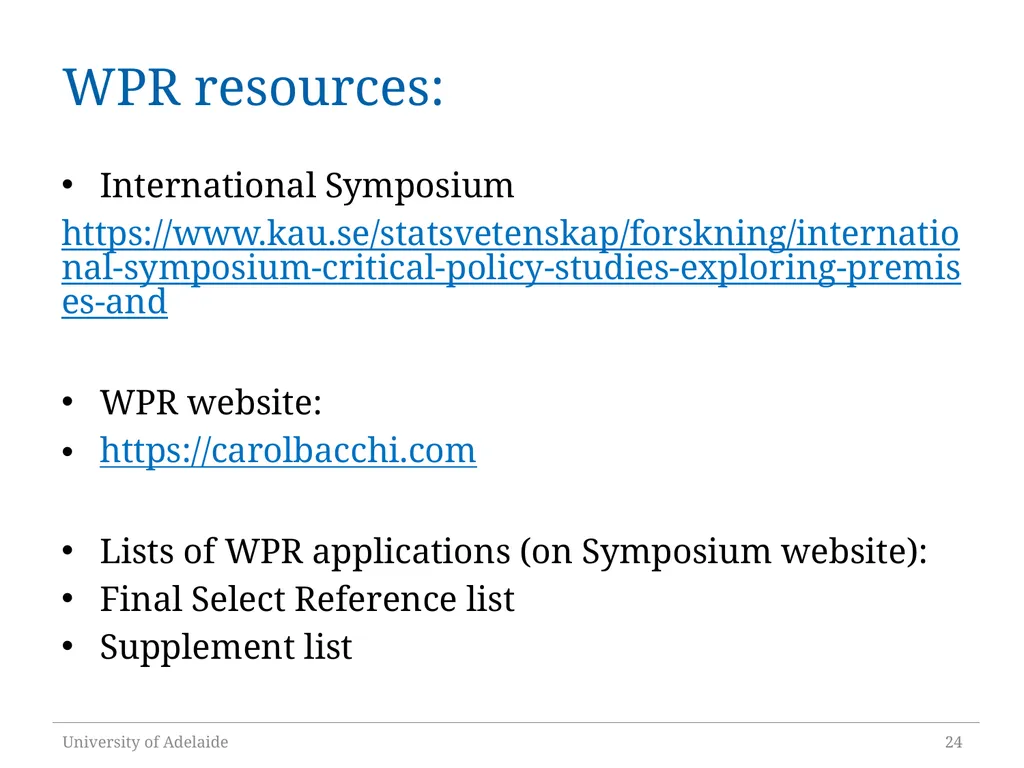
WPR resources: International Symposium
https://www.kau.se/statsvetenskap/forskning/international-symposium-critical-policy-studies-exploring-premises-and
WPR website:
https://carolbacchi.com
Lists of WPR applications (on Symposium website):
Final Select Reference list
Supplement list University of Adelaide 24<br>
https://www.kau.se/statsvetenskap/forskning/international-symposium-critical-policy-studies-exploring-premises-and
WPR website:
https://carolbacchi.com
Lists of WPR applications (on Symposium website):
Final Select Reference list
Supplement list University of Adelaide 24<br>
25
EXAMPLES OF APPLICATION CHILDHOOD OBESITY
Stephanie Alexander and John Coveney 2013. ‘A critical discourse analysis of Canadian and Australian public health recommendations promoting physical activity to children’, Health Sociology Review 22(4): 353-64.
SOCIAL INCLUSION
Angelique Bletsas 2007. ‘Contesting Representations of Poverty: Ethics and Evaluation’, Policy and Society 26(3): 65-83.
Robert B. Pereira 2014. ‘Using Critical Policy Analysis in Occupational Science Research: Exploring Bacchi’s Methodology’, Journal of Occupational Science 21(4): 389-402.
Nina Marshall 2012. ‘Digging deeper: The challenge of problematizing “inclusive development” and “disability mainstreaming”’, in A. Bletsas and C. Beasley (eds) Engaging with Carol Bacchi: Strategic Interventions and Exchanges. Adelaide: University of Adelaide Press. pp. 53-70. University of Adelaide 25<br>
Stephanie Alexander and John Coveney 2013. ‘A critical discourse analysis of Canadian and Australian public health recommendations promoting physical activity to children’, Health Sociology Review 22(4): 353-64.
SOCIAL INCLUSION
Angelique Bletsas 2007. ‘Contesting Representations of Poverty: Ethics and Evaluation’, Policy and Society 26(3): 65-83.
Robert B. Pereira 2014. ‘Using Critical Policy Analysis in Occupational Science Research: Exploring Bacchi’s Methodology’, Journal of Occupational Science 21(4): 389-402.
Nina Marshall 2012. ‘Digging deeper: The challenge of problematizing “inclusive development” and “disability mainstreaming”’, in A. Bletsas and C. Beasley (eds) Engaging with Carol Bacchi: Strategic Interventions and Exchanges. Adelaide: University of Adelaide Press. pp. 53-70. University of Adelaide 25<br>
26
Active Kids are Healthy Kids (DoHA 2004) A proposal:
‘Children should not be inactive for prolonged periods, except when they’re asleep!’ (p. 2) University of Adelaide 26<br>
‘Children should not be inactive for prolonged periods, except when they’re asleep!’ (p. 2) University of Adelaide 26<br>
27
Curbing Childhood Obesity (Public Health Agency of Canada 2010) A proposal:
in the battle against obesity, ‘improving parental awareness, knowledge and skills of healthy eating, and physical activity are also key to addressing this issue effectively’ (p. 3) University of Adelaide 27<br>
in the battle against obesity, ‘improving parental awareness, knowledge and skills of healthy eating, and physical activity are also key to addressing this issue effectively’ (p. 3) University of Adelaide 27<br>
28
Alexander and Coveney on Question 2: a message that health is equated with weight; i.e. dominance of a ‘less fat equals healthier discourse’;
a ‘cult of the body’;
a kind of Protestant asceticism – absence of pleasure and fun [a silence – Question 4]. University of Adelaide 28<br>
a ‘cult of the body’;
a kind of Protestant asceticism – absence of pleasure and fun [a silence – Question 4]. University of Adelaide 28<br>
29
Alexander and Coveney on Question 5 (effects) the possible downside in equating health with weight and the excessive focus in these policy texts on bodily appearance;
unintended negative effects for children (e.g., demonising fat, stigma, distorted body image and precipitating eating disorders);
a deeply moralizing discourse that can lead to (excessive) self-surveillance (subjectification; governmentality);
a neo-liberal responsibilisation of parents;
silence (Question 4) regarding how it is easier for socially and economically advantaged families to follow these recommendations, much like other social practices. University of Adelaide 29<br>
unintended negative effects for children (e.g., demonising fat, stigma, distorted body image and precipitating eating disorders);
a deeply moralizing discourse that can lead to (excessive) self-surveillance (subjectification; governmentality);
a neo-liberal responsibilisation of parents;
silence (Question 4) regarding how it is easier for socially and economically advantaged families to follow these recommendations, much like other social practices. University of Adelaide 29<br>
30
Bletsas 2007 ‘Contesting representations of poverty’ Bletsas examines the policy statements of the Rann Social Inclusion Unit (SIU), established in 2002.
On drug use Bletsas found a heavy endorsement of the need for young people to develop resilience.
She argues: ‘To the extent that resilience is offered as a solution to the problem, it is tacitly presumed that overcoming drug dependence is a project of individual will.’ University of Adelaide 30<br>
On drug use Bletsas found a heavy endorsement of the need for young people to develop resilience.
She argues: ‘To the extent that resilience is offered as a solution to the problem, it is tacitly presumed that overcoming drug dependence is a project of individual will.’ University of Adelaide 30<br>
31
Bletsas - school retention Proposals produced a ‘failure to connect’ with the formalised apparatus of education as the ‘problem’.
Here Bletsas identifies a silence – ‘There is no possibility [in this analysis] that the education system – in terms of its curricula, organisation or structure – could be the problem’. University of Adelaide 31<br>
Here Bletsas identifies a silence – ‘There is no possibility [in this analysis] that the education system – in terms of its curricula, organisation or structure – could be the problem’. University of Adelaide 31<br>
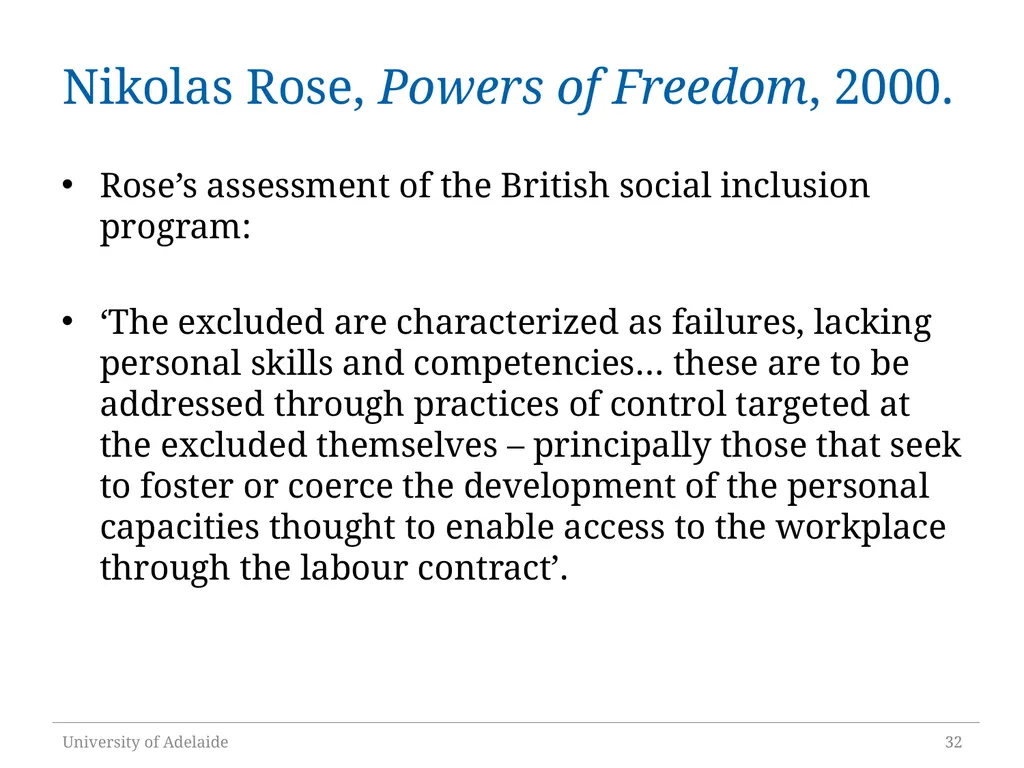
32
Nikolas Rose, Powers of Freedom, 2000. Rose’s assessment of the British social inclusion program:
‘The excluded are characterized as failures, lacking personal skills and competencies… these are to be addressed through practices of control targeted at the excluded themselves – principally those that seek to foster or coerce the development of the personal capacities thought to enable access to the workplace through the labour contract’. University of Adelaide 32<br>
‘The excluded are characterized as failures, lacking personal skills and competencies… these are to be addressed through practices of control targeted at the excluded themselves – principally those that seek to foster or coerce the development of the personal capacities thought to enable access to the workplace through the labour contract’. University of Adelaide 32<br>
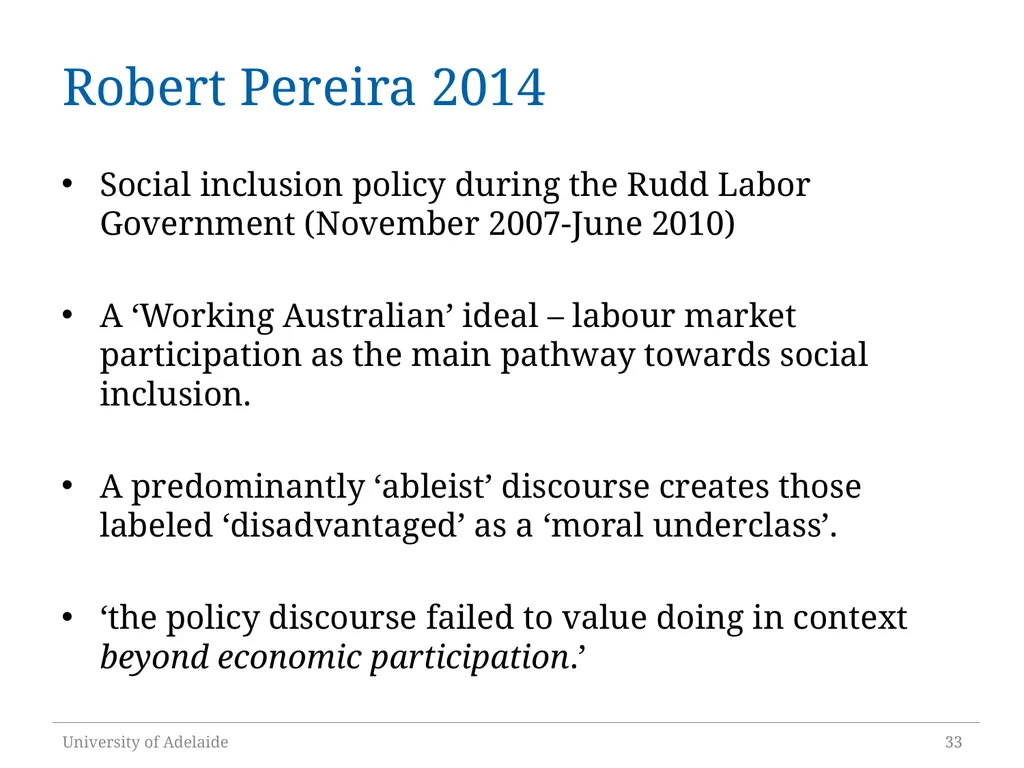
33
Robert Pereira 2014 Social inclusion policy during the Rudd Labor Government (November 2007-June 2010)
A ‘Working Australian’ ideal – labour market participation as the main pathway towards social inclusion.
A predominantly ‘ableist’ discourse creates those labeled ‘disadvantaged’ as a ‘moral underclass’.
‘the policy discourse failed to value doing in context beyond economic participation.’ University of Adelaide 33<br>
A ‘Working Australian’ ideal – labour market participation as the main pathway towards social inclusion.
A predominantly ‘ableist’ discourse creates those labeled ‘disadvantaged’ as a ‘moral underclass’.
‘the policy discourse failed to value doing in context beyond economic participation.’ University of Adelaide 33<br>
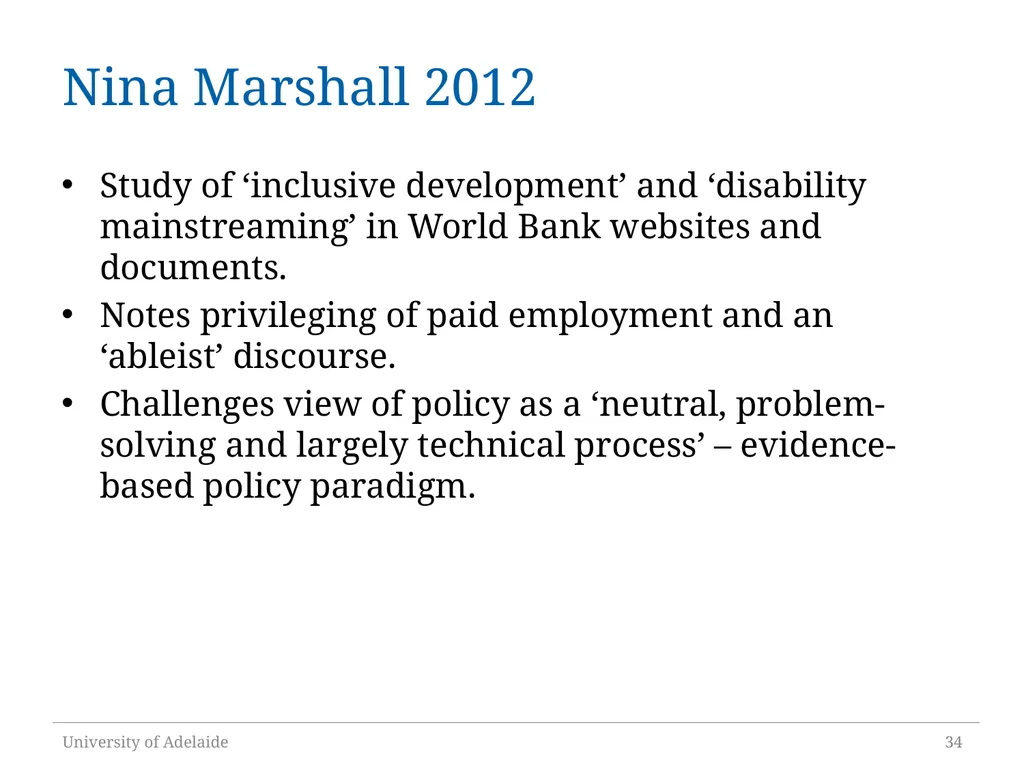
34
Nina Marshall 2012 Study of ‘inclusive development’ and ‘disability mainstreaming’ in World Bank websites and documents.
Notes privileging of paid employment and an ‘ableist’ discourse.
Challenges view of policy as a ‘neutral, problem-solving and largely technical process’ – evidence-based policy paradigm. University of Adelaide 34<br>
Notes privileging of paid employment and an ‘ableist’ discourse.
Challenges view of policy as a ‘neutral, problem-solving and largely technical process’ – evidence-based policy paradigm. University of Adelaide 34<br>
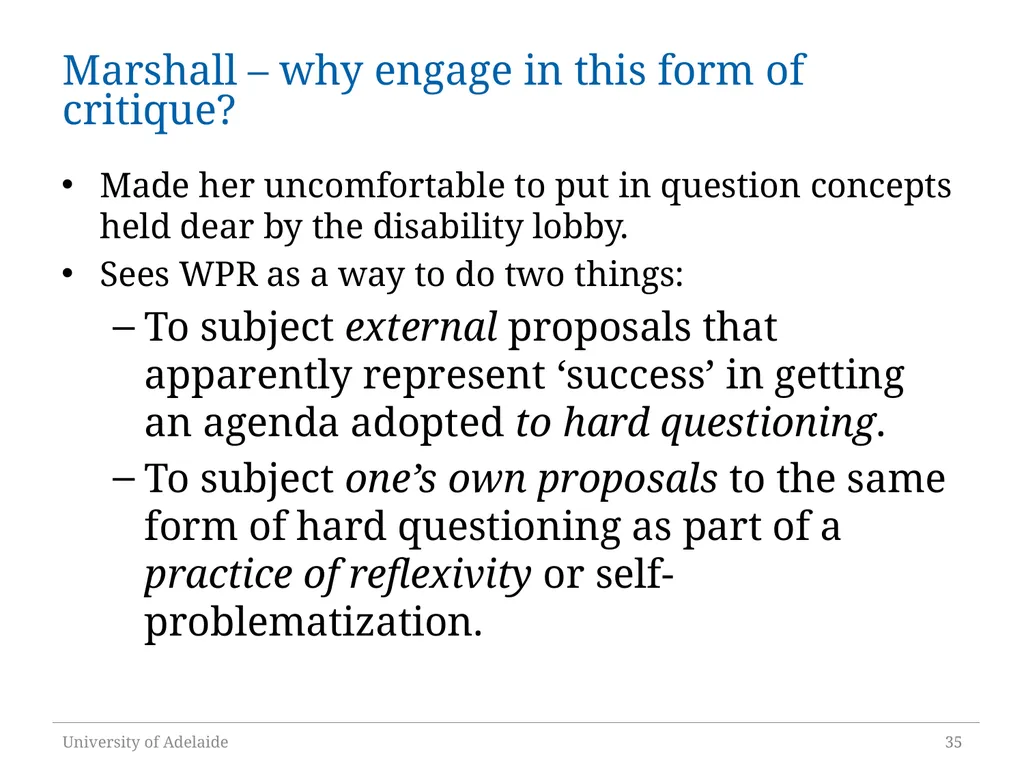
35
Marshall – why engage in this form of critique? Made her uncomfortable to put in question concepts held dear by the disability lobby.
Sees WPR as a way to do two things:
To subject external proposals that apparently represent ‘success’ in getting an agenda adopted to hard questioning.
To subject one’s own proposals to the same form of hard questioning as part of a practice of reflexivity or self-problematization. University of Adelaide 35<br>
Sees WPR as a way to do two things:
To subject external proposals that apparently represent ‘success’ in getting an agenda adopted to hard questioning.
To subject one’s own proposals to the same form of hard questioning as part of a practice of reflexivity or self-problematization. University of Adelaide 35<br>
36
Marshall, ‘Digging deeper’, p. 61. ‘Thus, far from adding little to equality campaigns, the “WPR” approach proposes a political, evaluative and reflexive mode of thinking firmly located on the side of those harmed by particular problematizations, but one which does not accept easy predictions about the effects of certain problematizations, or that we should except from consideration proposals that have acquired an authorized, self-evident status, whatever their source’. University of Adelaide 36<br>