
Critical Thinking and Clinical Reasoning Chapter
KL
Published · 36 slides · 0 views
1 / 1

Description
Critical Thinking and Clinical Reasoning Chapter -10 (NURS 210) 1-Identify of critical thinking its purpose. 2-Discuss techniques in critical thinking 3-Describe application of critical thinking in problem solving 4-Identify components of
Related Topics
Share
Embed code
Download this presentation From Below
"Critical Thinking and Clinical Reasoning Chapter" is the property of its rightful owner. Permission is granted to download and print the materials on this website for personal, non-commercial use only, and to display it on your personal computer provided you do not modify the materials and that you retain all copyright notices contained in the materials. By downloading content from our website, you accept the terms of this agreement.
Presentation Transcript
01
Critical Thinking and Clinical Reasoning Chapter -10 (NURS 210)<br>
02
1-Identify of critical thinking & its purpose.
2-Discuss techniques in critical thinking
3-Describe application of critical thinking in problem solving
4-Identify components of clinical reasoning and its integration with critical thinking.
5-Identify integration of critical thinking and clinical reasoning
6-Identify concept mapping. Learning Outcomes Students after this lecture will be able to:<br>
03
Critical thinking and clinical Reasoning Introduction
The practice of nursing requires critical thinking and clinical reasoning.
Critical thinking
Is the process of intentional higher level thinking of define a clients’ problem examine the evidence –based practice in caring for the client, and make choices in the delivery of care.
Clinical reasoning:
Is the cognitive process that uses thinking strategies to gather and analyze clients information ,evaluate the relevance of the information , and decide on possible nursing to improve the clients physiological and psychosocial outcomes clinical reasoning requires the integration of critical thinking in the identification of the most appropriate interventions that will improve the clients condition.<br>
04
Purpose of critical thinking Critical thinking is an essential skill needed for the identification of client problems and the implementation of interventions to promote effective care outcomes (Bittencourt & Crossetti, 2012).
The process of providing feedback and reflection is vital to the improvement of nursing practice. A study by Asselin (2011) revealed that students who reflected on new knowledge developed new insights regarding practice. The insights nurses acquired led to changes in their approach to practice.<br>
The process of providing feedback and reflection is vital to the improvement of nursing practice. A study by Asselin (2011) revealed that students who reflected on new knowledge developed new insights regarding practice. The insights nurses acquired led to changes in their approach to practice.<br>
05
Techniques in critical thinking 1-Critical analysis:
Is the application of set of questions to a particular situation or idea to determine essential information and ideas and discard unimportant information and ideas.
The questions are not sequential steps; rather they are a set of criteria for judging an idea.
Socrates was a Greek philosopher who developed the method of posing questions and seeking an answer . Socratic questioning is a technique one can use to look beneath the surface, recognize and examine assumptions, search for inconsistencies, examine multiple points of view , and differentiate what one knows from what one merely believes.<br>
06
Socratic Questions QUESTIONS ABOUT THE DECISION (OR PROBLEM)
Is this question clear, understandable, and correctly
identified?
Is this question important?
Could this question be broken down into smaller parts?
How might _____________ state this question?
QUESTIONS ABOUT ASSUMPTIONS
You seem to be assuming _____________; is that so?
What could you assume instead? Why?
Does this assumption always hold true?<br>
07
Socratic Questions QUESTIONS ABOUT POINT OF VIEW
You seem to be using the perspective of _____________.
Why?
What would someone who disagrees with your
perspective say?
Can you see this any other way?<br>
You seem to be using the perspective of _____________.
Why?
What would someone who disagrees with your
perspective say?
Can you see this any other way?<br>
08
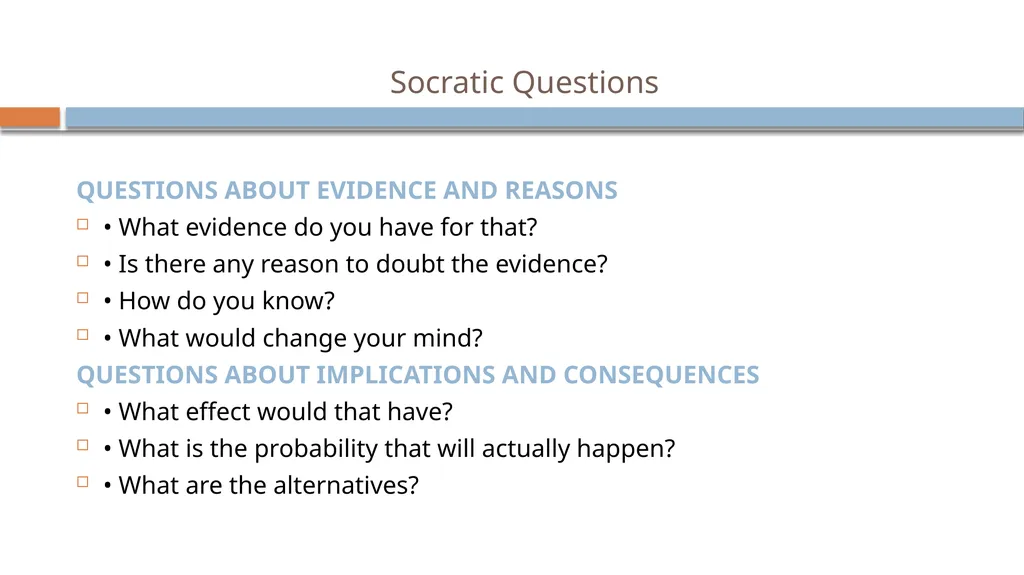
Socratic Questions QUESTIONS ABOUT EVIDENCE AND REASONS
• What evidence do you have for that?
• Is there any reason to doubt the evidence?
• How do you know?
• What would change your mind?
QUESTIONS ABOUT IMPLICATIONS AND CONSEQUENCES
• What effect would that have?
• What is the probability that will actually happen?
• What are the alternatives?<br>
• What evidence do you have for that?
• Is there any reason to doubt the evidence?
• How do you know?
• What would change your mind?
QUESTIONS ABOUT IMPLICATIONS AND CONSEQUENCES
• What effect would that have?
• What is the probability that will actually happen?
• What are the alternatives?<br>
09
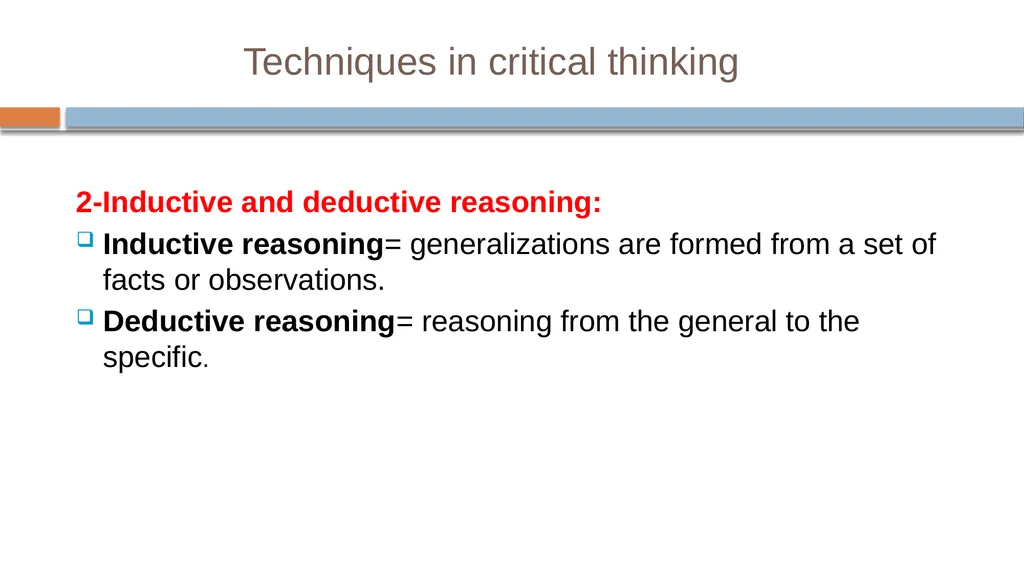
Techniques in critical thinking 2-Inductive and deductive reasoning:
Inductive reasoning= generalizations are formed from a set of facts or observations.
Deductive reasoning= reasoning from the general to the specific.<br>
Inductive reasoning= generalizations are formed from a set of facts or observations.
Deductive reasoning= reasoning from the general to the specific.<br>
10
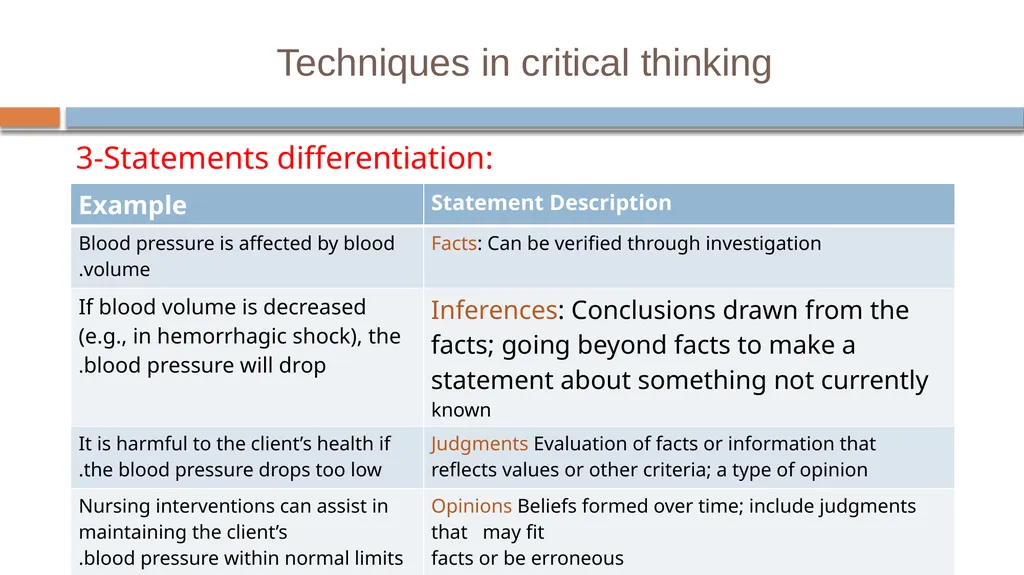
Techniques in critical thinking 3-Statements differentiation:<br>
11
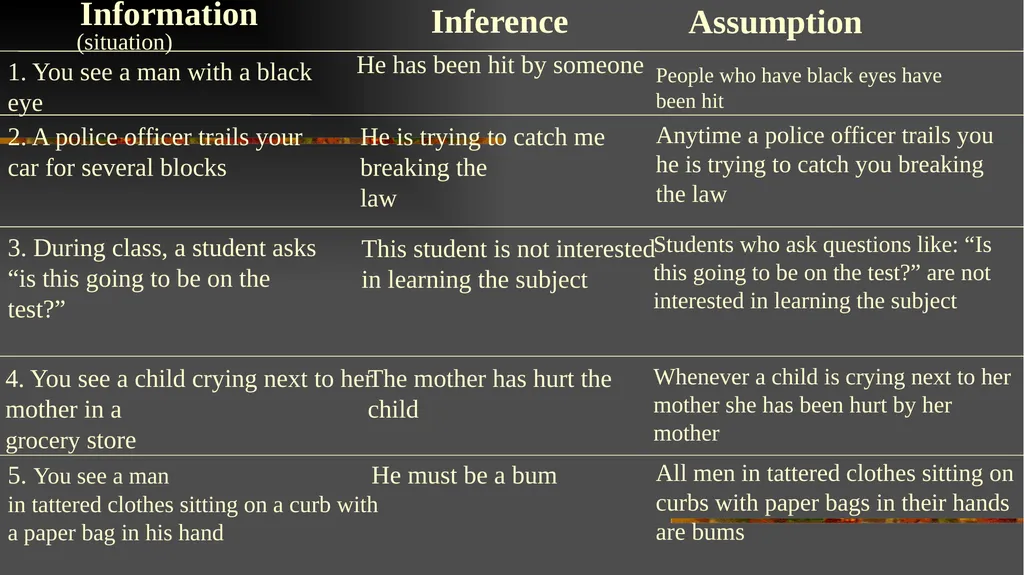
Information Inference Assumption 1. You see a man with a black eye 2. A police officer trails your car for several blocks 3. During class, a student asks “is this going to be on the test?” 4. You see a child crying next to her mother in a
grocery store 5. You see a man
in tattered clothes sitting on a curb with a paper bag in his hand He has been hit by someone People who have black eyes have been hit He is trying to catch me breaking the
law Anytime a police officer trails you he is trying to catch you breaking the law This student is not interested
in learning the subject Students who ask questions like: “Is this going to be on the test?” are not interested in learning the subject The mother has hurt the child Whenever a child is crying next to her mother she has been hurt by her mother He must be a bum All men in tattered clothes sitting on curbs with paper bags in their hands are bums (situation)<br>
12
Techniques in critical thinking 4-Evaluating the credibility of information sources:
is an important step in critical thinking. We cannot always believe what we read or are told.
The nurse must ascertain the accuracy of information by checking
other documents or with other informants. Hence, the expanding need for evidence-based nursing practice.
5-Clarifying concepts:To comprehend a client situation clearly, the nurse and the client must agree on the meaning of terms.
For example, if the clients says to the nurse “I think I have a tumor,” the nurse needs to clarify what the word means to the client—the medical definition of a tumor (a solid mass) or the common lay meaning of cancer—before responding.<br>
13
Techniques in critical thinking 6-Recognizing assumptions:
People also live their lives under certain assumptions. Some people view humans as having a basically generous nature, whereas others believe that the human tendency is to act in their own best interest.
The nurse may believe that life should be considered worth living no matter what the condition, whereas the client may believe that quality of life is more important than quantity of life.
If the nurse and client recognize that they make choices based on these assumptions, they can still work together toward an acceptable plan of care.
Difficulty arises when people do not take the time to consider what assumptions underlie their beliefs actions.<br>
14
Applying critical thinking to nursing practice Implementation of the nursing process provides nurses with a creative approach to thinking and doing to obtain, categorize, and analyze client data and plan actions that will meet the client’s needs.
Nursing process: is a systematic, rational method of planning
and providing individualized nursing care.
The phases of the nursing process are assessing, diagnosing, planning,
implementing, and evaluating<br>
Nursing process: is a systematic, rational method of planning
and providing individualized nursing care.
The phases of the nursing process are assessing, diagnosing, planning,
implementing, and evaluating<br>
15
Applying critical thinking to nursing practice Problem Solving
Problem solving: Process used when a gap is perceived between an existing state (what is occurring)& a desired state of what should be occurring.
Throughout the problem-solving process the implementation of critical thought may or may not be required in working toward a solution (Wilkinson, 2012). The nurse carefully evaluates the possible solutions and chooses the best one to implement.
Commonly used approaches to problem solving include trial and error, intuition, and the research process<br>
16
Applying critical thinking to nursing practice trial and error:
In trial and error, a number of approaches are tried until a solution is found.
The use of trial- and-error methods in nursing care can be dangerous because the client might suffer harm if an approach is inappropriate.
However, nurses often use trial and error in the home setting due to logistics, equipment, and client lifestyle .
For example, when teaching a client to perform a colostomy irrigation, bent coat hanger hung on the shower curtain rod pervades an appropriate height to perform the irrigation.<br>
17
Intuition
Is a problem-solving approach that relies on a nurse’s inner sense. It is a legitimate aspect of a nursing judgment in the implementation of care.
Intuition is the understanding or learning of things without the conscious use of the reasoning. It I also known as sixth sense, hunch, instinct, feeling, or suspicion. Applying critical thinking to nursing practice<br>
18
Applying critical thinking to nursing practice Clinical judgment:
in nursing is a decision-making process to ascertain the right nursing action to be implemented at the appropriate time in the client’s care.
The nurse must first have the knowledge base necessary to practice in the clinical area and then use that knowledge in clinical practice.
Clinical experience allows the nurse to recognize cues and patterns and begin to reach correct conclusions.<br>
19
Applying critical thinking to nursing practice RESEARCH PROCESS:
is a formalized, logical, systematic approach to problem solving. The classic quantitative
research process is most useful when the researcher is working in a controlled situation. Health professionals, often working with people.
For example, unlike many experiments with animals in which the environment can be strictly regulated, the effects of diet on health in humans are complicated by a person’s genetic variations, lifestyle, and personal preferences. However, it is becoming increasingly important for nurses to identify evidence that supports effective nursing care. One critical source of this evidence is research.<br>
20
Components of clinical reasoning Clinical reasoning is the analysis of a clinical situation as it unfolds or develops. It requires the nurse to use
1-cognitive and metacognitive:
processes. Cognitive processes are the thinking processes based on the knowledge of aspects of client care. Cognitive skills are learned through reading and applying health-related literature.
Metacognitive:
include reflective thinking and awareness of the skills learned by the nurse in caring for the client.
The nurse reflects on the client’s status, and through the use of critical thinking skills determines the most effective plan of care.<br>
21
Components of clinical reasoning 2-Setting Priories:
The nurse must know what assessments, tasks, and concerns need to be completed first.
Priories setting flexible because the clinical environment can change quickly, requiring changes in priories. Beginning nursing students often view everything as being of equal importance. They are often task oriented and focused on what needs to be done and not necessarily on what is most important. As they gain more clinical experience, they start to determine which data are most relevant and important to each client’s situation.<br>
22
Components of clinical reasoning 3-Developing Rationales:
After assessing the data and determine what is relevant to client’s condition and concerns, the nurse identifies interventions and sets priorities for most urgent needs.
Being able to state the rationale, based on nursing knowledge, acts as a check for potential errors, justifies the nurse’s actions, contributes to client safety, and helps the beginning nursing student learn how a nurse thinks in practice.<br>
23
Components of clinical reasoning 4-Learning how to act:
The nurse must know how and when to respond in a clinical situation by recognizing what is most urgent or significant. To take action, the nurse needs to understand the relevant medical and nursing information and translate this knowledge into a plan of care.
An example is thinking about potential complications given the client’s current problems. Applying this knowledge increases the nurse’s ability to quickly identify assessment data that indicate a potential complication.<br>
24
Components of clinical reasoning 5-Clinical Reasoning-in-Transition:
Clinical reasoning-in-transition is the ability to recognize subtle changes in a client’s condition over time. It includes the evaluation of nursing interventions and the trending of relevant assessment data.
Nurse need develop the sense of what is the most important in each changing clinical situation and remember that the primary focus in on the client’s well-being.
Thus, the nurse can initiate nursing interventions or actions quickly because he or she prepared for the possibility. Avoiding potential complications promotes client safety.<br>
25
Components of clinical reasoning 6-Clinical Reasoning-in-Transition:
Clinical reasoning-in-transition is the ability to recognize subtle changes in a client’s condition over time. It includes the evaluation of nursing interventions and the trending of relevant assessment data.
Nurses need to develop a sense of what is most important in each changing clinical situation and remember that the primary focus is on the client’s well-being.<br>
26
Components of clinical reasoning 7-Reflection:
is a key to success of clinical reasoning. Though reflection the nurse identifies factors that improved client care and those the required changing elimination. It is important to reflect on whether the client was assessed accurately and in a timely manner. The nurse think back on the interventions implemented and whether they were effective. Most importantly , reflection includes information on the outcome of care.<br>
is a key to success of clinical reasoning. Though reflection the nurse identifies factors that improved client care and those the required changing elimination. It is important to reflect on whether the client was assessed accurately and in a timely manner. The nurse think back on the interventions implemented and whether they were effective. Most importantly , reflection includes information on the outcome of care.<br>
27
Components of clinical reasoning 8-Responding to Changes in the Client’s Condition:
Nurses spend more time with clients than do other health care providers.
Clinical reasoning involves an understanding and assessment of the client’s relevant history and current condition and how it may be changing.
By closely monitoring and comparing any changes from previous assessment data, the nurse is able to recognize a change in status that may prevent an adverse outcome.<br>
28
Components of clinical reasoning 8-Reflection
is a key to the success of clinical reasoning. Through reflection the nurse identifies factors that improved client care and those that required changing or elimination. It is important to reflect on whether the client was assessed accurately and in a timely manner.
The nurse thinks back on the interventions implemented and whether they were effective. Most importantly, reflection includes information on the outcome of care.
The nurse also reflects on previous clinical experiences similar to this one to determine if the outcomes of care improved the clients’ conditions.<br>
29
Integration of critical thinking and clinical reasoning Nurses use critical thinking and clinical reasoning skills when making
decisions about client care. The decision-making process includes prioritizing care not only with one client but when providing care to many clients.
When faced with several client needs at the same time, the nurse must prioritize and decide which client to assist first.
Example,In the home care setting, the nurse must decide if the client’s
condition can be managed in the home or requires hospitalization.<br>
30
Integration of critical thinking and clinical reasoning Logical reasoning is a critical thinking skill that closely aligns
with clinical reasoning. In the planning of care, nurses must question
whether knowledge they possess about the care of the client is consistent
with the most current evidence-based practice. The nurse must review the most current nursing and health-related literature prior to implementing care.<br>
31
Concept mapping Concept mapping:
Concept mapping is a technique that uses a graphic depiction of
nonlinear and linear relationships to represent critical thinking. Also
known as mind mapping, concept maps are context dependent and
can be used to develop analytical skills.
Concept maps provide an opportunity to visualize things in your own way.
The concept map allows the nurse to map words on a page and focus on concepts and relationships.<br>
32
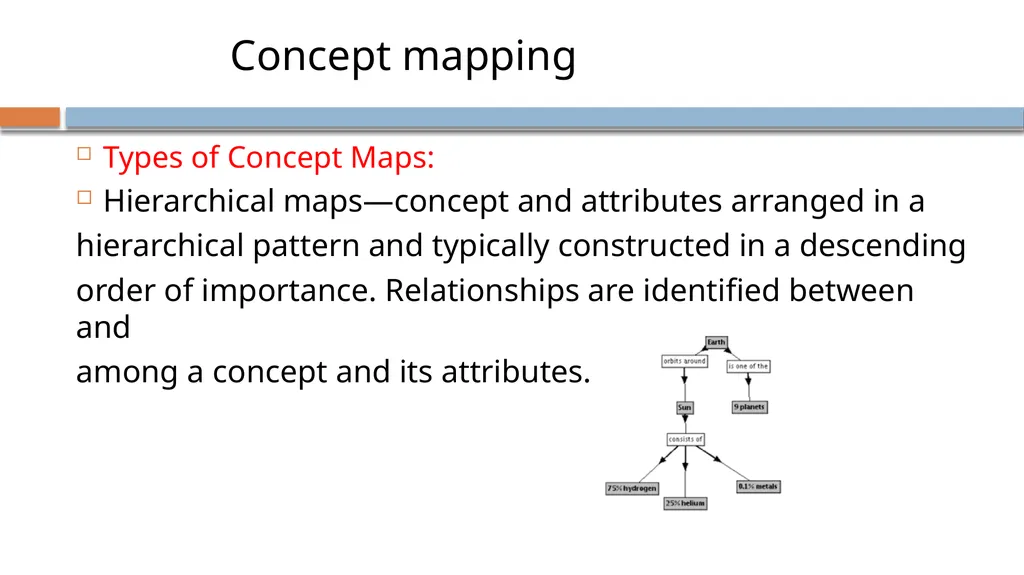
Concept mapping Types of Concept Maps:
Hierarchical maps—concept and attributes arranged in a
hierarchical pattern and typically constructed in a descending
order of importance. Relationships are identified between and
among a concept and its attributes.<br>
Hierarchical maps—concept and attributes arranged in a
hierarchical pattern and typically constructed in a descending
order of importance. Relationships are identified between and
among a concept and its attributes.<br>
33
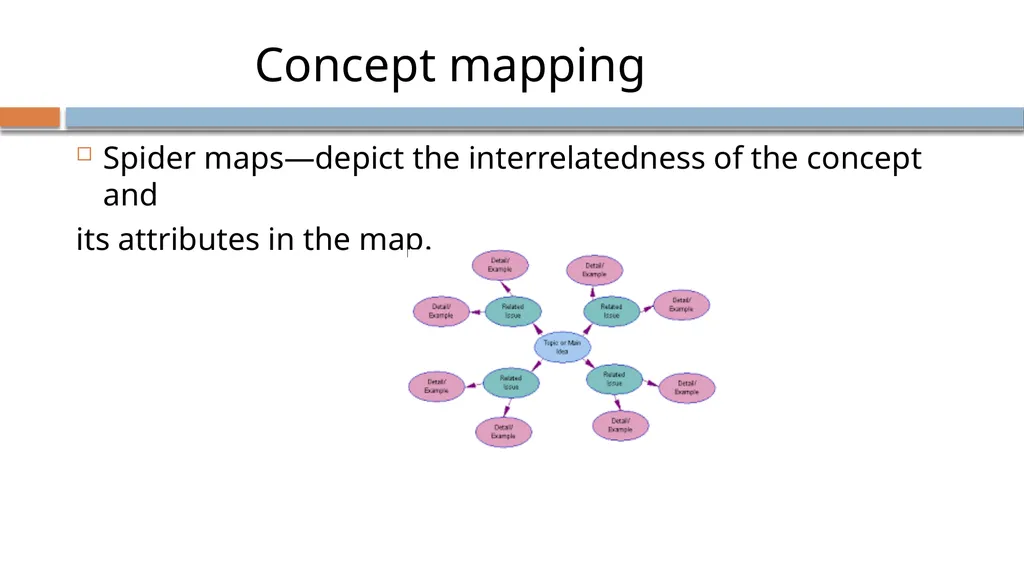
Concept mapping Spider maps—depict the interrelatedness of the concept and
its attributes in the map.<br>
its attributes in the map.<br>
34
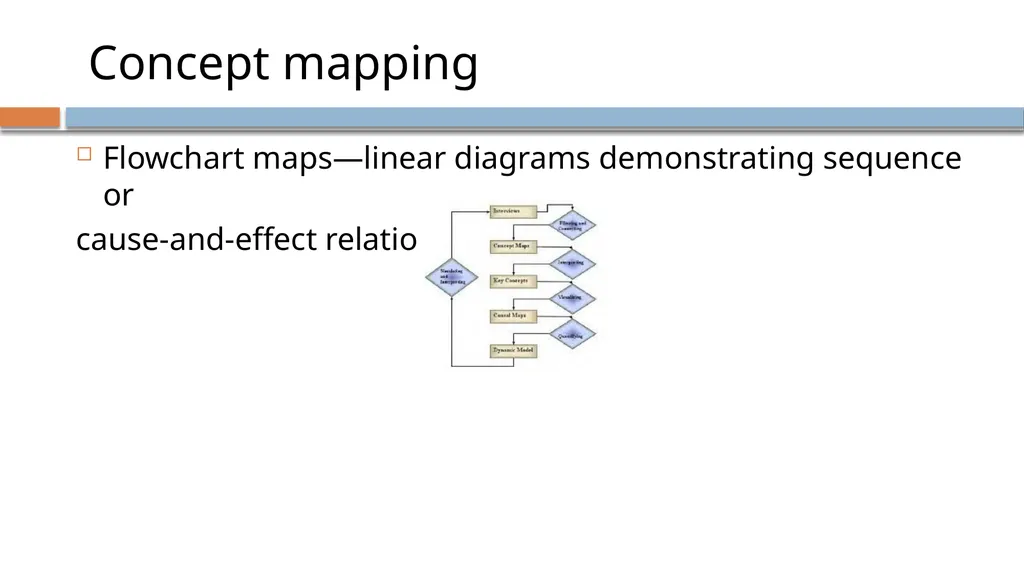
Concept mapping Flowchart maps—linear diagrams demonstrating sequence or
cause-and-effect relations.<br>
cause-and-effect relations.<br>
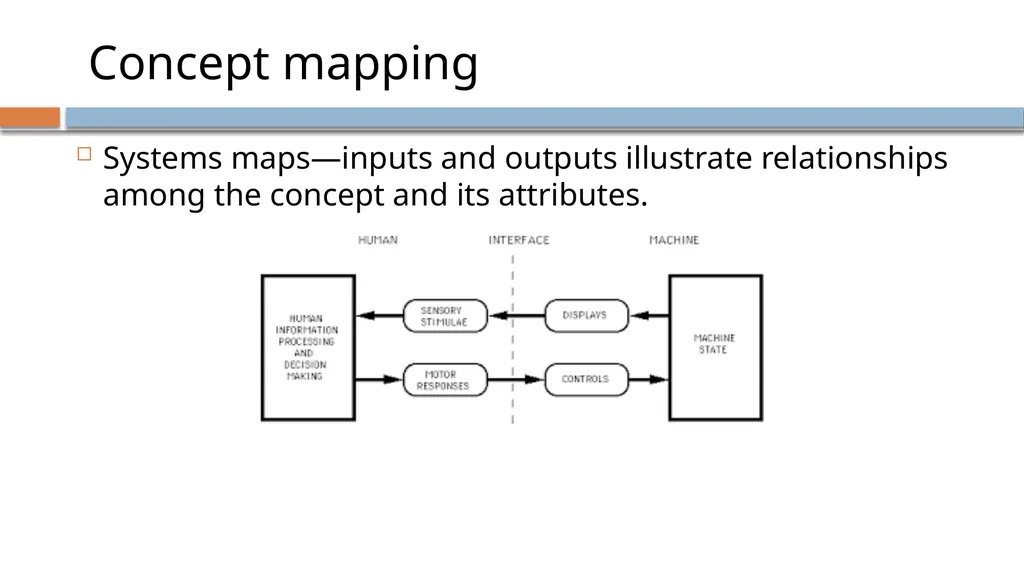
35
Concept mapping Systems maps—inputs and outputs illustrate relationships among the concept and its attributes.<br>