
CS5100 Advanced Computer Architecture Advanced
Description: CS5100 Advanced Computer Architecture Advanced Branch Prediction Prof. Chung-Ta King Department of Computer Science National Tsing Hua University, Taiwan (Slides are from textbook, Prof. Hsien-Hsin Lee, Prof. Yasun Hsu, Prof. Onur Mutlu) 1
Related Topics
Download Presentation
"CS5100 Advanced Computer Architecture Advanced" is the property of its rightful owner. Permission is granted to download and print the materials on this website for personal, non-commercial use only, and to display it on your personal computer provided you do not modify the materials and that you retain all copyright notices contained in the materials. By downloading content from our website, you accept the terms of this agreement.
Presentation Transcript
slide1. CS5100 Advanced Computer Architecture
Advanced Branch Prediction Prof. Chung-Ta King
Department of Computer Science
National Tsing Hua University, Taiwan (Slides are from textbook, Prof. Hsien-Hsin Lee, Prof. Yasun Hsu, Prof. Onur Mutlu)<br>
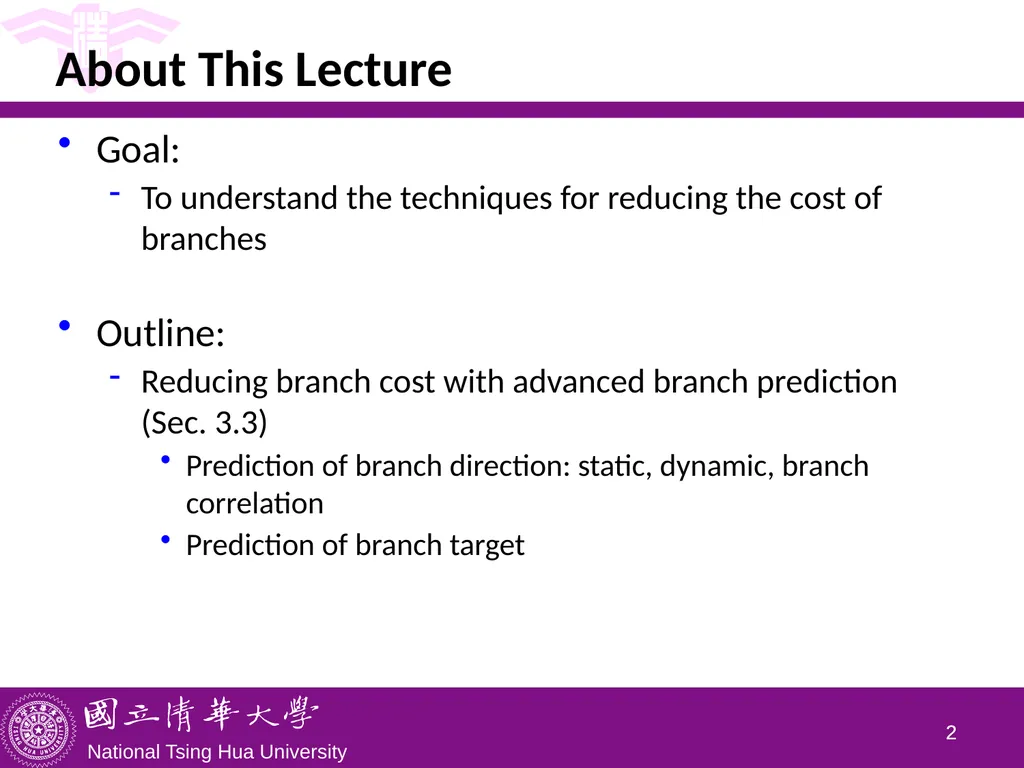
slide2. 1 1 About This Lecture Goal:
To understand the techniques for reducing the cost of branches
Outline:
Reducing branch cost with advanced branch prediction (Sec. 3.3)
Prediction of branch direction: static, dynamic, branch correlation
Prediction of branch target<br>
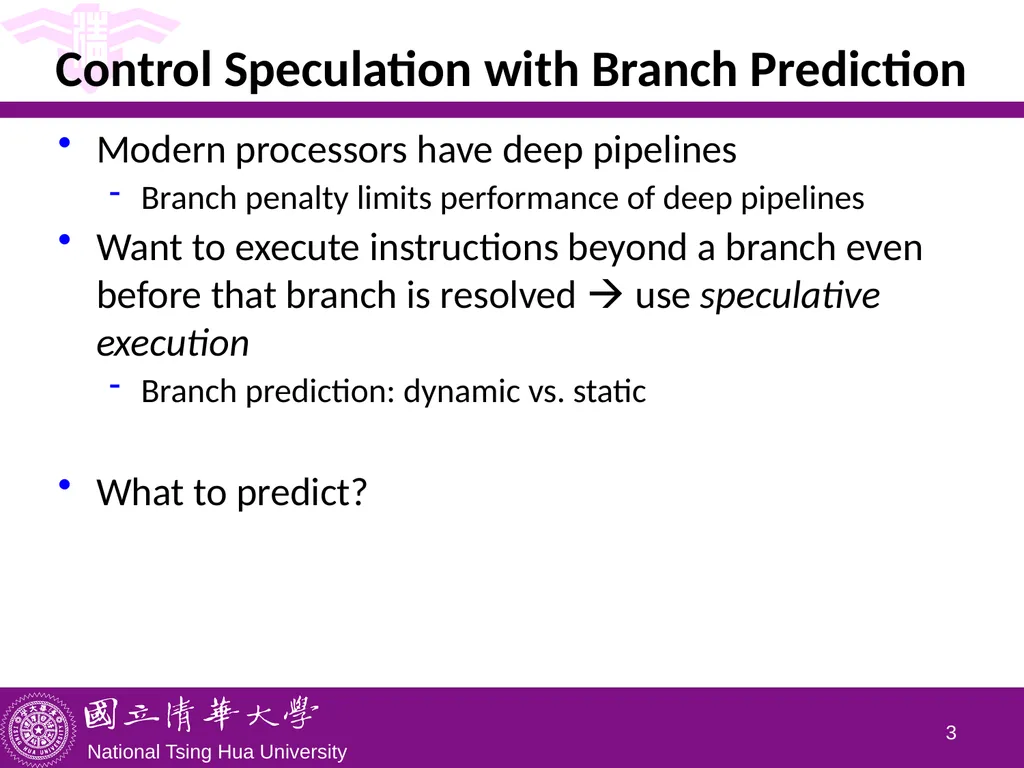
slide3. Control Speculation with Branch Prediction Modern processors have deep pipelines
Branch penalty limits performance of deep pipelines
Want to execute instructions beyond a branch even before that branch is resolved use speculative execution
Branch prediction: dynamic vs. static
What to predict? 2<br>
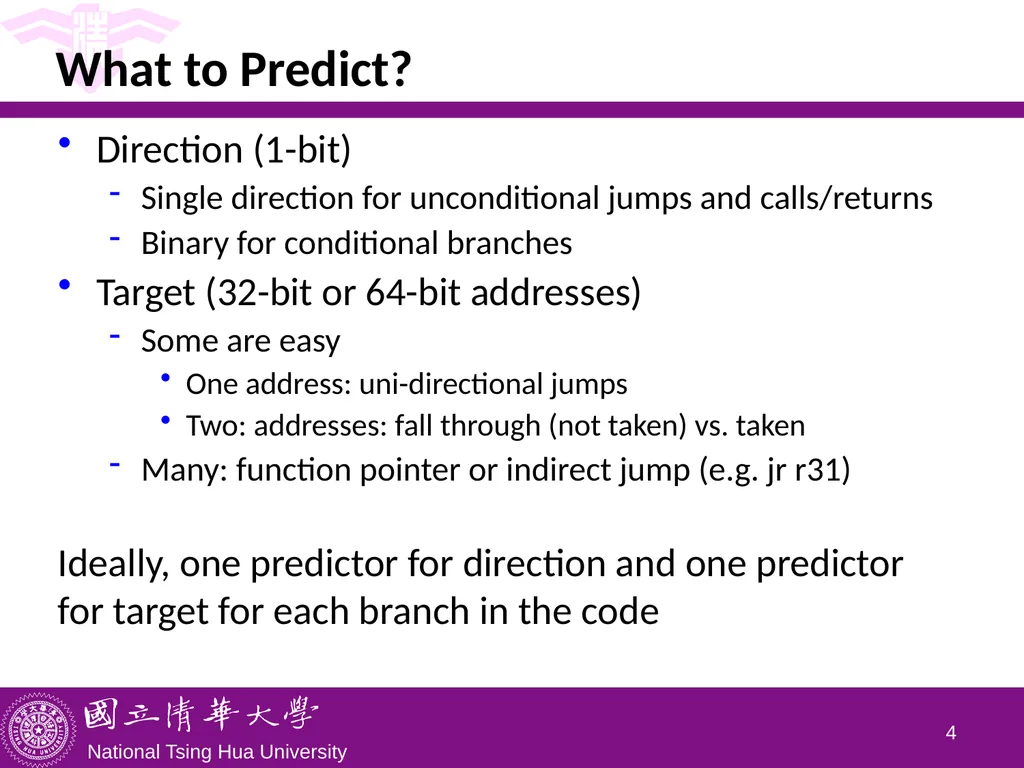
slide4. What to Predict? Direction (1-bit)
Single direction for unconditional jumps and calls/returns
Binary for conditional branches
Target (32-bit or 64-bit addresses)
Some are easy
One address: uni-directional jumps
Two: addresses: fall through (not taken) vs. taken
Many: function pointer or indirect jump (e.g. jr r31)
Ideally, one predictor for direction and one predictor for target for each branch in the code 3<br>
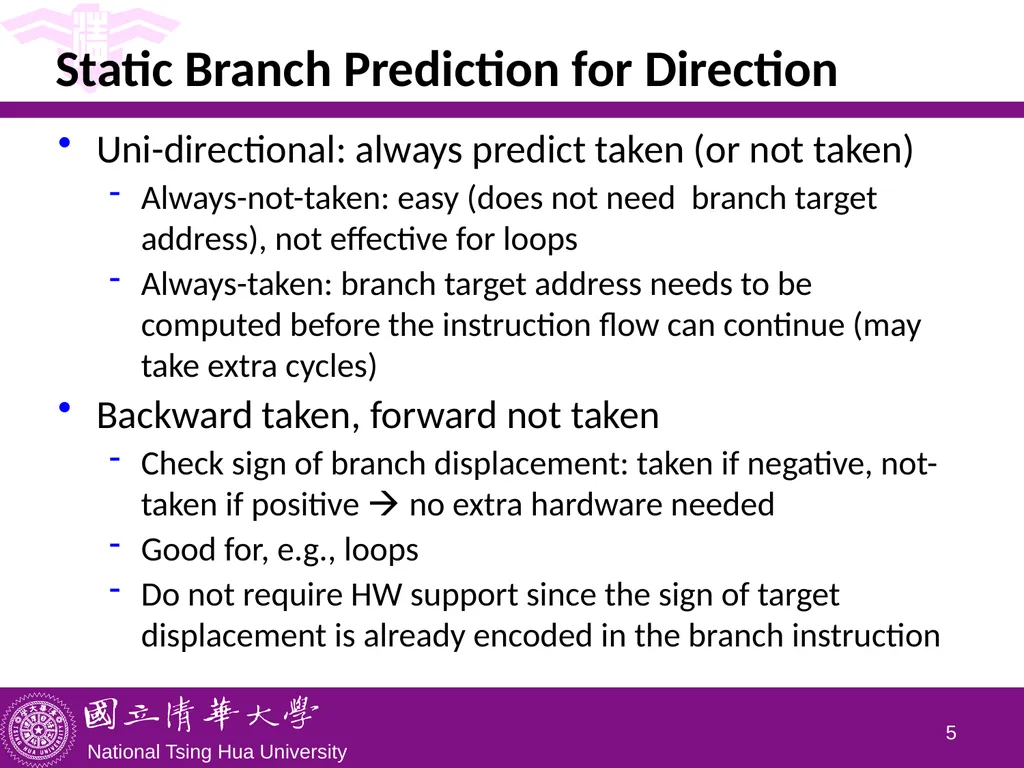
slide5. Static Branch Prediction for Direction Uni-directional: always predict taken (or not taken)
Always-not-taken: easy (does not need branch target address), not effective for loops
Always-taken: branch target address needs to be computed before the instruction flow can continue (may take extra cycles)
Backward taken, forward not taken
Check sign of branch displacement: taken if negative, not-taken if positive no extra hardware needed
Good for, e.g., loops
Do not require HW support since the sign of target displacement is already encoded in the branch instruction 4<br>
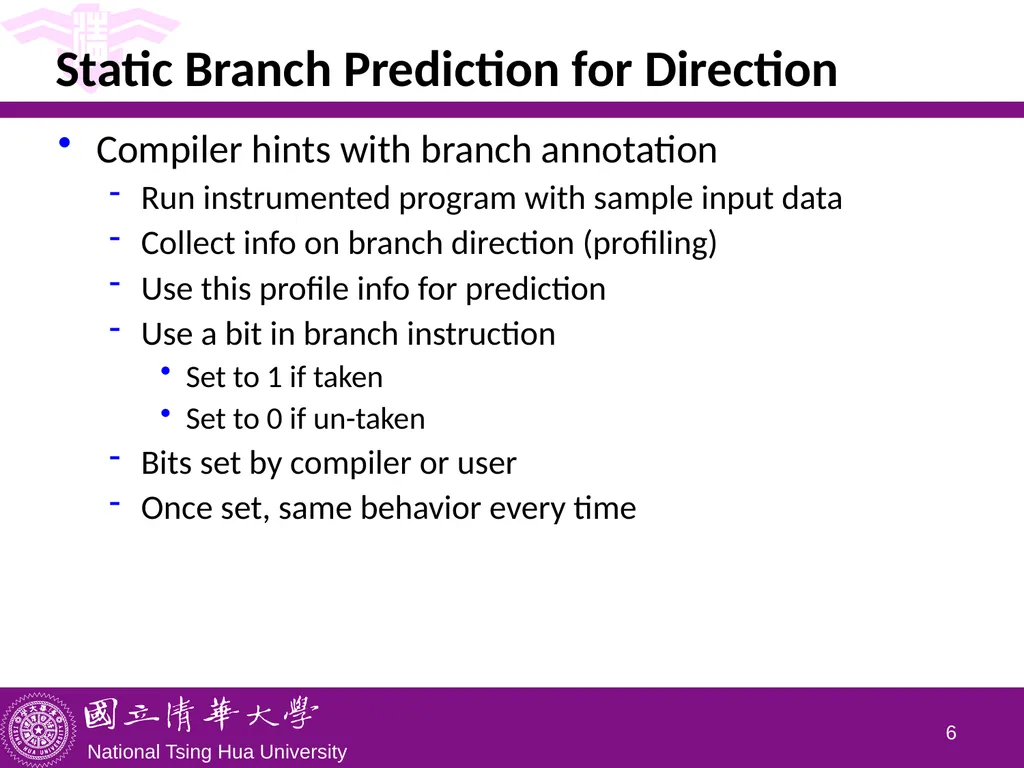
slide6. Static Branch Prediction for Direction Compiler hints with branch annotation
Run instrumented program with sample input data
Collect info on branch direction (profiling)
Use this profile info for prediction
Use a bit in branch instruction
Set to 1 if taken
Set to 0 if un-taken
Bits set by compiler or user
Once set, same behavior every time 5<br>
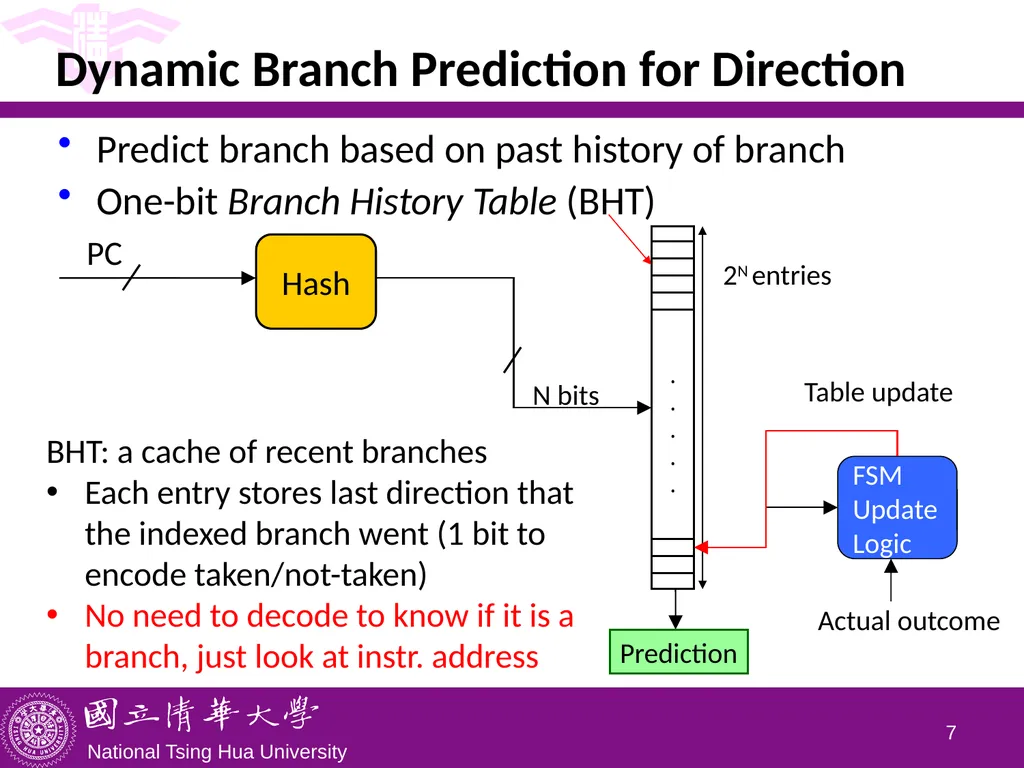
slide7. Dynamic Branch Prediction for Direction Predict branch based on past history of branch
One-bit Branch History Table (BHT) 6 PC .
.
.
.
. 2N entries Prediction N bits FSM
Update
Logic Table update Actual outcome BHT: a cache of recent branches
Each entry stores last direction that the indexed branch went (1 bit to encode taken/not-taken)
No need to decode to know if it is a branch, just look at instr. address Hash<br>
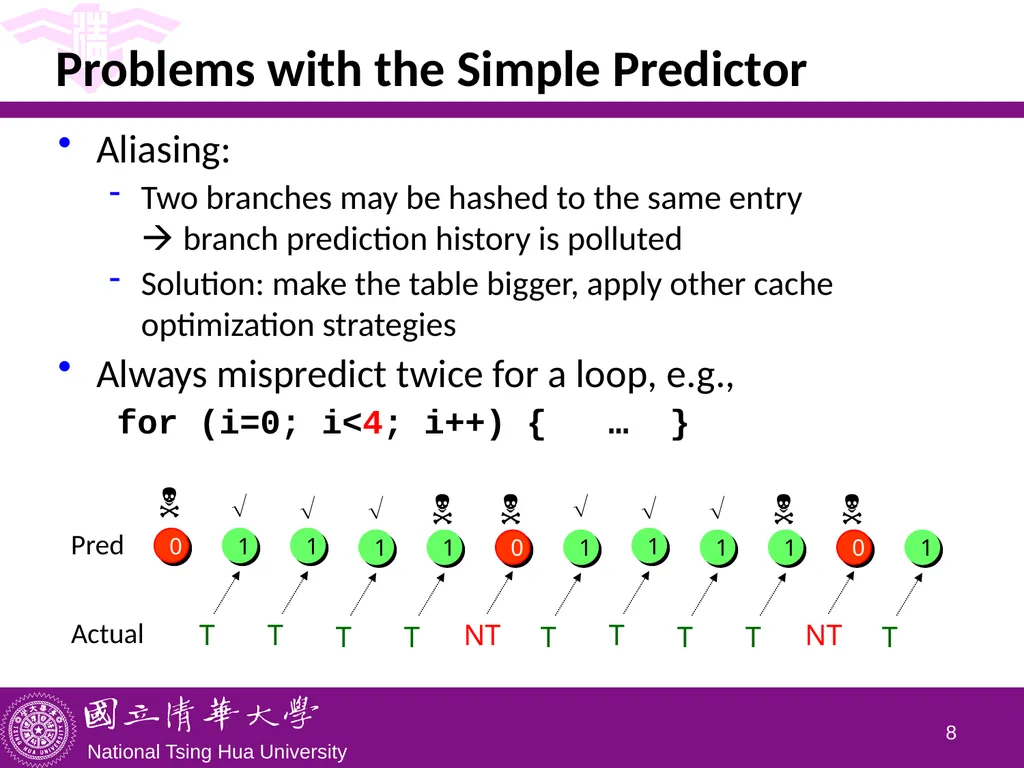
slide8. Problems with the Simple Predictor Aliasing:
Two branches may be hashed to the same entry branch prediction history is polluted
Solution: make the table bigger, apply other cache optimization strategies
Always mispredict twice for a loop, e.g.,
for (i=0; i<4; i++) { … } 7 0 Pred Actual T T T T NT T T T T NT T <br>
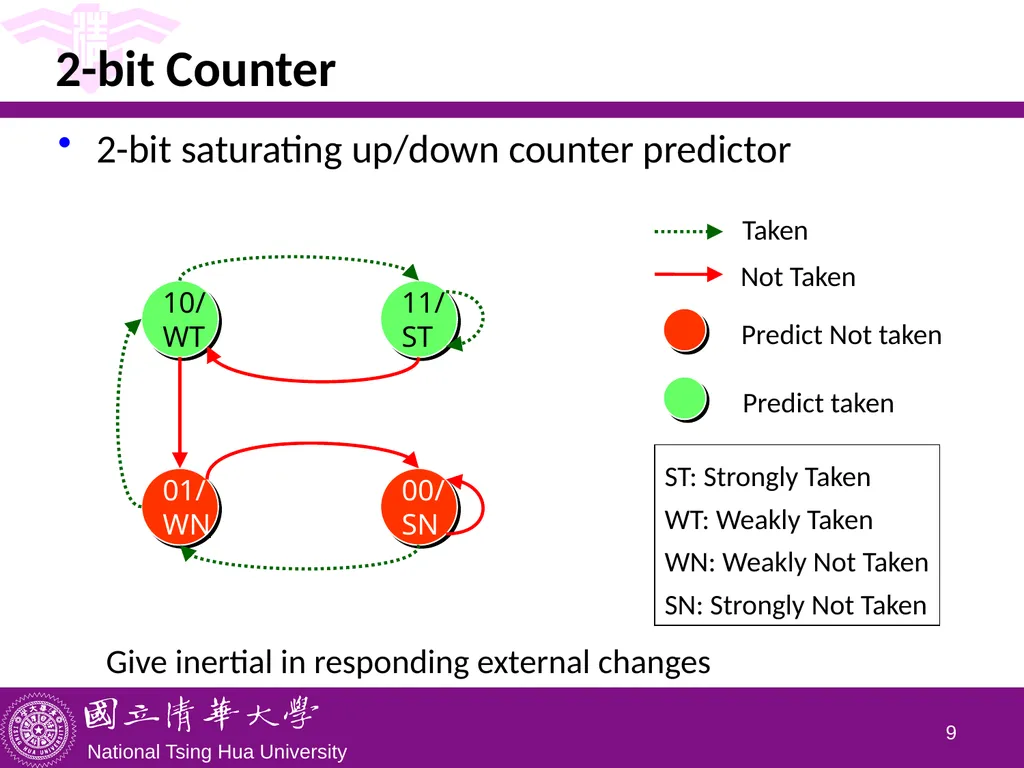
slide9. 2-bit Counter 2-bit saturating up/down counter predictor 8 Not Taken Taken Predict Not taken Predict taken ST: Strongly Taken
WT: Weakly Taken
WN: Weakly Not Taken
SN: Strongly Not Taken Give inertial in responding external changes<br>
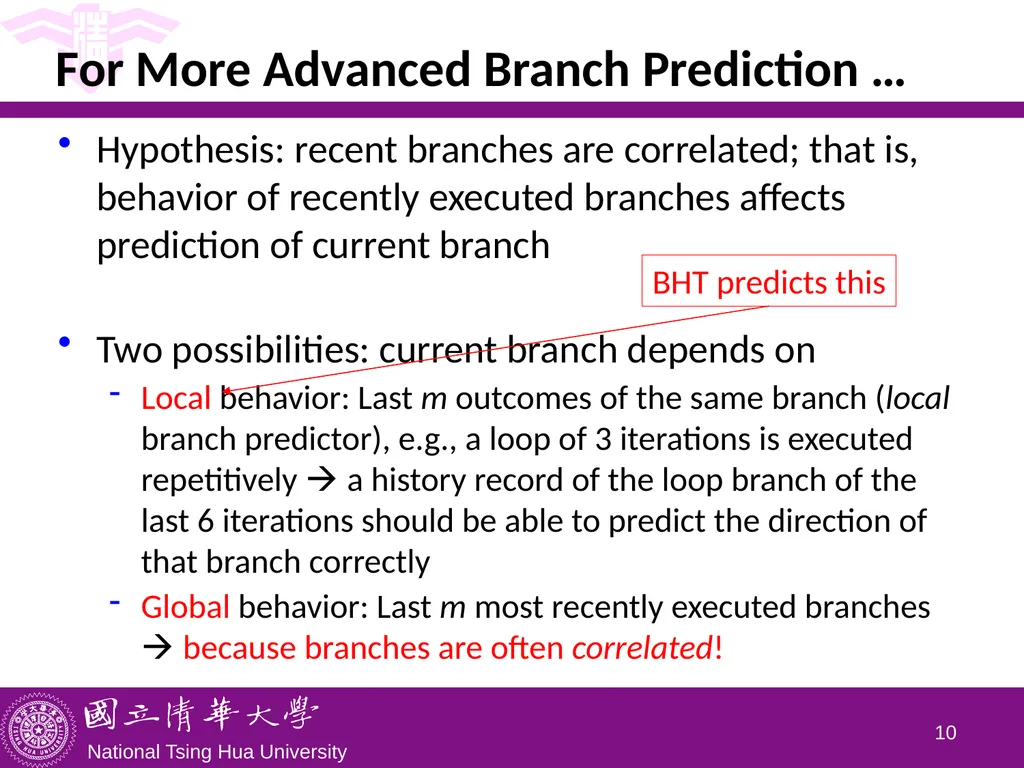
slide10. For More Advanced Branch Prediction … Hypothesis: recent branches are correlated; that is, behavior of recently executed branches affects prediction of current branch
Two possibilities: current branch depends on
Local behavior: Last m outcomes of the same branch (local branch predictor), e.g., a loop of 3 iterations is executed repetitively a history record of the loop branch of the last 6 iterations should be able to predict the direction of that branch correctly
Global behavior: Last m most recently executed branches because branches are often correlated! 9 BHT predicts this<br>
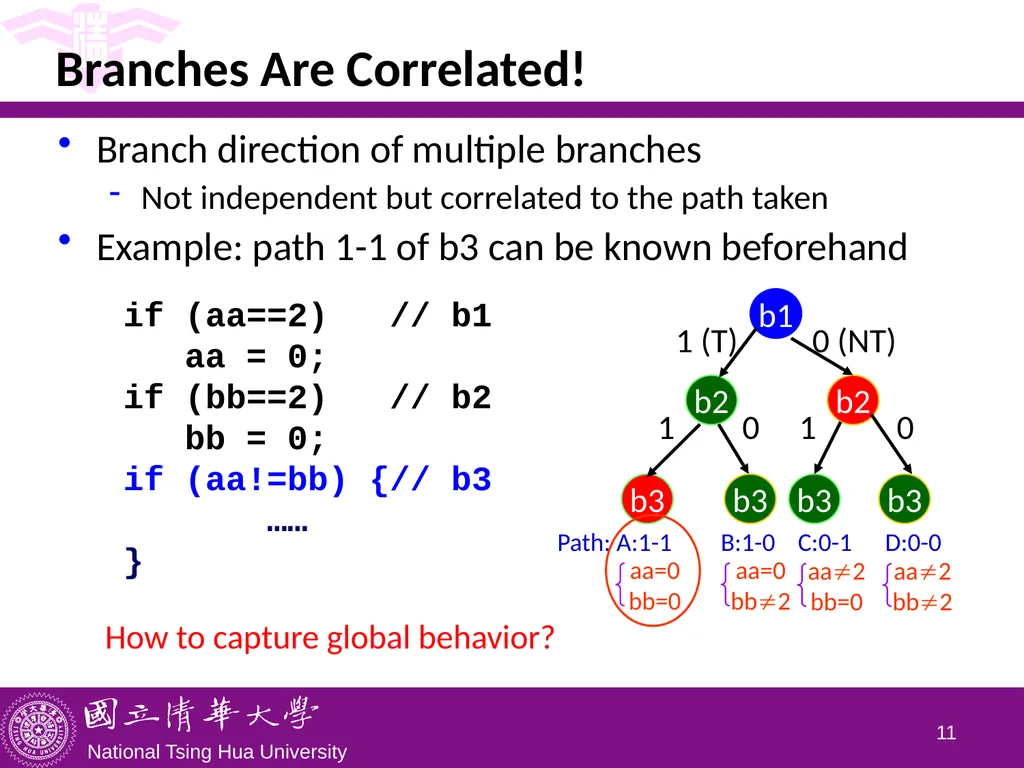
slide11. Branches Are Correlated! Branch direction of multiple branches
Not independent but correlated to the path taken
Example: path 1-1 of b3 can be known beforehand 10 if (aa==2) // b1
aa = 0;
if (bb==2) // b2
bb = 0;
if (aa!=bb) {// b3
……
} b1 b2 b2 b3 b3 b3 1 (T) 1 1 0 (NT) 0 b3 0 Path: A:1-1 B:1-0 C:0-1 D:0-0 How to capture global behavior?<br>
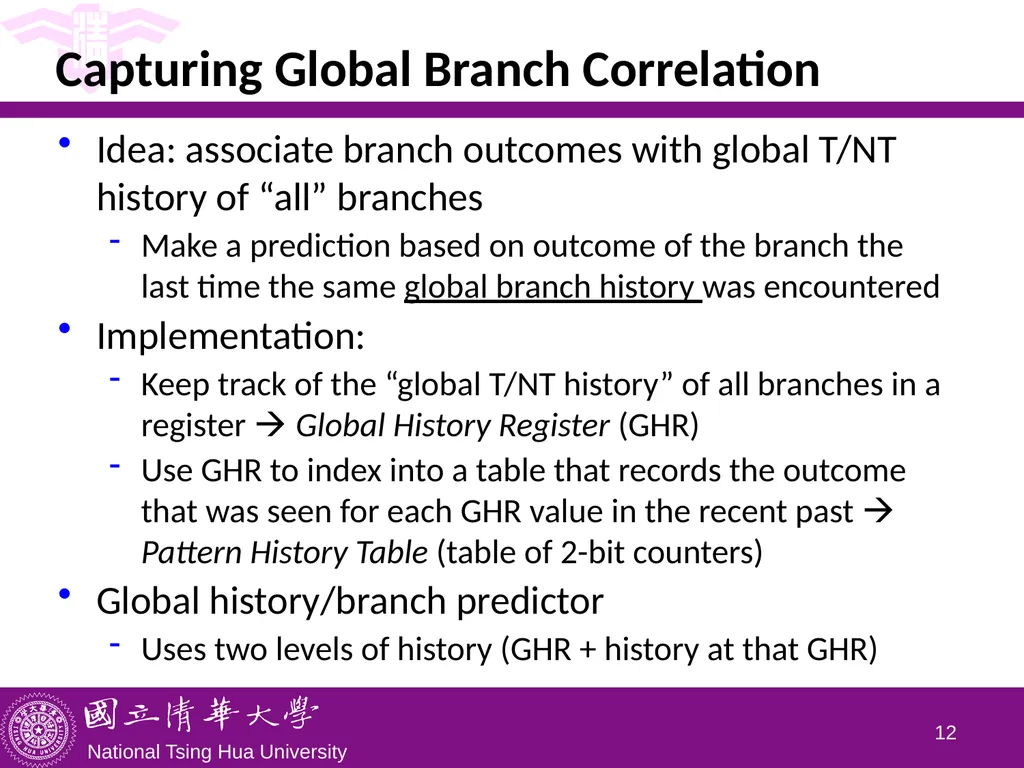
slide12. Capturing Global Branch Correlation Idea: associate branch outcomes with global T/NT history of “all” branches
Make a prediction based on outcome of the branch the last time the same global branch history was encountered
Implementation:
Keep track of the “global T/NT history” of all branches in a register Global History Register (GHR)
Use GHR to index into a table that records the outcome that was seen for each GHR value in the recent past Pattern History Table (table of 2-bit counters)
Global history/branch predictor
Uses two levels of history (GHR + history at that GHR) 11<br>
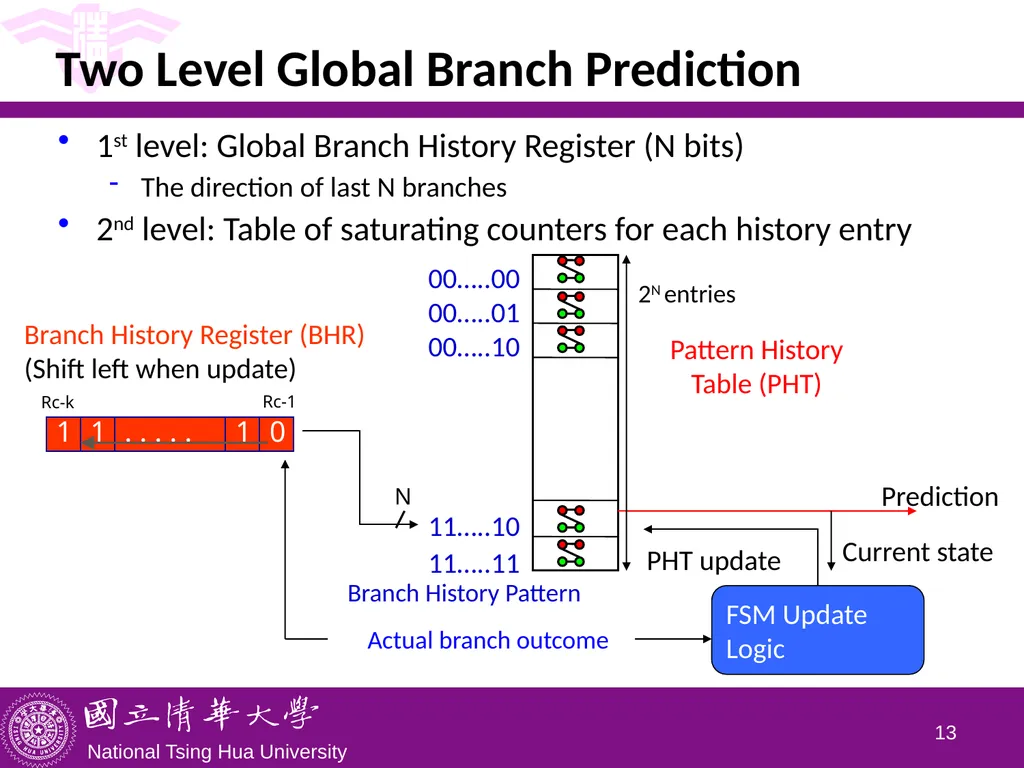
slide13. Two Level Global Branch Prediction 1st level: Global Branch History Register (N bits)
The direction of last N branches
2nd level: Table of saturating counters for each history entry 12 . . . . . 00…..00 00…..01 00…..10 11…..11 11…..10 Branch History Pattern Pattern History Table (PHT) Prediction Rc-k Rc-1 Actual branch outcome FSM Update
Logic Branch History Register (BHR)
(Shift left when update) N 2N entries Current state PHT update<br>
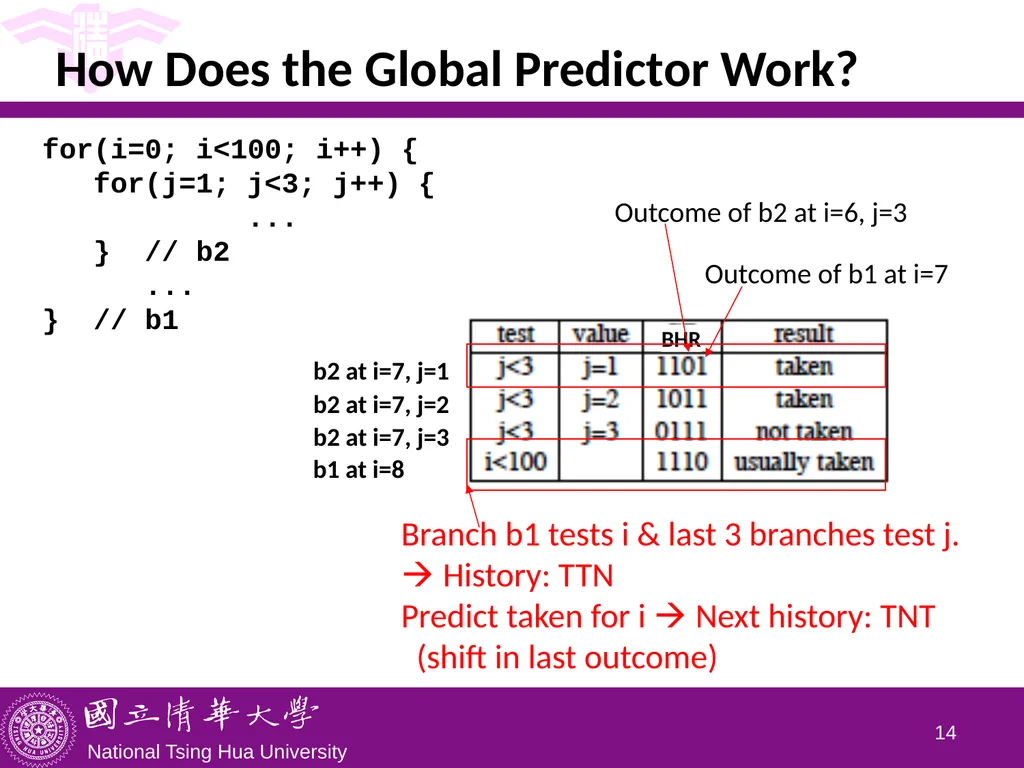
slide14. How Does the Global Predictor Work? 13 Branch b1 tests i & last 3 branches test j.
History: TTN
Predict taken for i Next history: TNT
(shift in last outcome) BHR for(i=0; i<100; i++) {
for(j=1; j<3; j++) {
...
} // b2
...
} // b1 Outcome of b1 at i=7 b2 at i=7, j=1 b2 at i=7, j=2 b2 at i=7, j=3 b1 at i=8 Outcome of b2 at i=6, j=3<br>
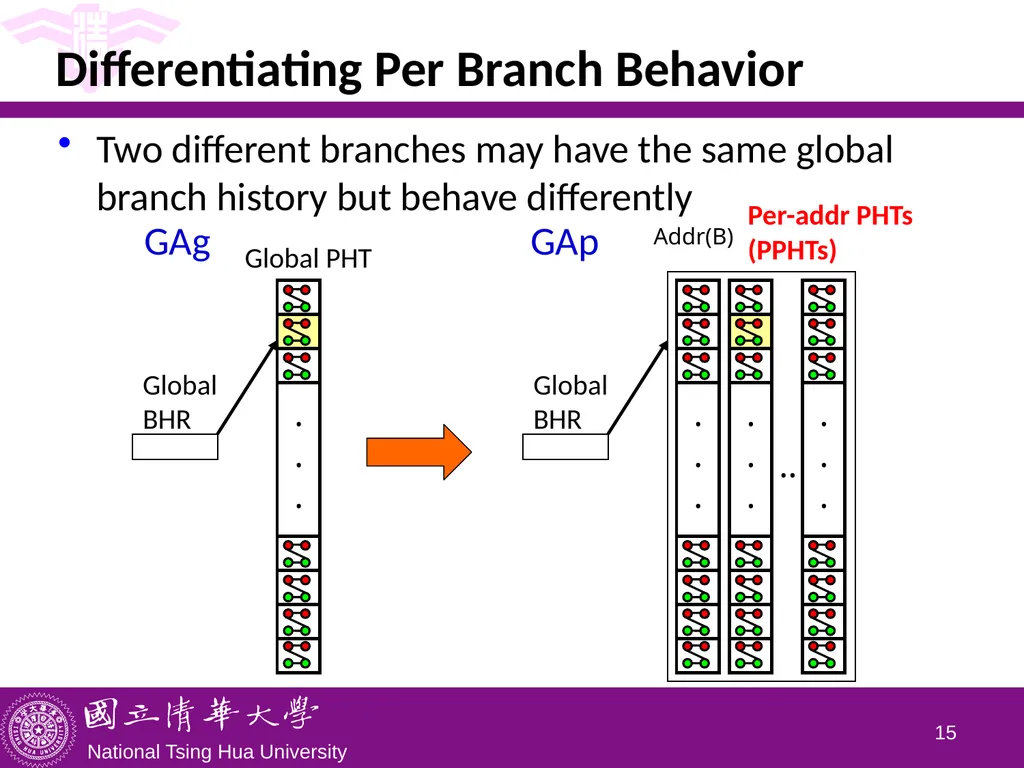
slide15. Differentiating Per Branch Behavior Two different branches may have the same global branch history but behave differently 14 Global
BHR Global PHT GAg Global
BHR .. Addr(B) Per-addr PHTs
(PPHTs) GAp<br>
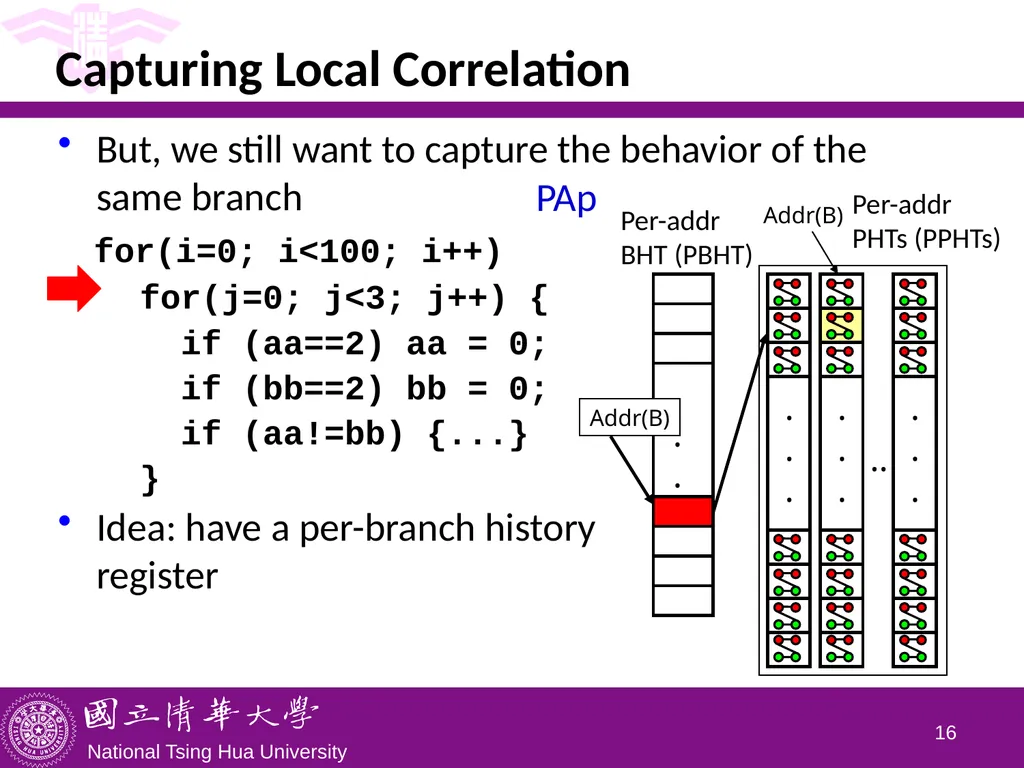
slide16. Capturing Local Correlation But, we still want to capture the behavior of the same branch
for(i=0; i<100; i++)
for(j=0; j<3; j++) {
if (aa==2) aa = 0;
if (bb==2) bb = 0;
if (aa!=bb) {...}
}
Idea: have a per-branch history register 15<br>
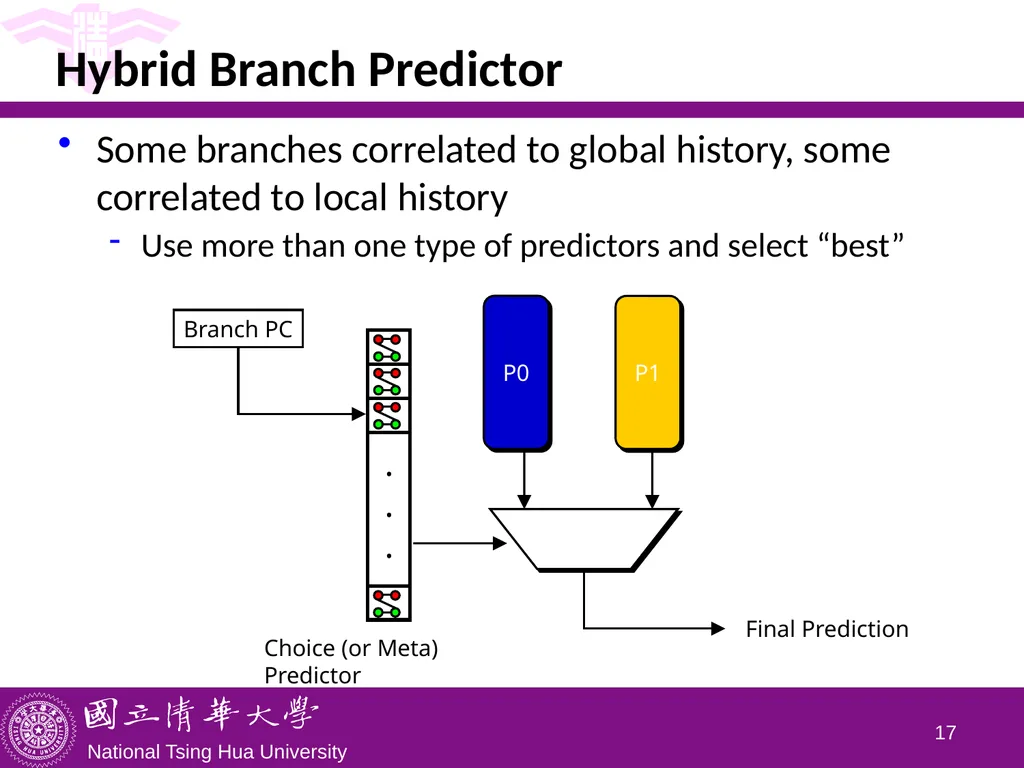
slide17. Hybrid Branch Predictor Some branches correlated to global history, some correlated to local history
Use more than one type of predictors and select “best” 16 P0 P1 .
.
. Choice (or Meta) Predictor Branch PC Final Prediction<br>
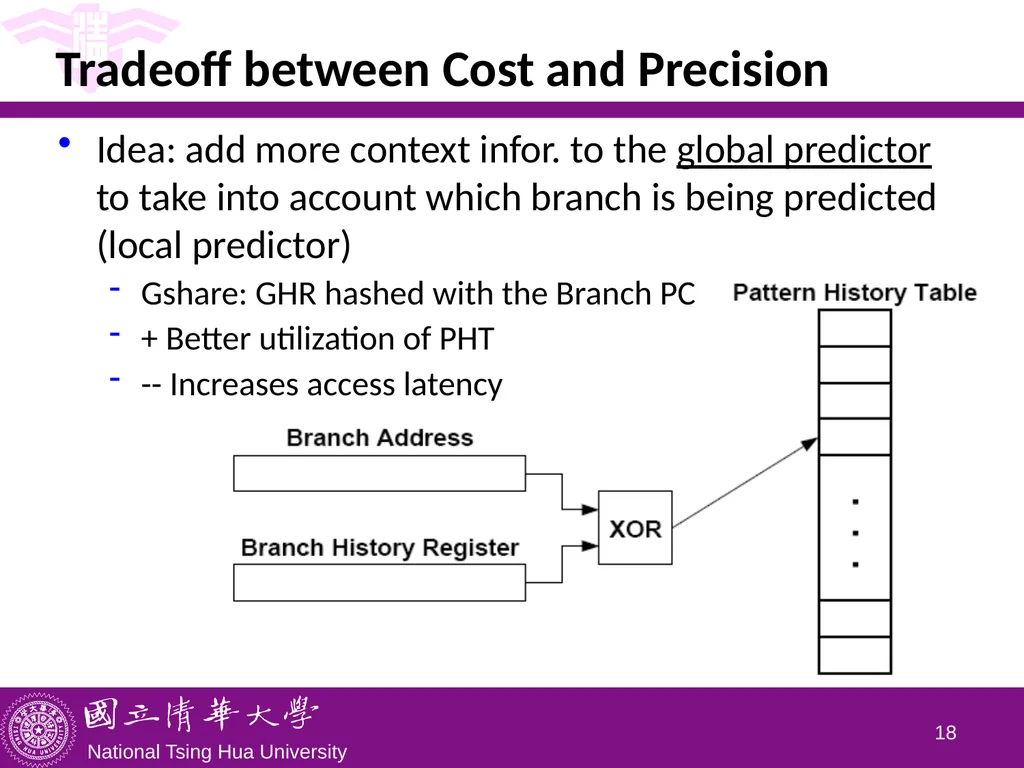
slide18. Tradeoff between Cost and Precision Idea: add more context infor. to the global predictor to take into account which branch is being predicted (local predictor)
Gshare: GHR hashed with the Branch PC
+ Better utilization of PHT
-- Increases access latency 17<br>
slide19. Outline Prediction of branch direction:
Static
Dynamic
Branch correlation
Prediction of branch target 18<br>
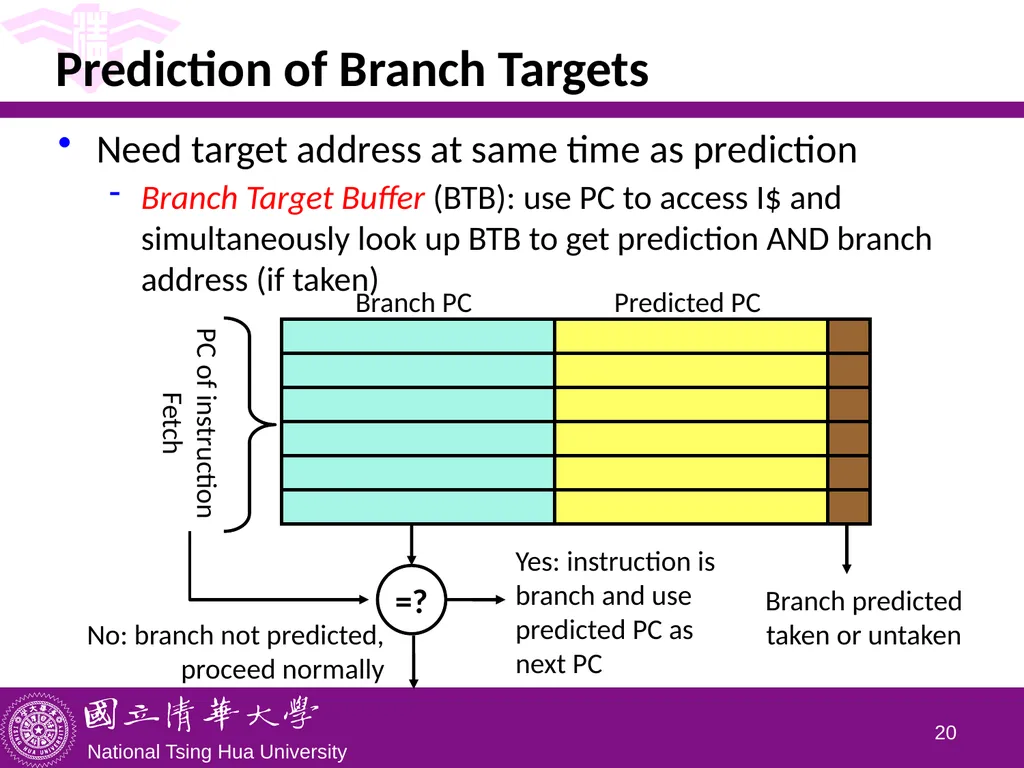
slide20. Prediction of Branch Targets Need target address at same time as prediction
Branch Target Buffer (BTB): use PC to access I$ and simultaneously look up BTB to get prediction AND branch address (if taken) 19 =? PC of instruction
Fetch Yes: instruction is branch and use predicted PC as next PC No: branch not predicted, proceed normally Branch predicted
taken or untaken<br>
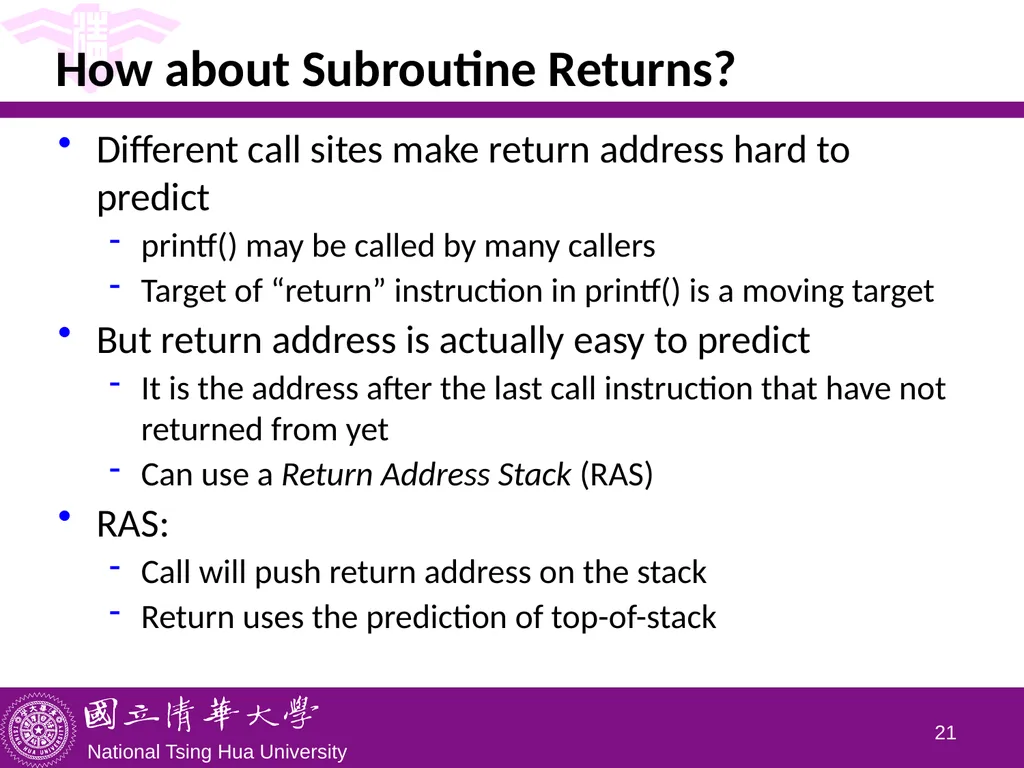
slide21. How about Subroutine Returns? Different call sites make return address hard to predict
printf() may be called by many callers
Target of “return” instruction in printf() is a moving target
But return address is actually easy to predict
It is the address after the last call instruction that have not returned from yet
Can use a Return Address Stack (RAS)
RAS:
Call will push return address on the stack
Return uses the prediction of top-of-stack 20<br>
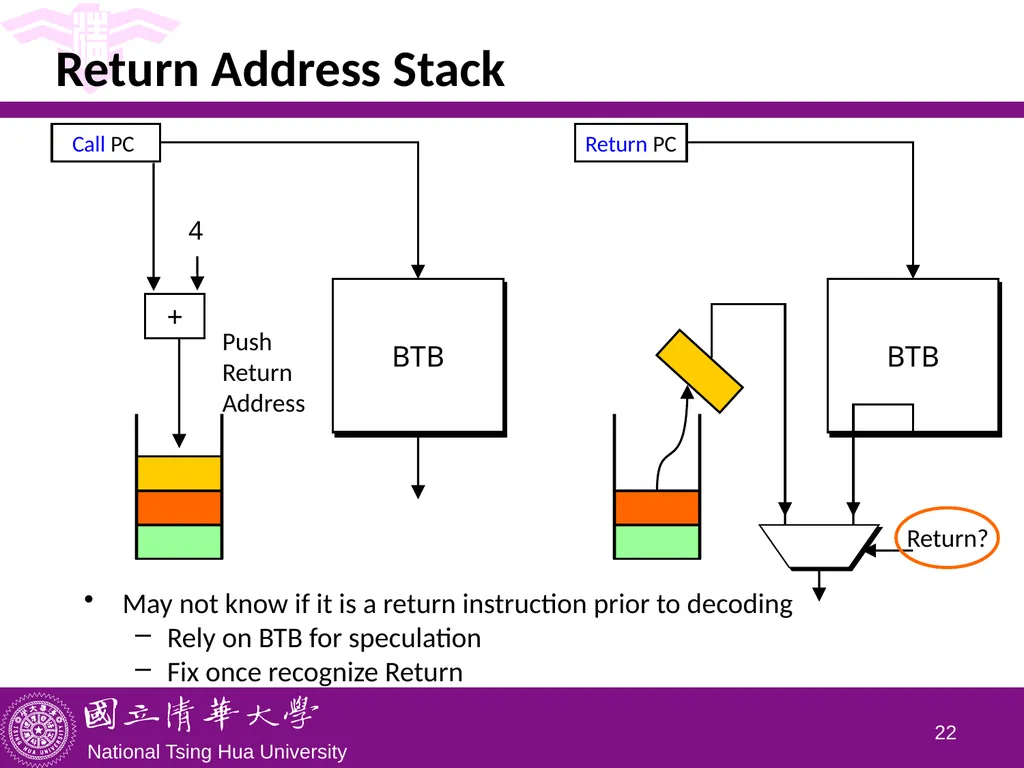
slide22. Return Address Stack 21 + 4 Call PC Push
Return
Address BTB May not know if it is a return instruction prior to decoding
Rely on BTB for speculation
Fix once recognize Return<br>
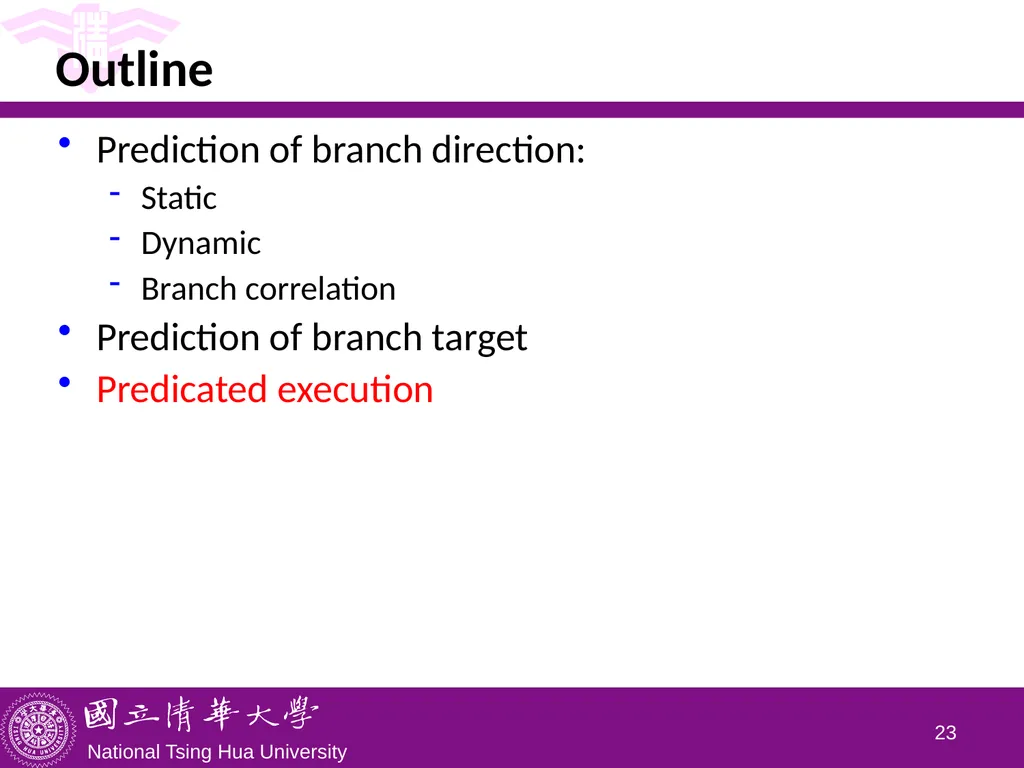
slide23. Outline Prediction of branch direction:
Static
Dynamic
Branch correlation
Prediction of branch target
Predicated execution 22<br>
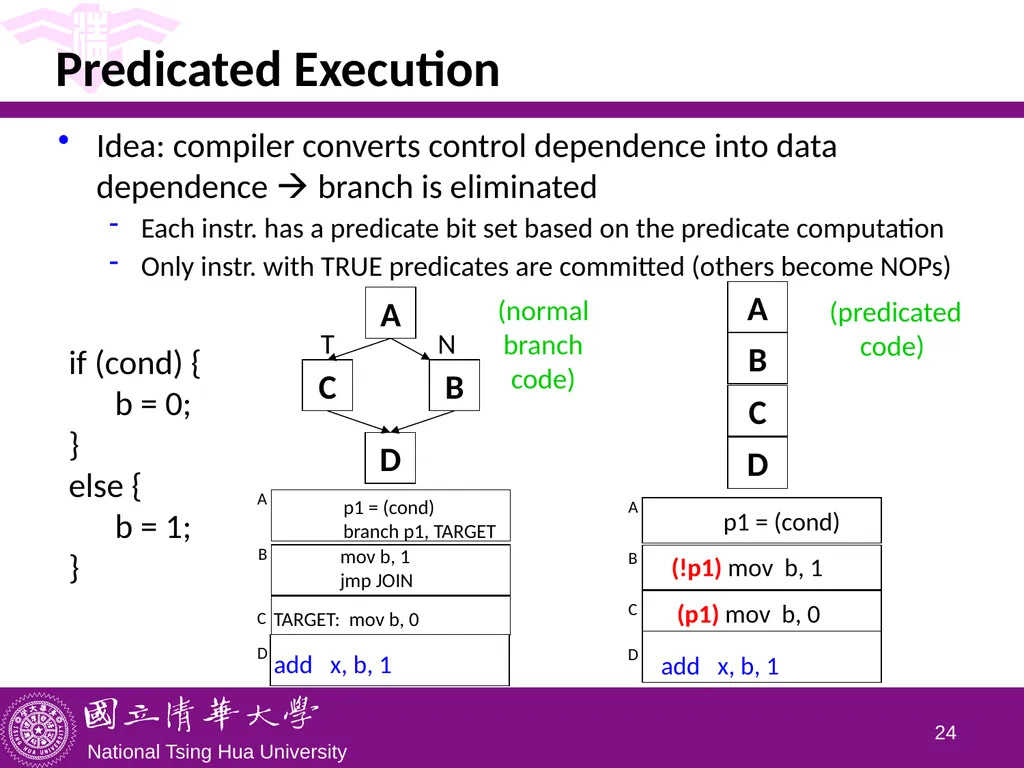
slide24. Predicated Execution Idea: compiler converts control dependence into data dependence branch is eliminated
Each instr. has a predicate bit set based on the predicate computation
Only instr. with TRUE predicates are committed (others become NOPs) 23 if (cond) {
b = 0;
}
else {
b = 1;
}<br>
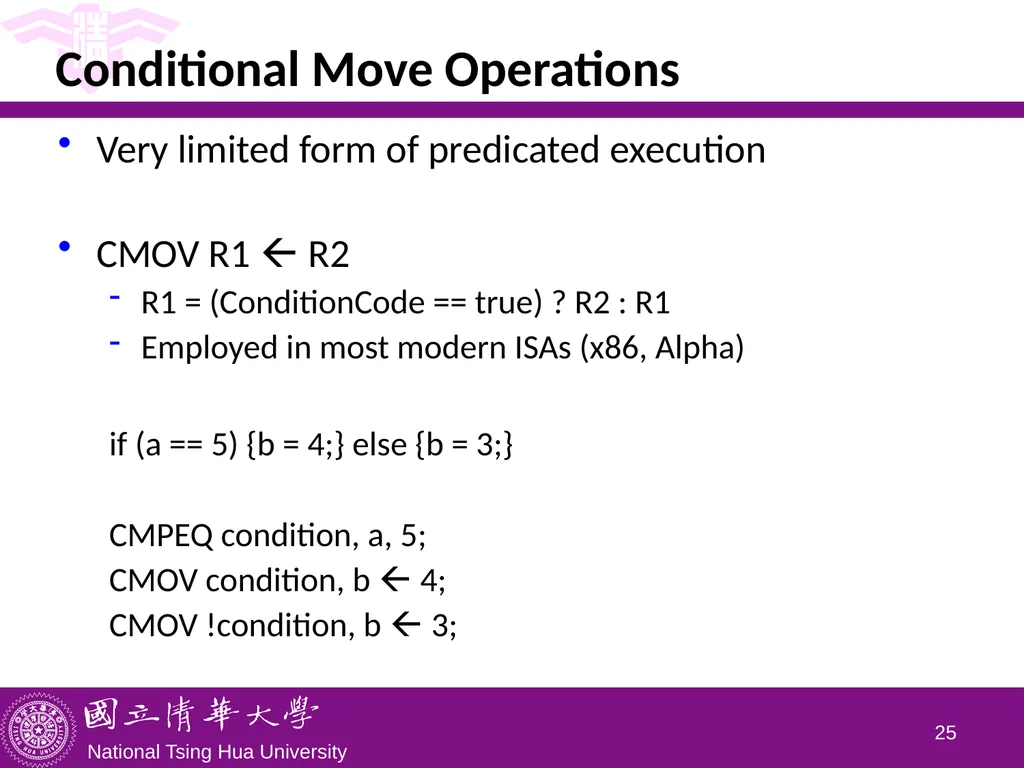
slide25. Conditional Move Operations Very limited form of predicated execution
CMOV R1 R2
R1 = (ConditionCode == true) ? R2 : R1
Employed in most modern ISAs (x86, Alpha)
if (a == 5) {b = 4;} else {b = 3;}
CMPEQ condition, a, 5;
CMOV condition, b 4;
CMOV !condition, b 3; 24<br>
slide26. Recap Branch History Table: 2 bits for loop accuracy
Correlation: recently executed branches correlated with next branch.
Either different branches
Or different executions of same branches
2-level predictor
Branch history and pattern history
Branch Target Buffer: include branch address and prediction
Return address stack for return address of calls 25<br>
Department of Computer Science
National Tsing Hua University, Taiwan (Slides are from textbook, Prof. Hsien-Hsin Lee, Prof. Yasun Hsu, Prof. Onur Mutlu)<br>
slide2. 1 1 About This Lecture Goal:
To understand the techniques for reducing the cost of branches
Outline:
Reducing branch cost with advanced branch prediction (Sec. 3.3)
Prediction of branch direction: static, dynamic, branch correlation
Prediction of branch target<br>
slide3. Control Speculation with Branch Prediction Modern processors have deep pipelines
Branch penalty limits performance of deep pipelines
Want to execute instructions beyond a branch even before that branch is resolved use speculative execution
Branch prediction: dynamic vs. static
What to predict? 2<br>
slide4. What to Predict? Direction (1-bit)
Single direction for unconditional jumps and calls/returns
Binary for conditional branches
Target (32-bit or 64-bit addresses)
Some are easy
One address: uni-directional jumps
Two: addresses: fall through (not taken) vs. taken
Many: function pointer or indirect jump (e.g. jr r31)
Ideally, one predictor for direction and one predictor for target for each branch in the code 3<br>
slide5. Static Branch Prediction for Direction Uni-directional: always predict taken (or not taken)
Always-not-taken: easy (does not need branch target address), not effective for loops
Always-taken: branch target address needs to be computed before the instruction flow can continue (may take extra cycles)
Backward taken, forward not taken
Check sign of branch displacement: taken if negative, not-taken if positive no extra hardware needed
Good for, e.g., loops
Do not require HW support since the sign of target displacement is already encoded in the branch instruction 4<br>
slide6. Static Branch Prediction for Direction Compiler hints with branch annotation
Run instrumented program with sample input data
Collect info on branch direction (profiling)
Use this profile info for prediction
Use a bit in branch instruction
Set to 1 if taken
Set to 0 if un-taken
Bits set by compiler or user
Once set, same behavior every time 5<br>
slide7. Dynamic Branch Prediction for Direction Predict branch based on past history of branch
One-bit Branch History Table (BHT) 6 PC .
.
.
.
. 2N entries Prediction N bits FSM
Update
Logic Table update Actual outcome BHT: a cache of recent branches
Each entry stores last direction that the indexed branch went (1 bit to encode taken/not-taken)
No need to decode to know if it is a branch, just look at instr. address Hash<br>
slide8. Problems with the Simple Predictor Aliasing:
Two branches may be hashed to the same entry branch prediction history is polluted
Solution: make the table bigger, apply other cache optimization strategies
Always mispredict twice for a loop, e.g.,
for (i=0; i<4; i++) { … } 7 0 Pred Actual T T T T NT T T T T NT T <br>
slide9. 2-bit Counter 2-bit saturating up/down counter predictor 8 Not Taken Taken Predict Not taken Predict taken ST: Strongly Taken
WT: Weakly Taken
WN: Weakly Not Taken
SN: Strongly Not Taken Give inertial in responding external changes<br>
slide10. For More Advanced Branch Prediction … Hypothesis: recent branches are correlated; that is, behavior of recently executed branches affects prediction of current branch
Two possibilities: current branch depends on
Local behavior: Last m outcomes of the same branch (local branch predictor), e.g., a loop of 3 iterations is executed repetitively a history record of the loop branch of the last 6 iterations should be able to predict the direction of that branch correctly
Global behavior: Last m most recently executed branches because branches are often correlated! 9 BHT predicts this<br>
slide11. Branches Are Correlated! Branch direction of multiple branches
Not independent but correlated to the path taken
Example: path 1-1 of b3 can be known beforehand 10 if (aa==2) // b1
aa = 0;
if (bb==2) // b2
bb = 0;
if (aa!=bb) {// b3
……
} b1 b2 b2 b3 b3 b3 1 (T) 1 1 0 (NT) 0 b3 0 Path: A:1-1 B:1-0 C:0-1 D:0-0 How to capture global behavior?<br>
slide12. Capturing Global Branch Correlation Idea: associate branch outcomes with global T/NT history of “all” branches
Make a prediction based on outcome of the branch the last time the same global branch history was encountered
Implementation:
Keep track of the “global T/NT history” of all branches in a register Global History Register (GHR)
Use GHR to index into a table that records the outcome that was seen for each GHR value in the recent past Pattern History Table (table of 2-bit counters)
Global history/branch predictor
Uses two levels of history (GHR + history at that GHR) 11<br>
slide13. Two Level Global Branch Prediction 1st level: Global Branch History Register (N bits)
The direction of last N branches
2nd level: Table of saturating counters for each history entry 12 . . . . . 00…..00 00…..01 00…..10 11…..11 11…..10 Branch History Pattern Pattern History Table (PHT) Prediction Rc-k Rc-1 Actual branch outcome FSM Update
Logic Branch History Register (BHR)
(Shift left when update) N 2N entries Current state PHT update<br>
slide14. How Does the Global Predictor Work? 13 Branch b1 tests i & last 3 branches test j.
History: TTN
Predict taken for i Next history: TNT
(shift in last outcome) BHR for(i=0; i<100; i++) {
for(j=1; j<3; j++) {
...
} // b2
...
} // b1 Outcome of b1 at i=7 b2 at i=7, j=1 b2 at i=7, j=2 b2 at i=7, j=3 b1 at i=8 Outcome of b2 at i=6, j=3<br>
slide15. Differentiating Per Branch Behavior Two different branches may have the same global branch history but behave differently 14 Global
BHR Global PHT GAg Global
BHR .. Addr(B) Per-addr PHTs
(PPHTs) GAp<br>
slide16. Capturing Local Correlation But, we still want to capture the behavior of the same branch
for(i=0; i<100; i++)
for(j=0; j<3; j++) {
if (aa==2) aa = 0;
if (bb==2) bb = 0;
if (aa!=bb) {...}
}
Idea: have a per-branch history register 15<br>
slide17. Hybrid Branch Predictor Some branches correlated to global history, some correlated to local history
Use more than one type of predictors and select “best” 16 P0 P1 .
.
. Choice (or Meta) Predictor Branch PC Final Prediction<br>
slide18. Tradeoff between Cost and Precision Idea: add more context infor. to the global predictor to take into account which branch is being predicted (local predictor)
Gshare: GHR hashed with the Branch PC
+ Better utilization of PHT
-- Increases access latency 17<br>
slide19. Outline Prediction of branch direction:
Static
Dynamic
Branch correlation
Prediction of branch target 18<br>
slide20. Prediction of Branch Targets Need target address at same time as prediction
Branch Target Buffer (BTB): use PC to access I$ and simultaneously look up BTB to get prediction AND branch address (if taken) 19 =? PC of instruction
Fetch Yes: instruction is branch and use predicted PC as next PC No: branch not predicted, proceed normally Branch predicted
taken or untaken<br>
slide21. How about Subroutine Returns? Different call sites make return address hard to predict
printf() may be called by many callers
Target of “return” instruction in printf() is a moving target
But return address is actually easy to predict
It is the address after the last call instruction that have not returned from yet
Can use a Return Address Stack (RAS)
RAS:
Call will push return address on the stack
Return uses the prediction of top-of-stack 20<br>
slide22. Return Address Stack 21 + 4 Call PC Push
Return
Address BTB May not know if it is a return instruction prior to decoding
Rely on BTB for speculation
Fix once recognize Return<br>
slide23. Outline Prediction of branch direction:
Static
Dynamic
Branch correlation
Prediction of branch target
Predicated execution 22<br>
slide24. Predicated Execution Idea: compiler converts control dependence into data dependence branch is eliminated
Each instr. has a predicate bit set based on the predicate computation
Only instr. with TRUE predicates are committed (others become NOPs) 23 if (cond) {
b = 0;
}
else {
b = 1;
}<br>
slide25. Conditional Move Operations Very limited form of predicated execution
CMOV R1 R2
R1 = (ConditionCode == true) ? R2 : R1
Employed in most modern ISAs (x86, Alpha)
if (a == 5) {b = 4;} else {b = 3;}
CMPEQ condition, a, 5;
CMOV condition, b 4;
CMOV !condition, b 3; 24<br>
slide26. Recap Branch History Table: 2 bits for loop accuracy
Correlation: recently executed branches correlated with next branch.
Either different branches
Or different executions of same branches
2-level predictor
Branch history and pattern history
Branch Target Buffer: include branch address and prediction
Return address stack for return address of calls 25<br>