
CS5100 Advanced Computer Architecture Course
Description: CS5100 Advanced Computer Architecture Course Overview Prof. Chung-Ta King Department of Computer Science National Tsing Hua University, Taiwan (Slides are from textbook, Prof. Hsien-Hsin Lee, Prof. Yasun Hsu, Prof. Marc Snir) What Is This?
Related Topics
Download Presentation
"CS5100 Advanced Computer Architecture Course" is the property of its rightful owner. Permission is granted to download and print the materials on this website for personal, non-commercial use only, and to display it on your personal computer provided you do not modify the materials and that you retain all copyright notices contained in the materials. By downloading content from our website, you accept the terms of this agreement.
Presentation Transcript
slide1. CS5100 Advanced Computer Architecture
Course Overview Prof. Chung-Ta King
Department of Computer Science
National Tsing Hua University, Taiwan (Slides are from textbook, Prof. Hsien-Hsin Lee, Prof. Yasun Hsu, Prof. Marc Snir)<br>
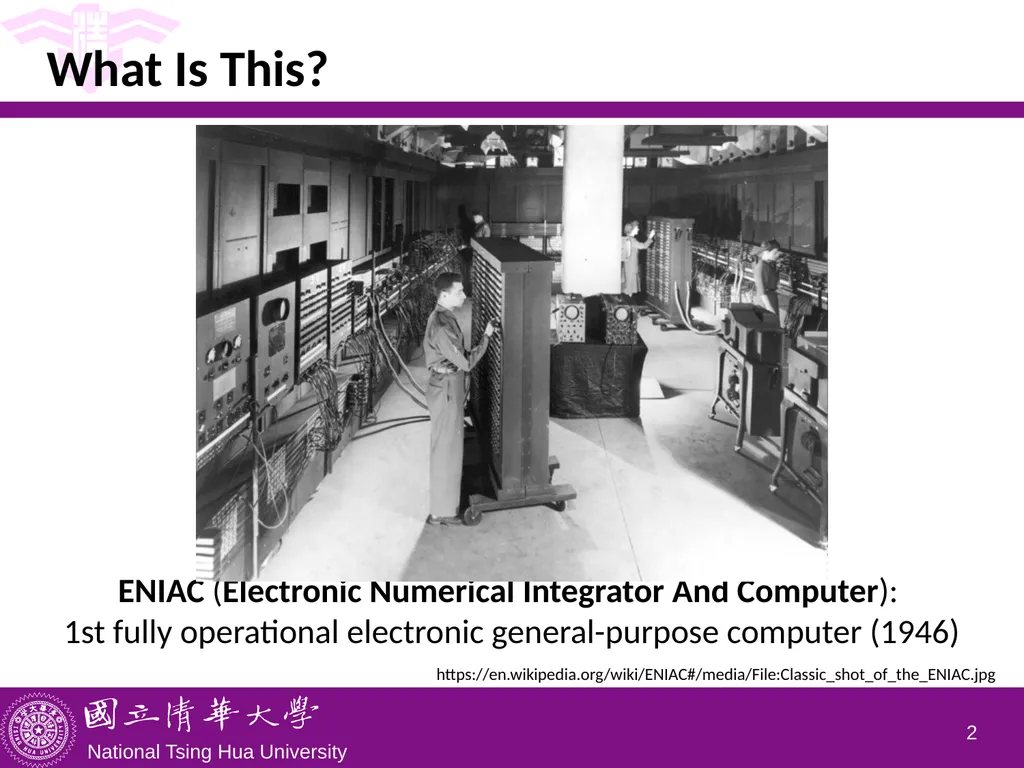
slide2. What Is This? ENIAC (Electronic Numerical Integrator And Computer): 1st fully operational electronic general-purpose computer (1946) 1 https://en.wikipedia.org/wiki/ENIAC#/media/File:Classic_shot_of_the_ENIAC.jpg<br>
slide3. When was the first processor on-a-chip developed?<br>
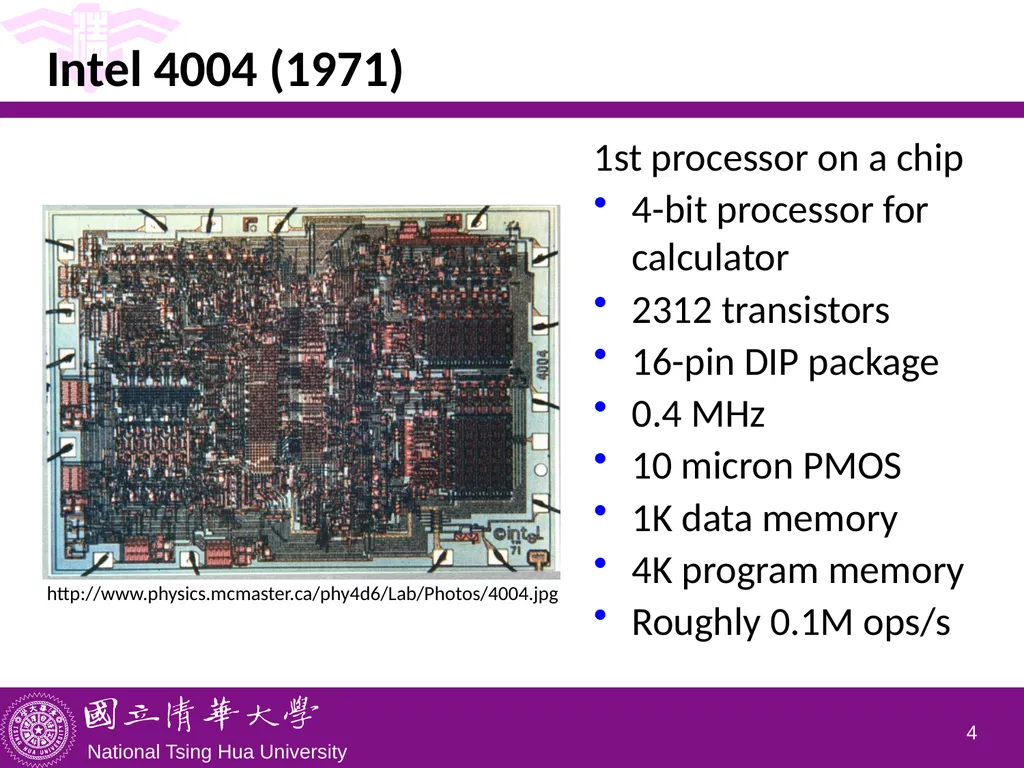
slide4. Intel 4004 (1971) 1st processor on a chip
4-bit processor for calculator
2312 transistors
16-pin DIP package
0.4 MHz
10 micron PMOS
1K data memory
4K program memory
Roughly 0.1M ops/s 3 http://www.physics.mcmaster.ca/phy4d6/Lab/Photos/4004.jpg<br>
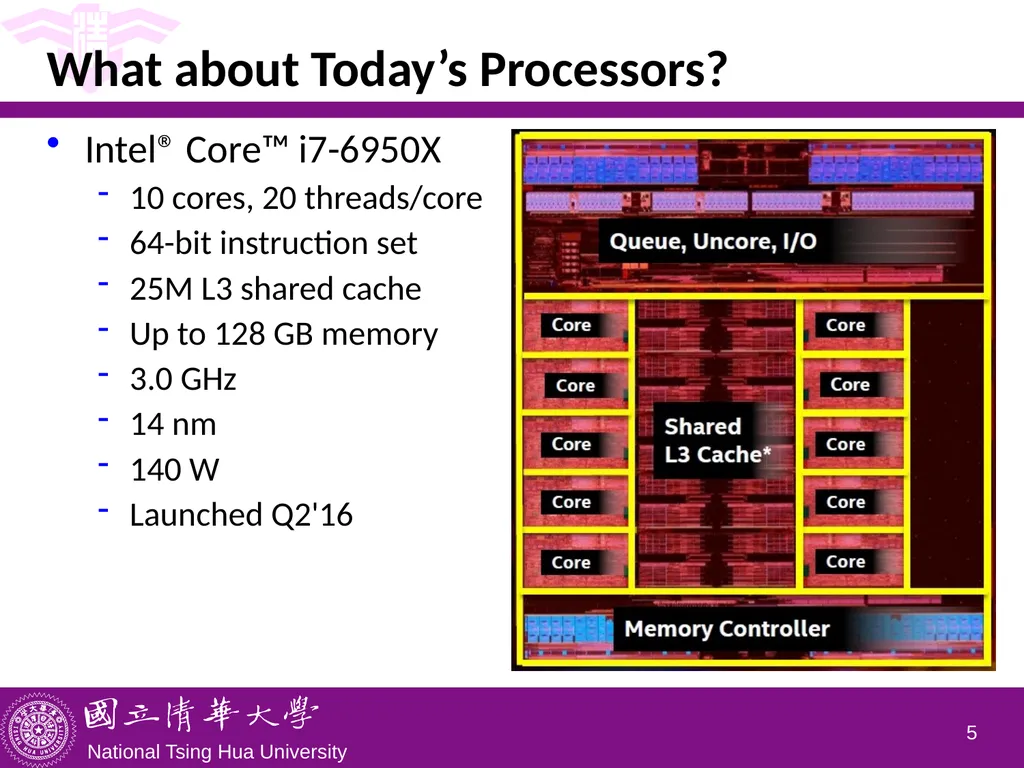
slide5. What about Today’s Processors? Intel® Core™ i7-6950X
10 cores, 20 threads/core
64-bit instruction set
25M L3 shared cache
Up to 128 GB memory
3.0 GHz
14 nm
140 W
Launched Q2'16 4<br>
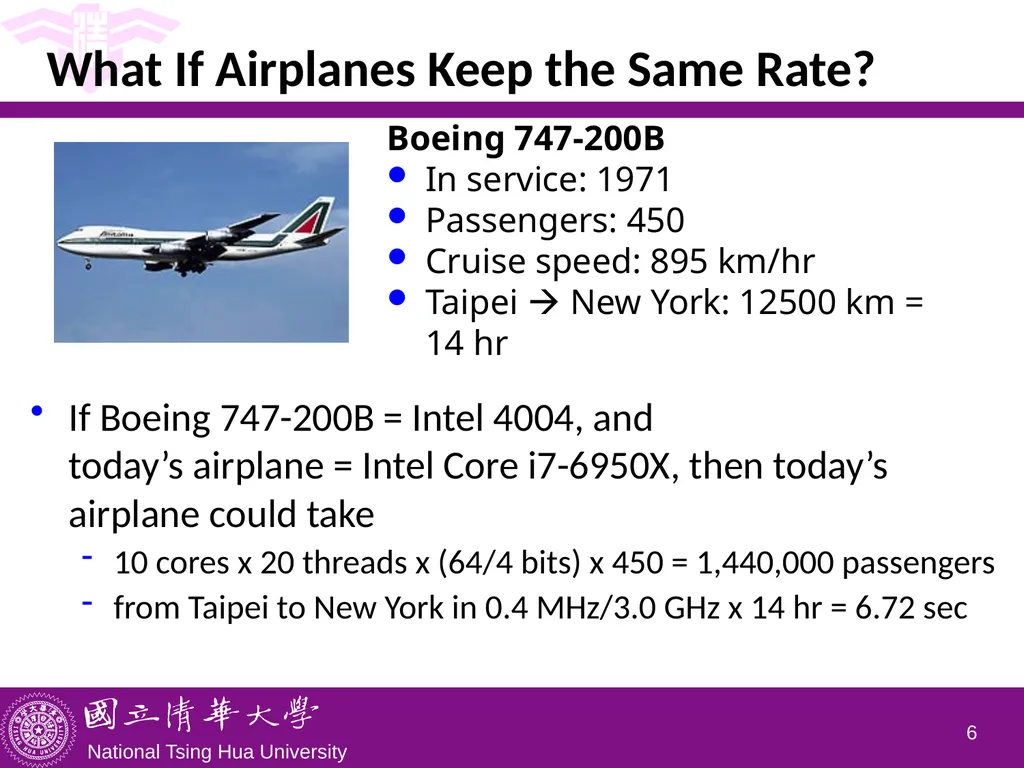
slide6. What If Airplanes Keep the Same Rate? If Boeing 747-200B = Intel 4004, and today’s airplane = Intel Core i7-6950X, then today’s airplane could take
10 cores x 20 threads x (64/4 bits) x 450 = 1,440,000 passengers
from Taipei to New York in 0.4 MHz/3.0 GHz x 14 hr = 6.72 sec Boeing 747-200B
In service: 1971
Passengers: 450
Cruise speed: 895 km/hr
Taipei New York: 12500 km = 14 hr 5<br>
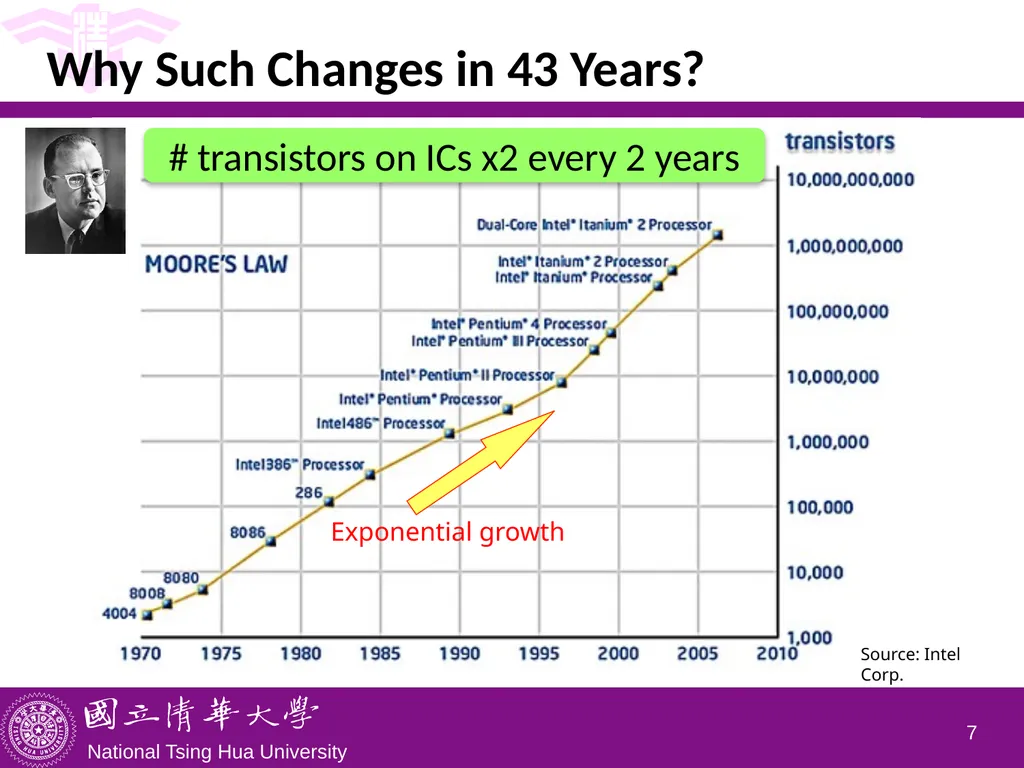
slide7. Why Such Changes in 43 Years? Source: Intel Corp. # transistors on ICs x2 every 2 years 6<br>
slide8. However, Quantity Performance! What matters most in progresses of semiconductor technology is the shrinking transistors
With the same chip size, shrinking transistors give more transistors on the chip
Shrinking transistors lead to performance improvements…
However, given more transistors, if there were no clever ways to use them effectively, we still would not get the computer performance
the critical role of computer architecture 7<br>
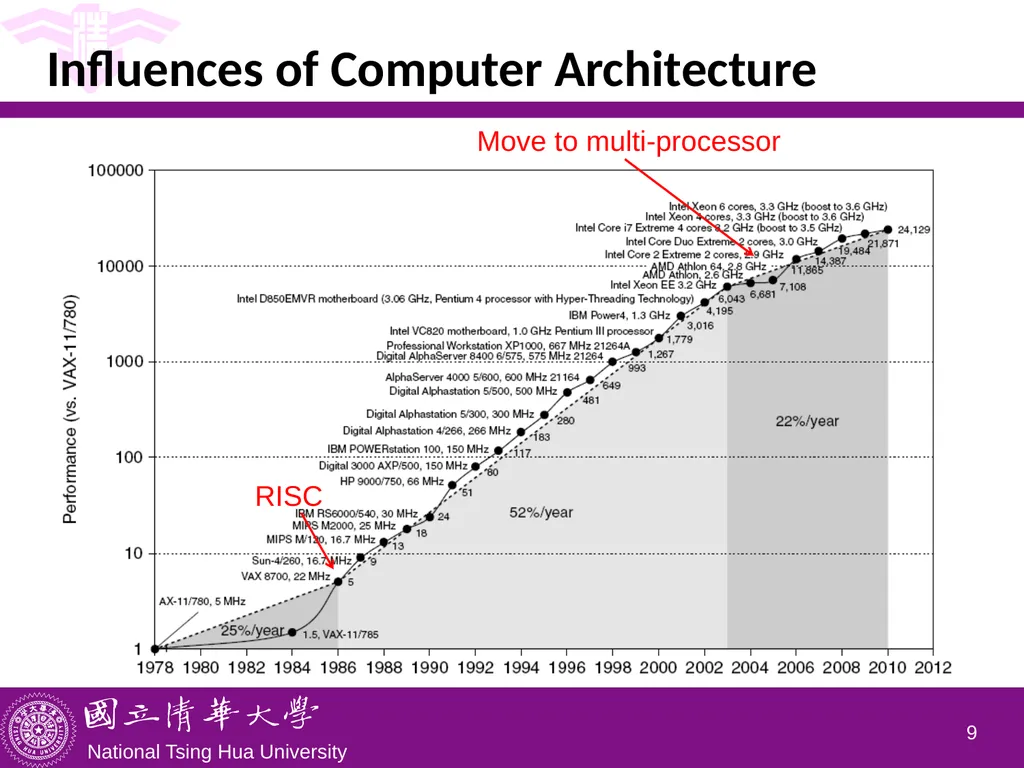
slide9. Influences of Computer Architecture RISC Move to multi-processor 8<br>
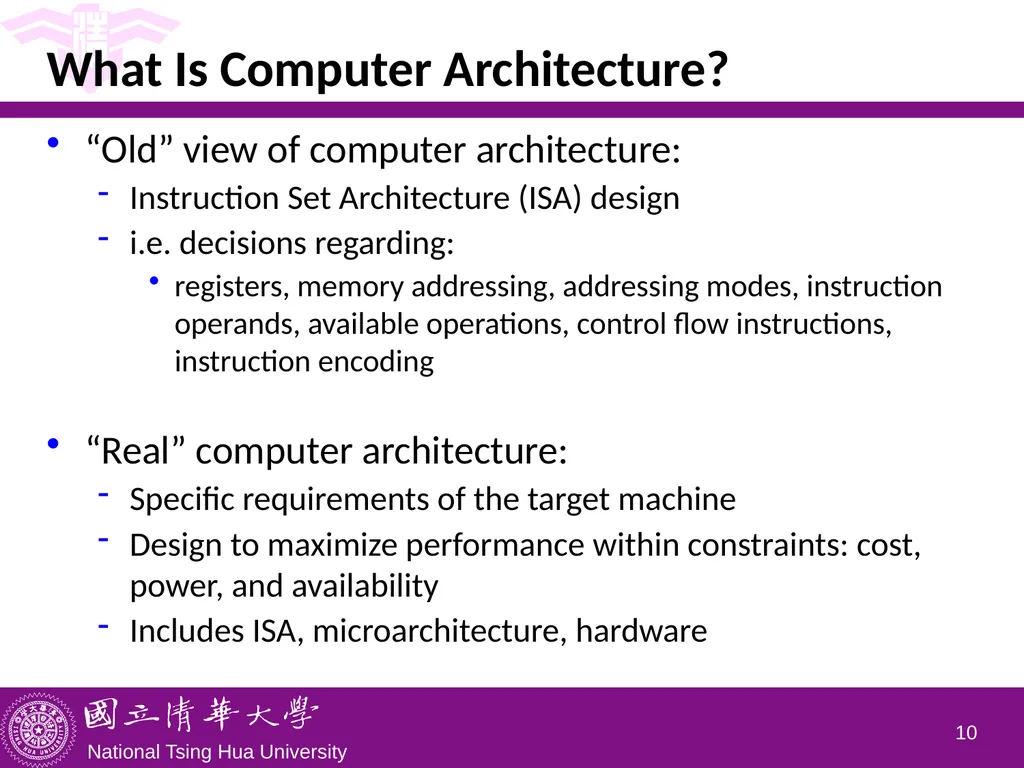
slide10. What Is Computer Architecture? “Old” view of computer architecture:
Instruction Set Architecture (ISA) design
i.e. decisions regarding:
registers, memory addressing, addressing modes, instruction operands, available operations, control flow instructions, instruction encoding
“Real” computer architecture:
Specific requirements of the target machine
Design to maximize performance within constraints: cost, power, and availability
Includes ISA, microarchitecture, hardware 9<br>
slide11. Constantly Changing Definition 50s to 60s: computer arithmetic
70s to mid 80s: instruction set design, especially ISA appropriate for compilers
90s: speculation (predict this, predict that); memory system; I/O system; multiprocessors; networks
2000s: power efficiency, on-die interconnection network, heterogeneity (multi-this, multi-that)
2015 and beyond: 1000’s cores, specialization, data intensive, irregular, asynchronous, self- and dynamic adapting, deep memory, dark silicon, post-Moore 10<br>
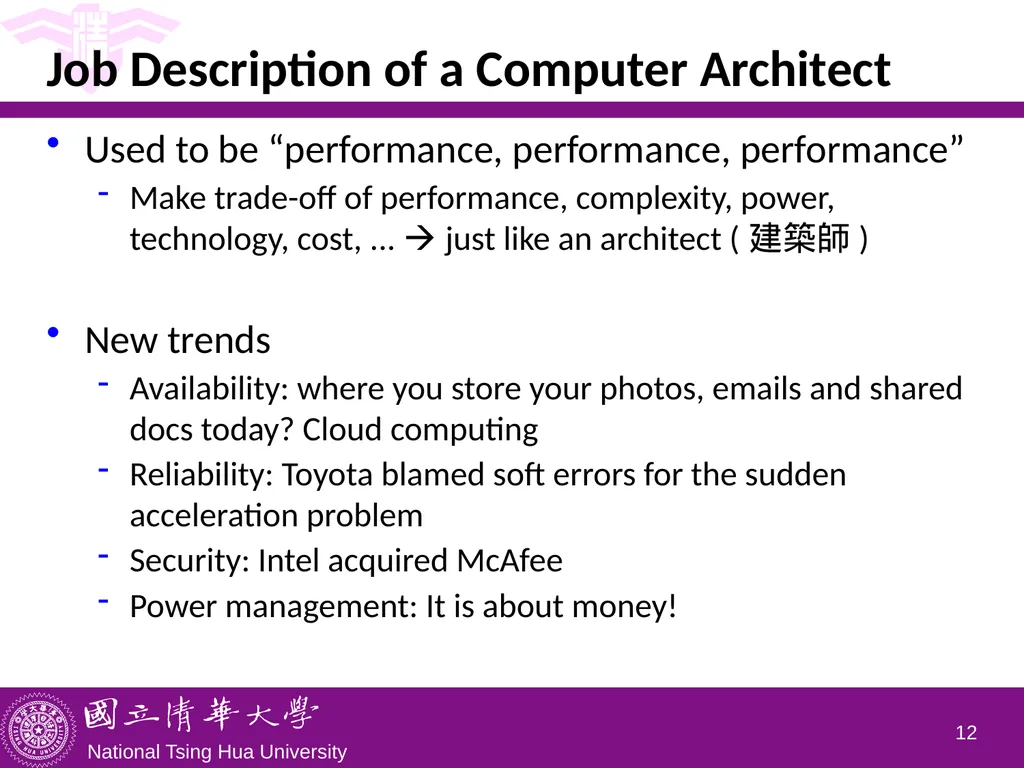
slide12. Job Description of a Computer Architect Used to be “performance, performance, performance”
Make trade-off of performance, complexity, power, technology, cost, ... just like an architect (建築師)
New trends
Availability: where you store your photos, emails and shared docs today? Cloud computing
Reliability: Toyota blamed soft errors for the sudden acceleration problem
Security: Intel acquired McAfee
Power management: It is about money! 11<br>
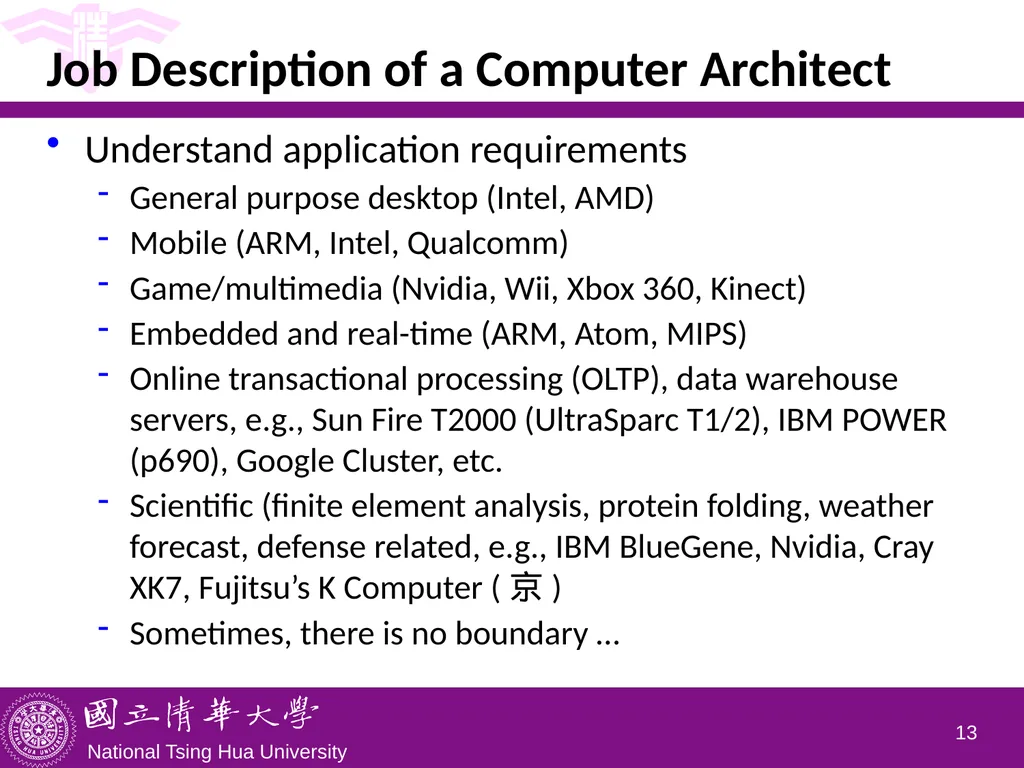
slide13. Job Description of a Computer Architect Understand application requirements
General purpose desktop (Intel, AMD)
Mobile (ARM, Intel, Qualcomm)
Game/multimedia (Nvidia, Wii, Xbox 360, Kinect)
Embedded and real-time (ARM, Atom, MIPS)
Online transactional processing (OLTP), data warehouse servers, e.g., Sun Fire T2000 (UltraSparc T1/2), IBM POWER (p690), Google Cluster, etc.
Scientific (finite element analysis, protein folding, weather forecast, defense related, e.g., IBM BlueGene, Nvidia, Cray XK7, Fujitsu’s K Computer (京)
Sometimes, there is no boundary … 12<br>
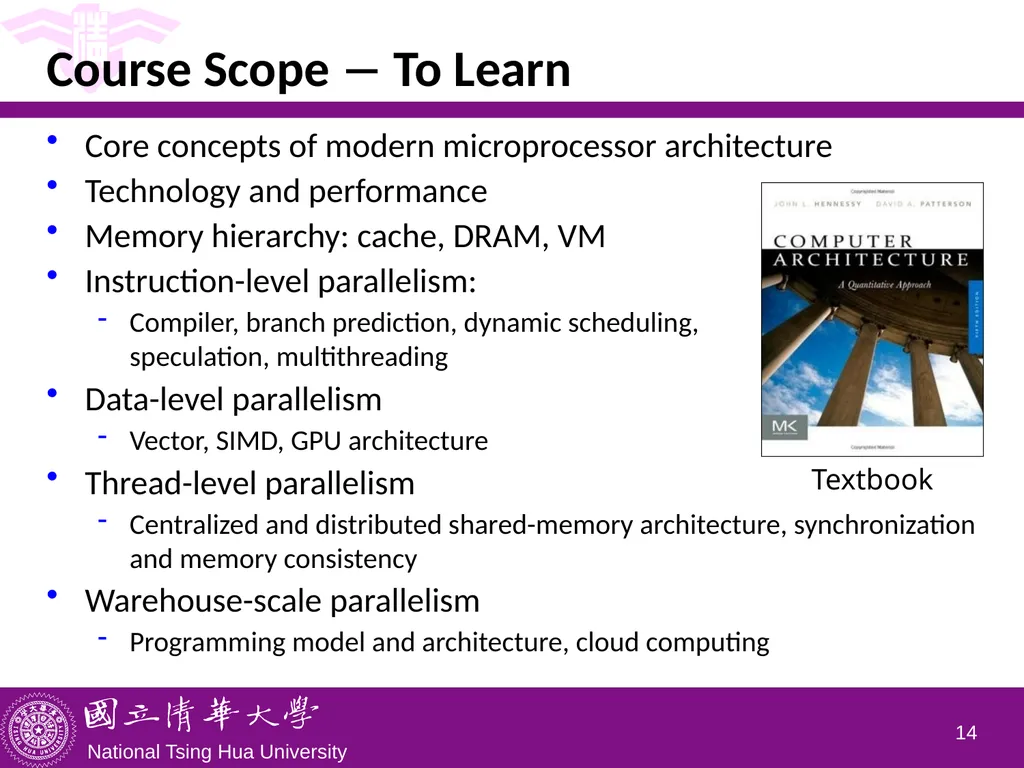
slide14. Course Scope To Learn Core concepts of modern microprocessor architecture
Technology and performance
Memory hierarchy: cache, DRAM, VM
Instruction-level parallelism:
Compiler, branch prediction, dynamic scheduling, speculation, multithreading
Data-level parallelism
Vector, SIMD, GPU architecture
Thread-level parallelism
Centralized and distributed shared-memory architecture, synchronization and memory consistency
Warehouse-scale parallelism
Programming model and architecture, cloud computing Textbook 13<br>
slide15. Course Information Instructor: Prof. Chung-Ta King (金仲達教授)
Office: Delta 640 Phone: x42804
email: king@cs.nthu.edu.tw
Teaching assistants: 蔡杰霖、何基愷
Office: CSEE 734 Phone: x33553
Class time:
Monday 10:10 - 12:00
Wednesday 9:00 - 9:50
Classroom: Delta 104
Course materials: iLMS
http://www.cs.nthu.edu.tw/~king/courses/cs5100.html 14<br>
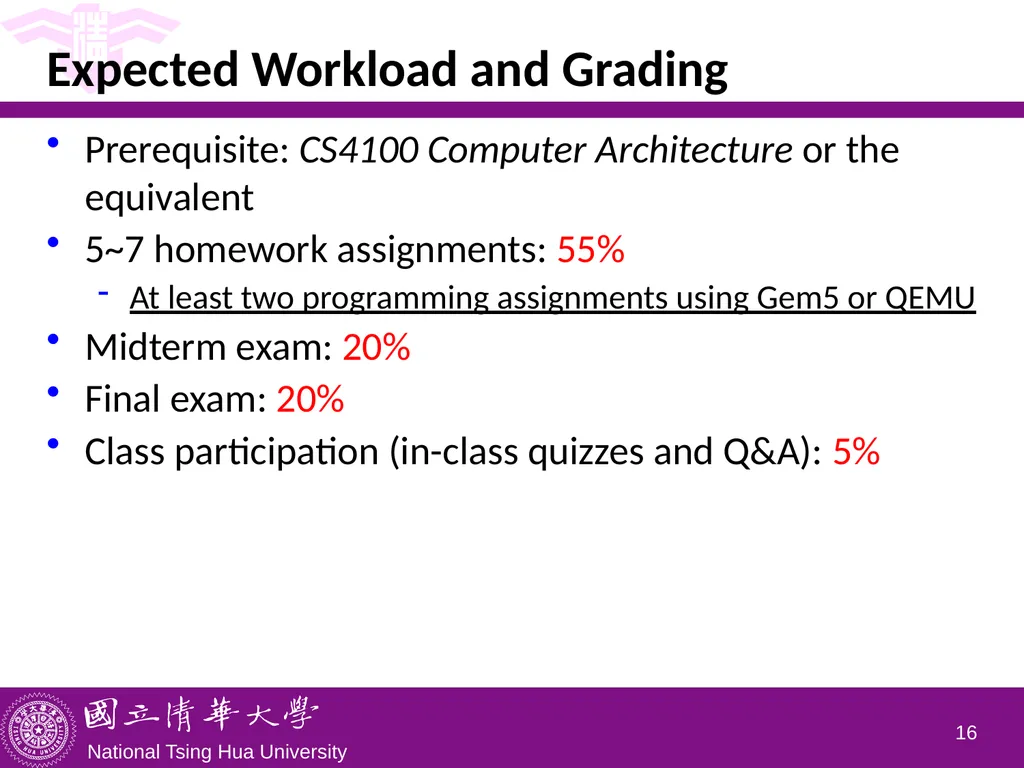
slide16. Expected Workload and Grading Prerequisite: CS4100 Computer Architecture or the equivalent
5~7 homework assignments: 55%
At least two programming assignments using Gem5 or QEMU
Midterm exam: 20%
Final exam: 20%
Class participation (in-class quizzes and Q&A): 5% 15<br>
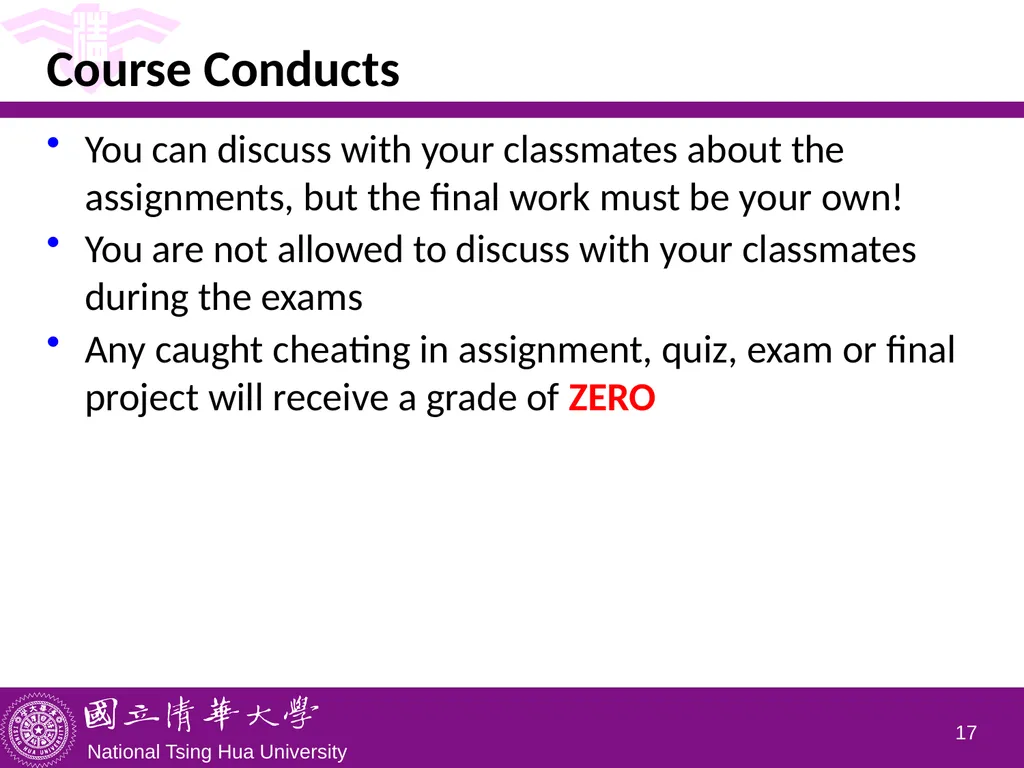
slide17. Course Conducts You can discuss with your classmates about the assignments, but the final work must be your own!
You are not allowed to discuss with your classmates during the exams
Any caught cheating in assignment, quiz, exam or final project will receive a grade of ZERO 16<br>
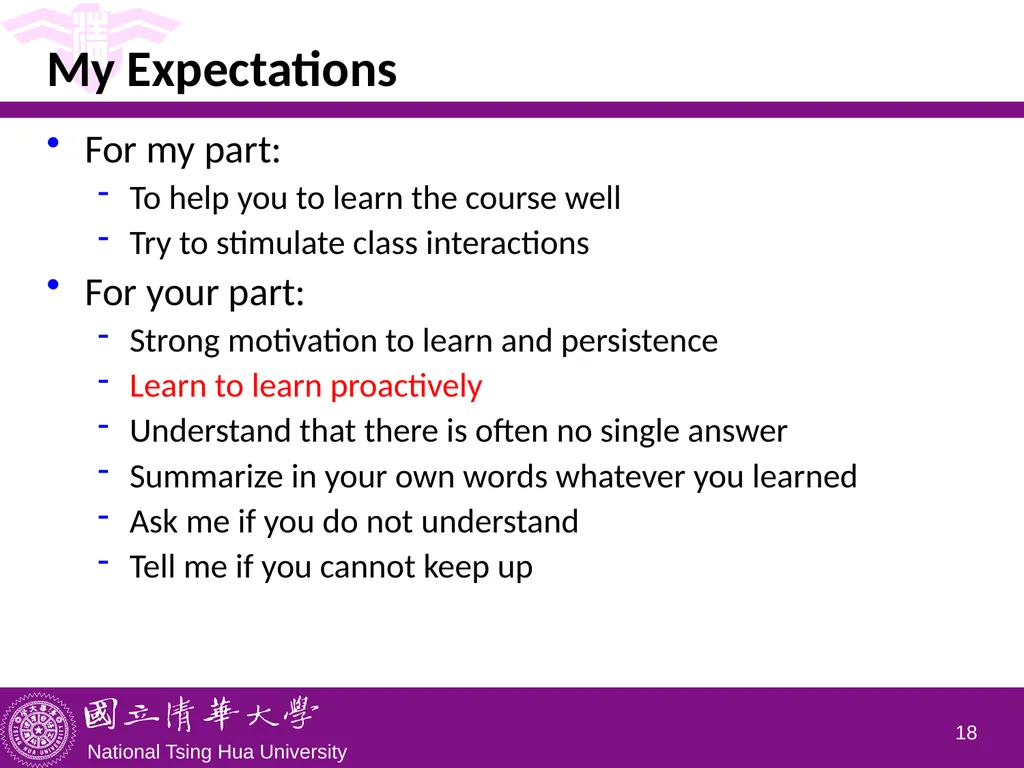
slide18. My Expectations For my part:
To help you to learn the course well
Try to stimulate class interactions
For your part:
Strong motivation to learn and persistence
Learn to learn proactively
Understand that there is often no single answer
Summarize in your own words whatever you learned
Ask me if you do not understand
Tell me if you cannot keep up 17<br>
Department of Computer Science
National Tsing Hua University, Taiwan (Slides are from textbook, Prof. Hsien-Hsin Lee, Prof. Yasun Hsu, Prof. Marc Snir)<br>
slide2. What Is This? ENIAC (Electronic Numerical Integrator And Computer): 1st fully operational electronic general-purpose computer (1946) 1 https://en.wikipedia.org/wiki/ENIAC#/media/File:Classic_shot_of_the_ENIAC.jpg<br>
slide3. When was the first processor on-a-chip developed?<br>
slide4. Intel 4004 (1971) 1st processor on a chip
4-bit processor for calculator
2312 transistors
16-pin DIP package
0.4 MHz
10 micron PMOS
1K data memory
4K program memory
Roughly 0.1M ops/s 3 http://www.physics.mcmaster.ca/phy4d6/Lab/Photos/4004.jpg<br>
slide5. What about Today’s Processors? Intel® Core™ i7-6950X
10 cores, 20 threads/core
64-bit instruction set
25M L3 shared cache
Up to 128 GB memory
3.0 GHz
14 nm
140 W
Launched Q2'16 4<br>
slide6. What If Airplanes Keep the Same Rate? If Boeing 747-200B = Intel 4004, and today’s airplane = Intel Core i7-6950X, then today’s airplane could take
10 cores x 20 threads x (64/4 bits) x 450 = 1,440,000 passengers
from Taipei to New York in 0.4 MHz/3.0 GHz x 14 hr = 6.72 sec Boeing 747-200B
In service: 1971
Passengers: 450
Cruise speed: 895 km/hr
Taipei New York: 12500 km = 14 hr 5<br>
slide7. Why Such Changes in 43 Years? Source: Intel Corp. # transistors on ICs x2 every 2 years 6<br>
slide8. However, Quantity Performance! What matters most in progresses of semiconductor technology is the shrinking transistors
With the same chip size, shrinking transistors give more transistors on the chip
Shrinking transistors lead to performance improvements…
However, given more transistors, if there were no clever ways to use them effectively, we still would not get the computer performance
the critical role of computer architecture 7<br>
slide9. Influences of Computer Architecture RISC Move to multi-processor 8<br>
slide10. What Is Computer Architecture? “Old” view of computer architecture:
Instruction Set Architecture (ISA) design
i.e. decisions regarding:
registers, memory addressing, addressing modes, instruction operands, available operations, control flow instructions, instruction encoding
“Real” computer architecture:
Specific requirements of the target machine
Design to maximize performance within constraints: cost, power, and availability
Includes ISA, microarchitecture, hardware 9<br>
slide11. Constantly Changing Definition 50s to 60s: computer arithmetic
70s to mid 80s: instruction set design, especially ISA appropriate for compilers
90s: speculation (predict this, predict that); memory system; I/O system; multiprocessors; networks
2000s: power efficiency, on-die interconnection network, heterogeneity (multi-this, multi-that)
2015 and beyond: 1000’s cores, specialization, data intensive, irregular, asynchronous, self- and dynamic adapting, deep memory, dark silicon, post-Moore 10<br>
slide12. Job Description of a Computer Architect Used to be “performance, performance, performance”
Make trade-off of performance, complexity, power, technology, cost, ... just like an architect (建築師)
New trends
Availability: where you store your photos, emails and shared docs today? Cloud computing
Reliability: Toyota blamed soft errors for the sudden acceleration problem
Security: Intel acquired McAfee
Power management: It is about money! 11<br>
slide13. Job Description of a Computer Architect Understand application requirements
General purpose desktop (Intel, AMD)
Mobile (ARM, Intel, Qualcomm)
Game/multimedia (Nvidia, Wii, Xbox 360, Kinect)
Embedded and real-time (ARM, Atom, MIPS)
Online transactional processing (OLTP), data warehouse servers, e.g., Sun Fire T2000 (UltraSparc T1/2), IBM POWER (p690), Google Cluster, etc.
Scientific (finite element analysis, protein folding, weather forecast, defense related, e.g., IBM BlueGene, Nvidia, Cray XK7, Fujitsu’s K Computer (京)
Sometimes, there is no boundary … 12<br>
slide14. Course Scope To Learn Core concepts of modern microprocessor architecture
Technology and performance
Memory hierarchy: cache, DRAM, VM
Instruction-level parallelism:
Compiler, branch prediction, dynamic scheduling, speculation, multithreading
Data-level parallelism
Vector, SIMD, GPU architecture
Thread-level parallelism
Centralized and distributed shared-memory architecture, synchronization and memory consistency
Warehouse-scale parallelism
Programming model and architecture, cloud computing Textbook 13<br>
slide15. Course Information Instructor: Prof. Chung-Ta King (金仲達教授)
Office: Delta 640 Phone: x42804
email: king@cs.nthu.edu.tw
Teaching assistants: 蔡杰霖、何基愷
Office: CSEE 734 Phone: x33553
Class time:
Monday 10:10 - 12:00
Wednesday 9:00 - 9:50
Classroom: Delta 104
Course materials: iLMS
http://www.cs.nthu.edu.tw/~king/courses/cs5100.html 14<br>
slide16. Expected Workload and Grading Prerequisite: CS4100 Computer Architecture or the equivalent
5~7 homework assignments: 55%
At least two programming assignments using Gem5 or QEMU
Midterm exam: 20%
Final exam: 20%
Class participation (in-class quizzes and Q&A): 5% 15<br>
slide17. Course Conducts You can discuss with your classmates about the assignments, but the final work must be your own!
You are not allowed to discuss with your classmates during the exams
Any caught cheating in assignment, quiz, exam or final project will receive a grade of ZERO 16<br>
slide18. My Expectations For my part:
To help you to learn the course well
Try to stimulate class interactions
For your part:
Strong motivation to learn and persistence
Learn to learn proactively
Understand that there is often no single answer
Summarize in your own words whatever you learned
Ask me if you do not understand
Tell me if you cannot keep up 17<br>