
CS5412: Bimodal Multicast Astrolabe Ken Birman
MS
Published · 40 slides · 0 views

1 / 1
Description
CS5412: Bimodal Multicast Astrolabe Ken Birman CS5412 Spring 2014 1 Lecture XIX Gossip 201 Recall from early in the semester that gossip spreads in log(system size) time But is this actually fast? infected 0.0 1.0 Time CS5412 Spring
Related Topics
Share
Embed code
Download this presentation From Below
"CS5412: Bimodal Multicast Astrolabe Ken Birman" is the property of its rightful owner. Permission is granted to download and print the materials on this website for personal, non-commercial use only, and to display it on your personal computer provided you do not modify the materials and that you retain all copyright notices contained in the materials. By downloading content from our website, you accept the terms of this agreement.
Presentation Transcript
01
CS5412:
Bimodal Multicast
Astrolabe Ken Birman CS5412 Spring 2014 1 Lecture XIX<br>
02
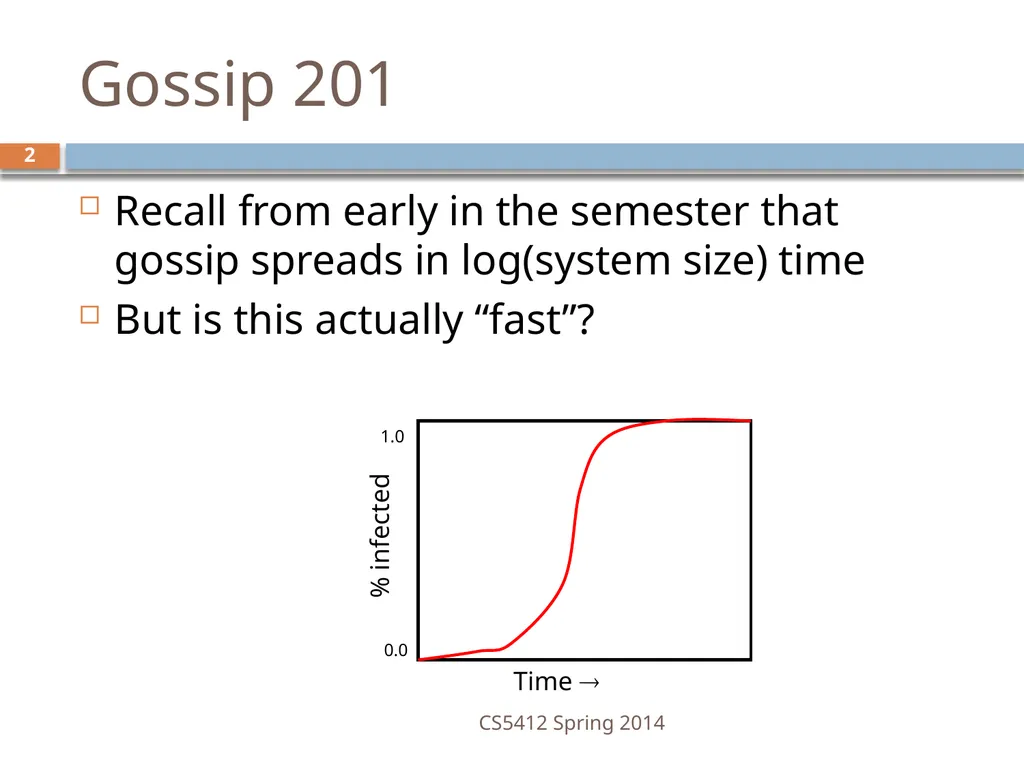
Gossip 201 Recall from early in the semester that gossip spreads in log(system size) time
But is this actually “fast”? % infected 0.0 1.0 Time CS5412 Spring 2014 2<br>
But is this actually “fast”? % infected 0.0 1.0 Time CS5412 Spring 2014 2<br>
03
Gossip in distributed systems Log(N) can be a very big number!
With N=100,000, log(N) would be 12
So with one gossip round per five seconds, information needs one minute to spread in a large system!
Some gossip protocols combine pure gossip with an accelerator
A good way to get the word out quickly CS5412 Spring 2014 3<br>
With N=100,000, log(N) would be 12
So with one gossip round per five seconds, information needs one minute to spread in a large system!
Some gossip protocols combine pure gossip with an accelerator
A good way to get the word out quickly CS5412 Spring 2014 3<br>
04
Bimodal Multicast CS5412 Spring 2014 4 To send a message, this protocol uses IP multicast
We just transmit it without delay and we don’t expect any form of responses
Not reliable, no acks
No flow control (this can be an issue)
In data centers that lack IP multicast, can simulate by sending UDP packets 1:1 without acks<br>
We just transmit it without delay and we don’t expect any form of responses
Not reliable, no acks
No flow control (this can be an issue)
In data centers that lack IP multicast, can simulate by sending UDP packets 1:1 without acks<br>
05
What’s the cost of an IP multicast? CS5412 Spring 2014 5 In principle, each Bimodal Multicast packet traverses the relevant data center links and routers just once per message
So this is extremely cheap... but how do we deal with systems that didn’t receive the multicast?<br>
So this is extremely cheap... but how do we deal with systems that didn’t receive the multicast?<br>
06
Making Bimodal Multicast reliable CS5412 Spring 2014 6 We can use gossip!
Every node tracks the membership of the target group (using gossip, just like with Kelips, the DHT we studied early in the semester)
Bootstrap by learning “some node addresses” from some kind of a server or web page
But then exchange of gossip used to improve accuracy<br>
Every node tracks the membership of the target group (using gossip, just like with Kelips, the DHT we studied early in the semester)
Bootstrap by learning “some node addresses” from some kind of a server or web page
But then exchange of gossip used to improve accuracy<br>
07
Making Bimodal Multicast reliable CS5412 Spring 2014 7 Now, layer in a gossip mechanism that gossips about multicasts each node knows about
Rather than sending the multicasts themselves, the gossip messages just talk about “digests”, which are lists
Node A might send node B
I have messages 1-18 from sender X
I have message 11 from sender Y
I have messages 14, 16 and 22-71 from sender Z
Compactly represented...
This is a form of “push” gossip<br>
Rather than sending the multicasts themselves, the gossip messages just talk about “digests”, which are lists
Node A might send node B
I have messages 1-18 from sender X
I have message 11 from sender Y
I have messages 14, 16 and 22-71 from sender Z
Compactly represented...
This is a form of “push” gossip<br>
08
Making Bimodal Multicast reliable CS5412 Spring 2014 8 On receiving such a gossip message, the recipient checks to see which messages it has that the gossip sender lacks, and vice versa
Then it responds
I have copies of messages M, M’and M’’ that you seem to lack
I would like a copy of messages N, N’ and N’’ please
An exchange of the actual messages follows<br>
Then it responds
I have copies of messages M, M’and M’’ that you seem to lack
I would like a copy of messages N, N’ and N’’ please
An exchange of the actual messages follows<br>
09
Optimizations CS5412 Spring 2014 9 Bimodal Multicast resends using IP multicast if there is “evidence” that a few nodes may be missing the same thing
E.g. if two nodes ask for the same retransmission
Or if a retransmission shows up from a very remote node (IP multicast doesn’t always work in WANs)
It also prioritizes recent messages over old ones
Reliability has a “bimodal” probability curve: either nobody gets a message or nearly everyone does<br>
E.g. if two nodes ask for the same retransmission
Or if a retransmission shows up from a very remote node (IP multicast doesn’t always work in WANs)
It also prioritizes recent messages over old ones
Reliability has a “bimodal” probability curve: either nobody gets a message or nearly everyone does<br>
10
lpbcast variation CS5412 Spring 2014 10 In this variation on Bimodal Multicast instead of gossiping with every node in a system, we modify the Bimodal Multicast protocol
It maintains a “peer overlay”: each member only gossips with a smaller set of peers picked to be reachable with low round-trip times, plus a second small set of remote peers picked to ensure that the graph is very highly connected and has a small diameter
Called a “small worlds” structure by Jon Kleinberg
Lpbcast is often faster, but equally reliable!<br>
It maintains a “peer overlay”: each member only gossips with a smaller set of peers picked to be reachable with low round-trip times, plus a second small set of remote peers picked to ensure that the graph is very highly connected and has a small diameter
Called a “small worlds” structure by Jon Kleinberg
Lpbcast is often faster, but equally reliable!<br>
11
Speculation... about speed CS5412 Spring 2014 11 When we combine IP multicast with gossip we try to match the tool we’re using with the need
Try to get the messages through fast... but if loss occurs, try to have a very predictable recovery cost
Gossip has a totally predictable worst-case load
This is appealing at large scales
How can we generalize this concept?<br>
Try to get the messages through fast... but if loss occurs, try to have a very predictable recovery cost
Gossip has a totally predictable worst-case load
This is appealing at large scales
How can we generalize this concept?<br>
12
A thought question What’s the best way to
Count the number of nodes in a system?
Compute the average load, or find the most loaded nodes, or least loaded nodes?
Options to consider
Pure gossip solution
Construct an overlay tree (via “flooding”, like in our consistent snapshot algorithm), then count nodes in the tree, or pull the answer from the leaves to the root… CS5412 Spring 2014 12<br>
Count the number of nodes in a system?
Compute the average load, or find the most loaded nodes, or least loaded nodes?
Options to consider
Pure gossip solution
Construct an overlay tree (via “flooding”, like in our consistent snapshot algorithm), then count nodes in the tree, or pull the answer from the leaves to the root… CS5412 Spring 2014 12<br>
13
… and the answer is Gossip isn’t very good for some of these tasks!
There are gossip solutions for counting nodes, but they give approximate answers and run slowly
Tricky to compute something like an average because of “re-counting” effect, (best algorithm: Kempe et al)
On the other hand, gossip works well for finding the c most loaded or least loaded nodes (constant c)
Gossip solutions will usually run in time O(log N) and generally give probabilistic solutions CS5412 Spring 2014 13<br>
There are gossip solutions for counting nodes, but they give approximate answers and run slowly
Tricky to compute something like an average because of “re-counting” effect, (best algorithm: Kempe et al)
On the other hand, gossip works well for finding the c most loaded or least loaded nodes (constant c)
Gossip solutions will usually run in time O(log N) and generally give probabilistic solutions CS5412 Spring 2014 13<br>
14
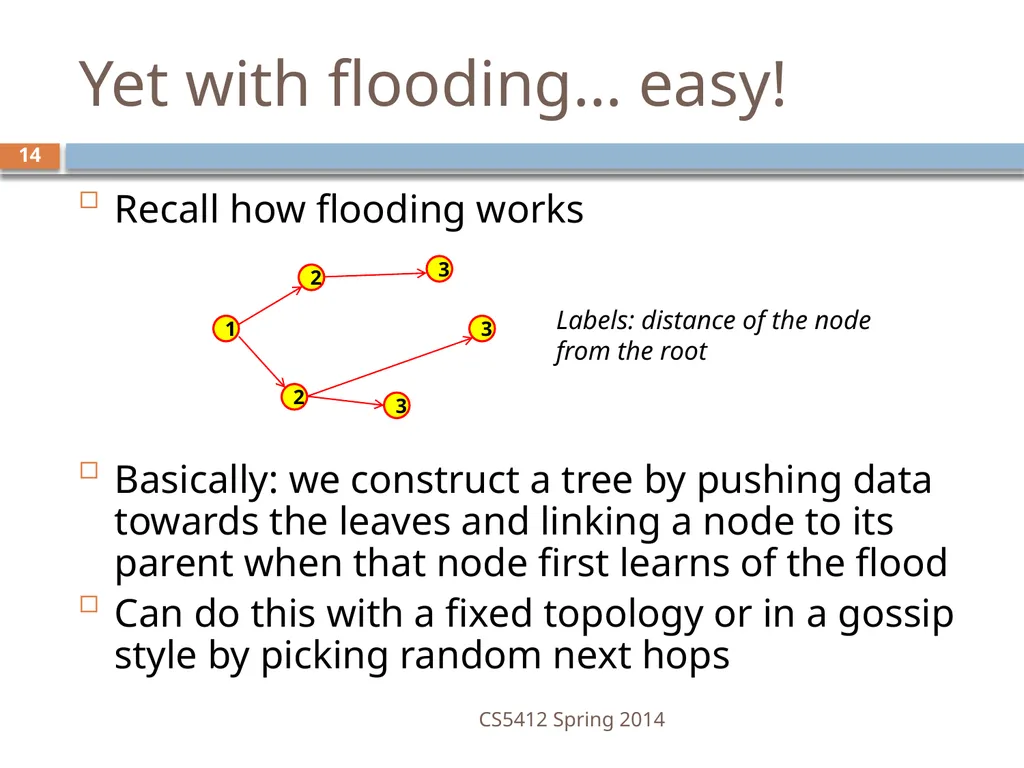
Yet with flooding… easy! Recall how flooding works
Basically: we construct a tree by pushing data towards the leaves and linking a node to its parent when that node first learns of the flood
Can do this with a fixed topology or in a gossip style by picking random next hops 1 3 3 3 2 2 Labels: distance of the node from the root CS5412 Spring 2014 14<br>
Basically: we construct a tree by pushing data towards the leaves and linking a node to its parent when that node first learns of the flood
Can do this with a fixed topology or in a gossip style by picking random next hops 1 3 3 3 2 2 Labels: distance of the node from the root CS5412 Spring 2014 14<br>
15
This is a “spanning tree” Once we have a spanning tree
To count the nodes, just have leaves report 1 to their parents and inner nodes count the values from their children
To compute an average, have the leaves report their value and the parent compute the sum, then divide by the count of nodes
To find the least or most loaded node, inner nodes compute a min or max…
Tree should have roughly log(N) depth, but once we build it, we can reuse it for a while CS5412 Spring 2014 15<br>
To count the nodes, just have leaves report 1 to their parents and inner nodes count the values from their children
To compute an average, have the leaves report their value and the parent compute the sum, then divide by the count of nodes
To find the least or most loaded node, inner nodes compute a min or max…
Tree should have roughly log(N) depth, but once we build it, we can reuse it for a while CS5412 Spring 2014 15<br>
16
Not all logs are identical! When we say that a gossip protocol needs
time log(N) to run, we mean log(N) rounds
And a gossip protocol usually sends one message every five seconds or so, hence with 100,000 nodes, 60 secs
But our spanning tree protocol is constructed using a flooding algorithm that runs in a hurry
Log(N) depth, but each “hop” takes perhaps a millisecond.
So with 100,000 nodes we have our tree in 12 ms and answers in 24ms! CS5412 Spring 2014 16<br>
And a gossip protocol usually sends one message every five seconds or so, hence with 100,000 nodes, 60 secs
But our spanning tree protocol is constructed using a flooding algorithm that runs in a hurry
Log(N) depth, but each “hop” takes perhaps a millisecond.
So with 100,000 nodes we have our tree in 12 ms and answers in 24ms! CS5412 Spring 2014 16<br>
17
Insight? Gossip has time complexity O(log N) but the “constant” can be rather big (5000 times larger in our example)
Spanning tree had same time complexity but a tiny constant in front
But network load for spanning tree was much higher
In the last step, we may have reached roughly half the nodes in the system
So 50,000 messages were sent all at the same time! CS5412 Spring 2014 17<br>
Spanning tree had same time complexity but a tiny constant in front
But network load for spanning tree was much higher
In the last step, we may have reached roughly half the nodes in the system
So 50,000 messages were sent all at the same time! CS5412 Spring 2014 17<br>
18
Gossip vs “Urgent”? With gossip, we have a slow but steady story
We know the speed and the cost, and both are low
A constant, low-key, background cost
And gossip is also very robust
Urgent protocols (like our flooding protocol, or 2PC, or reliable virtually synchronous multicast)
Are way faster
But produce load spikes
And may be fragile, prone to broadcast storms, etc CS5412 Spring 2014 18<br>
We know the speed and the cost, and both are low
A constant, low-key, background cost
And gossip is also very robust
Urgent protocols (like our flooding protocol, or 2PC, or reliable virtually synchronous multicast)
Are way faster
But produce load spikes
And may be fragile, prone to broadcast storms, etc CS5412 Spring 2014 18<br>
19
Introducing hierarchy One issue with gossip is that the messages fill up
With constant sized messages…
… and constant rate of communication
… we’ll inevitably reach the limit!
Can we inroduce hierarchy into gossip systems? CS5412 Spring 2014 19<br>
With constant sized messages…
… and constant rate of communication
… we’ll inevitably reach the limit!
Can we inroduce hierarchy into gossip systems? CS5412 Spring 2014 19<br>
20
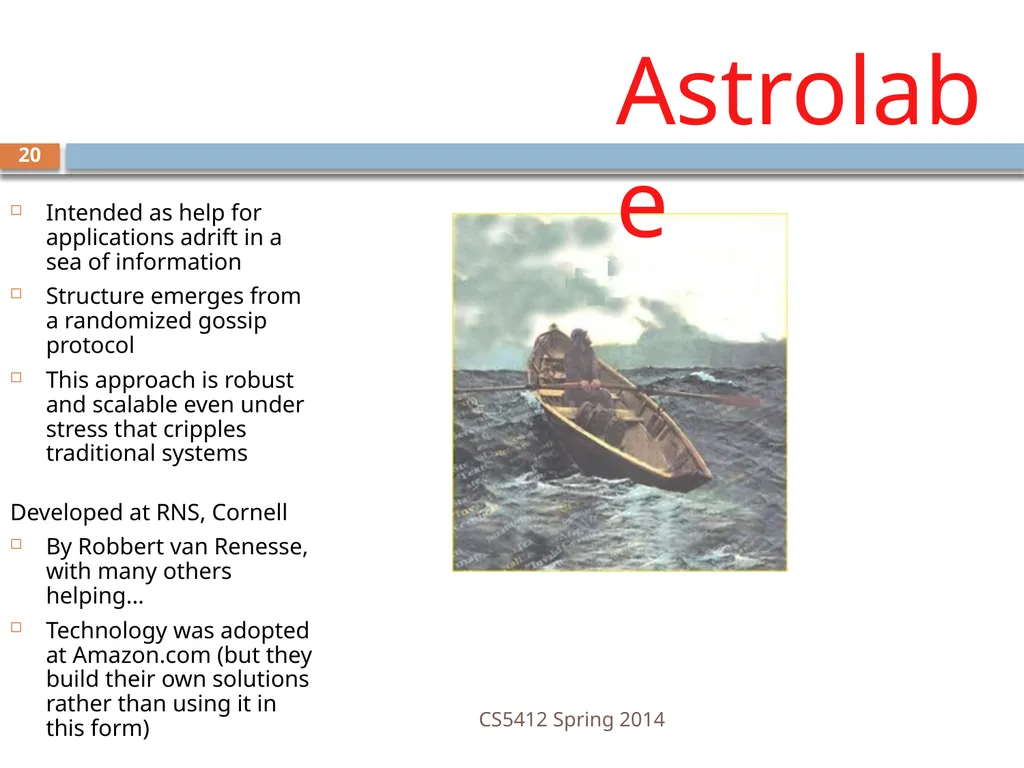
Astrolabe Intended as help for applications adrift in a sea of information
Structure emerges from a randomized gossip protocol
This approach is robust and scalable even under stress that cripples traditional systems
Developed at RNS, Cornell
By Robbert van Renesse, with many others helping…
Technology was adopted at Amazon.com (but they build their own solutions rather than using it in this form) CS5412 Spring 2014 20<br>
Structure emerges from a randomized gossip protocol
This approach is robust and scalable even under stress that cripples traditional systems
Developed at RNS, Cornell
By Robbert van Renesse, with many others helping…
Technology was adopted at Amazon.com (but they build their own solutions rather than using it in this form) CS5412 Spring 2014 20<br>
21
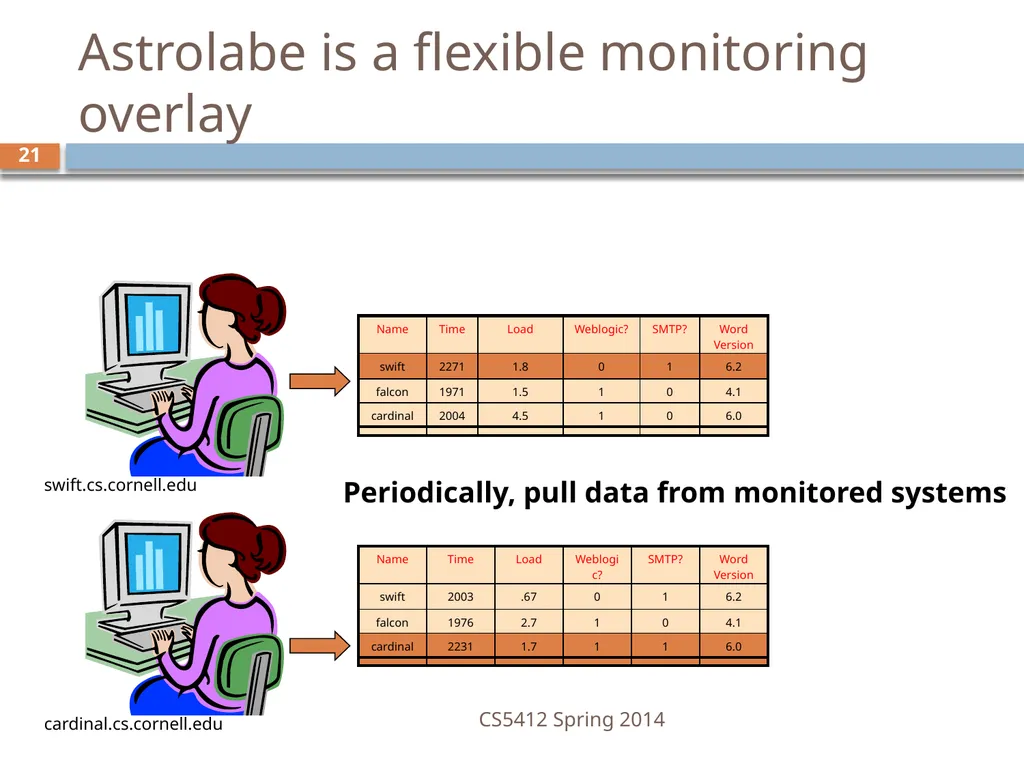
Astrolabe is a flexible monitoring overlay swift.cs.cornell.edu cardinal.cs.cornell.edu Periodically, pull data from monitored systems CS5412 Spring 2014 21<br>
22
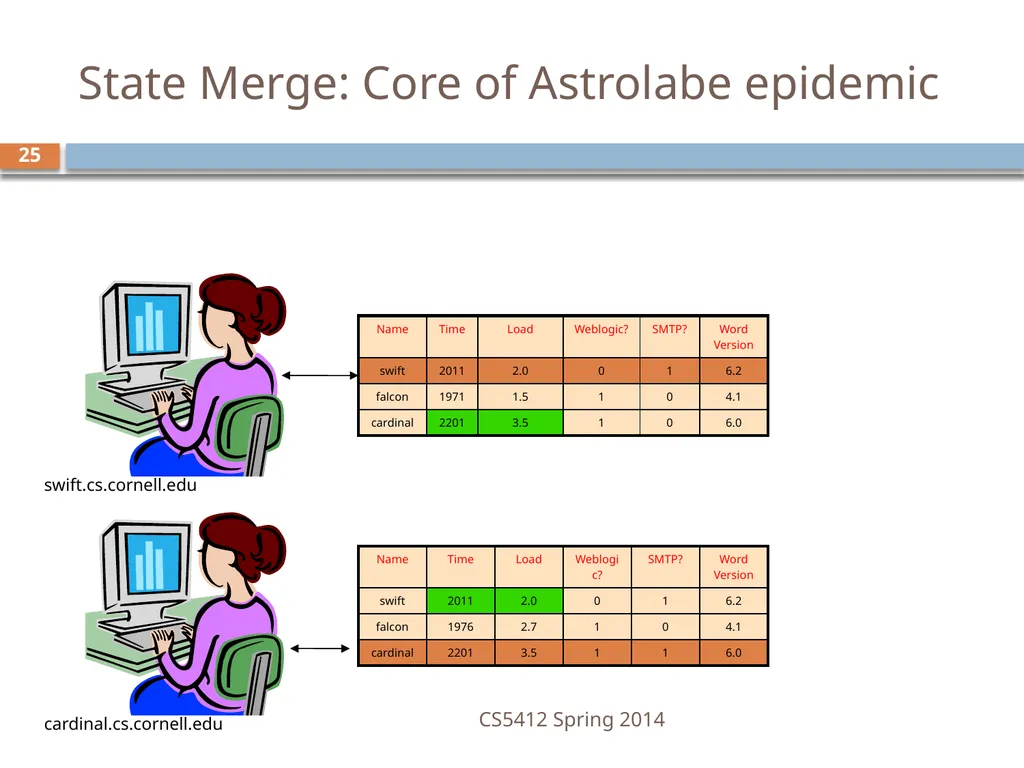
Astrolabe in a single domain Each node owns a single tuple, like the management information base (MIB)
Nodes discover one-another through a simple broadcast scheme (“anyone out there?”) and gossip about membership
Nodes also keep replicas of one-another’s rows
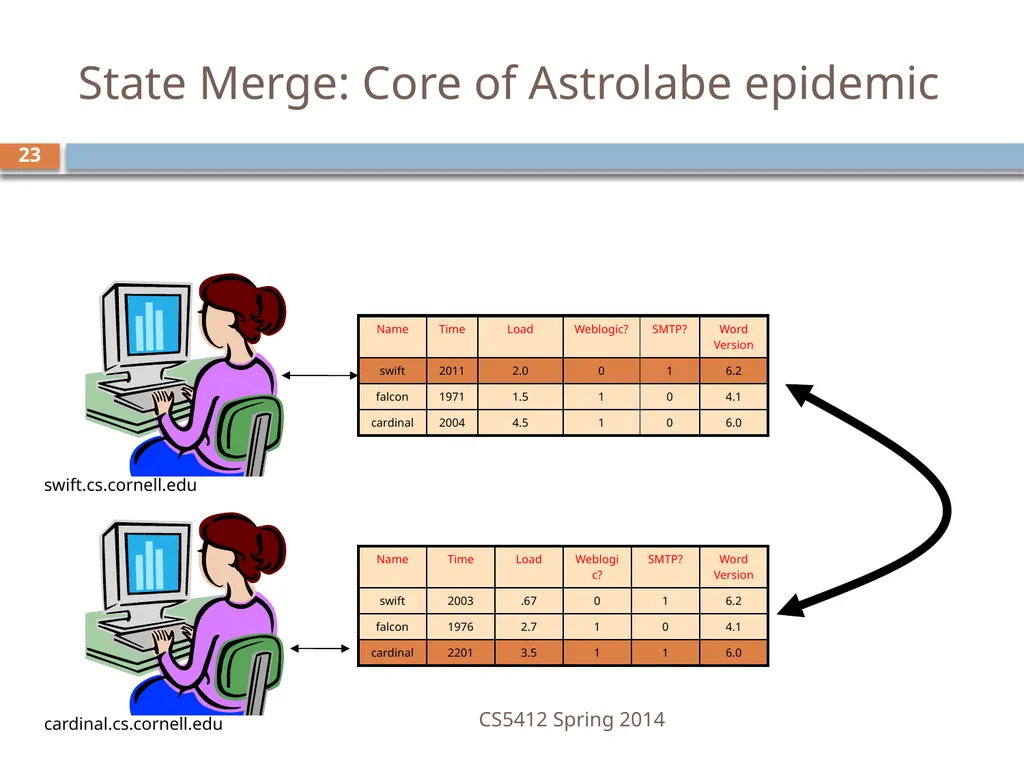
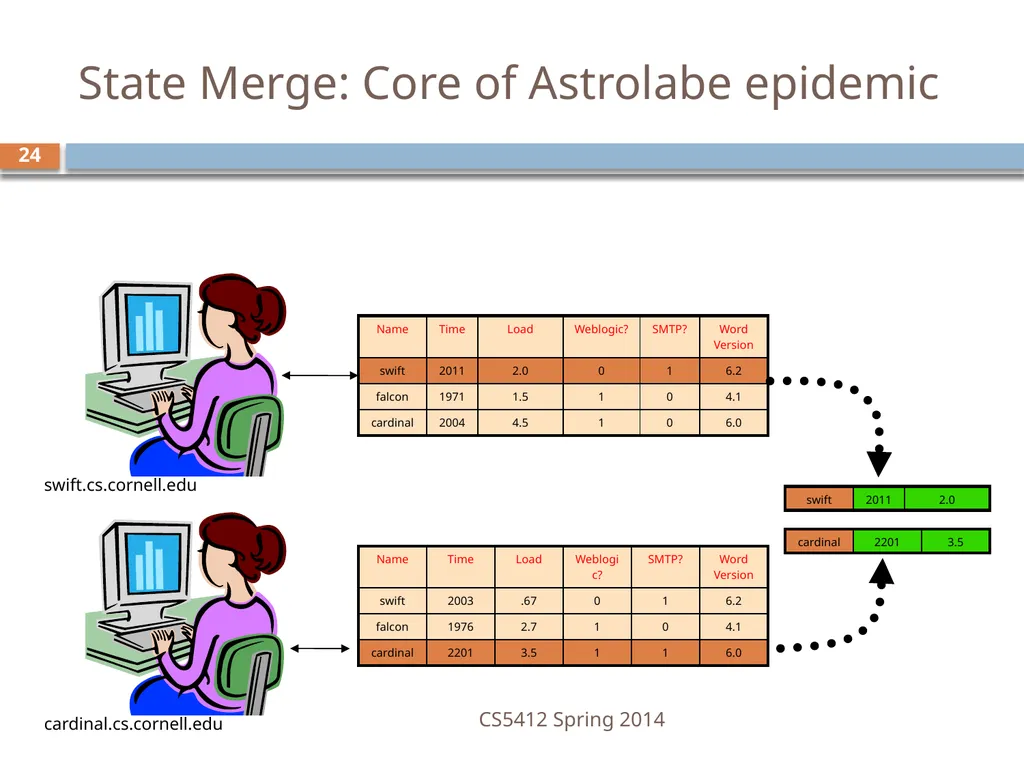
Periodically (uniformly at random) merge your state with some else… CS5412 Spring 2014 22<br>
Nodes discover one-another through a simple broadcast scheme (“anyone out there?”) and gossip about membership
Nodes also keep replicas of one-another’s rows
Periodically (uniformly at random) merge your state with some else… CS5412 Spring 2014 22<br>
23
State Merge: Core of Astrolabe epidemic swift.cs.cornell.edu cardinal.cs.cornell.edu CS5412 Spring 2014 23<br>
24
State Merge: Core of Astrolabe epidemic swift.cs.cornell.edu cardinal.cs.cornell.edu CS5412 Spring 2014 24<br>
25
State Merge: Core of Astrolabe epidemic swift.cs.cornell.edu cardinal.cs.cornell.edu CS5412 Spring 2014 25<br>
26
Observations Merge protocol has constant cost
One message sent, received (on avg) per unit time.
The data changes slowly, so no need to run it quickly – we usually run it every five seconds or so
Information spreads in O(log N) time
But this assumes bounded region size
In Astrolabe, we limit them to 50-100 rows CS5412 Spring 2014 26<br>
One message sent, received (on avg) per unit time.
The data changes slowly, so no need to run it quickly – we usually run it every five seconds or so
Information spreads in O(log N) time
But this assumes bounded region size
In Astrolabe, we limit them to 50-100 rows CS5412 Spring 2014 26<br>
27
Big systems… A big system could have many regions
Looks like a pile of spreadsheets
A node only replicates data from its neighbors within its own region CS5412 Spring 2014 27<br>
Looks like a pile of spreadsheets
A node only replicates data from its neighbors within its own region CS5412 Spring 2014 27<br>
28
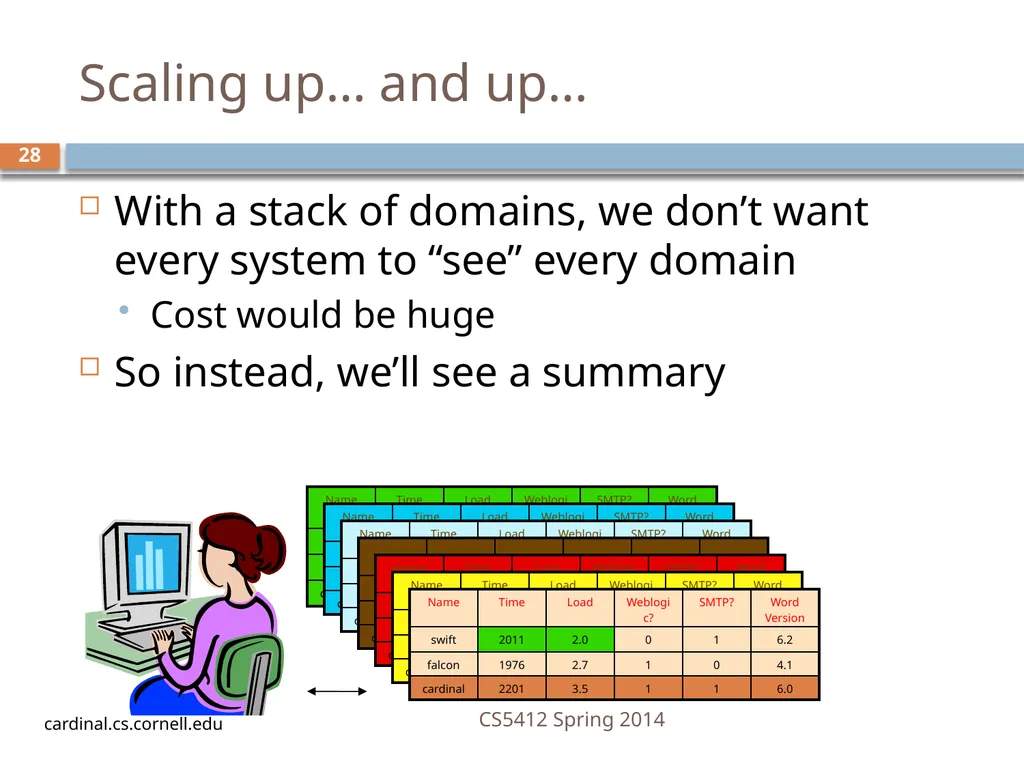
Scaling up… and up… With a stack of domains, we don’t want every system to “see” every domain
Cost would be huge
So instead, we’ll see a summary cardinal.cs.cornell.edu CS5412 Spring 2014 28<br>
Cost would be huge
So instead, we’ll see a summary cardinal.cs.cornell.edu CS5412 Spring 2014 28<br>
29
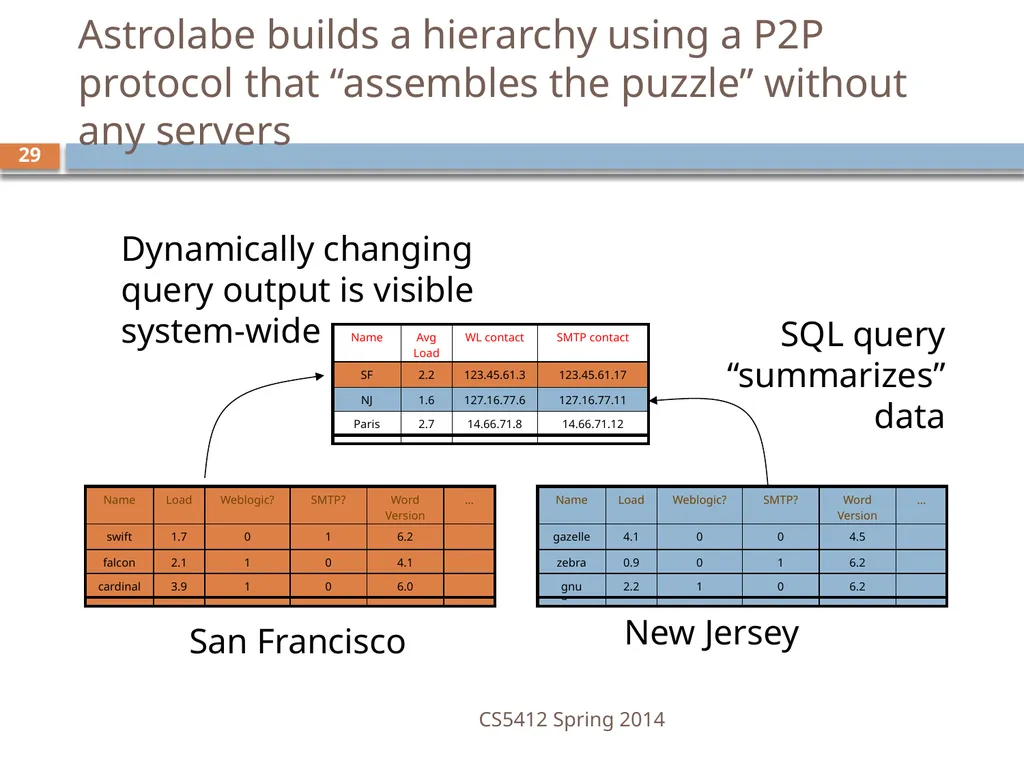
Astrolabe builds a hierarchy using a P2P protocol that “assembles the puzzle” without any servers San Francisco New Jersey SQL query “summarizes” data Dynamically changing query output is visible system-wide CS5412 Spring 2014 29<br>
30
Large scale: “fake” regions These are
Computed by queries that summarize a whole region as a single row
Gossiped in a read-only manner within a leaf region
But who runs the gossip?
Each region elects “k” members to run gossip at the next level up.
Can play with selection criteria and “k” CS5412 Spring 2014 30<br>
Computed by queries that summarize a whole region as a single row
Gossiped in a read-only manner within a leaf region
But who runs the gossip?
Each region elects “k” members to run gossip at the next level up.
Can play with selection criteria and “k” CS5412 Spring 2014 30<br>
31
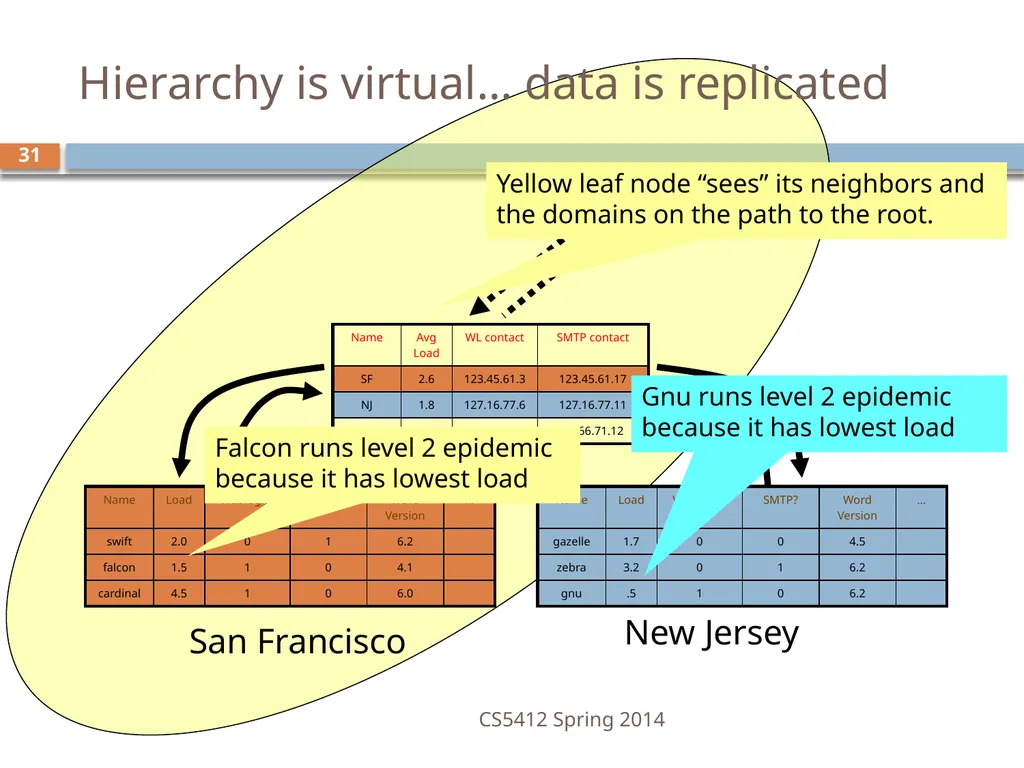
Hierarchy is virtual… data is replicated San Francisco New Jersey Yellow leaf node “sees” its neighbors and the domains on the path to the root. Falcon runs level 2 epidemic because it has lowest load Gnu runs level 2 epidemic because it has lowest load CS5412 Spring 2014 31<br>
32
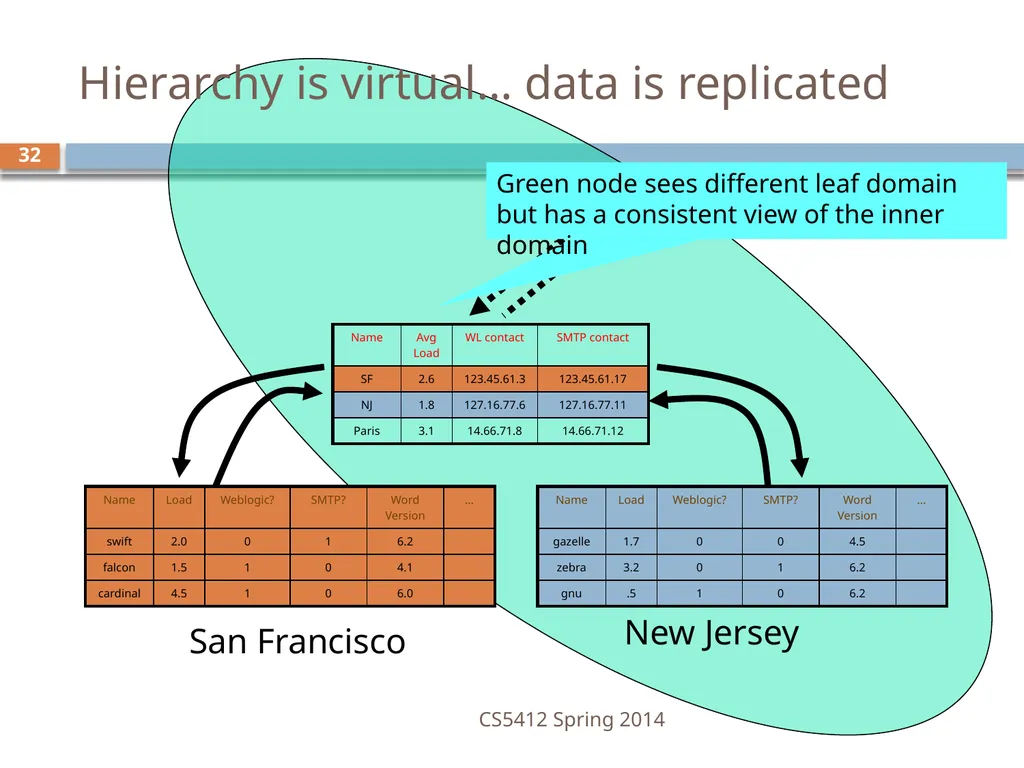
Hierarchy is virtual… data is replicated San Francisco New Jersey Green node sees different leaf domain but has a consistent view of the inner domain CS5412 Spring 2014 32<br>
33
Worst case load? A small number of nodes end up participating in O(logfanoutN) epidemics
Here the fanout is something like 50
In each epidemic, a message is sent and received roughly every 5 seconds
We limit message size so even during periods of turbulence, no message can become huge. CS5412 Spring 2014 33<br>
Here the fanout is something like 50
In each epidemic, a message is sent and received roughly every 5 seconds
We limit message size so even during periods of turbulence, no message can become huge. CS5412 Spring 2014 33<br>
34
Who uses Astrolabe? Amazon uses Astrolabe throughout their big data centers!
For them, Astrolabe helps them track overall state of their system to diagnose performance issues
They can also use it to automate reaction to temporary overloads CS5412 Spring 2014 34<br>
For them, Astrolabe helps them track overall state of their system to diagnose performance issues
They can also use it to automate reaction to temporary overloads CS5412 Spring 2014 34<br>
35
Example of overload handling Some service S is getting slow…
Astrolabe triggers a “system wide warning”
Everyone sees the picture
“Oops, S is getting overloaded and slow!”
So everyone tries to reduce their frequency of requests against service S
What about overload in Astrolabe itself?
Could everyone do a fair share of inner aggregation? CS5412 Spring 2014 35<br>
Astrolabe triggers a “system wide warning”
Everyone sees the picture
“Oops, S is getting overloaded and slow!”
So everyone tries to reduce their frequency of requests against service S
What about overload in Astrolabe itself?
Could everyone do a fair share of inner aggregation? CS5412 Spring 2014 35<br>
36
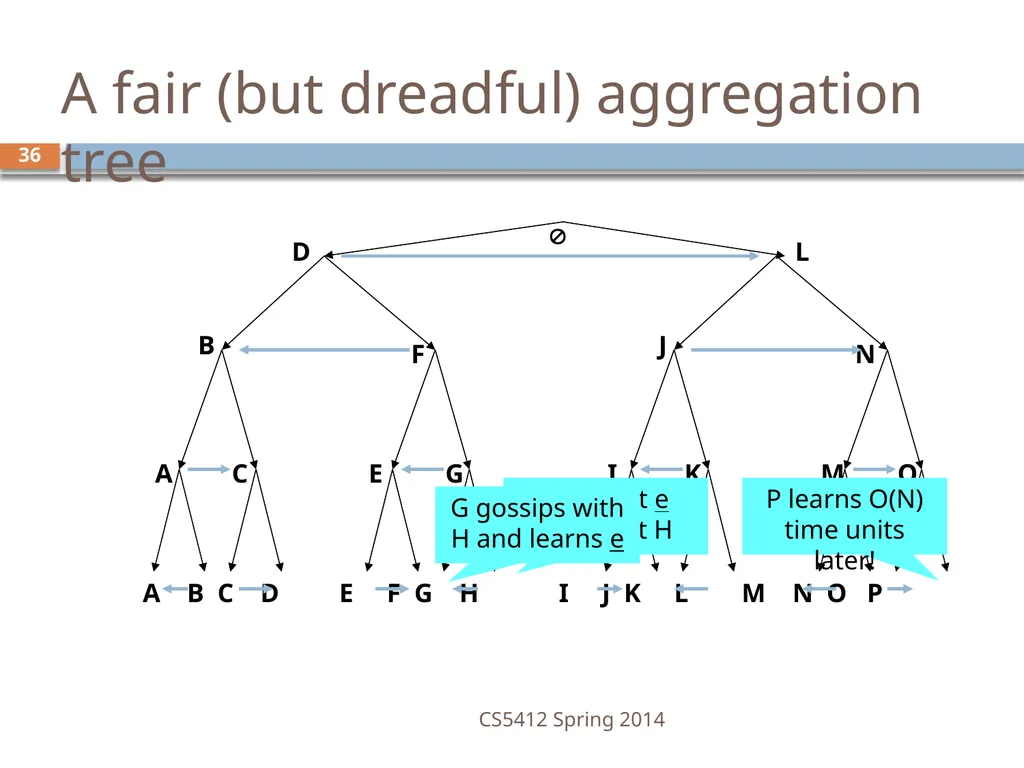
CS5412 Spring 2014 36 A fair (but dreadful) aggregation tree A B C D E F G H I J K L M N O P A C E G I K M O B F J N D L An event e occurs at H P learns O(N) time units later! G gossips with H and learns e<br>
37
CS5412 Spring 2014 37 What went wrong? In this horrendous tree, each node has equal “work to do” but the information-space diameter is larger!
Astrolabe benefits from “instant” knowledge because the epidemic at each level is run by someone elected from the level below<br>
Astrolabe benefits from “instant” knowledge because the epidemic at each level is run by someone elected from the level below<br>
38
CS5412 Spring 2014 38 Insight: Two kinds of shape We’ve focused on the aggregation tree
But in fact should also think about the information flow tree<br>
But in fact should also think about the information flow tree<br>
39
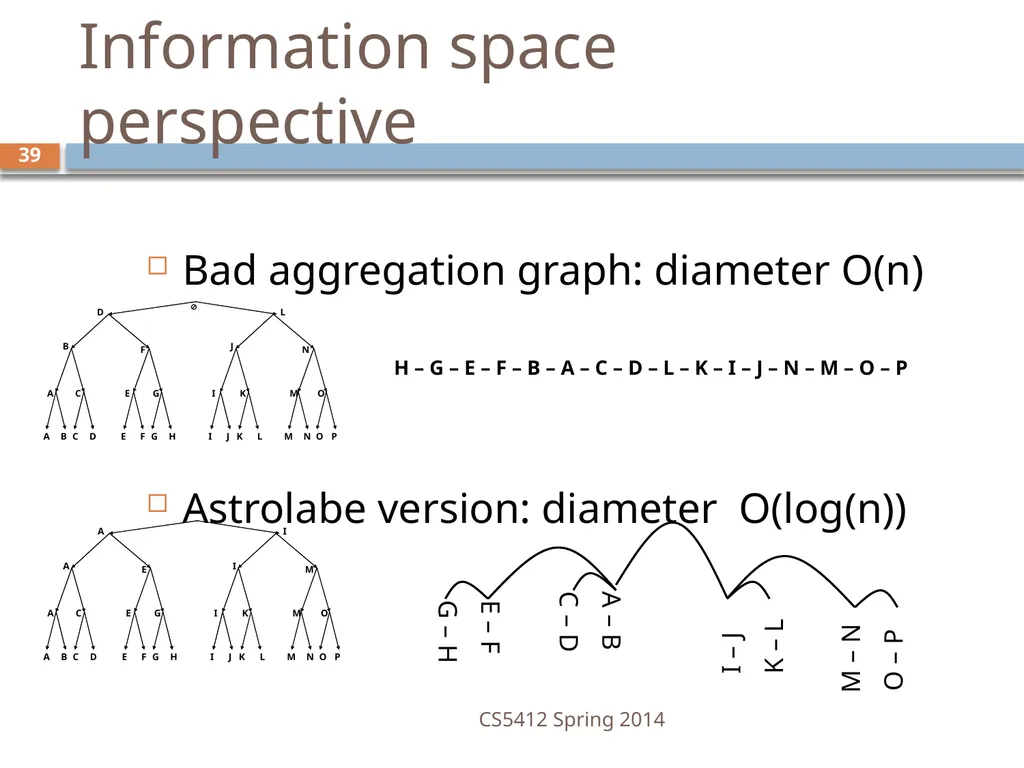
CS5412 Spring 2014 39 Information space perspective Bad aggregation graph: diameter O(n)
Astrolabe version: diameterO(log(n)) H – G – E – F – B – A – C – D – L – K – I – J – N – M – O – P<br>
Astrolabe version: diameterO(log(n)) H – G – E – F – B – A – C – D – L – K – I – J – N – M – O – P<br>
40
Summary First we saw a way of using Gossip in a reliable multicast (although the reliability is probabilistic)
Then looked at using Gossip for aggregation
Pure gossip isn’t ideal for this… and competes poorly with flooding and other urgent protocols
But Astrolabe introduces hierarchy and is an interesting option that gets used in at least one real cloud platform
Power: make a system more robust, self-adaptive, with a technology that won’t make things worse
But performance can still be sluggish CS5412 Spring 2014 40<br>
Then looked at using Gossip for aggregation
Pure gossip isn’t ideal for this… and competes poorly with flooding and other urgent protocols
But Astrolabe introduces hierarchy and is an interesting option that gets used in at least one real cloud platform
Power: make a system more robust, self-adaptive, with a technology that won’t make things worse
But performance can still be sluggish CS5412 Spring 2014 40<br>