Current IEEPA Tariff Refund Recovery Future-State Tariff Governance Process PA Tariff Refund Recovery Future Tariff Tracking Process CLASP Presented by: Corporate Purchasing May 26, 2026 Background and Context What Changed IEEPA Tariff
"Current IEEPA Tariff Refund Recovery &" is the property of its rightful owner. Permission is granted to
download and print the materials on this website for personal, non-commercial use only, and to display it
on your personal computer provided you do not modify the materials and that you retain all copyright
notices contained in the materials. By downloading content from our website, you accept the terms of this
agreement.
Presentation Transcript
01
Current IEEPA Tariff Refund Recovery & Future-State Tariff Governance Process PA Tariff Refund Recovery & Future Tariff Tracking Process CLASP
Presented by: Corporate Purchasing
May 26, 2026<br>
02
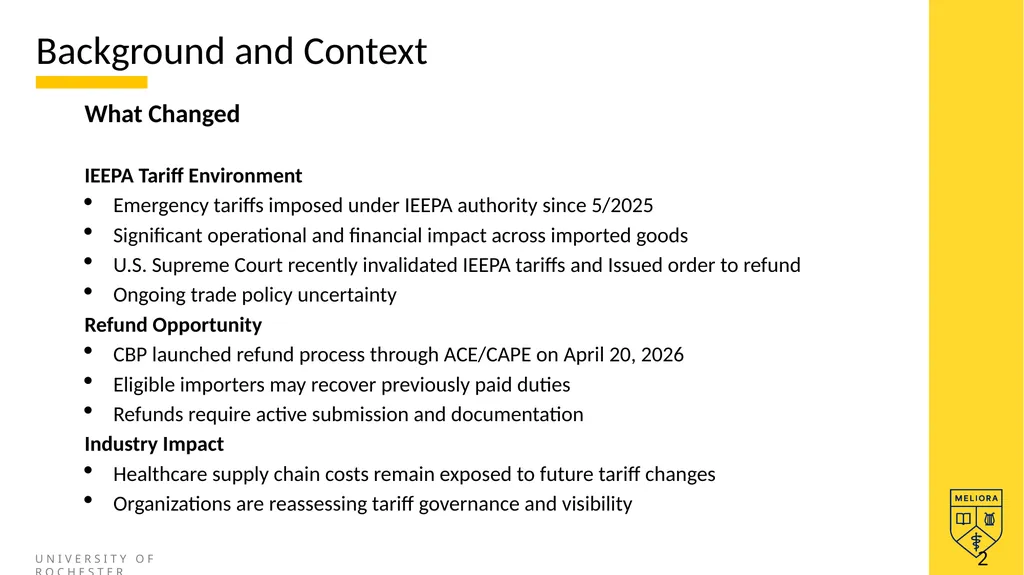
Background and Context What Changed
IEEPA Tariff Environment
Emergency tariffs imposed under IEEPA authority since 5/2025
Significant operational and financial impact across imported goods
U.S. Supreme Court recently invalidated IEEPA tariffs and Issued order to refund
Ongoing trade policy uncertainty
Refund Opportunity
CBP launched refund process through ACE/CAPE on April 20, 2026
Eligible importers may recover previously paid duties
Refunds require active submission and documentation
Industry Impact
Healthcare supply chain costs remain exposed to future tariff changes
Organizations are reassessing tariff governance and visibility 2<br>
03
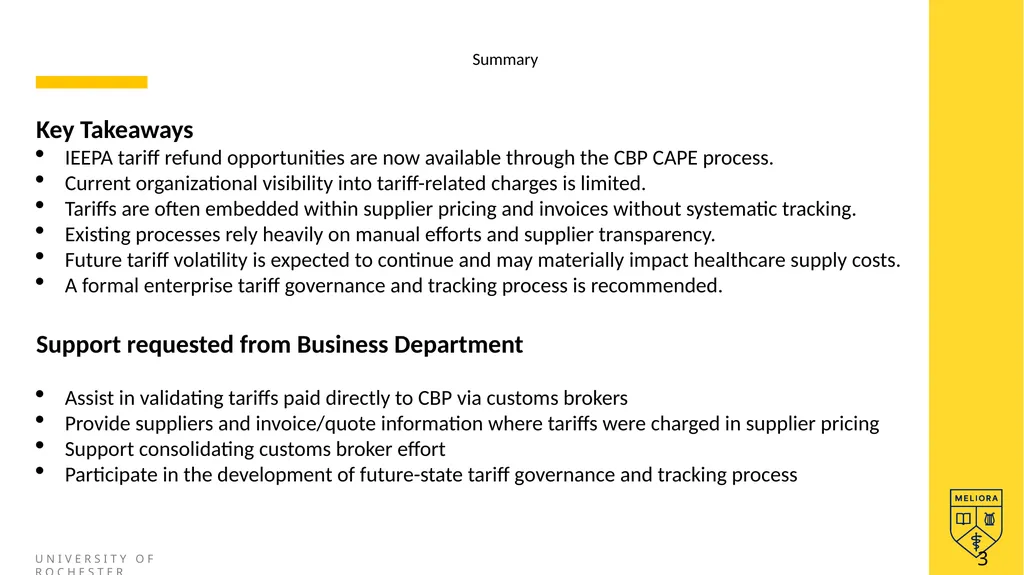
Summary Key Takeaways
IEEPA tariff refund opportunities are now available through the CBP CAPE process.
Current organizational visibility into tariff-related charges is limited.
Tariffs are often embedded within supplier pricing and invoices without systematic tracking.
Existing processes rely heavily on manual efforts and supplier transparency.
Future tariff volatility is expected to continue and may materially impact healthcare supply costs.
A formal enterprise tariff governance and tracking process is recommended.
Support requested from Business Department
Assist in validating tariffs paid directly to CBP via customs brokers
Provide suppliers and invoice/quote information where tariffs were charged in supplier pricing
Support consolidating customs broker effort
Participate in the development of future-state tariff governance and tracking process 3<br>
04
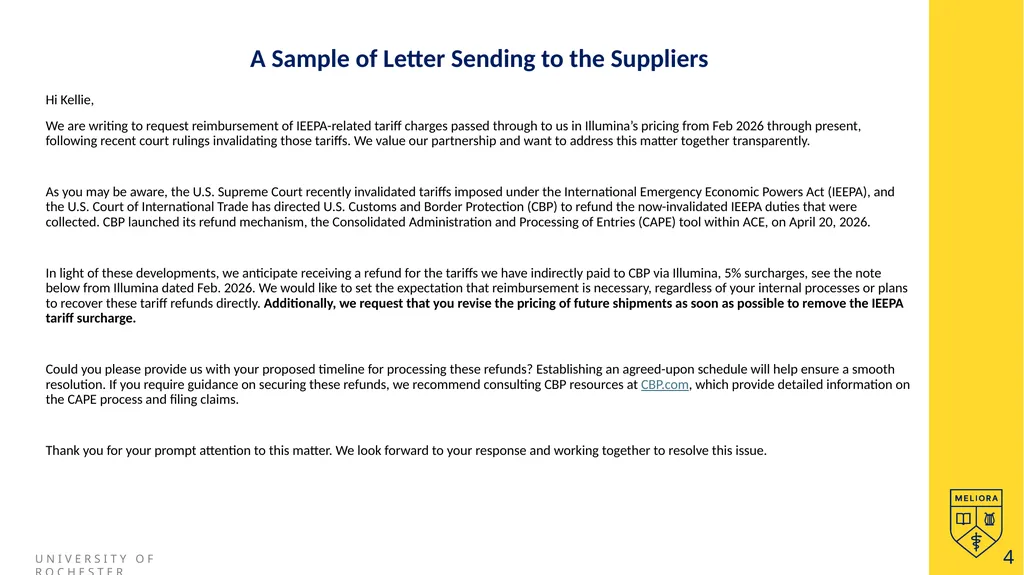
A Sample of Letter Sending to the Suppliers Hi Kellie,
We are writing to request reimbursement of IEEPA-related tariff charges passed through to us in Illumina’s pricing from Feb 2026 through present, following recent court rulings invalidating those tariffs. We value our partnership and want to address this matter together transparently.
As you may be aware, the U.S. Supreme Court recently invalidated tariffs imposed under the International Emergency Economic Powers Act (IEEPA), and the U.S. Court of International Trade has directed U.S. Customs and Border Protection (CBP) to refund the now-invalidated IEEPA duties that were collected. CBP launched its refund mechanism, the Consolidated Administration and Processing of Entries (CAPE) tool within ACE, on April 20, 2026.
In light of these developments, we anticipate receiving a refund for the tariffs we have indirectly paid to CBP via Illumina, 5% surcharges, see the note below from Illumina dated Feb. 2026. We would like to set the expectation that reimbursement is necessary, regardless of your internal processes or plans to recover these tariff refunds directly. Additionally, we request that you revise the pricing of future shipments as soon as possible to remove the IEEPA tariff surcharge.
Could you please provide us with your proposed timeline for processing these refunds? Establishing an agreed-upon schedule will help ensure a smooth resolution. If you require guidance on securing these refunds, we recommend consulting CBP resources at CBP.com, which provide detailed information on the CAPE process and filing claims.
Thank you for your prompt attention to this matter. We look forward to your response and working together to resolve this issue. 4<br>
05
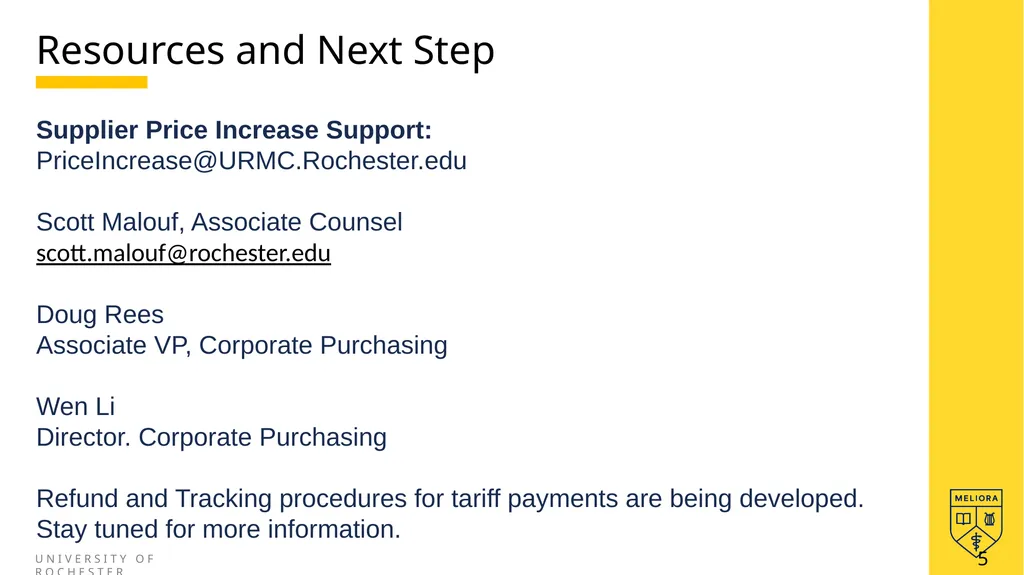
Resources and Next Step Supplier Price Increase Support: PriceIncrease@URMC.Rochester.edu
Scott Malouf, Associate Counsel
scott.malouf@rochester.edu
Doug Rees
Associate VP, Corporate Purchasing
Wen Li
Director. Corporate Purchasing
Refund and Tracking procedures for tariff payments are being developed.
Stay tuned for more information. 5<br>